Behind Anime Lines
© Sophia Staite (nee Barratt-Peacock) Student ID #000763
This Thesis Submitted for the Degree of Bachelor of Arts (Honours) University of Tasmania
Abstract
The misuse of soft power terminology for domestic political ends diminishes the
complexity of the original concept and results in a simplistic “cool Japan”
version of soft power. Despite numerous works acknowledging and discussing
anime’s soft power, there is a lack of audience study in this existing discussion.
Policy is being informed by these interpretations of soft power, the international
effectiveness of which relies on audiences behaving as anticipated. The absence
of research into a variable as central as audience limits our understanding of
how soft power functions in practice. Whether anime’s soft power is articulated
as cool Japan or as agitprop, assumptions are involved about audiences
decoding anime according to the dominant-hegemonic reading. When audiences
decode anime, they draw on their knowledge and experiences in ways which
can result in negotiated or resistant readings. To test these ideas I have explored
Hall’s encoding/decoding model. Using textual analysis and interviews with
Gundam’s creator/encoder to identify a dominant, anti-war reading of Gundam
Seed, I then conducted a focus group interview to observe the decoding
practices of non-fan viewers. The focus group research presented in this thesis,
although limited in scope, suggests that the assumptions inherent to the
treatment of audience by popular soft power discourses are problematic,
particularly when issues of warfare and memory are involved. I propose
combining a cultural studies approach with existing research to achieve a more
Table of Contents
Abstract...i
Table of Contents...ii
Table of Figures...ii
Acknowledgements ... iii
Glossary of Terms ...iv
Introduction ...1
Chapter One: Cool Japan or Agitprop? ...5
Literature Review ...6
Methodology...18
Chapter Two: Shooting Blanks...24
Textual analysis ...27
Questioning Soft Power...35
Chapter Three: Polysemy and Policy ...40
Interview and participant Information ...41
Results ...44
Conclusion ...54
Works Cited...59
Appendix A: Transcripts ...65
Interview ...65
Pre-viewing Questionnaire ...77
Appendix B: Gundam Reference Materials...81
Table of Figures
Figure 1 Prince Pickles (SDF Mascot and manga character) in Iraq...5Figure 2 Screen capture, Gundam Seed Episode Thirty-three...27
Figure 3 Screen capture, Gundam Seed Episode Eleven...35
Figure 4 Screen capture, Gundam Seed Episode Thirty-three...40
Figure 5 Athrun and Kira, childhood friends become foes ...41
Figure 6 Screen capture, Gundam Seed Episode Thirty-one...48
Acknowledgements
I owe a great deal of gratitude to the School of English, Journalism and European Languages for the wonderful support and encouragement I have received and the universal generosity of its staff. A special thank you to Louise North for her practical advice on interview techniques- if only I had benefited from her experience before conduction my interview I have no doubt that this would be a far superior thesis. My thanks also to Barbara Hartley for suggesting many useful resources.
I tip my hat to my family (who all now know what anime is and even sometimes watch it), and two members in particular:
My father, who always has a flash-card and an opinion, and who told me when I was ten and said I wanted to write a thesis to read everything first. I’m working on it.
Kain, who despite thinking that electrocuting me would be a good motivation to study, also got up early and stayed up late to make me coffee and has never, ever, not been there when I needed him.
There are many others to whom I am indebted: My seven interviewees, who gave up a weekend afternoon in the holidays to face clumsy questioning; my fellow students Alison and ウルサイモンfor suggesting chapter titles; and
Nicola, for gin and red pencil.
Finally and most importantly, my supervisor Craig Norris. For encouraging without pushing, critiquing without criticising and advising without dominating, I cannot thank you enough. You are a mentor and an inspiration.
Glossary of Terms
Agitprop
Political propaganda disseminated through art, literature and cinema. Anime
Japanese animated television programmes and cinema. Although many anime share a distinctive look characterised by very large eyes, the term
encompasses a range of genres from children’s entertainment to romantic drama, science fiction and pornography. “Anime” and “manga” have not been italicised because both words are now included in most English dictionaries. As with all Japanese nouns, the plural form is unchanged (ie plural of anime is anime). Gundam Seed
2002 Gundam Series directed by Mitsuo Fukuda, based on the original concept by Yoshiyuki Tomino. The Japanese title (機動戦士ガンダムSEED
[シード]) Kidō Senshi Gandamu Shīdo is commonly abbreviated in English to
Gundam Seed. The series spans fifty episodes with a follow up film and sequel series (Mobile Suit Gundam Seed Destiny). Gundam Seed aired in Japan from October 5, 2002 to September 27, 2003 at 6:00 pm on the Japan News Network stations Tokyo Broadcasting System and Mainichi Broadcasting System. Gundam, Series
Anime Series have been produced under the Gundam title for around thirty years. Gundam refers to them all collectively.
Gundam, mobile suit
The original series took its title from the giant mobile armour suits that it, and subsequent Series, were based on. To avoid confusion I have referred to the armour as ‘mobile armour suits’ rather than gundam.
LDP
Japan’s Liberal Democratic Party. The LDP has been in government since 1955, excluding 1993-1994.
Manga
Japanese comic books. Stylistically and thematically related to anime. Many anime are based on manga, and manga versions of original anime are also published. The manga form is ubiquitous to the extent that company reports, textbooks and operating manuals are all published in manga formats.
SDF
Japanese Self Defence Force. Use of the acronym in this setting
encompasses Japan’s army, navy, air force and, as of May 2008, military space program.
Militarisation/ Remilitarisation
These terms are used to indicate the existence of a legally sanctioned national military and should not be interpreted as referring to militarisation of government or any other political or moral implication.
USA
Introduction
Over the last thirty years and particularly the last fifteen years, the popularity of
anime internationally has skyrocketed. This popularity has triggered discussion,
inspired by the idea of soft power, about how Japan can benefit politically from
anime and other internationally consumed popular culture. Ongoing debate
about Japan’s military status has tapped into soft power ideas, seeing soft power
as either an alternative to military (hard) power or as a useful tool to
complement a re-instatement of Japan’s military. In this thesis I examine three
key approaches to anime’s soft power: cool Japan; agitprop and secondary texts
questioning these two approaches. I use the anime primary text Gundam Seed
and a focus group interview conducted with Australians after viewing Gundam
Seed to complicate the Japanese government’s articulation of soft power while
proposing, through my audience focus, a new approach to the study of anime
and soft power.
I grew up watching Sergeant York, John Wayne vehicles and numerous Second
World War films in which plucky Brits and laid back Yanks used their superior
wits and courage beat evil Nazis. I saw my first anime at nine and have been
watching ever since, including active involvement in university anime clubs in
Australia and Japan. When I saw my first anime depiction of war, with soldiers
on both sides who were both aggressive and gentle, frightened and brave and
repeatedly confronted by suffering civilians and the families of those they had
killed, I thought I had discovered something new and excitingly different.
Gundam in its various incarnations epitomised for me anime’s lack of moral
close reading of Gundam Seed and interviews with viewers would support my
initial reaction and show that anime had the potential to compensate for the
negative associations many Australian still have with Japan as a result of the
Second World War. As the research progressed, my results consistently
undermined the assumptions I had set out with. As a result, the project became
an interrogation of the assumptions I had made and how they had led myself
and others astray. The format of this thesis reflects that journey, beginning with
some of Japanese soft power’s true believers before presenting a close reading
of war in Gundam Seed that questions some of the anti-war claims of the
Gundam franchise. Challenges to soft power are then considered, with an
emphasis on the interplay between soft and hard power. Finally, I analyse a
focus group interview to determine how these ideas about anime, war and Japan
play out in an Australian case-study.
This paper’s study of diverse readings of Gundam Seed examines deeper layers
of interaction between cultures; producers and consumers of anime texts; and
the impact of media readings on international relations. I describe the collision
of two primary texts: Gundam Seed and reactions of an audience to it.
Competing readings of anime texts have produced the ideas of anime as soft
power resource and anime as paving the way to increased Japanese hard power.
How do these different interpretations locate audiences’ readings of anime texts,
and what assumptions about audiences do they make? Do the responses of
Australian viewers support these assumptions? By focusing on competing
readings of a single anime text, Gundam Seed, this study reveals complexities in
audience decoding practices and meaning making which call into question
In Chapter One I survey literature on soft power, Japan’s hard power and anime.
In this survey two dominant approaches to Japanese soft power are identified:
cool Japan and agitprop, the more complex suggestion that anime is being
utilised as a tool assisting military reinstatement. Both of these approaches rely
on audiences interpreting anime in certain ways. I introduce Stuart Hall’s
encoding/decoding model as a framework for examining audience
interpretations (decodings). In the second half of Chapter One I outline the
methodology for the audience research which makes up Chapter Three,
expanding on Hall to include textual analysis, historical considerations and
audience contextualisation practices. Chapter Two centres on a textual analysis
of Gundam Seed utilising war cinema theory and establishes a
dominant-hegemonic reading of the programme with which the audience discussion is
later compared. Soft power is examined in greater depth, focusing on the
example of former Japanese Foreign Minister Taro Aso and his promotion of
anime as a diplomatic tool. The third chapter presents the results of my
qualitative research and discusses the implications of these results for the two
approaches to anime’s soft power.
This thesis identifies a lack of systematic audience research as a fundamental
flaw in existing discussion of anime’s soft power. This lack is problematic
because policy is being based on these discussions, and if audiences behave
against expectations, as my research suggests it is likely that they will, the
importance of questions about soft power may be undermined by problems of
methodology. I propose a model to correct this problem by expanding on
to anime audiences and political and economic institution focused academic
research. In a small and limited application the suggested method is tested and
the results are shown to illuminate the intersection of hard and soft power and
the impact of Japan’s popular culture internationally. Based on these findings I
make recommendations for a more targeted diplomatic use of anime and
recommend the incorporation of well established methods of investigative
Chapter One: Cool Japan or Agitprop?
Anime, Soft Power and Audiences
Literature Review
The term soft power was first published by Joseph Nye, who explains that it
“co-opts people rather than coerces them. Soft power rests on the ability to
shape the preferences of others” (2004: 5). In other words, if I can convince you
that moving out of my way is what you yourself want to do, I will neither have
to bribe you to move nor use a bayonet to prod you out of my way. Although
hard power is used in this paper to refer to military power, according to Nye’s
definition economic power is also an aspect of hard power. This point is often
missed in soft power discussion, which assumes economic exercises of power,
such as foreign aid, to be soft power (see for example Lincoln 2003: 126).
According to Nye, both “sticks” and “carrots” are hard power resources (2004:
5). Nye identifies three soft power resources of a state: “Its culture (in places
where it is attractive to others), its political values (when it lives up to them at
home and abroad), and its foreign policies (when they are seen as legitimate and
having moral authority)” (Ibid: 11). Of course there is interaction between these
three, as in cases of governments funding cultural facilities, but for the purposes
of this paper it is culture (specifically in the pop-cultural form of anime) and the
attempts of foreign policy makers to take advantage of that culture’s popularity
that are of interest. Nye cautions that although popular culture is “often a
resource that produces soft power”, its effectiveness depends on context: “the
popularity of Pokemon games [does not] assure that Japan will get the policy
outcomes it wishes” (Ibid: 12).
Although dismissed in the past as having too insular a culture to generate soft
international attention. The three-hundred per cent growth between 1992 and
2002 in exports of “Japanese comics, films, art and video games … where other
sectors showed only 15 per cent growth” (Gravett 2004: 152) has resulted in
Japanese optimism that cultural exports will result in a soft power boom for
Japan. Foreign academics and journalists are publishing increasingly large
numbers of articles and books about anime, games and manga. Even Nye
himself comments that Japanese images dominate children’s dreams, and
Japan’s popular culture “was still producing potential soft power resources even
after its economy slowed down” (2004: 86). Importantly Nye refers to
“potential” soft power; the difficulties in taking advantage of that potential are
discussed in more detail in Chapter Two. Mark Katz states as fact that “millions
of teenagers … all around the world think positively about Japan because they
love its anime” (Katz July 30 2007). Tamotsu Aoki, Japanese Commissioner for
Cultural Affairs, sees anime as central to Japan’s soft power
Japanese anime, which have been named as Japan’s leading cultural export,
have successfully raised an “anime generation” that is mainly responsible,
both at home and abroad, for the emergence of today’s “Cool Japan”
phenomenon (2004: 13).
The idea of Japan as a cool country gaining power through international prestige
has proved extremely popular in Japanese international relations and academic
circles.
Coined by United States journalist Douglas McGray in reference to Japan, the
expression “Gross National Cool” is, according to David Leheny, “known to
contrasts Japan’s economic stagnation with its growing cultural influence (48).
However, his article is not as effusive as some of the Japanese rhetoric which
followed it (Aoki 2004; Aso 2006). McGray comments on Japan’s “economic
mess and military angst” (2002: 48), and speculates whether Japan “will be
content to remain so much medium and so little message” (Ibid: 54). These
more complex considerations have been largely ignored by enthusiastic
advocates of the idea of cool Japan, as discussed in more detail in the next
chapter.
Christine Yano describes a growing sense national pride in the idea of Japanese
cool and soft power, writing: “The Japanese government, recognizing the place
of such cute/cool-based soft power, is showing increasing interest in and
support for these informal cultural ambassadors” (2006: 163). A number of
government initiatives, including international competitions for manga and
cosplay (costumed role-play) artists, have been established to assert Japan as the
homeland for fans. Roland Kelts cites anime industry insiders who see
McGray’s article as a tipping point, pushing the Japanese government to form
policies geared to exploiting the soft power of pop-culture (2007: 113). The
Ministry of Economy, Trade and Industry has put “increasing stress on Japan’s
content business, now led by anime … as a strategic industry” (Gerow 2006).
What message the Government wants to transmit with these initiatives, and how
they will interact with the existing international relations challenges lingering
from The Second World War (hereafter WWII) are absent from this cool Japan
Other than sales figures, evidence is rarely produced to support the cool Japan
concept. It may seem self-evidently true to authors who see the influence of
Japanese pop-culture in Hollywood movies, their local street fashions and the
tastes of their own children. Government initiatives seem to make the same
assumptions. What meanings audiences make of the anime they consume is not
a question being asked along side soft power literature and policy making.
Analysis that assumes a linear flow of communication unaltered from sender to
receiver cannot elucidate the experiences of fan communities, whose
consumption of anime prompted the cool Japan idea, not the other way around.
The research that has been done indicates that these communities do not
automatically equate their enjoyment of Japanese media with attraction to
broader Japanese culture, a distinction which has the potential to undermine soft
power gains for Japan. Antonia Levi writes that when she first began publishing
about manga and anime over a decade ago, she
cherished rosy dreams that as the popularity and availability of these
Japanese cartoons spread, so too would the interest in Japan and its culture.
To some degree these dreams have come true, but not to the degree I had
hoped for, despite the fact that the awareness and availability of anime and
manga in translation have far surpassed anything I had expected (2006: 43).
Her exploration of how her expectations came to be so different from what is
occurring leads her to Stuart Hall
What I saw as a failure to appreciate the uniquely Japanese aspects of anime
and manga can just as easily be seen as an example of the type of negotiated
Encoding/decoding is a complex and ongoing process, even before
intercultural factors are introduced. In the case of anime and manga, where a
product encoded by and for one culture is decoded by a different culture, the
process goes beyond complex (Ibid: 44).
Beyond complex though it may be, the issue of how different groups decode
anime is, following the logic of soft power, vitally important for Japanese
foreign policy. Stuart Hall offers a theoretical framework which is ideally suited
to achieving an understanding of the forces at work in the international
reception of anime, and therefore the functioning of the soft power so generated.
As cultures begin to absorb and co-opt anime, the pre-existing structures and
ideologies will interact to make new meanings.
Soft power is an international relations concept and international relations is a
field that does not often focus on actors smaller than nations and multinational
corporations. Media theorists such as Hall provide the tools for examining the
phenomenon of anime’s intercultural appeal at the micro level. Hall not only
offers a strong framework for audience research, his ideas about television in
many ways pre-empt the idea of soft power. As James Procter summarises
televisual discourse plays a key ideological role in reproducing and securing,
by consent rather than force, the values and meanings of the dominant
cultural order. However, these dominant or preferred meanings are always
open to contestation and transformation [emphasis in original] (2004: 72).
That fans around the world are watching anime does not guarantee that they are
decoding that anime to conceptualise a cool Japan, as seemingly hoped for by
In Encoding/decoding (1973, cited version in a 1980 collection), Hall outlines
three hypothetical positions television viewers may adopt when making
meaning from a programme: dominant-hegemonic; negotiated and oppositional
(1980: 136-138). Viewers who decode a programme in the same way it has been
encoded, that is, in terms of the dominant definitions “principally generated by
political and military elites” (Ibid: 136), are adopting a dominant reading
position (Ibid). To use Hall’s industrial relations example, if a news broadcast
portrays lower wages and weaker unions as in the national interest, a view
adopting a dominant reading position will accept this explanation as common
sense. Viewers adopting a negotiated position accept dominant definitions in an
abstract sense, but at a situational level see “exceptions to the rule” (Ibid: 137).
For example, a worker may accept that low wages are important to combat
inflation in general, but still strike for better pay (Ibid). The oppositional
position “detotalizes the message in the preferred code in order to retotalize the
message within some alternate framework of reference” (Ibid: 138). In this case,
the same news report’s use of the term ‘national interest’ may be decoding as
‘class interest’ (Ibid). Encoding/decoding offers a useful framework for the
study of television reception, but also raises a number of important questions.
Why do individuals adopt the position that they do? How do political and
military elites promote certain definitions as dominant, and how aware are
viewers of these influences?
Nissim Kadosh Otmazgin laments the lack of both empirical and discursive
research regarding Japanese popular culture’s soft power, pointing out that a
majority of scholarship on Japanese popular culture outside Japan “consist of a
its representational practices” (2008: 74). Although textual analysis is an
important component in understanding international viewers’ attraction to
anime, the text alone does not provide enough information to explain audience
decoding. No television viewing experience is hermetically sealed. The viewer
brings a lifetime of experiences and knowledge into which the programme is
contextualised, and this background may explain the division of viewers into
different reading positions. It is just this sort of background which has the
potential to undermine soft power, as McGray alludes to with his comment
about Japan’s economic and military issues.
Anime’s soft power and cool Japan seem to offer almost utopic possible
alternatives to warfare and other hard power tactics when explained by the
Japanese government. During his time as Foreign Minister, Taro Aso was vocal
about the links between popular culture and soft power in democracies
What we have now is an era in which diplomacy at the national level is
affected dramatically by the climate of opinion arising from the average
person. And that is exactly why we want pop culture, which is so effective in
penetrating throughout the general public, to be our ally in diplomacy
(Aso April 28, 2006).
Other commentators have retotalized this message to instead see soft power as
a supporting act to hard power. Authors such as David Leheny point to
messages about Japan contained in exported anime, specifically that Japan is a
reformed nation whose military ought not be feared (2006: 224 and 232). Rather
than the somewhat amorphus cool Japan, this is an area where soft power has
of anime’s soft power potential has not been lost on Japanese
pro-remilitarisation reformers either. David Leheny suggests that government
enthusiasm for anime and manga exports is, at least in some circles, driven by
the desire to transmit a specific message about Japan’s military potential
Japan needs to support the spread of its popular culture overseas in order for
other countries to see what today’s Japan really is. It is a changed country …
It is a country that would not hurt a fly (Ibid: 224).
Rather than an alternative to hard power, Leheny sees soft power as a public
relations performance on behalf of hard power. In other words, he continues,
soft power “offers the opportunity to convince other people that Japan’s
development… with a normal military, is not to be feared, because this is a
nation that has only the best of intentions” (Ibid: 232). It can be argued,
following this interpretation, that soft power a Trojan horse containing the
resurgence of hard power. Whether soft power is an alternative to hard power,
or a way of achieving hard power, Japan’s current non-military status makes
soft power a pressing issue.
Japan’s post-war (1947) constitution includes a clause (Article 9) prohibiting
the maintenance of a military and rejecting war as a right of the nation. Seven
years after the constitution’s adoption, a “Self Defence Force” (hereafter SDF)
was created, the constitutionality of which continues to be debated (Saft &
Ohara 2006: 84). Until quite recently, Article 9 has been protected from further
amendment by the strength of public support for institutionalised pacifism, even
in the face of often intense international pressure (specifically from the USA) to
response to the Gulf War, a law was passed allowing overseas deployment of
the SDF in peace keeping missions, bearing arms only for self defence (Ibid).
The following decade saw a shift in Japanese attitudes towards the SDF,
especially among young people, many of whom now favour “normalising” the
country’s military (Nye 2002: 24). In 1999 and 2001 further laws were passed
allowing deployment of the SDF in the region surrounding Japan bearing
offensive arms in support of US led campaigns (Saft & Ohara 2006: 85). The
possibility of constitutional amendment begs, according to Paul Midford, the
question of whether the “mass public” would be supportive; the answer having
“big implications for US foreign policy, global politics, and regional politics”
(2006: 2).
Twenty Japanese nationals were killed in the September 11 2001 attacks on
New York (Ibid: 20). In the following weeks, a newspaper poll found that only
3.6% of respondents felt Japan was prepared to defend against a terrorist attack
(cited by Ibid: 21). However, only 24.7% responded that Japan should actively
co-operate with the US response (Ibid). In October 2001 another poll found
global warming and international terrorism tied for the respondents’ diplomatic
priorities (Cited by Midford 2006: 22). Support for the Iraq war was even less
enthusiastic, with Midford contrasting public perception that the US invasion of
Afghanistan was “an inevitable act of self-defence” (Ibid: 6) with a reaction to
the invasion of Iraq which was, “from the beginning, overwhelmingly critical”
(Ibid: 29). Midford suggests that the Japanese public “expresses skepticism
about the utility of military force for fighting terrorism, countering the
proliferation of weapons of mass destruction, or promoting democracy” (Ibid:
Despite this limited support, “Iraq became the most recent opportunity for
conservatives in Japan to press to alter or reinterpret the constitution to permit
dispatching soldiers abroad for combat” (Lincoln 2003: 123).
Then Prime Minister Junichiro Koizumi amended Self-Defence Force laws to
allow SDF defence of US bases in Japan from terrorist attack and dispatched the
SDF to provide logistical support during the Afghanistan invasion, with an
extended definition of permissible self defence (Midford 2006: 23), and in 2003
introduced a bill allowing dispatch of the SDF to Iraq (Ibid: 24). Japan’s policy
changes in response to the US led “war on terrorism” have gone beyond
changes in public opinion, opening up a gap that Midford describes as having
important implications for Japanese policy and politics (Ibid: 7). As long as the
Liberal Democratic Party remains in government and retains constitutional
revision as a policy objective, this public opinion gap will be problematic.
Popular culture presents a medium for the transmition of positive messages
about the SDF and constitutional reform with established domestic and
international audiences.
It is not only Japanese youths whose attitudes towards the SDF may be altering
as a result of anime. Saya Shiraishi writes
Japanese comics and television animations are spreading Japanese ideas
about childhood, war and peace, science and technology, and the future
world … often without revealing their Japanese origin” (1997: 272).
Shiraishi’s interpretation of anime’s global role as transmitting ideas almost
subliminally is particularly significant in the area of ideas about war, as anime
most resistant to the idea of Japanese remilitarisation. Guy Westwell writes that
the cultural imagination of war
is shaped by myriad representations of war appearing in numerous contexts,
ranging from television news broadcasts … to film and television
documentaries, comic books, novels, web pages, art exhibitions and war
memorials. These representations provide the common ground upon which a
collective, shared sense of war is worked out, articulated and sometimes
contested (2006: 5).
This imagination of war, and what justifies war, is politically important because
“in a democracy, the manufacture of popular support for war is a logical
necessity without which the nation’s war making capacity is severely
hampered” (Ibid: 2). As anime is consumed globally, and particularly in
countries impacted by Japanese militarisation during WWII, the representations
of war in that anime may have an important impact on the attitudes those
countries will take to Japanese attempts to substantially revise (or abolish)
Article 9.
Sabine Frühstück details the formidable PR machine at work on behalf of the
SDF, focusing on SDF attempts to “manipulate and align themselves with
popular culture” (2007: 117). These engagements with popular culture include
producing an anime series and manga versions of white papers (Ibid: 119). For
Fruhstuck, the trend of “an increasingly intimate relationship between the
Self-Defence Forces and popular culture” in itself “constitutes a form of
militarization” (Ibid: 148).Hironori Sasada sees manga as a significant
increase in the number of nationalistic manga published, some “achieving
tremendous financial success. The most notable include Sensoron (On War) by
Yoshinori Kobayashi (1998) … Sensoron sold more than 700,000 copies” (Ibid).
Including subsequent reprints, Sensoron has now sold over a million copies
(Rosenbaum 2006: 10). Kobayashi is also a founding member of the Japanese
Society for Historical Textbook Reform, an organisation which produced the
history textbook protested against by South Korea and China with
unprecedented violence in 2005 (Times April 10 2005). In turn, these and other
anti-Japan protests have solidified support for constitutional revision as the
Japanese public increasingly view their neighbours as antagonistic (Sasada
2006: 111 and 115). The increased interaction between the SDF and popular
culture on the one hand, and popular culture and nationalist, military themes on
the other, calls into question the utopic idea of cool Japan gaining international
influence through the spread of innocent cultural merchandise.
In 2007 the Ministry of Defence publicised a presentation titled Towards the
Realization of Gundam, detailing an armament system “designed with the
Gundam anime series in mind” (Defense Ministry's Gundam-Inspired
High-Tech Infantry Kit Grabs Otaku Attention November 15 2007). Far from
consuming the toy weapons marketed by Gundam, this group of ‘fans’ working
in the Ministry of Defence were inspired to create real weapons; instruments of
hard power. Fruhstuck’s exploration of the SDF’s use of pop-culture provides a
context to the creation of this armament system, making it a logical next step
rather than the bizarre oddity it at first appears. If the SDF have long been
military vehicles (Frühstück 2007: 141)) based on their hardware, it is not such
a leap to produce hardware based on an anime.
Methodology
Literature on Japan’s anime and manga exports provides a wealth of
quantitative research detailing industry statistics and the size of international fan
communities(see for example Kinsella 2000). Writings around audience, in
contrast, are often anecdotal and focus only on fan communities which, by their
nature, do not represent a broad spectrum of Japanese popular culture
consumers. The perspective of a teenaged fan who not only watches anime and
reads manga but also attends conventions, writes fan fiction and socialises via
online anime communities will surely be different from that of a child who
loves Pokemon but is not aware of its Japanese origin. Different again will be
the perspective of a middle-aged film critic whose exposure to anime is limited
to cinema releases such as Perfect Blue. This is not to say that anime fan
communities are not important subjects for study; simply that such studies must
be contextualised rather than presented as representative of broader categories
such as “teenagers” (such as Katz July 30 2007). It is unfortunately common to
encounter a quote from a subject such as “Jane Smith, 14, anime fan” with no
context as to why this person’s opinion is meaningful, how s/he was selected for
interview or what (if any) population s/he is presented as representing (for
example Kelts 2007: 211).
In order to examine how viewers might read an anime text a qualitative
approach is the most appropriate, because it allows the flexibility to follow
sees each instance “as an occurrence that evidences the operation of a set of
cultural understandings currently available” (Denzin & Lincoln 2000: 370).
According to Jennifer Mason, qualitative research has “an unrivalled capacity to
constitute compelling arguments about how things work in particular contexts”
[emphasis in original] (2002: 1). The context for this method of instances study
“is an example of the application of conventions of reading to a particular
programme” (Bertrand & Hughes 2005: 65). More specifically, it is a study of
how humanities students who are not anime fans read three episodes of Gundam
Seed, explored through a focus group interview. Non-fans have been selected to
test the implicit assumption this paper identifies, in soft power literature, that
anime consumption creates positive associations with Japan; and that consumers
will read the anime according to its dominant, encoded meaning. Anime fan
communities often extend their activities and interests beyond anime to involve
other aspects of Japanese culture, including popular music, fashion and martial
arts. Since it is unclear whether so many fans become interested in Japan as a
result of watching anime or if they watch anime as a result of an existing
interest in Japan, members of fan communities are inappropriate subjects for an
examination of the logic of soft power as it relates to anime.
Discussion of anime’s soft power often simplistically equates consumption of
anime with positive feelings for Japan (Katz July 30 2007), neglecting
possibilities of negotiated or resistant decodings and indigenisation practices.
By interviewing a group with sophisticated textual analysis skills but no interest
in anime, this research questions such an assumption and examines in detail the
group’s decoding of a text depicting hard power to test the viability of current
contexts of social formations and constructed identities of the self in relation
to historical conditions explain the interpretation strategies and affective
responses of readers. Thus, receptions need to be related to specific historical
conditions as events (2001: 282-293).
The text examined was produced in a militarily impotent Japan struggling to
define its world role in the wake of the September 11 2001 attacks on the US
and the subsequent invasion of Afghanistan. How might Australian viewers, as
debate continues over Australian troop deployments in Iraq, respond to Japanese
representations of war?
This research attempts to realise Tulloch and Jenkins’ search for “a way by
which audience research may be coupled with alternate approaches to textual
analysis and historical perspectives on the production process” (1995: 24) by
examining writings around Gundam’s creator; the historical context of Gundam
Seed’s production; analysis by academics and non-fan audience research. The
audience analysed is composed of University of Tasmania students who have
studied a textual-analysis based course such as English or History but are who
do not have a specific interest in, or knowledge of, anime. The interview group
is self-selecting in that only those who responded to my flyers of their own
volition are included, and an element of snowball sampling (Bertrand & Hughes
2005: 68) occurred. The sample is not intended to be representative of any
population, rather it is a method of instances study, with results not anticipated
to be transferable (Ibid: 65).
The Gundam “franchise” is enduringly popular in Japan (a new series has been
its large audience and interdependence with merchandise sales, Gundam
provides a “main stream” text. Gundam Seed was released in Japan in 2002, at a
time when the destruction of the World Trade Center in New York and
international troop deployments in Afghanistan re-focused Japanese political
attention to the restrictions on Japan’s Self Defence Force. Released in a year in
which war and the military were politicised issues internationally, Gundam Seed
depicts a detailed and transmutable (to reflect contemporary issues) war
scenario. Although it is a science fiction series with a futuristic setting
(including interplanetary travel), unlike other war television anime released in
2002, it does not feature aliens, magic or fantasy-feudal social settings. The
science fiction elements (with the exception of Gundam’s Mobile Suits) are
extensions of existing technologies such as genetic engineering. The problems
driving the conflicts (terrorism, racism and the challenges of remaining neutral
during world war) transcend the setting and reflect the political and social
concerns of 2002. For an outline of Gundam Seed’s plot, characters and places
relevant to the episodes screened to the focus group, refer to Appendix B.
A focus group interview was selected in favour of individual interviews for
three reasons. Focus groups provide an opportunity to examine the social
aspects of meaning making. As Kitzinger(cited by Ezzy & Rice 1999)points
out, no-one is entirely self-contained; people contextualise their knowledge and
create meanings through conversations with, and observation of, other people
(Ibid: 93). Therefore, because this research explores how the interviewees
understand Gundam Seed, “it makes sense to employ methods which actively
encourage the examination of these social processes in action” (Ibid). The
topics I had no reason to suppose the interviewees would be engaged with or
have thought about before. Although the pre-viewing questionnaire indicated
the topics the interview would cover, I felt they would form opinions more
comfortably and with greater depth in a group setting (Ezzy & Rice 1999: 91).
Finally, as a student researcher I relied completely on the goodwill of the
research participants and their generosity with their time. No incentives were
offered for participation, and around ninety minutes of anime viewing time was
required before the interview could begin. Holding a group interview allowed
for a relaxed atmosphere while viewing Gundam Seed and interacting with other
participants made the long time requirement less arduous for each individual.
Despite these advantages, there are also shortcomings to focus group interviews.
Because of their social nature, group interviews may tend towards consensus
forming (Ezzy & Rice 1999: 92). By including only university students with
humanities majors I hoped to overcome this problem. The participants were all
familiar with tutorial discussions and defending their positions in debate. At one
point during the interview a participant began speaking them trailed off and
looked uncomfortable. Another participant encouraged her to speak up, saying
“dissent is good”, after which she was able to express her opinion. Nevertheless,
it is still possible that the opinions expressed were moderated to be more
acceptable in a group setting. For example, in response to the pre-viewing
questionnaire question “do you see Japan as aggressive, neutral or neither” one
participant responded that she “wouldn’t want to piss them off”. During the
group interview she did not refer to this sentiment. Another concern was
participants’ confidentiality. While they had the option of using a pseudonym
pseudonym would be difficult to sustain with many studying similar subjects in
a small faculty. All participants were alerted to the possibility of assuming a
pseudonym and warned about the lack of confidentiality; fortunately all
Chapter Two: Shooting Blanks
Soft Power, Hard Questions
Aspiring sincerely to an international peace based on justice and order, the Japanese people forever renounce war as a sovereign right of the nation and the threat or use of force as a means of settling international disputes. In order to accomplish the aim of the preceding paragraph, land, sea, and air forces, as well as other war potential, will never be maintained. The right of belligerency of the state will not be recognized.
(Article 9, The Constitution of Japan, 1947)
Orb will not attack another nation, will not allow another nation to attack them, and will not intervene in the conflicts of other nations.
Soft power is more than a theory for Japan’s Ministry of Foreign Affairs. In the
aftermath of the 2003 Iraq war the Japanese government donated Oshin (a
television drama about a woman’s struggles to survive during the period around
the Second World War in Japan) to the Iraqi Media Network (Provision of the
TV Program "Oshin" to Iraq October 22, 2003) “to boost the morale of Iraqi
citizens during the reconstruction” (Ruh 2006: 141). Characters Hello Kitty and
Doraemon have been appointed “cultural ambassadors” (Japan appoints
cartoon ambassador March 19, 2008; Hosaka May 19, 2008). In this chapter
former Foreign Minister Taro Aso’s articulation of soft power in policy
provides us with an idealistic use of cool Japan ideas. Textual analysis of
Gundam Seed establishes a dominant reading, which although supporting Aso’s
approach, is open to being retotalised by a resistant reading. Finally, I critique
Aso’s application of soft power through international commentators to suggest
that the cool Japan approach to soft power has its roots firmly in nationalism
rather than internationalism.
Attempts by the Japanese government to take advantage of anime’s soft power
potential at a governmental level coalesced around the figure of Taro Aso, who
was a Cabinet Minister from 2003 to 2007, including two years as Foreign
Minister. In 2007 Aso unsuccessfully stood as a candidate for Prime Ministeri
(Martig 2007). A self-professed anime and manga fan who gained a large youth
following during his prime ministerial campaign by emphasising his
involvement in fan culture,ii Aso launched an international award for manga
(Bonisteel 2007; Yoshida 2007) and has also been involved with the World
Cosplay Summit, serving as a judge in 2006 (World Cosplay Summit 2006
seemed the leading candidate for Prime Minister, share prices in the manga
industry surged ( Manga shares gain on leader hopes 2007). His high profile
within Japan; his active pursuit of pop-culture based soft power internationally
and his personal identification with anime and manga fan communities make
Aso an ideal case-study to highlight the complexity of governmental approaches
to soft power. As Foreign Minister, Aso was active in promoting anime and
manga as diplomatic tools, with his explanations firmly situated in the cool
Japan tradition. He said in a speech to Digital Hollywood University
What is the image that pops into someone's mind when they hear the name
"Japan"? Is it a bright and positive image? Warm? Cool? The more these
kinds of positive images pop up in a person's mind … Japanese diplomacy is
able to keep edging forward, bit by bit, and bring about better and better
outcomes as a result (April 28, 2006).
Aso’s relationship with cool Japan is detailed further in the final section of this
chapter. Japanese newspaper Asahi Shimbun pointed out during the 2007
resurgence of international pressure for Japan to acknowledge and compensate
WWII “comfort women” that it can take years to cultivate soft power and only a
single high-profile gaff to destroy it (Shimbun 2007). Can anime’s grass-roots
popularity undo damage done at the governmental level? For Er Lam, Japan’s
soft power continues to be undermined by the continued conflict over WWII
memory (2007: 350). Not only are memories of past wars and debates about
Japan’s future military role issues around anime’s soft power, they are also
feelings of warmth to textual analysis and audience decoding, a more detailed
understanding of anime’s soft power emerges.
[image:32.595.184.499.153.402.2]Textual analysis
Figure 2 Screen capture, Gundam Seed Episode Thirty-three (Miriallia confronting the POW she believes to have killed Tolle)
Gundam Seed, the 2002 instalment of one of the longest-running and most
popular anime Series, is the story of a racially motivated war. It began airing in
Japan a few days after the first anniversary of the US led invasion of
Afghanistan, an event which had refocused Japan’s attention on Article 9 and its
impact on Japan’s international role. Its themes, established popularity and the
historical location of its production make Gundam Seed an excellent text to
explore representations of war and pacifism. For Gundam Seed and other anime
to effectively communicate reassurance about Japanese society (and military),
viewers must understand the programme’s meanings in the same way that the
creators have intended. To use Hall’s terminology, they must adopt a
dominant-hegemonic reading position (1980: 136).As mentioned in the introduction, on
as its anti-war stance, which are reflected in the following analysis. Three key
reasons I made these assumptions are the emphasis on civilian suffering; the
portrayal of authority figures as self-absorbed ideologues in contrast to the
similarities between essentially defensive motivation of common soldiers on
both sides; and the use of protagonists on both sides of the conflict rather than
dehumanising the ‘wrong’ side. These thematic elements are common to
Gundam series, and have also been identified by other critics as representative
of an anti-war message.
Hall warns that polysemy must not be confused with pluralism or equality
among connotative codes: “Any society/culture tends, with varying degrees of
closure, to impose its classifications of the social and cultural and political
world. These constitute a dominant cultural order” [emphasis in original]
(1980: 134). If a viewer “decodes the message in terms of the reference code in
which it has been encoded” (136), the reading position is classified by Hall as
dominant-hegemonic. In order to determine how Gundam is encoded, the
following analysis focuses on the attitudes expressed by the creator of the
original Gundam concept, Yoshiyuki Tomino, and David Vernal’s
extrapolations from his 1995 interview with Tomino. Although he created the
original concept and programme, Tomino did not direct Gundam Seed, which
was directed by Mitsuo Fukuda. As Tomino and Vernal’s comments establish
Gundam as an anti-war text, examples of negative representations of war are
then identified in Gundam Seed specifically, establishing a dominant reading of
Vernal writes that “Mobile Suit Gundam is an expression of the contemporary
Japanese anti-war ethic” (1995: 57). He sees Gundam’s underlying messages as
deconstructing the “otherness” of the enemy, and teaching that war is only
possible when individuals submit to ideology (Ibid). Ideology in the Gundam
universe is, according to Yoshiyuki Tomino, more dangerous than weapons
(Tomino interview with Vernal in Vernal 1995: 63). These messages are both
present in Gundam Seed, particularly the humanisation of the enemy. The
narrative tension is driven by the childhood friendship between protagonist Kira,
who spends most of the series fighting on the side of the Earth Alliance, and
Athrun, who fights for ZAFT. From the outset then, the protagonist is keenly
aware of the humanity of his opponents. The immediate comrades of both
Athrun and Kira are given back-stories and screen-time for thirty episodes
before being killed by Kira and Athrun respectively. The consequences for the
friends and families of the deceased are shown on both sides, with the mother of
Athrun’s friend weeping over his piano (he has dreamed of being a pianist
before the outbreak of war) and the suffering of Kira’s friendship circle driving
several subsequent episodes.
Gundam Seed incorporates many elements associated with anti-war genres, such
as a focus on civilian suffering and portrayal of the commanding classes
(military and political) as indifferent to the suffering of the soldiers they send
into battle. The Hollywood tradition of air force and technology/weapons
focused films relies on “the impression of a ‘clean’ techno-war, almost devoid
of human suffering and death, conducted with surgical precision by wondrous
mechanisms” (Franklin 1994: 25-43 cited in; Slocum 2006a: 18). The setting of
place in space with giant mobile armour suits, not people being hacked to pieces,
and when a pilot is killed it is in an explosion in which the human is invisible.
Yet the programme makes a point of showing the screaming, bleeding pilots
inside their cockpits (or more graphically, dismemberment: see figure 6). Both
the dialogue and character development frequently center on the trauma of war
and the inevitable impact on civilians.
The individual characters are shown fighting for very personal reasons: to
defend friends and family or avenge their deaths. On a macro level, however,
the war is explicitly racial. For ZAFT, the genetically enhanced co-ordinators
are the next evolution of humanity who are being held back and persecuted by
the naturals. For Blue Cosmos, the organisation behind much of the Earth
Alliance’s policy, Coordinators are an unnatural aberration, something unclean
to be eradicated. The characters who espouse strong ideological motivations for
the war are always shown removed from any actual fighting, sitting either
behind pristine desks or in darkened conference rooms. These ideologies are
shown in an entirely negative light, as ideas that are unsustainable when
members from the two groups actually get to know one-another. Flay, a female
school-mate of Kira, sees the extermination of all Coordinators as the only way
to end the war, and uses sexual and emotional manipulation to encourage Kira
(himself a Coordinator) to become more aggressive in battle. Her strategy
backfires when she realises she has developed feelings for Kira and she loses
the ability to generalise about all Coordinators through her personal interactions
with individuals. For Vernal, Gundam is a teaching tool which may lead to a
assimilate … his lessons on universal acceptance, then perhaps the future will
not resemble Gundam at all” (1995: 82).
Anti-war films have been frequently challenged by resistant decodings, “reliant
as they often are on spectacles of carnage and destruction, [they] can be
approached as fantasies of militarization” (Slocum 2006b: 196). The anti-war
reading of Gundam Seed introduced above as a dominant-hegemonic decoding,
which, consistent with Shiraishi and Leheny’s interpretation, anime is
disseminating internationally, is also vulnerable to a resistant decoding. Despite
the anti-war elements discussed earlier, the quandary J David Slocum refers to
“of whether any cinematic depiction of combat, with its intense, stimulating,
even eroticized images of death and destruction, could be viewed as anti-war”
(2006a: 20) is particularly relevant in the case of Gundam. The spectacle of
battle, and the minutiae of each new mobile suit’s technical specifications, are a
substantial part of what attracts fans to the show. Battles are typically quite long,
some spanning multiple episodes, and are accompanied by faster-paced and
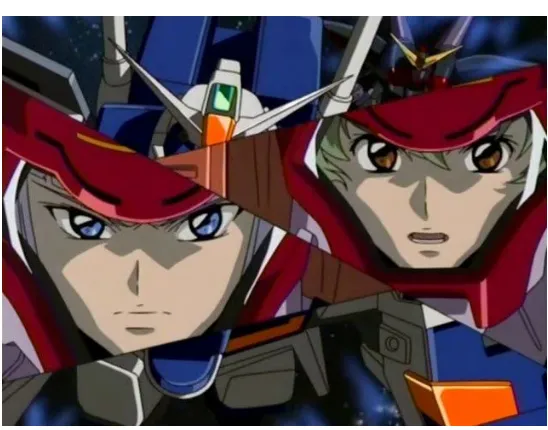
exhilarating background music and split screens showing multiple sites of
action simultaneously (see Figure 3), creating an atmosphere of excitement
unmatched in the slower moving, less engaging moments of reflection about the
nature of war.
In addition, there is a profound dislocation of responsibility for any of the
suffering represented. When traumatised after killing others in battle, the
characters are told that they had no choice, the culprit is war itself. Both Kira
and Athrun are told by their superior officers that they must shoot without
both would be safe, remains unspoken. Although the diegesis suggests that the
war was initiated in an attack on a civilian agricultural community by the Earth
Alliance/ Blue Cosmos, a racist faction bent on genocide, a majority of the
series takes place on an Earth Alliance battleship. Subsequent atrocities
committed against the Earth Alliance are presented almost as balancing out past
crimes, a feature of the series which echoes Japan’s prioritising of a narrative of
victimhood and downplaying of Japanese atrocities. Naoko Shimazu claims that
“the postwar Japanese liked to portray themselves as victims of pre-1945
militarism. This victim mentality is pervasive in the three categories of popular
representations -literature, films and television” (2003: 101). Alexander Bukh’s
comprehensive survey of history textbooks reveals
no doubt that depictions of Japan’s national victimhood continue to play a
central role in the currently dominant narrative, particularly in relation to the
Asia Pacific War… Furthermore, the narrative does not provide any material
related to individual responsibility for these atrocities committed by Japan;
hints about collective responsibility are vague and few (2007: 702).
In Gundam Seed, tragic events unfold with little attention paid to agency. The
idea that various individual soldiers, particularly Kira, are to blame for the
deaths of those they kill is repeatedly undermined with “war” blamed for the
suffering of both sides.
Shimazu reaches a similar conclusion to Bukh after examining Japanese film
and television
In popular representations of the war, the state represented as the militarists
programmes contain the underlying message of pacifism - of a kind that does
not question the responsibility of the Japanese (2003: 108).
Gundam Seed’s pacifist message is similar. War has awful consequences, but
what can the common soldier do? Consequently what is presented is a “great
man” attitude towards unfolding events. That is, the masses of civilians and
soldiers have no power to alter the fates prescribed for them by their leaders.
The ability to change the course of the war is restricted to charismatic leaders
who are related to already powerful dynasties. Ultimately it is up to Kira and his
sister, children of Orb’s leader, and their lovers Lacus (daughter of PLANT’s
civilian leader) and Athrun (son of PLANT’s military, ZAFT’s, leader) to
broker a cease-fire.
Yoshikuni Igarashi discusses at length in Bodies of Memory how the focus on
the decisions of “great men” Hirohito and Truman in ending WWII, and the
disregard that focus entails for all other factors, has allowed post-war Japan to
abdicate responsibility, as a society, for the war (particularly the Asian theater)
(2000: especially 24 – 28). In taking a similar approach to its fantasy world,
Gundam Seed enters dangerous territory for politically aware viewers. If, as
Vernal claims, “Mobile Suit Gundam is an expression of the contemporary
Japanese anti-war ethic” (1995: 57), the 2002 instalment (Gundam Seed) does
not necessarily convey reassurance to audiences who may be concerned that
Japan’s attitude towards WWII indicates an inability to control a
constitutionally unleashed military in the future. Slocum comments on a scene
in Jarhead (Dir. Sam Mendes 2005) where recruits watch Apocalypse Now (Dir.
(2006a: 14). He suggests that the appropriation of scenes from Apocalypse Now
by the younger generation of soldiers “at cross purposes with the intention of
their original maker” calls into question the ability of any cinematic mediation
of warfare to function as anti-war (Ibid: 20). With Gundam inspiring SDF
armament systems in a similar appropriation, the same question arises regarding
anime depictions of warfare. While Gundam’s international popularity supports
cool Japan by contributing to sales statistics, alongside collectable robot
figurines and sound-tracks audiences may be consuming messages about
Japanese interest in military technology and reluctance to accept collective
responsibility, in both past and imagined future, for the exercise of that
technology.
Peter Katzenstein describes the deployment of Japanese troops (however
heavily restricted their actions may have been) in Iraq as the crossing of “a
post-war watershed” (2006: 21). While I do not wish to suggest that Gundam Seed’s
representation of war led directly to Iraq, it is undeniable that if, as Westwell
suggests, the cultural imaging of war is shaped by influences including
entertainment media, and in turn this imagining shapes national policy, then
manga and anime have an impact on Japanese policy. Gundam, voted in 2005
Japan’s favourite anime of all time in a nationwide survey of multiple age
groups conducted by Asahi TV (TV Asahi Top 100 Anime 2005), is an important
text in understanding the contemporary Japanese imagining of war. As this
imagining plays itself out in the current debate over constitutional amendment
in Japan, it could have a profound impact on the region Japan and Australia
Questioning Soft Power
Figure 3 Screen capture, Gundam Seed Episode Eleven (example of split-screen technique used in battle scenes)
Contemporary international observers have been cautious about anime’s soft
power. The rhetoric from Japan is not devoid of nationalistic undertones and
domestic political machinations, which does not invalidate soft power but does
add depth and complexity to an otherwise seemingly utopic concept. For
example, Taro Aso’s push to recognise pop-culture’s importance may have been
as much aimed at convincing content producers (such as the students of Digital
Hollywood University) as it was politicians and diplomats. Roland Kelts
characterises the response of major anime studios to the US anime boom as
“sluggish”, particularly in their failure to secure international copyright
protection (2007: 121). He describes studio professionals who produce titles
commonly downloaded overseas as
genuinely astonished to learn that foreigners were interested in their products
at all. Others wearily played down the interest, brushing it off like so much
Aso’s book Stupendous Japan (とてつもない日本) (2007) reassures Japanese
voters, particularly young Japanese, that Japan is a nation to be proud of. Aso’s
promotion of Japanese pop-culture can also be seen as encouraging pride in
Japanese culture and society. Aso’s comment “[w]ith all due respect to Mickey
and Donald, whether you look at J-pop, J-anime, or J-fashion, the
competitiveness of any of these is much more than you might imagine” (Aso
April 28, 2006) is self conscious in drawing a positive comparison between
Japan’s pop-culture and that of Japan’s former occupier.iii Peng Er Lam
suggests a domestic as well as international audience for soft power, observing
that
[a] cheerful “Japan Cool” thesis from the West which validates Japanese
culture, albeit pop, is certainly reassuring and ego-boosting to many …
against the backdrop of a rising China and the negative portrayal of
democratic postwar Japan as unrepentant and militaristic by the Chinese and
Koreans (2007: 352).
While Aso’s identification with fan communities has heightened his profile
domestically and with international anime fans (English language “I Love Taro
Aso” T-Shirts are available from www.amazon.com), he is also an ambitious
politician who continues to campaign for the Prime Ministership (Harris 2008).
Following his 2007 defeat by Yasuo Fukuda, Aso’s formerly intense focus on
foreign policy has shifted. In 2008 he has reinvented himself as the voice of
Japan’s poor, focusing on pension problems and regional economic stagnation
(Harris 2008). Aso’s encouragement of pop-culture soft power was important
from the context of his domestic political ambitions. Seen in this light, Aso’s
speech at Digital Hollywood University has as much to do with domestic
morale boosting as it does with international engagement. Moreover, Er Lam’s
comment points to the complexity of Japan’s relationship with China. Aso has
made headlines for multiple controversial comments in international relations,
particularly in relation to Japan’s immediate region. He has angered China by
praising aspects of Japan’s colonisation of Taiwan(Taiwan colonization was
'good': Aso 2006), by referring to Taiwan as a “country” (Japan-China row
turns to Taiwan 2006) and naming China as a threat to Japan (Japan alarmed by
Chinese 'threat' 2005). Thus, when he told Digital Hollywood University
students “[w]e have a grasp on the hearts of young people in many countries,
not the least of which being China” (Aso April 28, 2006) his soft power rhetoric
strikes a somewhat hollow note. From an Australia point of view, Aso has been
accused of suppressing information about the use of allied prisoners of war, a
majority of whom were Australian, as forced labour by his family mining
business during WWII (Underwood June 26, 2007).
Peng Er Lam cautions “a liking for Japanese culture and society is not easily
translated into support for the Japanese state and its foreign policy goals” (2007:
359). Many Australians enjoy eating sushi without supporting Japanese whaling
in the Southern Ocean. Leheny and Shiraishi’s comments about anime’s
potential to spread not only itself as an export but also a specific message about
Japanese intentions and the SDF suggest a way to enhance the effectiveness of
anime based soft power diplomacy, albeit with distinct overtones of agitprop.
Rather than focusing exclusively on how many anime are being watched
audiences watch and how they read them. Alan McKee suggests that it is
common “to discover that audience members draw from publicly available
knowledges [sic] in order to make sense of texts” (2003: 90). The cultural
studies tradition of reception analysis “emphasizes media use as a reflection of a
particular sociocultural context and as a process of giving meaning to cultural
products and experiences” (McQuail 1997: 18). This implies that the same text
will probably be read differently by the same audience at different times. A film
that seemed cutting edge and futuristic maybe read as nostalgic and comical by
the same viewer ten or twenty years later. Likewise, Australian and Japanese
viewers may not read Gundam Seed in the same way.
Gundam, which Vernal characterises as “an expression of the contemporary
Japanese anti-war ethic” (1995: 57), is a text with the potential to fit Shiraishi’s
description of anime spreading Japanese ideas about war. Australia provides a
good testing site for these ideas. Japan is an important trading partner and
two-hundred thousand Australians visit Japan annually (Australian-Japanese
relations today 2006). Former Foreign Minister Alexander Downer, when
expressing support for Japan’s campaign to become a Permanent Member of the
United Nations Security Council, said “Australia and Japan believe in the same
things, we are working together to achieve the same objectives” (Downer March
22 2005). However, some Australians also have negative attitudes towards
Japan resulting from WWII. Memories of Australian suffering are kept alive in
film and television, for example the ABC’s 2002 Logie Award-winning Changi,
which depicts the highly traumatic experiences of Australian Prisoners of War
in a Japanese concentration camp. Ben Hills writes that when Australian Alex