
Organic Food Processing: Principles and future concepts including the further development of Annex VI of EU regulation 2092/91
31
0
0
Full text
(2) CONTENT - Objective - Ozone disinfection of open lettuce - Ozone disinfection of iceberg lettuce. Feb 2004 2.
(3) OBJECTIVE - The objective of this project is to develop a disinfection method for fresh-cut vegetables as an alternative to chlorine. - Why?. Feb 2004 3.
(4) What is the problem of the food industry? - Environmental pollution - a global problem. - For the sustainability of the environment, there is a need for the conservation of resources and for the minimization of consumption through recycling and reuse of resources as much as possible. - Minimization of water consumption and wastewater effluents – major issue. - UN Environment Programme*: Europe - one of the two global regions where more water is used for industry than for agriculture. In Europe, industry uses 55%, agriculture 31% and the domestic water use is 14% of the total.. *United Nations Environment Programme (1999) ‘Euroep and central Asia’, in Global Environment Outlook 2000 (pp.98-119), Eatrhscan, London.. Feb 2004 4.
(5) What is the problem of the food industry? - The food industry is one of the highest water consuming industries in Europe.* - In UK, the food industry accounts for about 10% (430 megaliters per day) of all industrial uses of public water, and about 10% of the industrial and commercial waste stream.** - FISS (Food Industry Sustainability Strategy) challenges the food industry to reduce its water use by 10-15% by 2020.**. * Casani, S., Rouhany, M., Knochel, S. Water Research, 39, 1134-1146, 2005. **www.defra.gov.uk/farm/policy/sustain/index.htm. Feb 2004 5.
(6) What is the problem of the food industry? - In food industry, cleaning and washing facilities accounts for approximately 70% of the total water usage. - In vegetable processing, about 78% of the water consumed is used for process operations. This is the highest ratio used for process operations compared to the other food processing sectors like dairy, beverage and meat. Therefore, there is a need for minimizing water consumption and wastewater discharge in food processing.. Feb 2004 6.
(7) What is the problem with chlorine? Why is there a need for an alternative to chlorine? - Use of chlorine is not allowed for the disinfection of organic products. - In some European countries, its use is even banned for conventional products. - Environmental concerns due to the formation of disinfection by-products, such as THMs and other chemical residues formed in the wastewater returned to the environment. - These waste waters have been linked to many serious problems such as cancer, fish death, water pollution, psychological and physiological diseases, and ecosystem damage.. Feb 2004 7.
(8) What is the problem with chlorine? Why is there a need for an alternative to chlorine? - Due to the residue problem, it also poses health risks to the consumer. - Besides, the produce industry is paying heavy charges and surcharges for discharging wastewater into public water and wastewater treatment systems.. Feb 2004 8.
(9) There is a need for alternative disinfection agents that enable the recycling or reuse of process water. Ozone is accepted as a good alternative for chlorine in this context.. Feb 2004 9.
(10) FACTS ON OZONE. - No residue problem - No or little disinfection by-products - Stronger oxidizer than chlorine - High antimicrobial activity - No need for sotrage of toxic chemicals as ozone is produced on-demand - Possible to reuse the process water - Accepted as an environmentally friendly process. Feb 2004 10.
(11) OZONE. But, - High relative start-up cost - High relative operation cost - Requires good filtration system - Inhalation health risks - Highly corrosive. Feb 2004 11.
(12) OZONE Regulatory Status - FDA (U.S. Food and Drug Administration) has approved the use of ozone in gaseous and aqueous phases as an antimicrobial agent on food, including meat and poultry (21 CFR 173.368, 2001). - In Europe; is allowed for conventional products, but not for organic products. - However, in the IFOAM Norms for organic production it is allowed for disinfection of foods. Feb 2004 12.
(13) Ozone Disinfection of Loosleaf Lettuce Materials and Methods z. Open lettuce; processed at the day of harvest.. z. Wrapper leaves removed and the leaves were shredded into 2-3 cm pieces with a sterile knife.. z. Pre-washed with tap water. z. Lettuce samples (100 g) dipped into the below solutions were thoroughly blended, spin dried and subsequently packaged into 35 μm OPP (20 x 20 cm) bags. Packages were sealed at ambient atmosphere and stored at 4ºC for a period of 13 days. – 3 ppm O3 – 2 min. – 3 ppm O3 – 5 min. – 1 ppm O3 – 2 min. – 1 ppm O3 – 5 min. – Chlorine – 2 min. – Citric (% 0.25) + Ascorbic acid (% 0.50) – 2 min.. Feb 2004 13.
(14) Ozone Disinfection of Loosleaf Lettuce Materials and Methods z. Ozon was produced using a corona disgharce ozon generator (Mikron Makine, Turkey). z. Ozonated water was obtained in an H2O-Mini Ozone Injection System.. z. Ozone levels were checked with a colorimetric kit (Spectroquant, Merck). Feb 2004 14.
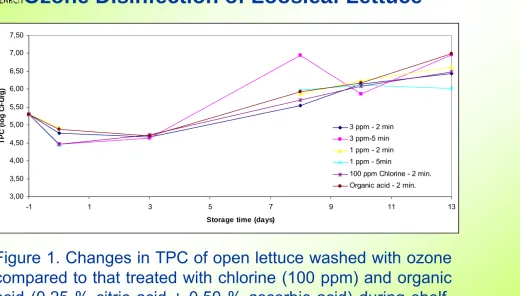
(15) Ozone Disinfection of Loosleaf Lettuce 7,50 7,00. TPC (log CFU/g). 6,50 6,00 5,50 5,00. 3 ppm - 2 min 3 ppm-5 min. 4,50. 1 ppm - 2 min. 4,00. 1 ppm - 5min 100 ppm Chlorine - 2 min.. 3,50. Organic acid - 2 min.. 3,00 -1. 1. 3. 5. 7. 9. 11. 13. Storage time (days). Figure 1. Changes in TPC of open lettuce washed with ozone compared to that treated with chlorine (100 ppm) and organic acid (0.25 % citric acid + 0.50 % ascorbic acid) during shelflife 4ºC for 13 days.. Feb 2004 15.
(16) Ozone Disinfection of Loosleaf Lettuce Psychrothropic count (log CFU/g). 7,50 7,00 6,50 6,00 5,50 3 ppm - 2 min. 5,00. 3 ppm-5 min 1 ppm - 2 min. 4,50. 1 ppm - 5min. 4,00. 100 ppm Chlorine - 2 min.. 3,50. Organic acid - 2 min.. 3,00 -1. 1. 3. 5. 7. 9. 11. 13. Storage time (days). Figure 2. Changes in psychrotropic count of open lettuce washed with ozone compared to that treated with chlorine (100 ppm) and organic acid (0.25 % citric acid + 0.50 % ascorbic acid) during the shelf-life 4ºC for 13 days.. Feb 2004 16.
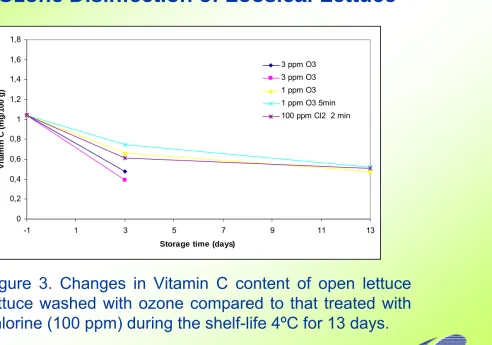
(17) Ozone Disinfection of Loosleaf Lettuce 1,8 1,6. 3 ppm O3 3 ppm O3. Vitamin C (mg/100 g). 1,4. 1 ppm O3 1,2. 1 ppm O3 5min 100 ppm Cl2 2 min. 1 0,8 0,6 0,4 0,2 0 -1. 1. 3. 5. 7. 9. 11. 13. Storage time (days). Figure 3. Changes in Vitamin C content of open lettuce lettuce washed with ozone compared to that treated with chlorine (100 ppm) during the shelf-life 4ºC for 13 days.. Feb 2004 17.
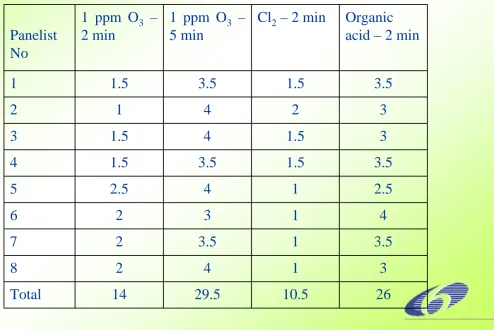
(18) Ozone Disinfection of Loosleaf Lettuce Table 1. Ranking test results for appearance at day 10. Panelist No. Feb 2004 18. 1 ppm O3 – 1 ppm O3 – Cl2 – 2 min 2 min 5 min. Organic acid – 2 min. 1. 1.5. 3.5. 1.5. 3.5. 2. 1. 4. 2. 3. 3. 1.5. 4. 1.5. 3. 4. 1.5. 3.5. 1.5. 3.5. 5. 2.5. 4. 1. 2.5. 6. 2. 3. 1. 4. 7. 2. 3.5. 1. 3.5. 8. 2. 4. 1. 3. Total. 14. 29.5. 10.5. 26.
(19) Ozone Disinfection of Loosleaf Lettuce Table 2. Ranking test results for taste at day 10. Panelist No. Feb 2004 19. 1 ppm O3 – 1 ppm O3 – Cl2 – 2 min 2 min 5 min. Organic acid – 2 min. 1. 2. 4. 1. 3. 2. 1. 4. 2.5. 2.5. 3. 1. 2.5. 2.5. 4. 4. 1.5. 3. 1.5. 4. 5. 3. 4. 1. 2. 6. 2. 3.5. 1. 3.5. 7. 1.5. 3. 1.5. 4. 8. 1. 4. 2. 3. Total. 13. 28. 13. 26.
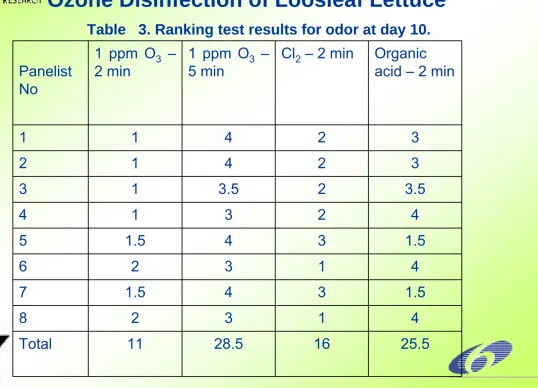
(20) Ozone Disinfection of Loosleaf Lettuce Table 3. Ranking test results for odor at day 10. Panelist No. Feb 2004 20. 1 ppm O3 – 1 ppm O3 – Cl2 – 2 min 2 min 5 min. Organic acid – 2 min. 1. 1. 4. 2. 3. 2. 1. 4. 2. 3. 3. 1. 3.5. 2. 3.5. 4. 1. 3. 2. 4. 5. 1.5. 4. 3. 1.5. 6. 2. 3. 1. 4. 7. 1.5. 4. 3. 1.5. 8. 2. 3. 1. 4. Total. 11. 28.5. 16. 25.5.
(21) Ozone Disinfection of Loosleaf Lettuce Results and Conclusion;. Feb 2004 21. z. A high discoloration and tissue softening occured in the samples treated with 3 ppm ozone, so they were discarded after 3-4 days of storage.. z. In general, chlorine treated lettuce samples and the samples washed with 1 ppm O3 for 2 min ranked to be better than the other samples at day 10.. z. No significant difference was observed between the samples in terms of microbial growth and vitamin C loss during storage.. z. In terms of retarding microbial growth and slowing down organoleptic changes, washing with 1 ppm ozone for 2 min at lower than 10°C was found to be a good alternative for chlorine disinfection of minimally processed lettuce..
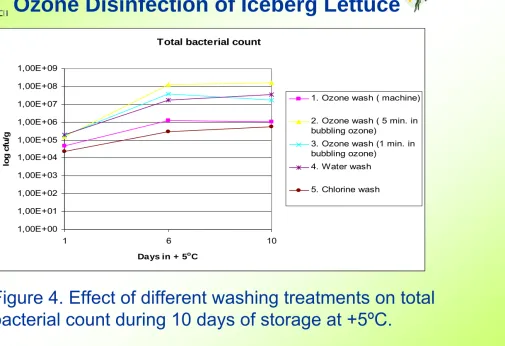
(22) Ozone Disinfection of Iceberg Lettuce Materials and Methods. Feb 2004 22. z. Iceberg lettuce; were transported and stored under refrigerated conditions until processing day.. z. Wrapper leaves stripped away and then the lettuce head was split in four pieces before washing. The pieces were shredded with a Hällde RG-200 vegetable cutter in 3 cm pieces ( 10 mm blade).. z. All samples were centrifuged in JMD drying drum (500 r/min).. z. A corona discharge ozone generator (10 g/h) was used to produce ozone.. z. Dissolved ozone was measured using an ATI Dissolved Ozone Monitor.. z. Shredded lettuce was packed in OPP packaging material generally used in industry in ambient atmosphere. The size of the pouch was 12,5 cm x 17,5 cm and 150 g of sample material was weighed into each pouch and heat sealed. All samples were stored for up to 10 days at +5ºC and evaluated on day 1, 6 and 10..
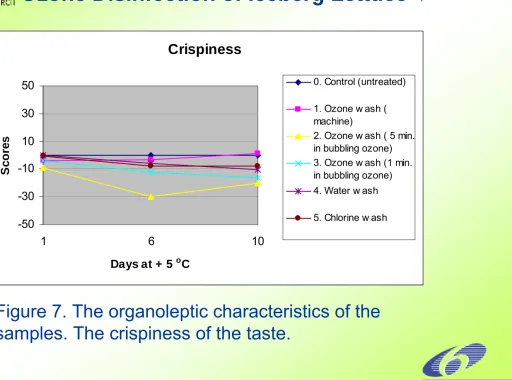
(23) Ozone Disinfection of Iceberg Lettuce The shredded iceberg lettuces were washed with five different solutions: 1. 7 ppm ozone dose, washing in Meiko GK60 washing machine (softprogram), 1 min. 2. 7 ppm ozone dose, washing in a tub (volume 70 l), 5 min. 3. 7 ppm ozone dose, washing in a tub (volume 70 l), 1 min. 4. Water wash, washing in Meiko GK60 washing machine (softprogram), 1 min. 5. Chlorine wash, 0,01 % active chlorine, prepared from sodium hypochlorite, 1 min.. Feb 2004 23.
(24) Ozone Disinfection of Iceberg Lettuce 1. 7 ppm ozone dose, washing in Meiko GK60 washing machine (soft-program), 1 min.. Feb 2004 24.
(25) Ozone Disinfection of Iceberg Lettuce Total bacterial count 1,00E+09 1,00E+08 1. Ozone wash ( machine). log cfu/g. 1,00E+07 1,00E+06. 2. Ozone wash ( 5 min. in bubbling ozone). 1,00E+05. 3. Ozone wash (1 min. in bubbling ozone). 1,00E+04. 4. Water wash. 1,00E+03. 5. Chlorine wash. 1,00E+02 1,00E+01 1,00E+00 1. 6. 10. Days in + 5o C. Figure 4. Effect of different washing treatments on total bacterial count during 10 days of storage at +5ºC.. Feb 2004 25.
(26) Ozone Disinfection of Iceberg Lettuce Enterobacteria. log cfu/g. 1. Ozone wash ( machine) 1,E+09 1,E+08 1,E+07 1,E+06 1,E+05 1,E+04 1,E+03 1,E+02 1,E+01 1,E+00. 2. Ozone wash ( 5 min. in bubbling ozone) 3. Ozone wash (1 min. in bubbling ozone) 4. Water wash. 1. 6. 10. 5. Chlorine wash. Days at + 5o C. Figure 5. Effect of different washing treatments on the growth of Enterobacteria during 10 days of storage at +5 ºC.. Feb 2004 26.
(27) Ozone Disinfection of Iceberg Lettuce Freshness of the taste 0. Control (untreated). Scores. 50 30. 1. Ozone w ash ( machine). 10. 2. Ozone w ash ( 5 min. in bubbling ozone). -10. 3. Ozone w ash (1 min. in bubbling ozone) 4. Water w ash. -30. 5. Chlorine w ash. -50 1. 6. 10. Days at + 5o C. Figure 6. The organoleptic characteristics of the samples. The freshness of the taste. Feb 2004 27.
(28) Ozone Disinfection of Iceberg Lettuce. Scores. Crispiness 50. 0. Control (untreated). 30. 1. Ozone w ash ( machine) 2. Ozone w ash ( 5 min. in bubbling ozone) 3. Ozone w ash (1 min. in bubbling ozone). 10 -10. 4. Water w ash. -30. 5. Chlorine w ash. -50 1. 6. 10. Days at + 5 o C. Figure 7. The organoleptic characteristics of the samples. The crispiness of the taste. Feb 2004 28.
(29) Ozone Disinfection of Iceberg Lettuce It was concluded that; - Industrial procedure could be developed on the basis of the treatments 1 and 3: 1. 7 ppm ozone dose, washing in Meiko GK60 washing machine (softprogram), 1 min – batch process. 3. 7 ppm ozone dose, washing in a tub (volume 70 l), 1 min – continuous process.. Feb 2004 29.
(30) SUMMARY -. -. Feb 2004 30. In terms of microbial safety assurance and retarding the organoleptic changes during shelf life, ozone treatment found to be succesfull. But, - A detailed cost-benefit analysis should be done for the use of ozone in food processing - This project gives a good basis for elaboration for a dossier for the discussion of the issue to be regulated in the EU..
(31) Thank you for your attention.... Feb 2004 31.
(32)
Figure

+6


Related documents
On the contrary, this study shows that women seeking an abortion have received more information about birth control than the women in the control group, but they still do not seem
In this study, therefore, we examined the effects of an 8-week health coaching self-management program (HCSMP) on self-care management behaviors, self-efficacy, health
This is a generalized model that takes into account the two Fama-French loadings that stand for the size and book-to-market effects (SMB and HML) and gives evidence of
In study subjects < 35 years of age, 11 β HSD1 activity was significantly increased in diabetics as compared to healthy controls (Table 4 , Fig.. In other age groups, 11 β
RT-PCR analysis of effects of BAI on the gene expression of IL-6, IL-8, and MCP-1 in IL-1 E - and TNF- D -activated HMC-1 cells. HMC-1 cells were treated
management schemes (CRMS and DRMS) to study the fun- damental relationship between the network performance (SE, EE, throughput and coverage probability) and key parameters,
A note about your eligibility for retiree health care coverage if your employment is terminated involuntarily: Notwithstanding the provisions noted above, under the current terms
The Kaufman County Sheriff’s Office reminds motorists that the 30-day warning period for the county’s new school zone speed safety camera program is completed. Motorists now caught
