ISO 14001 IMPLEMENTATION
IN AUSTRALIA
By
Ning Huang, B.Sc.
Submitted in partial fulfillment of the requirements for the degree of
Master of
Environmental Management
School of Geography and Environmental Studies
University of Tasmania
Declaration
I declare that this thesis contains no material which has been accepted for the award of any higher degree in any tertiary institution and that, to the best of my knowledge and belief, the thesis contains no material previously published or written by another person, except when due reference is made in the text.
)L))~
Abstract
This study investigates the current situation of ISO 14001 implementation in Australia. It focuses on selected issues such as: (1) the most important reasons for organizations in Australia to adopt ISO 14001; (2) the benefits and costs of certification in Australia; and (3) the problems encountered by early adopters that attained ISO 14001 in Australia. To address these issues, a mail survey was sent to 190 samples, which represented 199 companies that were certified to ISO 14001 before March 2000 in Australia. Seventy-three questionnaires were returned providing approximately 40% response rate overall.
The results show that the most important reasons behind the adoption of ISO 14001 by companies in Australia were improving environmental performance, enhancing due diligence, and improving regulation compliance. Environmental reasons were rated as more important than other reasons such as business competition mentioned in overseas literature.
The results also show that the costs of implementing ISO 14001 are very different from one company to another. It depends on many factors like how many sites and how many programs. Most respondents reported that benefits-.fr.Qlll ISO 14001 implementation are internal rather than market benefits.
Acknowledgements
First of all, many thanks to my supervisor Assoc. Prof. John Todd for his endless help, support, encouragement and patience during the completion of my thesis. Thanks to all the teaching staff and administrative staff of the School of Geography and Environmental Studies for their friendly attitude and assistance.
I would also like to thank Mr. David Hassel of TEMCO, Dr. Pat Mineely of North Forest Products and Ms. Ruth Ederle of Aurora Energy for their advice on the pre-testing of the questionnaire. Thanks to all the respondents in the mail survey to assist me in completing this thesis.
Thanks must also go to all my friends for their lasting encouragement and help. Special thanks to Peter for his statistical help, and thanks to Allan and Changming for their editorial assistance.
Table of contents
Declaration ...
I
Abstract ... II
Acknowledgements ... 111
Table of contents ... IV List of tables ... VI List of figures ... VII
CHAPTER 1 INTRODUCTION ...
!
1.1BACKGROUND ... 11.2 RESEARCH PURPOSE AND OBJECTIVES ... 4
1.3 OUTLINE OF STUDY ... 5
CHAPTER 2 ISO 14000 REVIEW AND AUSTRALIA ... 7
2.1 THE ISO 14000 SERIES ... 7
2.1.1 Development of ISO 14000 standards ... 7
2.1.2 Brief description of the standards ... 9
2.2 THE ISO 14001 EMS STANDARD ... 11
2.2.1 Specifications of the standard ... 11
2.2.2 Certification of ISO 14001 standard ... 19
2.2.3 Drivers and benefits for ISO 14001 implementation ... 21
2.2.4 Costs of ISO 14001 implementation ... 26
2.2.5 Weaknesses and criticisms of ISO 14001 standard ... 27
2.3ISO14001 STANDARD AND AUSTRALIA ... 29
CHAPTER 3 METHODOLOGY ... 35
3.1 DESIGN QUESTIONNAIRE··· 35
3.2 SAMPLE SELECTION ... 37
3.4 LIMITATIONS ... 39
CHAPTER 4 RESULTS ... 41
4.1 RESPONSE RATE ... 41
4.2 THE GENERAL INFORMATION OF RESPONDING COMPANIES ... 42
4.3 SOURCE OF INFORMATION FOR ISO 14000 SERIES AMONG COMPANIES ... 46
4.4 MAIN REASONS FOR IMPLEMENTING ISO 14001 ... 47
4.5 POTENTIAL BENEFITS FOR IMPLEMENTING ISO 14001 ... 48
4.6 DIFFICULTIES FACED IN ADOPTING ISO 14001 BY COMPANIES ... 48
4.7 COSTS OF IMPLEMENTING ISO 14001 ... 50
4.8 THE SUPPORT OF OTHER ISO 14000 STANDARDS FOR ISO 14001 IMPLEMENTATION ... 51
4.9 THE TIME PERIOD FOR THE SENIOR MANAGER TO REVIEW THE ENVIRONMENTAL MANAGEMENT SYSTEM OFTHECOMPANY ... 52
4.10 FuRTHER ENVIRONMENTAL IMPROVEMENT ... 53
4.11 THE POSITION OF RESPONDENTS ... 53
4.12 THE CRITICAL OPINION AND RECOMMENDATIONS OF ISO 14001 IMPLEMENTATION ... 54
CHAPTER 5 DISCUSSION ... 56
5.1 WHAT ARE THE MOST IMPORTANT REASONS FOR COMPANIES IN AUSTRALIA TO ADOPT ISO 14001? ... 56
5.2 WHAT ARE THE COSTS AND BENEFITS FOR ISO 14001 IMPLEMENTATION IN AUSTRALIA? ... 60
5.2.l Costs ... 60
5.2.2 Benefits ... 61
5.2.3 Comparing costs and benefits ... 64
5.3 WHAT ARE THE PROBLEMS OF ISO 14001 IMPLEMENTATION IN AUSTRALIA? ... 65
5.3.1 Interpretation of the requirements by the auditor is a major problem ... 65
5.3.2 Some companies became uncertain about ISO 14001 standard ... 65
5.3.3 Too much time consumption and documentation ... 66
5.3.4 Insufficient support or lack of understanding from government, public and community and top-management ... 66
5.3.5 Problems with integrating an ISO 14001 EMS and other existing management systems ... 67
CHAPTER 6 CONCLUSION ... 69
6.1SUMMARY ... 69
6.2 FURTHER STUDIES ... 72
6.3 CONCLUDING STATEMENT ... 73
List of tables
Table 2.1 Names and purposes of the key document in the ISO 14009 family ... 10
Table 2.2 Critical characteristics of an ISO 14001 EMS ... : ... 18
Table 2.3 Drivers of ISO 1400lcertification ... 24
Table 2.4 Benefits of ISO 14001 certification ... 25
Table 2.5 ISO 14001 certification bodies in Australia ... 32
Table 4.1 Responses to the questionnaire by different states in Australia ... 41
Table 4.2 Business activities of responding ISO 14001 certified companies ... 43
Table 4.3 Certification type of responding ISO 14001 certified companies ... 43
Table 4.4 The ISO 14001 certified year of respondents ... 44
Table 4.5 Main pollutants and environmental impacts of responding companies ... 45
Table 4.6 Main reasons for companies in Australia to pursue ISO 14001 implementation ... 4 7 Table 4.7 Potential benefits for companies by implementing ISO 14001 ... .48
Table 4.8 The costs of ISO 14001 implementation in Australia ... 50
Table 4.9 The position of respondents ... 54
List of figures
Figure 1.1 The number of ISO 14001 certified organizations in the top ten
countries ... 3
Figure 2.1 ISO 14000 family of standards ... 9
Figure 2.2 Environmental Management System model ... 11
Figure 2.3 Five major elements of ISO 14001 standard ... 13
Figure 2.4 The roadmap of EMS ... 17
Figure 2.5 The flowchart of ISO 14001 certification process ... 20
Figure 2.6 National infrastructure of ISO 14001 implementation in Australia ... 29
Figure 2.7 Number of ISO 14001 certified companies and sites in each state of Australia ... 31
Figure 2.8 Number of ISO 14001 certified companies and sites from 1996 to 1999 in Australia ... 31
Figure 2.9 The certification type of companies awarded ISO 14001 in Australia ... 32
Figure 2.10 The percentage of occupied market of certification bodies in Australia . 33 Figure 3.1 The flowchart of methodology ... 40
Figure 4.1 Source of information for ISO 14000 series standards ... 46
Figure 4.2 Difficulties faced in adopting ISO 14001 by companies ... 49
Figure 4.3 Comparison of the estimated costs of ISO 14001 certification with the potential benefits ... 51
Figure 4.4 Support of other ISO 14000 standards for ISO 14001 implementation ... 52
Chapter 1 Introduction
1.1 BACKGROUND
There is no doubt that the environment is of growing importance to all organizations. In the past, organizations, large and small, may have ignored the environmental aspects of their operations in their planning, but this is at a significant and growing level of risk to their long-term existence. Environmental disasters, such as the toxic releases at Bhopal in India, the mercury poisoning at Minimata, the Exxon Valdez oil spill in Alaska and radioactive spillage at Chernobyl, have had a serious impact on the environment. Smaller organizations can also have disastrous impact on the local environment. The cost of clean up and compensation far outweigh the cost of prevention for all organizations (Craddock and Cumming, 1996). Such events are not acts of God beyond the scope of business control. The organizations involved could have avoided many of these disasters if a clearly defined Environmental Management System, like ISO 14000, had been in place.
ISO 14000 is a voluntary management tool developed by the International Organization for Standardization (ISO) after the rapid acceptance of ISO 9000 (Quality Management System standards) and the increase in the number of environmental standards around the world (Jackson, 1997; Quality Network, 1999).
Chapter 1 Introduction
management system standard, not a performance standard. It is intended to be applicable to firms of all shapes and sizes around the world. The standard does not require specific environmental goals. Instead, it provides a general framework for organizing the tasks necessary for effective environmental management. The series of documents that encompass ISO 14000 includes components such as Environmental Management Systems, Environmental Auditing, Environmental Labelling, and product Life Cycle Assessment. The ISO 14001 standard, which lays out requirements for establishing an Environmental Management System (EMS), is the centrepiece of the IS014000 series. To become registered under ISO 14000, organizations must meet the requirements laid out in ISO 14001. All of the other standards in the ISO 14000 series provide supporting guidance. ISO 14001 is not prescriptive, that is, it does not specify environmental target practices and it does not state how environmental impacts should best be managed. This approach encourages creative and relevant solutions from the organization itself (Darnall et al. 2000; Fredericks and McCallum, 1995; Johnson, 1997; Martin and Sleeman, 1997; Pringle and Leuteritz, 1998).
The ISO 14000 standards are receiving significant amounts of attention from business managers and their legal and economic advisors all over the world, and one commentator has said that the standards may be a "watershed in the annals of
environmental regulation." (Stenzel, 2000, p.237). Four years after the official release
5,000 4,500 4,000
3,500
...
.8
3,000 E 2,500 ~ 2,000 1,500 1,000 500 0Chapter 1 Introduction
2,400
DJapan DGermany DUK • Sweden
• USA
• Netherlands • France
•"Taiwan"
Italy
[image:11.536.78.503.75.323.2]• Spain
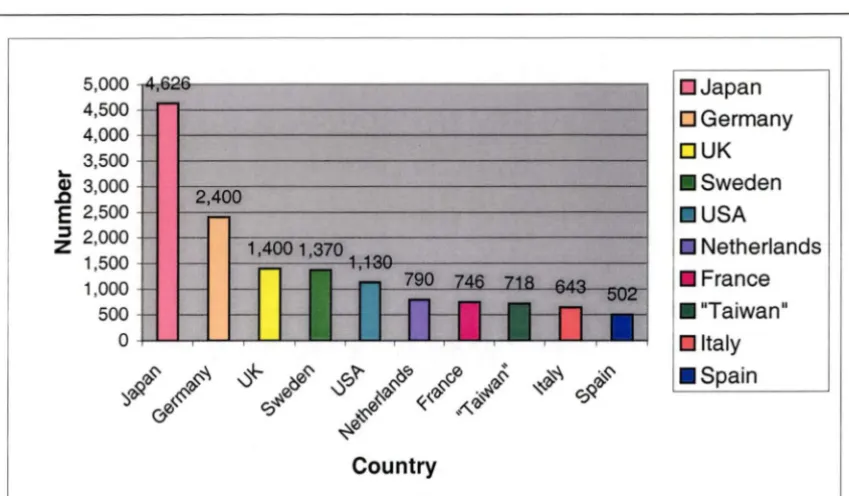
Figure 1.1 The number of ISO 14001 certified organizations in the top ten countries
(Source: ISO World, November 2000)
Australia. like many concerned nations, has been a signatory to a number of International Agreement and protocols, including those relating to ozone depleting
sub tances, greenhouse ga emi sion (global warming), pollution of the seas, and
transportation and dispo al of hazardous waste. Most of these agreements have later been reflected in Australian legislation. Concern for environmental issues has also markedly increased at a national level over the past few decades, with land
contamination, water and air pollution, disposal of wastes, and deforestation constantly becoming public i ue . Ther is increasing legislation, restriction, penalties and public
opinion governing the environmental performance of organizations at the national, state
and local levels (Craddock and Cumming, 1996).
Chapter 1 Introduction
14001, 14004, 14010-12). The interim Standards had the status of full Standards when the final Standards were published by International Organization for Standardization (ISO) in 1996 (Quinlan, 1997).
AS/NZS ISO 14001 was adopted unchanged from the International Standard ISO 14001 and is applicable to organizations in Australia. It provides an ideal opportunity for organizations to improve both their environmental and economic performance. For example, Sam Sproule of Alcoa's Kwinana Refinery (the first company to obtain ISO 14000 certification in Australia) said:
"Certification has been extremely productive for the plant and has allowed us to take a higher profile in terms of our environmental credentials. It has shown our customers that we continue to give environmental matters highest priority, and has also acted as a valuable communication tool within the company. Certification has assisted greatly in raising the awareness of the importance of environmental controls among all our employees." (Moy, 1997, p.21)
1.2 RESEARCH PURPOSE AND OBJECTIVES
Chapter 1 Introduction
The objectives of this thesis are:
1. To review the background of the ISO 14000 standard;
2. To carry out a survey of ISO 14001 certified companies in Australia;
3. To investigate why companies in Australia adopt ISO 14001 certification and assess its benefits and costs;
4. To assess problems encountered by companies that have already attained ISO 14001 certification in Australia.
1.3 OUTLINE OF STUDY
Chapter 2 provides a review of the literature related to ISO 14001 and introduces the
general background of ISO 14001 implementation in Australia. Firstly, an outline of the current status of the ISO 14000 standard as seen from an international perspective is presented. Then an explanation of what ISO 14001 represents, why organizations pursue ISO 14001 implementation and its costs and benefits are followed. The literature review also highlights the critical perspectives on ISO 14001 and details the general certification process of ISO 14001. Finally, the current situation of ISO 14001 accreditation and certification in Australia is summarised.
Chapter 3 provides details of the survey methodology. This includes an outline of the
design of the survey questionnaire for the mail survey that was used to obtain data, and how the data was interpreted and the limitation of the methodology.
Chapter 4 presents the results of the mail survey.
Chapter 5 examines the research findings and attempts to answer three questions.
Chapter 1 Introduction
ISO 14001? Secondly, what are the costs and benefits of ISO 14001 implementation in Australia? Finally, what are the problems of ISO 14001 implementation in Australia?
Chapter 2 ISO 14000 Review and
Australia
This chapter reviews the literature on ISO 14000 standards, focusing on the ISO 14001 standard, and summarises the current situation of ISO 14001 accreditation and certification in Australia.
2.1 THE ISO 14000 SERIES
2.1.1 Development of ISO 14000 Standards
ISO is a federation of non-government organizations established in 1947 to develop international standards, improve international communication and collaboration, and facilitate the exchange of goods and services. The federation is currently comprised of close to 100 national standards bodies (member bodies) from countries representing approximately 95 percent of the world's industrial production. The headquarters of the ISO secretariat is in Geneva, Switzerland (Conway, 1996). Australia is one of its members.
Chapter 2 ISO 14000 Review and Australia
Standards Association's Z750 (A Guide for a Voluntary Environmental Management), and the EDEMAS (Eco-Management and Audit Scheme). Other similar environmental management standards have been developed by the French Standards Association, the South African Bureau of Standards and Spanish Standards Association. With the proliferation of these standards, it was suggested that an international environmental standard be developed by the ISO to reduce the fragmentation of international markets, for the benefit of companies of all the countries in the world. As a result, the ISO began to respond by developing the ISO 14000 standards after the rapid acceptance of ISO 9000.
• In 1991, ISO established a Strategic Advisory Group on the Environment (SAGE) to assess the need for international environmental management standards with 20 countries, 11 international organizations and more than 100 environmental experts participating in the preparation of the basic document.
• In 1992, a technical committee (TC207) under SAGE was established to develop environmental standards. Environmental standards include five areas of environmental management: environmental management systems; environmental auditing and related environmental investigation; environmental labelling; environmental performance evaluation; and life-cycle assessment.
Chapter 2 ISO 14000 Review and Australia
2.1.2 Brief Description of the standards
[image:17.533.74.494.352.600.2]In brief, there are five environmental management standards, a guide, and a set of terms and definitions (Cascio et al., 1996).
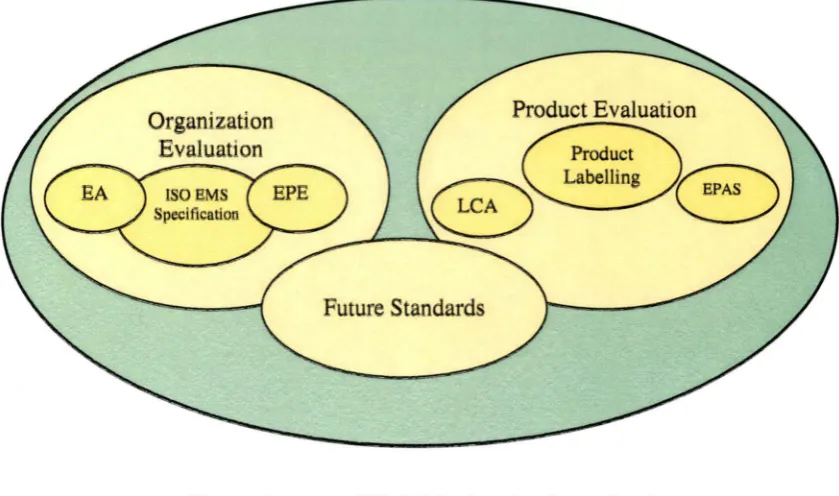
Figure 2.1 illustrates the ISO family of standards and the interconnection between them. As shown below, there are two discrete types of standards; one dealing with evaluation of organizations (e.g. ISO 14001, Environmental auditing - EA, and environmental
performance evaluation - EPE), and another dealing with evaluation of the product (e.g. product standards, Life Cycle Assessment (LCA) and Environmental Aspects in Product Standards (EPAS) - formerly a standard but, once drafted, was redefined as a
guide) (Woodside et al., 1998).
Product Evaluation
Product
Labelling
Figure 2.1
ISO
14000
familyof
standards
(Source: Woodside et al., 1998)
Table 2. l details the names and purpose of the key document in the ISO 14000 family. ISO is always con idering the development of new environmental management
Chapter 2 ISO 14000 Review and Australia
Table 2.1 Names and purpose of the key document in the ISO 14000 family (Source: Woodside et al., 1998)
Environmental. Management System (EMS) Standards
ISO 14001-Environmental Management Systems Specification This standard lays out elements of an EMS;
it applies to organizations of all sizes, and those who seek registration to the standard must conform to all requirements delineated within.
ISO 14004-Guzdance Document for EMS This document provides guidance on setting up an EMS; it is
most useful for those organizations with immature systems.
Environmental Auditing (EA) Standards
ISO 14010-General Principles of Environmental Auditing This document provides general principles of
environmental auditing; it is meant to apply to all types of environmental auditing and covers topics as objectivity, independence, competence, due professional care, and audit criteria.
ISO 14011-Auditing Procedures-Auditing of Environmental Management Systems This document provides
guidance for the EMS audit; although its use is not required, it provides pertinent information on how to develop an audit plan and conduct of an EMS audit.
ISO 14012-Auditor Qualzfzcatwn Crzterza This document sets forth gmdance for qualification cnteria for
internal and external environmental auditors who perform EMS audits.
Environmental Labels and Declarations Standards
ISO 14020-Princzples of All Environmental Labelling This document provides gmdance on the goals and
principle that should be consistently incorporated into all types of environmental labelling programs.
ISO 14021-Self-Declaratwn of Environmental Claims-Terms and Definitions This document is meant to
apply to manufacturers who are declanng that their product has an environmental attnbute (i.e., it is recyclable, energy-efficient, etc.)
ISO l4022:Symbols This document addresses environmental labelling symbols.
ISO 14023-Testing and Verification This document addresses testing and verification of environmental
claims.
ISO 14024-Practitioner Programs: Guiding Principles and Procedure for Multiple Crzterza (Type 1) This
document lays out the principles and protocols for environmental labelling programs. Environmental Performance Evaluation (EPE)
ISO 14031-Environmental Performance Evaluation This document addresses performance indicators for operat10ns in terms of emissions and efficiencies of processes; it also addresses performance indicators for the environment itself.
Life-Cycle Assessment (LCA) Standards
ISO 14040-Principles and Framework This document provides a clear overview of the practice, applications, and limitations of LCA to a broad range of potential LCA users.
ISO 14041-Goal/ Scope Definitions and Inventory Analysis This document decnes special requirements
and guidelmes for the preparation, conduct, and critical review of the life-cycle inventory analysis.
ISO 14042-Impact Assessment This document provides guidance on the impact phase of life-cycle
assessment.
Chapter 2 ISO 14000 Review and Australia
2.2 THE ISO 14001 EMS STANDARD
2.2.1 Specifications of the Standard
ISO 14001 is the most widely recognized environmental management standard. It was
finalized and issued as a first edition on September 1, 1996. It is a specification
standard, which means that organizations that conform to its requirements can become
registered to the standard. ISO 14001 was written as a consensus standard with nearly
50 countries participating. The 14001 standard is applicable to all types and sizes of
organizations with diverse geographical, cultural, and social conditions. It also applies
to all parts or any single part of an organization and/or its activities, products, and
services (Conway, 1996).
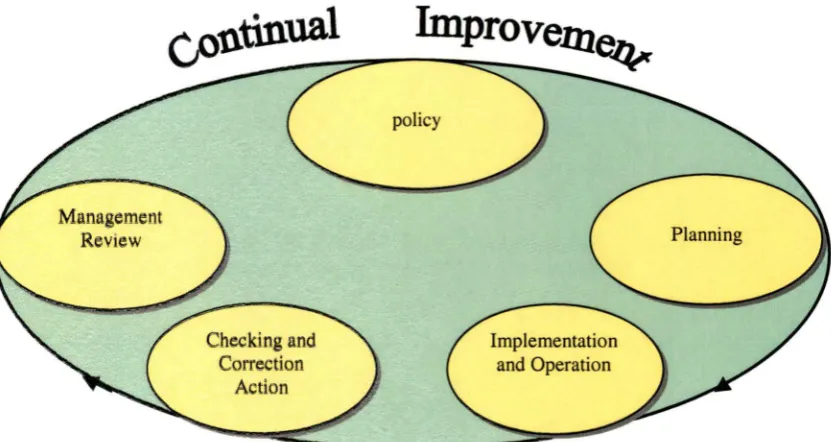
[image:19.532.84.500.380.601.2]A basic model of the standard is depicted in Fig. 2.2 (Woodside et al., 1998).
Figure 2.2
Improvelll~
policy
Environmental Management System model
Chapter 2 ISO 14000 Review and Australia
The ISO 14001 standard is organized as follows (Woodside et al., 1998. p. 7):
Introduction. This nonmandatory section sets the tone and context for implementation of the standard. In addition to background information about applicability and use of the standard, it provides a very basic model of the framework that the standard sets, which includes the five major elements and the concept of continual improvement. This model is presented in Fig. 2.2.
Scope (Section 1). This section specifies applicability and introduces Annex A as nonmandatory guidance.
Normative references (Section 2). None are listed at present.
Definitions (Section 3). Thirteen definitions that apply to the standard are presented. Examples include definitions of environmental aspect, continual improvement, environmental performance, and interested party.
Environmental Management System (EMS) requirements (Section 4). This section details the requirement section so that misinterpretation of the standard can be avoided.
Annex A. This nonmandatory (informative) annex provides guidance on the EMS requirement section so that misinterpretation of the standard can be avoided.
Chapter2 ISO 14000 Review and Australia
Annex C. This final nonmandatory (informative) annex provides
a bibliography of ISO 9000 standards, environmental audit
guidelines, and EMS guidance document.
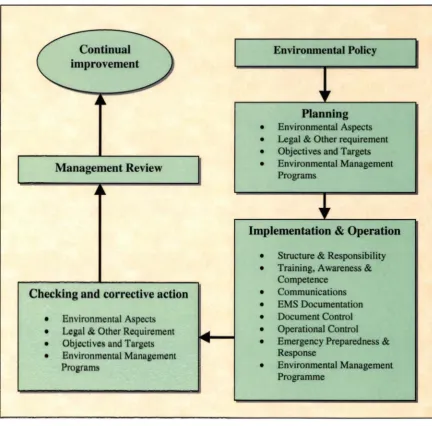
Five major elements included in the ISO 14001 standard are environmental policy,
planning, implementation and operation, checking and corrective action, and
management review (see Figure 2.3).
Management Review
Checking and corrective action
• Environmental Aspects
• Legal & Other Requirement
• Objectives and Targets • Environmental Management
Programs
Environmental Policy
Planning
• Environmental Aspects
• Legal & Other requirement
• Objectives and Targets
• Environmental Management Programs
Implementation & Operation
•
Structure & Responsibility•
Training, Awareness &Competence
•
Communications•
EMS Documentation•
Document Control•
Operational Control•
Emergency Preparedness &Response
[image:21.534.84.516.252.678.2]•
Environmental Management ProgrammeFigure 2.3 Five major elements of the standard
Chapter 2 ISO 14000 Review and Australia
Numerous authors (Woodside et al., 1996, Standard Australia/Standards New Zealand, 1996, Cascio et al., 1996; Gayle, 1998; Jackson, 1997) outline each of these elements, as summarised in the following paragraphs.
A Environmental policy
In section 4.1 (b) of ISO 14001, the standard requires that an organization's top management issue an environmental policy statement setting forth the organization's commitment to continual improvement of its environmental policy. Additionally, the policy must contain a commitment to the prevention of pollution and to statutory and regulatory compliance. The standard also requires the organization to communicate the terms of the policy to its employees. Finally, an organization must make the policy accessible to the public.
ISO 14001 defines "continual improvement" as:
The process of enhancing the environmental management system in order to achieve improvements in environmental performance in line with the organization's environmental policy. (Standard Australia/Standards New Zealand, 1996a, p. 1)
"Prevention of pollution" is defined as:
Use of processes, practices, materials or products that avoid, reduce or control pollution, which may include recycling, treatment, process changes, control mechanisms, efficient use of resources and material substitution. (Standards Australia/
Chapter 2 ISO 14000 Review and Australia
B. Planning
The planning approach in ISO 14001 illustrates the method by which an organization must implement its environmental policy.
1. Identify environmental aspects of the organization's activities, products and services that it can control and influence; determine which aspects are associated with significant environmental impacts;
2. Identify and maintain access to legal and all other requirements that apply to the environmental aspects of the activities, products and services;
3. Establish objectives and targets; and
4. Establish the EMS.
C. Implementation
Chapter 2 ISO 14000 Review and Australia
Individual or group concerned with or affected by the environmental performance of an organization. (Standards Australia/Standards New Zealand, 1996a, p. 2)
When implementing an EMS, an organization must maintain documentation describing the "core element" of the EMS and the manner in which they interact. An organization must design a procedure that ensures that EMS documents are comprehensive enough to allow the EMS to function effectively, and enable a reviewing auditor to evaluate the management system. Section 4.3.6 requires an organization to develop operational control procedures to ensure that the activities and targets are properly achieved. Also, ISO 14001 requires an organization to develop emergency procedures for potential accidents, such as accidental releases into the air, land or water. These emergency procedures include preventing or mitigating environmental impacts. An organization must review, revise and test these procedures to ensure its emergency preparedness.
D. Checking and corrective action
An organization must establish procedures to monitor and measure operations and activities that could affect the environment. It must plan regular reviews and record the results to gauge implementation and compliance. It must store and maintain all records.
"Records are evidence of the ongoing operation of the EMS .... The effective management of these records is essential to the successful implementation of the EMS. " (Standards Australia/Standards New Zealand, 1996b, p. 22).
Chapter 2 ISO 14000 Review and Australia
As part of an organizational "check-up," the standards require an established program for periodic EMS audits to assess whether the EMS is properly implemented and whether it conforms to the plans to fulfil the policy. The audit may be performed by an unbiased internal or external auditor. The audit provides an evaluation of the management system. It need not assess whether an organization is in technical compliance with environmental regulations.
E. Management Review
To continually improve the EMS, the final provision of ISO 14001 requires upper management to evaluate the EMS for both effectiveness and possible alterations to the EMS. Management must document the findings of its reviews, which are based upon audit results. Management must also document the degree of accomplishment of objectives and targets, evaluate the continuing suitability of the EMS and address the concerns of a relevant "interested party".
These elements interact with each other to form a road to reach the purpose of continual improvement. This road map will help business to arrive at a company's self-defined image of environmental responsibility (Johnson, 1997).
EMS
BOADJl(AP
Oper'1riun and 11np1eu1>nmt\on ,
~
---,
---Stt14Cturt", T-nmun~ anJ CiJPlrtWIUC(JliM
, I /::MS Dm:umctldt,t:ni qn.J. D-.g·.m1CJ.tt Con/nll
fi,{,-m}toflrt.,,_l.f "':01'
tuid Mea~w-m~ , , , c· •
EMSAuJtl
A{{itltb~ft'1.tU:-tt cf
Op~rtitMn ( fmtrol and &n0',Qflmnlt'2l
bm.uge11q Prepun:Jne.sx R~t.. t>.n1s
[image:25.538.69.492.483.653.2]and if.a.pons<:
Chapter 2 ISO 14000 Review and Australia
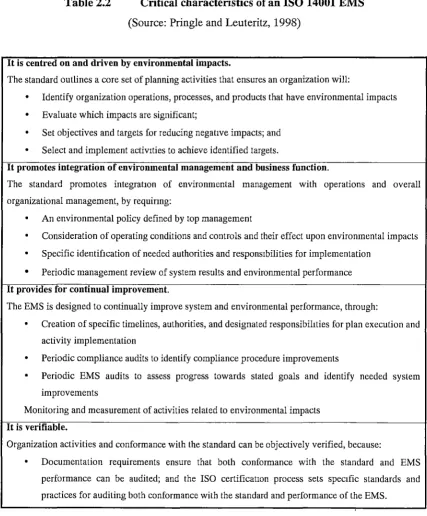
[image:26.537.66.493.160.676.2]Pringle and Leuteritz (1998) summarize the critical characteristics of an ISO 14001 EMS (see Table 2.2).
Table 2.2 Critical characteristics of an ISO 14001 EMS (Source: Pringle and Leuteritz, 1998)
It is centred on and driven by environmental impacts.
The standard outlines a core set of planning activities that ensures an organization will: •
•
Identify organization operations, processes, and products that have environmental impacts Evaluate which impacts are significant;
Set objectives and targets for reducing negative impacts; and Select and implement activities to achieve identified targets.
It promotes integration of environmental management and business function.
The standard promotes integration of environmental management with operations and overall organizational management, by requirmg:
• An environmental policy defined by top management
Consideration of operating conditions and controls and their effect upon environmental impacts Specific identification of needed authorities and responsibilities for implementation
• Periodic management review of system results and environmental performance
It provides for continual improvement.
The EMS is designed to continually improve system and environmental performance, through:
Creation of specific timelines, authorities, and designated responsibilities for plan execution and activity implementation
Periodic compliance audits to identify compliance procedure improvements
Periodic EMS audits to assess progress towards stated goals and identify needed system improvements
Monitoring and measurement of activities related to environmental impacts It is verifiable.
Organization activities and conformance with the standard can be objectively verified, because:
Chapter 2 ISO 14000 Review and Australia
2.2.2 Certification of ISO 14001 standard
Organizations can either be "certified" under ISO 14001 by third party certification or "self-declare" their participation. Third-party certification ensures that the organization's Environmental Management System progresses in accordance with the requirements of ISO 14001 standard. (Hammerschmid and Uliana, 1998).
In the case of third-party certification, it is likely that organizations will seek to become certified to ISO 14001 by application to a "registrar". Once an application is filed, the independent auditor from a registrar will perform conformity assessment evaluating an applicant's EMS system against the ISO 14001 criteria. Once granted, it will last for three years (Conway, 1996).
The Flowchart of the certification process of NCS International Pty Ltd shows a typical certification process for ISO 14000 (see Fig 2.5).
Wide· spread acceptance of the ISO 14001 standard has accelerated international demand for qualified Environmental Management System auditors.
As defined by ISO 14012, an environmental auditor is a "person qualified to perform environmental audits." EMS auditor is based on a three-level system. Level 1-Provisional Auditor (EMS-PA): an early entry grade for those with little or no EMS experience. Level 2- EMS Auditor (EMS-A): qualifies individuals to conduct EMS audits as part of an audit team. Level 3 - EMS Lead Auditor (EMS-LA): qualifies individuals to manage and coordinate EMS audits as the audit team leader (Standard Australia/Standard New Zealand, 1996c and Wilson, 1998).
Chapter2 ISO 14000 Review and Australia
Initial inquiry
Formal Application
Submission of initial Documentation on:
• Environmental Policy
• Environmental impacts & aspects
• Legal & Other requirements
• Documented Objectives & Targets
Preliminary Assessment
Conducted on site
Ongoing system
Document review
Amendments (if required)
Cenification Assessment
Corrective action?
Cenitication granted
Surveillance Audits Conducted
Full Reassessment after 3 years
Corrective action addressed
Figure 2.5 The flowchart of ISO 14001 certification process
[image:28.536.76.500.99.658.2]Chapter 2 ISO 14000 Review and Australia
states that formal training should address environmental science and technology; technical and environmental aspects of facility operation; relevant requirements of environmental laws, regulations, and related documents; Environmental Management Systems and standards against which audits may be performed; and audit procedures, processes, and techniques within three consecutive years. An auditor should receive "on-the-job" training for 20 equivalent workdays of environmental auditing and for a minimum of four audits, including involvement in the entire process under a lead auditor. Lead auditors must meet more extensive requirements (Hemenway, 1995).
2.2.3 Drivers and benefits for ISO 14000 implementation
Many surveys and studies have investigated the drivers and benefits of ISO 14001 certification.
A. Drivers
In general, according to Meadows (1998, pp.14-15), at the level of organization, the main driver of ISO 14001 can be related to:
•
•
Operational factors, such as standardizing and/or improving the way in which environmental issues are managed across the organization, linking environmental and quality management, and ensuring that the business is organized effectively and appropriately;
Chapter 2 ISO 14000 Review and Australia
• Financial factors such as controlling and/or reducing costs of waste, energy, production and insurance;
• Competitive factors from being at the leading edge of innovation, competitive effectiveness and marketing, or improving access to national and/or international markets in case ISO 14001 certification becomes a non-tariff trade barrier;
• Environmental factors including meeting the expectations of the community and existing and/or potential customers by promoting an environmentally responsible image.
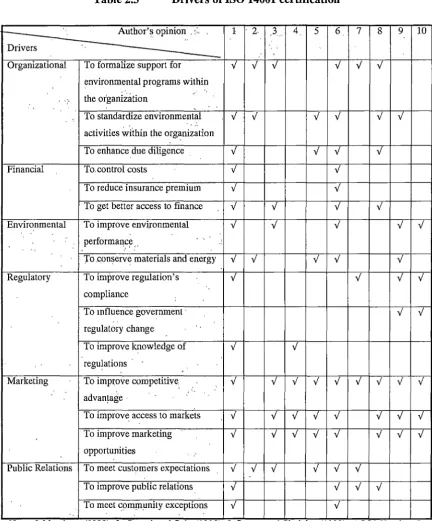
Other authors such as Boiral and Sala (1998), Cascio and Shideler (1998), SGS Yarsley (1996), Graff (1997), Kuryllowicz (1996), ISO 14000 West Coast Working Group-WCWG (2000), Mohammed (2000), Martin and Sleeman (1997) and Diamond (1996) also refer to some, or most, of the above drivers. Table 2.3 provides a summary of each of the drivers mentioned in each of these publications.
B. Benefits
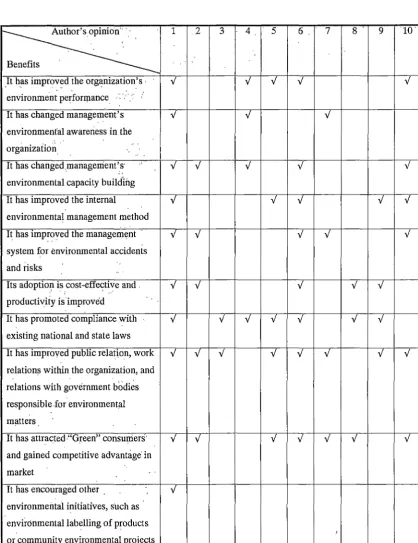
There are considerable benefits associated with implementing an Environmental Management System based on the ISO 14001 Standard and achieving certification by an independent third party. Lally (1998, pp.10-15) detailed benefits of ISO 14001 certification as follows:
•
It has improved the organization's environmentalperformances;
Chapter 2 ISO 14000 Review and Australia
• It has enhanced employee's environmental capacity building;
• It has improved the internal environmental management methods;
• It has improved the management system for environmental accident and risks;
• Its adoption is cost-effective and productivity is improved;
• It has promoted compliance with existing national and state laws;
• It has improved public relations, work relations within the organization, and relations with government bodies responsible for environmental matters;
•
It has attracted "Green" consumers and gained competitive advantage in the market;• It has encouraged other environmental initiatives, such as environmental labelling of products or community environmental projects.
Chapter 2 ISO 14000 Review and Australia
[image:32.535.62.494.164.685.2]refer to some or most, of the above benefits. Table 2.4 provides a summary of benefits mentioned by each of these authors.
Table 2.3 Drivers of ISO 14001 certification
Author'~ opinion . '.:. 1 ' 2. ),. 4 5 6 7 8 9 10 Drivers Organizational Financial Environmental Regulatory Marketing
To formalize support for environmental programs within the organization
To standardize environmental activities within the organi~~tion To enhance.due diligence . To.control costs
To reduce insurance premium To get better access to finance To improve environmental performanc~,,
' / <
ro -~onserve materials and energy v1 v1 To improve regulation's v1 compliance
To mfluence government regulatory change To improve knowledge of regu~ations
To improve competitive advan~age ·
To improve access to markets To improve marketing opportunities
Public Relations To meet customers expectations To improve public relations To meet COlll.!llunity exceptions
Note: I-Meadows (1998), 2- Bozral and Sala (1998), 3-Casczo and Shideler (1998), 4-SGS Yarsley,
5-Graff (1997), 6-Kuryllowicz (1996), 7-WCWG (2000), 8-Mohanmed (2000), 9-Martzn and Sleeman
Chapter 2 ISO 14000 Review and Australia
Table 2.4 Benefits of ISO 14001 certification
~
1 .2 3 4, 5 6 7 8 ' 9 10'' ' .
.It h.as improv~d the organization's , v' v' v' v' v'
' ' '
environment perforrµance .• : ·i·::
It has changed management's
v
v' v'environmenfal awareness in the organization,·
' '
It has changed.,managenient's· •'
v' v' v' v' v'
environmental capacity builcil.ng
It has improved the internal v' v' v' v' v'
environmental management method
It has improved the managem~mt
v
v' v' v' v'system for environmental accidents and risks
"
Its adoption is cost-effective and , v' v' v' v' v'
/ ' ' ' ~'-0
productivity is improved
It has promoted compliance with v' v' v' v' v' v' v'
existing national and state laws
It has improyed public relat~on, work v' v' v' v' v' v'
v v
relations within the organization, and
r~lations with g~vemment bodi~s responsible for environmentfll matters
It has attracted ·"Green" consumers'
" < ' '
v
v
v v v v
v
and gained competitive advantage' in
market ' '
It has encouraged other ,
v
environmental initiatives, such as envfronmental labelling of p~oducts
I
or community environmental projects
Note: I-Lally (1998), 2- Altham and Guerm (1999), 3-Cascw (1994), 4-Austrahan Local Government Association (1996), 5-IISD (1996), 6-ASNI (2000), 7-SCC (1999), 8-Kirkpatnck (1995), 9-Poulwt (1996),
Chapter 2 ISO 14000 Review and Australia
2.2.4 Costs of ISO 14001 implementation
Implementation of ISO 14001 costs time and money and the extent of those costs will depend on the scope of the EMS. For example, an EMS can be international, national, or limited to an individual plant. Implementation and certification costs are estimated to range from $100,000 to $1 million for plants run by a multinational corporation (Stenzel, 2000). Costs for small or medium-sized plants may range between $10,000 and $100,000 depending on the company's individual needs and circumstances (Stenzel, 2000). The cost of implementing an Environmental Management System is often proportional to the size and complexity of the operation. Costs between $15,000 and $150,000 per site have been reported (Graff, 1997). However, many support services have developed since the introduction of ISO 14000. For example, computer support services, which are used to guide ISO 9000 companies into certification, are now being used by ISO 14000 companies as well. These computer support services provide companies with a cost-effective way to gain training and practical results (Lally, 1998).
Internal costs of ISO 14001 include personnel time for training and implementation of EMS, and costs of technology required to deal with the environmental information being compiled and communicated. There are also costs of new monitoring equipment or upgrades to current equipment. These internal costs are estimated to account for approximately eighty percent of the costs of implementation of Environmental Management System (Stenzel, 2000). There are also external costs. A business needs the services of a register for the initial and continuing audits. In addition, legal counsel must be hired to examine the company's compliance with applicable environmental laws (Stenzel, 2000).
Chapter 2 ISO 14000 Review and Australia
impact. Training programs can be resource intensive especially considering the time lost from production and additional costs for instruction and the amount of time taken to document procedures for certain critical operations. Companies with high employee turnover or multiple sites may find knowledge transfer technologies and self-directed learning tools effective to develop and maintain employee capabilities and minimize some of these costs. Capital costs for Environmental Management System development are relatively low in comparison, assuming companies already have appropriate control equipment and monitoring instrumentation that comply with federal, state, and local requirements (Graff, 1997).
2.2.5 Weaknesses and criticisms of ISO 14001 Standard
Although the goals of ISO 14001 are reasonably stringent, there have been serious criticisms levelled against the standard by environmentalists. It has been suggested that that the ISO 14001 standard do not set any level of environmental performance and as such companies can set the lowest level of compliance, i.e. the local regulatory threshold. There is no incentive to set ambitious goals. On the other hand, some companies fear that the goal of continued environmental improvement will lead to increased regulation by the Environmental Protection Agency (EPA) and state agencies instead of less. Another criticism of the ISO 14001 standard is that companies can choose to self-certify rather than seek third-party certification. Without independent means of verifying information, the entire certification process is thrown into question (Murray, 1999). Those opposed to ISO 14001 believe that it will only result in unnecessary paperwork and few benefits (Kissel and Waston, 1995).
Chapter 2 ISO 14000 Review and Australia
A third criticism of ISO 14001 is the fact that no environmental information collected by a certified company needs to be disclosed to the public - it is considered confidential. ISO 14001 represents a regressive standard in some ways: multinationals will not be required to abide by the applicable national or regional laws and regulations of its location. In other words, the progress of initiatives such as the Canadian Responsible Care Program, the Japanese Keidanren Business Charter on Sustainable Development that requires multinationals to apply the same standards as the host country world-wide, is lost in ISO 14000. ISO 14001 requires that multinationals set "double standards". The environmental impact of multinationals may worsen rather than improve, since multinationals certified under ISO 14001 can choose to locate in countries which have few or lenient environmental laws and regulations, yet still comply with ISO 14001 (Benchmark Environmental Consulting, 1995).
The drawbacks of ISO 14000 certification include the present uncertainty of the future importance of the standard: an over-estimation could be extremely costly for a company (McCreary, 1996).
Chapter2 ISO 14000 Review and Australia
2.3ISO14001 STANDARD AND AUSTRALIA
Australia has actively built its national infrastructure for implementing ISO 14001.
There are three levels in the national infrastructure of ISO 14001 implementation in
Australia. These levels are depicted in Figure 2.6. The "certification body" is the term
used to designate the third-party auditing organizations, which certify organizations that
seek certification. Accreditation bodies - The Joint Accreditation System of Australia
and New Zealand (JAS-ANZ) evaluate the certification bodies. Organizations are
defined as:
A company, corporation, firm, enterprise or institution or
part or combination thereof, whether incorporated or not,
public or private that has its own functions and
administration (Standards Australia/Standard New
Zealand, 1996a,
p.2)
Provide
Accreditation
Accreditation Bodies (JAS-ANZ)
Certification
Bodies
Who Certify
[image:37.534.80.498.328.570.2]Organizations
Figure 2.6 National Infrastructure of ISO 14001 Implementation in Australia
JAS~ANZ, which was established by a formal Agreement between the Governments of Australia and New Zealand (JAS-ANZ, 1999), has developed comprehensive criteria for ISO 14001 certification bodies. JAS-ANZ conducted a six-month pilot program to test the suitability of these criteria and initiated an accreditation program for providers
Chapter 2 ISO 14000 Review and Australia
need to have accreditation from JAS-ANZ for their certification of organizations to ISO 14001 to have official recognition. Certification within Australia is strictly controlled by the JAS-ANZ who licenses formally accredited organizations to certify organizations only where they have demonstrated industry experience.
An organization in Australia can seek ISO 14001 certification by hiring an accredited certification body to conduct a thorough audit. There is a long-term relationship between organization and certification body where certification is only a starting point, not a final goal. After an organization is successfully certified to ISO 14001, it will continue to be audited to ensure that the Environmental Management System is being maintained and improved over time. The typical certification process complies with the process outlined in Figure 2.5.
The Quality Society of Australia (QSA) is the registration body for environmental auditors in Australia. QSA led a working group to develop draft Selection Criteria for the Certification of Environmental Auditors. A Register of Certified Auditors (RCA) is in operation, with a Board of representatives from environmental associations, industry and academia, to oversee environmental auditing activities (Craddock and Cumming, 1996). Under JAS-ANZ accreditation guidelines, auditors for ISO 14000 certification cannot be involved in the EMS implementation in their own organization, nor sister organizations.
In March 2000, there were 587 sites certified for ISO 14001 in Australia. These 587 sites were spread across 199 companies (that is, some companies had more than one
'site' certified) in all States and Territories (JAZ-ANZ Register, 2000).
Chapter2 ISO 14000 Review and Australia
300
• Company
• Site under company 250
200
...
Q) 150
.0
§
100z
50
0
ACT NSW OLD SA TAS VIC WA
• company 3 61 28 18 11 53 25
• Site under company 16 259 145 27 35 67 38
[image:39.536.72.506.82.321.2]State
Figure 2.7 Number of ISO 14001 certified companies and sites in each state of Australia
NT
0 0
Figure 2-8 shows the number of certified companies and sites in Australia between 1996
and 1999. The number of certified companies and sites increased with each year.
*
600 ..,_~----~--~---~~~~~~~--.
500 +-~~~~~~~~~~~~~~__,,,<1 ... ..LOL.~
~ 400 +-~~~~~~~~~~~~~---~~~~--I
.C
Q) ~~~~~~~~~
-+-Company
E
300 1-~~~~~~~~~---~~~~~--;:s
- Site under companyz
200 +- ~~~~~~~~~~~~~~-.-...-ac~100 +- ~--llAl;r.i!-~~~--::=-.-:::'--'--=:.__~~~--1
0 +-~_._-==~.,..-~~~~..--~~~--,.~~~~--1
[image:39.536.76.504.436.694.2]1996
Figure 2.8
1997 1998 1999
Year
umber of ISO 14001 certified companies and sites• from 1996 to 1999 in Australia
Chapter2 ISO 14000 Review and Australia
Figure 2.9 details the type of companies awarded ISO 14001 certification up to March
2000. This indicated that manufacturing comprises the largest fraction of certified
companies.
31 %
• Automotive repairs/service • Construction
4% 6% 7%
DE le ctricity,e ne rg ya nd chem ica Is products distribution, contractors and utility DPublic service
• Supply chain management Technical service
• W a s te m a n a g e m e n t DWaterand sewage service
• Manufacturing
[image:40.535.81.502.175.418.2]• M lnlng
Figure 2.9 The certification type of companies awarded ISO 14001 in Australia
According to JAS-ANZ
(2000),
there are ten certification bodies in Australia accreditedto
provide
ISO
14001
certification(see
Table2.5).
Table
2.S
ISO 14001 certification bodies in Australia(Source: JAS-ANZ, 2000)
The name of certification body
Bureau Veritas quality International - BVQI Davis Langdon International - DLl
DNV Certification Pty Ltd - DNV
International Standards Certification Pty Ltd - ISC KPMO Quality Certification Service - KQC
LRQA Australaisa - LRQA
NCS International Pty Ltd - NCSI
Quality Assurance Services Pty Ltd - QAS
[image:40.535.65.501.526.722.2]Chapter2 ISO 14000 Review and Australia
Among the above 10 certification bodies, only 7 are currently participating m the
certification market in Australia according to the JAS-ANZ Register list (2000). As
shown in Figure 2.10, NCS International Pty Ltd. occupies more than half of the
[image:41.537.77.505.199.410.2]certification market in Australia.
Figure 2.10
2%
• BC
• BVOI
DOLIO
DISC
•
LROA
NCSI
•
OAS
DSGS-ICS
The percentage of occupied market of certification
bodies* in Australia
Regulators in Australia have also begun to selectively target the most critical industries
for licensing and industry self-regulation in order to shift companies towards a more
effective regulatory system. ISO 14001 EMS standard have provided regulators with a
powerful tool to move industry away from command and control toward self-regulation
(Stone, 1998). In Victoria and New South Wales, special accredited licenses were
created by the EPA. If a company meets the following three criteria (EMS in place,
Auditing program, Public participation), then it may qualify for an accredited license
that will allow ome regulatory relief. Government will monitor companies to ensure
that their targets are achieved. If not, the EPA may remove accredited licence and
re-apply the normal permitting system to companies (ICF Incorporated, 1997).
Chapter 2 ISO 14000 Review and Australia
Chapter 3 Methodology
This Chapter outlines the methodology used in this study. The four parts included are: questionnaire design, sample selection, data analysis and method limitations. Budgetary constraints eliminated the possibility of face to face and telephone interviews. The decision to use mail surveys was based on advantages of low cost and the widely geographically dispersed survey population (Babbie, 1992).
3.1 DESIGN QUESTIONNAIRE
Fowler (1988) suggested that more attention should be given to questionnaire design. The design of the questionnaire in this survey was aimed at a concise and clear survey form. A combination of closed and open-ended questions were used, both to keep the respondent interested and motivated to answer all questions, and allow them to express their own opinion freely on some occasions (Oppenheim, 1992). There were 21 questions included in the questionnaire. The reason for selecting questions such as asking about benefits and drivers of ISO 14001 implementation was to compare these results with the results of the previous studies. The reason for designing questions such as exploring critical opinions and difficulties of ISO 14001 implementation was to understand the lessons from the earlier adopters.
Following questions were designed for the mail survey:
Chapter 3 Methodology
Question 4 asked companies in Australia to report on where they believed sources of information on ISO 14001 could be found.
Question 11 asked respondents to give an importance rating to reasons for undertaking ISO 14001. The statements were a synopsis of the 6 reasons outlined in the literature (Meadows, 1998).
Questions 12 asked respondents to identify benefits from ISO 14001 implementation experienced by the organization. A synopsis of 10 benefits outlined in the literature (Lally, 1998) was the basis for the answer.
Question 13 asked respondents about the difficulties with the ISO 14001 adoption process. The question included a synopsis of 14 difficulties outlined in the literature (Mohammed, 2000).
Question 14 explored the cost of ISO 14001 implementation in Australia, which included approximate hours of work attributed to ISO 14001 by all staff, costs of staff training programs linked to ISO 14001, costs of publication of environmental statements, fees for external validation and fees for certification. The question also compared costs with benefits.
Question 15 asked respondents about the relationship between ISO 14001 with other ISO 14000 standards (Environmental Auditing - ISO 14010, 14011, 14012, Environmental Labelling - ISO 14020, 14021, 14024, Life Cycle Assessment - ISO 14040, 14041, Terms and Definition - ISO 14050).
Questions 16, 17 asked respondents about the senior management's involvement with the Environmental Management System and whether they believed that further environmental improvement was possible.
Chapter 3 Methodology
and the respondent's critical opinions and suggestions on ISO 14001 implementation to regulators in Australia.
It is desirable to pre-test a questionnaire with several companies from the research population (Meadow, 1998). Due to considerations relating to time and cost, the questionnaire was pre-tested three times. Only three companies certified to ISO 14001 were chosen to participate in the pre-test in Tasmania. They were contacted by telephone, and all agreed to participate and provide feedback on the clarity of the questions and the extent to which the questions addressed the issues of drivers, benefits, costs and criticism of ISO 14001. Valuable feedback led to several changes in the detail and structure of the questionnaire.
3.2 SAMPLE SELECTION
The selection of the mail survey sample was based on the following criteria:
•
•
The sample included all the companies that had been certified to ISO 14001 by March 2000 according to the list purchased from JAS-ANZ. All certified companies were surveyed in order to maximize the number of responses.
The desired respondent was the person nominated on the JAS-ANZ register of certified companies as the point of public contact. The following approach was used when sending the survey questionnaire to the respondent.
o If the company had just had one contact person, only one mail survey questionnaire would be sent.
Chapter 3 Methodology
o If several different companies had the same contact person, only one mail survey questionnaire would be sent to this person. (It should be recognized that the responses might not exactly reflect all companies in this situation).
The JAS-ANZ Tegister list contained 199 companies. The above selection criteria reduced this to 190 contact persons, which represented 199 companies and 587 sites across these companies. A total of 190 contact persons were sent the questionnaire in July, 2000.
3.3 DATA ANALYSIS
Data from the survey questionnaire was entered into Epilnfo6, SPSS, Microsoft Excel and Word Documents for analysis. Statistical software Epilnfo6, SPSS, Microsoft Excel were used to collect and determine quantitative results. Descriptive and qualitative explanations however, provided in response to questions were firstly collected and classified according to categories and sub-categories using Microsoft Word. For example, the position of respondent was initially categorized under a "section manager" heading and sub-categorized under:
• Assurance/technical manager • Quality and environmental manager • OHS, EMS and QA manager • Engineering manager
• Health safety and environmental manager • Quarry manager
• Technical manager
• Health safety and Environmental services officer • Project and environmental manager
Chapter 3 Methodology
These results were analysed using the statistical software. An overall count of the frequency of responses in each category was made.
The environmental reports attached to the returned survey questionnaires from some of the responding companies will be analysed to support the discussion.
3.4 LIMITATIONS
The following factors should be noted as methodological limitations.
• Using the nominated public contact point provided by JAS-ANZ Register as the respondent: the research assumed that · these respondents had sufficient information on the topics under investigation. It should be recognized that the responses might not reflect the level of the Board or the central office of the company but may represent only an individual view of the subject matter (Meadows, 1998).
Chapter 4 Results
The Human Research Ethics Committee, Research and Development Office of
University of Tasmania approved the mail survey. The methodology is based on Meadows (1998) although the procedural details differed. The methodology can be
replicated and the conclusions generalized from the survey results and previous
[image:48.536.75.514.240.605.2]research. The results from previous research aided in drawing conclusions.
Figure 3.1 shows the flowchart of methodology for this mail survey.
Design questionnaire (21 questions)
Sample selection (190 samples)
Conduct mail survey
Data analysis
Bnilnfo6, SPSS, Microsoft
Excel analysis quantitative
data
Figure 3.1
questionnaire
Microsoft Word analysis descriptive and qualilative
dala
Chapter
4
Results
This chapter summarizes the results of the mail survey sent to Australian companies certified to ISO 14001. Interpretation of the data is based on the analysis of quantitative responses to the mail survey. Qualitative responses to questions are used to support and expand the understanding of the numerical data.
4.1 RESPONSE RATE
A total of 73 contact persons of the original 190 mail survey samples (representing 199 companies and 587 sites) responded to the questionnaire. The response rate was 38.4% (representing 36.7% companies and 50.9% sites). When this was adjusted to take account of 7 questionnaires that were not delivered, the response rate was about 40%. Table 4.1 outlines the response rate by different states. Interestingly, Tasmania has the highest response rate, which was 81.8%.
Table 4.1 Responses to the questionnaire by different states in Australia
State Survey Represeµt Represent. Survey Response Represent company Represent Site ,· Sample ., Company . Site , (N}lmber/Perceritage) (Number/Percentage) (Number/Percentage)
(N~mber) (Number) (Number)
ACT 3 3 16 0(0%) 0(0%) 0 (0%)
NSW 61 61 259 24 (39.3%) 24 (393%) 173 (66 R%)
QLD. 31 2R 145 12 (38.7%) 12 (42 9%) 59 (40 7%)
SA 17 JR 27 6 (35.3%) 6 (33 3%%) 12 (44 4%)
TAS 11 11 35 9 (81.8%) 9 (RI R%) 27 (77 1%)
VIC, 42 53 67 16 (38.1%) 16 (30 2%) 19 (2R 4%)
WA 25 25 3R 6 (24.0%) 6 (24 0%) 9 (23 7%)
Chapter 4 Results
There is no agreed-upon standard for a minimum acceptable response rate of mail surveys (Fowler, 1988). According to Bailey (1992), a response rate of 50% is considered acceptable for mail surveys. The effect of non-response on survey results depends on the non-response rate and the bias of non-responders. Although the relatively low company response rate of this survey may indicate a bias in the results, it still represented 50.9% of sites in Australia that would reduce the overall bias. For this reason, the results of this survey should reflect the situation of ISO 14001 implementation in Australia.
4.2 THE GENERAL INFORMATION OF RESPONDING COMPANIES
This section provides general information about the businesses that responded to the questionnaire, based on questions 1, 2, 3, 5, 6, 7, 8, 9, 10 and question 19. The answers to these questions include information about the core business activities, certification type, certified year, type of pollution and environmental impact, and other information related whether the business had published an annual environmental report and previously attained ISO 9001.
Chapter 4 Results
Table 4.2 Business activities of responding companies (N: Number of respondents=66)
Business activity ·
..
Percentage~ . . .. . .
' "
Construction 22.8%
'Manufacturing
.
50.0%Water and Sewerage services .
.
10.6%Waste management 4.5%
.
Industry product distribution, contractor and 9.1% utility (electricity, energy, chemicals)
.
Public services 1.5%
Local government 1.5%
Total 100%
[image:51.547.72.487.390.512.2]The results presented in Table 4.3 indicated that approximately 40% of certifications were based on the whole organization and approximately 40% were based on particular sites.
Table 4.3 ISO 14001 certification type of responding companies (N =73)
Certification type Percentage
Based on the whole company 45.2%
Based on the subsidiary company 13.7%
Based on the particular site/s 41.1%
Total 100%
Table 4.4 describes the ISO 14001 certified year of responding companies based on question 3. The majority of companies were certified in 1998 and 1999.