Working paper
The challenge of management of multidimensional enterprises analysed from a
logo-poietic perspective
Egon Noe, Danish Institute of Agricultural Sciences, PO Box 50, DK-8830 Tjele, Phone +4589991207
Hugo Fjeldsted Alrøe, Danish Research Centre for Organic Farming, PO Box 50, DK-8830 Tjele, Phone +4589991679
Archived
at
Abstract
The challenge to multidimensional farm management is analysed and discussed from the perspec-tive of the farm enterprise, explored within a logo-poietic framework as a self-organising sys-tem/network. In conclusion development of management of multidimensional farming takes: a re-construction of the values, ideas, and meaning around which the farm enterprises are organised, a new way of increase of nonredundant complexity, shifting from dimension reduction to contextuali-sation, and a development of interactive relationships that facilitate network building of multidi-mensional farming.
INTRODUCTION
The history of modernisation of agriculture is the story of exclusive attention to technological effi-ciency in food production, and in recent decades there has been a strong specialisation into mono-cultural farms. Changing conditions in terms of technical features and globalisation of markets are normally seen as the major rationale and driving force of this specialisation. However, the growing amount of knowledge and how this knowledge is produced and circulated may be an even stronger factor of explanation for this development and thereby a key to understanding the challenges and obstacles to the development of the kind of farming that takes into consideration ecological, social and political factors, hereafter abbreviated as “multidimensional farming”.
A century ago, all farms were multidimensional in their way of organising, not for romantic reasons or because of certain values, but because of the logic of multidimensionality seen from a biological and social as well as from an economic point of view. The majority of people were farmers and the farm was the limit of their mental universe. In the European context, there has been a clash between the rationality of multidimensionality and the modernisation process: as a first step, to increase food production necessitated by a fast growing population and especially after the World War II to se-cure food supply and, as a second step, to increase productivity per capita in order to supply labour force to the growing industrial sector, a process often called the green revolution (see e.g. Norgaard, 1994). The specialisation of agriculture has led to a tremendous increase in productivity, but also to many unintended side effects on the environment, landscape, and the possibility of livelihoods in the rural areas. In the seventies this raised a debate on sustainability, mainly focusing on the envi-ronmental aspect, and in the last decade more focus has been put on not only the negative side ef-fect of farming, but also on the necessary, positive efef-fects that we want farming to have in the rural areas, as expressed in the term multifunctionality (OECD, 2001).
Thus the call for sustainability and multifunctionality constitutes a tremendous challenge to the farm management of profitable farm enterprises, because a multidimensional management is needed to handle this whole range of voluntary and forced considerations of the agenda of multifunctional agriculture.
think-ing and agricultural practice may enrich our understandthink-ing of the challenges of multidimensional farming?
The key question raised in this paper is how the farmer/farm enterprise can mobilise and reproduce the necessary knowledge and skills (e.g. in terms of labour and consultants) into the management process of multidimensional agriculture without loosing the internal coherence and strategy of the enterprise, the quality of knowledge and skills, and the efficiency in food production?
In the paper we will analyse and discuss this challenge to farm management from a logo-poietic perspective. We have developed the logo-poiesis framework during the last decade in connection with our strivings to understand the mechanisms that underlie the heterogeneity of farms and farm management, and to grasp the connection between management knowledge and scientific knowl-edge. This framework has previously been elaborated and discussed in two papers by Noe & Alrøe (2003, 2005). However, our work with the present paper, and the very inspiring communication with Magoroh Maruyama have taken our theoretical and conceptual understanding a step further. We would now like to introduce the label logo-poiesis for this theory. The meaning of ”logo” is borrowed from Victor Frankel’s therapy. “Logos” is a Greek word for meaning, and logo-therapy builds on the understanding of human existence as the “will to meaning”. The meaning of “poiesis” is borrowed the theory of autopoiesis that deals with self-creation, self-production, and self-organisation of living organisms, not as a means or purpose for other organisms but as a con-tingent realisation of potentiality. This logo-poietic framework implicates an understanding of an enterprise as heterogeneous organisation that creates itself in a continuous process of production and reproduction of its own elements and organisation, never as a merely product of its surrounding condition but as one opportunity within the possibilities offered by the encompassing world - driven by the will to meaning.
In other words, logo-poietic theory is a theory of organisation that sees meaning as a self-organising principle. And, in relation to Maruyama's concept of futurogenic management (2004b), logogenic management is management that focuses explicitly on meaning as a self-organising principle.
The logo-poietic framework processes information in a way that is different from information addi-tion. Consider binocular vision, which makes use of the differences between the two images to en-able the brain to compute the depth, which is invisible to both eyes. Similarly, in poly-ocular vision, the differences between several images enable us to compute invisible dimensions, which cannot be obtained by adding several images (Maruyama 1978, 1984, 2004a). In Bateson’s (1979) terms, the information of depth, which is constructed from the differences from the images, is of a different logical type than the information from the two images. We can expect to find such invisible dimen-sions, whenever we compare different images, in line with Bateson’s definition of information as “difference that makes a difference”, i.e. a cognized difference at a different logical level.
Simply merging the economic and sociological perspectives into a socio-economic view leads either to a naïve understanding of social behaviour or a rather poor understanding of economic mecha-nisms. Following this line of thinking, the idea of holism can only refer to a poly-ocular view on a meta-reflexive level and never to a particular unified right way of observing or imaging the world. Epistemological (or theoretical) holism is an illusion and the equivalent of what Maruyama (2004a) describes as subunderstanding by dimension reduction - the blindness to certain dimensions that one cannot see. And, accordingly, we take a poly-ocular view to understand multidimensional enter-prises.
Since this is an emerging framework, we will give a more thorough explanation of the logo-poietic framework in section 2 as a basis for the analyses and discussions of the challenges of the manage-ment of multidimensional farming in section 3.
A FARM ENTREPRISE EXPLORED AS A LOGO-POIETIC ORGANISATION
The logo-poietic framework consists of a poly-ocular view on the process of enterprising that draws on four theoretical bodies: (1) Peirce’s semiotics, to establish a general semiotic (and not mechanis-tic) basis for understanding our interaction with and within the world. (2) Actor-network theory, to comprehend the heterogeneous ‘nature’ of a farm enterprise as both social, technological, biologi-cal, economibiologi-cal, etc., and to bypass the endless row of distinctions and dichotomies, like hard and soft systems, steered and steering systems, actor and structure. (3) Autopoiesis theory to grasp the necessity of self-organisation and self-reference for farm enterprises to make them a reality at all. A farm enterprise (like all other enterprises) is never fully dependent on its environment; it can never be a product of its environment, but only become a reality through its own choices and operations. And finally (4) an existentialist view of goals, purposes and meanings that are translated from a human perspective to an enterprise perspective to grasp and understand the substance of what makes the autopoiesis of heterogeneous actor-networks possible and likely.
Peirce’s Semiotics
Peirce’s semiotics is the foundation of the logo-poietic understanding, and it penetrates the way that the other theoretical elements are included in this poly-ocular view. According to Peirce:
"A sign, or representamen, is something which stands to somebody for something in some re-spect or capacity. It addresses somebody, that is, creates in the mind of that person an equiva-lent sign, or perhaps a more developed sign. That sign which it creates I call the interpretant of the first sign. The sign stands for something, its object. It stands for that object, not in all respects, but in reference to a sort of idea, which I have sometimes called the ground of the representamen." (Peirce, 1897, CP: 2.228)
Peirce also stresses the semiotic relation between the reality of the object and the immediate object that represents the dynamic object in a certain respect and capacity:
”… it is necessary to distinguish the Immediate Object, or the Object as the Sign represents it, from the Dynamical Object, or really efficient but not immediately present Object. It is like-wise requisite to distinguish the Immediate Interpretant, i.e. the interpretant represented or signified in the Sign, from the Dynamic Interpretant, or effect actually produced on the mind by the Sign; and both of these from the Normal Interpretant, or effect that would be produced on the mind by the Sign after sufficient development of thought." (Peirce, 1908, CP: 8.343)
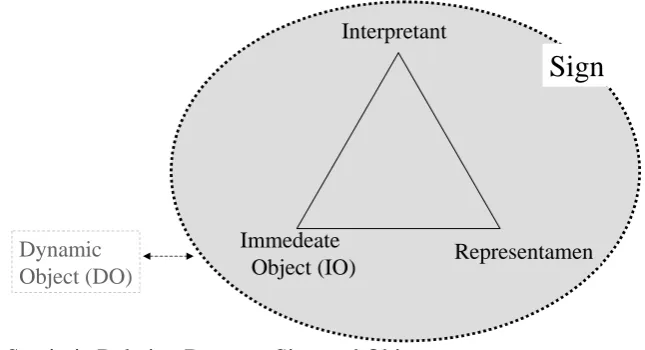
farm/farmer as interpreter. The immediate object “an animal producing milk for en income” stands in a relationship with the actualized and unfolded potentiality of the dynamic object that we have just referred to as a cow.
Interpretant
Representamen Immedeate
Object (IO)
Dynamic Object (DO)
[image:6.595.134.457.140.315.2]Sign
FIGURE 1: The Semiotic Relation Between Sign and Object
If we substitute the interpreter with a ‘nature conserver’, the cow as representamen could refer to the immediate object “an animal that keeps the meadows free of tree seedlings”. Other interpreters can be introduced which may add to our picture of the dynamic object, but always in terms of more immediate objects. It is important to stress that, in Peirce’s sense, there is no position from where we can observe the dynamic object as such, every perspective only adds to the number of immedi-ate objects that refer to the dynamic object. This is a central understanding that penetrimmedi-ates our inter-pretation of ANT, systems theory, and existentialism. Epistemologically there is no way in which we can grab the dynamic objects as entities, only as immediate objects, and every attempt to make such an entity description will only add to the number of immediate objects that can be associated with each other and with the dynamic objects. Only as a second order observation (an observation of the observations of immediate objects) we can reach a more (but never fully) comprehensive un-derstanding of the dynamic object.
Peirce helps us to understand that signs always belong to observers, but also depend on the potenti-ality of the dynamic object. The notion of the dynamic object may therefore also be understood as an ontological abstraction of the “Ding-an-sich” prior to any observation or labelling.
Furthermore we would like to add a second meaning to ‘dynamic’ apart from Pierces independent “really efficient object”. This second meaning refers to the evolutionary dynamic interaction be-tween the dynamic object and the immediate object, which as a co-evolutionary process contributes to the potentiality of the dynamic object; in other words, the fact that our interactions with the world influence the potentiality of the world.
Actor-Network
Actor-Network Theory is a theory (or rather a network of theories) that was developed by primarily Bruno Latour, John Law and Michel Callon, but many authors have contributed to it (se e.g. Law & Hassard, 1999).
"I simply want to note that actor-network theory may be understood as a semiotics of mate-riality. It takes the semiotic insight, that of the relationality of entities, the notion that they are produced in relations, and applies this ruthlessly to all materials - and not simply to those that are linguistic" (Law, 1999:4).
There are a number of concepts that are used by the actor-network theorists to methodologically op-erationalize this kind of thinking. We will only highlight a few here, which are necessary to under-stand a farm enterprise as an actor-network. The first one is the notion of an actor:
“An ‘actor’ in ANT is a semiotic definition – an actant – that is, something that acts or to which activity is granted by others” (Latour, 1997:6).
In accordance with this definition we will use the term 'actant' for the actors of ANT. The notion of an actant is not linked to the quality of the entity as such, but to the quality of the entity in the frame of the network into which the entity is mobilised:
“ …For the semiotic approach tells us that entities achieve their form as a consequence of the relations in which they are located. But this means that it also tells us that they are per-formed in, by, and through those relations” (Law, 1999:4).
When Peirce is translated into ANT terminology, the immediate object is equivalent to the actant of actor networks. The sign is the context of the actor-network in which the immediate object become an actor in some respect or capacity to the network. And like the immediate object only exists within the triadic sign in the presence of an interpretant, the “actants” only exist within actor net-works. An important point to stress here is that ANT has, to our knowledge, no notion of the world ‘an-sich’ similar to Peirce’s notion of “dynamic objects”. Instead, the notion of entity is used but somehow the notion of actor and entity melt together in the notion of artefacts - an artefact can be an actor in an endless web of actor-networks. As Bruno Latour states, ANT holds an ontology of endless webs of actor network:
“… the social is a certain type of circulation that can travel endlessly without ever encoun-tering either micro level – there is never an interaction that is not framed – or the macro level - there are only local summing up[s] which produce either local totalities (‘oligop-tica’ [structure viewed from one position. Authors' note]) or total localities (agencies)” (Latour, 1999:19).
The notions of endless circulation and local summing up leave ANT with very fussy ideas of or-ganisation and are obstacles to understanding an actor-network as a self-organising system (Noe & Alrøe, 2005). The reintroduction of semiotics and the notion of dynamic objects into ANT impli-cates a radical break with some of the core ideas in ANT but does not violate the radical idea of a heterogeneous semiotic network.
Given the surplus of partiality or possibilities linked to each dynamic object, one may easily realize how important it is for the coherence of the production strategy and the economical results of the farming processes that all interactions in the actor-network are balanced in accordance with the strategy of the actor-network. An example to illustrate this is Ewert & Browns’s (2003) case de-scription of the quality of labour in the reconstruction of wine production from low-quality to high-quality wine. A farm enterprise that produces grapes for low-high-quality wine cannot easily reorganise its network strategy to produce grapes for high-quality wine without other changes of the network. It takes, among other things, a retraining of low-salary workers to high-salary skilled workers, and their mobilisation into the actor-network.
ANT is a framework to understand and visualise the heterogeneity and complexity of a farm enter-prise, and to stress the importance of coherence in the network–strategy. A farm enterprise can be explained as the coherence of how the dynamic elements (artefacts, objects, product companies, people, etc) are involved in the network strategy. Not only in terms of technical coherence as Bar-bier & Lémery (2000:385) stress, but as the coherence of the entire socio-technical network includ-ing sense-makinclud-ing and social interaction. However, ANT has a very weak theoretical expression of how this cohesion is produced and reproduced. In our view, the encompassing world of the actor-networks continuously produces an oversupply of possibilities and options, and any coherency must be ascribed to network internal operations, and thereby to a process of reference and self-organisation (see figure 2).
Farm Enterprises as Autopoietic (Self-Producing and Self-Organising) Systems
20
9
34 27
6 10 17
42
22 24
37
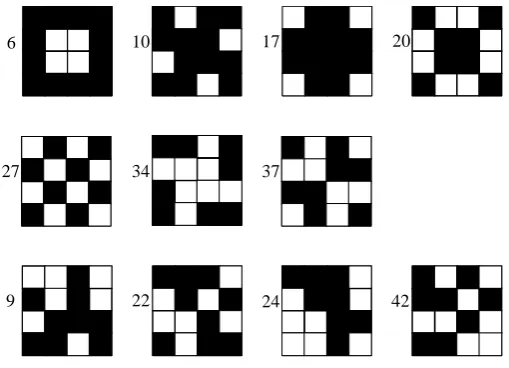
FIGURE 2 :
Examples TOB Patterns with High Redundancy: # 6. 10. 17. 20. 27. 34. 37. Low Redundancy: #9. 22. 24. 42. (From Maruyama 1995).
Theories of autopoiesis have been elaborated especially within biology by Maturana & Varela (1980) and by Bateson (1972). Luhmann has translated their theories into a comprehensive theory on the self-organisation of social (communicative) systems (Luhmann, 1984).
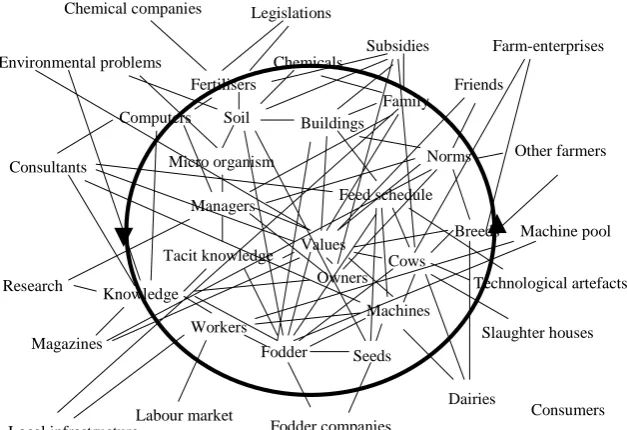
[image:9.595.172.427.82.266.2]Other farmers Dairies Consultants Fodder companies Labour market Breeds Chemical companies Soil Buildings Cows Workers Machines Family Knowledge Slaughter houses Owners Farm-enterprises Micro organism Seeds Research Machine pool Friends Consumers Magazines Technological artefacts Values Computers Feed schedule Subsidies Legislations Norms Environmental problems Local infrastructure Managers Chemicals Fodder Fertilisers Tacit knowledge FIGURE 3
A Simplistic Illustration of a Farm as a “Self-organising Actor-network”. In ANT there is no Hier-archy of Interaction. Heterogeneous Actors like Knowledge, Machines, Livestock and Chemical Products are all at the Same Level of Interaction in the Network. The Circle Illustrates the Neces-sary Process of Self-reference and Self-organisation to make the Mobilisation and Coherence of the Farming Network Possible.
To illustrate this with a realistic example from farming, imagine that you as farmer ask a range of persons such as the bank advisor, cattle adviser, veterinarian, and gross dealer, what would be the optimal strategic actions to perform from each of their perspectives, it is most likely that the merg-ing of their devises, if possible at all, will lead be a strong mismatch between these different ele-ments of farming, far from a coherent strategy. This creation of coherence must be a system-internal and self-referential operation, by which the system draws its own operational boundaries
The self-organisation of such heterogeneous social systems, as autopoietic systems, is then a proc-ess of increasing of nonredundant complexity. Every selection of objects, and of the meaning that is linked to these objects (created by the autopoietic system), which are enrolled as actants and inter-mediates into the actor-network, adds to the complexity of the network/system.
Autopoietic systems are seen as operationally closed systems, which means operationally self-sufficient and self-generating systems without (operational) input from the outside. This means that an autopoietic system has to produce its own internal system rationality or schema at its disposal. This also means that the system must produce its own input for operation (Foerster, 1984; Maturana & Varela, 1980; Luhmann, 1984).
tempo-rary price fluctuations, or is it a permanent decrease due to decreased demand or harder competition on the world market. Finally, the reaction by the system to this input will again depend on the sys-tem: some will just carry on believing that the situation will improve again, others will start work-ing harder, some will change their strategy, and again others will give up dairy farmwork-ing. So, it is the internal schema of the system and not the specific quality of the perturbation that defines how a sys-tem reacts to a certain perturbation. The notion of autopoiesis thereby leads to a general understand-ing of observation, namely, that it is the internal complexity of the system that is limitunderstand-ing the capa-bility of the system to observe itself and the capacapa-bility to observe the encompassing world.
Finally this autopoietic understanding of enterprises implies that the coherence of a farm-enterprise cannot be explored by studying only the elements that are enrolled into the system. The coherence needs to be studied from the perspective of the system/network – the network-strategy to coherence. The farming styles studies can be used as examples of how such operational boundaries can be stud-ied (Ploeg, 1994; Noe, 1999). Chiffoleau (2003) has committed some interesting studies of the way different strategies form different clusters of interrelationships. In these studies, farming systems are typologized with respect to the meaning around which they are organised.
Logo-Poietic Organisations - an Existentialist Understanding of Enterprises
The above theories deliver many answers to the questions of how an enterprise is organised. How-ever, they provide us with no answers to the question of why enterprises are organised. In biology there is a strong genetic coding for reproduction of the species, but this mechanism cannot readily be translated to the autopoiesis of organisations. We will therefore draw on some of the core ideas of Frankl’s logo-theory, building on the existentialist tradition of Kierkegaard and Sartre.
Victor Frankl (1984) claims that the unity of a human being cannot be found in a reduction in the multitude of perspectives, but in the overlaying guidance of meaning. Based on his experience in the concentration camps during World War II, Frankl developed a logo-theory and logo-therapy that emphasizes the role of the "will to meaning" for survival: that we as humans continuously need to find and reproduce a meaning of life to carry on. In the KZ-camp it was a well-known phenomena that a man who no longer was able to believe in any future of his own, was lost. It often occurred very suddenly, and then he stayed in his barrack, laying in his own urine and feces. Nothing could bring him out of this situation, threats, prayers or blows; every attempt was in vain (Frankl, 1984).
This loss of meaning Kierkegaard (1844) describes as a contingent freedom to choose through his notion of “Angest” [Anxiety] (translated by Reidar Thomte and Albert B. Anderson 1980):
“Therefore, I must point out that it [anxiety] is altogether different from fear and similar con-cepts that refer to something definite, whereas anxiety is freedom’s actuality as the possibility of possibility (1980:42).
Anxiety is neither a category of necessity nor a category of freedom; it is entangled freedom, where freedom is not free in itself but entangled, not by necessity, but in itself (1980:49).
own possibility, laying hold of finiteness to support itself. Freedom succumbs in this dizziness (1980:61).
Whoever is educated by anxiety is educated by possibility, and only he who is educated by possibility is educated according to his infinitude. Therefore possibility is the weightiest of all categories. It is true that we often hear the opposite stated, that possibility is so light, whereas actuality is so heavy (1980:156).
What I am saying here probably strikes many as obscure and foolish talk, because they pride themselves on never having been in anxiety. To this I would reply that one certainly should not be in anxiety about men and about finitudes, but only he who passes through the anxiety of the possible is educated to have no anxiety not because he can escape the terrible things of life but because these always become weak by comparison with those of possibility (1980:157)”.
In Sartre’s words, the individual is inauthentic if satisfied with the present situation and incapable of imaging that things can be otherwise. The individual is authentic by realizing the defects of the pre-sent situation and creating a future, which negates the prepre-sent and is negated by the prepre-sent. For Sartre, authenticity is when we become aware of our freedom to choose (Sartre, 1943). Maruyama (1979), in his analysis of the Moratorium syndrome, stresses the importance of authenticity of insti-tutions and organisations in terms of clear goals and visions, and he has in several other articles dealt with how goals can be put ahead of the technological development (Maruyama, 1972, 1979, 2002b).
The meaning(fulness) of an enterprise must always refer to something in the encompassing world. Self-realisation as a goal in itself cannot substitute this reference to the encompassing world. As Frankel claims, the more a man strives for self-realisation as the end goal, the further away from realisation he moves. Only by referring to meaning in the encompassing world, is
self-realisation possible as a by-product or spin-off (Frankl, 1984). Frankl uses a chess metaphor to de-scribe the contextuality and dynamics of meaning. If you ask a chess player what the best move in the world is, he will tell you that it depends on the actual position on the board and the person against whom you are playing. Furthermore the creation of meaning becomes a pre-rational condi-tion for any racondi-tional operacondi-tion, just as it is not possible to believe in God as a racondi-tional choice, merely because we know that it is good for one’s psychological well-being to do so.
Just as meaning is essential to the unity and survival of a human being, we claim that meaning is es-sential to understand the unity and internal coherence of self-organising heterogeneous social sys-tems/networks like enterprises. As Maruyama expressed it: “For an institution or organisation to be authentic it must be able to transcend itself, just as an authentic individual transcends
LOGO-POIETIC ORGANISATIONS AND THE CHALLENGE TO THE MANAGEMENT OF MULTIDIMENSIONAL FARMING
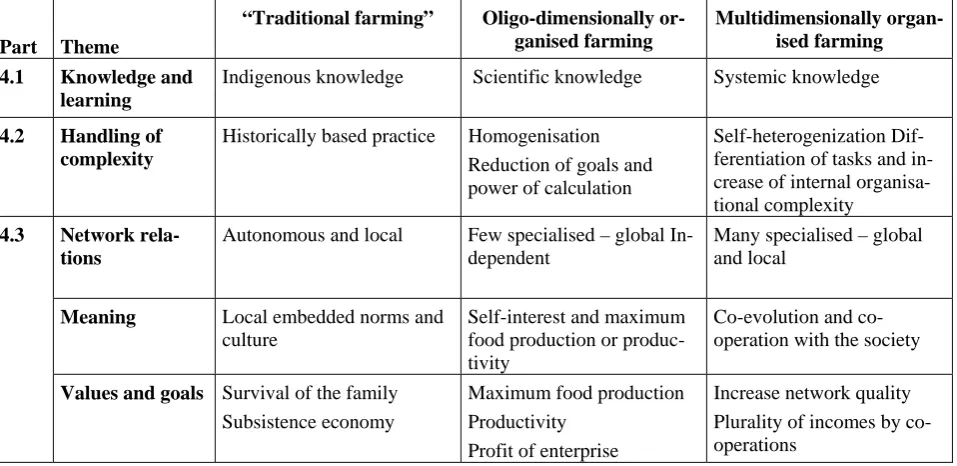
Above we have outlined a logo-poietic framework that strives to understand an enterprise from a poly-ocular view as a self-organizing, heterogeneous actor-network that is driven and produced by its will to meaning. In the following sections we will use this framework to analyse and discuss the challenges of the transition process of farming into multidimensional farming. In order to base this analysis on the reality of the farms, we will take of in a historical description of the transition of farming from traditional farming to oligo-dimensional farming and further to multi-dimensional farming, as outlined in the introduction to this article. Table 1 gives an overview of how the analy-sis is organised and some of the major findings.
[image:13.595.57.536.429.662.2]The entrance to this analysis is that an increase in the number of dimensions that are taken into ac-count implies a tremendous increase in internal complexity both redundant and non-redundant, which needs to be handled. Furthermore, it is the capacity of the enterprise that limits the complex-ity that can be handled, both in terms of the internal network complexcomplex-ity of the enterprise and in terms of “umwelt” complexity, such as the kind of changes and differences that the enterprise can observe and react upon. We here use Uxeküll’s notion of “umwelt” as the systems phenomenologi-cal representation of the encompassing world, which means that the umwelt belongs to the system and not to the encompassing world (Alrøe, 2000; Uxeküll, 1982). In the following, we will discuss how and to what extent multidimensional farming can be developed without loosing the productiv-ity of specialisation linked to oligo-dimensional farming.
TABLE 1 An Overview of how the Analysis of the Challenge to Management of Multidimensional-ity is Organised and some of the Major Findings
Part Theme
“Traditional farming” Oligo-dimensionally or-ganised farming
Multidimensionally organ-ised farming
4.1 Knowledge and learning
Indigenous knowledge Scientific knowledge Systemic knowledge
4.2 Handling of complexity
Historically based practice Homogenisation Reduction of goals and power of calculation
Self-heterogenization Dif-ferentiation of tasks and in-crease of internal organisa-tional complexity
Network rela-tions
Autonomous and local Few specialised – global In-dependent
Many specialised – global and local
Meaning Local embedded norms and culture
Self-interest and maximum food production or produc-tivity
Co-evolution and co-operation with the society
4.3
Values and goals Survival of the family Subsistence economy
Maximum food production Productivity
Profit of enterprise
Increase network quality Plurality of incomes by co-operations
Knowledge and Learning
inter-woven in a larger network of interdependent relations with the society in terms of economy, knowl-edge, supply etc. But when there is an external or internal wish of a rapid change of goals and reor-ganisation of the management processes, such a local, embedded practice shows considerable iner-tia and is difficult to change. Norms and rituals become out of context and are seen as major obsta-cles to modernisation.
The modernisation process of agriculture in the direction of oligo-dimensional farming changes the idea of ideal knowledge (to base the organising of the farming processes) from local contextual knowledge to general acontextual scientific knowledge. In this modernisation process we can ob-serve a coevolving and symmetrical process in the way in which agricultural knowledge has been produced and the way in which farming has been organised (Norgaard, 1994). The ideal of scien-tific research became to focus on one or two factors and to keep all other possible factors stable in order to isolate the significant effect of the input on the resulting output. The strong and, for the in-crease of productivity, very successful rationale of oligo-dimensional farming is the power of the reduction of the number of dimensions and increasing control, combined with a narrowing of goals. But when it comes to multiple goals, the paradigm of reduction shows its shortcomings in handling the explosion of additive complexity in multidimensional farming. The increasing computer power has not solved these problems, so far (McCown, 2001). These computer programmes either become very narrow in their perspective or based on very naive assumptions about the effects and relations.
In order to apply the knowledge generated within the paradigm of reduction, the farmers needed to keep the context as simple as possible, keeping all other variables constant. To illustrate this, the majority of cows in Denmark in the mid 70s were being kept on stable around the year, presumably because of a wish to be in control and to make conditions that matched the fodder experiments; even though this was detrimental to the welfare of the cows and a more expensive way of feeding them. The main reason for science not to produce results from grazing was that it was impossible to make this kind of fodder experiments in a scientifically acceptable way.
The management of multidimensional farming has to cope with multiple goals and aspects in the systems environment. The logic of generalised scientific knowledge as the basis for optimizing mul-tidimensional farming is collapsing under the exposure of complexity and contextuality. Although it might be possible to build a complex multidimensional model for the optimization of one system, this cannot be readily applicated to other systems because the different organisations and contexts of the enterprises.
Instead, multidimensional farming needs to draw on the notion of systemic knowledge, defined as knowledge that is mobilised within the system about the system’s interaction with its “Umwelt”. In this context, knowledge is defined in a very broad sense, as the system’s expectation of “what would happen if”. It includes expectations of the outcome of changes in the system’s internal op-erations, such as “what will happens if the enterprise decides to decrease the level of fertiliser”. And it includes expectations of what would be the outcome of changes occurring in the “umwelt”, such as “what will the outcome be of the implementation of a new legislation”. Systemic knowledge can be represented within the system in many ways in terms of beliefs, myths, stories, tacit knowledge, intuition, formalised rules and models – all that the system knows about itself and its environment.
1. Translation of scientific (“a-contextual”) knowledge, which means transferring knowledge produced within another context into the context of the farm enterprise
2. As a learning process (Bawden, 1991) through reflexive processes between outcome ex-pected (involving values and knowledge) and outcome observed
3. Systemic research paradigms that try to focus more on the systems context, in which the in-teraction that is studied, is embedded, than to isolate the inin-teraction from their embedded-ness (Alrøe & Kristensen, 2002). Farming systems research is an example of these ap-proaches (see e.g. Conway & McCraken, 1990; Mogensen & Kristensen, 1999) 4. Co-learning by identification of similar farming practices (Ploeg, 1994) or cooperative
learning processes through social or institutional organisations (Barbier & Lémery, 2000) 5. Self-heterogenization: mobilising people with different skills and competences into the
communicative management and learning process of the enterprise (Maruyama, 1980, 1984, 1985, 2002a, 2004b).
The fifth way may need some further explanation because it has to be understood as a true emergent property of the system/network, belonging to the “mind” of the enterprise, applying Bateson’s (1972) terminology. It should not be confused with the notion of functional differentiation. This kind of learning presupposes at least three different conditions of the enterprise: 1) acknowledge-ment of individual heterogeneity as a positive feature of the enterprise, 2) authenticity as a shared consciousness of the contingency of choice and a meaningfulness of the enterprise that refers to the surrounding world, and finally 3) the ability to increase and handle this nonredundant complexity within the enterprise (Maruyama, 1980, 1985, 2002a, 2003).
The learning processes of an enterprise may involve more or all of these approaches simultane-ously, but with Barbier & Lémery (2000:348) it is important to stress that there is “no learning without change”. Systemic knowledge is about how the system views its environment, and thereby how it organises itself. Then, knowledge is not necessarily a building where more and more bits are added to the construction.
Ways of Handling Systems Complexity and Network Coherence
An increase in systemic knowledge does not necessarily lead to multidimensional management. This also requires that the system is able to handle the increased dimensions and to create a connec-tion and coordinaconnec-tion between the different fields. The call for multidimensionality therefore neces-sitates a dramatic increase in the internal nonredundant complexity of the system if it is to observe and handle the entirely different dimensions. For example, a farm enterprise needs to have a notion of nature quality and knowledge on how to take up nature quality as a goal in the decision-making, if it is to handle this dimension of farming. Although we cannot understand this as a simple zero-sum game, there will be some kind of trade-off between specialisation and generalisation. The his-torical analysis gives a basis for identifying three different strategies to improve the management of complexity.
and sons for inheritance of the farm. Most operations are habitual, and only relatively few opera-tions are open for individual making, in return more focus could be put into these decision-makings, mainly in terms of observations. Organic farming is an example of a modern version of “concept management”, where more concerns are built into the organic way of farming through prescriptions and practice. However, also examples of less comprehensive concepts can be given, such as the “Israeli model” of heard health management, a health cooperation agreement between the veterinarian and the dairy farmer, which prescribes an array of routinised actions to be taken, and which presumes certain goals of production and a certain foddering strategy.
The “partial optimisation model” has it roots in the modernisation process and rational choice movement. The project of modernisation was to move from farm management based on practice and tradition to ‘rational choice’ decision-making. The key elements of this strategy were to re-duce the complexity of production by reducing the numbers of products and heterogeneous ele-ments involved in production, and by isolating each product for partial optimisation, keeping all other factors constant. For example, decision-making in the stable and in the field has become largely independent of each other (this can be seen, for example, by the way in which agricultural research as well as the advisory service has usually been organised).
The partial optimisation model’s answer to the management of increased complexity is functional differentiation, where each perspective is handled and optimized by a specialised body, and where the coordination between the different dimensions is negotiated through a trade off between the dif-ferent dimensions. The OECD approach to multifunctionality builds on such a partial optimization model, where the different dimensions are translated to commodity and non-commodity goods. The weakness of the partial optimisation model is that the “communication” between the different per-spectives or dimension becomes very primitive, in terms of discovering synergic and antagonistic mechanisms between the different dimensions. An example to illustrate this could be the synergy between milk production, nature preservation, and agro-truism. A combination of these three as-pects would probably be seen as suboptimal from each perspective, although the synergy effect could turn out to be better than the partial optimization.
The “communicative model” is rooted in “post-modern” management theory, and builds on an ex-plicitation of meaning and values as communicative mediators between each dimension of man-agement. Meta communication (communication about how to communicate within the enterprise) and meta-reflection (reflections about how to learn and reflection) are central elements in this man-agement strategy. One example to illustrate how this model operates could be the involvement of the workers and experts into the value and strategy discussion of the firm by enrolling them as shareholders, and through this to make the vision of the enterprise a part of every decision and op-eration made within the enterprise.
Whatever strategies are applied to increase systems complexity, there is a need for an increasing ef-fort to secure the internal coherency of the actor-network strategy. This sense-making convergence process becomes more and more important with increasing complexity as a communicative process within the actor-network between humans and organisations that are enrolled in the network strat-egy.
Multidimensional Farming, Network Relations, Meaning, Values and Goals
multidi-mensional farming is not only an internal process of the farm, but also a process of co-evolution (Norgaard, 1994) between the different actors and actor-networks/systems. Just as traditional farm-ing was interwoven in a complex, local network of interaction, multidimensional farmfarm-ing needs to be interwoven in a network of both local and global actors, in terms of labour, knowledge, advisors, interest organisations, etc. (see e.g. Vanloqueren et al., 2003).
In the paradigm of oligo-dimensional farming the surrounding actors (the market) are regarded as independent of each partial decision. In the paradigm of multidimensional farming, development necessarily has to be understood as a process of co-evolution, and each decision may have an im-pact on the surrounding actors and visa versa. In this dynamic perspective, agricultural sciences play a very important role in changing, or not changing, the scientific paradigm from reductionism to systemic contextual knowledge.
Multidimensional farming is a shift in meaning and organising values – a shift in paradigm. In tradi-tional farming, meaning was not an individual task, but was embedded in local norms and cultures. The individual person was not free to choose whether he wanted to be a farmer or not.
The shift to oligo-dimensional farming was closely connected with an ideological break with norms and culture by an individualisation of interest. The goals of maximizing food production had be-come the meaning of farming in relation to the society, separated from other interests and meanings that had previously been connoted with agriculture. In a situation of overproduction and regulation of food production, enterprises organised around the meaning of maximizing food production ended up in serious identical vacuums, an existential crises, as we could observe from the farmers’ very strong reactions against the environmental debate in the 80s in many countries. The meaning linked to farming has been even further narrowed down to the self-referential meaning of profit.
Multidimensional farming can be seen as a search for a new meaning of farm enterprises, where profit is not a goal on its own but a spin-off of the actualisation of meaning in relation to the sur-rounding world.
CONCLUSION AND PERSPECTIVES
Multidimensional farming is a challenge, not only to farm management, but also to the co-evolving development of the surrounding actor-networks. The challenge is how to reframe the problem of in-creased nonredundant complexity, and how to co-evolve a network of multidimensional farming.
From a logo-poietic perspective we would argue that the transition process of oligo-dimensional farming into multi-dimensional farming takes four co-evolving processes:
• a reconstruction of the values and ideas around which the farm enterprises are organised, • a reorientation towards systemic learning and systemic knowledge,
• a reorientation towards self-heterogenization and poly-ocularity, • a reorientation towards communicative management complexity,
• a development of multidimensional network relationships with surrounding actors (actor-networks) that facilitate network building of multidimensional management.
References
Alrøe, H.F. 2000. Science as Systems Learning: Some reflections on the cognitive and communica-tional aspects of science. Cybernetics & Human Knowing, 7(4): 57-78
Alrøe, H. F. & Kristensen, E. S. 2002. Towards a systemic research methodology in agriculture: Re-thinking the role of values in science. Agriculture and Human Values 19(1):3-23.
Barbier, M. & Lémery, B. 2000. Learning through Processes of Change in Agriculture: a Methodo-logical Framework. In M. Cerf, D. Gibbon, B. Hubert, R. Ison, J. Jiggins, M. Paine, J. Proost, N. Röling (Eds.). Cow up a tree – Knowing and Learning for Change in Agriculture: 381-396. Case studies form Industrialised Countries, INRA Paris.
Bateson, G. 1972. Steps to an ecology of mind. Ballantine Books New York. Bateson, G. 1979. Mind and Nature : A Necessary Unity. Bantam Books.
Bawden, R.J. 1991. Towards Action Researching Systems. In O. Zuber-Skerritt (Ed). Action
Re-search for Change and Development: 21-51. Brisbane, Centre for the Advancement of Learning and Teaching, Griffith University, 1991.
Conway, G.R. & McCraken, J.A. 1990. Rapid rural appraisal and Agroecosystem analysis. In M. Altieri & S. Hecht (Eds.). Agroecology and Small Farm Development: 203-218. Boca Raton, Florida. CRC Press, Inc.
Chiffoleau, Y. 2003. Learning about innovation through networks: The development of environ-ment-friendly viticulture. Paper presented at the XXth ESRS Congress 18-22 August 2003, Sligo, Ireland: Working group 1.5, Labour skills and training for multidimensional agricul-tures.
Ewert, J. & Brown, M. 2003. New Skills in the south African Wine Industry: Learning through networks or Innovation from Above? Paper presented at the XXth ESRS Congress 18-22 Au-gust 2003, Sligo, Ireland: Working group 1.5, Labour skills and training for multidimensional agricultures.
Francois. C. 1999. Systemics and Cybernetics in a Historical Perspective. Systems Research and Behavioural Science. 16 ():203-219
Frankl, V. 1947. Ein Psycholog erlebt das Konzentrationslager. Vienna. (Verlag für Jugend und Volk)
Frankl, V. E. 1984. Man’s search for Meaning – an introduction to logotherapy. Third edition, London. Simon & Schuster.
Foerster H.v. 1960. On Self-Organizing Systems and their Environments. In Yovitts M.C. & Cam-eron S. (Eds.) Self-Organizing Systems: 31-50. Pergamon, New York
Foerster, H.v. 1984. Oberving systems (2nd ed.) California, USA: Intersystems publications. Kierkegaard, S. 1844. Begrebet Angest, København Reitzel. Translated by Reidar Thomte and
Al-bert B. Anderson, 1980. The Concept of Anxiety: Kierkegaard's Writings, Vol 8. Princeton Univercity press, New Jersey.
Latour, B. 1997. Om aktør - netværksteori. Nogle få afklaringer og mere end nogle få forviklin-ger. Philosophia 25 (3-4): 47-64. [English version (1996) On Actor-Network Theory: A few clarifications. Soziale Welt 47(4): 369-381. Available online at
<http://amsterdam.nettime.org/Lists-Archives/nettime-l-9801/msg00019.html>]
Law, J. 1999. After ANT: complexity, naming and topology. In Law, J. & Hassard, J. (Eds.),
Actor-Network Theory and after. England. Oxford: Blackwell Publisher.
Law, J. & Hassard, J. (eds.) 1999. Actor-Network Theory and after. England. Oxford: Blackwell Publisher.
Luhmann, N. 1984. Soziale Systeme. Suhrkamp Frankfurt am Main [In English Social systems
(1995). England. Stanford University Press.]
Maruyama, M. 1960. Morphogenesis and Morphostasis. Methodos 12:251-296.
Maruyama, M. 1963. The second cybernetics: deviation-amplifying mutual causal processes.
American Scientist 51:164-179
Maruyama, M. 1972. Toward human futuristics. Co-existence 9: 101-120
Maruyama, M. 1978. Endogenous Research and Polyocular Anthropology in Perspectives on Ethnicity. Ed. R. Holloman & S. Arutiunov, The Hague: Mouton Publisher.
Maruyama, M. 1979. Goal moratorium syndrome. Technological Forecasting and Social Change
15:1-9
Maruyama, M. 1980. Mindscapes and science theories. Current Anthropology 21:589-599. Maruyama, M. 1984. Alternative concepts of management. Asia Pacific Journal of Management
1:100-111.
Maruyama, M. 1985. Mindscapes: How to understand specific situations in Multicultural Manage-ment. Asia pacific journal of Management 2(3)125-149
Maruyama, M. 1995. Individual Epistemological Heterogeneity across cultures and its use in or-ganisations. Cybernetica, 37(3):215-249.
Maruyama, M. 2002a. Metamorphosis: authenticity in institutions and organizations. Methamor-phosis 1(1) 71-86
Maruyama, M. 2002b. How to generate cultural and philosophical goals ahead of technology. Fu-tures Research Quarterly. Spring 2002
Maruyama, M. 2003. Causal loops, interaction and creativity. International Review of sociology
13:607-628.
Maruyama, M. 2004a. Polyocular vision or subunderstanding? Organization Studies, 25: 467-480. Maruyama, M. 2004b. Futurogenic management. Methamorphosis, 3:61-73.
Maturana, H., & Varela, F. 1980. Autopoiesis and cognition. Reidel, Boston.
McCown, R.L. 2001, Learning to bridge the gap between science-based decision support and the practice of farming: Evolution in paradigms of model-based research and intervention from design to dialogue. Australian Journal of Agricultural Research 52:549-571
Mingers, J. 1995. Self-Producing Systems – Implications and Applications of Autopoiesis. Lon-don, Plenum press.
Mogensen, L., Kristensen, T. 1999. Private farms for research in organic milk production in Den-mark. 5th International Livestock Farming Systems Symposium. Posieux. Schweiz, 19-20. august. EAAP publication no. 97. p. 06-101.
Noe, E. & Alrøe, H.F. 2003. Farm enterprises as self-organizing systems: A new transdisciplinary framework for studying farm Enterprises? International Journal of Sociology of Agriculture and Food 11(1) 3-14.
Noe, E. & Alrøe, H.F. 2005. Combining Luhmann and Actor-Network Theory to see Farm Enter-prises as Self-organizing Systems. Cybernetics and Human Knowing. (Accepted)
Norgaard. R.B. 1994. Development betrayed – the end of progress and a coevolutionary revision of the future. London and New York, Routledge.
OECD 2001. Multifunctionality Towards an Analytical Framework. [http://pinguet.free.fr/4.pdf] Peirce C.S. 1897, 1908. Charles Sanders Peirce, Collected papers. Edited by Charles Hartshorne
and Paul Weiss. Cambridge: Belknap Press of Harvard University Press, 1958-1966.
Ploeg, J.D.v.d. 1993. Rural sociology and the new agrarian question: A perspective from The Neth-erlands. Sociologia Ruralis 33(2):240-260.
Ploeg, J.D.v.d. 1994. Styles of Farming: An Introductory Note on the Concepts and Methodology. In J.D.v.d. Ploeg & A. Long (Eds.), Born from Within - Practice and Perspectives of
En-dogenous Rural Development: 7-30. Holland. Van Gorcum
Ploeg, J.D.v.d & Long, A. (eds.) 1994, Born from Within - Practice and Perspectives of
Endoge-nous Rural Development. Holland. Van Gorcum.
Sartre, J.P. 1943. L’Être et le Néant. Paris: Gallimaud.
Sriskandarajah, N., Bawden, R.J. & Packham, R.G. 1989. Systems Agriculture – A Paradigm for Sustainability. Paper presented at the Ninth Annual Farming Systems Research/Extension Symposium, University of Arkansas, Fayetteville, USA, October 9-11. AFSRE Newsletter
2(3):1-5. 1991
Uxeküll, J.v. 1982. The theory of meaning. Semiotica Special Issue 42(1):25-82
Vanloqueren G., Stassart, P. & Bare, P. 2003. Multifunctionality : realities and local stakes
con-struction. Proceedings of the XXth Biennal Conference of the European Society for Rural So-ciology, Sligo,18-22 august 2003
Biographies
Egon Noe is a Senior Scientist at The Department of Agroecology at the Danish Institute of cultural Sciences (DIAS). He holds a Ph.D. in rural sociology form the Royal Veterinary and Agri-cultural University in Copenhagen. His main field of interest is sociology of farm management and decision-making.