Rochester Institute of Technology
RIT Scholar Works
Theses Thesis/Dissertation Collections
11-9-2010
Appendages
Emily WintonFollow this and additional works at:http://scholarworks.rit.edu/theses
This Thesis is brought to you for free and open access by the Thesis/Dissertation Collections at RIT Scholar Works. It has been accepted for inclusion in Theses by an authorized administrator of RIT Scholar Works. For more information, please [email protected].
Recommended Citation
APPENDAGES
EMILY WINTON
THESIS
Submitted in Partial Fulfillment of the Requirements for the
Degree of Master of Fine Arts in Imaging Arts
Rochester Institute of Technology
School of Photographic Arts and Sciences
Committee Members Date
Professor Elaine O’Neil (Chair)_________________________________________
Professor Jessica Lieberman (Second)____________________________________
Professor Tina Lent (Third)____________________________________________
This thesis is dedicated to every moment before this one.
Acknowledgements
This thesis would not have been possibly without the support, guidance, and friendship of my committee members. To Elaine O’Neil, whose knowledge, constant encouragement, friendship, and belief in my abilities helped me to reach my true potential and have the best experience possible while attending RIT. To Jessica Lieberman, who never ceased to amaze me with her quirky outlook, her wonderful interpretation of life, and her knowledge and guidance of endless lengths. To Tina Lent, for her dedication, support, and outside perspective and who became the final piece to my committee composition. These three ladies have made this thesis a truly wonderful experience and I couldn’t have been more blessed!
I want to thank my family and friends for their part in helping to create the person I am today, and for loving me and supporting me on the journey of my life. My parents, who never said no to my education, and who taught me to strive for greatness, and go after my dreams. To my sisters, Molly and Kelly, who helped me to discover my own path, and loved me every wrong and right turn of the way. To my best friend Sam Greene, who listened to every tear, and laugh, and helped me remain true to myself, and face the realities of life. To Erin Mallory, whose love and support helped me to be who I am today. A true inspiration to my thesis, my life, and who will always hold a very special place in my heart. To Sara Tkac for your time, help, and encouragement to help me finish my thesis. Your push was hard but just what I needed!
To my partner Tina Despos, for helping me, not only with endless hours of physical labor, but also for helping me to discover a new side to myself, and continuing to support me and love me. Thank you for opening up your heart to me and sharing so much, this thesis would not be the same without you. I would not be the same without you.
… and now I shall list a few others….whose help is no less appreciated, I couldn’t have done this without you…
APPENDAGES
By: Emily Winton
B.F.A., Photography, University of South Florida, 2006 M.F.A., Rochester Institute of Technology, 2009
ABSTRACT
Appendages explores my sexuality, identity and the concepts of heteronormativity,
queer theory, and gender norms. Through the creation of sculptures called
DilNO’s, I was able to engage the audience in experiencing my interpretation
of my own sexuality. By mocking and bending the concept of the dildo, I was
challenging the stereotypes of gender, and lesbian sexuality and intimacy. The
sensations of touching and feeling played a vital role in both the creation and
presentation of the pieces in my thesis exhibition. Moving from my previous
photographic work into the three-dimensional realm of sculpture helped me
express the physical and sensual dimensions needed for the work. The tactile
experience of the objects conveyed to the viewer aspects of my sexuality as a
bisexual, woman preferred woman, while helping the audience learn more about
their own sexuality. Sharing this part of myself was vital to the work, as were my
journey and the personal discoveries made while making the work. This thesis
started out of a desire to explore my own need for comfort, and helped me to
Table of Contents
Dedication……… ii
Acknowledgement………..iii
Abstract………..………...iv
Table of Contents………..v
List of Illustrations………...vi
Introduction………...6
Strapping It On……….12
The Bear……….15
The Sanctuary………...…19
The DilNO’s………..24
Process and Conceptualization………..29
Influences………..36
Conclusion………39
Afterward………..41
List of Illustrations
Figure Page
1. Untitled, 2005 8
2. Dressing Room Fight, 2005 8
3. Bars and Stripes, 2006 9
4. Untitled (Sink) from Dispositions Series, 2007 9 5. Title Sign for Appendages Exhibition, 2009 12 6. Strapping “IT” On, Video Still, 2009 14
7. The Bear, 2009 17
8. The Bear (detail interior view), 2009 18 9. The Bear (detail paw view), 2009 18 10. The Sanctuary, 2009 21 11. Door Mat/Welcome Mat, 2009 22 12. The Sanctuary (detail Something New), 2009 23 13. The Sanctuary (detail post cards, candle), 2009 24 14. Ribbed for Her Pleasure, 2009 27
15. The Tickler, 2009 27
16. Jolly Green Giant, 2009 29
17. Scanned Sketches, 2008-2009 30 18. The Hugger & Pocket Rocket Fabric Swatches 31
19. The Hugger, 2008 32
20. The Bear (detail fabric) 32
21. Display Card & Swatch Installation 33 22. Strapping “IT” On, Installation View 34 23. Appendages Exhibition View, 2009 35 24. Francesca Woodman, House #4 Providence,
Rhode Island, 1976 37
25. Jenny Saville, Strategy (Triptych), 1994 38 26. Libby Rowe, Learning Feminine, Posture,
and Chin Up, 2008 38
27. Libby Rowe, Panties Portrait, Invitation,
Introduction
“For a woman to explore and express the FULLNESS of her sexuality, her emotional and intellectual capacity, would entail who knows what risks and who knows what truly revolutionary alteration of the social conditions that demean and constrain her.
Or she may go on trying to fit herself into the order of the world and thereby consign herself forever to the bondage of some stereotype of normal femininity– a perversion if you will”1
When I began graduate school in 2006, I had a certain understanding of myself
and where my life was headed. As I sit here today writing and looking back
over the last three and a half years, I question whether anyone will ever fully
understand themselves, or the paths that led them to where they are. My
artwork has always been an attempt to evaluate myself in order to have a
better understanding of who I am or was at the time, as well as an opportunity
to present this understanding to my audience. This is a continuous process of
internal discovery, and outward expression and communication, and while my
art has helped in this process, I feel it will never be done.
My previous work dealt with identity and gender roles, and more specifically,
it dealt with being overweight and my struggles with my identity as an obese
woman. This body of work began in my undergraduate studies, and originated
from the statement of a professor that “all great art needs to be shocking, or hard
to look at.” Combined with my own belief that all art should be personal, this led
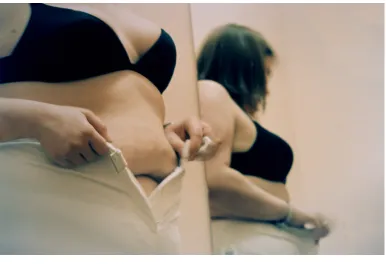
to a series of self-portraits where I
explored the struggles I underwent
as an overweight person (Figure 1),
from trying on clothing (Figure 2),
to eating with friends, dating, and
exercising.
When I arrived at RIT, I wanted to
continue with this body of work but
I knew it needed to evolve. During
my first quarter I completed a series
that dealt with my weight and
[image:9.612.317.540.72.405.2]society’s beliefs about what a heavy fig. 1 Untitled, 2005
[image:9.612.109.495.465.729.2]fig. 3 Bars and Stripes, 2006
person should and shouldn’t wear (Figure 3). During our first quarter review,
Elaine O’Neil (now the chair of my thesis committee), made the statement that
the work dealt less with my weight, and more with, “Where do I fit in?” This
became my question, my statement per se, throughout my work at RIT (Figure 4).
What is my role as a woman, as someone with weight issues, as a queer person,
and how do I fit into the norms society has established?
My thesis is an exploration of identity, sexuality and gender roles. A combination
of socialization and predetermined gender roles, help develop our identities and
sometimes our gender is decided for us before we are even born2. It then takes
the remainder of our lives to break out of the roles and, if we are lucky, discover
who we really are. Breaking through the limitations of these predefined roles,
one is often faced with a constant battle against labels and stereotypes. Gender
is something that I find hard to define; yet it is usually defined by patriarchal
cultures as the binary system of male and female, masculine and feminine3.
There is no room in this arrangement for anything other than the norms 4, and
anything that sneaks in is seen as a threat to the very foundation of our culture,
and so is condemned and banished. Similarly, human sexuality is defined
by a similar binary system, gay or straight, and in my opinion bisexuality or
pansexuality5 is considered waffling and associated with an inability to commit.
This negative label of bisexuality is something that I have struggled with for
2 Based on our sex we are given colors to identify with and told whether to play with dolls or trucks. Chanter, 3 3 Butler, Undoing Gender, 47
most of my “out” life. Oftentimes I found myself changing my label. Ashamed to
say I was bisexual, when I was with a woman for a long period of time I found
it was easier to say I was a lesbian rather than to explain. When I was with a
man I found the term bisexual to be an unwanted turn-on for him. It was often
assumed that I would have a threesome with another women and his male
chauvinist fantasies about “having” two women at once would come true.
It wasn’t until recently that I started to take back the word bisexual as my own.
I had to fight the system which tried to put me in one category or another. Now
I blend the lines and I am who I am, without the label or concern about it. I look
to strip the power from the words. I am interested in breaking the mold, creating
a new one, or working without one altogether. I am investigating my own life to
see where I fall. Am I normal? Abnormal? Which do I prefer? Which one is right?
Right by whose standards? What are my own standards? How can I change
them? Be them? Be me? How has my childhood affected me for the entirety of
my life? What are my preferences? How did they develop? Am I gay, straight,
bisexual, homosexual, pansexual, or just plain sexual?
Why do we feel the need to label others and ourselves? Can we exist without
the labels? What do these labels say about me? What does my resistance
against labels say about me? Why can’t we posses both masculine and feminine
qualities? Or can we? I always liked the nerdy quiet guys, does that mean I
liked were more “masculine,” does that mean I am more attracted to men? Or do
I just like people who possess both qualities? If so, what gender are they? What
gender am I? Being a woman who prefers other women, what are the things I
miss about being with men? Is it the Appendage? Is it wrong if I use a strap-on?
What does it mean to use a fake penis? What would my ideal dildo be? Do I, or
my partner, take on the masculine or feminine roles either sexually or mentally?
In this work I look at my life as a bisexual woman, one who prefers women, and
question how the role of masculinity fits into my life.
From these questions came Appendages. Born out of necessity, the objects in
Appendages explore sexual experiences in my relationships, examine my personal
ideals of marriage and the role of heteronormativity6 in these ideals; Appendages
also considers gender bending, stereotypes, and gender roles. Through this work
I question the supposed need for a binary “system” of gender roles and learned
more about my roles in my own sexual identity.
6 Heteronormativity was coined in 1991 by Michael Warner, referring to the “perceived reinforcement of certain beliefs about sexuality within social institutions and policies.” Clarke, Lesbians Gay Bisexual Trans and Queer Psychology: An Introduction 120.
Strapping It On
The assumption about many female homosexual relationships is often that
sex, without the proper necessities, must be more difficult or lacking in areas.
This is also where, in my opinion, a lot of fear comes from when dealing with a
homosexual relationship. The removal or replacement of one sex altogether is
frightening, and threatening and is seen as unnatural and implausible7. There is
an assumption by some heterosexuals that a solution or an answer is needed to
the obvious missing piece.
The idea of a “missing” member or object is odd to me. I have never felt the
need for “toys” or a penis when in a sexual relationship with a woman. The
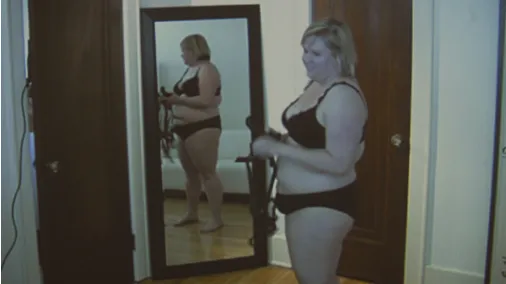
video Strapping “IT” On is a documentation of my first experience trying on a
strap-on dildo. In the video the viewer watches me as I try to figure out how to
put on a strap-on for the first time, as well as my reaction to it once it is on my
body (Figure 6). A prominently placed mirror both captures the full view of me
and my new appendage, as well as shows my expressions and reactions to the
audience. It was important to capture my expression in a completely candid and
unplanned way to share my “virginal” experience as a woman, wearing what is
considered to be a standard in lesbian sex.
The supplemental phallus is something that I have often rejected. This is because
of the assumption that sex is not complete between two women without “it.”
God made Adam and Eve to fit together, and therefore “how do two women fit
together?” In my experience with various partners I have chosen to allow my
partner to wear a strap-on, but I have never worn one myself. It could be seen
as a double standard, but I was against the use of one because I did not want to
feel as if a “male part” was necessary or that there was something lacking in sex
with women. In the past when a strap-on was used, it was for the partner that I
shared it with more than for myself. The dildo carries a weight of strength and
power with it, that comes from the history of the patriarchy and the power of the
man over woman 8, as well as someone being in control of an object of arousal or
stimulation.
The piece Strapping “IT” On,
is a video document; the real
piece is the experience itself.
The reactions I have, as well
as the audience’s personal
reaction, come together to
address issues of gender
bending, stereotypes of gender roles, and personal insecurity. Mixing the roles
of female and male, are issues with which the general public is not comfortable.
The uncommon view of a woman with a penis in this video has caused a range
of reactions. The first being laughter. Examples of this laughter are seen both in
[image:15.612.287.540.399.541.2]8 “…the phallus as the prototype or idealized property of the penis…” Butler, Bodies that Matter, 62.
my role in the video as one who is making myself vulnerable and insecure with
a new experience and the viewers’ discomfort with the voyeuristic view of a
semi-sexual act. Even though there is no actual sex act being performed, there
is the assumed action of sex after trying on the strap-on which is anticipated
throughout the experience.
I believe everyone has a natural sexuality or urge, but our patriarchal system
has socialized us in a way to see only the binary relationships as “valid” sexual
experiences. Thus, there is still vulnerability in the unknown of homosexuality
and its transgressions against heterosexuality. Sex between two women is deviant
from the gender role norms and standards 9. To replace the role of the male
altogether is threatening to the very understanding of the sexual binary system
and the patriarchy in which we live.
“Others devote time and energy regulating our gender, and we spend an even greater amount learning, rehearsing, exploring, and perfecting our gender. By adulthood, our role is inhabited so completely that it feels inevitable. And should the experimentation of childhood inadvertently re-emerge, we find it awkward, embarrassing, and even threatening. Threatening, but not departed. For although it looks like something we are, gender is always a doing rather than a being. In this sense, all gender is drag.”10
The Bear
Growing up, one of my favorite things was getting a really great big bear hug
from my father. It was a hug that squeezed me so tightly that I could almost feel
the love come into me. When he held me it took my breath away. As we get older,
we receive fewer and fewer of these. Being an overweight woman, my experience
has been that it is rare to be with someone who is larger than me, and smaller
people are usually not able to hug me “properly.” Being a women-preferred
bisexual though, this causes some problems. I find that I am with women more
often than men, and this usually means I am the larger of the two. Men are
often taller than me and are able to wrap their arms around me in a near-bear
experience. Sometimes men are shorter or smaller than me as well and both men
and women with smaller body types make it difficult to be held to my liking
in the full bear hug–to be enclosed in someone’s arms and have that feeling of
warmth, love, and security surge through you as they squeeze you, and hold you
without hurting you.
The Bear (Figure 7) is meant to look at the aspects of security in physical contact–
being held by a lover, rather than the psychological aspects of safety and security
of self. This is not to say that I cannot and have not felt secure with women, nor is
it a subconscious attempt at questioning my security in my sexuality. This feeling
of security is emotional. After all, most people like to held by another, or else we
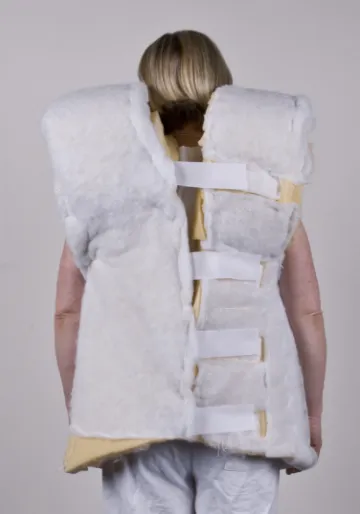
The Bear is a special shirt/suit
that I have created to supplement
this sometimes-missing aspect in
my relationships with people of a
smaller size than me. It has a foam
core with padding in all the right
places to add height and width
to my partner but with a soft and
comforting outer shell. The Bear
is adjustable with Velcro closures
on the backside and is made to
fit women or men who are smaller than myself (Figure 8). I, myself, do not
fit into The Bear. The color and textures are meant to be comforting and sleep
compatible. Sex, as well as cuddling, before bed are some of the most important
moments to feel secure and loved. Therefore the color white was chosen as the
ideal expression of serenity and peace. The texture is one of the softest I have
personally ever experienced in a fabric and I thought it only appropriate to use it
for such an intimate experience.
The arms of the shirt are left foamless so that the actual arms of the person can
be felt and experienced. Though they are still covered in the fabric, you are still
able to feel the shape of the arms just with an added textural encounter from
[image:18.612.324.540.71.361.2]the supple material shell. The hands of the shirt mimic an old children’s toy (I
believe I had a monkey) with paws that
have Velcro pads that lock onto each
other (Figure 9). It makes the hug a
semi-permanent experience, and only through
the pulling away of the hands can the
Velcro be separated. This is important to
the act of the hug, the hold, and being held
securely by someone you care about.
Though The Bear acts as a costume for my
partner, it is not meant to change who they are, only the shape of them. I have
left a space for the face and legs so that they are still able to move, speak, talk,
kiss, etc. This is important because I am not looking to replace or change them
but only “improve,” or enhance my experience with them. Ultimately it is about
the physical experience.
The Bear is not gendered. It has an ambiguous
shape, with no breasts, no pectoral muscles,
no curves other than the form it will obtain
from the wearer. It is not meant for one sex
more than another, only for “size-inhibited”
persons. I find comfort in the fact that The
[image:19.612.109.289.72.329.2]Bear has no gender. It is meant for woman
fig. 8 The Bear (detail interior view), 2009.
[image:19.612.367.542.502.721.2]and men. It is simply our socialization and biological knowledge of men
normally being larger, and “stronger” than women, which gives gender bias to
the piece and characterizes The Bear as masculine 11.
Those same standards of gender roles and stereotypes may be applied to the
exterior cover of The Bear, where the more womanly or feminine, soft sensual
exterior lies. This blend of genders is a true example of my own preferences for a
life partner, as well as an expression of my own sexuality and sensuality. The Bear
puts my partner at an equal level to my own– same size or closer to the same
size. This equality and exchange of roles is something that is very important in
my relationships.
The Sanctuary
Marriage is something that every little girl is supposed to grow up thinking
and dreaming about. As a little girl I mimicked the roles my mother and father
played with my Barbie and Ken dolls. I grew up thinking that I needed to be
a certain way and do certain things in order to have a fulfilled life. Recently a
friend asked me what I wanted to be “when I grew up” when I was younger. I
replied “a mom.” That was the only career choice I could think of as a child. I had
the diaper bag for my dolls and planned out when I was going to get married (at
22), have kids (at 25), how many (2), boys or girls (one of each), etc. Those years
have passed and when I think about where I was supposed to be, I laugh. I laugh
because, I don’t want kids, and the thought of being a mother is one of the most
frightening things to me ever.
So what do I do with these left over “dreams” I had as a child? Faced with the
reality of same-sex marriage being illegal contrasted against the preconceived
notions that I would one day get married brought me to a crossroads. The
Sanctuary is a collection of found objects and hand-made items that deal with my
issues of confusion, rebellion, and the ideals that heteronormativity have placed
within my own thinking (Figure 10). The urge to place heterosexual roles into my
homosexual relationships come from an ingrained need to fit in, a societal need
for conformity, and fear of the unknown12.
So what is it about marriage that keeps us wanting it? Is it an institution or
an ideal? I know that I can’t picture my wedding, but does that mean that I
shouldn’t have one? Does it matter anyway since I am not allowed to marry
the person of my choosing? If it were a woman, would we both wear dresses?
Would/Could it be in a church? All of these things, I face on a daily basis. The
ideals of marriage have been laid out for centuries, but do I want to come into
that stereotypical world? I do (I think). But would my marriage would be far
from typical?
In this installation I take pleasure in mocking the stereotypes. The image of
“man and wife,” diamond rings, the white dress, the groom– these things make
me laugh. They don’t fit into my picture. The tradition is lost with me. I guess
that’s where all the current cultural complaints about the “sanctity of marriage”13
come in. Showcasing your name on your towels or your rug or even a plaque
on the wall, the announcement at your wedding are all part of the traditions
surrounding being married within the patriarchy that I have learned. How do I
fit into that? What would objects belonging to me and my partner look like?
In The Doormat/Welcome Mat (Figure 11), I look at the idea of taking my
partner’s last name. This act challenges the traditional role of the woman taking
on the male’s name as a sign of ownership. This coincides with the history of
marriage as a business deal and the bride as a purchase prize 14. By combining
13 The Advocate, 29-31.
[image:23.612.110.539.252.522.2]14 In an arranged marriage, the marital partners are chosen by parents, community elders, matchmakers, or religious leaders in an effort to guide young people through the process of finding the right person to marry. New World Encylclopedia.com.
my last name with the first initial of my girlfriend’s last name I am creating a
blend of the names. This shows the equality in the relationship as well as playing
with the traditions of taking on a name.
In Something New (Figure 12), I play with the idea of a traditional wedding gift.
I created a hand-embroidered handkerchief with my new last name(s). The
switching of pronouns and last names, is part of the challenge that I face trying
to fit into the predetermined roles of “man and wife.” Also in questioning the Mr.
and Mrs. and Ms. or Miss with which last name to take I am again showing how
my lifestyle does not fit into these standards and how heteronormativity does not
[image:24.612.110.540.220.494.2]easily apply to my life.
The postcards and
memorabilia (Figure 13) in
The Sanctuary are glimpses
of my humor on the subject
of gay marriage. I find joy
in trying to imagine my life
in these drawn out ideals. I
do have a desire to be a part
of this world but in my own
way. The picture perfect wedding is not part of this dream. Instead I want a red
or black dress, I don’t want a diamond, but a ring is a nice idea and symbol.
I have a great internal struggle when it comes to marriage. It is an institution,
but one which continues the gender roles along a path of sexism. Fitting a
homosexual relationship into this institution is a continuance of heteronormative
thought. The civil rights for heterosexual and homosexual relationships as well
as transgendered, bisexual, and all other forms of sexual expression should
be the same. I want the right to be married but under my own traditions. In
The Sanctuary, I explore the beliefs I have known, abandoned, sustained, and
reinterpreted. If there is no man present in my wedding, how do the ideals of
the great American family change for me? Do I need a man in order to have a
“family.” Do I need children? Do animals count as “children?” The manipulation
[image:25.612.108.370.72.299.2]of objects within The Sanctuary gives form to my ideals of marriage and family.
The DilNO’s
When I first heard about “lesbians” as a child, I was told a horrific story of how
women would get together and use broomsticks and plungers to have sex. I was
appalled. This was not a topic I felt comfortable discussing with friends and
family. For a very long time I believed this story. It was not until much later that I
found out it was not quite realistic 15.
But there was the question of “How do two girls have sex?” I heard this question
often growing up. I think this question goes further back into the idea that “a
man and a women fit together”16 so a woman and a woman could not possibly fit
together. The nature of this “unnatural” union was curious. What sorts of objects
or positions were needed for such things to occur? Then of course there is the
supplemental penis, the dildo, the strap-on, vibrator or “toy” that is necessary to
obviously replace the lacking “piece” to achieve a connection.
The DilNO’s were created as an opposition to this “piece.” They are both
a replacement of the penis or male role in sex with two women and a
representation of the emotions, reactions and enjoyment that results from two
women being together. The shapes I created range from phallic to furniture-like,
15 This thought is not realistic to the current time period, but during my thesis work at RIT, I actually received a book from a friend titled “The Ways Homosexuals Make Love” by Michael Bellows. It was published in the 70’s and was Volume 2 in a series detailing sex techniques of homosexuals. This particular one, was the female to female version, which included detailed descriptions and pictures. I was a little appalled to find that they actually talked about broomstick handles as an adequate replacement object of desire, along with dildos, and fruit, 300.
from large to small, soft to hard. The DilNO’s represent my re-interpretation of
the dildo as a “necessary” object in a lesbian relationship. It is a re-owning of the
dildo, not the penis. The textures and fabrics used are references to the emotional
connection as well as the sensuality shared between women. These vary in
many ways, but all seem to have an overall connection of “softness” or coziness.
This distinction shows the comfort that I feel and express when thinking of
homosexuality, as well as the comfort of the body and the form of the woman
itself.
Each DilNO acts as both a representation of a sex toy, as well as an example of
the love and compassion that I feel in my relationships. The colors and shapes
of each DilNO say something about each piece. The colors were sometimes
chosen by my mood at the time. Either the idea for the piece came first or the
fabric inspired me in some way. The colors help to represent the emotions
connected with each piece. Some are bright, playful and seen as more fun or
happy, while others are darker, richer representations of the close, expressive
passion of sex and emotion. The experience with each object can be subjective,
depending on the viewer. Since sex and sexuality are experiences as well as
expressions, it is important for my audience to be able to touch The DilNO’s in
order to fully appreciate and understand the work. The textures chosen, as well
as the experience of touching, help communicate my personal perspective to
the viewer. They can feel what I feel, indulge in the fabrics and textures, and
fig. 14 Ribbed for Her Pleasure, 2009
and have them wrap around you, like in Ribbed for Her Pleasure (Figure 14). Or
to touch the bouncy fingers grabbing at you in all direction like with The Tickler
(Figure 15).
In addition to the experience of sex, the pieces ask the viewer to explore his or
her own sexuality. Sexual preferences are cultivated through out one’s lifetime.
Through the textural approach to the DilNO’s each person is able to discover a
little more about their own sexuality and preferences. Both men and women are
offered an opportunity to explore things they may not normally enjoy. While
each DilNO is my own direct representation of female-to-female sensuality,
gender lines bend because of the references to real dildos through the different
piece’s titles and concepts. Some pieces, like the Jolly Green Giant, take on
the phallic form to re-represent the dildo, but also have blatant rejections of
masculinity (Figure 16). The hard, powerful, stiffness of the phallus has been
removed from all of the DilNO’s; instead they are fluid, soft forms. This does not
make the DilNO’s any less powerful. They are untraditional in the definition and
understanding of the word power17 and fit into the redefining theme of the work.
The DilNO’s gain power through the untraditional, non-gendered experience of
the audience. The socio-cultural and political expression of maleness is what we
are already aware of when we think of the word masculine . While the DilNO’s
are non-gendered, they do possess masculine and feminine qualities. They are
accessible and experienced by all, and therefore represent a blur in gender roles.
Process and Conceptualization
Before Appendages, I had primarily worked with photography and video. I
created installations with large scale photographs, and did a few performance
videos, but I never ventured outside of the two-dimensional realm. I did,
however, begin to focus on audience interaction. The theme of shock and awe
that had been such an important aspect of my work in the past as a way get
people emotionally involved, joined together with audience interaction to form
this new 3-dimensional experience in Appendages. Because this was my first
sculptural experience, there
was a lot of learning and
planning that went into each
piece with the transformation
of ideas from my head into
the physical forms. I often
used crude drawings (Figure
17), and smaller prototypes
to work through the designs
of each piece, as well as the
construction process. It took
several tries or designs until
the piece came across the way I imagined it, and began to mimic the emotion
behind the idea. This process speaks in a tactile way about emotions and
[image:31.612.284.540.306.597.2]expression and this is crucial to the expression of sexuality.
In order to express different emotions and sensations, each object in Appendages
had to be unique, and the fabric choices were critical to their emotive qualities.
While I was selecting fabric I was looking for particular emotion that each
fabric could evoke. Whether I knew what I was looking for or not, the emotion
quality was the important thing. In order to preserve the work and maintain
each object, I made the choice to keep touching to a minimum. While it is not
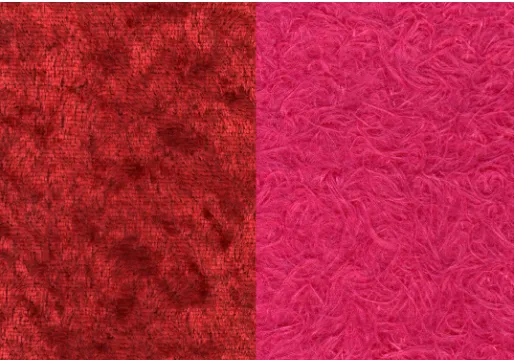
the same as touching each piece, I displayed swatches next to each piece to help
communicate these emotions and experiences to the audience (Figure 18). The
swatches allowed the audience to feel the texture of the pieces and imagine what
I might have been thinking or feeling when I selected the fabric.
The selection of different fabrics was something I did both intuitively as well
as conceptually. In some pieces, the fabrics came first, while in others the fabric
choice followed the idea. One of my first fabric choices was for The Hugger
(Figure 19). I loved the feeling of the crushed velvet, and the red color was very
[image:32.612.196.453.366.546.2]soothing, warm, and strong. The concept for this piece came after the purchase
of the fabric, but once I
knew I wanted the piece to
hug the body the warmth
and softness of the crushed
red velvet fit perfectly.
Alternatively, with The Bear,
the final fabric choice came
long after the concept. I had
to locate a fabric to personify
the specific qualities this piece required. It was very important to me that I have
the softest, most comforting fabric I could find (Figure 20). One of the most
important times to be held by a loved one is while sleeping, so the selection
of a muted color came from the idea that a bedroom should be absent of all
distractions for sleeping purposes. Whether the fabric choice was the result of a
random shopping spree or an intentional trip to the fabric store, the final success
of the pieces were unaffected by the
order of the process.
The display cards (Figure 21) next
to the DilNO’s and The Bear played a
vital role in connecting the audience
to my vision for each piece. I
[image:33.612.279.542.70.275.2]wanted the display cards to act as
fig. 19 The Hugger, 2008
[image:33.612.109.321.509.721.2]diagrams, similar to
an instruction booklet,
therefore drawings or
sketches seemed the
appropriate choice. The
use of photography and
Photoshop became crucial
to creating the desired
drawing aesthetic. By
photographing a model
with each piece, I was
able to show how the
DilNO’s should be used
or worn, and implied
directive that brought the pieces to life.
In the School of Photographic Arts and Sciences (SPAS) at RIT, each graduate
student is given the option of presenting their thesis exhibition on campus in the
SPAS Gallery. I chose to show in an environment where I could reach a larger
audience, not just the academic world, and community of RIT. I chose to have my
exhibition in downtown Rochester, at The Hungerford Complex, which is made
up of several buildings with various studios for rent. I planned the opening
night of Appendages to coincide with the city-wide event “First Friday,” in which
galleries around the city, including studios in The Hungerford, were open to
the public, and buses take people around to different openings. Perhaps most
importantly, with this space it afforded me the opportunity to work in my own
studio space for an entire month, so I would have the time needed to create the
installation.
I chose white walls in the gallery in order to isolated each piece and bring out the
shapes, colors and textures of the objects. I displayed the smaller objects on white
podiums and painted large white rectangles on the grey floor for the objects
that did not fit on the podiums. The large gallery space provided ample room
for each podium to have its own section, allowing each piece to be isolated and
thus experienced singularly. While the white space allowed each piece to stand
out it was also a reference back to the idea of the bedroom being devoid of all
distractions.
There were three separate rooms within the space. The use of curtains, and
white tape that looked
like stitching on the floor,
guided the audience into
the first room. The tour
began with Strapping
“IT” On, the inspiration
behind my thesis exhibition
(Figure 22). The
viewer entered
through dark
purple curtains to
find an enclosed
room, where they
were confronted
with the projected
performance of
my first experience
with a strap-on dildo. Once they viewed the video, they were then directed into
the main room of the gallery. The first piece they encountered was The Tickler
(Figure 23), a multicolored volcano of fingers that is both a reference to the
body and the “French Tickler” Condom. I began with this piece because it was
the strongest representation of the main ideas behind the DilNO’s series. When
creating this installation, I had a very clear vision of how the viewer would
walk through the space. It seemed quite obvious to me. But without the implied
directive of the taped stitching on the floor in the large room, the audience
wandered from piece to piece. Looking back, I would have preferred to have
more control over the viewer’s path in this section of the installation.
Because I intended it to be the viewer’s final interaction with the work, The
[image:36.612.224.540.70.306.2]Sanctuary was displayed near the exit. The progression of the installation, as well
as the ongoing nature of the piece, made a corner the most appropriate location.
The objective was to end with questions about heteronormativity, and the
Influences
Throughout my career as an artist, I have always been drawn to and influenced
by artwork dealing with the female form. Whether this was a cause of my
sexuality or not I cannot determine, but it was the result nonetheless. The first
artist I ever loved
was Francesca
Woodman, whose
haunting images
of her own
moving body
fitting through
time and space in
a ghostly fashion,
sucked me into
each image and
made me fall in
love with the
self-portrait (Figure 24). Her work helped me to look into myself and see what my
own space was like, and where I fit in. It helped me to become comfortable with
my body through the use of photography and the self-portrait. I loved the idea of
making myself into an art piece, and seeing myself as beautiful.
[image:38.612.195.539.190.533.2]Jenny Saville, helped me to see the world in chunks of color and showed me that
the grotesque is beautiful (Figure 25). She helped me to see outside of the beauty
of the photograph allowing me to see the beauty in the body instead, in my body.
Her paintings, with her meaty body parts in large format helped me to learn how
to display my work and to no longer hide behind the frame. Her work inspired
me to print my images life-size and capture the reality of the photograph, which
in turn gives the viewer a more realistic experience.
Most recently I have become obsessed with the work of Libby Rowe. She’s a
brilliant young artist who has showed me how far I can go with humor, and
audience participation. Seeing her work at the Society of Photographic Education
Conference in Denver, in 2008,
was the spark to ignite my
thesis idea, and helped me
to find my feet, in the world
[image:39.612.111.538.73.255.2]of hands on creation. Seeing
[image:39.612.109.368.583.718.2]her body of work titled Pink and more specifically her pieces Learning Feminine
(Figure 26), and Panties Portraits (Figure 27) helped me to see more in installation
style as well how to achieve more audience interaction. The Audience experience
really interested me in Rowe’s work. She would often have people mail her items
or try on clothing as part of the work itself. The work became the audience, and
the experience not only that she experienced but now how the audience could
also experience it for themselves.
It would be interesting to do the show again and to allow the audience to “play”
even more with the work. I know that while working with my committee I
often enjoyed watching their interactions with the pieces as I brought them in
to show. They giggled, and laughed and smiled, and became very childlike in
their attitudes. This interaction and level of fun is something I truly enjoy in
[image:40.612.113.536.77.301.2]Appendages.
Conclusion
Appendages is a critical examination of the break away from the traditional
gender roles engrained in heterosexuality, a questioning of the adoptions of those
traditions in homosexuality, and a closer examination of my life as a
bisexual-women-preferred woman. According to the Merriam Webster dictionary,
the word ‘appendage’ has a split definition. “1. Something appended to, or
accompanying, a principal or greater thing, though not necessary to it.” The
other definition, has a more biological sense: “2. A subordinate or subsidiary part
or organ; an external organ or limb .”18
Each series within Appendages functions as an individual body of work while
still functioning as a cohesive whole. In the past I have worked in series of
photographs, as well as installations which combined video and photographs.
The multi-faceted nature of the emotions I wanted to explore in Appendages
inspired the creation of sculpture. The installation needed to involve the
audience in a tactile interactive learning experience allowing them to engage and
understand the work on a deeper emotional level. The total experience of this
thesis is an expansion of my concepts of what my art production could and will
be in the future.
I had the special privilege to begin my thesis work in a committed, long-term
relationship with a woman. The unfortunate event of ending that relationship
helped me to reevaluate all of my predisposed ideals of that relationship and take
an introspective look at how the ending causes of my relationship were reflected
in the work. The work grew into something more. I was able to clearly define my
needs, as well as take a deeper look at my sexuality, both as a couple and later
as an individual. The physical and emotional aspects that I later realized I was
missing or lacking in my previous relationship had, unbeknownst to me, wound
up sewn into each DilNO.
“Sometimes a normative conception of gender can undo one’s personhood, undermining the capacity to persevere in a livable life.”19
Afterward
While finishing my thesis paper, I had an opportunity to show part of Appendages
at Rochester Contemporary Art Center (RoCo), a local gallery in Rochester. I
was given a small space, the constraints of which allowed me to re-examine the
display options for the work. At some point during the thesis exhibition planning
process, I had discussed painting silhouettes or figures onto the walls to show
the uses and positions of each piece. After looking at the gallery space at The
Hungerford Building, I decided that not all pieces would be silhouette-ready
and that the gallery space was entirely too large for that display option. During
the later showing at RoCo, I chose to display only a few of the DilNO pieces in
which I incorporated the silhouettes (Figure 28). The pieces were selected based
on their functionality and wearability. The plain silhouettes on the wall created
a minimalist feel that helped to isolate the objects, while showing off their uses.
[image:43.612.111.539.372.576.2]At the Hungerford Exhibition of Appendages, viewers read the display cards as
separate objects. The silhouette installation eliminated the need for the display
cards and the work could speak for itself. While not all of the pieces from
Appendages could be displayed in this manner, the silhouettes were successful for
those included in the RoCo Show and I’m looking forward to exploring similar
Bibliography
Bellows, Michael S. The Ways Homosexuals Make Love: Volume Two Female-to-Female Sex Techniques. San Diego: Academy Press Inc., 1970.
Butler, Judith. Bodies that Matter. New York & London: Routledge, 1993.
Butler, Judith. Undoing Gender. New York and London: Routledge Classics, 2004.
Chanter, Tina. Gender. Key Concepts in Philosophy. London: Continuum International Publishing Group, 2006.
Clarke, Victoria, Sonja J. Ellis, Elizabeth Peel, and Damien W. Riggs. Lesbians Gay Bisexual Trans and Queer Psychology: An Introduction.
Cambridge, New York. Cambridge University Press, 2010.
Cole, Joanna. Asking about sex and growing up: a question-and-answer book for boys and girls. William Morrow and Company, Inc, 1988.
Fausto-Sterling, Anne. Sexing the Body. First ed. Gender Politics and the Construction of Sexuality. New York: Basic Books, 2000.
Kaplan, Louise J., Female Perversions: the temptations of Madame Bovery. New York: Double Day, c1991
GENDERqUEER . Edited by Joan Nestle, Claire Howell, and Riki Wilchins. Voices from Beyond the Sexual Binary. Los Angeles and New York: Alyson Books, 2002.