MODULAR DESIGN FOR SPACE ENGINEERING RESEARCH
PLATFORMS
Mark Post, Regina Lee, Brendan Quine
Earth and Space Science and Engineering, York University, 4700 Keele St., Toronto, Canada [email protected], [email protected], [email protected]
Keywords: field robotics, mobile robots, embedded systems, electronics
Abstract: In this paper, we describe a modular design approach that is used in developing several research platforms for space engineering research at York University. We briefly describe three distinct research projects for space science and engineering research: a 6kg micro-rover under development for the Northern Light mars lander mission, a 50kg rover built by the York University Rover Team to compete in the annual University Rover Challenge, and a 1U CubeSat design for nanosatellite technology development research. All three research projects share a design philosophy to achieve modularity, efficiency, robustness and simplicity by adopting a common embedded hardware configuration using COTS hardware and a simple control topology. An on-board computer board stack based on a PC/104 or similar form-factor provides centralized control using an ARM microcontroller. Payloads and application-specific components are added using robust SPI, synchronous serial, and RS-485 interfaces, with provision made for ethernet and USB connectivity when needed. The software for this system is is based on open-source compilers and operating systems and is also modular in nature, using a portable base station GUI, wireless mesh networking between different systems, and JAUS messaging for flexible component-level communications. The proposed design approach allows sharing of resources while optimizing design features with cost-effective, readily-available commercial components for complex research projects.
1
INTRODUCTION
The challenges of creating system designs for space engineering research and education are often different from those encountered in industry. To min-imize costs and development time, commercial-off-the-shelf (COTS) components and free open-source software (FOSS) tools are preferred for building sys-tems for use in research and student projects. Addi-tionally, the engineers tasked with building and pro-gramming the robotic hardware are often students with limited knowledge of embedded systems and minimal hands-on experience, so using simple inter-faces and design methodologies is generally benefi-cial. In many cases, it is necessary to integrate net-works of simple components in a manner that not only keeps communications simple and efficient for pro-totype robots such as in (Candini et al., 2009), but also to allow sufficient flexibility for enlarging and
upgrading the systems later.
2
DESIGN CRITERIA
The following four criteria are proposed for the development of an adaptable, mobile robotic research platform.
1. Modularity: Parts of the system can be added and removed as needed for the purpose at hand, but the system uses common modules and interfaces for multiple purposes.
2. Efficiency: Most space hardware is solar-powered, and most mobile robotic hardware is battery-powered, so minimizing power use and weight is essential.
3. Robustness: Components and bus systems have to tolerate environmental variations and extremes that arise from the variety of conditions that may be encountered.
4. Simplicity: For a research institution, hardware must be simple to understand and flexible in operation so that it can be applied to many different levels of projects.
Recently, the rapid development of low-cost micro-controllers and highly-integrated logic devices for the mobile device market has made it possible to build modular, general purpose robotic hardware for a frac-tion of the cost and complexity needed even two decades ago. Designing and constructing these sys-tems in-house has the benefits of easy modification, low cost, and a better overall understanding of the system’s dynamics, and students can work in depth with the system as part of their education. To lever-age this capability, we propose a modular electronic design philosophy for electronic systems that can be used in a variety of research projects. The hardware should be easily adaptable to different uses. System modules should be easily field-replaceable and ser-viceable. Electronic parts used in this system need to be readily available for ease of development, tolerant of noise and voltage in field conditions, and inexpen-sive. Components in ball-grid array and other no-lead packages should be avoided to facilitate soldering, re-pair, and improve vibration resistance. Programming should make use of open and freely-available tools to ensure continuing availability.
2.1
Current Implementations
The motivation for designing a standardized set of in-terfaces and implementation guidelines is that
differ-ent research groups with varying hardware require-ments can share designs, hardware, and program code so more time and effort can be spend on the re-search itself as opposed to the hardware necessary to accomplish it. This paper describes a framework for field robotics that lends itself well to modular robotic systems such as rovers with payloads, un-manned aerial vehicles, sensor networks, and even nanosatellites. The focus is on efficiency and mini-mization so that physically small and solar-powered systems can be built, but the embedded hardware is centered on a modern ARM microcontroller that is powerful enough to support a variety of autonomous operating modes. This modular design is being put to use in several student and research projects at York University.
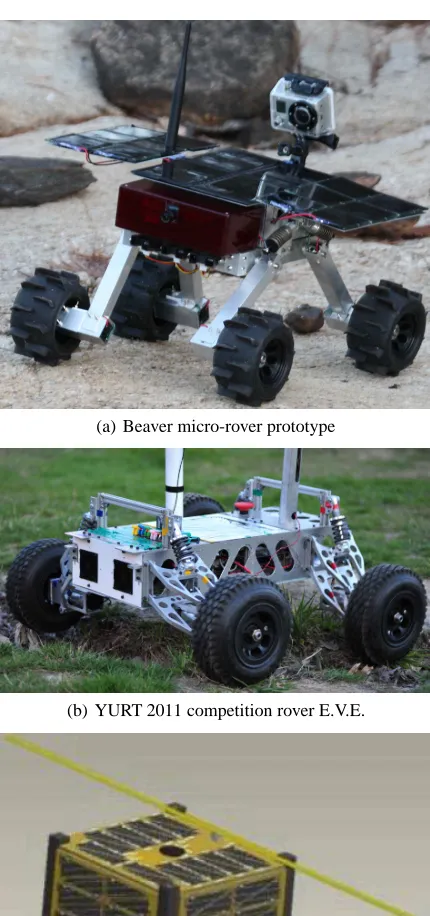
Foremostly, a micro-rover (or “µrover”) prototype known as the Beaver is currently under development for use in the Northern Light Mars Lander mission (Quine et al., 2008), a Canadian Mars lander and rover system instrumented to provide new information on the Martian atmosphere, surface, and subsurface. The 6kg micro-rover is capable of autonomous operation and is built on a four-wheel drive swing-arm suspen-sion chassis with two science payload spaces at the front and back. The first version of the Beaver was tested at the Algonquin Radio Observatory in Novem-ber 2010, and the results of testing have confirmed the usability of the modular system. The uRover design is based on a 10 x 10 x 20 cm form factor to accommo-date PC/104 form factor boards, batteries, and associ-ated hardware, and the on-board computer is based on a low-power ARM microcontroller that uses routed messaging for inter-component communications. A research prototype is shown in Figure 1 (a).
Also, The York University Rover Team (YURT) is a student group that has achieved podium finishes for all three years competing in the University Rover Challenge held by the Mars Society. Each year, the team builds a new 50kg rover based on the experi-ence gained in previous years and uses it to perform four distinct remotely-guided tasks in desert condi-tions with rocky terrain and>30◦C heat at the Mars Desert Research Station in Utah, USA (Post and Lee, 2011). The modular system design described here has both influenced and been influenced by the experi-ences of YURT, and each generation of rover refines the standards and implementation of the previous one. Figure 1 (b) shows the rover developed for the 2011 competition, known as E.V.E. (Enhanced Vehicle Ex-plorer)
modular embedded design philosophy. For a typi-cal CubeSat application, external payload interfaces and command routing is not necessary, as every com-ponent is contained on the on-board computer stack. The components are different but the engineering can remain consistent and retain most of the compatibil-ity with other robotic systems. A conceptual view of the CubeSat when completed is shown in Figure 1 (c). Planned future work includes development of unmanned aerial vehicles similar to those described in (Cho et al., 2007) using the same modular system.
3
HARDWARE ARCHITECTURE
To achieve the described flexibility in configura-tion of the the embedded on-board computer (OBC) hardware, a stack of printed circuit boards (PCB) is proposed as the basis for the modular system. This OBC stack includes a common motherboard for cen-tralized control, and additional daughterboards that can be added to suit the application. If more com-plexity is needed, additional stacks can be added and linked together.
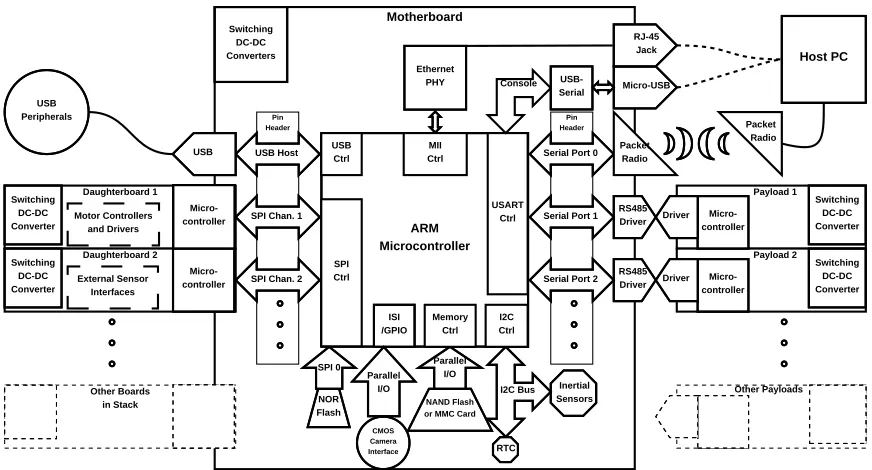
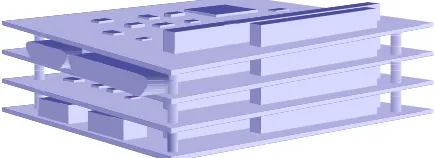
A diagram of proposed component and interface organization in the modular system is shown in Fig-ure 2. To date, most implementations have been built by hand using through-hole components, which makes the motherboards, daughterboards and pay-loads larger and heavier. A surface-mount electronic implementation in PC/104 form factor is currently un-dergoing critical design review, and will be used for the micro-rover prototype, while a slightly different but compatible implementation is under development for the nanosatellite prototype. The PC/104 form fac-tor describes a stack of PCBs with pass-through 0.1“ 64-pin and 40-pin headers, and was chosen because it is a common standard for embedded systems in in-dustry and robotics, and strikes a good balance be-tween compactness and flexibility. The pinout is al-tered to contain the communications interfaces de-scribed here. The resulting board stack will look as shown in Figure 3.
3.1
Control Topology
The proposed modular system is built around a pow-erful central microcontroller on a single motherboard in the OBC stack that is responsible for autonomy and system coordination. Additional daughterboards can contain a set of small component microcontrollers that perform low-level tasks and can be customized to suit different requirements. To make most effective use of off-the-shelf components, the interfaces used
(a) Beaver micro-rover prototype
(b) YURT 2011 competition rover E.V.E.
[image:3.595.309.524.115.573.2](c) York CubeSat nanosatellite concept
ARM Microcontroller
NAND Flash or MMC Card Parallel I/O Motherboard Inertial Sensors RS485 Driver RS485 Driver NOR Flash SPI 0 I2C Bus RTC Daughterboard 1 Daughterboard 2
SPI Chan. 1
SPI Chan. 2
Serial Port 1
Serial Port 2
Pin Header Pin Header Micro-controller Switching DC-DC Converters Switching DC-DC Converter Switching DC-DC Converter Micro-controller Payload 1 Payload 2 Micro-controller Switching DC-DC Converter Switching DC-DC Converter Micro-controller Serial Port 0
[image:4.595.80.516.92.327.2]Driver Driver SPI Ctrl USART Ctrl I2C Ctrl Memory Ctrl MII Ctrl Packet Radio Console USB-Serial Micro-USB Host PC Packet Radio Ethernet PHY RJ-45 Jack USB Ctrl USB Host ISI /GPIO Parallel I/O USB Other Payloads Other Boards in Stack Motor Controllers and Drivers External Sensor Interfaces CMOS Camera Interface USB Peripherals
Figure 2: Diagram of modular system topology
by rover systems have to be common enough to be present on most modern embedded hardware, but still well-suited for real-time robotic applications.
The standardized ARM architecture is preferred for central microcontrollers as it is possible to use em-bedded operating systems and program source code that are easily ported between specific microcon-trollers, with only the low-level hardware interfaces requiring modification in some cases. In the case of embedded Linux, these low-level interfaces are gen-erally handled in the kernel and accessible by means of user-space device interfaces. Currently, the Atmel AT91RM9200 and AT91SAM9260 ARM9 microcon-trollers are used, though a variety of automation-oriented ARM microcontrollers are available, most notably the Cortex-M3 and M4 series that use the Cortex Microcontroller Software Interface Standard (CMSIS), and will be used in future implementations. Due to the master-slave paradigm used in the mod-ular system, only one central ARM motherboard is usable in each OBC stack, but this limitation has not caused problems as ARM microcontrollers compara-ble in power to desktop computers are now availacompara-ble, and multiple OBC stacks can be used on a vehicle if needed. As per CubeSat standards, the 1U Cube-Sat under development at York University is based on the PC/104 form factor with an ARM-based cus-tom OBC stack. The YURT rovers use an ALIX em-bedded router motherboard with external serial inter-faces rather than an ARM microcontroller and
hard-ware stack, but future implementations may use ARM systems for better power efficiency and higher inte-gration with other systems.
The component microcontrollers can be inexpen-sive 8-bit microcontrollers for motor control, sen-sor monitoring, and payload management, or more complex controllers if required. The microcontroller most often chosen for this role is the Atmel AVR 8-bit RISC architecture, which is easily in-system programmable using the GNU C/C++ compilers and open-hardware SPI programmers. Modularity is achieved by attaching these to the central ARM mi-crocontroller using simple serial and parallel bus stan-dards and pin headers, or D-sub connectors for exter-nal connections. The use of small microcontrollers in this manner allows hardware customization without having to change the central controller in the system or its motherboard, which is often the most complex and costly component in a small robotic system.
hardware to program, and can consume significantly more power than microcontrollers of similar capabil-ity. However, low-power CPLD devices can be used where microcontrollers are less well-suited, such as high-speed encoding and decoding tasks.
3.2
Board-to-Board Communications
All signals are carried between OBC boards as shown in Figure 3 via standard 0.1“ pin headers. This fa-cilitates connection between boards and wires, and makes debugging easy. Proprietary connectors are often hard to test and usually are not compatible be-tween manufacturers and sizes. Due to the resiliency of using separate transmit, receive, clock, and frame synchronization wires, SPI is preferred for board-to-board communication at high bit rates, though a syn-chronous serial interface with clock like also provides a reliable connection. Communication with payloads is generally achieved using 8-bit serial communica-tions, which is the most common low-level way to interface with embedded systems, but TTL serial in-terfaces are also broken out through the pin headers for use in used in board-to-board communications. For debugging and system recovery purposes, one se-rial port should be designated as a system console or debug port, and this is usually available via USB-to-Serial converter IC for convenience in connecting portable PCs. GPS Devices and embedded radios are often serial devices that can be included in the OBC stack. Though very common, high speed per-sonal computer buses such as PCI and PCI-Express do not present significant benefit to low-speed embed-ded systems with limited I/O resources and integrated controllers.
The number of Serial and SPI devices is only lim-ited by the number of SPI and Serial interfaces on the ARM microcontroller. Provision is made on the board headers for at least four serial interfaces and four SPI interfaces with chip selects. Board headers do not make use of line drivers to save power. There have been no problems using direct pin connections between boards so long as the housing for the OBC stack is sealed from sources of ESD and contami-nants. The York CubeSat manages all onboard sys-tems through a mixture of SPI and synchronous TTL serial interfaces.
For register-level access to onboard sensors and peripherals, I2C is a synchronous bus widely used for register-level communications to multiple embedded ICs, but because it must embed addressing, bus ar-bitration, and multi-master capability using only two wires and a simple protocol, it is very sensitive to in-terference and noise from the environment. To
maxi-Figure 3: Rendering of PC/104 stack as used on micro-rover
mize reliability, trace lengths to the I2C host must be minimized and daughterboards and payloads must use a microcontroller to transfer data to SPI or serial bus lines from the I2C device.
For interfacing high-bandwidth devices, CMOS and CCD cameras are interfaced directly to the cen-tral ARM microcontroller via either a parallel bus of general-purpose input-output (GPIO) pins or if avail-able, a dedicated image sensor interface (ISI). Both volatile (RAM) and non-volatile (Flash) memory is interfaced by means of dedicated memory hardware, i.e. RAM interface, NAND Flash interface, and SDIO bus. Nearly all modern ARM microcontrollers have dedicated memory interfaces.
3.3
Payload Communications
For external payload communications, RS-485 has been selected as the standard of choice. The RS-485 interface is an industry standard for differential-pair serial communications to multiple transceivers, and is already used on many robotic systems. It may be used in either half-duplex mode (separate transmit and re-ceive pairs) or full-duplex mode (pairs connected), but full-duplex with a single master is preferred to avoid byte collisions and the need for bus arbitration. RS-422 devices are also compatible with this inter-face.
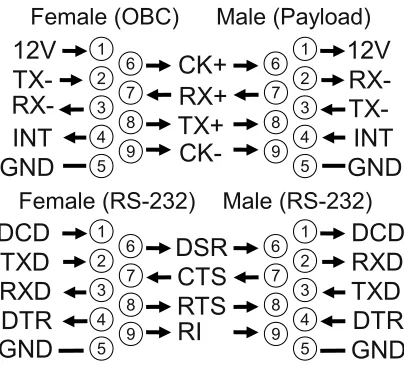
[image:5.595.308.525.97.176.2]pair is used to transmit a clock signal for synchronous operation to ensure reliable transmission. With the exception of high-bandwidth devices such as optical sensors, memory, and media interfaces, these serial links are more than capable of real-time command transmission. As no standardized D-sub pinout has been accepted for RS-485 communications, one was created to suit the modular system with differential clock (CK) power supply, and interrupt pins. The ex-ternal interfaces are situated on a board in the OBC stack with line drivers and external DE9 connectors. To pass GPIO signals and parallel buses, DB25 con-nectors are useful with each pin buffered against ESD and high voltage also.
The very common RS-232 serial port, while still present in a huge number of devices, is not tradition-ally compatible with RS-485 interfaces and is less ef-ficient as it is based on negative logic and±5−15V signal levels. A dedicated converter is the best method for interconnection. However, given that most mod-ern hardware uses only±5−7V and has thresholds at 1V , it is possible for RS-232 and RS-485 devices to communicate directly if required, for example, in new hardware testing or field debugging using RS-232. The payload pinout, shown in Figure 4, was chosen to be electrically compatible with RS-232 for this reason and to increase safety in case of accidental RS-232 connection. The RS-485 TX-(Z) and RX-(B) pins are connected to RS-232 RX and TX respectively to in-vert logic levels, TX+(Y) and RX+(A) are connected to RS-232 CTS and RTS respectively to serve as a ground reference. The CTS and RTS pins must be al-lowed to float to ground, and if the hardware does not allow this, TX+(Y) and RX+(A) must be connected to the RS-232 ground instead. This method works well using a MAX489 transceiver IC and is consid-ered an option for debugging and testing with RS-232 hardware and purpose-built serial interfaces. But it is less efficient than only RS-485 communications and breaks the RS-232 specification by referencing sig-nal levels to ground rather than±5−15V . Newer RS-232 hardware and USB to RS-232 converters that have low signal voltages are useable, but older high-voltage RS-232 hardware may be unsafe to use as the RS-485 transceiver used must be able to tolerate the signal voltages.
For devices other than system payloads, USB can be used for COTS hardware, since the interface is present on many embedded devices, but is gener-ally restricted to hot-pluggable external hardware and mass storage devices rather than hard-wired onboard peripherals. Ethernet can also be used, but has sig-nificant programming and routing overhead, so it is preferred as an external network interface for
de-Figure 4: Payload DE9 connector and RS-232 pinouts
velopment purposes. Other industrial standards for communications such as CAN, LIN, Firewire and Spacewire, though often used in other systems for reliability-critical applications (Torre et al., 2010), are not present on the majority of embedded devices and are not generally used in the interest of easy interop-erability. The Spacewire bus in particular, designed and used for space hardware, is very fast and robust, but is only implemented in hardware on a very small set of radiation-hardened devices which are very rare and expensive.
3.4
Radio Communications
[image:6.595.316.518.95.279.2]Another consideration is the need for multi-point communications and routing. There are many situa-tions when several mobile robots need to stay in com-munications with each other and with base station units, but relative movement, terrain variations and ambient conditions make static network structures un-reliable. One popular solution to this is the mesh net-work, which allows multiple transceivers to route data to each other using dynamically maintained and self healing network structures. The best known indus-trial mesh network specification is ZigBee, which is used frequently in sensor mesh networks but requires a dedicated coordinator and router nodes which lim-its the flexibility of the network. The B.A.T.M.A.N. (better approach to mobile ad-hoc networking) rout-ing protocol was recently added to the Linux kernel to allow mesh networking over wireless LAN networks, but is not designed for low-level serial hardware.
To provide a long-range serial mesh networking system, the Digi XBee PRO Digimesh 900 serial ra-dio module is used frequently on modular research hardware, one exception being the YURT rover which requires high camera data rates and uses Ubiquiti XR9 900MHz mini-PCI network cards, with XBee modules as a fallback if needed. The Digimesh proto-col is proprietary, but allows mesh networking with-out a central coordinator. As these radio modules use a well-known form factor, replacing them with 2.4GHz modules or custom modules that change fre-quency, range, and protocol is simple.
Future work in this area includes the development of an open-hardware transceiver module and purpose-designed mesh network protocol. For higher-power radio systems, an OBC daughterboard can be used. The advantage of using simple serial communications rather than Ethernet, Wireless LAN, or other IP com-munications standards, is that a wider variety of ra-dio systems and communications frequencies can be used, up to and including S-band and UHF radio sys-tems for space hardware. It is also easy to encapsu-late serial communications over IP-based systems if desired.
3.5
Power
Onboard batteries are expected to be used for power storage, and can be charged from solar panels or other sources. For small rovers and aerial vehicles, a sin-gle cell or stack of lithium-ion (Li-Ion) cells in series must be used to achieve high power densities. Since the batteries must be balance-charged for longevity, the electronics can run off the bottom cell in the stack, which is done on the micro-rover prototype. For large rovers, nickel metal hydride (NiMH) battery packs
can be used for higher stability and environmental tolerance, and 24V is used for powering larger drive motors with the rest of the electronics either being powered by a separate 12V battery as previous YURT rovers have been, or by using heavily-filtered switch-ing converters tolerant of high voltages. Battery volt-age and current monitoring is done via analog-to-digital converters, which are present on most modern microcontrollers and ideally are present on the central ARM microcontroller. In-depth testing of Li-Ion cells (Navarathinam et al., 2011), NiMH battery packs and high-current DC-DC power converters has been done to verify performance in extreme environmental and operational conditions.
With the availability of low-cost highly-integrated switch-mode converters, it is feasible for each mod-ule in the system to convert DC power from the sys-tem battery to whatever level is needed. Daughter-boards in the OBC generally use the system battery for power as well as regulated 3.3V and 5V sup-ply rails provided by the motherboard. The choice of power supply is important. Simple linear volt-age regulators that are commonly used on microcon-troller boards become less efficient relative to the in-put/output voltage difference, and are unsuitable for use in vacuum or high-temperature environments as the only mechanism for cooling is direct radiation of heat. To achieve the highest power conversion ef-ficiency possible, switching step-down (buck) con-verters are used, if at all possible, rather than step-up (boost) converters. Using only low-dropout buck converters with high input voltage tolerance makes it possible to achieve system efficiencies close to 90%. Also, each module is responsible for filtering its own load noise via capacitor-inductor networks to avoid injecting power supply transients back into the OBC. Zener diodes should also be used to protect from ESD and over-voltages.
3.6
Motor Control
re-quire a different control method usually considered incompatible with brush DC (Lee et al., 2003).
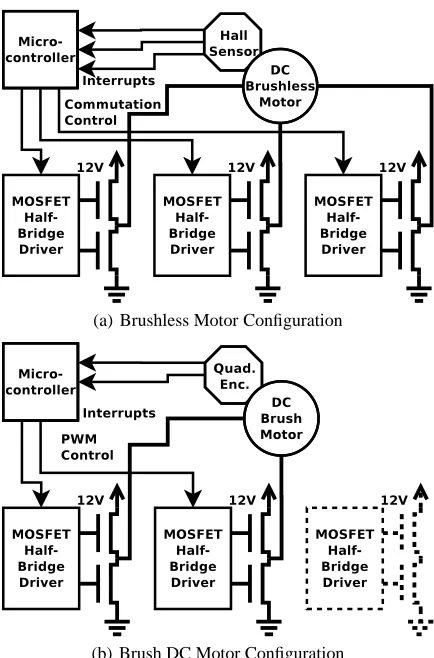
Ideally, both BLDC and DC motors could be driven with only software changes, so any changes to the system could be made by a microcontroller. Many small microcontrollers are suitable for implementing feedback and control of motors, and some PIC and AVR models include dedicated hardware for this pur-pose, while still being programmable in C and using minimal power. Flexible designs for multiple motors have been achieved using FPGA hardware and DSP ICs, such as in (Zerigui et al., 2007). While this ap-proach provides high control speeds, it requires more power to run the FPGA and introduces significant complexity in design and programming. To enable a common system to drive both brush DC and brush-less DC motors, a hybrid approach is required. DC motors are usually controlled by using a fixed input and pulse-width modulation (PWM) to manage the amount of total power provided to the motor. Brush-less DC motors are controlled by shunting power to different motor coils (or ”phases“) one at a time in synchronization with rotor speed, usually measured by Hall sensors, and speed control is achieved by changing the time that power is shunted. Both sys-tems usually use field-effect transistors (FETs) in a half-bridge configuration to control current flow, two for a brush motor in the ”H-bridge“ configuration, and one for each phase of a brushless motor. Brushless motors usually have up to three phases, so a hybrid controller can be built with three such half-bridges.
Figure 5 shows the hybrid system in both brush-less DC (a) and brush DC (b) configurations. For three-phase brushless use, a single set of three half-bridges are cycled in sequence to supply power to the three motor phases, while for brush use, two of these form an H-bridge to supply pulse-width mod-ulated DC power to the motor. Control feedback is via a 3-phase Hall sensor in the brushless case and bridges are commutated by setting GPIO lines, while a quadrature (Gray code) encoder is used in the brush case and pulse-width modulation control is used in hardware. The drive controller 12V is assumed to be the drive voltage in this diagram, but any appropriate motor voltage can be used. Each motor requires the use of one set of drive bridges, though a fast micro-controller can usually drive more than one bridge at a time. For small mobile robots and rovers, all needed drive motor controllers can usually be implemented on an OBC daughterboard, but for larger robots, the drive controller is implemented as an external payload to gain more space and better isolation. A prototype of this hybrid system has been built for the micro-rover, and shows promise for larger systems as well.
(a) Brushless Motor Configuration
[image:8.595.308.525.90.419.2](b) Brush DC Motor Configuration
Figure 5: DC motor controller basic configurations
4
SOFTWARE ARCHITECTURE
In order to benefit from and support the open-source community, and to ensure that the basis for the system remains freely available and up-to-date, open-source OS software and the GNU compiler col-lection (GCC) is preferred to form the software base for the modular system. It is assumed that most mo-bile platform software will have to control actuators, read sensors, and communicate with a base station, a set of central control programs for autonomous oper-ation, or both with system coordination occurring on the central ARM microcontroller. The YURT rover (Post and Lee, 2011) and micro-rover prototype are good examples of this kind of a system, as is the ex-ample is given in (Marosy et al., 2009). As such, a ro-bust multitasking framework and a routing and com-mand handling system are essential to reliable opera-tion.
mother-board. NAND flash is the most common and provides large storage capacity, while NOR flash devices can store only a few megabytes but may be more resis-tant to radiation and corruption (Farokh Irom, 2008). To mitigate the risks of software corruption, in the event of a boot failure the bootloader for the cen-tral ARM microcontroller will switch between two kernel/filesystem images. It is possible for the cen-tral ARM microcontroller to boot from the smaller failover device and retain sufficient capacity to program internal component microcontrollers as re-quired using SPI. Implementation of error-correction codes is also proposed for improving storage reliabil-ity, though it would have to be done either in software or on an external logic device such as a programmable logic device (PLD). For NAND flash devices, the re-cent addition of UBIFS to the Linux kernel provides error detection and wear-leveling for NAND devices, and currently appears to be the best option for NAND devices in Linux.
4.1
Operating Systems
Direct-to-hardware programming on the central ARM microcontroller is possible, but an embedded operat-ing system (OS) is usually used in research applica-tions to to expedite software development and sim-plify hardware interfacing. The Emdebian Linux OS has been used for most of the existing development work, and other FOSS systems are being investigated for real-time flight hardware implementations such as Linux with Xenomai for real-time support and FreeR-TOS as a standalone real-time framework.
Customized Linux kernel patches and drivers that implement user-space support for the embedded OBC peripherals such as the RS-485 interfaces, SPI con-trollers, and I2C sensors have been developed to pro-vide hardware integration, and a set of dedicated li-braries for 8-bit AVR microcontrollers has been cre-ated to assist in programming component applications for this system. The software for onboard systems has been developed entirely in C and C++ for efficiency and minimal code size. Other languages can be run on resource-constrained hardware such as real-time Java, and using a Linux environment enables the use of Python as well. These will be retained as options for future research.
For overall control and monitoring of remote sys-tems at the base station, a graphic user interface (GUI) has been developed using Java, with the philosophy that it must be portable to whatever OS is used at the base station, but need not run on resource-constrained embedded hardware. The GUI development is based on the work of the York University Rover Team, who
have been steadily improving their base-station GUI concept for each generation of remotely-controlled rover. The GUI integrates system health monitor-ing, GPS localization, joystick movement control, and camera displays for convenient use of the system op-erator.
4.2
JAUS Messaging
For designs where only a few microcontrollers are fixed in connection such as most nanosatellites, sim-ple byte-by-byte protocols work fine, but for large systems with multiple, changeable interfaces, a flexi-ble message routing and communications protocol is necessary. The routing system and protocol used cur-rently for robotics is based on the Joint Architecture for Unmanned Systems (JAUS), a messaging system that groups similar or associated capabilities of a sys-tem together and provides a consistent method of or-ganizing subsystems (The joint architecture for un-manned systems working group, 2007). The JAUS structure can be considered close to the minimum of functionality for universal point-to-point communica-tions in a multi-device system. Although JAUS does not specify implementation details, the JAUS refer-ence implementation has been used as the basis for the OpenJAUS project, an open-source framework for remote operation of robotic systems that is portable to a wide range of platforms.
The JAUS architecture is a tree structure, where an entire system is composed of subsystems, each con-taining nodes, each concon-taining components, which can have several redundant component instances. For the architecture we are describing, an individual robot represents a subsystem, a central ARM microcon-troller represents a node and a microconmicrocon-troller at-tached to that controller represents a component, which services a finite set of commands and may have redundant systems on the same bus. More than one central controller node can be present on a robot, and each node must run a node manager for routing com-munications to components, which is currently imple-mented as the OpenJAUS node manager. As JAUS commands can be large in scope and parsing require-ments, microcontroller components can use custom small-footprint commands for simple tasks. By us-ing only a small set of commands for each microcon-troller, most components are capable of sending and receiving basic commands using JAUS natively, and additional functionality is easy to implement.
capability of ”bypassing“ the central controller and communicating directly between components using only the node manager is sometimes useful and pro-vides failover capabilities. However, the node man-ager on each node must be very stable and should be restarted if abnormal program behavior is noticed. For ease of debugging, a ”console“ mode is used on microcontrollers with sufficient flash memory, so that by entering an escape sequence (commonly the AT escape sequence ”+++“) a simple serial text console can be used to send commands and check the status of the microcontroller using ASCII keystrokes. This al-lows easy field testing of components without requir-ing a full JAUS implementation to be present. De-velopment of JAUS-compatible code for the micro-rover prototype is proceeding, and may be used in the YURT rover in future as well.
5
CONCLUSION
In this paper, we briefly introduced three distinct space engineering research projects at York, namely micro-rover development, the York University Rover Team’s larger scale Mars rover prototype design and a 1U CubeSat-based nanosatellite design. In all three distinct research projects, we aim to design mobile platforms with a level of autonomy and simplicity with distinct mission objects for each project. The micro-rover is designed for Mars environment with full autonomy and redundancy. The YURT rover is designed each year to complete at the University Rover Challenge with minimal autonomy, but with flexibility for four separate tasks. The 1U CubeSat is designed to demonstrate nanosatellite technologies currently under development at York University.
The common design approach we have taken in developing the above research platforms is the mod-ularity and expandability in hardware and software design. We described a centralized control topology, in particular OBC design and communication proto-cols, and introduced a subsystem design methodology making use of highly-integrated commercial-off-the-shelf (COTS) parts and low-cost components. In mo-bile robots, the motor controllers provide selectable brush or brushless DC motor management, while in a satellite platform, the same design approach can drive reaction wheels. A software architecture based on open components was also developed with modularity in mind. In mobile platforms, mesh networking and the JAUS structure was adopted to accommodate ef-ficient point-to-point messaging communications. In future, we plan to implement the proposed modular design concept in other projects such as unmanned aerial vehicles and distributed sensors for navigation, mapping and remote sensing applications.
REFERENCES
Candini, G. P., Paolini, E., and Piergentili, F. (2009). Design and manufacture of a low cost educational hexapod rover. Acta Astronautica, 65(3-4):525 – 536. Cho, A., Kim, J., Lee, S., Choi, S., Lee, B., Kim, B., Park,
N., Kim, D., and Kee, C. (2007). Fully automatic taxiing, takeoff and landing of a uav using a single-antenna gps receiver only. In Control, Automation and
Systems, 2007. ICCAS ’07. International Conference,
pages 821 –825.
Farokh Irom, D. N. N. (2008). Radiation tests of highly scaled high density commercial nonvolatile flash memories. Technical report, Jet Propulsion Labo-ratory, California Institute of Technology, Pasadena, CA.
Lee, J., Choi, J., Chung, J., and Lim, J. (2003). Design and implementation of integrated drive circuit for a small bldc motor. In Electrical Machines and Systems,
2003. ICEMS 2003. Sixth International Conference,
volume 2, pages 491 – 494 vol.2.
Marosy, G., Kovacs, Z., and Horvath, G. (2009). Effective mars rover platform design with hardware / software co-design. In Design and Diagnostics of Electronic
Circuits Systems, 2009. DDECS ’09, pages 148 –151.
Navarathinam, N., Lee, R., and Chesser, H. (2011). Charac-terization of lithium-polymer batteries for cubesat ap-plications. Acta Astronautica, 68(11-12):1752 – 1760. Post, M. and Lee, R. (2011). Lessons learned from the york university rover team (yurt) at the university rover challenge 2008-2009. Acta Astronautica, 68(7-8):1343 – 1352.
Quine, B., Lee, R., and Roberts, C. (2008). Northern light - a canadian mars lander development plan. In
Con-ference Proceedings of CASI ASTRO 2008, Montreal, Canada.
Sarda, K. and C., G. (2010). Canadian advanced nanospace experiment 2 on-orbit operations; two years of push-ing the nanosatellite performance envelope. In
Con-ference Proceedings of CASI ASTRO 2010, Toronto, Canada.
The joint architecture for unmanned systems working group (2007). JAUS Reference Architecture Specification,
Volume II, Part I. Version 3.3 edition.
Torre, A. D., Finzi, A. E., Genta, G., Curti, F., Schirone, L., Capuano, G., Sacchetti, A., Vukman, I., Mailland, F., Monchieri, E., Guidi, A., Trucco, R., Musso, I., and Lombardi, C. (2010). Amalia mission lunar rover–the conceptual design of the team italia rover, candidate for the google lunar x prize challenge. Acta
Astronau-tica, 67(7-8):961 – 978.
Zerigui, A., Wu, X., quan Deng, Z., and Yu, K. (2007). Common hardware design for (2n+2, 0*n*3) wheels mobile rover. In Robotics and Biomimetics, 2007.