City, University of London Institutional Repository
Citation
: Frengel, Mike (2005). Process and form: perspectives on the application of
predetermined systems to sectional forms in music composition. (Unpublished Doctoral thesis, City University, London)This is the accepted version of the paper.
This version of the publication may differ from the final published
version.
Permanent repository link:
http://openaccess.city.ac.uk/17770/Link to published version
:
Copyright and reuse:
City Research Online aims to make research
outputs of City, University of London available to a wider audience.
Copyright and Moral Rights remain with the author(s) and/or copyright
holders. URLs from City Research Online may be freely distributed and
linked to.
Perspectives on the application of predetermined
systems to sectional forms in music composition.
Mike Frengel
Submitted for the degree of Doctor of Philosophy
City University, London School of Arts Department of Music
CONTENTS
DECLARATION OF RIGHTS AND PERMISSIONS ... III
A aSTRA CT ••.•••••••••••••••••••••••••••••••••••••••••••.••••••••••••••••••••••••••••••••••••••••••••••••••• IV INTRODUCTION ••••••••••••••••••••••••••••••••••••••••••••••••••••••••••••••••••••••••••••••••••••••••••• 1 CHAPTER ONE - COGNITION AND AESTHETICS •••••••••••••••••••••••••••••••••••• 8
Copition and Mnsical Acculturation. ...
.11.'
peI"ceptoalud CoaceptoaI Intuition in COIIIp(ISition Activity ••... 1.1 • • • • • • • • • • • • • • • • • • • 111.11 14 Perceptual Decision-l71tIking ... 15
Conceptual Decision-making ... 17
Predetermined. SysteDIli and Musical Aest:heties •••...•..•.••••..•.••.••• 11 ••• 11 • • • • • • • • • • • • • • • • • • • • • • • • • • 1 1 1 . . . . • • • • 21
Logical ExperimenJation ... 21
Objectivity ... 23
I?iscovery ... 24
Chapter Conclusion... ... ... _ . . . . ... ... . ... _ ... 25
CHAPTER TWO - PROCESSES ••••••••••••••••••••••••••••••••••••••••••••••••••••••••••••••• 28 Deyelopmental Processes ... • ... 11139
Performer implementaJion ... 42
Prcasses, Skucture and Motion ...•••..•... . ... 43
AbstrrJct Processes ... 43
Processes AptNied to Materials: Materials Applied to Processes ... 45
~~ .. O~y •.. M.~ .. ~~~~~.M .. ~ •• M.~ .. M.~ .. M.~ ... ~~M." •••• " .. ~ .. ~ .. ~ .. ~ .. M.~ .. M." •• M.".~ .. ~ •• ~.~ •• ~.~.~.M." .. ~ ... ~~~~~ ... ~~~ ••• !tJ Simultaneous Development ... 53
Interleaved Development ... 57
Conye~IMOe(l)iyer~)~~ ... M.~.M.".~.".~"".~ .. ~ .. ~ .. ~~~~~ ... ~~MM~~ ... MMMM~ ... ~~~~~ ... ~ Local Convergence ... 59
Structllral Convergence ... 62
Vertical and Horiwntal Convergence ... 63
Divergence ... 66
Criteria for a Form-l:Jea.ring DiIne _ _ _ ... r I . . . _ 71
Perceptual Grouping ... 72
Dimension Categorisation ... 72
Schema Susceptibility ... 74
Dimension Plurality ...•... 75
Primitive and Higher-order Musical Dimensions ... .. ... -..-76
Dimension Competition ...•... 78
IdeDtity Transformation and DimensioD ModDlation_ ... .. A Survey of I.,ess ConveDtionaI Musical Dimensions... .. ... 82
Timbre ...•...•...•...•..•. 82
Non-tonal Pitch ...•...•... 87
Event Sequences ... 90
Texture - Density ...•... 92
Component relationships ... 93
Cba.pter Coneillsion ... -...-... M CHAPTER FOUR - SECnONAL FORMS ... 96
GrqupiDg Structu.res. _ _ • _ _ _ ... . 1 . 1.11 • • • _ _ _ . • • • • • • • • • • • • • • • • • • • • • • • • • • • • • • • • • • • • • • • • • • _ _ _ . . . . "
SegmentationaJ Grouping ... 99
Temporal isolation ... 100
Closure ... 100
Transitional indicators ... 101
Duration ... 102
Sectional Grouping and Variance ... 103
Associative Structure ...•... 104
Interleaved Strodores ... • • I I I I . . . , . . . , • • • • • • • • • • 185
Continuation ...•...•...•.•... 107
Formal Arrangement ... 108
Interleaved. StJtoetu.res and the PsyeJloloaical Present ...•.••••...•...•.••...•...••••• 1.,
SupIDg Form with PrecietermiDetl SysteDIs... ... . ...
u.... .... ... .
...
111Sub-sectional Interleaved Structures ...•...•...•....•...•... 112
Sectional Interleaved Structures ...•...•...••.•...•..•... 115
Dynamic Identities: Dynanric Relationships •...•... 116
Structural Pillars ....•...•...•...•..•...•... 117
Coaclusioa. •••.•••. ,
....
,... .
, . . 11 . . . 118APPENDIX I - COMPACT DISC CONTENTS •••••••••••••••••••••••••••••••••••••••••• 123
APPENDIX II - SCORES •••••••••••••••••••••••••••••••••••••••••••••••••••••••••••••••••••••••••• 125
Declaration of Riahts and Permissions
Abstract
Two compositional concerns are prevalent and interrelated in my recent
music. The first is an interest in the use of predetermined decisions, and in many
cases rule-based systems, to influence the organization of events in a piece. The
orientation towards predetermined systems reflects a desire to avoid well-established
musical tendencies, which is achieved to the extent that decisions are removed from
moment-to-moment compositional activity, thereby evading perceptual intuition and
factors of musical acculturation. The use of predetermined systems also reflects a
concern for clarity of compositional intention, as processes tend to produce
structuraIly coherent developments due to their gradual and systematic progression.
The second characteristic that is prominent in my music is an interest in recurrent
sectional forms, which not only divide time but also offer listeners additional
opPortunities to absorb the musical ideas explored in a piece. These two concerns,
predetermined systems and sectional forms, are brought together through the use of
interleaved structures, whereby developments with distinct identities are divided,into
segments and alternated in succession. Interleaved structures are uniquely
continuous; upon the return of each process, the development resumes from the
point at which it was last suspended. Consequently, each segment represents just a
portion of the whole, and the full development of each process is only revealed over
the duration of the piece. When developments are transformed to the extent that their
surface qualities are significantly altered then dynamic relationships are likely to arise between them as the piece unfolds. Interleaved structures suggest a shift in
compositional concerns from the vertical to those that are oriented horizontally. In
my own music this has resulted in a greater emphasis on the relationships between
processes, and more specifically, on how those relationships evolve over the
Introduction
Two compositional concerns have been particularly prevalent in my music
over the past few years. The first is an interest in the use of predetennined decisions,
and in many cases rule-based systems, to influence the organisation of events in a
piece. The second is an interest in sectional forms. This writing is divided into these
two main topics, which are brought together by the fact that they constitute
important aspects of the original works discussed. Although they may at first seem
unrelated, and perhaps even at odds with each other, this writing will show that
predetermined systems offer the ability to design and control structures with distinct
identities that can be combined and arranged in unique ways to produce sectional
forms.
The act of composing music often involves making decisions from
moment-to-moment in the context of an explore-audition scenario, whereby the composer
sounds out various ideas and then makes judgements as to their fitness based on
what is heard. Put simply, we might say that such decisions are made 'by ear', and
they tend to lead to a highly subjective musical result, reflective of both the
preferences and the musical history of the individual. Composing, however, also
involves making decisions in advance, prior to any explore-audition activity. For
example, choices pertaining to style, instrumentation or plans for development may
all be made before any specific events are considered. The composer then enters an
explore-audition scenario with some predetermined notion of the desired outcome,
and this not only guides the ideas that are explored from moment-to-moment, but
also influences subsequent judgement as to the fitness of those ideas.
Most music involves some balance between predetermined and
moment-to-moment decision-making, yet the interaction between the two need not be a concern
of the composer. For example, it seems quite reasonable simply to accept that music
for brass ensemble can only contain brass sounds and that the behaviour of those
sounds must be limited to that which can be performed using brass instruments.
Important to my own interest in predetermined decisions, however, is the effect that
argued that the interaction between predetermined and moment-to-moment decision
making activities influences inventiveness in as much as predetermined decisions
can both stifle subsequent exploration or direct composers towards ideas that may
not have otherwise been considered. In this sense, predetermined systems offer
composers the ability to expand their creative potential.
Composers of Western art music have long been concerned with the
application of predetermined, and often rule-based, systems to govern or prescribe
the organisation of events in a composition or performance. The canon serves as just
one early example, and in fact, through the Middle Ages and Renaissance periods,
the term literally referred to a rule or instruction. The primary method for realising a
canon was to derive one or more additional voices from a single, notated principle
voice by applying the indicated rules to the notes of that voice during performance.
Rule-based systems such as the canon were explored out of an interest in creating
music that simultaneously engaged both affective and cerebral human inclinations.
Composers of the Renaissance period became interested in " ... writing music in
which the audible structure was supported by another, concealed, rigidly calculated
structure. The propensity to exercise technical virtuosity and publicly demonstrate
professional skill... persist[ed] in the canon making of Ockeghem and his
contemporaries" (Grout & Palisca, 1988: p.2I4). This interest in cerebral propensities has persisted in Western music~ it can be found in the fugues of J.S.
Bach, the etudes of Frederic Chopin, the rhythmic-harmonic relationships of Henry
Cowell and the strict serialist techniques of early electronic music, to mention just a
few historical examples.
One particular lineage of music that exemplifies a shift towards
predetermined systems is commonly referred to as Process music, and it grew
particular strong in the United States during the twentieth century with composers
such as Charles Ives, Henry Cowell, Conlon Nancarrow and Steve Reich serving as
examples and leaders of the movement. 1 Process music tends to be concerned with
I Steve Reich was the first. at least fonnally, to describe this music as Process music in his article
"Music as a Gradual Process" (1968). For the purpose of this writing, the word Process with a capital
'P' denotes a reference to the sub-genre, while process with a lowercase 'p' refers to a predetermined
unity achieved through logical coherence, and in what might be considered its purist
form, is characterised by a reduction of musical ideas to a single deterministic
system, which then generates the events as well as the form of a piece. The
composer makes few, if any, decisions once the process is designed and the source
material is chosen. Instead, the composer merely sets the system into motion. Put
simply, the music is the process and the process is the music. In "Music as a Gradual
Process" (1968), Steve Reich writes:
I do not mean the process of composition, but rather pieces of music that are,
literally, processes. The distinctive thing about musical processes is that they
determine all the note-to-note (sound-to-sound) details and the over all form
simultaneously (p.l).
In .the early Reich pieces, this unity provides the music with a particularly coherent
character, which is reflected at various levels of the music. Moreover, there is clarity
of compositional intention; the composer's aims are unambiguous.
Turning our attention to architectural aspects of music, it must first be said
that a conventionalised distinction between musical structure and musical form does
not seem to exist in the literature, and a proper discussion of that issue is beyond the
scope of this writing. However, it does seem necessary for the purposes at hand to
make such a distinction, and therefore the following definitions are applied as they
pertain to music only. Structure describes the raw shape of a segment of music in
time and can be attributed to segments of any length, ranging from a single sound to an entire piece. Form refers to the holistic structure of a composition, and includes
any self-referential associations made within that structure. Form, then, is a mental
representation of music that is concerned not just with shape, but also with internal
relationships. For example, the recognition of the music found at the end of a sonata
as a return to that heard previously in the exposition makes an important
contribution to the sonata form. Sonata form is not simply a particular ordering of
musical ideas, but rather an ordering which concludes with a return to the music of
the form. Importantly, many compositions can be classified as sonata forms, even
though their content is clearly different. This is because, at least in terms of
classification, the content itself is less important then the relationships between the
various content identities. To put the distinction in another way, we might say that
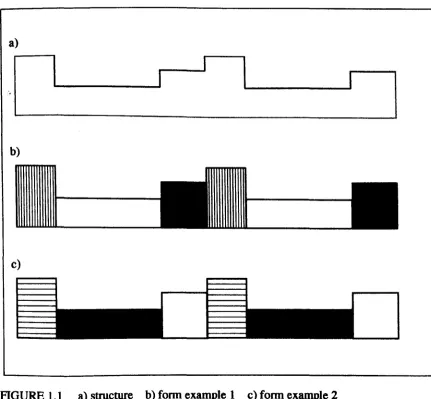
structure refers to frame while form refers to frame plus content a"angement. This
difference is illustrated in figure 1.1, where a represents a structure and b and c are
two different examples of the same form.
a)
I
I
I
b)
[image:10.522.59.491.236.635.2]c)
Three difficulties arise immediately in relation to the above distinction. Firstly, if structure is the raw shape of a musical surface then one might wonder what properties an assessment of that shape is to be based on? In order to answer this question a distinction must be made between perceived structure, which is a mental representation, and two-dimensional illustrations of structure such as those presented in figure 1.1. The illustrations representing both structure and form throughout this writing are intended to show only the prominent characteristics of a musical surface, and are thereby incomplete. Music is multidimensional, and each dimension carries its own structure. In some cases it may be that the mental representation of structure is more complex then a two-dimensional illustration can possibly suggest. At other times it may be that dimensions compete for interpretative influence, and as a result only the structures of the stronger dimensions are maintained. Considerable attention is paid to these issues later in the writing, and so further discussion of them will be debtyed until that time. The second issue that arises is that the term 'form' is only used to describe entire compositions, but it seems like an equal distinction can be
Sectional forms have long held a prominent position in art music, with
binary, rondo, and sonata forms providing just three examples. The overwhelming
majority of popular music is also sectional, most being songs that are divided into
verses, bridges and choruses. Aside from being familiar, sectional forms have other
important qualities that would seem to contribute positively to the listening
experience. Firstly, they divide time, breaking up the music into shorter segments
which can be more easily apprehended. Moreover, sectional forms are often
recurrent, giving listeners additional opportunities to hear and absorb the musical
ideas being explored. In the context of contemporary music, where so much of what
is presented to the listener is new, it would seem that these qualities are significantly
beneficial and comforting to a listener.
In terms of structure, individual processes tend to be relatively simple,
illuminating a single, unified idea. It is rare that they lead to sectional forms because,
at least where a purist attitude is adopted, the different sections would have to arise
from the process itself, which is unlikely. Instead, processes generally create forms
that gradually progress from one state to another, without sudden. drastic changes in
the character of the musical surface. Through the combination of multiple processes,
however, more complex forms can be created, and when the processes are
time-distinct and sufficiently distinguishable then those forms may be sectional. While the
use of multiple processes requires that the composer compromise the customary
notion of unity associated with Process music, in fact, this need not neglect the
desire for objectivity. There are ways of combining processes such that the result is
equally deterministic and equally arrived at outside an explore-audition scenario, as
will be shown in the forthcoming discussions.
This writing is divided into four chapters. Chapter one begins with a
discussion of aesthetic perspectives relevant to composition that is based on the use
of predetermined systems. A distinction is drawn between intuitive decision-making
and predetermined decision-making and some of the characteristics of each are
examined. Chapter two provides an in-depth discussion of processes, with a
particular concern for their structure and motion. The relationship between process
motion is presented. In addition, three concepts related to processes are introduced,
namely sequential processing, process polyphony and convergence. In chapter three
the concept of musical identity is introduced. The writing is directed towards issues
of form, but focuses on the factors that make a particular section recognisable.
Chapter four continues the discussion of sectional forms, beginning with a survey of
several factors affecting the segmentation and subsequent grouping and association
of musical sections. Interleaved structures are introduced, which are said to be
uniquely continuous and particularly well suited to process-oriented composition.
The topics in the chapters outlined above are discussed primarily in the
context of five original compositions:
1. And Then, Romina ... , for prepared electric guitar and fixed electronics
2. The 3 Faces of Karen Black, plus one face only for good measure, for Bb
clarinet and fixed electronics
3. Seven Sisters, for cello and acoustic guitar
4. Flap Jackson, for 2 flutes, piano and fixed electronics
5. Slinky, for acoustic guitar and fixed electronics
In addition, pieces by other composers and older original compositions will be
referred to, both because they provide examples relevant to the particular discussion
and because they reinforce the underlying compositional principles that constitute
Chapter One - COlnition and Aesthetics
The orientation towards predetermined systems in certain lineages of twentieth
century music reflects a shift in aesthetics, a key aspect of which is a desire to avoid
well-established musical tendencies, including both those relating to musical
practice in general and those relating to self-expression and personal preference. In
fact, such an aversion is achieved by moving compositional decision-making out of
an explore-audition scenario and onto predetermined plans. Since the resulting
music is not organised around perceived preferences, it often seems to come from
beyond the intuitions of the particular composer, and can sound unlike any other
style of music. In this way, predetermined systems are capable of generating a music
that might seem to be stylistically disconnected from the past, and it is equally this
sense of discovery that many composers find so attractive. Of course, the
diSConnection is only figurative; it is specifically the affective qualities of music that
are disengaged from the past. Historically, the fact remains that Process music did
occur and continues to do so.
The significance of an emphasis on predetermined systems in contemporary
music is deeper than just a shift in aesthetics. It has real consequences for the ability of a listener to understand the music, and ultimately leads to fundamental questions
as to the nature of music itself. Considerable evidence to support these claims is
provided by existent and ongoing research in the field of cognitive science in
general, and music cognition in particular. What follows is merely a brief overview
of that research, but my feeling is that it is adequate to illustrate that reliance on 'the ear', that is, the explore-audition scenario, during the act of composition inevitably
Cognition and Musical Acculturation
The study of music cognition aims to explain how music is perceived, and
more precisely, how that perception gives rise to musical understanding, or meaning.
Perception has traditionally been divided, although perhaps somewhat superficially,
into physiological and psychological layers.2 The physiological layers involve the
reception of a stimulus by the physical mechanisms of hearing-the auditory
system-the structure of which determines important dimensions of our hearing
potential, such as frequency response ranges, loudness curves, masking effects and
the critical bandwidth surrounding each particular frequency. Psychological layers
relate to the mental interpretation of a stimulus once it has passed the physical
auditory system. Inevitably, both physiological and psychological layers are at work
when listening to music, and we might summarise perception by saying that the
ph~siological layer supplies the brain with raw data while the psychological layer
attempts to interpret that data into a meaningful musical experience (Raffman,
1993). Studies in the field of music cognition provide an interesting understanding
of what it is that listeners find preferable in particular pieces of music, and more
generally, why people like music at all. Such research is important to any discourse
on composition, but is particularly relevant to a discussion of processes because, as
will be argued in the next section, the predetermined nature of decision-making in
music that involves processes challenges contemporary cognitive theories in
significant ways.
In his influential book Emotion and Meaning in Music (1956), Leonard
Meyer investigates the nature of music perception from a psychological perspective.
Meyer states that a stimulus has embodied meaning when, on the basis of past
experience, it makes us expect a consequent musical event For Meyer, meaning is
firmly attached to expectation, of which there are two types: conscious and
unconscious. Conscious expectations are intellectual experiences where the listener
has a conscious understanding of the musical structures and relationships contained
in a piece, and a conscious awareness of the expectation itself. Such conscious
understanding relies on an intellectual rationalisation of perceived information,
which is made in the context of a body of explicit knowledge that is based on
long-term memory and acquired through the intentional and conscious study or
deliberation on a subject or stimulus (Dienes & Perner, 1999). For example, a listener may appreciate a canonic piece because of the ingenuity applied to the
composition of the canon itself. Such appreciation is often achievable through
analysis of the score alone, without ever hearing the canon as manifested in sound.
Undoubtedly, appreciation of this sort is conceivable only because the listener has
some experience with, and explicit memory of, canonic composition, at least to the
extent that it is possible to recognise the particular canon in question as being unique
and interesting in some way. Importantly, in such circumstances, the listener is
aware of the reasons behind the sense of appreciation felt; the understanding is
conscious.
At the centre of Meyer's argument, however, is the idea that listeners
maintain a specialised, unconscious understanding of music, whereby meaning is
contained within the structurally important units themselves: the harmonies, phrases,
melodies, and so on.3
We are continually behaving in an intelligent way, comprehending meaning and
acting upon our perceptions, cognitions, and evaluations without ever making the
meanings themselves the objects of our scrutiny-without even becoming
self-conscious about what experience means (p.38).
According to Meyer, as we listen to music, expectations regarding the probability of
future events are continually being generated at various levels of the music's
3 According to Meyer, there are two attitudes towards musical meaning. Absolutists are those who
structure. Expectations remain unconscious so long as the course of events satisfies
them. They only become conscious when the probable outcome is either delayed or
replaced with an unexpected consequent. Of particular importance to this discussion, these expectations are the product of each individual listener's cumulative
experience with a musical style.
Expectation .. .is the product of the habit responses developed in connection with
particular musical styles and of the modes of human perception, cognition and
response-the psychological laws of mental life (p.30).
Expectations are, in fact, simply the manifestations of the embodied meaning
described earlier. Meyer goes on to state one of the basic hypotheses of his writing:
that emotional or affective responses are aroused in situations where expectations
are temporarily delayed or permanently denied.
The sort of unconscious understanding that is central to Meyer's argument is
not specific to the perception of music. In fact, it is widely discussed across many
areas of cognitive science, including linguistics (Chomsky, 1980), visual perception
(Kosslyn et al., 1990) and social cognition (Carlston & Smith, 1996), to mention just
a few. From a cognitive perspective, perception relies on unconscious frameworks of
knowledge, referred to as schemata.4
In a discussion of mental imagery, Nigel
Thomas (1999) provides a complete and accurate definition of a schema:
Schema... refers to a data structure, implemented in the brain, that functions to
govern perceptual exploration of the world so that appropriate perceptual tests are
applied at appropriate times and places, and that is continuously modified or
updated by the results returned by those tests so as to be able to govern perceptual
exploration in the future (p.l).
Literature in cognitive science portrays perception as a bi-directional system.
Interpretation of a stimulus is made in response to the relationship between the
4 In cognitive science literature schema is used to denote the singular, whereas schemata is used to
stimulus and the individual's schemata, which are acquired passively through
repeated experience with the activity concerned. At the same time, a representation
of that stimulus is added to the listener's acquired knowledge, so as to contribute to
future interpretations.
The exact nature of schema-based knowledge is an issue of considerable
debate, and there are two leading theories that attempt to explain it at a neurological
level. The Classical view (eg. Fodor, 1975; Newell & Simon, 1976) maintains that
information is stored in the brain as symbolic representations, much like a computer
stores digital data on a hard disk. Accordingly, interpretation involves comparing a
representation of the perceived input with those similar representations stored in the
brain from past experiences. Connectionist theory (eg. Bharucha, 1987; McCulloch
& Pitts, 1943; Rumelhart & McClelland, 1986; Rumelhart, 1989; Smolensky, 1988)
argues that as we listen to music a network of highly interconnected neurones is
activated, and the stronger the connection the greater is the level of excitement.
Furthermore, the excitement of each particular neurone has the effect of
strengthening its physical connections to other neurones. These connection strengths
are the key to connectionist theory because it is in the relative weights of the nodes
that musical knowledge is stored. It may be argued that these two theories are
actually not in contrast, but instead provide a single explanation of perception.
Simply put, the representations of the classical view may be nothing more than
patterns of stimulation across a neural network. There are, however, some important
differences between the two theories, but a proper investigation is beyond the scope
of this writing.
Schema-based theories of perception have naturally been applied to music,
perhaps most notably by Fred Lerdahl and Ray lackendoff in their book A
Generative Theory o/Tonal Music (1983). According to Lerdahl and lackendotf, the perception of music is similar to that of language, involving the unconscious
construction of abstract structures (representations), of which the events of the
musical surface are the only audible part. These abstract structures, which are
formed from schema-based knowledge, are what account for a listener's
musical structures that are reminiscent of Schenkerian analysis. Ultimately, it goes
further to present a grammar that defines the abstract structures relating to tonal
music that an experienced listener must possess, and relates those structures to
musical surfaces in the tonal style by way of various well-formedness, preference
and transformation rules.
Although schemata are individual to each of us, the degree to which we
collectively engage in the same, or similar, experiences will result in a
corresponding degree of similarity in our individual schemata. Such a consequence
is indeed necessary for the development of a musical language. Cognitively
speaking, musical language can be thought of in terms of the collectively shared
schemata within a particular group of people, which exists by the fact that those in
the group have had similar musical experiences to a sufficient extent that similar
structures have formed in each individual. While it is difficult to define the
boundaries of collective schemata, it is possible to be fairly confident that listeners will be familiar with many structures. Just as a person who does not know the meaning of the word 'house' can not be said to know the English language, equally in music, a person who does not understand, albeit unconsciously, the meaning of a
V -I chord progression can not be said to know the language of Western tonality. We can refer to musical acculturation as the method in which the collectively shared
schemata of a particular society are instilled in a person over time (Frances, 1988).
Anyone who has listened to the music of a remote culture has most likely observed
the importance that acculturation has on musical preference. Such experiences often
give rise to a sense of confusion and even frustration, presumably due to a lack of
understanding of the musical language. Regardless of whether such contact with
exotic music is deemed to be enjoyable, it seems clear that the experience of the outsider is much different from the experience of the listener who has grown up in
that culture, having listened to the music extensively and acquired the necessary
schemata to interpret and properly understand it.
To summarise, research in cognitive science, particularly in the area of music
cognition, provides us with an interesting and useful insight into the perception of
simultaneously on both conscious and unconscious levels. At the same time, the
unconscious aspects contribute to schemata and the conscious aspects contribute to
the listener's framework of explicit knowledge. What is important in the context of
this writing is that the perception of music is a matter of comparing what is heard to what has been learned through past experience, and the relationship that the
perceived music has to these internal schemata will determine the listener's
preference for the music. More specifically, in such comparisons it is the similarities
that are important because they provide meaning to what is perceived, either
conscious or unconscious. Accordingly, it is through similarity that expectations are
delayed or denied. Since composers of music are at the same time listeners, and
often so at decision-making moments during the act of composing, this
understanding of music perception has significant consequences with respect to
certain approaches towards composition and the nature of the decision-making
involved.
Perceptual and Conceptual Intuition in Composition Activity
At the outset of A Generative Theory of Tonal Music (1983), Lerdahl and
lackendoff state that the goal of their theory is to provide " ... a formal description of
the musical intuitions of a listener who is experienced in a musical idiom" (p.l).
Musical intuition, in the context of its usage above, is simply another way of
referring to a listener's response to a stimulus whose interpretation is formed in the
context of that listener's acquired schemata. Such responses are intrinsically tied to
the listener's preferences and an instinctive sense of what 'sounds right' when
listening to music. Since the composer is also a listener, intuition of this sort
certainly plays a role in the act of composition, but the difficulty with such a
description is that it only accounts for decisions that are made through audition. That
is, it only accounts for those situations where the composer sounds out a musical
idea, either preconceived or arrived at through exploration, so as to listen to it and
present during the act of composition are the result of decisions made outside this
explore-audition scenario, and in fact are often made before a single sound event is
composed. Surely those decisions also involve intuition in the sense of some idea as
to what the result will sound like. Intuition of this latter sort is fundamentally
different, relying on a framework of explicit knowledge that is consciously
accessible. We can distinguish between these two modes of intuition by referring to
perceptual intuition as that mode which relies on unconscious, schema-based
knowledge, and conceptual intuition as that mode which relies on a body of explicit,
memory-based knowledge. The composer exercises both modes of intuition during
the act of composition by way of two different types of decision-making, referred to
as perceptual decision-making and conceptual decision-making, accordingly.
Perceptual Decision-making
Perceptual decision-making leads to the determination of some
characteristics of the music in accordance with implications that arise from earlier
events in the piece. Such decisions are made from moment-to-moment 'by ear', in
the context of an explore-audition scenario, and presumably in relation to
preferences of the composer. Assuming that preferences are formed in relation to
schemata, it might be said that perceptual intuition looks to the past for
guidance-both the immediate past, the events in a particular piece, as well as the
experiential past, the events in the composer's lifelong musical development As a
consequence, reliance on perceptual intuition results in a music that is firmly
connected with music of the past and one would expect it to be abundant with
well-established musical tendencies, as manifested in similarities of behaviour,
relationship or function at various levels.
If only for completeness, it should be mentioned that there are likely to be
strong similarities between many musically preferred sonic gestures or phrase
structures and sound events that are experienced outside of the scope of music.
schemata and it is possible that musical preference may be in response to these
rather than schemata formed from previous musical experience. One example of
such an extra-musical influence is found in the relationship between the harmonic
spectrum of naturally occurring pitched sounds and the evolution of Western
tonality, which not only divides the frequency continuum into specific pitches that
correspond to the overtones on a given fundamental, but also places the importance
of each scale degree in close relation to the prominence of its relative position in the
natural harmonic series. To be specific, aside from the fundamental frequency and
its octave equivalents, the 5th and 3rd harmonics are the more perceptible in the
natural harmonic series and their corresponding pitches possess a comparable
importance in Western tonal theory, as the fifth and third scale degrees respectively.
Harry Partch (1949) lends more weight to the argument by claiming that these three
" ... are the most important scale degrees in nearly every musical system worthy of
the- name that the world has ever known" (p.87). Hermann von Helmholtz (1863)
was perhaps the first to propose that before the development of tonal music people
would have been familiar with these harmonies because of their prevalence in
naturally occurring pitched sound, including those of the human voice. It is no
surprise, then, that people would have been attracted to these intervals when music
began to be concerned with harmonic relationships. A proper investigation of the use of everyday sounds in music would need to account for whether the same schemata
are engaged when listening to music as when listening in non-musical contexts. It
may be that particular schemata are activated or their interpretive role heightened
when an individual decides that helshe is listening to music, and as a result, normal
listening may be different than musical listening in fundamental ways.
Reliance on perceptual intuition during composition provides significant
benefits to the resulting music. Foremost, it conforms to the predominant
understanding of what it is that we like about music-that we like it when it 'sounds
right.' A reliance on perception directs composition towards structures that are
meaningful to the composer, and because that composer is a member of a social
group and shares in the collective schemata of that group, one would expect that
argument one might presume that it is important for composers relying on perceptual intuition to remain 'in-tune' with the collective schemata of their population, which is accomplished by remaining familiar with music trends. On the other hand, however important collective schemata might seem to be, in reality they represent only the most common aspects of musical language. Returning to Meyer, it is largely the breaking of expectations that causes an emotional response to music. It may be more accurate to say that the collectively shared language provides a common set of expectations that can be broken, and the particular way in which they are broken is what identifies individuality amongst composers. At any rate, if musical preference is dependant on acquired musical language, then a strong argument can be made that working within the context of a musical language should be the aim of music composition, and the essence of music itself. In fact, to argue to the contrary one must be willing to accept music on fundamentally different terms.
Conceptual Decision-moking
arriving at the explore-audition activity.s Conceptual decisions can be applied to a
wide range of musical parameters and the nature of such decisions varies greatly.
This being the case, it is useful to further divide conceptual decisions into three
primary categories:
1. Environmental decisions
2. Developmental decisions
3. Deterministic systems
Environmental decisions relate to the general setting in which a composition
is to be formed, defining holistic parameters such as instrumentation, musical style
or duration, to name just a few. These decisions create the boundaries within which a
piece exists, and inevitably affect the role of perceptual intuition in composition by
act big to guide, or limit, exploration from moment-to-moment. This guiding/limiting
effect can be made clear through the use of a hypothetical example. Imagine that a
composer sets out to create a three-minute piece of tonal music for string quartet,
and that the piece is to be composed 'by ear' within the context of an
explore-audition scenario. Although the composer will rely largely on perceptual intuition
during the composition activity, a number of environmental decisions have been
made that will limit and guide exploration. The sound world will be limited to those
sounds capable of being produced by the specific stringed instruments making up the
quartet. Having decided that the piece is to be in a tonal style, the range of musical
sounds is largely restricted to twelve-tone equal tempered pitches, and presumably
those seven contributing to a specific tonality. Because a string quartet consists of
four players, some limit is also placed on the density, or number of different parts,
that the musical texture can contain. Finally, the decision that the piece is to be
S It is possible that moment-to-moment decision-making in one portion of a piece can influence
conceptual decisions applying to later portions. For the sake of simplicity, this discussion is limited to
limited to three minutes is likely to have durational implications for the composition
of sub-structural entities such as melodies, phrases and sections. During the act of
composition the composer may explore various musical ideas, for example by
sounding them out on a piano or other instrument. However, this exploration is
guided, and in significant ways limited, by the environmental decisions made at the
outset
Predetermined decisions may be made that prescribe developmental plans,
such as how a piece, or a section of a piece, will unfold over time. Developmental
decisions also limit or direct perceptual intuition in much the same way as
environmental decisions. However, environmental decisions are global and static,
meaning that the influence that they have on exploration remains constant over the
entirety of the piece. In contrast, developmental decisions can be applied to
sub-structures of a piece, and more importantly, the fact that they describe development
suggests that the implication that they have on perceptual decision-making is
dynamic; the particular effect may change according to the stage of development.
Again, the governing consequences of such decisions are best illustrated by way of
example. Let us suppose that a composer makes the decision that a particular
textural section will increase in intensity and that such growth will be achieved through the combined effect of a steady increase in activity, a parallel increase in
dynamics and a gradual transition from consonant to dissonant harmonies. Again,
the specific sequence of events may be composed within an explore-audition
scenario, but if the conceptual plan for development is followed than a number of
restrictive rules must be applied. Firstly, the average density of events will need to
increase over time. Secondly, at any given point in the development the pitch
material will be restricted to a set of intervals that occupies some range on the
continuum from consonance to dissonance, and that range will shift from being more
consonant to more dissonant as the development progresses. Lastly, the decision that
the section is to increase gradually in volume has implication for the sounds that can
The conceptual decisions discussed so far have had the effect of guiding or
limiting moment-to-moment exploration during the act of composition. It is possible
however, to incorporate a system that determines a specific sequence of events,
thereby taking the place of moment-to-moment decision-making all together. The
distinguishing feature of deterministic systems is that they organise musical
parameters according to data which itself has been determined by forces outside of
perceptual, moment-to-moment exploration. Such a system can be implemented as a data-generating algorithm, or may already be in the form of a collection of data that can be mapped to specific musical parameters. In the absence of perceptual
decision-making, the composer's intentions are restricted to those that are conceptual, and
these intentions are reflected directly in the design of the system. This inevitably
results in a heightened compositional emphasis on formal and conceptual concerns.
Furthermore, by abandoning reliance on the ear, deterministic systems can create a
kiud of disconnect from the music of the past, leading to relationships that are
outside any conventional musical language, a characteristic which might be seen as both their finest achievement and their most obvious point of criticism.
The idea of composing music that intentionally avoids reliance on perceptual
intuition has been met with considerable opposition by listeners and composers
alike, primarily because it contradicts common notions regarding the nature of music
itself. A piece that manages to disconnect itself from the past and from any known
musical language may be understood and appreciated in a cerebral sense, but is
likely to be meaningless in terms of schema-based understanding. Consequently, it
may not create the same sort of affective response that perceptually composed music
is capable of producing. This being the case, conceptual intentions cannot be
evaluated fairly in terms of perceptual intuition, but rather must be judged using other criteria that are more aligned with the nature of the decision-making involved.
This is not to say that perception does not playa part in evaluating deterministic
music; music is inherently a perceptual activity. However, where conceptual
intentions are concerned it may be that the function of perception is not to produce an affective response, but rather to act as a channel over which the concepts in a
is most clearly perceived, and an evaluation of the music should take clarity of
compositional intent into account. At this point it is instructive to examine some of
the motivations for emphasising predetermined systems in composition.
Predetennined Systems and Musical Aesthetics
The orientation towards predetermined systems in certain lineages of
contemporary music reflects a shift in aesthetics, which can be broadly characterised as consisting of three primary concerns:
1. Logical experimentation
2. Objectivity
3. Discovery
Logical Experimentation
Humans have an inherent propensity for logic, and it is not surprising that
such inclinations should find their way into the creative arts. An interest in the
application of rule-based systems to music is not a twentieth century phenomenon.
However, the importance placed on the listener's awareness of those systems in
Process music is a notable development. As James Tenney once commented,
" ... then the composer isn't privy to anything" (cited from Reich, 1968: p.1). Steve
Reich describes his thoughts on perceptible systems in Music as a Gradual Process
(1968):
I am interested in perceptible processes. I want to be able to hear the process
happening throughout the sounding music. To facilitate closely detailed listening a
musical process should happen extremely gradually. Performing and listening to a
musical process resembles:
turning an hour glass and watching the sand slowly run through to the
bottom;
placing your feet in the sand by the ocean's edge and watching, feeling, and
listening to the waves gradually bury them .
.. .I don't know any secrets of structure that you can't hear. We all listen to the
process together since it's quite audible, and one of the reasons it's quite audible is,
because it's happening extremely gradually ... Even when all the cards are on the
table and everyone hears what is gradually happening in a musical process, there are
still enough mysteries to satisfy all. These mysteries are the impersonal, unintended,
psycho-acoustic by-products of the intended process. These might include
sub-melodies heard within repeated melodic patterns, stereophonic effects due to listener
location, slight irregularities in performance, harmonics, difference tones, etc.
Listening to an extremely gradual process opens my ears to it, but it always extends
farther than I can hear, and that makes it interesting to listen to that musical process
again (p.l).
Process enthusiasts, whether composers, performers or listeners, usually
maintain both affective and cerebral interests in music, while the degree to which
they orient themselves towards one or the other varies. One might argue that music
is an audible art form, and therefore its audible qualities should be a composer's
primary concern. Accordingly, the implementation of any system is aimed at
creating a sonic outcome that is preferable in the context of a schema-based
interpretation, and if that does not result then such composers are inclined to either
change the system, modify the outcome or discard the idea all together. Other
composers maintain a more strict, experimental philosophy, and thus resist being
overly concerned with the outcome. This latter attitude is largely rooted in John
Cage's consideration of experimental music " ... not as descriptive of an act to be later judged in terms of success or failure, but simply as an act the outcome of which
is unknown" (Cage, 1961: p.13). Influenced by Cage, experimentalists often
approach the use of predetermined systems as an experiment in which an
first develops a hypothesis-a reason to believe that such an experiment may
produce an interesting sonic result. Along with an orientation towards
experimentation comes an acceptance that not all experiments are successful.
Christian Wolff once compared the situation to that of a baseball game. explaining
that we attend with the hope of witnessing a good game, but many times the game is
lousy. This. however. does not diminish our general enthusiasm for attending
baseball games (Wolff, personal communication, 1999). Moreover. an experiment
can result in various levels of success. Although a piece may not be deemed
successful as a whole. it may contain wonderful moments. or prove to be
inspirational in specific ways. It is entirely possible that one might find interest in a
piece of music, yet never wish to hear it again. On the issue of acceptance. Steve
Reich (1968) writes:
Musical processes can give one a direct contact with the impersonal and also a kind
of complete control, and one doesn't always think of the impersonal and complete
control going together. By a "kind" of complete control I mean that by running this
material through this process I completely control all that results, but also that I
accept all the results, without changes (p.l).
Objectivity
Perhaps the most overt avoidance of previous tendencies in much
contemporary music is found in its rejection of self-expression. In the article New
and Electronic Music (1958), Christian Wolff makes the following observations:
One finds a concern for a kind of objectivity, almost anonymity ... For at least
some of these composers, then, the final intention is to be free of artistry or taste.
But this need not make their work 'abstract'. for nothing, in the end, is denied. It
is simply that personal expression, drama, psychology, and the like are not part of
By restricting compositional decision-making to the design of a process, which then
generates the music, one senses that there is less of
a
focus on individual expression.It is not, however, that the music expresses nothing, but rather that the concepts and relationships that are expressed are external to the composer; they seem to have been
discovered rather than expressed.
While performing and listening to gradual musical processes one can participate in a
particular liberating and impersonal kind of ritual. Focusing in on the musical
process makes possible that shift of attention away from he and she and you and me
outwards towards it (Reich, 1968: p.2).
This avoidance of self-expression also helps to explain the acceptance of any
outcome that is associated with Cagean experimentalists. To the extent that the
c0!Dposer imposes judgement on the outcome of a deterministic system, that
composer is expressing personal preferences. After hearing the result of a musical
process it may be that the composer decides to modify the system in order to
enhance the perceived structure of the process. However, if one is to avoid 'self', in
as much as that is possible, then the aim should be to restrict any judgements and
modifications of the system to those that contribute to a greater expression of the
system itself-to those that illuminate the intrinsic qualities of the process.
Discovery
Deterministic systems effectively take the place of moment-to-moment
decision-making, thereby diminishing the role that perceptual intuition plays in
governing the organisation of events in a piece. This not only evades tendencies of
the individual, but in more extreme cases can also create a disconnection with the
music of the past, in the sense that the resulting music may be difficult to categorise
in terms of language or style. Deterministic systems are likely to produce musical
it is this sense of discovery-of venturing into uncharted territories-that many
composers find most interesting about them. The resulting music can be as
surprising to the composer as it is to a listener with no knowledge of the piece.
The extent to which predetermined systems create a music that is
disconnected from the past varies depending on the rules of the system and the
nature of the source material. The music of Steve Reich provides an example of a
moderate disconnection, where processes operate on phrases and tend to control
aspects of the large-scale development. Significantly, the source material in Reich's
music is almost always tonal and composed by ear. As a consequence, the music
retains a sense of familiarity, even if the manner in which it develops is innovative.
A greater disconnection is created when predetermined systems either operate on
less familiar source material, or on individual elements of a source set In the case of
the former, it is clear that if the material itself is unconventional, then it is less likely
that any organisational process will render it familiar. In the latter case, unfamiliarity
comes from the fact that no perceptually intuitive decisions are retained in the
organisational process. The sequence that is generated is determined entirely by the
process at the event level. When processes are used in this way, the result is likely to
be a music that does not resemble any known musical style or language, which can
pose challenges for the listener. Such systems demand a modification of one's
listening strategy, or at least of the criterion by which the music is judged. Rather
than considering the music from a purely schema-based, affective interpretation,
greater attention should be given to the compositional intention, the character of the
process and the structure of its development
Chapter Conclusion
The aim of this chapter has been to examine some of the motivating factors
behind the use of predetermined systems in contemporary music, and to consider the
significance of such an aesthetic shift in terms of cognition. Music has long been
development in contemporary music has been the shift towards conceptual concerns
and the degree to which composers have attempted to elude their own musical
preferences, turning moment-to-moment decision-making over to predetermined
systems or plans. The willingness of composers to abandon a reliance on perceptual
intuition reflects more than just a shift in aesthetics. When viewed in terms of
cognition, it suggests that the very essence of what music is and why people enjoy
listening to it is being questioned, and more importantly, altered. It is this challenge
to the fundamental nature of music that makes such an emphasis on predetermined
systems one of the most significant musical developments of our time.
At this point it is worthwhile explaining how the original pieces discussed in
this writing relate to the view of predetermined systems that has been outlined thus
far. To begin with, these pieces do not represent Process music in any pure sense.
Although they take inspiration from process composers, two factors prevent them
frdot being typical examples of Process music. Firstly, there is not the same concern
for unity at the formal level as there is in Process music. Unity is compromised in
order to make sectional forms a possibility. However, the desire for unity is often
retained at the process level, as this contributes to clarity of compositional intent,
which is a high priority. Secondly, many of the predetermined systems used in these
pieces are not deterministic, but instead are developmental, intended to guide or
influence perceptually intuitive decision-making. While there is a deliberate effort to
evade personal tendencies, that does not necessarily equate to a desire to avoid
personal preferences. This music is intended to be affectively appealing and I rely on
my own perceptual intuition for judgements. In the context of developmental
processes, there is no commitment to the logic, so when the results are not appealing
the system is modified or abandoned altogether.
The primary concerns with predetermined systems in these pieces are
threefold. The first can be described as a desire for clarity of compositional intent, and it is maintained that such clarity can be achieved in complex forms through the combination of simple, clearly defined structures. The second is to explore the ways
in which processes can lead to musical relationships that are beyond my own
explore-audition activity. This not only produces interesting music, but also adds a sense of
surprise and excitement to the composition process itself. It is important to me that the act of making music is rewarding, and not just concerned with reaching the final
product. Finally, predetermined systems are used to create musical surfaces with
clearly defined structures that are capable of contributing to large-scale musical
forms. In this respect, then, the predetermined system is merely a means to end, and
Chapter Two - Processes
A musical process may be defined as a predetermined system or plan that influences the organisation of events during the act of composition or performance. As they relate to decision-making, processes can be either deterministic or
developmental, that is to say, they can strictly prescribe or simply guide events in a piece. Apart from this difference, the two are closely related in that they both provide a method for the organisation of materials that diverts decision-making away from explore-audition activity. Perceptually, they both contribute to an orderly and coherent progression of events, which hopefully provides clarity to the formal intentions of the composer and adds to the particular identity of the music.
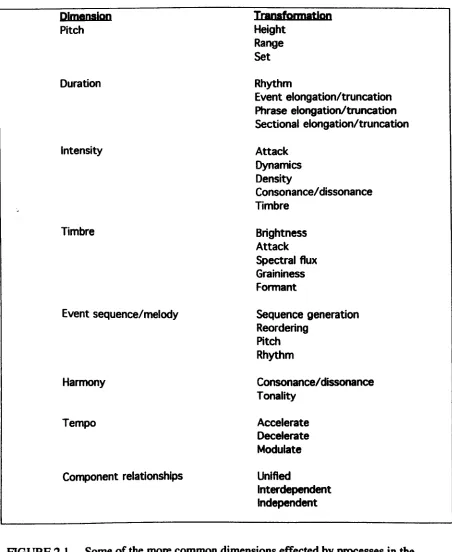
however, indicative of the wide range of possibilities available to transformation by processes. Dimension Pitch Duration Intensity Timbre Event sequence/melody Harmony Tempo Component relationships Transformation Height Range Set Rhythm Event elongation/truncation Phrase elongation/truncation Sectional elongation/truncation
Attack Dynamics Density Consonance/dissonance Timbre Brightness Attack Spectral flux Graininess Formant
[image:35.521.50.502.123.675.2]Sequence generation Reordering Pitch Rhythm Consonance/~ssonance Tonality Accelerate Decelerate Modulate Unlfled Interdependent Independent
Deterministic Processes
A deterministic process consists of a specific set of instructions that is
applied to source material in such a way that the process strictly determines the
resultant events. Importantly, it organises parameters entirely according to forces
outside explore-audition activity, and as a consequence, compositional attention is
inevitably focused on the design of the process and the selection and construction of
the source material. Once these are established, the system generates or transforms
the targeted parameters without the composer's involvement. From a compositional
perspective, deterministic processes can be divided into four main categories:
1. Mapping processes
2. Generati ve processes
3. Reordering processes
4. Combinatorial processes
Mapping processes describe a method for assigning the values of a collection
of already existent data to specific musical parameters, and they are commonly used to translate extra-musical entities into sound. The data set may be thought of as a
found object of which the composer does not control the structure, but instead
chooses based on the hypothesis that the 'readymade' structure will produce an
interesting result.6 Compositional craft, then, is expressed in the method of relating
the data to specific musical parameters, and it would seem to be aesthetically consistent to assume that this should be done in such a way as to contribute to the clarity of the inherent structure of the data. George Logemann's multimedia work
SET! is a clear example of a mapping process. It consists of a mapping of stellar coordinates from black and white x,y radial images directly to sound, with a third
6 The term 'readymade' is taken from Marcel Duchamp, who used it to refer to found objects in the
dimension, luminosity, mapped to intensity (Logemann, 1992). SETl allows the listener to 'hear' the constellations.
My own Wiring Sequence (1995), for three Bb clarinets, two oboes and Radio Shack
'no
in One' provides another example of a mapping process. The'no
in One' is a teach-yourself electronics kit, allowing the user to build 130 different projects by connecting wires to various numbered transistors, capacitors, diodes and so on. Some of the projects generate sound, and the one used in Wiring Sequence is the Light Harp, which produces a sine tone with pitch controlled by a light-sensitive resistor. For each project, the order in which the numbered connections should be made is given in a list referred to as the 'wiring sequence', and by convention, these lists progress from low numbered connections to high numbered connections, offering an inherent and consistent structure. The wiring sequence for the Light Harp is reproduced from the instructions in figure 2.2. In this piece, the ensemble is divided into two groups, separating the acoustic instruments from the '130 in One.'A conductor directs the piece by displaying the wiring sequence instructions on large cards, one at a time. While the '130 in One' uses these numbers as instructions for how to connect the various electronic components to build its sound, the woodwinds interpret them as indications as to the duration of their notes. In this way, both ensembles are using the wiring sequence to generate music, although with two very different approaches. Wiring Sequence is a light-hearted theatrical metaphor for some of the different ways that music is made.
1-29, 2-30, 3-16-41-109, 4-120, 5-106-110, 15-87, 40-105-88, 42-137, 119-138
FIGURE 2.2 The wiring sequence for the Radio Shack' 130 in One' Ught Harp