1 INTRODUCTION
Many unsaturated soils may undergo a significant settlement when wetted under load. If water is readi-ly available then this settlement can occur rapidreadi-ly; this is known as plastic collapse compression. Law-ton et al. (1992) define wetting-induced collapse as the densification of a soil caused by the addition of water at a constant total vertical stress. The term ‘collapse’ is used in the rest of this text to identify this irreversible hydro-mechanical phenomenon.
There are four main conditions required for col-lapse to occur (Barden et al. 1973, Mitchell 1976): (i) an open partly unstable, partly saturated fabric; (ii) high enough total stress that causes the structure to be metastable; (iii) a binding or cementing agent (including the effect of water menisci), which stabi-lises the structure when dry and (iv) addition of wa-ter. Each of these must be present to produce a col-lapse phenomenon, the degree to which each is present influences the resulting collapse observed.
A common observation during load and soak tests is that samples collapse from their initial water con-tent loading curve to the saturated compression line (Holtz & Hilf, 1961). The amount of collapse which occurs depends on the applied stress level. At low stress levels a small amount of expansion or com-pression may occur. Under these conditions the po-tential for collapse increases with increasing vertical stress, at least in the range where the load-ing/collapse yield locus (BBM model, Alonso et al.
1990) is activated on wetting. However experimen-tal observations have also indicated that at higher stress levels collapse potentials may reduce, result-ing in the determination of a maximum collapse, (Balmaceda, 1991; Futai, 1997; Rao & Revanasid-dappa, 2006). This reduction in collapse potential at higher stress levels may be attributed to a greater compression of the sample, which results in a higher dry density of the sample and a higher degree of sa-turation of the sample (Lawton et al., 1992). Both of these factors reduce the potential for collapse. Even-tually at higher stresses the soaking process induces no collapse.
In early Scanning Electron Microscopy (SEM) studies Barden et al. (1973) and Collins & McGown (1974) investigated the arrangements present within the microstructure of natural soils. Barden et al. (1973) in particular were interested in investigating the arrangements which existed within a number of sands, loessial soils and clays which exhibited col-lapse. Jommi & Sciotti (2003) studied differences in the microstructure of laboratory compacted and field compacted material using SEM. The study raised questions over whether soil compacted in the labora-tory should be used as a reliable reference material for field compaction given the resulting differences in microstructure.
With the shift towards the use of Environmental Scanning Electron Microscopy (ESEM), in which the sample can be imaged in its natural wet condi-tion, authors are again turning their attention to
mi-Characterisation, mechanical and microstructural behaviour of an
unsaturated silt
G. McCloskey & M. Sánchez
Department of Civil Engineering, University of Strathclyde, Glasgow, UK
E. Romero
Department of Geotechnical Engineering, Universitat Politècnica de Catalunya (UPC), Barcelona, Spain
crostructural changes which occur along hydraulic paths. Villar & Lloret (2001) observed the swelling behaviour of compacted FEBEX bentonite under constant volume, in which macropores became filled with the swelling bentonite particles. Zhang et al. (2005) investigated changes in the microstructure of a double porosity tropical soil along drying and wet-ting paths.
This paper presents the characterisation of the Bengawan Solo fill, a silt used in flood embankment construction in Indonesia. At the site under investi-gation, a number of engineering works have been constructed to improve the stability of the embank-ments. However it appears that these works provide the loading required, alongside the readily available access to water, low densities and moisture contents dry-of-optimum to produce conditions favouring collapse. The mechanical behaviour of this fill is presented in a number of soak and load oedometer tests on samples at (i) peak dry density (i.e. BS Light Compaction), (ii) low dry density and dry of opti-mum and (iii) undisturbed samples. Furthermore the vertical stress at which maximum collapse occurs is determined. The microstructure of the Bengawan Solo fill is investigated using ESEM under a number of different conditions, (a) Compacted, (b) Com-pacted, Loaded and (iii) ComCom-pacted, Loaded & Soaked, in order to determine the microstructural changes which are responsible for collapse induced volume changes. For comparison an undisturbed sample was also investigated using ESEM.
2 SITE DESCRIPTION
The soil investigated here was sampled from a site located along the flood defence embankments of the Bengawan Solo River, in the village of Kedunhard-jo, East Java, Indonesia. At the site the river is 100m wide and the embankment is 10m high and is fre-quently overtopped during the wet season.
During the site investigation low dry densities ranging from 1.18 -1.36Mg/m3 were determined alongside high moisture contents ranging from 36-43%. The site investigation was carried out at the end of the wet season. Shear vane tests were also carried out and the cohesion ranged from 20-40kPa, indicating a soft soil as classified in BS: 8004:1986.
There is a recurrent history of failure of the flood defence embankments at the site which is discussed in greater detail in McCloskey et al. (2008). Figure 1 shows a global failure, in a gabion reinforced section of the embankment. Other remediation measures put in place by the Ministry of Public Works include concrete slabs to protect erosion. McCloskey et al. (2008) argued that these measures provided the ne-cessary loading, alongside the low in-situ densities and readily available access to water to create condi-tions favouring plastic collapse compression of the
fill material. This phenomenon may be one of the possible mechanisms which contributed to the global failure of the gabion reinforced embankment (Fig. 1).
3 SOIL CHARACTERISATION
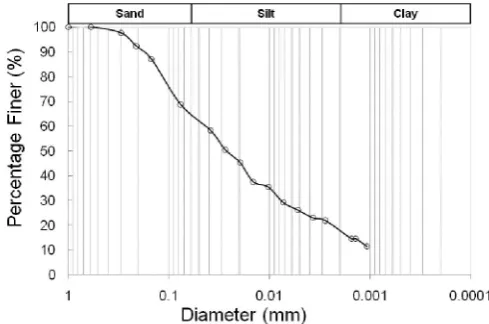
The soil investigated within this study is a medium plasticity sandy silt (Fig. 2) with particle density
ρs=2.72Mg/m3. The soil can be classified as an
inor-ganic silt of high compressibility (MH) in the Uni-fied Soil Classification System (LL=53%, PL=37%,
Ip=16%). Although the soil has a small clay fraction,
it has an activity A = 0.94, due to the high percen-tage of smectites in the clay fraction (88%), which have A=1-7 (Mitchell, 1976). Kaolinite makes up the remaining minerals in the clay fraction with an activity A = 0.5.
[image:2.595.309.563.413.559.2]The British Standard Light Compaction curve (input energy per unit volume = 596kJ/m3) is pre-sented in Figure 3; under this compactive effort the soil has a maximum dry density of 1.47Mg/m3 and an optimum moisture content of 28%. However Dr. Ria Soemitro of ITS, Surabaya, who works in colla-boration with the Ministry of Public Works has communicated to the authors that the embankments were constructed at 80 to 85% of the maximum dry
Figure 1. Global failure along gabion reinforced embankment
[image:2.595.313.558.602.764.2]dry density. This range is highlighted in Figure 3 and explains why low dry densities have been found at the site. It is for this reason that the samples pre-pared in the laboratory have been compacted to low dry densities in order to recreate conditions which are similar to those in the field.
In this study tests were conducted using both la-boratory compacted and undisturbed samples. The undisturbed samples were retrieved from the em-bankment using box samples according to the guide lines given by Fookes, (1990). Box samples were preferred to U100 tubes in order to protect the micro-structure of the material. This undisturbed material was sampled at the end of the wet season; one week after the embankments had been overtopped.
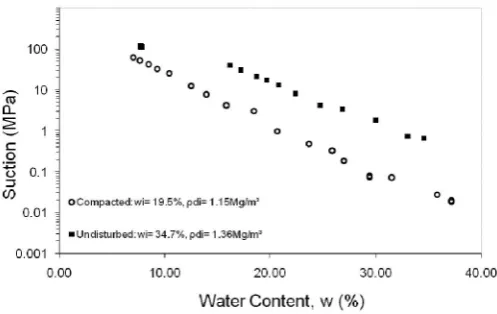
[image:3.595.41.284.414.570.2]Figure 4 presents the water retention curve for both undisturbed and laboratory compacted samples. The undisturbed sample is wet of optimum and has a higher dry density than the laboratory compacted samples. The curves converge at low moisture con-tent and high suction. It is important to note from the retention curve that at a moisture content of 20%, a low density laboratory compacted sample can have a suction of around 1MPa. A sample with a moisture content of 35% at the same density would have a suction of around 35kPa. As the material used to construct the embankments is transported material (taken from the riverbed) we can assume that there
Figure 3. BS Light Compaction Curve, ρdmax: 1.47Mg/m3, wopt: 28%
Figure 4. Water Retention Curves for laboratory compacted & undisturbed samples
remains no cementation effects within the soil and that the stabilising effect under dry of optimum con-ditions and at low dry densities is due to the role of suction.
4 MECHANICAL BEHAVIOUR
Three series of load and soak oedometer tests are presented here: (i) BS light compacted peak sam-ples; (ii) Low density, dry of optimum compacted samples (prepared at low dry densities similar to those found in-situ); and (iii) Undisturbed samples.
In series (i) BS light compacted peak samples, the specimens were prepared from a BS Compaction mould in order to recreate as closely as possible the peak conditions. It was not possible to recreate the dry of optimum samples, series (ii), in the compac-tion mould due to the crumbly fragile nature of the soil in this condition. The low density laboratory compacted samples were prepared in retaining rings 60mm in diameter, 18mm high in 3 layers using the damp tamping method. The undisturbed specimens were prepared from the box samples by cutting out block samples and trimming around the cutting rings.
No collapse was observed in series (i) BS light compacted peak samples on wetting at 127kPa, (Fig. 5). This is to be expected at the optimum condition.
Figure 6 presents the results from soak and load oedometer tests on remoulded samples with similar densities to those found in-situ. It can be clearly seen that the samples collapse from their natural water content loading curve to the saturated compression line, (Holtz & Hilf, 1961). Also noticeable is that at low vertical stresses the amount of collapse increas-es and at higher strincreas-essincreas-es it reducincreas-es. This is further highlighted in Figure 7 where the collapse potential (%) is plotted for the settlement due to wetting under each vertical stress. It is clear that the maximum col-lapse of 14% occurred on wetting at a vertical stress of 127kPa. Fookes (1990) published
Figure 5. Oedometer Results: Series (i) BS light compacted peak samples
1.
1
1.
2
1.3
1.4
1.
5
1
.6
10 15 20 25 30 35 40
Moisture Content (%)
Dr
y d
en
sity
(
Mg
/m
³)
85% ρdmax
80% ρdmax
[image:3.595.309.561.593.763.2] [image:3.595.36.285.612.769.2]Figure 6. Oedometer Results: Series (ii) Low density, dry of optimum samples
Figure 7. Collapse potentials at different vertical stresses for Series (ii) Low density, dry of optimum samples
Figure 8. Oedometer Results: Series (iii) Undisturbed samples
guidance relating collapse potential to severity of problem and suggested that values of collapse poten-tial between 10 and 20 % resulted in ‘severe trouble’ problems.
The results from soak and load tests on undis-turbed samples are presented in Figure 8. Specimens retrieved from the box samples varied greatly in dry density as a result of the heterogeneity of the materi-al on site. Therefore these results have been plotted in terms of normalised void ratio. No immediate
set-tlements were observed on wetting at loads of 63kPa and 127kPa. It is important to note here that the sample which was loaded to 127kPa and then inun-dated had a low dry density of 1.12Mg/m3, lower than the densities of the laboratory compacted sam-ples in series (ii) and yet no collapse was observed. This highlights the importance of the role of the ini-tial moisture content in producing collapse as sug-gested by Lawton et al. (1992).
The oedometer results indicate that the Bengawan Solo fill material is a collapsible material when compacted to low dry densities and at dry of opti-mum moisture content. Significant collapse induced volume changes were observed for samples at low dry densities in the range of dry density to which the embankments were constructed. Samples prepared at optimum dry density and moisture content showed no collapse on wetting. Undisturbed samples, wet of optimum showed no collapse even at low dry densi-ties.
5 MICROSTRUCTURAL STUDY
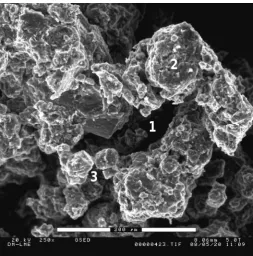
A qualitative microstructural study was carried out using environmental scanning electron microscopy (ESEM) to investigate the evolution of microstruc-ture during the collapse process. In this study three samples of the same initial conditions (w~19.5%, ρd=1.15Mg/m3) were investigated at three different stages of the collapse process: (a) Compacted, (b) Compacted Loaded and (c) Compacted, Loaded & Soaked. These images were then compared to that of an undisturbed sample. ESEM unlike conventional SEM allows samples to be imaged under wet condi-tions and also requires no special coating prior to imaging; thus simplifying the specimen preparation procedure greatly. The specimens imaged here were carefully fractured from larger samples in order to obtain representative natural surfaces.
removal of meniscus water lenses, as the voids be-came increasingly filled with bulk water during flooding. It is these meniscus water lenses present at the contacts which provide a stabilising effect (through an additional component of normal force, Fisher, 1926) in the dry, low density compacted sample (1MPa of suction). During wetting these lenses are removed and this additional force is lost. The overall change in fabric viewed in Figure 9c can be attributed to (i) the loss of rigidity of the aggrega-tions, (ii) the loss of strength on wetting between contacts and (iii) the loss of strength of bridging ma-terial. These changes all result in the loss of the
(a) Compacted: w =19.5%, ρd = 1.15Mg/m3, e = 1.38
(c) Compacted, Loaded & Soaked: w = 27.7%, ρd = 1.40, e = 0.95
macropores which are absent in Figure 9c. It is the loss of these inter-aggregate macropores on wetting which causes the collapse induced volume changes observed in Figure 6. Similarly Barden et al. (1973) found that the collapse mechanism of clayey soils was due to an effective aggregated macrostructure rather than the rearrangement of flocculated clay particles on wetting.
Finally the microstructure of an undisturbed sam-ple was also investigated using ESEM. There are distinct similarities between the Undisturbed sample (Fig. 9d) and the Compacted, Loaded & Soaked sample in Fig. 9c), namely both show fused aggrega-
(b) Compacted, Loaded: w =19.0%, ρd = 1.19Mg/m3, e = 1.29, Loaded to 127kPa for 24hrs
(d) Undisturbed: w = 30.5%, ρd = 1.34, e = 1.03
2
1
[image:5.595.33.287.213.470.2]3
Figure 9. ESEM micrographs of (a) Compacted, (b) Compacted, Loaded, (c) Compacted, Loaded & Soaked and (d) Undisturbed samples
4
5
6
7
tions (7, 8) in a uniform fabric, with a marked ab-sence of macropores. The outer covering of the fa-bric in the undisturbed sample appears to be more rounded than that in (Fig. 9c), this may be explained by the higher moisture content of the undisturbed sample. The comparison of Figures 9c and 9d sug-gests that the microstructure of the undisturbed sam-ple is very similar to that of the Compacted, Loaded & Soaked sample (collapsed) created in the laborato-ry with initial conditions, dlaborato-ry of optimum at low dlaborato-ry density.
The qualitative microstructure investigation presented here highlights the changes which occur during the process of collapse. In particular the main microstructural changes noted were (i) the sof-tening of aggregations; (ii) the removal of meniscus water lenses at contacts and (iii) the loss of strength of the bridging material on wetting. It is these changes which are responsible for the loss of the in-ter-aggregate macropores. The sample which un-derwent collapse in the laboratory showed a very similar microstructure to the undisturbed sample, which was sampled from the site at the end of the wet season. It appears from this investigation that the undisturbed material has already undergone col-lapse in-situ under its own self weight.
6 CONCLUSIONS
A characterisation of the Bengawan Solo fill materi-al used to construct flood embankments in Indonesia has been presented herein. It has been reported that the material is compacted in-situ at dry densities of 80-85% peak dry density. A series of load and soak oedometer tests performed on specimens within this range exhibited collapse behaviour at a number of different vertical stresses (from 63kPa to 538kPa). Maximum collapse was found to occur at 127kPa.
The microstructure of this material was investi-gated with specific reference to the changes occur-ring within the soil duoccur-ring the collapse process. The wetting resulted in the softening of aggregations, removal of meniscus water lenses and loss of strength of bridging material to form a fused uni-form fabric with no macropores. It appears from this qualitative study that the undisturbed material inves-tigated has already undergone collapse in-situ under its own self weight. It is proposed that these results will be further investigated using mercury intrusion porosimetry to quantify the pore size distribution of these samples.
7 ACKNOWLEDGEMENTS
The authors would like to acknowledge the assis-tance of Daniele Bertalot in carrying out some of the laboratory tests detailed herein. Furthermore special
thanks to the staff and postgraduate students at UPC, Barcelona for their assistance in carrying out the mi-crostructural study. The support of Dr. Ria Soemitro and Prof. Mark Dyer during the initial stages of this research is also appreciated.
The authors gratefully acknowledge the support of the Carnegie Trust, Bellahouston Travelling Scholarship, the Research Enhancement Group at the University of Strathclyde and the EC (contract number MIF1-CT-2006-040375).
REFERENCES
Alonso E. E, Gens A, Josa A (1990) A constitutive model for partially saturated soils. Géotechnique 40(3):405–430 Balmaceda, A. (1991). Compacted Soils: A theoretical and
ex-perimental study. PhD Thesis, Universitat Politécnica de Catalunya, Barcelona, Spain, 433p
Barden, L., McGown, A. and Collins, K. 1973. The collapse mechanism in partly saturated soil, Eng. Geol., 7:49-60 Collins K, McGown A (1974) The form and function of
micro-fabric features in a variety of natural soils. Géotechnique
24(2):223–254
Fisher, R. A. (1926). On the capillary forces in an ideal soil; correction of formulas by W.B. Haines. J. Agric. Sci. 16, 492–505.
Fookes, P.G. 1990. Tropical Residual Soils, Report of the Geo-logical Society Engineering Group Working Party, Quar-terly Journal of Engineering Geology, 23, 4–101
Futai, M. M. (1997). Analysis of Suction Control Oedometer Tests on Collapsible Soils (in Portuguese). Masters Thesis, COPPE/UFRJ, Rio de Janeiro, RJ, 255p
Holtz, W.G. and J.W. Hilf. (1961) Settlement of soil founda-tions due to saturation, Proceedings of the 5th International Conference on Soil Mechanics and Foundation Engineer-ing vol. 1, pp. 673–679
Jommi C, Sciotti A (2003) A study of the microstructure to as-sess the reliability of laboratory compacted soils as refer-ence material for earth constructions. In: Botempi F (ed) System-based vision for strategic and creative design, vol 3. A.A. Balkema, Lisse, pp 2409–2415
Lawton, E. C., Fragaszy, R. J. and Hetherington, M. D. (1992) Review of wetting induced collapse in compacted soil, J. Geotech. Engrg., ASCE, 118, 1376–1394
Mitchell, J. K. 1976. Fundamentals of soil behavior, Wiley, New York
McCloskey, G., Sanchez, M., Dyer, M. and Kenny, M. Beha-viour of a silt used in flood embankment construction in In-donesia. Unsaturated Soils: Advances in Geo-Engineering,
465-469, Toll et al. (eds.) 2008, Taylor & Francis Group, London. ISBN: 978-0-415-47692-8
Rao, S. M. and Revanasiddappa, K. 2006. The influence of cy-clic wetting drying on collapse behaviour of compacted re-sidual soil, Geotechnical and Geological Engineering, 24: 725-734.
Villar MV, Lloret A (2001) Variation of the intrinsic permea-bility of expansive clays upon saturation. In: Adachi K, Fu-kue M (eds) Clay Science for Engineering. A.A. Balkema, Rotterdam, pp 259–266