City, University of London Institutional Repository
Citation
:
Mera, M. (2009). Reinventing Question Time. In: Scott, D. B. (Ed.), The Ashgate research companion to popular musicology. (pp. 59-83). Aldershot: Ashgate Pub Co. ISBN 9780754664765This is the published version of the paper.
This version of the publication may differ from the final published
version.
Permanent repository link: http://openaccess.city.ac.uk/3899/
Link to published version
:
Copyright and reuse:
City Research Online aims to make research
outputs of City, University of London available to a wider audience.
Copyright and Moral Rights remain with the author(s) and/or copyright
holders. URLs from City Research Online may be freely distributed and
linked to.
City Research Online: http://openaccess.city.ac.uk/ [email protected]
3
Reinventing
Question Time
Miguel Mera
Over the past 20 years the academic study of screen music has become an increasingly established field. Following the publication of Claudia Gorbman’s groundbreaking Unheard Melodies: Narrative Film Music (1987) a substantial body of scholarship has emerged that explores music and the moving image using a variety of methodological approaches. The marked expansion of articles, books, anthologies and journals suggests that the study of screen music continues to move from the margins to the mainstream.1 However, almost all extant work considers the role of music in film. Other media, such as television, are largely ignored despite clear cultural impact and ubiquity. Recent publications and work in progress suggest this is changing, but, for the moment, the study of television music remains something of a scholarly blind spot.2
The reasons for this lacuna are complex. A recurrent argument proposes that, in comparison to cinema which requires sustained and intense concentration, broadcast television is regulated by the limited a ention span of the viewer. In the now classic work, Visible Fictions (1992), John Ellis explains that, when watching television, the spectator ‘glances rather than gazes at the screen; a ention is sporadic rather than sustained’.3 He also outlines how broadcast TV ‘offers a small image of
low definition, to which sound is crucial in holding the spectator’s a ention’.4 one could speculate that Ellis’s perception of low-‐‑definition and smaller TV images will
1 For example, four new journals focusing on screen music and/or sound have appeared in recent years. These include in order of first appearance: The Journal of Film Music
(International Film Music Society), Music, Sound and the Moving Image (University of Liverpool Press), Music and the Moving Image (University of Illinois Press) and
The Soundtrack (Intellect).
2 Recent publications that challenge the undervaluing of television in screen music studies include Kevin Donnelly’s Film and Television Music: The Spectre of Sound (London, 2008). Donnelly explores the role of music in television continuity segments as well as in television drama.One might also point to the current lack of work on videogames, music and sound in websites, or mobile media. A starting-‐‑point is Paul Hoffert’s Music
for New Media (Boston, MA, 2007).
be transformed in an era where widescreen TV and high definition broadcasting are becoming more prevalent, but his concept of sound as fundamental to the impact of television suggests its importance as a point of study. A similar idea is posited by Kevin Donnelly who observes that music in television is the ‘prevailing agent of control’,5 and, because audiences o en do something else while the television is on, ‘[w]e listen to television sometimes more than we watch it’.6
What these writers highlight, of course, is that television is principally a domestic medium, and it is this very domesticity that provides a unique perspective. Despite increased globalization, TV remains distinctly ‘national’ in the sense that British television represents a different domestic audience and sociocultural viewpoint than, for example, French television. As Ellis observes, ‘Broadcast TV is the private life of a nation-‐‑state, defining the intimate and inconsequential sense of everyday life’.7 Accordingly, television tends to adjust itself towards its audience in order to ‘include the audience’s own conception of themselves into the texture of its programmes’.8 As a tool for social and cultural research, therefore, television provides extraordinary potential for understanding the role that music has in shaping its audience and how music is in turn is shaped by its audience.
However, one of the principal challenges in the study of television music is simply accessing materials for study. Although DVDs of some TV series are widely available, other source materials are not easy to locate. Individual broadcasters, such as the BBC, hold archives of their materials but these are not always readily available. Older programmes are especially hard to trace given that the use of videotape for archival purposes only began to gain momentum from the mid-‐‑1970s onwards, coupled with the notion that television might be more than an ephemeral medium with long-‐‑term value in terms of heritage and culture. Owing to the vast amount of content that is broadcast a policy of selective archiving is generally unavoidable.9 Therefore, the study of a long-‐‑running television programme – as is my focus here – presents significant challenges in terms of access, even to the primary texts. Once physical materials have been accessed by the individual researcher, however, there still remains the problem of allowing others to hear and see it. For the purposes of this chapter, permission was requested to stream video examples via the Internet, but this was not granted: ‘We are in a position at the moment where we cannot allow BBC identifiable footage to appear on websites.’10 While the rights of copyright-‐‑ holders must, of course, be protected, the development of the field is dependent on the ability to access materials in order to see and hear what scholars discuss. Distribution mechanisms and copyright law, to some extent, define the type of scholarship that takes place. As Katharine Ellis points out, ‘musical research on
5 Donnelly, The Spectre of Sound, p. 111. 6 Ibid.
7 Ellis, Visible Fictions, p. 5 8 Ibid., p. 115.
9 See, for example, the BBC archive at: <h p://www.bbc.co.uk/archive> (accessed June 2007).
the internet is straitjacketed by licensing anachronism, ill-‐‑defined and inadequate legal exemptions, and a species of risk-‐‑aversion that stems from fear – among researchers and publishers alike – of becoming a legal test case’.11 However, we live in an increasingly digitally mediated world, and numerous digitization projects undertaken by broadcasters and other bodies are bringing about change that will eventually serve the field well in the future.12
This essay will examine the opening title music for the long-‐‑running British television debate programme Question Time which was first broadcast in 1979.13 The Question Time theme music was originally composed by Stanley Myers (1930–93) and, to date, has been changed on four occasions.14 However, instead of commissioning successive new themes, Myers’s musical material has been used as the basis for ‘reinvention’. In essence the same piece of music has survived since 1979, but has received differing interpretations and arrangements. If invention is the construction of that which has not existed before, the term ‘reinvention’ suggests recasting something familiar into a different – but equally original – form. Terms such as ‘sequel’, ‘adaptation’ or ‘remake’ do not seem appropriate, largely because of their association with film or literary theory, but also because they tend to focus on the idea of fixed texts at fixed points in history (for example, Hitchcock and Gus van Sant’s versions of Psycho in 1960 and 1998 respectively). The danger in this approach, as Constantine Verevis has shown, is that most critical accounts highlight a one-‐‑way process, a movement ‘from authenticity to imitation, from the superior self-‐‑identity of the original to the debased resemblance of the copy’.15 But a long-‐‑running television programme – particularly one that receives a weekly broadcast, is concerned with topical issues and is constructed by its audience – is always in a state of reinvention, evolving through a feedback loop with the public. Value judgements about fidelity and/or originality in comparison to the source text would obscure understanding of what actually takes place when a work is changed, such as the social and cultural forces that shape the act of reinvention. The term ‘reinvention’, therefore, a empts to ascribe an appropriate level of importance to later text(s) which may well be just as creative and indeed ‘original’ as the
11 Katharine Ellis, ‘Rocks and Hard Places’, in Johanna Gibson (ed.), Herchel Smith
Intellectual Property Futures (Cheltenham, forthcoming). Some issues in relation to
publishing rights are also raised by Anne e Davison in ‘Copyright and Scholars’ Rights’, Music, Sound, and the Moving Image, 1/1 (2007): 9–14.
12 In the UK bodies such as the British Universities Film and Video Council (BUFVC) is a representative body which promotes the production, study and use of moving image, sound and related media in higher education and research.
13 The website for Question Time contains some details about its history and some classic editions can be streamed. See: <h p://news.bbc.co.uk/1/hi/programmes/question_time/ default.stm> (accessed June 2007).
14 Myers reveals his musical background in an interview on the CD Stanley Myers:
The Deer Hunter and Other Themes (Milan 73138–35939–2). He began his musical career
playing piano for cabaret shows, in bars, and as a rehearsal pianist. He is best known as a film composer for his work with Stephen Frears.
primary text within their particular context. Furthermore, although we can select as an object of study any discrete moment in the history of Question Time, we must always understand this as part of a process of continuous evolution. Reinvention reflects a desire to reread or, as Leo Braudy observes, to ‘believe in an explicit (and thematized) way that the past reading was wrong or outdated and that a new one must be done’.16 In long-‐‑running television programmes, those moments when a new version must be done are like nodes reflecting the build-‐‑up of cultural, social, technological or political change.
Through an examination of the transformation of the Question Time theme this chapter will illustrate how the evolution of musical materials not only reflects societal change, but also parallels the shi ing British political spectrum, from the right-‐‑wing Thatcherite government of the 1980s to the centre-‐‑le (New) Labour government of the late 1990s onwards. This evolution also highlights changing features of television scoring practice during the same period, including developments in music technology. Inevitably, there are issues of taste to consider, but, as Pierre Bourdieu has shown, taste is not pure or innocent.17 Aesthetic choices are fundamental to the societal frameworks that encase them, including – I would argue – political frameworks. What this chapter hopes to show is that the study of television music raises new questions for screen music studies generally. These include the contrasts between ephemerality and longevity, the problem of sources, the social significance of music and moving image, and the interaction between music and political context.
Question Time
: The First Broadcast
Hello, and here we are for the first of our weekly Question Times with an
audience in a South London theatre which has been specially converted for television; that’s to say the theatre has been specially converted not the audience, the audience are much the same people as they were when they came in. They are what’s described in TV circles as ‘real people’ to distinguish them
from people who work in television. We don’t claim them to be a scientific
cross-section of the British nation but they are a very good collection, a wide-ranging collection from a broad variety of groups, organizations and
institutions, and to answer their topical questions I’ve got a pre y rich
mixture of personalities here with me …18
16 Leo Braudy, ‘A erword: Rethinking Remakes’, in Andrew Horton and Stuart Y. McDougal (eds), Play it Again, Sam: Retakes on Remakes (Berkeley, CA, 1998), p. 332. 17 Pierre Bourdieu, Distinction: A Social Critique of the Judgement of Taste, trans. Richard
Nice (Cambridge, MA and London, 1984).
So began Robin Day’s introduction to the first broadcast of Question Time on 25 September 1979.19 Although originally designed to fill a gap in the schedule, it has since become one of the most popular and enduring television programmes in the United Kingdom, offering the British public a unique opportunity to challenge leading decision-‐‑makers on contemporary issues. The format is simple and has remained unchanged since 1979. A panel consisting primarily of politicians, but which may also include newspaper editors, authors, religious leaders – anyone who is perceived to have an influence on the way nation and society is shaped – is asked questions by an audience representing a cross-‐‑section of British society. The panel is given no advance warning of the questions that will be put to them, but due to the topical nature of the programme a detailed knowledge of current affairs and of party policy (where relevant) is essential.20 For the first broadcast the panel comprised Michael Foot (Deputy Leader of the Labour Party), Teddy Taylor (former Conservative Sco ish Office minister), Edna O’Brien (novelist) and Derek Worlock (Archbishop of Liverpool).
Question Time generates the kind of debate that might take place in the House of Commons or the House of Lords, but the principal difference is that the public are central to the discussion and can directly hold their elected representatives to account. In his book Radio, Television, and Modern Life, Paddy Scannell recognizes a distinct form of connection in the talk show where the viewer is ‘invited in’ as a central aspect of its sociability.21 The studio audience plays a vital role and is ‘placed directly in the television studio as joint author of the text’.22 Along with the presenter, the studio audience act as substitute for the absent or ghost audience who are at home and generate an experience of togetherness. In the case of Question Time, that studio audience literally acts as a microcosm of the nation, diverse in its
19 Robin Day (1923–2000) originally trained as a barrister, but a er only a short period in practice he moved into journalism working initially for ITN and la erly for the BBC. In 1959 he stood as Liberal candidate for Hereford in the general election but failed to get into parliament. Alongside Question Time he also presented Panorama, and on radio was presenter of The World at One. He was widely regarded as one of Britain’s finest political interviewers and was knighted in 1981. His autobiography is entitled Day by Day:
A Dose of My Own Hemlock (London, 1975).
20 Conservative politician Boris Johnson (then the Shadow Minister for Higher Education but currently Mayor of London) seemed to be unaware of this in a broadcast on 8 July 2004 as he came unstuck while trying to bluff his way through a question about the government decision to admit Yusuf Al Qaradawi into the United Kingdom to speak on behalf of the Muslim Brotherhood. Johnson’s lack of knowledge about the subject – he was unaware of his own party’s stance and later admi ed being too complacent to have read the newspapers before the broadcast – and his a empt to charm his way around a question about the incitement of racial hatred simply confirmed his reputation as a likeable buffoon.
21 Paddy Scannell, Radio, Television and Modern Life (Oxford, 1996), p. 28. See Chapter Two: ‘Sociability’.
22 Sonia Livingstone and Peter Lunt, Talk On Television: Audience Participation and Public
political views, gender, race, age and socioeconomic structure. It is unsurprising, therefore, that Robin Day’s comments – as well as an extended camera pan of the entire auditorium – firmly establish the importance of the studio audience from the very outset. If it is true that a fundamental duty of citizenship within democracies is for individuals to form an opinion about public affairs and to express that opinion at the ballot box, televisation generally – and programmes such as Question Time specifically – make an important contribution to the democratic process. Furthermore, direct contact between decision-‐‑makers and ‘real’ people has contributed to the programme’s lasting appeal.
Any UK citizen of voting age can apply to a end a broadcast, and all audience members are invited to submit potential questions.23 The programme-‐‑makers select the shortlist of questions, depending on what they perceive to be of greatest national interest that particular week. The panellists’ responses are interspersed with comments from the audience, and anybody who wishes to speak need only raise their hand in order to a ract the a ention of the chairperson. The programme is recorded live at around 20:30 GMT each Thursday and then broadcast at 22:35. The reason for not broadcasting live at 22:35 is ‘to limit inconvenience to spectators and guests – enabling them to appear on the programme at locations across the country and still return to their homes at a reasonable hour – and therefore maximize the number of leading politicians and political commentators willing to take part’.24 The recording is completed in a single take, precisely as if it were broadcast live, and any text messages sent in when the programme is broadcast are live responses to the guests’ remarks. The discussion can vary from the intelligent and incisive to the frivolous and partisan. It may not quite accomplish the undistorted participatory communication between citizens that scholars such as Habermas believe to be the fundamental basis for a democracy,25 but it is as free a debate as the mechanics of making a popular television programme will allow, and Question Time remains the only regular forum on UK television where senior politicians are challenged by ordinary members of the public, at times with extraordinary consequences.26
23 The one exception to the age limit is the annual Schools Question Time where pupils are nominated by schools around the country and those selected join the production team and help make a special edition of the programme. This is a good way of engaging Britain’s youth in political debate.
24 <h p://news.bbc.co.uk/1/hi/programmes/question_time/faqs/default.stm> (accessed June 2008).
25 German Political Philosopher Jürgen Habermas argued for public communication unfe ered by institutional control. See The Theory of Communicative Action. Vol. 2
Lifeworld and System: A Critique of Functionalist Reason, trans. Thomas McCarthy
(Cambridge, 1987); The Structural Transformation of the Public Sphere: An Inquiry Into
a Category of Bourgeois Society, trans. Thomas Burger with the assistance of Frederick
Lawrence (Cambridge, 1989).
This format seems perfectly natural to UK audiences today, but this was not the case in the late 1970s when politicians rarely engaged with the public in such a direct manner. In that same first broadcast, for example, the novelty and awkwardness is in constant display and delightfully illustrated as one audience member tries and fails to ask the final question of the evening.
Robin Day: Well, we’ve got two or three minutes more on this enjoyable programme and I am going to call Mrs Dorothy Clark who has got, I think, a short question for us which will reveal what our guests are really like … Mrs Dorothy Clark … housewife … are you there?
Dorothy Clark: Which question?
Robin Day: You had a short one I think about … about the team …
Dorothy Clark: About the beer?
Audience laughter.
Robin Day: About the what?
Dorothy Clark: (searching in handbag)… Oh, I’m doing the wrong thing, aren’t I?
Robin Day: No, no, no, you’re … you just ask whatever you’d like to ask, but not a long political question.
Dorothy Clark: (searching through bits of paper and in realization) … Oh!
Robin Day: You had one at the end, I think I remember, you had two or three … I thought you wanted to ask one which … how are you doing there?… what have you got in that handbag?
Audience laughter.
Robin Day: Well while you’re waiting I’ll tell you what it was, it was: what does the team like doing on a night out?
Dorothy Clark: Oh, what does the team like …
Robin Day: Yes, we’ve got that.
With historical hindsight, presenter Robin Day’s comment about ‘this enjoyable programme’ and the indication that the question will ‘reveal what our guests are really like’ seems naïve and patronizing. But, interestingly, Michael Foot finds this line of questioning uncomfortable: ‘That’s not going to be revealed on this kind of programme’ (my italics). Foot’s lack of comprehension about the relevance of his personal interests was not an uncharacteristic view for the time and represents a genuine concern about individual privacy versus public duty, as well as the value of serious political discussion as mediated through television. This same concern is reflected in the fact that it was not until 1989 that House of Commons debates were first televised in the United Kingdom.27 Today, however, political life is constituted through its total immersion in a media-‐‑dominated world, and a contemporary, media-‐‑savvy audience is much be er informed. In short, political debate has changed, the way politicians relate to the public and the media has changed, and – following that notion to its logical conclusion – the nature of democracy has changed. If, as Fiske and Hartley suggest, television is a social ritual in which ‘our culture engages in order to communicate with its collective self’,28 then Question Time has consistently projected, represented and reflected an image of the British public back to itself.
Invention/Reinvention
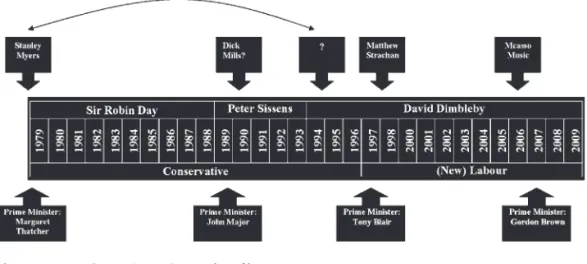
It is interesting to note that musical reinventions of the Question Time theme have occurred principally at moments when a new prime minister takes office (see Fig. 3.1). The programme itself was created only months a er Margaret Thatcher came to power and the music remained unchanged throughout the ten years in which she was prime minister, despite the fact the title graphics were revised on three occasions during this period.29 The music was reinvented shortly a er John Major and Tony Blair took office in 1989 and 1997 respectively. In 2006 – and with delicious irony – the music pre-‐‑empted Gordon Brown’s premiership, which is something he had himself been doing for a number of years.30
27 It is interesting to note that Robin Day himself published a book advocating the televisation of parliamentary debate as early as 1964: The Case for Televising Parliament
(London, 1964).
28 John Fiske and John Hartley, Reading Television (London, 2003), p. 64.
29 Although there is no evidence that the new government played any part in encouraging the birth of debate programmes such as Question Time, television coverage of the 1979 election campaign was particularly intense. All three major parties held daily press conferences and Thatcher worked especially hard to provide the media with photo opportunities. Curiously, however, she refused to appear on the programme Weekend
World in a debate with Labour leader James Callaghan and Liberal leader David Steel.
Weekend World, broadcast on ITV, ran from 1972 to 1988 and was presented by Brian
Walden.
The change that took place in 1994, however, seemed to coincide with the arrival of the new presenter, David Dimbleby. It has proved challenging to identify who arranged this version, but of all the reinventions this is by far the closest to Myers’s original. In fact, apart from an additional introductory bar and a slightly tighter performance, the ensemble, instrumentation and orchestration are exactly the same as the original. In comparison to the other versions this is not so much a reinvention as a rerecording, reflecting a shi from analogue to digital recording technology from the late 1970s to the mid-‐‑1990s. The sound quality is punchier and the bass sound, in particular, is more heavily compressed. This return to the original version could also be understood as an a empt by the programme-‐‑makers to generate a link to between the new presenter David Dimbleby and the first presenter Robin Day. The gravitas that Day naturally commanded seemed to elude Peter Sissens’s chairmanship in the early 1990s, and the appointment of David Dimbleby provided new energy in an a empt to reclaim the ‘glory days’ of the programme. Major reinventions – those that have incorporated new compositional elements or orchestrations – have occurred when there has been a change of government. The comparatively minor rerecording in 1994 therefore seems to reflect the arrival of the new presenter.
Figure 3.1 Question Time, Timeline, 1979–2009
It is important to understand the background to the creation of the original theme music. During the winter of 1978 the Labour government faced industrial disputes, escalating unemployment and deteriorating public services; it was dubbed the ‘winter of discontent’. The Conservatives easily won the 1979 general
election.31 Britain had shown itself to be progressive by electing the first female prime minister of any Western nation and had given Margaret Thatcher a clear mandate to reform economic decline. On arrival at 10 Downing Street on 4 May, Thatcher famously paraphrased the prayer of St Francis of Assisi: ‘Where there is despair may we bring hope.’ The nation had emphatically requested a change, and it was with a sense of hopefulness that the new Conservative government took office. It is in this context that the birth of Question Time, only four months into the new Conservative government, should be understood. In a number of ways Myers’s music reflects this hopefulness and optimism.
The dominant features of Myers score are a semi-‐‑quaver classical guitar pa ern that generates momentum, and regular anacrusis and downbeat stabs that further contribute to the forward motion. The ‘melodic’ construction is modal with an avoidance of the raised 7th(G). The simple harmonic structure revolves around an A minor tonal centre, but 6th, major 7th and 9th chords add harmonic colour. Myers’s interest in jazz and light music is also reflected in the instrumentation which includes piano, amplified double bass and drum kit (Ex. 3.1).
In 1978 Myers’s music for the Vietnam War drama, The Deer Hunter (Cimino), brought him international recognition. The main theme ‘Cavatina’ had in fact been recorded by the classical guitarist John Williams long before. It first appeared in the film The Walking Stick (Till, 1970) and on the album Changes (1971).32 In 1976 jazz singer Cleo Laine wrote lyrics for the theme and recorded the song ‘He Was Beautiful’, accompanied by John Williams. Following the release of The Deer Hunter in 1978 Williams’s instrumental version of ‘Cavatina’ reached number 16 in the UK pop charts. The popularity of ‘Cavatina’ may have been an important factor in the decision to employ Myers as the composer for the Question Time theme; he may even have been encouraged to use the classical guitar as the centrepiece of the arrangement as a consequence. It is certainly a striking choice, quite unlike themes for other political programmes of the era. Indeed, the Question Time theme displays more than a passing resemblance to Isaac Albéniz’s Asturias which was originally wri en for piano, but is be er known in its arrangement for solo guitar. A number of features suggest – though not as strongly as might as full-‐‑blown temp-‐‑track – that Asturias was certainly an influence on Myers’s thinking. In particular, comparisons could be drawn between the constant semiquaver movement over a pedal note, the modal melodic construction and the sudden fortissimo chord stabs that appear later in the piece (Ex. 3.2).33
31 The Conservatives won 339 seats compared to Labour’s 269. The swing to the Conservatives of 5.2 per cent was the largest since 1945. Thatcher’s win reflected the intense dissatisfaction with the Labour government as much as an endorsement of Conservative policies, but the desire for change was unequivocal.
32 Cube Records, producer: Stanley Myers (Fly/Fly 5, April 1971).
Example 3.1
Stanley Myers,
Example 3.2 Isaac Albéniz, Asturias, opening, guitar transcription
An important sociocultural influence is the fact that international package tourism flourished in the 1970s and 1980s, when millions of middle-‐‑class Brits went in search of a fortnight’s relaxation on beaches in Benidorm, the Costa del Sol or Mallorca and returned wearing a giant sombrero or carrying a stuffed donkey.34 Spain was exotic, but not too exotic. As Karen O’Reilly has shown in her ethnographic study of communities living in the south of Spain, expatriates consistently emphasized the idea of ‘continuity and change’.35 They came on holiday, but stayed for the weather and the quality of life. It was just like home – not least because resorts were full of other Brits – but ho er. The use of the guitar in Question Time arguably taps into the particularly British obsession with Spain during this period. The popularity of recordings by John Williams and Julian Bream is part of the same cultural movement.
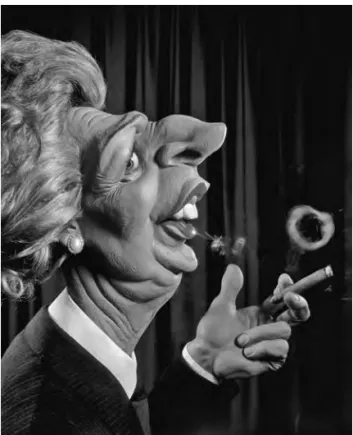
The Question Time theme also represents a more ‘feminine’ mode of scoring than other political programmes of the time such as Panorama, another long-‐‑running BBC current affairs programme first broadcast in 1953. Panorama’s thundering timpani, incisive brass and syncopated pa erns epitomize – following Tagg’s and Clarida’s definitions – a masculine mode of scoring.36 Myers’s Question Time theme, then, sits somewhere in between stereotypical representations of masculine and feminine in television music, perhaps because the late 1970s and early 1980s witnessed the appearance of the masculinized woman, particularly in the workplace, where pronounced shoulder-‐‑pads and power dressing became commonplace. American television imports such as Dallas and Dynasty further emphasized this representation. Thatcher herself was mocked for being more masculine than her male cabinet colleagues. The extremely popular satirical puppet programme
Spi ing Image, for example, portrayed her as a fascist hermaphrodite: wearing power suits, using urinals and smoking cigars (see Fig. 3.2).
34 Roger Bray and Vladimir Raitz, Flight to the Sun: The Story of the Holiday Revolution
(London, 2001).
35 Karen O’Reilly, The British on the Costa del Sol: Transnational Identities and Local Communities
(London, 2000), p. 24.
36 Philip Tagg, ‘An Anthropology of Stereotypes in TV Music?’, Swedish Musicological
Journal (1989): 19–42. Available at: <h p://www.tagg.org/articles/xpdfs/tvanthro.pdf>
(accessed June 2008); Philip Tagg and Bob Clarida, Ten Li le Title Tunes: Towards a
Musicology of Mass Media (New York and Montreal, 2003). This la er work is out of print
Figure 3.2 Margaret Thatcher: the Spi ing Image representation © Courtesy of Spi ing Image Workshop, John Lawrence Jones
The most striking aspect of Myers’s manuscript score is that there are significant differences between it and the recorded broadcast version. As far as can be ascertained, this is the only manuscript source in existence (Fig. 3.3).37 The score is wri en in Myers’s own hand and represents his orchestration, rather than that undertaken by an orchestrator from a sketch. Although they appear in the score, there is no string orchestra, bassoon, flute or harp countermelody, or cadential use of the horn in the broadcast version. The hi-‐‑hat plays a steady crotchet pa ern and not the semiquaver pa ern as it is notated. Furthermore, the entire B section of the ternary form score is not used for the broadcast version.38 In short, Myers’s broadcast music is a significantly pared-‐‑down version of the musical material contained within the score.
37 The MS is part of the Stanley Myers collection held at the Royal College of Music, London. The materials were donated to the institution by Nicholas Myers (Stanley’s son) and consist of 18 A3 boxes of full scores for film and television. There are no parts. Scores are not normally held by television companies, so it is unlikely that further sources exist.
Figure 3.3
There are a number of potential reasons for these differences. There is no date on the manuscript score so it is not clear when it was composed. It could be a dra version or might equally represent Myers original concept with budget restrictions or directorial influence resulting in the final pared-‐‑down version. Alternatively, the score may have been created for some other purpose, such as a soundtrack CD or for concert performance. Although Myers died in 1993, an album of his film and television music – including the music for Question Time – was posthumously released in 2001.39 However, the arrangement on that CD does not bear a close relation to the manuscript score either. It is possible that Myers took the score into the studio and made alterations or recorded different versions during the session. In current industry practice composers produce extensive demos of their work on digital audio workstations, and the director can hear a detailed mock-‐‑up of a cue before a single note is recorded. This was not the case in the late 1970s when Myers’s use of technology would have extended to a stopwatch, piano and pencil. The first time the director would have heard the music proper would have been in the recording session itself, leading to potentially greater variance from notated page to recorded artefact.40 In any case, the manuscript score bears no close relation to any of the existing recorded versions, which raises challenging questions about the value and relevance of such source materials.
Reinvention: Rule Britannia?
It was not until 1990 that Myers’s theme was first reinvented, a change that coincides with the arrival of the new prime minister, John Major. In 1989 he had inherited a deeply divided Conservative Party and was unable to prevent the ri s from tearing them apart. Major was mercilessly lampooned in the press, in particular by Guardian cartoonist Steve Bell who portrayed him wearing his underpants outside his trousers in an uptight and feeble imitation of superman (Fig. 3.4). Equally, on
Spi ing Image, Major’s puppet was literally a grey man (in comparison to the other colourful puppets) who ate dinner with his wife in deathly silence, occasionally saying ‘Nice peas, dear’.
39 Stanley Myers: The Deer Hunter and Other Themes (Milan, 73138-‐‑35939-‐‑2, 2001).
Figure 3.4 Three Cows on My Pants,41 Steve Bell, Guardian, 20 June 1996. Reprinted by permission of Steve Bell
The bu oned-‐‑up Britishness Major was perceived to represent was best exemplified by the phrase ‘back to basics’ which he coined in a speech in 1993 and which was an a empt to revitalize the government a er the financial disaster of Black Wednesday.42 ‘Back to basics’ was generally understood as a moral campaign
41 This is a parody of ‘Three Lions’ which was the official anthem of the England football team for the 1996 European Championships. The music was wri en by The Lightning Seeds and the lyrics were penned by comedians Frank Skinner and David Baddiel. The title of the song is derived from the English coat of arms. Steve Bell’s reference to ‘three cows’ mocks Major’s handling of the bovine spongiform encephalopathy (BSE) – more commonly known as mad cow disease – crisis. The epidemic was caused by feeding cows the remains of other ca le in the form of meat and bone meal. Nearly 4.5 million ca le were slaughtered in an a empt to eradicate the disease, and the European Commission banned unsafe British beef. In 1996 the link between BSE and variant CJD, the human form of the disease, was publicly acknowledged for the first time. Further cartoons of John Major drawn by Steve Bell can be seen at the British Cartoon Archive which is housed at the University of Kent.
emphasizing a romanticized, patriotic and innocent view of Britain of the 1950s. Ironically, the basics that most of the Conservative Party seemed to be ge ing back to involved illegal activities, sexual impropriety and abuses of power.43 In addition, the party was in the throes of destroying itself over the United Kingdom’s relationship with the European Union. It is in this context that the first major reinvention of the Question Time music is striking. The wholesome Elgarian musical gestures assert and emphasize a pompous, nationalist pride – a stiff upper lip combined with nostalgia for cucumber sandwiches and tea on the lawn with the vicar. The music represents an image of the nation that the wished to portray but which increasingly clashed with reality.44
The Performing Rights Society records are somewhat unclear, but we can speculate that this reinvention was by BBC Radiophonic Workshop composer Dick Mills.45 Although the same = 120 tempo as Myers’s original it feels much slower. This is partly because the reinvention is more stately, ostentatious and ‘Classical’ in approach. The solo guitar has been replaced by piano and busy string countermelodies adorn the semiquaver pa ern. In fact, so melodramatic are the countermelodies with constant running parallel 3rds and 6ths that they downgrade the centrality and importance of the semiquaver pa ern. The arranger even makes slight alterations to the main theme in order to be er accommodate this contrapuntal movement. The anacrusis upbeats have disappeared but are occasionally replaced by glissando flourishes. There is no regular drum pa ern driving the arrangement forward. The result is a heavier sound, and the ostentatious music aims to generate an impression of rigorous substance and dramatic magnitude.
This sense of self-‐‑importance is also reflected in the revised graphics. Previously, images of the panel members were intercut with simple graphic designs based around the le er Q. In the reinvented version, however, icons representing the economy, justice and a map of the nation are used instead, each embedded within a tall-‐‑backed chair. The palm of a hand is used as the symbol for asking a question and acts as the centrepiece of the design. It is surely no coincidence that these graphics and the studio set match the green leather and brown wood panelling of
43 These included: Michael Mates’s resignation as Northern Ireland Minister over his links with a fugitive tycoon; Tim Yeo’s resignation a er an extramarital affair resulted in him fathering a love-‐‑child with a Tory councillor; Stephen Milligan’s death from an autoerotic asphyxiation accident; Neil Hamilton’s acceptance of cash for questions; and Jonathan Aitken’s procurement of prostitutes for businessmen, and his subsequent conviction and prison sentence for perjury and perverting the course of justice. Even the mild-‐‑mannered prime minister himself had an extramarital affair with his environment minister, Edwina Currie, although this was not revealed until a er he had le office. 44 That approach is the sort of musical style that was parodied by programmes such as
Li le Britain only ten years later, which used a pompous, expansive theme to mock the idea of British identity as it is presented outwards to the rest of the world.
the central chamber of the House of Commons. The studio is presented, therefore, as a space of vital national debate equal in importance to parliament.
Reinvention: Cool Britannia?
Tony Blair came to power on 2May 1997 with a landslide victory. There was a sense of relief that 18 years of Conservative rule had come to an end, and something like a state of euphoria gripped the nation. Throughout the election campaign the D:Ream song ‘Things Can Only Get Be er’ had been used as a New Labour anthem The country was desperate for a change, which Blair embodied. In the early hours of the morning a er election day Blair exclaimed, ‘A new dawn has broken, has it not?’ and his messianic zeal seemed perfectly reasonable. On arrival at Downing Street massive crowds had gathered, and Blair was greeted like a rock star. He exuded optimism and possessed a natural ability to gauge the public mood. Indeed, this is arguably the principal feature of the Blair years. He understood the importance of the media and that controlling it was the key to political success. Blair appointed Alastair Campbell as his director of communications and strategy and he was given wide-‐‑ranging power to direct civil servants, even though he was unelected. The management of information and the a empt to provide positive exposure of the government’s policies to key stakeholders became a central New Labour focus, and Campbell was frequently referred to by the pejorative term ‘spin doctor’. Scholars such as Dominic Wring have referred to this political era as the ‘public relations state’.46 While evaluations of Blair as a parliamentarian differ, he is acknowledged to be a highly skilful media performer, appearing modern, charismatic, informal and articulate. Eric Louw explains that this kind of politician is, in fact, a function of the late 1990s media environment:
To be pre-selected as a politician now required displaying an understanding of, and willingness to behave in accordance with, the requirements of hyped politics, and to stick to the script provided by impression managers. This has
impacted on the political machine’s staffing profile, so that it can be argued,
televisualization impacts not only upon the hype dimension, but also upon the policy, dimension of the political process.47
Rather than the stately graphics of the 1990 version, the 1998 Question Time opening title sequence emphasizes action and energy. The focus is no longer on the panel members; instead, the public is centralized with animated faces and vigorous
46 Dominic Wring, ‘The New Media and the Public Relations State’ in Patrick Dunleavy, Richard Heffernan, Phillip Cowley and Colin Hay (eds), Developments in British Politics 8, (Basingstoke, 2006), pp. 231–50. See also Nicholas Jones, Sultans of Spin: Media and the
New Labour Government. (London, 2000).
hand gestures. Asking a question, it seems, involves confrontational gesticulation. Here is a population that is passionate and gets things done. The new version of the theme was reinvented by Ma hew Strachan, who had previously composed the music for a number of television programmes including the global hit Who Wants to be a Millionare?. More than anything, the reinvented music seemed to capture New Labour’s personification of a vibrant and energetic Britain. The most striking change is that the tempo is considerably faster at = 132 with a drum backbeat running throughout. In describing his modifications, Strachan explains: ‘The most significant element would have been the electronic rhythm section which I think is what the producers wanted. Ironically, it’s the aspect of the arrangement I don’t like much.’48 Strachan’s comment suggests that he was pressured by the producers to add the percussive elements as a reflection of contemporary fashion in scoring practice. Furthermore, Strachan’s interpretation is that this particular musical feature – in light of Blair’s media charisma – was designed specifically to reflect the rise of New Labour. The instrumentation also includes distortion electric guitar, perhaps an allusion to the fact that, in his youth, Blair played guitar in the band Ugly Rumours. In the early phases of Blair’s premiership, publicity opportunities
48 Ma hew Strachan, e-‐‑mail to author, 26 March 2007.
highlighting these rock-‐‑star credentials were sought time and again (Fig. 3.5). Blair famously held a drinks reception on 30 July 1997 which later became known as the Cool Britannia party. Invited guests included an eclectic mix of pop and rock stars, actors, designers, contemporary artists and businesspeople, most of whom were Labour supporters. The enduring image, widely published in the press, was of the prime minister sipping champagne with anarchic Oasis front-‐‑man Noel Gallagher. Cool Britannia summed up a mood of optimism and a renewal of British pride and this is reflected in Strachan’s reinvention.49
They wanted it to sound contemporary, which is the brief given by any
TV producer! Essentially I provided a generic, piano-‐‑led, current affairs
arrangement with a back beat. I think the desire to update the theme on the part of the producers certainly seems to chime with the ascension of New Labour.50
Strachan explains that as part of the scoring process, ‘I was given what I guessed was the original arrangement of the tune with the guitar at the centre. I elected to give the melody to piano though it is distinctly unpianistic’.51 Strachan’s reference to Myers’s ‘original’ guitar version is not entirely accurate. In fact he was provided with the 1994 version, which is of unknown origin, although remarkably close to Myers’s original. When each arranger is commissioned they receive a recording of the current theme tune from which they generate their own version. The result is rather like the playground game of Chinese whispers; the music mutates with each iteration reflecting the arranger’s prioritized listening. Composers react locally rather than longitudinally. Strachan elected to give the main semiquaver melody to the piano yet seemed unaware, for example, that a version with piano as the lead instrument had been created in 1990. A historical perspective is not brought to the task; rather, a reflection of the cultural climate of the moment shapes the scoring process: ‘I certainly had a sense of how to make it more in line with current affairs themes which were around at the time – mostly a ma er of instrumentation.’52 Instrumentation here refers as much to the means of production as the sounds sources that are used. Strachan’s music is technologically mediated and generated in its entirety on his digital audio workstation. Both the so ware and hardware used and the collection of samples all define the sound-‐‑pale e. Indeed, the soundworld – particularly the use of choral samples – bears comparison to that used in Who Wants to be a Millionaire? The sound is defined by the technology used and the resources available to the composer at particular points in history. Equally, the use of technology has the effect of dating the work: what seems cu ing-‐‑edge one year is antiquated the following.
49 John Harris, Britpop! Cool Britannia and the Spectacular Demise of English Rock (London, 2004).
50 Strachan, e-‐‑mail to author, 26 March 2007. 51 Ibid.
Reinvention: Dour Britannia?
The most recent reinvention took place in 2006, prior to Gordon Brown’s premiership in 2007. An important aspect of the working practice, in contrast to the examples explored thus far, is that the reinvention was undertaken by Mcasso Music Productions, a collective of composers who each produce an individual demo and then work together when the producers have identified the route they wish to pursue, rather like a graphic design company.53 Mcasso state that they ‘work individually and as a team, discussing each project together with the production department to provide clients with a diverse choice of tracks from which a master can be chosen’.54 It is easy to see how this approach is appealing to television producers, providing them with a greater choice and potential flexibility. Composer Toby Jarvis explains how Mcasso came to be hired:
Very simply, the Exec Producer of the programme is a friend of mine. They wanted to update the set, the titles and the graphics. I persuaded him to ask me to tender a new ‘revamped’ version of the music. Four of our composers
would each supply a different demo/orchestration from which the client could
pick their favourite, and then work up to a master.55
The collaborative approach employed by Mcasso challenges the common notion of the solitary auteur composer. As Vera John-‐‑Steiner observes, the twentieth century was moulded by the ‘Western belief in individualism’ but ‘careful scrutiny of how knowledge is constructed and artistic forms are shaped reveals a different reality’.56 This buried reality has been consistently undervalued in many disciplines, but particularly so in screen music studies. The concept of creation as a social, rather than individual, process is embedded in the collaborative nature of almost all screen production processes, yet composers have frequently been positioned as individuals with li le or no reference to the industrial, political or creative processes that surround them during the making of a film or television programme.57 This
53 The four composers who produced Question Time demos were Toby Jarvis, Stuart Hancock, Mike Connaris and Ben Foster. Mcasso Music Productions has since undergone a change in some of their personnel.
54 <h p://www.mcasso.com> (accessed April 2007) 55 Toby Jarvis, e-‐‑mail to author, 4 April 2007.
56 Vera John-‐‑Steiner, Creative Collaboration (Oxford, 2000), p. 3.
57 The idea of the auteur director has been a consistent preoccupation in film studies since the 1970s. See John Caughie, Theories of Authorship: A Reader (London, 1981). Recent writing by Gorbman gives emphasis to auteur-ist approaches in film music studies. See Claudia Gorbman, ‘Auteur Music’ in Daniel Goldmark, Lawrence Kramer and Richard Leppert (eds), Beyond the Soundtrack (Berkeley, CA, 2007), pp. 149–62; Claudia Gorbman, ‘Ears Wide Open: Kubrick’s Music’ in Robynn Stilwell and Phil Powrie (eds),
Changing Tunes: The Use of Pre-existing Music in Film (Aldershot, 2006), pp. 3–18. Jason
Toynbee refers to the idea of ‘social authorship’ throughout Making Popular Music:
represents a failure to reflect how creativity interacts with political structures. Researchers o en start from a position of supposed objectivity, justified by positivist a itudes and validated knowledge. When production processes are explored, however, different premises frequently present themselves. Radical misunderstandings or disagreements, naivety or prejudice on the part of those who control sight and script, as well as effective or ineffective communication pa erns, may reveal more about the nature of screen music than we have been able to identify thus far. Consequently, Mcasso’s approach not only highlights deficiencies in the field, but also challenges ideas about the development of musical materials in a collaborative context and how these might differ from more traditional practice. Jarvis explains the collective aesthetic approach to the task:
We were given the old title music and old graphic sequence. As everyone knows the music so well, we felt we couldn’t rewrite it. Just give it a kick up the backside. It sounded very dated and limp. One of our demos had a violin playing the old piano line. They hated that! We tried to bring some contemporary sounds and beats to it. I wanted it to sound like it had been produced by a contemporary dance band, someone like Faithless.58
It is interesting to note the recurrent focus on the outdated nature of the previous version. Jarvis talks about the ‘old piano’ line and explains that the collective were provided with the ‘old title music and old graphic sequence’ as a reference which needed a ‘kick up the backside’.59 The emphasis on the notion of the outmoded, archaic and obsolete seems to be the principal motivating factor in the compositional thought process: ‘We wanted people to think how cool the new arrangement was.’60 Just as with Ma hew Strachan’s version previously, the intention was to reflect contemporary tastes in the means of production, yet the source for comparison is always the current version not the original material or any of the other previous reinventions.
It is clear that Mcasso agreed ground rules before each composer developed their arrangement. Initially, the central semiquaver thematic material was transcribed: ‘The only thing we notated down was the piano part.’61 As the identifiable brand, Myers’s theme was perceived to be fundamental although, interestingly, Jarvis notes that this was not a specific requirement of the production team: ‘We were not asked to keep or ditch anything in particular.’62 The importance of Myers’s material seems to rest in the concept of familiarity because Mcasso did not want to ‘scare
58 Jarvis, e-‐‑mail to author, 4 April 2007. Faithless is a British band most famous for the dance songs ‘Insomnia’ and ‘God is a DJ’. Their music frequently blurs the boundaries between different genres, and elements of hip-‐‑hop, dance music and contemporary jazz can be heard on many of their records.
59 Jarvis, e-‐‑mail to author, 4 April 2007. 60 Ibid.