Changes in the relationship between
self-reference and emotional valence
as a function of dysphoria
L. A. Watson
1*, B. Dritschel
1, I. Jentzsch
1and M. C. Obonsawin
2 1School of Psychology, University of St Andrews, Scotland, UK
2Department of Psychology, University of Strathclyde, Scotland, UK
The self-positivity bias is found to be an aspect of normal cognitive function. Changes in this bias are usually associated with changes in emotional states, such as dysphoria or depression. The aim of the present study was to clarify the role of emotional valence within self-referential processing. By asking non-dysphoric and dysphoric individuals to rate separately the emotional and self-referential content of a set of 240 words, it was possible to identify the differences in the relationship between self-reference and emotional valence, which are associated with dysphoria. The results support the existence of the self-positivity bias in non-dysphoric individuals. More interestingly, dysphoric individuals were able to accurately identify the emotional content of the word stimuli. They failed, however, to associate this emotional valence with self-reference. These findings are discussed in terms of attributional self-biases and their consequences for cognition.
Many investigators have examined how people preferentially process and encode emotional information that is relevant to the self (Miall, 1986). When investigators have considered the valence of stimuli, they have found that, in healthy individuals, there is a close relationship between the processing of self-reference and the valence of personality traits (Pahl & Eiser, 2005). Many studies conducted across a range of different contexts show that individuals tend to view themselves through rose-tinted lenses (Alicke, Klotz, Breitenbecher, Yurak, & Vredenburg, 1995). A meta-analysis investigating the positivity bias in attribution research suggests that individuals tend to attribute positive traits or outcomes to internal, stable and global personal characteristics, whereas negative traits or outcomes are identified as unrelated to personal characteristics (Mezulis, Abramson, Hyde, & Hankin, 2004).
rate themselves as having less negative personality traits and negative behavioural characteristics than others (Allison, Messick, & Goethals, 1989; Messick, Bloom, Blodizar, & Samuelson, 1985). This self-positivity bias is one of the most common and robust findings within social psychology (Heine, Lehman, Markus, & Kitayama, 1999) and illustrates the close relationship between self-reference and emotional valence.
Is there a self-negativity bias in depression?
Several researchers have proposed that psychopathology is associated with changes in the self-positivity bias (Alloy, Albright, Abramson, & Dykman, 1990; Mezulis et al., 2004). Sweeny, Anderson, and Bailey (1986) found that the self-serving positivity bias is reversed in depressed populations, whereby negative events are associated with internal, stable and global causes. Effect sizes of the self-negativity bias are smaller in dysphoric university students than in psychiatric depressives.
In two seminal studies, Kuiper and Derry (1982) and Bradley and Mathews (1983) examined the differences in the processing of positive and negative personality traits across both non-depressed and depressed individuals within a self-referential context. The self-reference effect refers to the phenomenon that individuals have better recall for information presented in a self-referent context when compared with information presented in other-referent and semantic contexts (Symons & Johnson, 1997). Both studies found that non-depressed participants showed a significant bias within the self-referent condition for positive information supporting the positivity bias found in attribution research. The results were less consistent for depressed individuals. Kuiper and Derry reported the self-referent effect; however, increased recall was found for both positive and negative adjectives. In contrast, Bradley and Mathews found a complete reversal of the self-positivity bias in depressed individuals. Similar to Sweeny et al. (1986) within the self-referent condition, Bradley and Mathews found increased recall for negative adjectives only. These differences could be accounted for by differences in the measure of depression used in each study. The participants in the study conducted by Kuiper and Derry were dysphoric university students with a score of 9 or greater on the Beck Depression Inventory (BDI), whereas the participants in the Bradley and Mathews study were individuals with a current clinical diagnosis of depression.
Current research
Several researchers have examined the relationship between self-reference and emotion in more detail in non-dysphoric individuals by investigating the differences in the self-positivity bias in traits rated as extreme or moderate in emotional content (Pahl & Eiser, 2005), the underlying cognitive basis of the self-positivity bias (Sedikides and Green, 2004) and brain regions associated with self-related processing (Craik et al., 1999; Fossati et al., 2003, 2004; Kelleyet al., 2002). More recently, a study conducted by Moran et al. (2006) acknowledged the importance of emotional valence within self-referential judgments. They examined the processing of positive and negative personality traits in relation to the ‘self’ and ‘non-self’ judgments made within a self-referential context. In line with the self-positivity bias, individuals responded faster to self-positive and non-self-negative information. Regions of the brain were also found to be active within the self-positivity bias. Moranet al.proposed that a functional hierarchy exists within the brain to process both affective and cognitive components of the self. However, to date, in all of these studies, the effect of emotional valence was measured on self-reference indirectly, either through a rating of self-reference, by the extent to which words were recalled or the extent of Stroop interference. With the role of emotional valence becoming increasingly central for the study of the self, it is important to directly address both the role of emotion within self-reference and the relationship between self-reference and emotion within different mood states.
The present study
The aims of the present study are twofold: first, to replicate the findings of previous studies by identifying the self-positivity bias found in non-dysphoric individuals and, second, to further investigate how the relationship between self-reference and emotion changes as a function of mood state. It is predicted that the relationship between the self-referential and emotional content of words will differ across dysphoric and non-dysphoric groups. In non-non-dysphoric individuals, there is expected to be a strong positive relationship between words rated in a self-referential and emotional context (Moran
et al., 2006; Mezuliset al., 2004; Alickeet al., 1995; Allison, Messick, & Goethals, 1989; Messicket al., 1985). In dysphoric individuals, it is predicted that this relationship will be altered. Based on the previous literature, both strong and weak levels of this prediction can be made. The strong prediction states that the relationship between self-reference and emotion will be reversed in individuals experiencing elevated levels of negative mood (Sweeny et al., 1986; Bradley & Mathews, 1983), such that negative words will be rated as self-referent and positive words as non-self-referent. The weak prediction states that no relationship will exist between the words presented in both a self-referential and an emotional context (Kuiper & Derry, 1982; Mezuliset al., 2004).
possible to determine which components of the self-reference and emotion variables are altered and therefore contribute to the change in relationship between self-reference and emotion found in dysphoric mood states. This will extend our understanding of how this relationship changes as a function of negative mood.
Methods
Design and overview
The study consisted of two phases: (1) a pilot study to obtain suitable word stimuli, and (2) an experimental study to compare dysphoric and non-dysphoric individuals.
All participants completed the revised Beck Depression Inventory (BDI-II) and the Dysfunctional Attitudes Scale (DAS). The DAS was included for a separate study and will not be discussed further. Participants were also asked to rate the self-referential (‘like me’–‘not like me at all’) and emotional content (positive–negative) of words using two separate five-point Likert scales.
Word stimuli The pilot study
Initially, the pilot study was conducted in order to obtain a set of word stimuli, which varied across both self-referential (‘like me’–‘not like me at all’) and emotional (positive– negative) dimensions. Three hundred ninety-five words were selected for use, compiled from sets of words used in previous research (Brittlebank, Scott, & Williams, 1993; Green & McKenna, 1996; Bradley, Cuthbert, & Lang, 1998; Ridout, 2005).
Four hundred fifty-seven university students (341 females, mean ¼ 20.03 years, SD¼3:71) rated the emotional (positive, neutral or negative) and self-referential (like me or not like me) content of 50 of the 395 words on two separate five-point Likert scales. The results of Pearson’s correlation revealed a strong correlation between emotion and self-reference (rð394Þ ¼:92,p,:001), suggesting that words which were rated as positive were also rated as self-referent and words which were rated as negative were rated as non-self-referent.
Although this strong correlation supports the self-positivity bias identified in previous research (Alickeet al., 1995; Mezuliset al., 2004), it also limits the breadth of the word stimuli set. It was not possible to obtain sets of word stimuli in which words were rated as self-referent and negative or non-self-referent and positive by all participants. Therefore, word ratings of dysphoric and non-dysphoric participants will only be compared across the three word groups identified: (1) self-referent and positive, (2) neutral, and (3) non-self-referent and negative. Each word group consisted of 80 words, and word frequency, word length and grammatical word type were controlled for in each group.
The experimental study
one and five end-points of the scales. Two versions of the questionnaire were created to control for word order effects.
Participants
Forty-two participants took part in the experimental phase. Participants were classified into dysphoric and non-dysphoric groups on the basis of their score in the BDI-II questionnaire. Participants with a score below 7 were classified as non-dysphoric (N¼10, 7 females, mean ¼ 20.5 years, SD¼2:82) and those with a score above 15 were classified as dysphoric (N ¼17, 13 females, mean ¼ 22.69 years, SD¼6:49). Fifteen participants who scored within the range of 7–15 were excluded from further analyses. These high cut-off points were used in order to obtain purely non-dysphoric and dysphoric groups. Raising the cut-off score reduces the number of false-positive participants within a population sample (Beck, Steer, & Brown, 1996). All participants spoke English as per the university entrance requirements.
Procedure
Participants were provided with the booklet and instructed to rate each of the 240 words on two five-point scales. Participants were first asked to rate the emotional content of each word (positive–negative), and were then asked to rate the self-referential content of each word (‘like me’–‘not like me at all’). A general definition of self-reference was provided ‘The word can relate to any aspect of your life, work, leisure, your past or it may explain a personality trait’. All participants were debriefed as to the nature of the study on completion.
One half of the participants completed the questionnaire booklet (BDI-II, DAS) prior to the word rating task and the other half completed the questionnaire booklet after the word rating task.
Results
Participant variables
Statistical analyses were conducted to identify any possible confounds between the two groups in terms of participant variables. Chi-squared analyses revealed no significant differences between non-dysphoric and dysphoric groups for gender (xð1Þ ¼0:14, ns) or nationality (xð3Þ ¼0:67, ns). A one-way ANOVA revealed no significant age differences between non-dysphoric and dysphoric groups (Fð1;18Þ ¼0:105, ns).
A comparison of the relationship between self-reference and emotion in normal individuals and dysphoric individuals
In order to replicate the findings of previous studies and investigate the relationship between reference and emotion differences, the correlation coefficients for self-reference and emotion were calculated for each individual participant using Pearson’sR. These coefficients were then transformed into z-statistics using Fisher’s r to z
used to compare the two independent correlation coefficients. The method was taken from Howell (2002). The difference between the two correlations approaches significance (z¼1:36,p¼:083).
To examine this difference further, the correlations for each group were also examined independently. In the non-dysphoric group, a positive correlation was found between self-reference and emotion (rð9Þ ¼:63,p,:05). Positive words were more often rated as self-referent and negative words as non-self-referent. No correlation was identified between self-reference and emotion in the dysphoric group (rð16Þ ¼:10, ns).
Differences in the way in which non-dysphoric and dysphoric individuals identify with emotionally valenced information
To examine the differences identified in the above correlations in more detail, two 2 (participant group)£3 (word group) mixed ANOVAs were performed on the self-reference and emotion ratings, respectively. The factor participant group consisted of two levels (dysphoric and non-dysphoric) and the factor word group consisted of three levels (positive, neutral and negative).
Emotion
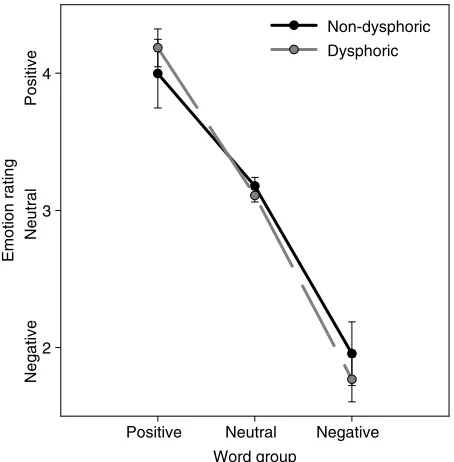
[image:6.595.113.340.518.749.2]The results of the 2 £ 3 mixed ANOVA for emotion identified a main effect of word groupFð2;52Þ ¼69:01,p,:001. Pairwise comparisons using a Bonferroni correction reveal that the mean word ratings of all the three word groups significantly differed from each other. Both participant groups rated positive words (4.09) as highly positive and negative words (1.83) as highly negative when compared with neutral words (3.13). No other effects or interactions were identified (Figure 1).
Self-reference
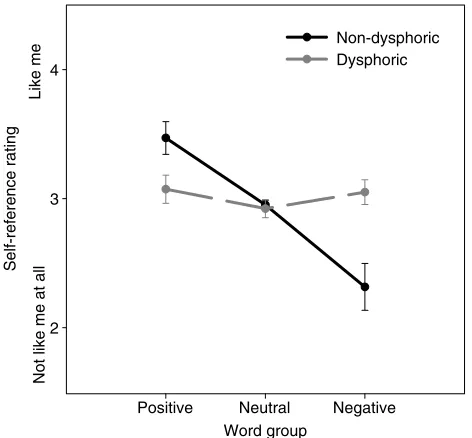
The results of the 2 £ 3 mixed ANOVA for self-reference show a main effect of word groupFð2;52Þ ¼12:54,p,:001. Pairwise comparisons using a Bonferroni correction reveal that positive words (3.27) are rated as high as ‘like me’ on the Likert scale and negative words (2.68) as low as ‘not like me at all’ on the Likert scale when compared with neutral words (2.94). All word groups significantly differed from each other (p,:05). No main effect of participant group was identified. However, an interaction between participant and word groups (Fð2;52Þ ¼11:94,p,:001) was found.Post hoc analyses in the form of two within-group ANOVAs were performed on the non-dysphoric and dysphoric participants’ word ratings, respectively. Non-dysphoric participants rated all positive (3.47), negative (2.32) and neutral (2.95) word groups as significantly different from each other (p,:05). In contrast, no significant differences were identified between any of the three word groups for dysphoric individuals (Figure 2).
Discussion
[image:7.595.148.384.531.750.2]The results support the hypothesis that the relationship between self-reference and emotion differs across non-dysphoric and dysphoric individuals. As predicted, a positive correlation was found between self-reference and emotion in non-dysphoric individuals. Positive words were rated as self-referent and negative words as non-self-referent. The weak prediction, that no relationship would exist between self-reference and emotion, was supported in dysphoric individuals (Alloy et al., 1990; Mezulis et al., 2004). Importantly, further analyses indicated that it is the differences in the processing of self-reference, not emotional valence, which are associated with differences in mood state. Non-dysphoric and dysphoric individuals rate the emotional content of words in the same way. However, dysphoric individuals fail to associate self-reference with
emotional valence. The findings suggest that dysphoric individuals can still identify the emotional valence of stimuli accurately. However, it is their evaluation of this valence within a self-referential context which is altered.
Several studies support the lack of an emotional association with self-identity in the context of dysphoria and depression. Kuiper and Derry (1982) found that recall within the self-referent condition, compared with the other-referent condition, was increased across both positive and negative stimuli. More recently, in a study of dysphorics, Smallwood (2004) utilized a word fragment task to examine self-reference and ambiguity. He found that dysphoric individuals used self-referent items to complete a word fragment task independently of the emotional tone of the stimuli. Finally, a study by Timbremont and Braet (2004) found that never depressed and remitted depressed children endorsed more positive adjectives as self-related, whereas currently depressed children endorsed equal numbers of positive and negative traits. These findings, and those of the present study, indicate that the context of self-reference (‘does this word describe me?’) automatically activates the self-schema, and that emotional processingwithinthis context is altered in dysphoria. More generally, these findings may indicate that dysphoria is associated specifically with changes in the sense of self, rather than with changes in all aspects of emotional processing. Dysphoric individuals may not define their self-identity through emotion in the same way as non-dysphorics.
Finally, two methodological points need to be addressed. The first point is the distinction between self-negativity and attenuated self-positivity biases identified in previous research. As stated previously, Sweenyet al.(1986) identified a self-negativity attributional bias in depressed individuals; in contrast, Mezuliset al.(2004) examined attribution in psychopathology and found that, overall, self-serving biases were attenuated rather than reversed. It is possible that these differences are due to the extent of depression measured. In the present study, dysphoric students were classified utilizing a high score on the BDI-II. In this population, the positivity bias was attenuated, but not reversed, supporting the results of Mezuliset al.’s (2004) study. It is possible that individuals who have been diagnosed as clinically depressed would show a full negativity bias.
The second methodological issue to be examined is the use of the Likert scale within the construct of self-reference. This scale provided participants with two options when classifying stimuli as non-self-referent: they could classify the item either as neutral in relation to the self or as not related to the self at all. This neutral option allowed individuals to rate information as neutral in relation to the self-referent rather than to the non-self-referent. Previous research on self-reference often utilizes a two-choice reaction time task (self/non-self) that does not include a neutral condition (Symons & Johnson, 1997; Williams, Watts, MacLeod, & Mathews, 1997). Therefore, it would be interesting for future research to attempt to include this neutral condition not only in studies examining emotional processing but also in studies investigating self-referential processing.
References
Alicke, M. D., Klotz, M. L., Breitenbecher, D. L., Yurak, T. J., & Vredenburg, D. S. (1995). Personal contact, individuation, and the better-than-average effect.Journal of Personality and Social Psychology,68, 804–825.
Allison, S. T., Messick, D. M., & Geothals, G. R. (1989). On being better but not smarter than others: The Muhammad Ali effect.Social Cognition,7, 275–296.
Alloy, L. B., Albright, J. S., Abramson, L. Y., & Dykman, B. M. (1990). Depressive realism and nondepressive optimistic illusions: The role of the self. In R. E. Ingram (Ed.),Contemporary psychological approaches to depression: Treatment, research, and therapy(pp. 71–86). New York: Plenum Press.
Beck, A. T., Steer, R. A., & Brown, G. K. (1996). BDI-II Manual. London: The Psychological Corporation.
Bradley, M. M., Cuthbert, B. N., & Lang, P. J. (1988).Affective norms for English words (ANEW): Technical manual and affective ratings. Gainesville: University of Florida.
Bradley, D., & Mathews, A. (1983). Negative self-schemata in clinical depression.British Journal of Clinical Psychology,22, 173–181.
Brittlebank, A. D., Scott, J., Williams, M. G., & Ferrier, I. N. (1993). Autobiographical memory in depression: State or trait marker.British Journal of Psychiatry,162, 118–121.
Corey, D. M., Dunlap, W. P., & Burke, M. J. (1998). Averaging correlations: Expected values and bias in combined Pearson rs and Fisher’s z transformations.Journal of General Psychology,125, 425–426.
Craik, F. I. M., Moroz, T. M., Moscovitch, M., Stuss, D. T., Winocur, G., & Tulving, E.et al.,(1999). In search of self: A positron emission tomography study.Psychological Science,10, 26–34. Fisher, R. A. (1921). On the probable error of a coefficient of correlation deduced from a small
sample.Metron,1, 3–32.
Fossati, P., Hevenor, S. J., Graham, S. J., Grady, C., Keightley, M. L., & Craik, F.et al.,(2003). In search of the emotional self: An fMRI study using positive and negative emotional words.
American Journal of Psychiatry,160, 1938–1945.
Fossati, P., Hevenor, S. J., Lepage, M., Graham, S. J., Grady, C., & Keightley, M. L.et al.,(2004). Distributed self in episodic memory: Neural correlates of successful retrieval of self-encoded positive and negative personality traits.NeuroImage,22, 1596–1604.
Green, M. W., & McKenna, F. P. (1996). Making semantic judgements about affectively valenced words: A new test of processing bias in anxiety.Personality and Individual Differences,20, 429–436.
Heine, S. J., Lehman, D. R., Markus, H. R., & Kitayama, S. (1999). Is there a universal need for positive self-regard?Psychological Review,106, 766–794.
Howell, D. C. (2002).Statistical methods for psychology, Belmont, CA: Duxbury.
Kelley, W. M., Macrae, C. N., Wyland, C. L., Calgar, S., Inati, S., & Heatherton, T. F. (2002). Finding the self? An event-related fMRI study.Journal of Cognitive Neuroscience,14, 785–794. Kuiper, N. A., & Derry, P. A. (1982). Depressed and nondepressed content self-reference in mild
depressives.Journal of Personality,50, 67–80.
Messick, D. M., Bloom, S., Boldizar, J. P., & Samuelson, C. D. (1985). Why we are fairer than others.
Journal of Experimental Psychology,21, 480–500.
Mezulis, A. H., Abramson, L. Y., Hyde, J. S., & Hankin, B. L. (2004). Is there a universal positivity bias in attributions? A meta-analytic review of individual, developmental, and cultural differences in the self-serving attributional bias.Psychological Bulletin,130, 711–747. Miall, D. S. (1986). Emotion and the self: The context of remembering. British Journal of
Psychology,77, 389–397.
Moran, J. M., Macrae, N., Heatherton, T. F., & Wyland, C. L. (2006). Neuroatomical evidence for distinat cognitive and affective components of self.Journal of Cognitive Neuroscience,18, 1586–1594.
Ridout, N. (2005). Processing of emotional material in major depression: Cognitive and neuropsychological investigations. Unpublished dissertation, University of St Andrews. Sedikides, C., & Green, J. D. (2004). What I don’t recall can’t hurt me: Information negativity
versus information inconsistency as determinants of memorial self-defense.Social Cognition,
22, 4–29.
Segal, Z. V., Gemar, M., Truchon, C., Guirguis, M., & Horowitz, L. M. (1995). A priming methodology for studying self-representation in major depressive disorder. Journal of Abnormal Psychology,104, 205–213.
Smallwood, J. (2004). Brief report: Self-reference, ambiguity and dysphoria. Cognition and Emotion,18, 999–1007.
Sweeny, P. D., Anderson, K., & Bailey, S. (1986). Attributional style in depression: A meta-analytic review.Journal of Personality and Social Psychology,50, 974–991.
Symons, C. S., & Johnson, B. T. (1997). The self-reference effect in memory: A meta-analytic review.Psychological Bulletin,121, 371–394.
Timbremont, B., & Braet, C. (2004). Cognitive vulnerability in remitted depressed children and adolescents.Behaviour Research and Therapy,42, 423–437.
Williams, J. M. G., Watts, F. N., MacLeod, C., & Mathews, A. (1997).Cognitive Psychology and Emotional Disorders. London: Wiley Press.