Adsorption structures of phenol on the Si(001)-(2
Ã
1) surface calculated
using density functional theory
Karen Johnston
Max Planck Institute for Polymer Research, P.O. Box 3148, D-55021 Mainz, Germany
Andris Gulans, Tuukka Verho, and Martti J. Puska
COMP/Department of Applied Physics, Aalto University School of Science and Technology, P.O. Box 11100, FI-00076 AALTO, Finland 共Received 18 May 2010; published 21 June 2010兲
Several dissociated and two nondissociated adsorption structures of the phenol molecule on the Si共001兲-共2⫻1兲 surface are studied using density functional theory with various exchange and correlation functionals. The relaxed structures and adsorption energies are obtained and it is found that the dissociated structures are energetically more favorable than the nondissociated structures. However, the ground state energies alone do not determine which structure is obtained experimentally. To elucidate the situation core level shift spectra for Si 2pand C 1sstates are simulated and compared with experimentally measured spectra. Several transition barriers were calculated in order to determine, which adsorption structures are kinetically accessible. Based on these results we conclude that the molecule undergoes the dissociation of two hydrogen atoms on adsorption.
DOI:10.1103/PhysRevB.81.235428 PACS number共s兲: 68.43.Bc, 68.43.Fg, 71.15.Mb, 79.60.⫺i
I. INTRODUCTION
Adsorption of organic molecules on semiconducting sur-faces provides a potential way to produce smaller transistors.1–3While there have been many studies concern-ing adsorption of benzene and related molecules on semicon-ductors there are surprisingly few studies concerning phenol adsorption. The OH group gives rise to dissociative reaction possibilities, in addition to the nondissociative adsorption observed for benzene.
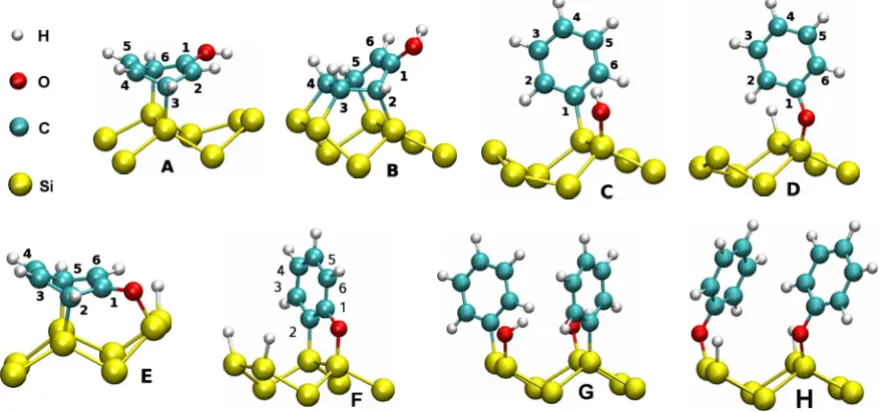
Casalettoet al.4studied phenol adsorption on silicon us-ing photoemission spectroscopy. Based on measurements of core level shifts 共CLS兲 of the surface Si 2p states and C 1s states they concluded that phenol undergoes dissociative ad-sorption at room temperature and that in the adsorbed state the phenyl ring is bonded to the surface via the O atom共see structure D in Fig.1兲. However, since the structure cannot be directly observed it is possible that other structures could also fit the data.
The theoretical study by Carbone et al.5 focused on pos-sible adsorption sites for the non-dissociated butterfly struc-ture 共structure A in Fig. 1兲 and the above-mentioned disso-ciative structure. They looked at possible reaction paths between the structures and found that the conversion barrier is of the same order as the room temperature thermodynamic energy. Other adsorption structures were not considered.
In this paper, we report density functional calculations of a variety of phenol adsorption structures, which includes structures that were not discussed in Refs. 4 and 5. In par-ticular, we show that those structures should be included in the analysis. The paper is organized as follows. In Sec.II, we describe the methodology, in Sec. III, we present the struc-tural data and adsorption energies of the various structures and calculate the core level shifts of the energetically most favored structures. The transition barriers to several adsorp-tion states were calculated to determine which states are ki-netically accessible. The results are discussed and summa-rized in Sec.IV
II. METHOD
Adsorption energies calculated using density functional theory are known to depend remarkably on the exchange-correlation共XC兲functional.6In order to understand this de-pendence more fully, we perform calculations using the gen-eralized gradient functionals 共GGA兲, PW91,7,8 PBE,9–11and revPBE,9,12,13 the three-parameter hybrid functional B3LYP14,15and the van der Waals density functional共 vdW-DF兲 that includes nonlocal correlation to describe van der Waals interactions.16
The PW91, PBE and revPBE calculations are performed using the Vienna ab-initio simulation package 共VASP兲,17,18 which is based on density functional theory共DFT兲and uses a plane-wave basis set. In the plane-wave calculations the core states are represented using the projector-augmented wave共PAW兲method19,20and the plane-wave cutoff energy is 400 eV.
The B3LYP calculations are performed using an all-electron approach implemented in the LCAO共linear combi-nation of atomic orbitals兲 code, CRYSTAL.21 We use the va-lence triple- plus polarization basis set for all atoms. The basis set for silicon was obtained by optimization of the total energy of bulk silicon in Ref. 22. The basis sets for the remaining atoms acquired from Ref. 23were originally de-veloped for atoms and molecules. In the present work, they are adapted for periodic calculations by increasing the expo-nent of the outermostp-type shell of C atom from 0.0892605 to 0.13. This shrinks computational expenses and helps to avoid numerical problems such as quasi-linear dependence of basis functions.21
present paper always include it. Nevertheless, even with the BSSE correction, a low quality basis set can yield energies far from the complete basis limit so we checked the perfor-mance of the basis set by comparing the PBE adsorption energies obtained with the LCAO and plane-wave ap-proaches. As shown in Table I, the two methods give very similar results in all cases, except for structure H, where the difference in the adsorption energies is 0.26 eV. The BSSE introduces artifacts in the interaction between neighboring phenyl rings that strongly affects the energy and, due to the flexibility of the Si–O–C bonds, the molecule moves away from the true energy minimum. This problem cannot be re-solved by a perturbative correction, however, if the basis set is expanded the relaxed structure changes and the LCAO adsorption energy starts to approach the plane-wave result. Consequently, this single case with a moderately large dis-crepancy is understood and the match between the LCAO and the plane-wave basis results for the other structures is good. With this in mind, we conclude that our LCAO results are reliable.
The van der Waals corrections to the adsorption energies are calculated using the real-space approach described in Ref.25combined with the multi-center integration method.26 Following Ref. 16, we use the revPBE functional12 to de-scribe the exchange. The total vdW-DF energy is calculated non-self-consistently as a post-GGA correction and is given by
EvdW-DF=ErevPBE+Ec
LDA
−Ec
PBE
+Ecnl, 共1兲
whereErevPBEis the total energy obtained in a self-consistent
calculation with the revPBE XC functional. The next two terms, Ec
LDA
and Ec
PBE
, are the LDA27 and PBE correlation energies, respectively. Their difference is calculated non-self-consistently using the PAW formalism. Finally, Ecnl is the nonlocal correlation term, which is evaluated using pseudodensities with the partial core correction.
In all calculations we use the equilibrium Si lattice con-stanta0, which is 5.47– 5.49 Å depending on XC functional
used. The Si共001兲surface is represented by nine atomic lay-ers of Si atoms with the top side 共2⫻1兲 reconstructed and the bottom layer Si atoms fixed in ideal lattice positions with their dangling bonds passivated by H atoms. The positions of the Si atoms on the bottom layer and the passivating H atoms are held fixed. In ourVASPcalculations, the supercell size for the 0.5 monolayer 共ML兲 coverage38 is
冑
2a0⫻
冑
2a0⫻6a0, [image:2.609.86.526.71.277.2]which contains a vacuum layer with a height of approxi-mately 22 Å. To check that there is no effect due to an artificial electric field, caused by using an asymmetric slab, structure D was recalculated with thicker vacuum layers. The change in the total energy on going from⬃22 Å to⬃38 Å was only 0.004 eV. TheCRYSTALcode employs the periodic boundary conditions only along the surface directions and hence the calculation does not include an artificial electric field in the vacuum. The Brillouin zone is sampled using a
TABLE I. Phenol adsorption energies 共eV兲 on the Si共001兲 -共2⫻1兲per surface unit cell for structures A-H. Results of standard DFT calculations with three different GGA functionals as well as those of the B3LYP hybrid functional and vdW-DF functional cal-culation with the revPBE exchange functional are shown.
Structure
Standard GGA Hybrid Nonlocal
PW91 PBE revPBE PBEa B3LYPa vdW-DF
A 1.06 1.01 0.57 0.97 0.66 1.26
B 1.27 1.24 0.75 1.26 0.80 1.23
C 2.96 2.88 2.65 2.78 3.00 3.40
D 2.38 2.30 2.09 2.32 2.58 2.82
E 2.61 2.52 2.04 2.47 2.41 2.91
F 3.89 3.78 3.20 3.81 4.29 4.12
G 5.85 5.68 5.03 5.18 5.52 7.16
H 4.82 4.64 4.13 4.40 4.92 6.07
[image:2.609.313.559.583.738.2]aLCAO.
Monkhorst-Pack mesh of 4⫻4⫻1kpoints. The ionic relax-ations are stopped when the maximum force on the ions is below 10 meV/Å.
To determine the transition states and barriers for the structural changes we use the adaptive nudged elastic band 共ANEB兲method.28This calculation is essentially a search for the saddle points of the potential energy surface and all ob-tained transition states satisfy the same maximum force cri-terion as above. The total energy and its gradients are evalu-ated using the PBE XC functional. Due to the computational expense of these calculations we use thinner silicon slabs consisting of 5 layers of Si atoms and the Monkhorst-Pack mesh of 2⫻2⫻1 k points. This simplification results in changes in adsorption energies that are less than 0.07 eV.
For a semiquantitative analysis of reactions rate constants we use the Arrhenius equation for the reaction rate constant
k=Aexp
冋
− ⌬E kBT册
. 共2兲
⌬E is the energy barrier obtained from the ANEB calcula-tions. In our estimates we use the temperature T= 293 K, which is consistent with the experimental conditions in Ref.
4. The pre-exponential factor A is related to atomic
vibra-tions and is assumed to be a constant. We have used a value of 1012 s−1, which is typical for reactions on surfaces. There
are common inexpensive ways of estimatingA, for example, using harmonic transition state theory, however, we have chosen to use a constant pre-exponential factor, since the right hand side of Eq.共2兲is much less sensitive to variations inAthan in ⌬E.
III. RESULTS AND DISCUSSION
A. Structural data
The various adsorption structures are shown in Fig. 1. Structures A–F have a coverage of 0.5 ML, whereas G and H correspond to C and D at a higher coverage of 1.0 ML. The position of the OH group and/or dissociated H atoms corre-sponds to the energetically favorable position for each mor-phology. The discussion of energy barriers in Sec. III D in-volves structures A
⬘
, D⬘
, E⬘
, and F⬘
, which are not shown in Fig.1. They are similar to structures A, D, E, and F, respec-tively, but with the phenol molecule or with dissociated H atoms bonded to different sites. For instance, a phenol mol-ecule in structure A is bound to one Si dimer, whereas in structure A⬘
it is bound to Si atoms on adjacent dimers.Structures A and B are nondissociated and are similar to the butterfly 共BF兲 and tight-bridge 共TB兲 structures of ben-zene on the Si共001兲-共2⫻1兲surface.29,30In both structures A and B, the OH group remains bonded to a carbon atom. In structure C the OH group is dissociated from the phenyl ring, and the OH group and the phenyl ring are bonded to Si atoms on the same dimer. In structure D the O–H bond is broken and the C6H5O−radical and the dissociated H atom
bond to Si atoms on the same dimer. Structure E is similar to A, but the O–H bond is broken and the O and H atoms are bonded to the Si dimer neighboring the phenyl ring. The O–Si bond is slightly stretched compared to structures C and
D due to the structural constraints. In structure F the O–H bond and the neighboring C–H bond are broken and the two dissociated H atoms are adsorbed on the other Si dimer. Similarly to structure E, the structural constraints result in a slightly longer Si–O bond compared to the free Si–O bond in structure C and D. Structures G and H correspond to C and D but with 1.0 ML coverage. The nearest neighbor phenyl rings are orthogonal with respect to each other. Parallel orientation is energetically less favorable.
B. Adsorption energies
1. Neglecting van der Waals interactions
The phenol adsorption energy is defined as
Eads=Emol+Eslab−Etot, 共3兲
whereEmol,Eslabare the total energies of the separate phenol
molecule and the Si slab, respectively, and Etot is the total
energy of the phenol molecule adsorbed on the Si-slab. The results obtained using the various XC functionals for the different structures are shown in TableI.
The choice of the XC functional is known to influence adsorption energies significantly.6PW91 and PBE have been found to give significantly higher adsorption energies than revPBE. For the nondissociated phenol structures A and B, the PBE adsorption energies are almost twice as large as those obtained with revPBE functional. For the remaining 0.5 ML structures, the PW91 and PBE energies are larger than the revPBE energies by 0.29–0.69 eV. Despite these quantitative differences, the energetic ordering for both GGA functionals is mostly the same. The dissociated structures are significantly lower in energy than the nondissociated struc-tures. This trend has been found previously for benzene31 and for chloro- and dichlorobenzene.32
For a 0.5 ML coverage, the energetically most favorable structure is F, which is by 0.8–0.9 eV lower in energy than the next lowest energy structure C. However, according to the revPBE calculations D is 0.15 eV more favorable than E, whereas according to PW91 and PBE calculations E is 0.22– 0.23 eV more favorable than D. Carbone et al.5 used first-principles calculations with the BLYP functional14,15to study structures A and D on various adsorption sites and found the adsorption energies of 0.55 eV and 2.56 eV, respectively. This is in good agreement with our B3LYP results and the small differences are presumably due to the differences be-tween BLYP and B3LYP functionals and the different cover-ages of 16 ML and 0.5 ML used in their and the present calculations, respectively.
2. Including van der Waals interactions
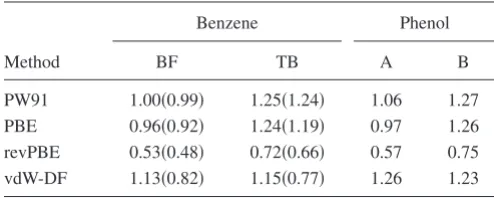
As shown in Table I, van der Waals forces make the ad-sorption energies of A and B comparable, in contrast to the standard GGA results that predict the B to be more energeti-cally favorable than A. This is in agreement with the recent results for benzene on the same silicon surface.33 Despite qualitative similarities, the present adsorption energies of phenol and those of benzene in Ref.33differ by⬃0.45 eV. Such a difference cannot be explained by a substitution of an H atom with the OH group. We address this problem by repeating the calculations of Ref.33within the present cal-culation scheme. The adsorption energies shown in TableII imply that the differences are of a numerical nature in evalu-ating the vdW correction. An analysis of the electron densi-ties used by Johnstonet al.in their calculations, reveals that the source of the discrepancy is the termEcLDA−EcPBE, which was calculated using the nonlinear core correction, while in the present paper the PAW formalism is used. Since the latter one is an all-electron method, we believe that the present results are more reliable.
The reversal in the ordering is also observed for structures D and E. However, since there is a disagreement among the GGA functionals concerning the relative stability of these geometries we cannot draw any firm conclusions.
Another interesting observation is that the high-coverage structures G and H have a higher adsorption energy per mol-ecule than that of the corresponding low coverage structures C and D when the van der Waals interaction is included. The distance between the centers of neighboring phenyl rings in structures G and H is ⬃5.5 Å, which is just slightly larger than the equilibrium distance between the molecules in an isolated benzene dimer in the T-shape and slip parallel configurations.34 Due to such a geometrical layout on the Si共001兲-共2⫻1兲 surface, the interaction of phenol molecules is attractive.
In all cases the magnitude of the correction due to the van der Waals interaction关the last three terms in Eq.共1兲兴is of the order of 0.48–1.07 eV per adsorbed molecule. The correc-tions are both large and scattered meaning that, in general, the correction may heavily influence the predictions for this kind of adsorbates.
C. Core level shifts
At this stage we focus on the dissociated structures and neglect structures A and B. So far, the results show that, for
a coverage of 0.5 ML, C and F are more stable than D and that E has an energy comparable to that of D. At high phenol exposure, corresponding to increased coverage, structure G becomes the energetically favorable one. In this subsection we attempt to determine the experimentally observed struc-ture by calculating the CLS spectra for each strucstruc-ture.
The experimental study by Casaletto et al.4 used x-ray photoemission spectroscopy 共XPS兲to measure the CLSs for the Si 2p, C 1s, and O 1s core states. In the present work, C 1sand Si 2pCLSs for structures C–F and H共the omission of G is explained below兲 are calculated and compared with experimental data. In calculating the core level shifts, we use the method described in Ref.35, where a pseudopotential for an atom core with a hole is constructed. Then, in the super-cell calculation, an electron is removed from the system and a homogeneous background charge is applied to keep the system neutral. We use VASP with the PW91 functional for these calculations. To calculate the relative C 1s CLSs for phenol on the Si共001兲-共2⫻1兲we use a nine atomic layer Si slab with the H-passivation on the bottom surface as de-scribed above. The Si 2pCLSs were found to be much more sensitive to the slab thickness than the structural properties and energies are. Thus, to obtain converged Si 2p CLSs we used slabs with 17 layers of Si atoms.
1.C 1s core level shifts
TableIIIshows the C 1sCLSs for structures C–F and H. It is clear from the results for D and H that the coverage does not affect the C 1s CLS, therefore, we have not calculated the CLSs for G as the results would be equal to those for C. For each structure, the average core level binding energy of the carbon atomssp2-bonded to two other carbon atoms and
to one hydrogen atom is taken as the reference energy. Ex-periments by Casalettoet al.4showed two peaks, which were attributed to the carbon atoms in the phenyl ring and the carbon atom bonded to the oxygen atom. Based on the mag-nitude of the shift and the ratio of 1:5 of the integrated in-tensity, Casaletto et al. concluded that the structure D was observed. According to our calculations, the spectra of struc-tures D–F and H all have one CLS around 1.6–1.7 eV with respect to the reference energy. For structures D and H the remaining five CLSs are positioned in the narrow range, TABLE II. Benzene adsorption energies 共eV兲 on the
Si共001兲-共2⫻1兲surface for structures BF and TB. The benzene cov-erage is 0.5 ML. The adsorption energies of Ref.33 are shown in parentheses.
Method
Benzene Phenol
BF TB A B
PW91 1.00共0.99兲 1.25共1.24兲 1.06 1.27
PBE 0.96共0.92兲 1.24共1.19兲 0.97 1.26
[image:4.609.48.295.118.217.2]revPBE 0.53共0.48兲 0.72共0.66兲 0.57 0.75 vdW-DF 1.13共0.82兲 1.15共0.77兲 1.26 1.23
TABLE III. C 1score level shifts共eV兲for phenol adsorbed on the Si共001兲-共2⫻1兲surface. The different adsorption structures, C–F and H, and the labeling of carbon atoms are shown in Fig.1. For each structure the reference energy is the core level binding energy averaged over thesp2-bonded, benzenelike carbon atoms.
C D E F H Modela
C1 −0.35 1.70 1.66 1.62 1.71 1.5
C2 −0.10 −0.12 0.41 −0.42 −0.09 0
C3 0.04 0.14 0.14 0.05 0.09 0
C4 0.01 −0.09 0.07 −0.09 −0.02 0
C5 0.10 0.14 0.47 0.06 0.11 0
C6 −0.04 −0.08 −0.21 −0.02 −0.08 0
−0.12 to +0.14 eV. Such a compact grouping can be ex-plained by almost equivalent nearest neighbor surroundings of the carbon atoms labeled with numbers 2–6 in Fig.1. This is not the case for structures E and F, in which some of the carbon atoms are bonded to silicon atoms and have different environments than the other carbon atoms. Consequently the spectra contain CLSs that are shifted from the reference en-ergy by 0.4–0.5 eV and −0.4 eV for E and F, respectively.
Although there are spectral features unique to each of structures C, D, E, and F, they are not necessarily resolvable in experiment. In order to compare the calculated results di-rectly to experiment, we plotted the core level shifts using Gaussian functions with the experimental FWHM of 1.0 eV.
The curves are shown in Fig.2along with a model function, which was constructed to reproduce the line-shape analysis and experimental data in Ref. 4. The figure shows clearly that the spectra of structures D共H兲, E, and F qualitatively fit the model function. However, since there is no visible shoul-der for structure C共G兲we can rule it out.
2.Si 2p core level shifts
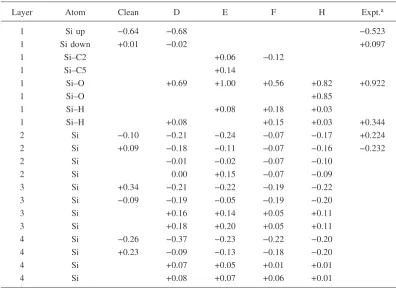
Next, we consider whether it is possible to distinguish between structures D, E, F, and H on the basis of the Si 2p surface core level shifts. To extract information about the Si 2p CLSs for the surfaces with adsorbed phenol it is first necessary to calculate the shifts for the clean surface. The CLSs for the clean surface and for structures D, E, F and H are shown in TableIV. For these calculations the silicon slab contains 17 atomic layers and the reference energy is taken to be the core level binding energy averaged over the bulk-like 13th–16th Si layers below the reconstructed surface. The Si 2pCLSs with adsorbed phenol do not agree with the data by Casalettoet al.4This is most likely due to their assump-tion that only the CLSs of the Si atoms on the surface are affected by the phenol adsorption, whereas our calculations clearly show that the SCLSs of the subsurface atoms change significantly.
Although the curve fitting to the experimental data is in-accurate we can still make use of the raw experimental data as shown in Fig. 3. The experimental curve for the clean surface has three distinct peaks. Due to the spin-orbit split-ting of the 2plevel two peaks with the intensity ratio of 1:2
-3 -2 -1 0 1 2
Intensity
Relative binding energy (eV) Model
[image:5.609.89.256.70.176.2]C D E F
FIG. 2.共Color online兲Simulated C 1score level binding energy spectra for structures C, D, E, and F. The energy zero is the core level binding energy averaged over the sp2-bonded, benzenelike carbon atoms. The model function is based on the measured spec-trum in Ref.4.
TABLE IV. Relative Si 2pcore level shifts共eV兲for the clean Si共001兲-共2⫻1兲surface and for the surface after phenol adsorption. Adsorbate structures D, E, and F with the 0.5 ML coverages and structure H with the 1 ML coverage are shown in Fig.1. The reference energy is the binding energy in the bulk environment.
Layer Atom Clean D E F H Expt.a
1 Si up −0.64 −0.68 −0.523
1 Si down +0.01 −0.02 +0.097
1 Si–C2 +0.06 −0.12
1 Si–C5 +0.14
1 Si–O +0.69 +1.00 +0.56 +0.82 +0.922
1 Si–O +0.85
1 Si–H +0.08 +0.18 +0.03
1 Si–H +0.08 +0.15 +0.03 +0.344
2 Si −0.10 −0.21 −0.24 −0.07 −0.17 +0.224
2 Si +0.09 −0.18 −0.11 −0.07 −0.16 −0.232
2 Si −0.01 −0.02 −0.07 −0.10
2 Si 0.00 +0.15 −0.07 −0.09
3 Si +0.34 −0.21 −0.22 −0.19 −0.22
3 Si −0.09 −0.19 −0.05 −0.19 −0.20
3 Si +0.16 +0.14 +0.05 +0.11
3 Si +0.18 +0.20 +0.05 +0.11
4 Si −0.26 −0.37 −0.23 −0.22 −0.20
4 Si +0.23 −0.09 −0.13 −0.18 −0.20
4 Si +0.07 +0.05 +0.01 +0.01
4 Si +0.08 +0.07 +0.06 +0.01
[image:5.609.106.503.449.738.2]and the separation ofs= 0.602 eV.4 correspond to each dif-ferent Si atom environment. The peak at 0.5 eV corresponds to the Si up-dimer atom and disappears as the coverage in-creases. With the increasing coverage, also the peak at −0.6 eV develops a shoulder at −0.8– −1.0 eV and a weak peak develops at around −1.6 eV. The shoulder and the small peak probably belong to the same atoms as their sepa-ration is approximately equal to the spin-orbit splitting.
We start by plotting the data for the clean surface and by comparing to experiment. The CLS for each atom is chosen to be a sum of two Gaussian functions with the above-mentioned intensity ratio and energy splitting. The total
in-tensity of the simulated spectrum is then equal to a sum of these split Gaussian functions, i.e.,
I共x兲=
兺
i=1N
␣L−1兵2e−共x+ai+s兲2/2b2
+ 4e−共x+ai兲2/2b2其
+Nbulk兵2e−共x+s兲
2/2b2
+ 4e−共x兲2/2b2其. 共4兲
Above,aiis the core level shift for atomi. 2bis the FWHM, for which we use the value of 0.26 eV. This is the average of the values for bulk and surface atoms used by Casaletto et al.40⬍␣⬍1 is an attenuation constant, which weakens the contribution from the subsurface layers and L is the layer index, so thatL= 1 corresponds to the surface layer,L= 2 to the subsurface atoms, etc.Nbulkand␣are parameters chosen
to fit the calculated clean surface spectrum to the experimen-tal one. Using␣= 0.7 andNbulk= 7 reproduces well the main features of the experimental curve, as can be seen in Fig.3. The simulated spectra for structures D, E, F, and H in Fig.3 are calculated using the same parameters as for the clean surface. To analyze our results it is easiest to observe the changes in the spectra for the different structures with re-spect to the clean surface re-spectrum.
In our fit the three main peaks are visible although some-what shifted compared to the experimental data. This is prob-ably due to the reference value of the core level shifts not being equal to the true bulk value. Nevertheless the fit is good enough to compare qualitatively, as shown in Fig. 3. The most obvious change in the curve is the disappearance of the Si up-dimer peak, which implies that the surface is saturated and that no asymmetric dimers remain. This satu-ration occurs for structures E, F, and H but not for D. It is senseless to discuss which structure agrees best with the ex-perimental Si 2p CLS spectrum, since, as explained before, we can make only a qualitative comparison. It is clear that none of the three structures can be ruled out on the basis of the data provided by CLS spectroscopy.
D. Reaction barriers
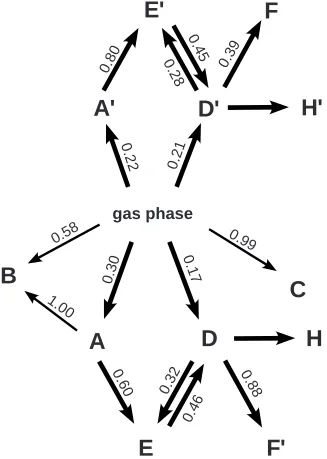
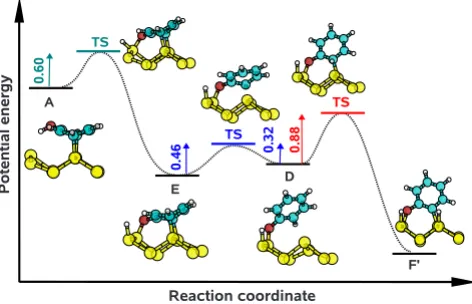
So far we can conclude that any of structures D共H兲, E, or F would be consistent with the experimental core level shift data. To determine which of the conformations are accessible at the room temperature 共used for experimental observation兲 we have calculated the activation energies for different struc-tural transformations of adsorbed phenol molecules as shown in Fig. 4.
The adsorption reactions starting from the gas phase al-ways involve precursor states, which can be seen in Fig.5. These precursor states are not discussed further as they only serve as initial traps where phenol molecules are bound non-covalently and weakly共⬍0.7 eV兲. In the course of time, the molecules either detach from the surface or transform to one of structures A–D. The transition from the molecule in the gas phase to structure D is shown in Fig. 5共a兲. After the molecule becomes trapped in the precursor state it faces a 0.17 eV high-energy barrier on its path to structure D. On the other hand, the energy needed for returning to the gas phase is 0.40 eV. Inserting these energies into Eq.共2兲yields a⬃104
times greater reaction rate constant for transforming to struc--2 -1.5 -1 -0.5 0 0.5 1
Intensity
Relative binding energy (eV) Clean
0.03 L 0.1 L 1.0 L
-2 -1.5 -1 -0.5 0 0.5 1
Intensity
Relative binding energy (eV) XPS
DFT
-2 -1.5 -1 -0.5 0 0.5 1
Intensity
Relative binding energy (eV) Clean
D E F H (b) (a)
(c)
ture D than for desorption. Qualitatively the same picture is observed for the adsorption reaction with structure A as the final product. The opposite conclusion can be drawn for the formation of structures B and C. The energetics of these transitions are shown in Figs.5共b兲and5共c兲. The main differ-ence in these curves compared to Fig. 5共a兲is the height of the barrier that a molecule has to overcome in order to form a covalent bond. For structures B and C this energy is no-ticeably higher than for desorption, therefore their formation is improbable.
The flowchart in Fig.4 does not contain reactions where structures E and F are acquired directly from the gas phase. These reactions require a formation of intermediate products such as structures A or D. For instance, structure F is pro-duced by breaking two bonds: O–H and C–H. In this case the former bond is much easier to break than the latter one and we anticipate that in the first dissociation event the hydrogen atom splits off from the O atom. This corresponds to the formation of a D-like structure. Thus, we consider reaction D→F rather than the adsorption of a molecule directly to structure F. On closer inspection, reaction D→F involves the diffusion of hydrogen atoms on the surface. Our calculations show that the energy barrier for a hydrogen atom to move diagonally across the dimer row is of the order of 2.5 eV, which is consistent with the findings of Bowler et al.36 Hence, we disregard this particular reaction in further discus-sion. On the other hand, reactions involving primed struc-tures, i.e., D→F
⬘
and D⬘
→F, do not require such a diffu-sion and the only barrier to overcome is related to the cleavage of a C–H bond.The activation energies can be inserted into Eq. 共2兲 to calculate reaction rate constants. The slowest transitions are A→E and D→F
⬘
, for which 1/k= 2⫻10−2 s and 1/k = 20 min, respectively. This shows that the formation of structure F⬘
is slow, yet it cannot be ignored.Consider a phenol molecule that approaches the surface with an orientation that leads to structures A
⬘
or D⬘
. Then the molecule undergoes a sequence of structural transformations A⬘
→E⬘
D⬘
→F, which is qualitatively similar to the one sketched in Fig.6. However, in this case the dissociation of a C–H bond requires only 0.39 eV, which is a much lower energy than the 0.88 eV required for the reaction D→F⬘
. To explain this difference we notice that in structures F and F⬘
the molecule is bound to two Si atoms that are separated by
[image:7.609.92.256.69.299.2]
FIG. 4. Transition barriers共in eV兲between the considered ad-sorption structures. Thick arrows represent probable reactions, whereas thin arrows represent unlikely ones.
(b) (a)
[image:7.609.329.537.83.569.2](c)
2.4 Å and 3.8 Å, respectively. The total energy of the former configuration is lower by 0.35 eV, which indicates that due to the variation of distance between the two Si at-oms an additional strain is exerted on the molecule in struc-ture F
⬘
. The same geometry considerations are valid for the two transition states, and the difference in their deformation energies can be estimated by the same number as above. This roughly corresponds to the difference in energy barriers for reactions D→F⬘
and D⬘
→F.Molecules with structures F and F
⬘
are bound the most strongly by some margin over the other structures so they are the final products of the reactions that happen on the surface. However, the slow time scale of reaction D→F⬘
implies that there can be other faster processes that prevent the formation of structure F⬘
. For example, if the surface is exposed to a high-phenol pressure and if we assume that the activation energy for D→H is similar to the gas-phase→D reaction then the surface will saturate to form structure H. Obviously, our analysis is incapable of providing quantitative informa-tion about what pressures are required in order for this out-come to take place. Instead, we note that in the experimental results for lower phenol exposures the complete coverage of the surface is not reached4and under these conditions struc-ture F⬘
, rather than H, will be obtained. For the reaction D⬘
→F the energy barrier is low and, consequently, the tran-sition time is fast. In fact, the whole sequence gas-phase→D共E兲→F involves only fast reactions. This means that other processes such as the formation of structure H
⬘
are extremely unlikely to interfere and at room temperature structure F will be abundant on the surface at any phenol deposition conditions.Activation energies of the considered reactions have not been measured experimentally. However, the quality of the present calculations can be indirectly assessed by using available data on the adsorption of benzene on Si共001兲-共2⫻1兲. The calculated activation energy of the A
→B reaction is 1.00 eV, which is in good agreement with the
experimentally measured barrier of 0.95 eV for the structural transformation BF→TB for benzene adsorbed on the Si共001兲-共2⫻1兲 surface.37
IV. CONCLUSIONS
Density functional theory calculations of the adsorption of phenol on the Si共001兲-共2⫻1兲 surface were performed. Re-gardless of the XC functional used, we found that the disso-ciated structures were energetically more stable than the non-dissociated ones. The highest adsorption energy per phenol molecule, obtained for the structure with two dissociated hy-drogen atoms 共structure F兲, is 3.20–4.29 eV. On the other hand, the highest energy per surface unit cell, obtained for the 1 ML coverage structure with one dissociated hydrogen atom 共structure G兲, is 4.13–6.07 eV. The large range of ad-sorption energies shows the strong dependence on the XC functional used. An important effect is observed when van der Waals interactions are included. Namely, similar to ben-zene, the relative stability of the structures is affected when the van der Waals interaction is included in the calculations. Furthermore, for a 1 ML coverage, van der Waals forces cause an attraction between neighboring phenyl rings.
C 1sand Si 2pCLS spectra for the dissociative structures were simulated and compared with the photoemission spec-tra in Ref. 4. Based on the comparison, we found that the structures with the cleaved OH group, C and G, do not fit the C 1s spectra obtained in experiment. The disappearance of the Si up-dimer peak from the experimental Si 2p spectra suggests that the surface is fully saturated and thus we can rule out the structure D. The previous analysis of the C 1s CLS spectrum led to the conclusion that structure H 共or D兲 was observed.4However, we have shown that the remaining dissociative structures, E and F, have very similar C 1sand Si 2pCLS spectra to H and, therefore, they cannot be distin-guished from H using photoemission spectroscopy alone.
From an analysis of reaction barriers we have shown that the activation energies for the formation of structures F and F
⬘
are 0.39 and 0.88 eV, respectively. They are low enough that both reactions will occur at room temperature. However, the rate of formation of structure F⬘
is slow and at high phenol pressure conditions it will be replaced by structure H. The low barrier path to F suggests that this structure will be the most abundant.ACKNOWLEDGMENTS
We thank Denis Andrienko and Nico van der Vegt for critical reading of the manuscript and Risto Nieminen for valuable discussions. We acknowledge computational re-sources provided by the Finnish IT Center for Science共CSC兲 and by the Rechenzentrum 共RZG兲of the Max Planck Soci-ety. This research was supported by the Finnish Funding Agency for Technology and Innovation共TEKES兲, the Acad-emy of Finland through its Centres of Excellence Program 共2006–2011兲 and by the Multiscale Modeling Initiative of the Max Planck Society.
[image:8.609.54.290.71.223.2]
1S. F. Bent,Surf. Sci. 500, 879共2002兲.
2X. J. Zhou and K. T. Leung,Surf. Sci. 600, 3285共2006兲.
3X. J. Zhou and K. T. Leung,J. Phys. Chem. B110, 9601共2006兲.
4M. P. Casaletto, M. Carbone, M. N. Piancastelli, K. Horn, K.
Weiss, and R. Zanoni,Surf. Sci. 582, 42共2005兲.
5M. Carbone, S. Meloni, and R. Caminiti, Phys. Rev. B 76,
085332共2007兲.
6B. Hammer, L. B. Hansen, and J. K. Norskov,Phys. Rev. B 59,
7413共1999兲.
7J. P. Perdew,Electronic Structure of Solids ’91共Academie Ver-lag, Berlin, 1991兲, p. 11.
8J. P. Perdew, K. Burke, and Y. Wang, Phys. Rev. B 54, 16533
共1996兲.
9J. P. Perdew, K. Burke, and M. Ernzerhof,Phys. Rev. Lett. 77,
3865共1996兲.
10J. Perdew, K. Burke, and M. Ernzerhof, Phys. Rev. Lett. 78,
1396共E兲 共1997兲.
11J. P. Perdew, K. Burke, A. Zupan, and M. Ernzerhof,J. Chem.
Phys. 108, 1522共1998兲.
12Y. Zhang and W. Yang,Phys. Rev. Lett. 80, 890共1998兲.
13J. P. Perdew, K. Burke, and M. Ernzerhof,Phys. Rev. Lett. 80,
891共1998兲.
14A. D. Becke,Phys. Rev. A 38, 3098共1988兲.
15C. Lee, W. Yang, and R. G. Parr,Phys. Rev. B 37, 785共1988兲.
16M. Dion, H. Rydberg, E. Schröder, D. C. Langreth, and B. I.
Lundqvist,Phys. Rev. Lett. 92, 246401共2004兲.
17G. Kresse and J. Hafner,Phys. Rev. B 48, 13115共1993兲.
18G. Kresse and J. Furthmüller,Phys. Rev. B 54, 11169共1996兲.
19P. E. Blöchl,Phys. Rev. B 50, 17953共1994兲.
20G. Kresse and D. Joubert,Phys. Rev. B 59, 1758共1999兲.
21R. Dovesi et al., Crystal 2006 User’s Manual 共University of
Torino, Torino, 2006兲.
22A. R. Porter, M. D. Towler, and R. J. Needs,Phys. Rev. B 60,
13534共1999兲.
23N. Godbout, D. R. Salahub, J. Andzelm, and E. Wimmer,Can. J.
Chem. 70, 560共1992兲.
24S. F. Boys and F. Bernardi,Mol. Phys. 19, 553共1970兲.
25A. Gulans, M. J. Puska, and R. M. Nieminen,Phys. Rev. B 79,
201105共R兲 共2009兲.
26A. D. Becke,J. Chem. Phys. 96, 2155共1992兲.
27J. P. Perdew and Y. Wang,Phys. Rev. B 45, 13244共1992兲.
28P. Maragakis, S. A. Andreev, Y. Brumer, D. R. Reichman, and
E. Kaxiras,J. Chem. Phys. 117, 4651共2002兲.
29Y. Taguchi, M. Fujisawa, T. Takaoka, T. Okada, and M.
Nish-ijima,J. Chem. Phys. 95, 6870共1991兲.
30R. A. Wolkow, G. P. Lopinski, and D. J. Moffatt,Surf. Sci. 416,
L1107共1998兲.
31F. Nunzi, A. Sgamellotti, and N. Re,J. Phys. Chem. C 111, 1392
共2007兲.
32F. Y. Naumkin, J. C. Polanyi, and D. Rogers,Surf. Sci. 547, 335
共2003兲.
33K. Johnston, J. Kleis, B. I. Lundqvist, and R. M. Nieminen,
Phys. Rev. B 77, 121404共R兲 共2008兲.
34A. Puzder, M. Dion, and D. C. Langreth, J. Chem. Phys. 124,
164105共2006兲.
35O. V. Yazyev and A. Pasquarello, Phys. Rev. Lett. 96, 157601
共2006兲.
36D. R. Bowler, J. H. G. Owen, C. M. Goringe, K. Miki, and G. A.
D. Briggs,J. Phys.: Condens. Matter 12, 7655共2000兲. 37G. P. Lopinski, D. J. Moffatt, and R. A. Wolkow,Chem. Phys.
Lett. 282, 305共1998兲.