11
Assessing Fun: Young Children as Evaluators of
Interactive Systems
Yusrita Mohd Yusoff
Department of Computer and Information Sciences University of Strathclyde
+44 (0)141 548 4311
[email protected].
ac.uk
Monica Landoni
Department of Computer and Information Sciences University of Strathclyde
+44 (0)141 548 2934
Monica.Landoni
@cis.strath.ac.uk
Ian Ruthven
Department of Computer and Information Sciences University of Strathclyde
+44 (0)141 548 3098
[email protected].
ac.uk
ABSTRACT
In this paper, we describe an exploratory study on the challenges of conducting usability tests with very young children aged 3 to 4 years old (nursery age) and the differences when working with older children aged 5 to 6 years old (primary school). A pilot study was conducted at local nursery and primary schools to understand and experience the challenges working with young children interacting with computer products. We report on the studies and compare the experiences of working with children of different age groups in evaluation studies of interactive systems.
Categories and Subject Descriptors
I.3.6 [Methodology and Techniques]: Interaction Techniques
General Terms
Measurement
Keywords
Usability and fun, evaluation, computer products, young children
1.
INTRODUCTION
There are many definitions of usability. For instance, usability as defined by ISO9241 is “the effectiveness, efficiency, and satisfaction with which specified users achieve specified goals in particular environments”. Bevan et al. [1] also provides one definition of usability, the degree to which a computer system is easy to learn and effective to use. Naturally, this easiness depends on who is the user.
Many go further than these standard usability attributes. Jordan as quoted in Monk [17] noted that “usability as a concept does not seem to include (positive) feelings such as, e.g. pride, excitement or surprise”. Feelings such as fun and enjoyment are rarely touched on in computer products, except in specific contexts such as computer gaming. Measuring fun, especially when children are interacting with computer products, has become an interesting and growing research topic.
In general, fun is doing activities that are enjoyable and amusing. According to Dorman [8] fun consists of elements of humour, chuckles, delight, ecstasy, gags, gaiety, happiness, jests, jokes, joy, laughter, merriment, mirth, play, pleasantries, quips, and witticism, etc. Read & MacFarlane [18] defined fun as something that children know about; they are experts. They experience it; therefore they can talk about it, describing it as excitement, play, laughter, and feeling good.
Carroll [4] suggests that fun should be included as a separate usability area because fun is not same as satisfaction. MacFarlane et al. [14] also agree that fun is not the same as satisfaction in the definition of usability by ISO 9241-11. Satisfaction is about progress towards goals and fun is not a goal-oriented. Shneiderman [25] states that designing for fun is associated with designing for children. Now more people notice the importance of fun as one of the critical success factors in determining the usability of children’s application software. But Yatim [29] claims there are no specific guidelines to measure the effectiveness, efficiency, and satisfaction or fun in any game authoring tool or similar. According to Blythe et al. [2] it is a beginning of the science of enjoyable technology known as “funology”.
Computer products for children are developed by adults. Therefore issues like usability and fun are very important to understand from a child’s point of view.Measuring fun especially for young children has become crucial and interesting to develop appropriate and interesting computer products for children. As computer products are being developed for increasingly younger children, new evaluation techniques are necessary to help younger children take part in evaluations.
In this paper we report on an exploratory study to investigate the challenges of involving very young children in evaluations: what kinds of evaluations can very young children engage in and what differences are there from evaluations appropriate to older children?
12
2.
CHILDREN AND TECHNOLOGY
According to Demner [5] in November 2000 almost 20 percent of all digital media users were children and the Internet is a part of child’s natural environment with many children now having access to the Internet at school and/or at home. As Plowman and Stephen in Stephen [28] note, information and communication technology (ICT) is not only about desktop computers, laptops and peripherals but also interactive television, digital cameras, video cameras, DVDs, mobile telephones, games consoles, electronic keyboards and toys that simulate ‘real technology’ such as toy laptops or barcode readers. So children and technology are intertwined because the technology gives impact on the way the children live and learn with all ICT.
2.1
Children as Participants
As many products are designed for childrens’ use, many researchers have argued that children should be involved in the software development process. Scott [24] argued that the best people to give information on the child’s perspectives, actions and attitudes are children themselves. They can give honest responses if questioned about events that are meaningful to their lives. Guha et al. [13] stated that usually children are not involved in the design process until the end even though there are many roles that children can play in the design of new technology. They believed that children should be involved as equal stakeholders throughout the design process.
Children have their own needs and preferences on computer products which are different to adults. Therefore, it is important to understand how to involve children in the product/system development life cycle. But of course there are challenges working with children especially when working with children at different age groups. For example, a technique might work for a 13-year-old but it would not work or need to be modified for a 4 year-old child [13]. Many problems need to be solved when respondents are children, including problems of language use, literacy and different stages of cognitive development [24]. For children, playing is the most enjoyable activity and nowadays it is very associated with technology. Markopoulus and Bekker [16] mentioned that mostly children play and learn while interacting with technology. They use computer products such as entertainment websites at home, school, or everywhere to get information, education and entertainment. Monk et al. [17] highlighted that fun and enjoyment are becoming a major issue since (ICT) moves from office to home. Research on children and technology is becoming crucial in the last few years.
Druin [9] and Markopoulos and Bekker [15] have started paying attention to children as technology users. They focused their researches on understanding children roles in developing new technologies. For example, Druin [9] stated that children can be involved in many roles such as user, tester, informants or design partner in developing new technologies. Markopolous and Bekker [16] also discussed children’s involvement in the design process based on a model introduced by Druin [10] but their focus was on involving children as a tester in usability testing methods.
[image:2.595.312.533.124.260.2]The model is shown in Figure 1.
Figure 1. The four roles that children may have in the design of new technologies. Figure adopted from Druin (2002)
2.2
Children as Evaluators
Many researchers have conducted evaluations involving children as evaluators and using different type of evaluation techniques. Previous works have involved children as evaluators to examine, in particular, the usability of computer products [6, 12, 27, 29 and 30]. Children are involved in many ways in evaluation sessions: for example they are required to perform predefined tasks and answer pre and post questionnaires in a lab. Increasingly, evaluations with children are conducted outside labs as interactive technology become more mobile [21].
Read and Markopoulus [21] suggest that different methods should be used in different locations. Some methods such as diary studies, think-aloud methods, surveys, and Wizard of Oz techniques have been used with older children. Read and Markopoulus also describe the Fun Toolkit - a survey method to obtain children’s opinion on technology. The Fun Toolkit is a survey instrument or a tool that was developed by Read. It started from a concept (v1) and being developed, used, and reviewed until becoming a Fun Toolkit (V3). The Fun Toolkit comprises of three instruments, the Smileyometer, the Fun Sorter, and the Again Again Table and was carefully designed to be Fun, Fast, and Fair [22]. Some researchers have used other methods like talk aloud (adapted from think aloud) and observation when involving young children as evaluators [7].
The Smileyometer is the first instrument in the Fun Toolkit and is the one most used. It is based on Visual Analogue Scales (VAS) and uses a 1-5 Likert scale and pictorial representations that can help children to identity their feelings or opinions. Faces with supporting text under it are represented horizontally to the children and they are asked to tick only one face. The faces in the Fun Toolkit were co-designed with children aged eight and nine and can be used before and after the children experience the computer technology. The Smileyometer features are easy and quick to complete and requires limited reading and no writing ability [22]. But [20] revealed that the Smileyometer was a useful tool for older children compared to young children. It is because too many young children tended to choose the high values and so the data had little variability.
The Fun Sorter is a tool used to compare a set of related technologies or products. It is based on a repertory grid and made up of n+ 1 columns (where n is the number of items being compared), and m+1 rows (where m is the number of constructs
user
tester
informant
design partner
13 being used). There are different ways of completing the Fun
Sorter. First children interpret the construct then write a description of the technology in blank spaces. But for children with poor reading and writing abilities, they place picture cards (pre-prepared) on an empty grid after interpreting the construct. Few suggestions are given in order to use the Fun Sorter. The use of constructs needs special attention since children are unpredictable in understanding words. It is also recommended that each construct presented individually for younger children aged less than 8 years old. One important thing is make sure children know what the cards represent if picture cards are used. This tool is the most challenging because children require to position and rank items to the construct. The good point is it can be made that no writing is required. Besides, it is fast and fun to complete especially when stick cards are used [22]. But the intention of the Fun Sorter is to record a children’s opinions of the technology or activity, to gain a measure of the child’s engagement [20].
The Again Again Table is a simple table consists of four columns and n + 1 rows (where n is the number of activities under comparison). Child needs to tick either ‘yes’, ‘maybe’, or ‘no’ for each activity or product. The table should be presented in a single sheet after the children have experienced all the technologies. This tool is most useful if three or more products or activities are being compared. In order to improve validity, the first column can be presented in different orders for different children. It is advisable to minimize the rows (items to compare) as to avoid children from being bored. This table is easy and quick to complete, no writing activity involved, and only has one question to be answered, “Do you want to do it again”? Thus this tool is very suitable to younger children [22].
For interactive search systems evaluation is a particular concern, and interactive systems must be evaluated with end-users – the people for whom the system is constructed [23]. Without such end-users we cannot understand how well the interface supports the user, how usable the system is or evaluate how well the system supports the user in completing a whole search [3]. With children this is difficult. Literature describing children’s involvement with usability studies, e.g. [9], points at the difficulty of gathering valid feedback since verbal communication, both in understanding and formulating sentences, is not as effective as with adults. Consequently, evaluators have been forced to seek methods, ranging from interpreting free drawings [11] to using collections grids with “smiles” instead of grades [19]. Children also have problems in expressing their feelings in terms of satisfaction [9,
19]. A third element emerging from previous studies [26] is the discrepancy between reported and observed usability when children are asked to provide subjective feedback versus direct observation.
Thus it is clear that standard tools for user evaluations are not directly applicable to children’s evaluation; questionnaires require higher degrees of literacy than is common in young children, interviews require high degrees of reflection and techniques such as think-aloud require high degrees of cognitive dexterity [20]. Neither can we expect children to engage in standard experimental procedures such as searching on artificial search tasks, searching for controlled amounts of time, or engaging in procedures such as training or debriefing.
Rather, for conducting user evaluations with children we need to (a) develop evaluation methodologies that allow children to
interact naturally with the system being evaluated whilst retaining some experimental control, (b) understand how children express notions of satisfaction with a system and (c) understand what metrics are appropriate for children’s search systems.
There is particularly a dearth of work on engaging very young children in usability evaluations. This might be because of physical and mental abilities; limitations of these mean that some researchers think young children are not capable of being involved in usability evaluation. In this paper we explore the challenges of involving very young children in usability evaluations with particular reference to evaluating the fun of an information system.
3.
THE STUDY
An exploratory study on evaluating young children interacting with an edutainment website was conducted at a local nursery school and a local primary school. The purpose of the study was to understand and experience the challenges of working with young children, aged 3 to 4 years old at the nursery and 5 to 6 years old at the school and any possible differences when working with children of different ages. Eight nursery children and five school children voluntarily participated in the study.
3.1
The Nursery Background
The Nursery is located in the UK and offers two sessions, morning and afternoon. The morning session starts at 8.45am and finishes at 11.45am. The afternoon session starts at 1.00pm and finishes at 4.00pm with 10 permanent staff.
The capacity of the nursery is 80/80. It means for each session, the maximum number of children is 80. In session 2008/2009, there are 79 children attending the morning and afternoon nursery session, genders were equally represented in each session. The nursery is a diverse school with children from many nationalities. Besides English, there are various languages spoken by the children in the nursery such as Urdu, Punjabi, Malay, Mirpuri, Pushto, Arabic and Farsi.
In the nursery, there are four rooms fully-equipped with toys, books, and other children’s’ material but only Room 1 and Room 2 have computers. Room 1 was the place where the study was conducted. Even though there are three computers available in the room but only one computer (in the middle) with a speaker was used in the study.
3.2
The School Background
The Primary School is also in the UK. The school has 15 teaching and five support staff at the moment. It also has pupils come from different minority ethnic communities such as Pakistan, Malay, Czech, and Arabic. The working capacity of the school is 260. But in the current session 2008/2009, the present roll is 219 pupils, which are 122 boys and 97 girls.
14
3.3
The CBeebies Website
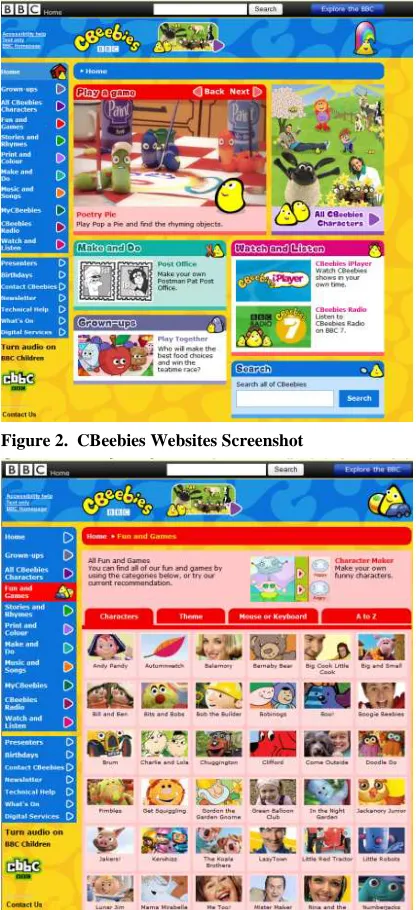
[image:4.595.52.260.256.711.2]During the study the children were asked to interact with the CBeebies website. The CBeebies website is based on a very popular children television channel in UK. Figure 2 shows the main site as used in the study. There are 18 main links on the left handside of the screen such as, Home, All CBeebies Characters, Fun and Games, Stories and Rhymes, Print and Colour, Make and Do, Music and Songs and many more. At Home screen, contents on the right handside changes regularly. This interactive website that contains multimedia elements like graphic, audio, video, animation, and text can be accessed through URL http://www.bbc.co.uk/cbeebies. For the study purposes, the children were asked to play/explore the Fun and Games section only, Figure 3.
Figure 2. CBeebies Websites Screenshot
Figure 3. CBeebies Websites: Fun and Games Screenshot
3.4
Procedure
Prior to the study we obtained ethical permission from the Local Education Authority, Departmental Ethics Committee and parental consent forms. The latter was required to allow children to take part in the study. We discussed the issue of reward with the Headteachers who felt this would not be appropriate so no reward for participation was given in the nursery study.
3.5
Methodology
Both studies comprised of five main activities: 1. recruiting the children
2. introducing the researcher
3. asking volunteer children to play/explore the Fun and Games section in CBeebies website for 5 minutes, 4. interviewing each participant for about 5 minutes, 5. asking the child to draw a character that represented
what they enjoyed about the game
In the sections that follow we describe how these stages were accomplished in the two locations and why they were important. In both locations we followed methodologies that were acceptable to the nursery and school. Although this results in differences in recruitment and methodologies, it is important for real-life studies to fit with the constraints imposed by the participating organizations.
3.5.1
Greeting
Nursery: The researcher made several visits to the nursery prior to the study to familiarize herself with the nursery environment and to familiarize the nursery pupils with her presence in the nursery.
In the nursery, rather than employ direct recruitment the nursery staff suggested that the researcher wait at the computer desk until an interested child came to play computer games. This suggestion was agreed by the researcher. The nursery staff were also a good source of knowledge as to which children were good at using computers from their daily observations of the children.
On the day the study was conducted, the weather was warm and sunny. Most of the children enjoyed playing bicycles and scooters outside the nursery building and showed less interest in playing inside. Due to an outbreak of Swine Flu in a nearby primary school, some of the children who were most able to use computers were absent from the nursery.
School: A Pupil Support Assistant (PSA) was assigned by school’s headteacher to help the researcher at the primary school. Based on the returned parental consent forms, the researcher was asked to select 5 children to take part in the study. Before the study was started, all the Primary 1 (first year) children were taken to the gymnasium for a physical exercise class. Then the PSA took children one-by-one from the gymnasium to participate in the study. The participant selection at school was done systematically and took a shorter time to accomplish.
3.5.2
Introduction of researcher
15 “Do you know me..?” and then answering it by herself,
“I am Mrs X...”
School: In the school, the researcher was introduced by the class teacher formally in front of the class before the study was conducted. This was a standard method of introducing new people to the children in the school.
3.5.3
Ask volunteer child to play/explore
In both locations, the researcher showed them a laminated-screenshot of the CBeebies websites and the children were asked to choose a game to play with. This meant the children choosing a game with which they were familiar. As we were interested in evaluation methodology, rather than evaluating a specific product, we felt this was a fair limitation.
We set a target of 5 minutes to play with the game because it was presumed that young children might lose focus in a longer period. It also to make sure the study at nursery can be finished before snack time, around 11.00am. At school, the study was stopped for 15 minutes for playtime or morning interval at 10.45am.
Each child spent another 10 minutes for interviewing and drawing.
3.5.4
Interview
In both locations, if the child remained long enough to be interviewed we asked a range of open and closed questions. These questions were to explore what kinds of questions children of different ages were comfortable answering and what kinds of responses they were willing to give. The questions were deliberately conversational in nature, starting with closed questions which are easier to answer. The questions were as follows:
1. Have you seen this program before? 2. Have you used this program before?
These two closed questions were to gain insight into a child’s previous experience which may be useful for contextualising the responses to later questions and for exploring what the child found fun about a game.
3. Do you like to play game from this website? 4. Which game do you like to play?.
5. Why do you like to play this game?
These questions are on general experience of using this popular site and were asked if the children was familiar with the site. The question block starts with a closed question, leading to simple choice question and finally an open question.
6. Do you like the colours used?
7. Do you like to hear songs from this game? 8. How do you feel after playing this game?
These questions explore what aspects of a program or game might be enjoyable to a child. We are particularly interested in the evaluation of fun from a child’s perspective and wanted to explore what judgements a child may give through the use of open questions.
9. Do you want to recommend this game to your friend? Why?
This question tested a child’s ability to identify, express, and share their emotions of having fun by telling other people. In this question, friends are highlighted because of the importance as the closest person for them to play with.
10. Can you draw the character that you like most from the site? The final question, really a task, asked the child to draw the character they liked most from their exploration. This exploratory activity might be useful to identify whether children having fun interacting with the game. Their enjoyment of playing self-chosen game can be transformed into a cartoon character drawing explicitly on a piece of paper.
4.
FINDINGS
In this section, we summarise the outcomes from each study in sections 4.1 and 4.2, with particular attention to the final task in section 4.3 and draw some comparisons in section 4.4.
4.1
Findings from Nursery Study
10 questions were planned but which questions were asked was determined by the child’s mood and ability to answer. We took care not to place any pressure on any child or to continue if it became clear that a child was becoming bored or did not understand questions. Some children did struggle with physical limitations such as hand and eye coordination in using computers. A particular issue, which we will return to later is the child’s mood.
Questions 1 - 4 were easily answered by the children. They were very familiar with the websites. In fact, they can directly go to the page without any help. The children said that they watch CBeebies TV channel at their home almost every day. Only one participant did not want to play any games from the CBeebies websites and chose another game.
The open question 5 was more difficult for children to answer and was not asked to all participants. It was clear that open reflective questions were difficult for very young children to answer. Similarly other open questions such as question 8 and 9, which were only asked to children that showed ability to communicate and reason, were difficult to answer.
It was particularly difficult for children to reason about emotions. Even though many computer programs and games are designed to be fun and enjoyable, very young children could express enjoyment but not reason about it.
4.2
Findings from School Study
10 questions were prepared for the study and all of them were asked during the study to all participants. But only two participants could understand and answer all the questions. Questions 1 - 4 were easily and confidently answered by the children. They were very familiar with the websites. One participant managed to go to the CBeebies websites by clicking
Favorites Center. Questions 6 – 7 also can be answered by all of
them.
16
4.3
Drawing
The final task we asked the children to engage in was to draw their favourite character from the game they choose to play with. This was an attempt to see if we could learn something about what children enjoyed about a game from an associated activity. The quality of the drawing here was not important – and most very young children naturally could not produce recognizable drawings – rather we wanted to create a stimulus for discussing their experience of the game.
In the nursery most of the children could not answer question 10. All of them were unable to draw except one girl. The others were only able to colour the paper that had been given to them and engaged in little discussion related to the game. One child, when asked about the drawing, said the character he liked most is
Batman, which is not in the CBeebies websites and out of context.
In the school, however, all of the participants could draw a character related to the experience of the game. They were able to draw the cartoon character even though it was not exactly same as seen on the computer screen. In particular a drawing was so good to be easily recognized by the researcher.
4.4
Comparisons between the Two Groups of
Children
The aim of this exploratory study is to understand what are the major differences between working with young children (school) and very young children (nursery) when evaluating information systems. As more information and particularly search systems are being created for very young children it is important to understand the challenges of evaluation by such children and how best to engage them in the process of evaluation. In this section we will summarise some of the major trends from our study.
4.4.1
Recruitment
Recruitment is a challenge when working with very young children. In the nursery context, where the main activities are play, children’s participation had to be voluntary. Hence only children who were interested took part and their involvement ceased when they were bored. One child participant got bored playing after two minutes and walked away to play with other things in the room. As noted before, other environmental distractions such as good weather or interesting toys made computers less attractive. Another participant refused to play any CBeebies game but would play other games. Other children were more shy and took longer to approach the researcher, although were interested to join the study.
We deliberately chose a real-life setting to conduct the evaluations as children’s use of computer products naturally takes place within environments where there are choices of activities. If a very young child becomes bored or has more interesting activities – particularly those that involve other children – then they can quickly lose interest in the evaluation. Although this means that evaluations with very young children may often be snap-shots of interactions with computer products being picked up and quickly dropped, this does lend realism to the evaluation compared to the actual use of a computer product.
Recruitment also relates to child’s confidence in the researcher. In our case, the researcher took care to become a familiar part of the nursery environment. However, we did notice that some children took longer to trust the researcher than others and the researcher
did devote time to engaging with children in other activities, such as singing songs, to help engender a trust relationship with children.
In the school context all children were comfortable with computers and the school was happy to assist in direct recruitment within the class. This will not be the case in all schools but the context of a school – where children are expected to learn as well as play - does mean that children are becoming used to engaging in activities that they have not chosen themselves.
4.4.2
Verbalisation
All children in the school environment were better at verbalising and general communications. All could choose a game and explain why they chose it. They could not answer all the open-ended questions but some could answer the most difficult questions and give reasons for their answers, e.g. why they would recommend a game to friends, which could be used to gain additional information on the attractive features of a game. In the nursery environment, the children were more reluctant to answer questions and at least one child would use nodding rather than verbalizing responses. In same environment, two children gained confidence from participating together. Very young children also had more difficulty in understanding questions. When working with very young children, therefore, it may be necessary to have different means of asking questions and to carefully consider what kinds of questions children may be able to answer.
4.4.3
Evaluation as a process
A particular issue that arose was the degree to which the process of evaluation can be separated from the process of interaction with a computer product. Often evaluation techniques are separated to the act of interaction, i.e. the evaluation takes place after the interaction. Alternatives that can be used at the same time as interaction, such as think-aloud are not suitable for very young children due to the need to verbalise and reason.
When we asked the school children to draw a favourite character from the game, most could carry out this task and could discuss the character with reference to the game. However with the children in the nursery, this task largely failed and the act of drawing was seen as a different activity to the game. This raises questions about how to connect evaluation to the experience of interacting with a product.
5.
LIMITATIONS AND FUTURE
DIRECTIONS
17
6.
CONCLUSIONS
Our study focused on computer games. This was to provide children with a familiar computer product so that we could concentrate on the process of evaluation. However, we believe our findings on evaluation are relevant to any interactive product such as search systems. Increasingly researchers are examining search systems for use specifically by children. Usually these systems assume a certain level of literacy and so concentrate on older children. However, younger children are often able to use computers and may want to search for information. The information they wish and the methods that are appropriate to enable them to search may be very different from those of other users, which means that we need to have methods of evaluating systems for this group of children.
Our study was aimed at understanding the challenges of working with young children. Obviously it was difficult to get data from the young children. They can easily feel bored, do not understand some questions, cannot necessarily reason about experience, may experience language barriers due to low vocabularies and may have physical limitations such as hand and eye coordination in using computers. This has implications for the design of search systems for children but also for evaluation: evaluations of search systems with very young children cannot rely on the relatively open-ended data gathering methods (such as interviews and think-aloud) common in search evaluations of older people. Neither can search evaluations rely so strictly on the comparative experimental method commonly seen in IR evaluations where the same participants operate two or more versions of a system for fixed times and on given search tasks. Our experience suggests that, given very young children are emotionally driven, evaluation techniques will require to be flexible in coping with children’s emotional states (including boredom and shyness), and focus on concepts accessible, understandable and interesting to children. We are exploring such approaches now.
While the study conducted at the primary school with five volunteer participants had indicated that there were possible differences when working with children of different ages. Children at primary school are more confident, easily can understand questions and instructions, and also have better communications skills.
Several studies should be conducted in the nursery to obtain more and richer data from the young children. Our first study had the additional merit to break the ice with the children and let them familiarise with the researcher. We expect that if several studies are conducted involving young children, perhaps the process of getting data from them becomes easier and their ability to contribute to computer product development becomes stronger.
7.
ACKNOWLEDGMENTS
Our thanks to the nursery and primary schools for allowing us to conduct the study and giving us support in terms of material and time.
8.
REFERENCES
[1] Bevan, N., Kirakowski and J., Maissel, J. 1991. What is usability? In Proceeding of the Fourth International
Conference on HCI. Stuttgart, Germany. 1991.
[2] Blythe, M., Hassenzahl, M., and Wright, P. 2004. Introduction. interactions 11, 5 (Sep. 2004), 36-37. DOI=
http://doi.acm.org/10.1145/1015530.1015545
[3] Borgman, C. L., Hirsh, S. G. and Hiller, J. “Rethinking online monitoring methods for information retrieval systems: from search product to search process”. Journal of the
American Society for Information Science, 47,7, 568-583.
1996.
[4] Carroll, J. M. 2004. Beyond fun. interactions 11, 5 (Sep. 2004), 38-40. DOI=
http://doi.acm.org/10.1145/1015530.1015547
[5] Demner, D. (2001). Children on the Internet. Retrieved May 27, 2009, from University of Maryland, Universal Usability in Practice Web site from
http://otal.umd.edu/uupractice/children/
[6] Donker, A., and Markopoulos, P. Assessing the effectiveness of usability evaluation methods for children. Paper presented at the PC-HCI2001, Patras, Greece. 2001.
[7] Donker, A. and Reitsma, P. 2004. Usability testing with young children. In Proceedings of the 2004 Conference on
interaction Design and Children: Building A Community
(Maryland, June 01 - 03, 2004). IDC '04. ACM, New York, NY, 43-48. DOI=
http://doi.acm.org/10.1145/1017833.1017839
[8] Dorman, C. (2000). Engaging consumers, using humour in electronic commerce. Computers and Fun 3, BCS HCI Group, York, England.
[9] Druin, A., Bederson, B., Boltman, A., Miura, A., Knotts-Callahan, D., and Platt, M. 1998. Children as our technology design partners. In the Design of Children's Technology, A. Druin, Ed. Morgan Kaufmann Series In Interactive
Technologies. Morgan Kaufmann Publishers, San Francisco, CA, 51-72
[10] Druin, A. "The Role of Children in the Design of New Technology”. Behaviour and Information Technology, 21, 1, 1-25, 2002.
[11] Druin, A., Weeks, A., Massey, S., and Bederson, B. B. 2007. Children's interests and concerns when using the
international children's digital library: a four-country case study. In Proceedings of the 7th ACM/IEEE-CS Joint
Conference on Digital Libraries (Vancouver, BC, Canada,
June 18 - 23, 2007). JCDL '07. ACM, New York, NY, 167-176. DOI= http://doi.acm.org/10.1145/1255175.1255207 [12] Egloff, T. H. 2004. Edutainment: a case study of interactive
cd-rom playsets. Comput. Entertain. 2, 1 (Jan. 2004), 13-13. DOI= http://doi.acm.org/10.1145/973801.973822
[13] Guha, M. L., Druin, A., Chipman, G., Fails, J. A., Simms, S., and Farber, A. 2004. Mixing ideas: a new technique for working with young children as design partners. In
Proceedings of the 2004 Conference on interaction Design and Children: Building A Community (Maryland, June 01 -
03, 2004). IDC '04. ACM, New York, NY, 35-42. DOI=
http://doi.acm.org/10.1145/1017833.1017838
[14] MacFarlane, S., Sim, G., and Horton, M. 2005. Assessing usability and fun in educational software. In Proceedings of
the 2005 Conference on interaction Design and Children
(Boulder, Colorado, June 08 - 10, 2005). IDC '05. ACM, New York, NY, 103-109. DOI=
18 [15] Markopoulos, P. and Bekker, M. 2002. How to compare
usability testing methods with child participants. In
Proceedings of the International Workshop Interaction Design and Children (IDC) 2002. Eindhoven, The
Netherlands.
[16] Markopoulos, P. and Bekker, M. “Interaction Design and Children”. Interacting with Computers, 15, 2, 141 – 149, 2003.
[17] Monk, A., Hassenzahl, M., Blythe, M., and Reed, D. 2002. Funology: designing enjoyment. In CHI '02 Extended
Abstracts on Human Factors in Computing Systems
(Minneapolis, Minnesota, USA, April 20 - 25, 2002). CHI '02. ACM, New York, NY, 924-925. DOI=
http://doi.acm.org/10.1145/506443.506661
[18] Read, J.C. and MacFarlane, S. (2000). Measuring Fun – usability testing for children. Computers and Fun 3, BCS HCI Group, York, England.
[19] Read, J. C., MacFarlane, S. J., and Casey, C. Measuring the Usability of Text Input Methods for Children. Paper presented at the HCI2001. Lille, France. 2001.
[20] Read, J. C. and MacFarlane, S. 2006. Using the fun toolkit and other survey methods to gather opinions in child computer interaction. In Proceedings of the 2006 Conference
on interaction Design and Children (Tampere, Finland, June
07 - 09, 2006). IDC '06. ACM, New York, NY, 81-88. DOI= http://doi.acm.org/10.1145/1139073.1139096
[21] Read, J. C. and Markopoulos, P. 2008. LIFELONG INTERACTIONS
Understanding children's interactions: evaluating children's interactive products. interactions 15, 6 (Nov. 2008), 26-29. DOI= http://doi.acm.org/10.1145/1409040.1409047
[22] Read, J. C. “Validating the Fun Toolkit: an instrument for measuring children’s opinions of technology”. Cognition,
Technology & Work, 10, 2, 119 – 128, 2008.
[23] Saracevic, T. 1995. Evaluation of evaluation in information retrieval. In Proceedings of the 18th Annual international
ACM SIGIR Conference on Research and Development in information Retrieval (Seattle, Washington, United States,
July 09 - 13, 1995). E. A. Fox, P. Ingwersen, and R. Fidel, Eds. SIGIR '95. ACM, New York, NY, 138-146. DOI= http://doi.acm.org/10.1145/215206.215351
[24] Scott, J. 2000. Children as Respondents: The Challenge for Quantitative Methods. In P. Christensen and A. James. Research with Children: Perspectives and Practices. RoutledgeFalmer. London, UK.
[25] Shneiderman, B. 2004. Designing for fun: how can we design user interfaces to be more fun?. interactions 11, 5 (Sep. 2004), 48-50. DOI=
http://doi.acm.org/10.1145/1015530.1015552
[26] Sim, G., MacFarlane, S. and Horton, M. 2005. Evaluating usability, fun and learning in educational software for children. In Proceedings of World Conference on
Educational Multimedia, Hypermedia and
Telecommunications 2005. Chesapeake, VA: AACE.
[27] Sim, G., MacFarlane, S., and Read, J. 2006. All work and no play: Measuring fun, usability, and learning in software for children. Comput. Educ. 46, 3 (Apr. 2006), 235-248. DOI=
http://dx.doi.org/10.1016/j.compedu.2005.11.021
[28] Stephen, C., McPake, J., Plowman, L. and Berch-Heyman, S. “Learning from the children: Exploring preschool children’s encounters with ICT at home”. Journal of Early Childhood
Research, 6, 2, 99 – 117, 2008.
[29] Yatim, M. 2008. Usability and fun evaluation of a game authoring tool. In Proceedings of World Conference on Educational Multimedia, Hypermedia and
Telecommunications.