Int. J. Electrochem. Sci., 14 (2019) 11607 – 11615, doi: 10.20964/2019.12.66
International Journal of
ELECTROCHEMICAL
SCIENCE
www.electrochemsci.orgEffect of Ni Doping on Electrocatalytic Hydrogen Evolution
Activity of MoS
2Congrong Wang1,3, Shun Wang1, Jianguo Lv1,3,* , Yuxuan Ma1, Gaoliang Zhou1,
Mingsheng Chen2, Yongqi Wang1, Min Zhao1,3,*, Xiaoshuang Chen4
1 School of Physics and Materials Engineering, Hefei Normal University, Hefei 230601, China 2 School of Electronic Information and Electrical Engineering, Hefei Normal University, Hefei 230601, China
3 Universities Joint Key Laboratory of Photoelectric Detection Science and Technology in Anhui Province, Hefei 230601, China
4 National Laboratory for Infrared Physics, Shanghai Institute of Technical Physics, Chinese Academy of Sciences, Shanghai 200083, China
*E–mail: [email protected] (J. Lv), [email protected] (M. Zhao).
Received: 7 July 2019 / Accepted: 11 October 2019 / Published: 29 October 2019
Pure MoS2 and Ni doped MoS2 were prepared by mean of hydrothermal method. The microstructure, surface morphology and chemical composition were investigated by X-ray diffractometer, Raman spectroscopy, FE-SEM and XPS. The diffraction peak corresponding to (002) lattice plane shifts to smaller angle when Ni atoms incorporate into MoS2 crystal lattice. Few layer MoS2 nanosheets with perpendicularly oriented structure appeared when MoS2 were doped with moderate Ni. The electrocatalytic hydrogen evolution reaction of the pure MoS2 and Ni-MoS2 was investigated by LSV and EIS. The results indicated that the Ni-1.0-MoS2 exhibits the best HER activities. The overpotentials at 10mA cm-2 and the charge transfer resistance (Rct) were 164 mV (vs. RHE) and 89 Ω, respectively. The Ni-1.0-MoS2 electrocatalysts also exhibited good stability, which was significantly for potential applications in the field of electrocatalysis.
Keyword: Ni-MoS2; Electrocatalysis; Hydrogen evolution reaction; Hydrothermal method
1. INTRODUCTION
future {Ren, 2016 #2350}. It is thought that electrocatalytic water splitting is the best technique to hydrogen production{Xiong, 2018 #2351}. The hydrogen evolution reaction (HER) is the important half reaction in electrochemical water splitting, which highly rely on the electrocatalytic activity. Currently, Pt-group metals are the most advanced HER catalysts. However, insufficient reserves and high prices limit the application range of these materials for electrocatalysts. Thus, development of non-noble metal HER electrocatalysts deemed to be of great significance for future energy conversion, storage and application {Al-Mamun, 2016 #2352;Chen, 2011 #2353}. MoS2 is one of the layered chalcogenides, which has been acted as promising alternatives for noble metals in the past few years {Zhao, 2015 #2360;Li, 2019 #2361;Liu, 2016 #2362;Huang, 2019 #2363}. However, MoS2 in bulk form exhibits poor activity of electrocatalytic hydrogen production due to its few exposed edge active sites and poor intrinsic conductivity. Therefore, many methods have been projected to devise MoS2 with few-layers structure and nano-size so as to increase the exposed edge active sites. In addition, regulating electronic structure by elemental doping (such as cobalt and iron) and coupling with conductive materials have also been proposed to improve electrical conductivity of MoS2 and decrease the hydrogen adsorption energy for higher electrocatalytic HER {Deng, 2015 #2354;Xiong, 2018 #2351;Wu, 2017 #2357;Si, 2019 #2358}. However, researches involving the electrocatalytic HER on Ni doped MoS2 have been seldom reported {Li, 2018 #2359}.
In this letter, Ni doped MoS2 were prepared by a simple hydrothermal synthesis.
Ni doping has an significant effects on microstructure, surface topography, composition and element valence of the MoS2. Compared to pure MoS2, the Ni-MoS2 exhibited preferable electrocatalytic HER performance in H2SO4 solution with the concentration of 0.5 M. The Ni-MoS2 composite electrocatalysts could be easily prepared and used as a cathode materials in the field of electrocatalytic HER.
2. EXPERIMENTAL
In a typical synthesis, 14 mmol hexaammonium heptamolybdate tetrahydrate ((NH4 )6Mo7O24·4H2O), 60 mmol thiourea (CH4N2S) were put into 80 mL deionized(DI) water. Subsequently, 0.2 mmol, 1.0 mmol or 1.4 mmol nickel nitrate (Ni(NO3)2) were added the above-mentioned solution, which was vigorous stirred to obtain uniform solution. After that, the solution was poured into a Teflon-lined stainless steel autoclave a volume of 100 mL, which was put in oven. The autoclave was reacted at the temperature of 220° for 24 h. After reaction was completed, the sample was cooled down to room temperature. The final sample was rinsed in proper order with absolute ethanol and DI water and dried at 60 °C under vacuum. The MoS2 with different Ni contents was named as Ni-0.2-MoS2, Ni-1.0-MoS2 and Ni-1.4-MoS2, respectively. For comparison, pure MoS2 was also prepared using similar process, but without nickel nitrate (Ni(NO3)2).
by field emission scanning electron microscopy (FE-SEM, Hitachi S-4800). Chemical components and valence states were performed on a X-ray photoelectron spectrometer (XPS, Thermo, ESCALAB 250).
Electrochemical measurements were carried out with a three-electrode electrochemical system using an electrochemical workstation (CHI 660E). Working electrode with Ni-MoS2 catalysts were prepared as follow: 10 mg catalysts were dispersed into 25 μL Nafion solution (5.0%, Du Pont) and 400 μL isopropyl alcohol. Then the solution was mixed thoroughly by ultrasonic treatment for 60 min and form a homogeneous ink. The ink was coated on carbon paper (1.0×1.0 cm2), which was treated in an oven at 60 °C for 10 h. The working electrode could be obtained. For comparison, pure MoS2 catalyst ink was also prepared as the same process as Ni-MoS2 catalyst ink. Linear sweep voltammetry (LSV), cyclic voltammetry (CV) and chronoamperometry with a scan rate of 10 mV s-1 were performed in 0.5 M H2SO4 solution. Ag/AgCl (3 M KCl), carbon cloth and the carbon paper with various catalysts as the reference electrode, counter electrode and working electrode, respectively. The electrocatalytic stability was tested in 0.5 M H2SO4 solution at room temperature with the potential cycling between 0.2 and -0.4 V (vs. RHE) with a scan rate of 10 mV s-1 for 1000 cycles. Electrochemical impedance spectroscopy (EIS) was tested by applying a bias of 5 mV versus the Ag/AgCl electrode in a frequency range between 105 and 0.1 Hz. All the final potentials were calibrated to a reversible hydrogen electrode (RHE).
3. RESULTS AND DISCUSSION
[image:4.596.129.481.360.608.2]
Figure 1. XRD spectra of pure MoS2 and Ni-MoS2.
Figure 2. Raman spectra of pure MoS2 and Ni-MoS2.
[image:5.596.93.510.133.471.2]
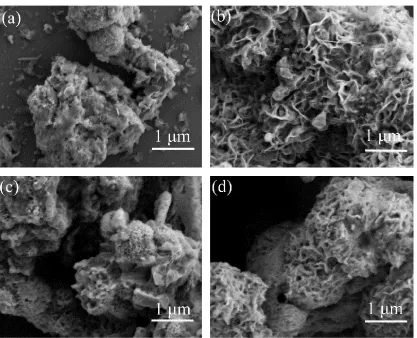
surface morphology with high specific surface area is preferred for most electrocatalysts {Hou, 2016 #2341}.
Figure 3. Typical FE-SEM images of pure MoS2 and Ni-MoS2 nanosheets.
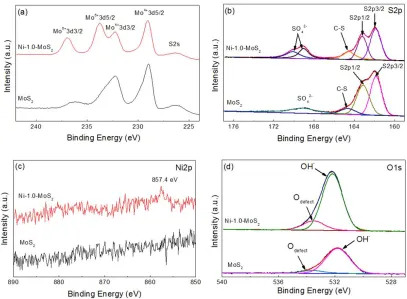
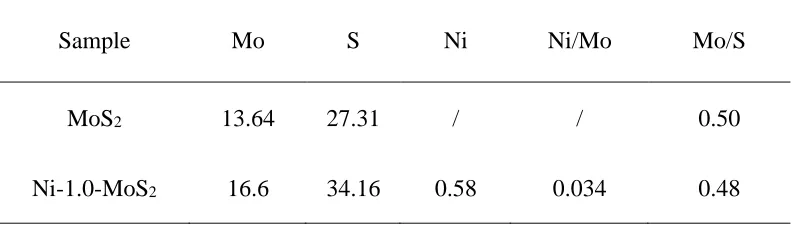
energy peak at 531.8 eV corresponding to the OH- groups. The high energy peak at 533.6 eV may be attributed to oxygen defects. The XPS results indicate that the existence of Mo, Ni and S elements in the Ni-1.0-MoS2. The element content (at.%), Ni/Mo and Mo/S ratio of MoS2 and Ni-1.0-MoS2 are shown in Table1. It can be seen that the atomic ratio of Mo to S in the pure MoS2 is 0.50, suggesting the formation of stoichiometric MoS2. The atomic ratio of Mo to S in the Ni-1.0-MoS2 is 0.48, which slightly deviates from stoichiometric ratio. Ni atoms were incorporated into molybdenum sulfide lattices and form compounds of sulfur, molybdenum and nickel.
Figure 4. (a) High-resolution Mo3d, (b) resolution S2p (c) resolution Ni2p and (d) high-resolution O1s XPS spectrum of pure MoS2 and Ni-1.0-MoS2.
[image:6.596.94.501.224.523.2]
Electrochemical impedance spectroscopy (EIS) measurements were used to investigate the electrode interfacial properties and HER catalytic kinetics. EIS were performed at a given overpotential with a voltage perturbation amplitude of 5 mV in the frequency range of 100 kHz to 0.1 Hz. Fig. 5b shows the Nyquist plots for the electrodes in 0.5M H2SO4 solution. The charge transfer resistance (Rct)
[image:7.596.97.504.282.570.2]can be obtained by fitting the Nyquist plot according to the equivalent circuit model {Chen, 2017 #2365}. It can be seen that the Ni-1.0-MoS2 electrode has the smallest charge transfer resistance (Rct) of 89Ω, which far less than that of the pure MoS2 (6108Ω). It is well known that the Rct is associated with the electrocatalytic kinetics at the catalyst/electrolyte interface and gives information about the reaction rate of HER {Li, 2017 #2364}. Therefore, the Ni-1.0-MoS2 electrode has the fast charge transfer and the optimum HER kinetics.
Figure 5. (a) LSV curves and (b) EIS spectra of pure MoS2, Ni-0.2-MoS2, Ni-1.0-MoS2, Ni-1.4-MoS2, (c) I-t curves and (d) CV cycle curves of Ni-1.0-MoS2 electrode
Table 1. The element content (at.%), Ni/Mo and Mo/S ratio of MoS2 and Ni-1.0-MoS2
Sample Mo S Ni Ni/Mo Mo/S
MoS2 13.64 27.31 / / 0.50
Ni-1.0-MoS2 16.6 34.16 0.58 0.034 0.48
4. CONCLUSION
In summary, the pure MoS2 and Ni-MoS2 were facilely prepared by means of a hydrothermal method. The perpendicularly oriented few layer MoS2 nanosheets had been observed in the Ni-1.0-MoS2, which had the larger specific surface area. In acidic medium, the overpotentials of the Ni-1.0-MoS2 was 164 mV (vs. RHE) at 10mA cm-2 and presented the higher electrocatalytic HER activity compared with pure MoS2. It could be concluded from the EIS measurements that the Ni-1.0-MoS2 had the smallest charge transfer resistance (Rct) of 89Ω, which far less than that of the pure MoS2 (6108Ω). The good durability for the Ni-1.0-MoS2 electrocatalyst make it applied in the practical electrocatalysis.
ACKNOWLEDGEMENTS
This work was supported by National Natural Science Foundation of China (Nos. 51701001, 61804039), Academic funding projects for Top Talents in Subjects (Majors) of Universities (No. gxbjZD31), Natural Science Foundation of Anhui Higher Education Institution of China (KJ2019A0734, KJ2019A0736, KJ2017A924, KJ2017A002), Natural Science Foundation of Anhui Province (No. 1808085QE126), Foundation of Universities Joint Key Laboratory of Photoelectric Detection Science and Technology in Anhui Province (No. 2019GDTC03) and Foundation of Co-operative Innovation Research Center for Weak Signal-Detecting Materials and Devices Integration Anhui University (No. Y01008411, WRXH201703).
References
1. Z. Pu, Q. Liu, A.M. Asiri, Y. Luo, X. Sun, Y. He, Electrochimica Acta, 168 (2015) 133.
2. M. Balat, H. Balat, Energy Sources, Part A: Recovery, Utilization, and Environmental Effects, 31 (2009) 1280.
3. Y.R. Liu, X. Shang, W.K. Gao, B. Dong, J.Q. Chi, X. Li, K.L. Yan, Y.M. Chai, Y.Q. Liu, C.G. Liu, Applied Surface Science, 412 (2017) 138.
4. X. Ren, X. Ren, L. Pang, Y. Zhang, Q. Ma, H. Fan, S. Liu, International Journal of Hydrogen Energy, 41 (2016) 916.
5. Q. Xiong, X. Zhang, H. Wang, G. Liu, G. Wang, H. Zhang, H. Zhao, Chemical Communications, 54 (2018) 3859.
7. Z. Chen, D. Cummins, B.N. Reinecke, E. Clark, M. Sunkara, T.F. Jaramillo, ACS Nano,11 (2011)4168.
8. K. Zhao, W. Gu, L. Zhao, C. Zhang, W. Peng, Y. Xian, Electrochimica Acta, 169 (2015) 142. 9. Y. Li, B. He, X. Liu, X. Hu, J. Huang, S. Ye, Z. Shu, Y. Wang, Z. Li, International Journal of
Hydrogen Energy, 44 (2019) 8070.
10.Y.R. Liu, W.H. Hu, X. Li, B. Dong, X. Shang, G.Q. Han, Y.M. Chai, Y.Q. Liu, C.G. Liu, Applied Surface Science, 384 (2016) 51.
11.L. Huang, L. Ai, M. Wang, J. Jiang, S. Wang, International Journal of Hydrogen Energy, 44 (2019) 965.
12.J. Deng, H. Li, J. Xiao, Y. Tu, D. Deng, H. Yang, H. Tian, J. Li, P. Ren, X. Bao, Energy & Environmental Science, 8 (2015) 1594.
13.L. Wu, X. Xu, Y. Zhao, K. Zhang, Y. Sun, T. Wang, Y. Wang, W. Zhong, Y. Du, Applied Surface Science, 425 (2017) 470.
14.C. Si, Y. Wu, Y. Sun, Q. Liu, L. Tang, X. Zhang, J. Guo, Electrochimica Acta, 309 (2019) 116. 15.Y. Li, L. Wang, A. Song, M. Xia, Z. Li, G. Shao, Electrochimica Acta, 268 (2018) 268.
16.H. Xu, Z. Zhou, Y. Liu, Q. Liu, Z. He, S. Wang, L. Huang, H. Zhu, Luminescence, 32 (2017) 812. 17.L. Changgu, Y. Hugen, L.E. Brus, T.F. Heinz, H. James, R. Sunmin, Acs Nano, 4 (2010) 2695. 18.X. Guo, Y. Hou, R. Ren, J. Chen, Nanoscale Research Letters, 12 (2017) 479.
19.Y. Hou, S. Cui, Z. Wen, X. Guo, X. Feng, J. Chen, S, Small, 11 (2016) 5940.
20.Z.q. Cao, M.z. Wu, H.b. Hu, G.j. Liang, C.y. Zhi, NPG Asia Materials, 10 (2018) 670.
21.L. Chen, W. Yang, X. Liu, J. Jia, International Journal of Hydrogen Energy, 42 (2017) 12246. 22.R. Li, L. Yang, T. Xiong, Y. Wu, L. Cao, D. Yuan, W. Zhou, Journal of Power Sources, 356 (2017)
133.