Inside the Summer 2012 EUSA Review:
EUSA Review Forum: Deepening v. Broadening: A False Dilemma?
Is There a Widening-Loosening Trade-off in European Integration? Frank Schimmelfennig 2
When Widening Makes Deepening Eva G. Heidbreder 3
Wider and Deeper? Enlargement and Integration in the European Union
Jonathan Slapin, Anand Menon, and R. Daniel Kelemen 4
Ever Closer or Ever Wider? Public Attitudes Towards Further
Enlargement and Integration Sara B. Hobolt 4
EU as Global Actor Interest Section
The Court of Justice as Global Governance Actor in EU-US relations Elaine Flahey 6 Opening Pandora’s “Toolbox:” The European Union as as
Actor of “World Society” Didem Buhari 8
EU Public Policy Interest Section
Commerce, Crisis, and EU Health Policy Holly Jarman 11
Book Reviews 14
Koopmans, Ruud and Paul Statham (eds).The Making of a European Public Sphere.New York: Cambridge University Press, 2010. Reviewed by Neil Cruickshank
Chalmers, Damian, Davies, Gareth and Monti, Giorgio. European Union Law Second Edition. Cambridge: Cambridge University Press, 2010. Reviewed by Kathryn Breitenborn Kigera
Daviter, Falk. Policy Framing in the European Union. New York: Palgrave Macmillan, 2011. Reviewed by Nikolaos Zahariadis
Wells, Sherrill Brown. Jean Monnet: Unconventional Statesman. Boulder (CO): Lynne Rienner, 2011 Reviewed by Yannis Karagiannis
Review of Documentary by Don C. Smith, Jean Monnet, The Father of Europe, 2011.
Reviewed by Björn Fleischer
Kelemen, R. Daniel. Eurolegalism: The Transformation of Law and Regulation in the European Union. Cambridge: Harvard University Press, 2011.
Reviewed by Heather A. D. Mbaye
Falkner, Gerda (ed).The EU’s Decision Traps. Comparing Policies.Oxford: Oxford University Press, 2011.
Reviewed by Marzena Kloka
Deepening v. Broadening: A False Dilemma?
Five years after the last wave of EU enlargement, this EU Forum takes a step back to ponder the consequences of the Europe’s integration to an ever-wider circle of member states – from the six founding members to the current 27.
All contributors take issue with the conventional no-tion that there exists an obvious tradeoff between “deep-ening” and “wid“deep-ening” the European Union. Based on an empirical dataset of EU treaty law, Frank Schimmelfen-nig argues that, to the extent that there is a tradeoff, it is not so much between deepening and broadening as between “widening and tightening” – as membership increases, the Union may become temporarily more heterogeneous. In a similar vein, Eva Heidberger’s study of the recent enlargement to Central and Eastern Europe highlights a phenomenon of “creeping integration”; in certain areas, the Commission was able to quietly assert the necessity of greater coordination, not only during but also beyond the enlargement process. Jonathan Slapin, Anand Menon and Dan Kelemen’s seek to generalize the argument through a quantitative analysis of federations and international organizations; they argue not only that there is “no correlation between size and depth”, but also that “deepening and widening go hand in hand”. Finally, Sara Hobolt’s inquiry into citizens’ perceptions of the relationship between widening and deepening reveals very divided public opinions: “While a majority of citizens are either supporters or opponents of both processes, over a third perceive a trade-off between deepening and widening, generally favoring deeper integration but opposing further enlargements.”
In sum, the main lesson of this EUSA Forum is loud and clear – there is no automatic tradeoff between wid-ening and broadwid-ening. How could conventional wisdom be so wrong? The contributors to this EUSA Forum of-fer insightful explanations. Perhaps also were member governments so acutely fearful of the risks of enlarge-ment that they took preventative measures to avoid a disintegration of Europe. Whatever the case may be, it does appear as if conventional wisdom became, with each wave of enlargement, a self-defeating prophecy. The question is whether this pattern will continue, i.e. whether the balance of power among member states and social groups will continue to favor those who want to deepen the Union. A serious trade-off between deepen-ing and widendeepen-ing could conceivably arise if this ceased to be the case.
Nicolas Jabko EUSA Review Editor
Is there a widening-loosening trade-off in European integration?
Frank Schimmelfennig
There is no convincing empirical evidence for the oft-evoked dilemma of widening and deepening in Eu-ropean integration. During its 60-year history, the EU’s policy competencies and membership have generally co-evolved. Widening and deepening are, however, not the only large trends in European integration. Since the early 1990s, integration has been accompanied regularly by differentiation: the fact that EU rules and policies are not valid in all member states. The euro zone and the Schengen area are the most prominent examples.
So maybe we do not find a detrimental impact of
widening on deepening because the real trade-off is between widening and tightening? This conjecture is based on the argument that enlargement increases heterogeneity. The integration and policy preferences and capacities of new member states often differ from those of the old member states. Differentiation is an ef-fective method to accommodate such heterogeneity. It allows the old member states to exclude new members from individual rules and policies, without denying them membership altogether, if they fear that enlargement will
undermine the efficiency of the policy or the utility that
they derive from integration. On the other hand, new member states may be exempted from individual obliga-tions of membership, without having to forgo member-ship entirely, if such obligations are particularly costly or
difficult to sell at home. Indeed, each accession treaty
contains a list of transitional arrangements consisting of exemptions from rights and obligations of membership for the new member states.
Empirically, however, the impact of enlargement on differentiated integration is limited. Data on differentiated integration in EU treaty law show that the EU’s widen-ing has so far not had a lastwiden-ing effect of “loosenwiden-ing” the Union. The treaty law impact of the early enlargement rounds of the 1970s and 1980s was minor. In Northern enlargement, the new member states produced differ-entiation for less than one per cent of all treaty articles. Greece started with a share of less than three and Portugal and Spain with less than two per cent. The enlargement rounds of the past two decades, however, produced differentiation in around 15 per cent of all treaty articles.
Yet the differentiation effects of enlargement dimin-ish rapidly and disappear completely after a few years. The average duration of differentiations for each of the Northern and Southern enlargement rounds of the 1970s
and 1980s was approximately five years. The value for
companied by a longer duration. The average duration for differentiations from Eastern enlargement cannot be calculated precisely at this point because of many on-going exemptions. For the moment, however, the average duration is still in line with the earlier pattern. Moreover, those new member states (such as Estonia, Malta, or Slovenia) which have already terminated (almost) all exemptions did not need more than four to
five years to do so. This was even faster than in the first
period of integration.
In sum, affecting roughly 15 per cent of the treaty
base initially and lasting for five years on average and
less than 10 years at most, differentiation in the context of enlargement is best seen as a transitional instrument of adaptation that facilitates the accession process but does not produce long-lasting or even permanent discrimination or legal disunity. Even if we include dif-ferentiation in the picture, the trade-off between widening and deepening does not resurface.
Frank Schimmelfennig ETH Zurich
When Widening Makes Deepening
Eva G. Heidbreder
A general trade-off between deepening and widening does not stand the empirical test. Although theoretically compelling, a growing body of analyses refutes the as-sumption. Enlargements neither increase heterogeneity of positions in everyday EU decision-making across the board, nor per force lower the likelihood for more intense and expansive integration. Debunking the com-mon wisdom as myth implies a new research agenda: how do horizontal and vertical integration actually affect
each other? In addition, these findings take us back to
a core question of EU research: what are the drivers of
integration? Going beyond mere falsification of the as
-sumed deepening-widening tradeoff draws our attention the causal links of territorial expansion and the increased depth and width of joint EU policy-making.
One conceptual angle to investigate whether and how widening is a cause for deepening is to start from the actual enlargement process and to focus on the unintended repercussions of its implementation. In this vein, the strategic approach developed for eastern enlargement raises a simple puzzle. The European Commission was assigned competences vis-à-vis the candidate states that went beyond the powers formally conferred to it in the framework of the EU acquis. During the pre-accession phase, the Commission thus applied double standards that were binding for the candidate states but not the member states. While in some policy areas, as foreseen, these special steering capacities
expired at the moment of accession, the Commission stayed active in others.
Explaining the variance between the cases in which powers were contained to the pre-accession phase (nuclear safety, and anti-corruption policies) and those in which the Commission expanded its capacities beyond the enlargement realm (minority protection, administra-tive capacity building, and cross-border cooperation), uncovers two conditions under which, indeed, policy making in the pre-accession context caused further deepening. All double standard policies meet a neces-sary condition: the existence of a strong pressure to coordinate new policy problems at the EU level in face of the prospective enlargement. All policies that entered the agenda as double standards were highly political; they had so far remained outside the EU realm, but they were considered crucial problems in the candidate states. Moreover, the pressure for coordination increased
in all five cases during the pre-accession phase because
the Commission created policy solutions for problems
otherwise not tackled or handled less efficiently in other
international forums.
Yet, pressing policy problems and the perceived
need for coordination are not sufficient to explain why a specific policy is deepened; widening does not set off a functional automatism for deepening. The sufficient condition concerns the policy type: the specific problem
at stake determines which instruments can be feasibly applied to implement a policy. If the utilized instruments do not openly expose the political clout behind the prob-lem and threaten to shift political attention to the EU level, member states let the Commission intervene in basically any area. Therefore, distributive or soft regulative policies are probable candidates for further deepening, whereas the dawning creation of visible political authority will lead to an outsourcing of responsibilities from the EU to other
international organizations that offer less efficient but
politically less demanding policy solutions.
The findings provide answers to the two questions
raised above. First, widening is under certain conditions a driver of integration. Enlargement extended the policy agenda to salient political areas, in which the old member states had no interest whatsoever to confer hard pow-ers to the EU. At the moment of accession, the double standards limited to the candidate states had to be fully integrated, or else they disappeared. As long as the Commission could minimize visibility and political noise around its new powers, the member states accepted continued interference and hence deepening despite the highly political nature of the issues at play. Second, this mode of creeping integration is not necessarily unique to
the enlargement context. Therefore, the specific mecha
with the research agenda that debunking the deepening-widening trade-off has opened up.
Eva G. Heidbreder, University of Konstanz
Reference
Heidbreder, E. G. (2011) The Impact of Expansion on EU Institutions (New York: Palgrave/Macmillan)
Wider and Deeper? Enlargement and Integration in the European Union
Jonathan Slapin, Anand Menon and R. Daniel Kelemen
The potential impact of widening – the enlargement of the EU to include additional member states – on deepening – increasing the scope and strength of the EU’s powers – has been a central concern of many EU scholars and of many public debates about the EU’s future. Yet while the relationship between widening and deepening is recognized as one of the ‘big questions’ in
the field of European integration, many academic and
policy analyses remain based on the recitation of dubi-ous ‘common wisdoms’ – above all the assumption that widening impedes deepening.
The notion that widening should impede deepen-ing has intuitive appeal and has found resonance in the theoretical literature, particularly in the IR literature on multilateral cooperation and collective action. Yet if we look to the empirical record, it is not clear that such claims are well founded.
Our quantitative analysis of both federations and
international organizations (specifically regional trade
agreements) reveals no correlation between size and depth. Turning to the EU itself, widening and deepen-ing have often gone hand in hand. Anticipation of the possible consequences of enlargement has frequently led member states to introduce institutional reforms that deepen integration. For instance, concern that the 2004 enlargement could render EU institutions unworkable was a central motivation for holding three Intergov-ernmental Conferences that reformed, and ultimately deepened, the EU.
We argue that an institutionalist account can explain when and how widening and deepening go hand in hand. The impact of widening on deepening depends on the position of the enlargement state relative to the prefer-ence distributions of existing member states across a range of policy areas. Unsurprisingly, widening is more likely to impede deepening with respect to an issue if the enlargement state is a preference outlier with an extreme anti-deepening position. However, the impact of adding a laggard state will differ across issue areas and may still encourage deepening. In policy areas where supranational actors already enjoy powers to act in the
face of legislative gridlock, widening may facilitate deep-ening. While expansion may create legislative gridlock and impede deepening in the short-term, it may also strengthen the role of supranational actors and provide the impetus for institutional changes that encourage deepening in the long term.
Recent developments within the Union seem
to confirm our theoretical expectations. Not only has
EU decision making continued to function in a wider Union, but widening has promoted institutional reforms that have accelerated deepening. For example, work-ing styles and rules of procedure have been adapted to cope with enlargement – thus, the European Council in June 2002 adopted ‘Rules for the Organisation of the Proceedings of the European Council’. Amongst other things, this called for some agenda items to be marked as not being for debate, the Presidency was given the authority to limit speaking time, and limits were imposed on the size of delegations. Similar adaptation has been evident in the Council of Ministers and other bodies.
In contrast to many of the claims made in the litera-ture, we argue that the effect of widening on deepen-ing within organizations is highly contdeepen-ingent upon the nature of expansion. Whether widening impedes or fosters deepening depends upon the preferences of the new members and the nature of decision making rules. Moreover, a difference may exist between short and long term effects. Even if enlargement creates the potential for gridlock in the short term, in may create incentives for more reform in the long run.
Jonathan Slapin, University of Houston Anand Menon, University of Birmingham Daniel Kelemen, Rutgers University
Ever closer or ever wider? Public attitudes towards further enlargement and integration
Sara B. Hobolt
Do citizens perceive a trade-off between an ever closer European Union and an ever wider EU? The process of ‘widening’ the European Union with more member states has often been seen to go hand in hand with the process of ‘deepening’ integration by transferring
more powers to the European Union. Over the past five
decades the EU has managed to more than quadruple
its membership, while at the same time significantly
extending the Union’s authority into new competence areas. However, the current economic crisis in the eu-rozone has exposed deep divisions within the European Union, between euro insiders and outsiders and within the eurozone between the ‘paymasters’ in the North and
the countries in need of financial support in the South. Calls for closer fiscal integration among an inner core of
widening are complementary, and it has been suggested that such a strategy to “deepen and narrow” is the only way to save the eurozone.
It has become increasingly clear that public support is a necessary requirement for further widening and deepening, but less is known about whether citizens perceive a trade-off between these two integration processes and if so, whether this has become more pronounced in recent years. It is of crucial importance to understand why some citizens see deepening and widening as complementary whereas others perceive
them as conflicting. Of particular importance is whether
a country’s status as an insider or an outsider in the
eurozone and net contributor/ net beneficiary of EU
funds shapes the way in which citizens perceive the two processes of integration.
Findings from an analysis of Eurobarometer data from the period since the big expansion of the EU in 2004 show that while support for both deepening and widening have declined slightly since the onset of the eurozone crisis, generally these attitudes have remained
remarkably stable over time. I do, however, find signifi
-cant differences across countries in citizens’ support for deepening versus widening. While a majority of citizens are either supporters or opponents of both processes, over a third perceive a trade-off between deepening and widening, generally favoring deeper integration
but opposing further enlargements. More significantly,
such attitudes are concentrated within core eurozone member states and among the better-educated, more
knowledgeable citizens. These findings, based on multi
-level analysis of Eurobarometer data, are consistent with utilitarian explanations of integration: they suggest that the winners of the integration process want to consolidate and strengthen the union, but close the door to additional (poorer) member states. In net contributor countries, such preferences are notably driven by concerns of
ad-ditional financial burdens for existing members rather
than symbolic considerations.
These findings have important implications. First,
they suggest that attitudes towards European integration are multidimensional and that some citizens have mul-tifaceted opinions on the integration process. Second,
they indicate that a one-size-fits-all model of attitudes
towards integration may be inappropriate, since the factors that shape attitudes towards deepening and widening are conditioned by the national economic and
political context. Finally, these findings could also imply
that we are moving towards a more divided multi-speed Europe, as opinion-leaders in the core eurozone coun-tries are reluctant to foot the bill to expand the Union to include more members (and perhaps even bail out current members), whereas they are keen to support further integration among a core of countries.
Sara B. Hobolt, London School of Economics
EUSA Review
The EUSA Review (ISSN 1535-7031) [formerly the ECSA Re-view] is published three times yearly by the European Union Studies Association, a membership association and non-profit organization (founded in 1988 as the European Community Studies Association) devoted to the exchange of information and ideas on the European Union. We welcome the submission of scholarly manuscripts. Subscription to the EUSA Review is a benefit of Association membership.
Editor: Nicolas Jabko
Book Reviews Editor: Susanne Schmidt Managing Editor: Joseph Figliulo 2011-2013 EUSA Executive Committee
Amie Kreppel, Chair
(University of Florida) Michelle Egan, Vice Chair
(American University) Adrienne Héritier
(European University Institute) Nicolas Jabko
(Johns Hopkins University) Berthold Rittberger
(University of Mannheim) Susanne K. Schmidt
(University of Bremen) Mitchell Smith
(University of Oklahoma) Alberta Sbragia, ex officio member
(University of Pittsburgh) Immediate Past Chair (2009-2011) Adrienne Héritier
(European University Institute) European Union Studies Association 415 Bellefield Hall
EUSA BIENNIAL CONFERENCE Baltimore, May 9-11, 2013
Call for papers and panels
The European Union Studies Association invites scholars and practitioners engaged in the study of Europe and the European Union to submit panel and paper proposals for its 2013 Thirteenth Biennial International Conference, May 9-11, in Baltimore, Maryland. This conference also marks the 24th anniversary of EUSA. The Program Committee plans to promote the broadest possible exchange of theoretical approaches, disciplinary perspectives and research agendas. Please note the following:
1. On the basics of paper and panel proposals:
* We welcome both paper and panel proposals, particularly those that foster transatlantic dialogue. Panel proposals need to consist of three to four papers.
* Participants are limited to two appearances on the conference program (two papers or one paper and one discussant role; chair roles do not count toward the appearance limit). Participants should therefore sub-mit no more than two proposals.
* For organizational reasons, the program is subdivided into seven substantive sections (integration theory in the EU and beyond; history and institutions; economics and political economy; sociology, political be-haviour and elections; law, public policy and regulation; external relations, enlargement and security; teaching
the EU). Please indicate for which section you would like to be considered. Note that there is no fixed num
-ber of panels for each section. Choosing one section rather than another does not enhance or diminish your chances of having your paper or panel accepted.
2. Other conditions:
* The Program Committee reserves the right to make changes to organized panel proposals, including their composition.
* You do not need to be an EUSA member to submit a proposal, but all those appearing on the confer-ence program must be current EUSA members.
* We cannot honor individual scheduling requests; by submitting a proposal you agree to be available from 8:30 a.m. on Thursday, May 9 through 6:00 p.m. on Saturday, May 11.
The 2013 Program Committee is:
Program Co-Chairs Adrienne Héritier (EUI)
Sections under which proposals should be made:
Law, Public Policy, and Regulation Tim Büthe (Duke University)
This section welcomes papers focusing on legal integration and the European Court of Justice, issues of rights and equal-ity, and all substantive areas of EU regulation and public policy-making.
History and Institutions
Morten Rasmussen (University of Copenhagen)
This section extends to research on the designing and transformation of European political, administrative and legal insti-tutions and the way they operate and develop over time. How do instiinsti-tutions operate under strong problem pressure? Do they absorb shocks by adjusting incrementally or are they subject to profound changes?
Sociology, Political Behaviour, and Elections Alexander Trechsel (EUI)
This section raises questions regarding the specific features of European societies and the changes they have been sub -ject to in recent years. How does public opinion react to the transformation of European societies? How do political
par-ties, interest groups and social movements process these changes and influence electoral outcomes and public policies
as a response to these transformations?
Economics and Political Economy Waltraud Schelkle (LSE)
This section focuses on economic policies and dynamics ranging from trade to investment, employment, competition,
fiscal and monetary policies, and welfare state reform. The section includes research on critical economic developments such as the financial crisis and shifts in the international distribution of economic power.
External Relations, Enlargement, and Security Frédéric Mérand (University of Montréal)
This section includes all aspects of EU foreign and security policy; EU engagement in global governance; and EU devel-opment, aid and capacity building operations. The section also includes work on past and potential future EU enlargement and EU relations with neighboring regions.
Integration Theory in the EU and Beyond Walter Mattli (Oxford University)
This section focuses on general questions pertaining to the dynamics of integration such as the factors which drive a deepening or a weakening of European integration, the underlying political processes, structures and modes of gover-nance. It also goes beyond the EU and asks whether similar factors drive regional integration elsewhere (e.g. Mercosur, NAFTA, ASEAN) or whether different factors are at work and produce different outcomes.
Teaching the EU
John Occhipinti (Canisius College)
This section welcomes paper and panel proposals on any and all aspects of teaching the European Union.
The firm deadline for receipt of proposals is September 30, 2012. You will be notified of the Program Committee's decision
regarding your proposal by December 17, 2012.
EU as a Global Actor
Interest Section
The Court of Justice as Global Governance Actor in EU-US Relations
E.L. Fahey
The role of the Court of Justice in foreign policy qua Global Governance is both a legal and political ques-tion which has attracted little interest from scholars of political science and international relations studying the Court of Justice, less still lawyers. The Court is
regarded as having little influence on EU foreign policy
generally, even by those less hostile to this viewpoint, and, at the very least, as having expended little time construing or analysing substantive EU foreign policy.1 There is little doubt but that the EU increasingly acts externally as a Global Governance actor, both politically and legally, particularly after the implementation of the Treaty of Lisbon, where it emerges with more legal and unitary coherence. However, its “actorness” is as-sessed unevenly by lawyers and international relations theorists.2 Most studies of EU “actorness” focus upon the EU institutions more broadly pre-Lisbon, conclud-ing that the EU is both hardly and highly developed in its foreign policy actions.3 The significance of the ac -tions of the Court qua judicial actor remain very much a political science-like phenomenon- when analysis closely scrutinises what occurs outside the courtroom upon strategic interactions of other institutional actors in response to it unlike legal scholarship, which remains devoted to the study of internal courtroom activities.
Transatlantic relations provide a fertile laboratory for global governance scholarship, but less obviously legal scholarship. Yet despite the waning political importance of the EU to the US, transatlantic relations are rapidly increasing and deepening in number in recent times, particularly in justice cooperation. While more EU in-stitutional actors and agencies, for example Europol or the European Banking Authority, may possibly generate transatlantic relations in law, the Court of Justice has had limited opportunities to review this “high politics”
qua “courtroom activities” There is a rising significance
of law and legal theory to the Transatlantic Relationship. Transatlantic actors frequently deploy law as a politi-cal tool, in one way or another. For example, in 2011, the US House of Representative passed legislation to explicitly prohibit the impact of EU law in the US legal order.4 Another example is constituted by EU amicus curiae submissions before the US Supreme Court in death penalty cases.5 EU-US policy and law-making is increasingly porous or “outside-in” and “inside-out,” between the two legal orders. Thus, the extent to which EU legal rules are transplanted or replicated in the US
is growing, for example, the transposition of REACH in California. And thus the question remains, how would
these developments influence the review of specific
transatlantic policy and rules by the Court of Justice?
More specifically, the actual origins for EU-US rela
-tions lie mainly in bilateral regulatory cooperation agree-ments, binding and non-binding rules, between the US and the then EC and now the EU, as well as Protocols, Exchanges of letters. The most “successful” EU-US policy cooperation in Justice and Home Affairs since 9/11 in particular is remark worthy in two other ways- in
that it is both recent and prolific, as a field of cooperation
in extraordinary times. The extent of these legal obliga-tions and their impact upon individual rights remains far more contentious than merely regulatory cooperation might generate. The US Attorney General, Eric Holder, recently claimed before the European Parliament that no rights violations have ever occurred as a result of any EU-US relations in the context of Justice and Home Affairs, thereby warranting further legal cooperation in these areas and beyond. Whatever about the merits of the substantive content of recent EU-US relations, as a matter of EU law there is a particular novelty to the legal formulation of the agreements entered into, but as a matter of EU law only and no more. For example, the most recent EU-US PNR Agreement expressly states that the Agreement is not a Treaty and is not amenable to review under US law, creating a curious quagmire for EU citizens affected by EU-US measures.
An analysis of the legal effects of Transatlantic mea-sures in the caselaw of the Court of Justice does not reveal much by way of quantity, marginally more than a comparable search of the US Supreme Court.6 The Court of Justice has also neglected to avail of opportu-nities or possibilities in litigation to enlarge institutional powers or competences where possible.7 The limited amount of caselaw in this regard is indicative of much about the legal contours of EU-US relations. The Court has not perhaps acted in the interests of a “European”
unified approach to EU-US relations, prior to the Treaty
of Lisbon at least, however imperfect or challenging such an approach might seem to push for coherence. Nor has the Court acted to strengthen citizens’ rights or the hand of individual institutional actors, particularly
in its recent high profile PNR decision, where on the
contrary the Court may in fact be interpreted to have “gifted away” the power dynamic. The possibilities for the Court are, however, manifold, where it may act as an agent of change in global governance and also as guardian of individual rights, if it so wishes.
Notes
1. De Witte, B. (2008) ‘Too much constitutional law in the European Union‘s Foreign Relations?‘ in B. De Witte and M. Cremona (eds.), EU Foreign Relations Law: Constitutional Fundamentals (Hart Publishing, Oxford and Portland Oregan 2008) p. 11.
2. See the analysis of Kaunert, C. (2010) “Europol and EU Counterterrorism: International Security Actorness in the
External Dimension” Studies in Conflict and Terrorism, 33:
7, pp. 652-671.
3. Manners, I. (2002), Normative Power Europe: A Contra-diction in Terms? Journal of Common Market Studies, 40: pp. 235–258; Nicolaidis, C. & Howse, R. (2003) “This is my EUtopia…narrative as power” in J.H.H. Weiler, I. Begg & J. Peterson (eds). Integration in an Expanding European Union (Oxford: Blackwell) pp. 341-366
4. HR 2594 European Union Emissions Trading Scheme Prohibition Act of 2011 was passed by the US House of Representatives in late October 2011 purporting to prohibit the application of EU law to US airline carriers.
5. Atkins v. Virginia 536 US 304 (2002); Roper v. Simmons 2004 WL 1619203 (US). See the excellent account given Cremona, M. (2011) “Values in EU Foreign Policy” in M. Evans & P. Koutrakos eds., Beyond the Established Legal Orders Policy interconnections between the EU and the rest of the world (Oxford: Hart Publishing) pp. 275-317.
6. A search in Curia for “transatlantic”- searching for trans-atlantic-related documents yields 14 documents (31 January 2012), not all of which relate to substantive law (eg
refer-ences to a transatlantic flight in a consumer law dispute or
a transatlantic law journal). A comparable search in the US
Supreme Court yields five results, none of which are substan -tive results either (2 February 2012).
7. For example: Case C-233/02 French Republic v. Commis-sion [2004] ECR I-2759 (EC-US Guidelines on Regulatory Cooperation and Transparency) Case 142/88 Hoesch AG & Federal Republic of Germany v. Bergrohr GmbH [1989] ECR I-3413 Arrangement in exchange of letters Case C-327/91 France v. Commission [1994] ECR I-3641 1991 (EC-US Com-petition Cooperation Agreement); the so-called Open Skies caselaw eg; C-467/98 Commission v Denmark [2002] ECR I-9519; Case C-523/04 Commission v. Netherlands [2007] ECR I–3267; Passener Name Records (PNR)- Joined Cases C-317/04 and C-318/04, European Parliament v Council and Commission, Judgement of the Grand Chamber of 30 May 2006, [2006] ECR I-4721.
The EUSA Executive Committee is pleased to announce the online
publica-tion of the first EUSA Biennial Conference
Special Issue of the Journal of European Public Policy (JEPP). This Special Is-sue includes seven (revised) papers se-lected by peer review from amongst those nominated by discussants and chairs as among the best presented at 2011 Bien-nial EUSA conference. The Special Issue can be found at http://www.tandfonline. com. The paper version is now available.
Opening Pandora’s “Toolbox:” The European Union as an Actor of “World Society”
Didem Buhari
Given the recent economic, social, and politi-cal crises in Europe, it would be timely to study the EU’s global actorness from a global perspective that transcends the dichotomous thinking reinforced by the strategic-normative debate. The “World Society School” led by John W. Meyer (also known as the Stanford School’s sociological institutionalism) intro-duces analytical tools – “world society”, “ritualized rationality”, and “disinterested actorhood”- to expand our understanding of global politics and society (see Drori and Krücken 2009; Boli, Gallo-Cruz and Math-ias 2010; Buhari-Gulmez 2010). To begin with, rather than being insulated or cut off from the external en-vironment, the EU is embedded in a “World society”, i.e. a decoupled, centreless, and dynamic global entity that provides universalistic blueprints for how to un-derstand and behave in the world (Meyer 2001). Both
the compliance deficit within the EU and the chronic failure to define European cultural identity (Biebuyck
and Rumford 2011) reinforce the assumption that the EU’s agency is less constituted by intergovernmen-tal bargains or a particular cultural centre than global scripts -termed “global cultural myths” by Meyer and Rowan due to their historicity and bias for liberalism and scientism- actively promoted by epistemic, pro-fessional communities and international organizations that cultivate a global mindset. The emphasis on the EU’s embeddedness in the global renders the tradi-tional accounts of the EU’s global actorness highly problematic.
Rather than embracing the dichotomy of self-interested vs. norm-driven actorhood, the World So-ciety scholars suggest acknowledging “disinterested actorhood” (Meyer and Jepperson 2000). Disinter-ested actors are those who advise “proper” (or self-interested) actors on how to think and act by providing the latter with not only normative but also cognitive scripts enacted at the global level and thought to be
universally applicable. By definition, disinterested ac
-tors include international organizations, professional and epistemic communities who are not only problem-solvers but also “trouble-makers” due to their constant efforts to rethink, reframe, and reorganize modern so-ciety and politics. Their scripts are followed by mod-ern actors -including nation states, societies, regions, groups, and individuals- who rely on external recogni-tion and legitimarecogni-tion. In this context, due to its active contributions to the enactment and spread of global standards, the EU is a disinterested actor that is a crucial part of global legitimation processes. A recent
study on the disinterested aspect of the EU’s global actorness is developed by Joseph Jupille and Brandy Jolliff (2011:9-13). Accordingly, compliance with the EU implies a search for external legitimation: the EU is seen as an authority that provides globally legitimate templates for action. Accordingly, in addition to its “market power” (Damro 2011) and “normative power” (Manners 2008), the EU holds the authority to prob-lematize, transform, and reframe (in line with world society scripts) the taken-for-granted visions of exist-ing problems and available solutions in the national realm. For instance Turkey, an EU candidate country that is infamous for its failure to implement strategic and normative conditionality, has already experienced radical processes of cognitive transformation involving
the redefinition and reframing of key political concepts
such as national sovereignty, secularism, and minority amongst others. This means that the EU’s conditional pressures do not only trigger strategic and normative debates, but also cognitive efforts to embrace globally
endorsed definitions, categories, methods, and solu
-tions.
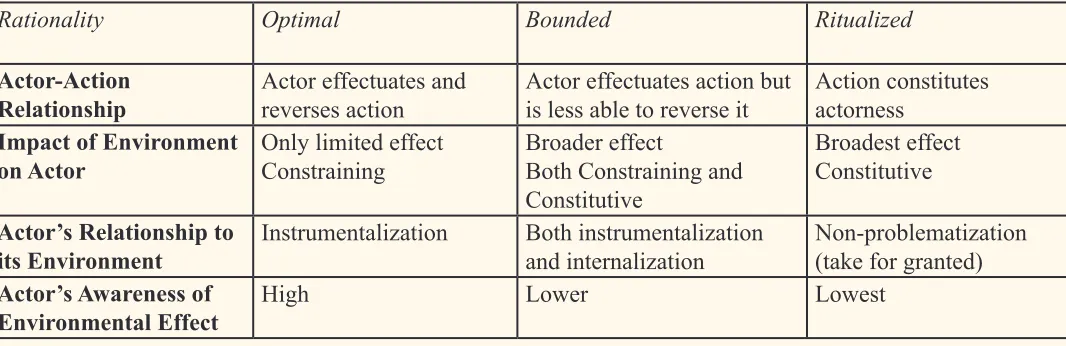
Finally, the World Society School challenges the prevailing dichotomy of optimal vs. bounded ra-tionality -or Calculus vs. Cultural logic (Hall and Taylor 1996) or logic of expected consequences vs. logic of normative appropriateness (March and Olsen 1998)- which respectively inform rationalist and constructivist approaches to the EU’s global actorness. The optimal-bounded rationality debate centres on determining whether (i) the EU’s actorness follows
“utility-maximi-zation” or “satisficing”, (i) the EU’s behaviour is instru
-mental or norm-driven, and (iii) environ-mental effects on the EU are of strategic or of normative character (See Table 1). While optimal rationality focuses on one’s tendency to compute all possible outcomes of an action before acting, bounded rationality highlights the time, normative, and cognitive constraints that lead one to fail in one’s search for optimal solution. Alterna-tively, the World Society School treats rationality as a cultural norm that constitutes legitimate actorhood in the modern world, rather than an inherent ‘fact’ of social and political life. In this sense, actors resort to post-hoc rationalizations to justify their scripted behav-iour. By using the term ‘ritualized rationality’, the World Society School helps to uncover the general tendency to follow the logic of heuristic decision-making. Such logic involves using mental short cuts to understand complex phenomena (Leading political scientists on heuristics are Herbert Simon, Daniel Kahneman, Alex Mintz). Hence, without knowing anything about the
topic at hand, one still finds a short cut to judgment by
So, unlike optimal and bounded rationality which assume that actors inherently seek to
maxi-mize efficiency, ritualized rationality de-emphasizes
purposive actorness. It rather draws attention to the ceremonial and post-hoc nature of rationalizations underlying actorness: “ritualized rationals” embrace scripts not solely because they are certain that the latter could solve their particular problems or grant them normative superiority, but also –and most im-portantly- because the scripts are globally endorsed and have a “taken-for-granted” character. According to such path-breaking perspective, the EU’s frequent
reference to scientific and UN- or INGO-promoted
“evidence” reinforces the assumption that EU-led re-forms are embraced abroad not only because they are
“beneficial” or “appropriate” but also because they are
globally endorsed/legitimated. This suggests revisiting interest-based accounts of the EU’s effect on domes-tic polidomes-tics and society: Compliance with the EU condi-tionality tends to be ‘ritualized/ceremonial’ rather than a clearly “thought-out” process. As if performing a ritu-al, national parliaments pass EU-led reforms that have been lumped together without much consideration of
their specificities; and no parliamentarian has much
idea of how to put these reforms into practice in a
spe-cific context. However, under the constitutive effects
of global rationalization processes, national decision-makers resort to post hoc instrumental explanations for their scripted behaviour (Meyer 2007:795).
Conse-quently, it is difficult to apprehend the bias introduced
by post hoc rationalization, which misleads many to favour strategic accounts of the EU’s global actor-ness. Nevertheless, serious political research usually reveals confessions made by national political elites that ‘the national interest is something you invent on your way to the airport’ (quoted in Sjursen 2006:99).
In sum, the study of the EU’s global actorness needs a global theory that transcends prevailing di-chotomies in political research. The World Society School introduces important “tools” –world society, dis-interested actorness, and ritualized rationality- to move beyond a possible theoretical impasse by grasping the cognitive dimension and thus, the “bigger picture” in European studies. It puts a special emphasis on the cognitive transformations the EU is triggering through its conditional stimuli. The World Society School also revolutionizes studies on the relationship between Europe and globalization with its structurationist ap-proach: Instead of being merely a gatekeeper against
global flows (as evoked by terms such as Schengen
-land or Fortress Europe), the EU could also be thought as a gateway to global legitimation processes due to its primary role in enacting and spreading the world society’s scripts (Rumford and Buhari-Gulmez 2011; Rumford and Buhari-Gulmez 2012).
[image:11.612.42.575.504.677.2]Didem Buhari, University of London
Table 1. Three types of rationality
Rationality
Optimal
Bounded
Ritualized
Actor-Action
Relationship
Actor effectuates and
reverses action
Actor effectuates action but
is less able to reverse it
Action constitutes
actorness
Impact of Environment
on Actor
Only limited effect
Constraining
Broader effect
Both Constraining and
Constitutive
Broadest effect
Constitutive
Actor’s Relationship to
its Environment
Instrumentalization
Both instrumentalization
and internalization
Non-problematization
(take for granted)
Actor’s Awareness of
References
Biebuyck, William & Chris Rumford (2011), “Many Europes: Rethinking multiplicity”, European Journal of Social Theory 15(1), 3-20.
Boli, John, Selina Gallo-Cruz, and Matthew D. Math-ias (2010) “World society, world-polity theory, and international relations”, in The International Studies Encyclopedia, ed. Robert Denemark. Malden, MA: Blackwell. http://www.isacompendium.com/public/
Boli, J. & Thomas, G. (eds.) (1999) Constructing World Culture: International Nongovernmental Orga-nizations Since 1875, Stanford, California: Stanford University Press.
Buhari-Gulmez, Didem (2010) “Stanford school on sociological institutionalism: A global cultural Approach”, International Political Sociology 4(3): 253–70.
Damro, Chad (2011) “Market Power Europe”, Eu-ropean Union Studies Association Twelfth Biennial International Conference, Boston (Massachusetts USA), 3-5 March 2011.(reprinted in JEPP March 2012).
Drori, Gili S., and George Krücken (2009) “World society: A theory and research program in
Context”, in World society: The writings of John W. Meyer, ed. G. Krucken and G.S. Drori, 1–32. Oxford: Oxford University Press.
Jupille, Joseph and Brandy Jolliff (2011) “Regional-ism in the World Polity”, European Union Studies As-sociation Twelfth Biennial International Conference, Boston (Massachusetts USA), 3-5 March 2011.
Manners, I. 2008, “The Normative Ethics of the Euro-pean Union”, International Affairs 84(1): 65-80.
Meyer, John W. (2007) “Reflections on Institutional
Theories of Organizations”, in Handbook of Organi-zational Institutionalism, edited by R. Greenwood, C. Oliver, R. Suddaby, and K. Sahlin-Andersson. Thou-sand Oaks: Sage.
Meyer, J. W. 2001, “The European Union and the Globalization of Culture”, in Institutional Approaches to the European Union, edited by S. S. Andersen,
Arena, Oslo, p. 227-45.
Meyer, John W., and Brian Rowan (1977) “Institution-alized Organizations: Formal Structure as Myth and Ceremony”, American Journal of Sociology 83 (2): 340–363.
Meyer, John W. and Ronald Jepperson. (2000) “The ‘Actors’ of Modern Society: The Cultural Construc-tion of Social Agency”, Sociological Theory 18 (1): 100–120.
Rumford, Chris, and Didem Buhari-Gulmez (2011) “Contradictions in European integration: A global per-spective”, in Global trends and regional development, ed. Nikolai Genov, New York, NY: Routledge.
Rumford, Chris and Didem Buhari-Gulmez (2012) “The European Union”, in George Ritzer (ed.) Ency-clopedia of Globalization (5 volumes), Wiley-Black-well.
Sjursen, Helen (2006) “Values or Rights? Alterna-tive Conceptions of the EU’s ‘NormaAlterna-tive’ Role”, in The EU’s Roles in International Politics: Concepts and Analysis, edited by O. Elgstrom, and M. Smith. London: Routledge.
EUSA Public Policy
Interest Section
Commerce, Crisis, and EU Health Policy
Holly Jarman
Reactions to the economic crisis in Europe frequently involve retrenchment of public health care, and in a few countries explicit privatization of health care responsibilities. Moreover, the European Union’s existing policy frameworks, and developing agendas as distinct as health care services regulation and pe-ripheral bailouts, are creating an explicitly pro-market framework for health care.
European states are currently maintaining a precarious balance between the old models of health policy decisionmaking in the context of welfare states, and the new realities of global markets. Ongoing trends towards the commercialization and
globaliza-tion of healthcare pose significant challenges for Eu
-ropean policymakers. Legal frameworks governing crossborder healthcare -the movement of patients and medical professionals from one state to another, the commercial presence of foreign health providers, and crossborder health services- have been created which need to be supplemented by stronger policies if they
are to fulfill member state promises to promote high
quality healthcare that is broadly accessible.
Some Context
Now might not seem like a good time to call for the strengthening of health systems in European Union member states. As I write this, the Eurozone is experiencing yet another wave of political turmoil and economic uncertainty in the ongoing, slow motion
car wreck that is the current financial crisis. Strategies
to bring back economic growth in ailing EU countries have revolved around debt reduction, to be achieved via public spending cuts, which frequently include cuts to health and social services.
Under great pressure to appease markets and debtors, several member states have dismembered their health systems. Ireland, a historically underfund-ed health system, saw its health budget cut by 26 per cent in 2009, with a further Eur746 million cut for 2011. In Greece, the health budget decreased by Eur1.4 bil-lion in 2011, with deep and rapid cuts to hospital fund-ing. In the same year, Italy announced extensive bud-get cuts to health care infrastructure, research funding, and disease prevention, and tight new budget caps on regional pharmaceutical spending (Mladovsky, Srivas-tava, Cylus, et. al. 2012). Other governments, such as the United Kingdom and Portugal, have radically
reformed their health systems in an attempt to control the rising costs of care.
On top of the current economic instability and pressure for austerity, European governments already face some severe longterm challenges which will im-pact their health systems in the decades to come. De-pending on the state, these challenges can include ag-ing populations which require more care and pay fewer taxes, shortages of healthcare professionals such as doctors and nurses, or rising healthcare costs which challenge public budgets. In trying to tackle these is-sues over several decades, governments have intro-duced successive policies aimed at rationing access to treatment and limiting price rises. It can be argued that European welfare states have entered an era of permanent retrenchment, a ‘silver’ age of more lim-ited state-sponsored health and social services which pales in comparison to earlier models of the welfare state (Ferrera 2008).
Both these short and long term factors have placed considerable pressure on health budgets. But there are other, simultaneous, trends which are just as important in shaping current and future health policy.
While member states enact austerity measures, offi
-cials at the European level are focussing on making markets. Strategies to bring back economic growth put forward by the Commission focus extensively on negative integration and the liberalization of services throughout the internal market. The proposed Single Market Act, adopted by the Commission but not yet by member states, calls for the standardization of servic-es at the European level via the European Standard-ization System, liberalStandard-ization of public procurement
policies, simplified procedures for mutual recognition
of mobile workers, and the construction of a ‘digital single market’ which can empower consumers and in-crease the ‘effectiveness’ of public services and pro-curement (European Commission 2011).
that they should be excluded from the internal market (Hervey 2011).
The modern EU was built around a customs union, and the Common Commercial Policy, which ap-plies a common external tariff to goods entering the Union, is one of the oldest EU competences. Until the Treaty of Lisbon, the Commission and the Coun-cil dominated trade policymaking among EU member states. The Commission could propose trade policy agenda items to the Council, which would in turn for-mulate a mandate for the Commission to negotiate on behalf of the EU member states. The TFEU greatly enhanced the role of the European Parliament in this process, with framework legislation in trade and in-vestment, and implementing legislation for the Com-mon Commercial Policy are now decided using the ordinary legislative procedure (Kleimann 2011).
To date, the EU has not made many commit-ments in international trade negotiations to liberalize external trade in health services, but it has made some
qualified commitments in the areas of hospital and so
-cial services. The TFEU takes an important step by making trade in services an exclusive Union compe-tence, which potentially reduces the need for mixed
agreements requiring national parliamentary ratifica
-tion (Eeckhout 2011), although this area of EU law still seems untested and susceptible to future member state and Court actions. The scope of the EU’s health services commitments may well change in the future,
as the increased influence of the Parliament over the
trade policy process alters the structure of opportunity for health providers, policy advocates, and other lob-byists.
Finally, it may be the Troika of the European Commission, the European Central Bank, and the In-ternational Monetary Fund, and not the EU’s
legisla-tive process, which has the most significant impact on
the future shape of health policy in certain Eurozone states. National bailout packages for Ireland, Greece
and Portugal included some very specific directions
about the reform of these countries’ health systems (Fahy 2011). Some of these reforms may well be ap-propriate, and some may be sorely needed. But they do not stem from democratic mandates. They are not the directives of health ministries or health policy
ex-perts. Nor are they reforms specifically designed to
improve or maintain health outcomes.
In short, the pattern of EU authority over health
services reflects the tension between health systems,
which are largely bound to national territories, and goods and services markets, which cross national
bor-ders. Member states have the power to define health policy, and to manage and finance health services
and medical care, although the TFEU commits EU What might the EU do? Who has health policy
competence?
What explains how the EU can do these things? The adoption of austerity and retrenchment measures, the proposed ‘relaunch’ of the internal ket, and the ongoing globalization of healthcare mar-kets, are part of a new and distinct policy environment for European health systems. This policy environment is more international than in previous decades. It con-tains weaker proponents of public services, and more
officials, managers, cross-national companies and
other organizations supporting private ownership, op-eration, and funding of healthcare services. It is
politi-cally conflictual, and legally complex. How well will the
EU institutions and member states adapt to this new environment?
Substantial health policy competence at the EU level is relatively new. Although the central EU institutions have had some ability to coordinate ele-ments of health systems and public health policies for decades, passing important legislation in blood and cancer policy, and crossborder emergency care, this authority has not always been explicit in the EU trea-ties themselves.
In the last few years, this picture has begun to change, with a much broader EU-level health policy realized and implemented through internal market law. This has happened in three ways. First, through a se-ries of European Court of Justice decisions which es-tablished de facto EU competence in health services by applying the principles of internal market law. Second, by the Directive on the Application of Patients’ Rights in Crossborder Healthcare, which translated the ECJ jurisprudence into legislation using the language of human rights and consumer choice. And third, through the Lisbon Treaty, which granted the Union new pow-ers to set public health policies in areas such as health security, alcohol policy and tobacco control.
In contrast with their historically weak powers in health, the EU institutions have long held stronger authority over aspects of the internal market and ex-ternal trade, meaning that existing EU competences to
shape markets have a strong influence over the direc
institutions to encourage cooperation between mem-ber states on health services in ‘cross-border areas’. Where trade and health collide most forcefully, in ar-eas where competences are shared and complex, it is
likely that the ECJ will end up redefining the boundar
-ies of these policy issues, while the increased power of the European Parliament may see greater attention paid to ‘domestic’ policy areas.
If You Build It, They Will Come
To say that this more international policy envi-ronment may have lasting effects on health systems in Europe is not too far fetched. In the last 15 years, the EU has moved a long way towards creating a de jure internal health market. In other words, the Court has ruled, and the other EU institutions have legislat-ed, to promote an internal market in health services, in a way that is largely independent of the extent of actual crossborder economic activity in health.
First, health has been defined in EU law and
policy as a commercial service, and patients as con-sumers of that service. A series of European Court of Justice decisions, starting with Kohll and Decker in 1998, applied EU internal market law to health. This
critical path of legal decisions confirmed the right of
EU citizens, as consumers, to consume health ser-vices in states other than their home state. With some limitations, the Court decided that crossborder pa-tients should be reimbursed by their home state for healthcare obtained abroad. This raised substantial questions about the ability of EU member states to manage the capacity of their own health systems, resulting in panic and pushback from national policy-makers.
In response to calls from member states for le-gal certainty on this issue, the Commission proposed a Directive on crossborder patient mobility in 2008. De-spite continued contention among EU interest groups, and delaying tactics from some member states, an amended version of the directive was adopted into EU law in February 2011. The Directive on the Appli-cation of Patients’ Rights in Crossborder Healthcare followed the Court’s jurisprudence by protecting the rights of EU citizens to consume health care in states other than their home state, with the costs paid for by their home state. These legal changes have strength-ened the potential ability of EU citizens to demand crossborder healthcare, regardless of the fact that the actual number of people crossing state borders to ob-tain care remains fairly small.
This may not be the case in the longer term, however, as a constellation of actors recognize the potential of the EU as a health market. With its aging population and publicly funded health services, the
EU is seen by many internal and external actors as a large potential market for the health services that they provide.
Globally, states such as Singapore, Thailand, India, Costa Rica, and even Japan have been promot-ing medical tourism. Indian health providers, for exam-ple, see telemedicine, including teleradiology and re-mote monitoring, as the set of services they are most likely to sell to Europeans (Smith and Chanda 2009). At the same time, prominent health providers, clinics, and hospital chains have been investing in their global operations, and key private health insurers (such as Blue Cross) have begun to create products that allow, and even incentivize, crossborder patient mobility.
European politicians and EU officials are not
immune to this enthusiasm. The health sector forms a huge part of the EU’s overall economic activity, and
can be seen not just as a drag on public finances, but
as a potential contributor to them. If rising global de-mand for healthcare can be met within Europe, it is argued, the highly skilled EU health workforce and advanced medical technology could potentially con-tribute to renewed growth in the EU (European Com-mission 2007, 2010, 2011b). Several European states and the providers which inhabit them, for example Hungary (for dental services) and Germany (for high end cancer care) see health services as a growth sec-tor, and have expressed their interest in increasing the number of foreign patients that they treat.
Conclusions
Political and business elites are coming to care more and more about crossborder trade in services, including health services. In Europe, this interest is a double-edged sword. On the one hand, liberalizing trade in services may provide the economic growth that EU members have been desperately seeking in recent years, allowing those states with highly skilled populations to capitalize on those assets.
On the other, many EU member state govern-ments, activists, and interest groups, are wary of the effect that liberalization could have on their domestic public programs and welfare states. What member states actually want are crossborder spot markets - the ability to contract for occasional, unusual health procedures or workers in a way that supplements, without heavily impacting, domestic health systems (Greer and Jarman 2012).
provid-ers move, and regardless of whether online medical services spread and widespread telemedicine use becomes more feasible. What matters is political and economic pressure to create a market. The austerity trend, the Commission’s proposals for market making, and the globalization of health markets, show that this pressure is building.
References
Eeckhout, Piet. 2011. EU External Relations Law, 2nd Edi-tion. Oxford: Oxford University Press.
European Commission. 2007. Accelerating the Develop-ment of the eHealth Market in Europe, eHealth Taskforce Report. 2010. A Strategy for Smart, Sustainable and Inclu-sive Growth, COM(2010) 2020 Final, March 3rd. 2011a. Single Market Act: Twelve Levers to Boost Growth and
Strengthen Confidence, “Working Together to Create New
Growth”, SEC(2011)467 Final. 2011b. Establishing a Health for Growth Programme, the Third Multi-Annual Programme of EU Action in the Field of Health for the Period 2014-2020, COM(2011) 709 Final, November 9th.
Fahy, Nick. 2011. Who is shaping the future of European health systems? British Medical Journal, 2012; 344: e1712.
Ferrera, Maurizio. 2008. The European Welfare State: Golden Achievements, Silver Prospects. West European Politics, 31:1-2, 82-107.
Glinos, I.A., Baeten, R., Helble, M., and Maarse, H. 2010. A Typology of Cross-border Patient Mobility, Health & Place.
Greer, Scott L., and Jarman, H. 2012. ‘Spot Markets and Bureaucratic Politics: Promises, Perils, and Policies in EU Healthcare Services’, Journal of European Social Policy.
Hervey, Tamara. 2011. If Only It Were So Simple: Public Health Services and EU Law. 179-250 in Marise Cremona, Ed. Market Integration and Public Services in the European Union. Oxford: Oxford University Press.
Jarman, Holly. Forthcoming 2012. Trade in Services and the Public’s Health: A ‘Fortress Europe’ for Health? In Scott L. Greer and Paulette Kurzer, European Union Public Health Policies, New York: Routledge.
Kleimann, David. 2011. Taking Stock: EU Common Com-mercial Policy in the Lisbon Era. CEPS Working Document No. 345 (April).
Mladovsky, Philipa Divya Srivastava, Jonathan Cylus, Ma-rina Karanikolos, Tamás Evetovits, Sarah Thomson and Martin McKee. 2012. Health Policy in the Financial Crisis. Eurohealth Observer 18(1): 3-6.
Smith, Richard, Rupa Chanda, and Viroj Tangcharoensa-thien. 2009. Trade in Health-Related Services, The Lancet, 373: 593-601.
Koopmans, Ruud and Paul Statham (eds.). The Making of a European Public Sphere. New York: Cambridge University Press, 2010.
Timely and topical, The Making of a Euro-pean Public Sphere is a worthwhile read. It does a very good job unpacking, analysing and challenging contemporary Europeanization and pinpointing the various ways in which media discourse and
com-munication networks influence decision-making and
contentious politics in Europe. By questioning the ex-isting top-down legitimating ethos favoured by Euro-pean Union (EU) elites and various policies aimed at legitimating EU governance, the volume contributes to literature and scholarship in the areas of European-ization, media, identity and political contention. Koop-mans and Statham (along with thirteen contributing authors) cover a lot of ground, both theoretically and empirically, and spend considerable time cataloguing and investigating the EU’s legitimacy ‘problems’ and
public sphere deficit. The ‘claim-making approach’ they utilise permits discussion to flow from sources
of information, e.g. media, to the ‘collective public actors’ that utilise it, e.g. social movement organiza-tions.
The book is divided into eleven chapters, not including Statham’s very thorough and useful introduc-tory chapter. It would seem the book’s singular task is to explain and understand democratic legitimacy in the context of contemporary media discourse, com-munication networks (i.e. media) and political conten-tion, and by extension, how a more open and partici-patory Europe can be realised by way of a European public sphere. All the chapters, in one way or another, aim to elucidate the emergence, non-emergence or partial emergence of a European public sphere, and various modes and channels of communication are scrutinised to determine how each contributes to its eventual development. A very competent group of scholars have done well to add an empirical dimen-sion to what has thus far been (and could still eas-ily be) a wholly theoretical debate. Moreover, as with most good books, it does an excellent job orienting the reader to its method, methodology, and concep-tual framework. So while it borrows from social move-ment and political sociological literature, it does chart its own course with respect to theorising about ‘the’ European public sphere.
The interdisciplinary character of this volume, and of the contributors, is proof positive that
peanization, as a paradigm or heuristic, continues to advance and mature, zigzagging through disciplines, theoretical approaches, and frameworks. With many (if not most) of the social sciences represented, this volume offers readers an encompassing analysis of ‘media discourse and political contention,’ and the ‘politicization of European policies.’ Furthermore, and again owing to its interdisciplinary methodology,
it considers the ‘impact’ and ‘influence’ of EU politics
on Europeans, national states, and mass media, and how integration (and perceptions thereof) frame politi-cal mobilization, collective action, and more generally claim-making. Concern for a European public sphere is never far away, and the authors do well to link their
findings back to this central consideration.
Their argument is two-fold: (1) for the EU and its institutions (both collectively and discretely) to main-tain and/or gain a real sense of democratic legitimacy, as the authors of The Making of a European Public Sphere suggest, journalists and lawmakers must act purposefully and forthrightly to supply Europeans with relevant information about EU institutions and Euro-pean decision-making, and; (2) for this model to work, the EU should endeavour to work ‘with’ and ‘through’ national parliamentarians, media and civil society. A top-down approach would further alienate the Europe-an public. As Statham argues, “for there to be Europe-anything that meaningfully resembles a public sphere at all, Eu-ropean decision making needs to be made visible to citizens” (p. 5). And in the post ‘permissive consensus’ Europe, a Europe characterised by cross-cutting and overlapping policy spheres, it becomes all the more important for Europeans to engage European law-makers directly, through mediating institutions.
Koopmans and Statham’s volume is useful, and welcome, for two main reasons. First, it does well to push the debate on Europeanization, integra-tion and the European ‘public sphere’ forward, utilis-ing cases and empirics to ground what has been, up until this point, a predominantly theoretical discussion. Second, it presents theoreticians with an answer to a vitally important question: What should (or could) a European public sphere look like? Stratham suggests “allowing the national politics that people understand to do the job of providing legitimacy to the EU is much more likely to be sustainable, meaningful, and effec-tive” (p. 305). Alas, a European public sphere will de-velop not top-down, but out of routinized political con-tention, mobilization and contestation at the national state and local levels. This would be the only way to appropriately empower and animate Europeans and European lawmakers.
Readership: Senior undergraduate and gradu-ate students taking courses on European integration or European media, and practitioners (i.e. policy
mak-ers) concerned with the EU’s democratic (and public
sphere) deficit.
Neil Cruickshank, Algoma University (Canada)
Chalmers, Damian, Davies, Gareth and Monti, Gior-gio. European Union Law Second Edition. Cambridge University Press, 2010.
This volume is the second edition of European Union Law, in which the authors give a thorough ex-planation of the creation of law, as well as the imple-mentation of the law and what such laws mean. This volume explains the impact of European Union law within countries as well as at the supranational govern-ment level. The authors indicate the role and strength of individual member states, while emphasizing the European Union (EU) body of governance as a
col-laborative and influential force that oversees the best
interests of individual member states. The implications of EU policy and expectations of member states are outlined in a way that allows the reader to fully grasp the concept of EU law and the EU Court. The reader is
pulled in within the first sentence of the preface, which
begins by detailing the Myth of Europa and the rela-tion to Europe. The authors explain that the myth has many meanings, including working together
collabora-tively to establish unified goals and objectives, as well
as the negative connotations that the myth holds. It is a truly candid example of the way in which the EU operates and interacts. While there is collaboration, there is also dissent; it is not easy to maintain a bal-ance between a supranational governing power and individual member state sovereignty. The unique and intriguing way in which the authors begin telling the story of the development of the EU, sets the stage for the entire volume. In the same way that this volume begins by describing the cover, the reader moves ef-fortlessly through the evolution of the EU, EU Institu-tions, law, governance, citizenship, policy, economics and law enforcement. This volume has been edited to include revisions following the Lisbon Treaty, and the implications thereof.
This volume is divided into twenty-four chap-ters that elaborately detail the inner mechanisms of the EU, beginning with the formulation of the EU and
the Treaty on European Union. The first chapter out