Briefing Paper
SMART TECHNOLOGY AND SMART PEOPLE: HUMAN RESOURCE DEVELOPMENT IN THE ELECTRONICS INDUSTRY
by
Dr James McCalman, Centre for Technical and Organisational Change
University of Glasgow Business School
Introduction
There are a number of indicators in the
electronics industry in Scotland which currently
suggest that developing the management and
workforce base will provide solutions to industry
challenges being predicted for the 1990s. These
challenges refer to increasing globalisation of
the industry, the growing importance of Europe as
the major growth market for electronics firms, and
the need for flexibility in organisations to be
able to respond rapidly to change.
There is little doubt that the make-up of the
industry in Scotland is changing, if somewhat
slowly. The Scottish Development Agency in its
1988 Scottish Electronics Industry Database noted
the increasing level of qualified personnel
employed by the industry across a range of
functions. There are currently 3,400 research
workers employed in the electronics industry and
the level of qualified personnel across a range of
functions such as Research and Development,
manufacturing, sales and marketing has increased
by 25 per cent since 1986 (SDA,1988).
Young, Hood and Dun!op (1988) have noted the
growing tendency of multinationals in Scotland to
exhibit significant Research and Development
operations, to undertake product and/or process
development for European and/or world markets, and
for the Scottish managers of these firms to attain
considerable levels of autonomy over product and
marketing decisions. The main issue here is that
the "branch plant syndrome" is being diminished
over time and with this subsidiary operations are
offering higher quality jobs, higher local
linkages, limited technology transfer and
significant RSD and marketing responsibilities.
One would be tempted to argue that with the growth
of such responsibility comes a number of
opportunities. Chief amongst these are issues
related to developing key personnel in
foreign-owned manufacturers, ensuring that the skills base
in these companies continues to increase and
spread to indigenous firms, and encouraging the
management of qualified personnel to take their
smart people with smart ideas out into the
enterprise world.
However, as one might expect, the possibility of
direct comparison between the Palo Alto model of
critical mass spin off and that of the central
belt is somewhat limited. There are a number of
features which account for this. One of the more
important of these is the degree of human resource
development invested in the management of
electronics companies in Scotland. The National
Economic Development Council's (NEDC) Electronics
Industry Sector Group reported in 1988 that in
order to strengthen competitiveness in UK
Electronics, 'UK companies will have to invest
heavily to create and develop technical and
managerial skills, counteracting any disadvantages
inherent in the UK education system and culture.'
The main argument here is not one of a nation
lacking in technical competence, but rather, 'in
the overall emphasis placed by UK companies on
human resources development...' (NEDC, 1988,
p. 67).
of how we should be managing people? What are the benefits to the economy of smart technology and smart people? Some well known local examples of American subsidiary operations are used as a means of illustrating what is current best practice in human resource development.
Human resource development
Garratt (1987) has noted that during the 1970s and 1980s, organisations in the UK have become people conscious. He makes the point that there has been a necessary evolution in the boardroom to take account of people issues, 'Whilst accountants continue to rule the roost it was noticeable that operations, marketing, sales, and personnel had a lot more attention paid to them in the 1970s. A definite shift occurred which allowed the more "people-orientated" disciplines to play a growing part in designing and implementing the strategies for organisations. Cold logic had proved insufficient whilst emotions, the quality of strategic thinking, and the quality of working life began to become issues which boards tried to address.' However, it can be argued that the retrenchment of the 1979 world depression has caused UK firms to return to some old cost accounting methods, with less emphasis placed on companies' major assets - its people.
The differences between the major successful foreign-owned electronics companies (Digital, Hewlett-Packard, IBM, and Polaroid are some examples resident in Scotland) and their
indigenous counterparts, in general, is that they, 'appear to place a much greater emphasis on human resources development than the UK companies.' (NEDC 1988). The reasons for this are twofold. First, there is a greater depth of experience in American firms related to people asset management. The electronics industry has been in existence in the United States for over forty years. The structure and nature of its growth emphasised the importance of highly skilled personnel who needed to be treated with respect. Schwartz (1986) cites the example of the rectangular hierarchy in American electronics firms in 'Silicon Valley' where even the allocation of a specific parking space to the Chief Executive Officer would be enough to stimulate rebellion amongst employees (single status is a major influencing variable in these organisations).
Second, The underlying philosophy of American
corporations has altered to take account of change in the environment. These alterations have paid particular attention to changing the philosophy on human resources, and this is reflected in several areas including recruitment, training, development and rewards structures. It is these aspects of human resource management that indigenous companies need to learn to take on board. What American subsidiaries do in relation to human resources, they do well. It is not based on altruism but on business policy: smart people operating smart technologies need to be organised flexibly and effectively to maintain competitive edge in a fast moving industry.
New contexts, new philosophies
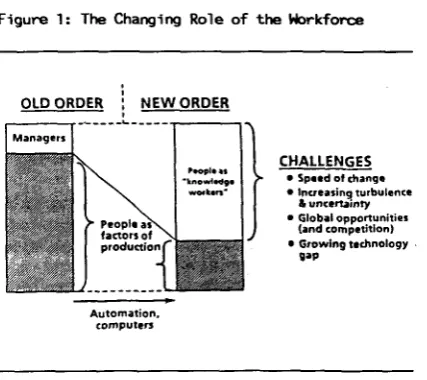
The underlying philosophy in organisations throughout the 1980s as it relates to human resource management issues has altered. The emphasis has been shifted away from the traditional concept of people as a cost which needs to be minimised at all times, towards the view that successful companies are inhabited by successful people. The changing role of the workforce (Figure 1) takes account of the increase in the level of automation and computerisation, the challenges which organisations face in the 1990s from the external environment, but places particular emphasis on the desire to use people in organisations as a means of generating competitive advantage. Harnessing this resource involves a number of factors. These relate to issues such as recruitment techniques, the emphasis placed on retraining as opposed to hiring and firing, the continuous development of both managers and employees, and the instigation of appropriate organisation design and adequate reward systems.
Recruitment
Figure 1 : The Changing Role o f t h e Workforce
OLD ORDER NEW ORDER
Managers
CHALLENGES
• Spaed of changa • Increasing turbulence
& uncertainty • Global opportunities
(and competition) e G r o w i n g technology
-gap
Source: Charter Group Initiative, Steering body
presentation, 23/11/87, Members: Confederation of
British Industry, Foundation for Management
Education, British Institute of Management.
employees with multlskilling. Employees are
encouraged to take on new activities and move away
from traditional bounded responsibility. What is
true for the production worker is also true for
management. At Digital, both managers and
production workers are characterised by their lack
of specific job titles and job descriptions and
boundaries are loose and ill-defined. This type
of structure encourages flexibility and the desire
to cross traditional manufacturing restrictions.
Training content also places emphasis on the fact
that to work and manufacture products in an
environment characterised by speed of change,
uncertainty, opportunity and growth requires
access to knowledge beyond how to manufacture the
product. "Soft" management skills (interpersonal
skills, managing people, managing change etc.) are
encouraged at all levels. Similarly, the
philosophy of human resource management in
electronics stresses the need to determine
training needs by combining internal and external
provision and by doing this at the point of sale
in consultation with the personnel function.
In American electronics firms, the goal is to
attain adaptability and fit and this takes the
emphasis away from meeting a personnel-oriented
view of the best candidate towards working within
an environment populated by other individuals who
will place demands on the potential recruit. At
Digital for example, the emphasis when recruiting
is to look less for qualifications than for
qualities. The type of employee that fits well is
one who is able to take up the challenge of rapid
change and the response necessary. Similarly,
initiative, team work, and communication skills
are prized (Computing, 18th May 1989). In Digital
at Ayr for example, two graduates who had been
recruited as managers expressed their surprise at
having been interviewed by the work groups that
they would be working with to manufacture
computers.
Training and Retraining
The question of maintaining the right skills level
in the organisation is crucial to the development
and growth of the business. The traditional
corporate wisdom in terms of maintaining human
resource skills has been to hire and fire to
achieve the blend. This conventional wisdom is
being turn on its head for two reasons - its
expensive and it wastes talent. The new
philosophy is one of retraining and providing
Development
Instead of operating on a single track career path
which necessitates stepping into "dead men's
shoes", the more successful of our American
electronics contingent operate
on
the rotation of
staff, and more particularly, managers through the
different business functions. This offers the
ability to experience the different pressures
placed on managers and workforce alike, and
provides them with the ability to look at the
overall picture. Similarly, managers need
experience of the external environment and how
other subsidiaries operate, hence the need to
increase rotation around subsidiaries. Although
this ability may be hampered in the more
restrictive geographical confines of indigenous
firms, the ability to generate internal career
patterns linked to the firm which emphasise and
reinforce corporate (or company) culture are
important. Similarly, fast track programmes are
advocated as a means of retaining talent.
In terms of staff development the emphasis is
being placed on developing the individual as part
of a team and by doing so strengthening the link
between employees and the organisation.
Organisations such as Digital in Ayr and Polaroid
at their Vale of Leven plant are using "high
[image:3.545.95.309.79.269.2]from traditional assembly line manufacturing techniques. These work teams allow individual members to develop a range of skills in the manufacture of products whilst broadening their work content and personal development beyond the manufacture of products. At Polaroid, one of the high performance work teams recently gave a seminar to senior management representatives from the Danish multinational, Danfoss. There are numerous benefits to such approaches. At Digital the benefits of high performance work teams include:
o the ability to respond positively and quickly to change
o improved process layout which enhances communication flows
o "ownership" of actions and product
identification by employees
o the potential for multi-functional career development
o better business understanding and priority setting
o greater flexibility through multi-skilling
(Buchanan and McCalman, 1989)
These types of approach are not unique to American electronics manufacturers. Typically, Japanese electronics managers spend up to thirty per cent of their time developing the skills of their subordinates. However, what is important is the American recognition that to compete effectively on global markets against competitors such as Japan, does not mean adopting Japanese management techniques per se. What firms such as Digital et al. do regard as important is recognition that human resource development can address technological and strategic problems. Factors such as high performance work design are combined with corporate goal setting, product and process innovations, management style, and the management of change to create a climate of change in organisations.
Appraisal and reward systems
Once again the leading American electronics firms based in Scotland are removing traditional reward structures in favour of more flexible approaches.
Where previously technical skills were rewarded with promotion, appraisal techniques are now being based on different skill categories and the ability to make contribution to the firm's development. Therefore, concepts such as the ability to work and support a team, and the use of leadership instead of directive management skills, are combined with technical expertise.
The individual is appraised and has his future objectives set against corporate strategy - what can you do for the organisation? This tying of the individual into the corporate growth pattern is also reflected in salary determination. One example of this is where employees working in teams have the ability to make a contribution to the assessment of team members, and pay is tied into team performance. Several organisations in Scotland are currently operating these procedures. At Digital in Ayr the payment systems developed for work teams are based on a "skills matrix" designed to avoid using job titles and grades as the basis of financial reward. Employees are rewarded for acquiring, retaining, and demonstrating mastery of the different skills required for effective business operation. This approach complements the high performance organisational design concepts by encouraging skills extension and flexibility.
The lessons learned
Are the experiences of leading electronics companies in Scotland more widely applicable? One would argue that there are two factors that need to be taken into consideration in designing effective organisations for the 1990s. These relate to the organisation of work and the changing role of management.
Work organisation
need for the organisation to focus its attention
on flexibility, quality, and asset utilisation to
retain competitiveness. One feature of the
effective use of assets relates to work
organisation.
the ability to recognise technological
innovation for application within the firm
interpersonal skills and the ability to
manage highly skilled and educated employees
Management in companies such as Digital and
Polaroid want employees to be able to change jobs
and develop skills as the products and production
processes develop. The work organisation issues
which are being addressed successfully in these
types of organisations relate to employees being
able to deal with manufacturing problems on the
spot without the need for management intervention.
The heart of total quality management and other
drives for effective production emphasise the
crucial nature of getting it right first time.
Macbeth (1989) views advanced manufacturing
strategy as a process of, 'simplicity before
complexity - people before machines.' There is
a growing recognition amongst electronics
manufacturers that the best methods of production
are not through increased automation but through
the operation of expensive machinery in an
effective manner. This means that rather than
resorting to robotic assembly lines, firms are
adopting stand alone high technology equipment,
used by a committed workforce - smart technology
needs smart people.
One method of achieving the degrees of competitive
edge required in order to prosper in today's
global market environment is investment of time
and effort in people. Many Japanese electronics
companies in the UK have recruitment policies
aimed at getting school leavers without set work
practices who are therefore more open to company
working practices which emphasise flexibility.
Similarly, one lesson that UK electronics firms
must learn is that investment in training is that,
an investment and not a cost. If there is one
single feature which distinguishes the successful
American subsidiary abroad it is the willingness
to devote time and effort into getting training
development right.
Management style
A first year MBA student at Glasgow Business
School, a practising manager, recently indicated
the three most important attributes that managers
will need for the 1990s:
o greater business/market awareness (1992 etc)
The managerial environment is certainly changing
and American electronics companies in Scotland are
in the vanguard of this management change process.
This stems from a recognition that you cannot get
the best out of people by scaring the living
daylights out of them. It also recognises the
change in emphasis that management in the 1990s
will have to deal with (Figure 2 ) .
Figure 2: The Changing Role of Management
OLD ORDER
• Efficiency culture
• Production-oriented
• Optimisation
• Authority
• Conformity
NEW ORDER
• Enterprise culture
• Market-oriented
• Management of
change
• Leadership
• Initiative
Source: Charter Group Initiative, Steering body
presentation, 23/11/87, Members: Confederation of
British Industry, Foundation for Management
Education, British Institute of Management.
adaptability; and the development of new employment policies which encourage and reward employee flexibility.
The experience of companies in Scotland, such as Digital is that management needs an altered internal focus in its human resource approach. One of the benefits of this alteration is to allow managers time to concentrate effort elsewhere. Management style where it contributes in a non-directive manner allows for the provision of advice when asked for by the workforce, this in turn allows managers the ability to concentrate on long term business policy issues. These issues are related to vendor management, sales forecasting accuracy, and finding new business.
Smart technology, smart people and the economy
NEDC (1988), argues that, 'UK companies and foreign companies operating in the UK must therefore identify skill building and people development as among there highest priorities, and must invest to counteract any relative deficiencies in the supply of talent from the education system, both through in-house training and through influence in educational curricula. They should also investigate means to create and maintain closer university links and a higher profile, more cohesive image for the electronics industry.' If the movement towards strategic human resource development policies begins to gain ground in more than just the enlightened parts of the American contingent (and even here it is only in a limited number of subsidiaries) then the potential for benefit to the remainder of the electronics industry and the Scottish economy as a whole will be immeasurable.
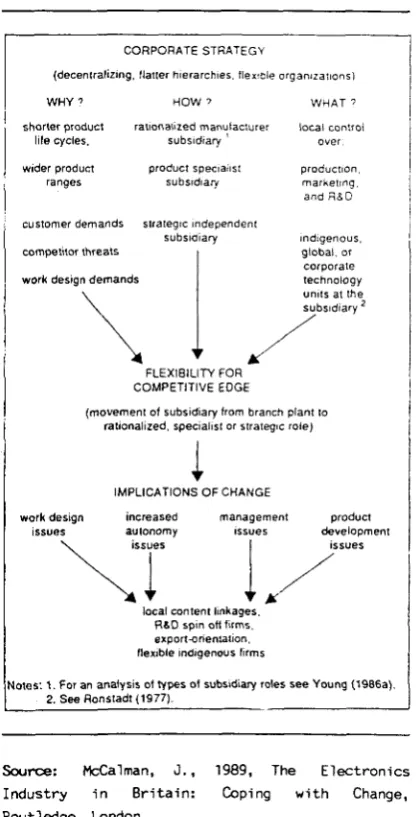
McCalman (1989) puts forward a model for development of the electronics industry which stresses the importance of using the foreign-owned segment to generate indigenous firms (Figure 3 ) . This can be combined with other features of the Scottish economy currently under negotiation.
The establishment of "Scottish Enterprise" is one such example where concern should be related to formulating a policy which allows organisations, educational establishments and government agencies to take advantage of the climate and push through on the learning curves of organisations like American electronics subsidiaries. There is a simple logic here; concern over human resource development issues in American electronics
subsidiaries in Scotland 1s not based solely on devotion to the good of others. It relates to changing requirements. Using the expertise of the foreign sector combined with management educators
in educational establishments to develop human
resource policies may offer opportunities for the
[image:6.545.274.483.203.612.2]Scottish economy.
Figure 3: An Optimistic Model for the Electronics Industry
Source: McCalman, J., 1989, The Electronics
Industry in Britain: Coping with Change, Routledge, London
There are problems that have to be faced. The difficulties are related to macro and micro policy determination. This is perhaps best summed by a comment from Alastair Macpherson, head of the
C O R P O R A T E S T R A T E G Y
(decentralizing, flatter hierarchies, flexible organizations)
W H Y ?
shorter product life cycles.
wider product ranges
H O W •>
rationalized manufacturer subsidiary '
product specialist subsidiary
customer d e m a n d s strategic independent subsidiary competitor t h r e a t s
w o r k design d e m a n d s
W H A T ?
local control over
p r o d u c t i o n . m a r k e t i n g . a n d R S D
i n d i g e n o u s . g l o b a l , or c o r p o r a t e t e c h n o l o g y units at the subsidiary 2
F L E X I B I L I T Y FOR C O M P E T I T I V E EDGE
( m o v e m e n t of subsidiary from branch plant to r a t i o n a l i z e d , specialist or strategic role)
1
w o r k design issues
I M P L I C A T I O N S O F C H A N G E
increased m a n a g e m e n t product a u t o n o m y issues d e v e l o p m e n t
issues
local c o n t e n t linkages, R&O spin off firms, export-orientation, flexible indigenous firms