journal homepage:www.elsevier.com/locate/dam
Quasimonotone graphs
✩Martin Dyer
1, Haiko Müller
∗School of Computing, University of Leeds, Leeds LS2 9JT, UK
a r t i c l e i n f o
Article history:
Received 5 September 2018 Received in revised form 16 July 2019 Accepted 7 August 2019
Available online xxxx
Keywords:
Hereditary graph class Switch Markov chain Bipartite permutation graph Monotone graph
Polynomial time recognition
a b s t r a c t
For any classCof bipartite graphs, we define quasi-Cto be the class of all graphsGsuch that every bipartition ofGbelongs toC. This definition is motivated by a generalisation of the switch Markov chain on perfect matchings from bipartite graphs to nonbipartite graphs. The monotone graphs, also known as bipartite permutation graphs and proper interval bigraphs, are such a class of bipartite graphs. We investigate the structure of quasi-monotone graphs and hence construct a polynomial time recognition algorithm for graphs in this class.
©2019 The Author(s). Published by Elsevier B.V. This is an open access article under the CC BY license (http://creativecommons.org/licenses/by/4.0/).
1. Introduction
In [6] (with Jerrum) and [7] we considered theswitchMarkov chain on perfect matchings in bipartite and nonbipartite graphs. This chain repeatedly replaces two matching edges with two non-matching edges involving the same four vertices, if possible. (See [6,7] for details.) We considered the ergodicity and mixing properties of the chain.
In particular, we proved in [6] that the chain israpidly mixing (i.e. converges in polynomial time) on the class of monotonegraphs. This class of bipartite graphs was defined by Diaconis, Graham and Holmes in [5], motivated by statistical applications of perfect matchings. The biadjacency matrices of graphs in the class have a ‘‘staircase’’ structure. Diaconis et al. conjectured the rapid mixing property shown in [6]. We also showed in [6] that this class is, in fact, identical to the known class ofbipartite permutationgraphs [15], which is itself known to be identical to the class ofproper interval bigraphs[10], see also [4].
In extending the work of [6] to nonbipartite graphs in [7], we showed that the rapid mixing proof for monotone graphs extends easily to a class of graphs which includes, besides the monotone graphs themselves, allproper, orunit,interval graphs[1]. In this class the bipartite graph given by the cut between any bipartition of the vertices of the graph must be a monotone graph. We called these graphsquasimonotone.
In fact, ‘‘quasi-’’ is an operator on bipartite graph classes, and can be applied more generally. In this view, quasimono-tone graphs are quasi-monoquasimono-tone graphs, as formally defined in Section2, and discussed in Section2.1.
For any class of bipartite graphs that is recognisable in polynomial time, the definition of its quasi-class implies membership in co-NPand deterministically only an exponential time recognition algorithm. Thus an immediate question is whether we can recognise the quasi-class in polynomial time. The main contribution of this paper is a proof that quasimonotone graphs have a polynomial time recognition algorithm.
✩ A preliminary version of this paper appeared in the Proceedings of WG 2018 (Dyer and Müller 2018). Research supported by EPSRC grant EP/S016562/1.
∗
Corresponding author.
E-mail addresses: [email protected](M. Dyer),[email protected](H. Müller). 1 Research supported by EPSRC grant EP/M004953/1.
https://doi.org/10.1016/j.dam.2019.08.006
whenGis isomorphic toH.
A subgraph ofG
=
(V,
E) is acycleinGif it is connected and 2-regular. Thelengthorsizeof a cycle is the number of its edges (or vertices). Achordof a cycle (U,
F) in (V,
E) is an edge inU(2)∩
E\
F. A chord in a cycle of even length is oddif the distance between its endpoints on the cycle is odd. That is, anodd chordsplits an even cycle into two smaller cycles of even length. Aneven chordsplits an even cycle into two smaller cycles of odd length.Aholein a graph is a chordless cycle of length at least five. A cycle of length three is atriangle, and a cycle of length four aquadrangle. A hole isoddif it has an odd number of vertices, otherwiseeven. LetHoleFreebe the class of graphs
without a hole, andEvenHoleFreethe class of graphs without even holes. For the purposes of this paper, alonghole will be defined as an odd hole of size at least 7.
Abipartition L
,
Rof a setVis such thatL⊆
VandR=
V\
L. Then, ifG=
(V,
E) is any graph, the graphG[
L:
R]
is the bipartite graph with vertex bipartitionL,
R, and edge set the cutL:
R= {
xy∈
E:
x∈
L,
y∈
R}
. We refer toG[L:
R] as a bipartition ofG.Thedistancedist(u
, v
) between two verticesuandv
is the length of a shortest (u, . . . , v
) path inG. IfHis an induced subgraph ofG, andx,
y∈
H, we denote the distance fromxtoyinHby distH(x,
y). Ifv
∈
V, dist(v,
H) is the minimum distance dist(v, w
) fromv
to any vertexw
∈
H. The maximum distance between two vertices inGis thediameter ofG.IfG
=
(V,
E) andv
∈
V, we denote the neighbourhood ofv
byN(v
), andN(v
)∪ {
v
}
byN[
v
]
.1.2. Structure of the paper
The focus of the paper, of which [8] is an extended abstract, is on the class of quasimonotone graphs. In Section2 we discuss a generalisation of the construction of the class and some immediate properties. In Section2.1we give some examples.
Section3shows that quasimonotone graphs can be recognised in polynomial time. We begin, in Section3.1, by proving some properties of quasimonotone graphs for later use, using the characterisation of monotone graphs by forbidden induced subgraphs. The anticipated recognition algorithm first looks for flaws (defined in3.1) and then branches into different procedures depending on the length of a short hole (defined in3.3) in the input graph. We describe how to find such a hole in3.3. The remaining forbidden subgraphs are pre-holes, also defined in3.1.
Sections4and5deal with graphs containing a long hole. Again we start with some technical lemmas showing that the long hole enforces an annular structure in the absence of flaws. The structure is determined bysplitting, described in 5.1. Possible pre-holes must wind round this annulus once or twice. We complete the process by checking for pre-holes, using a procedure given in5.2.
If there is no long hole we can list all the triangles and 5-holes in the input graph. In this case a shortest pre-hole consists of two of these odd cycles and two vertex-disjoint paths between them. We describe this in more detail in Section6.
Section7summarises the algorithm with a formal description, and discusses its running time.
In Section8, we give a short discussion of a central question raised in the paper, recognising a pre-hole in an arbitrary graph. Though we do not settle this question, we show that a related question isNP-complete. That is, given a graph, is it a pre-hole?
Finally, Section9concludes the paper.
2. Quasi-classes and pre-graphs
Ahereditaryclass of graphs is closed under taking induced subgraphs. LetBipartitedenote the class of bipartite graphs,
and letC
⊆
Bipartite. Then we will say that the graphGisquasi-CifG[
L:
R] ∈
Cfor all bipartitionsL,
RofV.Lemma 1. IfC
⊆
Bipartiteis a hereditary class that is closed under disjoint union thenC=
Bipartite∩
quasi-C.Proof. First letG
=
(L∪
R,
E) be any bipartite graph that does not belong toC. SinceG=
G[
L:
R]
the graphGdoes not belong to quasi-C. HenceC⊇
Bipartite∩
quasi-C.Next we showC
⊆
Bipartite∩
quasi-C. LetG=
(X∪
Y,
E) be a graph inCand letL:
Rbe a bipartition ofX∪
Y. Now G[
L:
R]
is the disjoint union ofG1=
G[
(X∩
L)∪
(Y∩
R)]
andG2=
G[
(X∩
R)∪
(Y∩
L)]
. The graphsG1andG2belong toC since the class is hereditary, and henceG[
L:
R]
is inCbecauseCis closed under disjoint union. ThusG∈
quasi-C. □A hereditary graph class can be characterised by a setF of forbidden subgraphs. The setF is minimal if no graph in
Fcontains any other as an induced subgraph.
Lemma 2. IfC
⊆
Bipartiteis characterised by a setF of forbidden induced subgraphs, let pre-F= {
pre-H|
H∈
F}
. Then quasi-Cis characterised by the set of forbidden induced subgraphs pre-F.Proof. SupposeG
=
(V,
E) containsH′=
(V′,
E′
), a pre-H for someH
∈
F. ThenV′has a bipartitionL′
,
R′
such that H′
[L′ :R′
]
=
H. ExtendingL′,
R′
to a bipartitionL
,
RofV,G[
L:
R]
containsH. ThenG[
L:
R]
∈
/
C, soG∈
/
quasi-C. Conversely, if G∈
quasi-C, everyG[
L:
R] ∈
C, so noG[
L:
R]
containsH, for anyH∈
F. ThusGcontains no pre-H, for anyH∈
F, that is, noH′∈
pre-F. □Note, however, that pre-F may not be minimal for quasi-CwhenF is minimal forC.
2.1. Examples
The class quasi-Bipartiteis clearly the set of all graphs.
IfCis the class of complete bipartite graphs, it is easy to see that quasi-Cis the class of complete graphs. Note however, that this class is not closed under disjoint union. Now, if Cbecomes the class of graphs for which every component is complete bipartite, then quasi-Cis the class of graphs withoutP4, paw or diamond. These three graphs are the pre-P4’s, seeFig. 1. To see this we observe the following:
•
If a graphGcontains a pre-P4then there is a bipartitionG[
L:
R]
that contains aP4as induced subgraph. A connected component ofG[
L:
R]
containing such aP4is not complete bipartite.•
NowGdoes not contain a pre-P4. If a connected componentH of a bipartition ofGis not complete bipartite, then Hcontains aP4, contradicting the fact thatGdoes not contain a pre-P4.Bounded-degree graphs give another example. IfCdis the class of bipartite graphs with degree at mostd, for a fixed integerd
>
0, then quasi-Cdis the class of all graphs with degree at mostd. To see this note that, ifv
has degree at mostd inG, thenv
has degree at mostdin anyG[
L:
R]
. Conversely, ifv
has degreed′>
d, then
v
also has degreed′in anyG
[
L:
R]
such that
v
∈
L,N(v
)⊆
R. The unique forbidden subgraph forCdis clearly the starK1,d+1. Therefore, the class quasi-Cdis characterised by forbidding pre-K1,d+1’s, a set with sizeO(d2). Hence quasi-Cdcan be recognised in polynomial time, for fixedd.A less obvious example is for the classCoflinear forests, which are disjoint unions of paths. Its quasi-class contains all graphs with connected components that are either a path or an odd cycle.
ChordalBipartiteis the class of bipartite graphs in which every cycle of length at least six has a chord.OddChordal
is the class of graphs in which every even cycle of length six or more has an odd chord. We show in [7] that
quasi-ChordalBipartite
=
OddChordal. However, the complexity of the recognition problem for the class OddChordalis open, even though the classChordalBipartitecan be recognised in almost linear time [13]. More generally, polynomialtime recognition ofCdoes not directly imply the same property for quasi-C. All we can assert is membership in co-NP, by guessing a bipartitionL
,
Rand showing in polynomial time thatG[
L:
R]
∈
/
C.Finally, as remarked above, if Monotone is the class of monotone graphs and Quasimonotone is the class of quasimonotone graphs, then quasi-Monotone
=
Quasimonotone, by definition. Most of this paper examines the structure and polynomial time recognition of graphs in this class. As we have remarked, the linear-time recognition ofMonotonehas little relevance to this issue.
A further example,Quasichains, is discussed in [7]. It is the quasi-class arising from unions ofchain graphs(defined
in5.1), soQuasichains
⊂
Quasimonotone.Note that quasi-Cdoes not necessarily inherit the properties asC. For example, considerperfection. SinceC
⊆
Bipartite,C
⊂
Perfect, the class of perfect graphs. But every bipartition of an odd hole is a linear forest. Thus, for any bipartite superclass of linear forests, the quasi-class contains odd holes, which are imperfect. In particular, this holds for the classQuasimonotone. However, if C is hereditary, closed under disjoint union, since C
⊆
quasi-C and fails to have some property, then clearly quasi-Ccannot have the property. ThusQuasimonotoneis not closed under edge deletions, sinceMonotoneis not.
However, ifCis closed under edge deletions, so is quasi-C. To see this note that, forG′
=
G
\
e, eitherG′[
L
:
R] =
G[
L:
R]
orG′
[
L:
R] =
G[
L:
R] \
eholds, soG′[
L:
R] ∈
C, and henceG′∈
quasi-C.On the other hand, ifC is closed under edge contraction, quasi-Cis unlikely to have this property. Any class which includes the cycle of length
ℓ
, but excludes the cycle of lengthℓ
′< ℓ
, is clearly not closed under edge contraction. Thus quasi-LinearForestsis not closed under edge contraction, even thoughLinearForestsis, since it includes all odd cycles,
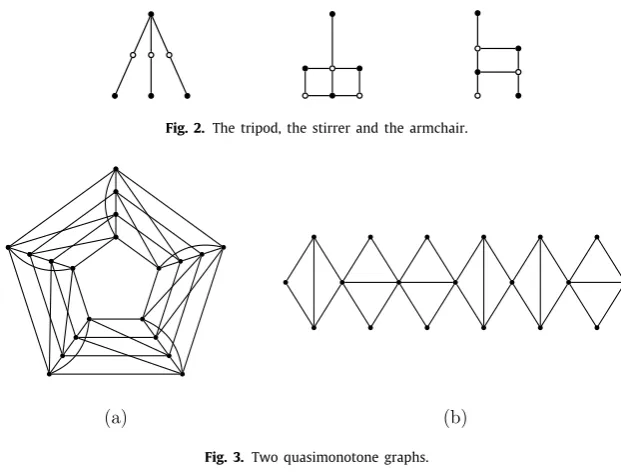
Fig. 2. The tripod, the stirrer and the armchair.
Fig. 3. Two quasimonotone graphs.
3. The structure of quasimonotone graphs
3.1. Flaws and pre-holes
A bipartite graph ismonotoneif and only if the rows and columns of its biadjacency matrix can be permuted such that the ones appear consecutively and the boundaries of these intervals are monotonic functions of the row or column index. That is, all the ones are in a staircase-shaped region in the biadjacency matrix. Equivalent characterisations exist, see [12] (Lemma 1.46 on page 52) or [2] (Proposition 6.2.1 on page 93):
•
A graph is monotone if and only if it is AT-free bipartite.•
A bipartite graph is monotone if and only if it does not contain a hole, tripod, stirrer or armchair as induced subgraph. The tripod, stirrer and armchair are depicted inFig. 2.For references to further characterisations see [4]. Monotone graphs are also calledbipartite permutation graphs[15] and proper interval bigraphs[10].
We let Monotone denote the class of monotone graphs, and then we let Quasimonotone denote the class
quasi-Monotone. Two example graphs are shown inFig. 3.
LetFlawbe the class containing all pre-tripods, pre-stirrers and pre-armchairs. We will say that any graph inFlawis
aflaw. AflawlessgraphGwill be one which contains no flaw as an induced subgraph. Since all flaws have seven vertices, we can test inO(n7) time whether an input graphGonnvertices is flawless. Let
Flawlessdenote the class of flawless
graphs.
Therefore, quasimonotone graphs are characterised by the absence of holes, tripods, stirrers and pre-armchairs. LetQuasimonotonebe the class of quasimonotone graphs.
ClearlyQuasimonotone
⊆
EvenHoleFree∩
Flawless, but equality does not hold, as we now discuss.LetP
=
(p1,
p2, . . . ,
pℓ) be a path inG. Thealternating bipartition L,
RofPassignsL= {
p1,
p3, . . .
}
andR= {
p2,
p4, . . .
}
. We will say thatPispre-chordlessif it is an induced path inG[
L:
R]
. In particular, any induced path inGis pre-chordless. Similarly, letC=
(p1,
p2, . . . ,
pℓ) be an even cycle inG. ThenC is a pre-hole if it is a hole inG[
L:
R]
. ThusC must be an even cycle, and all chords must run betweenLandLorRandRin an alternating bipartitionL,
RofC. This is equivalent to requiring thatC has no odd chord. The alternating partition is inconsistent for an odd cycle, so an odd cycleC cannot be a pre-hole.From this discussion, it is clear thatGcontains no pre-hole if and only if it is odd-chordal, as defined in Section2.1. Hence Quasimonotone
=
Flawless∩
OddChordal. Given an input graph G, we wish to test whether or not G∈
Quasimonotone. We can test whetherG∈
Flawlessin polynomial time, but we do not know how to determine whether G∈
OddChordal. Thus it is not clear that thisQuasimonotonecan be recognised in polynomial time, since pre-holes canbe of arbitrary size inFlawless. SeeFig. 4for a family of such pre-holes.
The main contribution of this paper will be to show that the recognition problem forQuasimonotoneis indeed in
Fig. 5. Cases in the proof ofLemma 3.
Fig. 6. Cases in the proof ofLemma 5.
3.2. Properties of flawless graphs
First we prove a useful lemma about graphs inFlawless.
Lemma 3. Let G
∈
Flawless. Let P=
(p1,
p2,
p3,
p4,
p5,
p6,
p7)be a pre-chordless path in G,(p2,
p3,
p4,
p5,
p6)be a hole in G, or(p1,
p2,
p3,
p4,
p5,
p6)be a pre-hole in G. Ifv /
∈
P is such thatdist(v,
P)=
dist(v,
p4), thendist(v,
p4)=
1.Proof. Since dist(
v,
P)=
dist(v,
p4) the shortest path fromv
top4cannot use any edge ofP. Therefore, suppose, without loss of generality, that dist(v,
P)=
2, and (v,
u,
p4) is the shortest path fromv
toP. Consider the alternating bipartition ofPextended tou∈
Randv
∈
L, as shown by the black (L) and white (R) vertices inFig. 5. There are no edges fromv
to P, since dist(v,
P)>
1, and there are no edges between vertices ofPinG[
L:
R]
, sincePis pre-chordless.Thus the only possible edges inG
[
L:
R]
, other than inPand the 2-path (v,
u,
p3), are those joininguto a vertex inL. There are three cases, where none, one or both of these edges are present, as shown inFig. 5. Note that the ‘‘one’’ case has a symmetric version, where the vertices inParep1,
p2,
p3,
p4,
p5, and the edgeup2is present. But these graphs are the tripod, armchair and stirrer, respectively, contradictingGbeing flawless.If (p2
,
p3,
p4,
p5,
p6) is a hole, or (p1,
p2,
p3,
p4,
p5,
p6) is a pre-hole, we need only observe that the configurations in Fig. 5exist, ifPis allowed to ‘‘wrap around’’ the (pre-)hole. That is, ifp1,
p7are interpreted asp6,
p2respectively. □Note that any subpath of a pre-hole or odd holeCis pre-chordless.
Lemma 4. Every odd hole or pre-hole in a connected flawless graph is dominating.
Proof. LetCbe an odd hole or pre-hole in the connected flawless graphG. We show dist(
v,
C)≤
1 for every vertexv
of G.If
v
∈
C, this is obvious. Otherwise, letw
be a vertex such that dist(v,
C)=
dist(v, w
). Consider the subpath P=
(p1,
p2, . . . ,
p7) ofCsuch thatw
=
p4, where this path wraps aroundC if|
C|
<
7. SinceCis a hole or a pre-hole,P is pre-chordless. The result then follows fromLemma 3. □IfC is an odd hole we will calln(C)
= {
v
∈
V:
dist(v,
C)≤
1}
, the neighbourhood ofC. Thus, ifGis connected, then G=
N(C) for any odd holeC⊆
G.Lemma 5. Suppose G
∈
Flawless∩
EvenHoleFree, and that C is an odd hole in G, of length at least seven. Then every vertexv
∈
V has at most three neighbours in C . If there are two neighbours,w,
x, thendistC(w,
x)=
2. If there are three neighbours,w,
x,
y, thendistC(w,
x)=
distC(x,
y)=
2. If C is a short odd hole in G, thenv
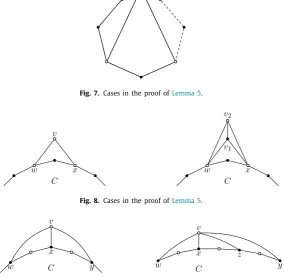
has at most two neighbours on C . [image:5.544.117.425.58.284.2]Fig. 7. Cases in the proof ofLemma 5.
Fig. 8. Cases in the proof ofLemma 5.
Fig. 9. Cases in the proof ofLemma 5.
Now suppose
v
has two neighboursw,
xonC. Sinceℓ
= |
C| ≥
7 is odd, we may assumeν
=
distC(w,
x)≤
(ℓ
−
1)/
2. Suppose first thatν
is odd. Then we obtain an even cycleC′by omitting
ν
−
1 vertices ofC and addingv
. Consider the alternating bipartitionL:
RofC′. SeeFig. 7, with black nodesL, and white nodesR. NowC′
has even length
ℓ
′=
ℓ
−
ν
+
2≥
(
ℓ
+
5)/
2≥
6. Then, sinceCis chordless, there is an even hole inG[
L:
R]
, unlessv
is adjacent to every vertex ofL. However, sinceℓ
≥
7,G[
L:
R]
contains a stirrer, as shown inFig. 7, contradictingG∈
Flawless. Thus distC(w,
x) cannot be odd.Thus suppose distC(
w,
x)=
ν
≤
(ℓ
−
1)/
2 is even andν >
2, soν
≥
4. Thenv, w,
xlie on a chordless cycle inGof even lengthν
+
2≥
6. This is an even hole, contradictingG∈
EvenHoleFree, so we must have distC(w,
x)=
2. Then G[{
v
} ∪
C]
is the graph shown inFig. 8, andGhas another odd hole of lengthℓ
, passing throughv
.There can be several vertices
v
1, v
2, . . .
with neighboursw
andx, but there can be no edge between any pair of these vertices. Otherwise there is a bipartition containing an armchair, seeFig. 8. If these vertices have neighbours only inC, then they are all false twins.Now suppose
v
has at least three neighboursw,
x,
yonC, wherew,
yare such that distC(w,
y) is maximised. Consider the alternating bipartitionL:
Rof the (w, . . . ,
y) path inC, extended tov
∈
R. Thenv
must be adjacent to every vertex in Rbetweenw
andy, since otherwise there is an even hole inG[
L:
R]
. Ifv
has exactly three neighbours,G[
L:
R]
contains the subgraph shown inFig. 9, withL,Rthe white and black vertices, respectively. Nowv
cannot have a fourth neighbourz onC. Otherwise,Ghas a stirrer, involvingv
, the (w, . . . ,
z) path, andy, as shown inFig. 9.Finally, if
v
has three neighbours inC, as shown inFig. 9, then dist(w,
y)=
2, and distC(w,
y)=
4. ThusC is not a short odd hole, a contradiction. □The following is similar toLemma 5, but the details of the proof are slightly different.
Lemma 6. Let C be a pre-hole in G
∈
Flawless. Then every vertexv
∈
C has at most five neighbours in C . Two of these are via edges of C , sov
is incident to at most three chords. If there are two chords,vw, v
x, thendistC(w,
x)=
2. If there are three chords,vw, v
x, v
y, thendistC(w,
x)=
distC(x,
y)=
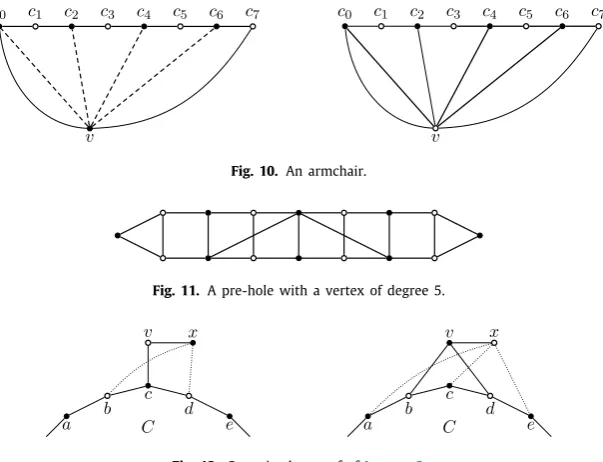
2.Fig. 10. An armchair.
[image:7.544.121.423.57.288.2]Fig. 11. A pre-hole with a vertex of degree 5.
Fig. 12. Cases in the proof ofLemma 6.
The degree bound ofLemma 6is tight. SeeFig. 11.
Lemma 7. Let C be an odd hole in G
∈
Flawless. Suppose thatv /
∈
C has a neighbour x∈
/
C . Then there are verticesw,
y∈
C such that(v
xyw
)is a quadrangle.Proof. FromLemmas 4and5,
v
andxhave at least one, and at most three, neighbours onC. If either has two neighbours then these are at distance 2 onC. Observe that it suffices to prove thatw,
yexist so thatv
xyw
is simply a 4-cycle. If it is not a quadrangle, eitherv
orxhas two adjacent neighbours onC, contradictingLemma 5.Suppose
v
has exactly one neighbourconC. Then we have the first configuration shown inFig. 12, with the bipartition indicated by the black and white vertices onG[
S]
, whereS= {
a,
b,
c,
d,
e, v,
x}
. This contains a tripod, unlessxis adjacent tobordor both. If is adjacent tob, then the Lemma follows withw
=
candy=
b. If is adjacent tod, then the Lemma follows withw
=
candy=
d.Now suppose
v
has two neighboursb,
donC. Then, byLemma 5, we have the second configuration inFig. 12, with the bipartition onG[
S]
shown in black and white. Ifv
has a third neighbourzonC, thenz∈
/
Sso we may ignore it. Then G[
S]
contains an armchair, unlessxis adjacent to at least one of the black verticesa,
c,
e. Ifxa∈
E, we takew
=
b,
y=
a, ifxc∈
E, we takew
=
b,
y=
c, and ifxe∈
E, we takew
=
d,
y=
e. □3.3. Determining a short odd hole
We can test whetherGcontains a hole in timeO(
|
E|
2), using the algorithm of [14]. Moreover, the algorithm returns a hole if one exists. If the hole is even, we can concludeG∈
/
Quasimonotone. IfG∈
Flawless, we will show that it has a well-defined structure, so it is possible that there is a faster algorithm than [14] for detecting a hole. However, we will not pursue this here.We begin with a simple result.
Lemma 8. If C is an odd cycle in a graph G, there is a triangle or an odd hole C′in G.
Proof. The claim is clearly true if
|
C| ≤
3. Otherwise, assume by induction that it is true for all cycles shorter thanC. If C is not already a hole, it has a chord that divides it into a smaller odd cycleC1, and an even cycleC1′. The lemma now follows by induction onC1. □The proof ofLemma 8can easily be turned into an efficient algorithm to findC′
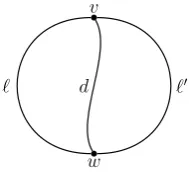
. LetC be an odd hole in a graphG. ThenC will be called ashortodd hole inGif dist(
v, w
)=
distC(v, w
) for all pairsv, w
∈
C.Fig. 13. Odd holeCwith a shortervwpath.
Fig. 14. Short odd holes of unequal size.
Proof. Clearly dist(
v, w
)≤
distC(v, w
) for all pairsv, w
∈
C. Thus, suppose thatC is an odd hole inG, but there is a pairv, w
such that dist(v, w
)=
d< ℓ
=
distC(v, w
), and letℓ
′= |
C| −
ℓ
≥
ℓ >
d. Thus one ofℓ, ℓ
′is odd and the other even. SeeFig. 13.We may assume that the shortest
vw
pathPhas no internal vertex in common withC. Otherwise, we may choose a different pairv, w
for which this is true. Thus we can form two cyclesC1,
C2of lengthsℓ
+
d, ℓ
′+
d. Now one ofℓ
+
d, ℓ
′+
d is odd and the other even. Also max{
ℓ
+
d, ℓ
′+
d} =
ℓ
′+
d= |
C| −
ℓ
+
d<
|
C|
. Thus we have an odd cycle, C1say, with|
C1|
<
|
C|
. Now, byLemmas 11and8,C1contains an odd holeH, and we have|
H| ≤ |
C1|
<
|
C|
. We can now check whetherH is a short hole. This process must clearly terminate with a short hole, since the hole becomes progressively shorter. □Note that the proof ofLemma 9gives an efficient algorithm for finding a short odd holeH, given any odd holeC. Clearly the shortest hole inGis a short hole, but the converse need not be true in general, even for quasimonotone graphs. See Fig. 14, which has a short 5-hole and a short 7-hole.
We will also use the following simple corollary.
Corollary 10. If C is a short odd hole in a graph G,diam(G)
≥
diam(C)=
(|
C| −
1)/
2. □We can make similar definitions for pre-holes. Thus, ifCis a pre-hole,G′
=
G[
C]
, andL:
Ris the alternating bipartition ofC, thenG′[
L
:
R]
contains no edge other than those ofC. Aminimalpre-holeC is such thatG[
C]
contains no pre-hole with fewer than|
C|
vertices. Clearly, any graph which contains a pre-hole contains a minimal pre-hole.4. Flawless graphs containing a long hole
4.1. Triangles
Lemma 11. Let G be a quasimonotone graph containing an odd hole C of size at least 7. Then G contains no triangle that has a vertex in C .
Proof. SinceCis an odd hole, there are only two cases.
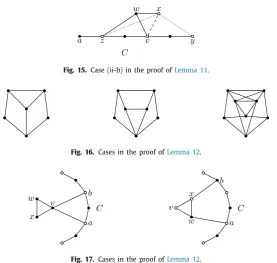
(i) If the triangle has two vertices onC, then we have the situation ofFig. 7on page 11, which cannot occur. (ii) If the triangleT
=
(v, w,
x) has one vertexv
onC, then consider the graphG′induced byC
∪
T, soCis the shortest hole inG′. There are two subcases.
(a) If neither
w
norxhas another neighbour onv
, we have the situation ofFig. 6, which cannot occur.Fig. 15. Case (ii-b) in the proof ofLemma 11.
[image:9.544.134.412.54.317.2]Fig. 16. Cases in the proof ofLemma 12.
Fig. 17. Cases in the proof ofLemma 12.
However, ifCis a 5-hole, there are quasimonotone graphs which contain a triangle with one vertex inC. SeeFig. 16.
Lemma 12. Let G be a quasimonotone graph containing an odd hole C of size at least7. Then G contains no triangle which is vertex-disjoint from C .
Proof. SupposeT
=
(vw
x) is such a triangle, and consider the subgraphG′induced byC
∪
T. ByLemma 7,Cis a shortest hole inG′, so the vertices ofT have degree at least one and at most two inC. NowT is the only triangle inG′
, since any other triangle would have a vertex inC, contradictingLemma 11. Thus all vertices ofC have degree at most one in T, since a vertex of degree two or more would induce a triangle, using an edge ofT. Now suppose some vertex ofT,
v
say, has two neighboursa,
binC, seeFig. 17. ThenG′has a hole with|
C′| = |
C|
througha, v
andb, withv
∈
C′. Since|
C′| ≥
7, this contradictsLemma 11.ThusT has at most three neighbours inC. Hence there are at least four vertices inC which have no neighbour inT. Let
ν
≥
2 be the maximum number of consecutive vertices inC with no neighbour inT. Suppose these are bordered by verticesa,
b∈
C, wherew
a,
xb∈
E. SeeFig. 17. Thus, ifν
is odd, there is a pre-hole througha, w, v,
xandb, and, ifν
is even, there is an even hole througha, w,
xandb. SeeFig. 17. □Again, If
|
C| =
5, it is possible to have a triangle which is vertex-disjoint fromC. AgainFig. 16shows an example, but note that this also contains triangles which share an edge with the 5-cycle. It is not difficult to show that, ifGcontains a 5-cycle and a vertex-disjoint triangle, thenGmust contain a triangle which shares at least one vertex with the 5-cycle. However, we will not prove this because we make no use of it here.4.2. Long odd holes
Lemma 13. Let C
,
C′ be odd holes in a quasimonotone graph G such that C′∩
C̸=
∅, and|
C|
,
|
C′| ≥
7. Let G′=
G
[
(C′∪
C)
\
(C′∩
C)
]
, Then G′has no odd hole or pre-hole.
Proof. Without loss of generality, we will assume
|
C| ≤ |
C′|
. IfG′has a pre-hole,Gis not quasimonotone. So suppose there is an odd holeH inG′
. ClearlyH must contain edges from bothC andC′
. LetPbe the pathH
∩
C, andP′the pathH
∩
C′. We chooseHso that
|
P′|
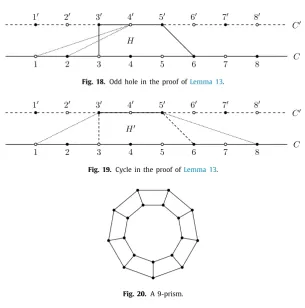
is minimised. SeeFig. 18, whereHis bounded by the edges 3′
3 and 5′
6, and
|
P′| =
2. Suppose any vertex inv
the interior of pathP′has an edge to a vertex
w
∈
C. Clearlyw /
∈
P, orHis not a hole. Letv
andw
be chosen so that distC(w,
P) is minimised. Then there is either an odd holeH′with|
C′∩
H′|
<
|
P′|
, contradicting the choice ofH, or an even hole, contradicting quasimonotonicity. For example, considerv
=
4′in Fig. 18. Ifw
=
2, thenH′is (4′
,
5′,
6
,
5,
4,
3,
2,
4′) and
|
C′∩
H′
| =
1. If
w
=
1, then (4′,
5′,
6
,
5,
4,
3,
2,
1,
4′Fig. 18. Odd hole in the proof ofLemma 13.
Fig. 19. Cycle in the proof ofLemma 13.
Fig. 20. A 9-prism.
Thus we may assume that no vertex inP′has an edge toC, excepting possible extreme vertices ofP′. Now (C
∪
H)\
(C∩
H) is an even hole, with length|
C| + |
H| −
2|
C∩
H|
, unless the extreme vertices ofP′have edges toC\
P. If not,G′cannot be quasimonotone. So suppose one of the two extreme verticesv
ihas an edge tow
i∈
C\
P(i=
1,
2). Then, byLemma 5,w
i is unique and dist(w
i,
P)=
2 (i=
1,
2). Now we can construct an even hole inG′. For example, considerv
1=
3′, v
2=
5′ inFig. 19. The only possibilities forv
iw
i are 3′1 and/or 5′8. Then we can use 3′1 in place of 3′3 and/or 5′8 in place of 5′6 to form an odd cycleH′
, as shown inFig. 19. SinceH′
has no edge to a vertex inC
\
H′, we have an even hole (C
∪
H′)
\
(C∩
H′). SoGis not quasimonotone, a contradiction. □
Corollary 14. Let C
,
C′be odd holes in a quasimonotone graph G, such that C′
∩
C
̸=
∅. Let G′=
G
[
(C′∪
C)
\
(C′∩
C)
]
. Then G′is a monotone graph.
Proof. G′
is flawless, and has no holes or pre-holes fromLemma 13, so it is monotone. □
Note that the holesC
,
C′inCorollary 14can have different size. SeeFig. 14, whereG′is aladder(see [6]) with two pendant edges. However, if we have vertex-disjoint odd holes they cannot have different lengths.Aprismis the graph given by joining corresponding vertices in two cycles of the same length. It is ann-prismif the cycles have lengthn[11]. SeeFig. 20for an example.
Lemma 15. Let G be a quasimonotone graph containing an odd hole C . Then G contains no vertex-disjoint hole C′
with
|
C′| ̸= |
C
|
. Moreover, if|
C| ≥
7, any two vertex-disjoint holes with|
C′| = |
C
|
induce a prism in G.Proof. Let G′
=
G
[
C∪
C′]
, and suppose
|
C′| ̸= |
C
|
. LetC1denote the shorter ofC,
C′, andC2 the longer, so|
C1| ≥
5 and|
C2| ≥
7. Then every vertex ofC1has degree in{
1,
2,
3}
inC2and every vertex ofC2has degree in{
1,
2}
inC1. Since|
C2|
>
|
C1|
, there must be a vertexv
∈
C1with degree 2 or 3 inC2, by simple counting. Leta,
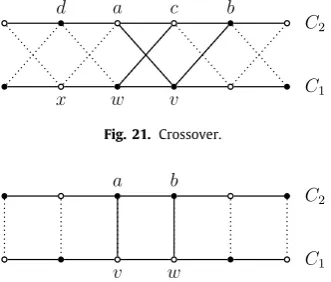
bbe two of these neighbours, such thatacbis a subpath ofC2. SeeFig. 21. SinceG′is flawless, byLemma 7every edge ofC1is in a quadrangle with some edge ofC2, and vice versa. Thuscmust be adjacent to a neighbourw
ofv
onC1, andG′must contain the configuration of Fig. 21. NowG′ [image:10.544.125.423.57.214.2]Fig. 21. Crossover.
Fig. 22. Matching betweenC1andC2.
Fig. 23. Preholes with odd holesC1,C2.
Fig. 24. A possible pre-hole.
We give C1the alternating bipartition except, since
|
C1|
is odd, bothw, v
∈
L. Similarly we giveC1 the alternating bipartition with botha,
c∈
R. This is the alternating partition of an even cycleC1\
wv
,w
c,C2\
ac,av
. We callav
,w
c a crossover, and a pre-hole formed in this way acrossover pre-hole. Now we observe that all possible edges other than av,
cw
have both endpoints inLor both endpoints inR. ThusG′is a pre-hole.
Thus all vertices inC1must have only one edge toC2. (SeeFig. 22.) Since these edges form a matching betweenC1and C2, we must have
|
C1| = |
C2|
, andG[
C∪
C′]
must be a prism. □5. Preholes in flawless graphs
Lemma 16. If G
∈
Flawlessand has an odd hole of sizeℓ
≥
7, any minimal pre-hole C in G is either an even hole or(a) two odd holes intersecting in an edge or
(b) two disjoint odd holes connected by a quadrangle.
SeeFig.23.
Proof. We may assume thatGhas no triangles, fromLemmas 11and12. ClearlyChas at least one even chordewhich divides it into two smaller odd cyclesC1 andC2. ByLemma 8,C1 andC2contain odd holesC
′
1
,
C′
2. IfC
′
1
=
C1,C′
2
=
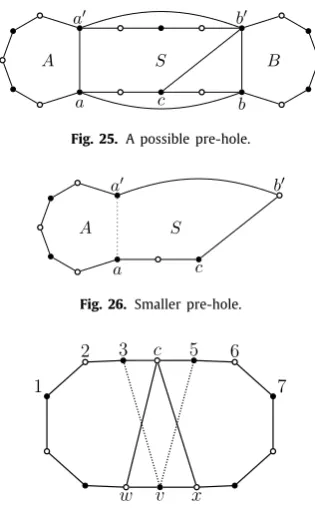
C2, then we are in case(a). Otherwise, we can useLemma 8to arrive at two odd holesAinC1andBinC2. NowAandBcan have only one chord ofCin their boundaries, sinceChas only even chords. Thus the structure ofC is either as shown in Fig. 23, or as shown inFig. 24. We must show thatCcannot be a minimal pre-hole in the latter case. [image:11.544.189.355.61.202.2]Fig. 25. A possible pre-hole.
Fig. 26. Smaller pre-hole.
Fig. 27. Preholes with odd holesC1,C2.
particular, the edgea′b′must be present, andb′has no other edge toA. Also, we must havea
,
b,
a′,
b′∈
L, or we would have a smaller case(b)pre-hole usingab,
a′b′ .
Letcbe the vertex nearestaon the path fromatobsuch thatb′
cis an even chord ofC, as shown inFig. 25. Note that cis well determined, sincec
=
bis possible.Consider the cycleC′
inGshown inFig. 26. It is easy to see thatC′
is a pre-hole, where the certifying bipartition simply movesb′
fromLtoRfrom that ofFig. 25, as shown. ThusC′
is a pre-hole with size
|
C′|
<
|
C
|
, soCwas not a minimal pre-hole. Thus any minimal pre-hole involving two vertex-disjoint holes of size at least 7 must be as in case(b).Finally supposeC′
1
,
C′
2 are edge- but not vertex-disjoint, so they intersect in a single vertexc. Since
|
C′
1
∪
C′
2
|
is odd, there must be a vertexv
∈
C\
(C1′∪
C2′). SinceC is minimal, andv
is adjacent to bothC1′,
C2′, byLemma 7,v
must be unique. SinceGhas no even hole,c, v
are the opposite vertices of a quadrangle (c,
x, v, w
), withv
∈
L,c,
x, w
∈
R. Thus we have the configuration shown inFig. 27.The vertices such that distC(c)
≤
3 form a pre-chordless pathP=
(1,
2,
3,
c,
5,
6,
7), as shown in Fig. 27. Since|
C1′|
,
|
C2′| ≥
5, distC(v,
P)≥
2. Supposev
is not adjacent to any vertex ofP. Then dist(v,
P)=
dist(v,
c)=
2, sov
c∈
Eby Lemma 3. This is a contradiction, sinceCis a pre-hole. Thusv
has an edge toP, thus to 1,
3,
5 or 7. By symmetry, suppose eitherv
1∈
Eorv
3∈
E. Ifv
1∈
E,v
3∈
/
E, the cycle (v,
1,
2,
3,
c, w
) is a 6-hole inG, contradicting the minimality ofC. Thusv
3∈
E. But now the quadrangle (v,
3,
c,
x) separatesCinto two vertex-disjoint odd cyclesH1=
(v,
3,
2,
1, . . . , w
) and H2=
(c,
5,
6,
7, . . . ,
x). Thus C contains two vertex-disjoint odd holesH1′⊆
H1,H2′⊆
H2, byLemma 8. By the minimality ofC, we must haveH1′=
H1,H2′=
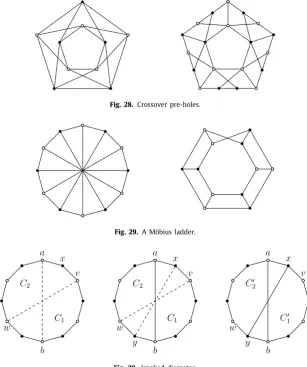
H2, and we are in case(b)again. □Thus. ifGcontains an odd hole of size at least 7, minimal pre-holes have only two types, case(a)and case(b). From Lemma 15, case(b)are crossover pre-holes. Examples are shown inFig. 28.
So let us consider the case(a)pre-holes. We will call theseMöbius pre-holes, since we will show that such a pre-hole must be aMöbius ladder[9,11]. SeeFig. 29for two different drawings of a Möbius ladder. As the name suggests, this is a ladder with a crossover.
Lemma 17. If C is a Möbius pre-hole in a flawless graph G, then C is aMöbius ladder.
Proof. LetChave the alternating bipartition such thata
,
b∈
RandabdividesC into odd holesC1,
C2, with|
C1| ≤ |
C2|
. Note, since|
C1|
,
|
C2| ≥
5, that|
C| ≥
8. SeeFig. 30. Ifais incident to more than one chord, then one ofC1,
C2is not a hole, soCis not a case(a)pre-hole. Soabis the only chord incident toaand, similarly,b.Fig. 28. Crossover pre-holes.
Fig. 29. A Möbius ladder.
Fig. 30. Implied diameter.
C2
∩
Lbetweenw
andb. Thus, in particular,xymust be an edge, whereyis adjacent tobonC2. NowxydividesCinto odd holesC′1
,
C′
2, so we can repeat the argument to show that
vw
is an edge, wherew
is adjacent toyonC2. We can iterate the argument for all vertices betweenaandbonC. If|
C1|
<
|
C2|
, we will be left with an even hole on|
C2| − |
C1| +
4 vertices. So we must have|
C1| = |
C2|
, and all edges between diametral pairs onC, as inFig. 29. □5.1. Splitting
LetGbe a flawless graph with a holeC of length
|
C| ≥
6. If|
C|
is even, we concludeG∈
/
Quasimonotone, so|
C| ≥
7 is odd. ThusGdoes not contain a triangle, fromLemmas 11and12. We will assume that this has been tested. We will now show thatGmust have the annular structure referred to in Section1.2, rather like a monotone graph with its ends identified.Now supposeGhas a short odd holeC withC
≥
7, determined by the procedure ofLemma 9. Thus, byCorollary 10, diam(G)≥
12(|
C| −
1)≥
3. Choose anyv
∈
C, and consider the graphGv=
G[
V\
N[
v
]]
. ThenGvcontains no holes, since any holeHinGvmust be a hole inG. But any holeHinGeither containsv
, or has a vertexw
adjacent tov
, byLemma 4. Sincev, w /
∈
Gv,H⊈Gv. Neither canGvcontain a pre-hole, since any pre-hole must contain two holes. ThusGvis flawless and contains no holes or pre-holes, so is a monotone graph. Now diam(G) is at least diam(C)=
(|
C| −
1)/
2≥
3. Thus there exists aw
∈
Csuch thatN(v
)∩
N(w
)=
∅.By definition [6], a graph is monotone if and only if it is bipartite, and its biadjacency matrix has an ordering of rows (L) and columns (R) so that it has the ‘‘staircase’’ structure indicated inFig. 32. This is symmetrical with respect to rows and columns [6]. That is, the transpose of the biadjacency matrix represents the same monotone graph withL andR interchanged.
Fig. 31. Chain graph structure.
Fig. 32. Decomposition of a monotone graph.
Fig. 33. Neighbourhood ofwinGv.
In the monotone representation, it is an easy observation that the graph has a decomposition into chain graphs, as indicated inFig. 32, where Lis partitioned inD1
,
D3, . . .
and RintoD2,
D4, . . .
. This partition was given previously by Brandstädt and Lozin [3], though their proof is based on the representation of a monotone graph as a bipartite permutation graph, and is nontrivial.Now we have shown that Gv is monotone, and there is a
w
such that N(v
)∩
N(w
)=
∅. Thus N(w
) and its neighbours induce a monotone subgraphNw of G, as indicated in Fig. 33. It is easy to see that the vertex set ofNwis
{
x∈
L∪
R:
dist(w,
x)≤
2}
. ClearlyNw is the union of two chain graphsCw,
C′w, withCw lying in the rows below and including
w
, andC′w in the rows above.
We can determine this split using the monotone representation ofGv, with the algorithm of [15]. Then we can construct a representation of the adjacency matrixA(G) ofGas indicated in the first diagram inFig. 34, whereD2
=
N(w
),C1=
Cw (transposed), andC7=
Cw′. The chain graphsC2, . . . ,
C6are a decomposition of the monotone graphGw. Note that the ordering of the chain graphs in the decomposition is circular, and the second diagram inFig. 34gives an equivalent representation to the first, whereC1(transposed) is moved from the first to the last position.Suppose there arekchain graphs in the decomposition. In our illustration,Fig. 34,k
=
7.Lemma 18. A flawless graph G which has an odd hole of size at least 7 is quasimonotone if and only if it has such a decomposition and does not contain a pre-hole. If there are k chain graphs in the decomposition, then k is odd, and the shortest hole in G has k vertices.
Proof. It is clear thatkmust be odd, sinceD1
,
D3, . . . ,
Dkare the sets of rows.The only reason thatGcould fail to be quasimonotone is that it has an even hole or a pre-hole. But any holeHmust have at least one edge in each of the chain graphs C1
,
C2, . . . ,
Ck. Otherwise, suppose H has no edge in Ci. Ifi=
1, thenHis entirely contained in a monotone graph with decompositionC2, . . . ,
Ck. Ifi=
k, thenHis entirely contained in a monotone graph with decompositionC1, . . . ,
Ck−1. Otherwise,H is entirely contained in a monotone graph with decompositionCi+1, . . . ,
Ck,
C1, . . . ,
Ci−1. This contradicts monotonicity.Now we observe thatHmust have an odd number of edges in each chain graphC. This is because the path through
Fig. 34. Decomposition ofA(G) for a quasimonotone graphG.
Fig. 35. Path through a chain graph.
same reason, the path cannot pass throughCmore than once. So the path must enterCthrough a horizontal segment and leave through a vertical segment, or vice versa. Therefore, there must be an odd number of edges ofHinC. HenceH has an odd number (k) of odd numbers of edges, and so the total number of edges ofHmust be odd. Thus any holeHin Gmust be an odd hole.
Now we observe that the numberkof chain graphs in the decomposition ofGis the length of a shortest hole. We take exactly one edge in each of theCi(i
=
1,
2, . . . ,
k), connected by a zig-zag path of vertices, as indicated inFig. 34. □However, it is still possible that Gcontains a pre-hole. However, the decomposition ofLemma 18implies that any pre-hole must wind around the annular structure ofG. We consider the question of detecting such pre-holes in Section5.2. The decomposition ofGcan clearly be carried out in polynomial time. We check thatGis flawless, and has no triangle, or hole of size smaller than 7. We check thatGis not a pre-hole. If so, we determine a short odd hole. Then we use the algorithm of [15] to determine the monotone structure ofGv, the monotone structure ofGw, and the split ofNw. If any of these steps fails,Gis not quasimonotone. If all succeed,Gis quasimonotone, unless it contains a pre-hole. As an example, consider the graphGshown inFig. 36.
Observe that this procedure really only requires thatGbe triangle-free, and have diameter at least 3. Thus it can be applied to test quasimonotonicity of some graphs with 5-holes, for example that inFig. 14.
5.2. Recognising pre-holes
Let G
=
(V,
E) be a flawless graph with a hole of sizeℓ
≥
7. Lemma 18 can determine whether or not G is quasimonotone provided it does not contain a pre-hole. We now consider recognition of a pre-hole in such a graph. We use the partition ofVfrom Section5.1into independent setsD1, . . . ,
Dℓ, whereDℓ+1≡
D1. All edges inErun between DiandDi+1(i∈ [
ℓ
]
). LetGi=
G[
Di∪
Di+1]
, with edge setEi, and letGi=
(V,
E\
Ei). Note thatGiis a chain graph andGi is a monotone graph. ThusGi is bipartite, with bipartitionL:
R, say, withDi,
Di+1∈
L.We search for possible crossovers inGi. These are pairsa
,
b∈
Di+1,c,
d∈
Di, such thatac,
ad,
bc,
bd∈
E. We list all such quadruplesa,
b,
c,
d,O(n4) in total, seeFig. 37. Given any quadruple, we attempt to determine vertex disjoint paths Pac,
PbdinGibetweena,
candb,
dor betweena,
dandb,
c. SeeFig. 38, cases (a) and (b). We can do this inO(n|
E|
)=
O(n3) time by network flow. Both paths are even length, sinceGiis bipartite anda,
b,
c,
d∈
L.If these paths do not exist, we discard this quadruple and consider the next in the list. If these paths do exist, in case (a) we have found a crossover pre-holePac
,
ad,
Pbd,
bc, in case (b) we have found a Möbius pre-holePad,
bd,
Pbc,ac. This is clearly a cycle with even length. That it is a pre-hole is certified by reversing the bipartition onPac in case(a),Pad in case (b), as shown inFig. 39.Fig. 36. G,G1,N1and the derivedA(G).
Fig. 37. Possible crossover.
Fig. 38. Vertex-disjoint paths.
Fig. 40. An internal triangle.
Fig. 41. A pre-hole and its Hamilton subgraph.
6. Flawless graphs without long holes
6.1. Minimal pre-holes in hole-free graphs
The main problem here is to recognise pre-holes. LetC be any minimal pre-hole in a flawless hole-free graphG. A triangle inG
[
C]
will be called aninteriortriangle ofC if it has no edge in common withC, acrossingtriangle if it has one edge in common withC, and acapofCif it has two edges in common withC.Lemma 19. If C is a minimal pre-hole in a flawless graph with
|
C|
>
12, then G[
C]
has no interior or crossing triangles, and C is determined by two edge-disjoint caps.Proof. SupposeC has an interior triangle, as shown inFig. 40. The vertices
v, w,
xpartitionCinto three segments. From Lemma 6, we must have distC(v, w
)≤
4, distC(w,
x)≤
4 and distC(x, v
)≤
4, and hence|
C| ≤
12.IfG
[
C]
has a crossing triangle, thenChas an odd chord, a contradiction. Now, sinceCis a pre-hole, there must be an even chordu0v
0which partitionsCinto two odd cyclesC1,C2with common edgeu0v
0. Suppose thatC1is not a triangle. SinceG∈
HoleFree,C1must have a chordu1v
1partitioning it into an odd cycleC1′and an even cycleC′
2, with
|
C′
1
|
<
|
C|
. If C′1is not a triangle we repeat the process until we reach a triangleT1, which must be a cap, and must be unique. Otherwise we have discovered a crossing or internal triangle of C, a contradiction. This must occur after at most
|
C1|
repetitions. We then apply the same procedure toC2, obtaining the second capT2. ClearlyT1andT2are edge-disjoint, since they are separated by the chordu0v
0. Then|
C| ≥
6 implies that they can share at most one of the verticesu0, v
0. □Note that pre-holes with fewer than 12 vertices may contain an interior triangle. SeeFig. 46for an example with 6 vertices. However, the bound 12 is probably far from tight.
Let T1,T2 be caps ofC, such that
v
i∈
Ti is adjacent to two edges ofC (i=
1,
2). Then there are two edge-disjoint (v
1, . . . , v
2) pathsP1,
P2inC. SeeFig. 41.Lemma 20. Let C , with
|
C|
>
12, be a minimal pre-hole in a flawless hole-free graph determined byv
1, v
2, and let C′=
C
\ {
v
1, v
2}
. Then G[
C′]
is a Hamilton monotone graph, and all chords of C′
connect P1to P2.
Proof. ClearlyG
[
C′]
is Hamilton, sinceG[
C]
is Hamilton. NowC′cannot be a pre-hole, since it is strictly smaller than C. SoG
[
C′]
cannot contain a triangle, byLemma 19. It cannot contain a larger odd cycle, since then it would contain a triangle, by the argument ofLemma 19. Therefore,G[
C′]
is bipartite and, sinceG∈
HoleFree, contains no hole. So, since G∈
Flawless,G[
C′]
is a monotone graph. Supposeuv
is an edge ofG[
C′]
withu, v
∈
P1. Then, sinceG[
C]
has only even chords, the even chorduv
and the segment ofP1betweenuandv
forms an odd cycle, giving a contradiction. □Thus any minimal pre-holeC comprises a Hamilton monotone graphG
[
C′]
, to which we add two capsT1,T2. We may also add edges from
v
1andv
2toC′, as long as they are even chords inC.Fig. 42. Cases in the proof ofLemma 21.
Fig. 43. Cases in the proof ofLemma 22.
Fig. 44. Cases in the proof ofLemma 22.
Proof. The chords must be as shown inFig. 42(a), since otherwise there is an even hole or a pre-armchair, similarly to Lemma 5. Note that
v
bmust be present ifv
dis inG. If there is a chord to bothP1andP2, we can find a smaller pre-hole by movingv
fromLtoRand using the longer chords fromv
. SeeFig. 42(b). □Lemma 22. Let C be a minimal pre-hole with
|
C| ≥
8. Then all vertices in P1have a chord to P2and vice versa.Proof. Suppose first that there are no chords from
v
1orv
2inG=
(V,
E).Letu
∈
P1have no edge toP2. SinceG[
C′]
is monotone,umust be in a quadrangle with its neighbours inP1and a vertexw
∈
P2. SeeFig. 43(a). Nowuis a distance at least 2 fromv
1andv
2, since otherwise it has an edge ofT1orT2to P2. Thusuis at distance at least 2 fromP2. Now ifw
is a distance at least 3 from bothv
1andv
2,Lemma 3implies thatu must have an edge toP1, a contradiction.Otherwise, we have the situations shown inFig. 43(b), where the edgebxis absent. Thusayorc
w
, or both, must be inG. Suppose that only one is inGand, without loss of generality, that it isay, as shown inFig. 43(b). Now eitherbzor cy, or both, must be present inG. Ifbz∈
E,v,
a,
b,
z,
y,
x, w
give a pre-stirrer, a contradiction. So suppose onlycyis inE. Thenv, w,
x,
y,
z,
a,
bgive a pre-stirrer, again a contradiction. Thus the edgebx∈
Eunless bothay,
cw
∈
E, as shown in Fig. 43(c). In this case we have a shorter pre-hole (. . . ,
d,
c, w, v,
a,
y,
z, . . .
), after interchangingv,
a, w
betweenLandR. Thus we must havebx∈
E, giving the conclusion. Observe that the configuration of case (a) requires at least 10 vertices, and those of cases (b) and (c) require at least 8. Therefore the conclusion holds only if|
C| ≥
8.Now we must consider the effect of chords from
v
1orv
2. These do not affect case (a), sinceP2remains pre-chordless. Alsoumust remain at distance 2 fromP2, since otherwise we are in case (b) or (c).In case (b), the only chord from
v
that can break the flaws inFig. 43(b) is the edgev
x, as shown inFig. 44(a). In this case, we simply givew
the role ofv
, as shown inFig. 44(b). Note that the chordv
z, if it exists, will now connectP1toP2.Finally, consider the configuration ofFig. 43(c). By symmetry, we can assume that the chords from
v
arev
b, v
d, as shown inFig. 45(a). The edgev
bis absent from the shorter pre-hole inFig. 45(b), so we have only to consider the edgev
d. However, ifv
d∈
E, it now connectsLtoR. Thus there is a shorter pre-hole (. . . ,
z,
y,
a, v,
d, . . .
), a contradiction. □Corollary 23. Let C be a pre-hole with
|
C| ≥
8. Then, forv
∈
C ,3≤
degG[C](v
)≤
5(v /
∈ {
v
1, v
2}
),2≤
degG[C](v
)≤
4Fig. 45. Cases in the proof ofLemma 22.
Fig. 46. Prehole with 3 vertices of degree 2.
Fig. 47. |T∩C′| = 3.
Fig. 48. |T∩C′| = 1.
Proof. Follows directly fromLemmas 6and22. □
Note that there is a pre-hole with six vertices and three vertices of degree 2, and an interior triangle.
LetT1
= {
v
1,
u1, w
1}
,T2= {
v
2,
u2, w
2}
be any two edge-disjoint triangles in a flawless graphG. LetMbe the component ofG\ {
v
1, v
2}
containingu1w
1,u2w
2, if such a component exists. IfMdoes not exist thenv
1, v
2clearly do not determine a pre-hole. However, if it doesLemma 24. C
=
(v
1,
u1, . . . ,
u2, v
2, w
2, . . . , w
1, v
1)determines a minimal pre-hole if and only if M is a monotone graph containing two vertex-disjoint paths between u1,
u2andv
1, v
2.Proof. SinceC′
⊆
M, the condition is certainly sufficient. Now, if there are not vertex-disjoint pathsP1
=
(u1, . . . ,
u2), P1=
(v
1, . . . , v
2), thenC cannot be a pre-hole. So suppose thatM is not monotone, and hence must contain a triangle T= {
u, v, w
}
. There are four cases depending on the number of vertices inT∩
C′. (i)
|
T∩
C′| =
3. ThenC′is not monotone, so this cannot occur, byLemma 20. (ii)|
T∩
C′| =
2. There are two subcases:
(a)
|
T∩
P1| =
2. SeeFig. 47(a). In this case, withv
to the left ofu, letxbe the neighbour ofuinP2furthest to the left ofw
2. Then, on movingufromRtoL, (v
1,
u1, . . . , w, v, w,
x, . . . , w
1, v
1) is a shorter pre-hole. (b)|
T∩
P1| = |
T∩
P2| =
1. See Fig. 47(b). In this case, one edge of the triangle is a chord of C′. Then(