UNIVERSITY OF SOUTHERN QUEENSLAND
THE IMPACT OF TECHNOLOGICAL
CAPABILITY ON POWER, TRUST AND
INTER-FIRM RELATIONSHIP PERFORMANCE
A dissertation submitted by
N
ORA
ZRINM
DL
ATIPSchool of Management and Marketing
For the award of
Doctor of Philosophy
ABSTRACT
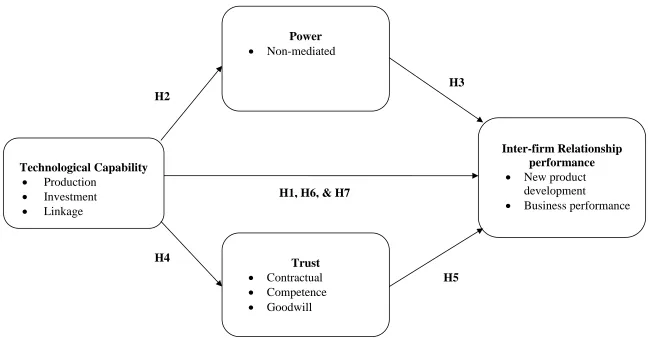
This study investigates the impact of technological capability on power, trust and inter-firm relationship performance between manufacturers and their suppliers within the supply chain context. This study also verifies the mediating effect of power and trust in the relationship between technological capability and inter-firm relationship performance. Building from the perspective of supply chain management, Resource Base View, power, and trust theories; a conceptual model is developed and the hypotheses are drawn to show the interrelationship between these constructs.
This study adopts a mixed method approach where data is collected in two phases. Phase One consists of a quantitative based approach whereby data is obtained through paper-based postal survey questionnaires. Phase Two involves qualitative method and the data is acquired through a series of case study interviews. In phase one, the survey questionnaires were mailed to 800 Malaysian manufacturing companies listed in the Federation of Malaysian Manufacturers Directory 2009. A total of 132 surveys were received of which 126 responses were usable, signifying a response rate of 15.75 per cent. The partial least square (PLS) statistical approach has been conducted to test the research hypotheses. Meanwhile in phase two, the data was collected from five manufacturing organisations. Case study approach was chosen and the data was analysed by identifying specific themes that emerged from the interviews, followed by cross case analysis.
The quantitative results indicate that there is an association between technological capability and the inter-firm relationship performance. The PLS path coefficient shows positive direction (0.2782) which is significant at p<0.001. This finding is supported by the qualitative result that found the association between both constructs and thus confirms that the Resource Based View theoretical perspective can be applied to the association between firm competitive advantage and the relationship performance in the context of Malaysian manufacturing supply chain.
The empirical results from the quantitative data analysis also reveal the association between technological capability, trust and inter-firm relationship performance constructs. The findings suggest that there is a positive association between technological capability and trust at significant level of p<0.001 (PLS path coefficient of 0.6170). The association between trust and the inter-firm relationship performance is also found to be positive (PLS path coefficient of 0.3252) and significant at p<0.001. This research also reports the mediation impact of trust on the positive association between technological capability and inter-firm relationship performance. The Sobel test of mediation effect indicates z value of 3.703 and significant at p<0.001. As expected, the qualitative findings provide support for these associations and, interestingly, add to the possibility of benevolence trust occurrence in a relationship as a result of technological capability deployment.
This research contributes to the literature by offering further understanding of Resource Based View theory in the context of a developing country viewpoint (Malaysia) since previous studies have largely focused on developed countries. This research also expands the theoretical application of Resource Based View by examining the mediating effects of both power and trust constructs in enhancing relationship performance outcomes and thus provides linkages between Resource Based View theory, power-dependency theory and trust theory. This study also contributes to the knowledge by extending the previous research on measuring technological capability, power, trust and inter-firm relationship performance by conceptualising them as multi-dimensional constructs.
C
ERTIFICATE OFD
ISSERTATIONI certify that the ideas, results, analyses and conclusions reported in this dissertation are entirely my own effort, except where otherwise acknowledged. I also certify that the work is original and has not been previously submitted for any awards, except where otherwise acknowledged.
Nor Azrin Md Latip Date
ENDORSEMENT
Dr Latif Hakim Date
A
CKNOWLEDGEMENTI wish to acknowledge the support given to me by many people who contributed in several ways to the successful completion of this dissertation. Particularly, I thank my supervisors, Dr Latif Al-Hakim and Dr Heather Maguire in the School of Management and Marketing for their invaluable guidance and encouragement throughout the period of my study. Their comments, suggestions and constructive critiques, as well as the time allotted to me, have been instrumental in accomplishing the research project. I would like to thank my editor Chris O’Reilly for proof reading the draft of this thesis to improve its quality.
The research journey would not have been possible without the financial support from my sponsors, Universiti Pendidikan Sultan Idris and Ministry of Higher Education Malaysia. Personally, I would like to thank Zarina Mohd Yaacob, Senior Assistant Registrar (Examination and Study Leave Unit) and Hussin Mahmud, coordinator of the Scholarship Department for ensuring timely conduct of all payments throughout the period of my study.
I am grateful to Dr Kamel Fantazy, Carleton University, Canada for granting permission to use his data collection instrument and e-mailing those instruments. I bear full responsibility in any error or omission during the instrument adaption process. I would also like to thank all the participants involved in the survey questionnaires and case study interviews for sharing their precious time and knowledge as this dissertation could not have been completed without the assistance of all these people.
I would like to thank the Research and Higher Degree Office, Faculty of Business and Law at USQ for their support. I also would like to thank my friends Muftah, Raziq, Heri, and Atikah for their encouragement and constructive critiques.
On a more personal note, I would like to thank my father, Haji Md Latip and my mother, Hajjah Rahmah, and my in-laws, Hajjah Omi Kelsum and the late Allahyarham Haji Abdullah for their immense love, do’a and moral support. I am deeply indebted to my lovely daughters, Nurul Nabilah Najwa and Nurul Aiman Asyiqin, and my son, Muhammad Nafiz for their patience and forbearance over the time of the study.
T
ABLE OFC
ONTENTSABSTRACT ... ii
Certificate of Dissertation ... iv
Acknowledgement ... v
Table of Contents ... vi
List of Figures ... x
List of Tables ... x
List of acronyms and abbreviations ... xii
1. Chapter 1: Introduction ... 1
1.1 Research background and problem statement ... 1
1.2 Research question ... 6
1.3 Motivation ... 6
1.4 Expected contribution ... 8
1.5 Research setting ... 10
1.6 Research approach ... 16
1.7 Definition of key terms ... 17
1.8 Organisation of the thesis ... 19
2. Chapter 2: Literature Review ... 21
2.1 Introduction ... 21
2.2 Supply chain management literature ... 21
2.3 Related theories ... 29
2.3.1 The Resource Based View theory ... 29
2.3.2 Technological capability ... 35
2.3.3 Power theory ... 45
2.3.4 Trust theory ... 52
2.3.5 Inter-firm relationship performance ... 58
2.4 Gaps in the literature ... 63
3. Chapter 3: Conceptual Framework ... 65
3.1 Introduction ... 65
3.2 Conceptual model ... 65
3.3.1 Association between technological capability and inter-firm relationship
performance ... 68
3.3.2 The role of power ... 70
3.3.3 The role of trust ... 74
3.4 Chapter summary ... 78
4. Chapter 4: Research Methodology ... 79
4.1 Introduction ... 79
4.2 Research design ... 80
4.3 Ethical considerations ... 87
4.4 Phase One: Quantitative method ... 88
4.4.1 Survey instrument development ... 88
4.4.2 Pilot study ... 96
4.4.3 Population and sample ... 97
4.4.4 Data collection ... 99
4.4.5 Control variables ... 101
4.4.6 Data analysis ... 101
4.4.7 Test of mediation effects ... 116
4.4.8 Validity and reliability ... 117
4.5 Phase Two: Qualitative method ... 119
4.5.1 Case study approach ... 120
4.5.2 Case study protocol ... 122
4.5.3 Pilot study ... 127
4.5.4 Sample selection ... 128
4.5.5 Data collection ... 130
4.5.6 Data analysis ... 132
4.5.7 Validity and reliability ... 133
4.6 Chapter summary ... 138
5. Chapter 5: Quantitative Data Results ... 139
5.1 Introduction ... 139
5.2 Population overview ... 139
5.3 Response rate and data screening ... 140
5.4 Basic statistical assumption ... 143
5.5 Demographics ... 144
5.5.3 Paid up capital ... 146
5.5.4 Year of establishment ... 147
5.5.5 Annual sales turnover ... 148
5.5.6 Number of major suppliers ... 149
5.5.7 Annual research and development, training and development, and new technology expenditures ... 149
5.6 Reliability ... 150
5.7 Dimension reduction: Factor analysis ... 151
5.7.1 Factor analysis results ... 152
5.8 Two step approach of PLS analysis ... 155
5.8.1 Step 1: Assessment of the outer model ... 156
5.8.2 Step 2: Structural model evaluation ... 172
5.9 Test of hypotheses ... 175
5.10 Assessment of mediating effects ... 177
5.11 Chapter summary ... 180
6. Chapter 6: Qualitative Data Results ... 182
6.1 Introduction ... 182
6.2 Overview of the case study ... 182
6.3 Case study A ... 184
6.3.1 Background ... 184
6.3.2 Technological capability ... 185
6.3.3 The role of power ... 187
6.3.4 The role of trust ... 188
6.3.5 Inter-firm relationship performance ... 190
6.4 Case study B ... 192
6.4.1 Background ... 192
6.4.2 Technological capability ... 193
6.4.3 The role of power ... 196
6.4.4 The role of trust ... 197
6.4.5 Inter-firm relationship performance ... 199
6.5 Case study C ... 200
6.5.1 Background ... 200
6.5.2 Technological capability ... 201
6.5.3 The role of power ... 204
6.5.5 Inter-firm relationship performance ... 206
6.6 Case study D ... 208
6.6.1 Background ... 208
6.6.2 Technological capability ... 209
6.6.3 The role of power ... 211
6.6.4 The role of trust ... 212
6.6.5 Inter-firm relationship performance ... 213
6.7 Case study E ... 215
6.7.1 Background ... 215
6.7.2 Technological capability ... 216
6.7.3 The role of power ... 219
6.7.4 The role of trust ... 220
6.7.5 Inter-firm relationship performance ... 222
6.8 Cross case analysis ... 224
6.8.1 Technological capability ... 224
6.8.2 The role of power ... 229
6.8.3 The role of trust ... 234
6.8.4 Inter-firm relationship performance ... 237
6.9 Chapter summary ... 240
7. Chapter 7: Conclusions and Implications ... 241
7.1 Introduction ... 241
7.2 Discussion of major findings ... 241
7.2.1 Technological capability and inter-firm relationship performance ... 242
7.2.2 The role of power ... 246
7.2.3 The role of trust ... 251
7.3 Contribution of the study ... 256
7.3.1 Contribution to the literature ... 256
7.3.2 Contributions to practice ... 259
7.4 Limitations of the study ... 262
7.5 Direction for future research ... 264
List of References ... 266
Appendices ... 286
Appendix 3: Consent form and interview checklist ... 293
Appendix 4: Identification of multivariate outliers ... 296
Appendix 5: Distribution characteristic and test of normality ... 297
Appendix 6: Homoscedasticity and Linearity Test ... 298
Appendix 7: Rotated component matrix ... 299
L
IST OFF
IGURES Figure 2.1: Supply chain network ... 23Figure 2.2: Inter and intra-organisational integration ... 26
Figure 2.3: Vertical collaboration ... 27
Figure 3.1: Conceptual model ... 67
Figure 4.1: Basic model of the mixed method used in this study ... 83
Figure 4.2: Sequential explanatory design ... 85
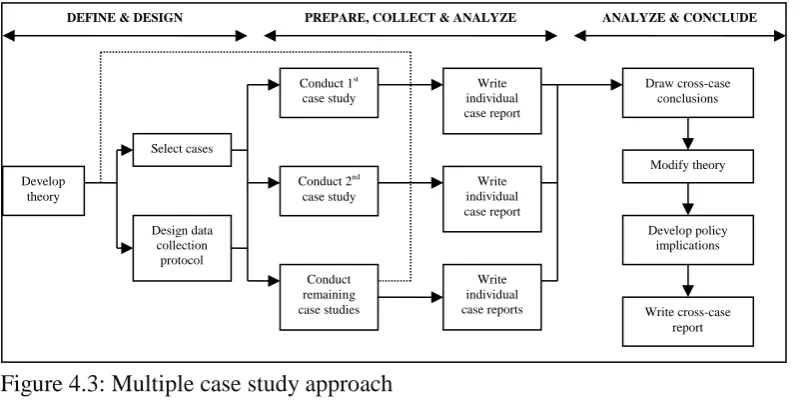
Figure 4.3: Multiple case study approach ... 121
Figure 5.1: The measurement model of the study ... 156
Figure 5.2: Initial result of PLS analysis on the measurement model ... 158
Figure 5.3: Result of PLS analysis on the measurement model after final run ... 162
L
IST OFT
ABLES Table 2.1: Definitions of supply chain management ... 25Table 2.2: Definition of technological capability, previous research objective and major findings ... 36
Table 2.3: Sources of power... 48
Table 2.4: Common dimension of trust... 56
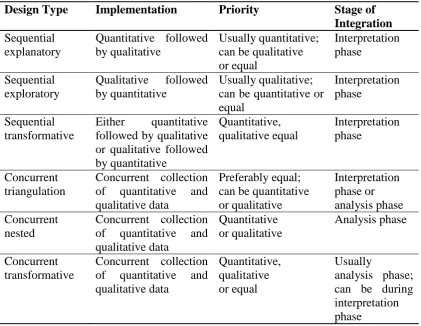
Table 4.1: Mixed method type of design ... 86
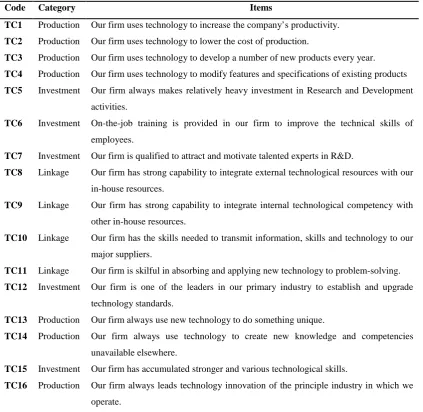
Table 4.2: The measurement items of technological capability ... 92
Table 4.3: The measurement items of power ... 93
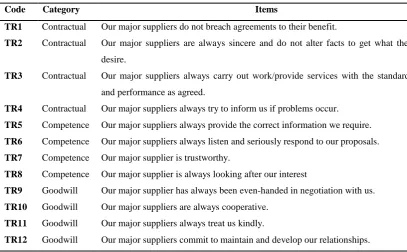
Table 4.4: The measurement items of trust ... 94
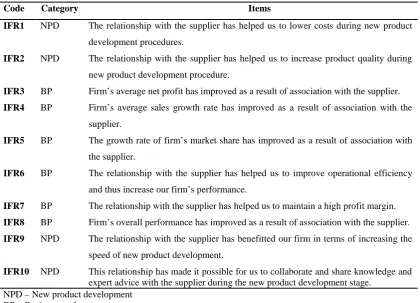
Table 4.5: The measurement items of inter-firm relationship performance ... 95
Table 4.6: 7-point Likert scale response categories ... 96
Table 4.7: List of organisation participating in the case study ... 129
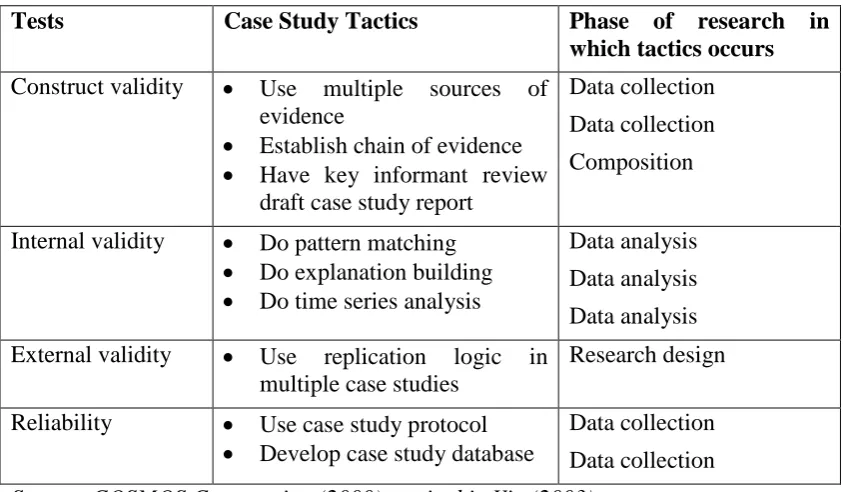
Table 4.8: Case study tactics for four design tests ... 134
Table 5.1: Univariate outliers ... 142
Table 5.3: Organisation legal structure ... 146
Table 5.4: Paid up capital ... 147
Table 5.5: Year of establishment ... 148
Table 5.6: Annual sales turnover ... 148
Table 5.7: Number of major suppliers ... 149
Table 5.8: Annual R&D expenditure, training and development expenditure and allocation on acquiring new technology ... 150
Table 5.9: Reliability coefficient for the measurement items ... 151
Table 5.10: The KMO and Bartlett’s test of sphericity ... 153
Table 5.11: Summary on the results of factor analysis ... 153
Table 5.12: Dimensions of the constructs based on the results of factor analysis ... 154
Table 5.13: Initial values of outer loadings ... 159
Table 5.14: The values of outer loadings after final run ... 163
Table 5.15: Composite reliability and Cronbach’s alpha for dimensions in their respective outer models ... 164
Table 5.16: Composite reliability, Cronbach’s alpha and R² among constructs ... 166
Table 5.17: Average variance extracted (AVE) for dimensions in their respective outer models ... 167
Table 5.18: Average variance extracted (AVE) among constructs ... 168
Table 5.19: AVE, square root AVE and correlation of dimensions... 171
Table 5.20: AVE, square root AVE and correlation of constructs... 171
Table 5.21: R² value of the endogenous construct ... 173
Table 5.22: Path coefficient, t-value and significance ... 175
Table 5.23: Regression coefficient before and after the insertion of the mediators. .... 178
Table 5.24: Test of mediation ... 179
Table 6.1: List of organisations participating in the case study ... 183
Table 6.2: Summary on technological capability’s construct ... 225
Table 6.3: Summary on the role power ... 232
Table 6.4: Summary on the role trust ... 233
Table 6.5: Summary on inter-firm relationship performance ... 239
L
IST OF ACRONYMS AND ABBREVIATIONSAMT Advance Manufacturing Technology
APITD Action Plan for Industrial Technology Development
AVE Average Variance Extracted
CBSEM Covariance base Structural Equation Modelling
CFA Confirmatory Factor Analysis
EDI Electronic Data Interchange
FMM Federation of Malaysian Manufacturers
GDP Gross Domestic Product
ICT Information and Communication Technology
IFR Inter-firm Relationship Performance
IMP Industrial Master Plan
IT Information Technology
KEMP K-Economy Master Plan
MIMOS Malaysian Institute of Micro Electronics Systems
MNC Multi-National Corporation
MSC Multimedia Super Corridor
NIE New Industrializing Economies
PLS Partial Least Square
R&D Research and Development
RFID Radio Frequency Identification Device
SCM Supply Chain Management
SEM Structural Equation Modelling
1.
C
HAPTER1:
I
NTRODUCTION1.1 Research background and problem statement
Recent factors in today’s world such as globalisation, maturing markets and rapid technological change, and intensified and swift change within marketplace competition have fostered manufacturers to seek new ways of establishing and maintaining sustainable competitive advantage (Santoro & Chakrabarti 2002). There are two major competitive advantages in business that have been widely documented in the literature, namely:
2. Technological capability is one of the foundations of a firm’s competitive capability. Technological capability has been acknowledged as being the root of a firm’s competitive advantage in many literatures (Chang 1996; Hsieh & Tsai 2007; Tsai 2004). It helps firms to increase their ability to apply technical knowledge in creating and delivering innovative products that consumers may value; and thus affect the overall business performance and new product development performance of a firm (Wang et al. 2006).
Indeed, the relationship between manufacturers and their suppliers has evolved over the past two decades from merely transactional processes based on arms-length agreements to much closer collaboration processes based on trust and technology. Researchers have highlighted a logical and compelling argument for the need to develop closer relationships to foster a win-win environment. They argue that a closer inter-firm relationship between manufacturers and their key suppliers can play an important role in increasing the organization’s capability, as well the ability by its supply chain to respond quickly to any unpredictable changes (Hoyt & Huq 2000).
performance. It is an extension of the of inter-firm relationship concept and is gauged through the perception of whether the relationship is perceived to be productive and rewarding (Gyau & Spiller 2008).
Over time, technological capabilities are able to increase competency within the supply chain by integrating the systems and processes in the chain. The development of technological competencies further supports the manufacturer-supplier relationship by offering a seamless coordination of almost all activities among the members in the supply chain (Abdullah 2009). In support of this notion, Bongsug et al. (2005) reveal the importance of technology as one of the components in enabling supply chain integration. They report that technology can help to increase the information processing of a relationship and, thus, support greater inter-firm cooperation while reducing the uncertainty in the collaboration.
In a similar vein, Carr and Smeltzer (2002) in their research on the relationship between technological use and the manufacturer-supplier relationship found that maintaining up-to-date information systems and having direct computer-to-computer links with suppliers is crucial in the manufacturer-supplier relationship.
dynamic association between these two constructs and, thus, the catalyst for further investigation.
This initial perception also fails to take into account the existence of power and trust in business relationships. For example, Boeck and Wamba (2008) argue that the adoption of technology may lead to potential conflict rather than benefit to inter-organisational relationships. They contend that there is the possibility that firms may initially encourage other members in the partnership to adopt the same technology. Subsequently, any disagreement on this matter will result in the exercise of power to generate pressure on members - which may create conflict in the relationship.
The concepts of power and trust are both complementary and contrary to each other in social behaviour study. As such, they need to be managed simultaneously to ensure the efficiency and effectiveness of a business relationships (Ireland & Webb 2007). In a complementary nature, both have the ability to substitute for each other when one fails to reach the expected outcome. For example, firms may exercise an appropriate level of power in relationships, together with contractual and competence trust, to achieve the desired outcome. In this sense, power exists in the form of a non-coercive manner that binds relationships more than what has been stated in the business contract, while trust is a complementary control to prevent extra cost arising from opportunistic behaviour (Ireland & Webb 2007; Ke et al. 2009; Maloni & Benton 2000).
in a relationship. Restricting access by other parties to these resources will raise questions as to a partner’s intention and can be perceived as denying other partners the opportunity for survival. As a result, the level of trust between these firms may deteriorate and, thus, affect the inter-firm relationship (Ireland & Webb 2007; Ke et al. 2009).
1.2 Research question
The main research question for this research is addressed below:
What impact does technological capability have on power, trust and inter-firm
relationship performance?
The sub-questions derived from the above research question are as follows:
• What impact does technological capability have on inter-firm relationship
performance?
• What impact does technological capability have on power?
• What impact does technological capability have on trust?
1.3 Motivation
especially in developing nations like Malaysia and this is the prime motivation for this study.
Conversely, power and trust are closely related to the study of inter-firm relationships. Both constructs have been identified in most prior research as being important factors in the business relationship (Bachmann 2001; Benton & Maloni 2005; Brown, Lusch & Nicholson 1995; Ke et al. 2009; Ratnasingam 2000; Sengun & Wasti 2009; Zhao et al. 2008). However, there is no known research being conducted to gauge their relationship with technological capability as mediators and this has provided extra focus for this study.
1.4 Expected contribution
The study is expected to explain the impact of technological capability on power and trust and inter-firm relationship performance. Therefore, there are several contributions which can be expected from this study. This study seeks to contribute to the literature by providing empirical evidence relating to technological capability, power, trust and inter-firm relationship performance within the supply chain context.
Grounded by Resource Based View theory, this research is also expected to make a contribution towards the theory by exploring how inter-firm relationship performance between manufacturing firms and their suppliers derive benefits from the use of their technological capability. In addition, this research will offer empirical evidence from a developing country viewpoint (Malaysia) and may contribute further insights to the literature as previous studies have, for the most part, focused on developed countries.
In addition, this study is also expected to contribute to the literature by providing linkages between Resource Based View theory, power-dependency theory and trust theory. Empirical evidence in this research examines the mediating effects of both power and trust on the relationship between technological capability and inter-firm relationship performance. Most of prior technology-related studies only looked at power or trust as dependent variables (Abdullah 2009; Ryssel, Ritter & Gemunden 2004). Based on theoretical grounds, it is found that both power and trust co-exist in firm interrelationships and are interrelated with technological capability. Thus, incorporating these variables (power and trust) in one study as a mediator may enrich the current literature and provide a broader understanding of the relationship between Resource Base View, power-dependency, and trust theories.
decisions related to technological capability expansion. This study also hopes to provide valuable information on the current status of technological capability of manufacturing industries in Malaysia to assist the government in planning the development of or review of current policy relating to the country’s manufacturing sector.
1.5 Research setting
Globally, technological capability has always been recognised as one of the primary components that contribute towards a country’s economic growth and prosperity. The utilisation of more advanced technology will undoubtedly continue to be a significant source of competitive advantage in the future but, unfortunately, it is not being dispersed evenly across countries and knowledge creation is largely concentrated in highly-developed and industrialised nations. Although this knowledge can be disseminated to other countries through various channels of technology transfer such as international trade, foreign direct investment, or public awareness in promoting the use of technology, there is still a gap in the level of achievement in this area across countries. Many countries continue to fall behind in upgrading their technological capability and some have failed to absorb the knowledge that has already become obsolete in other countries (Archibugi & Coco 2004).
as Japan, Taiwan and South Korea. During the early stage of industrialisation, these countries were merely users of advanced technology that they acquired from developed industrialised nations. However, these countries have transformed from being users into becoming masters of technological competencies by developing their own technological capability. Since then, these countries have grown swiftly into new grounds of technology and have become world class players in the advanced technology sector, particularly in areas such as telecommunications and semiconductors (Rahman & Bennett 2009).
In comparison, Malaysia does not enjoy the same level of technological capability as many developed countries such as Japan, South Korea or Taiwan. In accord with the developing nation status, there has been no formal attention to building basic high technology infrastructure until the government decided to transform its manufacturing industry and thus change its dependency from a traditional agricultural base economy to modern industrialisation (Rasiah 2004).
Since the 1960s, the Malaysian manufacturing industry has evolved from light to heavy industries. The country’s light industry consists of traditional activities such as food processing, wood and textile. On the other hand, the national heavy industry comprises capital intense and complex activities that include electrical, semiconductor and electronic products. This transformation began in the late 1960s and grew rapidly during the 1980s. By the 1990s, the country possessed advanced industrial infrastructure which was only slightly lower than that of South Korea and Taiwan (Lall 1999).
The growth in the manufacturing sector has been driven by the introduction of a ‘Look East’ policy in the early 1980s. This policy aimed to integrate Japanese and South Korean heavy industrial technology with Malaysia’s resource-based industrialization in order to improve the nation’s productivity and economic performance. The policy intended to assimilate these countries’ working culture to focus on relationships and collaboration between firms in the same supply chain (Lim 2008). This aimed to counter the weaknesses of manufacturing companies in their inter-firm collaborations since they are traditionally stand-alone organisations that serve domestic markets and not export-oriented manufacturing organisations (Lall 1999).
competitive in the market. New sub-sectors which focus on high value-added manufacturing such as petrochemicals, heavy machinery, aerospace, maritime and defence industries have been promoted. Consequently, the government will enhance and develop existing and new industrial clusters, as well as Small and Medium Enterprises (SMEs) in all states in order to move the economy up to the value chain (Economic Planning Unit 2006).
Meanwhile, the root of technological capability development in Malaysia can be traced to early 1985 when the government set up the Malaysian Institute of Micro Electronics Systems (MIMOS) in that year. The main objective in establishing the MIMOS was to focus on providing critical technology infrastructure to help the local electronics manufacturing industry in building technological capability to design, produce and market an exceptional quality of electronic products internationally during the global growth of the electronics industry in the mid-1980s (MIMOS 2010).
Later, the Industrial Master Plan (IMP) was introduced in 1986, with the objective of developing a broad-based manufacturing sector. IMP was viewed as a ten year plan, acting as a blueprint to build high technology institutions (Rasiah 2004). Among the outline of the first IMP was the goal to transform the national economic dependence from the traditional agricultural sector to a product based manufacturing sector (Johan 2006).
the Fifth Malaysia Plan (5MP). This action plan acted as a complement to the first IMP to increase industrial technology development effectively, since the country’s expenditure on Research and Development (R&D) and R&D activity was still relatively low (Kondo 1999). The action plan continued in the Sixth Malaysia Plan (6MP) and the report outlined that the APITD is an essential step in providing strategies and guidelines to develop technological capability through selected technology acquisition from abroad. Apart from that, another aim of the APITD centres on developing human resources and infrastructure, promoting the importance of basic science in education systems and building a society that appreciates science and technology (EPU 2010).
However, there are flaws in the execution part of both policies since the government’s emphasis is mainly on institutional development (for example Sapura Electronics and Celcom). The focus on building high-tech institutional centres under these policies is not followed by increases in investment in human capital development and the need for strengthening the inter-firm relationship, as well as coordination within industrial conurbations. Rasiah (2004) elaborates that the country lacks expert manpower in technical fields and inadequate R&D expenditure; and this has hindered most of the R&D activity and thus slowed down the innovation and creativity process. On top of that, there are no serious efforts in building inter-firm connections and cooperation among them.
productivity and competitiveness. The main concern is to uplift Malaysia’s contribution to the value-added aspect and thus the strategy focuses move up to the value-added chain. As the world shifted to Knowledge Economy (K-economy) in the year 2000, the government reacted by introducing K-Economy Master Plan (KEMP) in 2003. This plan aimed to help the manufacturing sector to embrace innovation, re-engineer the business process, create new ideas, and develop outstanding value-added products and services. The manufacturing industry was urged to build their core competencies and to rely more on ICT to enhance the value added component of their products and services (Johan 2006).
The implementation of KEMP in 2003 was reasonably effortless since the momentum of technological capability development was continued by the Government of Malaysia through the establishment of the Multimedia Super Corridor (MSC) project in 1995 - modelled after Silicon Valley, California. The MSC is part of the Vision 2020 program which was formulated to transform the country into fully developed by the year 2020. The Vision 2020 program was proposed by the government during the tabling of 6MP in 1996.
participation from numerous numbers of MNC such as Microsoft, Motorola and Sony, local firms can obtain the benefits from the technology and knowledge brought in by these MNCs through strategic R&D activities (Mohan, Omar & Aziz 2004; Ramasamy, Chakrabarty & Cheah 2004).
Meanwhile, the government introduced the Third IMP, launched in 2006, covering a fifteen year period up to the year 2020. The objective of the Third IMP is to achieve long term global competitiveness mainly through transformation and innovation of the manufacturing sector. Some of the aims under this IMP are to sustain the contribution of the manufacturing industry towards the nation’s economy and to strengthen integration among manufacturers - not only domestically, but also in promoting industrial conurbation regionally and globally. It also promotes the use of extensive ICT and other technologies up to the value chain. The plan also emphasizes the importance of developing innovative and creative human capital in the country. This is to ensure that industry has sufficient technical expertise; and this would later ease to promote an active R&D environment (MITI 2010).
1.6 Research approach
The quantitative design is selected as the first phase to describe the association among the studied variables. Data is gathered via a paper-based postal survey questionnaire distributed to manufacturing companies in Malaysia. The FMM Directory 2009 has been chosen as the primary source of population. Initial statistical procedures, such as data screening, testing of multivariate assumptions and analysing the demographic profiles, uses the Statistical Package for Social Sciences (SPSS) software. The test of hypotheses is largely based on the Partial Least Square approach via SmartPLS software.
Subsequently, the second phase involves the qualitative design, and case study method is used to uncover the nature of the problem by gathering in-depth information from the same population, since very few studies have been conducting to measure the relationship between the variables involved. The purpose of the case study is to gather information on these occurrences and data is collected from these cases via semi-structured interviews and documentation. The data is then analysed to identify the areas of interest and later a cross case analysis was conducted to support the findings in Phase One. The definitions of key terms are briefly discussed in the following section.
1.7 Definition of key terms
1. Technological capability - refers to the firm’s level of technological capability which is categorised into three major technical functions, namely, production capability, investment capability and linkage capability (Lall 1999).
2. Inter-firm relationship performance - refers to the degree the business relationship between two or more firms is perceived to be effective and beneficial for both parties (Gyau & Spiller 2008).
3. Power - the quantitative phase focuses on the non-mediated power base, while qualitative phase investigates both mediated and non-mediated power bases. These power bases reside in the organisation that possesses or controls the scarce resources and the power exercised over the firm seeking those resources (Ireland & Webb 2007).
4. Trust - refers to a firm’s willingness to take a risk by depending on another party whom they strongly believe could fulfil their obligations in an exchange relationship (Paterson 2007).
6. Manufacturing industry – refers to the Malaysian manufacturing sector which has been chosen as the population of this study due to its substantially contribution to the country’s Gross Domestic Product (GDP).
7. Structural equation modelling (SEM) - an advance multivariate analysis that combines aspects of factor analysis and multiple regression, allowing the researcher to simultaneously examine a series of interrelated dependence relationships among the measured variables and latent constructs (variates), as well as between several latent constructs.
8. Partial Least Square (PLS) - an alternative method to SEM approach which provides parameter estimates for a linear equation - as does SEM - but is less sensitive to sample size considerations.
1.8 Organisation of the thesis
This thesis comprises seven chapters as follows:
2. Chapter 2 reviews the relevant literature on supply chain, technological capability, inter-firm relationship performance, as well as a discussion on power and trust.
3. Chapter 3 explains and presents the conceptual model and the associated hypotheses to be tested.
4. Chapter 4 describes the research methodology procedure which involves two phases of data collection. The first phase engages in quantitative data collection procedures via distribution of survey questionnaires, basic analysis using SPSS and test of path model. The second phase employs the qualitative data collection through semi-structured interviews with the identified participants.
5. Chapter 5 covers the results of the first phase which involves quantitative data collection and analysis as described in Chapter 4. The results of the structural model and hypotheses testing are presented.
6. Chapter 6 reports the results of the second phase which covers qualitative data collection and analysis.
2.
C
HAPTER2:
L
ITERATURER
EVIEW2.1 Introduction
This chapter aims to review the theories and the prior literature that are relevant to this study. This chapter is divided into several sections. Firstly, a brief outline of the supply chain management concept from the general business and manufacturing sector perspective is provided. Secondly the chapter provides a discussion of the related theories underpinning the concept of technological capability, relationship power, and the factor of trust that relates to the context of this research. This section continues with a discussion of why firms engage in inter-firm relationships with their suppliers, as well as the concept of inter-firm relationship performance. The chapter concludes by highlighting the gaps and scarcity in the literature and an analysis of the impact of technological capability on power, trust and inter-firm relationship performance.
2.2 Supply chain management literature
demand. As a result, the importance of locating products within the entire distribution channel for customer accessibility with minimal cost has become more challenging than ever before. Companies also realise that optimal performance of an organisation cannot be achieved through performance maximisation of a single department. All functions need to be optimal and companies must have the ability to look at the entire supply chain and understand the impact of decisions in any particular area. Vertically integrated companies have become more specialised and instead of providing their own source of supply, they have started utilising suppliers who can provide low cost quality materials. They realise that parties in the supply chain could stand to benefit from the success of other parties (Lummus, Vokurka & Alber 1998; Simchi-Levi, Kaminsky & Simchi-Levi 2003; Zhao et al. 2008).
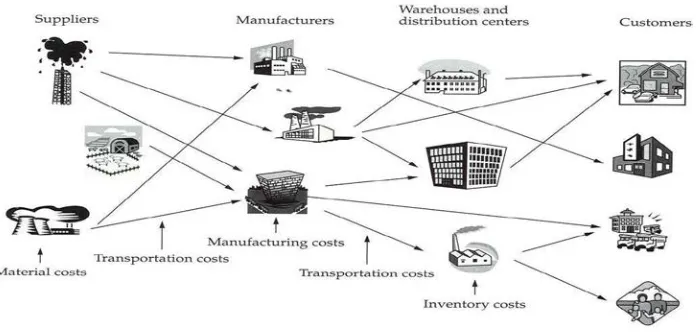
Figure 2.1: Supply chain network
Source: Simchi-Levi, Kaminsky and Simchi-Levi (2003)
The Global Supply Chain Forum (GSCF), a group of non-competing firms and a team of academic researchers, define SCM as ‘the integration of key business processes from end user through original suppliers that provides products, services and information that add value for customers’ (The Global Supply Chain Forum (1998) as cited in Lambert, Cooper & Pagh 1998).
‘...a set of approaches utilised to efficiently integrate suppliers, manufacturers,
warehouses, and stores, so that merchandise is produced and distributed at the
right quantities, to the right locations, at the right time, in order to minimise
system wide costs while satisfying service level requirements. The supply chain
consists of suppliers, manufacturing centres, warehouses, distributor centres,
and retail outlets, as well as raw materials, work in progress, inventory, and
finished products that flow between the facilities’.
The above definition is utilised in this research since it takes the consideration of every facility and units which includes suppliers and manufacturers throughout the supply chain with the objectives to achieve efficient integration and relationship between manufacturers and their suppliers, attaining cost effective networking and taking consideration onto improve the overall supply chain performance.
Table 2.1: Definitions of supply chain management
Authors Definition of SCM
Jones and Riley (1985, p. 19)
Managing the total flow of materials from suppliers to the end users.
Cooper and Ellram (1993, p. 13)
An integrative philosophy to manage the total flow of a distribution channel from the supplier to the ultimate user
Lummus, Vokurka and Alber (1998, p. 49)
Managing the network of entities that may include suppliers, carriers, manufacturing sites, distribution centres, retailers and customers through which material and information flow.
Mentzer et al.(2001, p. 18)
The systemic, strategic coordination of the traditional business functions and the tactics across these business functions within a particular company and across businesses within the supply chain, for the purpose of improving the long term performance of the individual companies and the supply chain as a whole.
Ho, Au and Newton (2002, p. 4422)
The philosophy of management that involves the management and integration of a set of selected key business processes from end user through to original suppliers that provides products, services, and information that add value for customers and other stakeholders through the collaborative efforts of supply chain members.
Stadtler (2005, p. 576)
The task of integrating organisational units along a supply chain and coordinating materials, information and financial flows in order to fulfil customer demands with the aim of improving competitiveness of the supply chain as a whole.
Thakkar, Kanda and Deshmukh (2008, p. 98)
A set of business activities including purchase from open/spot market, manufacturing or processing of subcomponents/ subassembly within the plant and delivery to large enterprises using hired transportation to enhance value of end product and in turn to ensure long-term regular purchase order.
(Source: developed for this research by the author from literature)
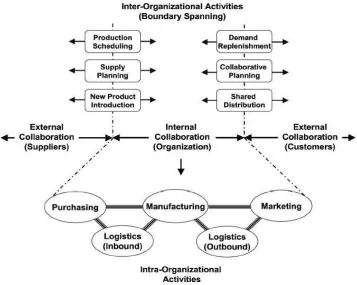
managing information and materials across functional boundaries and processes within an organisation. Regarding the need for information dissemination across departments, Barratt (2004) clarifies that the exchange of information needs to be implemented at all levels of activity including operational, tactical and strategic levels.
Figure 2.2: Inter and intra-organisational integration
(Source: Barratt (2004))
Relationship Management (CRM), collaborative demand planning and forecasting, demand replenishment and shared distribution (see Figure 2.3).
Figure 2.3: Vertical collaboration
(Source: Barratt (2004))
outside an organisation, mutual understanding needs to be developed in order to achieve a higher degree of production efficiency and to help reduce the risk of uncertainties in the production process (Mazlan & Ali 2006).
Therefore, Morash and Clinton (1998) conclude that building a healthier relationship with other firms involved in the supply chain is advantageous since it can result in operational excellence and a more responsive supply chain. Among the possible opportunities for collaboration with this side of supply chain (see Figure 2.3) are supplier development, supplier planning and production scheduling, collaborative design which includes new product development, and collaborative logistics (Barratt 2004).
2.3 Related theories
The previous section discussed the concept of supply chain management. This section commences with an outline of the related theories underpinning this study. The first theory (the Resource Based View theory) concerns the technological capability concept. This is followed by an overview of related theories governing the issues of power, trust and inter-firm relationship performance.
2.3.1 The Resource Based View theory
The Resource Based View theory stems from strategic management studies which have been widely used over the last two decades and extends the concept of distinctive competence (Coombs & Bierly 2006). Retrospectively, the origin of Resource Based View theory can be traced back to 1984 when Wernerfelt (1984) laid the foundation of the concept of this theory by proposing the importance of the relationship between profitability and resources, and how firms manage these resources over time to persistently outperform other firms.
emerged as a widespread application and has become a predominant theoretical framework in contemporary research (Andersén 2011).
The key concern of this theory is accepting the transitory nature of a firm’s resources that eventually lead to competitive advantage. Competitive advantage is defined by Barney and Clark (2007, p. 24) as the ability ‘to create more economic value than the marginal (break-even) competitor in its product market’. In simple terms, firms need to mobilise their strategic resources in order to create more value by producing more net benefits via superior product differentiation with lower cost, relative to the least efficient competitor.
Nevertheless, it is also important to note the issue of sustainability of these advantages in the long run. Barney and Clark (2007, p. 52) coined the term ‘sustained competitive advantage’ and define it as the ‘ability in creating more economic value than the marginal firm in its industry and when other firms are unable to duplicate the benefits of this strategy’. This definition implies that sustained competitive advantage does not exclusively focus on current competitors in the market, but also refers to potential competitors who might enter the industry in the future.
In general, firms’ resources correspond to ‘all assets, capabilities, organisational processes, firm attributes, information, knowledge, etc. controlled by a firm that enable it to conceive of and implement strategies that improve its efficiency and effectiveness’ (Daft 1983 cited in Barney 1991, p. 101). In short, it refers to a firm’s inner strength that can be used to conceive of and enforce value creation activity (Hitt & Ireland 1985).
Meanwhile, capability is defined as the ‘bundles of skills and accumulated knowledge, exercised through organisational process, which enables firms to coordinate activities and make use of their assets’ (Cravens & Piercy 2006, p. 6). Nevertheless, both resources and capabilities can only be considered as the source of sustained competitive advantage if they are scarce, valuable, inimitable and non-substitutable (Barney 1991; Barney 2001; Barney & Clark 2007; Coombs & Bierly 2006).
In a similar vein, Hittand and Ireland (1985) also agree that enhancing firms’ competitive advantage may improve business performance. The argument is that distinct competence and superior organisational routines lead to resource advantage and employing them - particularly in value-chain activities - may help increase business performance.
Meanwhile, Chmielewski and Paladino (2007) have empirically examined the relationship between resource and capability in different market conditions. They have found a significant relationship between resource and capability, and the strength of this relationship is shown to be robust across various market conditions. They also report that resource orientation has a positive significant impact on all performance indicators.
Schroeder et al. (2002) investigated the linkage between manufacturing strategy from the perspective of Resource Based View theory and manufacturing performance. They contend that a firm’s resources and capabilities are unique and difficult to duplicate or substitute. They further assert that these resources and capabilities are built by the employees through internal cross-function training, suggestion systems, external learning via customers and suppliers, and proprietary processes and equipment developed by the firms. Based on 164 manufacturing firms’ data, the findings empirically reveal that, driven by internal and external learning, the proprietary processes and equipment developed by firms are significantly related to manufacturing performance. Interestingly, they found that generic resources are ineffective in achieving high level performance since they are also freely available to competitors. Therefore, consistent with the Resource Based View theory, they conclude that resources and capabilities which are idiosyncratic and difficult for competitors to imitate lead to higher competitive performance.
2003), these characteristics are as follows. Firstly, the resource must be valuable to the firm in the sense that it contributes to firm efficiency and effectiveness, and neutralises threats in a firm’s environment. Secondly, the resource must be scarce among firms’ current and potential competitors and thus controlling it may result in disadvantage to its competitor. Thirdly, the resource should be hard to imitate by competitors to prevent them developing it easily. Fourthly, the resource should be imperfectly mobile to prevent ex-post competition that would nullify any advantages of controlling it in the first place. Lastly, there is no known substitute or strategically equivalent resource that can be used for the same purpose.
2.3.2 Technological capability
Technological capability within the manufacturing sector has been identified as a crucial strategic resource that enables firms to remain competitive in the market (Ehigie & McAndrew 2005; Meyer-Stamer 1999; Tsai 2004; Tyler 2001). This concept has also been highlighted as part of the supply chain operational capabilities, together with logistics capability and structure capability. In brief, supply chain operational capabilities are defined as ‘the pattern of decisions related to sourcing products, capacity planning, conversion and distribution of finished product, demand management, communication and delivery’ (Kim 2006, p. 1085). Nonetheless, it is important to note that, to date, there is little consensus on the exact definition of this concept. For example, García-Muiña and Navas-López (2007, p. 31) define technological capability as
‘---the generic knowledge-intense ability to jointly mobilize different scientific
and technical resources which enables a firm to successfully develop and design
new products (goods or services) and productive processes, in creating the
desired outcome, by implementing competitive strategy’.
Also emphasizing the importance of technical knowledge, Wang et al. (2006, p. 30) identify the concept of technological capability as ‘a set of pieces of knowledge that includes both practical and theoretical know-how, methods, procedures, experiences and physical devices and equipment’.
Table 2.2: Definition of technological capability, previous research objective and major findings
Authors Definition Objective Findings
Acha (2000, p. 3)
The knowledge and skills required to identify, appraise, utilise and develop technologies and techniques relevant to the industry. Through the application and extension of knowledge and skills (in particular technologies and skills), the firm is building its stock of both explicit and tacit knowledge accordingly.
To describe the relationship between technological capabilities and operational performance in the case of the upstream petroleum industry
The study reports mixed relationship between technological capability dimensions and operational performance. The author suggests further investigation needed to confirm this relationship.
Figueiredo (2002)
Resource needed to generate innovation in production, processes, and project engineering. The resource is also accumulated to manage future technological change.
To understand the practical implication of technological capability, accumulation path on operational performance.
Technological capability and accumulation path has impacted the operational performance.
Afuah
(2002, p. 172)
Each firm has specific technology resources such as patent, skilled engineer, knowledge, product design etc. that is used to offer products with desirable characteristics and technological capability then refers to the firm’s ability to use these resources to combine components, methods, processes and techniques, and underpinning core concepts to offer products.
To present a model for estimating the value of distinctive technological capabilities.
The study has provided the linkage between customer value and the competitive advantage from technological capabilities.
Reed and Walsh
(2002)
The capability to innovate and awareness of future technology requirements.
Aim to discuss the potential to enhance the technological capability through supply development scheme.
The formal processes of supplier development are found to have little direct impact on suppliers’
technological capability. Kim (2006) The ability in developing differentiation capability
through the use of scientific knowledge in production that can guarantee the delivery of value-added products and facilitate rapid response to changing market needs and new customer requests.
To identify the interaction of corporate competitive capability and supply chain operational capability for performance improvement.
Technological capability has positive a significant impact on market performance (which includes sales and market share growth).
Therefore, based on the various definitions above, this study defines technological capability concept as the firm’s capability to employ a salient and diverse range of resources which include knowledge, skills and various technical resources (including software and hardware such as information technology (IT) and machinery) to offer products and remain competitive in the market. This definition generally denotes that technological capability in each firm is unique and each firm has its own technology resources to stay competitive in the market. This is consistent with Lall (1992, 1999) who proclaim that technological knowledge is different among firms and not shared equally, nor easily imitated or transferred across firms. It also has been recognised as the driving force and the root of a firm’s long-term sustainable competitive advantage (Tsai 2004).
Table 2.2 also denotes that the contribution of technological capability has not only been acknowledged as crucial towards overall competitive advantage of firms, but also to supply chain performance as a whole, and to inter-firm collaboration. Consequently, organisations should focus their attention on investing in state-of-the-art facilities and equipment in order to strengthen the operational aspect of their business, as well as to enhance the efficiency of the supply chain, and further support inter-firm relationships (Abdullah 2009).
advantage. In their research on South African manufacturers, they found that the first six benefits of adopting AMT is obtaining competitive advantage, increase throughput, improved quality, reduced cost, better management control, and increased flexibility. The findings also reveal that there is no significant difference in perceived benefits of the South African manufacturers on this manufacturing technology across all firm sizes.
Researchers also believe that superior technological capability can increase efficiency and higher differentiation through improved process and product innovations (Kam 1999; Lall 1992; Wang et al. 2006). Organisations with remarkable technological competencies are able to produce higher differentiation through innovative products in response to rapid changes in the market needs since they can secure efficiency benefits by pioneering innovation activities. Therefore, firms are able to create greater value than their competitors which allows them to achieve an above-average return on investment (Teece & Pisano 1994; Tsai 2004).
begin to realise the importance of automating their supply chains through electronic mechanisms.
In an exploratory study by Patrakosol and Lee (2009) on the impact of technology on inter-firm relationship performance in a two-country comparative study (the USA, a developed country; and Thailand, a developing nation), their findings reveal that technical resources are positively associated with inter-firm relationship performance across these two countries. However, they caution that not all technology capabilities have a significant impact on inter-firm relationship performance, for instance, only the Thai firms recognise higher innovation performance as a result of technical adoption as compared to US firms.
In addition, researchers argue that trying to achieve supply chain optimization through technology assimilation could result in a potential breakdown in the supply chain relationship. As such, many researchers believe that more research should be conducted to further clarify the link between these two constructs (Boeck & Wamba 2008; Deeter-Schmelz & Kennedy 2004; Jayaram & Vickery 2008).
In short, technological capability has been regarded by many researchers as the source of competitive advantage. It is also an important element, especially in the supply chain, as it helps to increase efficiency and integrate systems and processes in the chain. Nevertheless, it has a mixed impact on various performance outcomes and the key reason may lie in the multidimensionality of this concept.
The infamous typology for measuring technological capability is production capability, investment capability and linkage capability, as proposed by Lall (1992). He discloses that production capability ranges from the skills of operating, maintaining and controlling that process and product technology, as well as efforts in absorbing the new technology either by newly buying or imitation by other firms. Meanwhile, Dahlman, Ross-Larson and Westphal (1987) believe that production capability is about the ability of a firm to monitor, improve and optimise overall manufacturing operations.
The evidence of R&D as a crucial component in building firm’s level technological capability has been recorded in many previous research. For example, Acha (2000) employs R&D as technology indicators to unravel the relationship between technological capability and operational performance in the vertical chain within the petroleum industry. Their findings reveal that there is a positive association between R&D as part of the production capability on the inter-firm performance.
Schoenecker and Swanson (2002) also include R&D in their technological capability model that employs R&D expenditure and other statistics on new product development as a proxy to measure technological capability, concluding that technological capability has a positive association with both sales growth and profits. Therefore, it is not surprising that R&D has been utilised in many other studies (Coombs & Bierly 2006; Corsten & Felde 2005; Hsieh & Tsai 2007; Tsai 2004; Wang et al. 2006) as an indicator for measuring technological capability.
Nevertheless, the increment of R&D activities is closely related with the investment capability of firms. Thus, it is worth noting that investment capability is one of the indicators of technological capability, especially in R&D investment, since it reflects a firm’s innovative activity and possibly enables firms to accumulate technical knowledge through staff learning and development (Tsai 2004). Therefore, the next section discusses the importance of investment capabilities within the technological capability context.
In general, investment capability is often associated with the firm’s ability to upgrade its manufacturing equipment so as to increase its operational capability. Apart from increasing firm’s operational performance, the decision to invest in manufacturing technology may yield some strategic business performance indicator. According to Small and Chen (1995), firms can expect major strategic benefits such as early entry to the market via new product development, perceived market leadership, ability to offer a continuous stream of customized product and improved flexibility which is very important for the growth and sustainability of the firm.
performance outcome since it increases firm’s ability in developing new products quickly and effectively and taking effective actions in improving its financial flexibility.
Meanwhile, the concept of investment capability is actually broader than acquiring the manufacturing equipment alone. It is also consists of skills and knowledge needed in identifying the capital cost of the project in obtaining the selected technology, manufacturing equipment procurement, the appropriateness of the manufacturing equipment in building the technological capability to the operating firm, organizing appropriate training to adequately equip staff, and the understanding gained by the operating firm from the new technology (Lall 1992; Molina-Domene & Pietrobelli 2011).
It is interesting to note here that educating, training and developing technical manpower is included as the measurement criterion of the investment capability dimension. Coombs and Bierly (2006) divulge that the ability to absorb new technology partly depends on the experience and expertise of employees to assimilate external knowledge and develop internal capability. This is in line with Wignaraja’s (2002) argument that investment in human capital leads to improvement in technological performance. The importance of human capital investment through training and learning has been widely recognized as the source of technological capability (Molina-Domene & Pietrobelli 2011).
that as long as the investment in staff training and development is to acquire technological related knowledge, then it can be considered as an important source of technological capability for the organisation. Nevertheless, this knowledge can only be useful if it can integrate technology with other resources within and outside the organisation. Thus, the next section discusses the final dimension of technological capability known as linkage capability.
Linkage capability consists of skills and knowledge in receiving and transmitting information within the organization itself, as well as technology transfer with other firms in the supply chain (Lall 1992). As technological capability is part of supply chain operational capability, a firm’s capability to integrate its resources within and outside its surroundings is essential to survive and thrive, especially if the resources are becoming scarce (Kim 2006).
includes strategic linkage with suppliers, inviting suppliers to participate in new product development, integrating production and inventory planning, exchanging information, and a reliable supplier network.
Nevertheless, both internal and external linkages are closely link to each other. Recently Huo (2012) in his research on the impact of supply chain integration on company performance using data collected from 617 manufacturers in China has found that internal linkage improve external integration and that internal and external linkages directly and indirectly enhance the manufacturers performance. He argues that the component of internal linkage which includes joint product design, cross-functional teams, information sharing, communication and inter-firm relationship can positively enhance external linkage capabilities because the conducive partnership atmosphere has created free flow of information sharing across the supply chain. The findings of this research is consistent the previous research in this domain when Flynn, Huo and Zhao (2010) also found the positive association between internal and external capabilities with operational and business performance. The next section continues with a discussion on power theory.
2.3.3 Power theory
management (Cox 1999; Emerson 1962; Molm 1997; Salancik & Pfeffer 1978; Yeung et al. 2009).
In general, power has been defined as ‘the ability to influence another person’s or organisation’s behaviour’ (Monczka, Trent & Handfield 2001, p. 500). Ratnasingam (2000, p. 56) further specified it as ‘the capability of a firm to exert influence on another firm to act in a prescribed manner’. In the supply chain context, Doherty and Alexander (2006) extended this definition to how a partner could influence the behaviour of another partner within the supply chain.
Meanwhile, from the perspective of a manufacturing firm’s power with respect to its supplier, Jin (2008, p. 14) defines power as ‘the ability of a manufacturing firm to alter its supplier’s decision which otherwise would not have been changed’. In this sense, the manufacturers are believed to hold significant control over the supplier’s decision making.
another party might translate it into actual power resources by influencing the target firm to do something it would not otherwise do (Baldwin 1979).
Meanwhile, Salancik and Pfeffer (1978) extended the concept of power theory through increasing the focus on dependency by introducing resource dependency theory. This theory provides a major review on power formation in a business relationship (Ireland & Webb 2007). The theory is based on the assumption that organisations will depend on each other in relation to the need to secure important resources or materials (Salancik & Pfeffer 1978).
Researchers argue that there will be a certain degree of dependency between two partners in the manufacturer-supplier relationship. A partner who has the ability to provide access to scarce resources will have significant power to control inter-organisational transactions (Chong & Ooi 2008; Jun, Cai & Peterson 2000).
Ireland and Webb (2007) further explain that power will reside in the organisation that possesses or controls the scarce resources and that power will be exercised over the firm seeking those resources. This situation will create dependency of the target firm on the source firm, which could cause a power imbalance in the relationship.
affect inter-firm relationships since it is closely related to the degree of interdependence between partners in the supply chain.
El-Ansary and Stern (1972) uncovered two main roots of organisational power: power source/base focus and power dependency focus. Although all of their hypotheses are not supported by the data, this research has shed light on the inter-firm relationship research domain since it is one of the earliest studies to provide empirical evidence on the manufacturer-supplier relationship within the distribution channel.
Power is a multi-dimensional construct and in the prominent research by French and Raven (1959) can be segregated into five bases namely, reward, coercive, expert, referent and legitimate. Table 2.3 indicates the bases of power (together with a brief description), particularly in inter-firm relationship research which reflects the reason why one party may have influential authority over another.
Table 2.3: Sources of power
Power source Brief description
Reward Source retains ability to mediate rewards to target.
Coercive Source holds ability to mediate punishment to target.
Expert Source has access to knowledge and skills desired by target.
Referent Target values identification with source.
Legitimate Target believes source retains natural right to influence.
Traditionally, reward and coercive are the most common power bases. Reward power is the extent to which a source firm has the ability to use rewards to control target firms in a relationship. An example of such a reward is prolonging an existing business contract or rewarding a new one. In contrast, coercive power is the extent to which a source firm has the ability to punish a target firm through negative consequences in order to control a relationship. For example, the source firm may threaten to withhold payment, revoke existing contracts or freeze the business relationship (Benton & Maloni 2005).
Besides these traditional power bases, there are other sources of power that may exist in the inter-firm relationship context such as legitimate, expert and referent power bases. Legitimate power is the extent to which a source firm has formal hierarchical authority in the chain of command. It stems from the extent to which one firm has ‘the right of command’ to control the target firm. For example, the target firm believes in the right of the source firm to wield influence via a sales contract (Schermerhorn, Hunt & Osborn 2005).
However, these five power bases have been simplified by many researchers to facilitate exploration of the concept of power. Scholars have dichotomised all the different power sources into categories such as coercive/non-coercive, mediated/non