A review of literature carried out for NCSL by Angela McFarlane, Anton Bradburnand Agnes McMahonof the Graduate School of Education,
University of Bristol
E-Learning for Leadership:
Emerging indicators of effective practice
Full Report
| Autumn 2003
© National College for School Leadership 2003 1
Contents
Introduction 2 What do we mean by effective practice in e-learning
for leadership? 2
What did we find? 5
Emergent effective practices 5
Implications 7
Evidence from the literature 8
1 Learner characteristics 8
2 Subject matter characteristics 11
3 Learning process characteristics 12 4 Programme content and structure characteristics 15 5 Medium and channel characteristics 20 6 ICT hardware and software characteristics 24
7 Ethical issues 25
In conclusion 27
A caution 27
Next steps 27
References 29
© National College for School Leadership 2003 2
Introduction
This literature review was carried out in order to produce a synthesis of the best research evidence currently in existence into the notion of effective practice in e-learning for leadership. The purpose of the review was not only to gain an overview of the current state of research and practice in this area, but to begin to develop a model of the factors that affect the success of e-learning in this area.
The starting point for the review was a set of 11 research questions posed by the National College for School Leadership (NCSL), who commissioned this report.
The report begins with some definitions of key ideas and terms used in the review, a detailed description of key findings, the methods employed to produce the review and the sources used.
What do we mean by effective practice in e-learning for leadership?
In order to explore the notion of effective practice in e-learning for leadership it is necessary to think about what we mean by the terms:
• effective practice
• e-learning
• leadership development
• e-learning for leadership development
Exploring the meaning of e-learning
The term ‘e-learning’ is used widely by a range of people, and may not always carry the same meaning. Early on in this review it was evident that almost every writer defined the term for themselves, but not surprisingly most of these in fact offered variations on a theme. They all refer in some way to a combination of content, technology and services as the three core elements of e-learning (Henry 2001). Within these three core elements are four major components identified by Davis and Harden (2001) as:
• courseware
• authoring software
• virtual learning environments
© National College for School Leadership 2003 3
Some definitions of e-learning
• E-learning is internet-enabled learning (Gunasekaran et al 2002)
• E-learning is the appropriate application of the internet to support the delivery of learning, skills and knowledge in a holistic approach not limited to any particular courses,
technologies, or infrastructures (Henry 2001)
• E-learning is learning from electronically delivered information (Honey 2001)
• E-learning is the application of ICT to online delivery of educational courses as part of traditional on-campus provision, to distance learning, or as part of corporate training (Lewis 2002)
• E-learning is learning prefixed by an ‘e’ and more time should be devoted to the suffix than the prefix (Pailing 2002)
• E-learning consists of learning processes and interactions that are stimulated, supported and favoured by innovative educational technologies (Ravenscroft 2001)
• E-learning is online learning at a distance thereby making the distinction between e-learning and distance learning (Rich 2001)
• E-learning is the provision of learning through computer-based processes, or multimedia (Roffe 2002)
• E-learning is: “Internet, or intranet, based training that enables users to access training courses and learning materials on a computer” (Baldwin-Evans 2002)
Exploring the meaning of leadership
If there are a range of opinions on the exact meaning of e-learning, there is almost as wide ranging a discussion of the precise meaning of the term ‘leadership’. For the purposes of this review we used a guiding framework of school leadership drawn from the 10 School Leadership Propositions set out by NCSL.
Exploring the idea of effective practice
© National College for School Leadership 2003 4
Eleven research questions to investigate effective practice in e-learning for leadership
• What motivations and aspirations apply to leadership e-learners?
• How do leadership e-learning programmes successfully recruit and retain learners?
• How is success evaluated? What application and impact is attributable?
• What factors produce satisfying learning experiences?
• What features are included in programmes deemed successful?
• What are the most effective practices for online tutoring and facilitation arrangements?
• What are the most effective features of online community collaboration for learning?
• Are cost benefits identifiable?
• How effective is e-learning as part of a blended learning experience, compared with conventional face-to-face programmes?
• Considering the programmes in use in corporate/private, public and educational settings, what similarities and differences are evident? What influences are apparent?
• How are curricula and learning processes similar and different across programmes and contexts?
Exploring the idea of effective practice in e-learning for leadership
© National College for School Leadership 2003 5 Diagram 1: The framework guiding the literature search
What constitutes ‘effective practice’ in e-learning for leadership development?
What did we find?
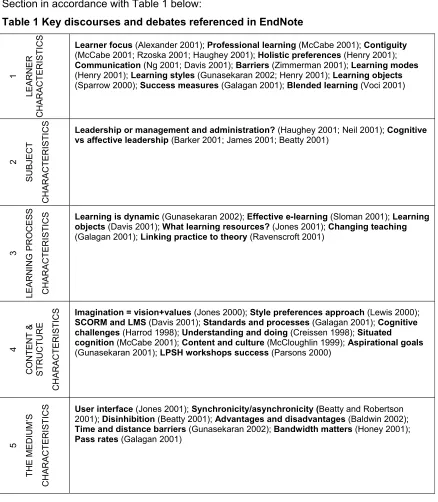
There were some 4,500 citations relating to some aspect of the review, but after careful study only 90 proved relevant. Not surprisingly given the novelty of the field of enquiry, few of the sources addressed any of our starting questions directly. However much relevant evidence emerged to inform these questions, both directly and indirectly. Extracting information from this literature revealed seven clusters, or fields, grounded in the various discourses within the relevant literature. These clusters revolved around:
1. Learner characteristics and preferences
2. Subject characteristics
3. Learning process characteristics
4. Content and structure characteristics
5. The medium’s characteristics
6. The technologies’1 characteristics
7. Ethical issues
Emergent effective practices
There is no one model of practice that guarantees total success of an e-learning for leadership programme, and indeed there is emerging evidence that the success of a programme is culture bound and may not be generalisable as a result. However, some common factors are beginning to emerge.
1 These are information and communication technologies (ICT).
BEST PRACTICES e-LE ARNING LEADERSHIP DEVELOPMENT BOUNDING CONCEPTS B E S T P R A C T IC E e-LEARNING
e-LEARNING FOR LEADERSHIP DEVELOPMENT LEADERSHIP DEVELOPMENT
© National College for School Leadership 2003 6
Of paramount importance in the learners' assessment of a course is the extent to which it satisfies their goals and aspirations. Leadership learners want content that is challenging enough to provoke reflective cognition. Evidence drawn from the literature suggests that
successful providers of online learning consider how learners' predispositions to ways of building and communicating knowledge impact on the learning process. Personal values may also be important here, although an alignment of the values of the programme with the personal values held by learners seems less important in a business context, where successful completion is linked to an acceptance of organisational aims and objectives, and may be a requirement for promotion.
Disregarding the approach of some business enterprises to e-learning for leadership where the organisational objectives may take priority, placing the learner at the centre of programme design and delivery emerges as the most effective practice. Focusing on the learner highlights good practices associated with both the pre-programme phase and the delivery phase of programmes. Effective pre-programme practices include taking account of the learners' needs, preferences, competencies and values (in an education context) in order to inform learning design and delivery. This may take the form of an individual learner needs analysis before the programme starts, a general analysis of user needs that informs material design, or a
combination of the two. The practice of adapting programme design and distribution in response to the learner's experience of the programme is achievable through a process of continual monitoring, which utilises appropriate measures – although this is rare.
In addition to the quality of programmes and their fit with the hopes and ambitions of those engaging with them, key success factors include ICT training for learners prior to the
commencement of a course. Following this initial training learners will continue to need ongoing ICT support throughout their courses together with ready access to a computer (preferably at home and in the work place) and stable internet provision delivered at broadband speed.
During the distribution of the programme it is good practice to make support available to learners as they engage with the programme – from tutors and from other learners. Effective practice also involves the provision of opportunities for learners to meet together as a group at least prior to embarking on the online elements of the programme. This encourages the establishment of group dynamics and facilitates subsequent communication and collaborative processes at individual and group levels. Where this occurs high levels of comfort with online communications can result with some headteachers then being happy for online interactions to replace routine face-to-face meetings and other contacts since they find they:
• are too busy with operations management during school hours to engage in synchronous communications
• prefer asynchronous email communication
• regard ICT as releasing them from the "tyranny of the telephone"
• have abandoned telephoning headteacher colleagues for information in favour of conducting their own online searches
Accepting that individuals will have preferred approaches to their learning, and responding to this by blending an electronic learning environment with more traditional classroom-based learning provision is a successful practice. It is very noticeable that in programmes that have a leadership component within a wider management remit, it is the leadership elements that tend to be addressed face-to-face. This seems to reflect both a recognition that leadership
© National College for School Leadership 2003 7
Finally, there are good practice implications for e-learning providers intent on remaining
competitive in the developing marketplace for the products and services related to e-learning for leadership. For example, higher education institutions will continue to rival one another, but they may also experience growing competition from private and public sector providers in their market segment. Recommended good practice in this situation is to emulate the operations of private sector enterprises – efficiency and effectiveness for example – while ensuring that the learning experiences on offer remain consistent with the personal needs and values of the learners.
Implications
What seem to be the characteristics of effective programmes in e-learning for leadership?
The implications flowing from the synthesis of evidence that emerged in the review are that effective practices in e-learning for leadership include:
1. adopting a learner-centric approach to the design and delivery of programmes 2. ensuring a learner-to-programme alignment through a range of pre-programme
diagnoses to ascertain:
• personal goals and aspirations
• learning style preferences
• competences with information and communication technologies
• time management capabilities
• ease of access to computers
3. creating programme content which accords with the cultural values of the professional learners
4. taking an efficient and effective approach to programme provision
5. providing opportunities for the professional learners to get to know one another prior to the commencement of programmes in order to optimise peer-to-peer and reciprocal learner-to-facilitator communications
6. encouraging the professional learners to develop a group dynamic in order to promote collaborative working within the e-learning environment
7. delivering leadership development by means of a blended learning structure although the proportions of a successful blend may vary widely
8. offering ongoing support to learners throughout the programme
9. devising and implementing measures through which programme quality and learner satisfaction can be continuously appraised
© National College for School Leadership 2003 8
Evidence from the literature
In pursuit of objectivity the evidence that follows is reported without comment. There are two main reasons for the eclectic nature of this evidence. First, compared to other literatures, the e-learning literature is immature and therefore incomplete. Secondly, the Evidence for Policy and Practice Information (EPPI) approach (see Appendix 1: Methodology) bounds the evidence within the inclusion criteria originating from the 11 research questions and excludes much material that is not evidence based.
1 Learner characteristics
Learner focus The work of Alexander (2001) conceptualises successful e-learning as taking place within a complex system where the failure of one part causes the failure of the whole. Researching with McKenzie in 1998, Alexander studied 104 e-learning projects. Their major finding was that the use of ICT does not of itself improve learning. They refer to a model of the student learning experience (Trigwell 1995) which advocates a systems approach to e-learning development. They point out that while the student experience of e-e-learning remains largely undocumented students do report that:
• support from tutors and peers has a major impact on their online learning
• time is important and time management training is required
• the ICT skill level of learners is important
Collaboration learning groups need to be encouraged to evolve because peer-to-peer learning and peer support within the learning process are valuable (Davis and Harden 2001). Learners can exercise agency for their fellow learners. Students, it is claimed, often prove the best tutors of other students. This kind of agency, facilitating the learning of others, could occur either in face-to-face, or in virtual environments although few studies actually show evidence of this. Ng (2001) attempted to utilise email in order to promote collaborative learning within a group of 35 Hong Kong Open University students. Only 10 of them participated in this study. The author interprets his data as showing that the online communication environment can affect:
• participation in a learning programme and in learning tasks
• social cohesion within groups of learners
• group dynamics
• levels of communication anxiety
Barriers The investigator argues that ICT must work within the socio-cultural context of learning. This means taking account of how individuals acquire and apply tools for thinking and acting in a given culture and society. He sees the challenge as being to integrate ICT with educational practice, learning experience and cognitive processing within the constraints of social and cultural norms. Ng cites work by McCloughlin (1999), who studied indigenous Australians and found that web-based instruction depends on culturally appropriate design. In this socio-cultural context account needed to be taken of learner values, student perceptions, styles of
communication and desired learning outcomes.
© National College for School Leadership 2003 9
email they subsequently experienced communication anxiety from what they perceived to be delayed responses from Ng even though the cause of some delays seemed to be due to the particular log on schedules of the individuals concerned. This study also found that a lack of non-verbal communication and oral cues was a further inhibitor to the use of email for collaborative purposes. Ng evaluated email as an ineffective tool with which to facilitate
message sharing and concluded that online communication requires the development of a new set of social and communication skills.
Success factors In New Zealand, Rzoska (2001) identified five critical success factors affecting e-learning in her sample of headteachers, which were:
• regular access to a computer, especially in evenings and at weekends
• pre-programme ICT training
• positive attitudes to trying something new
• readily available ICT support
• reliable internet service provision
From her findings Rzoska doubts whether e-learning can deliver a desirable educational experience for all school principals and whether ICT can offer the kind of interactions through which knowledge can be socially constructed to underpin professional development. Additionally in her study Rzoska concluded “…that the Coromandel headteachers who are both
geographically and professionally isolated need and want face-to-face opportunities for networking and professional development. They value professional relationships and believed that electronic learning is a supplement not a replacement for face-to-face learning.”
From Alberta, Haughey (2001) reports on the deployment of ICT among headteachers for a range of purposes, including professional learning, in their workplaces. She reports that in Canada ICT is located within a “stable and well supported overview of educational leadership”. In the wider political view, ICT in schools is regarded as important for the growth of Canada’s knowledge-based economy. In schools, in addition to the internet, ICT supports school
information systems (SIS) and headteachers regularly use database, presentation, management and administration software. Haughey writes that:
1. Contiguity has fallen out of favour with headteachers despite a previous culture in which informal breakfast meetings were regarded as important.
2. Headteachers:
• are too busy with operations management during school hours to engage in synchronous communications
• prefer asynchronous email communication
• regard ICT as releasing them from the “tyranny of the telephone”
• have abandoned telephoning headteacher colleagues for information in favour of conducting their own online searches
Learning styles E-learning consists of three core elements: content, technology and services (Henry 2001). E-learning providers/designers frequently fail to focus on the learning style
preferences of users and rarely offer more than one approach. Integrated learning paths tailored to the student, the subject material, the level of competence and learner preferences should be paramount. Gunasekaran et al (2002), like Henry, state that for corporate sector users e-learning is mission critical.
© National College for School Leadership 2003 10
users (McFarlane et al 2002). Reiterating Henry (2001), the e-learning experience has to be compelling for individual users. This means it must align with their goals and aspirations and in order to achieve this it needs to be appealing, valuable and productive. The experience from North America is that providers of e-learning have taken a one size for all approach. This is contrary to the recognition that users have individual learning preferences and styles.
Learning modes Kolb et al (1979) and subsequently Honey and Mumford (1992) demonstrated that learners do have learning preferences. Additionally, McCabe (2001) identifies three learning modes relating to school principals. These are:
1. foundational – regarded as all learning prior to appointment as a principal 2. experiential – regarded as:
• situational learning
• emergent learning
3. intentional – where an individual identifies his/her own learning needs together with a preferred learning strategy
Learning mode three above may describe an attribute of school principals in New Zealand, but this behaviour may not generalise to a population of headteachers anywhere else and the set of behaviours bounded within this intentional mode of learning may not transfer to other
populations of learners.
Learner autonomy Sparrow (2000) writes that e-learning puts the learner in control and, providing the appropriate bandwidth is in place, learners will be able to draw on a diverse range of learning objects. The writer claims that the power of e-learning resides in its ability to deliver distributed learning. Learning objects, or content according to Henry (2001), are defined as bits of learning content deliverable via the internet. Learning objects enable a pick and mix approach to tailored learning, but this calls for a common interface so that learners can select content from a range of sources easily. Bringing these elements together is seen as the key to achieving cost and learning efficiencies in e-learning.
Accepting learner sovereignty places substantial responsibility on learners to take charge of their own learning process. It may be that some of them, even many of them, are ill equipped to discharge this responsibility successfully. A scenario offered by Smith and Wild (2002)
elaborated from this approach shows learning provision being driven by ICT. The authors offer a new learning paradigm in which the power of ICT transforms organisations into the technology rich hubs of learning networks staffed by a range of education professionals and operating almost 24/72 for 52 weeks of the year.
Incentives The more online learning changes teaching, the more teaching remains the same – at least where motivating learners is concerned. Zimmerman (2001) reported that the American Society for Training and Development (ASTD) intended to develop standards for the certification of web-based training. In the process of working up these standards ASTD published the results of its survey of 10 companies and among the findings was that potential e-learners are less likely to use web-based training if it is only available on their workplace desktops. The survey also found that courses offering incentives – anything from framed certificates to digital cameras – were more likely to motivate users to complete. The survey also disclosed that the most popular courses were those comprised of blended learning.
© National College for School Leadership 2003 11
2 Subject matter characteristics
NCSL’s 10 Propositions for School Leadership indicate that the role of the headteacher is underpinned by both academic rigour and workplace developed skills thereby requiring that headship qualifications are grounded in both practice and theory. This applies not only to headship, but also to leadership at other levels within the school. Creissen and Ellison (1998) wrote that:
Greater responsibilities at the school level have resulted in greater pressure from a wide range of sources, including government and the teaching profession, for a more coherent approach to leadership and management development for both middle managers and for headteachers.
Leadership, or management and administration? Management and administration are both said to be concerned with operations, while leadership is concerned with envisioning an organisational future and developing and implementing strategies to achieve it. For Neil et al (2001) leadership should be concerned with the exercise of high level conceptual skills coupled with executive decision-making. Leadership requires the development of critical reflection, which operates at three incremental levels:
1. technical, or action level, focusing on what happened 2. analysis of underlying assumptions
3. consideration of moral/ethical assumptions
Cognitive vs affective leadership In addition to the properties of leadership highlighted above a number of authors also argue for the inclusion of affective elements in school leadership development. Beatty and Robertson (2001) examined two online communities; one in New Zealand for leaders in education, the other in Canada for exploring leadership and emotion. Crawford (2000) contends that the affective side of leadership is of the utmost importance. She researched the affective aspects of leadership in the context of a failing school. Taking this school as a case the author argues that the affective dimension of leadership is neglected. For Crawford emotions are an additional sense and are thus a way of knowing that enables
reflection on both an outer world (reality/objectivity) and an inner world (subjectivity) thereby providing a way of relating these two worlds with one another.
© National College for School Leadership 2003 12
3 Learning process characteristics
Professional learning Discussion of the relationship between learning delivery and learning processes needs to proceed from a concept of learning. Professional learning can be self-directed activity aimed at improving knowledge and skills specific to an employment role and in the context of school leadership professional learning can be defined as:
That which enhances [the] capability and effectiveness of [principals] in their role as a leader [in] their schools. (McCabe 2001)
Learning is dynamic Some areas of discourse in the literature are evangelistic about e-learning. Gunasekaran et al (2002) define e-learning as internet-enabled learning and enthuse about the opportunities it offers for the development of dynamic learning models. The authors claim that e-learning enhances knowledge, skills and performance and that ICT, the
technologies which enable e-learning, will deliver a range of benefits including:
• an improved quality of learning
• easier access to education and training
• reduced costs of education
• improved cost-effectiveness of education
The web-enabled environment in which e-learning is offered is characterised by interactive, self-paced multimedia instruction, the assessment of knowledge and skills, the availability of
performance support materials and online communication with tutors and peers.
Aiming to “make learning widely accessible, just-in-time and better than being there” the Lucent Technologies’ Learning and Performance Centre (LPC) has drawn up a table of benefits it ascribes to the application of ICT to learning compared to traditional learning and this is reproduced below.
ICT and traditional learning compared
SYNCHRONOUS ASYNCHRONOUS
Consists of scheduled events (classroom
and technology-based) Empowered learners determine where and when they acquire learning
Instructor motivates attention and sets
the pace Self-motivated learner sets the pace (leading to faster assimilation of coursework)
Courses are quick to develop and economical to revise
Courses are delivered close to needs and are inexpensive to deliver
Instructor answers questions Fosters learning by doing
Instructor assesses learning (homework, Q&A, testing, evaluation)
Assesses learning by performance (simulates job the student is doing)
Supported by culture of traditional schooling
© National College for School Leadership 2003 13
Some aspects of the Lucent Technologies example are reinforced by the e-learning model adopted by the University of Glamorgan’s Business School (UGBS). There is a virtual classroom featuring tutor/learner interactions in a collaborative, multimedia environment capable of running on an internet, extranet or intranet. As with the American corporate so with UGBS the value proposition associated with e-learning focuses on cost effectiveness and on flexible learning. The Glamorgan model was underpinned by the work of Salmon (2000) involving samples of Open University students and corporate candidates. Salmon identified the following five stages in the development of e-learning as an enabler of learning processes:
1. access and motivation 2. forming online relationships 3. information exchange 4. knowledge construction 5. development
E-learning delivers programmes online and relies on an integrated web-based infrastructure featuring:
• a learning portal
• a learning management system – involving registration, scheduling and diagnostics
• content – requiring provision and ongoing assessment
• learner support – via discussion groups, virtual classrooms and online learning
What learning resources? Striving for quality assurance led UGBS to draw up a set of criteria, through which the business school was able to identify Blackboard as the appropriate virtual learning environment, which it subsequently adopted. Jones ( 2001), who reports on the UGBS model of e-learning, states that an outcomes-based approach to e-learning facilitates course design. She also argues that a successful programme delivered within an e-learning
environment will rely heavily on:
• provision of a learning resource centre
• Online Public Access Catalogue (OPAC) resource cataloguing
• electronic access to journals via online databases
• subject gateways – which are accessible electronically
The author further contends that the user interface is a key element in an e-learning programme and that multi-disciplinary teams on the supply side are crucial. This implies a need to integrate functions such as registry, teaching, library, corporate and learner services in a way that is transparent to the user. In considering what model of e-learning to adopt in support of learning processes, UGBS considered the work of Britain and Liber (1999), who in turn cited the work of Mason (1998), which identified three potential models:
1. content and support – featuring low online activity typically involving less than 20 per cent of a learner's time
2. wrap-around – optimum for distributed learning requiring 50/50 online activity to other elements of blended learning
© National College for School Leadership 2003 14
Finally, there is another resonance of Lucent Technologies when Jones (2001) provides a table comparing traditional pedagogic assumptions with assumptions about e-learning. This is reproduced below.
Characteristics and assumptions of traditional and e-learning universities
INPUT TRADITIONAL
CHARACTERISTICS AND ASSUMPTIONS
E-LEARNING
CHARACTERISTICS AND ASSUMPTIONS
Place of learning Students come to the
university campus Students based anywhere working from home or place of work
Mission Defined by quality of
teaching
Defined by quality of service and support
Funding Measured by FTEs –
hours of input/learning hours
Based on learning outcomes
Curriculum Relatively stable Dynamic (but within prescribed curriculum outlines)
Instruction Primarily face-to-face,
mainly teacher-centred Online student centred
Faculty Full time members of staff emphasis on instructional quality
Full time and part time staff with emphasis on quality of support
Students Meets admission
requirements – little ongoing measurement of change in overall learning
Ongoing assessment of individual student’s progress. Formative assessment in the public domain
Library Increasing volumes in
library Online resources/journals. Collaborative libraries
Learning technology Used to supplement or enhance lectures
Central teaching process
Physical facilities Central physical plant – halls of residence, students’ union,
healthcare, classrooms
© National College for School Leadership 2003 15 Changing teaching The evidence drawn from both Lucent Technologies and UGBS indicates that electronic learning enhances the quality of learning processes while making cost savings. Galagan’s (2001) work contains a reminder that learning effectiveness should not be confused with cost effectiveness. The nature of cost effectiveness in both the above examples is related to delivery costs. No data are made available about development costs either in relation to
designing courses, or in connection with developing technology infrastructures.
Linking practice to theory E-learning consists of learning processes and interactions that are stimulated, supported and favoured by innovative educational technologies. Ravenscroft (2001) takes a 50-year sweep of learning theories to arrive at Vygotsky's (1978) theory of the
development of higher mental processes. From this perspective the writer contends that dialogue models and dialogue games are important elements in the learning process and that therefore e-learning needs to provide opportunities for collaborative, argumentative and reflective discourses.
Piaget is labelled as a cognitive constructivist, whose initial study of learning processes was conducted with a very small sample of children. Vygotsky builds on Piaget’s theory of learning by including the social setting and not being confined to the individual as a frame of reference. Vygotsky is a social constructivist and his learning theory is a socio-cognitive one. From this perspective activity theory is developed, which advocates that learning processes should be set in a social, cultural and historical context.
Ravenscroft proposes that meaning arises and evolves during transactions that are influenced by the social relations within a community. The writer argues that the link between current educational practice and learning theory is quite weak and goes on to identify the need for a science of learning technology design aligned with stable and theoretically grounded interaction models.
4 Programme content and structure characteristics
Imagination = vision+values Parke-Davis Pharmaceutical Research and Development initiated a systematic process in originating and structuring programme content aimed at increasing the leadership capabilities of its scientific management staff. The project described by Jones et al (2000) was underpinned by the idea that leadership should focus on imagination consisting of vision and values and on application consisting of translating theory into practice. The goal of the Parke-Davis leadership programme was to shift the perspective of management staff from following the science to leading other scientists.
In the corporate sector there is a dichotomy. Some business enterprises take control of content and structure to ensure that programmes align with business aims. Other business entities advocate a learner centric approach to programme content and structure rather than a business centred one. In the literature this latter approach seems to be prevalent among commercial e-learning providers.
Style preferences approach IBM's Basic Blue for Managers is an example of an e-learning programme aiming to develop leadership with 30,000 managers worldwide. From their experience of Basic Blue, Lewis and Orton (2000) challenge the learning style preference
© National College for School Leadership 2003 16 Effective e-learning Writers point to the successful delivery of skills training via e-learning, but for Sloman (2001) this form of learning is most effective in supporting the acquisition of
knowledge; least effective where interpersonal skills need developing. Sloman writes that e-learning will have most impact as part of a blended approach to training. A blended approach to content delivery to underpin the learning process is also recommended by Davis and Harden (2001). A blend of e-learning plus CD-Rom multimedia plus classrooms plus tutors is claimed to be the most effective, especially in medical training.
Learning objects With the application of blended learning curriculum planning and course design will require re-thinking. Courses can now be built to take advantage of re-usable learning objects. Rusable learning objects are predicted to become the instructional technology of e-learning. Re-usable learning objects are also known as content objects, knowledge objects and re-usable information objects. Objects are sometimes referred to as bits. Bits can be colour images, video clips or self-assessment questions. They can be given meta-tags and stored as digital entities in a repository of learning objects to be drawn upon as required.
This approach generates economy and efficiency. It is also claimed that students will be able to build their own courses to meet their own needs, but this is a view likely to be hotly contested by teachers and trainers. If re-usable learning objects represent the way forward for writing courses then it follows that a management system (LMS) will be essential. An LMS will serve as an enabling technology for e-learning and will facilitate the management of students, interactions, content, delivery, quality and performance.
Those managing learning processes will be required to deploy their skills in different ways when delivering learning content through ICT systems. Sloman refers to the ASTD and its identification of a number of emergent roles involved in the application of learning technologies.
They include the:
• designer, who determines content and learning methods
• implementer, who works with technical staff to provide logistical support
• instructor, who facilitates learning either in a live broadcast, or a high-tech classroom
• organizational change agent, who helps an organization adopt to new technology and see its value and benefits (Sloman 2001)
From these roles Sloman goes on to predict that three functional specialisms centred on the design of learning processes, the delivery of learning content and the support of learners will develop as e-learning moves towards attracting a critical mass of users.
There is evidence indicating that such functional specialisms may have been applied at Lucent Technologies. This enterprise was spun out of the American AT & T Corporation more than six years ago and has gone on to become a leading player in the design and manufacture of information and communication technologies and software. Like many other global corporate enterprises Lucent Technologies continuously looks to the development of its intellectual capital as a source of sustainable competitive advantage. Skills and knowledge have a short half-life in the knowledge economy and this company invests heavily in training and developing its
workforce in order to remain at the leading edge. Being a commercial enterprise it is unsurprising that learning and development strategies are closely aligned with business strategies.
© National College for School Leadership 2003 17
classroom environments under the direction of a trainer/teacher with content called up over a digital network by learners and under their control. Naish (2002) uses a cookery metaphor to explain blended learning and the principle of a preferred sequence for mixing ingredients. In the same way that:
…onions should be fried before they are added to the blend rather than boiled, to retain their flavour. So blending has to do with intentional, sequenced integration of the different elements and those elements must be prepared using techniques that are appropriate for what we are trying to achieve.
The author writes that for effective blended learning intentional sequenced integration should be brought together with appropriate learning methods and supported by technologies which have the capacity to cope with the blending process. He offers the programme of e-leadership developed by the Center for Creative Leadership (CCL)3 as an exemplar and highlights the CCL’s blended learning sequence as:
1. virtual kick-off
2. a three-day workshop with face-to-face interaction between CCL facilitators and candidates
3. a business project
4. three x one-month electronic modules 5. individual coaching
6. internal mentoring
7. a two-day face-to-face workshop
Evidence presented by Voci and Young (2001), drawn from a six-month leadership programme employing blended learning, suggests that combining these two learning models – traditional and blended – produced outcomes including:
• improved bonding within teams and team working outputs
• the development of communities of practice united through shared concepts and language
• enhanced efficiencies in group learning
Designing the blend The mission of Lucent’s Learning and Performance Centre (LPC) is to provide:
…the learning solutions that the individuals and organisations within the company need for success. (Harrod et al 1998)
A key part of the centre’s learning services delivery is based on an 80/20 division. In the LPC context:
The 80 per cent, or asynchronous, portion may be either individual, or team, based with students themselves determining how best to accomplish the required learning.
3 There are more details about the blended learning in the journal article, but the study undertaken by the
American Society for Training and Development, which published its findings in ‘T+D’ is not referenced by Naish. However, the full version of Naish’s article – ‘Blending or mixing?’ is available online from
© National College for School Leadership 2003 18
The remaining 20 per cent of learning is synchronous and contiguous. In this portion the learning process is instructor driven and takes place in traditional classrooms, or technology-based environments.
These ‘students’ have a mix of technology and traditional resources at their disposal to support them in achieving their learning objectives. In terms of access channels there are the
organisation’s intranet and the internet. In addition to CD-ROMs and electronic libraries there are streamed videos and videotapes. For person-to-person and trainer-student communications there are email, teleconferencing and videoconferencing facilities. Access to books and journals seems commonplace by comparison. The LPC employs a range of metrics allied to learning outcomes and claims that its 80/20 blended learning model achieves learning rates that are between 1.25 and 1.50 times faster than learning that is solely classroom based.
SCORM4 & LMS5 Scalability in distributed learning will become a critical concern as adoption of it reaches a mature level. In the United States the scale of take up of distance learning in higher education had already reached 1.7 million students by 1997/98 with the most popular channel being asynchronous internet instruction. Scalability raises a concern for the introduction of common standards. Davis and Harden (2001) report on SCORM developed by the US Government’s Department of Defence in its Advanced Distributed Learning (ADL) project. SCORM enables the use of web-based learning content across multiple environments and products.
E-learning embraces four major components, which are courseware, authoring software, virtual learning environments (VLE) and learning management systems (LMS). If SCORM becomes the de facto standard the courseware component – the content and structure of e-learning packages – will need to be SCORM compliant.
…in e-learning, as in other areas, the solution that offers most hope is the establishment and adoption of standards. If all systems have a common core of functionality they will be [compatible] and investment will be protected…so long, of course, that they comply with the standards. And that those standards are future-proof. (Newman 2002).
In addition to business aims and learner centred issues the content and structure of programmes are also impacted by technological imperatives.
Standards and processes E-learning needs processes and standards, like SCORM, plus ICT tools such as virtual classrooms and video server technology as well as templates for developing course content when very large numbers of learners are involved (Galagan 2001). Galagan also touches on scalability in writing about Cisco Systems and describing its three different e-learning audiences:
1. 10,000 system engineers, who have a learning portal, which has achieved a 95 per cent log on with this community
2. 40,000 re-sellers employing about 200,000 staff in 132 countries for whom a dedicated site was developed in three months from scratch
3. 100,000s of users of Cisco products/services
4 An acronym for Sharable Content Object Reference Model
© National College for School Leadership 2003 19 Cognitive challenges Harrod and Townsend (1998) draw attention to the need for
Understanding and doing content to offer sufficient cognitive challenges and to be
Situated cognition structured in such a way that it contains no barriers to the extraction of information by learners. The content of developmental programmes for school leadership needs a significant school-based element so that there is understanding as well as doing (Creissen and Ellison 1998). The authors argue for the importance of vision as the focus of leadership and target the development of competencies, which they regard as the potential of candidates to deploy constructs in real situations within contextual and cultural constraints rather than competencies, as the most important aspect of courseware content. One thread of
discourse in the literature develops the proposition that a major advantage of an e-learning community resides in the asynchronicity of online forums because this aspect of ICT allows reflective cognition. McCabe (2001) writes that reflective thinking is of higher quality than reactive cognition, which characterises conventional classroom-style synchronous interactions.
Content and structure In addition to programmes being intellectually appropriate there is debate in the literature suggesting that effective web-based instruction also depends on culturally appropriate design (McCloughlin 1999). Thus content and structure will need to consider learner values, student perceptions and styles of communication in pursuit of the desired learning outcomes. Where learners are expected to achieve standards in their professional qualifications then structure and content need to be informed by evidence drawn from empirical research (see Levacic and Glatter 2001 below).
Aspirational goals For learners the e-learning experience must fit tactically and strategically with their goals and aspirations. This means courseware has to be appropriately structured and offer compelling content in order to be appealing, valuable and productive (Gunasekaran et al 2002). In this regard NCSL’s Leadership Programme for Serving Headteachers (LPSH) is described as being designed to deliver a behavioural model of leadership in which the leadership style, competencies and characteristics of a headteacher are linked to school performance (Parsons et al 2000).
LPSH workshops success The model is based on a Hay McBer development programme originally aimed at senior managers in the private and public sectors. LPSH contains self-development and diagnostic elements. There is also a supporting element provided by Partners in Leadership, which links headteachers with business and offers an ICT component. The authors evaluated the four-day LPSH workshops, which groups of 14 headteachers attended at a time. The fieldwork was conducted with 20 workshops. In addition 1,400 headteachers participating in LPSH were surveyed and 60 LPSH/workshop trainers were also surveyed. Subsequently 20 per cent of trainers and 75 per cent of headteachers were interviewed. The researchers reported very high levels of user satisfaction indicating that in this programme content and structure matched with the candidates’ goals and aspirations.
Quality standards The concern with standards and measurement are recurring themes in the literature. Technical standards in relation to SCORM were raised earlier (Davis and Harden 2001), but returning to the matter of quality and fitness for purpose commented on by Wallace earlier, Roffe (2002) sees e-learning as a new instructional paradigm. His view is:
...in terms of learning the ‘e’ term has less to do with electronics and much more to do with the other ‘e’s: the engagement of the learner, the enhancement of the learning, the experience of exploration, the ease of use, the empowerment of the learner to control the learning schedule and the execution of the learning programme.
© National College for School Leadership 2003 20
and finds none of them entirely satisfactory. Finally Roffe presents a framework for assessing e-learning, which focuses on the:
1. number of learners going through the programme 2. efficient use of resources
3. effectiveness of the results achieved 4. return on investment
He reveals the process favoured by the University of Wales and discusses it in some detail to demonstrate how it is being applied in this Institution.
Precepts for an e-learning quality assurance strategy reproduced from Roffe (2002)
QAA GUIDELINE E-LEARNING STRATEGY PRECEPTS
System design Clear governance and control throughout an organisation, especially where there is a disaggregrated design environment
Academic quality and standards Attention to academic tasks to support the e-learning curriculum
Management Appropriate choice and effective
management of technology qualifications of staff
Student development Electronic support for pre-entry
counselling, motivation and autonomous learning needs
Student communication Electronic participation to address student needs as well as strategies for feedback, to contribute to meetings and to disseminate information
Student assessment Capabilities for e-learning are applied to enhance student assessment and achievement
5 Medium and channel characteristics
User interface The networks through which learning content is distributed
© National College for School Leadership 2003 21 Disinhibition In this respect Beatty and Robertson (2001) offer a counter view in a rich
exploration of the affective aspect of some digitally networked communities established for purposes of discussion. They argue that digitally mediated discussions can have a disinhibiting effect allowing individuals to break free of the so-called conspiracy of silence, which normally masks their affective natures. The authors refer to 'flaming' as emotional responses to aspects of discussion and to 'framing' as calming behaviours aimed at reducing the effects of flaming. They suggest that males seek individuation and females seek affiliation through their online
exchanges.
Advantages and disadvantages While Ng (2001) reported on the reluctance of students to
Time and distance barriers use email, Gunasekaran (2002) regards the web and its facilitation of email communications as combining to eliminate time and distance barriers. By these means time zones and geographical separation may have been overcome, but the availability of time to interact with e-learning has emerged as a new constraint (Mason 2001). The survey by McFarlane et al (2002) shows that for busy teachers and headteachers, time is an overhead and there is an opportunity cost associated with this scarce resource. If going online has a perceived time penalty and the experience is comparatively unproductive then users cease to engage with the technology. In this sense time has become the new distance. Further advantages and disadvantages bound up with the properties of the medium and its associated distribution channels are identified by the Croydon Market Research Centre, which surveyed 1,021 companies with 500 plus employees for COROUS – the Open University's corporate division (Baldwin 2002). Of these 30 per cent had already used online staff
development programmes and another 30 per cent said they would consider using it. The Open University was ranked as the most trusted potential supplier for online learning packages. Respondents said that the advantages of online learning included staff being able to learn at their own pace and in their own time. Online learning was described as being convenient, flexible, easy to use and available to a wide audience. The disadvantages reported included:
• learning being impersonal with no interaction with teachers, or peers
• no offering of personal feedback
• not being suitable for all subjects
• requiring a measure of ICT literacy before commencing
Virtual communities While there are discussions in the literature in which the term ‘community’ is frequently used its meaning is unclear. There are, though, definitions of community in the literature relating to knowledge management where the term refers to communities of practice. In the knowledge management domain communities of practice are comprised of professional learners and can be real, or virtual. Lave and Wenger (1991), for instance, are credited by Hildreth et al (2000) as the first to introduce the concept of communities of practice, or CoPs. Lave and Wenger define a real community of practice as:
A set of relationships among persons, activity and world, over time and in relation with other tangential CoPs.
Their concept is analogous to an apprenticeship process in which situated learning, legitimate peripheral participation and “…generative social practice in the lived in world” are key factors. It is also possible for CoPs to become virtual6 and Voci and Young (2000) claim this as an outcome, but this seems to contradict one of the success criteria established early on by Lave and Wenger, which concerned the importance of face-to-face contact. Key aspects in successful
6 As demonstrated at Buckman Laboratories (Graham and Pizzo 1997; Pan 1999; Despres and Chauvel
© National College for School Leadership 2003 22
virtual CoPs are a “shared domain language and knowledge". In some circumstances
professional learners form, or are formed into professional groups. Members of these groups display shared values, common aims and collective expectations, which function as a glue bonding them together. Where this activity takes place within an online community it is mediated by the technologies involved. Asynchronous and non-contiguous communications are two of the mediating characteristics of e-learning technologies and what these technologies offer are virtual transactions and virtual social interactions free from the constraints of time and place. No
evidence was found in the literature concerning the extent to which e-learning can be used to create, or support, such a community.
Data from New Zealand show that the rate of take-up of ICT in the country’s schools has been astonishing. In the five-year period ending in 1999, internet access in primary schools in New Zealand rose from 14 per cent to 96 per cent. More than half of New Zealand’s schools have fewer than six teachers and almost half of its schools are in rural locations. While very few New Zealand primaries did not have a web connection by the end of the last century, only 34 per cent of school principals were accessing the internet on a daily basis. McCabe (2001) had expected that as ICT was so widely available in schools a much larger proportion of principals would have been using it.
She accepts that a lack of ICT facility among principals was very evident in her sample and that the majority of the sample lacked ready access to a computer in a suitable workspace, but the disadvantages of the virtual environment featured in e-learning were revealed by Waikato principals in relation to:
1. cognitive content, which frequently failed to challenge, or meet their specific needs 2. frustration with capturing content from a mass of material because it was
inadequately structured
Holistic approach From the private sector these two disadvantages are supported by Henry’s (2001) advocacy of a total approach to the application of electronic learning by which he means harnessing of the power of the internet to deliver learning, skills and knowledge in a holistic approach neither limited to any particular educational programmes nor to infrastructures and technologies. “Most of all”, he argues, “e-learning needs to be compelling to the audience it targets, offering the learners a resource that is seen as appealing, valuable and productive to their goals and aspirations.”
Communication Among the claims made in favour of asynchronous communication is that it allows time to reflect and polish a response before it is delivered (Hall 2001). However, for the Waikato group this potential benefit was outweighed by the perceived increased effort required compared to face-to-face transactions. The lack of real social interaction and communication in real time are issues raised elsewhere in studies of school leadership in New Zealand. Rzoska (2001) describes a delivery model and some outcomes associated with Making Changes, which was a headteacher development programme operating in the year 2000 in schools on the Coromandel Peninsula in New Zealand. Here an annual staff turnover of 75 per cent among headteachers in this remote region had been recorded prior to the intervention project. In the year following completion of the Making Changes programme there was only one change of headteacher in the 48 schools participating in the study.
© National College for School Leadership 2003 23
assumed ICT literacy amongst the headteacher population, which proved to be a misperception. Only three headteachers went online in the 12 months of the programme when online working was available. The reasons for this low take-up were cramped and inappropriate working conditions in the school amounting to shared office space, slow access speed and instability with the internet and restricted access to the school's single computer. These headteachers preferred face-to-face visits and the instant communication offered by telephoning, followed by fax and then e-mail.
Bandwidth matters The web-enabled environment is characterised by interactive, self-paced multimedia instruction; the assessment of knowledge and skills; the availability of performance support materials; and online communication with tutors and peers, which contradicts some of the disadvantages recorded in the COROUS survey above (Gunasekaran 2002). The web-enabled environment also contrasts sharply with distance learning, which lacks both interactive and live offerings (Rich 2001). E-learning enables networking and blended learning through access to multimedia, but as Honey (2001) points out, for multimedia and the range of electronic sources – referred to in the Lucent Technologies example – to run effectively requires sufficient bandwidth.
Without fast connections the danger is that e-learning could be reduced to e-reading. To prevent the potential of this digital medium from being vitiated Honey advocates that the channel
characteristics should include technologies that work and internet access that is trouble-free. Additionally, users should come to electronic learning with at least basic ICT competences and should be motivated learners. The writer champions learning as process and not as product. In his vision learning becomes a learnable process that enables learners to convert data and information into meaningful knowledge.
In support of Mason’s contention that time is the new distance, Honey claims that e-learning providers ignore the fact that learners have to find the time and the space in which to learn. His evidence in support of this comes from the Campaign for Learning survey, which shows that 58 per cent of users learn in the workplace and 29 per cent of them learn at home. This survey also finds that employers have no interest in their employees’ learning style preferences. The
evidence is that 47 per cent of employers surveyed in the Campaign for Learning claimed that e-learning had been tailored to meet individual needs, but only seven per cent of employees in the survey agreed with this.
Pass rates Data from Lucent Technologies above appears to demonstrate that one
© National College for School Leadership 2003 24
6 ICT hardware and software characteristics
The literature searches surfaced a number of definitions of e-learning, which range from the more facile to the more thought provoking. The source of the definition of e-learning adopted in the Review’s Methodology Section (pages 6/7) was in a survey of 204 major UK companies conducted in July 2002 by Taylor, Nelson, Sofres for SkillSoft. Sixty three per cent of
respondents identified the description of e-learning as: “Internet, or intranet, based training that enables users to access training courses and learning materials on a computer.” (Baldwin-Evans 2002)
Key components From a consideration of its associated hardware and software Jones (2001) identifies the key components of e-learning as a learning portal, an LMS, courseware and a virtual learning environment such as Think.com (now talk2learn), Blackboard or other virtual environment in which learning can occur. The complexity of the technologies and systems involved in e-learning calls for the development and application of what Ravenscroft (2001) referred to as “a science of learning technology design”, which itself needs to be grounded in learner behaviour and their modes of interacting with the appropriate ICT.
Critical success factors Reflecting on learner behaviour stemming from interaction with these technologies Rzoska’s (2001) five critical success factors affecting e-learning are apposite. Her recommendations are that there should be:
1. regular access to a computer, especially in evenings and at weekends 2. pre-programme ICT training for learners
3. motivation of learners to adopt positive attitudes to trying something new 4. readily available ICT support for learners to call upon
5. reliable internet service provision, which is both stable and fast
Alignment needs From an interpretation of empirical evidence gathered in Australia, Alexander (2001) concludes that the deployment of ICT hardware and software needs to be aligned with the core business of organisations. Where investment in e-learning is substantial7 it seems reasonable that organisations should expect a return on investment through such alignment.
New learning paradigm Online technologies are continuously changing the learning by
listening paradigm to a paradigm that features learning by doing instead (Harrod and Townsend 1998). The ICT associated with developing skills and professional knowledge has enabled training programmes to migrate from the classroom to the internet, intranets and extranets and from learning centres to workplaces thereby offering new and stimulating opportunities for both learners and programme providers.
7 Australia’s RMIT University committed AUS$50 million to this during 1999–2001 and the University of
© National College for School Leadership 2003 25
7 Ethical issues
Is ICT neutral? Wright (2002) doubts whether ICT, by means of which some elements of school leadership are delivered, can be a neutral force. He raises the spectre of a hidden agenda in the wholesale and uncritical adoption of ICT in schools and its further application in the professional development of leadership with headteachers. Wright takes a value position in relation to managerialism and makes leadership synonymous with managerialism.
Although he offers no empirical evidence with which to underpin these concerns, the author points to what he sees as inherent dangers in a reliance on positivist methods when applied to researching ICT. Wright sees something inherently worrying in the manner in which data are coded, stored, manipulated and distributed. He sees mathematics, especially algebra, and logic, especially the Boolean variety, as potentially reductionist. Thus headteachers could be misled into forming a distorted view of reality in which qualitative phenomena may be overlooked in favour of the quantifiable.
Compatible values Headteachers too expressed ethical concerns, but these were about the compatibility of business values with educational values in the Partners in Leadership element of LPSH (Parsons et al 2000). A large proportion of those surveyed, 83 per cent of them, also considered the ICT component of this LPSH component to be ineffective.
Market competition While LPSH candidates have reservations about the compatibility of education and business values, higher education institutions are involved in market competition with e-learning providers from the private sector. In this context the boundary between education and business is becoming increasingly fuzzy. Defining e-learning as the application of ICT to online delivery of educational courses as part of traditional on-campus provision, to distance learning, or as part of corporate training Lewis and Orton (2000) states that e-learning offers resource efficiencies after initial investment and this will help higher education institutions maintain market share.
This author draws attention to the pressures for change generated by the potential of ICT. She identifies e-commerce, student learning, the role of teachers and market forces as the major drivers and offers her view that e-learning will develop into a global market place. In the USA virtual learning in the higher education sector is projected to be worth $10 billion in 2003 with a further $11 billion in the corporate sector making this market attractive to venture capitalists. According to Lewis, the higher education institutions and corporate sectors will continue to emerge as differentiated segments in the provision of e-learning.
She argues that UK higher education institutions can take advantage of the innovative potential of networked learning by developing a B2C (business to consumer) approach to education. The author refers to three models drawn from Means and Schneider (2000) in this respect:
• bubble-in: where the e-learning division operates within the institution alongside conventional teaching, but competes for resources
• bubble-out: in which the e-learning division is spun out as an independent business
• transformation: where e-learning provision becomes the core business and the higher education institution becomes a virtual university
An example of ‘bubble-out’ is provided by Rich (2001), who refers to the University of
© National College for School Leadership 2003 26
E-learning offers borderless education, which is both an opportunity and a threat for UK
universities. They will need to compete in this marketplace, but with an estimated investment of £5 million needed to produce an online degree course and 200 staff hours required to output one hour of computer-aided learning resourcing costs are prohibitive. Consequently to exploit this opportunity will call for strategic partnerships/alliances, possibly outsourcing and the formation of various consortia.
Lewis suggests how higher education institutions could exploit these models and regards the conversational framework of student/teacher dialogue operating in the mediated learning process as a competitive advantage for these establishments. Lewis concludes by identifying five critical success factors for higher education institution survival in the evolving global marketplace for electronic learning namely:
1. a clear understanding of targeted global segments
2. the adoption of integrated business systems with emphasis on student delivery via personalised web portals
3. the ability to manage effectively the introduction of new technology 4. organisational responsiveness
© National College for School Leadership 2003 27
In conclusion
A caution
The literature concerned with e-learning for leadership is fragmented and therefore offers only snapshots, some with higher granularity than others, rather than a clear and complete picture of what might constitute effective practices in e-learning for leadership. It is noteworthy that no meta-analysis or previous reviews are available, which is almost certainly a result of the immaturity of the field. It also is debatable whether some studies of school leadership
development satisfy the criteria applicable to robust research. However, successive searches of the literature have surfaced several examples of e-learning for leadership and e-learning applied to other developmental goals, which demonstrate partial good practice.
Cross-national comparisons of Canadian and New Zealand studies of headteachers as professional learners suggests that some findings may be bound to a particular culture or context. Additionally, the findings from the business sector, where motivations to complete may be very different, may also be highly contextual. This may mean that these research outcomes are not capable of generalisation to populations of professionals, or to professionals in other countries.
Complex interactions
Formulating effective practice indicators in the field of e-learning for leadership needs to be informed by the contents of the seven information clusters above. These clusters frame potential connections between learner characteristics and preferences and the remaining six categories. So, in the design and implementation of e-learning for leadership, consideration must be given to how the characteristics and preferences of learners might interact with the subject, learning processes, content and structure, the medium, information and communication technologies and ethical considerations.
Next steps