MINING ENVIRONMENTS:
THE GOOD, THE BAD, AND THE UGLY
1Bernd G Lottermoser2
Abstract: Since the first scientific observations on mining environments over 400 years ago, we have gained some phenomenal knowledge on mine, land and waterways degradation and related environmental protection issues. Yet today, we continue to be faced with numerous challenges, including the recurring failure of mine waste repositories, the unconstrained production of acid rock drainage and the widespread dispersal of contaminants from mine sites into the environment. More than ever, environmental scientists have important contributions to make as they provide the data necessary for rational decision-making in critical areas such as resource development, environmental protection, waste management and remediation, as well as mine, land and waterway rehabilitation.
The most urgent problem facing environmental scientists working on mining environments is the quantification of the interactions that control the distribution of contaminants in rocks, soils, sediments, waters and biota. We must precisely describe the chemistry and mineralogy of contaminants and understand their long-term behaviour. We need to drastically improve our scientific efforts to explain environmental processes at mine sites on all scales, including micro and macro scales as well as in 3-D and 4-D. In addition, we must improve our predictions on mine drainage, aquifer and final void water quality. While the rehabilitation of many mine sites and waste repositories is pursued by using best practices, we must continue to search for innovative, cost-effective remediation technologies and sustainable rehabilitation practices. Evaluations of recently rehabilitated mine sites could produce data on the successes and failures of rehabilitation efforts. Such studies should sharpen our ideas on the factors leading to contaminant dispersal and the development of new remediation technologies. The rehabilitation of mine sites and secure disposal of mine wastes require a new precision in the total description of mine sites and an understanding whether our current rehabilitation practices are sustainable in the long term.
There is reason for optimism that the required progress is possible. Such optimism is based on the phenomenal advances in our ability to observe and describe mining environments. However, detailed studies of natural, mined, contaminated and rehabilitated environments are necessary if we are to quantify the variables controlling the containment and dispersal of contaminants and if we are to develop innovative remediation protocols. Our efforts could ensure that the 21st century goes down in history as that of “green technologies”.
Key Words: uranium, gold, base metals, rehabilitation, remediation, reclamation.
1
Paper was presented at Mining and the Environment IV Conference, Sudbury, Ontario, Canada, October 19-27, 2007.
2
Bernd G. Lottermoser, Associate Professor, School of Earth and Environmental Sciences, James Cook
Mankind is feeling the limitations of its science and technology despite all the advances in knowledge on mining environments and the improved practices in mine site rehabilitation and mine waste management. Tailings dams continue to fail and leak; waste rock dumps erode; capping designs of mine waste repositories do not succeed; mine-derived contaminants are dispersed into the biosphere, hydrosphere, pedosphere and atmosphere; predictions on the long-term kinetic behaviour of mine wastes turn out to be incorrect; and the long-term costs of mine site rehabilitation can be staggering (Lottermoser, 2007). As the perturbations have become recognised, our lack of knowledge of fundamental environmental processes at many mine sites has become obvious. The time has come to drastically improve our scientific efforts to understand these processes on all scales.
The objective of this paper is to review some of the characteristics, environmental impacts and failed rehabilitation methods pertaining to mining environments. The paper will draw predominantly on “the good”, “the bad” and “the ugly” examples of mining environments from Australia and elsewhere to illustrate our advances in knowledge (“the good”), the gaps in our understanding (“the bad”), and the challenges ahead (“the ugly”).
The Good: Rio Tinto, Spain
Acid rock drainage (ARD) resulting from the oxidation of sulfides in mine wastes is a major environmental issue facing the mining industry today. This pollution process has a long history dating back thousands of years when the Rio Tinto mining district of Spain experienced periods of intense mining and the associated production of pyrite-rich wastes and ARD waters. ARD production must have been occurring at least since the first exploitation of the Rio Tinto ores 5000 years ago (Davis et al. 2000), which highlights the long-term nature of ARD.
At Rio Tinto, successive mining activities have resulted in the creation of a unique “mining landscape” (Fig. 1). The region has numerous abandoned mine workings and is littered with derelict buildings and disused mining and processing equipment. There are also uncountable waste rock heaps, ore stockpiles, tailings dumps, slag deposits, and settling ponds, most of which do not support any vegetation. The lack of vegetation on sulfidic wastes and local soils increases erosion rates into the headwaters of the Rio Tinto. Pyritic waste particulates are transported into the river tens of kilometers downstream of the mine and processing sites (Hudson-Edwards et al., 1999). The erosion processes exacerbate the “moonscape appearance” of the area affected by mining, mineral processing and smelting activities. Most importantly, the Rio Tinto mining district is characterized by uncontrolled pyrite oxidation in exposed mine workings and waste materials (Romero et al., 2006). The oxidation of pyrite causes formation of sulfuric acid and the dissolution of many metals. Mine waters are quite acid (pH 2 or less) due to the oxidation of abundant pyrite.
Figure 1: Slag heap, sulfidic waste dumps, and abandoned railway carriages at Rio Tinto, Spain. The mining activities have left uncountable waste rock heaps, ore stockpiles, tailings dumps, slag deposits, and settling ponds, most of which do not support any vegetation. The exploitation of sulfidic ores has created a unique “mining landscape” and caused massive ARD flowing into the Rio Tinto.
Mining may not be entirely responsible for the generation of ARD and its impact on the Rio Tinto. Historical records refer to the river’s long-standing acidity. The Romans called the Rio Tinto “urbero”, Phoenician for “river of fire”, and the Arab name for it was “river of sulfuric acid” (Ariza, 1998). There is also geological evidence that the sulfide orebodies experienced long-term weathering and erosion at some stage in their geological history. The presence of thick jarosite-rich gossans capping the pyritic ores indicates that acid weathering of outcropping sulfide ores could have produced natural ARD prior to mining. The unique red colour of the river may have attracted the very first miners to the region (Ariza, 1998). Consequently, the water’s conditions today could be a combination of natural ARD and mining induced ARD.
Advances in Knowledge
The knowledge that mining leads to environmental impacts is not new to modern science. In 1556, a Spanish priest, Diego Delgado, reported on the Rio Tinto mines and documented fundamental principles of ARD processes and impacts. Diego Delgado recognised: (a) that pyrite oxidation leads to the formation of ARD products including sulfuric acid; (b) that iron hydrolyses and forms Fe-rich cements in stream sediments; and (c) that ARD waters are toxic to fish and other aquatic organisms (Salkield, 1987).
Australia has been a significant uranium producer since 1954, with first generation (1954-1971) uranium mines previously operating in the Northern Territory (South Alligator Valley, Rum Jungle), Queensland (Mary Kathleen) and South Australia (Radium Hill). These mines have undergone rehabilitation immediately upon or well after mine closure. Rehabilitation strategies and environmental impacts of individual mine sites thereby depend on the mineralogical and geochemical properties of the ore as well as local hydrological and climatic factors. For example, Australia’s uranium deposits are located in widely different climates, ranging from monsoonal tropical to semi-arid conditions. In the wet and seasonally wet climates, ARD development and the leaching of waste repositories are dominant pathways of contaminants into surrounding environments (e.g. Rum Jungle, Mary Kathleen). Recent research on rehabilitated uranium mine sites located in wet climates (Richards et al., 1996; Menzies and Mulligan, 2000; Taylor et al., 2003) has revealed the varied success of the applied rehabilitation efforts. In comparison, there is little knowledge of the status and environmental impacts of rehabilitated uranium mines in semi-arid climates. The Mary Kathleen and Radium Hill mine sites represent such uranium mines that were rehabilitated in the 1980s.
Mary Kathleen
Mary Kathleen, in northwest Queensland, operated from 1956 to 1963 and again from 1976 to 1982. It is situated in a region with a semi-arid climate, high evaporation rate and a summer rainfall maximum causing ephemeral flooding and sediment transport. The open scrub and woodland has been used for low density cattle grazing. Rehabilitation of the Mary Kathleen open pit mine, mill and tailings repository sites occurred between 1982 and 1985. This involved the dry capping of the tailings repository with rolled soil/loam/clay and overlying unmineralised waste rock, disposal of contaminated waste into the bottom of the pit and allowing its subsequent flooding, and the partial to complete capping of many of the waste rock dumps. The area was returned to cattle grazing and public access.
Mineralised rock at Mary Kathleen (ore and waste rock) is dominated by a metasomatic calc-silicate assemblage, with minor amounts of sulfide minerals, rare earth minerals and uraninite. Although calcite is commonly present, there is oxidation of sufficient sulfides to generate acid conditions in the pit lake, the upper part of the tailings storage facility (TSF) and seepage from the latter. Pit walls are locally encrusted with transient soluble sulfates and there is evident mobility of Fe, Ca, Cu, U and REE. Pit water is slightly acid, Ca-SO4-rich and exceeds recreational water quality guideline values
for TDS, Fe, Mn, SO4, Cu and Ni, and livestock water guidelines for Cu and U.
Seepage water from the TSF is slightly acid (pH 5.5), metal- and SO4-rich, and radioactive (Fig. 2).
There is rapid precipitation of Fe oxyhydroxides, with absorbed U, REE, Y, As and radionuclides. Further downstream, surface and groundwaters become near-neutral, but increase in salinity such that there is widespread precipitation of sulfates. Although release of U and other metal/metalloid contaminants from the TSF is insignificant, concentrations of TDS, U and SO4 in surface waters
exceeds livestock water guidelines.
Figure 2: Seepage point at the base of the tailings dam wall, Mary Kathleen, Australia. Abundant sulfate efflorescences and Fe-oxyhydroxide precipitates form from the acid, saline, radioactive seepage water (pH: 5.5; salinity: 0.31 %). Bolders in the retaining wall are approximately 1 m in diameter.
Radium Hill
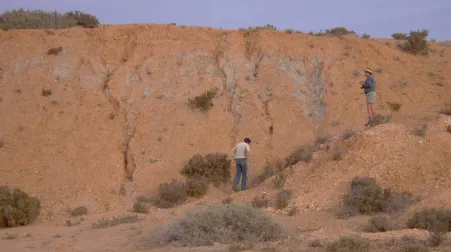
The Radium Hill mine, in northeastern South Australia, operated from 1954 to 1961. It is in semi-arid grazing land, drier and of lower relief than at Mary Kathleen. At Radium Hill, underground mining occurred with processing of ore on site, resulting in the generation of mill tailings dams and numerous dumps of waste rock material. Some of the latter was crushed and used for local construction purposes, including buildings, roads and railway ballast, despite it exhibiting low-level radioactivity. After mining ceased, most infrastructure was demolished and removed, but there was no remediation of the waste dumps and tailings repositories. About 1980, capping of the main TSF was performed and this action lessened the effects of wind and water erosion. The region is currently used for low density grazing and has low human visitation.
Figure 3:Rill erosion of the soil capped tailings storage facility, Radium Hill, South Australia (height of facility approximately 6 m). The soil capping is being removed, resulting in the exposure of radioactive tailings in rills.
Gaps in Knowledge
At Mary Kathleen, it was predicted upon mine site rehabilitation: (a) that the tailings porewaters would not infiltrate into the local aquifer; (b) that there would be little chance of ARD and of metal and radionuclide mobility from the waste rock dumps and tailings repository; and (c) that seepage water quality would not pose a problem for human or stock health, despite sulfate contamination of the groundwater being the main long term environmental impact. Twenty years after rehabilitation, it is evident that some rehabilitation measures have been quite successful in reducing dispersion of U and related elements into the surrounding environment (e.g. the TSF cover). By contrast, the predictions made on the geochemical behaviour of waste rock dumps and the TSF proved to be incorrect. There is still significant physical and chemical mobility of contaminants from the TSF into ground and surface waters, contaminants are being transferred into plants, and there is a threat to stock health. Physical erosion and chemical leaching of waste rock repositories and the leaching of the tailings repository are the dominant pathways of contaminants into surrounding environments (Lottermoser and Ashley, 2005; Lottermoser et al., 2005).
The Ugly: Rehabilitated Gold Mine Sites, Australia
Red Dome
The Red Dome mine, in semi-arid tropical northwestern Queensland, operated from 1986 to 1997. It is situated in a region with a semi-arid climate, high evaporation rate and annual tropical monsoons, with the area receiving 750-800 mm of rainfall in a two-month period. Limestones and marbles are abundant throughout the deposit, resulting in the dominance of alkaline pH conditions within the various ore and waste rock types (pH 8.3 to 10.5). The operation produced over 1 million ounces of gold as well as copper-gold concentrates, using cyanide heap leach, flotation and carbon in leach (CIL) techniques.
[image:7.595.72.525.323.617.2]Significant features of the site include three large waste rock dumps, a 20 ha leach pad, a 31 ha TSF, and a 320 m deep open pit. In 1998, the Red Dome TSF was decommissioned and capped. The capping consisted of three layers: (1) a 600 mm thick layer from spent heap leach material to contain and inhibit infiltration; (2) a 300 mm thick layer of screened primary rock >4 mm to act as a capillary break; and (3) a 300 mm thick surface layer of oxide waste material to provide a growth medium for revegetation.
Figure 4:View from the tailings storage facility, Red Dome gold mine, Queensland, Australia. Cyanide-bearing
seepage waters (~200-500 mg/l total cyanide, 80-300 mg/l WAD cyanide, 200-600 mg/l Cu) emanate from the capped tailings repository. The seepage is collected via a series of ponds where chemical degradation of cyanide and precipitation of copper cyanide salts occur. The passively treated effluent is discharged to the local stream system.
criteria require that the concentration of Total Cyanide (TCN) and Cu in water do not exceed a limit of 1 mg/L and 2.3 mg/L, respectively. While disposal and treatment of the seepage via the tanks and ponds were effective, it required regular pumping. Hence, the State Government advised the lease holder to set up a more appropriate and fail safe system of treatment and disposal that required less human intervention. To date, such a fail safe treatment system for Cu-cyanide rich mine drainage waters remains to be identified.
Horn Island
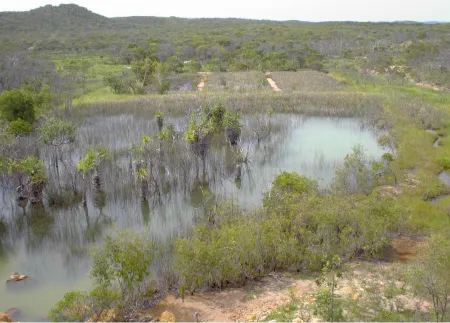
[image:8.595.73.523.313.636.2]The Horn Island gold mine is located in the Torres Strait region, which represents a stretch of water separating southern Papua New Guinea from the Australian mainland. The mine site is in a seasonally wet-dry tropical climate (1700 mm per year), with a summer rainfall maximum causing ephemeral flooding, erosion and sediment transport. The mine itself operated from 1987 to 1989, producing 1431 kg of gold. Gold-bearing lodes occur on Horn Island as quartz-sulfide veins in a porphyry stockwork system and associated propylitic alteration. Sulfide minerals (pyrite, galena, chalcopyrite, arsenopyrite) are abundant and, ore and waste materials are acid generating.
Figure 5: Wetland at the Horn Island gold mine, Australia. The wetland has failed because an adjacent damwall was constructed using acid generating waste rocks (foreground), which resulted in significant ARD and caused plant death.
freshwater has resulted in acceptable water quality, there is ARD from the ore stockpile and waste rock dumps, affecting vegetation and possibly littoral marine fauna and flora of the Great Barrier Reef. Also, tailings placed into a shallow water pond (max. ~6 m deep) release metals into the overlying water column. Moreover, the installed wetland has failed as materials used for the construction of the wetland and adjacent dam are acid generating (Fig. 5). Additional rehabilitation would be necessary. However, the lack of suitable capping materials in the Torres Strait region, its remote location and seasonal rainfall pattern, and the intended return of the mined land to indigenous landholders pose an extraordinary reclamation challenges.
Challenges Ahead
Rehabilitation of the Red Dome and Horn Island gold mine sites aimed to apply best practices. However, the applied approaches and technologies did not lead to the successful rehabilitation of the two mine sites even in the short term. At Red Dome, the penetration of meteoric water through a dry capped TSF and the presence of clay-rich tailings at depth have allowed the leaching of the tailings repository and the release of Cu-cyanide seepage waters into surrounding environments. At Horn Island, the use of acid-generating waste for remediation works, the presence of tailings in a shallow water pond, and the lack of suitable capping materials continue to cause environmental impacts and pose extraordinary reclamation challenges.
Conclusions
More than ever, environmental scientists have important contributions to make as they provide the data necessary for rational decision-making in critical areas such as resource development, waste management and remediation, environmental protection, and mine, land and waterway rehabilitation. The most urgent problem facing environmental scientists working on mining environments is the quantification of the interactions that control the distribution of contaminants in rocks, soils, sediments, waters and biota. We must precisely describe the chemistry and mineralogy of contaminants and understand their long-term behaviour. In addition, we must improve our predictions on mine drainage, aquifer and final void water quality. Furthermore, we must search for innovative, cost-effective remediation and rehabilitation technologies. The rehabilitation of mine sites and secure disposal of mine wastes require a new precision in the total description of mine sites and an understanding whether our current practices will be sustainable in the long term. Evaluations of recently rehabilitated mine sites could produce data on the successes and failures of existing rehabilitation practices. Such studies should sharpen our ideas on the factors leading to contaminant dispersal and the development of new remediation technologies.
There is reason for optimism that the required progress is possible. Such optimism is based on the phenomenal advances in our ability to observe and describe mining environments. However, detailed studies of natural, mined, contaminated and rehabilitated environments are necessary if we are to quantify the variables controlling the containment and dispersal of contaminants and if we are to develop innovative remediation protocols. Our efforts could ensure that the 21st century goes down in history as that of “green technologies”.
Literature Cited
Ariza, L. M. 1998. River of vitriol. Sci. Amer. 279:15-18.
Braungardt, C. B., Achterberg, E. P., Elbaz-Poulichet, F. and Morley, N. H. 2003. Metal geochemistry in a mine-polluted estuarine system in Spain. Appl. Geochem. 18:1757-1771.
Davis, Jr R. A., Welty, A. T., Borrego, J., Morales, J. A., Pendon, J. G. and Ryan, J. G. 2000. Rio Tinto estuary (Spain): 5 000 years of pollution. Environ. Geol. 39:1107-1116.
alluvium contaminated by metal mining in the Rio Tinto area, southwest Spain. Appl. Geochem. 14:1015-1030.
Leblanc, M., Morales, J.A., Borrego, J. and Elbaz-Poulichet, F. 2000. 4 500-year-old mining pollution in southwestern Spain; long-term implications for modern mining pollution. Econ. Geol. 95:655-662.
Lottermoser, B. G. 2007. Mine wastes: characterization, treatment and environmental impacts (2nd Ed.). Springer, Heidelberg, 304 pp.
Lottermoser, B. G. and Ashley, P. M. 2005. Tailings dam seepage at the rehabilitated Mary Kathleen uranium mine, Australia. J. Geochem. Explor. 85:119-137.
Lottermoser, B. G. and Ashley, P. M. 2006. Physical dispersion of radioactive mine waste at the Radium Hill uranium mine site, South Australia. Aust. J. Earth Sci. 53:485-499.
Lottermoser, B. G., Ashley, P. M. and Costelloe, M. T. 2005. Contaminant dispersion at the rehabilitated Mary Kathleen uranium mine, Australia. Environ. Geol. 48:748-761.
Menzies, N.W. and Mulligan, D. R. 2000. Vegetation dieback on clay-capped pyritic mine wastes. J. Environ. Qual. 29:437-442.
Richards, R. J., Applegate, R. J. and Ritchie, A. I. M. 1996. The Rum Jungle rehabilitation project. In: Mulligan D. (ed.) Environmental Management in the Australian Minerals and Energy Industries 1996. University of New South Wales Press, pp. 530-553.
Romero, A., Gonzalez, I. and Galan, E. 2006. Estimation of potential pollution of waste mining dumps at Peña del Hierro (Pyrite Belt, SW Spain) as a base for future mitigation actions. Appl.
Geochem. 21:1093-1108.
Salkield, L. U. 1987. A technical history of the Rio Tinto mines: some notes on exploitation from pre-Phoenician times to the 1950s. The Institution of Mining and Metallurgy, London, 114 pp. Taylor, G., Spain, A., Timms, G., Kuznetzov, V. and Bennett, J. 2003. The medium-term performance