STUDENT
OPPORTUNITY
FUNDING:
Foreword
Social mobility, widening participation
and fair access have rightly been passions
of successive governments. For more than
a decade this interest has been supported
by specific funding streams badged
under various names but all united by one
common objective: to ensure that students,
whatever their background, have the
encouragement and the practical support
to enable them to access the transformative
experience of studying for a higher
education qualification.
Today this resource, supported by
government and distributed in England to
universities and higher education institutions
by the Higher Education Funding Council
for England (HEFCE), is referred to as Student
Opportunity funding. In many ways its
distribution can be compared to the recently
introduced pupil premium in schools.
million+ is a university think-tank, working to solve complex problems in higher education through research and evidence-based policy.
million+
90 London Road London SE1 6LN
Phone 020 7717 1655 Twitter: @million_plus [email protected] www.millionplus.ac.uk
NEON (National Education Opportunities Network) is the
professional organisation for widening access to higher education in England.
NEON
Tavistock House Tavistock Square London WC1H 9JB
Phone: 020 7383 0988 Twitter: @neonhe
www.educationopportunities.co.uk
Authors:
Katy Morris, Head of Policy and Research, million+
Dr Graeme Atherton, Director, NEON.
Thank you to all of the universities that have supported this research, and particularly those that provide valuable case study material, including Anglia Ruskin University, Bath Spa University, Staffordshire University, The University of Bedfordshire, and The University of Sunderland.
November 2013
deleted in challenging economic
times, funding for student opportunity
should be seen as an investment in
the future of individuals and a wider
investment that brings long-term
economic and societal benefits.
This is also why politicians of
all political parties need to pin their
colours to the mast and commit
to continuing to invest in Student
Opportunity funding to 2015
and beyond. If we are serious about
supporting social mobility and
‘Opportunity Britain’, and about
securing the long term economic
competitiveness of the UK, then
Student Opportunity funding counts.
Professor Michael Gunn
Vice-Chancellor of Staffordshire
University and Chair of million+
Dr Graeme Atherton
Director, NEON (National Education
Opportunities Network)
Introduction
1 Robbins, L. (1963) The Report of the Robbins Committee
on Higher Education. London, HMSO.
2 Barr, N and Glennerster, H (2013) Fifty years of Robbins,
available via http://www.lse.ac.uk/alumni/LSEConnect/ articles/fiftyYearsofRobbins.aspx
3 Robbins, L. (1963) The Report of the Robbins Committee
on Higher Education. London, HMSO.
4 HESA (2013) Statistical First Release 183.
5 HESA Students in Higher Education 2011-12.
The year 2013 marks a full half a
century since the publication of the
landmark Robbins Report
1which
paved the way for the expansion of
university places and participation
in higher education.
Back in 1963, the year that the Robbins Report was published, the landscape of higher education looked very different. Just 5% of young people went on to study full-time degree courses and rates of participation amongst working-class men and women were even lower2. Higher education
was in effect the preserve of a small, narrowly drawn, chosen few.
Having undertaken extensive research and analysis over a two year period, the Robbins Committee on Higher Education concluded that this state of affairs was far from ideal. In a 335 page report (accompanied by five additional volumes of research), the Committee identified that an increasing number of people had the aptitude and capacity to enter university and that the bar on entry would be a major barrier to the British economy if it was not lifted.
The Committee therefore argued for an expansion in the British higher education system so that ‘courses of higher education [are] available for all those who are qualified by ability and attainment to pursue them and who wish to do so’.
The distinction between ability and attainment is subtle but vitally important: the Robbins
Committee recognised that qualifications are not the only measure of an individual’s potential.
Why examine Student Opportunity funding now?
Over the past 50 years, successive
governments have adhered to variants of the Robbins principle: that higher education courses should be available to all those who are
qualified and wish to study, irrespective of their social or economic background, although in practice constraints on public expenditure have meant that student numbers have always been capped. The higher education sector in the United Kingdom has undergone significant transformation during this time: whereas in 1963 there were 216,000 full-time undergraduate students and 31 universities3, in 2011-12
there were 1,411,975 full-time undergraduate students (plus a further 516,165 part-time undergraduates)4 and 163 universities5.
Over this time rates of progression to higher education have increased amongst people from all backgrounds, ages and social groups. The advent of specific funding in the academic year 1999-2000 – known initially as the Widening Participation Premium and latterly as the Student Opportunity allocation – to help universities recruit and support students from disadvantaged backgrounds, has played an important role in facilitating this shift in England.
Student Opportunity funding sits alongside student support arrangements for disadvantaged groups. Programmes such as Aimhigher
and the Lifelong Learning Networks that operated in the 2000s, and now the indirect public
investment flowing through Office for Fair Access (OFFA) Access Agreements, all form an ecosystem which supports access to higher education. The student body is now far more diverse and far more representative of wider society than it was in 1963, which is a cause for celebration.
Foreword
continued
Government resources to support
participation and student opportunity
have always been part of a rich and
complimentary ecosystem of funding.
Under the previous government
Aimhigher was one part of this
ecosystem. Since 2012, this has been
replaced by indirect public investment
arising from Access Agreements
overseen by the Office of Fair Access.
Crucially, universities which are
world-leaders in promoting opportunity
and social mobility have also added
significantly to the funding resource
made available by government.
The success of many universities in
supporting students who in previous
generations were denied the right
of passage to study for a degree,
has been stunning and should be a
cause for celebration. Despite these
successes however, this report
illustrates why supporting students
to access and succeed at university
remains a ‘work in progress’.
What is the Student
Opportunity allocation?
The Higher Education Funding
Council for England (HEFCE) has
been providing specific funding for
widening participation to higher
education institutions and further
education colleges since the academic
year 1999-2000. Previously known
as the Widening Participation
Premium, this funding was renamed
the Student Opportunity allocation
for the academic year 2013-14.
As set out by OFFA12, widening participation
in higher education involves removing the barriers to higher education that students from lower income households and other under-represented backgrounds face. This encompasses both entry to higher education in general terms (widening participation’) and the concept of ‘fair access’ which refers to the uneven distribution of students from under-represented groups within higher and further education institutions.
The Student Opportunity allocation is one of three allocations that HEFCE provides to support what it defines as public benefit objectives13.
Through recognising some of the extra costs associated with recruiting and supporting disabled students and students from disadvantaged
backgrounds who are currently underrepresented in higher education, the Student Opportunity allocation is designed to promote successful participation in higher education by everyone who can benefit from it.
There are three distinct components to the Student Opportunity allocation.
> Widening access: The first component consists of funding for outreach activities that are designed to raise aspirations and
attainment among potential students from under-represented groups.
> Improving retention and success: The second component is funding to help institutions improve progression and support students who are most at risk of dropping out of their course of study. > Supporting disabled students: The third component entails funding intended to improve access and provision for students with disabilities.
In essence, the Student Opportunity allocation recognises and reflects the Robbins principle that higher education should be available for all those who are qualified by either ability or attainment. Not everyone has equal access to higher education, and amongst those who enter higher education, not everyone starts from the same base. Yet through undertaking additional activities designed to reach out to disadvantaged and underrepresented groups, and through providing opportunities and support to students who may have additional learning needs, universities and FE colleges enable students from all backgrounds to realise their full potential. This, in turn, promotes social mobility and enhances the long-term economic competitiveness of the United Kingdom.
12 OFFA (2013) Frequently asked questions. Available
from http://www.offa.org.uk/press/frequently-asked-questions/#definitions
13 The other two specific HEFCE funding steams are designed
to support small specialist institutions and high-cost subjects and vulnerable subjects.
6 UCAS (2013) Demand for full-time undergraduate higher
education (2013 cycle, March deadline) UCAS Analysis and Research, July 2013.
7 Jerrim, J, Vignoles, A and Finnie, R (2012) University access
for disadvantaged children: A comparison across English speaking countries, DoQSS Working Paper No. 12-11, Institute of Education. Available from http://repec.ioe.ac.uk/REPEc/pdf/qsswp1211.pdf
8 HESA Performance Indicators (T3b: Non-continuation following
year of entry: young full-time first degree entrants by low participation marker and continuation status).
9 Note that the National Scholarship Programme was heavily
criticised by million+ and others on the basis of its eligibility criteria, distribution of ‘scholarships’ between institutions and emphasis on fee waivers rather than bursaries. See million+ (2011) The National Scholarship Programme: A national scheme or a postcode lottery? Available from http://www.millionplus.ac.uk/documents/reports/ million+_Policy_Paper_-_National_Scholarship_Programme.pdf
10 HM Treasury (2013) Spending Round 2013.
11 Hurt, G (2013) Universities with more poor students benefit
from ‘double dipping’ on funds, The Times, 27th July, available via http://www.thetimes.co.uk/tto/education/article3826833.ece
Some – mostly modern – universities have been particularly successful in broadening their student intakes, recruiting based on potential and supporting students from a very diverse range of backgrounds. These institutions offer supportive and engaging learning environments for students of all ages and backgrounds who would not otherwise attend university, thereby driving social mobility in the United Kingdom.
Yet fifty years after the Robbins Report was published, widening participation should not be considered a ‘mission accomplished’. It remains true that people from more disadvantaged
backgrounds are significantly less likely to progress to university than people from the most advantaged backgrounds overall6. They are also less likely
to win places at traditional universities than
similarly qualified students from more advantaged backgrounds7. And those who do enter higher
education are less likely to complete their degree programmes than their more socio-economically advantaged peers8.
There is much, therefore, still to do to ensure that all those who are qualified by ability and attainment are able to pursue and succeed in higher
education, if they so wish. Yet at the same time there are indications that the Student Opportunity allocation – vital funding that enables higher and further education colleges to recruit and support students from disadvantaged backgrounds and those with disabilities – may be under threat. In the June 2013 Spending Review the Government announced that the National Scholarship
Programme, a fund originally intended to incentivise participation in higher education under the new fees regime9, would be reduced in value by £100m and
refocused on postgraduate support from 2015-16.
In addition, the Government announced that ‘at least £45 million will be saved [in 2015-16] through asking HEFCE to reprioritise teaching grant spend’10. There have been strong indications in
recent months that the Student Opportunity Allocation (SOA) – worth £332 million in 2013-14, and a core part of the widening participation ecosystem – will bear the brunt, and possibly the entirety, of this reduction. An article by The Times on Saturday 27th July confirmed that this is what some in the higher education sector are calling for, both publicly and privately11.
A £45 million reduction to the Student Opportunity fund would reduce the funding that HEIs will receive in 2013-14 to support student access, retention and success by 13.6%. This would cast serious doubt on the Government’s commitment to social mobility. It would not be possible for many institutions to absorb such a reduction in income without their work in this area being seriously affected, with significant consequences for the access agenda. It would also compound the issues thrown up by the withdrawal of public funding from Aimhigher in 2010 and the Lifelong Learning Network programme in 2012.
As the Government considers the National Strategy for Access produced jointly by HEFCE and OFFA, this report examines the importance of the Student Opportunity allocation and how this funding acts as a catalyst to enable higher and further education institutions to admit and support students who would not otherwise go to university. Drawing on case studies from institutions with the most diverse cohorts of students, its findings suggest that Student
Opportunity funding serves as an investment in the nation’s talent and future workforce, arguably the most important part of the country’s infrastructure, and that cutting the Student Opportunity allocation would therefore be an entirely false economy.
Introduction
Anglia Ruskin University operates a summer roadshow which is targeted at Year 12 and 13 pupils, Level 3 students, Access to HE learners, parents and school staff, as well as members of the public at weekends.
The project started in 2011 following the
introduction of the new student finance system and the need to ensure that prospective students were not put off by the headline tuition fee. The Roadshow Bus tour in June and July 2013 again focussed on student finance but also incorporated information about the university application process and additional opportunities for prospective students to meet Student
Ambassadors and understand what university life might be like.
Over a 6 week period in June and July 2013 the Roadshow reached 29 schools and colleges, 2,250 students and 250 parents and received 33 mentions in newspapers and online articles. Participating students gave an average score of 8.25 out of 10 to the activities they took part in and students showed measurable growth in knowledge of higher education, student life, how to choose a course and student finance.
The part-time, flexible access Step up to HE Foundation Certificate programme at Staffordshire University targets mature students from the most deprived parts of Stoke-on-Trent. This innovative and highly successful course is supported partially through Student Opportunity funding.
It is specifically designed for individuals who are interested in participating in higher education but have been out of education for some time, are currently working and/or have a range of commitments. There is also a
well-established tradition of family members and friends entering university through this course. Teaching and learning focuses on the
development of reflection, metacognition and self-belief as the starting point to a wide range of academic skills, for example: critical thinking, academic writing and referencing. Successful completion of Step up to HE awards 30 credits at level 3 and demonstrates the potential to move onto further study. Many learners who complete the course progress onto a wide range of undergraduate programmes such as Psychology, Sociology, Accounting and Finance, Health Studies and History. One learner recently achieved his long term ambition by achieving a place to study Experimental Film at Staffordshire University. Step up to HE is critical to the decision making process for mature learners and houses a specialist advisor to provide support throughout the application process and beyond. A strong working relationship has developed with a range of awards at Staffordshire University who actively recruit Step Up to HE learners. The individual long term impact of this type of provision is significant and results at degree level are very good, with learners usually achieving a first or 2.1 classification. The Choices Together scheme, which is funded
via Student Opportunity funding, aims to support access to and success within higher education amongst care experienced applicants and students. It includes a number of activities for 14-16 year olds and their carers and families through the Raising Aspiration Partnership (RAP) between the universities of Sunderland, Newcastle and Northumbria. This allows care leavers to make campus visits and experience university life at all three universities.
Anglia Ruskin University Roadshow Bus
Step Up to HE at Staffordshire University
Choices Together for Care Leavers at the University of Sunderland
How is Student Opportunity
funding allocated and spent?
The Student Opportunity allocation
operates on a similar principle to
the recently introduced Pupil
Premium
14. Funding follows the student
but it is allocated directly to higher
and further education institutions
according to the composition of their
student cohorts. The three-pronged
HEFCE funding formula (comprising
widening access; improving retention
and success; and disabled students)
recognises the complexities of
recruiting and supporting students
from disadvantaged backgrounds
and those with disabilities
15.
Funding follows the student but institutions
maintain discretion over how to spend the funding, with reference to guidance issued by HEFCE. Such discretion is important because the diversity of the higher education sector means that higher and further education institutions face different challenges in relation to widening participation and therefore set themselves different priorities16.
It is important to note that most institutions use Student Opportunity funding to invest in both infrastructure and activities. Infrastructure can include staff members (for example, staff who develop and deliver access programmes), facilities, resources and virtual infrastructure, whilst activities include projects, programmes, schemes and initiatives. The case studies in this paper give a flavour of just some of the ways in which Student Opportunity funding is deployed to increase participation in higher education and promote student success at institutions with the most diverse student profiles.
Such funding by no means covers the full cost of the outreach and retention activities undertaken but it does enable institutions to develop
interventions that raise aspirations and improve access, retention and success for disadvantaged groups at different stages in the student lifecycle. Student Opportunity funding should therefore be thought of not as a cost, but as an investment in civil society and the future workforce.
Widening Access
The widening access component of Student Opportunity funding is calculated on the basis of the number of new undergraduate entrants from low participation neighbourhoods. This reflects the rate of participation in higher education at ward-level of young undergraduates and the proportion of 16-74 year olds with a HE qualification at ward level for mature and part-time undergraduates.
Higher and further education institutions draw on Student Opportunity funding when planning and undertaking a huge array of programmes and activities intended to increase access and participation amongst groups that are under-represented within higher education. Depending on the programme and the target audience, such activities may be driven by a single institution or take place in partnership with other institutions and interested groups. Some activities are discrete, one-off interventions, whilst others involve sustained engagement over a longer period of time.
14 Note that IPPR called for Student Opportunity funding and
the National Scholarship Programme to be replaced by a ‘student premium’ in IPPR (2013) A Critical Path: Securing the future of higher education in England. The merits – or otherwise – of this proposal are explored further in the Annex.
15 HEFCE (2012) Widening access for students from disadvantaged
backgrounds: funding allocation method for 2012-13.
16 CFE and Edge Hill University (2013) The Uses and Impact of
HEFCE Funding for Widening Participation Report to HEFCE.
“Most universities use
The employability support programme at Anglia Ruskin University aims to ensure that students from disadvantaged backgrounds (who comprise the majority of the undergraduate cohort) are given the support they need to complete their studies, achieve the degree classification they want and to obtain
professional employment once they graduate. A team of Faculty Employability Advisers deliver employability support services throughout the year, with provision tailored to year groups and particular points in the academic calendar. Advisers work with students to teach them how to network, how to dress and how to conduct themselves when employers invite them to social functions as part of the selection process. Additional initiatives undertaken over the last two years include the creation of Employer Focus Groups within each Department to increase interactions between employers, academic staff and students, enhance curricula and provide students with additional opportunities for work placements, internships and jobs following graduation. Anglia Ruskin University has also become the first University in the Central and Eastern regions to offer the Duke of Edinburgh Scheme to students as a means of offering additional, employer recognised, activities which enhance
employability skills and give opportunities to broaden narrative when asked competency based questions at interview.
The Partnership Office at the University of Bedfordshire runs a scheme whereby Associates (current students who are paid for their time) work with schools and colleges to raise the aspirations of local students. In 2012-13 the University of Bedfordshire piloted a new approach which combined outreach and aspiration raising for access students in schools and colleges with a focus on academic skills promotion. This was intended to help address the fact that incoming
university students do not universally make the most of the academic skills learning development opportunities that are provided by universities, with consequences for retention and student success.
The University of Bedfordshire piloted
optional Continuing Professional Development (CPD) training for Associates via workshops and work shadowing of staff in the
Professional and Academic Development team who work in the academic skills drop-in centre. Associates also participated in the provision of drop-in academic skills support for new students entering the University of Bedfordshire. Initially, six Associates participated and
all reported that they felt better prepared to promote the value of academic skills to school and college students. The Associates also reported that their own academic skills had been enhanced as a result of participating in the CPD offered, in turn increasing their own success. The University of Bedfordshire plans to expand the Associate CPD scheme in the 2013-14 academic year and undertake further evaluation of the effectiveness of the scheme in the future.
Employability Support
at Anglia Ruskin University CPD for Associates at the University of Bedfordshire
How is Student Opportunity
funding allocated and spent?
continued
For care experienced students, the University of Sunderland provides a range of support mechanisms which recognise the challenges care leavers may face. These include offering help moving in and a ‘welcome’ food voucher to spend on essentials, offering guaranteed accommodation for 52 weeks or the option to have belongings stored at no cost during holiday periods, sending birthday and
greetings cards, acting as guarantor for students wanting to live in private accommodation, providing support through a dedicated support team and a graduation package including cost of gown hire and photos.
The University of Sunderland holds the Buttle Trust Quality Mark, an exemplary standard for the work it does with care leavers and recently extended the support and scholarships offered to care leavers wishing to embark on postgraduate courses.
Support for Care Leavers at the University of Sunderland
Improving Retention and Student Success
The improving retention component is linked to age and entry qualifications as these have been shown to provide an accurate indication of the likelihood of a student dropping out of their
course17. Students are assigned to one of twelve risk
categories which are then assigned a risk weight. Funding is also linked to the mode of study of new undergraduate entrants to reflect higher non-completion rates amongst part-time students. As with widening access and disability support activities, Student Opportunity funds for improving retention and student success can be used to support specific groups of students who are known to be at greater risk of dropping out.
More frequently however, Student Opportunity funds for improving retention and student success are used to enhance provision and support for all students, particularly at institutions with inclusive student profiles. Measures can include the provision of additional learning, teaching and assessment support, enhanced pastoral support, curricula re-design, and careers development and
employment support for students who may enter higher education without the social and cultural capital to effectively succeed in the highly competitive graduate employment market. Universities and FE colleges seek to engage
with primary schools, secondary schools, colleges, charities and employers in order to widen participation. Their outreach activities are often targeted at a particular group of people, for example care leavers.
17 HEFCE (2013) Student Opportunity: funding
allocation method for 2013-14.
“Measures can include the provision of
additional learning, teaching and assessment
support, enhanced pastoral support,
How much is Student
Opportunity funding worth?
In 2012-13 HEFCE provided
£366 million of funding for widening
participation. This was made up
of £127 million for widening access,
£225 million for improving retention
and £13 million for supporting
disabled students.
Funding for widening participation for the academic year 2013-14 will fall to £332 million following HEFCE’s decision to remove £40 million from the widening access for part-time student’s component of the Student Opportunity Allocation, on the basis that undergraduates studying part-time are now eligible for tuition fee loans19.
Part-time students are indeed now eligible for tuition fee loans but part-time participation has fallen alarmingly since 2010. Between 2010-11 and 2012-13, part-time undergraduate entrants fell by 105,000 (40 per cent)20 and some institutions
have been forced to withdraw courses that have historically attracted mainly part-time students. Since the overwhelming majority of part-time students are mature learners and since mature learners are more likely to have widening
participation characteristics21, any fall in part-time
participation is likely to have significant long-term implications for social mobility and workforce skills. Yet there is no sign of recovery in part-time demand for 2013-1422, which means that universities and
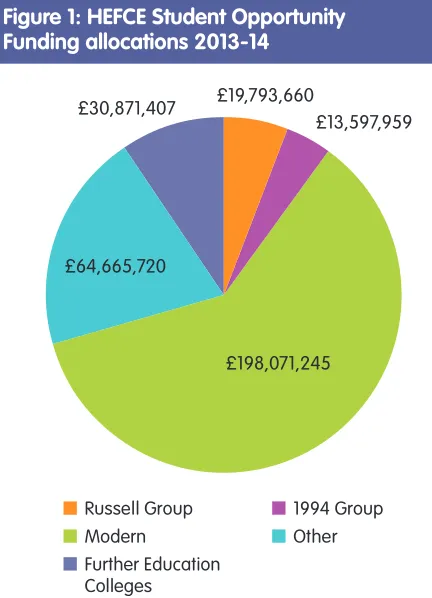
colleges are unlikely to be able to substitute the widening access component of Student Opportunity funding for tuition fee income. The removal of the funding for outreach activities directed at part-time students is therefore a significant cause for concern and its impact on outreach activities directed at part-time students must be closely monitored. For 2013-14 HEFCE intend to allocate a total of £332 million (14.1% of all the Teaching Funding allocated in this year) in Student Opportunity Funding. This comprises £88 million for widening access (broken down into £62 million for full-time and
£28 million for part-time access), £228 million for improving retention (comprising £174 million for full-time and £54 million for part-time) and £15 million for supporting disabled students23.
Despite the loss of funding for part-time outreach activities, this represents substantial and vital investment in civil society and the future workforce. The concentration of Student Opportunity
funding within modern universities reflects the differing institutional strategies, recruitment practices and student cohorts of different types of university. Modern universities are at the forefront of the widening participation agenda, offering a broad range of courses and flexible study options and delivering supportive and engaging learning environments for students of all backgrounds and all ages, thereby driving social mobility.
19 HEFCE (2013) Recurrent grants and student number
controls for 2013-14.
20 HEFCE (2013) Higher Education in England: Impact of the 2012 reforms.
21 Morris, K and McVitty, D (2012) Never Too Late To Learn: Mature
students in higher education. million+ and NUS.
22 Universities UK (2013) The Power of Part-Time: Review
of part-time and mature higher education.
23 HEFCE (2013) Recurrent grants and student number
controls for 2013-14.
Russell Group Modern
Further Education Colleges
1994 Group Other £198,071,245
£13,597,959 £19,793,660
£30,871,407
[image:7.1191.918.1134.143.442.2]£64,665,720
Figure 1: HEFCE Student Opportunity Funding allocations 2013-14
At Bath Spa University, Student Opportunity funding is used to support an Early
Induction Programme for disabled students. This programme has run since 2007/08 and aims to help students who may be unsure about the support they are entitled to and who feel anxious about the transition to
university, by helping them to settle in, orientate themselves and feel part of the student body. The programme takes place over the two days before new undergraduates arrive on campus. Every new undergraduate student who
discloses a disability or specific learning difficulty is personally invited to attend by the Student Support Service. Peer Mentors – specially trained students from years two and three – help with the moving-in process and the delivery of the event, encouraging participants to take part in a range of motivational and social activities, whilst specialist staff are also on hand to answer queries and offer advice and reassurance. Students who do attend report increased confidence and their appreciation of an opportunity to settle in, in a calm and relaxed environment. The Early Induction Programme is evaluated each year and suggested improvements acted on, where appropriate. Since 2007/08 there has
also been a continuing trend of improvement in the continuation of students who have disclosed a disability or specific learning difficulty and in the percentage who achieve First or Upper Second Class honours at Bath Spa University.
Early Induction Programme for
Disabled Students at Bath Spa University
Supporting Disabled Students
The disability allocation is based on the proportion of students that each institution recruits who are in receipt of the Disabled Students’ Allowance (DSA). To ensure some level of funding for all institutions there is a floor in the disability allocation.
Higher and further education institutions are firmly committed to ensuring that students are not prevented from accessing higher education because of their disability. Whilst resources and support are often directed towards students with registered disabilities, research by Edge Hill University and CFE shows that a majority of institutions also use Student Opportunity funds to target students who identify as having a physical or mental disability, health condition or learning difficulty18.
Interventions and support can take many forms including admissions support, support for the transition to university, specific
resources, facilities and equipment, additional non-medical helpers, support for examinations and assessments, staff training and development and building redesign.
18 CFE and Edge Hill University (2013) The Uses and Impact of
HEFCE Funding for Widening Participation Report to HEFCE.
How is Student Opportunity
funding allocated and spent?
continued
Source: HEFCE Recurrent grants for 2013-14, Annex A
“The concentration of
Student Opportunity
funding within modern
universities reflects the
differing institutional
strategies and recruitment
practices of different types
of university. Modern
What has the Student
Opportunity allocation achieved?
Research by UCAS shows that in 2004, 18 year olds living in the most advantaged areas27 were
4.3 times more likely to apply for higher education than those living in the most disadvantaged areas. By 2013 there was still a marked difference in application rates but the size of the gap had diminished substantially: 18 year olds living in the most advantaged areas were 2.7 times more likely to apply for higher education than those living in the most disadvantaged areas in 201328.
Other evidence is slightly more mixed. Research by HEFCE29 identifies differing trends over the
period 1998-99 to 2011-12 depending on how relative advantage and disadvantage are measured. When disadvantage is measured through rates of progression to higher education at ward level30
(POLAR 3), HEFCE identifies that the number of young entrants to higher education from the most disadvantaged areas increased from 16,500 in 1998-99 to 26,200 in 2011-12, an increase of 9,000 or 60 per cent. Yet since participation by young people from the most advantaged areas increased from 51 per cent in 1998-99 to 60 per cent in 2011-12, the gap in participation rates between the most advantaged and most disadvantaged young people widened on this measure from 38 percentage points in 1998-99 to 40 percentage points in 2011-12. When HEFCE measure disadvantage through household income at ward level, a different picture emerges. Whereas young participation rates in the most advantaged areas increased from
46 per cent to 53 per cent (seven percentage points) on this measure between 1998-99 and 2011-12,
participation rates in the most disadvantaged areas increased from 18 per to 30 per cent (12 percentage points) over the same period. In other words there was still a marked difference in application rates based on household income but the size of the gap reduced over the period of time in question.
Irrespective of how relative disadvantage is measured, what is certainly true is that there are more young people from low participation neighbourhoods, lower socio-economic classes and low income households participating in
higher education today than there were in 1998-99. It is also true that young entrants are just one part of the widening participation story: there are also more mature students and more students with disabilities participating in higher education than before. In addition, non-completion rates have fallen even as the student body has increased in size and diversified in composition: the proportion of full-time first degree entrants not continuing on to their second year fell from 9.0% in 2001-2 to 7.4% in 2009-1031.
These overall improvements have been driven in large part by modern universities adopting innovative approaches to providing opportunities for good students faced with real disadvantages. Drawing partly on the contribution via Student Opportunity funding, these institutions have achieved a great deal in their work to reach out to under-represented groups, recruit on ability and potential as much as attainment and offer students the support they need in order to succeed in higher education.
27 Note that these figures are based on the POLAR2 classification,
developed by HEFCE, where the most disadvantaged areas were defined as wards with the lowest rates of young participation across the 2000-01 and 2004-05 cohorts.
28 UCAS (2013) Demand for full-time undergraduate higher education
(2013 cycle, March deadline) UCAS Analysis and Research, July 2013.
29 HEFCE (2013) Trends in young participation in higher education.
30 Note that these figures are based on the POLAR3 classification,
developed by HEFCE, where the most disadvantaged areas are defined as wards with the lowest rates of young participation across the 2005-6 and 2009-10 cohorts.
31 HESA Performance Indicators: T3.
Since the introduction of what is
now known as Student Opportunity
funding, significant progress has
been made in widening access to
higher education in England. Indeed
widening participation was described
in 2011 by Sir Martin Harris, then
Director of the Office for Fair Access,
as one of the success stories of
higher education since 2000.
‘Let’s just remind ourselves, because we’re in danger of forgetting it, that widening participation in its broader sense has been one of the great success stories of English universities in the last seven or eight years – really a triumphant expansion of opportunities for young people from families
and from schools where university education had seemed to be unattainable and, whatever happens over the next few years, that success story should not be forgotten24.’
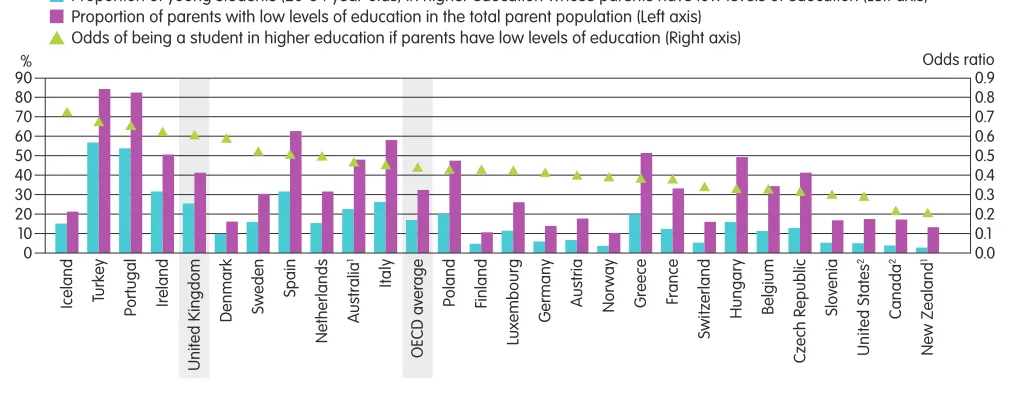
International comparisons show that the United Kingdom is performing well in terms of broadening access to higher education. Data from the OECD in Figure 1 below, comparing higher education participation by young people whose parents have low levels of education between OECD countries, shows that the UK ranks 5th highest in terms of the likelihood of a student whose parents have low levels of education progressing to higher education and is significantly above the OECD average25.
The United Kingdom is also unique in the scale of the provision of higher education opportunities for mature students who have taken a less direct route to university or college26.
24 Speech by Sir Martin Harris at a seminar on Widening
Participation and Fair Access held by the Higher Education Policy Institute (HEPI) on 2nd March 2011. http://www.hepi. ac.uk/files/HEPI%20Seminar%202nd%20March%202011.pdf
25 OECD (2013) Education at a glance Paris: OECD.
26 million+ and NUS (2012) Never Too Late to Learn:
[image:8.1191.35.545.472.670.2]Mature students in higher education.
Figure 2: Participation in higher education of students whose parents have low levels of education (2009)
90 Iceland % 80 70 60 50 40 30 20 10 0 0.9 Odds ratio 0.8 0.7 0.6 0.5 0.4 0.3 0.2 0.1 0.0 Proportion of young students (20-34 year-olds) in higher education whose parents have low levels of education (Left axis) Proportion of parents with low levels of education in the total parent population (Left axis)
Odds of being a student in higher education if parents have low levels of education (Right axis)
Tu rkey Portugal Ireland United Kingdom Denmar k Sweden Spain Netherlands Australia 1 Italy OECD aver ag e Poland Finland Luxembourg
Germany Austria Norwa
y Greece France Swi tzerland Hungar y Belgiu m Czech Republic Slovenia Un ited States 2 Canada 2 New Zealand 1
“Non-completion rates have
fallen even as the student
What has the Student
Opportunity allocation achieved?
continued
The Return to Student Opportunity funding
Since Student Opportunity funding represents an investment in human capital it is important to consider the nature and extent of the longer-term ‘return’ to investment. There are a number of philosophical issues surrounding the notion of ‘return on investment’ in education, but previous work by London Economics and million+ has established that there are a wide range of economic and non-economic benefits accruing from degree level attainment.
In recent years there has been an increasing amount of work seeking to quantify the economic returns to individuals and the Exchequer associated with higher education participation. Methodologies and estimates of the returns to graduate level qualifications vary considerably but it is clear that graduates enjoy enhanced earnings and employment outcomes than non-graduates and that the Exchequer benefits considerably from investing in higher education, including through the provision of Student Opportunity funding. For example London Economics (2011) estimate the net Exchequer benefit associated with
undergraduate degree level provision at £89,000 overall. This reflects a net Exchequer benefit of £102,000 per degree for men and £59,000 per degree for women. The associated rate of return achieved by the Exchequer resulting from the funding of undergraduate degrees stands at 10.8% overall (11.4% for men and 9.6% for
women)39. Using a different methodology Walker
and Zhu (2013) estimate the social benefit to the government of undergraduate provision as £264,000 for men and £318,000 for women40.
In addition, evidence shows that graduates benefit from increased self-confidence and self-esteem, better health and improved intergenerational social mobility. They are also more likely to vote, more likely to undertake and complete further learning, less likely to be involved in crime and more likely to engage in community activity or voluntary work41.
Crucially, these benefits – which are
advantageous for individuals, wider society and the Exchequer – have held strong even as the overall number of people, and the proportion of people from under-represented groups, entering higher education has increased. In fact NIESR (2013), which identifies that the share of the
UK workforce with a university education increased from 12.0 per cent to 18.9 per cent between
1994 and 2005, attributes a full third of the 34% increase in labour productivity between 1994 and 2005 in the United Kingdom to the accumulation of graduate skills in the labour force42. The research therefore confirms
that higher rates of HE participation (by a more representative student cohort) generate a long-term increase in productivity.
Overall what this means is that Student
Opportunity funding, alongside the other grants that HEFCE makes on behalf of BIS and the Treasury, should be thought of as investments in civil society and the future workforce.
The stark differential between rates of progression to higher education amongst young people from the most and least advantaged areas shows there is much work still to be done. Without continued investment via the Student Opportunity Fund, there would be a limited prospect of continued widening access and participation.
39 BIS (2011) BIS Research Paper 45: The Returns To Higher
Education Qualifications. London Economics on behalf of the Department for Business, Innovation and Skills.
40 BIS (2013) BIS Research Paper 112: The Impact Of University
Degrees On The Lifecycle Of Earnings: Some Further Analysis. Professor Ian Walker (University of Lancaster) and Yu Zhu (University of Kent) on behalf of the Department for Business, Innovation and Skills.
41 BIS (2013) Research Paper 146: The Benefits of Higher
Education Participation for Individuals and Society: key findings and reports “The Quadrants”.
42 BIS (2013) BIS Research Paper 110: The Relationship Between
Graduates And Economic Growth Across Countries. National Institute of Economic and Social Research on behalf of the Department for Business, Innovation and Skills.
The extent of their success is clear from the sheer diversity of their student intakes and the fact that students from groups that are under-represented in higher education at national level often comprise the majority of these universities’ undergraduate students. For example:
> More than a fifth of young full-time first degree entrants at the University of Sunderland (25.6%), University of Bolton (22.3%) and just under a fifth at Staffordshire University (18.6%) were from low participation neighbourhoods (POLAR 3) in 2011-12. This compares to the sector average in England of 10.2%32.
> Around a tenth of all full-time first degree students at Bath Spa University (10.6%) and the University of Bolton (9.0%) were in receipt of Disabled Students’ Allowance (DSA) in 2011-12, compared to the sector average in England of 6.0%33.
> Just under half of young full-time first degree entrants at the University of East London (48.7%), Middlesex University (47.9%) and London
Metropolitan University (47.8%) were from the bottom four socio-economic classes (NS-SEC 4, 5, 6 & 7) in 2011-12, compared to the sector average in England of 30.9%34.
> More than 98% of young full-time first degree entrants at the University of Bedfordshire (98.7%), University of Bolton (98.6%) and UCLan (98.3%) were from state schools or colleges in 2011-12. The sector average in England was 88.5%35.
> More than half of all first degree undergraduates at the University of West London (62.0%),
University of East London (61.4%), University of Bolton (57.4%) and London Metropolitan University (56.8%) were mature students in 2009-10,
compared to the UK average of 30.2%36.
> More than a third of all undergraduates at Staffordshire University (40.3%), University of Bolton (38.5%) and University of Sunderland (37.0%) were studying on a part-time basis in 2011-12. This compares to the sector average in England of 28.1% including the Open University, or 18.6% when the Open University is excluded37.
In widening participation and delivering the opportunities and the support that students from under-represented groups need to succeed, these institutions have enabled students who would not otherwise have gone to university to benefit from all that higher education can offer and to realise their potential. In light of the Robbins Report’s aspirations fifty years ago, there should be more recognition of, and support for, the success of the institutions that have done the most to widen participation in higher education. There are lots of factors at work behind the growth in higher education participation amongst under-represented groups beyond Student Opportunity funding and the commitment of particular institutions. These include rising school attainment, the expansion of the number of university places available, the student support system and changing labour market requirements. However there are indications that the advent of specific funding for widening participation has helped embed a more strategic approach to widening participation in higher and further education institutions and provided a contribution towards infrastructure, staffing and activities that promote access and participation38.
This, in turn, has enabled universities to increase participation by people from groups that are under-represented in higher education.
32 HESA Performance Indicators: T1a.
33 HESA Performance Indicators: T7.
34 HESA Performance Indicators: T1a.
35 HESA Performance Indicators: T1a.
36 million+ and NUS (2012) Never Too Late To Learn: Mature
students in higher education.
37 HESA Students in Higher Education 2011-12.
38 CFE and Edge Hill University (2013) The Uses and Impact of
HEFCE Funding for Widening Participation Report to HEFCE.
“Without continued investment via the
Student Opportunity Fund, there would
be a limited prospect of continued
Where next for the Student
Opportunity allocation?
Recommendation 2: Treasury should treat Student Opportunity funding as an investment with an associated financial return, not simply a cost to be minimised
The Higher Education Funding Council for England (HEFCE) has been providing specific funding for widening participation to higher education institutions and further education colleges since the academic year 1999-2000. The evidence suggests that this has proven to be an effective means of achieving results.
Despite success so far, however, the UK still has a longstanding skills problem43 and it is
vital that people of all ages and backgrounds are able to upskill and realise their potential, including through higher education participation. Student Opportunity funding, which supports the recruitment and retention of students from disadvantaged backgrounds and those with disabilities, should therefore be understood as an investment in human capital, civil society and the long-term economic competitiveness of the United Kingdom, rather than as a cost to be minimised. Further to this, the estimated net Exchequer benefit associated with undergraduate degree level provision of £89,000, and the associated rate of return achieved by the Exchequer of 10.8% on the funding of undergraduate degrees, suggests that the Treasury should consider successful spending options designed to support people to study for a degree as an investment.
Recommendation 3: Government should secure the future of Student Opportunity funding beyond 2015-16
Student Opportunity funding is a vital part
of the wider higher education access ecosystem. This does not mean that it covers the full costs of the outreach and retention activities that higher and further education institutions undertake.
When combined with other sources of funding, it does facilitate the development of infrastructure and interventions that raise aspirations as well as improve access, retention and success for disadvantaged groups at different stages in the student lifecycle. If such investment was significantly reduced or even abolished for 2015-16 this would disrupt an ecosystem that is still in the process of adapting to the 2012 reforms to the higher
education funding system. It would not be possible for many institutions to absorb such a reduction in Student Opportunity funding without their widening participation and student success work being seriously affected, with consequences for both current and prospective students, and for wider society and the nation’s long term economic competitiveness.
Whilst the student body is now far more diverse and far more representative than it used to be, and while some institutions have been outstandingly successful in encouraging participation in higher education by people from under-represented groups, it is also clear that there remains much to do in terms of both widening participation and fair access. A temporary or permanent reduction to Student Opportunity funding would jeopardise further progress in this area as well as existing programmes and activities.
Given the continued high returns associated with undergraduate degrees and the beneficial impacts of higher education for thousands of individuals from under-represented groups, the opportunity costs of reducing this funding would be very high over the long term. It is therefore essential that the Student
Opportunity spending is protected and that the Student Opportunity allocation is put on a secure long-term footing.
43 OECD (2013) OECD Survey of Adult Skills.
Recommendation 1: There should be clear recognition by Government that Student Opportunity Funding supports social mobility
Student Opportunity funding recognises and reflects the fact that amongst those who enter higher education, not everyone starts from the same base. It also accommodates the diverse disadvantages being faced, which are best tackled by different means that are fully integrated into course provision and student experience. Through outreach activities and appropriate support, helped by Student Opportunity funding, higher and further education institutions succeed in enabling students from all backgrounds to benefit from the transformative power of higher education. This, in turn, promotes aspiration and social mobility.
As part of the efforts to build a better evidence base and strengthen social mobility, there has been a drive to capture more evidence on how Student Opportunity funds are used by universities. This drive must focus, however, on outcomes rather than budget lines if success is to continue. For their part, individual institutions should be able to identify the full array of widening participation and student success activities that they undertake and the infrastructure in which they invest. However, policy makers must recognise that HEFCE has actively encouraged
institutions to mainstream their widening participation and student success activities rather than treat them as isolated ‘add-ons’. It should be recognised that this makes it difficult, and perhaps counter-productive, to track specifically the activities and infrastructure that the HEFCE allocation supports.
The ‘accountability’ agenda must therefore be balanced against the need for institutions to be ambitious in their approach to widening participation and provide them with the
latitude to innovate and trial new programmes and activities. A strict financial reporting system set centrally would not only present difficulties in practical terms but also stifle innovation and militate against both risk-taking and the further embedding of widening access within the teaching and learning strategies of institutions. This being the case, politicians, civil servants, stakeholders and higher and further education institutions must continue to take a holistic approach to the variety of funding streams which are combined and deployed in different ways to promote access and student success. Crucially government should recognise the important role that Student Opportunity Funding has played in promoting social mobility – and that in higher education this remains ‘work in progress’.
“Temporary or permanent reduction
to Student Opportunity funding
would jeopardise further progress
in this area as well as existing
Conclusion
The leaders of all three major
political parties in England have
recognised the inherent unfairness
of a society in which background
can sometimes appear to count for
more than talent. Deploying different
banners and slogans, David Cameron,
Nick Clegg and Ed Miliband are,
nonetheless, united on the need to
improve social mobility and have
drawn attention to the disadvantages
for individuals and for Britain of
a society which limits opportunities.
Student Opportunity funding
contributes to the social mobility
agenda espoused and promoted
by the Prime Minister, the Deputy
Prime Minister and the leader of
the Opposition. This resource is an
important source of funding that
follows the student in an ecosystem
that rewards success and provides
for flexibility and innovation – criteria
that taxpayers and policy-makers
rightly demand from public spending.
The existing funding criteria has
the value of allowing universities
to use methods that work best for
specific student groups – for example,
by providing very different support
mechanisms for care leavers,
students with disabilities, and those
learning later in life.
Equally important, Student
Opportunity funding is an investment
that the evidence suggests works,
helping to change the life-chances
of thousands of individuals but also
providing positive returns to the
Treasury through higher earning
premiums and tax receipts associated
with graduate qualifications.
On the grounds of building social
mobility, but also of providing
enhanced premiums and benefits
to taxpayers and the Treasury for
the long term, Student Opportunity
funding counts.
Recommendation 4: Higher education institutions should collaborate widely
The success of institutions in widening access varies significantly. Although funding follows success, even successful programmes can be strengthened and grown through co-operation across several further and higher education institutions.
As identified in the interim HEFCE and OFFA report on the National Strategy for Access, there is a need for institutions to focus on outcomes rather than inputs and to undertake more holistic evaluations of the impact of their widening participation infrastructure and activities44.
Amid a number of significant successes achieved through Student Opportunity funding, there remains room for improved collaboration, innovation and the sharing of good practice in the field of widening access to higher education.
At present, few institutions engage in structured conversations with each other about what they are doing and what works for them. There is also no national mechanism whereby good practice can easily be
identified and widely shared. Progress will require whole system improvement and renewed commitment to sharing best practice within and between higher and further education institutions. Importantly, further consideration needs to be given as to how such collaboration can be fostered in an environment where competition for students has been incentivised.
Where next for the Student
Opportunity allocation?
continued
“This resource follows the student,
rewards success, and provides for
flexibility and innovation – criteria that
taxpayers and policy-makers rightly
demand from public spending.”
44 HEFCE and OFFA (2013) National Strategy for Access
Annex
In June 2013 the Institute of Public Policy
Research (IPPR) called for the Student Opportunity fund to be replaced by a ‘student premium’: ‘The Commission recommends introducing a student premium of £1,000 extra per student from a low-participation area or who has
received free school meals to create an incentive to recruit such students and to recognise the additional learning support some students need, funded by reallocating existing widening participation resources and the abolition of the National Scholarship Programme45.’
Whilst IPPR’s recognition that reaching out to disadvantaged communities and investing in recruiting and retaining a diverse student intake are worthy aims that carry additional costs is welcome, the specifics of the proposal are concerning. The free school meals and low participation neighbourhood criteria suggested by IPPR are more simplistic than the formula HEFCE currently use to allocate SOF funding and reflect neither the many forms of disadvantage that exist nor the student success component of Student Opportunity funding.
At face value the bigger problem with this proposal is that it could effectively cut public funding for access and retention in half. In 2014/15, the government is expected to spend £468 million on widening participation, comprising £318 million in Student Opportunity funding (compared to £366 million in 2012-13 and £332 million in 2013-14) and £150 million through the National Scholarship Programme.
Such funding by no means covers the full costs of widening access and improving retention but, as set out above, it does enable institutions that promote opportunity and participation to recruit and support students from disadvantaged backgrounds.
Whilst IPPR advocate a phased transition to this new system, it seems highly unlikely that the Government and HEFCE would agree to run three funding stream in parallel. In the current environment it is much more likely that any student premium would replace Student Opportunity and NSP funding.
IPPR identify 230,000 students currently enrolled at English HEIs who would be eligible for the student premium under the free school meals and low participation neighbourhood criteria which would mean student premium funding would amount to £230 million. Since institutions would receive less per disadvantaged student than under the present system and since IPPR propose that student numbers remain flat in line with demographics, the forecast doubling in the number of
disadvantaged students going to university seems wildly optimistic. In the meantime,
a like-for-like replacement of Student Opportunity and NSP funding with a student premium
would halve investment in access and retention and reduce the ability of higher and further education institutions to further widen access and promote success.
45 IPPR (2013) A Critical Path: Securing the future
million+
90 London Road London SE1 6LN Phone 020 7717 1655 Twitter: @million_plus [email protected] www.millionplus.ac.uk
NEON
Tavistock House Tavistock Square London WC1H 9JB Phone: 020 7383 0988 Twitter: @neonhe