Research Report DFE-RR090
Evaluation of the
Schools Linking
Network
Final report
David Kerr, Avril Keating, Helen Poet,
Thomas Spielhofer, Joana Lopes, Ellie
Mundy
This research report was commissioned before the new UK Government took office on 11 May 2010. As a result the content may not reflect current Government policy and may make reference to the Department for Children, Schools and Families (DCSF) which has
now been replaced by the Department for Education (DFE).
Contents
Acknowledgements 3
Executive Summary 5
Introduction 5
Key findings 5
Background 6
Research Methods 6
Findings 7
Recommendations 8
Final Word 10
Chapter 1 Introduction 11
1.1 Schools Linking Network (SLN) 11
1.2 Aims and objectives of the study 16
1.3 Research design and methods 17
1.4 Structure of the report 19
Chapter 2 Measuring the impact and outcomes of school linking 20
2.1 What are local integration and cohesion and how can school linking
contribute to fostering it? 20
2.2 Measuring the impact of school linking on cohesion 24
2.3 Summary 28
Chapter 3 Implementation and management of the
Schools Linking Network 30
Key findings 30
3.1 Introduction 30
3.2 Implementation and management at the local authority (LA) level 30
3.3 Implementation and management at the school level 38
Chapter 4 Pupil experiences and views of the SLN programme 49
Key findings 49
4.1 Introduction 49
4.2 Pupil experiences of school linking 50
4.3 Pupil enjoyment of school linking and challenges experienced 55
Chapter 5 Impact and Outcomes 61
Key findings 61
5.1 Introduction 61
5.2 Impacts and outcomes for pupils 61
5.3 Impacts and outcomes for schools and teachers 78
5.4 Impacts on the local authority (LA) and wider community 81
Chapter 6 Conclusions and recommendations 83
6.2 Conclusions 84
6.3 Recommendations 92
6.4 Final Comment 94
7. Bibliography 96
8. Appendices 99
Appendix 8.1 Case-study selection 101
Appendix 8.2 Survey fieldwork procedures 102
Appendix 8.3 Survey: achieved sample and sample weighting 103
Appendix 8.4 Survey: school and pupil characteristics 104
Appendix 8.5 Factor analyses of survey data 107
Appendix 8.6 Background to the analysis of survey data: imputation of missing
data 112
Appendix 8.7 Background to the analysis of survey data: multilevel
modelling 113
Appendix 8.8 Survey: pupil responses and factor scores 117
Appendix 8.9 Survey: multilevel models 121
Appendix 8.10 Exemplar Local Authority Audit Form
Acknowledgements
The authors would like to express their thanks to the Department for Education (DfE) for providing sponsorship for this research. We would especially like to thank Ghulam Abbas and his team (at the DfE) as well as Richard White, Sarah Butt and Iain Noble for their assistance and support throughout the evaluation. We are also grateful to the members of the Study’s Steering Group for their help in shaping the direction of the evaluation and, in particular, for their constructive comments on the framing and writing of this report.
We also wish to extend our thanks to Angie Kotler and her team at the Schools Linking Network (SLN) in Bradford and London, for their help in enabling us to understand and experience the SLN model and for the details they provided about the aims, mechanics and progress of the SLN national pilot programme. Such context has been invaluable in the conduct of the evaluation and in the framing of the report and its findings, and recommendations going forward.
The authors gratefully acknowledge the support provided by colleagues at the National Foundation for Educational Research (NFER) in the completion of this research, especially the team in Research Data Services (RDS), for organising the collection and processing of the quantitative data. We would like to thank our statistician for this evaluation, Yin Lin, for all her technical expertise and advice. Special thanks are also due to Sagina Khan for her on-going and efficient administrative assistance and support.
Finally, we are deeply indebted to all of the people who have taken the time to participate in this evaluation and provide invaluable data and assistance. We would especially like to thank the local authority (LA) staff, school leaders, teachers and pupils, in both primary and secondary schools, who completed the questionnaires and agreed to be case-studies and talk in-depth about their experiences of school linking.
Executive Summary
Introduction
NFER was commissioned by the Department for Education (DfE, formerly the Department for Children, Schools and Families (DCSF)) to conduct an independent evaluation of the national pilot of the Schools Linking Network (SLN). The evaluation was focused on three key objectives:
1. To collect data on the types of school linking activities taking place in LAs and to evaluate the processes (at LA and school level) that are administering and supporting the school linking
2. To measure the impact and outcomes of school linking at different levels (i.e. on pupils, schools, staff, and local communities)
3. To consider the sustainability and cost-effectiveness of school linking beyond the pilot phase.
Key findings
• Local authorities (LAs) played a critical role in supporting the SLN programme schools. This included auditing local needs and cohesion issues and agreeing on priorities, then linking schools and providing three days training and support. • Overall, the programme was successfully implemented across most of the schools.
However, LAs and schools faced some issues around matching link partners (with some schools not being able to link with the type of school they originally envisaged).
• Most LAs and schools were planning to continue linking activities into the future. • School linking can have a positive impact on many aspects of pupils’ skills,
attitudes, perceptions and behaviours, particularly their respect for others, their self-confidence and their self-efficacy, as well as broadening the social groups with whom pupils interact.
• There is mixed evidence for the programme’s impact on pupils’ knowledge and understanding, their willingness to express their opinions, and perceptions of school and wider community climate (e.g. perceptions of the incidence of bullying).
• The programme is more likely to have an impact if there is sustained involvement (two or more link visits) of pupils in the programme, and impact beyond those pupils directly involved in linking activities is likely to necessitate a deliberate and sustained dissemination effort within the school.
Background
In 2007, to support the implementation of the duty on schools to promote community cohesion, funding was provided by the DCSF, in partnership with the Pears Foundation, to launch a national school linking programme in England, overseen by the Schools Linking Network (SLN). SLN developed from a model of local school linking which was originally established in Bradford in 2001 and Tower Hamlets in 2006, and aims to “facilitate links between schools in England to help children and young people explore their identity, celebrate diversity and develop dialogue”. School linking brings schools in different communities together in the belief that, under the right conditions, increased contact between school children from diverse backgrounds and neighbourhoods can have a positive impact on attitudes and ‘reduce mutual prejudice and wariness between groups of children based on cultural, religious, or ethnic differences’. In this way, school linking can contribute to strengthening integration and cohesion at the local level.
The national pilot evaluated by NFER was designed to extend the linking programme beyond Bradford and Tower Hamlets, and to allow other local authorities (LAs) to establish similar programmes in their area. To date, around 40 LAs have been working with SLN. The latter provide a ready-made model, resources, support and training to the LAs, who then design and administer the programme in a way that is locally relevant for their schools and communities. SLN also operates a National Gateway to allow schools to link directly and independently of their LA, and works with non-governmental organisations (NGOs) who are seeking to establish local linking initiatives.
Research Methods
The evaluation was based on a two-stage, quasi-experimental research design. During the first ‘pre’ phase, NFER collected baseline evidence from pupils and schools in order to measure pupils’ prior attitudes towards, and experiences of, cohesion and integration, as well as schools’ policies towards cohesion and their plans for school linking. This baseline data was then used in the second ‘post’ phase, to measure the types of changes that had taken place and the impact of school linking. Quantitative and qualitative evidence was collected in each phase, though the quantitative strand of the evaluation is based on secondary school pupils only.
Quantitative
Qualitative
• Eight case-study clusters, six drawn from LAs that had recently signed up to SLN through the LA-based route, one made up of schools drawn from the Gateway-based route, and one using schools participating in school linking via the NGO route. In each case study, in-depth interviews were conducted with teachers who were involved in school linking, members of the school’s senior management team, and, where applicable, the local organisers (i.e. strategic manager and the operations manager in the LA or NGO). In addition, focus groups were conducted with a selection of pupils who were participating in the linking activities.
Findings
Types and processes of school linking (at LA and school level)
• All three types or models of school linking – Partnership, Gateway and NGO – can develop effective practices, but the evaluation found that the Partnership model (between SLN and LAs) was more successful in this respect than the other two models. LAs and their staff and, in turn, schools and school staff, appreciated the level of support provided by the Partnership model throughout the linking process and, in particular, the access to expert training and resources.
• The Partnership model was the most common approach to school linking but, in reality, it comprised a myriad of practices and processes on the ground. This is because LAs and schools adapt the SLN partnership model to fit their particular contexts and circumstances.
• There are three interrelated stages of the linking process – start up, running, and maintenance and sustainability – and each of these stages has key challenges.
Impact and outcomes of school linking
• School linking is a new, complex and challenging area. The practice and processes of school linking are still emerging through the national pilot.
• The key determinant of the impact and outcomes of school linking for pupils is the intensity of the school linking experience. The survey evidence showed that linking had greater impact where pupils linked with pupils from their partner school two or more times during the year.
• The evaluation uncovered primarily positive outcomes for pupils, schools and LAs. This was due to linking being carefully planned, conducted and reviewed. However, there were a small number of examples of negative outcomes, where linking was less carefully thought through and merely reinforced existing attitudes and stereotypes about particular groups in society.
• There is evidence that school linking can impact on pupils’ knowledge and understanding, skills, attitudes, dispositions and behaviours, particularly those concerning self-confidence and self-efficacy. However, the picture is mixed about the impact of school linking on particular aspects and attributes, such as their willingness to express opinions and perceptions of school and community climate. • There is evidence that involvement in school linking can have an impact on
self-reflection, and learning about their pupils through observation of them interacting with pupils from partner schools and their attitudes.
• The impact and outcomes of school linking are greater where the co-ordination role is shared at both LA and school level.
Sustainability and cost-effectiveness of school linking
• There is an interrelationship between cost-effectiveness and sustainability. The sustainability of school linking going forward is dependent on its cost-effectiveness, and vice-versa, for LAs, schools and funders.
• The pilot phase of SLN was viewed as highly cost-effective by participating LAs and schools, both primary and secondary, in relation to its impact and outcomes achieved.
• LA and school staff believe that for school linking to be effective and sustainable there is a need for money to support the whole process of school linking, i.e. to pay for coordination of links at local/LA level, CPD training and support for schools, the school coordinator’s time, monitoring and evaluation and post-link activities.
• There is evidence from the evaluation that collecting and using monitoring and evaluation evidence can assist with issues of sustainability and funding at LA and school level, both within and across LAs and schools.
• The chances for the sustainability of school linking at school and LA level can be improved if conscious attempts are made to embed the learning and outcomes across the school curriculum and to link the learning to other LA programmes and initiatives.
• The majority of LAs and schools involved in the evaluation had plans to continue their involvement in school linking beyond the pilot phase in 2010/11 and had already secured funding and staffing to enable this to happen.
Recommendations
Types and processes of school linking
1. Review the differing types or models of school linking: Consider in more detail the particular strengths and weaknesses of the Partnership, Gateway and NGO models of school linking in relation to the changing context of policy and practice. There should be a particular focus on the diverse ways in which LAs operate the Partnership model.
religious/interfaith dimension, should be a feature of all school linking going forward.1
3. Address the challenge of recruiting more schools, particularly secondary schools, and making links across neighbouring LAs: Much of the current school linking involves primary rather than secondary schools and takes place within, rather than across, neighbouring LAs. With the issues addressed by school linking of particular relevance to older pupils there is a need to address the question of how more secondary schools could be encouraged to participate in school linking. Also, with neighbouring LAs providing greater diversity of contexts and schools there is a need to explore the potential to set up school linking across neighbouring LAs.
4. Focus on improving the processes of school linking: The evaluation outcomes underline the importance for effective school linking of having linking processes that cover pre-linking, linking and post-linking activities. There is a need to use the learning from the evaluation to focus on improving these processes.
Impact and outcomes of school linking
5. Give more thought to impact and outcomes: Though the importance of impact and outcomes is articulated through SLN’s CPD training and support, it is clear that this is not always translated through into actual practice on the ground. There is therefore a need for those involved in school linking to give greater thought to what the desired impact and outcomes of such linking are, particularly for pupils, schools and communities, and decide how they can best be achieved in practice.
6. Improve the collection of monitoring and evaluation data, and explore how it can be used for greater impact: The evaluation underlines how the outcomes of monitoring and evaluation can be used to promote school linking to wider audiences, within and across schools and LAs. It suggests the need to explore how such sources can be used for greater impact at national, local and school level.
Cost-effectiveness and sustainability of school linking
7. Explore the cost effectiveness of different types and processes of school linking against impact and outcomes: The outcomes of the evaluation highlight how those involved in the SLN pilot phase view school linking as highly cost-effective. There is a need to explore the cost-effectiveness of the different types of school linking (Partnership, Gateway and NGO) and of the
1
particular processes (pre-linking, linking and post-linking) going forward against impact and outcomes.
8. Address the uncertainties about the sustainability of school linking going forward: It is imperative to address the uncertainties that LAs and schools already involved in school linking have going forward about their ability to continue being involved in such activities beyond 2010/11. There is a danger that if these uncertainties continue then the experiences and momentum of school linking built up during the pilot phase will be dissipated and lost, making it difficult to retain existing links in LAs and schools and attract new ones.
Evaluation of and research on school linking
9. Make full use of the strengthened evidence base: The evaluation strengthens the evidence base concerning the types, processes and practices of school linking at LA, school and pupil level. It provides considerable food for thought and action for future policy and practice at all levels - SLN staff, LA staff, school leaders and teachers, and children and young people.
10.Look to take the evaluation design further: Look to follow-up the pupils and school and LA staff who participated in the SLN pilot phase at a later point to gauge the extent of any on-going impact of school linking on pupils, schools and LAs, and to assess the extent of sustainability.
Final Word
In an evaluation of this nature, it is fitting that the last word should go to those most closely involved in the processes and practices of school linking.
‘If the teachers are on board and enthusiastic, they completely make the project, they make it happen’. (LA strategic manager)
‘The CPD is essential. It’s been a fabulous opportunity for staff to network and to share their experiences and that has been one of the biggest learning points in the whole project because they have been able to share their experiences and inspire colleagues’. (LA operational manager)
Chapter 1 Introduction
NFER was commissioned by the Department for Education (DfE, formerly the Department for Children, Schools and Families (DCSF)) to evaluate the Schools Linking Network (SLN) and its contribution towards strengthening integration and cohesion within schools and communities.
Integration and cohesion have been an area of key concern for politicians and policy makers over the past decade. Interest in this area was first prompted in 2001 by the violent disturbances in Oldham and other areas in Northern England cities in May of that year, but continued throughout the decade, following the London terrorist bombings in 2005 and as immigration increased beyond expectations. These events heightened awareness of the racial, ethnic and religious segregation in some towns and cities, and led to a series of policy initiatives at national and local level. The overwhelming aim of these initiatives, was to try to bring the diverse communities of Britain together and to combat extremism developing among young people and communities (see Commission on Integration and Cohesion, 2007 and DCLG, 2010). Many of these initiatives signalled the key role of schools education, and local authorities (LAs) in assisting in this process. Indeed, in 2007 the then government introduced a new duty on schools to promote community cohesion (DCSF, 2007), and since 2008 Ofsted have reported on schools’ contribution to building cohesion as part of their inspection process (Ofsted, 2010).
1.1 Schools Linking Network (SLN)
In 2007, to support the implementation of the duty on schools, funding was provided by the DCSF, in partnership with the Pears Foundation, to launch a national school linking programme in England, overseen by SLN. SLN developed from a model of local school linking originally established in Bradford in 2001 and Tower Hamlets in 2006, and aims to “facilitate links between schools in England to help children and young people explore their identity, celebrate diversity and develop dialogue”. School linking brings schools in different communities together in the belief that, under the right conditions, increased contact between school children from diverse backgrounds and neighbourhoods can have a positive impact on attitudes and ‘reduce mutual prejudice and wariness between groups of children based on cultural, religious, or ethnic differences’ (Raw, 2006: 9). In this way, school linking can contribute to strengthening integration and cohesion at the local level.
communities. SLN also operates a National Gateway to allow schools to link directly and independently of their LA, and works with non-governmental organisations (NGOs) who are seeking to establish local linking initiatives. Further details about the precise nature of the model, resources, support and training available to LAs, and via LAs to their schools, are provided below in Sections 1.1.1 and 1.1.2. This sets out what was intended to happen in the LA-based school linking model from the perspective of SLN. It is helpful to provide this detail at the start of this evaluation report because it enables the reader to compare what was intended/planned to happen in LAs and their schools during the national pilot and what actually happened in practice, as evidenced in this report.
The school linking model devised by SLN has been successfully established in Bradford since 2002. An internal evaluation, commissioned by SLN in 2005-6 (Raw 2006), found evidence that where the school linking model was thoughtfully introduced as part of curriculum it could assist the development of pupils’ critical thinking skills and emotional literacy. In other words, pupils were able to re-evaluate their attitudes to difference, become more open to learning about other cultures and to begin to challenge racist assumptions and stereotypes. The evaluation also reported that pupils involved in the linking activities gained confidence in meeting other people, and were able to work in teams for a common goal, reflect positively on their experiences and communicate these using a range of media.
It took three years working closely with schools, the Council and partner organisations in Bradford and then again in Tower Hamlets for SLN to establish a sustainable model of schools linking that met the broader aims of community cohesion across those districts and which was a good fit with the curriculum.
The DCSF brief for SLN for the national pilot was to work with 40 more LAs evenly spread across England, beyond Bradford and Tower Hamlets, to develop local school linking over three years. The brief also asked SLN to operate a web-based support strand, alongside the LA-based model, for individual schools to set up links independently anywhere in the country. This web-based support became known as the ‘Gateway model’ of school linking. The functioning of the LA model is described below. Unlike the LA model, there was no existing evidence going into the pilot to say that a web-based, Gateway model would be effective. However, in the interests of equity and fairness, DCSF felt that it was important to give all schools in England access to opportunities to find a link school as this was a recommended way of contributing to community cohesion. It was recognised that the web-based, or Gateway, route would necessarily be less well supported than the LA model.
1.1.1 SLN support for LAs
The LA-based model of school linking offered to LAs and their schools by SLN comprised the following core components:
• Selection of a lead officer in the LA who would have strategic oversight of the SLN pilot.
• Appointment of an officer to lead the operation of the SLN pilot programme in the LA with 20 schools.
• Completion of a detailed LA audit (See Appendix 8.10 for a completed exemplar audit form)2.
• Attendance on a three-day course in SLN’s Bradford base of both the strategic lead and the newly appointed officer from the LA.
• The course covered:
¾ Using an LA audit to map an effective pilot programme, including establishing a local steering group to ensure joined-up thinking between education priorities and other cohesion issues
¾ Exploring a broad definition of identity, diversity, equality and community ¾ School recruitment processes
¾ Training in content and delivery of three days continuing professional development (CPD) for the teachers who would lead the school linking projects
¾ Visit to at least one pair of linked schools to observe practice and talk to staff and pupils involved
¾ Learning to work with local partner organisations, e.g. galleries and museums, to explore local heritage and stories
¾ Practical guidance on successful linking events based on a range of examples and themes
¾ Evaluation processes
¾ Use of the SLN web-based resource bank for classroom practice to support learning from the linking experiences – using reflective practice. This last being probably the most important part of the entire process
¾ Recording, disseminating and establishing a sustainable local implementation.
On agreement of participation in the SLN national pilot programme, each LA was offered central government funding to contribute to the Operations post (£15k) plus supply cover and running costs for each of the 20 schools (at £1200 per school = £24k). This works out at between £30-£60 costs per pupil involved in the year-long programme in the start-up year. The expectation is that this cost per pupil decreases in subsequent years with LA and school staff using their experience to broaden access to the programme for more pupils. This funding to LAs was only deployed on evidence of the completion of: appointment of appropriate staff in the LA; LA staff attendance at the SLN three-day training course; recruitment of schools to the programme; and, receipt by SLN of detailed year’s action plan from LA.
2
Following the three-day SLN course, the LA officers went away and planned the programme in their LA. This included recruiting 20 schools representing a cross section of the local population and with a range of different objectives linked in pairs or clusters, with an agreement that they would send a lead teacher to attend the three days of CPD throughout the following school year and operate the programme within their classes and in partnership with the link school.
The LA officers were invited back to SLN late in the autumn term to a review day to share their experiences of the start-up phase of the pilot programme in their areas. SLN advisers also visited each LA at least once, usually to observe and give feedback of the first CPD day with the schools, sometimes to assist in the delivery of the launch day in each area. This was normally late September/early October. LA officers then sent a report of progress to SLN at the end of each term and a final report in the summer, including their own evaluation of the programme and intentions for the following year (when there would be no more government funding available and the local council and schools were expected to continue to fund the work). An annual SLN network event was also held in July where LAs and schools came to share the learning of the year across the country.
1.1.2 SLN support to schools via LAs
SLN also provided support to schools via LA staff involved in the national pilot. The support to schools mirrored the support provided by SLN direct to LAs and their staff. The first step was for schools to audit their own community and develop a needs analysis and therefore be clear what they want and require the outcomes to be from a linking project with another school – this would not be the same for all. For instance, a school with a very diverse population may not initially see any benefits to a link with a school with a less diverse population. However, through exploration it may become clear that some pupils would benefit from broader experience of different places in England and two schools may come together to explore national heritage from very different starting points in order to come to a shared understanding.
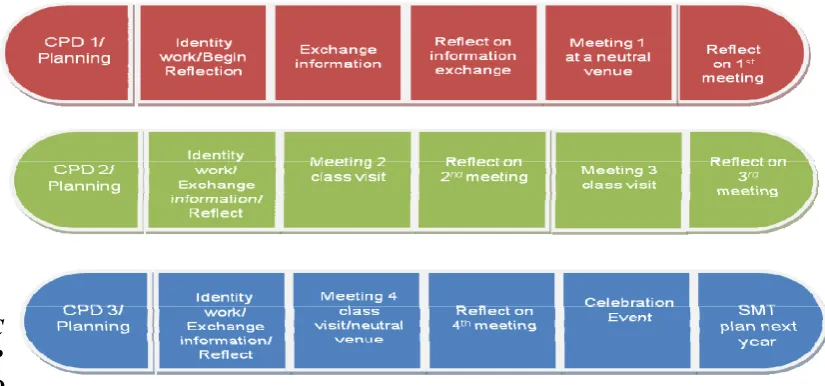
Figure 1.1: SLN CPD Programme for Schools
C P D
CPD Day 1 is in the autumn term and covers introducing the idea of the project to the school; establishing space in the curriculum for preparation work based on four key questions: Who am I? Who are we? Where do we live? and How do we all live together?; planning and exchanging introductory information about each other, planning effective linking days – usually in a neutral visit in the first instance - and introducing the importance of reflective practice. SLN recommends that a reflection session is held soon after each linking meeting. The course also covers baseline assessment.
CPD Day 2 is early in the spring term and brings the teachers back to reflect on the successes and lessons of the term 1 work and plan together with their link teacher for the rest of the year’s work. At CPD day 2, teachers are asked to familiarise themselves more with the SLN website and resources so that they could return to the key questions and consider how they want to develop work around these. They are also asked to record their work on web pages and provide feedback on how successful the lessons were. It is at this point in the year also that the controversial issues work normally begins with an input on tools and techniques for this.
CPD Day 3 is in the summer term and provides a final opportunity for the teachers to meet and reflect on the journey of the year, plan for hand over to new teachers and for continuation of the work with their own classes in the future. This is often combined with a celebration event where pupils from all the 20 schools gather to share the learning from their work. These events take place in most LAs sometime in late June, early July.
direct with SLN trainers. However, in this model there is no local support network but rather telephone or email support available from SLN.
It should be noted that one of the key aims of the national pilot of SLN was to learn from the pilot experience at every level in order to inform any subsequent expansion/national roll out of the SLN programme across further LAs and regions. This included learning more about:
• Which method of school recruitment is the most effective in LAs, depending on local circumstances. For example, in some areas LAs need to choose schools more carefully in order to ensure productive matches, whereas in other areas this is a less critical factor
• How local issues concerning community cohesion are played out and understood and the best way for schools to engage with these
• The extent of teacher skills and confidence in tackling sensitive and controversial issues concerning community cohesion
• The levels of commitment of school leaders and governors to issues of diversity and equality.
This evaluation was carried out with a range of LAs and their schools across England during their pilot year of working with SLN. The purpose of the pilot programme in each area was to apply the SLN model to each individual context, and learn and adapt the model to fit along the way. This evaluation, in part, assesses how well the LAs and schools were successful in this objective. This evaluation investigates pilot programmes in seven of the 40 LAs involved in the LA-based model and in one pair of schools involved in the Gateway model of school linking.
1.2 Aims and objectives of the study
NFER was commissioned by the Department for Education (DfE, formerly DCSF) to conduct an independent evaluation of the national pilot. This evaluation was focused on three key objectives:
1. To collect data on the typesof school linking activities taking place in LAs and to evaluate the processes (at LA and school level) that are administering and supporting the school linking
2. To measure the impact and outcomes of school linking at different levels (i.e. on pupils, schools, staff, and local communities)
3. To consider the sustainability and cost-effectiveness of school linking beyond the pilot phase.
1.3 Research design and methods
The evaluation was based on a two-stage, quasi-experimental research design. During the first ‘pre’ phase, NFER collected baseline evidence from pupils and schools in order to measure pupils’ prior attitudes towards, and experiences of, cohesion and integration, as well as schools’ policies towards cohesion and their plans for school linking. This baseline data was then used in the second ‘post’ phase, to measure the types of changes that had taken place and the impact of school linking.
Quantitative and qualitative evidence was collected in each phase (see Figure 1.2). It should be noted that the quantitative strand of the evaluation is based on secondary school pupils only, while the qualitative strand is based on both secondary and primary school pupils. This selection was made deliberately. Based on evidence and advice from those involved in surveys of pupils concerning sensitive and controversial issues, such as community cohesion, it was deemed that the topics of this evaluation concerning issues such as cohesion, equality and diversity were too difficult to capture from primary school aged pupils through a quantitative survey instrument. There would be a need to detail explanations of key terms and concepts (both verbal and written) both before and throughout the administration of the survey instruments and this would undermine both the quantity and quality of the data collected from pupils of this age. Given this, the decision was taken to collect the quantitative data solely from pupils in secondary schools. With more time available to collect evidence, and with the support of the research team in person in schools to explain concepts and terms, it was deemed possible to include primary school pupils, along with their secondary school counterparts, in the qualitative strand of the evaluation.
The quantitative strand involved a two-sweep survey of pupil knowledge, attitudes, experiences, and behaviours before and after participating in school linking activities. To ensure that any changes could be explained by linking rather than by school characteristics. The survey was administered to pupils who were participating in the linking activities, as well as those who were not. In addition, the survey was also administered in a matched comparison group of schools not participating in SLN. The pupils in the comparison group served as a control group, against which the results in the SLN schools could be compared and the effects of linking (rather than contextual effects) could be identified. Table 1.1 shows the pre- and post-intervention survey response rates for both SLN programme schools and comparison schools.
Table 1.1: School-level response rates
Round Type No. of
schools contacted
No. of schools which completed the survey Response rate Intervention sample
36 17 47%
Round 1 –
pre-intervention Comparison sample
120 27 22.5%
Intervention sample
17 15 88%
Round 2 –
post-intervention Comparison sample
27 23 85%
Pupils were surveyed before and after the SLN programme period. A sample of 3902 pupils responding to both the pre- and post-surveys was achieved – 1536 from SLN programme schools and 2366 from comparison schools. Among the 1536 pupils from SLN schools, 455 reported that they had been directly involved in school linking activities. All subsequent analysis reported here was based on this sample of 3902 pupils. Details of responses to each and both surveys are given below in Table 1.2.
Table 1.2: Survey responses
Surveyed
pre-intervention
Surveyed post-intervention
Surveyed both times
Pupils in SLN programme schools
2282 1620 1536 Pupils in comparison
schools
3690 2502 2366
Total 5972 4122 3902
members of the school’s senior management team, and, where applicable, the local organisers (i.e. strategic manager and the operations manager in the LA or NGO). In addition, focus groups were conducted with a selection of pupils who were participating in the linking activities.
In conclusion, these two strands provided robust data to enable crucial insights to be drawn about the impact of school linking and its potential to contribute to fostering integration and cohesion.
1.4 Structure of the report
Chapter 2 Measuring the impact and
outcomes of school linking
In this chapter we describe the evaluation framework that was developed to measure the impact and outcomes of school linking and to assess its contribution towards strengthening integration and cohesion within communities. This was an especially challenging task. In 2008, Dyson and Gallannaugh conducted a scoping review of research on the role of schools in promoting local integration and cohesion, and they concluded that:
• Overall, the research literature in this field is limited in extent, uneven in coverage and (apparently) variable in quality. It provides plenty of ideas for action, but much less by way of robust understanding or evidence of outcomes... Perhaps most significant, it actually has very little to say about
community cohesion as opposed to pupils’ behaviours and attitudes (Dyson and Gallannaugh, 2008: 28)
• The lack of research on the impact on communities and local cohesion is perhaps not surprising; the concepts are complex and often contested. Furthermore, identifying a robust and reliable set of predictors and indicators has proved challenging (Ratcliffe et al, 2008 and Demack et al, 2010: 17).
This chapter describes in brief how this challenge was tackled in this evaluation, and lists the variables and indicators that have been taken into account in the analysis.
2.1 What are local integration and cohesion and how can school
linking contribute to fostering it?
In recent years, local integration and cohesion have been principally referred to with the term “community cohesion”, a concept that came to be widely used in policy debates after the 2001 Cantle Report on the disturbances in Oldham, Bradford and Burnley in May of that year (Home Office, 2001). What this term has meant has shifted over the past decade (see Ratcliffe et al, 2008), but in their Guidance on the Duty to Promote Community Cohesion, the Department for Education (formerly the DCSF) defined community cohesion as:
Cohesion is therefore about how to avoid the corrosive effects of intolerance and harassment: how to build a mutual civility among different groups, and to ensure respect for diversity alongside a commitment to common and shared bonds (DCSF, 2007).
Recent research has indicated that a number of complex and inter-related factors contribute towards creating cohesion in local communities (see Laurence and Heath, 2008; Demack et al, 2010; Letki, 2008). Insights were also drawn from the literature on education for citizenship at school, which shed light on the relationship between schools, social capital, and building civic communities (see, for example, Whiteley, 2005; Keating et al, 2009).
Table 2.1: Variables influencing integration and cohesion
Level of analysis
Possible variables
Background variables (e.g. sex, socio-economic status, ethnicity, religion, age, attitudes towards school and learning)
Experience of diversity (e.g. Contact / friendship with other ethnic groups)
Experience of discrimination
Attitudes towards diversity and equality (e.g. openness / tolerance)
Levels of pupil participation and efficacy (e.g. feeling of empowerment to change school/ local/ wider community; Participation in extra-curricular activities)
Attitudes and ties to their community/ communities (e.g. trust in friendships and relationships with teachers/ parents;)
Level of deprivation Individual level
Citizenship type (e.g. active, social justice, passive)
Level of diversity (e.g. % EAL)
Level of deprivation (e.g. % FSM) School level
School climate (e.g. Levels of democracy and tolerance, incidence of discrimination and bullying)
Atmosphere in local area/ community “climate”
Deprivation in local area Community-level
Diversity in local area
However, while these factors have to be taken into account in the data analysis and interpretation, school linking is not designed to impact upon all of these variables (for example, school linking is not designed to change the level of deprivation in the community). Instead, SLN has developed a school linking initiative that aims to:
• Develop and deepen children and young people’s knowledge and understanding of identity/ies, diversity, equality and community
• Develop skills of enquiry, critical thinking, reflection and communication • Develop trust, empathy, awareness and respect
• Provide opportunities for children and young people to meet, build new relationships, work together, and contribute to the wider community
These aims are underpinned by Intergroup Contact Theory3 and the premise that, under the right conditions, increased contact between school children from diverse backgrounds and neighbourhoods can have a positive impact on children and young people’s attitudes, skills, knowledge, understanding, and experience of their own community and others.
The work is defined by a move away from ‘multiculturalism’, which has been criticised for accentuating difference, towards developing ways of living positively together: understanding diversity both for the richness it brings, but also acknowledging the tensions and complexities that have to be grappled with in order to find ways to live peacefully together, as seen from local, national and increasingly global perspectives.
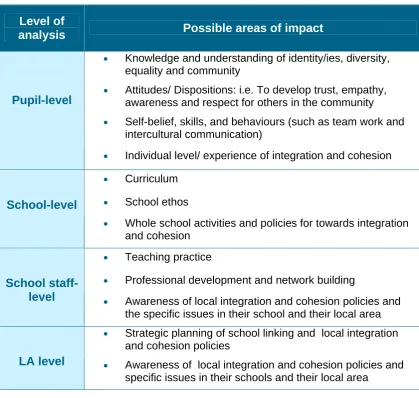
Based on these stated aims, and on discussions with the SLN team, we developed a list of ways in which school linking could contribute to fostering integration and cohesion at different levels: the pupil-level; the school-level; teacher-level; and the LA-level. The SLN model is designed to be embedded locally and to have impact at all four levels. However, it is recognised that such impact takes time and may not be fully visible in the early stages of implementation and delivery. These possible areas of impact became the outcomes of interest in this evaluation and are listed in Table 2.2.
3
Table 2.2: School linking and cohesion: impacts areas at different levels
Level of
analysis Possible areas of impact
• Knowledge and understanding of identity/ies, diversity, equality and community
• Attitudes/ Dispositions: i.e. To develop trust, empathy, awareness and respect for others in the community • Self-belief, skills, and behaviours (such as team work and
intercultural communication) Pupil-level
• Individual level/ experience of integration and cohesion
• Curriculum
• School ethos School-level
• Whole school activities and policies for towards integration and cohesion
• Teaching practice
• Professional development and network building School staff-
level • Awareness of local integration and cohesion policies and the specific issues in their school and their local area • Strategic planning of school linking and local integration
and cohesion policies
LA level • Awareness of local integration and cohesion policies and specific issues in their schools and their local area
2.2 Measuring the impact of school linking on cohesion
Table 2.3: Evaluation framework to examine the impact of school linking on local integration and cohesion
Level of
analysis Possible areas of impact Indicators
• Knowledge and understanding
of identity/ies, diversity, equality and community
• Knowledge and understanding of themselves and their community
• Knowledge and understanding of other cultures, communities etc.
• Attitudes/ Dispositions: i.e. To develop trust, empathy, awareness and respect for others in the
community
• Attitudes towards diversity, equality, immigration, human rights etc
• Enjoyment of diverse people and cultures
• Awareness of diversity, discrimination, etc
• Respect for others / respect for the rights of others
• Trust
• Openness to different opinions
• To develop self-belief, skills, and behaviours (such as team work and intercultural communication)
• Ability to work together with others (indicator of team work)
• Ability to talk about similarities and differences between people and places
(indicator of intercultural communication)
• Critical thinking and reflection
• Personal efficacy
• Confidence and willingness to identify and combat prejudice
• Inter-personal skills and confidence (e.g. learning how to meet new people
and get along with them; learning how to cope in strange and new situations)
Pupil-level
• Pupil perceptions and
experience of integration and cohesion
• School climate (incl. experience of bulling/ discrimination)
• Curriculum • Evidence of increased planning and coverage of identity/ diversity issues in
the curriculum
• School ethos • Support from senior leaders, teaching colleagues
• Democratic and tolerant school climate
School-level
• Whole school activities and policies for towards integration and cohesion
• Dissemination of learning from school
• Increased planning for sustaining SLP and/or other integration and
cohesion strategies in school development plan
• linking from SLP staff to other colleagues, and linking between SLP and
other integration and cohesion strategies
• Teaching practice
• New teaching skills
• Evidence of increased planning and coverage of identity/ diversity issues in
the curriculum
• Professional development and network building
• Opportunity to link with other teaching professionals and share good
practice School staff-
level
• Awareness of integration and cohesion policies and the specific issues in their school and their local area
• Increased awareness of national and local cohesion policies for education
(and more broadly)
• Development of appropriate integration and cohesion policies that reflect a
knowledge of, and interest in, the needs of the school and local communities
• Strategic planning of school
linking and cohesion policies • Development of strategies for sustaining SLP beyond the pilot year
LA level
• Awareness of integration and cohesion policies and the specific issues in their schools and their local area
• Increased awareness of national and local integration and cohesion
policies for education (and more broadly)
• Development of appropriate integration and cohesion policies for their
Particular attention was paid to considering how we could measure integration and cohesion at the local level. One of the key challenges was to develop indicators that would reflect children and young people’s experiences; the vast majority of the existing indicators have relied on data from adults or LAs (such as reports of race-related incidents recorded by police officers). Among the adult population, one of the main indicators has been responses to the question:
"to what extent do you agree or disagree that this local area [within 15/20 minute walking distance] is a place where people from different backgrounds get on well together?"
The response options are: definitely agree, tend to agree, tend to disagree, definitely disagree, or don’t know (see Home Office Citizenship Survey 2005). This indicator has been critiqued by Ratcliffe et al (2008: 54) for being too broad, too vague, and too reductive. For example, the term ‘background’ is a catch-all term that could be interpreted in a number of ways, which makes causal linking and robust interpretation difficult.
As a result, we tried to develop a more holistic measure of children and young people’s experiences of their school and their communities. To do so, we drew on the latest research on integration and citizenship education and identified a series of additional indicators of the relationship between children and young people and their communities. This research produced two useful concepts and corresponding sets of indicators. The first is “school climate”, a concept that is widely used in the citizenship education literature, to denote
“the impressions, beliefs, and expectations held by members of the school community about their school as a learning environment, their associated behaviour, and the symbols and institutions that represent the patterned expressions of the behaviour” (Homana et al., 2005: 2).
Schools are one of the main communities that children and young people experience, and the school community may not overlap with their local community; we therefore deemed it important to include a measure of their experiences in school as well as outside of school.
This concept has been measured in a variety of ways, but for the purposes of this evaluation, we focused on the following:
• The extent to which teachers discuss discrimination with pupils
• Pupil perceptions of unfair treatment by teachers (either personally experienced or witnessed)
• The level of bullying in the schools (either personally experienced or witnessed bullying in last 12 months)
• Pupil perceptions of the level of segregation within the school (that is, the extent to which different groups (racial, ethnic, religious or other) in the school “get on”).
The second concept that emerged we termed “neighbourhood climate” to echo the concept of school climate and to denote a broad understanding of neighbourhood experience. Again, we sought to include multiple indicators of this concept, including:
• Pupils’ ties to their community (friends, relatives, and opportunities for participation)
• Pupil perceptions of unfair treatment outside school • Trust of people in proximal social/ civic institutions
• Trust in different racial, ethnic, religious or socio-economic groups
• Pupil perceptions of the level of segregation within their neighbourhood (that is, the extent to which different groups (racial, ethnic, religious, socio-economic or other) in their neighbourhood “get on”).
Combined, these indicators provide a multi-faceted understanding of children and young people’s experiences of their school and local communities.
2.3 Summary
Chapter 3 Implementation and management of
the Schools Linking Network
Key findings
• LAs played a critical role in supporting the SLN programme in schools. This included auditing local needs and cohesion issues and agreeing on priorities, then approaching and initially linking schools, providing three days training and support, and taking care of practicalities such as collating a list of possible neutral venues for linking activities, which freed schools to concentrate on other aspects of the programme.
• Overall, the programme was successfully implemented across most of the schools. However, LAs and schools faced some issues around matching link partners (with some schools not being able to link with the type of school they originally envisaged). Also, some inter-school links broke down often as a result of staff changes.
• Most LAs and schools were planning to continue linking activities into the future.
3.1 Introduction
This chapter explores the implementation and management of the SLN programme across three main phases:
• Network start up – getting involved in the network and/making links with other schools
• Network running and maintenance • Network sustainability.
It does so from two differing viewpoints of those involved with SLN. The first perspective is that of the LAs tasked with starting up the local networks. The second perspective is that of the schools and school staff who responded to the approaches, largely though not exclusively from LAs, to take part in school linking. Together these two perspectives provide a broad overview of the issues, challenges and successes in the implementation and management of school linking through the pilot programme of SLN.
3.2 Implementation and management at the local authority (LA)
level
network into the future. The following sections explore the role LAs played in relation to each of these phases as part of SLN and highlight particular examples of effective practice developed to overcome any issues or challenges encountered.
It is worth noting that one of the areas visited in this evaluation was a link using the Gateway model (i.e. where schools set up links with other schools across England independently and where no such LA support was available). This meant that such schools could not benefit from the types of support described in this chapter.
3.2.1 Network start-up
The research revealed that, at the start-up phase, LA staff played a critical role in establishing effective partnerships between schools. In particular, the following aspects were of importance in ensuring the successful initial organisation of the SLN programme:
• Recruiting an appropriate range of schools to the network
• Matching schools, using a range of criteria, in order to establish effective linking partnerships
• Gaining support and commitment from school leaders and ensuring, as far as possible, that teachers who are committed to the value of integration and cohesion were assigned to lead the programme in their school
• Providing clear details of what will be expected of schools throughout the year of linking and of support to sustain the programme beyond the pilot.
These are explored in further detail below.
The main method for recruiting schools to the network employed by LAs was to contact all primary and/or secondary schools in their authority and to ask them to complete an ‘Expression of Interest’ (EOI) form. Schools used this form to outline their existing approaches to integration and cohesion, what they hoped to achieve from the programme, their ideas on which pupils would be involved and the topics they planned to cover. LAs hoped that this approach would enable them to set up effective links between diverse schools, including ethnically diverse schools:
‘It was around diversity, so we were trying to link more diverse schools with mainly white schools.’ (LA strategic manager)
Also, the information contained in the EOI forms was used by the LAs to match schools, alongside local knowledge about school characteristics, challenges and needs in terms of community cohesion:
However, several authorities found that this approach did not allow them to attract a sufficient diversity of schools to the network. In particular, some LAs reported that they were not able to attract sufficient secondary and ethnically more diverse schools. As one operational manager commented:
‘Generally, we found it was more mono-cultural. We did have schools that had diverse ethnic minority populations, but overall it was the mainly white British schools that registered’. (LA operational manager)
It is worth noting that of the seven LAs involved in the research, two had not recruited any secondary schools to their network. Another LA had recruited three, while others managed to involve between four and six secondary schools.
Many LAs commented on struggling to involve secondary schools, largely as a result of other priorities and insufficient project funding, as one strategic manager explained:
‘The only challenge was [that] we didn’t have secondary involvement, but I think money wasn’t attractive to them. I always find primary schools have a can do attitude; secondary colleagues have so much on that, unless there is a big monetary carrot to dangle, they are not interested really.’ (LA strategic manager)
Effective practice in recruiting schools
One LA identified a short list of schools based on known characteristics of the schools, capacity to take on the project and relevance to existing work taking place within the school. This enabled the authority to attract a more diverse range of schools into the network. Another solution adopted by some LAs was to set up links with schools in neighbouring authorities to get access to a broader selection of schools. This allowed for more tailored links between schools. However, in some cases, as a consequence it meant that pupils had to travel further to visit their partner schools and it required more time to coordinate activities with other LAs.
LAs also played a role in setting up linking partnerships between schools involved in the network. It was particularly effective in those authorities which:
• were able to draw on a large and diverse pool of schools
• could draw on local knowledge about the characteristics of local schools
Effective practice in partnership linking of schools
One LA used the information in the Expression of Interest (EOI) form and the assistance of a steering group to set up effective links between schools. ‘After the EOI we narrowed it down to certain schools and we had on cards data on schools’ percentage of pupils registered as EAL (English as an additional language), BME (Black and minority ethnic) pupils, FSM (free school meals)”. Also included was what the schools had requested. “Some of them specifically requested a particular type of school. For example, a largely white British school might say “We would like to be linked with a school that is more ethnically diverse”. And we took what we knew and the steering group matched them’. The steering group consisted of people with a lot of local knowledge of schools, including the senior school improvement manager and the head of inclusion.
In contrast, there were some LAs where links were not as effective. This was mainly a result of a lack of diversity of schools in the areas and/or involved in the network. In one instance, for example, a LA strategic manager reported:
‘Recently, we have asked for expressions of interest for the second year of the programme, and I have almost had only all-white schools coming forward wanting to link with a school with greater ethnic diversity’.
One of the key lessons learned by LA staff was the need to ensure that they engaged schools and teachers in the linking process that were committed to the value of integration and cohesion from the start of the work. As one interviewee commented:
‘I’ve learnt that it’s really important to work with teachers that are keen to take part. If you have the teachers that are just right, then you know it’s going to work. But when you get someone resistant to taking part then you can have problems’. (LA operational manager)
LA staff with good knowledge of local schools played an important role in making links with such teachers and ensuring that they were committed to the process. Engaging such teachers was presented as a critical success factor:
‘If the teachers are on board and enthusiastic, they completely make the project, they make it happen’. (LA strategic manager)
Another important role of LA staff, who had received three days training from SLN, at the start of the programme was to provide clear guidance to schools on the nature and structure of the SLN programme and the year ahead, including key dates, the main aims and objectives of the linking programme and what would be expected of schools, teachers and pupils.
going to be, and also what learning outcomes we are planning to achieve by the end of the project’. (LA operational manager)
3.2.2 Network running and maintenance
After the links had been set up between schools, LAs continued to play an important role in maintaining linking partnerships and encouraging effective links between schools. Interviews with local authority staff suggested that they played a role in:
• Embedding school linking in schools – to ensure continuity in case of staff turnover/sickness
• Delivering CPD opportunities as per the SLN three-day training model (see Chapter 1)
• Providing ongoing support to overcome any challenges
• Encouraging schools to monitor and evaluate the impact of school linking.
Interviews with LA staff suggested that losing key members of staff within a school was one of the main reasons for links between schools breaking down – though other reasons included unsuccessful matching of partner schools and schools not being committed to the project.
‘We had one school where one of the link teachers moved to a different school and the teacher who took her place wasn’t as dynamic. So the teacher from the other school was ticked off to be honest and they were going to drop out’.
(LA strategic manager)
LAs played a critical role, therefore, in trying to ensure that schools involved in the network were not only committed to the process, but that more than one teacher was involved in managing the school linking programme. Overall, it was more likely to be sustained and continue if schools made links to the school linking programme across the curriculum, including, for example, in citizenship or PSHE lessons. There was some evidence to suggest that this was more likely to be the case in schools that had been involved in SLN for a while, and that schools in their first year sometimes relied on one key member staff to coordinate the linking activities. In such cases, there was a danger that if this teacher either left the school or was absent due to sickness or other reasons, the school linking process could break down.
Effective practice in embedding linking in school
One LA always ensured that each school had at least two named contacts involved in the school linking programme. ‘It’s important for someone else to have a hand in it and know about it, whether it’s the lead teacher, mentors or someone else in their school. Otherwise, the teacher goes and you have invested so much with that teacher and they take all that knowledge with them’.
partnerships. Four of the LAs had delivered at least three CPD training days as recommended and designed by SLN, while the other three had offered two training days.
All authorities emphasised the positive impact of the training that they had delivered. They all believed that it had not only helped to engage schools in the school linking process, but that it had also ensured that schools sustained their involvement. In some cases, it had also helped to overcome issues or challenges identified by schools. LA staff believed that teachers had particularly appreciated the CPD training days for the opportunity to link with other schools and learn from their experiences:
‘The CPD is essential. It’s been a fabulous opportunity for staff to network and to share their experiences and that has been one of the biggest learning points in the whole project because they have been able to share their experiences and inspire colleagues’. (LA operational manager)
However, in some cases, teachers from schools had not been able to attend training sessions as a result of other engagements or not being able to find cover for lessons. As a LA contact said:
‘It’s quite fatal if one of the link teachers is there and the other teacher isn’t. It’s not good for the partnership is it? And that’s happened because of illness or one of them is on a residential’. (LA operational manager)
Effective practice in delivering CPD training
One LA had linked the provision of the incentive payment to schools with their attendance at the first two CPD training events. ‘We didn’t give them the money if they didn’t turn up. We had to pay them for the last one, but the first one we kept saying to them, “if you don’t come you don’t get the money because that’s for cover”’.
LAs provided other forms of support to schools other than the specific CPD training events, although the level of support differed across authorities. In all cases, the operational manager maintained contact with participating schools either by phone or by email, but others had more direct contact, sometimes also involving a strategic manager.
Some of the LAs had maintained considerable ongoing support to schools throughout the year. One operational manager, for example, had kept a very hands-on role with the four secondary schools involved in school linking, although he only had one day per week available for the project.
There were similar levels of hands-on involvement in two of the authorities which had around 20 schools in the network and full-time operational managers. In these cases, it was felt that offering such ‘hands-on support’ was a way of encouraging more schools to get involved in school linking by taking some of the organisational burden off schools. It is possible that without such ongoing support, some schools would not have found the time to engage in the programme. It is also worth noting that LAs without a full-time operational manager were more likely to report problems in finding time to support schools and were also less likely to have large numbers of schools involved in the network.
This contrasted with more minimal contact and support in one LA. The operational manager in one LA with six secondary schools involved in the school linking programme said that, after the first of two CPD training events, his role had mainly been to keep in contact with the schools by phone and email and to send termly updates to SLN. He believed that after the initial set-up, the schools had pushed the programme forward largely independently of him without much need for ongoing support. ‘If the schools were dependent on me, I wouldn’t have been giving them a good service’.
Almost all LAs said that they had encouraged schools to use the SLN evaluation forms to collect baseline and end-of-project data from pupils in order to measure any changes in attitudes, confidence and self-esteem. However, three authorities reported that they realised, sometimes only towards the end of the year, that several schools had not conducted the baseline assessment. This meant that not all schools had collected data on the impact of the programme.
Some LAs had complemented these school-based evaluations with their own attempts at measuring, or at least documenting, the impact and outcomes of the school linking programme. In some cases, this consisted mainly of monitoring information relating to the number of visits conducted or the number of pupils involved in the programme. Others used more informal evaluation methods, including conducting informal interviews with pupils.
Effective practice in evaluating the impact of school linking
3.2.3 Network sustainability in the future
All LAs considered that the programme had been highly cost-effective, although the actual amount of money received by schools to support their linking activities differed. It ranged from £400 to £1000 per school dependent on decisions by each LA about how to make best use of the funding received via SLN. However, most LA staff emphasised that the funding provided only covered some of the total costs and that schools involved in school linking had to spend some of their own resources to fully fund the costs. The support provided was seen as an important mechanism to get schools involved, if only to cover the cost of cover to encourage teachers to attend CPD sessions.
‘Most things like this in the past have been £4000. Every time you get involved in an external piece of work you’re given £4000 to get on with it. The £600 is just initial costs contribution, it’s been very useful and they [the schools] have appreciated [it].’ (LA strategic manager)
Most of the LAs were planning to continue school linking the following year – either by drawing on additional funding from within the LA, asking schools to fund the support or drawing on existing funds from the previous year that had not yet been spent. Only one LA explicitly stated that they were unlikely to continue to support school linking in schools due to financial issues:
‘Well, we’re in a terrible state, our budget has to be reduced a lot, and I don’t know if I will be in post next year. I know there will be no money from the local authority at all. That's the way of the world’. (LA operational manager)
In two authorities, strategic managers involved with SLN had convinced senior LA staff to fund the school linking in the future; this had been done by selling the concept, and aims and outcomes of school linking to them.
‘We have tried really hard to sell it and we have been out and presented to lots of different groups and steering groups, and it’s worked. We have shown them video evidence, we have taken the children, and we took an identity box the class made full of special things the children have done. And they have opened the box and taken things out and their reaction has been “Wow this is really