Research report 76
Developing the Children’s
Measurement Framework:
Selecting the Indicators
Holly Holder, Tiffany Tsang and Polly Vizard
Developing the Children's Measurement Framework:
Selecting the Indicators
Holly Holder, Tiffany Tsang and Polly Vizard
First published Summer 2011
ISBN 978 1 84206 391 0
EQUALITY AND HUMAN RIGHTS COMMISSION RESEARCH REPORT SERIES
The Equality and Human Rights Commission Research Report Series publishes research carried out for the Commission by commissioned researchers.
The views expressed in this report are those of the authors and do not necessarily represent the views of the Commission. The Commission is publishing the report as a contribution to discussion and debate.
Please contact the Research team for further information about other Commission research reports, or visit our website:
Research Team
Equality and Human Rights Commission Arndale House
The Arndale Centre Manchester
M4 3AQ
Email: [email protected] Telephone: 0161 829 8500
Website: www.equalityhumanrights.com
You can download a copy of this report as a PDF from our website:
If you require this publication in an alternative format, please contact the Communications Team to discuss your needs at:
Contents
Acknowledgements vii
Foreword viii
Executive summary x
1. Introduction 1
1.1 What is the Equality Measurement Framework (EMF)? 1 1.2 The extension of the Equality Measurement Framework to
cover children and young people 4
1.3 Specialist consultation on the selection of indicators for children
and young people 7
1.4 Organisation of this report 10
1.5 Next steps 11
2. Existing frameworks for monitoring the equality and human rights
position of children and young people 13
2.1 The UN Convention on the Rights of the Child 13
2.2 England and Wales: Every Child Matters (ECM) 15
2.3 Wales: The Welsh Assembly’s Seven Core Aims for Children
and Young People 18
2.4 Scotland: Getting it Right for Every Child 20
2.5 Overview of sources of data on children and young people that
have been consulted for the purposes of the project 23
3. Selection criteria 26
3.1 Principles for selecting indicators for children and young people 26
3.2 Selection criteria: project checklist 29
3.3 Revisions to selection criteria following consultation 31
4. A. Life 32
4.1 Sub-domains 32
4.2 Short-list 32
4.3 Evaluation tables and feedback 33
4.4 Recommendations 41
5. B. Health 42
5.1 Sub-domains 42
5.2 Short-list 43
5.3 Evaluation tables and feedback 45
5.4 Recommendations 67
6. C. Physical Security 69
6.1 Sub-domains 69
6.2 Short-list 69
6.3 Evaluation tables and feedback 73
6.4 Recommendations 98
7. D. Legal Security 100
7.1 Sub-domains 100
7.2 Short-list 101
7.4 Recommendations 118
8. E. Education and Learning 120
8.1 Sub-domains 120
8.2 Short-list 121
8.3 Evaluation tables and feedback 123
8.4 Recommendations 150
9. F. Standard of Living 153
9.1 Sub-domains 153
9.2 Short-list 153
9.3 Evaluation tables and feedback 155
9.4 Recommendations 166
10. G. Productive and Valued Activities 168
10.1 Sub-domains 168
10.2 Short-list 168
10.3 Evaluation tables and feedback 170
10.4 Recommendations 176
11. H. Individual, Family and Social Life 178
11.1 Sub-domains 178
11.2 Short-list 179
11.3 Evaluation tables and feedback 181
11.4 Recommendations 195
12. I. Identity, Expression and Self-respect 196
12.1 Sub-domains 196
12.2 Short-list 196
12.3 Evaluation tables and feedback 198
12.4 Recommendations 205
13. J. Participation, Influence and Voice 207
13.1 Sub-domains 207
13.2 Short-list 207
13.3 Evaluation tables and feedback 209
13.4 Recommendations 219
14. Final conclusions and recommendations 221
14.1 The process of selecting indicators 221
14.2 Overall reactions to the CMF 222
14.3 Disaggregation characteristics 225
14.4 Human rights and the list of vulnerable groups 230 14.5 Expanding the indicators and measures to cover additional
disaggregation characteristics 232
14.6 Other priority areas for data development 234
14.7 Data availability 236
14.8 Definitions, breakdowns and intersectionalities 243
14.9 Population coverage of the indicators 247
14.10 Geographical coverage of the indicators 249
14.11 Presentation and interpretation of data 250
14.12 Forward development of the CMF 251
References 265 Appendix 1: The list of central and valuable freedoms for children 275 Appendix 2: Participation and coverage of the Specialist Consultation
on the Selection of Indicators for Children and Young People 279
Appendix 3: Data gaps 281
Figures
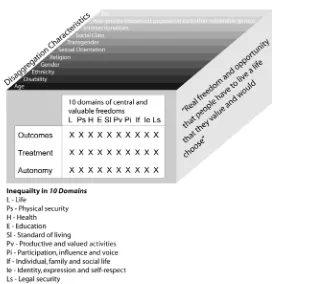
1.1 The ‘substantive freedom matrix’ 4
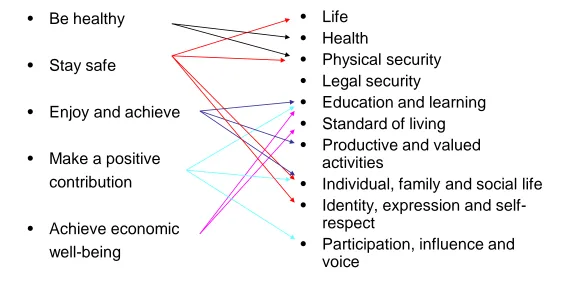
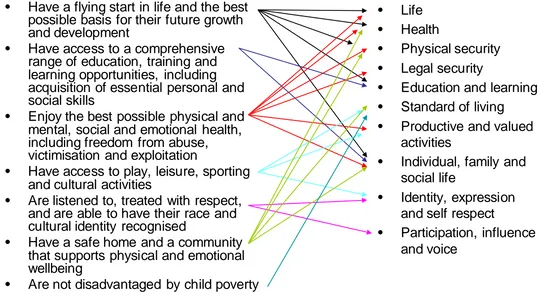
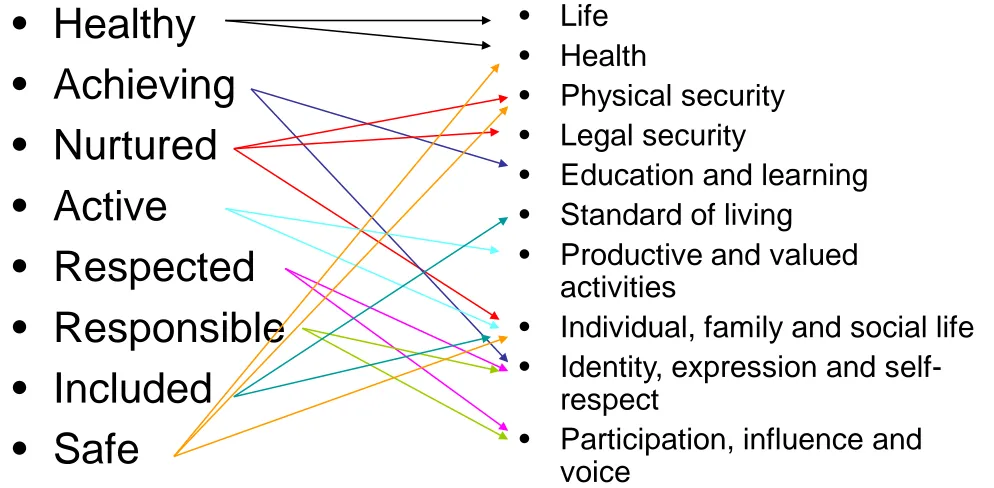
2.1 Mapping 'Every Child Matters' to the CMF 17
List of acronyms
ACPO Association of Chief Police Officers ASBO Anti-Social Behaviour Order
BCS British Crime Survey
BHPS British Household Panel Survey BME Black and Minority Ethnic
BMI Body Mass Index
CASE Centre for Analysis of Social Exclusion CEOP Exploitation and Online Protection Agency CJS Criminal Justice System
CMF Children’s Measurement Framework CRAE Children’s Rights Alliance for England
DCLG Department of Communities and Local Government DCSF Department for Children, Schools and Families DR Deaths Registered [in England and Wales] DSOs Departmental Strategic Objectives
DWP Department of Work and Pensions EAL English as an Additional Language EC European Commission
ECM Every Child Matters
EHRC Equality and Human Rights Commission EMF Equality Measurement Framework
EU European Union
EYFSP Early Years Foundation Stage Profile FAC Families and Children Study
FRA European Union Agency for Fundamental Rights FRS Family Resources Survey
GB Great Britain
GEO Government Equalities Office GIRFEC Getting it Right for Every Child HBAI Households Below Average Income HBSC Health Behaviour in School-aged Children HMI Her Majesty’s Inspectorate
HMIP Her Majesty’s Inspectorate of Prisons MP Member of Parliament
MSP Member of the Scottish Parliament NCB National Children’s Bureau
NEET Not in Education, Employment or Training NIS National Indicator Set
NSPCC National Society for the Prevention of Cruelty to Children PANOC Positive and Negative Outcomes of Caring
PCSO Police Community Support Officer PSAs Public Service Agreements
QIF Quality Improvement Framework SEN Special Education Needs
STCs Secure Training Centres
STIs Sexually Transmitted Infections
UKHTC United Kingdom Human Trafficking Centre UNCRC UN Convention on the Rights of the Child VRQ Vocationally Related Qualification
YJB Youth Justice Board
Acknowledgements
We are very grateful to a large number of people who have helped us with this project. Consultation participants in England, Scotland and Wales, and online, gave freely of their time and expertise, and helped enormously to improve the final
selection of indicators.
Particular thanks to the EHRC Foresight Team, especially David Darton and Andrew Meads, for directing the project, to Fiona Glen for general support, comments and advice; and above all to Liz Speed for her outstanding management of the project and for dedicated and first-class input during the editorial process. Thanks also to Kathleen Doyle, Morag Patrick, Amelia John, Wayne Vincent and Heather Dean for their expertise and input during event discussions, as well as their assistance with the organisation of the Scottish and Welsh consultation events.
In addition, our one-to-one discussions and email exchanges with, amongst others, Launa Anderson, Jane Colvil, Aoife Daly, Samantha Dimmock, Diana Dodd, Katie Driver, Gwion Evans, Samantha Grant, Alison Hosie, Simon Jones, Stephen Lamb, Sioned Lewis, Marion Macleod, Dee Martin, Liz McDermott, Peter Matejic and Bryce Millard have been immensely beneficial to us.
Thanks also to Ruth Lupton, Abigail McKnight and Kitty Stewart from CASE for their help and advice.
Anita Bardhan-Roy, Jane Dickson, Jack Finegan, Joe Joannes, Eva Moratinos, Anna Tamas and Nic Warner provided first-rate administrative, IT and statistical support, which we could not have done without.
Finally, special thanks to Tania Burchardt who helped to set up and scope this project before going on maternity leave and to whom we are grateful for advice and support.
Foreword
The wellbeing of children, and especially those who are potentially vulnerable to the impacts of material, educational and social deprivation and neglect, retains a central place in public debates at the national and international level. In part, this is because early life experiences are crucial for acquiring what the Nobel prize winning
economist Amartya Sen, whose ‘capability approach’ to measuring inequality and wellbeing is extensively used in what follows, terms the ‘functionings’ needed for future success in many of areas of adult life. But it also reflects the widespread view that childhood itself is seen to be a unique experience in modern societies. This has not always been so, nor is it yet universal.
The Equality and Human Rights Commission is therefore pleased to present its report on the development of its Children’s Measurement Framework (CMF). This is the third of four Commission reports which provides details of the four Measurement Frameworks (MFs) which the Commission has been developing to measure progress with regard to its three mandate areas: Equality, Human Rights and Good Relations. The First, Developing the Equality Measurement Framework: selecting the indicators was published in July 2009 and was used to inform the selection of the indicators and measures used in the Commission’s first Triennial Report, How Fair is Britain?:
Equality, Human Rights and Good Relations in 2010, published in October of last
year. The second, the Good Relations Measurement Framework, was published in the summer of 2010. The final report, covering the Commission’s proposed Human Rights Measurement Framework, will be published later in 2011.
The CMF, which largely seeks to extend the Equality Measurement Framework (EMF) to children, has been developed for the Commission by a team from the Centre for the Analysis of Social Exclusion (CASE) at the London School of
Economics. The Commission would like to take this opportunity to thank the CASE team – led by Polly Vizard and ably supported by Tiffany Tsang – for their hard work in conducting the consultation work that led up to this report. We would also like to thank all of those individuals and groups who participated in the consultation events which were held as part of this exercise at various locations across Great Britain. Their contribution to this process has been invaluable and we hope that the final report has done justice to the many views and ideas that were expressed during these meetings. We would also like to thank all of those groups and individuals who, while unable to attend the events, gave their views via other means. Again, these proved extremely valuable to the consultation process.
Commission after this point by the Home Office and the Scottish Government. However, since the summer of 2010, a number of developments have occurred which mean that further Commission work will be required in order to finalise the list of indicators and measures contained in this report. Perhaps, most importantly, the Government has announced, or is undertaking, several reviews of official data sources and surveys which may result in some of the sources of measures data listed in this report being lost or limited for reasons of cost. The Commission is making its representations to Government with regard to these as it believes it is crucial in the current economic climate, and to ensure the integrity of its work on the MFs so far, for statistical data on its mandate areas to be protected from
unnecessary reductions in availability, frequency and quality. However, the abolition of the Tellus Survey, which this report makes much use of, has already been
announced. In addition, and unlike the EMF report, the list of CMF measures has not, as yet, been subject to a ‘technical testing’ stage that would allow the proposed list to be shortened. We intend to do this when the data landscape becomes clearer.
Finally, while the CMF domains are fixed, the proposed grouping of indicators and measures may be subject to further internal Commission work. Again this may occur after the future data landscape has been clarified.
In conclusion, and despite these ongoing uncertainties, the Commission hopes the following report will be helpful to all of those who are concerned with the promotion of children’s issues and interests in contemporary British society. Thus any approach to measuring the ways in which society treats its children and young people, and
Executive summary
Background and aims
The Measurement Frameworks are being developed by the Equality and Human Rights Commission (EHRC) to monitor and evaluate progress towards achieving equality and human rights in Britain. This report documents the next step in their development, to select a set of indicators for children and young people within each of the 10 domains of the Equality Measurement Framework (EMF).
A set of indicators for adults was agreed through a consultative process in 2008. The team from the Centre for Analysis of Social Exclusion (CASE) was commissioned in 2009 by the EHRC to extend the EMF to cover children and young people and to undertake a specialist consultation to ensure that the views of key stakeholder groups and subject experts were fully explored.
A separate set of indicators for children and young people is needed for a number of reasons. These include: the availability and collection of data at a household rather than individual level; recognition of child-specific and young-people specific issues; the need to focus and re-specify existing adult indicators for children and young people, even when they appear to be directly applicable; the need for different approaches depending on the age of a child; and the resolution of a number of complex and sensitive issues around the relationship between children and young people with their family and the state.
The objective of the specialist consultation in January and February 2010 was to achieve maximum possible agreement on up to five indicators for each domain that highlight particularly salient facets of inequality for children, and to specify the
associated measures under each indicator that will be used for monitoring purposes in England, Scotland and Wales.
The CASE team prepared a provisional short-list of indicators for each domain, as a basis for discussion at the Specialist Consultation. The criteria that were used to develop the short-list of indicators are discussed in Chapter 3. The short-lists were then subjected to scrutiny and discussion, including identifying possible data sources, through the specialist consultation process. The short-list was revised and extended taking account of the views and feedback of participants, and a final shortlist was prepared.
What did we ask of participants at the specialist consultation?
consultation were invited to comment on:
• The selection criteria. Are they an appropriate basis for identifying and agreeing a set of indicators for children and young people?
• Preferred indicators. Are there preferred alternatives and can additional data sources be identified, including where we have provisionally identified data gaps? • The relevance of disaggregation characteristics and the definition of a child. Are
some or all of the disaggregation characteristics adopted in the adult’s framework relevant for children and what are the appropriate age thresholds?
• The definition of a child. What is the appropriate definition of a child that should be adopted as a basis for the EMF?
Methods
The selection of a set of indicators for children was a five-stage process:
1. Drawing up a set of criteria with which to select indicators for children and young people
A set of criteria with which to select indicators has been adapted from the list developed for the consultation on indicators for adults. Full details of the selection criteria are provided in Chapter 3. Consultation participants were invited to comment on the appropriateness of the selection criteria as well as on the short-lists of indicators for children.
2. Developing a long-list and provisional short-list of indicators for children and young people
The CASE team has undertaken a comprehensive review of data sources specific to children and prepared a long-list of indicators and a provisional short-list for each domain.
The provisional short-lists for each domain were arrived at by applying the ‘essential’ and ‘desirable’ selection criteria. The short-list of indicators within each domain includes five indicators for each domain, with measures specified under each indicator.
The long-lists and provisional short-lists for each domain were set out in 10 separate Briefing Papers that was uploaded onto the consultation website.
reflect both equality and human rights concerns were identified and selected for each domain.
3. Face-to-face consultation with subject specialists and stakeholders
Three full-day events, one each in England, Scotland and Wales, were held to discuss the provisional short-list of indicators, as well as to discuss specific issues across the domains which arise in regional contexts.
4. Web consultation
In addition to the face-to-face consultation events, participants were able to provide written feedback and comments through a web consultation. This was arranged to facilitate more detailed comments, the submission of documents and time for reflection and consultation with colleagues following the one-day events. Individuals and organisations unable to attend the one-day events were also able to submit feedback and comments through the web
consultation.
The web consultation went live on 25 January 2010 and individuals and groups were able to submit comments and suggestions until 28 February 2010.
5. Revision of the short-lists following the face-to-face consultation events and the web consultation. The provisional short-list tabled as a basis for discussion at the specialist consultation has been revised by the CASE team in line with comments and feedback, and a final short-list has been developed.
Forty people attended the consultation events in total and five organisations responded to the web consultation. We also had three in-depth one-to-one meetings with DCSF in 2010, and further meetings, email exchanges and conversations with over 20 organisations and institutions.
Summary of general recommendations
As a result of this process, a series of recommendations are made, some of which are general and others which are domain specific. They are those of the authors alone. The recommendations build directly on the findings from this exercise and are designed to guide and assist data providers and those central to the future
development of the framework.
Overall reactions to the Children's Measurement Framework (CMF)
international human rights Committees and enables the vulnerable groups layer in the 3-D Matrix presented in Chapter 1: to be 'unpacked'.
• We recommend that the 'outcome' indicators and measures for children and young people identified through the Human Rights Measurement Framework should be added to the existing indicators in the CMF when they are available, in order to ensure that human rights concerns are reflected and captured within each EMF domain.
Disaggregation characteristics
• We recommend that in general, the set of disaggregation characteristics
(ethnicity, age, disability, religion or belief, gender, sexual orientation, transgender and social class) that have been applied in the context of the EMF for adults, should be viewed as applying in the context of the CMF. We recommend that the following disaggregation characteristics should be systematically added to major social surveys covering children and young people: disability, religion or belief, gender, ethnicity, age and social class, including in the early years, foundation and primary school context.
• We recommend that monitoring of sexual orientation in the context of children and young people should be taken forward on a good practice led, indicator by
indicator basis.
• We recommend that sexual orientation is added to the list of characteristics recorded in major social surveys for young people aged 16+, building on our recommendations for the adults' EMF and the ONS Sexual Identity Project. We note that young people age 16-18 are already covered by this recommendation and confirm that data for the 16-18 year old age-band disaggregated by sexual orientation should be used in conjunction with the CMF.
• We recommend that more attention is given to the need to develop a question on sexual identity/sexual orientation that could be fielded in surveys that go out to secondary school children and/or be used in the context of separate and targeted engagement/monitoring exercises.
Human rights and the list of vulnerable groups
• We recommend that the following list of vulnerable children and young people, which has been extended and revised on the basis of consultation feedback, is used in conjunction with the CMF. This is in line with the recommendations of international human rights Committees and enables the vulnerable groups layer in the 3-D Matrix presented in Chapter 1 to be 'unpacked'.
List of vulnerable groups of children and young people:
• Children whose families have no recourse to benefits (covers immigrants, asylum seekers and refugees)
• Children looked after by social services
• Children in the Criminal Justice System (CJS)
• Children with parents who are in contact with the CJS or who suffer from substance or alcohol abuse
• Children resident or detained in public or private institutions • Children at risk of abuse and neglect
• Gypsies and Travellers • Trafficked children • Homeless children
• Disabled children (with separate reporting for physical and mental health difficulties, Special Education Needs, Additional Education Needs and Additional Support for Learning)
• Children living in income poverty • Children who are carers
• Children living in unsuitable accommodation
• Care leavers and young adults in relation to transitional issues • Teenage parents
•
• Any other child or young person on the Children In Need register (which includes any child referred to Children’s Social Care Services in
England).
Expanding the indicators and measures to cover additional disaggregation characteristics
• We recommend that relevant bodies work together to take forward the
development of indicators of deaths from non-natural causes for children and young people who are resident or detained in public or private institutions (Life domain, Indicator 5) and physical security for children and young people who are resident or detained in public or private institutions (in the Physical Security Domain, Indicator 4).
• We recommend that disaggregation of indicators and measures by additional disaggregation characteristics is taken forward.
Other priority areas for data development
• We recommend that indicators of autonomy for children and young people are developed, building on the work that has been undertaken in the context of adults (Burchardt, Evans and Holder, 2010). This would need to involve cognitive testing on both the wording of potential questions and the areas of life that are important for children and young people.
• We recommend the funding of research to explore the feasibility of developing new equality and human rights indicators derived from Helpline data. Relevant areas include Helpline data on maltreatment and bullying (in the context of
children and young people and self-reported discrimination and elder abuse in the context of adults).
Data availability
• We recommend that an adequate sample size that can facilitate disaggregation by the relevant characteristics is developed for the British Crime Survey, the British Household Panel Survey and the Citizenship extensions to cover children and young people.
• We have made a number of recommendations on how the use of existing data sources can be maximised in order to address data gaps. These include recommendations on survey questions, including:
o The addition of questions to measure additional disaggregation characteristics in existing social surveys (e.g. disability to the National Pupil Database).
o Modification of question wording, for example questions referencing adverse treatment on the grounds of race and ethnicity to cover additional
characteristics (for example, in the physical security domain, broadening of the question on experiences of violence motivated by targeting characteristic to cover religion or belief, disability, gender and sexual orientation, as well as ethnicity and race).
o The addition of questions to existing surveys (such as the proposal to add a question on homophobic bullying to the Tellus Survey).
o Data linkage (e.g. linking the Children in Need Census to the National Pupil Database, using the unique Pupil Number).
The general picture in England
The general picture in Wales
• We recommend that further research work is undertaken to identify additional measures for Wales that match the short-list of indicators and measures that have been specified for England. The starting point for this work should be the Welsh Monitor and the underlying data sources for this listed above.
• We recommend that the gaps on monitoring by ethnicity and disability within the Welsh Monitor are addressed.
• We recommend that booster samples are considered for the BCS extension and the Citizenship extension where they are necessary to achieve robust within Wales analysis by disaggregation characteristics.
• We recommend that consideration is given to the need for a Welsh-specific specialist social survey on children and young people.
• We recommend that development of the National Survey takes account of the need for Welsh-specific survey data on children and young people. Consideration in developing questions should be given to the need for additional Welsh-specific CMF measures that match up with the measures defined for England.
• We recommend that regular monitoring of bullying in Wales, using Welsh-specific questions on bullying, is a particular priority, since the measures available through the HBSC Survey do not facilitate disaggregation by disability, religion or belief, and sexual orientation. The new one-off survey, ‘A Survey into the Prevalence and Incidence of School Bullying in Wales’ could provide a strong basis for question development of regular monitoring of bullying in Wales (Bowen and Holtom, 2010).1
The general picture in Scotland
• We recommend that the Scottish Government agrees a set of national statistical indicators for children and young people to monitor progress under the Getting it
Right for Every Child Framework. We further recommend that there is active
engagement between the Scottish Government and key stakeholders such as Save the Children Scotland to ensure that this objective is achieved as soon as possible.2
1 Feedback from the Welsh Assembly Government suggests that the number of children
included in the National Survey may not be sufficient for these purposes (depending on whether sub-Wales level data is needed or if confidence intervals may be too large to
account for small changes over time). If it was decided that the National Survey is the vehicle for obtaining data for CMF it may be possible to find a way around this issue, perhaps by combining data from consecutive years.
We recommend that the CMF is viewed as an input into this process and consideration is given to the indicators and measures in the CMF by the ScottishGovernment.
2 For an update concerning the development of indicators for children in Scotland, see
• We recommend that further work be undertaken to continue the process of developing the CMF for Scotland, including by matching the set of measures for England to social survey and administrative sources in Scotland and/or to identify different/separate measures as appropriate. The potential of existing data sources such as the GUS, the Millennium Cohort Study and the Edinburgh Study of Youth Transitions and Crime should be fully explored as a potential basis for CMF indicators and measures for Scotland.
• We recommend that future question and survey development in Scotland take account of the set of indicators and measures that has been specified for the CMF. This includes those relating to bullying and physical violence, which are derived in the English context from Tellus, the Citizenship Survey extension and the BCS extension).
Definitions, breakdowns and intersectionalities
• We recommend that disaggregation in the context of the CMF should be as fine-grained as possible, given the data source.
• We recommend that intersectionalities between equality characteristics are analysed and presented at the data gathering stage, where relevant and revealing.
• In Wales, particular priority should be given to exploring intersectionalities between Welsh as a first language and other disaggregation characteristics.
Definition of a child
• We recommend that as a general rule the CRC definition of a child be adopted for project purposes, with those aged 17 and under covered by the CMF. However, the upper-age threshold should not be imposed rigidly, and coverage of the 18-24 age-band may also be desirable in the context of particular indicators and
measures.
Application of age-bands
• We recommend that the EMF and the CMF should be cross-referenced as appropriate.
Population coverage of the indicators
• We recommend the standard questionnaire module discussed in Alkire et al. (2009) (which is based on indicators across the 10 domains with harmonised questions on equality characteristics that can be modified to suit each intended setting), is developed and designed to cover children and young people as well as adults.
transgender should be undertaken, based on consultation with key stakeholders and children and young people.
Presentation and interpretation of data
• We recommend that development of the web-tool based on the ideas set out in Alkire et al. (2009) is taken forward.
Forward development of the CMF
• We recommend that the indicators are revisited regularly to ensure they continue to reflect the most important equality and human rights issues while retaining a degree of continuity, to facilitate analysis of trends over time. We recommend that research is undertaken to take forward the evaluation function of the CMF.
• We recommend that consideration is given to involving children and young people in scrutinising the short-list of indicators produced by the specialist consultation, for example by means of a citizen’s jury comprising children and their parents, teenagers and other young people.
• We recommend the development of a set of survey questions on children who are carers and that children and young people are directly involved in the process of developing those questions.
• We recommend the development of an easy access version of the CMF for children and young people.
Immediate next steps – undertaking of the 'technical stage'
• We recommend that the technical, data gathering and narrative phases of the CMF are taken forward at the earliest possible stage, to ensure the delivery of a robust evidence base.
• There is some potential for rationalization of indicators and measures at the technical stage, particularly where alternative data sources have been put forward as a basis for measures. Whilst it has been possible to incorporate some of the proposals for rationalization that have been tabled by the PMG, others raise complex issues that require further discussion, and we recommend a meeting to take forward this discussion prior to the technical stage. In principle, in some instances, the position of vulnerable groups might be captured as additional measures under more general indicator headings (rather than as separate indicators).
Factoring in changes to policy and data availability following the May 2010 General Election
• The forward development of the CMF will also need to take account of the
report and following the General Election in May 2010. This report has been drafted on the basis of the CMF consultation which took place in early 2010. It recommends a set of indicators and measures based on information available at this time. However, the recommended set of indicators and measures, our general evaluation of the availability of social survey and administrative sources relating to children, and the recommendations and conclusions that are premised on this evaluation, are all potentially affected by changes in policy and data availability since May 2010.
• Policy changes announced and/or implemented include, but are not limited to: changes in policy affecting children detained in the immigration and asylum-seeking context; testing of all policies against UNCRC (Wales); development of a new child poverty and early years strategy; changes in required attainment within the educational context, including Foundation stage; changes in anti-social
disorder policy and changes in institutional arrangements for online protection (CEOP). Policy changes of this type will have a potential impact on the indicators and measures selected for the CMF. For example, the CMF includes measures relating to the detention of children under Immigration Act powers and
percentages of children achieving required development levels in the Foundation Stage and other Key Stages in the educational context. The specification of these measures may need to be revised in the light of these policy changes and
announcements.
Summary of indicators and measures
As a result of this study, 50 indicators have been identified for children and young people across the 10 domains, comprising 200 measures overall.
The short-list of indicators for children and young people A. LIFE
Indicator 1: Infant mortality rate
Measure 1.1 (E,W) The number of deaths under the age of one year, per 1,000 live births
Indicator 2: Homicide of children and young people
Measure 2.1 (E,W) (E,W) Homicide rate of children and young people
Measure 2.2 (E,W) Domestic homicide of children and young people (covering parent or relative as suspect)
Measure 2.3a (E) Homicide of children and young people involving sharp instruments and shootings
Measure 2.3b (W) Homicide through violent crime
Measure 2.4 (E,W) Racially motivated, religiously motivated and homophobic homicide of children and young people
Indicator 3: Other specific-cause mortality rates for children and young people
Measure 3.1 (E,W) Cancer mortality rate for children and young people
Measure 3.2 (E,W) Suicide rate for children and young people
Measure 3.3 (E,W) Mortality rate for children and young people caused by transport accidents
Measure 3.4 (E,W) Mortality rate for children and young people caused by accidents in home and residential institutions
Indicator 4: Preventable deaths of children and young people
Indicator 5: The number of deaths from non-natural causes for children and young people resident and/or detained in public or private institutions
Measure 5.1 (E) The number of deaths from non-natural causes and self-inflicted deaths of children and young people in custody, prisons, secure training centres and secure children’s homes
Measure 5.2 The number of deaths from non-natural causes and self-inflicted deaths from non-natural causes of children and young people in health, social care and educational establishments (boarding schools, special schools, etc)
B. HEALTH
Indicator 1: Limiting illness, disability, mental and emotional health among children and young people
Measure 1.1 (E,W) The percentage of children and young people who report a long-standing health problem or disability that limits their ability to carry out normal day-to-day activities
Measure 1.2 (E,W) The percentage of children and young people who report poor mental health
Measure 1.3 (E,W) The percentage of children and young people who often worry about everyday concerns
Measure 1.4a (E,S,W) The percentage of children and young people with eating disorders (anorexia nervosa and bulimia)
Measure 1.4b (E,S,W) The percentage of children and young people who self-harm
Measure 1.5 (E,W) The percentage of children with an underweight birth
Measure 1.6 (E,W) The percentage of children and young people with asthma and other respiratory diseases
Measure 1.7 (E,W) The percentage of children and young people with diabetes
Indicator 2: Reproductive and sexual health for young people
Measure 2.2 (E,W) Teenage pregnancy: conception rate of under 18s (conception per thousand women in age-group)
Measure 2.3 (E,W) Live birth rates of under 18s (live births of under 18s compared to total conceptions of under 18s)
Measure 2.4 (E,S,W) Prevalence of Sexually Transmitted Infections (STIs) among young people
Indicator 3:Experiences for children and young people of discrimination and dignity and respect in healthcare
Measure 3.1 Dignity and respect in healthcare for children and young people
Measure 3.2 Access to a reliable and confidential complaints system against health services for children and young people
Measure 3.3 Discrimination in access to GP services experienced by Gypsy and Traveller children
Indicator 4: Healthy living for children and young people
Measure 4.1 (E,S,W) Healthy development of children and young people – the percentage of mothers breastfeeding at 6-8 weeks from birth
Measure 4.2 (E) The percentage of children and young people who are eligible for free school meals who actually receive free school meals
Measure 4.3 (E,W) The percentage of children and young people who are obese
Measure 4.4 (E,W) Physical activity for children and young people
(a) The percentage of children and young people who have done sports or exercise activities in the last seven days
OR
(b) The percentage of children and young people who have done something active everyday or most days in the last seven days
Measure 4.5 (E,W) The percentage of children and young people eating the recommended levels of fruit and vegetables
Measure 4.7 (E) The percentage of children and young people who consume alcohol or use drugs
Measure 4.8 (E) The percentage of children and young people in households who are living in an area with less favourable environmental conditions
Indicator 5: Health status of vulnerable children and young people
Measure 5.1 (E,W) The number of children and young people seriously injured in a road traffic incident
Measure 5.2a (E) The number of A&E admissions caused by unintentional and deliberate injuries to children and young people
Measure 5.2b (E) A&E accidents and injuries rate by location (a. home, b. work, c. public place, d. work/educational establishment, e. other)
Measure 5.3 (W) The percentage of young carers reporting poor mental health compared to non-carers of the same age
Measure 5.4 (E) The percentage of young people in custody and secure training centres who report poor access to health services
Measure 5.5 (E) The percentage of looked after children who have not received an annual health check, an annual dental check, do not have up to date immunisations or who have been identified as having a substance misuse problem who have not received an intervention
Measure 5.6 (E) The percentage of looked after children who have poor mental health
C. PHYSICAL SECURITY
Indicator 1: Violent crime against children and young people
Measure 1.1 (E,S,W) Percentage of children that are victims of violent crime (all types)
Measure 1.3 (E,W) Percentage of children and young people who have had someone hit, attack, or threaten them on purpose with a weapon (this might have been something like a stick, a rock, a knife, a gun, or anything else that could have hurt them) (a) in the last 12 months, (b) average number of times in the last 12 months
Measure 1.4 (E,W) Percentage of victims of total firearm offences that are under 18 years old (a) including air weapons, (b) excluding air weapons
Measure 1.5 (E,W) Percentage of children and young people who are victims of serious knife crime
Measure 1.6 (E,W) Prevalence of violence and incidents of threats against children and young people where the offender is (a) a family member or relative (includes parents, guardians, brothers, sisters, step/adopted/foster family members, or other relatives; (b) a girlfriend, boyfriend or partner
Measure 1.7 (E,W) Percentage of 16-17 year olds that are victims of domestic violence (with reporting of relationship of victim to principal suspect, including partner violence)
Measure 1.7 (S) Percentage of 16-17 year olds that are victims of partner violence
Measure 1.8 Self-reported experiences of maltreatment and bullying: evidence from helpline sources
Indicator 2: Maltreatment, abuse and neglect of children and young people
Measure 2.1 (E,W) Percentage of children and young people who are victims of sexual violence, with separate reporting of:
(a) sexual assault (b) rape
(c) unlawful sexual intercourse with a minor (d) unlawful sexual activity with a minor
(e) abuse of children through prostitution or pornography (f) gross indecency with a child
Measure 2.2 (E,S,W) Percentage of children and young people in need of protection, with separate reporting for:
(a) those on child protection registers
(c) those on child protection registers who have been de-registered within less than six months, six months to a year, one year to two years, and more than two years
Measure 2.3 (E,S,W) Percentage of online reports by under 18s of grooming, by category, that are:
(a) inciting a child to watch a sexual act (b) inciting a child to perform a sexual act (c) arranging to meet a child
(d) through using a mobile phone (e) through inappropriate online chat (f) via instant messaging
(g) via a social networking site (h) via a gaming site
(i) of other suspicious activity
Measure 2.4 (E,W) Percentage of looked after children and young people who are placed in care because of abuse or neglect
Measure 2.4 (S) Percentage of looked after children and young people who are placed in care due to a Child Protection Measure
Measure 2.5 Exposure of children and young people to domestic violence and domestic abuse
Indicator 3: Hate crime
Measure 3.1 (E,W) Percentage of criminal incidents against children and young people that were motivated by the child’s:
(a) skin colour or racial background (b) religious background
(c) other reasons
Measure 3.2 (E,S,W) Percentage of 16-17 year olds who are victims of hate crime, by category:
(a) race (b) religion (c) age (d) gender (e) disability
(f) sexual orientation
Indicator 4: Physical security for children and young people resident or detained in public and private institutions
Measure 4.1 (E,W) Number of children and young people in custody who have been insulted, had his/her family insulted, been physically abused, had their property taken or been sexually abused by trainees or members of staff
Measure 4.2 (E,W) Number of children and young people in custody who have been targeted on the grounds of (a) being new, (b) race or ethnic origin, (c) being from a different part of the of the country
Measure 4.3 (E,W) Percentage of children and young people in custody who think staff will take them seriously if he/she told them that they had been victimised
Indicator 5: Fear of crime for children and young people
Measure 5.1 (E,W) Percentage of children and young people who said that they have been threatened in a way that frightened them (this includes threats to physically attack the respondent, use violence on the respondent, or to threaten to break or damage something belonging to the respondent) (a) in the last 12 months
(b) average number of times in the last 12 months
Measure 5.2 (E,W) Percentage of children and young people who go out in the evening without an adult supervising them (a) less than once a month, (b) never, because of a fear of crime
Measure 5.3 (E,W,S) Percentage of 16-17 year olds who feel very unsafe or unsafe being alone at home and/or in local area (during the day and after dark)
Measure 5.4 (E,W) Percentage of 16-17 year olds who feel very
worried/worried about physical attack, intimidation and acquisitive crime
Measure 5.4 (S) Percentage of 16-17 year olds who feel very worried/worried about physical attack, sexual assault and acquisitive crime
Measure 5.6 (E) Percentage of children and young people who feel a bit unsafe or very unsafe (a) in the area where he/she lives, (b) going to and from school, (c) in school, (d) on local public transport
Measure 5.7 (E) Percentage of children and young people who worry about being a victim of crime
Measure 5.8 (E) Percentage of children and young people who feel that their life would be improved if they had more help to feel safer at school and in the local area
Indicator 6: Bullying of children and young people
Measure 6.1 (E,W) Percentage of children and young people who say that someone had bullied him/her in a way that frightened or upset the respondent (a) in the last 12 months, (b) once a month, (c) more than once a week, (d) everyday.
Measure 6.2 (E,W) Number of children and young people who have
experienced cyber bullying, as a percentage of the total number who have been bullied in the last 12 months in a way that frightened or upset him/her
Measure 6.3 (E) Percentage of children and young people who have
experienced bullying at least once or more in the past 4 weeks when they are not in school (including on the journey to school)
D. LEGAL SECURITY
Indicator 1: Equal treatment by the police and criminal justice system for children and young people
Measure 1.1 (E,W) Percentage of children and young people approached by the police or a PCSO to be:
(a) stopped in the street (b) stopped while in a car (c) stopped and searched
Measure 1.2 (E,W) Percentage of 16-17 year olds: (a) stopped on foot or vehicles
Measure 1.2 (S) Percentage of 16-17 year olds who had contact with police because they were stopped in a car, on a motorcycle or on foot, to be asked questions or searched
Measure 1.3 (E,W) The percentage of children and young people who think that if the police were to stop and search them, they would be treated fairly
Measure 1.4 (E,W) Percentage of children and young people who disagree that the police treat everyone fairly whatever their skin colour or religion
Measure 1.5 (E,W) Percentage of children and young people dissatisfied with the way the police handled an incident reported to the police directly by the respondent
Measure 1.6 (E,W) Percentage of 16-17 year olds who are confident that the criminal justice system (police, CPS, courts, prison and probation service): (a) meets the needs of victims
(b) respects the rights of those accused of committing a crime and treats them fairly
Measure 1.6 (S) Percentage of 16-17 year olds who are confident that the Scottish criminal justice system provides (a) equal access to the legal system for all
(a) serves all communities of Scotland equally and fairly
(b) provides an appropriately high standard of service for victims of crime (c) provides an appropriately high standard of service for witnesses
Measure 1.7 (E) Percentage point difference in the proportions of each BME group of young people on youth justice disposals against the proportions of each BME group in the equivalent local population
Measure 1.8 (E,S,W) The use of ASBOs against children and young people: (a) The number of children and young people that have received an ASBO (b) The proportion of children and young people issued with ASBOs against
the proportion of adults (18+) issued with ASBOs
Indicator 2: Detention as a last resort for children and young people
Measure 2.1 (E,W) Percentage of children and young people sentenced to custody of all those receiving a conviction in court
Measure 2.2 (E,W) Number of children and young people in: (a) prison establishments: gender and age
(b) police cells
(c) secure children’s homes (d) secure training centres
Measure 2.3 (E,S,W) Number of children and young people entering and leaving detention centres under Immigration Act powers and duration of stay: (a) who enter detention (with percentage who are asylum detainees)
(b) leaving detention (with percentage who are asylum detainees) (c) duration of their stay in detention (data gap)
Measure 2.4 (E,W) Of the children and young people with ASBOs, the percentage sentenced to custody as a result of breaching an ASBO. Including separate reporting for length of custodial sentence:
(a) Up to and including 1 month (b) Over 1 month and up to 2 months (c) Over 2 months and up to 3 months (d) Over 3 months and up to 4 months (e) Over 4 months and up to 5 months (f) Over 5 months and up to 6 months (g) Over 6 months and up to 8 months (h) Over 8 months and up to 10 months (i) Over 10 months and up to 12 months (j) Over 1 year and up to 2 years
(k) Over 2 years
Measure 2.4 (S) The ratio of children and young people sentenced to prison or detention as a result of breaching an ASBO compared to all children and young people with ASBOs
Indicator 3: Children in detention: conditions and treatment with dignity and respect
Measure 3.2 (W) Number of Welsh children and young people held in detention centres in England
Indicator 4: Complaints and redress for children and young people in detention
Measure 4.1 (E,W): Percentage of children and young people in custody who report that:
(a) they have been encouraged to withdraw a complaint (b) they do not know how to make a complaint
(c) it is easy to make a complaint
(d) they feel that complaints are sorted out fairly
Indicator 5: Offences reported and brought to justice for children and young people
Measure and source not yet identified.
E. EDUCATION AND LEARNING
Indicator 1: Education outcomes at key stages for children and young people
Measure 1.1 (E) The percentage of children achieving the required level of development by the end of Foundation Stage
Measure 1.2 (E) The number of children achieving at least level 2 for reading, writing and maths at Key Stage 1
Measure 1.3 (E) The number of children achieving at least level 4 in mathematics and English at Key Stage 2
Measure 1.4 (W) The percentage of children who reach the required Foundation Phase Outcome at the end of the Foundation Phase
Measure 1.5 (E,W) The number of children achieving at least 5 A*-C GCSEs including English and mathematics
Measure 1.6 (E,W) The achievement of a Level 3 qualification by the age of 19
Measure 1.7 (E,S,W) The percentage of 16-18 year olds who are not in education, employment or training (NEET)
Measure 2.1 (E) The percentage of 'looked after children' in year 6 who have been in care for at least one year achieving at least level 4 in mathematics
Measure 2.2 (E) The percentage of 'children in need' in year 6 achieving at least level 4 in mathematics
Measure 2.3 (E) The percentage of 'looked after children' in year 11 who have been in care for at least one year achieving the equivalent of at least 5 A*-C GCSEs, including English and mathematics
Measure 2.4 (E) The percentage of 'children in need' in year 11 achieving the equivalent of at least 5 A*-C GCSEs, including English and mathematics
Measure 2.5 (E) The percentage of children leaving care who do not have any qualifications (who are over the age of 16 when leaving care, are not due to sit an exam later in the school year after leaving care and do not have a health condition or disability that prevents them from sitting an exam)
Measure 2.6 (E) The percentage of looked after children who are 16 years old who are not involved in employment, education or training (NEET)
Measure 2.7 (E) Children and young people in custody (under 16): percentage not participating in education
Measure 2.8 (E) Children and young people in custody (16-18): percentage not participating in education or training
Measure 2.9 (E) Drop-out of school rates of Gypsy, Roma and Traveller children
Measure 2.10 (E) Percentage of children who have been excluded from school (either for a fixed period, permanent or lunchtime)
Indicator 3: Safety, security and emotional health at school for children and young people
Measure 3.2 (E) Percentage of children and young people who are bullied outside of school grounds (a) a few times a year, (b) every month, (c) every week, (d) most days, (e) everyday
Measure 3.3 (E) Percentage of children and young people who feel that their school deals with bullying (a) very well, (b) quite well, (c) not very well, (d) badly, (e) bullying is not a problem in my school
Measure 3.4 (E,S,W) Common measure of bullying across England, Scotland and Wales: percentage of children and young people who reported that they have been bullied at least twice at school in the past couple of months
Indicator 4: Use of internet by children and young people
Measure 4.1 (E,S,W) The percentage of households with children and young people who have access to a computer at home
Measure 4.2 (E,S,W) The percentage of households with children and young people who have access to the internet at home
Indicator 5: Common measures of education achievement for England, Scotland and Wales
Measure 5.1 (E,S,W) Mean cognitive assessment score in England, Scotland and Wales
Measure 5.2 (E,S,W) Mean PISA reading score in England, Scotland and Wales
Measure 5.3 (E,S,W) Mean PISA mathematics score in England, Scotland and Wales
Measure 5.4 (E,S,W) Mean PISA problem solving score in England, Scotland and Wales
Measure 5.5 (E,S,W) Mean PISA science score in England, Scotland and Wales
Measure 5.6 (E,S,W) Mean TIMMS mathematics score in England, Scotland and Wales
F. STANDARD OF LIVING
Indicator 1: Housing quality and appropriate accommodation for children and young people that is also secure
Measure 1.1 (E) The percentage of households with children and young people living in non-decent, overcrowded or unadapted accommodation
Measure 1.1 (S,W) Percentage of households with children and young people living in sub-standard, overcrowded or unadapted accommodation
Measure 1.2 (E) Percentage of young offenders with access to suitable accommodation
Measure 1.3 (E) Proportion of care leavers in suitable accommodation
Measure 1.4 (E,W) Number of households with children and young people living in temporary accommodation
Indicator 2: Income poverty for children and young people
Measure 2.1 (E,S,W) Percentage of children and young people living in
households below 60 per cent of contemporary median income, before housing costs
Measure 2.2 (E,S,W) Percentage of children and young people living in households below 60 per cent of contemporary median income, after housing costs
Measure 2.3 (E,S,W) Percentage of children and young people living in
households experiencing persistent income poverty (i.e. living below the relative poverty line in at least three out of four consecutive years)
Measure 2.4 (E,S,W) Percentage of children and young people living in absolute income poverty
Indicator 3: Deprivation for children and young people
Measure 3.1 (E,S,W) The percentage of children and young people living in relative low-income households and in material deprivation
Indicator 4: Quality of the local area
Measure 4.1 (E) Percentage of children and young people who don’t use public transport because there isn’t any where he/she lives
Measure 4.2 (E) Percentage of children and young people who say that there are no play spaces or parks near where he/she lives
Measure 4.3 (E) Percentage of children and young people living in an area with ‘unsatisfactory’ or ‘poor’ local environmental conditions
Measure 4.3 (S,W) Average number of problems cited with local environmental quality
Indicator 5: The standard of living of vulnerable children and young people
Measure 5.1 (E,W) Percentage of children and young people in custody who are not normally able to have a shower everyday if he/she wants
G. PRODUCTIVE AND VALUED ACTIVITIES
Indicator 1: Play and valuable activities for children and young people
Measure 1.1 (E) Percentage of children who report that their lives would be better if there were more organised activities and things to do
Measure 1.2 (E) Percentage of children who report that their lives would be better if there were more places where they could go to spend time with their friends
Measure 1.3 (E) The percentage of all children and young people aged from birth to 16 years (from all social and ethnic groups, including those who are disabled), who play out for at least four hours each week
Measure 1.4 (E,W) Percentage of children and young people who have
undertaken voluntary activities or helped someone not in their family (unpaid) in the last year
Indicator 2: Rest and leisure for children and young people
Measure 2.1 (E) Percentage of children and young people who say that they don’t have the time to do any activities that they would like to do
want to go (b) none (c) one to two times (d) three to five times (e) more than five times (f) don’t know
Indicator 3: Education, training and employment activities for 16-17 year olds
Measure 3.1 (E,S,W) Percentage 16-17 year olds who are economically active and who are earning less than the minimum wage (including paid over-time)
Measure 3.2 (E,W) Percentage of 16-17 year olds who report that they experience labour market discrimination
Indicator 4: Treatment and protection for working children and young adults
Measure 4.1 (E,S,W) The number of children and young people trafficked for domestic servitude and other forms of exploitation
Measure 4.2 Prevalence of prostitution among children and young people
H. INDIVIDUAL, FAMILY AND SOCIAL LIFE
Indicator 1: Emotional support, avoiding loneliness and hope for the future for children and young people
Measure 1.1 (E,S,W) Percentage of children who do not have any close friends
Measure 1.2 (E) Percentage of all children and young people who say that they have not had very much help or no help at all to plan what to do when they are older (or after the end of Year 11)
Measure 1.3 (E) Percentage of all children and young people who say that: (a) they feel positive about the future
(b) their life would be better if they had more help to plan for their future
Measure 1.4 (E,W) Percentage of children and young people who say that they look after, or give any help or support to family members, friends, neighbours or others because of either:
(a) long-term physical or mental ill-health/disability
(b) problems related to old age (not including anything done as part of paid employment); broken down by:
Measure 1.5a (E,S,W) Percentage of children not spending the minimum number of hours per day with their parent/s or primary carer
Measure 1.5b (E,S,W) Percentage of parents for whom achieving the
minimum number of hours with their child/children would result in a transition into poverty
Indicator 2: Freedom from domestic abuse (emotional or financial) for 16-17 year olds
Measure 2.1 (E,W) Percentage of 16-17 year olds experiencing domestic abuse (emotional or financial) in the last 12 months (reporting the relationship of victim to principal suspect)
Indicator 3: Being able to form attachments and bonds with others
Measure 3.1 (E,W) Percentage of children and young people in custody who report that it is difficult for family and friends to get to the establishment to visit them
Measure 3.2 Percentage of children and young people who feel able to form and maintain relationships
Indicator 4: Being able to participate in key social and cultural occasions which matter to you
Measure 4.1: (E,S,W) Percentage of children who would like to celebrate on special occasions such as birthdays, Christmas or other religious festivals but whose household cannot afford it
Indicator 5: Respect for individual and family life
Measure 5.1 Percentage of children and young people who feel able to be themselves (a) with their family, (b) with friends, (c) in public
Measure 5.2 Percentage of children and young people who feel put down or badly treated by friends, teachers or others because of (a) who they are, (b) who their family are
Measure 5.4 Percentage of children and young people who have been bullied because of (a) perceptions of their sexual orientation, (b) perceptions of their parent/s being lesbian, gay or bisexual
I. IDENTITY, EXPRESSION AND SELF-RESPECT
Indicator 1: Experiences of identity-based harassment and interference
Measure 1.1 (E,W) Percentage of children and young people who said that in the last year, someone made fun of them or was rude to them because of their race, ethnicity, skin colour or religion
Measure 1.2 (E,W) Percentage of children and young people who said that in the last year, they have felt that someone treated them unfairly because of their race, ethnicity, skin colour or religion
Measure 1.3 (E,W) Percentage of children and young people who said that they often feel that people in Britain are treated unfairly because of their race, ethnicity or skin colour
Measure 1.4 (E,W) Percentage of children and young people who said that they often feel that people in Britain are treated unfairly because of their religion
Measure 1.5 (E,W) Percentage of children and young people who said that they often feel that people in Britain are treated unfairly because they are poor and don’t have a lot of money
Indicator 2: Perceptions of treatment with dignity and respect among young people
Measure 2.1 (E,W) Percentage of children and young people who say that they strongly or slightly agree that the government treats young people with respect
Measure 2.2 (E,W) Percentage of children and young people who say that they strongly or slightly agree that television and newspapers talk about young people fairly
Indicator 3: Being able to engage in cultural practices
Measure 3.1: (E,W) Percentage of young people in custody who report it is difficult for them to attend religious services
Indicator 4: Self-respect
Measure 4.1: Mean score on Rosenberg’s self-esteem scale
Indicator 5: Freedom from stigma and stereotyping
Measure 5.1: Mean accumulated humiliation score
Measure 5.2: Percentage of children and young people who feel stereotyped and/or put down because of their (a) gender, (b) ethnicity, (c) age, (d)
disability, (e) religion, (f) social class, (g) sexual orientation
J. PARTICIPATION, INFLUENCE AND VOICE
Indicator 1: Participation in decision-making processes in critical areas of the lives of children and young people
Measure 1.1a Percentage of children and young people who feel able to express their view freely in matters affecting them
Measure 1.1b Of the children and young people that have expressed a view in matters affecting them, the percentage who feel their view was taken seriously by decision-makers
Measure 1.2 (E) Percentage of children and young people who feel that their: (a) ideas about their school have been listened to ‘a lot’ or ‘a little’ when given to the school council or in some other way
(b) lives would be better if there were more chances to have a say in how things are run at school or in the local area
Measure 1.3 (E) Percentage of children and young people who report that they were asked to and then gave their ideas to a school council and/or a youth council or youth parliament about things that are important to them in the last year, and/or during a meeting outside school about making things better in his/her local area
Measure 1.5 (E,S,W) Percentage of children and young people who report that they have no say at all over decisions made by:
(a) their local council (b) national government
Measure 1.6 (E,S,W) Percentage of children and young people who report that they have no say at all over what they do and over what happens to them in their day-to-day life
Indicator 2: The political activities of children and young people
Measure 2.1 (E,W) Percentage of children and young people who say that they have (a) attended a public meeting, demonstration or protest, (b) signed a petition, or (c) contacted a local councillor or a Member of Parliament (MP)
Measure 2.1 (S) Percentage of children and young people who say that they have (a) attended a public meeting, demonstration or protest (b) signed a petition or (c) contacted a local councillor or a Member of Scottish Parliament (MSP)
Measure 2.1 (W) Percentage of children and young people who say that they have (a) attended a public meeting, demonstration or protest, (b) signed a petition, or (c) contacted a local councillor or a Member of Welsh Assembly
Measure 2.2 (S) Percentage of young people who participate in elections to the Scottish Youth Parliament
Measure 2.3 Percentage of children and young people who participate in the: (a) Children’s Youth Parliament
(b) Young Scot
Indicator 3: Involvement in clubs, organisations and the local community
Measure 3.1 (E,S,W) Percentage of children and young people who say that they hardly ever/never go to:
(a) youth clubs, scouts, girl guides, or other organised activities
(b) do sports (including football, aerobics, dance classes and swimming)
Measure 3.3 (E) Percentage of children and young people who report that in the last four weeks they have taken part in a group activity led by an adult outside school lessons (such as sports, arts, or a youth group)
Measure 3.4 (E) Percentage of children and young people who report that they have participated in a youth centre or club (including a religious, faith or community group) to taken part in organised activities in the last four weeks
Indicator 4: Being treated with dignity and respect while accessing and participating in decision-making processes and forums
Measure 4.1 Percentage of children and young people treated with dignity and respect while accessing and participating in local or national decision-making forums
Indicator 5: Inclusion in participation in mainstream activities
Measure 5.1 Percentage of children and young people who don’t feel that they can participate in mainstream activities because of their age, gender,
1.
Introduction
This chapter provides background information on the extension of the Equality Measurement Framework for Children and Young People. Section 1.1 provides the background to the Equality Measurement Framework for Children and Young People (henceforth referred to as the 'Children’s Measurement Framework' or CMF). Section 1.2 discusses the extension of the EMF to cover children and young people. Section 1.3 examines the nature and scope of the Specialist consultation on the selection of indicators for children and young people. Section 1.4 provides an overview of the current report.
1.1 What is the Equality Measurement Framework (EMF)?
The Equality Measurement Framework is one of four Measurement Frameworks being developed by the Equality and Human Rights Commission (EHRC), to monitor and evaluate progress towards achieving equality and human rights in Britain. The Commission has a legal duty to monitor, evaluate and report on progress towards equality and human rights in Britain, taking account of age, disability, ethnicity, gender, transgender, religion or belief, and sexual orientation. The EMF is being used by the Commission to discharge this statutory responsibility.
It is important to note at the outset that the EMF is not a performance measurement framework. Rather, the Framework provides a baseline of evidence on the equality and human rights position of individuals and groups, and can be viewed as having two key functions.
• First, the EMF has a function as a high level national equality and human rights monitoring tool, enabling the Commission to evaluate ‘how well’ individuals and groups are doing from an equality and human rights perspective, and to identify and report on the challenges.
• Second, the EMF has a function as a high level national regulatory tool – enabling public authorities and other institutions and organisations concerned with equality and human rights to tailor and refine their policies.
The development of the EMF has drawn on three key inputs: the theoretical
underpinning of the capability approach developed by Amartya Sen; the international human rights framework; and extensive consultation with the general public,
individuals and groups at risk of discrimination and disadvantage. Further
Outcomes, process and autonomy
The EMF aims to capture three distinct aspects of inequality that can arise between individuals and groups. These are:
• Inequality of outco