AARE 2011 Conference Proceedings 1 The Re-framing of Practice: Writing anecdotes as a tool for critical reflection
Michèle McGill, University of Southern Queensland, [email protected]
A person has observed a stained glass window from the road many times and marvelled at its beauty. One day an opportunity arises whereby that person can enter the building to view the window from the inside. The initial perceptions are now intensified, expanded and deepened as the detail is viewed, appreciated and understood. How has the ʻoutsideʼ perception changed now that the inside has been seen?
Abstract
This research is about how beginning and experienced teachers can use anecdotes as a tool to step inside their own understandings of themselves as learners and teachers and gain greater appreciation of themselves as professional educators. The challenge is to develop tools and strategies which promote a dialogical process whereby the professional educator can engage in critical reflection in a private and public professional conversation in an ongoing safe and
supportive context. The focus of this research has been to investigate how a specific tool, anecdote, can be used by beginning and experienced teachers to engage in a critically reflective dialogue about their tacit knowledge and understandings of learning and teaching, their role as teachers and how their practice is or could be affected by those understandings.
The writing and re-writing of an anecdote provides an opportunity and means to assist teachers to comprehend what has happened; to appreciate and accept that their view is always partial (in both senses of the word), and that through dialogue with their peers they can perceive, understand and capture both the complexity and ʻaccuracyʼ of the incident.
The key findings reported here relate to the changes which occurred during the re-writing process and how this is reflected in an increased depth of understanding of the events, reactions and in particular how this ʻre-memberingʼ might influence current and future practice.
Introduction
Teaching has been described as “…the most privatized of all public professions” (Palmer, 1999, p. 142). For many teachers, their understanding, skills, knowledge, values and intents become overlaid with the daily experiences of classroom life and become part of their tacit knowledge of teaching. Teachers often do things because they feel right and they work (Freire, 1972; Schön, 1983 and 1990; Tochon and Munby, 1993; Wasley, 1994). As teachers progress through their teaching careers they tend to accumulate stories of experiences that guide their practice (Loughran and Northfield, 1996). However, these stories can be both a benefit and a hindrance. The stories may be used to illuminate current problems and, as a result of experience also frame
understandings into models of pedagogy that guide practice (Russell and Munby, 1991). However, these frames built over years of experience can solidifyʼ and run ahead of the specific current events and context and result in a response that may well become habitual rather than necessarily reflective.
AARE 2011 Conference Proceedings 2 The use of narratives such as stories, critical incidents and, anecdotes can provide an entry into teachersʼ lives and their understanding of those events which have shaped or are shaping their understandings of their professional practice and pedagogy (Clemente and Ramirez, 2008; Connelly and Clandinin, 1990; Coulter,Charles and Paynor, 2007; Doecke, Brown and Loughran, 2000; Doyle and Carter, 2003; Jalongo, Isenberg and Gerbracht, 1995; LaBoskey and Cline, 2000; Lancy, 1993; McNiff, 2007; Moon and Fowler, 2000; Xu and Connelly, 2008).
The use of anecdote (van Manen, 1999), a specialised form of narrative or story, can be used to spotlight, magnify and explore events and their meaning in teachers' lives. Because of the very specific grammar, ( i.e. key features), the brevity of the tale, its immediacy and personal
perspective, and the requirement of the punch line, many teachers have found anecdotes to be an interesting and inviting way of reconsidering practice (Loughran, 2010; van Manen, 1999).
Anecdotes as tool for critical reflection
An anecdote as defined by the Concise Oxford English Dictionary (2002) is a “narrative of a detached incident, or a single event, told as being in itself interesting and striking”. These short tales produce clear, powerful and often poignant reflections despite sometime being reviled as the “…dime store of history” (de Goncourt, E. and J 1904 as cited in Gossman 2003, p. 152). These tales are about a past event -often one when the writer was a learner, observing another teacher or an event - in the teaching life of the writer. This literary genre requires one to focus on specifics - the events, persons, the details of context. The tight structure of an anecdote with its dramatic three- part structure of situation, encounter or crisis and resolution marked by a ʻpointeʼ (Gossman, 2003) provides a perimeter to frame that specific event, to give it concrete form and allow the writer the opportunity to climb Deweyʼs metaphorical tree (Dewey, 1933).
The features as defined by van Manen (1999, p.20) of an anecdote are as follows: 1. it is a very short and simple story
2. it usually relates one incident 3. it begins close to the central idea 4. includes important concrete detail 5. it often contains several quotes 6. it closes quickly after the climax 7. it requires punctum for the punch line
Central to the process and purpose of anecdotes is reflection. However, to define reflection can be somewhat problematic as definitions of reflection, its application within learning, teaching and even teacher education abound with little consensus (Calderhead, 1989; Grimmett, Erickson, MacKinnon and Riecken, 1990, Korthagen and Lagerwerf, 2001; Loughran, 2010; Munby and Russell, 1993; Phelan, 1997; Postholm, 2008; Shulman, 1999; Tom, 1985). However, across the diversity of definitions for reflection, there appears to be an underlying assumption that teachers should use logical, rational, step-by-step analyses of their own teaching and the contexts in which the teaching occurs (Korthagen, 1993). This commonsense definition can be expanded to include and value the exploration of oneʼs perceptions and understandings of a specific experience (Dewey, 1933) and regard the experience in a critical manner and maybe change behaviour based on that critical reflection. Reflection could therefore be regarded as the process whereby one frames and re-frames problematic experiences and understandings. To find answers to a problematic experience one has to cope with uncertainty, disequilibrium and even confusion as a new ways of seeing, hearing and feeling past events (Schön, 1983; Lee and Loughran, 2000).
AARE 2011 Conference Proceedings 3 1. The fairly strict guidelines of the genre of anecdote force the writer to focus, to distill the
essence of the event. There is no room for extra information to cloud, obscure or even conceal the meaning.
2. The telling, writing and multiple re-writings reinforces this distilling of the essence of the tale. Within words and sentences are “our preunderstandings and distortions” (Gitlin and Goldstein, 1987, p. 106) and these need to be spotlighted. The telling, writing and analysis of the
anecdote provides a vehicle for what Shor described as an “illumination of reality” (1986, p. 422); a way to make sense of our experiences to ourselves (Kwamena Kwansah-Aidoo 2000); an organising concept to develop critical thinking and critical reflection (Brookfield, 1995; Jalongo et al, 1995; van Manen 1999). This re-writing process provides a framework to analyse, frame and re-frame the events and responses. The sharing, re-writing and editing processes enables and encourages the teachers to move through the technical, contextual and confrontational levels of reflection (Smyth, 1987) to uncover and clarify their understandings of the events described in the anecdote.
3. The use of concrete details and quotes provides the opportunity for personal response and immediacy for both writer and reader. The tales gain a presence, a present reality whereby the writer and the reader may become a part of that experience, albeit vicariously.
4. The discussion with peers and the process of horizontal evaluation with peers (Gitlin and Goldstein, 1987) provides space for the teacher to step away from the event, to verbalise to others and themselves what is essential about the tale. Reflection through private journalling can lead to a one-way conversation with one-self. Through discussion with others a
conversation (Yinger, 1990) is generated in spoken or written form which provides a vehicle for the writer and listener/reader to critically reflect on their own and other tales, a means to unlock beliefs, perceptions, assumptions and experiences (Kwamena Kwansah-Aidoo, 2000), a direction to focus their reflection and lastly a strategy to encourage teachers to move beyond the technical to the contextual and especially confrontational levels of reflection.
Purpose of the Research
The purpose of this research was to investigate how teachers can reframe their intentions and beliefs about their practice through the processes of reading, writing and re-writing of an anecdote about a personal learning or teaching experience. The writing and re-writing provided an
opportunity and means to assist teachers to comprehend what has happened; to appreciate and accept that their view is always partial (in both senses of the word), and that through dialogue with their peers, others and especially themselves they can perceive, understand and capture both the complexity and accuracy of the incident (Isaacs, 1999).
Research Questions
(a) Overarching Research Question
How does the process of interrogating lived educational experiences through the use of anecdotes assist teachers reframe their intentions and beliefs about their practice?
(b) Embedded Question
How does the experience of writing and re-writing the anecdote influence and assist in reframing their practice?
AARE 2011 Conference Proceedings 4 Participants
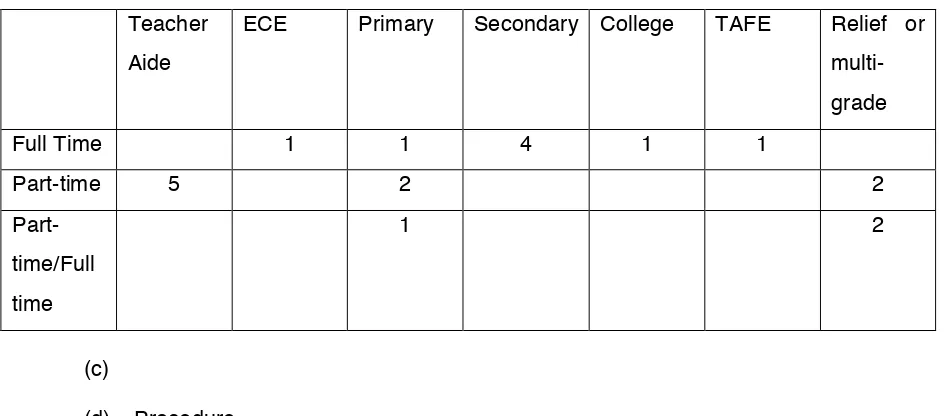
There were 20 participants from Tasmania involved in the data collection engaged in an In-Service course focussing on studying teaching. The group included male and female respondents;
representatives from the following teaching sectors: teacher aide, early childhood, primary, secondary, college and Technical and Further Education; teachers in state and private school systems, full time and part time teachers; and beginning and experienced teachers.
Table 1: Gender distribution of participants Male Female
4 16
Table 2: Teaching sector of participants Teacher
Aide
ECE/Primary Primary Secondary/College TAFE
[image:4.595.66.540.364.572.2]3 3 7 6 1
Table 3: Mode of teaching service
Teacher Aide
ECE Primary Secondary College TAFE Relief or multi-grade
Full Time 1 1 4 1 1
Part-time 5 2 2
Part-time/Full time
1 2
(c)
(d) Procedure
There were four steps to the process:
1. The development of the skills to write an anecdote;
2. the discussion with their peers of the meaning of the tale during a face-to-face discussion; 3. the re-writing of the anecdote with a coda linked the research literature to the theoretical,
conceptual and value issues raised in the anecdote, and 4. follow-up telephone interviews.
AARE 2011 Conference Proceedings 5 issues raised by the anecdote as a coda to their tale. The first three steps: the telling, writing, re-writing and discussion were used to bring interpretations of an experience into a visible,
discussable and tangible form in a safe context.
The final step, individual interviews, were conducted by telephone and recorded approximately 6 months later. Prior to the interview being formally recorded, a brief data sheet was completed to provide details on gender, teaching sector, any area of teaching expertise, years of teaching, whether a formal teaching qualification had been completed, whether they taught full time or part time or relief and a self-report on where they would place themselves on the Novice-Expert continuum (Berliner, 2004, 1988). The completion of the data sheet served three functions: 1. The time was used to ensure volume levels were satisfactory for recording in a non-
threatening manner;
2. important contextual data was collected and a comfortable non-threatening conversational climate established (Shuy, 2002).
This process was completed in 6-10 minutes. The interview was then conducted using the previously sent schedule of questions as the interview framework with probe questions and
clarifications introduced as prompted by each respondentʼs answers. Respondents were informed that notes were being taken during the interview to provide clarification in case the tape recording was unclear and to assist the interviewer in the final re-cap. Each interview took approximately 30 minutes for the formal recording phase. Prior to the conclusion of each interview, the responses to each question were re-capped by the interviewer and respondents were given the opportunity to add to or clarify any of their responses. This process of re-capping provided a space for initial data analysis by beginning to clarify potential ambiguities or confusions and to check if the interviewerʼs interpretations were what the interviewee had intended. (Rosenblatt, 2003) The final question ʻAre there any last things you would like to add?ʼ provided the opportunity for the respondents to
synthesise their thoughts and to add other information not elicited by the formal questions. At this stage the tape was stopped and the next stage of verification was explained.
Limitations
(e) Telephone interviews
It was necessary to use telephone interviews as I had re-located to Queensland and all the respondents lived in various locations in Tasmania. Initially this was viewed as a potential limitation, however the use of telephone interviews overcame constraints of location, economics and time in terms of travel and time zones (Shuy, 2002). Each interview required approximately 30 minutes, but because of our prior working relationship and the desire of the participants to discuss in detail their responses (many had made detailed notes prior to the interview) the usual arguments against long telephone interviews were not realised (Shuy, 2002). In addition, a professional relationship had been established with the cohorts through our time together in the Tasmanian Summer School residentials; all were volunteers; the teacher-student power relationship had had time to become blurred and fade; and the non face-to-face context provided unexpected
AARE 2011 Conference Proceedings 6 (f) Memory, Narratives and Life stories
When listening to or reading anecdotes, stories or even life histories the issues of accuracy of memory is of concern. Is this story a snapshot accurately frozen in time, a recollection, a flashbulb memory (Brewer, 1996), an interpreted representation (Brewer, 1996) or is it a “…present
construction of a past, present and future life” (Rosenthal, 1993, p.60)? Conway (1996) proposes that we have three types of autobiographical memories:
1. Lifetime periods which are general, often abstract and measured in years. e.g. my teen years, when the kids were little.
2. General events which are measured in months and are often events repeated in oneʼs life. e.g. birthdays, family celebrations, and maybe weddings, learning to drive. 3. Specific events which are often clearly recalled in terms of exact time, location and
people present. These are often those flashbulb memories such as a response to the question, ʻWhat were you doing when you first heard about September 11?ʼ These are often accompanied by sensory recall. e. g. remembering smells, sounds (Brewer, 1988).
How we tell or write these narratives depends on the present context of place, time and players (Freeman, 1993; Rosenwald and Ochberg, 1992). Our memories become multilevel and movable in terms of how they are recalled, understood and told. Subjectivity and positionality are at the centre of the process (Reissman, 1993). Mishler, (1992) would claim oneʼs past is viewed and understood by oneʼs present sense of self, a position supported by psychologists and philosophers such as Brewer (1996) and Freeman (1993). The anecdotes told by Phase 1 interviewees fit into Conwayʼs (1996) category 3. Many commented on how they could see the event, hear the words and even see themselves in the context of the anecdote. However, it became clear in the
interviews that their understandings were influenced by the writing and re-writing in a current context of becoming a teacher. These were recollections (Freeman, 1993) which were being selected and reinterpreted by adults for a particular audience. This does not mean that they are fiction rather they are the truth as the teller now remembers and understands it in their current context.
(g) Trustworthiness and Credibility
The notions of plausibility, credibility and trustworthiness are crucial in research using narrative as the research means (Polkinghorne, 2007). Researchers such as Barone, (1992); Connelly and Clandinin (1990) and van Manen, (1990) believe that the traditional definitions of validity and reliability are not applicable in this form of narrative research a position disputed by Phillips (1994). The criteria (credibility, transferablity, dependability and confirmability) suggested by Lincoln and Guba (1985) provided a framework to address the need and means to address the importance of the trustworthiness of the data collection and analysis methods.
AARE 2011 Conference Proceedings 7 For this group, the effect of these limitations was reduced as we had developed a trusting
relationship in our time working together during their study. The Phase One interview for each participant included a time when they quickly re-told the story which could be checked against the original written anecdote and the interview provided a space where both parties were able to
participate in what Widdershoven (1993) defines as an edifying dialogue for the joint construction of understanding and redefinition where opportunity was provided for transfer of those understandings to new contexts.
Lincoln and Guba (1985) suggest that prolonged engagement, persistent observation, triangulation and member checking assist in establishing trustworthiness. Phase 1 participants had worked directly with the researcher for one semester and for those participating in the inquiry, albeit at a distance, with the setting up of interviews, the interview itself and the verification process. All interviews were verified by the interviewees and during the interview the interviewer was able to check accuracy and understandings, add later thoughts and clarify meaning and intents. To assist in replicability, each step of the research process had been carefully tracked and described above. In addition, the written anecdotes provided a data set for later research where the readers were asked to identify why they had chosen a specific anecdote. In all cases the reasons chosen matched the reasons given by the writer of the anecdote, giving further weight for the
trustworthiness of the data set. Results and Discussion
The topics of the anecdotes were varied, written from the perspectives of themselves as learners, as teachers and observers of other teachers. Life in the classroom is “…shot through with
uncertainty” (Bauman 1993 as cited in Buzelli and Johnston 2002, p. 11). The classroom is an arena where teachersʼ personal and professional beliefs and values - the ways they engage in the constant moment-to-moment, day-to-day negotiations, the appropriateness and meaningfulness of solutions reached to solve immediate contextualised problems, the what and how we teach, and how we treat children - are on public display (Buzelli and Johnston 2002).
Nearly all of the anecdotes had comments on the social values, codes of conduct (Kwamena Kwansah-Aidoo 2000) and moral implications of teaching and learning as learners and
practitioners. Teaching is a moral activity, because it is founded upon a relationship which involves making decisions and taking actions that influence the social, emotional, intellectual and moral development of others in oneʼs care (Buzelli and Johnston 2002, p.10).
The themes addressed justice and often injustice in a classroom; how a sense of self was
supported or undermined; the discrepancies between what was said and what was done; the role of oneʼs values and beliefs being challenged or supported and how a single event can make a difference.
(h) Interview Questions
The interviewees were asked the following questions?
a. Where would you rate yourself on the Novice – Expert continuum? b. How many times did you write and/or re-write your anecdote? c. How did the writing and re-writing process change the anecdote?
d. How did the re-writing process change your understanding of the events and meaning of your anecdote?
AARE 2011 Conference Proceedings 8 Initial overview of group participants in relation to gender, teaching sector, personal appraisal on Novice-Expert continuum and number of drafts
Table 4: Number of drafts written
ID Gender Sector Novice-Expert Number of
Drafts
1 F Primary Proficient 3
2 M Secondary Competent Refined draft
3 M Secondary Comp/Prof 1
4 F Primary Advanced Beg 2
5 F Primary Proficient 2
6 F VET Competent 6-10
7 F Primary Advanced Beg unknown
8 M Secondary Expert 2
9 F Primary Advanced Beg 6
10 F Secondary Competent 3
11 F TA Advanced Beg 4-5
12 F ECE/Primary Advanced Beg 3
13 F TA Novice 2
14 F ECE Nov/Adv Beg 1-2
15 M Secondary Proficient 1-2
16 F ECE/VET Proficient 3-4
17 F Primary Proficient Many
18 F ECE Advanced Beg 3
19 F Primary Proficient 1
20 F Secondary Expert 1
The numbers are too small to make any generalisations in terms of sector or gender or even Novice-Expert attribution. However, it would appear that for many the need to get it ʻrightʼ was very important.
Reasons for the Re-writes
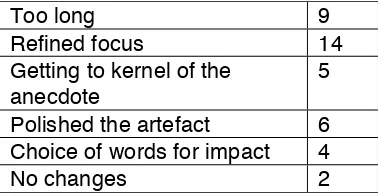
Table 5: Reasons for Re-Writes
Too long 9
Refined focus 14
Getting to kernel of the anecdote
5
Polished the artefact 6 Choice of words for impact 4
No changes 2
[image:8.595.67.256.592.690.2]AARE 2011 Conference Proceedings 9 (i) Sample Comments:
I think my first attempt was about a thousand. I think I was getting it off my chest. Then I sort of halved it because I bound it in with an incident where I heard my husband explaining something to one of my twin daughters.
Well certainly I was able to refine the whole process. When I first wrote it, it was probably twice as long and quite frankly it was full of quite a lot of stuff that wasnʼt necessary or didnʼt need to be there and sort drew the whole process out. At the end when I had finished with a product that really just said what needed to be said and what the listener needed to read or know and so because of that the impact was there and the interest. Yeh when I first started there was a lot of background. But at the end I had something less than a page that said it all and had impact with it.
I wanted to make sure that they understood just the trepidation, and the fear and the anxiety of the incident.
[image:9.595.67.293.327.677.2]Rationale for the Re-writing process
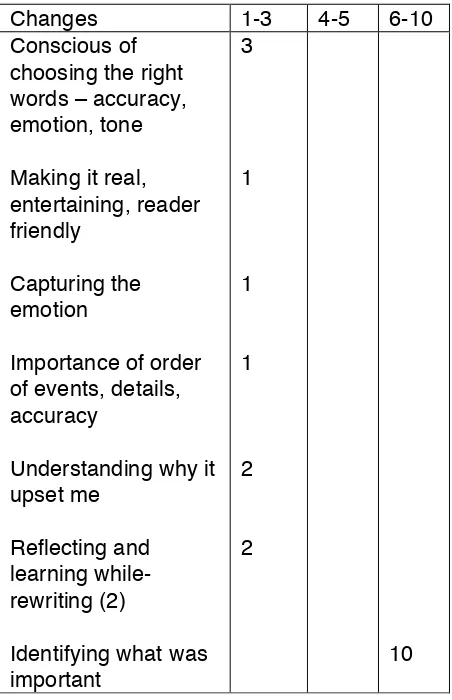
Table 6: Reasons for changes made to the original anecdote
Changes 1-3 4-5 6-10
Conscious of choosing the right words – accuracy, emotion, tone
Making it real, entertaining, reader friendly
Capturing the emotion
Importance of order of events, details, accuracy
Understanding why it upset me
Reflecting and learning while-rewriting (2)
Identifying what was important
3
1
1
1
2
2
10
AARE 2011 Conference Proceedings 10 (j) Sample Comments:
Well the writing of it was a process of just remembering it, and putting it down. And then when I had to rewrite it, that's when I sort of started to connect with the emotions of the situation.
When you get the chance to re-write it you actually start to put things in the order that you remember them actually happening. And then other things drop into your mind and you think ʻOh well this actually occurred as well and it is just as relevant as the other piece of the informationʼ. So it makes the anecdote become more accurate.
The first one I was just getting down the story. The second time I was looking a bit more critically at the impact it had on me and what he was doing in pedagogy styles I guess. And the third time I was trying to get it all together.
It is in the writing and re-writing that the key benefits of the anecdotes were realised. Many
commented that the word limit forced them to focus, to distil the essence of the tale and that during this process they became very clear in their own minds why this tale had meant so much to them, what their role was within it, how their understandings as a child were not those of the present adult and for some an understanding of why that teacher may have behaved in that manner. This was particularly clear for a person who had been demeaned by an expert maths teacher and who now is an expert German teacher.
I can appreciate the frustration of that teacher who was teaching at a very high level and once a week or twice a week she had to come and sit with the dimmos.
[image:10.595.69.452.450.762.2]Change in understandings
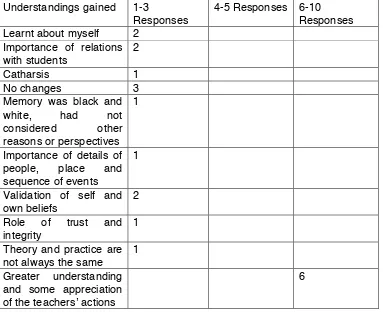
Table 7: Understandings gained through the processes of writing and re-writing
Understandings gained 1-3
Responses
4-5 Responses 6-10 Responses Learnt about myself 2
Importance of relations with students
2
Catharsis 1
No changes 3
Memory was black and white, had not considered other reasons or perspectives
1
Importance of details of people, place and sequence of events
1
Validation of self and own beliefs
2
Role of trust and integrity
1
Theory and practice are not always the same
1
Greater understanding and some appreciation of the teachersʼ actions
AARE 2011 Conference Proceedings 11 This question prompted some fascinating revelations. They began to question themselves why the story had remained so strong in their memories; was their memory accurate and how did that memory connect with their understandings of themselves as teachers in the present.
(k) Sample Comments:
Now when I can reflect back on it by using this I am able to learn some things for myself about myself and also about how important it is to have from a teaching perspective to form relationships and have trust and integrity.
The fact that just throwing children into groups is not going to necessarily bring about the benefits that the literature says that that particular strategy will bring about.
I realised that what it was all about was actually putting the needs of the students before the curriculum. And that was actually why I thought it was important. The emotional needs of the students. If they are too emotional, that they canʼt put it aside out of their lives and take on board what youʼre teaching as a teacher. And I hadnʼt realised that.
I think we remember everything about the incident and I do about mine almost in black and white. No shades of grey. And what happened was what happened and you are not looking for other reasons or perspectives. I think thatʼs probably what I looked at more when it came to writing the coda.
I think it did and helped me to rationalise what was actually happening and what the event meant to me. Something I had had difficulty in doing previously.
Changes to personal practice
This was analysed from two perspectives:
i. Theme throughout anecdote and interview
AARE 2011 Conference Proceedings 12 Thematic consistency
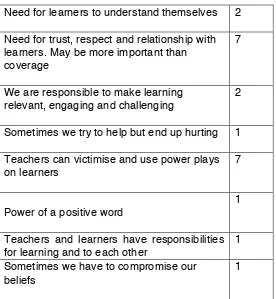
Table 8: Consistency of theme throughout anecdote and interview
Need for learners to understand themselves 2
Need for trust, respect and relationship with learners. May be more important than coverage
7
We are responsible to make learning relevant, engaging and challenging
2
Sometimes we try to help but end up hurting 1
Teachers can victimise and use power plays on learners
7
Power of a positive word
1
Teachers and learners have responsibilities for learning and to each other
1
Sometimes we have to compromise our beliefs
1
The primary observations here are on the primacy of relationship, both positive and negative and the need for understanding for learning.
(l)
Sample Comments:
I had been teaching with music and doing drawings and using artefacts and things like that. I had been doing that for about 10 years. But I hadnʼt made an absolute thing about making it the children think for themselves why they were doing it. Making them sit there and think about it was something new.
The one thing that has really come through since I started teaching is that real learning really doesnʼt begin until you have a relationship or trust with your students and in actual fact it pays to spend more time on that at the beginning of the year before you even get in and start doing some actual teaching and learning stuff.
I guess listening to, going back and hearing what the teacher said and having a focus on the positives I have realised what the power of, the power of the word, is. How powerful that little bit of praise can be and how damaging it is if it is a negative. Application to current practice
AARE 2011 Conference Proceedings 13 (m) Sample Comments:
One way this has made me think about power is it needs to be shared. As a teacher aide also I have a responsibility but I donʼt have the responsibility that a teacher does have. Not quite to the degree. So thatʼs made me realise that when I am a teacher that I will have the power over the children, but to make sure that it is an equal power between children and me.
Well I am clear about where I come from in my teaching or clearer anyway. Because it is always an ongoing learning process. But clearer why it is important for me not to be behaviourist and authoritarian in my approach and ... I guess I connected with that really important experience I had as a student myself and bring it into my practice that I can do better than that and do it a different way. Not copy or not to fall into those patterns that I learnt to make the changes and do it differently and understand why it is important for me to do it differently.
I find as a result of that type of situation I definitely allow and encourage my students to dream. And that I tend to spend a lot of time listening asking them what they dream about, what they want to be, how are things at home, just sit and chat and chat and chat all through recess and lunchtime and after school and that kind of thing to get them to find out who they really are.
I had something in the coda I wanted to refer to. I think it influenced my understanding in a personal way. As a practising teacher it gave me insight into the needs of
students to have ownership of their work. And to have trust and so that they feel valued and they need to be encouraged. And I think too that it made me realise how vulnerable children are.
Conclusion
This paper describes research in progress used with a group of beginning, up-grading and post-graduate education students to develop and refine their approach to the reflective process through the writing and re-writing of their anecdotes about their teaching and learning experiences. In summary the use of anecdote has proven a successful research tool to provide a safe and valuable arena for teachers to explore and discuss their pedagogical beliefs and how these beliefs influence their practices in classrooms. Overall, the writing and re-writing appears to result in deeper levels of reflection beyond “What did I do?”
During the writing and re-writing stage the writer/teacher is dealing with his/her responses to that event. How that anecdote is related and structured reflects the writer/teacherʼs perspective and understanding of that event. The conversation which follows, be that as a written coda, a
AARE 2011 Conference Proceedings 14 References:
Barone, T. (1992). A narrative of enhanced professionalism; educational researchers and popular storybooks about school people. Educational Researcher, 21(8), pp. 15-24.
Berliner, D.C. (2004). Describing the behaviour and documenting the accomplishments of expert teachers. Bulletin of Science, Technology and Society, 24(3), pp. 200-214.
Berliner. D.C. (1988). The development of expertise in pedagogy. Charles W. Hunt Memorial Lecture, American Association of Colleges for Teacher Education, New Orleans, LA, ED 298122.
Brewer, W.F. (1996). What is recollective memory? In D.C. Rubin (Ed.), Remembering our past. Studies in autobiographical memory (pp. 19-66). Cambridge, UK: Cambridge University Press.
Brookfield, S. (1995). Becoming a Critically Reflective Teacher. San Francisco, CA: Jossey-Bass. Burns, R.B. (2000). Introduction to research methods. 4th ed. Frenchs Forest, Australia: Longman. Buzzelli, C.A. and Johnston, B. (2002). The moral dimension of teaching. Language, power and
culture in classroom interaction. New York, NY: Routledge Falmer.
Calderhead, J. (1989). Reflective teaching and teacher education. Teaching and Teacher Education, 5(1), pp. 43-51.
Clemente. M. and Ramirez, E. (2007). How teachers express their knowledge through narratives. Teaching and Teacher Education. 24(5), pp. 1244-21258.
Connelly, F.M. and Clandinin, D.J. (1990). Stories of experience and narrative enquiry. Educational Researcher, 19(5), 2-14.
Connelly, F.M. and Clandinin, D.J. (1988).Teachers as Curriculum Planners: Narratives of Experience. New York, NY: Teachers College Press.
Conway, M.A. (1996). Autobiographical knowledge and autobiographical memories. In D.C. Rubin (Ed.), Remembering our past. Studies in autobiographical memory (pp. 67-93). Cambridge, UK: Cambridge University Press.
Coulter, C., Charles, M. and Paynor, I. (2007). Storytelling as pedagogy: an unexpected outcome of narrative inquiry. Curriculum Inquiry. 37(2), pp. 103-122.
Dewey, J. (1933). How We Think. Boston, MA: D.C. Heath.
Doecke, B., Brown, J. and Loughran, J. (2000). Teacher talk: the role of story and anecdote in constructing professional knowledge of beginning teachers. Teaching and Teacher Education. 16(3), pp. 35-48.
Doyle, W. and Carter, K. (2003). Narrative and learning to teach: implications for teacher-education curriculum. Journal of Curriculum Studies, 35(2), pp.129-137.
Dudukovic, N.M., Marsh, E.J. and Tversky, B. (2004). Telling a story or telling it straight: the effects of entertaining versus accurate retellings on memory. Applied Cognitive Psychology, 18, pp. 125-143.
Eraut, M. (1994). Developing Professional Knowledge and Competence. London, UK: The Falmer Press.
Freeman. D. (1993). Renaming Experience/Reconstructing Practice: Developing New Understandings of Teaching. Teaching and Teacher Education, 9(5/6), pp. 485-497. Freire, P. (1972). Pedagogy of the Oppressed. London, UK: Penguin.
Gitlin A. and Goldstein S. (1988). A dialogical approach to understanding: horizontal evaluation. In W.J. Smyth (Ed.). A critical pedagogy of teacher evaluation (pp. 101-111). Geelong, Australia: Deakin Press.
Gore, J.M. and Zeichner, K. (1995).Connecting action research to genuine teacher development. In J. Smyth (Ed.) Critical discourses on teacher development (pp. 203-214). London, UK: Cassell.
AARE 2011 Conference Proceedings 15 Grimmett,P.P., Erickson, G.L., Mackinnon, A.M. and Riecken, T.J. (1990). Reflective Practice in
Teacher Education. In R.T. Clift, W.R. Houston and M.C. Pugach (Eds.). Encouraging Reflective Practice in Education (pp. 20-38). New York, NY: Teachers College Press.
Isaacs, W. (1999). Dialogue and the art of thinking together. New York, NY: Doubleday.
Jalongo, M.R., Isenberg, J.P. and Gebracht, G. (1995). Teachersʼ stories; from personal narrative to professional insight. San Francisco, CA: Jossey-Bass.
Judd, C.M., Smith, E.R. and Kidder, L.H. (1991). Research methods in social relations 6th ed., Orlando, FL: Harcourt Brace Jovanovich.
Korthagen, F.A. and Lagerwerf, B. (2001). Teachersʼ professional learning: how does it work? In F.A. Korthagen (ed.). Linking practice and theory. The pedagogy of realistic teacher education (pp. 175-206). : London, UK: Lawrence Erlbaum Associates, Publishers. Korthagen, F. (1993). Two Modes of Reflection. Teaching and Teacher Education, 9(3), pp.
317-326.
Kwamena Kwansah-Aidoo. (2001). Telling stories: the epistemological value of anecdotes in Ghanaian communication research. Media, Culture and Society, 23, pp. 359-380.
LaBoskey, V. and Cline, S. (2000). Behind the mirror: inquiry-based storying in teacher education. Reflective Practice. 1(3), pp. 359-375.
Lancy, D.F. (1993). Qualitative research in education. An introduction to the major traditions. New York, NY: Longman.
Lee, S.K.F. and Loughran, J. (2000). Facilitating pre-service teachersʼ reflection through a school-based teaching program. Reflective Practice, 1(1), pp. 69-89.
Lincoln, Y.S. and Guba, E.G. (1985). Naturalistic inquiry. Newbury Park, CA: Sage.
Loughran, J.J. and Northfield, J.R. (1996). Opening the classroom door: teacher researcher, learner. London, UK: Falmer Press.
Loughran, J. L. (2010). What expert teachers do. Enhancing professional knowledge for classroom practice. Crows Nest, Australia: Allen and Unwin.
McNiff, J. (2007). My story is my living educational theory. In J. Clandinin (Ed.). Handbook of narrative inquiry. Mapping a methodology (pp. 308-329). Thousand Oaks, CA: Sage: Mishler, E.G. (1992). Work, identity, and narrative: an artist-craftmanʼs story. In G.C. Rosenwald
and R.L. Ochberg (Eds.), Storied Lives. The cultural politics of self-understanding (pp. 21-40). New Haven, CT: Yale University Press.
Moon, J. and Fowler, J. (2000). ʻThere is a story to be told….ʼ.A framework for the conception of story in higher education and professional development. Nurse Education Today, 28(2), pp. 232-239.
Munby, H. and Russell, T. (1993) “Reflective teacher education: Technique or epistemolgy”, Teaching and Teacher Education, 9(4), pp. 431-438.
Olson, J. (1992) Understanding Teaching, Milton Keynes, Open University Press.
Palmer, P.J. (1999). The courage to teach. Exploring the inner landscape of a teacherʼs life. San Francisco, CA: Jossey- Bass Publishers.
Pearsall, J. (Ed.). (2002). Concise Oxford English Dictionary. Oxford, UK: Oxford University Press. Phelan, A. (1997) When the Mirror Crackʼd: The Discourse of Reflection in Pre-service Teacher
Education. In K.Watson, C.Modgil and S. Modgil (Eds) Educational Dilemmas: Debate and Diversity Volume One, Teachers, Teacher Education and Training (pp. 169-178). London, UK: Cassell.
Phillips, D.C. (1994). Telling it straight: issues in assessing narrative research. Educational Psychologist, 29 (1), pp. 13-21.
Polkinghorne, D.E. (2007). Validity issues in narrative research. Qualitative Inquiry, 13(4), pp. 471-486.
Postholm, M. B. (2008). Teachers developing practice; reflection as key activity. Teaching and Teacher Education. 24, pp. 1717-1728.
AARE 2011 Conference Proceedings 16 Rosenblatt, P.C. (2003). Interviewing at the border of fact and fiction. In J.F. Gubrium and Holstein,
J.A. (Eds.) Handbook of interview research. Context and method (pp. 893-909). Thousand Oaks, CA: Sage Publications.
Rosenthal, G. (1993). Reconstruction of life stories. Principles of selection in generating stories for narrative biographical interviews. In R. Josselson and A. Lieblich (Eds.), The narrative study of lives vol. 1 (pp. 59-91). Newbury Park, CA: Sage Publications.
Rosenwald, G.C. and Ochberg, R.L. (1992). Introduction: life stories, cultural politics, and self-understanding. In G.C. Rosenwald and R.L. Ochberg (Eds.), Storied Lives. The cultural politics of self-understanding (pp. 1-18.). New Haven, CT: Yale University Press. Russell, T. and Munby, H. (1991). Reframing: the role of experience in developing teachersʼ
professional knowledge. In D.A. Schön (Ed.) The Reflective Turn (pp. 164-187). New York, NY: Teachers College Press.
Shor, I. (1986). Critical Teaching and Everyday Life. Montreal, Canada: Black Rose Press. Schön, D. (1990) Educating the Reflective Practitioner, San Francisco, CA: Jossey-Bass
Publishers.
Schön, D.A. (1983). The Reflective Practitioner. London, UK: Temple Smith.
Shulman, L. S. (1999). Knowledge and teaching; foundations of the new reform. In Jenny Leach and Bob Moon (Eds.). Learners and pedagogy (pp. 61-77). London, UK. : The Open University.
Shuy, R.W. (2002). In-person versus telephone interviewing. In J.F. Gubrium and J.A. Holstein (Eds.) Handbook of interviewing research context and method (pp.537-555). Thousand Oaks, CA: Sage Publications.
Smyth, J. (1987.) When teachers theorize their practice: a reflexive approach to distance
education. In T. Evans and D. Nation (Eds.) Critical reflections on distance education (pp. 197-233). London., UK: The Falmer Press.
Tochon, F. and Munby, H. (1993). Novice and expert teachers. Time epistemology: a wave function from didactics to pedagogy. Teaching and Teacher Education, 9(2), pp. 205-218.
Tom, A.R. (1985). Inquiring into Inquiry-Oriented Teacher Education. Journal of Teacher Education, 36(5), pp. 35-44.
van Manen, M, (1999). The language of pedagogy and the primacy of student experience. In J.J. Loughran (Ed.) Researching teaching. Methodologies and practices for understanding pedagogy (pp.13-27). London, UK: Falmer Press.
van Manen, M. (1995) On the Epistemology of Reflective Practice. Teachers and Teaching: theory and practice, 1(1), pp. 33-50.
van Manen, M. (1991) The Tact of Teaching. Albany, NY: State University of New York Press. Van Manen, M. (1990). Researching lived experience. Human science for an action sensitive
pedagogy. New York, NY: The Arthouse Press.
Wasley, P. A. (1994). Stirring the Chalkdust. Tales of Teachers Changing Classroom Practice. New York, NY: Teachers College Press.
Widdershoven, G.A.M. (1993). The story of life. Hermeneutic perspectives on the relationship between narrative and life history. In R. Josselson and A. Lieblich (Eds.), The narrative study of lives Vol. 1 (pp. 1-20). Newbury Park, CA: Sage Publications.
Xu, S. and Connelly, M. (2008). Narrative inquiry for teacher education and development: focus on English as a foreign language in China. Teaching and Teacher Education. 25(2), pp. 219-227.