Research Report DFE-RR031
Evaluation of
the Right2B
Cared4 pilots
interim report:
Overview of emerging
themes and issues
Emily R. Munro, Harriet Ward,
This research report was written before the new UK Government took office on 11 May 2010. As a result the content may not reflect current Government policy and may make reference to the Department for Children, Schools and
Families (DCSF) which has now been replaced by the Department for Education (DFE).
2
Contents
page
1. Executive summary 3
2. Background 8
3. Introduction and scope of report 10
4. Methodology 12
3.1 Mapping approaches to meet the aims and objectives
of Right2BCared4 12
3.2 Focus Groups 13
5. Placement stability, remaining in care until 18 and preparation
for leaving 15
6. Empowerment, communication and participation 29 7. Next steps and local authorities involved 42
8. Conclusion 45
9. Bibliography 53
Appendices
Appendix A: Mapping exercise summary tables 48 Appendix B: Aim and objectives of the research 52
List of tables
Table 1: Focus group attendees 13
Table 2: Pilot sites encouraging young people to remain in care until the age of 18 under existing policy and under
Right2BCared4 16
Table 3: In-depth case study and pilot sites 43 Table A.1: Preparation for independent living 48 Table A.2: Independent Reviewing Officers 49 Table A.3: Provision of Independent Advocacy and other
3
1. Executive Summary
Background
The Right2BCared4 pilot began in October 2007 in 11 local authorities and is based on the following principles:
Young people should not be expected to leave care until they reach 18 years old;
They should have a greater say in the decision making process preceding their exit from care; and
Should be properly prepared for living independently.
Key to this pilot is that the transition from care to independence should be planned and properly managed, that young people should be consulted about their wishes and feelings and that they should have access to independent advocacy.
This interim report presents findings from a mapping exercise and focus groups undertaken between January and June 2009 with social workers, personal advisers, independent reviewing officers (IROs) and other key professionals from each of the pilot sites, to explore:
How each of the pilot sites planned to meet the objectives of
Right2BCared4 and any changes compared to plans submitted to the former Department for Children, Schools and Families; and
Early benefits and challenges since implementation.
Key Findings from the Interim Report
The interim report provides a preliminary insight into the early benefits and challenges of Right2BCared4 from the perspective of those professionals involved in its planning and implementation.
4 need to be understood within the wider context of the area’s existing services. The boundaries between leaving care provision to meet the requirements of the Children (Leaving Care) Act 2000, organisational responses to the Care Matters: Time for Change (DfES, 2007), the Children and Young Persons Act 2008 (see: http://www.leavingcare.org/data/tmp/5344-10767.pdf) and
Right2BCared4 are blurred and making comparisons between different authorities ‘pre’ and ‘post’ implementation is challenging.
Pre-existing policy and practice
Prior to Right2BCared4 over half of the pilot local authorities’ already encouraged young people to stay in care until they reached the age of 18.
Eight local authorities indicated that they brought forward reviews, if necessary, in response to changes in young people’s circumstances. All the pilot sites had supported accommodation options available,
including shared housing and self-contained flats with either on-site or visiting support.
Young people’s entitlement to remain in care until they reach legal adulthood
The pilot was perceived to have increased local authorities willingness to provide appropriate accommodation for young people up until they reach 18.
The way in which information about independence was presented to young people was perceived to be changing in some local authorities, with increased emphasis being placed upon young people’s entitlement to stay in care.
Offering the option for young people to return to care if they left before the age of 18 and encountered difficulties was seen to offer an
5 Training or ‘taster’ flats and renewed emphasis on the role of carers in
preparing young people for independence
Four local authorities extended their accommodation provision under Right2BCared4, introducing training/taster flats1 or a residential unit. Training/taster flats were deemed to have a number of benefits,
offering young people a ‘taste of independence’ whilst allowing them to return to their main placement afterwards. Professionals were also able to obtain a better insight into what additional skills and support young people may need in the future to prepare them for
independence.
Young people’s wishes and local authority capacity to secure and maintain
placements
Not all young people want to remain in care longer, irrespective of what professionals perceive to be in their best interest.
The opportunity to allow young people to return to care was seen as a positive development; however foster care shortages meant that it was rarely possible for a young person to return to their previous foster or residential placement.
Challenges were experienced by professionals trying to sustain placements as this was conditional not only on the young person wanting to stay, but also on foster carers or residential units being willing and able to care for the young person (see also, Munro et al., 2010).
Trying to secure placements for young people with complex needs can be resource intensive and placement costs can be high (Ward et al., 2008). This has wider cost implications.
Management of the transition to adulthood
Some professionals raised concerns that Right2BCared4 had not resolved the problems that can be encountered in managing the
1
Training/taster flats offer the opportunity to experience what it is like to live independently before leaving care to move to independent accommodation. The flats temporary
6 transition process and that legislation and age related entitlement rules were still causing difficulties. For example:
Local authorities identified practical difficulties in providing ongoing support once young people reached 18. These included residential units being in breach of their registration if they extended placements and financial, tax and benefit issues for foster carers continuing to care for young people post 18 (see also, Munro et al., 2010).
One authority highlighted that that the transfer of responsibility for accommodation from children’s services to housing was problematic. Concerns were expressed that foster carers were overprotecting young
people in their care, leaving them ill equipped for living independently (see also, Munro et al., 2010).
The role of the Independent Reviewing Officer (IRO)
Right2BCared4 introduced measures designed to strengthen the role of the IRO, including appointing a named IRO for each young person and requiring the IRO to consult with young people prior to their review to establish their wishes and feelings.
The enhanced IRO role was deemed by professionals to have improved scrutiny of care plans and allowed workers to spend more time with young people prior to their reviews.
It was also suggested that policies strengthening notification
procedures, to ensure that IROs are aware of significant changes, had given them leverage to challenge local authority plans if these were not perceived to be in the young person’s best interests.
IROs need to work collaboratively with social workers, however they must feel able to challenge them if the young person’s care plans are not seen to be in their best interests, or if there are delays in the
decision making process. This had caused tensions in some pilot sites, with social workers feeling that IROs were taking over their case
7 The benefits of additional reviews were deemed to be dependent upon
the ability to actively engage young people and empower them to take control of the review and decide where it should be held and who should be invited.
Next steps
8
2. Background
International research suggests that, as a group, care leavers are at high risk of social exclusion and poor outcomes as they negotiate the transition to adulthood, including low educational attainment, unemployment, poverty, mental health problems, social isolation, homelessness, instability and involvement in crime (Biehal et al., 1995, 1999; Broad, 1999; Cashmore and Paxman, 1996; Courtney et al., 2001; 2005; Munro, Stein and Ward, 2005; Stein et al., 2000; Stein and Carey, 1986; Stein and Munro, 2008). Although some young people successfully ‘move on’ from care, too many ‘struggle’ as they make the transition from care to independence (Stein, 2008). The
pathways young people take are influenced by their pre-care experiences, the quality of care they receive, the nature of their transitions from care, and the support they receive after they leave (Stein, 2008).
In England, in recent years there have been changes in legislation, policy and practice aimed at delaying young people’s discharge from care, improving the consistency of support, and strengthening arrangements to assist them
financially (Department of Health, 2001). Care Matters: Time for Change (Department for Education and Skills, 2007) proposed a further package of measures designed to enhance the preparation of, and support for, care leavers. The Right2BCared4 project is one of the interventions being piloted2. Approximately 1,100 young people from a total of 11 local authorities are involved in the 3 year pilot which began in October 2007. It is based on the principle that young people aged 16-18 should not be expected to leave care until they reach the age of 18; that they should be properly prepared before they move to independent living arrangements and that they should have a greater say in the decision-making process preceding their exit from care. The pilot recognises that to facilitate this it is important that the transition from care is planned in advance and properly managed; that young people are fully consulted and their wishes and feelings are taken into account and that they have access to independent advocacy.
2
9
3. Introduction and scope of report
The overarching aim of the evaluation is to assess the extent to which the Right2BCared4 pilots help care leavers achieve better outcomes (see
Appendix B for further details). This is an interim report based on data from a mapping exercise and focus groups undertaken between January and June 2009 to explore how each of the 11 pilot sites planned to meet the aims and objectives of Right2BCared4 and the changes they have made since the project began. Emphasis is placed upon exploration of some of the issues that have arisen as local authorities have sought to improve the stability of final care placements and reduce the number of young people moving to
independence before they reach 18 and strategies to empower young people to participate meaningfully at each stage of the transition process.
The interim report provides a preliminary insight into both the early benefits and challenges of aspects of Right2BCared4 from the perspective of those professionals involved in planning and implementing it. It is important to acknowledge that implementation of pilot projects is an iterative process and changes at both national and local level mean the plans are likely to evolve and adapt over time. Further, Right2BCared4 is essentially based upon a series of key principles, rather than a single intervention and a range of approaches have been adopted by authorities to meet the aims and objectives of the pilot. Developments and changes in each local authority need to be understood within the wider context of the area’s existing services for looked after children and care leavers. This means that the boundaries between leaving care provision to meet the requirements of the Children (Leaving Care) Act 2000, organisational responses to the Care Matters: Time for Change (DfES, 2007), the Children and Young Persons Act 2008 (see:
10 transition from care to adulthood. Further details are outlined in Section 6 (p.29).
11
4. Methodology
4.1 Mapping approaches to meet the aims and objectives of
Right2BCared4
Purpose and method
A preliminary mapping exercise was undertaken by the research team at the beginning of the evaluation. The purposes of this were:
to identify similarities and differences in delivery plans for each of the local authorities to meet the aims and objectives of Right2BCared4; facilitate selection of six case study areas and ensure that the main
approaches to the Right2BCared4 pilot are examined in depth.
The research team asked representatives in each of the 11 pilot sites to submit their original application to the Department for Children, Schools and Families (DCSF) outlining their plans for delivering Right2BCared4, their local evaluation strategy and any other supporting documentation they felt would facilitate this initial mapping exercise. The research team constructed a mapping template which was designed to capture and systematically record information on Right2BCared4 pilot provision and proposed models of
delivery. Where possible a distinction was drawn between existing policy and practice, which provides a foundation to support implementation of
Right2BCared4, and changes proposed to meet the aims and objectives of the pilot. Broad categories examined during the exercise included:
overarching principles underpinning service provision; review mechanisms; IRO model of provision; advocacy and strategies to facilitate young people’s participation and empowerment and preparation for independent living. The range of interpretations of how to meet the overarching objectives of the pilot meant that certain components of local authority plans did not lend
12 presented in sections five and six of the report, to contextualise the focus group data.
4.2 Focus Groups
Purpose and method
Eleven focus groups, one per pilot site, were held with a combination of social workers, personal advisers, independent reviewing officers (IROs) and other personnel identified as having a role in implementing Right2BCared4 in each local authority.
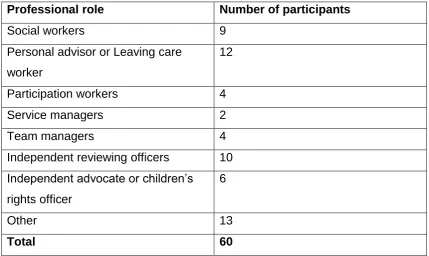
[image:13.595.83.513.439.695.2]Between four and eight professionals attended each focus group. All but two of the focus groups included social workers or leaving care workers and IROs. A breakdown of the attendees according to job roles is shown in table 1, below.
Table 1: Focus group attendees
Professional role Number of participants
Social workers 9
Personal advisor or Leaving care worker
12
Participation workers 4
Service managers 2
Team managers 4
Independent reviewing officers 10 Independent advocate or children’s
rights officer
6
Other 13
Total 60
13 meet the Right2BCared4 objectives, as well as to illuminate variations in the roles, views and experiences of different professionals working with eligible, relevant and former relevant young people. Group discussions are a useful tool for allowing professionals from a shared background to discuss their views and attitudes, revealing differences in perspectives and opinions and identifying themes and issues requiring more depth exploration during in-depth interviews (Ritchie and Lewis, 2003). Data were imported into NVivo 7 and analysed thematically to explore similarities and differences in views according to professional group as well as variations between local
authorities. Findings from the focus groups are also being used to support the development of research tools for subsequent phases of the research.
The next section of the report draws together findings from the mapping
14
5. Placement stability, remaining in care until 18 and
preparation for leaving
Social and economic changes have influenced normative transitions to independence in Western societies and families play an increasing role in supporting children into adulthood and provide ongoing social, practical and emotional support (Bynner and Parsons, 2002; Jones, 2002; Mendes and Moslehuddin, 2006; Wade and Munro, 2008). In contrast, care leavers are expected to make the transition straight from childhood dependence to
adulthood self-sufficiency and assume adult responsibilities at a younger age than their peers (Biehal et al., 1995; Dixon and Stein, 2005; Garnett, 1992; Jones, 1995; Pinkerton and McCrea 1999; Propp et al., 2003). In addition, they cannot necessarily rely on consistent support from their families (Biehal and Wade, 1996; Sinclair et al., 2005). In this context it is particularly
important that they are not expected to make the transition to independence before they are ready and that they are properly prepared.
Right2BCared4 seeks to promote the principle that young people have the right to be cared for by the local authority until they reach 18 and enhance the preparation they receive to support their transition. The rationale for this is linked both to research evidence that demonstrates the value of delaying young people’s discharge from care and because it is recognised that young people leaving care should be entitled to the same care that young people in the general population expect from a reasonable parent (Dixon, 2008; Wade and Dixon, 2006, Department for Education and Skills, 2007). The pilot lends weight to these ambitions in a number of ways. It makes it explicit that the local authority must actively seek to delay young people’s discharge from care and gives young people a much greater say over decisions that they should leave care before they are 18. Local authorities are not permitted to make significant changes to plans, such as moving a young person to ‘independent’ accommodation, without this being scrutinised under the care reviewing process and the young person agreeing the change3. Further, young people
15 must be provided with support from an independent person at the review meeting. Where exceptionally, the outcome of the review sets aside the wishes and feelings of the young person or overrules the advice of the independent advocate then changes can not be made until the dispute resolution process has been followed. The following section outlines the policies and procedures in place prior to implementation of Right2BCared4, before going on to consider changes under the pilot.
Pre-existing policy and practice before implementation of
Right2BCared4
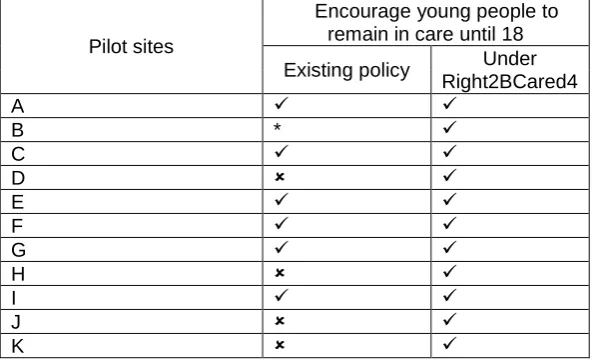
[image:16.595.145.442.487.667.2]The mapping exercise revealed that just over half the pilot authorities had already adopted the principle that young people should be encouraged to remain in care until 18, prior to implementation of Right2BCared4. As such, they were continuing to support and maintain placements for young people beyond the age of 16 and staff were encouraging young people to delay their discharge from care until they reached legal adulthood.
Table 2: Pilot sites encouraging young people to remain in care until 18 under existing policy and under Right2BCared4
Pilot sites
Encourage young people to remain in care until 18 Existing policy Under
Right2BCared4 A
B * C D E F G H I J K
* considered good practice for young people in foster care to remain in placement up to 18 but young people in residential leave at 16 years of age (based on focus group data)
16 discretionary nature of this is removed under Right2BCared4 as local
authorities have to hold a review to make a significant change to a young person’s care plan.
To support preparation for independence on a more practical level all 11 pilot sites were already found to have supported accommodation options available, including shared housing and self-contained flats with either on-site or visiting support. Table A.1 provides a summary of what is available in each local authority (p.48). In shared accommodation, residents have their own bedroom but share other facilities such as bathrooms, kitchens and living rooms. Self-contained flats accommodate one young person at a time. These types of accommodation cater for young people who require assistance to live independently. Supported accommodation helps care leavers acquire the skills necessary to cope with independent living, thus easing their transition from care to independence. The following section explores some of the developments that have taken place since pilot sites have implemented Right2BCared4.
Changes in policy and practice post implementation of Right2BCared4
Young people’s entitlement to remain in care until they reach legal
adulthood
The emphasis placed upon young people’s right to remain in care, coupled with increased scrutiny of this under the care planning process was seen to have influenced practice to different extents across the pilot sites. In part this is likely to reflect differences in practice before Right2BCared4. If
17 [The IROs] ...rather than saying to the young person, ‘What are your
thoughts’, they’d say ‘At 16 you can have a training flat’, and you’re like, ‘Well, they haven’t even expressed any interest in leaving yet’.
The pilot was also seen to have increased local authorities’ willingness to provide appropriate accommodation for all young people up to the age of 18, including those who leave care earlier but then wish to return because they are experiencing difficulties. This was seen to offer a better ‘safety net’ for young people and more closely models the approach that parents would adopt with their own children. As one worker put it:
A good parent says... ‘Well, I’m hanging in there with you’. ..If they make the
decisions [to leave home] themselves by voting with their feet - a good parent is there…saying, ‘When you’re through this, your home is here’.
Another suggested that:
The Local Authority’s response has changed...particularly for the likes of 16
and 17-year-olds really, leaving residential placements, because often those sorts of scenarios are fairly negative ones rather than a positive decision: it’s ‘I’ve had enough of this,’…In the past it would have been, ‘Well we’ll find him a B & B if we can’t find anything else’…Now we’re in a much stronger position to be saying ‘Uh-uh, that’s not acceptable’, and at the very least if they’re going
to go then we want a package of support there for them (Leaving Care Worker).
Right2BCared4 emphasises not only that young people should be entitled to remain in care, but also that they should be well prepared for the transition to adulthood. Although all young people need to develop skills for independent living there are certain distinct issues that raise specific challenges for those seeking to prepare looked after children. Young people may enter care late meaning that time is limited to prepare them or to address emotional or
18 absence of a ‘safety net’ or option of returning to care beyond the age of 18. At the same time, it is arguably even more crucial that they are adequately prepared because unlike their peers in the general population they cannot continue to rely on carers for financial support. Emotional support from their carers cannot be guaranteed either. Use of a training or ‘taster’ flat is one strategy that has the potential to better equip young people with the skills they need. Funding under Right2BCared4 supported developments in this respect.
Training or ‘taster’ flats and renewed emphasis on the role of carers in
preparing young people for independence
The mapping exercise revealed that four areas proposed extending their accommodation provision to include the option of a temporary stay in a taster flat or residential unit. LA B planned to introduce a four-bedded residential unit specifically for young people aged 16-18. Prior to the pilot, this authority had not supported young people in residential care to remain looked after beyond 16. In three sites short-term placements to offer young people a ‘taste’ of independence were proposed. LA H proposed offering young people up to 8 weeks in a ‘taster flat’ with a Supported Accommodation team
providing young people with advice and practical support to help them develop their independent livings skills. LA F and LA I proposed similar
schemes offering young people three weeks in a flat. Further details from the focus groups revealed that in LA F young people are provided with an
Independent Living folder, which contains guidance and advice for their stay and they are expected to record their experience and achievements
(http://www.bournemouth.gov.uk/News/press_office/Press_Releases/May_20 08/valeroad.asp). In LA I young people stay at the flat for three weeks on three separate occasions and complete a nine week programme of work.
19 young people may need in the future to prepare them for independence. This may be particularly important given that data from the focus groups revealed an ongoing concern that foster carers may be over protecting young people in their care, meaning that young people are not provided with sufficient
opportunity to take on additional responsibilities or test boundaries and learn in the safety of their placement. ‘It’s very easy to infantilise and make
dependent kids in care’ (Right2BCared4 lead) but this can leave young people exposed and ill-equipped for living alone when they cease to be looked after (see also, Munro et al., 2010). A further benefit of ‘trial’ independence in this context is that young people return to care rather than struggling alone. There is also a sense in which they are not seen to have failed, but the experience may help them,
realise – especially the young men – that actually asking for help from time to time is...OK…you’re not a failure because you need a bit of help (Leaving Care Worker).
Only four pilot sites provided new accommodation options under
Right2BCared4 but a further five identified the importance of preparing, training and supporting foster carers to encourage them to give children more freedom and responsibility. It was rarely clear whether the strategies local authorities were adopting to try and address this issue, outlined below, had been triggered by Right2BCared4.
In LA D awareness had grown that, in the past, preparation was effectively postponed until young people transferred to the leaving care team. Greater attention was now being given to rectifying this and supporting carers to look at this with young people at an earlier stage. They had also developed guidance and information materials to support this. In LA E, carers were being asked to assess young people’s skills earlier than had traditionally been the case. In LA F foster carer training is being undertaken in collaboration with young people who have spent time in care or accommodation. In another authority (LA K) workshops were being held with stakeholders to better
20 with young people and to develop policies around these issues. Post-18 carers’ policies and procedures had also been developed, including scenarios that foster carers might encounter to help them respond when issues arose with respect to young adults’ health and emotional development and so forth.
It is noteworthy that concerns about over protection and risk adversity in foster and residential care are not new, indeed, they were recognised in early
research on young people in and leaving care (Parker et al., 1991, Stein and Carey, 1986). It is too early to determine whether the developments outlined above are having a discernable impact upon carers’ behaviour, but this will be explored further in the next phase of the evaluation. Carers’ views and
experiences of supporting young people’s transition from care to adulthood are also being sought in the evaluation of the Staying Put 18+ Family placement pilot programme (Munro et al., 2010).
Ongoing issues and challenges
Young people’s wishes and local authority capacity to secure and
maintain placements
Although the pilot was seen to have led to welcomed changes in policy and practice, this was not seen to have been without challenges and a number of issues were encountered as local authorities sought to embed the principles of Right2BCared4. First, not all young people want to remain in local authority care for longer. A combination of factors may contribute to this, including, pre-entry experience, satisfaction with placement, levels of support and care whilst looked after, as well as young people’s perceptions of what
21 Some don’t want to be looked after, they arrive not wanting to be looked after,
they have quite a wide range of different expectations about what being 16,
17 and older is about. I just worry that sometimes they come into and leave
the looked after system much more quickly than citizen children do, and that may be for good reasons in some cases, but I just think that it’s an area…we
could do with looking at more closely (Service Manager).
Irrespective of professional perspectives on what is in the best interests of the child, young people may not want to exercise their right to remain in care until they reach 18. Workers suggested that those with the most complex needs and care histories, that might benefit most from the enhanced entitlements under Right2BCared4, are also the young people least likely to choose to stay.
Having the scope to allow young people to return to care if they left and struggled to cope was therefore seen to be a positive development.
There’s not a fear now that that’s the end, that they can before their 18th
birthday ask to come back into care. So there’s not anyone saying, ‘You made that decision, that’s final’.
However, professionals noted that even with this option, care leavers are still being expected to make the transition to adulthood earlier than their peers in the community and some of them are having to leave before they are
emotionally ready to do so. Foster carer shortages also mean that it is rarely possible for young people to return to their former placement if they leave care and then seek to return. Difficulties in this respect may be further exacerbated by raising the age of exit from care or accommodation.
So the young person’s got that right where they can say, ‘Well you know I want to come back [into care], it’s not worked out’…but they haven’t got the
22 There’s a shortage of foster carers in [LA], so very often if a young person
moves out then their space is automatically snapped up by someone else
(Area Service Manager).
Practical difficulties could also be encountered in securing placements for young people with complex needs.
But we’re not talking about great numbers…there’s only one person that’s used their veto [sic] to return to care after it’s broken down…and that worked OK. But there’s one that’s been trying to use their veto[sic] to come back into
care for months and it’s just not worked because they’ve not been able to
place him anywhere (Independent Reviewing Officer).
Trying to secure placements can be particularly resource intensive in terms of social work activity. Placement costs are also substantially higher for young people with more complex needs, including emotional and behavioural difficulties and offending behaviour (Ward et al. 2008). This therefore has wider resource implications for the local authorities concerned. Indeed each of the pilot areas expressed anxieties about the sustainability of changes under Right2BCared4 without additional funding.
23 We’ve got a young lad, an asylum seeker, who’s having difficulties in the placement and the foster carer says I’m giving you 28 days notice.I have done some work to help this lad stay there, and for it to continue. But now I’m being told by the fostering team oh we’ve put another child in on the strength of him moving in 28 days, so he’s got to go! (Independent Reviewing Officer).
Management of the transition to adulthood
Another concern raised by professionals was that the pilot had not really resolved the problems that can be encountered in managing the transition process. Legislation and age related entitlement rules in the transition from childhood to adulthood were still causing difficulties after implementation of Right2BCared4.
But it’s interesting, isn’t it. Cos you’ve shifted the age…but actually the issues around the transition process haven’t actually been solved (Independent Reviewing Officer).
We identified fairly quickly, that all it has done is just knock it back two years, erm, you know what used to be 16…used to have all these arguments. We’ve
shunted it back to 18 but, you know, our 18 year olds are just as vulnerable as
those 16 year olds were (Independent Reviewing Officer).
Ongoing concerns were raised about this in the context of a system in which foster carers may continue to over protect young people in their care.
Young people don’t know how to open the washing machine...potentially we could hit [difficulties] if we don’t tackle this issue with foster carers...a lot of young people are gonna skip that training flat, they’re going to move from
foster care or supported lodgings, extended foster care straight into a [council] flat...So I think we’re going to hit problems at a later age...they could be 19, 20
24 This illustrates how young people may continue to experience difficulties when they leave care, irrespective of age, because they have not received sufficient preparation and therefore have to suddenly adjust to instant adulthood. That is, they may experience extended and abrupt transitions to adulthood (Stein and Munro, 2008). The implications of this may be more pronounced for young people in and leaving care, compared to their peers in the general population, as the former cannot rely on receive ongoing emotional and/or financial support from their carers into adulthood.
Once young people reached legal adulthood local authorities identified practical difficulties in providing ongoing care. Two authorities identified that extending placements in residential units beyond eighteen, even for a short period, was problematic as it meant their care homes would be in breach of their registration. The financial implications of foster carers continuing to care for young people post age 18, on an approved lodging basis, at a lower rate of payment, alongside wider tax and benefit issues linked to young people
reaching adulthood, were also raised. Such issues are also being explored in the Staying Put 18+ Family Placement pilot programme (Munro et al., 2010). A mismatch between different legislative frameworks and different
perspectives on children’s and adult services responsibilities also raised challenges for local authorities.
Joint working and legislative frameworks
Housing
The transfer of responsibility for accommodation from children’s services to housing was identified as particularly problematic in one pilot site.
Housing needs to be involved and saying ‘Yes, we are looking. They’re turning 18, let’s say we’ve got a place coming up at 18 and 3 months, they can move in there’. There needs to be some transition, not ‘Oh…you can only come in when you are 18 to say you’re homeless and do a Homeless
25 them after 18 and Housing won’t pick them up until they’ve gone through all
their bureaucracy (Leaving Care Worker).
In the same authority, Right2BCared4 had enabled social workers to secure management agreement for a high-cost placement to meet the needs of a young person who asked to return to care shortly before she was 18 years old. However, a gap in service provision emerged when the case was referred to adult services. Although the young person was deemed to have special needs, because she did not fall under adult services disability criteria, allegedly they were not willing to pay for the placement until she reached 19 years of age.
Effective joint working between departments can minimise discontinuities in service provision. Housing and Children’s Services, Preventing
homelessness and tackling it effects on children and young people
(Department for Communities and Local Government, Department for Children, Schools and Families, 2008) emphasises the importance of co-operation between housing and children’s services department. The recent Southwark judgement (see: http://www.leavingcare.org/news/135/) also clarifies each agency’s responsibilities. There was considerable variation between local authorities concerning their working relationships with housing. Well-established relationships in one pilot area meant that some Housing Officers would make children’s services aware if a young person was starting to build up arrears or complaints, which enabled the authority to offer
additional support. Under Right2BCared4 one pilot site has also appointed an accommodation support worker with specialist knowledge of housing
legislation.
I had one young person recently and because he went into the housing office
knowing the right legislation that person has just signed and got a house, whereas if I’d gone in there not knowing that legislation she’d have been
found intentionally homeless and not got a place (Placement Support Worker).
26 The complexity of immigration legislation also caused difficulties for some local authorities. Policies affecting transition for unaccompanied young
people are complex and continuously shifting (Wade et al., 2005). In one area difficulties were encountered as decisions concerning benefit and housing entitlements for young people with the same immigration status and
paperwork appeared to be different. Such inconsistencies make preparation and planning problematic and can leave those in transition particularly
vulnerable. Five pilot sites raised issues concerning service responses to meet the needs of unaccompanied asylum seeking children.
While UASC are trying to build new attachments, networks of support and settle in to a different social, economic and cultural climate they may also be facing uncertainty as to whether or not they will be granted leave to remain. Uncertainty concerning the future can impede preparation and planning. As one worker indicated, the emotional impact of this on young people can be immense:
After her case was rejected…she didn’t participate in anything. The one answer she wants is ‘am I staying, am I going, what’s happening to me?’ She can’t concentrate. So she missed out on education (Team Manager).
Professionals also identified that such cases could be difficult to deal with on a personal level. Decisions concerning immigration status were beyond their control, yet, the outcomes would determine whether or not the young person would be entitled to ongoing support from the authority (see also, Chase et al., 2008).
I’ve got a person he’s all rights exhausted, and we as a borough have
undertaken a human rights assessment on him, and then said basically that’s it, we’re withdrawing all support, goodbye…So he went, and we aren’t
28
6. Empowerment, communication and participation
Legislative requirements and the principles of participation
The Children Act 1989 recognises that local authorities should (as far as is reasonably practicable), ascertain the wishes and feelings of the child and that their views should be given due consideration when decisions are made (sec 22) . Sanders and Mace (2006) suggest that professionals can face dilemmas meeting these requirements due to potential conflicts between the need to protect a child’s best interests and the young person having a voice. Power imbalances can also cause difficulties. Data from the national statistical returns on young people’s methods of participation at their last review indicated that just under two thirds of those aged 10-15 (64%) physically attended their review and spoke for themselves. A further 16 per cent of children did not attend but briefed an advocate to speak on their behalf. Amongst young people aged 16 the figures were 73 per cent and 16 per cent respectively. Four per cent of young people neither attended nor had their views conveyed to the review meeting (SSDA 903, year ending 31 March 2008). However, these data do not reveal the extent to which young people felt able to engage with this process or whether they felt their views were listened to and acted upon.
Shier (2001; 2006) identifies five levels of participation: 1) children are listened to 2) children are supported in giving their views 3) children’s views are taken into account 4) children are involved in decision making processes 5) children share power and responsibility for decision making. At each level he also identifies that professionals may have different degrees of commitment to the processes and outlines three stages of commitment: openings, opportunities and obligations. Openings occur when professionals are intent to work at that level of participation. Opportunity occurs when needs (including, for example, staff time and professional skills and knowledge are available to enable
29 professionals are obliged to work in a particular way and this becomes part of the culture.
Past research suggests that young people’s reluctance to contribute to the decision-making process can sometimes be attributed to workers’ poor communication and listening skills:
They used to come and do reviews and they used to say ‘Is everything all right’ and everyone used to say ‘Yes’ but they never looked into it properly and asked you questions…I used to get a review once every nine months or something…And she was never available…She always tried to make
arrangements for the days I was not available…so that made me really angry
(Alison. Age at entry: 15 years. Age left 17 years old, in Skuse and Ward, 2003, p. 165).
A core element of Right2BCared4 centres around developing mechanisms that promote young people’s active participation in the decision-making process. To facilitate this, a number of measures have been introduced for the pilot. Right2BCared4 introduces the expectation that additional reviews (above and beyond those required to meet statutory requirements) should be held if changes to care plans are anticipated or occur due to ‘significant changes’ such as:
for a young person to leave care before the age of 18;
for a child to move from a regulated placement to unregulated lodgings (with a different carer) or to ‘independent living’ before the age of 18; if a child moves from a placement in residential care where the care
plan has indicated that the placement is appropriate and the child is settled and attending school;
30 a young person is about to be discharged from a Secure Children’s
Home or is leaving custody.
The IRO is responsible for ensuring that all necessary information is available before the review to allow a balanced decision to be taken as to whether a proposed change is in the best interests of the young person. The IRO is expected to adjourn the meeting if information is not available and changes should not be implemented until a review is held4. A review should then be reconvened when all the necessary information is available (and within 12 weeks)5. All young people are expected to attend their reviews and if a significant change is proposed then young people must have access to independent advocacy.
The role of Independent Reviewing Officers (IROs)
The Right2BCared4 pilot also introduces measures intended to strengthen the role of the IRO, including:
Requiring local authorities to appoint a named IRO for each child. This step aims to enhance the personal accountability and individual
responsibilities of each IRO and build in a presumption that every child has a right to a consistent relationship with one professional who keeps their care plan under review;
Requiring IROs to spend time individually with each child prior to any reviewso that the IRO personally establishes the child’s wishes and feelings about the issues to be covered at the care planning meeting. This requirement includes giving disabled children in care an
entitlement either to be supported by an IRO who has been trained in communication and other skills necessary to facilitate care planning for children with significant additional needs or for the IRO to seek a
4
If a move must take place, for example when a young person is being discharged from custody then the review should go ahead, but future commitments should be ‘least disruptive’ to the young person.
5
31 specialist who has these skills to elicit and put forward effectively the child’s views.
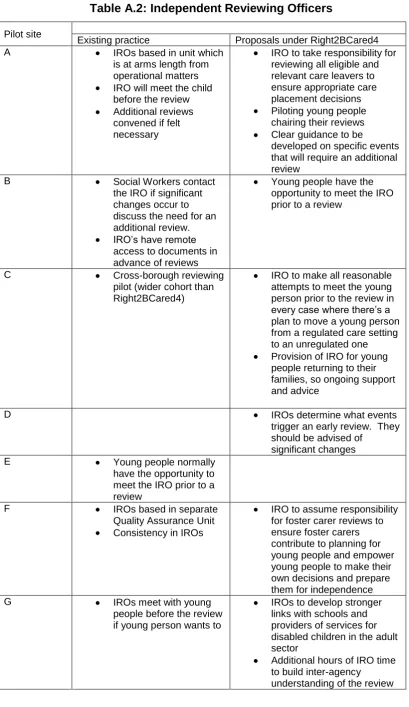
The mapping exercise outlines IRO practice in each local authority prior to Right2BCared4 and plans for implementation. Further details are provided in appendix A. In five areas before implementation of the pilot, it was already standard practice for the IRO to meet with young people prior to the review, if this was what the young person wanted.
Local authorities outlined in their applications to DCSF that the IRO would have a key role in clarifying the circumstances in which additional reviews would be convened and making social workers aware of the new
requirements. In addition, authorities proposed a range of different approaches to enhancing the IRO role both to improve care planning and support young people’s participation. LA B proposed to develop a system to allow IROs to have remote access to documents in advance of review
meetings. In LA A they proposed piloting young people chairing their own reviews with support from the IRO. LA C have appointed a dedicated
Right2BCared4 IRO to work with their cohort of young people and proposed to extend IRO support to young people returning to their families. The benefits of some of these strategies will be explored in-depth in the next phase of the research.
Changes in policy and practice post implementation of Right2BCared4
32 promoting participation in reviews. In one area the additional funding
available under the pilot meant the IRO was able to visit a residential unit on a weekly basis to
discuss issues with them and it’s done on a really informal basis so that they see me as someone who’s just involved within their life, as it were
(Independent Reviewing Officer).
In another pilot site the dedicated Right2BCared4 IRO acted as a
‘go-between’ when relationships between social workers and/or carers and young people were at risk of breaking down. The IRO’s availability and their
capacity to invest time in dialogue with individual young people meant that channels of communication remained open. The IRO was also able to spend time keeping up to date with the progression of the case over time, reading case notes regularly and seeking clarification of whether key tasks had been completed in a timely fashion.
Increased communication between IROs and advocates was identified as a development since implementation of Right2BCared4. This was perceived by independent advocates to have enhanced young people’s rights.
One of the things we do differently now under the project, our first questions is, ‘Right, who’s the IRO?’ and we think about making those links, because we know more about the IRO’s role, and that they are possibly more aligned to
our role really (Children’s Rights Officer).
Prior to Right2BCared4 we had situations from an advocacy point of view...I
can name three young people where they were removed and complaint letters went to their old address…Right2BCared4 has been really good [as we can] say you can’t [make a significant change to plans] until there’s a review, but we’re also picking up the phone to the reviewing officers…[who] can get
33
Challenges and ongoing issues
The enhanced role of IROs, however, has raised new issues for some local authorities with some re-negotiation of role boundaries having to take place. Although IROs need to work collaboratively with social workers it is also important that they feel able to challenge colleagues if there are delays in the decision-making process, or if they feel that care plans are not in the best interests of the young person.
IROs work quite hard to have some kind of cooperative relationship with
people working directly with young people, but you have to be careful that that’s not a collusive one, it compromises the young person’s best interests,
and I think IROs struggle with [this]. They know their colleagues are
sometimes very hard pressed…but we do need to be clear that if something isn’t right that needs to be highlighted…it’s not a criticism of an individual worker necessarily, but the fact remains that young person’s not getting the
deal they should (Service Manager).
Demarcation of responsibilities following an increase in IRO involvement in cases had caused tensions in some areas, particularly at the outset. Some social workers felt that IROs were taking over their case management responsibilities and that their practice was under constant scrutiny. There were also workload implications associated with having to hold additional reviews.
At this stage in the evaluation it is not yet clear whether the enhanced IRO role particularly benefits certain groups of young people, for example, those with complex care histories. An IRO in one of the pilot sites questioned whether it was a good use of resources to travel considerable distances to visit young people in stable placements a week before their review and that some young people had been a little bemused by this. Although
34 the focus groups. Further attention will be given to this in subsequent phases of the research.
Convening additional reviews in response to significant changes
Pre-existing policy and practice before implementation of
Right2BCared4
Applications to DCSF to become a pilot site revealed that eight local authorities already considered bringing reviews forward in response to changes in young people’s circumstances. In these areas therefore, Right2BCared4 could be seen as formalising arrangements rather than indicating a wholesale change in practice.
Changes in policy and practice post implementation of Right2BCared4
and ongoing challenges and issues
Amongst professionals there were mixed views concerning the potential value of convening additional reviews. The potential benefits were seen to depend to some extent on the skills of professionals to actively engage young people in the review process, making young people the focus of the meeting and allowing them some control over it. Focus group respondents claimed that for reviews to be perceived as a positive experience for young people it was important that they had a sense of ownership of the process and felt empowered to drive the review. This could include having the freedom to decide who should attend and where the review was held. As one IRO reflected, the review process needs to evolve and adapt:
It needs to change with the young person, so that as they grow and change
35 packaged for that young person to get them to buy into it. It doesn’t…have to
be a formal meeting, and I think that we need to move away from that
(Leaving Care worker).
The scope to move away from ‘bureaucratic tick boxing’ was also identified by professionals as facilitating young people’s engagement in reviews.
We are moving away from a lot of people sitting around a table at a LAC review, the important people need to be there, but it’s not an agency meeting, it’s not professionals meeting, it’s a young person’s meeting...(Independent Reviewing Officer).
IROs and advocates have a role to play in encouraging young people to actively engage in a formal meeting process that historically young people may have felt alienated by and excluded from.
Very often young people withdraw because of their past experiences of
processes, and I think the thing is to try and find a way to actually draw them
back (Independent Reviewing Officer).
It was clear that there were differences in professional perspectives as to whether additional reviews simply met the needs of the organisation and/or the young person. In one authority they were positive that Right2BCared4 had been something that their ‘difficult’ young people had responded well to and that they had welcomed the fact that the IRO was checking that if they had left care that this was their informed decision and that they were aware that they had a right to return. In another pilot site a leaving care worker reflected:
36 know, I might be on his case a bit, because I think I’ve succeeded in
communicating that I actually do care what happens to him…And I think it’s a helpful umbrella – it’s not a cure all but I do think it’s a useful bit of padding for
that young person to fall back on.
The review, in the contexts described above, was seen as one process within the wider context of one-to-one work, rather than the only forum for decision-making. Past research demonstrates that young people value contact and support that is seen to go beyond professional requirements and sends the message to young people that they are of value in their own right (Skuse and Ward, 2003). However, not all professionals viewed additional reviews as beneficial.
So they’re used to having gone through their whole care history, of having two, and all of a sudden, ‘Right, that’s changed, we have to have a review. ‘Again! I don’t want to have a review, I don’t like going to them as it is. What are you doing, why are you doing that?’ That’s what I’m finding a challenge about Right2BCared4. It’s actually, erm, changing their view about how a
review works.
By the time people are 16, 17 they really are no longer interested in reviews,
and one must bear in mind that these are just normal adolescents underneath
it all and they do become increasingly disenchanted and disassociated with
the process because the real work goes on elsewhere, the real work goes on
with the one-to-one stuff (Leaving Care Worker).
Independent Advocacy
The Advocacy Services and Representations Procedure (Children)
37 offer help in obtaining an advocate. The pilots are expected to empower
young people to be actively involved in planning their move to independence and enable them to participate meaningfully in each stage of the transition process and have their wishes and feelings taken into account. The mapping exercise found that every area, as one would expect, already had an
arrangement with a charity or independent provider to offer advocacy. Two pilot sites also indicated that independent visitors and/or mentors were available. More detailed plans to extend the provision of advocacy are outlined in appendix A.
Pre-existing policy and practice before implementation of
Right2BCared4
LA K have sought develop their advocacy service by specifically targeting young people whose placements have been identified as unstable. LA H has proposed to write to all young people aged between 14 and 18 to advise them of their enhanced advocacy service and remind of this service at their reviews. Similarly, LA F also intends to formally encourage young people to make use of the advocacy service (from the age of eight years old) to support them during their reviews. LA I plan to introduce an opt-out advocacy service, which will be routinely offered to children and young people when they first enter care. LA G intends to automatically refer young people (aged 14 and over) to their advocacy service whenever a significant change to their care plan is proposed.
38 have differed. Variations in uptake of advocacy will be explored further in interviews with young people and professionals involved in supporting and caring for them.
Ongoing challenges and issues
It was clear both from the paperwork submitted to DCSF and during focus groups that there were mixed views as to when independent advocacy services should be made available and for how long. As a Children’s Rights Officer reflected:
We had long debates amongst ourselves and amongst other authorities about
when you give a young person an advocate or whether you actually give them
an advocate or whether you offer them that service when they need it. So,
when we first started, we wrote to everyone in the sort of fourteen and fifteen [age group], saying there is this advocacy service, we know you’re going to be
going through a lot of changes, and looking towards independent living on your own over the next few years…would you like somebody to help you through that? And there wasn’t anybody that said Oh yes, please, that’d be
lovely.
Looked after young people often experience multiple changes of social worker over the course of their care career and as such have to negotiate new
relationships with a number of workers who have access to extensive personal information about them from case records. In this context it is
perhaps unsurprising that some are reluctant to seek advice and support from yet another professional. As one advocate recounted:
I’ve had it said to me, Oh you’re just another person who comes into my life
39 The large number of people asking young people for their views was also raised as a concern by some professionals.
I’ve got an advocate asking my views, I’ve got some Right2BCared4 bod asking me for my views, and now I’ve got the independent reviewing officer
asking me for my views, how many bloody times do I have to tell them!
(Independent Reviewing Officer).
It is important that young people have choice and that it is clear to them the distinct contribution that an independent advocate might make. In the pilot area above, young people who have had an advocate have been explaining to others what the service can offer, so that young people become more aware of how the advocacy service might assist them. In another area advocacy was more fully embedded in the culture of the authority prior to implementation of the Right2BCared4 pilot. Where this was the case young people, including those who are considered ‘hard to engage’, were perceived by professionals to value having an advocate. The independent nature of advocates was identified as one reason for this, especially for those who felt let down by children’s social care.
As an advocacy agency, we have a very different relationship with young people because they work with us because they’ve chosen to work with is, and they know we’re an independent agency so that from the very beginning they’re very open with us. Erm, as I say, it’s a very different relationship and they know that we’re purely for them (Advocacy worker).
I don’t think they see it as an extra person, I think it’s their person
40 In eight areas it was noted that since Right2BCared4 had begun, leaving care workers’ and IROs’ views of the positive role and contribution that advocates could play had increased and these authorities were increasingly encouraging young people, particularly those who were disengaged, to access support via this route. As one advocate explained:
We’re not kind of bound up by…any departmental pressures, and I guess one
of the changes [since R2BCared4] is that we do get more referrals coming via professionals because they will say to us and the young people, ‘Look, I can’t
say this on your behalf because I work for [Local Authority], so go to
[Advocacy service]…’ …And young people are happy with that. I mean at the
end of the day young people just kind of want to feel that someone is truly on
their side and, whilst they have good relationships with other professionals,
leaving care workers etc, etc, they know at the end of the day that they work
for the authority.
Subsequent phases of the evaluation will explore the distinct contribution that IROs and independent advocates make to supporting young people’s
41
7. Next steps and the local authorities involved
This is an interim report which offers a preliminary insight into some of the issues that professionals have encountered during the first 12-18 months of the Right2BCared4 pilot. The final report will present findings from a wider range of data sources collected from six out of the eleven pilot sites, plus two comparator sites. Young people’s views and experiences are being be
collected via a survey and 64 in-depth interviews. These aspects of the
evaluation are being conducted by former care leavers who have been trained as peer researchers. Case files on a sub-sample of cases will also be audited, with the permission of the young people concerned. In these cases the
professionals involved in the pathway planning process will also be
interviewed. Activity data will be collected to examine the costs of operating Right2BCared4 compared with standard leaving care services. Data will also be extracted from Management Information Systems to provide contextual information on the in-care experiences of young people, the progress they have made and outcomes achieved.
Selection of case study areas for in-depth evaluation
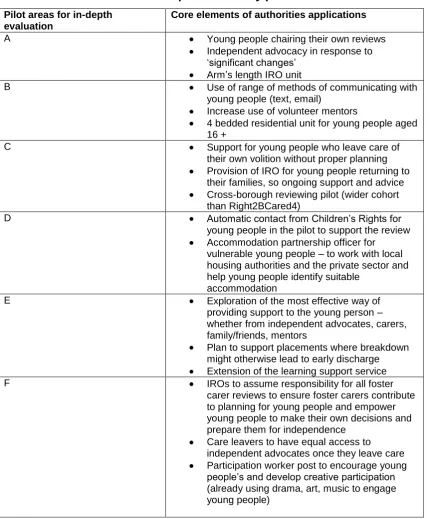
Six areas have been selected for in-depth case study work, including the peer research component of the evaluation to explore young people’s views and experiences of service provision under Right2BCared4. The selection of six pilot sites was informed by the mapping exercise, to facilitate exploration of a wide range of different approaches to the delivery of Right2BCared4. Two of the six pilot sites are also engaged in work with the Centre for Child and Family Research (CCFR) on a DCSF funded study that aims to identify and monitor the costs incurred to social care and other agencies to support children in need, including care leavers (Holmes et al., forthcoming, 2010).
42
Table 3: In-depth case study pilot sites
Pilot areas for in-depth evaluation
Core elements of authorities applications
A Young people chairing their own reviews Independent advocacy in response to ‘significant changes’
Arm’s length IRO unit
B Use of range of methods of communicating with young people (text, email)
Increase use of volunteer mentors
4 bedded residential unit for young people aged 16 +
C Support for young people who leave care of their own volition without proper planning Provision of IRO for young people returning to their families, so ongoing support and advice Cross-borough reviewing pilot (wider cohort than Right2BCared4)
D Automatic contact from Children’s Rights for young people in the pilot to support the review Accommodation partnership officer for
vulnerable young people – to work with local housing authorities and the private sector and help young people identify suitable
accommodation
E Exploration of the most effective way of providing support to the young person – whether from independent advocates, carers, family/friends, mentors
Plan to support placements where breakdown might otherwise lead to early discharge Extension of the learning support service F IROs to assume responsibility for all foster
carer reviews to ensure foster carers contribute to planning for young people and empower young people to make their own decisions and prepare them for independence
Care leavers to have equal access to
independent advocates once they leave care Participation worker post to encourage young people’s and develop creative participation (already using drama, art, music to engage young people)
Decisions were not based on any assessment of the perceived quality of plans or existing services. The choice of areas was based upon a desire to try and ensure that a wide range of core strategies for delivery of the aims and objectives of Right2BCared4 are being evaluated in-depth to assist with
43
Selection of comparator authorities
In addition to the six pilot authorities identified above, data are also being collected from two authorities that have not implemented Right2Bcared4 (comparator authorities). Authorities identified as providing high quality services to eligible, relevant and former relevant young people were shortlisted as potential comparator sites, so that Right2BCared4 can be evaluated against best ‘standard leaving care’ practice. This is likely to offer a fair comparison, given that pilot sites were expected to demonstrate similar characteristics to those identified as being necessary to meet the criteria for becoming a Beacon council for children in care services.
NCAS (What Makes the Difference?) had carried out a baseline survey of services available to older looked after children and care leavers between January 2007- April 2007 (see:
http://www.leavingcare.org/professionals/products/baselining_survey). Forty three local authorities completed a questionnaire and a number of service managers were interviewed. Annual performance assessment data (2006-2007) on the ‘percentage of care leavers aged 19 living in suitable
accommodation’ were then examined and those performing below pilot sites were excluded. This 'long short list' was then narrowed to exclude authorities with small populations of looked after children aged 16 or above. Those authorities that receive leaving care services provided by the charity Catch 22 (which NCAS sits within) were also excluded as NCAS are part of the
44
8. Conclusion
Right2BCared4 outlines a series of principles that ought to be promoted within pilot sites with the aim of improving outcomes for care leavers. At the core lies the belief that young people have the right to remain looked after until they reach 18, or until there is agreement from professionals and young people that they are prepared and ready for independence. The principles of the pilot move leaving care policy along a continuum away from accelerated and compressed pathways to independence and towards transitions more akin to those of the general population. This was universally welcomed by social care professionals and advocates during the course of focus groups. Right2BCared4 was seen to provide leverage and funding to encourage young person centred rather than resource led decision-making. It was also felt that organisational cultures and attitudes were shifting and there was increasing recognition that local authorities needed to act as a good parent would. However, the extent to which changes were attributable to
Right2BCared4 rather than the wider Every Child Matters and Care Matters agenda was not always clear cut. Practitioners and managers did feel that local authorities’ corporate parenting role has been brought into sharper focus.
It’s not quite just so much about money any more: there seems to have been a subtle [shift]…there’s much more [thinking] as a parent would. If you are a parent and your child needs something, you go overdrawn, don’t you? And I think in a way it’s a bit like corporate parents now for education, for
accommodation…they have to act like parents and can’t just say ‘Sorry, off you go’ (Inclusion Officer)