Teachers’
workload diary
survey 2010
Gemma Deakin, Nicola James, Mike
Tickner & Jane Tidswell
This research report was commissioned before the new UK Government took office on 11 May 2010. As a result the content may not reflect current Government policy and may make reference to the Department for Children, Schools and Families (DCSF) which has now been
replaced by the Department for Education (DFE).
List of charts and tables 1
Executive summary 2
Acknowledgements 4
1 Introduction 5
2 Comparisons between 2010 and previous surveys 8
3 Findings from the 2010 survey 17
4 References 32
5 Annex of tables 33
Annex A The Workload Agreement 2003 60
Annex B1 Technical report 61
Table 1: School response rate by type of school, 2010 6 Chart 1 Average hours, primary schools, 2000-10 8 Chart 2 Average hours, secondary schools, 2000-10 9 Table 2 Average hours worked by full-time teachers (in primary, secondary and special
schools) in one week in March, 1994-2010 10
Table 3 Average total teaching hours worked by full-time teachers in one week, 2000-10 12 Table 4 Average teaching hours (2000/06 definition) worked by full-time teachers in a
week, 2000-10 13
Table 5 Percentage of teaching hours as a proportion of total working hours, full-time
teachers only, 2007-2010 14
Table 6 Percentage of hours worked in the evening, before the school day and on weekends as percentage of total hours worked per week, full-time teachers only,
2007-2010 15
Table 7 Total hours worked by type of school and role, 2010 17 Table 8 Hours worked outside ‘normal’ hours by full-time teachers, 2010 24 Table 9 Composition of hours worked at weekends, before school and after 6pm by full-
time classroom teachers, 2010 25
Table 10 Workload Agreement timeline 60
Executive summary
• Workload is a common reason for teachers to leave the profession1. The 2010
Teachers’ Workload Diary Survey provides independently collected data on the hours, working patterns and tasks undertaken by teachers in maintained primary, secondary and special schools in England and Wales. This year, the majority of diaries were completed online for the first time (the previous 10 surveys were undertaken on paper), and were completed for a single week in March 2010. A sample of 1244 teachers was achieved from across 164 maintained schools.
• All references within this report to significant differences mean that the difference between two or more results is statistically significant at the 90% or 95% level (significance level is 95% unless otherwise indicated)2.
• Since 2000, the average hours worked per week has fallen for most grades of teacher in maintained primary, secondary and special schools; however the average number of hours worked per week has remained high. In the 2010 survey, average hours worked per week remain above 50 hours for most types of teacher, with only secondary school and special school classroom teachers working, on average, slightly less than 50 hours per week.
• Compared to hours worked in 2000, all categories of teachers working full-time (except secondary classroom teachers) worked significantly fewer hours in 2010 on average. The largest difference between 2000 and 2010 in terms of the average number of hours worked per week was for deputy heads in primary (difference of 5.3 hours) and
secondary schools (4.9 hours) and classroom teachers in special schools (4.8 hours).
• There were no significant decreases in average hours worked by any categories of teacher between 2009 and 2010.
• Among full-time primary school staff, average hours worked per week by headteachers has increased annually since 2005 to 56.1 hours per week in 2010. Deputy heads and classroom teachers have seen their average working hours fall between 2009 and 2010. For classroom teachers, the decrease in hours between 2008 and 2010 was significant.
• The average number of teaching hours worked by primary classroom teachers in 2010 is significantly higher than in 2007 and 2009 (but not 2008).
• The average number of hours reported by secondary school classroom teachers has remained fairly steady since 2000. Secondary heads and deputies have seen a modest decrease in hours compared to 2009, but significant decreases compared to 2000.
1
Smithers and Robinson (2003) Factors affecting teachers’ decisions to leave the profession, DfES. 2
Department heads’ average hours have increased slightly since 2009, but are significantly lower than average hours worked in 2000.
• The average number of teaching hours worked by secondary headteachers has decreased significantly since 2009.
• Comparing the average hours worked by headteachers in primary and secondary schools, primary head teachers have seen a general increase in hours while secondary heads have seen their average hours decrease, resulting in almost a convergence of their respective average hours in 2010.
• Hours worked on average by special school classroom teachers have fluctuated over time; however the decrease in hours between 2000 and 2010 is significant. Compared to 2009, their average hours in 2010 have increased (by 3.6 hours) but the increase is not significant.
• Special school classroom teachers teaching hours were significantly higher in 2010 than in 2007, 2008 and 2009.
• All full-time staff in primary and secondary schools continue to work more than a fifth of their total average hours before school/after 6pm/on weekends, which equates to around 10 hours per week. There has been a slight decrease in proportion of hours worked outside ‘normal’ hours since 2009.
• From the open comments received, planning, preparation and assessment (PPA) has been identified as the factor that has had the greatest positive impact in reducing teachers’ working hours. The introduction of ‘rarely cover’ was the second most frequently mentioned factor having a positive impact on workload.
• The survey also takes into account teachers’ perception of their workload. There were some variations in these perceptions between roles and between types of schools. Less than a fifth of teachers who answered reported that they were expected to do things that were not part of their job all/most of the time. Slightly more thought they were unable to do things that should be part of their job all/most of the time. Less than a quarter of full-time teachers felt their workload allowed them to pursue personal interests outside work all/most of the time.
• Around half of teachers reported that their duties represented good use of their time. They were less positive that they had the time to do the job as it should be done at most/all of the time (between 28.9% and 67.4% depending on the type of school and seniority of the teacher).
Acknowledgements
ORC International wishes to thank the stakeholders who supported the design and delivery of the 2010 diary survey, which contributed to the successful running of the survey.
1
Introduction
The 2010 Teachers’ Workload Diary Survey provides independently collected data on hours and working patterns in maintained schools3 in England and Wales. This is the eleventh survey; previous surveys were carried out in 1994, 1996, 2000 and then annually from 2003. The 2010 survey was commissioned directly by the Department for Education (DfE)4.
1.1 Background
Teachers’ workload is a common reason for teachers leaving the profession5. Several measures have been put in place to ensure that teachers’ time and energies are focused on the key tasks that require their particular professional skills, expertise and judgement, and thus to reduce the overall workload by redistributing or eliminating other tasks. The National Agreement6 on raising standards and tackling workload was signed by the then government, employers and school workforce unions in January 2003 (See Annex A).
1.2 Response
rate
Of the 662 maintained schools randomly selected7 for the 2010 Teachers’ Workload Diary Survey, 164 schools (25%) cooperated, meaning that at least one teacher completed a diary survey. Across these 164 schools, 2179 teachers were sampled, and of these, 1244
completed a usable diary survey8 (57%). A more detailed description of the methodology can be found in the technical report (see annex B1).
3
Academies were not included in the sample 4
Following the change of Government on 11 May 2010 the Department for Children, Schools and Families (DCSF) was renamed Department for Education (DfE)
5
Smithers and Robinson (2003) Factors affecting teachers’ decisions to leave the profession, DfES. 6
http://www.socialpartnership.org 7
The survey used a multi-stage, stratified random sample with clustering approach from a
comprehensive listing of all schools in England and Wales. Sampling involves stratifying maintained schools by type (and within primary only, by size). Schools within each stratum were then selected systematically using different sampling schemes, to ensure that for each phase there was a mixture of large and small schools within the sampling pool.
8
Table 1: School response rate by type of school, 2010
All schools Primary Secondary Special
Issued sample 662 262 372 28
Number cooperating 164 89 64 11
% cooperating 25% 34% 17% 39%
The response rate has fallen year-on-year (with the exception of 2007). The refusal rate in 2010 was over 50%, the main reasons given included being too busy, having too many surveys to complete and not feeling that the results would directly benefit them. It is worth noting that, in general, the completion rate of non-compulsory research in maintained schools has fallen over time.9
1.3
The 2010 survey
The main change from previous surveys was that the diary and accompanying surveys were completed online, while in the previous 10 iterations the surveys had been completed on paper. Further details of the methodological changes can be found in the technical report (see annex B1).
Other than the change in data collection mode, the survey was broadly similar to the previous 10 years, in that teachers in cooperating schools completed diaries for a single week in early March. For this reason, it should be kept in mind that these survey statistics do not necessarily provide an accurate picture of working patterns in other weeks of the year, although an important factor for selecting this week is that it is generally a typical week for school term-time.
As a result of changes to the diary in 2007 (when lesson cover was split into two separate categories, one classified as teaching and the other as non-teaching pupil/parent contact), grouped breakdowns of workload activities should not be compared directly with the pre-2007 surveys, although comparisons of total workload and of individual activities remain valid.
In line with previous years, diaries in which teachers had entered less than six hours for the week (where, for instance, teachers had only filled in their activities for one day) are
excluded from the calculations of average hours for all types of teacher. This is to avoid underestimation of the average hours being worked for some categories of teacher, particularly those with small sample sizes.
9
Findings are presented for sub-groups where base sizes are 50 or more. If a subgroup with fewer than 50 respondents is referred to, it is accompanied by a note to indicate a low base size. Note that the base size for secondary school headteachers and special school
headteachers, deputies and classroom teachers are all below 50 in the 2010 survey.
References to significant differences mean that the difference between two or more results is statistically significant at the 90% or 95% level (significance level is 95% unless otherwise indicated). Further information on the statistical test used can be found in Annex B.
2
Comparisons between 2010 and previous surveys
Charts 1 and 2 and Tables 2, 3 and 4 compare the average total hours worked in 2010 with previous years for key sub-groups of teachers in primary, secondary and special schools where bases sizes are large enough.
2.1 Total hours worked
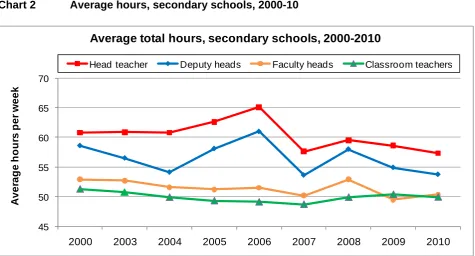
Charts 1 and 2 show the average total hours worked by teachers in primary and secondary
schools respectively.
Chart 1 shows that in 2010, all categories of primary school teachers report working over 50
hours per week. Hours worked on average by headteachers, deputy heads and classroom
teachers in 2010 are significantly lower than in 2000, although for primary headteachers there has been an increase in average hours each year since 2005.
Chart 1 Average hours, primary schools, 2000-10
45 50 55 60
2000 2003 2004 2005 2006 2007 2008 2009 2010
A
ver
ag
e
h
o
u
rs p
er
w
eek
Head teacher Deputy Classroom Average total hours, primary schools, 2000-2010
Chart 2 shows that the average number of hours worked by secondary school classroom
teachers has remained comparatively steady since 2000, around the 50 hours per week
mark. The average number of hours worked by headteachers and deputy heads has been more changeable over time. All categories worked fewer hours per week on average in 2010
than in 2000.
Chart 2 Average hours, secondary schools, 2000-10
45 50 55 60 65 70
2000 2003 2004 2005 2006 2007 2008 2009 2010
A
ver
ag
e h
o
u
rs p
er
w
eek
Head teacher Deputy heads Faculty heads Classroom teachers
[image:12.595.74.550.112.368.2]Average total hours, secondary schools, 2000-2010
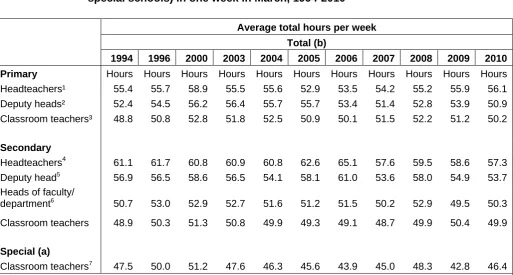
Table 2 provides detailed figures of total average hours in all schools and by all grades of
teacher from 1994 to 2010. Hours worked by headteachers and deputy heads in special
Table 2 Average hours worked by full-time teachers (in primary, secondary and special schools) in one week in March, 1994-2010
Average total hours per week Total (b)
1994 1996 2000 2003 2004 2005 2006 2007 2008 2009 2010
Primary Hours Hours Hours Hours Hours Hours Hours Hours Hours Hours Hours
Headteachers¹ 55.4 55.7 58.9 55.5 55.6 52.9 53.5 54.2 55.2 55.9 56.1 Deputy heads² 52.4 54.5 56.2 56.4 55.7 55.7 53.4 51.4 52.8 53.9 50.9 Classroom teachers³ 48.8 50.8 52.8 51.8 52.5 50.9 50.1 51.5 52.2 51.2 50.2
Secondary
Headteachers4 61.1 61.7 60.8 60.9 60.8 62.6 65.1 57.6 59.5 58.6 57.3 Deputy head5 56.9 56.5 58.6 56.5 54.1 58.1 61.0 53.6 58.0 54.9 53.7 Heads of faculty/
department6 50.7 53.0 52.9 52.7 51.6 51.2 51.5 50.2 52.9 49.5 50.3 Classroom teachers 48.9 50.3 51.3 50.8 49.9 49.3 49.1 48.7 49.9 50.4 49.9
Special (a)
Classroom teachers7 47.5 50.0 51.2 47.6 46.3 45.6 43.9 45.0 48.3 42.8 46.4 (a) Special schools heads and deputies omitted because of low sample numbers.
(b) Incomplete diaries (where teachers for instance have filled in less than six hours’ worth of activities for the week) are excluded from the calculation of average hours for all types of teacher
1. The change in total hours between 2010 and measures taken from 2000 and 2005 is statistically significant at the 90% level
2. The change in total hours between 2010 and measures taken from 2000, 2003, 2004, 2005 is statistically significant at the 95% level, and 1996 is statistically significant at the 90% level
3. The change in total hours between 2010 and measures taken from 2000, 2004, 2008 is statistically significant at the 95% level; and 1994 and 2003 is statistically significant at the 90% level
4. The change in total hours between 2010 and measures taken from 1994, 1996, 2000, 2003, 2005 and 2006 is statistically significant at the 95% level, and 2004 is statistically significant at the 90% level
5. The change in total hours between 2010 and measures taken from 2000, 2005 and 2006 is statistically significant at the significant at the 95% level, and 2008 is statistically significant at the 90% level
6. The change in total hours between 2010 and measures taken from 1996, 2000, 2003 and 2008 is statistically significant at the significant at the 95% level
7. The change in total hours between 2010 and measures taken from 2000 is statistically significant at the significant at the 95% level
Total hours worked include, as in previous years, completing the diary, which takes around an hour on average
There were however a number of statistically significant decreases in average hours
• The average total hours worked by primary heads has decreased from 58.9 hours per week in 2000 to 56.1 in 2010 (a difference of 2.8 hours), although since 2005 there has been a progressive increase10.
• There has been a reduction in the total number of hours worked on average by deputy heads in primary schools from 56.2 hours per week in 2000 to 50.9 in 2010 (a difference of 5.3 hours).
• In 2000 primary school teachers worked 52.8 hours per week on average compared to 50.2 in 2010 (a difference of 2.6 hours).
• Secondary school heads report working fewer hours in 2010 per week (57.3) than in 2000 (60.8) (a difference of 3.5 hours).
• The average total hours worked by deputy heads in secondary schools has fallen from 58.6 hours per week in 2000 to 53.7 in 2010 (a difference of 4.9 hours) and a
decreasing trend since 2008.
• In 2000 heads of faculty/department in secondary schools worked 52.9 hours per week, on average; this has decreased to 50.3 in 2010 (a difference of 2.6 hours).
• On average, special school classroom teachers worked fewer hours per week in 2010 (46.4) than in 2000 (51.2) (a difference of 4.8 hours).
2.2 Teaching hours
In the 2007 survey, some changes were made to the activity codes to more accurately
represent teachers’ activities. Code T11 in the 2006 survey, ‘covering absent teacher’s
lesson within the timetabled day’ was split into two new codes: ‘teaching during cover for absent colleague within timetabled day’ (amended in 2008 to ‘non-regular teaching during
cover for absent colleague within school’s timetabled day’) and ‘covering for absent
colleague, when cover takes the form of supervising pre-set work’. As a result of these changes, which have been maintained for the 2010 survey, some time that would previously
have been classed as teaching is now classed as non-teaching. Therefore, direct
comparisons of teaching hours between pre- and post-2007 surveys should still not be made.
10
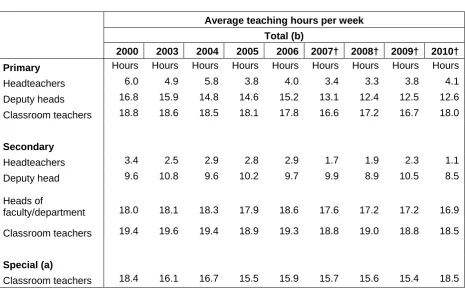
Table 3 Average total teaching hours worked by full-time teachers in one week, 2000-10
Average teaching hours per week Total (b)
2000 2003 2004 2005 2006 2007† 2008† 2009† 2010†
Primary Hours Hours Hours Hours Hours Hours Hours Hours Hours
Headteachers 6.0 4.9 5.8 3.8 4.0 3.4 3.3 3.8 4.1 Deputy heads 16.8 15.9 14.8 14.6 15.2 13.1 12.4 12.5 12.6 Classroom teachers 18.8 18.6 18.5 18.1 17.8 16.6 17.2 16.7 18.0
Secondary
Headteachers 3.4 2.5 2.9 2.8 2.9 1.7 1.9 2.3 1.1 Deputy head 9.6 10.8 9.6 10.2 9.7 9.9 8.9 10.5 8.5 Heads of
faculty/department 18.0 18.1 18.3 17.9 18.6 17.6 17.2 17.2 16.9 Classroom teachers 19.4 19.6 19.4 18.9 19.3 18.8 19.0 18.8 18.5
Special (a)
Classroom teachers 18.4 16.1 16.7 15.5 15.9 15.7 15.6 15.4 18.5
(a) Heads and deputies omitted because of low sample numbers.
(b) Teaching hours as defined in 2003, 2004, 2005, 2006, 2007, 2008, 2009 and 2010 are not comparable with those of previous years - these exclude administering/invigilating tests, registration, and pastoral/counselling sessions. The figures were recalculated using the new definition for the 2000 data shown here.
† Definition of teaching has changed from previous years: some classroom supervision, which was previously included in the teaching codes, is now classified as non-teaching pupil/parent contact
When looking at changes to total teaching hours of full-time teachers between the 2007,
2008, 2009 and 2010 surveys (see table 3), the following significant differences can be found:
• For primary schools’ classroom teachers, the number of teaching hours in 2010 is significantly higher than 2007 and 2009, (with an increase of 1.3 hrs between 2007 and 2010); the difference between 2010 and 2008 was not significant.
• For secondary headteachers, the number of teaching hours in 2010 is significantly lower than in 2009, but not significantly lower than 2007 or 2008.
• There were no significant differences between 2010 and 2007-09 for primary
headteachers and deputy heads, and secondary deputy heads, heads of department and classroom teachers
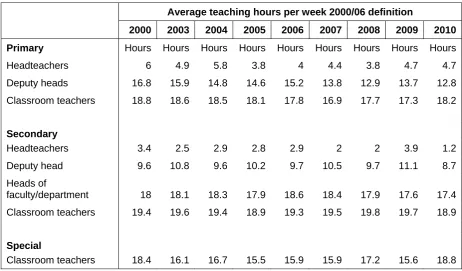
Table 4 below shows teaching hours from 2007-10 surveys recalculated using the definitions
from 2000-06 (by adding on to the total teaching hours codes P22 ‘covering for absent
[image:16.595.70.533.280.551.2]colleague, when cover takes the form of supervising pre-set work’ and P31 ‘supervising pupils on educational visits, or while external provider is teaching pupils’).
Table 4 Average teaching hours (2000-06 definition) worked by full-time
teachers in a week, 2000-10
Average teaching hours per week 2000/06 definition
2000 2003 2004 2005 2006 2007 2008 2009 2010
Primary Hours Hours Hours Hours Hours Hours Hours Hours Hours
Headteachers 6 4.9 5.8 3.8 4 4.4 3.8 4.7 4.7 Deputy heads 16.8 15.9 14.8 14.6 15.2 13.8 12.9 13.7 12.8 Classroom teachers 18.8 18.6 18.5 18.1 17.8 16.9 17.7 17.3 18.2
Secondary
Headteachers 3.4 2.5 2.9 2.8 2.9 2 2 3.9 1.2 Deputy head 9.6 10.8 9.6 10.2 9.7 10.5 9.7 11.1 8.7 Heads of
faculty/department 18 18.1 18.3 17.9 18.6 18.4 17.9 17.6 17.4 Classroom teachers 19.4 19.6 19.4 18.9 19.3 19.5 19.8 19.7 18.9
Special
Classroom teachers 18.4 16.1 16.7 15.5 15.9 15.9 17.2 15.6 18.8
Typically, recalculating teaching hours in this way increases the average teaching hours by
up to half an hour in 2010, which was also the case in 2008 and 2007. In 2009, about one and a half hours was added to average teaching hours for secondary headteachers
(because of a relatively large amount of time spent on educational visits).
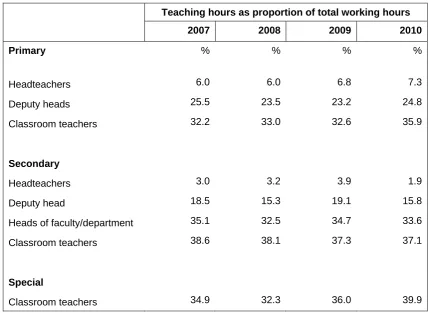
Looking at the proportion of total working hours spent teaching according to post-2006 definitions of teaching hours between 2007 and 2010; there has been an increase for
primary headteachers and classroom teachers and special school classroom teachers, but a
decrease for secondary headteachers and secondary deputy heads.
In primary schools, classroom teachers spent about a third of their working hours teaching,
In secondary schools, classroom teachers spent more than a third of their working hours on teaching activities. Heads of department/faculty spent a little less of their working hours
[image:17.595.76.505.205.518.2]teaching than classroom teachers.
Table 5 Percentage of teaching hours as a proportion of total working hours,
full-time teachers only, 2007-2010
Teaching hours as proportion of total working hours
2007 2008 2009 2010
Primary % % % %
Headteachers 6.0 6.0 6.8 7.3
Deputy heads 25.5 23.5 23.2 24.8
Classroom teachers 32.2 33.0 32.6 35.9
Secondary
Headteachers 3.0 3.2 3.9 1.9
Deputy head 18.5 15.3 19.1 15.8
Heads of faculty/department 35.1 32.5 34.7 33.6 Classroom teachers 38.6 38.1 37.3 37.1
Special
Classroom teachers 34.9 32.3 36.0 39.9
2.3 Evening/before school day and weekend working
It is possible to estimate the number of hours full-time teachers work ‘out of hours’ (before
school11, after 6pm and on weekends) from the survey data. Table 6 shows the proportion of
teachers’ total hours worked outside normal working hours between 2007 and 2010 in primary and secondary schools12.
11
Before school hours was calculated from the first school activity in the Headteacher survey (e.g. registration). If this information was not available 8.30am was taken as the start of the school day. 12
Table 6 Percentage of hours worked in the evening, before the school day and on weekends as percentage of total hours worked per week, full-time
teachers only, 2007-2010
Percentage of hours worked
2007 2008 2009 2010
% % % %
Primary schools
Headteachers 23.8 22.1 22.0 20.7
Deputy headteachers 21.8 23.7 24.0 21.3 Classroom teachers 23.2 23.1 22.9 22.3
Secondary schools
Headteachers (b) 24.4 26.8 24.5 21.3 Deputy headteachers 24.6 25.2 24.8 22.3 Heads of department 23.6 25.3 24.7 23.0 Classroom teachers 23.9 23.8 24.8 22.3
Special schools
Classroom teachers (c) (a) (a) (a) 19.3
(a) Information not available for special school classroom teachers 2007-2009 (b) Caution, low base size (42) in 2010
(c) Cautions, low base size (32), in 2010 head-teachers and deputy heads excluded due to small base size
Teachers are continuing to work at least a fifth of their working hours (around 10 hours)
outside what might be regarded as their normal working day. The proportion of hours worked
outside the normal working day as a percentage of their total hours has fallen slightly since 2007.
2.4 Perception of workload
The diary survey asked teachers about their perception of their workload in a series of attitudinal statements. Between a fifth and a quarter of respondents did not answer these questions (recorded as not stated) in 2010 and this should be taken into account when interpreting the responses and when comparing with previous years’ results.
The following findings emerged in 2010 when looking at ‘all the time’ and ‘most of the time’ responses combined with comparisons shown with 2008 and 2009 where there are notable differences. Note that differences for these questions were not tested for statistical
significance.
2008) and least likely for full-time primary school deputy heads (7.1% in 2010). Primary school heads show the greatest improvement since 2009 with regard to being asked to do things that were not part of their job, falling from 23.4% in 2008 and 25.3% in 2009 to 13.7% in 2010. The greatest increase in perception of being expected to do something that was not part of their job, was for secondary heads (from 4.6% in 2008 to 9.3% in 2010).
• Around a quarter of secondary school staff (not including headteachers) said they were unable to do things that should be part of their job all or most of the time in 2010, which is an increase on both 2008 and 2009 figures. Headteachers in secondary schools were least likely to say they were unable to do things that should be part of their job in 2010 (17.6%). Primary school headteachers were less likely to report being unable to do things that were part of their job in 2010 (17.6%), compared to 2009 (24.1%).
Furthermore, special school teachers show the greatest improvement between 2008 and 2010 (37.8% in 2008 to 15.6% in 2010).
• Two-thirds of secondary headteachers (67.4%), and more than half of part-time primary classroom teachers (54.3%) and special school teachers (56.3%) reported having the time to do their job as it should be done most or all the time in 2010. This contrasts with 29.1% of secondary heads of department (which has decreased since 2008 and 2009). The greatest improvement reported was by secondary headteachers (from 39.6% in 2008 to 50.7% in 2009 and 67.4% in 2010), although primary headteachers showed only a modest improvement (from 41.1% in 2008 to 46.1% in 2010). Secondary deputy heads reported the opposite, with fewer indicating that they had the time to do the job as it should be done in 2010 (37.5%) compared to 2009 (50.9%) and 2008 (43.5%). This pattern was also found for deputy heads in primary schools; 2010 (37.1%) compared to 2009 (48.3) and 2008 (68.1%).
• In 2010, around half of all teachers felt their duties represented a good use of their time all or most of the time. Special school teachers and secondary school headteachers were most positive about this (78.1% and 73.1% respectively). Part-time secondary classroom teachers (48.6%) and full-time primary classroom teachers (49.8%) were the least positive.
3
Findings from the 2010 survey
3.1
Total hours worked overall
[image:20.595.76.364.247.510.2]The total hours worked per week on average by teachers in different types of school and role are shown in the Table 7 below. The average hours worked increase slightly with seniority in primary and secondary schools.
Table 7 Total hours worked by type of school and role, 2010
Total hours worked per week,
full-time only Primary
Headteachers 56.1
Deputy heads 50.9
Classroom teachers 50.2
Secondary
Headteachers 57.3
Deputy head 53.7
Heads of faculty/department 50.3 Classroom teachers 49.9
Special (a)
Classroom teachers 46.4
(a) Special schools heads and deputies omitted because of low sample numbers.
The more senior the teacher the less time they spent on non-working breaks in school hours. Heads in primary school had 1.7 hours non-working time per week compared to 2.9 hours for classroom teachers. In secondary schools, deputy heads had 1.7 hours and classroom teachers 3.1 hours.
All types of teacher in all types of school had around half an hour of authorised absence on average per week.
3.2 Analysis of hours spent on each activity (grouped)
This chapter presents a breakdown of total hours into ‘grouped’ activities which include:
teaching; PPA; non-teaching pupil/parent contact; school/staff management; general
administrative support; individual/professional activity and other activities. Throughout this chapter findings are presented where the base size is 50 or more. For secondary
headteachers and all grades in special schools (headteachers, deputies and classroom
there is a finding of interest (this is accompanied by a cautionary note indicating the low base size).
3.2.1 Analysis by school type and job role
Primary teachers
Primary school classroom teachers spent more than a third of their working hours teaching, on average (35.8%) and a similar proportion of their time on PPA activities (34.0%). The rest
of their time was roughly split evenly between the other ‘grouped’ activities.
Headteachers in primary schools spent the majority of their time on school/staff management activities (52.2%), non-teaching pupil/parent contact (13.6%) or
individual/professional activity (12.0%).
Deputy heads’ time was more evenly spread across the ‘grouped’ activities; they spent on average more than a fifth of their time on each of teaching (24.8%), PPA activities (28.1%)
and school/staff management (21.2%).
Secondary teachers
Secondary school classroom teachers, like their primary school counterparts, spent on
average more than a third of their working hours teaching (37.0%) and a similar proportion of
their time on PPA activities (32.5%). They spent proportionately more of their time on non-teaching pupil/parent contact (13.8%) than primary school classroom teachers do and only
4.1% on general administrative support (three percentage points less time than their primary
counterparts).
Secondary heads13 spent more than two-thirds of their time on school/staff management
(68.8%), as an average. Most of their remaining time was spent on non-teaching pupil/parent
contact (14.4%) or individual/professional activity (9.7%). Only a very small proportion of their time is spent teaching (2.0%).
Deputy heads in secondary schools were more involved in school/staff management (38.5%
of their time, on average) than their primary school counterparts and less involved in teaching (15.8% of their time). The majority of the rest of their working time was spent on
PPA (16.0%) or non-teaching pupil/parent contact (15.1%).
Department heads in secondary schools had a similar profile to classroom teachers in terms of their time spent on ‘grouped’ activities, but spent slightly more time on school/staff
management (10.8%) and slightly less on PPA (28.7%) compared to classroom teachers.
See annex of tables (Table A1) for average working hours of full-time teachers in total and on grouped activities.
13
3.3 Teaching
hours
On average, classroom teachers spent at least a third of their time teaching, which equates to around 18 hours a week (3.6 hours per day). The vast majority of this time was regular
timetabled teaching. Less than an hour of the average primary and secondary school
classroom teacher’s time per week was spent on non-regular teaching such as cover for an absent colleague within timetabled day (not including cover supervision), teaching outside
timetabled hours, assisting in other lessons or on educational visits.
The pattern was similar for deputy heads and heads of department (however, they spent fewer hours on timetabled teaching).
Primary heads spent more time covering for absent colleagues (0.8 hours per week) than
their deputies (0.2 hours) or classroom teachers (0.1 hours). Primary heads had 2.8 hours per week on average regular timetabled teaching. Findings at this level of detail for
secondary heads were not shown due to low base size (42 respondents).
See annex of tables (table A19 for primary schools and A20 for secondary schools).
3.4 Planning, preparation and assessment including PPA timeline
PPA as a ‘grouped’ activity was the second most common activity for classroom teachers after teaching. Specific activities included planning/preparing for lessons or tests, marking or
assessing pupils and writing reports on pupil progress.
The most common PPA activity was lesson planning or preparing for tests. Primary
classroom teachers spent an average of 10 hours per week on this activity, while secondary
teachers spent 8.7 hours on it. Furthermore, heads of department in secondary schools
spent 7.1 hours per week and deputy heads in primary schools spent 8.2 hours per week on lesson planning.
The second most common PPA activity was assessing/marking pupils’ work (including more
general assessment activities). In secondary schools, classroom teachers and heads of department both spent an average of around 5.5 hours a week on this. In primary schools,
classroom teachers and deputy heads spent just less than five hours a week on this activity.
See annex of tables (table A19 for primary schools and A20 for secondary schools).
3.5 Non-teaching contact with pupils and parents
There were 13 different activities that made up non-teaching pupil/parent contact, including
2009, the Workforce Agreement guidelines outlined that teachers should rarely be asked to cover lessons of absent colleagues in this way14.
Primary teachers
In primary schools, classroom teachers spent on average 4 hours a week on these ‘grouped’
activities, compared to 4.8 by deputy heads and 7.7 by headteachers.
The most common task for all three types of teacher was supervising pupils
before/after/during the school day (2.5 hours for heads, 1.9 for deputies and 1.5 for
classroom teachers, on average). For heads and deputies, the second most common task was contact with parents (2.2 hours and 1.3 hours per week respectively). The average
classroom teacher spent around three-quarters of an hour on each parent contact and taking registration/classroom management, but less than 0.1 hours a week on pre-set classroom
cover (when grossed up to a 39-week school year, this equates to 3.9 hours per year). The
vast majority of teachers (more than nine in ten) did no pre-set classroom cover, while the
majority that did any classroom cover did between 45 minutes and one hour of classroom cover in the diary week.
See annex of tables (table A19).
Secondary teachers
In secondary schools, all staff spent more time on non-teaching pupil/parent contact than
their equivalents in primary schools. See annex of tables (table A20).
• Deputy heads spent an average of 8.1 hours per week on this ‘grouped’ activity with four activities in particular on which they spent more than an hour per week each:
supervising pupils (2.6 hours), contact with parents (1.8 hours), disciplining/praising pupils (1.1 hours) and other activities relating to particular pupils or parents (1.1 hours).
• Heads of department spent 7.1 hours per week on average in non-teaching pupil/parent contact, including 1.5 hours on supervising pupils, 1.2 hours on parental contact, 1 hour on class registration/classroom management and 0.9 hours on pupil activities outside timetabled teaching (eg coaching sport or drama rehearsal).
• On average, classroom teachers in secondary schools spent 6.9 hours a week on non-teaching pupil/parent contact. Within this, more than an hour per week is spent on supervising pupils (1.5 hours), registration/classroom management (1.3) and parental contact (1.3 hours). On average, 0.1 hours per week was spent on pre-set classroom cover (when grossed up to a 39-week school year this equates to 3.9 hours per year). Another point to note is that in 2009 secondary classroom teachers spent 0.4 hours a week on pre-set classroom cover (15.6 hours per year).
3.6 School/staff management
School/staff management can be divided into internal activities (such as meetings,
appraising, mentoring, and developing policies) and external activities (for example, contact
with educational bodies, local community and other local education providers). As would be
expected, the more senior the staff the more time they spent on school/staff management. See annex of tables (table A19 for primary schools and A20 for secondary schools).
Primary teachers
In primary schools, on average, headteachers spent 29.3 hours on these ‘grouped’ activities compared to 10.8 among deputy heads and 3.4 among classroom teachers.
• The main tasks classroom teachers were involved in were staff meetings (1.3 hours) and other management activities (0.6 hours). No other activity took up more than half an hour per week.
• Deputy heads spent most of their school/staff management in staff meetings (2.4 hours, on average), developing school policy (1.3 hours), or in contact with staff, but not about specific pupils or planning (1 hour) and other management activities not covered by the tasks listed in the survey (2.5 hours).
• Headteachers spent the majority of their time on school/staff management and at least half an hour of that on each of 13 of the 14 tasks listed in the survey. Headteachers spent at least 2 hours per week on average on each of the following activities: staff meetings (3.1 hours), contact with staff that was not about specific pupils or planning (2.8 hours), school policy development (2.8 hours) and contact with educational bodies (2.1 hours). The largest proportion of time (8.9 hours) was not covered by pre-codes shown in the survey.15
Secondary teachers
In secondary schools, headteachers spent, on average, 39.5 hours a week on school/staff
management, while their deputies spent 20.7 hours. Heads of departments spent much less time on this activity (5.4 hours), and classroom teachers even less (2.6 hours).
Headteachers16 spent the majority of their working hours on school/staff management (39.5
hours out of 57.3).
• The main school/staff management activity for classroom teachers and department heads was attending staff meetings (0.9 and 1.9 hours on average per week, respectively).
15
The large number of school/staff management hours recorded as ‘other’ signifies that several activities are not covered by the existing pre-coded list.
16
• Deputy heads undertook a range of tasks, with the following taking up an hour or more of their time each in a week, on average: general staff meetings (4.9 hours), school policy development (2.8 hours), contact with staff, but not about specific pupils or planning (1.7 hours), coaching/mentoring staff (1.5 hours), appraising/monitoring staff (1.2 hours) and contact with support staff (1 hour). Other management activities, not covered by the task list in the survey, accounted for 4.9 hours of their total working hours.
• Details of hours spent working on management activities by secondary school headteachers are not shown due to the low base size (42 respondents)
3.7 General administrative support
This ‘grouped’ activity includes keeping records (including those on pupil performance), organising equipment, preparing displays, setting up the classroom and photocopying. See
annex of tables (table A19 for primary schools and A20 for secondary schools).
Primary schools
In primary schools, headteachers spent the greatest average time on administrative support
(4.7 hours), compared to classroom teachers (3.6 hours) and deputy heads (3.0 hours).
• Classroom teachers in primary schools spent about an hour and a half per week setting up or tidying up the classroom, on average. Less than half an hour is spent on each of the other activities.
• On average for deputy heads, their time was split fairly equally between setting up/tidying classrooms (0.7 hours), keeping records on pupil performance (0.6 hours), keeping other school records (0.5 hours) and organising resources (0.4 hours).
• The majority of general administrative activity (2.4 hours, on average) undertaken by headteachers was classed as ‘other’. They also spent at least half an hour a week on each of simple clerical tasks such as photocopying (0.7 hours) and organising resources and premises (0.6 hours).
Secondary schools
In secondary schools department heads, deputy heads, and classroom teachers spent about the same amount of time on general administration (averages of, 2.5, 2.3 and 2.1 hours
respectively).
• Deputy heads spent 0.6 hours per week on organising resources/ premises and 0.8 hours on ‘other’ activities. No other individual activity took up more than 0.3 hours per week on average.
• Secondary school classroom teachers spent around half an hour on each of setting/tidying up the classroom and ‘other’ activities.
3.8 Individual/ professional activity
Individual/professional activity includes training and development and background reading, as well as time spent keeping the workload diary itself. Keeping the diary took teachers
around an hour. See annex of tables (table A19 for primary schools and A20 for secondary
schools).
Primary schools
In primary schools, headteachers spent on average more time on individual/ professional
activity (6.7 hours) than their deputies (4.8 hours) or classroom teachers (3.5 hours)17. The most common activity for all three types of teacher was training and development which
included in-service education and training (INSET), peer observation and being mentored.
Headteachers spent 3.1 hours per week on this compared to 2.3 hours among deputy heads and 1.7 among classroom teachers.
Secondary schools
In secondary schools also, the more senior the respondents the more time they spent on
individual/professional activity. Deputy heads on average spent 5.1 hours per week on this, heads of department 3.5 and classroom teachers 3.1. Also, like in primary schools, training
and development was the most common activity for all grades of secondary teacher; with 1.9 hours for deputy heads, 1.3 for heads of department and 1 hour per week for classroom
teachers. Results for headteachers are not shown due to the low sample size.
3.9 Evening/before school and weekend working
Work that takes place out of ‘normal’ hours includes time worked before the school day (ie before registration), after 6pm and on weekends. In 2010, teachers at all levels in primary
and secondary schools18 worked on average at least 10 hours outside normal hours, which
equates to a fifth of their weekly workload. The majority of this work took place on weekdays
17
The average number of hours spent on individual/professional activity was higher in 2010 than in 2009. A review of individual unweighted responses and the notes column (where teachers can add additional notes about individual entries) showed that there were 124 entries for individual/
professional activity that were 3 hours or longer (the longest was 12 hours). The notes show that these entries were for INSET days/sessions, conferences, courses and observation at other schools and included travel time for off-site activities.
18
(between 6 and 8 hours) and slightly less on the weekend (between 3 and 5 hours, except for secondary teachers without Teaching and Learning Responsibility (TLR19) who spent
[image:27.595.68.514.176.492.2]5.26 hours working on the weekend).
Table 8 Hours worked outside ‘normal’ hours by full-time teachers, 2010
Percentage of total hours worked
Out of ‘normal’
hours (a) At weekends
Before school/after 6pm
Hrs % Hrs % Hrs %
Primary schools
Headteachers 11.6 20.7 3.9 6.9 7.8 13.8
Deputy headteachers 10.8 21.3 4.1 8.1 6.7 13.2 Classroom teachers 11.2 22.3 4.2 8.3 7.0 14.0 Classroom teachers with TLR 11.0 22.3 4.1 8.2 6.9 14.0 Classroom teachers without TLR 11.6 22.7 4.3 8.5 7.3 14.3
Secondary schools
Headteachers 12.2 21.3 4.2 7.3 8.0 14.0
Deputy headteachers 12.0 22.3 4.1 7.6 7.9 14.7 Heads of department 11.6 23.0 4.3 8.6 7.2 14.3 Classroom teachers 11.2 22.3 4.7 9.4 6.5 12.9 Classroom teachers with TLR 11.2 22.4 4.2 8.3 7.0 14.1 Classroom teachers without TLR 11.3 22.5 5.3 10.5 6.0 12.0 (a) Combination of hours worked on weekends, before school and after 6pm
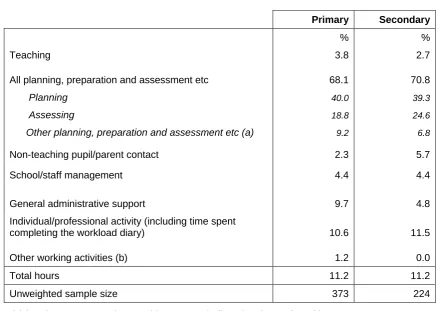
Looking at the work undertaken by full-time teachers before school, after 6pm and on
weekends, most of it was PPA activities (an average of 68.1% in primary schools and 70.8% in secondary schools). Other activities taking place out of ‘normal’ hours are shown in Table
9.
19
Table 9 Composition of hours worked at weekends, before school and after 6pm by full-time classroom teachers, 2010
Primary Secondary
% %
Teaching 3.8 2.7
All planning, preparation and assessment etc 68.1 70.8
Planning 40.0 39.3
Assessing 18.8 24.6
Other planning, preparation and assessment etc (a) 9.2 6.8
Non-teaching pupil/parent contact 2.3 5.7
School/staff management 4.4 4.4
General administrative support 9.7 4.8 Individual/professional activity (including time spent
completing the workload diary) 10.6 11.5
Other working activities (b) 1.2 0.0
Total hours 11.2 11.2
Unweighted sample size 373 224
(a) i.e. "lesson preparation, marking etc" excluding planning and marking (b) Other activities comprise authorised absence in school hours
3.10 Attitude to job and workload
As in previous years, teachers were asked a series of questions regarding their perception of their job and workload. These questions explored the following:
• how often they were expected to do things that were not part of their job;
• how often they were unable to do things that should be part of the job;
• whether they believe they have the time to do the job as it should be done;
• whether they feel their duties represent a good use of their time; and
• and whether they feel their workload allows them to pursue personal interests outside work.
• Between a two thirds (special school teachers) and half (secondary headteachers) of respondents were rarely or never expected to do something that was not part of their job20.
• Between a third (primary deputy heads) and almost two-thirds (primary
headteachers) felt they were unable to do things that were part of their job from at least time to time.
• A minority of respondents reported that they rarely or never had the time to do the job as it should be done; however, it was a slightly more common view among deputy heads in secondary schools. Conversely, no secondary headteachers reported that they never/rarely had the time to do the job as it should be done21.
• The large majority of teachers at all levels (between 69.3% and 91.6%) felt that their duties represented a good use of their time, at least from time to time. No more than 5% in any role/school type felt that their duties rarely/never represented good use of their time. The remaining respondents did not state an answer
• More than a third of teachers in nearly all roles/school types reported that their workload allowed them to pursue personal interests outside rarely or never. The exceptions were special school classroom teachers (15.6%) and part-time primary school classroom teachers (28%).
Teachers’ perceptions of/attitudes to workload
The 2010 survey also asked a series of questions which the respondents were able to answer in their own words, rather than respond to predetermined categories22. They were asked which:
• types of activities they were expected to do but didn’t think they should be doing; • activities they would like to spend less time doing;
• activities they were unable to do but thought they should be doing; and
• activities they would like to do more of.
Activities expected to do but not considered part of role
In total, nearly 400 respondents identified activities they were expected to do but did not think they should be should be doing. These included administrative or clerical tasks (78
20
Caution, low base sizes: special schools classroom teachers (32) and secondary school headteachers (42)
21
Caution, low base size (42) 22
respondents), photocopying (58), providing cover (45), pupil behaviour management on behalf of colleagues (26), putting up displays (24) and attending meetings (24).
Activities like to spend less time doing
Similarly, when asked what they would like to spend less time doing, respondents mentioned marking (130 respondents mentioned this), planning (104), administrative/ clerical tasks (100), attending meetings (75), behaviour management (50), making/ finding resources (45), photocopying (42), dealing with parents (38), providing cover (31) and display work (26). In total, 733 respondents answered this question.
Activities unable to do but considered part of role
With regard to activities that teachers thought they should be doing, but did not have time to do 446 respondents gave a response in their own words. The most common responses were planning (75), marking (74), delivering better lessons (50), assessment (43), mentoring/ supporting staff (37), contact with parents (21) and preparing displays (15).
Activities like to do more
In terms of what teachers would like to spend more time doing, of the 715 comments, the most frequently mentioned were planning (167), more time with pupils (75), preparing resources (72), observing colleagues’ lessons (37), continued professional development (CPD) (33), marking (29), displays (26), contact with parents (22) and pastoral care (22). Some of these activities (planning, marking, preparing displays) were also mentioned as activities that teachers would like to spend less time doing.
Teachers were also asked questions about their perception of their workload in a format where they could give a response in their own words. These questions were:
• What factors have had a positive impact on your workload?
• What factors have had a negative impact on your workload?
• What things could still be done at a school level?
• What things could still be done at a local level?
• What things could still be done at a national level?
Positive impact
Around 1000 respondents identified factors that had a positive impact on workload. The most frequently mentioned included: having PPA time (258 respondents), not having to cover lessons (introduction of ‘rarely cover’ guidelines) (154), sharing planning/resources (110), re-using lesson plans (97), dedicated headship time (86), team work (86), delegation of tasks (77), activities of support staff (technicians, administrators, teaching assistants) (59), and having more teaching experience (41).
A hard-working staff. Supportive governing body, appropriate challenge and support from the LA and my SIP [School Improvement Partner]. Reasonable and realistic expectations of myself. A network of friends and colleagues at the end of a phone or email. My mentor head. A brilliant PA. A brilliant business manager. Headteacher, secondary school
A management structure that engages in activities that take the pressure off the headteacher's workload through delegation. Colleagues involved develop their own skills as well as leading school improvement. Headteacher, primary school
PPA time is good as it allows you to really plan what you are going to do with that allocated time. It is also wonderful now that we don't have to do our own displays, collect money etc. Having a computer in our rooms is fab and each teacher having a laptop has helped with workload. Head of department, secondary school
Working alongside good, friendly colleagues. Children's behaviour, enthusiasm to learn and being happy in the classroom. Having a good relationship with parents and their praise of your work. Teacher, primary school
Negative impact
Conversely, around 1000 respondents identified factors that had a negative impact on their workload. These factors included school functions/meetings (209), class size (too large, 30+) (177), new government initiatives (121), Assessing Pupil Progress (APP) (94),
assessment/marking (68), dealing with poor pupil behaviour (53), SATS (27), staff
turnover/absence (25), administrative tasks (16), reporting (15), inspection (15), and lack of office/workspace for PPA (8).
Again, a collection of quotes will illustrate the range of responses:
ICT developments and the expectation of typing up reports of meetings attended/student reports, data entry for student progress. Data analysis. Attendance at PTA meetings, PTA events, Governors’ meetings, local curriculum meetings, school functions all tend to eat into the time left for leadership and management and home–life balance. Deputy head, secondary school
Lack of sharing resources in department. Head and deputy head of department lacking people-managing skills and understanding how to manage staff. No team spirit in department. Teacher, secondary school
New strategies being introduced. Excessive paperwork. Not being valued as an educator and teacher rather than assessor, report writer and data handler. New ideas being introduced but having to follow two systems to make sure process works. Uncertainty about KS2 SATS tests being continued, eg in Science – affects planning. Teaching foreign languages. Teacher, primary school
In order to better understand how teachers could be best supported to reduce their workload, respondents were asked about what could be done at the school, local and national levels.
School level
About 800 respondents put forward suggestions regarding what could be done at the school level. The main suggestions were: more time to carry out special/extra roles (133), fewer timetabled teaching hours (96), more non-contact time (93), more teaching
assistants/administrative support (60), fewer/shorter/more focused staff meetings (52), more advance warnings of changes/new initiatives (25), less paperwork (20), guidelines to tackle pupil behaviour problems (14), improved/more use of online/electronic systems (11) and clear communications (4). Notable quotes follow.
Behaviour – needs a reliable system that is supported from top down, as disruptive students are hard to deal with and senior management do not work on this, but pay lip service. Head of department, secondary school
Double PPA time and allow more marking time for core subjects, especially those with a heavy mark load. If English and Maths are important enough to be core subjects and used as a basis for league tables, reward us with extra time to get it right. Teacher, secondary school
Giving teachers more control of what they are teaching, not requesting forms to be filled in with no actual reason for them, other than a paper-filling
exercise. Teacher, primary school
Increased responsibility taken by admin. staff for routine tasks such as coordinating records of attendance (eg we complete termly attendance reports for each child manually), creating lists for parent consultation evenings to coordinate siblings, etc, photocopying. Teacher, primary school
Local level
cluster (88), more funding (eg for IT/building/CPD) (39), fewer meetings (18), more guidance (eg teaching/managing workload, collaboration) (12) and local education authority (LEA) to have better understanding of teachers' roles (7).
Here are some illustrative quotations:
Better professional development and training specifically focused on
individual school's need. More efficient building and property service that gets on with things more quickly instead of leaving to the last minute. Effective targeting of money and resources to meet the needs of all children.
Headteacher, primary school
Make a stand against all the things that increase workload and don't directly improve teaching and learning, especially anything that is just a paper trail. Share practice that reduces workload and avoids us all reinventing the wheel constantly – there is a feeling that we are all trying to solve the same
problems in our schools, when we should be sharing. Deputy, primary school
More support with behavioural issues, respect of the teacher as a professional in her own right and respect her judgement on a variety of issues, more money for classrooms and improvement of the school as a whole. More money for professional development. Teacher, secondary school
National level
Finally, at the national level suggestions included: fewer initiatives/changes to curriculum (191), treat teachers as professionals (131), more funding (68), more resources (38), less inspection (25), smaller class sizes (15), recognition of hard work teachers do and their achievements (13), less bureaucracy (11), more PPA time in the school timetable (10), abolish SATs/ league tables (9), have the same systems across all schools (9) and fewer targets/less monitoring (5). Around 700 respondents put forward suggestions of which the following are examples:
Streamline the number of new initiatives that schools are continually having to absorb and implement. Listen to the teachers in schools and focus on the priorities of helping schools concentrate on what they do best, teach children.
Deputy head, secondary school
Allowing teachers to be used for cover if the classes they would be teaching are out of school – rarely cover should be confined to only those non-contact periods for which they are timetabled. Deputy head, secondary school
Get politicians to understand that there are skilled leaders working in schools doing a fantastic job in difficult situations. Really try to address teacher recruitment issues. Headteacher, secondary school
4
References
National Agreement (2003) Workload Agreement Monitoring Groups. Further information available: http://www.socialpartnership.org
DfES (2003) Raising Standards and Tackling Workload: A National Agreement. London: Department for Education and Skills. Available:
http://publications.teachernet.gov.uk/eOrderingDownload/DfES%200172%20200MIG1975.pdf
Smithers and Robinson (2003) Factors affecting teachers’ decisions to leave the profession, DfES. Available
http://www.education.gov.uk/research/data/uploadfiles/rr430.pdf
Sturgis, Smith and Hughes (2006) A study of suitable methods for raising response rates in schools surveys. Department for Education and Skills. Available:
http://www.dcsf.gov.uk/research/data/uploadfiles/rr721.pdf
5
Annex of tables
Page
Table A1 Average hours worked by full-time teachers, in total and on grouped activities 35 Table A2 Average hours worked by full-time heads of department in secondary schools 36 Table A3 Average hours worked by full-time classroom teachers 37 Table A4 Average hours worked by full-time classroom teachers with Teaching and
Learning Responsibility Payment 38
Table A5 Average hours worked by full-time classroom teachers without Teaching and
Learning Responsibility Payment 39
Table A6 Average total hours worked by full-time classroom teachers in primary school by
demographics 40
Table A7 Average total hours worked by full-time classroom teachers in secondary school
by demographics 41
Table A8 Average hours worked by full-time classroom teachers by school demographics 42 Table A9 Distribution of total hours worked by full-time headteachers 43 Table A10 Distribution of total hours worked by full-time deputy and assistant
headteachers 44
Table A11 Distribution of total hours worked by full-time heads of department in
secondary schools 45
Table A12 Distribution of total hours worked by full-time classroom teachers 45 Table A13 Distribution of total hours worked by full-time classroom teachers with
Teaching and Learning Responsibility Payment 46 Table A14 Distribution of total hours worked by full-time classroom teachers without
Teaching and Learning Responsibility Payment 46 Table A15 Distribution of teaching hours (a) worked by full-time classroom teachers 47 Table A16 Distribution of teaching hours (a) worked by full-time classroom teachers with
Table A17 Distribution of teaching hours (a) worked by full-time classroom teachers without Teaching and Learning Responsibility Payment 48 Table A18 Average hours worked by part-time classroom teachers 48 Table A19 Average hours spent on individual activities by full-time headteachers, deputy
headteachers and classroom teachers in primary schools 49 Table A20 Average hours spent on individual activities by full-time headteachers, deputy
headteachers, heads of department and classroom teachers in secondary
schools 52
Table A21 Percentage of total hours worked by full-time teachers at weekends, before
school or after 6pm on weekdays 54
Table A22 Composition of hours worked at weekends, before school and after 6pm for
full-time classroom teachers 55
Table A23 Relationship of total hours worked at weekends, before school and after 6pm for
full-time classroom teachers 56
Table A24 General attitudes of teachers to their jobs and workloads 57 Table A24 General attitudes of teachers to their jobs and workloads 58 Table A25 Average total hours, teaching hours and hours worked at weekends, before
Weighted
Heads (a) Deputy heads (a) Classroom teachers
Secondary
Primary Secondary Primary Secondary Primary Head dept Classroom Special
Hrs % Hrs % Hrs % Hrs % Hrs % Hrs % Hrs % Hrs %
Teaching 4.1 7.3 1.1 2.0 12.6 24.8 8.5 15.8 18.0 35.8 16.9 33.5 18.5 37.0 18.5 40.0 Planning, preparation and
assessment 3.2 5.6 2.0 3.6 14.3 28.1 8.6 16.0 17.1 34.0 14.4 28.7 16.2 32.5 14.3 30.9 Non-teaching pupil/parent contact 7.7 13.6 8.2 14.4 4.8 9.5 8.1 15.1 4.0 8.0 7.1 14.2 6.9 13.8 5.2 11.1 School/staff management 29.3 52.2 39.5 68.8 10.8 21.2 20.7 38.5 3.4 6.7 5.4 10.8 2.6 5.2 2.7 5.7 General administrative support 4.7 8.4 0.7 1.2 3.0 5.9 2.3 4.3 3.6 7.1 2.5 5.0 2.1 4.1 2.5 5.3 Individual/professional activity (b) 6.7 12.0 5.6 9.7 4.8 9.5 5.1 9.5 3.5 7.0 3.5 7.0 3.1 6.2 2.5 5.4
All known working activities 55.7 99.2 57.1 99.7 50.4 98.9 53.3 99.3 49.5 98.6 49.9 99.1 49.4 98.9 45.6 98.4 Other working activities (c) 0.5 0.8 0.2 0.3 0.6 1.1 0.4 0.7 0.7 1.4 0.5 0.9 0.5 1.1 0.7 1.6
All working activities 56.1 100 57.3 100 50.9 100 53.7 100 50.2 100 50.3 100 49.9 100 46.4 100 (a) - excluding special schools where sample numbers were very low
(b) - includes up to one hour for completing the diary survey (c) Other activities comprise authorised absence in school hours
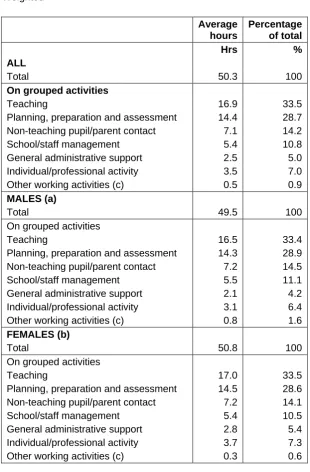
Table A2 Average hours worked by full-time heads of department in secondary schools
Weighted
Average hours
Percentage of total
Hrs %
ALL
Total 50.3 100
On grouped activities
Teaching 16.9 33.5
Planning, preparation and assessment 14.4 28.7 Non-teaching pupil/parent contact 7.1 14.2 School/staff management 5.4 10.8 General administrative support 2.5 5.0 Individual/professional activity 3.5 7.0 Other working activities (c) 0.5 0.9
MALES (a)
Total 49.5 100
On grouped activities
Teaching 16.5 33.4
Planning, preparation and assessment 14.3 28.9 Non-teaching pupil/parent contact 7.2 14.5 School/staff management 5.5 11.1 General administrative support 2.1 4.2 Individual/professional activity 3.1 6.4 Other working activities (c) 0.8 1.6
FEMALES (b)
Total 50.8 100
On grouped activities
Teaching 17.0 33.5
Planning, preparation and assessment 14.5 28.6 Non-teaching pupil/parent contact 7.2 14.1 School/staff management 5.4 10.5 General administrative support 2.8 5.4 Individual/professional activity 3.7 7.3 Other working activities (c) 0.3 0.6
(a) - 70 teachers (b) - 130 teachers
(c) - Other activities comprise authorised absence in school hours
Table A3 Average hours worked by full-time classroom teachers
Weighted
Average hours Percentage of total
Primary Secondary Primary Secondary
Hrs Hrs % %
ALL
Total 50.2 49.9 100 100
On grouped activities
Teaching 18.0 18.5 35.8 37.0
Planning, preparation and
assessment 17.1 16.2 34.0 32.5
Non-teaching pupil/parent
contact 4.0 6.9 8.0 13.8
School/staff management 3.4 2.6 6.7 5.2 General administrative support 3.6 2.1 7.1 4.1 Individual/professional activity 3.5 3.1 7.0 6.2
Other activities (c) 0.7 0.5 1.4 1.1
MALES (a)
Total 49.0 50.6 100 100
On grouped activities
Teaching 17.9 19.5 36.6 38.6
Planning, preparation and
assessment 18.2 16.6 37.1 32.8
Non-teaching pupil/parent
contact 3.7 7.2 7.5 14.3
School/staff management 4.0 2.8 8.1 5.5 General administrative support 1.8 1.4 3.7 2.7 Individual/professional activity 3.0 2.7 6.2 5.4
Other activities (c) 0.4 0.3 0.7 0.6
FEMALES (b)
Total 50.4 49.6 100 100
On grouped activities
Teaching 18.0 17.9 35.7 36.2
Planning, preparation and
assessment 16.9 16.0 33.5 32.4
Non-teaching pupil/parent
contact 4.0 6.7 8.0 13.5
School/staff management 3.3 2.5 6.5 5.0 General administrative support 3.8 2.4 7.6 4.9 Individual/professional activity 3.6 3.3 7.2 6.7
Other activities (c) 0.7 0.7 1.5 1.3
(a) - 52 teachers in primary schools and 84 in secondary schools (b) - 320 teachers in primary schools and 140 in secondary schools (c) - Other activities comprise authorised absence in school hours
Table A4 Average hours worked by full-time classroom teachers with Teaching and
Learning Responsibility Payment
Weighted
Average hours Percentage of total
Primary Secondary Primary Secondary
Hrs Hrs % %
ALL
Total 49.2 49.1 100 100
On grouped activities
Teaching 17.1 17.9 35 36.5
Planning, preparation and
assessment 16.1 14.2 32.6 28.9
Non-teaching pupil/parent contact 3.2 7.9 6.6 16.2 School/staff management 4.6 4.0 9.4 8.1 General administrative support 3.4 2.3 7.0 4.8 Individual/professional activity 3.6 2.2 7.4 4.6
Other activities (c) 1.1 0.4 2.2 0.9
MALES (a)
Total
On grouped activities
Teaching Planning, preparation and
assessment Non-teaching pupil/parent contact
School/staff management (d) (d) (d) (d) General administrative support
Individual/professional activity
Other act