PRFFECT
I: A Versatile Tool for Spectroscopists
Benjamin R. Smitha,b, Matthew J. Bakerb,∗, David S. Palmera,∗∗
aWestCHEM, Department of Pure and Applied Chemistry, Thomas Graham Building,
University of Strathclyde, 295 Cathedral Street, Glasgow G1 1XL United Kingdom
bWestCHEM, Department of Pure and Applied Chemistry, Level 7, Technology and
Innovation Centre, University of Strathclyde, 99 George Street, Glasgow G1 1RD United Kingdom
Abstract
PRFFECT is a computer program to aid with spectral preprocessing and the
development of classification models. Via a simple text interface, PRFFECT
allows users to select wavenumber ranges, perform spectral preprocessing, carry
out data partitioning (into training and testing datasets), run a Random Forest
classification, compute statistical results, and identify important descriptors for
the classification. The preprocessing options provided fall into four categories:
binning, smoothing, normalisation, and baseline correction. The program
out-puts a wide-variety of useful data, including classification metrics and graphs
showing the importance of individual wavenumbers to the classification models.
As proof-of-concept, PRFFECT has been benchmarked on preprocessing and
classification of four food analysis datasets. Sensitivities and specificities above
0.92 were obtained in all cases. The results show that different preprocessing
procedures are optimal for different datasets. The PRFFECT software is
avail-able freely to the community via GitHub. Link:
https://github.com/Palmer-Lab/PRFFECT.
Keywords: FTIR spectroscopy, Random Forest, software, machine learning, spectral diagnostics, food testing
IPRFFECT: Pre-processing & Random Forest Feature Extraction Combination Tester.
1. Introduction
Spectral diagnostics is an important and growing area of research. It involves
the collection of spectral data with the aim of building a model to detect changes
in samples, then using that model to classify new spectral samples. It is used in
many diverse fields. For example, Elliset. al. used Fourier transform infrared 5
(FTIR) spectroscopy combined with genetic algorithms and regression models
in order to detect spoilage of meats[1]. Raman spectroscopy combined with
Neural Networks and k-nearest neighbour models have been used to detect illicit
substances such as cocaine[2]. Near infrared (NIR) spectroscopy in combination
with Least-Squares Support Vector Machines was used to develop a method of 10
detecting acidity levels in grapes[3]. Recent work in our groups has used FTIR
and Raman spectroscopy in combination with various types of machine learning,
applying these to diverse tasks such as diagnosing cancerous disease states from
serum samples, rapid discrimination of maggots, segregation of brain tumour
cell lines, and discriminating biological warfare simulants.[4, 5, 6, 7, 8, 9] 15
The best choice of spectral preprocessing is an unresolved problem in the
spectral diagnostic community. Often, preprocessing is done by a set routine
used by research groups across all datasets. However, the choice of the particular
methods and parameters are not finely tuned to particular dataset types. With
PRFFECT (Pre-processing & Random Forest Feature Extraction Combination 20
Tester) we provide a robust methodology to make it easier to test different
pre-processing routines in the development of spectral diagnostic models. Finding
reliable methods and parameters is important in order to build a strong routine
for translation into clinical and other settings. PRFFECT makes this possible
by offering a large array of user-settable preprocessing methods. The classi-25
fication and feature extraction stages after preprocessing are accomplished by
Random Forest.
The Random Forest (RF) machine learning algorithm is widely used in many
different fields of research, including cheminformatics,[10, 11] bioinformatics,
used in the annotation of lung cancer subtypes [14] and in the diagnosis of
non-small cell lung carcinoma, [15] urinary bladder cancer, [16], hyperlipidemia [17],
and brain tumours [7]. RF has proven to be a robust and accurate technique
for developing spectral diagnostic models, giving excellent classification results
without over-fitting. It also includes built-in routines for variable selection and 35
for assessing the importance of each variable to the model.
2. Materials and Methods
2.1. Programming
The PRFFECT program is written for the R programming language, which
is an open-source and freely available environment for statistical computing[18] 40
that can be installed on all common operating systems. The aim was to provide
a comprehensive and user-friendly system for the preprocessing needs of
spec-troscopists. Since it was not feasible to implement all available preprocessing
routines, only the most commonly used methods were included in the current
release of the program, including vector normalisation, binning, Savitzky-Golay 45
(S-G) filter smoothing, numerical derivatives, etc. Several other
preprocess-ing routines have already been considered for future releases.[19, 20] All of the
methods in the current version of PRFFECT are described in detail in the
sec-tions below. Many combinasec-tions of these methods can be used in conjunction
with one another. The preprocessing options are arranged into sections. The 50
order of these follows the most commonly encountered preprocessing workflow
observed in biospectroscopy research: binning, smoothing, normalisation,
base-line correction. The code does not currently include a routine to correct for
resonant scattering effects, which the user may wish to consider before running
PRFFECT. 55
Inspiration was drawn from a few existing R packages. In particular,
Clau-dia Beleites’ excellent hyperSpec package[21]. We build on the work that has previously been done in this field by providing a simple interface, several types
one program. 60
2.2. Binning
Binning is the practice of increasing the wavenumber spacing (δ) by aver-aging a number of adjacent datapoints, thereby reducing the complexity of hte
dataset. Binning is often carried out on biospectra. Binning can sometimes in-65
crease signal-to-noise ratio by decreasing spectral resolution. It is also useful for
reducing the dimensionality of a spectral dataset. The implementation provided
here simply takes mean values of intensities and wavenumbers, then replaces the
spectrum with these values at intermediate mean wavenumbers. The settable
variablebin factor decides the magnitude of the binning. For example, with a 70
bin factor of 4, the mean of every 4 data points will be calculated. The mean of the 4 associated wavenumbers of the spectrum will also be calculated and
placed alongside the new binned data.
Table 1: Example of binning a spectrum by factor of 4
Input Data Binned Data
Wavenumber Intensity Wavenumber Intensity
1000 0.125
1001 0.13
1002 0.12 1001.5 0.12125
1003 0.11
1004 0.15
1005 0.16
1006 0.155 1005.5 0.15125
1007 0.14
2.3. Smoothing and Smoothing Parameters
The options for smoothing include the most widely used in the field. The 75
denoising, and local polynomial fitting with Gaussian weighting. The purpose of
these methods is to increase the signal-to-noise ratio without greatly distorting
the signal.
80
Wavelet denoising is very good at improving the quality of spectra that
al-ready have a reasonably high signal to noise ratio[22]. It also improves the
visual quality of these spectra. For datasets with a very low signal to noise
ratio, wavelet denoising is on a par with other less sophisticated denoising
methods. It has also been reported that this type of denoising improves spec-85
tral resolution and information recovery in IR spectroscopy[23]. PRFFECT
includes an implementation of the discrete wavelet transform based on the work
of Daubechies.[24] The smoothing parameter option in PRFFECT adjusts the
length of the Daubechies’ filters (i.e. the number of coefficients) and must always
be an even number. The estimated noise-free signal is returned as output. 90
The algorithm for the discrete wavelet transform operates by iterating through
the input spectral data in steps of two. At each iteration, the function used to
estimate the smoothed data depends on both the current data point and a small
number of following data points. The last iteration presents a problem,
how-ever, as some of the input data is not defined. This is overcome in our wavelet 95
implementation by simply padding zeroes to the input data. This returns
trans-formed input data elements of the same length and resolution as the original
spectral data.
Savitzky-Golay filtering is especially good at removing high-frequency
noise from input signals. It is a well established smoothing method for pre-100
processing of biospectra.[25, 26] The smoothing method is based upon local
squares polynomial approximation. Savitzky and Golay showed that
least-squares smoothing reduces noise while maintaining the height and shape of
waveform peaks.[25] The algorithm fits a polynomial to a fixed number of input
data points, within a moving window of fixed size. The smoothed data point 105
is evaluated from the fitted polynomial at each step of the algorithm. In the
set by the user.
Local polynomial fitting with Gaussian weightingis another
ing option included in the package. It is useful for general denoising and smooth-110
ing of data. The smoothing function works by estimating and fitting Gaussian
curves for each part of the spectrum. The user-defined variable for this method
is the bandwidth, which controls the amount of smoothing by modulating the
Gaussian kernel density estimator.[26]
2.4. Normalisation choices
115
The normalisation choices are simpler than the smoothing choices, in that
they do not have any parameters to be set.
Scaling of each spectrum between 0 and 1can bring spectral datasets
with varying overall intensity into compatibility. In a spectrum where xmin
120
represents the minimum intensity, andxmaxrepresents the maximum intensity,
each element,xi of the vector of absorption intensitiesxcan be scaled to give
˜
xi in which ˜xmin= 0 and ˜xmax= 1 (Equation 1).
˜
xi=
xi−xmin xmax−xmin
(1)
Vector normalisationis a widely-used method for spectral normalisation.
Rather than a simple scaling operation, it ensures that all spectra within a 125
dataset have the same vector length of 1 (i.e. unit vectors). The vector of
absorption intensitiesxcan be converted to its corresponding unit vectorxˆby
dividing each element,xi, by the vector length||x||.
ˆ
xi= xi
||x|| (2)
Normalisation to Amide I bandis another offered normalisation
proce-dure. Each point in the spectrum is scaled by the maximum intensity of the 130
ˆ
xis found by dividing each element, xi, in the vector of absorption intensities
xby the maximum intensity within the Amide I band xA (Equation 3).
ˆ
xi= xi xA
(3)
2.5. Baseline Correction choices and parameters
First and second derivative spectra are often used together with
ma-135
chine learning algorithms as spectral resolution can be increased this way. These
methods are implemented in PRFFECT as numerical differentiation to give
both first and second derivatives of the absorption intensities with respect to
wavenumber. As these operations are straightforward mathematical transforms,
no input parameters are necessary. 140
Rubberband baseline correctionis offered. This is a somewhat
uncom-mon method, intended to be used when other methods are not appropriate due
to unusual background conditions. This is especially true when the background
noise is non-linear, having a greater effect at one end of the spectrum than
an-other. In this situation, spectra will appear to be very convex with respect to the 145
baseline at one end but not the other. This method works by fitting smoothing
splines through supporting points. These supporting points are chosen by an
algorithm which finds a convex hull under the spectrum. The spectrum is then
”pulled down” at the more convex areas to sit on the baseline along with the
rest of the spectrum. The convex hull underneath the spectrum is defined with 150
the aid of the base R function ”chull”. The user input for this type of baseline
correction is the noise cut-off level. This is set in the user-defined input file.
Polynomial baseline correctionis provided. This option is intended to
be used when distortion of the spectra due to differentiation is undesired.[27]
The method is based upon a least-squares polynomial curve-fitting function. 155
The degree of the polynomial, k, is modulated in the user input. Equation 4 shows the generalised polynomial formula, whereM is the number of terms as-sociated with the polynomial at a particular degree. The measured spectrum
repre-sents the constant, andx represents the indeterminate of the polynomial. The 160
residual sum-of-squares (RSS) between these two is given by Equation 5. These
equations show a very standard polynomial least-squares fitting. The
implemen-tation however becomes a more useful baseline correction approach by iterating
the smoothing 100 times (by default), and having a tolerance for change inRSS
between iterations of 0.001 by default. 165
yf ittedj =
M X
k=0
akxkj (4)
RSS=
n X
i=1
[yf ittedi −yexpi ]2 (5)
2.6. Random Forest
Classification models can be built in PRFFECT using the Random Forest
algorithm introduced by Breiman and Cutler.[28] A Random Forest is an
en-semble of decision trees grown from separate bootstrap samples of the training
data using the CART algorithm.[28] The branches in each tree continue to be 170
subdivided during training while the minimum number of observations in each
leaf is greater than a predetermined value. The descriptor selected for branch
splitting at any fork in any tree is not selected from the full set of possible
de-scriptors but from a randomly selected subset of predetermined size. There are
three possible training parameters for Random Forest: ntree - the number of 175
trees in the Forest; mtry - the number of different descriptors tried at each split;
and nodesize - the minimum node size below which leaves are not further
sub-divided. There is extensive evidence in the literature that the Random Forest
algorithm is insensitive to small changes in the training parameters around their
default values (ntree = 500, mtry=√N, nodesize= 5). [10, 29, 30, 31] The 180
implementation of Random Forest in PRFFECT is based on the randomForest
2.7. Random Forest Feature Importance
The importance of particular spectral features to the Random Forest
classifi-cation can be ascertained using the combined mean decrease in Gini coefficient, 185
with respect to wavenumbers. The Gini impurity of a node is dependent on
the probability of each possible outcome. For a single node τ in the RF clas-sification, the Gini impurity is found by Equation 6 below, whereg(τ) is the impurity of nodeτ,n is the total number of spectra at the node whilenA and
nB are the number of spectra belonging to class A or B respectively.
190
g(τ) = 1−nA
n 2
−nB
n 2
(6)
Every time a node is split on a predictor (wavenumber), the Gini impurity for
the two child nodes is less than the parent node. This is because the dataset is
gradually being sorted into predicted classes, and becoming more homogeneous
with respect to the proportion of classesAorB. When nodeτis split, resulting in two child nodes υ and φ, the change in Gini (∆g) is found by Equation 7 195
wherenυ andnφ are the number of spectra in nodesυ andφrespectively. The
value of ∆g is larger when a greater change in impurity occurs after the split, thus allowing for the decrease in Gini to be used as a measure of importance of
a certain wavenumber.
∆g=g(τ)−nυ
n
g(υ)−nφ
n
g(φ) (7)
The overall Gini importance (G) of a particular spectral feature θ is found 200
by the sum across all nodes of each tree ψ, and across all trees in forest ω
(Equation 8).
G(θ) =
ψ X i=1 ω X j=1
∆gi,j (8)
2.8. Classification Metrics
A selection of statistical metrics are automatically generated by PRFFECT
These are defined from the number of true positive(TP), true negative(TN), false
positive(FP) and false negative(FN) predictions as well as ”real”(actual number
of positives and negatives in the dataset) positives(P) and negatives(N). The
abbreviation MCC stands for Matthews Correlation Coefficient. Each statistic
is generated for both cross-validation on the training data and for prediction of 210
the test set.
Number of Positives (P)=T P +F N (9)
Number of Negatives (N)=T N+F P (10)
Sensitivity=T P
P =
T P
(T P +F N) (11)
Specificity= T N
N =
T N
(T N+F P) (12)
Positive Precision= T P
(T P +F P) (13)
Negative Precision= T N
(T N+F N) (14)
Accuracy= (T P +T N)
(T P+F P +F N+T N) (15)
MCC= p (T P ∗T N)−(F P ∗F N)
(T P+F P)(T P +F N)(T N+F P)(T N+F N) (16)
2.9. Operation of the program
The program can be set to use any combination of the preprocessing methods
outlined above. There is a ”none” option for each category. The categories being
binning, smoothing, normalisation and baseline correction. The user-defined 215
parameters are different depending on particular methods chosen. All of these
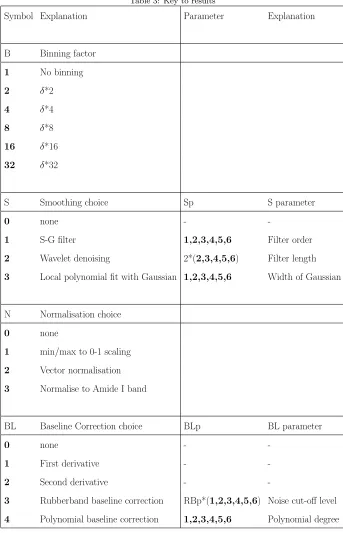
showing the available options and parameters in each category. See the online
Flowchart 1: PRFFECT workflow. One option is chosen from each main preprocessing block
(dark blue, light blue, red, green.) Auxiliary options for wavenumber range selection (yellow)
2.9.1. Example of operation
220
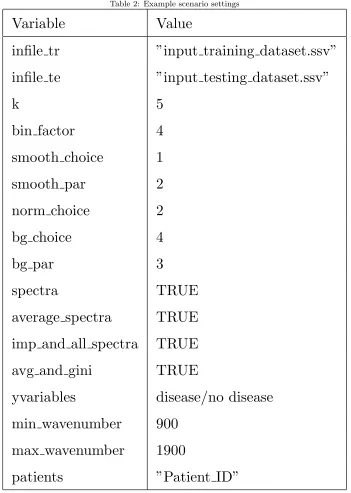
The following is an example of setting up and running the program in an R
environment. The user in this scenario wanted a binning of 4δ, S-G smoothing of order 2, vector normalisation and polynomial baseline correction of degree
3. They also wanted a wavenumber region of 900-1900 cm−1, and wished to
plot all available graphs. The descriptor being predicted was ”disease/no dis-225
ease”, which is a column with a 1 to denote a patient with the disease, and
2 for a patient without the disease. The desired split between training and
test sets was two thirds training - one third test. A script to do the splitting
is described in the Supporting Information. This script will by default split a
single CSV file into two files with training (input training dataset.ssv) and test-230
ing (input testing dataset.ssv) data respectively. The user intends to carry out
a 5-fold cross-validation of the training data. In this example scenario, there
are multiple spectra per patient, and the column denoting patient ID is called
”Patient ID”. The file user defined input.R would be set up according to Table
Table 2: Example scenario settings
Variable
Value
infile tr
”input training dataset.ssv”
infile te
”input testing dataset.ssv”
k
5
bin factor
4
smooth choice
1
smooth par
2
norm choice
2
bg choice
4
bg par
3
spectra
TRUE
average spectra
TRUE
imp and all spectra
TRUE
avg and gini
TRUE
yvariables
disease/no disease
min wavenumber
900
max wavenumber
1900
patients
”Patient ID”
and graphs would then be output as files into the current working directory. See
the flowchart for a list of the output files.
2.10. Example Data
240
As an example of the operation of the program, four datasets have been
analysed to find the best preprocessing parameters. These are all open-source
datasets available via the internet. The datasets were all FTIR spectra of food
items[34, 35, 36, 37]. The FTIR methods used included attenuated total
reflec-tion (ATR) and diffuse reflectance infrared Fourier transform (DRIFT). 245
2.10.1. Fruit Puree Example Dataset
The original fruit puree study[34] involved a PLS regression to predict
adul-teration of strawberry purees with various adulterants of other fruits or sugars.
The overall binary classes of the study were strawberry and non-strawberry,
with the adulterated samples being in the non-strawberry category. The study 250
used a training, tuning and test set for the regression. The classification was
then carried out by plotting the output of the PLS model, and cut-offs set by
95% confidence intervals. Using this methodology, overall results (mean of
sen-sitivity and specificity) were 96.5%, 93.5% and 94.3% for the training, tuning
and test sets respectively. There were 983 spectra in total, of which 351 were 255
pure strawberry.
2.10.2. Meats Example Dataset
The meat authenticity study[35] used ATR FTIR spectra of three different
types of meat. Chicken, pork and turkey samples were minced and the
spec-tra directly taken by placing the mince on an ATR crystal. There were two 260
spectra each of 20 samples, giving a total of 120 spectra. The classes were split
equally, giving 40 per meat type. The study used PLS regression to attempt to
detect varying levels of contamination of each meat into others. For example,
a regression was carried out to detect levels of turkey mixed with chicken. The
standard deviation of prediction errors (actual vs predicted composition) in that 265
2.10.3. Olive Oil Example Dataset
The olive oils study[36] combined multivariate analysis with ATR-FTIR, to
attempt to distinguish olive oils from different countries. The analysis methods
used were LDA based upon the scores from PLS, and a GA to determine variate 270
selection followed by LDA on the subset. The method of statistical analysis
and result collection was via a leave-one-out cross validation. The PLS-LDA
achieved a 96% success rate, and the GA-LDA achieved a 100% cross-validation
success rate.
The dataset itself consisted of 120 spectra, with 2 spectra per sample. Of 275
the samples, there were 10 from Greece, 17 from Italy, 8 from Portugal and 25
from Spain. The region of the IR spectrum used was 799-1897cm−1.
2.10.4. Coffee Example Dataset
The coffee study[37] focussed on the discrimination of two common types of
instant freeze-dried coffee,Arabica and Robusta. The original article explores 280
whether these types of coffee can be authenticated alone; and quantified in
mix-tures of the two. The spectra were collected via DRIFTS and ATR techniques.
LDA, PCA and regression were then employed as the data analysis methods.
LDA of the PCA scores yielded 100% accuracy of classification between the two
species. This classification was run with a roughly 4:1 training:test set split. 285
For the regression of differing proportions of each species, an R2 value of 0.99
and standard error of 1.2% were reported using internal cross-validation.
The available dataset (raw data) consisted of 56 samples (29 Arabica, 27
Robusta), collected in the 800-1900cm−1 region, using the DRIFTS technique.
The data had a nominal resolution of around 3.85cm−1. 290
3. Results and Discussion
Grid searches were carried out to find best combinations of preprocessing.
The fitness evaluation function was the prediction accuracy statistic for the
search, every permutation of methods/parameters was tested on 96 randomly 295
selected training and test set splits. This was done to ensure a fair and accurate
portrayal of the abilities of the program. Results are given for best combinations
of preprocessing found for the data described above. In each subsection, tables
of the top 12 combinations are shown. A key to the table headings is given
Table 3: Key to results
Symbol Explanation Parameter Explanation
B Binning factor
1 No binning
2 δ*2
4 δ*4
8 δ*8
16 δ*16
32 δ*32
S Smoothing choice Sp S parameter
0 none -
-1 S-G filter 1,2,3,4,5,6 Filter order
2 Wavelet denoising 2*(2,3,4,5,6) Filter length
3 Local polynomial fit with Gaussian 1,2,3,4,5,6 Width of Gaussian
N Normalisation choice
0 none
1 min/max to 0-1 scaling
2 Vector normalisation
3 Normalise to Amide I band
BL Baseline Correction choice BLp BL parameter
0 none -
-1 First derivative -
-2 Second derivative -
-3 Rubberband baseline correction RBp*(1,2,3,4,5,6) Noise cut-off level
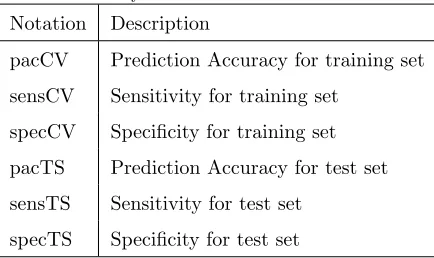
Table 4: Key to notation for statistical metrics
Notation Description
pacCV Prediction Accuracy for training set
sensCV Sensitivity for training set
specCV Specificity for training set
pacTS Prediction Accuracy for test set
sensTS Sensitivity for test set
specTS Specificity for test set
The statistical metrics used were sensitivity (true positive rate), specificity
(true negative rate) and prediction accuracy. The first two of these metrics are
widely used and have been defined elsewhere.[7]. Prediction accuracy, which is
defined in Equation 15, was used as the fitness function to identify the optimal
combinations of preprocessing routines. 305
3.1. Fruit Example Dataset
Table 5 shows the results for the binary classification of strawberry vs
non-strawberry purees. The results are on a par with the original study[34]. The
procedure in the original article is quite different from the procedure used to
generate our results. In this work, we used a direct classification with output 310
of important features. The original methodology was to use a PLS regression
both to find optimum number of PLS scores and to do a classification. Since
PRFFECT can directly produce a classification and report the best features, a
standard classification methodology was used by us. The original study used
three data partitions: training, tuning and test sets. As these were a third of 315
the data each, and RF training parameters are set to default values, we used two
thirds as a training set, and one third as a test set. A tuning set was not required
because RF is insensitive to small changes in its adjustable parameters and is
not prone to over-fitting.[7, 10, 38, 29] Default RF parameters were used for all
classifications reported in this article (500 trees per Random Forest, √ndesc.
320
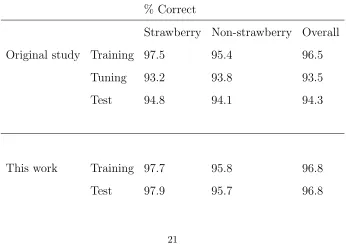
more than 5 samples). Presented in Table 6 below is a direct comparison of our
best results from the top row of Table 5, and those of the original study.
The best combinations of preprocessing for this dataset always included a
binning factor of 4 or 8. When a factor of 8 was found to be preferable, it was 325
always followed with smoothing type 1 (S-G filter) with a smoothing parameter
of 5 (filter order). Smoothing types 1 and 3, S-G filter and local polynomial
Gaussian fit respectively, were the only two types to appear in the top dozen
results. The dataset shows an insensitivity to normalisation type, with all four
options appearing among the best classifiers. When it came to baseline correc-330
tion, every time the best choice was first derivative.
Overall, the results are very consistent across the measured metrics and CV
and test sets. The lowest statistic for both sets was specificity (equivalent to
”Non-strawberry” column in Table 6 below). However, our results were still
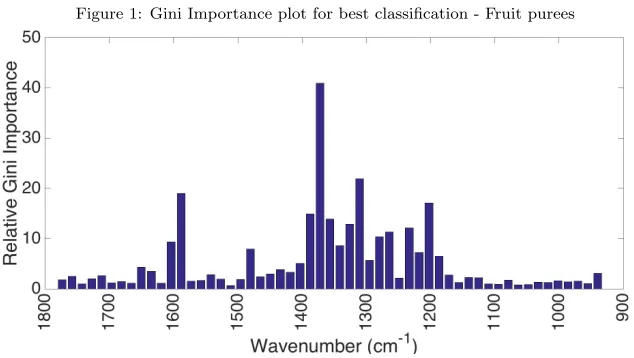
slightly in excess of the original study. Figure 1 shows the most important 335
Table 5: Results for fruit dataset
B S Sp N BL BLp pacCV sensCV specCV pacTS sensTS specTS
4
1 2
2
1
-
0.970
0.977
0.958
0.971
0.979
0.957
4
3 5
3
1
-
0.970
0.974
0.962
0.970
0.974
0.964
4
1 3
3
1
-
0.970
0.972
0.964
0.970
0.975
0.962
4
1 1
3
1
-
0.969
0.973
0.963
0.971
0.976
0.964
4
1 4
2
1
-
0.969
0.978
0.954
0.971
0.981
0.955
8
1 5
2
1
-
0.969
0.975
0.959
0.973
0.980
0.961
4
3 6
3
1
-
0.969
0.973
0.962
0.972
0.976
0.964
4
3 4
3
1
-
0.969
0.973
0.962
0.971
0.976
0.963
8
1 5
1
1
-
0.969
0.976
0.958
0.971
0.979
0.959
4
1 2
0
1
-
0.969
0.975
0.959
0.970
0.978
0.955
4
3 6
0
1
-
0.969
0.976
0.957
0.970
0.978
0.957
4
3 5
0
1
-
0.969
0.975
0.957
0.971
0.979
0.956
Table 6: Comparison of original results to this work, % correct classifications
% Correct
Strawberry Non-strawberry Overall
Original study Training 97.5
95.4
96.5
Tuning
93.2
93.8
93.5
Test
94.8
94.1
94.3
This work
Training 97.7
95.8
96.8
[image:21.612.133.479.460.711.2]Figure 1: Gini Importance plot for best classification - Fruit purees
3.2. Meats Example Dataset
Since this dataset included 3 classes, metering the best possible preprocessing
was more cumbersome than with a binary classification. This is because there
are three separate sets of statistics which make up one result. Here, we have 340
simply averaged the results across all 3 meat types to find the best combinations.
A full database of all results obtained in this work can be found in the supporting
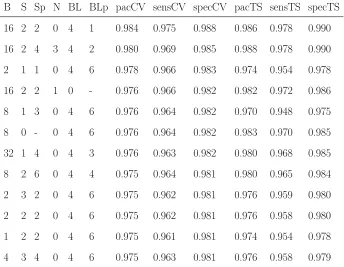
information. All found best combinations shown in Table 7 gave very strong
classification results. These are of course average results across pork, turkey
and chicken meats. As might be expected, pork was the easier meat to identify, 345
with many perfect results. The two bird meats were more difficult to separate
from one another, but overall the classifications performed very well.
The best combinations for this particular 3-way classification are very
in-teresting, especially the insensitivity to binning factor. All explored binning
factors are present in the top 12 results. The best combinations also appear 350
to be insensitive to smoothing choice and smoothing parameters. Again, all
possible smoothing types are present in the top 12. As for normalisations, 0
(no normalisation) was the preferred option. For baseline correction, option 4
(polynomial baseline correction) was seen in all but one of the top dozen. The
parameter space, with 6 appearing the most often.
Of all the results displayed in Table 7, specificity is the highest overall. This
could be due to the ease of which pork is separated from the two bird meats.
The slightly lower sensitivity values (although still very high) are probably due
to the difficulty of separating the turkey from the chicken meat. This gave a 360
very good test for the robustness of the random forest algorithm as a whole, in
that one class stood very far out from the others.
The main focus of the original paper[35] was to perform a regression of
varying compositions of meat mixtures. The spectra of the mixtures were not 365
available at the time of writing. Therefore, we have focussed on the classification
of different meats from the dataset. It is shown in the original article that PCA
was carried out on the whole meat data, and the loadings examined. The
loadings described show the strongest features in the 1550-1650 cm−1 protein
region. There was also a smaller feature at 1740 cm−1 (lipid region). Figure 370
2 shows that this assessment fits well with what was found in this study. Of
course, it ought to be borne in mind that our best preprocessing combination
had a heavy binning factor of 16. Therefore, exact matches to wavenumber
Table 7: Results for meat dataset - average across 3 meat types
B
S Sp N BL BLp pacCV sensCV specCV pacTS sensTS specTS
16 2 2
0
4
1
0.984
0.975
0.988
0.986
0.978
0.990
16 2 4
3
4
2
0.980
0.969
0.985
0.988
0.978
0.990
2
1 1
0
4
6
0.978
0.966
0.983
0.974
0.954
0.978
16 2 2
1
0
-
0.976
0.966
0.982
0.982
0.972
0.986
8
1 3
0
4
6
0.976
0.964
0.982
0.970
0.948
0.975
8
0 -
0
4
6
0.976
0.964
0.982
0.983
0.970
0.985
32 1 4
0
4
3
0.976
0.963
0.982
0.980
0.968
0.985
8
2 6
0
4
4
0.975
0.964
0.981
0.980
0.965
0.984
2
3 2
0
4
6
0.975
0.962
0.981
0.976
0.959
0.980
2
2 2
0
4
6
0.975
0.962
0.981
0.976
0.958
0.980
1
2 2
0
4
6
0.975
0.961
0.981
0.974
0.954
0.978
[image:24.612.137.465.449.629.2]4
3 4
0
4
6
0.975
0.963
0.981
0.976
0.958
0.979
Figure 2: Gini Importance plot for best classification - Meats
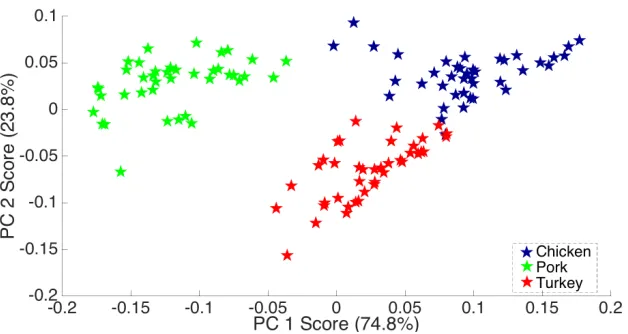
Figure 3 shows a PCA plot of the meat dataset, after being pre-processed 375
Figure 3: PCA plot for best preprocessing - Meats
plot present in the original study. Since the separation is better, it can be
concluded that the pre-processed data offers an improved classification.
3.3. Olive Oil Example Dataset
Similar to the meat example dataset, the olive oils dataset was a multi-380
class classification. In total there were four classes which represented country of
origin. Therefore Table 8 represents results averaged across these four classes.
A full database of results can again be found in the supporting information.
The results shown are for a 66:33 training:test split, as it is common to all
example datasets studied. The results were good overall, with specificity being 385
the strongest statistic. This may be expected since there were four classes
involved in the classification. Again, CV and TS results were very close.
Binning factors of 4 and 8 were preferred. The dataset appeared to be
rela-tively insensitive to smoothing choice and smoothing parameters. Normalisation
choice was similar, with normalisation to Amide I (option 3) being the only one 390
not appearing. It was clear however that baseline choice 1 (first derivative) was
strongly preferred.
Since the original study[36] employed a Leave-Two-Out Cross Validation
(LTOCV), we have repeated the classification with that methodology, using
A LTOCV was employed because there were two spectra per sample. While the
original study reported 100% correct classifications, our method misclassified
a total of 7 spectra from the 120 in the dataset. Three Spanish samples were
misclassified as Italian, two Spanish samples were misclassified as Portuguese
and two Portuguese samples misclassified as Italian. This meant a 94.2% correct 400
classification rate for our methodology. Although this is lower than the original
study, it is on a par with the overall results shown in Table 8.
Figure 4 shows the most important wavenumber descriptors for the four-way
classification. Some similarities can be seen between the histogram of the genetic
algorithm in the original paper (Figure 5a) and the Gini plot in our Figure 4. 405
It may be expected that these plots would show similar features, although they
[image:26.612.134.475.367.650.2]were arrived at in very different ways.
Table 8: Results for olive oil dataset - average across 4 oil origins
B S Sp N BL BLp pacCV sensCV specCV pacTS sensTS specTS
8
0 -
1
1
-
0.964
0.928
0.975
0.965
0.927
0.975
4
3 6
2
1
-
0.963
0.929
0.974
0.963
0.927
0.973
4
3 6
1
1
-
0.963
0.929
0.974
0.958
0.923
0.970
4
1 2
2
1
-
0.962
0.927
0.974
0.963
0.934
0.973
4
3 5
2
1
-
0.962
0.924
0.973
0.963
0.931
0.974
4
3 4
2
1
-
0.961
0.923
0.972
0.965
0.937
0.975
8
0 -
2
1
-
0.961
0.916
0.973
0.969
0.940
0.978
4
1 6
0
1
-
0.960
0.924
0.972
0.966
0.939
0.976
4
1 3
0
2
-
0.960
0.927
0.972
0.964
0.930
0.974
4
3 4
1
1
-
0.960
0.922
0.972
0.961
0.927
0.972
4
1 4
1
1
-
0.960
0.921
0.972
0.971
0.947
0.979
Figure 4: Gini Importance plot for best classification - Olive Oils
3.4. Coffee Example Dataset
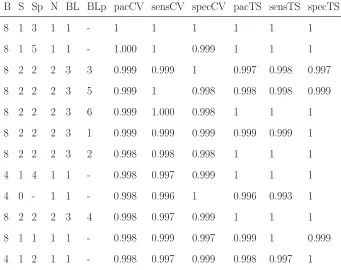
Table 9 shows the classification results for the coffee dataset. This shows
clearly that the program performs just as well as the original study, even with 410
(effectively) a much smaller training set. Another interesting comparison to
make would be the areas of spectral distinction between the two species, as
identified in this work, and that of the original authors. This was originally
identified by examining PCA loadings. The Gini importance metric built into
our program should also show similar regions. The original study[37] found 415
areas of interest in the following regions: A large peak at around 1760 cm−1,
several loadings in the 1550-1750 cm−1 region, and several smaller features in
the 1150-1300 cm−1region. Figure 5 shows the Gini plot for the best
combina-tion of preprocessing parameters. As can be seen, the largest peak in the Gini
is in the same area as the original study’s PCA loadings. The other features 420
described by Briandet et. al. also match up rather well. Our best classification
happened to have a binning factor of 8 applied to the spectra. Therefore it
should be borne in mind that such heavily binned spectra by definition have
fewer datapoints overall.
It can be seen from Table 9 that the classification ofArabica vs Robusta was 425
near-perfect classifications. The reason there are small decreases in some statistics is
because these results were generated from averages of 96 separate training/test
set selections to ensure an un-biased test of the program. Binning factors of 8
and 4 were favourable. This translates to roughly a 30.8 cm−1and 15.4 cm−1
ef-430
fective resolution respectively. The most favourable smoothing type was wavelet,
with a filter length of 4 (actual filter length is found by 2*Sp, as shown in
Ta-ble 3.) The best normalisation procedures were found to be min/max scaling
and vector normalisation. Interestingly, whenever min/max scaling was used,
the best baseline correction was always first derivative. Conversely, whenever 435
vector normalisation was used, the best baseline correction was the rubberband
technique. The rubberband technique appeared to be insensitive to the baseline
parameter, BLp (noise cut off level) for this dataset.
Overall, the program performed as well as the original study and showed 440
Table 9: Classification Results forArabica vsRobusta
B S Sp N BL BLp pacCV sensCV specCV pacTS sensTS specTS
8
1 3
1
1
-
1
1
1
1
1
1
8
1 5
1
1
-
1.000
1
0.999
1
1
1
8
2 2
2
3
3
0.999
0.999
1
0.997
0.998
0.997
8
2 2
2
3
5
0.999
1
0.998
0.998
0.998
0.999
8
2 2
2
3
6
0.999
1.000
0.998
1
1
1
8
2 2
2
3
1
0.999
0.999
0.999
0.999
0.999
1
8
2 2
2
3
2
0.998
0.998
0.998
1
1
1
4
1 4
1
1
-
0.998
0.997
0.999
1
1
1
4
0 -
1
1
-
0.998
0.996
1
0.996
0.993
1
8
2 2
2
3
4
0.998
0.997
0.999
1
1
1
8
1 1
1
1
-
0.998
0.999
0.997
0.999
1
0.999
4
1 2
1
1
-
0.998
0.997
0.999
0.998
0.997
1
Table 10: Results for coffee dataset - Comparison of methodologies
Source Correct Classifications
Original LDA classifier 100%
Figure 5: Gini Importance plot for best classification
4. Conclusions
Using PRFFECT, we were generally able to match or exceed the results
from the example studies. It was also a more streamlined process, and
pro-vided more information in some cases via the Gini Importance metric. It was 445
also possible to generate classification statistics automatically via the
built-in algorithms. PRFFECT shows great potential as a tool for spectroscopists
who wish to carry out classifications and explore various types of
preprocess-ing. Our group has already used it with success for diagnosing brain cancer
from serum FTIR samples.[7] It is particularly attractive since it is an all-in-one 450
package, no external preprocessing or statistical analysis of results is required.
Although PRFFECT dramatically simplifies the development of spectral
clas-sification models, it is not intended to be operated completely blindly. The
user must still make their own decisions about the reliability of the input data,
including whether the classes assigned to each sample are sufficiently well de-455
fined. Using the process-only version, it is possible to produce a dataset which
has been subject to several complex preprocessing procedures in one step. We
envision PRFFECT as being a popular and useful tool for spectroscopists of all
5. Independent testing
460
The software was independently tested by Dr John Mitchell of the
Depart-ment of Chemistry at the University of St. Andrews in the UK. At the time of
testing, the list of software dependencies in the manual was incomplete, but this
problem has now been fixed, as noted below. His comments in full:
“Thank you for giving me the opportunity to use your PRFFECT code. 465
I think it’s going to be a very useful resource for researchers looking to get
extra value from spectroscopic data at the interface between spectroscopy and
machine learning. I was aware of it from a poster at the ScotChem meeting in
Glasgow.
Having looked at the code, the manual is extensive and very helpful. I was 470
able to run the example datasets provided and they worked as expected. We
initially encountered some issues identifying which packages were to be
pre-installed. Thanks to your group for providing a definitive list of the R packages
required. I’m glad to see that the manual has been updated accordingly. I think
the current version of the manual is excellent and provides a clear and thorough 475
guide to the usage and capabilities of your excellent software.
I can confirm that the software runs as expected and that I expect it to
prove a valuable resource for the scientific research community.”
Acknowledgements
We thank Holly Butler and Robby Fritzsch for useful discussions. DSP and 480
BRS are grateful for use of the EPSRC funded ARCHIE- WeSt High
Perfor-mance Computer (http://www.archie-west.ac.uk, EPSRC Grant No. EP/K000586/1).
MJB and DSP would like to thank Scottish Enterprise for funding. MJB is
grateful for funding from EPSRC, Dstl, Rosemere Cancer Foundation, Brain
References
[1] D. I. Ellis, D. Broadhurst, D. B. Kell, J. J. Rowland, R. Goodacre, Rapid
and quantitative detection of the microbial spoilage of meat by fourier
transform infrared spectroscopy and machine learning, Appl. Environ.
Mi-crobiol. 68 (6) (2002) 2822–2828. 490
[2] M. G. Madden, A. G. Ryder, Machine learning methods for quantitative
analysis of raman spectroscopy data, in: OPTO Ireland, International
So-ciety for Optics and Photonics, 2003, pp. 1130–1139.
[3] F. Chauchard, R. Cogdill, S. Roussel, J. Roger, V. Bellon-Maurel,
Applica-tion of ls-svm to non-linear phenomena in nir spectroscopy: development of 495
a robust and portable sensor for acidity prediction in grapes, Chemometr.
Intell. Lab 71 (2) (2004) 141–150.
[4] J. R. Hands, G. Clemens, R. Stables, K. Ashton, A. Brodbelt, C. Davis,
T. P. Dawson, M. D. Jenkinson, R. W. Lea, C. Walker, et al., Brain
tu-mour differentiation: rapid stratified serum diagnostics via attenuated to-500
tal reflection fourier-transform infrared spectroscopy, J. Neurooncol 127 (3)
(2016) 463–472.
[5] C. L. Pickering, J. R. Hands, L. M. Fullwood, J. A. Smith, M. J. Baker,
Rapid discrimination of maggots utilising atr-ftir spectroscopy, Forensic
Sci. Int. 249 (2015) 189–196. 505
[6] T. Mudariki, R. Lea, G. Clemens, M. Baker, P59diagnostic application
of vibrational spectroscopy for the segregation of brain tumour cell lines
coupled with multivariate statistics, Neuro-oncology 16 (suppl 6) (2014)
vi10.
[7] B. R. Smith, K. M. Ashton, A. Brodbelt, T. Dawson, M. D. Jenkinson, 510
N. T. Hunt, D. S. Palmer, M. J. Baker, Combining random forest and
2d correlation analysis to identify serum spectral signatures for
[8] J. R. Hands, K. M. Dorling, P. Abel, K. M. Ashton, A. Brodbelt, C. Davis,
T. Dawson, M. D. Jenkinson, R. W. Lea, C. Walker, et al., Attenuated 515
total reflection fourier transform infrared (atr-ftir) spectral discrimination
of brain tumour severity from serum samples, J. Biophotonics 7 (3-4) (2014)
189–199.
[9] S. J. Barrington, H. Bird, D. Hurst, A. J. McIntosh, P. Spencer, S. H.
Pelfrey, M. J. Baker, Spectroscopic investigations of surface deposited bi-520
ological warfare simulants, in: SPIE Defense, Security, and Sensing,
Inter-national Society for Optics and Photonics, 2012, pp. 83580E–83580E.
[10] D. S. Palmer, N. M. O’Boyle, R. C. Glen, J. B. Mitchell, Random forest
models to predict aqueous solubility, J. Chem. Inf. Model 47 (1) (2007)
150–158. 525
[11] J. L. McDonagh, D. S. Palmer, T. v. Mourik, J. B. Mitchell, Are the
sublimation thermodynamics of organic molecules predictable?, J. Chem.
Inf. Model. 56 (11) (2016) 2162–2179.
[12] R. Diaz-Uriarte, S. de Andres, Gene selection and classification of
microar-ray data using random forest, BMC Bioinformatics 7. doi:{10.1186/
530
1471-2105-7-3}.
[13] D. R. Cutler, T. C. Edwards, Jr., K. H. Beard, A. Cutler, K. T. Hess,
Random forests for classification in ecology, Ecology 88 (2007) 2783–2792.
doi:{10.1890/07-0539.1}.
[14] F. Grosserueschkamp, A. Kallenbach-Thieltges, T. Behrens, T. Bruening, 535
M. Altmayer, G. Stamatis, D. Theegarten, K. Gerwert, Marker-free
au-tomated histopathological annotation of lung tumour subtypes by FTIR
imaging, Analyst 140 (7) (2015) 2114–2120. doi:10.1039/c4an01978d.
[15] J. Ollesch, D. Theegarten, M. Altmayer, K. Darwiche, T. Hager, G.
Stama-tis, K. Gerwert, An infrared spectroscopic blood test for non-small cell 540
adenocarcinoma, Biomedical Spectroscopy and Imaging 5 (2016) 129–144.
doi:10.3233/BSI-160144.
[16] J. Ollesch, M. Heinze, H. M. Heise, T. Behrens, T. Br¨uning, K. Gerwert,
It’s in your blood: spectral biomarker candidates for urinary bladder cancer 545
from automated FTIR spectroscopy, Journal of Biophotonics 7 (2014) 210–
221.
[17] H.-Z. Chen, G.-Q. Tang, W. Ai, L.-L. Xu, K. Cai, Use of Random Forest in
FTIR Analysis of LDL Cholesterol and Tri-Glycerides for Hyperlipidemia,
Biotechnology Progress 31 (6) (2015) 1693–1702. 550
[18] R Development Core Team, R: A Language and Environment for
Statisti-cal Computing, R Foundation for StatistiStatisti-cal Computing, Vienna, Austria,
ISBN 3-900051-07-0 (2008).
URLhttp://www.R-project.org
[19] A. Kohler, J. Sul´e-Suso, G. D. Sockalingum, M. Tobin, F. Bahrami, 555
Y. Yang, J. Pijanka, P. Dumas, M. Cotte, D. G. van Pittius, G. Parkes,
H. Martens, Estimating and Correcting Mie Scattering in
Synchrotron-Based Microscopic Fourier Transform Infrared Spectra by Extended
Mul-tiplicative Signal Correction, Appl. Spectrosc. 62 (3) (2008) 259–266.
[20] L. Kerr, B. Hennelly, A multivariate statistical investigation of background 560
subtraction algorithms for raman spectra of cytology samples recorded on
glass slides, Chemometr. Intell. Lab. Syst. 158 (Supplement C) (2016) 61
– 68.
[21] C. Beleites, V. Sergo, hyperspec: a package to handle hyperspectral data
sets in r, R package v. 0.98-20120725. 565
[22] B. K. Alsberg, A. M. Woodward, M. K. Winson, J. Rowland, D. B. Kell,
[23] D. Zhan, S. Sun, Q. Zhou, Z. Qin, Wavelet denoising and optimization of
two-dimensional correlation ir spectroscopy, Spectrosc. Spect. Anal. 24 (12)
(2004) 1549–1552. 570
[24] I. Daubechies, Orthonormal bases of compactly supported wavelets, Comm.
Pure Appl. Math 41 (7) (1988) 909–996.
[25] A. Savitzky, M. J. Golay, Smoothing and differentiation of data by
simpli-fied least squares procedures., Anal. Chem. 36 (8) (1964) 1627–1639.
[26] M. J. Baker, J. Trevisan, P. Bassan, R. Bhargava, H. J. Butler, K. M. 575
Dorling, P. R. Fielden, S. W. Fogarty, N. J. Fullwood, K. A. Heys, et al.,
Using fourier transform ir spectroscopy to analyze biological materials, Nat.
Protoc. 9 (8) (2014) 1771–1791.
[27] C. A. Lieber, A. Mahadevan-Jansen, Automated method for subtraction of
fluorescence from biological raman spectra, Appl. Spectrosc. 57 (11) (2003) 580
1363–1367.
[28] L. Breiman, Random forests, Mach. Learn. 45 (1) (2001) 5–32.
[29] L. D. Hughes, D. S. Palmer, F. Nigsch, J. B. O. Mitchell, Why are some
properties more difficult to predict than others? A study of QSPR models
of solubility, melting point, and log P, J. Chem. Inf. Model. 48 (2008) 585
220–232.
[30] D. S. Palmer, M. Miˇsin, M. V. Fedorov, A. Llinas, Fast and general method
to predict the physicochemical properties of druglike molecules using the
integral equation theory of molecular liquids, Mol. Pharm. 12 (9) (2015)
3420–3432. 590
[31] E. O. Cannon, A. Bender, D. S. Palmer, J. B. O. Mitchell,
Chemoinformatics-based classification of prohibited substances employed
[32] A. Liaw, M. Wiener, Classification and regression by randomforest, R news
2 (3) (2002) 18–22. 595
[33] B. R. Smith, M. J. Baker, D. S. Palmer, PRFFECT User Manual,
Univer-sity of Strathclyde, Glasgow, UK (2017).
URLhttps://github.com/Palmer-Lab/PRFFECT
[34] J. Holland, E. Kemsley, R. Wilson, Use of fourier transform infrared
spec-troscopy and partial least squares regression for the detection of adulter-600
ation of strawberry purees, J. Sci. Food Agr. 76 (2) (1998) 263–269.
[35] O. Al-Jowder, E. Kemsley, R. Wilson, Mid-infrared spectroscopy and
au-thenticity problems in selected meats: a feasibility study, Food Chem.
59 (2) (1997) 195–201.
[36] H. S. Tapp, M. Defernez, E. K. Kemsley, Ftir spectroscopy and multivariate 605
analysis can distinguish the geographic origin of extra virgin olive oils, J.
Agr. Food Chem. 51 (21) (2003) 6110–6115.
[37] R. Briandet, E. K. Kemsley, R. H. Wilson, Discrimination of arabica and
robusta in instant coffee by fourier transform infrared spectroscopy and
chemometrics, J. Agr. Food Chem. 44 (1) (1996) 170–174. 610
[38] D. S. Palmer, J. B. O. Mitchell, Is experimental data quality the
limit-ing factor in predictlimit-ing the aqueous solubility of druglike molecules?, Mol.