0022-538X/93/010390-08$02.00/0
Copyright X)1993, American Society for Microbiology
Formation of
Rhinovirus-Soluble ICAM-1
Complexes and
Conformational
Changes in the Virion
HELANAHOOVER-LITTYANDJEFFREY M. GREVE*
Institute for Molecular Biologicals, Miles Research Center, 400 Morgan Lane, West
Haven,
Connecticut 06516-4175Received 23July 1992/Accepted22September 1992
Viralreceptors servebothto targetvirusestospecificcelltypesandtoactivelypromotethe entry of bound virus intocells.Humanrhinoviruses(HRVs)canform complexesinvitro withatruncated soluble form of the
HRV cell surface receptor, ICAM-1. These complexes appear tobe stoichiometric, with approximately 60 ICAMmolecules boundpervirionor1ICAM-1moleculepericosahedral face of thecapsid.Thecomplexcan
havetwofates, either dissociatingtoyieldfree virus and free ICAM-1 oruncoatingtobreak downtoan 80S
emptycapsidwhich has releasedVP4,viralRNA,and ICAM-1. Thisuncoatingin vitro mimics theuncoating of virusduringinfection of cells.Thestabilityof thevirus-receptor complexisdependentontemperature and therhinovirusserotype.HRV serotype 14(HRV14)-ICAM-1 complexes rapidlyuncoat,HRV16 formsastable
virus-ICAM complexwhich doesnot uncoatdetectablyat34°C,and HRV3 hasan intermediate phenotype.
Rhinovirus can also uncoat after exposure to mildly acidic pH. The sensitivities of individual rhinovirus serotypestoICAM-1-mediated virusuncoatingdonotcorrelate withuncoatingpromoted byincubationatlow pH, suggestingthat thesetwomeansofvirus destabilization occurbydifferent mechanisms. Soluble ICAM-1
and lowpHdonot actsynergisticallytopromoteuncoating.Therateofuncoatingdoesappeartobeinversely relatedtovirusaffinityfor itsreceptor.
Cell surface receptors for viruses serve multiple roles in theprocessof viral infection. First,receptorsservetotarget avirustocertain classes of cellsexpressingaparticularviral receptorand thuspartlydetermine the tissuetropismof the virus. Second, receptors may play a role inpromoting the entry of the viral genome into the cell. The viral receptor may,byvirtue of its normal intracellulartrafficking, deliver
the virus into the appropriate intracellular compartment. Examplesof this include thedeliveryofinfluenza virus and Semliki Forest virus into the endosomal compartment by receptor-mediated endocytosis, where the acidic pH pro-motes fusion of the viral envelope with the endosomal membrane and release of the viral genome into the cyto-plasm (20). Alternatively, the receptor may play an active
role inentryby directly causingstructuralrearrangementsof the virion which promote virusentryintothe cellorphysical
uncoating of the viral genome. Evidence for such a direct effect of receptor onvirus structurehasbeen described for poliovirus (2, 10, 12), rhinovirus (9), and human immuno-deficiency virus (11, 23). However, the physiological
rele-vance of these phenomena to virus entry during infection
havenotbeenunambiguously demonstrated, due in part to the high particle-to-infectious unit ratio exhibited by these viruses.
We have been investigating how the major group of
rhinoviruses utilizes itsreceptor, ICAM-1, to enterthe cell (8). Humanrhinovirus(HRV),amemberofthe picornavirus
family,iscomposedof fourcapsid proteins, VP1, VP2,VP3, andVP4, 60 copies of whicharearranged inanicosahedral
capsid around a single-stranded RNA genome. The
three-dimensional structuresofseveralrhinovirusserotypes have been determined (13, 29). ICAM-1 is composed of five immunoglobulin-like extracellular domains, a
membrane-anchoring region, and a short C-terminal cytoplasmic
do-*Correspondingauthor.
main(31, 33). TheN-terminal immunoglobulin-like domain contains the virus-binding site (21, 32). ICAM-1 can be
produced in several truncated soluble forms which are
capable ofbindingto andinhibitingthe infectivityof rhino-virus: these includeasoluble formconsistingof domains 1to 5 (9, 19)andasolubleformconsistingof domains 1 and 2(9). In this report, we describe the production of saturated
virus-receptor complexes with soluble truncated ICAM-1. We demonstrate that these complexes can spontaneously uncoat, releasing the viral subunit VP4, viral RNA, and boundICAM-1, andweexamine theparameterscontrolling therateofuncoating. We discuss the relevance of these in vitro conformational changesin the viriontovirusentryin
vivo.
MATERUILS AND METHODS
Virus stocks. HRVserotype3 (HRV3)wasobtained from
the AmericanTypeCultureCollection,HRV14wasobtained
from M. Rossmann (Purdue University), and HRV16 was
obtained from R.Rueckert (UniversityofWisconsin).Virus
was grown in HeLa S3 cells, metabolically labeled with
[35S]methionine, and purified as previously described (8).
Virus concentration was determined by visual quantitation
of capsid proteins relative to standard proteins on
silver-stained sodium dodecylsulfate(SDS) gels.
Soluble ICAM-1 and low-pH treatment of virus. Soluble ICAM-1 was added to
[35S]methionine-labeled
virus (ap-proximately 20,000 cpm)in N buffer(10 mM HEPES [N-2-hydroxyethylpiperazine-N'-2-ethanesulfonic acid], 200 mM NaCl,1 mMCaCl2,1 mMMgCl2 [pH 7.5])-0.1mgof bovineserumalbumin(BSA)permltoatotal volumeof100,ul.For
low-pH treatment, 10 ,ul of [35S]methionine-labeled virus
was added to 90 pl of N buffer-0.1 mg of BSA per ml adjusted to pH 5.0 and incubated at 34°C for 1 h. The sampleswerechilledonice, neutralized with10 pulof0.1M Tris (pH 7.5), andseparatedon sucrosegradients.
390
on November 9, 2019 by guest
http://jvi.asm.org/
Sucrose gradient sedimentation. Rhinovirus incubatedwith solubleICAM-1or atlowpHwassedimented through 5.0-ml 5 to 25% sucrose gradients as previously described (9). Except where indicated, BSA at 0.1mg/mlwas included in the sucrose gradient buffers to prevent loss of viral protein. Recovery of virus radioactivity from gradients ranged from 90 to 100%.
Virus binding to cells. HeLa cells were detached from monolayers with 0.03% EDTA, pelleted by centrifugation, andresuspendedin Nbufferwith2%fetal calf serum.Atotal of 2 x 10⁴ cpm of [35S]methionine-labeled rhinovirus of knownspecific activity was added to a final volume of 100
PI
and afinal cell concentration of 107 cells per ml. The mixture wasincubated at34°C for the indicated times with agitation every 1.5 min. The samples were then chilled on ice and immediately layered over 1 ml of5% Ficoll-N buffer in a microcentrifuge tubeand spun at 12,000 x g for 30 s. The supematant wasremoved, and the pellet was solubilized in 100 ,ul of 0.5% Triton X-100-N buffer before scintillation counting.
Stoichiometry of virus-receptor complex. Virus-receptor complexes between ICAM-1 and HRV14 or HRV16 were formedby incubation of 45 ,ug of virus with a 480-fold molar excess of ICAM-1 over virus (8-fold molar excess over potential receptor-binding sites) inatotal volume of150
PI
for 1 h34°C. The mixturewas sedimented through sucrose gradients in the absence of BSA, and gradient fractions containingvirus-receptor complexes were identified by SDS-polyacrylamide gel electrophoresis (PAGE). The pooled virus-receptor complex peaks were dialyzed against 0.1% SDS-water, lyophilized, and resuspended in gel loading buffer, and approximately 5 to 10 P,g of complex was
separated by SDS-PAGE. Thegel was then electroblotted onto polyvinylidene difluoride membranes (Applied Biosys-tems),andbandscorrespondingtoICAM-1 and viral capsid proteinswereexcised and subjectedtoamino acidanalysis forquantitation (3). VP1was notquantitatively transferred outof thegel under these conditions and therefore wasnot
included inthe analysis. Since the amino acid sequence of HRV16 isnotknown, the normalization for HRV16 samples is based on assumed total molecular weights of the
corre-spondingcapsidproteins fromHRV14. RESULTS
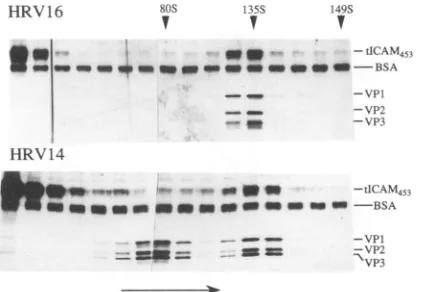
Products ofvirus-soluble receptor interaction. Incubation oftworhinoviruses, HRV16andHRV14, withanexcessof asoluble form of theentire extracellular domain ofICAM-1, tICAM453, resulted in the formation of a virus-receptor complex sedimenting at 135S (Fig. 1). A smaller protein comprising the two N-terminal domains of ICAM-1,
tICAM185,
also formed a virus-receptor complex with HRV16sedimentingat140S (datanotshown). Quantitation of themolar ratio of ICAM-1toviralcapsidsubunits in both the HRV14 and HRV16 complexes byamino acid analysis indicated a ratio approaching unity (Fig. 2). It has been predicted thatacanyon in eachprotomericfaceof rhinovirus should becapableofbindingreceptor(28,29).Theseresults indicate that the complexes are stoichiometric complexes composed of approximately 60 ICAM-1 molecules, with 1 molecule associated with each of the 60protomericfaces of the virion.WithHRV14,an80Speakwasalsoobtained(Fig. 1).The 80Speakhas beenpreviously identifiedas anemptycapsid, lackingboth VP4 and viral RNA(9).The lackof association oftICAM453with the80S species indicates that duringthe
HRV16 xS IvS 149S
v V
a we -tlCAM4s.
I am we W " I M - BSA
_ -VPI
.- m -VP3
HRV14
._0_ !-. .. Nw OR -tICAM4s,
" M _M _ _ __ -BSA
- = =
-=M=_
_s -VPI -VPl VP3FIG. 1. Compositionofproductsofrhinovirus-soluble receptor interaction. Samples (10 pA) from sucrosegradient fractionswere analyzedbySDS-PAGE andsilver stained. HRV16 or HRV14(50
~Lg)
wasincubatedwith a480-fold molarexcessof tICAM453 over virions for2 hat34WC before centrifugation.Positions of 80S empty capsids,the 135S virus-receptorcomplex,and the149Snative virus areindicated, and thehorizontal arrowonthe bottom indicates the direction ofsedimentation. Control samples ofHRV16and HRV14 incubated in the absence of tICAM453 sedimented at 149S, and tICAM453sedimented atthetopof thegradient (datanotshown).uncoating reaction, ICAM-1 as well as RNA and VP4 has been released from thecapsid.
Factors which determine virus-receptor complex stability. The rateof uncoatingwasfoundtobedependent on several factors,oneof which is the rhinovirus serotype. The sensi-tivityof three rhinovirus serotypes to uncoatingby soluble
Mr (K)
200-97
-68-
-45
-
26-18
-_
a
4-a
a
-0CAM451
-tICAM,5
3-VPI
- VP2
=-VP3
-VP4
4.87# 4.7 ICAMI-I(Piiiol)
7.K
7.95.I
VP2
+VP3(pnol) 0.67 0.94 0.94 Ratio ICAM-1/VP2 [image:2.612.342.553.76.222.2]+VP3
FIG. 2. Stoichiometry of isolated rhinovirus-receptor
com-plexes. tICAM453ortICAM185 (0.5
pLg)
andapproximately1to2pLg
ofisolated 135Sor140Svirus-receptorcomplexeswithtICAM453or
tICAM185,respectively,wereisolated andanalyzed bySDS-PAGE andsilverstaining;notethattICAM185stainspoorly bythis method. Aparallel gel loaded with approximately 5 to 10
p.g
of the samesampleswassubjectedtoamino acidanalysisof individual bandsas described in Materials and Methods. Quantitation of ICAM-1 and viral capsid proteins VP2 and VP3 and their molar ratios in the complexesaretabulatedbelow therespectivelanes.
1
I
S.,
on November 9, 2019 by guest
http://jvi.asm.org/
[image:2.612.342.548.419.629.2]100- 60
-A
50 .
40 % 80S 30
20
10
0
0 30 60 90 120 150 180
100.
% 135S %80S
-0--100
80 60 40 20
0 10 15 25
tICAM(453)
(gM)
B
0 60
120' 1'80'
20 300%80S
HRV16
0 60 120 180 240 300
[image:3.612.315.544.73.380.2]Time(min)
FIG. 3. Sensitivity of three rhinovirus serotypes to tICAM453-mediated uncoating. [35S]methionine-labeled rhinoviruswas
incu-bated with 10,uMtICAM453for theindicatedperiodsat34°C,chilled
to4°C, and thenanalyzed bysucrosegradient sedimentation. The
resultsareexpressedasthe fraction of totalradioactivity recovered in the80S and 135S peaks.
ICAM-1 was examinedin the experiment shown in Fig. 3.
These experiments were performedwith trace amounts of [35S]methionine-labeled rhinovirus and a large excess of tICAM453tomake the reaction first order with respecttothe
tICAM453 concentration. The three serotypes, HRV14, HRV3,and HRV16,variedmarkedly in their sensitivityto
tICAM453. At34°C, HRV14 uncoatedveryrapidly (half-life
[t112]
= 2 h), HRV3 uncoatedmore slowly (t112 = 4 h), andHRV16 exhibited very little uncoating. The kinetics exhib-ited by HRV14 are consistent with a precursor-product
relationship between the 135S and 80S species. HRV3
ex-hibited lower fractions of both the135S and the 80Sspecies, possibly due to dissociation ofthe virus-receptor complex during centrifugation. HRV16was converted quantitatively
tothe 135SpeakinthepresenceoftICAM453.
The effect oftICAM453 concentration, time, and
temper-ature on the formation of 135S and the 80S peaks was
examined withHRV3,which exhibitedthe intermediaterate
ofuncoating (Fig. 4). The extent of the uncoating reaction
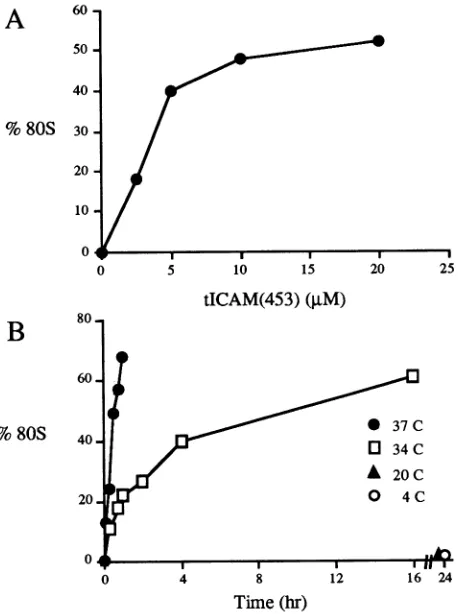
was dependent on tICAM453 concentration (Fig. 4A). The
maximalrateofuncoating requiredtICAM453concentrations
* 37C
o 34C
A 20C O 4C
Time(hr)
FIG. 4. DependenceoftICAM453-mediateduncoatingof HRV3 on ICAM-1 concentration, time, and temperature. (A) 35S-HRV3 wasincubated with various concentrationsoftICAM453for 3 h at 34°C,chilledto4°C,andthen sedimentedthroughsucrosegradients. (B)35S-HRV3wasincubatedwith 10,uMtICAM453for the indicated times and temperatures and thensedimentedthroughsucrose gra-dients. Uncoating wasnot observed in the absence oftICAM453 (datanotshown).
sufficient to completely block HRV3-ICAM-1 binding (9) andarethuslikely toapproach saturatingconcentrations of soluble ICAM-1. Theuncoatingreactionwas characterized by amarked temperature dependence (Fig. 4B). The reac-tionwasundetectableat4 or20°C and exhibited
t1l2
values of 4 h at 34°C(the optimal temperature for virus growth) and 0.5 h at37°C. Incontrast, therateof formation of the 135S species was essentially identical at 34 and 37°C (data not shown).Theisolated 135S complex spontaneously generated 80S empty capsids when incubated at 34°C, explicitly
demon-strating aprecursor-product relationshipbetween the 135S complexand the 80S emptycapsid.This isdemonstrated in the experiment with HRV14 shown in Fig. 5, in which isolated
HRV14-tICAM453
complex incubatedat34°Cfor 3h in the presence ofexogenously added tICAM453 produced 80S emptycapsids. However, the extent ofuncoatingwas dependent on the addition of exogenoustICAM453.
In the absence of exogenous tICAM453, the 135S complex prima-rily generated 149Svirus; this 149S species is likely to be native virus generated from the dissociation of the virus-receptor complex because it was not associated with tICAM453andwasinfectious(datanotshown).The fact that 149S native virus and 80S empty capsids can both deriveon November 9, 2019 by guest
http://jvi.asm.org/
[image:3.612.100.261.76.425.2]80
60
40
20
100
80
&
6040
20(
500-
C
400l
300.
200
100.
0 -~
5 10 15 20
FRACTION#
FIG. 5. Fate of isolated rhinovirus-receptor complex. 135S [35S]methionine-labeled HRV14-tICAM453 complex was isolated froma sucrosegradientanddialyzed againstNbuffer(pH 7.5)for 1 h at 4°C. The sample was then divided and resedimented (A)or incubated for 3 h at34°C in the absence (B)or presence (C) of additional tICAM453(10 ,uMfinalconcentration) before resedimen-tation.
from isolated 135S complex indicates that virus-ICAM-1 dissociation per se does not result in release of VP4 and RNA. The increasedextentofuncoating in the presence of exogenous
tICAM453
suggeststhatuncoating is favoredby maintaining highoccupancyofthereceptor-bindingsiteson the virus.SensitivitytosolubleICAM-1-mediated uncoatingdoes not correlate with instabilityatlowpH. Rhinovirus is knownto be rapidlyinactivated by low pH (30), and low pH causes
partial disassemblyof the virion(25).LowpH is likelytobe aphysiologically importantfactor in virusuncoatingsincean intracellularlow-pH step appearstoberequired for produc-tiveuncoatingof rhinovirus in vivo(7, 18). Wehave exam-ined the sensitivity of various rhinovirus serotypes to pH 5.0, a pHlikely to be encountered in the endosomal com-partment (22).
[35S]methionine-labeled
rhinoviruswasincu-1000
8000 HRV16
6000
4000
2000
0
0 S 10 15 20
FRACTION#
No
FIG. 6. Sensitivity ofthree rhinovirus serotypes tolow-pH treat-ment.
[35S]methionine-labeled
rhinovirus was incubated at pH 5.0 for 1 h at 34°C as described in Materials and Methods before neutralization and sedimentationthroughsucrosegradients.batedatpH 5.0 for 60 min,neutralized,and thenanalyzed by sucrosegradientcentrifugation. The three serotypes exam-ined showed markedly different sensitivity to low pH as revealed bothby theextentofdisassembly and by thenature of the subviral products produced (Fig. 6). HRV14 was rapidly andquantitativelyconvertedto anoninfectious 135S VP4-minus RNA-containing species (0.14 PFU/cpm
com-pared with 3,700 PFU/ml for control virus) but did not further disassembletothe80S VP4-minus RNA-minus spe-cies, while HRV3 gave riseto amixture of the135Sand80S species. HRV16 remained largely intact and did not yield significantamounts of the 135Sor80S species.
The135Sspecies generatedby low pH
(135SpH;
seeFig.9)was clearly distinct from the 135S species generated by tICAM453 (135SR)because (i) ICAM-1was not complexed with
135SpH,
(ii)
135SpH
wasnoninfectious,
and(iii)
135SpH
lackedVP4(25;datanotshown). Thus,thecosedimentation of
135SpH
and 135SR was coincidental. The 80Sspecies
generated bylow pHlacked RNAand VP4 andwas indis-80S 135S 149S
)0
)0
)0
)0
0
0.
0.
00
0.
on November 9, 2019 by guest
http://jvi.asm.org/
[image:4.612.92.278.74.475.2] [image:4.612.349.530.75.473.2]GREVE
U12
0 10 15 20
FRACTION#
FIG. 7. Effect oftICAM453andpH5.0onuncoatingof HRV14. Sucrose gradient profiles of[35S]methionine-labeled HRV14
incu-bated at pH 5.0 for 30min at34°C (top), incubated with 20 nM
tICAM453 for 30minat34°C(middle), andincubated withtICAM453
asdescribed for thetoppanel (bottom), adjustedtopH5.0bythe addition of 100 ,ul of N buffer (pH 5.0), and incubated for an additional 30minat34°C. Sampleswereneutralized and cooledto 4°Cbeforesedimentation.
tinguishable from the 80S species generated by soluble ICAM-1.
In thatboth receptorbinding andanintracellularlow-pH step are required for virus infection, we examined the
combined effect of tICAM453 and low pH on uncoating in
vitro. HRV14 was chosen for this experiment because it
does not uncoat at pH 5.0, while it does uncoat with tICAM453. HRV14 was preincubated with a subsaturating amountoftICAM453for30 minand then acidifiedtoapHof
5.0 for30min, neutralized, and analyzedon sucrose
gradi-ents. Conditions were chosen such that the amount of ICAM-1-mediated uncoatingwasless thanhalf-maximal. As canbeseeninFig. 7, the amountof uncoating bytICAM453 plus pH 5.0 was similarto the uncoating bypH 5.0 alone. Thus,theuncoatingtothe 80Semptycapsid by low pH and
ng HRV/ 106 Cells 6
4
2
0 1 2 3 4 s
Time(min.)
FIG. 8. Rate ofbinding of three rhinovirus serotypestoHeLa cells.Binding of[35S]methionine-labeledrhinoviruswasdetermined as described in Materials and Methods. Symbols: *, HRV3; A, HRV14;El, HRV16.
by
tICAM453
was not additive. There was, in fact, aslight inhibition of theformation of the 135S species by pH 5.0 in the presence oftICAM453-Inverse correlation exists between rate ofuncoating and bindingaffinity.Therelative affinities ofHRV14,HRV3,and HRV16 for ICAM-1werecomparedbymeasuringthe initial rate ofbinding to HeLa cells (Fig.8). The resultsindicated that HRV16 had thehighest,HRV3hadanintermediate,and HRV14had the lowest initial rate ofbinding. Thus, within this set of serotypes, the greater the initial rate of virus binding toreceptor, the slower therateofuncoating.
DISCUSSION
Although the receptor for themajorclass of rhinoviruses has been identified as ICAM-1, little is known about the cellular and molecular events that follow virus binding to receptor,that relatetovirus entry into thecell,orthatrelate to virus uncoating. In this report, we examined several aspects of the interaction of rhinovirus with soluble trun-cated forms of ICAM-1 in vitro. First,wedemonstrated the formation of stable virus-receptor complexes. Second, we showed that these virus-receptor complexes can spontane-ouslyuncoatand identified several variables which control the rate of uncoating. Third, we compared the conforma-tional changes in the virus induced byreceptor binding to conformational changes induced by low pH, a factor rele-vant tovirusuncoatingin vivo.
Formation of virus-receptor complexes. Wedemonstrated the formation ofvirus-receptorcomplexes whichare appar-entlysaturated with receptor. ThestoichiometryofICAM-1 tocapsid proteininthesecomplexesapproaches 1:1 ICAM-l:viralprotomer, suggesting thatoneICAM-1 moleculecan bindtoeachof the 60 icosahedral faces of the virion. These dataareconsistentwith the canyonhypothesisproposedby Rossmann and coworkers(6, 28,29), in which the receptor-binding site on rhinoviruswas proposed to be located in a
depression centered on eachicosahedral face of the virion. This conclusionregardingthe number andlocation of recep-tor-binding sites is confirmed and extended by structural analysisof HRV16-soluble ICAM-1complexes(14, 26).
Factors regulating the uncoating of virus-receptor com-plexes. Rhinovirus-receptor complexes are capable of
un-coatingorbreakdowntoemptycapsidswhich havereleased viralRNA, thecapsid proteinVP4(9),and receptor.Empty capsids, which have a sedimentation value of 80S, are
on November 9, 2019 by guest
http://jvi.asm.org/
[image:5.612.333.538.72.205.2] [image:5.612.84.271.76.478.2]similar or identical to empty
capsids
which are generatedduring
infection in vivo(1, 17)
and therefore appear to be physiologically relevant subviral products. Several factors determine the rate of virus uncoating. First, the rate ofuncoating
variesdramaticallyinasmall selection of theover 100 rhinovirus serotypes. This variability in the ability to uncoat ranges from the phenotype exhibited by HRV14, whichuncoatswithahalf-time of 15 min,tothat ofHRV16, which uncoats veryslowly
at34°C.
Second, the rate ofuncoating
isdependent
onICAM-1concentration,
the max-imalraterequiring saturating
ICAM-1 concentrations.Third, theuncoating
reaction isstrongly dependent
ontemperature. Therateofuncoating
at37°Cis 10-foldhigherthantherate at34°C.
Interestingly,
theoptimal
temperature for virusgrowth
is34°C,
the titer of rhinovirusbeing
10-foldhigher
when grown at
34°C
than at 37°C(34).
The temperaturedependence
of virusuncoating
is theonly
step of the rhinovirus lifecycle
we are aware of which possesses a similar temperaturedependence.
While thephysiological
significance
ofthis ispresently unclear,
it ispossible
thatthehigher
rateofICAM-1-mediateduncoating
at37°Cresults ina
higher
fraction ofunproductive uncoating
events invivo.Finally, receptor-mediated uncoating
appears to be deter-minedby
arate-limiting
step intrinsic to thevirus-receptorcomplex
itself rather thanby
dissociation of ICAM-1 from the virion perse.This conclusion is basedontheobservation that the isolated HRV14-ICAM-1complex
could either dissociate back to free native virus and free ICAM-1 or uncoat,depending
on the absence or presence ofexoge-nously
addedICAM-1, respectively.
An inverse
relationship
was observed between virus-receptoraffinity
andrateofuncoating
in thethree serotypes examined. Thatis,
serotypes with ahigh
virusaffinity
for receptorexhibited lowerratesofreceptor-mediateduncoat-ing.
Whether this correlation ismerely adaptive
for the relevant serotypes orwhether it ismechanistically
coupledtothe
uncoating
reaction ispresently
unclear. Oneexplana-tion is that formaexplana-tion ofa
tight virus-receptor complex (as
in thecaseofHRV16)
preventsthe release of receptor from thecomplex,
which could becoupled
inanobligatory
manner to the release of viral components.Alternatively,
it ispossible
that receptor
binding
torapidly uncoating
serotypes(as
in the case ofHRV14) requires
conformationalchanges
in the virus which lead to destabilization of thevirion,
while serotypes that formtight complexes require
minimal ornondestabilizing
conformationalchanges.
There isnodirect evidence at present thatbinding
of receptor itself causes conformationalchanges
in thevirion, although
ithas been shown that a conformationalchange
in the base of the rhinovirus canyon inducedby
acapsid-binding compound
prevents
binding
of HRV14 to receptor(27).
Whatever the molecular basis of thesephenotypes
provestobe,
it is clear that rhinovirusmusttreadadelicate balance betweenmain-taining
anaffinity
for receptorhigh enough
to allow for efficientbinding
tocells andmaintaining
astructureflexibleenough
to uncoat once insidethe cell.A clear limitation to
defining
the molecular basis of thephenotypes
described here is thehigh degree
of sequencedivergence
among rhinoviruses; HRV14 andHRV89,
forexample,
both ofwhich bind to themajor
receptor, haveonly
53% amino acid sequenceidentity
in theircapsid
proteins (4).
Toclearly
determine the causalrelationships
between various parameters of
virus-receptor
interactionas well as to map thecapsid protein
residues involved in conformationalchanges
of thevirion,
discrete amino acidsubstitutionsonthebackground of a single serotype must be analyzed.
Relationship ofreceptor-mediated andlowpH-induced un-coating. Rhinovirusesaredistinguished from other picorna-virusesbytheirsensitivitytoinactivationatlowpH(30), and it has beenpreviously reported that low pH causes progres-sivedisassemblyof rhinoviruscapsids (25).Inaddition, it is clear thatanintracellularlow-pH step is required for infec-tion of rhinoviruses belonging to the minor receptor class (18, 24) and themajorreceptorclass(7), indicatingthat the effect of lowpHonrhinovirusstructureis aparameter that is physiologically relevant to the entry process. Thus, we examined the effect of incubationatpH 5.0,apH likelytobe encountered in the endosomal compartment (22), on the same three rhinovirus serotypes. While 80S VP4-minus RNA-minus emptycapsids and an intermediate 135S VP4-minus RNA-containing speciescanbegenerated bylow-pH treatment of rhinovirus, there appeared to be no clear relationship between susceptibility to virus destabilization by low pH and by soluble receptor. For example, HRV14 was very rapidly uncoated to the 80S empty capsid by receptor,while lowpH generated only the intermediate 135S VP4-minus RNA-containing subviral particle. These data indicate that thesensitivityofagivenserotype to receptor-mediateduncoatingisnotsimplydueto ageneralized lower stabilityof the virion. These data also suggest that destabi-lizationby receptor andby lowpH must occurby distinct molecular mechanisms andfurther suggest that destabiliza-tion of the virionduring uncoatingin vivooccursindistinct stages.
Significance ofvirus conformational changes in vivo. The role of receptor-induced conformational changes in virus uncoatingin vivocannotbedefinitivelydetermined from the studies described here. The results presentedhere indicate that soluble receptor is capable of causing destabilizing conformational changes in the virion sufficient to cause uncoating of the virion. However, whether the degree of occupancyofreceptor-bindingsitesonthe virus by cellular receptorin vivo approachesthehighlevelachievedin vitro in this
study
is presently unknown. It is possible that an incremental destabilization of the virion by receptor (i.e., either not sufficient to cause uncoating or not globally transduced over the entire virion) acting in concert with other factors(see
below) is sufficienttocause uncoating in vivo.Thereare atleasttworate-limitingstepsduringrhinovirus uncoating invivo, (i) therate ofvirus-receptor binding and
(ii)
destabilization of the virionbylowpH(presumablyin the endosomalcompartment).
This work suggests thepossibility of a third step, destabilization of the virus by receptor binding. The rhinovirus serotypes examined here all have similarparticle/PFU
ratios, indicating that the overall effi-ciencies of infection are similar. The wide variability ofspecific
serotypeswith respect to these parameters in vitro would suggest thatarelativeinefficiencyinonestep(suchasvirus-receptor binding)could beaccompanied bya compen-satory greater efficiencyin one or more other steps of the entry process
(such
aslowpH-orreceptor-mediated desta-bilization of thevirion)tomaintainaviable overallefficiency of infection. Since both receptorbinding
andanintracellularlow-pH
steparerequiredfor infection invivo,weexamined thepossibility
that receptor and lowpHactsynergisticallyto promoteuncoating.Our results suggest that soluble ICAM-1 and low pH are not additive in their ability to promoteuncoating, and,
ifanything,
soluble ICAM-1 appears toslightly
inhibit the lowpH-induced
transition tothe135SpH
on November 9, 2019 by guest
http://jvi.asm.org/
Soluble
ICAM-1
+ I
a135SR
- 3
+VP4+RNA
80S
EC+VP4
AcidicpH
135SpH
+RNA
80S
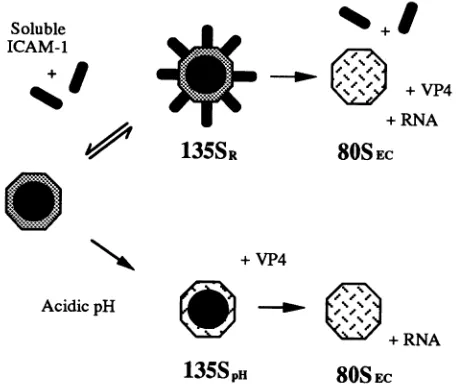
ECFIG. 9. Diagrammatic representation of speciesdescribed in the
text.
13SPH
istheRNA-containingVP4-minusspecies generated bylowpH; 135SRisthe virus-soluble receptorcomplex;80SECis the
RNA-minus VP4-minusemptycapsid.
species. These results indicate that ifreceptorbinding and low pH act to promote virus uncoating in vivo, it is not
simply at the level of enhancing the rate of uncoating. Rhinovirus islikelytoundergo ahydrophobic transitionto promote interaction with and/or penetration of the
mem-brane(16), and evidence has beenpresentedthat conforma-tional changesinrhinovirus inducedbylowpH (15) and in poliovirus bycontactwith cells(5)result inaconformational
transitiontoahydrophobicform of the virion. For
success-ful infection, rhinovirus must not simply be uncoated but must be uncoated in such a manner that the RNA is
efficiently translocated across the membrane into the cyto-plasm, aprocessthatwasnotexamined here. It is therefore possible that rhinovirus mustbe tethered to the membrane during passage through the low-pH environment of the endosome in order to promote the interaction with and penetrationof thelipid membrane,thusprovidingarationale for theapparentstabilization of virustolowpH byreceptor.
In summary, we described here the formation and
char-acterization oftwoproductsof the interaction of rhinovirus with soluble ICAM-1, a saturated virus-receptor complex
andanemptycapsid (Fig. 9). Examination of several rhino-virusserotypesrevealedsignificant variabilityin thestability of the virus-receptor complexes and the rate of receptor-mediated uncoatingaswellasvariabilityin theproductsof low-pH treatment. These results suggest that different rhi-novirus serotypes may varytheir strategies for deliveryof the viral genome into the host cell. Determination of the
physiologicalroles of the in vitro conformational transitions described here will require a moredetailed characterization
oftheuncoating pathwayofmultiplerhinovirusserotypesin vivo as well as complete reconstitution of the uncoating processinvitro.
ACKNOWLEDGMENTS
We thank Carla Forte andChristopherMarlor forhelpful discus-sions and suggestions, Marsha Kremer and Michael Rossmann (Purdue University) for purified HRV14, Tom Buckholz and Carla
Brini for amino acidanalysis,Mike Kamarck foracarefulreadingof themanuscript, andSuzyPafka forphotography.
REFERENCES
1. Abraham, G., and R. J. Colonno. 1988. Characterization of human rhinoviruses displaced byan anti-receptormonoclonal antibody.J.Virol. 62:2300-2306.
2. DeSena, J., and B. Mandel. 1977. Studies on the in vitro uncoating ofpoliovirus. II. Characteristics of the membrane-modifiedparticle. Virology 78:554-566.
3. Dorward, D., H. D.Huguenel,G.Davis,andC. F. Garon.1992. Interactions betweenextracellularBorreliaburgdorferi proteins and non-Borrelia-directed immunoglobulin M antibodies. In-fect. Immun. 60:838-844.
4. Duechier, M., T. Skerm, W. Sommergruber, C. Neubauer, P. Gruendler,I.Fogy,D.Blaas,and E.Kuechier.1987. Evolution-aryrelationshipswithin the human rhinovirus genus:
compari-sonof serotypes 89, 2, and 14. Proc. Natl. Acad. Sci. USA 84:2605-2609.
5. Fricks,C.E., andJ.M.Hogle. 1990. Cell-induced conforma-tionalchange inpoliovirus: externalizationof the amino
termi-nus of VP1 is responsible for liposome binding. J. Virol. 64:1934-1945.
6. Giranda,V.L.,M. S.Chapman,and M. G. Rossmann. 1990. Modelingof the human intercellular adhesion molecule-1, the humanmajorgroup receptor.Proteins7:227-233.
7. Greve, J.M.Unpublisheddata.
8. Greve, J. M.,G.Davis, A.M.Meyer,C. P.Forte,S. C.Yost, C. W.Marlor,M. E.Kamarck,andA.McClelland. 1989.The majorhumanrhinovirusreceptorisICAM-1. Cell56:839-847. 9. Greve, J. M., C. P. Forte, C. W. Marlor, A. M. Meyer, H.
Hoover-Litty,D.Wunderlich,andA. McClelland. 1991. Mech-anismsofreceptor-mediated rhinovirus neutralization defined bytwosoluble forms of ICAM-1. J. Virol. 65:6015-6023. 10. Guttman, N., and D. Baltimore. 1977. A plasma membrane
componentable tobind andalter virions ofpoliovirustype 1: studiesoncell-freealterationusingasimplifiedassay.Virology 82:25-36.
11. Hart,T.K.,R.Kirsh,H.Ellens,R. W.Sweet,D.M.Lambert, S. R. Peteway,J. Leary,and P.J. Bugelski. 1991. Bindingof solubleCD4proteinstohumanimmunodeficiencyvirus type 1 and infected cells induces release of envelope glycoprotein gpl20.Proc.Natl. Acad. Sci. USA 88:2189-2193.
12. Kaplan,G., M.S. Freistadt,and V. R. Racaniello. 1990. Neu-tralization ofpoliovirus by cell receptors expressed in insect cells. J. Virol.64:4697-4702.
13. Kim,S.,T.J.Smith,M. M.Chapman,M.G.Rossmann,D.C. Pevear, F. J. Dutko, P. J. Felock, G. D. Diana, and M. A. McKinlay.1989.Crystalstructureof human rhinovirus serotype 1A(HRV1A).J.Mol. Biol. 210:91-111.
14. Kolatkar, P. R., M. A. Oliveira, M. G. Rossmann, A. H. Robbins,S. K.Katti,H.Hoover-Litty,C.Forte,J.M.Greve,A. McClelland,and N.H. Olson. 1992. Preliminary X-ray crystal-lographic analysisof intercellular adhesionmolecule-1. J.Mol. Biol. 225:1127-1130.
15. Korant,B. D., K. Lonberg-Holm, J. Noble, andJ.T. Stasny. 1972. Naturally occurringandartifically producedcomponents of three rhinoviruses.Virology48:71-86.
16. Lonberg-Holm, K., L. B. Gosser, and J. Shimshick. 1976. Interaction ofliposomes with subviral particles ofpoliovirus type 2and rhinovirus type 2. J. Virol.19:746-749.
17. Loi,berg-Holm, K.,and B. D. Korant.1972.Earlyinteractions of rhinoviruseswith host cells.J. Virol. 9:29-40.
18. Madshus, I. H.,S.Olsnes,and K.Sandvig. 1984. DifferentpH requirementsfor entry of thetwopicornaviruses,human rhino-virus 2 and murineencephalomyocarditis virus.Virology 139: 346-357.
19. Marlin,S.D.,D. E.Staunton,T.A.Springer,C.Stratowa,W. Sommergruber, and V. J. Merluzzi. 1990. A soluble form of intercellular adhesionmolecule-1 inhibits rhinovirus infection. Nature(London)344:70-72.
20. Marsh,M.,and A. Helenius. 1989.Virus entry intoanimal cells. Adv. Virus Res. 36:107-151.
21. McClelland, A., J. deBear, S. C. Yost,A. M. Meyer, C. W. Marlor, andJ. M. Greve. 1991. Identification of monoclonal antibody epitopesand criticalresidues for rhinovirusbindingin
on November 9, 2019 by guest
http://jvi.asm.org/
[image:7.612.64.292.76.268.2]domain 1 of ICAM-1. Proc.Natl. Acad. Sci. USA 88:7993-7997. 22. Mellman,I., R. Fuchs,and A.Helenius. 1986. Acidification of
the endocytic and exocytic pathways. Annu. Rev. Biochem. 55:663-700.
23. Moore, J. P., J. A. McKeating, R. Weiss, and Q. J. Sattentau. 1990. Dissociation of gpl20 from HIV-1 virions induced by solubleCD4. Science 250:1139-1142.
24. Neubauer, C., L. Frasel, E. Kuechler, and D. Blass. 1987. Mechanism of entry of human rhinovirus 2 into Hela cells. Virology158:255-258.
25. Noble, J., and K. Lonberg-Holm. 1973. Interactions of
compo-nents of human rhinovirus type 2 with HeLa cells. Virology 52:270-278.
26. Olson, N. H., P. R. Kolatkar,M.A.Oliveria, R. H. Cheng,J. M.
Greve, A. McClelland, T. S. Baker, and M. G. Rossmann. Structure ofa human rhinovirus complexed with its receptor
molecule. Proc.Natl. Acad. Sci. USA,inpress.
27. Pevear, D. C., M. J. Fancher, P. J. Felock, M. G. Rossmann, M.S. Miller, G. Diana, A. M. Treasurywala,M. A.McKinaly, and F.J. Dutko.1989.Conformationalchangein the floorof the humanrhinoviruscanyonblocksabsorptiontoHeLacell
recep-tors.J.Virol. 63:2002-2007.
28. Rossmann,M. G.1989. Thecanyonhypothesis. Hiding the host cellreceptor attachment site on aviral surface fromimmune
surveillance. J. Biol. Chem. 264:14587-14590.
29. Rossmann,M. G., E. Arnold, J. W. Erikson, E. W.
Franken-berger,P. J. Griffith, H. Hecht, J. E. Johnson, G. Kamer,M.
Luo, A.G.Mosser,R. R. Rueckert,B.Sherry, and G. Vriend. 1985. Structure ofacommoncold virus and functional relation-shiptootherpicornaviruses. Nature(London) 317:145-153. 30. Rueckert, R. R. 1990. Picornaviridaeand their replication, p.
507-548. In B. N. Fieldsetal. (ed.), Virology. Raven Press, New York.
31. Simmons, D., M.W. Makgoba, and B. Seed. 1988. ICAM, an
adhesion ligand of LFA-1, is homologous to the neural cell adhesionmolecule NCAM. Nature(London) 331:624-627. 32. Staunton, D. E., M. L. Dustin, H. P. Erickson, and T. A.
Springer. 1990. The arrangement of immunoglobulin-like do-mains ofICAM-1 and the binding sites for LFA-1 and
rhinovi-rus.Cell61:243-254.
33. Staunton, D. E., S. D. Marlin, C. Stratowa, M. L. Dustin, and T. A.Springer. 1988. Primarystructureofintercellular adhesion molecule 1 (ICAM-1) demonstrates interaction between the immunoglobulin and integrin supergene families. Cell
52:925-933.
34. Stott,E.J., and G. F. Heath.1970. Factorsaffectingthegrowth of rhinovirus 2 in suspension cultures of L132 cells. J. Gen. Virol. 6:15-24.
![FIG. 6.ment.forneutralization Sensitivity of three rhinovirus serotypes to low-pH treat- [35S]methionine-labeled rhinovirus was incubated at pH 5.0 1 h at 34°C as described in Materials and Methods before and sedimentation through sucrose gradients.](https://thumb-us.123doks.com/thumbv2/123dok_us/1303920.83570/4.612.349.530.75.473/forneutralization-sensitivity-rhinovirus-methionine-rhinovirus-described-materials-sedimentation.webp)
![FIG. 8.cells.HRV14;as described Rate of binding of three rhinovirus serotypes to HeLa Binding of [35S]methionine-labeled rhinovirus was determined in Materials and Methods](https://thumb-us.123doks.com/thumbv2/123dok_us/1303920.83570/5.612.84.271.76.478/described-rhinovirus-serotypes-methionine-rhinovirus-determined-materials-methods.webp)