0022-538X/85/070001-09$02.00/0
Copyright © 1985,American Society forMicrobiology
Site-Directed Mutagenesis of the
Simian Virus 40
Large T-Antigen
Gene:
Replication-Defective
Amino Acid Substitution Mutants
That
Retain the Ability
to
Induce Morphological Transformation
KEITH W. C.
PEDEN'*
AND JAMES M. PIPAS2HowardHughes Medical Institute Laboratory, Department of Molecular Biology and Genetics, Johns Hopkins University Schoolof Medicine, Baltimore, Maryland 21205,1 and Department of Biological Sciences, University of Pittsburgh,
Pittsburgh, Pennsylvania
152602Received 25 October 1984/Accepted5 March 1985
We used a heteroduplex deletion loop mutagenesis procedure for directing sodium bisulfite-induced mutationstospecific sitesonviralorplasmidDNAtogenerateaseries ofSV40 large T-antigen pointmutants. The mutations weredirected toaregionof theT-antigengene, 0.5mapunits,that isthoughttobeimportant for interaction of theproteinwith the viraloriginof DNAreplication.Of the 16 mutantsreported here, 10 had lost the abilitytoreplicatetheirDNA,and 3 others showedareduced level ofreplication comparedto wildtype. Allof themutantstestedwerecapableoftransformingratcells in culturebythe dense focusassay.We conclude that thesequencesof theearly regionaround 0.5mapunitsarecritical for thereplicationof viral DNA but not
for the transformation function of T antigen.
The large tumor antigen (T antigen) of simian virus 40 (SV40) is a regulatory protein that is expressed early after infectionand functions to initiate viral DNAreplication(71),
activate late region transcription (1, 12, 25, 26, 45, 55), and autoregulate early region transcription (1, 26, 53, 73). In
addition, Tantigen is capableofinducingthemorphological transformationofanumber of cellstypesinculture(3,6,19,
27, 28, 38, 44, 59, 68, 70, 72). During infection of both
permissive and nonpermissive cells, T antigen induces a
numberofchanges in cellularmetabolism. For example, T
antigen stimulatescellular DNAsynthesis(7, 15, 21, 22, 57,
65, 75) and activates the transcription of certain cellular
genes (64-66).
Three biochemical activities of T antigen have been
de-scribed: a DNA-binding activity (41, 42, 52, 58, 74), an ATPase activity (8, 16, 76), and the ability to bind a host
protein of53,000 daltons, p53 (30, 33). The binding of T
antigentospecificsequencesattheorigin of viral replication is thought to be required for the autoregulation of early region transcription,thestimulation oflateregion transcrip-tion, and the initiation of viral DNA replication. Further-more, systemsthatreplicate SV40 DNA in vitroare
depen-dent upon Tantigen (2, 32). The activities thatfunction to
induce morphological transformation have not been identi-fied.
One approachtounderstandingthemolecular mechanism
of Tantigen action isto correlate thebiochemicalactivities of this molecule with its multiple biological effects. To this
end, we have attempted to separate the activities of T antigen by mutating the T-antigen gene at specific sites. Experiments with deletion mutants that synthesize frag-mentsoftheprotein have demonstrated that some activities can be dissociated (9, 15, 49, 65). These studies also indi-cated that certain activities seemed to reside in discrete
functionaldomains of the protein. For example, the ability to
*Correspondingauthor.
stimulate cellular DNA synthesis requires residuesbetween
amino acids 82 and 272 and is unaffected by mutations
outsidethisregion (65). Similarly,thefunction that activates thetranscriptionof silentrRNA genesresides in the central portion oftheprotein (65). On theotherhand,theabilitiesto
initiate viral DNA replication and to induce morphological transformationofcells incultureweresensitivetomutations
in several regions ofthemolecule andwere notdissociated from each other (49). This indicates that either the same
biochemical activities ofTantigen that induce transforma-tionarerequired for viralDNAreplicationorthemutational
lesions alter the protein structure such that independent activitiesare lostcoordinately.
Results from Shortle et al. (62) and Margolskee and Nathans (37) have implicated the region ofSV40 Tantigen
around 0.5 mapunits(m.u.)asbeing involved in viral DNA
replication. Mutations at the origin of DNA replication leadingto areducedabilitytoreplicate couldbe suppressed by mutations in T antigen, and two second-site revertants havebeenfoundtohavelesionsthat mapto0.5m.u. onthe SV40 genome, changing amino acids 157 and 166,
respec-tively. Additional evidence thatthisregion ofthe protein is
involved with the DNA replication activity has come from the studies ofStringer(69), Gluzman and Ahrens (18), and Manos and Gluzman (35, 36). Viral genomes isolated from SV40-transformed monkeycells (18, 35, 36)or ratcells (69) have been found to carry mutations in the T antigen gene thateliminatetheabilityof the proteinto replicate itsDNA
while maintainingthe transformation activity. Therefore, to determine whether in vitro-constructed mutations in this
regionwouldaffect the DNA replication activity, and also to map the extent ofthis region, it was decided to target 0.5 m.u. of SV40 for site-directedmutagenesis. With a series of mutants it should be possible to characterize which bio-chemical activities are involved with DNA replication and transformation. Asimilarapproach has been taken recently byKalderonand Smith(24). We report here theisolation and characterization of in vitro-constructed amino acid substitu-1
on November 10, 2019 by guest
http://jvi.asm.org/
2 PEDEN AND PIPAS
tion mutants thateliminate the DNAreplicationfunction of Tantigen while leaving thetransformation activity relatively unaffected.
MATERIALS AND METHODS
Cells, viruses, DNAs, and bacterial strains. The small plaque strain ofSV40 (776)wasgrowninBSC40 cells, asdescribed
previously(4, 5). REF52 and Rat-1 (79) cells wereobtained
from W. Topp,Cold Spring Harbor Laboratory,ColdSpring Harbor, N.Y., and grown in Earle minimum essential
me-dium supplemented with 10% fetal bovineserum(HyClone;
Sterile Systems, Inc.,Logan, Utah). SV40 deletionmutants are described by Pipas et al. (49) and in references within theirstudy. The plasmid pKP38 is pBR322 from which the AvalandSalIsites have been mutated by repairing the four unpaired nucleotides, followed by ligation, as described by
Peden and Nathans (47). MM294 and BD1528 have been described previously(43, 47).
Preparation of plasmid DNA. Small-scale preparations of plasmid DNA were made by the method of Holmes and
Quigley (23). Large-scale preparations were carried out as
described previously (46, 47).
Construction of nucleotide substitution mutations. The
pro-cedureusedfollowedclosely that described previously (47). DNA fromtheplasmid pSVB40,arecombinant of wild-type
SV40 and pKP38 joined through their BamHI sites, was
digested with KpnI, and DNA from pSVdlil37 and
pSVdlll38 was digested with ClaI. KpnI-digested pSVB40
(2 ,ug) wasmixed withClaI-digested pSVdlli37 (2 ,ug) and,
separately, with ClaI-digestedpSVdlll38 (2 ,ug) in 1,620
RI
ofH20, denatured by addition of 1 M NaOH (180RI;
final concentration, 0.1M) and incubationat37°C for 10min,and neutralizedby additionof 360RI
of neutralizing solution (1 M Trishydrochloride[pH 7.2], 1 M HCl; 2:1;seereference29).Renaturation was allowed to proceed at60°C for 2 h. The extentof heteroduplex formationwasdeterminedbyagarose
gel electrophoresis, since these molecules migrate with form II species, and varied between 20 and 40% of the linear, homoduplex molecules. This mixture was concentrated by
ethanol precipitation and dissolved in 200 ,u of 10 mM Tris hydrochloride (pH 8)-i mM EDTA.
Mutagenesis with sodium bisulfite was carried out as
describedpreviously (17, 47, 60). Between 50ngand 1 ,g of
theheteroduplex mixture wasincubated with 2.5 M sodium
bisulfite-1 mMhydroquinoneat37°C under paraffin oilinthe dark for 1h, followed by dialysis by the method of Shortle andNathans(60). Thismutagenized DNAwasuseddirectly
totransform BD1528toampicillin resistance (31), and plas-midDNAwasprepared from the pooled transformants (23).
Full-length molecules were enriched by digestion of the
deletion mutant DNA with AvaI and SalI, and DNA was
preparedfrom individual MM294 transformants. Those full-length molecules (ascertained by restriction enzyme
map-ping; HindIII plus TaqI for the pSVdlli37 series, Hinfl for thepSVdlIl38 series) were subjected tosequenceanalysis. Fifty to 80% of those molecules sequenced had nucleotide changes.
DNA sequence analysis. Mutants were subjected to se-quenceanalysis by the method ofMaxam and Gilbert (39) after labeling the 3' ends of restriction fragments with Micrococcus luteus DNA polymerase I and the
ap-propriately labeled [a-32P]dNTP and unlabeled dNTP. Cleavageproductswereresolvedon8%polyacrylamidegels
(56). Mutants in the d11137 region were labeled with
[a-32P]dGTP
at the DdeI site at nucleotide 4499 (78), and thefragments
wereseparated
byelectrophoresis
on6%
poly-acrylamide
gels and recovered by the method ofMaxamandGilbert (39). Mutantsin the
d11138
regionwerelabeledwith[a-32P]dCTP
at theHinfl
site at nucleotide 4376, and the fragments were separated byelectrophoresis
on 2.5%agarose gels and recovered on NA45 membranes
by
aprotocol of Lizardi
supplied
by Schleicher &Schuell, Inc.,Keene, N.H.
Indirect immunofluorescence in monkey cells. BSC40 cell monolayers in 5-cm dishes were transfected with 1 ,ug of plasmid DNA from the mutants by the DEAE-dextran method(40).The nextday, the cellsweretrypsinized, plated inchamber slides, allowedtoattach, andfixed in ethanol.T
antigen
wasdetected with hamsterSV40 anti-T serum(50).Viability and complementation tests. Viability was deter-mined at 32, 37, and 40°C by transfecting BSC40 cell monolayers with 1ng ofexcised and ligated DNA per5-cm dish by the DEAE-dextran method (40). Plaques were
scored at
32°C
between 3 and4 weeks and at 37 and40°C
between12days and 3 weeks.
Complementation
tests were done by coinfecting BSC40cell monolayers with mixtures of10 ngeach of excised and ligatedmutantDNAand
d11007
DNA per5-cmdish.Plaqueswere scoredafter 12 to 14days at
37°C.
Marker rescue. Marker rescue was
performed by using
modifications ofpublished procedures (18, 29). SV40
frag-ments used for the marker rescue were either cloned into pBR322 or
purified
from agarosegelsbyelectroelution
and DEAE-cellulose chromatography (63). Wild-type viral HindIII fragments were inserted into theHindlIl
site of pBR322, HaeIII fragmentswere inserted into theBalI site,
and
Alul
fragments were inserted into the PvuII site of pBR322.BamHI-digested
mutant DNA (30 to 50 ng),HaeIII-digested plasmid containing
theSV40HaeIII Cfrag-ment(120ng),andeither the
appropriately digested
plasmid
containing
thefragment
tobe tested(120ng)orthegel-puri-fied
fragment
(10to20ng)weremixed and then denaturedby
addition of0.1volume of1 MNaOHand incubationat
37°C
for10min. Afterneutralization
by
additionof0.2volume of neutralizing solution (see above),heteroduplex
formationwas allowed to occur (in a final volume of 260
RI)
by incubation at 68°C for 30min. DEAE-dextran (260Rd)
wasadded to 250
,ug/ml,
and the mixture was used to transfecttwo 5-cm dishes of BSC40
monolayers.
After 1 to 2 h at37°C, minimum essential medium plus 10% fetal bovine
serum was
added,
and the cells were incubated at37°C
overnight.
Thefollowing day,
themediumwasreplaced
withagarforplaque determinationasdescribedabove.
DNAreplicationinmonkey cells. ViralDNA
replication
ofthe mutants was measured in BSC40 cells as described
previously
(48,49).
Afterdigestion
withDpnI plus
BclI,
DNA was fractionated by
electrophoresis
on 1% agarosegels and transferred to nitrocellulose
(67),
and viral se-quences were detectedby
hybridization
with32P-labeled
SV40DNA
(labeled by
nicktranslation[34,
54]).
Hybridiza-tionand
washing
offiltersweredoneasdescribedpreviously
(46).
Transformation of rat cells. Rat
embryo
fibroblasts(REF52)
and Rat-1cells(79)
wereseeded into5-cmdishesatapproximately
5 x10⁴
cellsper dish theday
beforetransfec-tion.Mutant DNA(1 ,ug per
dish)
wasintroduced,
using
thecalcium
phosphate
procedure (20)
andglycerol
shock(14).
Disheswerefedevery 3
days
withminimalessential medium plus 10% fetal bovineserum, andfociwerescoredat3 weeks aftertransfection.J. VIROL.
on November 10, 2019 by guest
http://jvi.asm.org/
RESULTS
Mutant construction. Base substitution mutations were
generated in the T antigen gene at 0.5 m.u. by the
heteroduplex deletion loop mutagenesis method described previously (47). In this method, aheteroduplex is prepared
betweenadeletionmutantandawild-typemolecule, and the
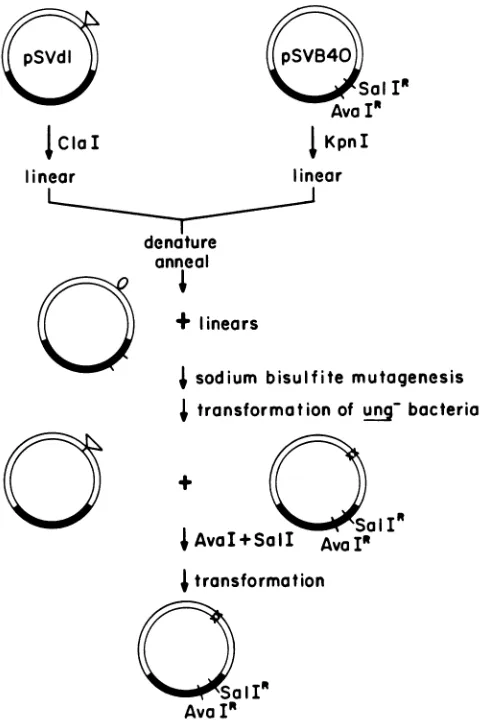
cytosine residues in the resulting single-strandedloopatthe position of the deletion become targets for deamination by sodium bisulfite. Two deletion mutants, d11137 and d11138 (49), were used as templates for mutant construction. The procedure isdescribed above and outlined in Fig. 1.
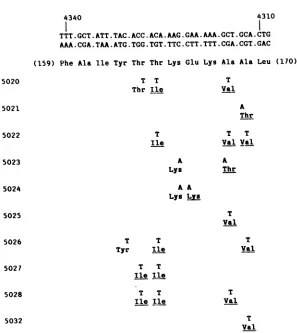
Sequence determination ofmutants. Figures 2 and 3 show thenucleotidesequencechangestogether with thepredicted
aminoacid substitutions ofmutantsconstructed with d11137 and d11138 as templates, respectively. Both
cytosine-to-thymine andguanine-to-adenine transitions were found, as
expected, since both strands are able to participate in heteroduplex formation. Of the 11 cytosine-guanine base pairs (bp) susceptible to sodium bisulfite in the exposed 31 nucleotides of d11137, 8werechanged. More importantly, of
the six amino acids that could be changed by this method, four were mutated. In the case of the d11138 series, 11
ClaI lKpnI
tear linear
denature anneal
+ linears
4
sodium bisulfite mutagenesis4
transformation of ug bacteria+
I
AvaI+SalAvaIII
I
transformationIII
AvaIR
FIG. 1. Summary ofmutagenesis procedure. The plasmid pSVdl isarecombinantbetweenanSV40deletionmutantand pBR322, and pSVB40 isarecombinant betweenwild-type SV40and a pBR322
derivative from which theAvaI and Sall sites were removed by
[image:3.612.317.560.82.310.2]mutation. Thedetailsaregiven inthetext.
TABLE 1. Infectivity of SV40 pointmutants Infectivity (PFUperdish)atthefollowing
Mutant temp(°C)
32 37 40 37"
pSVB3 101 109 98 NDb
5013 91 103 97 112
5014 0 0 0 86
5015 50C 64' 61' 76
5016 53C 42c 35' 42
5017 0 0 0 53
5018 0 0 0 50
5020 0 0 0 63
5021 60 76 81 70
5022 0 0 0 42
5023 0 0 0 55
5024 83d 107d 122' 85
5025 0 0 0 47
.5026 0 0 0 76
5027 0 0 0 38
5028 0 0 0 54
5032 77 81 82 ND
a
d11007
added.b ND,Not done.
Small plaque morphology.
d Small plaque morphology, appearing several dayslate.
cytosine-to-guanine
bp were targets and 10 were mutated,resulting inthechanging of five ofthesix susceptible amino acids. Those mutations that did not change the amino acid
sequence are notincluded here, since several of this class of
mutant had nodetectable phenotypic alterations.
Cellular localization of T antigen by indirect im-munofluorescence. The ability ofthe mutants to produce a stable Tantigenwasdetermined by indirect
immunofluores-cence with a hamster polyclonal SV40 anti-T serum after transfection of
BSC40
monolayer cultures with plasmidDNAs. All mutants produced nuclear fluorescence with intensities approximately that of the wild-type SV40 plas-mid, pSVB3. Mutants 5017, 5018, and 5028 produced weak
cytoplasmic fluorescence aswell.
Viability on BSC40 cells. The ability of each mutant to
plaque on BSC40 cell monolayers was measured at32, 37,
and
40°C,
and the ability to complement the late deletionmutant helper,
d11007,
was determined at37°C
(Table 1). Noneofthe mutants except 5024 showedany temperature-dependent growth.Three mutants wereviable andproduced plaques with morphology indistinguishable from thatpro-duced by wild-type SV40 (5013, 5021, 5032), and two mu-tants produced small plaques (5015, 5016). Mutant 5024
showed a slight cold-sensitive phenotype, producing very
small plaques4 to5 dayslaterthan wildtype at
32°C
and 1 to 2 days later at37°C.
All defective and partially defective mutants could be
complemented by
d11007,
demonstrating thatthey aredefec-tive only in early function. Complementation plaques with the nonviable point mutants were smaller than those
ob-tained with an early deletion mutant that produces no T
antigen, such as
d11136
(49). This could be due to interfer-ence with wild-type T antigen function by the mutantpro-tein.
Markerrescueof mutants. Toconfirm that thephenotype
of the mutants was aconsequence of thenucleotidechanges determined by DNA sequence analysis, marker rescue
ex-periments were carried out. Thelocations of thefragments
used andof the deletions in
d11137
andd11138
are shown inir
on November 10, 2019 by guest
http://jvi.asm.org/
[image:3.612.60.300.319.682.2]4 PEDEN AND PIPAS
4454 4422
1
1
CAA.CAT.TCT.ACT.CCT.CCA.kA.kkG.kG.kAGAk.kkG.GTA.GAA
GTT.GTA.AGA.TGA.GGA.GGT.TTT.TTC.TTC.TCT.TTC.CAT.CTT
(121) Gln His Ser Thr Pro Pro Lys Lys Lys Arg Lys Val Glu (133) 5013
5014
5015
5016
5017
5018
k
T Ser
TT Leu T Ser
T T
Ser Ser T
Phe
5019 A A A A
[image:4.612.146.488.61.311.2]Lys Lys Lys Lys
FIG. 2. Sequences of point mutants isolated by using d11137 as template. The nucleotide sequence of SV40 DNA together with the corresponding amino acid sequence of T antigen from amino acid residues 121to133 is shown across the top. Nucleotides 4454 and 4422 are thelimits of the deletion ofd11137. Mutantdesignations are in the left column, and the nucleotide changes for each mutant are shown. Amino acidsubstitutions are underlined.
4340 4310
1
1
TTT.GCT.ATT.TAC.ACC.ACA.AAG.GAA.AAA.GCT.GCA.LCTG
AKA.CGA.TAA.ATG.TGG.TGT.TTC.CTT.TTT.CGA.CGT.GAC
(159) Phe Ala Ile Tyr Thr Thr Lys Glu Lye Ala Ala Leu (170)
T T T
Thr Ile Val
A Thr T
lIle
T T
Tyr Ie
T T
Il.
lieT T
Ile lie
T T
Val Val
A A
Lys Thr
AA
Lys ]~Ls
T Val
T
Val
T Val
T Val
FIG. 3. Sequencesofpoint mutantsisolated by using d11138as template.The formatofthefigure isasdescribed for Fig. 2.
5020
5021
5022
5023
5024
5025
5026
5027
5028
5032
J. VIROL.
on November 10, 2019 by guest
http://jvi.asm.org/
[image:4.612.156.453.394.727.2]Fig. 4. Mutations in both the 1137 and 1138 regions were
rescued (Table 2) by both the HindIll B fragment
(nucleotides 5171 to 4002) and the RsaI B fragment (nucleotides 4876 to4168) but not byHaeIII-C (nucleotides 2799to2259;thefragment usedtocyclize the heteroduplex), HaeIII-E (nucleotides 5191 to4862), or HindIII-D
(nucleo-tides 4002 to 3476; data not shown), thus localizing the lesions to the RsaI B fragment. The AluI C fragment
(nucleotides 4643 to4314) rescued mutants 5014, 5017, and 5018, whichwere isolated by using d11137 as template, and some of the mutants isolated in the d11138 region (mutants 5024, 5026, and 5027). Since the end of the AluI C fragment lieswithin the deletion limits of 1138, it would be anticipated that notall themutants wouldbe rescued. In fact, mutants 5023 and 5025, which have mutations causing amino acid changes eitheroutsideoratthelastnucleotide of the AluI C fragment,arenotrescued. In thecaseofmutants5020, 5022, 5026, and 5028, which have mutationsleading toamino acid changesboth within and outside AluI-C, only 5026 is rescued byAluI-C, indicating that the substitution Ala-169to Val is inconsequential. Thiswasconfirmed by obtaining DNA from
two such rescuants and determining their DNA sequence.
Both had the original cytosine-to-thymine transition at
nu-cleotide 4312 ofmutant 5026; this viable mutant is number 5032 in Fig. 3.
Hinfl-C (nucleotides 4376 to 3610) failed to rescue the
lesions in the 1137 seriesmutantsbut rescued allthosein the 1138 series, as predicted (Table 2). Thus, the mutations in
the 1137series mapto267bp between nucleotides 4643 and 4376, and those in the 1138 regions to 208 bp between nucleotides 4376 and 4168,or,if rescued by AluI-C, tothe 62 bp between nucleotides 4376 and 4314. Since over 100
nucleotides of each mutant were sequenced and no
ad-ditional alterations were found, we feel confident that the
nucleotide substitutions of each mutantpresented in Fig. 2 and 3areresponsible for the observed phenotypes.
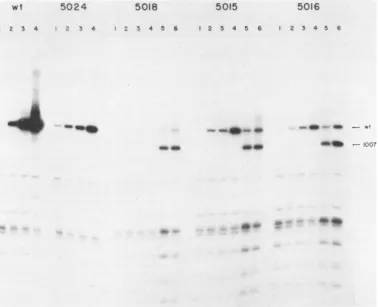
DNA replication in BSC40 cells. To test whether the mutantsretained theability toreplicatetheir DNA, weused
theDpnI assay described previously (48, 49). Examples of
this assay are shown in Fig. 5, in which the replication
[image:5.612.317.558.79.301.2]efficienciesof wild-type SV40 and mutants5024,5018, 5015, and 5016 are compared. In 10 out of 16 cases, no DNA
TABLE 2. Markerrescueresults
Plaquesperdishproducedby the following restriction fragment Mutant HaelIl-C HinidIII-B RsaI-B Alilu-C Hinfl-C
5013 >100, >100 ND" ND ND ND
5014 0,0 51,43 29, 33 35, 26 0,0
5015 >100, >lOO 29, 18 ND ND ND
5016 >100, >100b 17, 33 ND ND ND
5017 0,0 28,37 11, 13 19. 22 0,0
5018 0,0 25,31 14,4 20,25 0,0
5020 0, 0 23,35 17,40 0,0 14,3
5022 0, 0 32, 17 49, 23 0,0 18, 15
5023 0,0 26,29 9, 16 0,0 6,7
5024 >100, >100h 38, 45' 21,27' 27, 23' 10,3'
5025 0,0 21, 19 30, 28 0, 0 19,23
5026 0, 0 42, 26 40,42 10, 19 9,8
5027 0,0 61,38 24,40 29, 28 9,9
5028 0,0 24,30 60, 35 0,0 8,8
aND,Not done.
Smallplaquemorphology.
Numbersofwild-type plaques; -100 small plaquesappeared 2to3days late.
TABLE 3. Summary of biological activities" Replica-
Trans-Repll-
ica-(
formationMutant Amino acidsubstitutions Viabil-ity tionof wild (%wildof type) type)
5013 Arg-130 Lys + 100 14
5014 Pro-125 Ser - 0 110
5015 Pro-126 Leu +' 20 58
5016 Pro-126 Ser +' 15 37
5017 Pro-125 Ser, Pro-126 - 0 115
Ser
5018 Ser-123- Phe - 0 60
5020 Thr-164-- lie, Ala-168 - Val - 0 32
5021 Ala-169 -Thr +b 100 57
5022 Thr-164 - Ile, Ala-168 - - 0 15
Val, Ala-169-* Val
5023 Ala-168 Thr - 0 58
5024 Glu-166 Lys + 40 23
5025 Ala-168 Val - 0 19
5026 Thr-164 Ile, Ala-169 Val - 0 60
5027 Thr-163 Ile, Thr-164 Ile - 0 40
5028 Thr-163-> Ile, Thr-164 Ile, - 0 10
Ala-168 -* Val
5032 Ala-169 -s Val +b ND" 108
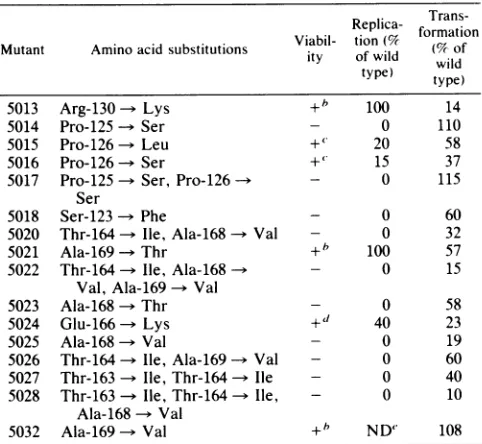
a Viability was measured as theabilityto formplaquesonmonolayers of BSC40cells at37°C, replicationwasmeasuredin BSC40 cellsat37°C,and transformation was measured by densefocusassay on ratcell linesREF52
andRat-1.Thenumbersof fociper dish on REF52cells variedbetween 80 and 110with the wild-typeSV40-pBR322recombinantpSVB3.but onRat-1cells thenumberswere 20 to 30fociperdish.Data areshownonly fortheREF52
cellline. Foci werepresentinassays on Rat-1 cellswith all ofthe mutants
listedexcept5032.whichwas notassayed. bWild-type plaquemorphology. ' Smallplaque morphology.
dSmallplaque morphology,slightly cold sensitive.
eND,Not done.
replication was detectable. Those mutants that produced
plaques (5013, 5015, 5016, 5021, 5024) all replicated their DNA as expected. Since mutant 5032 produced plaques of wild-type morphology, it would also be expected to be
positive in this assay although it was not tested. Mutant
5024, which formed late-appearing small plaques at 37 and
32°C,
replicatedits DNA toapproximately40%
that of wildtype at bothtemperatures (Table 3).
Morphological transformation of nonpermissive rodent cells. The ability of the T-antigen mutants to transform nonpermissive cells in culture was tested on two rat cell
lines, the REF52 line and the Rat-1 line, using the dense
focusassayofTodaroandGreen(77). All mutants, whether
viable or not, were able to induce foci with various ef-ficiencies on both cell lines (Table3). Thus, the transforma-tion functransforma-tion by this assay is relatively insensitive to
muta-tionsin theregion oftheT-antigen gene between nucleotides 4450and 4429 and nucleotides 4330 and 4312.
DISCUSSION
We report the isolation and preliminary characterization
of16 newSV40 mutants with amino acidsubstitutions in the largeTantigen. The mutations were targeted to a region near 0.5 m.u. on the viral genome, using the heteroduplex de-letion loop mutagenesis procedure for directing sodium bisulfite-induced transitions. Nucleotide changes were deter-mined by DNA sequence analysis, and in those cases in which a mutant exhibited an altered phenotype, marker rescueexperimentswerecarried out to confirm the locations of the mutations responsiblefor the phenotype.
on November 10, 2019 by guest
http://jvi.asm.org/
[image:5.612.59.300.531.697.2]6 PEDEN AND PIPAS
0.64 053
5163 4918
T antigen gene
4572 1137
D3
0.17 m.u.
4002 1138
C3
HindI-B
5171 4002
4876
RsaI-B Alul-C
4168
4643 4314
5 Hinfl-C 4376
FIG. 4. Map positions of the fragments used for marker rescue. The T-antigen gene from m.u. 0.64 to 0.17 is shown at the top, and the region from nucleotide 5163 (0.64 m.u.) to nucleotide 4002 (0.42 m.u.) is expanded. The open boxes represent the locations of the deletions ind11137andd11138,and the extent and nucleotidelimits of the fragments found to marker rescue the mutations of the points mutants are shown.
Three ofthe mutants (5013, 5021, 5032) hadnormal plaque
morphologies and, where tested, replicated their DNA to
levels similarto that of wild-typeSV40.These mutants were
also capable of inducing dense foci on REF52 cells. We
conclude that substitutions ofLysforArg atposition130and of eitherVal orThrforAla atposition 169do not alter the
ability ofTantigen to supportproductive viralinfection or
transformation.
Three mutants (5015, 5016, 5024) displayed a reduced
abilityto replicate their DNAas well as an altered plaque
morphology. Mutants5015 and 5016 change Pro-126toLeu or toSer,respectively. Both formed small plaques relativeto wild type at the three temperatures tested. Therefore, the
abilitytoundergoa productive infection is reduced but not
abolished in these mutants.
Themutation in 5024 results in the substitution ofLysfor Gluatposition166.Thissameresidue is changedtoGln ina mutant selected as apseudorevertant ofanorigin-defective
mutant (37, 62). Since the revertant produces a T antigen capable of functioning witha number ofmutant origins(61) that are defective with the wild-type T antigen (37), it indicates thatthis region of the proteinis important forthe
interaction with theoriginofreplication. Mutant 5024 has a
cold-sensitive phenotype,formingsmallplaquesthat appear
lateat32°C. ViralDNAreplication is reduced toabout40%
of the level ofwild-type SV40 at both 32 and 37°C. Since 5024iscapable of replicatingits DNA at32°Cbut forms very small plaques at this temperature, we suggest that the T
antigen of 5024 is defective in an essential function for productive infection other than DNA replication, such as
activation oflate transcription, processing ortranslation of latemRNA, orencapsidation.
The remaining 10 mutants were defective for plaque formation atall three temperatures tested, and allfailed to
replicate their DNA to a detectable level. Two of these mutants, 5014 and 5017, contain a substitution of a Ser for Pro atposition 125: mutant 5014 carries thesingle substitu-tionwhile 5017 has an additional change ofPro-126 to Ser.
Thus, while replacement of Pro-126 with eitherLeu (mutant
5015)orSer(mutant 5016)leads to a partially active protein,
substitution oftheadjacent Pro-125 with Serresults in a T
antigen unable to replicate its DNA and unable to form plaques. Similarly, a substitution of Phefor Seratposition
123 (mutant 5018) and either Thr (mutant 5023) or Val
(mutant5025) for Ala-168 leadstotheDNA replication-nega-tive phenotype. Thr-164 may be critical for the replication function ofTantigen, sincemutant 5026, which carries the double substitution Thr-164 to Ile and Ala-169 to Val, is defective, whilemutant5032, which has thesingle substitu-tion at position 169, is viable. Two mutants (5027, 5028)
carry substitutions ofIlefor Thr-163. However, the
impor-tanceof this changecannotbeassessed, since both also have the lethal replacement Thr-164 to Ile. In summary, we
obtained amino acid substitutionsat ninepositions.
Altera-tions at four of these residues, Ser-123, Pro-125, Thr-164, andAla-168,destroyed the
ability
ofTantigen
tosupportthe replication of viralDNA. Substitutionsatanothertwo posi-tions, Pro-126and Glu-166, reduced the level of viral DNAreplication relative to wildtype.
Therefore,
thereplication
function oflargeT
antigen
isvery sensitivetomutations inthisregion oftheprotein.
Incontrast, theability of SV40 large T
antigen
to induce cellular transformation was notaffectedappreciably
in any of themutants sofar tested. Of the 10mutantsthatshowed no detectable viral DNA replication in monkey cells, all werecapable oftransformingthe REF52 ratcelllineby the dense focus assay. We conclude that at least one of the activities of T antigen necessary for DNAreplication
inpermissivecells is not
obligatory
to inducethe transformedphenotype in nonpermissive cells and,
therefore,
the twoactivitiesare separableby mutation.
This conclusion issupported
by
thefindings
ofothers(18,
36, 39)that SV40genomes isolated from transformed cells
frequently possess point mutations between 0.45 and 0.5 m.u.oftheT-antigengene that resultinthesame
phenotype.
Replacementsof Thr for Asn-153 (18),GlnforHis-203
(36),
J. VIROL.
on November 10, 2019 by guest
http://jvi.asm.org/
[image:6.612.141.479.65.286.2]wt 5024 5018 5015 5016
1 2 3 4 i2 3 4 I2 3 4 5 6 2 3 4 5 6 1 2 3 4 5 6
-.. iu4 -w
Am gm do-_04Mlft - 007
FIG. 5. Replication ofSV40 pointmutantDNA inmonkey cells.Subconfluent BSC40 cellmonolayersweretransfected withpointmutant DNA orpointmutantDNAplushelperd11007DNA.HirtDNA wasprepared (48, 49)atdifferent times afterinfection,purified, digestedwith DpnI andBcII, fractionated byelectrophoresis on 1.2% agarose gels, transferred tonitrocellulose, and hybridized with32P-labeled SV40 DNA.DNAwaspreparedatthefollowing timesposttransfection:24 h(lanes 1), 36 h (lanes 2), 48 h(lanes 3),72h(lanes4) 36 hwithdl1007 added(lanes 5), 48hwithdl1007added(lanes 6).
Glu forLys-214 (69), and Glu for Lys-224 (36) also conferred
the replication-negative, transformation-competent
pheno-type. Furthermore, Pearson-White and Nathans (personal communication) constructed a mutant, 1153, containing an
additional Ile residue inserted between amino acids 143and
144.Thismutant also possessed thesame phenotype.
Recently,Kalderon andSmith(24)describedanextensive seriesofmutantsconstructed in vitro byamethodanalogous
tothe one used here and reachedsimilarconclusions. From thecombined results, itcanbeconcluded that the region of
Tantigenwheremutationscan leadtothereplication
nega-tive, transformation-competent phenotype can be extended to include amino acids 106 to 224. It remains possible, of
course, that mutations in other regions ofthe protein will
also result in this phenotype. Infact, Manos and Gluzman (35)have shownrecentlythatsubstitution ofArgforLys-516 or ofSer for Pro-522 results in the same phenotype and, therefore, this part ofT antigen must be involved, either directly orindirectly, in DNA replication.
While the molecular basis for the mutationalseparation of thetransformation and replication functions of T antigen is notunderstood, the simplest possibility is that these muta-tionsdestroyabiochemical activity of Tantigen required for viral DNA replication while leaving those activities that mediate transformation untouched. A detailed examination
ofthebiochemical properties ofthemutant proteinswill be necessary to differentiate between thepossible mechanisms.
Of interest in this regard will be whether the mutant T
antigens bind
specifically
totheorigin
ofSV40DNAreplica-tion. Experiments with other
replication-negative,
trans-formation-competent mutant T
antigens
have shown that some areable tobindinaMcKayassay(41) while othersare not(36,51),suggestingthat theinabilitytobindtotheoriginof DNA
replication
cannot be the only mechanism thatresults in the
replication-negative
phenotype.Mutants have been isolated that replicate theirDNAbut have areduced potential to induce morphological transfor-mation ofnonpermissive cells. Cosman and Trevethia (11) described a mutant, tsA1642, that is temperature sensitive forlytic growth,
replicates
its DNA, butis unableto trans-form mouseembryo fibroblasts. Mutant5002, whichhas twoamino acid substitutions in the first exon ofT antigen, is
unable to transform REF52 cells but replicates itsDNA to about50% of wild-typelevels(K. W. C.Peden,unpublished observations). These two mutants suggest that the
replica-tion activity may not be sufficient forthe transformation of
nonpermissive
cells.Finally, we point out that site-directed mutagenesis pro-vides apowerfultool forintroducingchanges intoregions of proteins thought to be offunctional significance. Such
re-gions may be identified by virtue oftheirprimary structure or indicated by previous genetic analysis. Thus, specific hypotheses concerning structure-function relationships can be tested. Along these lines, we are currently directing
mutations to otherpartsofTantigensuch as theaminoacids known to be phosphorylated (80), the regions conserved
on November 10, 2019 by guest
http://jvi.asm.org/
[image:7.612.119.497.66.373.2]8 PEDEN AND PIPAS
among thevariouspapovavirus T antigens (13), the residues towhich the ATPaseactivity has been localized (8, 10), and the majorhydrophobicregion of the protein.
ACKNOWLEDGMENTS
WethankDaniel Nathans for continued interest and support and for comments on the manuscript. In addition, we would like to express gratitudeto theparticipants of the Cedar Bay Conference for lively criticism of the work, to Laura Sanders and Fredda Slutzman for able technical assistance, to Jacque Migeon for se-quencing some of the mutants, and to Doris Wiczulis and Lily Cowan fortyping themanuscript.
This work was supported byPublic Health Servicegrant 5 P01 CA16519 from the National Cancer Institute andgrant MV-182from theAmericanCancerSociety.
LITERATURECITED
1. Alwine, J. C.,S.I.Reed,andG. R. Stark. 1977. Characteriza-tion of the autoregulaCharacteriza-tion of simian virus 40 gene A. J. Virol. 24:22-27.
2. Ariga, H., and S. Sugano. 1983. Initiation of simian virus 40 DNAreplication in vitro. J.Virol. 48:481-491.
3. Brockman, W. W. 1978. Transformation ofBALB/c-3T3 cells bytsAmutantsof simian virus40: temperaturesensitivity of the transformed phenotype and retransformation by wild-type vi-rus. J.Virol. 25:860-870.
4. Brockman, W. W., T. N. H. Lee, and D. Nathans. 1973. The evolution ofnew species of viralDNAduring serialpassageof simianvirus40 athigh multiplicity. Virology 54:384-397. 5. Brockman, W. W., and D. Nathans. 1974. The isolation of
simianvirus40variants withspecifically alteredgenomes.Proc. Natl.Acad. Sci. U.S.A. 71:942-946.
6. Brugge, J. S.,andJ. S. Butel. 1975. Involvement of the simian virus40 gene Afunction inthemaintenance oftransformation. J. Virol. 15:619-635.
7. Chou, J. Y.,andR. G. Martin. 1975. DNAinfectivityand the induction of host DNA synthesis with temperature-sensitive mutants of simian virus40. J.Virol. 15:145-150.
8. Clark, R., D. Lane, and R. Tjian. 1981. Use of monoclonal antibodies as probes of simian virus 40 T antigen ATPase activity. J. Biol. Chem.256:11854-11858.
9. Clark, R., K. Peden, J. M. Pipas, D. Nathans, and R. Tjian. 1983. Biochemical activities ofT-antigen proteins encoded by simian virus 40 A gene deletion mutants. Mol. Cell. Biol. 3:220-228.
10. Clertant,P., andI.Seif. 1984. A commonfunction forpolyoma viruslarge-T andpapilloma virus El proteins?Nature(London) 311:276-279.
11. Cosman,D.J., and M. J. Trevethia. 1981.Characterization ofa
temperature-sensitive, DNA-positive, nontransforming mutant ofsimian virus40. Virology 112:605-624.
12. Cowan,K., P. Tegtmeyer, and D. D. Anthony. 1973. Relation-ship of replication and transcription of simian virus 40 DNA. Proc.Natl. Acad. Sci. U.S.A.70:1927-1930.
13. Friedman, T., A. Esty, P. LaPorte, and P.Deininger. 1979.The nucleotide sequence andgenome organization of the polyoma early region: extensive nucleotide and amino acid homology withSV40. Cell17:715-724.
14. Frost, E., and J. Williams. 1978.Mapping temperature-sensitive and host-range mutations of adenovirus type 5 by marker rescue. Virology91:39-50.
15. Galanti, N., G. J. Jonak, K. J. Soprano, J. Floros, L. Kaczmarek,S. Weissman,V.B.Reddy,S. M.Tilghman,and R.
Baserga.1981.Characterizationandbiologicalactivityof cloned simianvirus40 DNAfragments.J.Biol. Chem.256:6469-6474. 16. Giacherio, D., and L. P. Hager. 1979. A poly dT stimulated ATPaseactivityassociated withSV40largeTantigen. J. Biol. Chem.254:8113-8116.
17. Giza, P. E.,D. M.Schmit,and B. L. Murr. 1981. Region-and strand-specific mutagenesis of a recombinant plasmid. Gene 15:331-342.
18. Gluzman,Y., and B. Ahrens. 1982.SV40earlymutantsthatare
defectiveforviral DNAsynthesis but competent for transforma-tionofculturedratand simiancells. Virology123:78-92. 19. Gluzman, Y., J. Davison, M. Oren, and E. Winocour. 1977.
Properties of permissive monkey cells transformed by UV-ir-radiatedsimian virus 40.J. Virol. 22:256-266.
20. Graham, F. L.,and A.J. van der Eb. 1973. A new technique for the assay of infectivity ofhumanadenovirus5DNA. Virology 52:456-467.
21. Hiscott, J. B., and V. Defendi. 1979. Simian virus 40 gene A regulationof cellular DNA synthesis. I. In permissive cells. J. Virol. 30:590-599.
22. Hiscott, J. B., and V. Defendi. 1981. Simian virus 40 gene A regulation of cellularDNAsynthesis. II. In nonpermissivecells. J. Virol. 37:802-812.
23. Holmes, D. S., andM. Quigley. 1981. A rapid boiling methodfor the preparation of bacterial plasmids. Anal. Biochem. 114:193-197.
24. Kalderon, D., andA. E. Smith. 1984. Invitro mutagenesis ofa putative DNA binding domain of SV40 large-T. Virology 139:109-137.
25. Keller, J. M., and J. C. Alwine. 1984. Activation oftheSV40 latepromoter: direct effectsof Tantigenin the absenceofviral DNAreplication. Cell36:381-389.
26. Khoury, G., and E. May. 1977. Regulation of early and late simian virus 40transcription: overproduction of earlyviral RNA intheabsenceofafunctional T-antigen.J. Virol. 23:167-176. 27. Kimura, G., and R. Dulbecco. 1973. A temperature-sensitive
mutantofsimian virus 40affectingtransforming ability. Virol-ogy52:529-534.
28. Kirmura, G., and A. Itagaki. 1975.Initiation andmaintenance of celltransformation bysimian virus 40: aviral genetic property. Proc. Natl. Acad. Sci. U.S.A.72:673-677.
29. Lai,C.-J., and D. Nathans. 1975. A map of temperature-sensi-tivemutantsofsimian virus40.Virology66:70-81.
30. Lane, D. P., and L. V. Crawford. 1979. T antigen is bound to a host protein in SV40-transformed cells. Nature (London) 278:261-263.
31. Lederberg, E. M., and S. N. Cohen. 1974. Transformation of Salmonella typhimurium by plasmid deoxyribonucleic acid. J. Bacteriol. 119:1072-1074.
32. Li, J. J., and T. J. Kelly, Jr. 1984. Simian virus 40 DNA replication in vitro. Proc. Natl. Acad. Sci. U.S.A. 81: 6973-6977.
33. Linzer, D. I. H., and A. J. Levine. 1979. Characterization ofa 54K dalton cellular SV40 tumor antigen present in SV40-transformed cells and uninfected embryonal carcinoma cells. Cell17:43-52.
34. Maniatis, T., A. Jeffrey, and D. G. Kleid. 1975. Nucleotide sequence of the rightward operator of phage X. Proc. Natl. Acad. Sci. U.S.A. 72:1184-1188.
35. Manos, M. M., and Y. Gluzman. 1984. Simian virus 40 large T-antigen pointmutantsthat aredefective in viralDNA replica-tion but competent in oncogenic transformation. Mol. Cell. Biol. 4:1125-1133.
36. Manos, M. M., and Y. Gluzman. 1985. Genetic and biochemical analysis of transformation-competent, replication-defective simian virus40largeTantigenmutants. J. Virol. 53:120-127. 37. Margolskee,R.F., and D. Nathans. 1984. Simianvirus40mutant
Tantigens with relaxedspecificity for the nucleotide sequence atthe viral DNAorigin of replication. J.Virol.49:386-393. 38. Martin, R. G., and J. Y. Chou. 1975. Simian virus40functions
required for the establishment and maintenance ofmalignant transformation. J. Virol. 15:599-612.
39. Maxam, A. M., and W. Gilbert. 1980. Sequencing end-labeled DNA withbase-specific chemical cleavages.MethodsEnzymol. 65:499-560.
40. McCutchan, J. H., and J. S. Pagano. 1968. Enhancement of the infectivityofsimianvirus 40deoxyribonucleicacid with diethyl-aminoethyl-dextran. J. Natl. CancerInst. 41:351-357. 41. McKay, R., and D. DiMaio. 1981. Binding of an SV40 T
antigen-relatedproteintothe DNAof SV40regulatorymutants. Nature(London)289:810-813.
42. McKay, R. D. G. 1981. Bindingofasimian virus 40 T antigen-J. VIROL.
on November 10, 2019 by guest
http://jvi.asm.org/
related proteintoDNA. J. Mol. Biol. 145:471-488.
43. Meselson,M., and R. Yuan.1968.DNArestrictionenzymefrom E. coli.Nature (London)217:1110-1114.
44. Osborn, M., and K. Weber. 1975. Simian virus 40 gene A function and maintenance of transformation. J. Virol. 15:636-644.
45. Parker, B. A., and G. R. Stark.1979. Regulation ofsimianvirus 40transcription: sensitive analysis oftheRNAspeciespresent
earlyininfectionsbyvirusorviral DNA.J. Virol.31:360-369. 46. Peden, K., P. Mounts, and G. S. Hayward. 1982. Homology between mammalian DNA sequences and human herpesvirus
genomes detected by a hybridization procedure with
high-complexity probe. Cell 31:71-80.
47. Peden, K. W. C., and D. Nathans. 1982. Local mutagenesis within deletion loops of DNA heteroduplexes. Proc. Natl. Acad. Sci. U.S.A.79:7214-7217.
48. Peden,K. W.C., J. M. Pipas, S.Pearson-White,and D. Nathans. 1980. Isolation ofmutantsofananimal virus in bacteria.Science 290:1392-1396.
49. Pipas, J.M., K.W. C.Peden, and D. Nathans.1983. Mutational analysis of simianvirus40Tantigen: isolationand characteriza-tion ofmutantswithdeletionsinthe T-antigengene.Mol. Cell.
Biol.3:203-213.
50. Pope, J.H., and W. P. Rowe.1964.Detectionof specific antigen in SV40-transformed cells by immunofluorescence. J. Exp. Med. 120:121-128.
51. Prives, C., L. Covey, A. Scheller, and Y. Gluzman. 1983. DNA-binding properties of simianvirus 40T-antigen mutants defective in viral DNAreplication.Mol.Cell.Biol.3:1958-1966. 52. Reed, S.I.,J. Ferguson, R. W. Davis, and G. R.Stark. 1975. T
antigenbindsto SV40attheorigin of DNAreplication. Proc. Natl. Acad. Sci. U.S.A.72:1605-1609.
53. Reed,S. I.,G. R. Stark, and J. C. Alwine. 1976.Autoregulation
ofsimian virus40geneAbyTantigen. Proc.Natl. Acad. Sci.
U.S.A.73:3083-3087.
54. Rigby,P. W. J., M. Dieckmann, C. Rhodes, and P. Berg. 1977. Labellingdeoxyribonucleic acidtohigh specific activityin vitro by nick translation with DNA polymerase I. J. Mol. Biol.
113:237-251.
55. Rosenthal, L. J., and M. Brown. 1977. The control of SV40 transcription during lytic infection: late RNA synthesis inthe
presenceof inhibitors of DNAreplication. Nucleic Acids Res. 4:551-565.
56. Sanger, F.,and A. R. Coulson. 1978. Theuseof thinacrylamide
gelsforDNAsequencing. FEBS Lett.87:107-110.
57. Scott,W.A., W. W.Brockman, and D. Nathans. 1976. Biologi-cal activities of deletion mutants ofsimian virus 40. Virology 75:319-334.
58. Shalloway, D., T. Kleinberger, and D. M. Livingston. 1980. Mapping ofSV40DNAreplication origin region binding sitesfor the SV40 T antigen by protection against exonuclease III digestion. Cell20:411-422.
59. Shiroki, K., and H. Shimojo. 1971. Transformation ofgreen
monkey kidney cells by SV40 genome; the establishment of transformedcell lines and thereplication ofhuman adenovirus andSV40intransformed cells. Virology45:163-171.
60. Shortle, D., and D. Nathans. 1978.Localmutagenesis:amethod for generating viral mutants with base substitutions in preselected regionsof the viralgenome.Proc. Natl. Acad.Sci.
U.S.A.75:2170-2174.
61. Shortle, D., and D. Nathans. 1979.Regulatorymutantsof simian
virus 40: constructed mutants with base substitutions of the originof viral DNAreplication. J. Mol. Biol. 131:801-817. 62. Shortle,D.R.,R. F.Margolskee, andD.Nathans. 1979.
Muta-tionalanalysis of the simian virus 40 replicon: pseudorevertants ofmutantswithadefectivereplicationorigin. Proc. Natl. Acad. Sci. U.S.A. 76:6128-6131.
63. Smith, H. 0. 1980. Recovery of DNA from gels. Methods Enzymol. 65:371-380.
64. Soprano, K. J.,V.G. Dev, C.M.Croce,and R. Baserga.1979. Reactivation of silent rRNA genes by simian virus 40 in human-mouse hybrid cells. Proc. Natl. Acad. Sci. U.S.A. 76:3885-3889.
65. Soprano, K. J., N. Galanti, G.J. Jonak, S. McKercher, J. M. Pipas, K. W. C. Peden, and R. Baserga. 1983. Mutational analysis of simian virus 40 T antigen: stimulation of cellular DNAsynthesis andactivation of rRNA genes by mutants with deletions in the T-antigen gene. Mol. Cell. Biol. 3:214-219. 66. Soprano,K.J.,M.Rossini, C.Croce,and R.Baserga.1980. The
role of large T antigen in SV40-induced reactivation of silent rRNA genes in human-mouse hybrid cells. Virology 102: 317-326.
67. Southern, E. M. 1975. Detection ofspecific sequences among DNAfragments separated by gelelectrophoresis. J. Mol. Biol. 98:503-517.
68. Steinberg, B., R. Pollack, W. Topp, and M. Botchan. 1978. Isolation and characterization ofTantigen-negative revertants from aline of transformedratcellscontainingonecopyof the SV40 genome. Cell 13:19-32.
69. Stringer, J.R. 1982.Mutantof simian virus 40 largeT-antigen that is defective for viral DNA synthesis, but competent for transformation of culturedratcells. J.Virol. 42:854-864. 70. Suarez, H. G., M. F. Bourali, R. Wicker, S. Estrada, and C.
Cassingena. 1972. Properties ofan SV40-transformed African green monkey kidney (BSC-1) cell line. Int. J. Cancer 9:324-333.
71. Tegtmeyer, P. 1972. Simian virus 40 deoxyribonucleic acid synthesis: the viralreplicon. J. Virol. 10:591-598.
72. Tegtmeyer, P. 1975. Function of simian virus 40 gene A in transforming infection. J. Virol. 15:613-618.
73. Tegtmeyer, P.,M.Schwartz, J.K.Collins,and K. Rundell.1975. Regulation oftumorantigensynthesis by simian virus40gene A.J. Virol. 16:168-178.
74. Tjian, R. 1978. The binding site on SV40 DNA for a T antigen-related protein. Cell 13:165-179.
75. Tjian, R.,G.Fey,and A.Graessmann.1978. Biological activity ofpurifiedsimian virus 40 Tantigenproteins. Proc. Natl. Acad. Sci. U.S.A. 75:1279-1283.
76. Tjian, R.,and A.Robbins.1979.Enzymaticactivitiesassociated withapurified simian virus40Tantigen-related protein. Proc. Natl. Acad. Sci. U.S.A.76:610-614.
77. Todaro, G. J., and H. Green. 19764. An assay for cellular transformation bySV40. Virology 23:117-119.
78. Tooze, J. 1981. DNAtumorviruses: molecularbiologyoftumor viruses, 2nd ed., rev.,p. 799-841.ColdSpring Harbor Labora-tory, Cold Spring Harbor,N.Y.
79. Topp, W. C. 1981. Normal rat cell lines deficient in nuclear thymidine kinase. Virology 113:408-411.
80. VanRoy, F.,L.Fransen,and W.Fiers.1983.Improved localiza-tionof phosphorylation sites insimian virus40largeTantigen. J. Virol. 45:315-331.