City, University of London Institutional Repository
Citation
:
Haddad, M. ORCID: 0000-0002-4822-5482, Pinfold, V., Ford, T., Walsh, B. and Tylee, A. (2018). The effect of a training programme on school nurses’ knowledge, attitudes, and depression recognition skills: The QUEST cluster randomised controlled trial.International Journal of Nursing Studies, 83, pp. 1-10. doi: 10.1016/j.ijnurstu.2018.04.004
This is the accepted version of the paper.
This version of the publication may differ from the final published
version.
Permanent repository link:
http://openaccess.city.ac.uk/id/eprint/19516/Link to published version
:
http://dx.doi.org/10.1016/j.ijnurstu.2018.04.004Copyright and reuse:
City Research Online aims to make research
outputs of City, University of London available to a wider audience.
Copyright and Moral Rights remain with the author(s) and/or copyright
holders. URLs from City Research Online may be freely distributed and
linked to.
The effect of a training programme on school nurses' knowledge, attitudes, and
1
depression recognition skills: The QUEST cluster randomised controlled trial.
2
3
Mark Haddad§1, Vanessa Pinfold2, Tamsin Ford4, Brendan Walsh5, Andre Tylee3
4
5
1School of Health Sciences, City University of London, London UK
6
2
McPin Foundation http://mcpin.org/
7
3
Health Service & Population Research Department, Institute of Psychiatry, Psychology and
8
Neuroscience, King's College London, London, UK
9
4
University of Exeter Medical School
10
5
Economic and Social Research Institute, Dublin, Ireland
11
§
Corresponding author
12
13
Published in: International Journal of Nursing StudiesVolume 83, July 2018, Pages 1-10
14
https://doi.org/10.1016/j.ijnurstu.2018.04.004
15
16
17
Abstract
18
Background
19
Mental health problems in children and young people are a vital public health issue. Only
20
25% of British school children with diagnosed mental health problems have specialist mental
21
health services contact; front-line staff such as school nurses play a vital role in identifying
22
and managing these problems, and accessing additional services for children, but there
23
appears limited specific training and support for this aspect of their role.
24
Objectives
25
To evaluate the effectiveness of a bespoke short training programme, which incorporated
26
interactive and didactic teaching with printed and electronic resources. Hypothesized
27
outcomes were improvements in school nurses’ knowledge, attitudes, and recognition skills
28
for depression.
29
Design
30
A cluster-randomised controlled trial.
31
Participants and setting
32
146 school nurses from 13 Primary Care Trusts (PCTs) in London were randomly allocated to
33
receive the training programme.
34
Methods School nurses from7 PCTs (n=81) were randomly allocated to receive the training
35
intervention and from 6 PCTs (n=65) for waiting list control. Depression detection was
36
measured by response to vignettes, attitudes measured with the Depression Attitude
37
Questionnaire, and knowledge by the QUEST knowledge measure. These outcomes were
38
measured at baseline and (following training) 3 months and nine months later, after which
39
nurses in the control group received the training programme.
40
Results At 3 months, 115 nurses completed outcome measures. Training was associated with
41
significant improvements in the specificity of depression judgements (52.0% for the
42
intervention group and 47.2% for the control group, P=0.039), and there was a non-significant
43
increase in sensitivity (64.5% compared to 61.5% P=0.25). Nurses’ knowledge about
44
depression improved (standardised mean difference = 0.97 [95% CI 0.58 to 1.35], P<0.001);
45
and confidence about their professional role in relation to depression increased. There was
46
also a significant change in optimism about depression outcomes, but no change in tendency
47
to defer depression management to specialists. At 9-month follow-up, improved specificity in
48
depression identification and improved knowledge were maintained.
49
Conclusions
50
This school nurse development programme, designed to convey best practice for the
51
identification and care of depression, delivered significant improvements in some aspects of
52
depression recognition and understanding, and was associated with increased confidence in
53
working with young people experiencing mental health problems.
54
Keywords
1
Attitude; Depression; Education, Professional; Knowledge; Mental Health; Nurses, Public
2
Health
3
4
Contribution of the Paper.
5
What is already known about the topic?
6
Mental health problems affect one in ten young people, and these problems have
7
substantial impacts on achievement and wellbeing in adulthood.
8
Specialist services intervene with only a minority of young people with mental health
9
problems, and there is an urgent need to enhance the involvement of front-line
10
professionals such as school nurses in problem recognition and management.
11
Systematic reviews indicate that universal and targeted health promotion
12
interventions are effective for a range of mental health, social and educational
13
outcomes, and that such interventions can be delivered and facilitated by routine staff
14
(such as teachers) rather than clinical specialists.
15
16
What this paper adds
17
A brief, multifaceted educational programme for school nurses was developed on the
18
basis of review and consultation with stakeholder groups including a survey and
19
focus groups.
20
Our evaluation showed that this educational intervention was associated with some
21
positive improvements in school nurses’ attitudes to depression and its management,
22
increases in their knowledge, and improvement in their ability to differentiate
23
depression from other problems that young people experience.
24
Because of the design and methods used, this evidence that brief training can enhance
25
aspects of attitudes, knowledge and problem detection appears robust and
26
generalisable.
27
28
Background
29
The mental health of children and young people is a fundamental part of their overall quality
30
of life, strongly influencing their current and future wellbeing and life chances. This is
31
explicitly recognized by the Convention on the Rights of the Child (UN General Assembly
32
1989), and a raft of policy initiatives in the United Kingdom (UK) (Department of Health
33
2015, Public Health England and The Children and Young People’s Mental Health Coalition
34
2015), Europe (Braddick et al. 2009), the USA (AACAP 2009), and elsewhere (Currie et al.
35
2012).
36
37
Many mental health problems commence in early life: a systematic review of studies
38
incorporating standardised diagnostic assessments indicates a world-wide pooled prevalence
39
of 13.4% among children and adolescents (Polanczyk et al. 2015). Anxiety and depressive
40
disorders make up around half of this (Green et al. 2005). These problems are associated with
41
social and educational under-achievement (Esch et al. 2014), higher rates of smoking and
42
substance misuse (Davis et al. 2008), increased risks of teenage pregnancy (Mollborn &
43
Morningstar 2009), of self-harm, and of suicidal ideas and completed suicide (Mars et al.
44
2014, Goldman-Mellor et al. 2014).
45
46
Psychological problems in young people frequently persist into adulthood. Population based
47
epidemiological studies of lifetime and initial occurrence of mental health problems in the
48
USA (Kessler et al. 2007) and cohort and follow-up studies the UK (Kim-Cohen et al. 2003,
49
Ford et al. 2017) show extensive problem persistence; half of those people with lifetime
50
problems experience initial symptoms by the mid-teenage years, and (excluding dementia)
51
three-quarters of mental health problems in adult life start by the mid-20s. Prospective British
52
cohort data over a 50-year follow-up period provides powerful evidence of long-term impacts
53
are reduced by 28%, the probability of working is 11% lower, and there are consistent
1
reductions in memory, emotional stability and personality components of agreeableness and
2
conscientiousness (Goodman et al. 2011).
3
4
There is widespread stigma associated with mental health problems, and for this reason
5
together with heterogeneity of presentation, a large proportion of young people with mental
6
health problems are not identified and offered evidence-based support and treatment. Among
7
all age groups, people may have uncertainties and fears about depression and its treatment,
8
but these difficulties may be particularly relevant to young people, resulting in low levels of
9
help-seeking from mental health professionals (Gulliver et al. 2010) as well as from
non-10
professional supports (Biddle et al. 2004). Health professionals experience difficulty in
11
accurately recognising depression in all age groups, with a systematic review indicating that
12
around half of people presenting with depression are not correctly identified by nurses
13
(Mitchell & Kakkadasam 2011). The life stage transitions characteristic of adolescence may
14
influence health professionals’ recognition of depression in this age group, with clinical
15
features possibly interpreted as transient responses to life problems or teenage angst (Patton et
16
al. 2014).The ability of health professionals to identify depression is affected by these factors,
17
as well as by their confidence in their own skills and in the available treatment and support
18
approaches (Haddad et al. 2009).
19
20
This is important as unrecognised problems indicate missed opportunities to intervene to
21
interrupt the trajectories associated with long-term negative outcomes (de Girolamo et al.
22
2012). There appear to be widespread delays between the emergence of psychological
23
problems and treatment contacts, with World Health Organisation (WHO) World Mental
24
Health survey findings indicating that within high-income nations, where services are most
25
available and accessible, the median treatment delay is between 10 and 28 years for anxiety
26
disorders, and between 1 and 4 years for mood disorders (Wang et al. 2007). Studies in the
27
UK indicate similarly low rates of specialist service contact, with only 25% of young people
28
with clinically impairing problems in contact with specialist mental health services, though
29
twice as many in contact with primary health care professionals and teachers (Ford et al.
30
2007). The impact of mental health problems together with the extent of unmet need
31
underline the importance of all professionals working with children, particularly those within
32
universal children’s health services and primary health care, having key skills in identifying
33
and managing common difficulties, together with knowledge about how to access more
34
specialised services for those children they cannot manage themselves (Ford et al. 2007).
35
36
Basing mental health promotion and prevention activities within school fits logically with
37
their expanding role with greater focus on health and well-being (OECD 2014). School-based
38
mental health initiatives include universal whole-school programmes, typically addressing
39
areas such as problem solving, interpersonal skills, empathy, and coping with stress (Fazel et
40
al. 2014, Sancassiani et al. 2015) to targeted or selective interventions addressing those
41
judged to be at increased risk of developing problems or displaying subclinical symptoms.
42
Findings from evaluation studies provide conflicting evidence: a review of the effectiveness
43
of universal school-based health promotion showed positive effects of interventions for
44
physical activity and healthy eating outcomes, tobacco use, and being bullied, but a lack of
45
evidence for mental health benefits (Langford et al. 2014). However, a review that
46
specifically focused on depression prevention programmes for children and young people
47
found modest evidence that both universal and targeted interventions were effective, the
48
authors concluding that schools remain one of the most promising sites for the delivery of
49
programmes, and that universal roll-out has much to offer (Merry et al. 2011).
50
51
Providing front-line staff with the knowledge and skills to promote good emotional health and
52
to deliver early interventions for children at risk of developing mental health problems has
53
been widely advocated as an important part of addressing this issue (Hoge et al. 2009, EU
54
children’s services (Department of Health, 2004) specified that that all staff working directly
1
with children and young people should have sufficient knowledge, training, and support to
2
promote psychological well-being and to identify early indicators of difficulty, and this key
3
theme has been re-iterated and developed in successive review policy documents and clinical
4
guidelines (NICE 2005, HM Treasury 2008, Department of Health 2008, NICE 2013).
5
6
In the UK, and several European countries, school nurses are registered nurses who typically
7
hold a further postgraduate education in Specialist Community Public Health Nursing,
8
whereas in the USA and Australia, school nurses do not necessarily hold specialist advanced
9
practice qualifications. They are key providers of public health interventions for school-aged
10
children, and are in an ideal position to deliver mental health promotion and prevention
11
activities (Department of Health and Public Health England, 2014). They have been identified
12
as having a key role in this work by their professional organisations in the USA (National
13
Association of School Nurses 2013) and the UK (Royal College of Nursing 2017); and
14
similarly, survey responses from 37 WHO European Region member states reveal that school
15
nurses are the most common health provider in schools and that mental health and
16
behavioural problems alongside life-style health related issues are priority areas for school
17
health (WHO Regional Office for Europe 2010). Key aspects of the school nurse role centre
18
on promoting health and emotional well-being, supporting those with emotional and mental
19
health difficulties and referring to relevant agencies and services where appropriate. This
20
support for children, young people, and families can enable early identification of mental
21
health issues, provision of interventions, and assistance through partnerships with primary
22
and secondary care colleagues and, where relevant, timely referral or signposting to specialist
23
services to ensure problems do not escalate to crisis point (Department of Health 2012).
24
Importantly, school nurses and teachers are the professionals most commonly approached by
25
parents whose children have mental health problems (Ford et al. 2007). The need for mental
26
health support may occur throughout this school-age population, but children with
27
disabilities, those in care, and young carers, including those with family histories of mental
28
health problems, are more vulnerable to difficulties and to poor health outcomes and school
29
nurses may be particularly well-placed to provide support and identify the need for early help
30
among this group.
31
32
In England, school nurses are the biggest workforce specifically trained and skilled to deliver
33
public health for school-aged children; however, since 2013, the responsibility for
34
commissioning public health services has transferred from health services to local
35
government with and there has been a decline in the provision of school nursing services (a
36
14% reduction in full time equivalent [FTE] school nurses from 2013 to 2017 and a 22% FTE
37
reduction since 2010) (NHS Digital 2017).
38
39
The QUEST Project
40
In order to extend understanding of school nurses’ capacity and support needs for working
41
with common mental health problems we set up a project called QUEST – improving school
42
mental health: a quality improvement evaluation for school nurses and teachers, which was
43
supported by The Health Foundation’s Engaging with Quality in Primary Care programme
44
(http://www.health.org.uk/programmes/engaging-quality-primary-care).
45
46
To help determine the best approaches for enhancing school nurses’ confidence and skills in
47
managing common mental health problems, we conducted a UK-wide survey to examine their
48
role, attitudes, and needs in relation to this area of practice (Haddad et al. 2010). This study
49
indicated the extent of school nurses' involvement and commitment to mental health work
50
with young people; 93% agreed that this was an integral part of their job, and for most (55%)
51
this occupied more than a quarter of their work time. However, nearly half (46%) of
52
respondents reporting having not received any post-registration training in mental health.
53
School nurses’ attitudes indicated a rejection of stigmatizing views of depression and strong
54
people who self-harm and recognizing and being better equipped to assist in managing
1
depression and anxiety as key topics for staff development programmes. Focus groups that we
2
conducted with school nurses based in two English cities in a separate study (Pryjmachuk et
3
al. 2012) provided further detail, indicating that they valued involvement with the mental
4
health of young people, and felt this was an important area of their practice, but that a lack of
5
confidence and appropriate training together with extensive workloads were seen as the main
6
obstacles to this area of practice. The importance of support from local specialist mental
7
health teams was also emphasised.
8
9
Study aims and design
10
The QUEST study was designed as a cluster randomised controlled trial (RCT) of a specially
11
developed educational programme. Our main hypotheses were that school nurses who had
12
received QUEST training would show greater sensitivity (correct identification of cases: the
13
true positive rate) and specificity (correct identification of non-cases: the true negative rate)
14
for the recognition of depressive symptoms (using a vignette method) than a control group,
15
and that the trained group would achieve higher knowledge scores and reveal a more positive
16
attitude to depression than the control group. The primary outcome time-point was at
three-17
months following baseline measurement, and a follow-up outcome time-point was at
nine-18
months.
19
20
Ethics and funding
21
Ethical approval to conduct this study was obtained from a designated NRES Committee
22
London (REC Reference No. 08/H0720/42). The study was supported by an Engaging with
23
Quality in Primary Care grant awarded by The Health Foundation, an independent charity that
24
supports health care practice and policy research.
25
26
All participants provided informed consent and took part on a voluntary basis and were not
27
remunerated for their participation.
28
29
Methods
30
Project team and steering
31
A project team was established comprised of clinical academics in partnership with staff from
32
the mental health charity Rethink Mental Illness, school nurse leads from the services of two
33
boroughs in South West London, and a service user representative. A steering group was also
34
formed to oversee the study, made up of key members of the three UK school nurse
35
professional organisations (the Royal College of Nursing [RCN] School Nurses’ Forum,
36
Community Practitioners’ and Health Visitors’ Association [CPHVA], and School and Public
37
Health Nurses’ Association [SAPHNA]), as well academic and clinical experts, teaching
38
staff, and senior representatives from the Department of Health, the Mental Health
39
Foundation and the Charlie Waller Memorial Trust.
40
41
Intervention
42
Based on the findings of our survey and focus groups, together with discussions with a range
43
of stakeholders including young people, mental health charity/user group representatives, and
44
professional organisations leads (RCN, SAPHNA, and CPHVA), we clarified educational
45
needs and related considerations about mode, duration and feasibility. In line with models of
46
behaviour change, we sought to involve school nurses as credible opinion leaders in the
47
development of the training materials, and identified and accessed these nurses through
48
engagement with local and national professional organisations and services (Greenhalgh et al.
49
2004, Prior et al. 2008). A training programme and linked resources were developed based on
50
identified needs together with evidence concerning effective approaches to enabling changes
51
in clinician behaviour (Grimshaw et al. 2004, Lau et al. 2015). The aims of the programme
52
were to enable more accurate identification of depression by school nurses, and to provide
53
them with improved knowledge of available support and management for pupils who were
54
aspects of clinician education and professional development most clearly associated with the
1
uptake of clinical guidelines and consequent improvements in patient outcomes, combining
2
education meetings using mixed interactive and didactic methods delivered during a single
3
(whole day) session and a follow-up (half-day session provided 4-6 weeks later), with a
4
resource package which included printed and audio-materials, including a disc with copies of
5
all materials, addresses and links to relevant tools, guidelines, and support services. The
6
package included summary detail and links to relevant National Institute for Health and Care
7
Excellence (NICE) guidelines and protocols; health status and risk measures including the
8
Moods and Feelings Questionnaire (Angold et al. 1995); and information materials for
9
professionals, for young people and for family members. The training was delivered to groups
10
of school nurses according to their service teams, which at the time of the study (2008-11)
11
were Primary Care Trusts (PCTs): these were the statutory commissioning and health and
12
social care providers, coterminous to London boroughs, and were abolished in 2013 and
13
replaced by clinical commissioning groups (CCGs). The training sessions were delivered with
14
an identical programme and resources by the same trainers (clinicians and service user), with
15
group sizes of around 10 staff attending. Members of the locality specialist mental health
16
team for each of the participating school nurse PCT groups were invited to attend and
17
contribute to part of the training session.
18
19
Measures
20
We evaluated the effect of training by measures of attitudes, knowledge, and depression
21
recognition. We used an existing measure of attitudes, the Depression Attitude Questionnaire
22
(DAQ) (Botega et al. 1992), a 20-item attitude scale that has been used in studies involving
23
general practitioners (GPs) and nurses in the UK and elsewhere (Haddad et al. 2012),
24
including our survey of school nurses. In the DAQ, respondents denote the strength of their
25
agreement or disagreement with statements concerning depression, with factor analysis
26
indicating factors relating to optimistic or pessimistic views about the causes of depression
27
and its responsiveness to treatment, confidence in managing depression as part of one’s
28
professional role, and views about whether depression requires specialist treatments and
29
professionals. Psychometric testing of the DAQ in samples of GPs and nurses has indicated
30
key common attitude factors and internal consistency values between 0.59 and 0.64 for the
31
subscales and between 0.62 and 0.64 for the overall scale (Haddad et al. 2012).
32
33
Because there were no adequate existing measures for depression knowledge and detection
34
we constructed a 24-item test concerning key features, risk factors, management, and referral
35
indicators, and a series of 12 vignettes to evaluate skills in recognising its presenting features.
36
The development of the QUEST measures for depression knowledge and detection are fully
37
described in a previous publication (Haddad & Tylee 2013). In short, these were developed
38
from a review of the literature including clinical guidelines for depression management,
39
mental health literacy materials, and previously developed tests, together with a series of
40
panel group consultations with a group (n = 21) comprised of school nurses, clinical
41
academics, mental health charity staff, and a service user.
42
Four related content areas were covered by the knowledge question set: clinical features -
43
presentation and symptoms (4); condition description (6); risk factors and predictors (7);
44
management/treatments/referral criteria (5). Items were of multiple choice format with a total
45
possible score of 22. The item difficulty index - the percentage of correct responses for each
46
item, with higher values indicating greater ease - ranged between 0.19 to 0.89, with a mean
47
level of 0.48 (Haddad & Tylee 2013).
48
49
Participants’ accuracy of depression identification was measured using a vignette method.
50
Twelve depression vignettes were constructed with the assistance of the project panel to
51
portray either features suggestive of clinical depression or more ambiguous features of
52
distress or adjustment problems (Haddad & Tylee 2013). The likelihood of the features in
53
each of the vignettes representing clinical depression was judged on a four-point scale:
54
1 likely to have some mild features of depression
1
2 likely to have clinically significant features of depression
2
3 highly likely to be clinically depressed
3
4
Scores were converted to a dichotomous rating of non-depressed (0 or 1) or depressed (1 or
5
2). Five of the vignettes represented depression cases, and seven, although manifesting
6
difficulties and distress, were non-cases. The judgement and scoring of 7 clinician experts
7
enabled consensus about depression caseness: the extent of agreement for expert raters’
8
identification of intended cases was 94%, whereas for non-cases, it was 86%. Additionally,
9
the intra-class correlation between the caseness ratings of the different raters for the 12
10
vignettes was determined as 0.733 (95% CI 0.547 to 0.893; df = 11; P<0.001).
11
12
Pilot study
13
To examine the feasibility of recruitment procedures, the acceptability of the training package
14
intervention, the time and capacity to complete the outcome measures, and the response
15
characteristics of the outcome measures, a pilot study using a single group pre-test, post-test
16
design was conducted involving the school nurses (n=26) of a single London PCT. This PCT
17
was excluded from recruitment to the subsequent RCT.
18
19
Responses to the outcome measures and additional feedback derived from brief satisfaction
20
questionnaires and semi-structured interviews enabled review and modification of the content
21
and duration of the training, and changes to the wording and format of some aspects of
22
measurement. In particular, the instructions for the vignette-based depression detection
23
measures were altered. In the pilot study, participants were requested to rate each of the 12
24
cases on the likelihood of clinical depression, and were also asked to briefly note two key
25
elements of the young person’s presenting problem, to describe what additional information
26
would help the assessment, and to note two key elements of a resulting management plan.
27
This was found to be too laborious and provided data which were not directly relevant to the
28
key study aims, so the vignette instructions were reduced to only a depression status judgment
29
using a four-point scale. The format and delivery of the pilot training was found to be
30
appropriate to the participating staff needs and was well-received; responses to the pilot
31
delivery clarified the importance of involving the local mental health team for part of the
32
session and the interval to the half-day follow-up.
33
34
Sample size calculation
35
Sample size calculation was based upon the primary objective (significant improvement in
36
case detection by school nurses). A systematic review of the
routine clinical accuracy of
37
practice and community nurses’
depression identification found reported sensitivity to38
range between 16% and 37%, with a pooled value of 26% (Mitchell & Kakkadasam 2011).
39
The limited studies of the effects of clinician training on depression identification indicate
40
potentially substantial improvements (Gledhill et al. 2003, Eisses et al. 2005, Kramer et al.
41
2013). Based on these sources we estimated staff sensitivity of depression detection to be
42
20%, increasing to 50% post-training, which indicated that 39 participants were needed in
43
each group. This would have 80% power to detect this expected difference in recognition at
44
5% significance level. Allowing for a cluster design correction based on the findings of the
45
Hampshire Depression Project a cluster randomised controlled trial of an educational
46
programme for GPs (Thompson et al. 2000), using a correlation of the sensitivity and
47
specificity of detection ratings of 0.035, inflates the required sample to 50 in each arm with a
48
minimum of 12 clusters needed. Allowing for a possible 25% staff dropout, 134 staff in total
49
were needed.
50
51
Procedures: participant recruitment, intervention delivery, and measurement
52
Recruitment to the cluster RCT was from 30 of the 31 NHS London PCTs: school nursing
53
services and teams were organised at PCT level and this was deemed the most appropriate
54
intervention – so PCTs were the clusters for this trial. Senior managers with responsibility for
1
school health were contacted within each of these PCTs with information about the study and
2
details of the extent of involvement required from school nurse participants.
3
4
As is usual in cluster trials, initial consent for individual school nurse’s involvement was
5
provided by relevant managers who were appropriate to make decisions on behalf of the
6
entire cluster and to act as cluster gatekeepers. PCT school nurse teams were enrolled on a
7
‘first-come first served’ basis, based on a positive response from the relevant service manager
8
to the invitation and a commitment support the involvement of at least half (and ideally all) of
9
all employed school nurses to attend the training activities and complete the study measures.
10
This cluster-level consent was provided for the school nurse teams of fifteen London PCTs,
11
following which further enrolment to the trial was stopped. Two of these withdrew from the
12
study prior to cluster allocation to the trial arms, leaving the school nurse teams of thirteen
13
London PCTs (clusters) which were randomly allocated to the two study arms. Random
14
allocation by cluster PCT was conducted by an independent researcher with clusters coded to
15
ensure allocation was concealed from researchers and potential participants until the moment
16
of assignment.
17
18
Individual informed consent was obtained from each available school nurses following cluster
19
allocation. Training was provided to all available school nurses based within those PCTs
20
randomly allocated to the study intervention arm; staff in the control arm PCT clusters
21
received the training package at the end of the study, following measurement of all study
22
endpoints. Researchers administered the outcome measures to both groups at the three
time-23
points and ensured that all copies were collected to minimise the potential for checking,
24
comparing and over-familiarisation with the measures.
25
26
Statistical analyses
27
Descriptive analyses were used to provide summary estimates of outcome measures. The size
28
of intra-cluster correlation coefficient (ICC) for each of the outcome variables was identified
29
by one-way ANOVA, where ICC = (F–1)/(F+m–1) and m the number of participants per
30
cluster. A multi-level random-effects generalized least squares (GLS) model adjusted for
31
clustering of school nurses within the participating PCTs was used to estimate at 3 and 9
32
months the between groups difference in knowledge and DAQ scores, and correct/incorrect
33
depression detection in the twelve vignettes. For all analyses of intervention effect baseline
34
values, specialist practitioner status and allocation were entered as predictors. SPSSTM 22.0
35
was used for the input and descriptive analysis of study data. Stata 13 (StataCorp LP) was
36
used for the statistical analyses of the study data. Regression analyses took account of the
37
clustered nature of the RCT with clustered standard errors also included to account for
38
similarities in responses within clusters.
39
40
Sensitivity analyses to account for missing data were undertaken using intention to treat
41
analysis, with the last observation carried forward from the baseline for participants with
42
missing data.
43
1
2
CONSORT diagram showing the flow of participants through each stage of a
3
randomized trial.
4
5
6
7
8
9
10
11
12
13
14
15
16
17
18
19
20
21
22
23
24
25
26
27
28
29
30
31
32
33
34
35
36
37
38
39
40
41
42
43
44
45
46
47
48
49
50
51
52
53
Invited to participate (30 Clusters=PCTs)
Included (15 clusters)
Declined to participate/ failed to respond (13 clusters)
Withdrew following initial acceptance (2 clusters)
Randomized (13 clusters, n = 146)
Allocated to intervention (7 clusters, n = 81)
A
ll
oca
ti
on
E
nrol
lm
en
t
Allocated to control (6 clusters, n = 65)
Follo
w up
3-month outcome completed n = 61/81 (75%)
Lost to follow up n=20 n = 4 annual leave / sickness n = 2 changed post
n = 2 declined further involvement n=3 workload demands
n= 9 unavailable
3-month outcome completed n = 54/65 (83%)
Lost to follow up n=11 n = 2 annual leave / sickness n = 1 changed post
n = 8 unavailable
A
nalys
is
9-month outcome completed 44/81 (54%) Lost to follow up n = 37
n = 4 annual leave / sickness n = 3 changed post
n= 6 workload demands n= 24 unavailable
9-month outcome completed 47/65 (72%) Lost to follow up n = 18
n = 2 annual leave / sickness n= 6 workload demands n= 11 unavailable
Analysed, 3-months: 68.5% Knowledge n= 61/80 Attitudes (12-items) n = 59/77 Sensitivity n = 52/81
Specificity n = 50/81 Analysed, 9-months: 51.5% Knowledge n= 40/80 Attitudes (12-items) n = 44/77 Sensitivity n = 42/81
Specificity n = 41/81
Analysed 3-months: 71.9% Knowledge n= 54/65 Attitudes (12-items) n = 51/64 Sensitivity n = 40/62
Specificity n = 42/61 Analysed, 9-months: 71.2% Knowledge n= 46/65 Attitudes (12-items) n = 45/64 Sensitivity n = 47/62
1
2
Results:
3
13 of the 30 eligible NHS London PCTs participated in the study. 146 participants were
4
recruited from these13 PCTs, with between 4 and 18 school nurses from each PCT entering
5
the study. These represented between 50% and 90% of the available school nurse workforce
6
of these Trusts.
7
8
Random allocation by cluster PCT resulted in the available school nurse workforce of seven
9
PCTs (81 school nurses) allocated to the intervention group (receipt of training package) and
10
the school nurses of six PCTs (65 school nurses) to the control group (waiting list for receipt
11
of training). 75 (51%) of the participants possessed the post-registration public health
12
specialist practitioner qualification – 43 (53%) in the intervention group and 32 (49%) in the
13
control group.
14
15
Overall, 70% of the 146 participants who were enrolled at baseline completed measures at the
16
3-month follow-up, with slightly higher retention within the control arm than the intervention
17
arm. Measure completion was higher for the knowledge questionnaire than the detection
18
vignettes, with overall completion derived from the mean of summed completion rates for the
19
four areas of outcome measurement (knowledge - 18 items; attitudes – 12 items; sensitivity –
20
5 vignettes; specificity - 7 vignettes). At the nine-month follow-up, overall completion was
21
60% (52% in the intervention arm and 71% in the control arm).
22
23
Depression detection by vignettes
24
At baseline, the overall sensitivity based on the 5 vignettes devised to represent ‘true cases’ of
25
depression was 66.3%, whereas overall specificity derived from the 7 vignettes that
26
represented ‘non-cases’ of depression was 48.3%. The sensitivity of depression recognition
27
varied between the trial clusters from 52% to 86.7%; specificity varied between clusters from
28
39.3% to 57.1%
29
30
There was no statistically significant difference between the trial clusters as determined using
31
one-way ANOVA (F12,130 = 1.237, P = 0.265. The intra-cluster correlation coefficient of
32
sensitivity ratings (baseline) was 0.013; whilst for specificity it was 0.004.
33
34
Following the training, no significant differences were evident between the intervention and
35
control groups for sensitivity of depression recognition at either the three-month or
nine-36
month follow-up. However, for participants’ specificity ratings, there were significant
37
differences between groups following the intervention at three-months (49.3% v 57.1%,
38
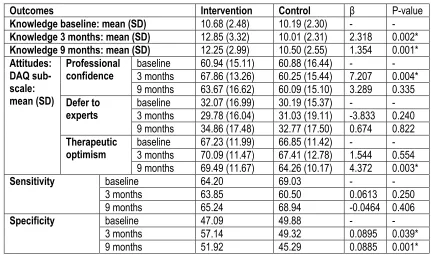
P=0.039) and at nine-months (45.3% v 52.9%, P=0.001) (Table 1).
39
40
Knowledge
41
Mean (Standard Deviation) values at baseline between the trial clusters ranged from 8.29
42
(1.60) (cluster 9) to 11.73 (2.19) (cluster 1); the overall mean score was 10.46 (2.40).
43
There was a statistically significant difference between the trial clusters as determined using
44
one-way ANOVA (F12,132 = 2.162, P=0.021); though, a Tukey post-hoc test indicated that no
45
particular between-cluster differences in knowledge test scores were statistically significant
46
(Tukey HSD using harmonic mean sample size n=8.911; P=0.089). The intra-cluster
47
correlation coefficient of knowledge scores (baseline) was 0.095.
48
49
Significant differences in knowledge scores between the trial groups were evident at the
50
three-month and the nine-month time-points. The mean difference at three months was 2.80
51
(95% CI 1.73 to 3.87), P<0.001; this corresponds to a 12.7% difference on the knowledge
52
measure, a large effect size d = 0.97 (95% C.I. 0.58 to 1.35) (Table 1).
53
For the three-month time-point, linear regression including trial allocation group, baseline
1
knowledge score and specialist practitioner status as predictors indicated a significant effect
2
of allocation to training (P=0.002 coefficient (β) for group effect =0 2.318). The overall
3
model fit (R2) was 0.331.
4
5
At nine-months the difference between the control and intervention groups reduced (β=1.75,
6
95% CI 2.94 to 0.56), but remained significant (P=0.001) (β for group effect = 1.354). The
7
overall model fit (R2) was 0.283, and the effect size was moderate: d = 0.64 (95% C.I. 0.20 to
8
1.07).
9
[image:12.595.81.512.223.478.2]10
Table 1: Baseline, three-month and nine-month outcomes for QUEST trial participants
11
12
Outcomes Intervention Control β P-value
Knowledge baseline: mean (SD) 10.68 (2.48) 10.19 (2.30) - -
Knowledge 3 months: mean (SD) 12.85 (3.32) 10.01 (2.31) 2.318 0.002*
Knowledge 9 months: mean (SD) 12.25 (2.99) 10.50 (2.55) 1.354 0.001*
Attitudes: DAQ sub-scale: mean (SD)
Professional
confidence baseline 3 months 60.94 (15.11)67.86 (13.26) 60.88 (16.44) 60.25 (15.44) - 7.207 - 0.004*
9 months 63.67 (16.62) 60.09 (15.10) 3.289 0.335
Defer to
experts baseline 3 months 32.07 (16.99) 29.78 (16.04) 30.19 (15.37) 31.03 (19.11) - -3.833 - 0.240
9 months 34.86 (17.48) 32.77 (17.50) 0.674 0.822
Therapeutic
optimism baseline 3 months 67.23 (11.99) 70.09 (11.47) 66.85 (11.42) 67.41 (12.78) - 1.544 - 0.554
9 months 69.49 (11.67) 64.26 (10.17) 4.372 0.003*
Sensitivity baseline 64.20 69.03 - -
3 months 63.85 60.50 0.0613 0.250 9 months 65.24 68.94 -0.0464 0.406
Specificity baseline 47.09 49.88 - -
3 months 57.14 49.32 0.0895 0.039* 9 months 51.92 45.29 0.0885 0.001* For DAQ sub-scales, negative items are reversed so higher values indicate more positive attitudes.
13
P values and coefficients for allocation group effect from regression model controlling for clustered data
14
with specialist practitioner status and baseline value as covariates.
15
*Statistically significant at P<0.05 level.
16
17
18
Attitudes
19
The mean baseline values (SD) of the DAQ subscales were similar for intervention and
20
control participants: for professional confidence, 60.91 (15.66); for tendency to defer to
21
experts, 68.76 (16.26); and for pessimistic view of depression, 32.94 (11.69).
22
23
There were significant differences between clusters at baseline for two of the DAQ
sub-24
scales: professional confidence (F12,132 = 3.374, P<0.001); and pessimism about depression
25
(F12,129) = 2.281, P=0.012). Tukey post-hoc tests indicated between-cluster differences in
26
attitude scores were statistically significant for professional confidence in three clusters
27
(3,4,7) and for pessimism in two clusters (2,5). For the summed 12 DAQ items included in
28
the sub-scales, the intra-cluster correlation coefficient was 0.033.
29
30
The attitude factor concerning professional confidence improved post-training (60.94 to
31
67.86) whereas among the control group participants no improvement was evident (60.88 to
32
60.25) (Table 1). GLS regression analysis indicated a significant between groups difference
33
controlling for baseline values and specialist practitioner status (β for group effect = 7.207;
34
between groups in professional confidence had diminished and was no longer statistically
1
significant (P=0.34).
2
3
There were no significant changes in the other DAQ attitude factors at the three-month
4
outcome point. However, at the final nine-month time-point, the factor involving an
5
optimistic or pessimistic view of depression and its response to treatment was significantly
6
different between the groups (P=0.003) with the scores indicating a more positive view
7
among the intervention group, whilst the control group ratings on these items had become
8
slightly more negative.
9
10
Sensitivity Analyses
11
Results from regressions using last observation carried forward (LOCF) for missing data
12
produced very little differences in the results above, though the coefficient for the effect of
13
the intervention did reduce slightly. These findings highlight the results were
non-14
substantially affected by missing data at follow-up.
15
16
Discussion
17
This study addressed an area of key public health importance, seeking to develop the skills of
18
school nurses to more accurately and confidently identify depression among school pupils,
19
and to equip them with improved knowledge of evidence-based approaches for the
20
management of this condition. The findings showed the training programme we developed
21
and implemented was associated with sustained improvements in participating school nurses’
22
knowledge about depression and its management, and although the sensitivity of depression
23
judgements was not influenced by the intervention, there were statistically significant and
24
sustained improvements in the specificity of their judgements. The absence of change in
25
sensitivity of depression identification did not appear (from examination of response
26
distribution) related to ceiling effects in our devised vignette measures. However, it is
27
possible that the sensitivity of depression recognition in this professional group was greater
28
than in other generalist health professionals, as the value identified was higher than in studies
29
of ‘real recognition’; but unfortunately, our use of vignettes means this may not be a valid
30
comparison. A higher level of correct recognition limits the potential for training to result in
31
improvement in this measure, which may provide partial explanation of this null result,
32
though it may be that our training was not sufficiently focused or expertly informed
33
concerning this key aim. However, specificity was improved, and this is an important
34
outcome: assisting school nurses in this aspect of differentiating between distress and
35
probable clinical depression should result in reduced likelihood of inappropriate referral and
36
intervention. There was also improvement in one key aspect of attitude, professional
37
confidence, following training, though this was not sustained to the final follow-up point.
38
Contrary to our expectations, the training did not have any effect on views about specialist
39
compared to generalist care; however, optimism about depression and its response to
40
treatment improved post-training and was significantly more positive at the nine-month
time-41
point. It appears that our education about depression was successful in highlighting risks and
42
consequences of depression whilst also emphasising potential for recovery and wellbeing.
43
44
Key strengths of this study were the extent to which the development of the training
45
programme and linked materials was informed by consultation with the school nurse
46
workforce (including a survey and focus groups) as well as by the involvement of
47
stakeholders representing health professionals, mental health academics and service user
48
organisations.
49
50
This evaluation involved a rigorous research design, using a cluster RCT to minimise the
51
effects of bias and confounding to establish firm evidence about the effects of the depression
52
training for school nurses. By using coding and an independent researcher, allocation was
53
concealed, preventing selection bias and protecting the assignment sequence until allocation.
54
possibility of contamination effects – in this case the potential ‘cross-talk’ and sharing of
1
teaching resources which would dilute any intervention effect. All available school nurses,
2
and other first level and second level school nursing staff from the workforces of 13 London
3
PCTs were invited to enter in this study, and participants comprised nearly 5% of the total
4
school nurse workforce of England [there were 3000 full-time equivalent school nursing staff
5
at the time of this study (NHS Digital 2017)]. The recruitment approach was designed to
6
maximise the validity and generalisability of findings and the sample obtained met the
pre-7
specified sample size target as well as being formed of adequate proportions of the total
8
numbers of staff in each of the PCT clusters.
9
10
Our study had several important limitations. It was not feasible to conduct a study with
11
measures of the effect of the depression education programme on real-world (i.e. using actual
12
school pupils) clinical outcomes or true measures of depression recognition, management or
13
referral. Although the outcomes that were examined used either validated measures or were
14
developed using standardised procedures and reported in peer-reviewed publications, the
15
extent to which they reflect clinical practice is uncertain. As noted in our report concerning
16
their development (Haddad & Tylee 2013), the use of vignettes to examine depression
17
recognition skills is problematic, primarily because of the ways it differs from clinical
18
practice where observing, asking, probing, and discussion with the individual and with
19
significant others are key elements of the assessment process. Using vignette measures
20
resulted in a higher level of correct identification (baseline sensitivity was 66%) than in a
21
meta-analysis of nurses’ depression identification across all settings, which was 42%
22
(Mitchell & Kakkadasam 2011). This higher level may be associated with a limited potential
23
for improvement following training. Conversely, the vignettes provided a measure of
24
specificity (48% at baseline) that was substantially lower than that found in real-world
25
studies, with meta-analysis results for nurses across all settings found to be 84% (Mitchell &
26
Kakkadasam 2011).
27
28
In this study it was impossible to blind participants to their allocation group, and participants’
29
knowledge of group assignment may lead to the harbouring of expectations or to feeling
30
deprived, which may influence responses. We mitigated against thisby a waiting-list type
31
design wherein the control group was provided with the training intervention at the end of the
32
trial: this is likely to have contributed to the higher level of retention evident in the control
33
compared to the intervention arm of the trial. The way in which outcome measure collection
34
was supervised and administered (to prevent sharing of knowledge test answers and
over-35
familiarisation with other measures) meant that the data collectors were not blind to study
36
group either. However, the outcome measures were all in standardised self-report format, so
37
there was little room for researcher-participant interaction to influence ratings. Coding of
38
completed questionnaires enable blinded data entry and analysis.
39
40
This study was conducted in 13 London PCTs/boroughs, and although the service settings
41
encompassed inner city and suburban areas and each cluster was comprised of a different
42
service organisation, this may nonetheless limit the generalisability of study findings to other
43
locations and services. Recruitment was based on a first-come, first-served basis, and the
44
participating 13 PCT were the initial responders to invitations sent to all the 31 inner and
45
outer London PCTs. This recruitment approach may have resulted in selection of services
46
with greater interest and commitment to this area of service provision than those whose
47
response was delayed or not forthcoming.
48
49
Loss of participants during study follow-up may be a source of bias and will reduce power
50
affecting the validity, reliability and generalisability of results, with loss of 20% or more
51
commonly regarded as a marker of a lower quality study and of more serious threats to
52
validity (Fewtrell et al. 2008). In this study, 70% of the recruited sample completed outcome
53
measures at the three-month principal outcome point (ranging from 79% for the knowledge
54
up, there were substantially fewer completed measures, overall 60%, and the extent of
1
attrition was larger in the intervention than control arm (completed outcome measures: 52%
2
compared to 71%). The extent of loss to follow-up is a clear weakness of this study; however
3
the baseline characteristic specialist practitioner status in each trial arm was found not to
4
differ between those seen and not seen at follow-up, which suggests that attrition did not
5
substantially differ between trial arms or between baseline and follow-up in regard to this
6
measured variable (specialist practitioner status at baseline: 49.2% - control, 53.1% -
7
intervention; at 3-months: 48.1% - control, 56.7% - intervention; and at 9-months: 52.3% -
8
control, 59.5% - intervention).
9
10
Attrition was related in part to exceptional workforce demands at the time of this study. In
11
September 2008, a human papilloma virus (HPV) vaccination programme was introduced in
12
England, with all 12- to 13-year-old and 17- to 18-year-old girls being offered the vaccine,
13
which is primarily delivered by school nurses and a considerable additional demand on
14
workforce capacity. Additionally, in the wake of the publicising of the child abuse case of
15
Baby Peter (Serious Case Review, November 2008) and the period that followed, there was a
16
considerable rise in school nurses’ involvement in child protection referrals, investigations,
17
proceedings (Macleod et al. 2010) which similarly interfered with continued participation this
18
study.
19
20
Conclusions
21
School nurses are well-placed to promote good emotional health and provide early
22
intervention services for young people at risk of developing mental health problems. This
23
activity fits well with school-based health promotion addressing health-related behaviours
24
that may be established in adolescence such as alcohol and substance use, healthy eating,
25
sexual practices and physical activity. The importance of these activities and of the school
26
nurse’s role in their delivery are widely recognised, and identified in policy and research in
27
the UK and many other countries (WHO Regional Office for Europe 2010, National
28
Association of School Nurses 2013, Royal College of Nursing 2017).
29
30
School nurses receive limited training in mental health and have limited confidence in this
31
part of their role (Haddad et al. 2010); and this study has demonstrated, using robust methods,
32
that a relatively brief educational package can have positive and sustained impacts on this
33
important area of practice. This evaluation adds to our understanding of school-based
nurse-34
led health care, indicating that a purpose-designedtraining package is effective in improving
35
the knowledge of school nurses about depression in young people, their confidence in
36
working with young people who might be depressed, and aspects of their ability to correctly
37
distinguish depression from distressing life problems.
38
39
Enhancing school nurses’ knowledge, attitudes and skills is essential to enable them to work
40
effectively as mental health promoters and for them to better collaborate with their teaching
41
and health professional colleagues in early recognition, support and intervention for young
42
people who are at risk. Although professional education innovations of this sort may be
43
valuable, it is important to note that school nurses in the UK are a workforce that has
44
substantially reduced in numbers since 2010, and that more recent changes in the
45
commissioning of public health services have been associated with further decline in staff
46
numbers. School nurses make a vital contribution to young peoples’ health and have a key
47
role to play alongside other professionals in improving mental health in schools; but as well
48
as professional development and training there needs to be acknowledgment and support for
49
their role.
50
63
64
Competing interests
65
AT was partly funded for some of the time of the study by NIHR BRC at the Institute of
66
1
Authors' contributions
2
MH, AT, TF, VP contributed the study design, and the delivery and management of the
3
project, MH and BW analysed the findings. All authors contributed to the reporting of the
4
study.
5
6
Acknowledgements
7
8
Steering Group/Project Advisors: Belinda Shear; Veronique Black; Ann Howers (school
9
nurse team leads); Dr Paul Walters; Professor Stephen Campbell, Professor Ian Norman,
10
Professor Diane De Bell; Professor Stephen Pryjmachuk; Professor Woody Cann; Professor
11
Stan Kutcher; Dr David Ekkers; Norman Young (clinical/ academics); Sharon White
12
(CPHVA); Ros Godson (Unite: School Nursing); Joy Winks (RCN: School Nursing); Sue
13
Hart (head-teacher); Babs Young (DH); Brigadier Michael Lord (Charlie Waller Memorial
14
Trust); Nick Hoile (Mental Health Foundation);
15
16
Intervention development and delivery: Dr Cathy Street, Gill Allen; Jude Sellen; Leigh Smith
17
(Rethink Mental Illness)
18
19
Researchers: Dr Tanya Graham; Georgia Butler; Marion McHugh