On a Greedy Algorithm to Construct Universal
Cycles for Permutations
Alice L.L. Gao1, Sergey Kitaev2, Wolfgang Steiner3 and Philip B. Zhang4 1Department of Applied Mathematics
Northwestern Polytechnical University, Xian, Shaanxi 710072, P.R. China 2Department of Computer and Information Sciences
University of Strathclyde, 26 Richmond Street, Glasgow G1 1XH, UK 3IRIF, CNRS UMR 8243
Universit´e Paris Diderot – Paris 7, 75205 Paris Cedex 13, Paris, France 4College of Mathematical Science
Tianjin Normal University, Tianjin 300387, P. R. China Email: 1[email protected], 2[email protected],
3[email protected], 4[email protected]
Abstract. A universal cycle for permutations of lengthn is a cyclic word or permutation, any factor of which is order-isomorphic to exactly one permu-tation of length n, and containing all permutations of length n as factors. It is well known that universal cycles for permutations of length n exist. How-ever, all known ways to construct such cycles are rather complicated. For example, in the original paper establishing the existence of the universal cy-cles, constructing such a cycle involves finding an Eulerian cycle in a certain graph and then dealing with partially ordered sets.
In this paper, we offer a simple way to generate a universal cycle for per-mutations of length n, which is based on applying a greedy algorithm to a permutation of length n−1. We prove that this approach gives a unique universal cycle Πn for permutations, and we study properties of Πn.
Keywords: universal cycles; combinatorial generation; greedy algorithm; permutations
1
Introduction
A universal cycle, or u-cycle, for a class of combinatorial objects is a cyclic word containing each object, encoded by a word, exactly once as a cyclic interval (called a factor). Universal cycles were introduced by Chung, Dia-conis and Graham in [2]. However, the origin of the notion of a u-cycle is in the study of the celebrated de Bruijn cycles, which are cyclic words contain-ing each word of length n over some alphabet, for a given n, exactly once (see [3]).
There are many ways to construct a de Bruijn cycle. A “classical” way to construct a de Bruijn cycle is via the notion of a de Bruijn graph of order n, which is a directed graph representing overlaps between words of length n. It can be easily shown that any de Bruijn graph is balanced and strongly connected, and thus it contains an Eulerian cycle. Moreover, one can show that a de Bruijn graph of order n is the line graph of the de Bruijn graph of order n−1, and thus any de Bruijn graph contains aHamiltonian cycle, which can easily be translated to a de Bruijn cycle.
1.1
Martin’s algorithm to generate de Bruijn sequences
An alternative construction of a de Bruijn sequence involves concatenating together, in lexicographic order, all theLyndon wordswhose length dividesn. An interesting, and most relevant to our paper fact is that this sequence was first generated by Martin [11] in 1934 using the following greedy algorithm.Martin’s greedy algorithm to generate a de Bruijn sequence
Start with the word (k−1)n−1 and then repeatedly apply the following rule: Append the smallest letter in {0,1, . . . , k −1} so that factors of length n in the resulting word are distinct. Once no more extension is possible, remove the n−1 rightmost letters.
For example, for k = 3 and n = 2, the steps of the algorithm are: 2 → 20 → 200 → 2001 → 20010 → 200102 → 2001021 → 20010211 → 200102112→20010211.
1.2
Universal cycles for permutations
Universal cycles for permutations were one of the main objects considered in [2]. A universal cycle for n-permutations is a cyclic word, each length n
factor of which is order-isomorphic to a unique n-permutation, and every
n-permutation is order-isomorphic to some factor in the word. There is a long line of research on universal cycles for permutations, e.g. see [1, 4, 5,6, 7, 8,9, 12].
Even though the basic original idea to construct universal cycles for per-mutations is similar to that of constructing de Bruijn cycles via de Bruijn graphs, the situation with permutations is much more complicated. Indeed, just proving the existence of such a universal cycle uses a not so trivial trick of clustering the graph of non-overlapping permutations, an analogue of the de Bruijn graph in the case of permutations. The actual construction of universal cycles for permutations in [2] involved dealing with partially or-dered sets and resulted in a nice conjecture on the minimal alphabet that was settled 17 years later by Johnson in [9]. Namely, it turns out that it is possible to construct a universal cycle for n-permutations using just n+ 1 letters; using n letters is impossible (unless using the shorthand encoding of
n-permutations by (n−1)-permutations, which is deleting the rightmost el-ement in each n-permutation; see [5]) as can be easily seen, e.g. in the case of n = 3.
We found the existent constructions of the universal cycles for permuta-tions in the literature to be rather involved, and we asked ourselves whether the simple algorithm by Martin for de Bruijn cycles could be extended to the case of the permutations. We were pleased to discover that the answer to the question was positive with surprisingly small changes that were required to Martin’s algorithm: instead of the initial word (k−1)n−1 we use the increas-ing permutation of length n−1, and instead of the smallest available letter on a given iteration of the process we use the smallest available extension of the respective permutation, to be defined in Section 2.1. Interestingly, be-ginning with a monotone permutation, that is, the increasing or decreasing permutation of appropriate length, is a necessary condition in our greedy algorithm, as we show in Section 2.4.
1.3
Basic definitions
form a factor of w. If w is a cyclic word then a factor can begin at the end of w and end at the beginning ofw. If u is a factor of w, we also say thatw
covers red(u).
Definition 1.1. A wordΠ0nis auniversal word, oru-word, forn-permutations if Π0n covers every n-permutation exactly once.
Definition 1.2. A cyclic word Πn is a universal cycle, or u-cycle, for n
-permutations if Πn covers every n-permutation exactly once.
1.4
Organization of the paper
This paper is organized as follows. In Section 2.1we show our simple way to generate the words Π0n and Πn, and in Sections 2.2 and 2.3 we justify that
the constructions of Π0n and Πn work. Also, in Section2.4 we show that our
greedy algorithm to generate Π0nand Πncan only be applied to the increasing
permutation of lengthn−1. Further, Section3 discusses some properties of Π0n and Πn, and Section 4 gives several directions of future research. This
includes a discussion on reducing the alphabets of Π0n and Πn in Section 4.1
and a possibility of extending our approach to relevant object in the literature in Section 4.2.
2
Simple generation of u-words and u-cycles
for permutations
2.1
Generating
Π
0nand
Π
nLet π = π1π2· · ·πm be a permutation of m distinct integers. Then the i-th
extension of π to the right, 1≤i≤m, is the permutation
cb(π1)cb(π2)· · ·cb(πm)b,
where b is the i-th smallest element in {π1, π2, . . . , πm}, and
cb(x) =
(
x if x < b, x+ 1 if x≥b.
The (m+1)-st extensionis the permutationπb, wherebis the largest element in {π1 + 1, π2 + 1, . . . , πm + 1}. We call the first extension the smallest
The following simple algorithm produces recursively a universal word Π0n of length n! +n−1 for n-permutations.
The greedy algorithm to construct Π0n Begin with the increasing permutation
Π0n,0 := 12· · ·(n−1).
Suppose that a permutation
Π0n,k =a1a2· · ·ak+n−1
has been constructed for 0≤k < n!, and no two factors in Π0n,k of length
n are order-isomorphic. Leti be minimal such that no factor of lengthn
in Π0n,k is order-isomorphic to the i-th extension of ak+1ak+2· · ·ak+n−1,
and denote the last element of this extension byb. Then
Π0n,k+1 :=cb(a1)cb(a2)· · ·cb(ak+n−1)b.
For some k∗, no extension of Π0n,k∗ will be possible without creating a
factor order-isomorphic to a factor in Π0n,k. The greedy algorithm then terminates and outputs Π0n:= Π0n,k∗.
For example, the steps of the algorithm for n= 3 are as follows:
12→231 →3421→45312→564132→6751324→78613245 = Π03.
We note that for each k, Π0n,k is a permutation of {1,2, . . . , k +n−1}. The following simple extension of the greedy algorithm turns the universal word for permutations Π0n into a universal cycle for permutations Πn.
Generating the u-cycle Πn from Π0n
Remove the last n−1 elements in Π0n and take the reduced form of the resulting sequence to obtain Πn.
For example, Π3 is given by
Π03 = 78613245→786132→red(786132) = 564132 = Π3. For another example, Π4 is given by
2.2
Justification of
Π
0nbeing a u-word for permutations
In the following, let n be arbitrary but fixed. For Π0n,k =a1a2· · ·ak+n−1, setσk:= red(akak+1· · ·ak+n−1), σk0 := red(ak+1ak+2· · ·ak+n−1),
and
Jk=|{j ≤k : σ0j =σ
0
k}|,
i.e. Jk is the number of occurrences of the (n−1)-permutationσk0 in Π
0
n,k. By
the definition of the greedy algorithm, all i-th extensions of σk0 with i < Jk
occur in Π0n,k, and theJk-th extension ofσk0 does not occur in Π0n,k. Therefore, the greedy algorithm terminates at k if and only if Jk = n+ 1. If Jk ≤ n,
then σk+1 is the Jk-th extension of σk0 (and ends with Jk).
Lemma 2.1. The greedy algorithm terminates atk if and only ifσk= 12· · ·n.
Proof. If σk = 12· · ·n, then σk0−1 =σ0k = 12· · ·(n−1) and Jk−1 =n. Thus,
Jk =n+ 1, and the greedy algorithm terminates at k.
For the converse, assume thatσk 6= 12· · ·n. By the preceding paragraph,
this implies that σj 6= 12· · ·n for all j ≤k. Since each word aj+1· · ·aj+n−1, 1 ≤ j ≤ k, is preceded by the letter aj and the permutation σj occurs
only at the position j, we have σ0j = σ0k for at most n different indices
j ≥ 1. If σ0k 6= 12· · ·(n −1), then we have σ00 6= σk0 and thus Jk ≤ n. If σk0 = 12· · ·(n−1), then we have σ0j =σk0 for at most n−1 different indices
j ≥ 1 (because σj = 12· · ·n is not possible), which also gives that Jk ≤ n.
Therefore, the greedy algorithm does not terminate at k if σk6= 12· · ·n.
Lemma 2.2. Π0n covers all n-permutations.
Proof. We shall prove this lemma by contradiction. Suppose that a permu-tation π1π2· · ·πn is not covered by Π0n. Then π2· · ·πn is covered at most n−1 times, hence red(π2· · ·πn)n is not covered. More generally, we have for
1≤k ≤n that, if red(πk· · ·πn)(n−k+ 2)· · ·n is not covered, then
red(red(πk+1· · ·πn)(n−k+2)· · ·n)n= red(πk+1· · ·πn)(n−k+1)· · ·(n−1)n
is not covered. We obtain that Π0n does not cover the permutation 12· · ·n, contradicting Lemma 2.1.
Theorem 2.3. Π0n is a u-word for n-permutations.
2.3
Justification of
Π
nbeing a u-cycle for permutations
Theorem 2.4. Πn is a u-cycle for n-permutations.Proof. By Theorem 2.3, it suffices to prove that
red(akak+1· · ·ak+n−1) = red(ak· · ·an!a1· · ·ak+n−n!−1)
for all n!−n+ 2 ≤k≤n!.
First, note thatσi ends with 1 for all i < n. Hence, we have that
Π0n,n−1 =n(n+ 1)· · ·(2n−2)(n−1)(n−2)· · ·1
and thus
ak < a1 < a2 <· · ·< an−1 for all k ≥n.
Next, we show that σi ends with n for all i ≥ n!−n+ 2. Suppose that
this is not true for some i≥n!−n+ 2. Since Π0n is a u-word, we must have
σi0−1 =σj0−1 for some j > i. It follows fromσn!= 12· · ·n that
an! < an!+1 <· · ·< an!+n−1.
In particular,
an!< an!+1<· · ·< aj+n−2. Then, σi0−1 =σj0−1 implies that
an!+i−j < an!+i−j+1 <· · ·< ai+n−2 <· · ·< an!+n−1.
Iterating this argument gives that aj < aj+1 < · · · < an!+n−1 and thus
ai < ai+1 < · · · < an!+n−1, contradicting the assumption σi does not end
with n. Therefore, σi ends with n for all i≥n!−n+ 2, which implies that
ak< an!+1 < an!+2 <· · ·< an!+n−1
for all n!−n+ 2 ≤k≤n!. It follows that
σk = red(akak+1· · ·an!)(n!−k+ 2)· · ·n = red(ak· · ·an!a1· · ·ak+n−n!−1)
2.4
Uniqueness of
Π
nThe construction of Πnbegins with the permutation 12· · ·(n−1) and is
fol-lowed by consecutive applications of the greedy algorithm choosing the small-est possible element to extend the already constructed sequence. A natural question is what happens if we start with a different permutation of length
n −1 and follow the greedy steps of our algorithm? Can we obtain other (non-equivalent) constructions of u-cycles forn-permutations? The following theorem answers this question.
Theorem 2.5. Beginning the construction of Πn (and thus of Π0n) with an
(n−1)-permutation Π0n,0 6= 12· · ·(n−1)and following the steps of the greedy algorithm will not produce a u-cycle for n-permutations.
Proof. Assume that σ00 6= 12· · ·(n−1). As in the proof of Lemma 2.1, the greedy algorithm terminates atkifσk= 12· · ·n. Now, the second part of the
proof of Lemma 2.1 shows thatJk < n when σk0 = 12· · ·(n−1). Therefore,
the permutation 12· · ·n is not covered by Π0n, hence Π0n is not a u-word and Πn is not a u-cycle.
3
Properties of
Π
nand
Π
0nIn this section, we shall give some properties of Πn and Π0n. All our results
discussed are stated in terms of Π0n, since the same results for Πnwill trivially
follow from the definition of Πn.
Our main result is that all permutations with 1 beforenoccur in the first half of Π0n, and those withnbefore 1 occur in the second half. More precisely, consider the partition of the symmetric group Sn =S1,n∪Sn,1, where
S1,n ={π1π2· · ·πn∈Sn: i < j for πi = 1, πj =n}, Sn,1 ={π1π2· · ·πn∈Sn: i < j for πi =n, πj = 1}.
Theorem 3.1. We have an!
2+1 = 1,
σn!
2 =n12· · ·(n−1), σ
n!
2+1 = 134· · ·n2, σ
n!
2+2= 23· · ·(n−1)1n,
σk: k ≤ n! 2
=Sn,1 and
σk : k > n!
2
In particular,σn!
2 =n12· · ·(n−1) is the last occurrence of ann-permutation starting withn,σn!
2+1 = 134· · ·n2 is the first occurrence of ann-permutation starting with 1, and σn!
2+2 = 23· · ·(n−1)1n is the first occurrence of an n -permutation ending with n.
For the proof of Theorem3.1, we use the following lemmas.
Lemma 3.2. Letm≥1be minimal such thatσm starts with1. Thenam = 1,
and σk does not end with n for all k ≤m.
Proof. The fact thatam = 1 is a direct consequence of the greedy algorithm.
Suppose thatσk ends with nfor somek ≤m. Then we have σ0j =σ
0
k−1 for n different indicesj < k. Sinceσk6= 12· · ·n, we have thatj ≥1 for all thesej.
Hence, there are n different permutations σj ending with σk0−1. Therefore, one of these permutations starts with 1, contradicting the definition ofm.
Lemma 3.3. Let m be as in Lemma 3.2. We have σk ∈Sn,1 for all k < m,
σm−1 =n12· · ·(n−1) and σm = 134· · ·n2.
Proof. We use induction on k. We have σ1 = 23· · ·n1∈ Sn,1. Assume that
σj ∈ Sn,1 for all j ≤ k, where 1 ≤ k < m. If σk0 ∈ Sn−1,1, then we have
σk+1 ∈Sn,1 because σk+1 does not end with n by Lemma 3.2. Now, assume that σ0k ∈ S1,n−1. Since σk ∈ Sn,1, σk starts with n. Moreover, we cannot
have σ0j = σk0 for 1 ≤ j < k, since otherwise it implies that σj0 ∈ S1,n−1. Together with σj ∈Sn,1, it follows that σj would also have to start with n,
contradicting thatσj 6=σk. Ifσk0 6=σ
0
0, then this implies thatσk+1ends with 1 and hence σk+1 ∈ Sn,1. Finally, if σk0 =σ
0
0, then σk+1 is an i-th extension of 12· · ·(n−1) with i ≥2, thus σk+1 starts with 1, which is possible only for
k =m−1. Therefore, we have σk ∈Sn,1 for all k < m.
We have σm ∈ S1,n because it starts with 1, hence we obtain from the
previous paragraph that σm0 −1 = σ00, σm−1 = n12· · ·(n − 1) and σm =
134· · ·n2.
Lemma 3.4. Let m be as in Lemma 3.2. We have σk ∈S1,n for all k ≥m,
with σm+1 = 23· · ·(n−1)1n.
Proof. Suppose that σk ∈Sn,1 for somek ≥m. Then, we will show that, for some i≥m, σi starts with n and ends with n−1. We obtain that, for some
i ≥ m, σi ends with n1, and finally this yields that n12· · ·(n−1) occurs
First, note that σk0 = σ00 and σk ∈ Sn,1 are possible only for k =m−1. Therefore, σk ∈Sn,1 for k ≥m implies that σ0j =σk0 for at most n different
indices j ≤ k. Moreover, since σj cannot start with 1 if j < m or j = k, and since k ≥m, there are at most n−2 different indices j < m such that
σj0 =σk0. Hence the (n−1)-st extension of σk0 occurs afterm.
If σk ∈ Sn,1 does not start with n, then its (n−1)-st extension is also in Sn,1, with the position of n shifted to the left; we obtain iteratively that there is some i≥m such thatσi starts with n and ends with n−1. On the
other hand, if σk starts with n, then the (n−1)-st extension of σ0k−1 starts with n and occurs at or after the position k.
Therefore, we can assume that, for some k ≥ m, σk starts with n and
ends with n−1. Now, we cannot have σj0 =σk0 for some 1≤j < m, because
σj 6= σk would imply that σj ends with n, which is not possible for j < m.
Since σk0 6= σ00, we obtain that σ0k does not occur before m, hence the first extension of σk0, which ends with n1, occurs after m.
Finally, assume that σk ends with n1 for some k ≥ m. Then, iterating
(n−1)-st extensions gives thatn12· · ·(n−1) occurs after m, contradicting that σm−1 =n12· · ·(n−1). Hence, we cannot have σk∈Sn,1 for k ≥m.
Since σm0 = 23· · ·(n −1)1 by Lemma 3.3 and σm+1 ∈ S1,n, we have σm+1 = 23· · ·(n−1)1n.
Proof of Theorem 3.1. Since |S1,n| = |Sn,1| = n!/2, the theorem is a direct consequence of Lemmas 3.3 and 3.4, with m=n!/2 + 1.
Note that, since an!
2+1 = 1, we have, for all k ≤ n!/2−n + 2, some 0 ≤ j ≤ n−2 such that σk+j ends with 1. This also follows from the fact
that σk ∈ Sn,1 for all k ≤ n!/2. Similarly, since σk ∈ S1,n for all k > n!/2,
we have, for all k > n!/2, some 0 ≤ j ≤ n−2 such that σk+j ends with n.
Therefore, an!+n−1 is the largest element to the right ofan!
2+1 = 1.
4
Directions of further research
4.1
Reducing the alphabets of
Π
0nand
Π
nletters that is required for our greedy construction. These considerations will be similar in nature to dealing with partially ordered sets in [2].
For example, constructing Π03 in a greedy way with respect to the number of letters used, we end up with a word over a 6-letter alphabet, not over an 8-letter alphabet:
12→231 →3421→45312→564132→5641324→56413245.
Such an optimization is irrelevant for the construction of Π3, but it would be relevant for the construction of Πn for n ≥ 4. So, the idea is that in
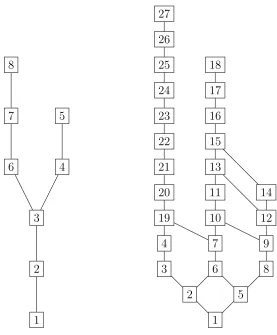
the original construction of Π0n some of the letters can be used more than once. This defines a partial order on the letters of the originally constructed Π0n indicating which letters have a choice to be used more than once. More precisely, the poset is defined by aj ≺ak ifaj < ak and |k−j|< n, where ≺
denotes the poset relation. Then the minimal number of letters is the length of this partial order. Such partially ordered sets, in the cases of n = 3,4, are shown in Figure 1, and we can see that Π03 (resp., Π04) actually requires 6 (resp., 13) distinct letters. It would be interesting to study properties of such partially ordered sets. For example, from the case ofn = 4, we see that such partially ordered sets are not necessarily graded.
We note that our greedy algorithm will never result in the optimum size of the alphabet, which is n+ 1 for n-permutations, because of the first n
steps of the algorithm when we are forced to use new letters, so the total number of letters will be ≥ 2n−2 > n+ 1 for n ≥ 4. However, to find the exact optimal size for our construction is an interesting problem requiring understanding the partially ordered sets in question.
1 2 3
4 5
6 7 8
1 2 3 4
5 6 7
8 9 10
11
12 13
14 15
16 17 18
[image:12.612.165.442.120.455.2]19 20 21 22 23 24 25 26 27
Figure 1: Partially ordered sets for Π03 and Π04
4.2
Shortened universal words/cycles for permutations
It would be interesting to extend our approach to generate universal cycles for permutations in the context of shortened universal words/cycles for per-mutations that were introduced in [10].namely, 123 and 213; starting at the second position (and reading the word cyclically), we obtain the word 121 encoding the permutations 132 and 231, and finally, starting at the third position, we (cyclically) read the word 211 encoding the permutations 312 and 321. For another example, the word 1232 is also a universal cycle for permutations of length 3.
The main goal of [10] is to study compression possibilities for (classical) universal cycles for permutations. In particular, [10] shows that such univer-sal cycles exist of lengths n!−kn for k = 0,1, . . . ,(n−1)!. The approach in [10] to obtain these results is graph theoretical, and it actually does not provide any explicit constructions of the objects in the general case. Thus, (a modification of) our approach to generate universal cycles could poten-tially be useful in generating shortened universal words/cycles, and this is an interesting direction of further research. An idea here would be to introduce a rule, or rules, overriding the rules of the algorithm, while still beginning with the increasing sequence of length (n−1) for n-permutations. For example, we could require to use the minimum letter equal to some letter among the (n−1) preceding letters, if possible, while following our original algorithm otherwise. So that the steps of such a modified algorithm in the case ofn = 3 could be
12→121→1211→12112
covering all 6 permutations non-cyclicly, or for the cyclic version, we can stop at 121 (132 and 231 are covered by 121, 321 and 312 by 211, and 123 and 213 by 112). However, correctness of such an algorithm, or its variations, must be addressed, which is outside of the scope in this paper.
Acknowledgments
References
[1] M. Albert, J. West. Universal cycles for permutation classes. 21st In-ternational Conference on Formal Power Series and Algebraic Combina-torics (FPSAC 2009), 39–50,Discrete Math. Theor. Comput. Sci. Proc., AK, Assoc. Discrete Math. Theor. Comput. Sci., Nancy, 2009.
[2] F. Chung, P. Diaconis, R. Graham. Universal cycles for combinatorial structures. Discrete Math. 110 (1992) 43–59.
[3] N.G. de Bruijn. A combinatorial problem. Nederl. Akad. Wetensch., Proc. 49 (1946) 758–764.
[4] A. E. Holroyd, F. Ruskey, A. Williams. Faster generation of shorthand universal cycles for permutations. Computing and combinatorics, 298– 307, Lecture Notes in Comput. Sci. 6196, Springer, Berlin, 2010. [5] A. E. Holroyd, F. Ruskey, A. Williams. Shorthand Universal Cycles for
Permutations. Algorithmica64 (2012) 215–245.
[6] G. Hurlbert, G. Isaak. Equivalence class universal cycles for permuta-tions. Discrete Math. 149 (1996) 1–3, 123–129.
[7] G. Isaak. Hamiltonicity of digraphs for universal cycles of permutations.
European J. Combin. 27 (2006) 6, 801–805.
[8] B. W. Jackson. Universal cycles of k-subsets and k-permutations. Dis-crete Math. 117 (1993) 1–3, 141–150.
[9] J. R. Johnson. Universal cycles for permutations. Discrete Math. 309
(2009) 5264–5270.
[10] S. Kitaev, V. N. Potapov, V. Vajnovszki. On shortening u-cycles and u-words for permutations. arXiv:1707.06110.
[11] M. H. Martin. A problem in arrangements. Bulletin of the American Mathematical Society 40 (1934) 859–864.