arXiv:1904.07691v2 [cs.LO] 30 Apr 2019
Completeness for Game Logic
Sebastian Enqvist
∗, Helle Hvid Hansen
†, Clemens Kupke
‡, Johannes Marti
§and Yde Venema
¶∗Stockholm University, SE-10691 Stockholm. Email: [email protected] †Delft University of Technology, P.O. Box 5015, NL-2600 GA Delft. Email: [email protected] ‡University of Strathclyde, 16 Richmond St, Glasgow G1 1XQ, UK. Email: [email protected]
§Universit¨at Bremen, Postfach 330440, 28334 Bremen. Email: [email protected] ¶University of Amsterdam, P.O. Box 94242, NL-1090 GE Amsterdam. Email: [email protected]
Abstract—Game logic was introduced by Rohit Parikh in the 1980s as a generalisation of propositional dynamic logic (PDL) for reasoning about outcomes that players can force in determined 2-player games. Semantically, the generalisation from programs to games is mirrored by moving from Kripke models to monotone neighbourhood models. Parikh proposed a natural PDL-style Hilbert system which was easily proved to be sound, but its completeness has thus far remained an open problem.
In this paper, we introduce a cut-free sequent calculus for game logic, and two cut-free sequent calculi that manipulate annotated formulas, one for game logic and one for the monotone µ-calculus, the variant of the polymodal µ-calculus where the semantics is given by monotone neighbourhood models instead of Kripke structures. We show these systems are sound and complete, and that completeness of Parikh’s axiomatization follows. Our approach builds on recent ideas and results by Afshari & Leigh (LICS 2017) in that we obtain completeness via a sequence of proof transformations between the systems. A crucial ingredient is a validity-preserving translation from game logic to the monotoneµ-calculus.
I. INTRODUCTION
A. Game logic, background and motivations
Game logic was introduced by Parikh in the 1980s [1] as a modal logic for reasoning about the outcomes that players can force in determined 2-player games. We refer to the two players asAngelandDemon, following [2]. A modal formula
hγiϕshould be read as,“Angel has a strategy in the gameγ
to ensure an outcome in whichϕholds”.
Syntactically, Parikh’s game logic is an extension of propo-sitional dynamic logic (PDL) [3] as games are composed from atomic games and constructors that denote sequential composition of games, as well as choice, iteration and test for Angel, and finally the dual operator which denotes swapping the roles of the two players. In Parikh’s original language, the strategic ability of Demon is thus only implicitly expressed through the dual operator, and PDL programs can be viewed as 1-player games (played by Angel). Semantically, the gen-eralisation from 1-player games to 2-player games is obtained by moving from Kripke structures to monotone neighbourhood structures. Game logic is thus a non-normal, monotone modal logic.
Just as PDL can be translated into the (normal) modal µ-calculus [4], game logic can be naturally translated into the monotone modal µ-calculus [5], and from there into the
normal modalµ-calculus for the language that has two normal modalities for each monotone modality [6]. This was already sketched by Parikh in [1], and later improved in [2], [5] to show that the satisfiability of game logic is in EXPTIME. We refer to [1] and the survey [2] for applications of game logic and further results.
B. A landscape of logics for games
Parikh’s game logic is probably the first of a family of logics designed to reason about different aspects of games. Since then, modal logics for multi-player games that can express strategic powers of groups of agents have appeared such as ATL [7] and Coalition Logic [8]. There are also logics that focus on 2-player games but go beyond game logic such as strategy logics [9], [10], which treat strategies as first-order objects, and dGL [11] which combines game operations and first-order quantification for hybrid games.
C. The challenge of completeness for game logic
It is a long-standing open question whether a complete proof system for game logic exists. The completeness result for dGL in [11] is of a rather different nature, since it concerns the completeness of a non-recursively enumerable logic relative to some oracle logic. Parikh proposed in [1] a natural-looking PDL-like Hilbert systemPar, but a proof of its completeness has thus far remained an open problem. Only (relatively easy) partial results were known: completeness for the dual-free fragment [1], and for the iteration-free fragment [2], [5]. Giving a completeness proof similar to the one for PDL from [12] using canonical models seems impossible for the full language of game logic as such a proof essentially involves a filtration argument. It is not difficult to see, however, that game logic is not well-behaved with respect to filtrations.
The difficulty of showing completeness for the entire lan-guage of game logic can perhaps be explained by the fact that in the presence of both angelic iteration and dual, game logic (when interpreted over Kripke frames) spans all levels of the alternation hierarchy of the (normal) modal µ-calculus [13]. This is in stark contrast with PDL, LTL and CTL∗ which are all contained in low levels of the alternation hierarchy. Over Kripke models, game logic is thus a highly expressive fragment of the modal µ-calculus for which completeness is highly involved. The classical automata-based approach to the completeness of the µ-calculus from [14], [15] relies on the
c
existence of “disjunctive” normal forms in the language of the µ-calculus. It is unlikely that a similar normal form can be defined for the more rigid game logic syntax, as occurrences of the×-operator introduce greatest fixpoint operators that are invariably tied to conjunctions.
D. Main results and approach
In this paper, we introduce three cut-free sequent calculi, two for game logic and one for the monotoneµ-calculus, that we show all to be sound and complete. The first of these is the system for game logicGwhich is a cut-free sequent calculus with deep inference rules. We show that G is complete, and that this implies completeness of Parikh’s Hilbert system. One of the rules in G is a so-called strengthened induction rule, which is inspired by the strengthened induction rule in [16], and somewhat similar to Kozen’s context rule [14, Proposition 5.7(vi)]. Our approach relies on game logic being able to express this rule. Just as it is convenient to work with µ-calculus formulas in negation normal form, the system G
works on game logic formulas innormal form, where negation may only be applied to atomic propositions, and the dual game operator only to atomic games. Consequently, the system G
is defined for the normal form languageLNF which contains demonic game constructors as primitives. Given a game logic formulaϕ,nf(ϕ) is the formula obtained by bringingϕ into dual and negation normal form.
The second system for game logic, called CloG, is a cut-free sequent calculus with a closure rule. InCloG, game logic formulas from LNF are annotated with names for formulas of the form hγ×iϕ. These names keep track of unfoldings
of these greatest fixpoint formulas, and together with the closure rule they facilitate the detection of repeated unfolding of greatest fixpoints formulas in the same context (which closes the proof tree branch). Technically, this is achieved by imposing side conditions on the closure rule in CloG. These side conditions involve an order 4 on the set F consisting of game logic formulas of the form hγ∗iϕ or hγ×iϕ. These
game logic fixpoint formulas will be in 1-1 correspondence with fixpoint variables when we translate into the monotone µ-calculus.
The third system, CloM, is a cut-free sequent calculus for the monotone µ-calculus, also with a closure rule and name annotations. This system is a monotone variant of the systemClofor the normal modalµ-calculus introduced in [16]. In CloM, the side conditions are expressed with the usual (priority/subsumption) order ≤ on fixpoint variables where x≤y means thatxis of higher priority thany.
Our approach to proving soundness and completeness builds on recent work by Afshari & Leigh. In [16] they presented a cut-free sequent calculus for the normal modalµ-calculus, and proved its completeness via a series of transformations through other proof systems, including the systemClo, and ending at the complete tableaux systems with names developed in [17]
and [18]. We prove completeness of the systemsG,CloGand
CloMby showing that we can transform derivations as follows:
Par←−1) G←−2) CloG←−3) CloM←−4) Clo
1) First, the transformation of G-derivations to Par -derivations goes via an intermediate Hilbert system ParFull, which is an extension of Par to the full language which has angelic as well as explicit demonic operations and freely-placed duals and negations. These transformations are rela-tively straightforward using that Par essentially has cut via modus ponens.
2) The transformation ofCloG-derivations toG-derivations requires non-trivial adaptations of the analogous result in [16, Theorem VI.1]. It uses a translation(−)• that replaces anno-tations on game logic formulas with certain “deep insertions of demonic tests”, which are the game logic analogues of the “deep disjunctions” of [16].
3) The transformation of CloM-derivations into CloG -derivations relies on a novel translation(−)♯from game logic into the monotone µ-calculus. This translation is truth- and validity-preserving, it commutes with fixpoint unfolding, and crucially, it reflects the order on fixpoint variables inϕ♯ into the order on fixpoint formulas inF. Note that the translation of game logic from [2] goes into the two-variable fragment of modalµ-calculus, and it is therefore not useful for the proof transformations in this paper. Indeed, we see the translation (−)♯ as one of our main technical contributions.
4) Finally, we obtain completeness of CloM from the completeness ofClo[16] by transformingClo-derivations into
CloM-derivations via a validity-preserving translation (−)t which is the fixpoint extension of a well-known translation of monotone modal logic into normal modal logic [6].
To summarise, completeness of Parikh’s system Par is obtained by the following argument. Assume that ϕ is a game logic formula that is valid over monotone neighbourhood models. As the above mentioned translations are validity-preserving, the normal modalµ-calculus formula ((nf(ϕ))♯)t is valid over Kripke models. By completeness of Clo, there is a Clo-derivation of((nf(ϕ))♯)t. By the above sequence of transformations, we obtain aPar-derivation ofϕ.
E. Outline
The paper is organised as follows. In Section II we recall the basic definitions of game logic, we introduce Parikh’s Hilbert-style axiomatisationPar, we present the cut-free Gentzen style system G and show that G-derivations can be transformed into Par-derivations (Thm 11). In Section III, we introduce the annotated proof system CloG for game logic and show how CloG-derivations can be translated into G-derivations (Thm. 15). In Section IV we define the annotated system
monotoneµ-calculus (Thm. 26). In Section VI, we apply the transformation results to prove soundness and completeness ofCloG,GandPar. Finally, in Section VII we conclude and discuss related and future work. Due to space limitations we only provide proofs of key results. All proofs that have been omitted from the main text can be found in the appendix.
II. TWO DERIVATION SYSTEMS
A. Game logic: basics
Throughout, we assume fixed countable sets P0 and G0 of atomic propositions and atomic games, respectively. Over these sets we shall define three distinct languages of game logic. Parikh’s original languageLPar only allows the angelic version of game constructors, while dual and negation may occur freely, The normal form language LNF allows both angelic and demonic game constructors, while negation and duals may only occur in front of atoms. The full language
LFull allows all connectives and game constructors from the other two languages, and freely placed duals and negations.
Definition 1. The languages LPar and LNF consist of the formulas and games generated by the following grammars:
LPar ∋ϕ ::= p| ¬ϕ|ϕ∨ϕ| hγiϕ, γ∈ GPar
GPar ∋γ ::= g|γ;γ|γ⊔γ|γ∗|γd|ϕ?, ϕ∈ LPar
LNF∋ϕ ::= p| ¬p|ϕ∨ϕ|ϕ∧ϕ| hγiϕ, γ ∈ GNF
GNF∋γ ::= g|gd|γ;γ|γ⊔γ|γ⊓γ|γ∗|γ×
|ϕ?|ϕ!, ϕ∈ LNF
LFull∋ϕ ::= p| ¬ϕ|ϕ∨ϕ| hγiϕ, γ∈ GFull
GFull∋γ ::= g|γ;γ|γ⊔γ|γ⊓γ|γ∗|γ×|γd
|ϕ?, ϕ∈ LFull
where p ∈ P0 and g ∈ G0. In LPar and LFull we admit the connectives →,∧,↔as the usual abbreviations.
The game operations should be read as follows. The compo-sitionγ;δmeans first playγ, then playδ. Theangelic choice
γ⊔δis the game where Angel decides whether to play γ or δ. Theangelic iterationγ∗is the game in whichγis played a
finite, possibly zero, number of times, with Angel at the start and after each round deciding whether to stop or play one more round ofγ. Theangelic testψ?is the game in whichϕ is evaluated, and Angel immediately “loses” ifψis false, and otherwise play continues. The dual game γd is the game in which the roles of the two players are interchanged, i.e., the strategies of Angel in γd are exactly the strategies of Demon inγ, and vice versa. The definitions of the demonic operations are such that (cf. [2]):
γ⊓δ= (γd⊔δd)d, γ×= ((γd)∗)d, ψ! = ((¬ψ)?)d (1)
The interpretation of the demonic operations is obtained by replacing “Angel” with “Demon” in the above. However, since a modal formulahγiϕexpresses the strategic ability of Angel in γ, hγ⊓δiϕ means that Angel has a strategy to achieveϕ in bothγ andδ, andhγ×iϕmeans that Angel has a strategy
for maintainingϕindefinitely when playingγ repeatedly, and not knowing when the iteration terminates. Finally, ψ! is the
game in which Angel immediately “wins” ifψis true. Hence,
hψ!iϕis true if at least one ofψ andϕis true.
We will often refer to formulas and games jointly asterms. We denote the subterm relation byE, using ⊳for the strict version. For example,g×⊳hg×;hipandh⊳(hhip?) ;g.
Formulas of the formhγ∗iϕorhγ×iϕwill play the role of
fixpoint variables on the game logic side. In particular, we need to define an order≺on them, but it is not immediately clear how to do that. For example, a naive approach based on the subformula-relation will not work, since we need that, e.g.,
h(g×⊔h)×ip ≺ hg×ip. Our solution is to use the converse
subterm relation on the game terms that label the modalities.
Definition 2. We define the set of least, greatest, respectively all,fixpoint formulasinLNF as follows:
F∗ := {hγ∗iϕ|γ∈ GNF, ϕ∈ L
NF}, F× := {hγ×iϕ|γ∈ GNF, ϕ∈ L
NF}, F := F∗∪F×.
We define an order ≺ on F by setting hγ◦iϕ ≺ hδ†iψ for ◦,† ∈ {∗,×}ifδ†⊳γ◦. We writehγ◦iϕ4hδ†iψif δ†≺γ◦
orδ†=γ◦.
It should be clear that≺is transitive and irreflexive.
We need the following notion of (Fischer-Ladner)closure.
Definition 3. The closureCl(ξ)of a formulaξ∈ LNF is the smallest subset of LNF that contains ξ and is closed under subformulas as well as the following rules: Ifhγ∗iϕ∈Cl(ξ)
then ϕ∨ hγihγ∗iϕ ∈ Cl(ξ). If hγ×iϕ ∈ Cl(ξ) then ϕ∧ hγihγ×iϕ ∈ Cl(ξ). If hψ?iϕ ∈ Cl(ξ) then ψ ∈ Cl(ξ). If hψ!iϕ∈Cl(ξ)thenψ∈Cl(ξ). The setsF(ξ), F∗(ξ), F×(ξ)
of all/least/greatestfixpoint formulas of a formulaξ∈ LNFare given asF(ξ) :=F∩Cl(ξ), etc.
The simplest way to define the semantics of these languages is as follows [2]. We denote byM(S)the set of all monotone mapsf:℘(S)→℘(S). An effectivity function for a game γ
on a setS is then aEγ ∈ M(S), ands∈Eγ(Y)means that at positions, Angel is effective forY inγ, i.e., Angel has a strategy inγ that ensures that the outcome ofγ is inY.
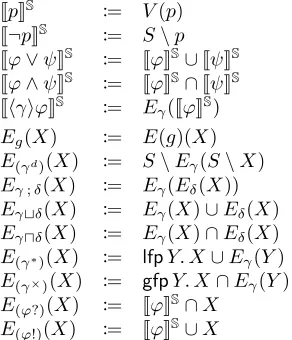
Definition 4. A game model is a triple S = (S, E, V) such that V : P0 → ℘(S) is a valuation and E: G0 → M(S) assigns an effectivity function on S to every atomic g∈G0. By a mutual induction on formulas and games, we define the
meaningJϕKS
function Eγ inS for complex gamesγ as follows:
JpKS
:= V(p) J¬pKS
:= S\p Jϕ∨ψKS
:= JϕKS
∪JψKS
Jϕ∧ψKS
:= JϕKS
∩JψKS
JhγiϕKS
:= Eγ(JϕKS
) Eg(X) := E(g)(X) E(γd)(X) := S\Eγ(S\X)
Eγ;δ(X) := Eγ(Eδ(X)) Eγ⊔δ(X) := Eγ(X)∪Eδ(X) Eγ⊓δ(X) := Eγ(X)∩Eδ(X) E(γ∗)(X) := lfpY. X∪Eγ(Y)
E(γ×)(X) := gfpY. X∩Eγ(Y)
E(ϕ?)(X) := JϕKS
∩X E(ϕ!)(X) := JϕKS
∪X
Notions like satisfiability, equivalence, etc., are defined in the standard way. In particular, a game formulaϕ isvalid, nota-tion:|=ϕ, ifJϕKS
=S, for every game modelS= (S, E, V).
Proposition 5. There are recursively defined, truth-preserving translations
nf(−) : LFull→ LNF
pa(−) : LFull→ LPar
As a corollary of this, negation is definable inLNF. We shall need the following explicit definition in the sequel.
Definition 6. By a mutual induction we define the comple-mentation ϕ := nf(¬ϕ) of an LNF-formula ϕ, and the dual gameeγ of anLNF-gameγ:
p := ¬p
¬p := p
ϕ∨ψ := ϕ∧ψ ϕ∧ψ := ϕ∨ψ
hγiϕ := hγeiϕ
e
g := gd
g
(gd) := g
g
γ;δ := eγ;eδ ]
γ⊔δ := eγ⊓eδ ]
γ⊓δ := eγ⊔eδ
g
(γ∗) := (γe)×
]
(γ×) := (γe)∗
g
(ϕ?) := ϕ!
g
(ϕ!) := ϕ?
The following proposition is proved by a straightforward induction. We leave the details to the reader.
Proposition 7. In any game model S= (S, E, V)we have
JϕKS
=S\JϕKS
andEeγ =Eγd
for any formulaϕ∈ LNF and gameγ∈ GNF.
B. Parikh’s Hilbert-style system
The first axiom system for game logic was proposed and conjectured to be complete by Parikh [1]. This is a Hilbert-style system for the languageLPar that axiomatises the angelic iteration with what Parikh calls Bar Induction. We will refer to this system as Par, and it is shown in Figure 1 below. For ϕ∈ LPar, we write Par⊢ϕif there is a Par-derivation ofϕ.
Par Axioms:
1) All propositional tau-tologies.
2) hγ;δiϕ↔ hγihδiϕ 3) hγ⊔δiϕ↔ hγiϕ∨hδiϕ 4) hγ∗iϕ↔ϕ∨ hγihγ∗iϕ
5) hψ?iϕ↔ψ∧ϕ 6) hγdiϕ↔ ¬hγi¬ϕ
Par Rules:
ϕ ϕ→ψ
MP
ψ
ϕ→ψ
Mon hγiϕ→ hγiψ
hγiϕ→ϕ
[image:4.612.309.568.51.169.2]BarInd hγ∗iϕ→ϕ
Fig. 1. Axioms and rules ofPar.
The systemPar is easily seen to be sound. A main contri-bution of our paper is that we confirm Parikh’s completeness conjecture. We prove Theorem 8 in section VI below.
Theorem 8(Soundness and Completeness of Par). For every formulaϕ∈ LPar, we have:Par⊢ϕiff |=ϕ.
C. The cut-free sequent systemGfor game logic
We now introduce a cut-free (Tait-style) sequent system
G for game logic formulas in normal form. A sequent is thus defined as a finite set of LNF-formulas (to be read disjunctively). For a finite setΦ⊆ LNF, we define Φ∈ LNF as the normal formWΦof¬(WΦ).
The system G consists of several parts. Its core is the sequent calculus version of monotone modal logic as shown in Figure 2. In order to reason about game operators, in Fig. 3
Ax Φ,Φ
Φ weak Φ, ϕ
ϕ, ψ
modm
hgiϕ,hgdiψ Φ, ϕ, ψ
∨
Φ, ϕ∨ψ
Φ, ϕ Φ, ψ
∧
[image:4.612.102.248.69.239.2]Φ, ϕ∧ψ
Fig. 2. The basic rules of the sequent calculusmon-MLfor Game Logic.
we list some rules, each of which directly mirrors the semantic meaning of one game constructor.
Φ, ϕ∨ hγihγ∗iϕ ∗
Φ,hγ∗iϕ
Φ, ϕ∧ hγihγ×iϕ ×
Φ,hγ×iϕ
Φ,hγiϕ∨ hδiϕ
⊔
Φ,hγ⊔δiϕ
Φ,hγiϕ∧ hδiϕ
⊓
Φ,hγ⊓δiϕ
Φ, ψ∧ϕ ? Φ,hψ?iϕ
Φ, ψ∨ϕ ! Φ,hψ!iϕ
Fig. 3. The sequent calculus rulesGameOpfor game operations.
In the third part of the G proof system we have the three “deep” derivation rules given in Figure 4. These rules are needed for technical reasons, as will become clear in some of the proofs further on.
The final ingredient ofGis the strengthened induction rule
[image:4.612.75.270.409.538.2]Φ, ψ(γ)
Mong
d
Φ, ψ(χ! ;γ)
Φ, ψ(ϕ)
Monfd
Φ, ψ(hχ!iϕ)
Φ, ψ(hγihδiϕ)
;d Φ, ψ(hγ;δiϕ)
Fig. 4. Deep rules for Game Logic: DeepG. The notationψ(ϕ)should be read as follows:ψis a context, i.e., a formula with a unique occurrence of a proposition letterp, andψ(ϕ)is the formula obtained by substitutingpfor ϕinψ.
we show in Theorem 15 how inds is used to translate the closure rule of the systemCloG. In this sense,indsplays a role similar to thecontext rule[14, Proposition 5.7(vi)] in Kozen’s completeness proof for the aconjunctive fragment of the modal µ-calculus. Only, Kozen’s proof is based on satisfiability and the context rule therefore deals with least fixpoint unfoldings. Our approach is based on validity, and inds therefore detects greatest fixpoint unfoldings.
[image:5.612.49.309.53.86.2]Φ, ϕ∧ hγih(Φ! ;γ)×ihΦ!iϕ inds Φ,hγ×iϕ
Fig. 5. Strengthened induction rule for Game Logic.
To obtain a more concrete understanding of the inds rule, think of the formula hγ×iϕ as a greatest fixpoint formula νx.ϕ∧ hγix. The “standard” fixpoint rule forγ× would read
as follows: “from ψ → ϕ∧ hγiψ infer ψ → hγ×iϕ”, or,
formulated as a Tait-style sequent rule:
Φ, ϕ∧ hγiΦ ind Φ,hγ×iϕ
Now, observing thathΦ!iϕ≡Φ∨ϕ, one may see thatindsis indeed a variation of ind.
Some further understanding of the ruleindsmay be gained by establishing itssoundness. For this purpose we may reason by contraposition, showing that the refutability of the conclu-sion ofindsimplies the refutability of its premise. It is not hard to see that this boils down to proving the following statement, which is formulated using the dual formulas and games.
Proposition 9. If χ∧ hγ∗iϕ is satisfiable, then so is either
χ∧ϕorχ∧ hγih(χ? ;γ)∗ihχ?iϕ.
In words, this Proposition states the following. Suppose that there is a situation where χ holds and where Angel has a strategy in the game γ∗ ensuring the outcome ϕ. Suppose
furthermore thatχandϕcannot be true simultaneously. Then there is a situation where χ holds, and where Angel has a strategy inγ∗which not only ensures thatϕholds afterwards,
but also guarantees that while playingγ∗, after each round of
playingγ, the formulaχ holds.
The completeness of Gwill follow from the completeness of the system CloG, which we introduce in the next section. The proof of Theorem 10 will be outlined in Section VI.
Theorem 10(Soundness and Completeness ofG). For allξ∈ LNF, we have:G⊢ξiff |=ξ.
The following theorem states the transformation results betweenGandParthat are needed for transferring soundness fromPar toG, and completeness fromGtoPar.
Theorem 11. We have:
1) For allϕ∈ LPar, ifG⊢nf(ϕ)thenPar⊢ϕ. 2) For allξ∈ LNF, ifG⊢ξ thenPar⊢pa(ξ).
III. AN ANNOTATED PROOF SYSTEM
The completeness ofG will follow from the completeness of the annotated tableau systemCloGwhich we introduce now.
A. TheCloGsystem for Game Logic
InCloG, formulas are annotated with names that are used to detect repeated unfoldings of greatest fixpoint formulas in the same context. With each greatest fixpoint formula ϕ ∈
F× we associate a countable set N
ϕ of names for ϕ. We assume thatNϕ∩Nψ=∅if ϕ6=ψ. The set of all names is N =Sϕ∈F×Nϕ. Names will typically be denoted byx,y, . . . or with subscripts x0,x1, . . .. Names inherit the order 4 on the set F of fixpoint formulas: For all x ∈ Nϕ, y ∈ Nψ, we define x 4 y iff ϕ 4 ψ. For a sequence of names a = x0,x1, . . . ,xn−1∈N∗ and a fixpoint formulaϕ∈F, we will write a 4ϕ if for all xi occurring in a, xi ∈Nψ such that ψ4ϕ. The empty sequence is denoted by ε. Anannotation
is a sequencea=x0,x1, . . . ,xn−1∈N∗that is non-repeating and monotone w.r.t. 4, i.e., for all i < n−1, xi 4 xi+1. An annotated game logic formula ϕa consists of a formula ϕ∈ LNF and an annotationa∈N∗.AnnotatedCloG-sequents are finite sets of annotated game logic formulas, and will be denoted byΦ,Ψ,etc.
The system CloG derives CloG-sequents using the axiom and rules in Figure 6. The closure rule clox discharges all occurrences of the sequent Φ,hγ×iϕax appearing as an as-sumption above the proof node where the rule is applied. The side conditions ensure that no fixpoint formula of higher priority than hγ×iϕ is unfolded between the application of clox and its discharged assumption.
A CloG-proof is a finite tree of CloG-inferences in which each leaf is labelled by an axiom or a discharged assumption. Intuitively, aCloG-proof can be understood as a finitary repre-sentation of a non-wellfounded/circular proof. The discharged assumptions are the nodes where the circularity is detected. For a formulaξ∈ LNF, we writeCloG⊢ξto mean that there is aCloG-proof ofξε. Note that CloGisanalyticin the sense that any CloG-proof of ξε will contain only formulas from
Cl(ξ), and names for fixpoint formulas inF×(ξ).
Completeness of CloG will follow from the completeness of the systemCloM, which we introduce in Section IV-B. We prove Theorem 12 in Section VI.
Ax1
pε,(¬p)ε
Φ, ϕa, ψa
∨
Φ,(ϕ∨ψ)a
ϕa, ψb
modm (hgiϕ)a,(hgdiψ)b
Φ, ϕa Φ, ψa
∧
Φ,(ϕ∧ψ)a
Φ,(hγiϕ∨ hδiϕ)a
⊔
Φ,(hγ⊔δiϕ)a
Φ,(hγiϕ∧ hδiϕ)a
⊓
Φ,(hγ⊓δiϕ)a
Φ
weak Φ, ϕa
Φ, ϕab,
exp Φ, ϕaxb
Φ,(hγihδiϕ)a ; Φ,(hγ;δiϕ)a
Φ,(ϕ∨ hγihγ∗iϕ)a
(a4hγ∗iϕ) ∗
Φ,(hγ∗iϕ)a
Φ,(ϕ∧ hγihγ×iϕ)a
(a4hγ×iϕ) ×
Φ,(hγ×iϕ)a
Φ,(ψ∧ϕ)a ? Φ,(hψ?iϕ)a
Φ,(ψ∨ϕ)a ! Φ,(hψ!iϕ)a
[Φ,hγ×iϕax]x .. .
Φ,(ϕ∧ hγihγ×iϕ)ax (a4x∈Nhγ×iϕ,x∈/Φ,a) clox
Φ,(hγ×iϕ)a
Fig. 6. The axiom and rules of the system CloG. In the side condition of
clox, “x∈/Φ,a” means thatxdoes not occur inΦora.
B. Removing annotations with the bullet translation
In order to translate CloG-proofs into G-proofs, we must remove annotations. First, we introduce some notation. We let
hhγiiϕ:=
hhγ1iihhγ2iiϕ if γ=γ1;γ2
hγiϕ otherwise
That is, if γ=γ1;· · ·;γk, and none of the game termsγi is itself a composition, thenhhγiiϕ=hγ1i · · · hγkiϕ.
Given a sequenceϕ~ =ϕ1, . . . , ϕn of formulas and a game term γ, we define
ϕ!
←− := ϕn! ;(. . .(ϕ1!). . .)
ϕ!·γ
←−−− := ϕn! ;(. . .(ϕ1! ;γ). . .).
We can now define the translation (−)• which removes annotations. Intuitively, what this translation does is to weaken fixpoint formulas by adding dual tests corresponding to for-mulas associated with names in the annotation of a fixpoint formula. This will be used to “remember” contexts in which greatest fixpoint formulas have been unfolded. The translation needs to be set up carefully, so that it can be used to transform
CloG-proofs toG-proofs. In particular, it is tailored to fit with the strengthened induction rule inG.
Definition 13. Assume that we have an assignment{χx|x∈
N} of a game logic formula χx ∈ LNF to each name x. We define the bullet translation(−)• from annotated game logic
formulas toLNF byϕε•=ϕ, and for non-empty annotations
aas follows: pa•:=p, (¬p)a•:=¬p, (ϕ∨ψ)a•:=ϕa•∨ψa•, (ϕ∧ψ)a•:=ϕa•∧ψa•,
(hγiϕ)a•:=hhβ(γ,a, ϕ)iiϕa•,
β(g,a, ϕ) :=g, β(gd,a, ϕ) :=gd, β(ψ?,a, ϕ) := (ψa•)?,
β(ψ!,a, ϕ) := (ψa•)!, β(γ∗,a, ϕ) :=γ∗,
β(γ;δ,a, ϕ) :=β(γ,a,hδiϕ) ;β(δ,a, ϕ), β(γ⊔δ,a, ϕ) :=β(γ,a, ϕ)⊔β(δ,a, ϕ), β(γ⊓δ,a, ϕ) :=β(γ,a, ϕ)⊓β(δ,a, ϕ).
The crucial clause of the translation is the case for the demonic iteration. Ifa=bx1· · ·xnc, wherex1, . . . ,xnare all the names forhγ×iϕina, then we define
β(γ×,bx1· · ·xnc, ϕ) := (χ!·γ
←−−−) ×;χ!
←−
whereχ~ :=χx1, . . . , χxn. Note that as a special case we have
β(γ×,a, ϕ) =γ× if there are no names forhγ×iϕina.
The bullet translation only affects the outermost fixpoint operators of a game term. This does, however, not mean that there is only ever one fixpoint affected in a formula. For in-stance when following the trace of the formulah(g;(h×))×ip
in some CloG-proof the fixpoint might unravel such that we obtain the formula hh×ih(g;(h×))×ip. Applying the bullet
translation to this formula might affect the outermost fixpoints of both modalities.
The following lemma shows how the bullet translation applies to annotated fixpoint formulas. It is needed in the proof of Theorem 15 below.
Lemma 14. Let a =bx1. . .xn wherex1, . . . ,xn are all the names ina forhγ×iϕ∈F×. Then we have:
(hγ×iϕ)a• = h(χ!·γ ←−−−)
×ihhχ! ←−iiϕ
b• and (2)
(ϕ∧ hγihγ×iϕ)a• = ϕb•∧ hhγiih(χ!·γ ←−−−)
×ihhχ! ←−iiϕ
b•
(3)
C. EmbeddingCloGinto G
We are now ready to show how CloG-derivations can be transformed toG-derivations. This will be used in Section VI to transfer completeness fromCloGtoGand soundness from
GtoCloG.
Theorem 15. For allξ∈ LNF, if CloG⊢ξthenG⊢ξ.
Proof. Consider a game logic formula ξ and assume that π is a proof of ξε in CloG. We assume that each application of the clo-rule in π introduces a distinct name, i.e., for any distinct pair of rule applicationsclox1 andclox2 inπwe have x1 6= x2. This assumption is w.l.o.g. as we can rename the variable names occurring in π appropriately if needed. The shape of the rules of CloG also imply that for each variable namexoccurring inπ, there is a corresponding occurrence of theclox-rule.
We now assign a formula χx to each variable name x
[image:6.612.47.303.50.342.2]distance of the (unique) clox instance in π from the root of π. Concretely, for a variable namexwe consider the sequent Φ consisting of the side formulas of the application ofclox in π and set χx := Φ•. Here the bullet translation of Φ is
well-defined as any variable nameyoccurring inΦmust have been introduced by an instance ofcloythat is closer to the root of the proof tree than clox, so that the formula χy is already defined by the induction hypothesis.
We now show how to transform theCloG-proofπofξεinto a G-proof of ξ by demonstrating that (i) for all (discharged) assumptionsΦofπthere is aG-derivation ofΦ•, and (ii) for
all CloG-rule applicationsΦ1/Φ2inπthere is a corresponding
G derivation ofΦ2• from assumptions inΦ1•.
Consider first the bullet translation of an arbitrary dis-charged assumption of an application of clox in π. Such a translation is of the formΦ•,(hγ×iϕ)ax•
for some annotated sequent Φ and a game logic formula (hγ×iϕ). Furthermore,
by definition we have χx = Φ•. Now consider the following G proof:
Φ• , χx
weak Φ•
, χx, θ
∨
Φ• , χx∨θ
! Φ•
,hχx!iθ
Φ• , χx
weak Φ•
, χx,hχ!·γ
←−−−ih(χx! ;χ←−−−!·γ)
×
ihχx!iθ
∨
Φ•
, χx∨ hχ!·γ
←−−−ih(χx! ;χ←−−−!·γ)
×
ihχx!iθ
! Φ•
,hχx!ihχ!·γ
←−−−ih(χx! ;χ←−−−!·γ)
×
ihχx!iθ
;d
Φ•
,hχx! ;χ!·γ
←−−−ih(χx! ;χ←−−−!·γ)
×
ihχx!iθ
∧
Φ•
,hχx!iθ∧ hχx! ;χ!·γ
←−−−ih(χx! ;χ←−−−!·γ)
×
ihχx!iθ
×
Φ•
,h(χx! ;χ!·γ
←−−−)
×
ihχx!iθ
where θ :=hhχ!
←−iiϕ
a• and ~χ =χx1, . . . , χx
n with x1, . . . ,xn
being all names of hγ×iϕ in a. The remaining assumption
in this G proof is the sequent Φ•, χx = Φ•,Φ•. But in fact
foranyfinite setΨ ={ψ1, . . . , ψn} we can easily derive the sequentΨ,Ψ = Ψ, ψ1∧ · · · ∧ψn inGusingninstances ofAx andweak followed by an application of∧. Using Lemma 14 one can verify that
Φ•,h(χx! ;χ!·γ
←−−−)
×ihχx!iθ= Φ•,(hγ×iϕ)ax•
which shows that we have constructed the requiredG deriva-tion of the translated assumpderiva-tion.
We show claim (ii) above, ie., that for each rule application inπ there is a correspondingG derivation. We only consider the rulesexpandclo. For the other rules the reasoning is either trivial or it follows from reasoning that is similar but simpler as the one forclo.
Suppose that an instance of the exp-rule is applied in π to obtain Φ, ϕaxb from Φ, ϕab. Let θ = hγ×iϕ′ be the
fixpoint formula corresponding to xand suppose w.l.o.g. that θ∈F×(ϕ)and that the bullet translationϕab• is of the form
ψ(hh(χ!·γ
←−−−) ×;χ!
←−iiψ
′) where χ~ =χx1. . . χx
n are the context
formulas corresponding to the namesx1, . . . ,xnofθthat occur inab. Letχ~′=x
1. . .x. . .xn be the list of names ofθinaxb. Thenϕaxb•=ψ(hh(χ′!·γ
←−−−) ×;χ′!
←−iiψ
′)and it is now easy to see
that this formula is derivable fromϕab• inGby applying the Mongd-rule twice for each occurrence ofθ that got expanded by the bullet translation.
Lastly, consider an application of theclo-rule in πthat de-rives fromΦ,(ϕ∧ hγihγ×iϕ)ax the conclusion Φ,(hγ×iϕ)a. We need to construct a corresponding G derivation. First observe that by Lemma 14 we have
(hγ×iϕ)a•=h(χ!·γ
←−−−) ×ihhχ!
←−iiϕ
b•,
whereband~χare chosen as in the previous case. Furthermore
(ϕ∧ hγihγ×
iϕ)ax•=ϕb•
∧ hhγiih(χx! ;χ!·γ
←−−−)
×
ihχx!ihhχ!
←−)iiϕ
b• ,
=ϕb•
∧ hhγiih(Φ•! ;χ!·γ
←−−−)
×
ihΦ•!ihhχ!
←−)iiϕ
b• where we again used Lemma 14 and the fact that χx = Φ•.
Now we build the followingGderivation:
Φ•, ϕb•∧ hhγiih(Φ•!;χ!·γ ←−−−)
×ihΦ•!ihhχ! ←−iiϕ
b•
;d Φ•, ϕb•∧ hγih(Φ•!;χ!·γ
←−−−)
×ihΦ•!ihhχ! ←−iiϕ
b•
Mongd Φ•, ϕb•∧ hχ!·γ
←−−−ih(Φ •!;χ!·γ
←−−−)
×ihΦ•!ihhχ! ←−iiϕ
b•
Monf d Φ•,hhχ!
←−iiϕ
b•∧ hχ!·γ ←−−−ih(Φ
•!;χ!·γ ←−−−)
×ihΦ•!ihhχ! ←−iiϕ
b•
inds Φ•,h(χ!·γ
←−−−) ×ihhχ!
←−iiϕ
b•,
Here, the double lines indicate that multiple applications of the specified rule could be required to reach the next sequent. Using the equations given above the proof tree, we have given aG-derivation ofΦ•,(hγ×iϕ)a•
from assumption Φ•,(ϕ∧ hγihγ×iϕ)ax•. This shows that for each instance of clothere is a correspondingG-derivation as required.
IV. THE MONOTONEµ-CALCULUS
In this section we give the basic definitions of the monotone µ-calculus, and we introduce an annotated proof system for it.
A. The monotoneµ-calculus: syntax and semantics
Additionally to the sets P0 and G0 from Section II-A we now also fix a countable setVar offixpoint variables. We shall only considerµ-calculus formulas in negation normal form.
Definition 16. The languageLµNF of themonotoneµ-calculus
consists of the formulas:
LµNF∋A, B ::= p| ¬p|x|A∨B |A∧B
| hgiA| hgdiA|µx.A|νx.A
wherep∈P0,g∈G0 andx∈Var.
We apply the usual notions concerning variable binding, writingVar(A)/FVar(A)for the sets of all/all free variables inA. A formulaA is asentenceifFVar(A) =∅.
This is essentially the language of a multi-modalµ-calculus, except we writehgdiϕinstead of [g]ϕin order to stay closer to game logic syntax.
Our definition of the system CloM below crucially involves the following priority order ≤A onVar(A), and a notion of well-namedness from [16].
Definition 17. Let A be a µ-calculus formula and x, y ∈
Var(A). We writex <−A y if for some subformula ofA of the formσy.B whereσ∈ {µ, ν}, the variablexoccurs freely in σy.B. We denote by <A the transitive closure of <−A on
Var(A). We denote by≤A the reflexive, transitive closure of <−A on Var(A). We say that A islocally well-named if <A is irreflexive.
We show examples of <−A in Examples 22 and 23 below. The semantics of the monotone µ-calculus over the game models from Section II-A is standard.
Definition 18. We define the meaning JAKS
h of a formula A ∈ LµNF in the game modelS = (S, E, V), relative to an assignmenth:Var →℘(S), by a standard induction, where, e.g.,JhgdiAKS
h:=S\Eg(S\JAK
S
h), and
Jµx.AKS
h := lfpX.JAK
S
h[x7→X] Jνx.AKS
h := gfpX.JAK
S
h[x7→X].
Here h[x7→ X] is the assignmenth′ given by h′(x) := X
andh′(y) :=h(y)fory6=x.
The meaning of a sentence AinSdoes not depend on the assignment, and so we denote this set as JAKS
. Notions like satisfiability, validity, etc., are all defined in the standard way.
B. TheCloM-system for the monotone µ-calculus
The proof system CloM is the monotone analogue of the annotated sequent system Clo for the µ-calculus from [16], with one further difference. In order to prove our key Proposi-tion 24 below, we need more control over the order on fixpoint variables than allowed by the global order of [16]. Instead, we will use the fixed order≤C, for some ambient formulaC, and defineCloMto be parametric in such a C.
So fix a well-namedµ-calculus formulaC. In the derivation system CloMC, formulas are annotated with sequences of names, as in the system CloG. To each variablex ∈Var(C) we link a set Nx of names for x, in such a way that Nx∩Ny =∅ifx 6=y. As in Section III-A, we let the names inherit the order ≤C over variables, introduce annotations, and extend the relation ≤C to hold between annotations and variables.
The proof rules ofCloMC are in Figure 7. ACloMC-proof is a finite tree of inferences in which each leaf is labelled by an axiom or a discharged assumption. For a formulaA∈ LµNF, we write CloM⊢A if there is aCloMA-proof of Aε.
Analogous to CloG, the system CloM is analytic in the sense that any CloMC-proof of Cε contains only formulas from Cl(C) and names for variables inVar(C). Hence, the order≤C is defined for these names and variables.
We show thatCloMis sound and complete for the semantics of the monotoneµ-calculus given in Definition 18 by reduction to the soundness and completeness of the system Clo with respect to Kripke models, which has been proven in [16].
Ax1
pε,(¬p)ε
Γ, Aa, Ba
∨
Γ,(A∨B)a
Aa, Bb
modm
hgiAa,hgdiBb
Γ, Aa Γ, Ba
∧
Γ,(A∧B)a
Γ
weak Γ, Aa
Γ, A(µx.A(x))a
(a≤C x) µ
Γ,(µx.A(x))a
Γ, Aab,
exp Γ, Aaxb
Γ, A(νx.A(x))a
(a≤Cx) ν
Γ,(νx.A(x))a
[Γ, νx.A(x)ax]x .. . Γ, A(νx.A(x))ax (a≤C x∈Nx,x∈/Γ,a) ν-clox
[image:8.612.311.567.50.255.2]Γ,(νx.A(x))a
Fig. 7. The axiom and rules of the systemCloMC.
The reduction uses a translation (−)t:Lµ NF → L
2µ NF from monotoneµ-calculus into normalµ-calculus that is based on well-known ideas, going back to [6], though our approach is closer to the one from [19, Ch.10], for simulating monotone modal logics with normal modal logics. The basic idea is that an effectivity function E: ℘(S) → ℘(S) corresponds to a monotone neighbourhood function N: S → ℘(℘(S)) which can be encoded with two Kripke relations on state space S∪℘(S): A relation RN ⊆ S×℘(S) that relates states to their neighbourhoods, and a relation R∋ ⊆ ℘(S)×S that
relates neighbourhoods to their elements. Conversely, from two Kripke relations on a state space S one can define a monotone neighbourhood function N: S → ℘(℘(S)) using the same idea. The language L2µNF is the modal µ-calculus language that has two (normal) modalitieshgNiandhg∋ifor each g ∈ G0. The translation of atomic formulas, Boolean connectives and fixpoints is defined by straightforward re-cursion. For modalities, we take (hgiA)t = hg
Ni[g∋](At),
and (hgdiA)t= [g
N]hg∋i(At). Using the model translatons described above, we can show that(−)tpreserves satisfiability and validity.
Lemma 19. For all formulasC∈ LµNF,
1) ifCis satisfiable in a game model, thenCtis satisfiable in a Kripke model forL2µNF.
2) if C is valid over game models, then Ct is valid over Kripke models forL2µNF.
Lemma 19 gives the semantic part needed in the proof of the following theorem.
Theorem 20(Soundness and Completeness ofCloM). For all C∈ LµNF,C is valid (on game models) iffCloM⊢C.
annotated proof system Clo[16] for the normalµ-calculus. First, we note that the translation (−)t extends to anno-tated formulas and sequents in the obvious manner. For both directions, we transform proof trees starting from the root going up. The most interesting case is in the construction of a CloM-proof for A ∈ LµNF from a Clo-proof of At ∈ L2µ NF when the modal rule from Clo is applied. So suppose some node v in a Clo-proof π is obtained from an application of the (normal) modal rule, and v is labelled with a sequentΓt whereΓis a sequent of annotatedLµNF-formulas. ThenΓtmust have the form hgNi[g∋]A1, ...,hgNi[g∋]An,[gN]hg∋iB, and hence Γ must have the form hgiC1, ...,hgiCn,hgdiD where Ct
1 =A1, ..., Cnt =An,Dt =B. By inspection of the rules ofClo, and assuming thatn≥2(since the other case is easier), we see that the subtree of the Clo-proof π rooted at v must have the following shape:
.. . Ai, B
mod [g∋]Ai,hg∋iB
weak [g∋]A1, ...,[g∋]An,hg∋iB
mod hgNi[g∋]A1, ...,hgNi[g∋]An,[gN]hg∋iB
We mimic this by the followingCloM-derivation steps:
Ci, D
mod hgiCi,hgdiD
weak hgiC1, ...,hgiCn,hgdiD
The label of the top node of this derivation translates toAi, B, and so we can inductively continue the construction using the corresponding smaller subtree of π.
V. GAMELOGIC AND THE MONOTONEµ-CALCULUS
In this section we define a novel translation from formulas in game logic to formulas in the monotone µ-calculus, and prove that if the translation of a formula is provable in CloM
then the formula is provable in CloG.
A. Translating Game Logic to the monotoneµ-calculus
It is shown in [5, sec. 6.4.2] that game logic can be translated into the two-variable fragment of the monotone µ-calculus. However, we use more than two variables because we need to keep track of the nesting of fixpoints. Before we give the formal definition of our translation, we first explain informally how we achieve this. Consider the translation of a game logic formula ξ ∈ LNF. Formulas hγ◦iϕ ∈ F(ξ)
translate to fixpoint formulas of the formσx.A(x) on the µ-calculus side. In order to synchronise the translation across unfolding of fixpoint formulas, we syntactically encodehγ◦iϕ
into the fixpoint variable that it gives rise to in the translation ofξ.
Definition 21. We define the translation (−)♯:L
NF → LµNF by a mutual induction on formulas and games as follows:
p♯ := p (¬p)♯ := ¬p (ϕ∧ψ)♯ := ϕ♯∧ψ♯ (ϕ∨ψ)♯ := ϕ♯∨ψ♯
(hγiϕ)♯ := τϕ γ(ϕ♯) τϕ
g(A) := hgiA τgϕd(A) := hgdiA
τγϕ⊓δ(A) := τϕ γ(A)∧τ
ϕ δ(A) τγϕ⊔δ(A) := τϕ
γ(A)∨τ ϕ δ(A) τγϕ∗(A) := µxhγ
∗iϕ
.A∨τγhγ∗iϕ(xhγ
∗iϕ
) τγϕ×(A) := νxhγ
×iϕ
.A∧τγhγ×iϕ(xhγ
×iϕ
) τγϕ;δ(A) := τγhδiϕ(τδϕ(A))
τψ?ϕ(A) := ψ♯∧A τψ!ϕ(A) := ψ♯∨A
Example 22. Forϕ=h(a∗;(b×⊔c))×ip, the translation is
ϕ♯ = νxϕ.p∧
µxψ.((νxθ.xϕ∧ hbixθ)∨ hcixϕ)∨ haixψ withψ = ha∗ihb×⊔ciϕ
θ = hb×iϕ
Applying the definitions of order on game logic fixpoint formulas (Def. 2) andµ-calculus fixpoint variables (Def. 17), we find that:
ϕ≺ψ, ϕ≺θ and xϕ<−
ϕ♯ xψ, xϕ<
−
ϕ♯ xθ
Example 23. Forϕ=h(a∗; (hb×ip)?)×ihc∗iq,
ϕ♯ = νxϕ.(µxψ.q∨ hcixψ)∧
(µxζ.((νxθ.p∧ hbixθ)∧xϕ)∨ haixζ) withψ = hc∗iq
ζ = ha∗ihhb×ip)?iϕ, and
θ = hb×ip
Applying the definitions of order on game logic fixpoint formulas (Def. 2) andµ-calculus fixpoint variables (Def. 17), we find that:
ϕ≺ζ, ϕ≺θ and xϕ<−
ϕ♯ x
ζ
The above examples illustrate how the order on fixpoint variables in µ-calculus is reflected in game logic fixpoints along the translation, and that translations are always locally well-named. These are the syntactic properties of (−)♯ that are crucial to our proofs.
Proposition 24. For allξ∈ LNF the translationξ♯ is locally well-named, and for all ϕ, ψ ∈ F(ξ) we have xϕ, xψ ∈
Var(ξ♯), and thatxϕ≤
ξ♯ xψ impliesϕ4ψ.
On the semantic side, our translation is adequate in the sense that it is truth- and validity preserving. Recall that LNF and
Proposition 25. For everyξ∈ LNF and every game modelS it holds thatJξKS
=Jξ♯KS
.
Proof. By a straightforward induction.
B. From CloMto CloG
We now show how to construct aCloG-derivation of a game logic formulaξ from aCloM-derivation ofξ♯.
For this purpose, we identify the set Nϕ of names for ϕ ∈ F(ξ) with the set Nxϕ of names for the variable
xϕ ∈ Var(ξ♯). This is possible since both sets are defined to be arbitrary countable sets. We then extend the translation (−)♯to annotated formulas and sequents by taking
(ϕa)♯:= (ϕ♯)a and Φ♯:={(ϕa)♯|ϕa∈Φ}.
That is, the translation leaves annotations unchanged.
Theorem 26. For allξ∈ LNF, ifCloM⊢ξ♯ thenCloG⊢ξ.
Proof. We will prove the theorem by induction on the com-plexity of proof trees, and for a proper development of the induction we need to take care of derivations with open branches because theclo-rule allows to discharge assumptions. We shall write π : A ⊢CloMC Γ to say that π is a CloMC
-derivation ofΓfrom assumptions inA, and similarly forCloG -derivations with open assumptions.
More precisely, we shall prove, by induction on the com-plexity of CloM-derivations, that everyCloMξ♯-proofπ
satis-fies the following property:
for every game logic sequent Φ: if π:A ⊢CloMξ♯ Φ♯ then there is aCloG-proofπ′:G ⊢
CloGΦwhereG♯=A. (∗)
Two preliminary remarks are in order before we dive into the proof details. First, in the sequel we will often omit the annotation of formulas, for the sake of readability. And second, without loss of generality we may adopt theinjectivity assumption stating that for each formula A in Φ♯ there is precisely one formulaϕinΦwithϕ♯=A.
In the base case of our proof, the derivation πis either an application of the axiom Ax1 or a one-node derivation of a sequentΦ♯, where the set of assumptions ofπis the singleton set {Φ♯}. In both cases it is straightforward to see that the derivation π′, consisting of a single node labelled Φ, meets
the requirements stated in (∗).
For the inductive step, first observe that we may assume that none of the formulas in Φis of the formhγ;δiψ. Should ϕ ∈ Φ be of this form then we could apply the rule ; and subsequently work with the formula hγihδiψ, for which it holds that(hγihδiψ)♯= (hγ;δiψ)♯. This can be repeated until the resulting formula is of the required shape.
For the proof of the inductive step, we make a case distinction as to the last applied rule in the CloM-derivation π.
In case the last applied rule is the rule∧, thenΦ♯ must be of the form Φ♯ = Γ, A
0∧A1 and the rule ∧ is applied to
the premises Γ, A0 andΓ, A1. By our injectivity assumption there is precisely one formula ϕ in Φ such thatΦ = Ψ, ϕ, Ψ♯= Γandϕ♯=A
0∧A1. But then it follows by the definition of the translation (−)♯ and our assumption on the shape of the formulas in Φthat there are three possibilities: either (i) ϕ=ϕ0∧ϕ1 such thatϕ♯0 =A0 and ϕ♯1 =A1, or (ii) ϕ=
hγ0⊓γ1iψ such that(hγ0iψ)♯ =A0 and(hγ1iψ)♯ =A1, or (iii) ϕ=hψ?iχ such thatψ♯=A
0 andχ♯=A1.
The other cases being similar, we only consider case (ii). Here we haveCloMξ♯-proofsπ0, π1of the sequentsΨ♯,hγ0iψ♯
andΨ♯,hγ
1iψ♯, from two respective sets of assumptions A0 andA1such thatA0∪ A1=A. Use the induction hypothesis to obtain, fori = 0,1, a set Gi of game logic sequents such thatGi♯=Ai, as well as aCloG-proofπi′:Ai ⊢Ψ,hγiiψ. We then apply the rule∧to get a proof of the sequentΨ,hγ0iψ∧
hγ1iψ, followed by the rule ⊓ to derive the sequent Φ = Ψ,hγ0⊓γ1iψ. Finally, the set of assumptions of the resulting derivation π′ is the set G
0∪ G1, which clearly satisfies the condition that(G0∪ G1)♯=A.
The cases where the last rule applied in π is one of ∨,
modm, orweak, are similarly easy to deal with; we omit the details.
Now consider the case where π ends with an application of the rule µ for a least fixpoint. We then have that Φ♯ = Γ, µx.A(x)a, the premise of this application ofµis the sequent Γ, A(µx.A(x))a, and the side conditiona≤
ξ♯ x is fulfilled. As
explained above we can assume that there is a single formulaϕ inΦsuch thatΦ ={Ψ, ϕ},ϕ♯Ψ = Γandϕ♯=µx.A(x). As we have already excluded the possibility thatϕis a modality whose main operator is the composition it follows from the definition of the translation (−)♯ that ϕ = hγ∗iψ such that
A(x) =ψ♯∨τϕ
γ(x). Note thatx=xhγ
∗iψ
by definition of the translation(−)♯. Some further calculations show that
A(µx.A(x)) =ψ♯∨τγϕ(µx.A(x)) = (ψ∨ hγihγ∗iψ)♯.
We can thus apply the induction hypothesis to obtain a
CloG-proof of the sequent Ψ, ψ ∨ hγihγ∗iψ, from a set of
assumptions G satisfying G♯ =A. We then want to use the rule ∗ to obtain a proof of Φ = Ψ, ϕ = Ψ,hγ∗iψ from the
same setG of assumptions. To do so we need to ensure that the side conditiona4hγ∗iψis satisfied. Hence consider any
nameythat occurs inaand letχbe the fixpoint formula such thaty∈Nχ. From the side condition a≤ξ♯ xit follows that
y≤ξ♯ x, and then from Proposition 24 that χ4hγ∗iψ, and
hence we obtain the requiredy4hγ∗iψ.
If the last rule applied in π is the fixpoint rule ν for the greatest fixpoint then we can use a similar argument as in the paragraph using ×instead of ∗.
Finally, consider the case where the last rule applied in π is ν-clox for some name x, discharging the assumptionΩ = Γ, νx.A(x)ax. We then may observe thatΦ♯ = Γ, νx.A(x)a, that the premise of this application of ν-clox is the sequent Γ, A(νx.A(x))ax, and that the side conditions a ≤
ξ♯ x and
Ψ♯ = Γ andϕ♯ = νx.A(x). And, similar to the case of the rule µ discussed above, we may assume that ϕ=hγ×iψ for
γ andψ such thatA(x) =ψ♯∧τϕ
γ(x), and that
A(νx.A(x)) =ψ♯∧τγϕ(νx.A(x)) = (ψ∧ hγihγ×iψ)♯.
We then apply the induction hypothesis and obtain a CloG -derivation of the premise of the ν-clox-rule from assump-tions G ∪ G′, where each sequent in G′ translates to Ω (the
assumption discharged by the application of the ν-clox-rule with conclusionΦ♯). It follows that every sequent in G′ must
be of the form Θ, ϕax
0 with Θ♯ = Γ and ϕ ♯
0 = νx.A(x). From ϕ♯0 = νx.A(x) = ϕ♯ it follows that ϕ
0 = ϕ (syntac-tically), since we encode the formula ϕ = hγ×iψ into the
fixpoint variable x of its translation. That is, we may take
G′ ={Θ,hγ×iψax|Θ∈ L}for some set L withL♯
Σ={Γ}. Note, however, that the sequents in L will generally not be identical to Ψ, which means that we cannot simply finish our proof with an application of theν-clox-rule of theCloG-system here. We need a more elaborate construction.
In fact we need to generalise the statement about Ψanda
to the observation below, where we let S be the (finite!) set of game logic sequents Σsuch thatΣ♯= Γ.
CLAIM1. For everyΣ∈ S there are game logic sequentsGΣ andLΣsuch that (†1)GΣ♯ =A,L
♯
Σ={Γ}and (†2) for every b = ax1· · ·xk, with x1, . . . ,xk names for hγ×iψ, there is a CloG-proof
ρbΣ: GΣ∪ {Θ,hγ×iψb|Θ∈ LΣ} ⊢ Σ,(ψ∧ hγihγ×iψ)b
PROOF OF CLAIM Fix a sequent Σ ∈ S. Repeating the argument that we just gave and that is directly based on the inductive hypothesis, we obtain sets of game logic sequents
GΣ and LΣ satisfying condition (†1), together with a CloG -derivation ρax
Σ of the sequent Σ,(ψ∧ hγihγ×iψ)ax from the assumptions GΣ∪ {Θ,hγ×iψax|Θ∈ LΣ}.
Now consider an annotation b= ax, where x =x1· · ·xk, with k ≥ 1. We will transform the derivation ρax
Σ into the desired derivation ρb
Σ in two stages. First, we simply replace every occurrence of x as (part of) an annotation in ρax
Σ with x. This transforms ρax
Σ into a structure ρ′ which is almost a properCloG-proof. The only problem concerns applications in ρax
Σ of theexpansionruleexpof the form∆, ϕcd/∆, ϕcxd. Inρ′ we may not be allowed to derive∆, ϕcxd from∆, ϕcd by one application of the expansion rule, but we can easily take care of this problem in the second state of the construction, namely by deriving∆, ϕcxdfrom∆, ϕcdby aseriesof applications of the expansion rule. This finishes the proof of the claim. ◭
We will use derivations of the form ρb
Σ as building blocks for our CloG-derivation of the sequent Ψ,hγ×iψa. The idea is to first build up, step by step, a pseudo-derivation of Ψ,hγ×iψa which differs from a properCloG-proof in that not all assumptions of prospective applications of theclo-rule are discharged. Once we have completed the construction of this pseudo-derivation, we transform it into a proper CloG-proof by taking care of these undischarged assumptions. To do this
in a proper way we need to be precise about the annotations, and we need to introduce some auxiliary definitions.
Most importantly, we define a pseudo-derivation to be a proof in the derivation system CloG extended with the derivation rule D:
Φ,(ϕ∧ hγihγ×iϕ)ax
a4x∈Nhγ×iϕ,x∈/Φ,a Dx
Φ,(hγ×iϕ)a
Clearly,Dis identical to the ruleclo, apart from the fact that it does not require that the assumptions of the formΨ,hγ×iϕax in the proof tree leading up to the premise ofDare discharged. We shall call a node t in a proof tree dangling if the rule applied attisD. Observe that a pseudo-derivation is a proper
CloG-derivation just in case it has no dangling nodes. We now construct a pseudo-derivation for the sequent Ψ,hγ×iψa. We shall make use of a set {x
Σ | Σ ∈ S} of special, fresh names, all associated with the fixpoint formula
hγ×iψ. Our starting point of the construction is the one-node
derivation consisting of the sequentΨ,hγ×iψa.
Now suppose that the current approximation σ of the pseudo-derivation contains an assumption of the form Σ,hγ×iψb, where Σ ∈ S and the annotation b is of the form b = ax with xΣ not occurring in the sequence x = xΣ1· · ·xΣk. By our Claim 1, we may take a CloG-proofρ
bxΣ Σ of the sequent Σ,(ψ∧ hγihγ×iψ)bxΣ from the assumptions
GΣ∪ {Θ,hγ×iψbxΣ | Θ ∈ LΣ}. We adjoin copies of the derivationρbxΣΣ to the derivation tree, linking each leaf in the current approximationσwhich is labelled as indicated, to the root of a copy ofρbxΣ
Σ through an application of the ruleDxΣ. The above construction must terminate after finitely many steps, basically as a consequence of the fact that the setS is finite. Letρdenote the pseudo-derivation that we arrive at in this way, and letG be the set of assumptions ofρthat belong to the setS{GΣ|Σ∈ S}; clearly then we have thatG♯=A. It is not difficult to verify that the pseudo-derivation ρ satisfies the following conditions:
1) All leaves ofρare labelled with an axiom, a sequent from
G, or else a sequent of the formΣ,hγ×iψb, whereΣ∈ S and the annotationbis of the formb=axΣ1· · ·xΣk, with
Σ1= Ψ,Σ∈ {Σ1, . . . ,Σk}, and theΣi are all distinct. 2) If a leaflis labelledΣ,hγ×iψb, whereb=ax
Σ1· · ·xΣk,
then the path from the root r of ρ to l passes through nodesr=t1, . . . , tk, in that order, such that (a) everytj is either dangling or the conclusion of an application of theclo-rule, and (b) the namexΣi was introduced at the
successor ofti.
3) If t is a dangling node of ρ, labelled, say, with the sequentΣ,hγ×iψb, andl is a leaf abovetlabelled with Σ,hγ×iψc, thenbx
Σis an initial segment ofc.
Step by step we will now transform this pseudo-derivation into a properCloG-derivation. Clearly it suffices to prove that we can turn any pseudo-derivation satisfying the conditions 1) – 3) into a pseudo-derivation that still satisfies mentioned conditions, but has a smaller number of dangling nodes.