Tel: 01 400 33 41, 01 400 31 45 Fax: 01 400 33 48, 02 252 11 89 E-mail: [email protected]
www.mg.gov.si
Progress Report of Slovenia under Directive 2009/28/EC
1. Sectoral and overall shares and actual consumption of energy from renewable sources in the preceding two years (n-1; n-2, e.g. 2010 and 2009) (Article 22(1)(a) of Directive 2009/28/EC)
Table 1: Sectoral (electricity, heating and cooling, and transport) and overall shares of energy from renewable sources1
2009 2010
RES – H and C2 (%) 24.9 26.62
RES – E3 (%) 33.8 32.2
RES – T4 (%) 2.01 2.87
Overall RES share 5 (%) 18.99 19.90 Of which from cooperation
mechanism6 (%)
0 0
Surplus for cooperation mechanism7 (%)
0 0
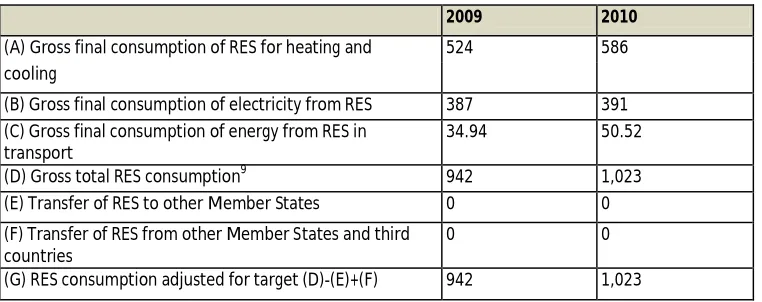
Table 1a: Calculation table for the renewable energy contribution of each sector to final energy consumption (ktoe)8
2009 2010
(A) Gross final consumption of RES for heating and 524 586 cooling
(B) Gross final consumption of electricity from RES 387 391 (C) Gross final consumption of energy from RES in
transport
34.94 50.52
(D) Gross total RES consumption9 942 1,023
(E) Transfer of RES to other Member States 0 0
(F) Transfer of RES from other Member States and third countries
0 0
(G) RES consumption adjusted for target (D)-(E)+(F) 942 1,023
1
Facilitates comparison with Tables 3 and 4a of the National Renewable Energy Action Plans (NREAP).
2 Share of renewable energy in heating and cooling (H and C): gross final consumption of energy from renewable sources for heating and cooling (as defined in Articles 5(1)b) and 5(4) of Directive 2009/28/EC), divided by gross final consumption of energy for heating and cooling. The same methodology applies as in Table 3 of the NREAP.
3 Share of renewable energy in electricity (E): gross final consumption of electricity from renewable sources for electricity (as defined in Articles 5(1)(a) and 5(3) of Directive 2009/28/EC), divided by total gross final consumption of electricity. The same methodology applies as in Table 3 of the NREAP.
4 Share of renewable energy in transport (T): final energy from renewable sources consumed in transport (cf. Articles 5(1)(c) and 5(5) of Directive 2009/28/EC), divided by the consumption in transport of 1) petrol; 2) diesel; 3) biofuels used in road and rail transport; 4) electricity in land transport (as reflected in row 3 of Table 1). The same methodology applies as in Table 3 of the NREAP.
5 Share of renewable energy in gross final energy consumption. The same methodology applies as in Table 3 of the NREAP. 6
In percentage points of overall RES share. 7 In percentage points of overall RES share. 8
Facilitates comparison with Table 4a of the NREAP. 9
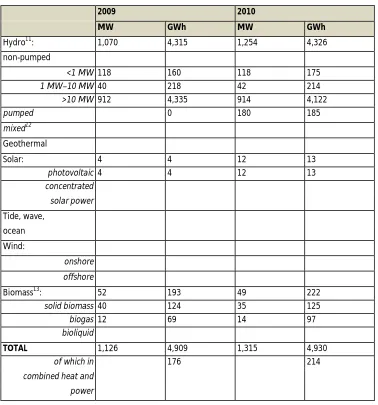
Table 1b: Total actual contribution (installed capacity, gross electricity generation) from each renewable energy technology in Slovenia to meet the binding 2020 targets, and the indicative interim trajectory for the shares of energy from renewable resources in electricity10
2009 2010
MW GWh MW GWh
Hydro11: 1,070 4,315 1,254 4,326
non-pumped
<1 MW 118 160 118 175
1 MW–10 MW 40 218 42 214
>10 MW 912 4,335 914 4,122
pumped 0 180 185
mixed12 Geothermal
Solar: 4 4 12 13
photovoltaic 4 4 12 13
concentrated solar power Tide, wave,
ocean Wind:
onshore offshore
Biomass13: 52 193 49 222
solid biomass 40 124 35 125
biogas 12 69 14 97
bioliquid
TOTAL 1,126 4,909 1,315 4,930
of which in 176 214
combined heat and power
Note: Only the data on the total hydroenergy produced has been normalised.
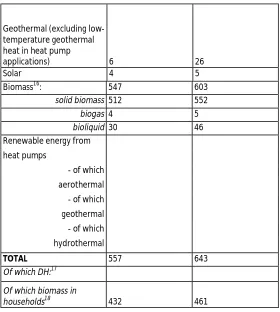
Table 1c: Total actual contribution (final energy consumption14) from each renewable energy technology in Slovenia to meet the binding 2020 targets, and the indicative interim trajectory for the shares of energy from renewable resources in heating and cooling (ktoe)15
2009 2010
10 Facilitates comparison with Table 10a of the National Renewable Energy Action Plans. 11 Normalised in accordance with Directive 2009/28/EC and Eurostat methodology. 12
In accordance with the new Eurostat methodology.
13 Takes into account only those complying with applicable sustainability criteria, cf. last subparagraph of Article 5(1) of Directive 2009/28/EC.
14
Direct use and district heat as defined in Article 5(4) of Directive 2009/28/EC. 15
Geothermal (excluding low-temperature geothermal heat in heat pump
applications) 6 26
Solar 4 5
Biomass16: 547 603
solid biomass 512 552
biogas 4 5
bioliquid 30 46
Renewable energy from heat pumps
- of which aerothermal - of which geothermal - of which hydrothermal
TOTAL 557 643
Of which DH:17
Of which biomass in
[image:4.595.71.351.68.380.2]households18 432 461
Table 1d: Total actual contribution from each renewable energy technology in Slovenia to meet the binding
2020 targets, and the indicative interim trajectory for the shares of energy from renewable resources in the transport sector (ktoe)1920
2009 2010
Bioethanol/bio-ETBE
Of which biofuels21 Article 21(2) Of which imported22 Biodiesel
Of which biofuels23 Article 21(2) Of which imported24 Hydrogen from renewables
Renewable electricity
Of which road transport Of which non-road transport Others (e.g. biogas, vegetable oils, etc.) – specify
16
Takes into account only those complying with applicable sustainability criteria, cf. last subparagraph of Article 5(1) of Directive 2009/28/EC.
17 District heating and/or cooling from total renewable heating and cooling consumption (RES-DH). 18
In total renewable heating and cooling consumption.
19 For biofuels, takes into account only those complying with sustainability criteria, cf. last subparagraph of Article 5(1). 20 Facilitates comparison with Table 12 of the NREAP.
21
Biofuels included in Article 21(2) of Directive 2009/28/EC. 22 From the whole amount of bioethanol/bio-ETBE. 23 Biofuels included in Article 21(2) of Directive 2009/28/EC. 24
Of which biofuels25 Article 21(2) TOTAL
Slovenia has no oil refineries. We import all liquid fuels, for transport as well as for heating. The liquid fuels for transport which we import frequently contain a small proportion of biofuel.
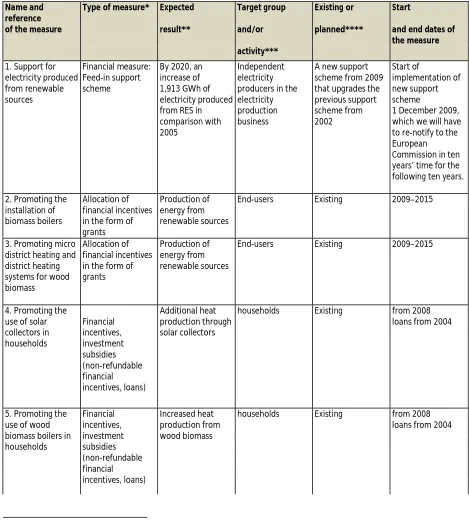
[image:5.595.69.538.224.745.2]2. Measures taken in the preceding 2 years and/or planned at national level to promote the growth of energy from renewable sources, taking into account the indicative trajectory for achieving the national RES targets as outlined in the National Renewable Energy Action Plan (Article 22(1)(a) of Directive 2009/28/EC) Table 2: Overview of all policies and measures
Name and reference
Type of measure* Expected Target group Existing or Start
of the measure result** and/or planned**** and end dates of
the measure activity***
1. Support for electricity produced from renewable sources Financial measure: Feed-in support scheme
By 2020, an increase of 1,913 GWh of electricity produced from RES in comparison with 2005
Independent electricity producers in the electricity production business
A new support scheme from 2009 that upgrades the previous support scheme from 2002 Start of implementation of new support scheme
1 December 2009, which we will have to re-notify to the European Commission in ten years’ time for the following ten years. 2. Promoting the
installation of biomass boilers
Allocation of financial incentives in the form of grants
Production of energy from renewable sources
End-users Existing 2009–2015
3. Promoting micro district heating and district heating systems for wood biomass
Allocation of financial incentives in the form of grants
Production of energy from renewable sources
End-users Existing 2009–2015
4. Promoting the use of solar collectors in households Financial incentives, investment subsidies (non-refundable financial incentives, loans) Additional heat production through solar collectors
households Existing from 2008
loans from 2004
households Existing from 2008
loans from 2004 Increased heat
production from wood biomass 5. Promoting the
use of wood biomass boilers in households Financial incentives, investment subsidies (non-refundable financial incentives, loans)
25
households existing not in the NREAP
from 2010 loans from 2004 Increased use of
renewable energy sources
Financial incentives, investment subsidies (non-refundable financial incentives, loans) 6. Promoting the
use of heat pumps for the preparation of sanitary hot water and heating in households
from 1998 Companies,
households
existing not in the NREAP
Increased production of electricity from renewable sources Financial
incentives, investment subsidies (loans) 7. Promoting the
production of electricity from renewable sources
2a Please describe the progress made in evaluating and improving administrative procedures to remove regulatory and non-regulatory barriers to the development of renewable energy (Article 22(1)(e) of Directive 2009/28/EC).
We have simplified procedures for the construction and operation of photovoltaic power plants.
We have added a new Article 5a to the Act Amending the Energy Act (OGRS No 22/10, EZ-D) which makes an exception for owners of generating plants up to 50 kW – specifically, there is no requirement for them to be organised in accordance with the provisions of the Companies Act, but they may perform their electricity production business as natural persons.
With the adoption of the Decree Amending the Energy Infrastructure Decree (OGRS, No 75/10), we have simplified procedures for installing electricity generators that use renewable energy sources and are mounted on or in buildings. No construction permit is required for fuel cells and wind power plants up to 50 kW or for solar power plants up to 1 MW, since the installation of such plants is regarded as investment maintenance work.
With the adoption of the new Mining Act (OGRS, Nos 61/10, 62/10, 76/10), we have simplified procedures for exploiting geothermal energy. A mining permit is no longer required for the exploitation of geothermal energy from boreholes that are no deeper than 300 m below the surface.
In September 2010, in cooperation with Borzen, the electricity market organiser, and SODO, the electricity distribution network system operator, the Ministry of the Economy issued a booklet containing useful advice for the construction of small-scale installations for the generation of electricity from renewable sources and the cogeneration of heat and power (an updated second edition of the booklet was published in February 2011)
(http://www.mg.gov.si/fileadmin/mg.gov.si/pageuploads/Energetika/Dokumenti/Elektrarne_OVE_SPTE_brosu ra.pdf). The aim of this booklet is to disseminate information on and educate potential investors in the possibility of constructing small-scale electricity-generating installations, and to serve as a guide to procedures for acquiring permits and commencing production.
Measures for ensuring access to the network for electricity generated from renewable sources and for high-efficiency cogeneration have already been laid down in legislation for implementation of Directive 2001/77/EC; they ensure access to the network and provide for exemption from the costs of grid connection (excluding the costs of implementing a connecting line) and priority dispatch. This is ensured on the basis of the following articles of the Energy Act: 64j, 64k, 64l and 64m.
3. Please describe the support schemes and other measures currently in place that are applied to promote energy from renewable sources, and report on any developments in the measures used with respect to those set out in your National Renewable Energy Action Plan (Article 22(1)(b) of Directive 2009/28/EC).
Support for electricity produced from renewable sources
The Slovenian support scheme for electricity produced from renewable sources and for high-efficiency cogeneration has been harmonised with EU regulations. It accords with the Guidelines on State Aid for Environmental Protection (2008/C82/01) and aims to foster the establishment of a stimulative investment environment for new projects related to renewable energy sources and efficient energy use.
In accordance with the guidelines, support is defined as financial aid for electricity production in RES
generating plants, where the costs of producing such electricity exceed the price that can be obtained for it on the electricity market.
In Slovenia, support for electricity produced in RES generating plants and in the cogeneration of heat and power (CHP) comprises:
- guaranteed purchase of electricity (hereinafter: guaranteed purchase). On the basis of this support, irrespective of the price of electricity in the market, the support centre buys all the acquired net electricity produced, for which the RES or CHP generating plant has received guarantees of origin, at the guaranteed electricity prices set out in the Decree on Support for Electricity Generated from Renewable Energy Sources (OGRS, No. 37/2009, and amendments) and the Decree on Support for Electricity Produced from High-Efficiency Cogeneration (OGRS, No 37/2009, and amendments);
- financial aid for current operations (hereinafter: operating support). This support is allocated for net electricity generated for which a guarantee of origin has been received and which RES and CHP electricity producers sell themselves on the market or use for their own consumption, provided the costs of producing this energy are greater than the price that can be obtained for it on the electricity market.
RES generating plants with a nominal power of up to 5 MW and CHP generating plants with a nominal power of up to 1 MW are eligible for the guaranteed purchase of electricity. For such generating plants, during the validity of the contract on guaranteed purchase, the support centre regulates the registration of the operating forecast and balances the difference between the forecast and actual production, including the balance-sheet affiliation. RES generating plants engaged in the co-incineration of wood biomass are not eligible for
guaranteed purchase, irrespective of the size class of the plant.
RES generating plants with a nominal power of up to 5 MW and CHP generating plants with a nominal power of up to 1 MW may decide, instead of guaranteed purchase, to sell electricity independently on the market and to receive operating support, where they must themselves arrange the registration of their operating forecast and the balancing of the difference between forecast and actual production, including balance-sheet affiliation.
RES generating plants with a nominal power of 5 MW or more and CHP generating plants with a nominal power of 1 MW or more are entitled to receive operating support only.
The duration of support is defined in the decision allocating support, and is 15 years for new RES generating plants and 10 years for new CHP generating plants.
Those eligible for support entitled to choose the method of support they receive communicate their decision on the method of support provision in their applications for a decision allocating support sent to the Energy Agency.
The level of guaranteed purchase prices for electricity is the same as the reference costs of electricity generation for individual production technologies and size classes. The price in the contract on guaranteed purchase, where the input energy product does not represent a cost, is formulated only from the fixed part of the price, but at RES generating plants at which the input energy product represents a cost, it is also
formulated from the variable part of the price, in the same ratio as the fixed and variable parts of the reference costs.
Operating support is the difference between the reference costs of producing electricity in individual types of generating plants and the reference market price of electricity.
If on the basis of the Energy Agency’s forecast reference market prices of electricity it is determined that the price of electricity in the market, where account is also taken of the characteristics of operating individual types of generating plant, is higher than the reference costs of electricity production applying to the period in question, operating support for electricity for the period in question is not paid.
Eligibility for support is held by new and mainly new RES and CHP generating plants that are in possession of a valid declaration for the generating plant and that meet the prescribed conditions observed by the Energy Agency in the process of deciding on eligibility for support.
Further information:
http://www.mg.gov.si/si/delovna_podrocja/energetika/sektor_za_oskrbo_energetske_vire_in_rudar stvo/podporna_shema_ove_in_spte/
Programme for promotion of the energy use of wood biomass
The programme for promotion of the energy use of wood biomass is carried out via two public calls for applications: Those entitled to grants are, primarily, companies and sole traders. Both calls for applications are carried out under the state aid allocation rules; aid intensity therefore ranges from 30 to 50%.
Financial incentives are intended to promote innovative systems based chiefly on high -efficiency energy conversion technologies and the exploitation of renewable energy sources.
The promotion programme is carried out via two public calls for applications. The first call for applications is intended for the construction of district heating systems and the second for the construction of micro district heating systems and the installation of individual wood biomass boilers. In both cases, projects entitled to financing under axes 1 and 3 of the Rural Development Programme are excluded.
Grants may be obtained for the construction or extension of district heating systems which use wood biomass or geothermal energy as their energy source. Eligible costs include a boiler room incorporating one or more wood biomass boilers up to 20 MW or equipment for the cogeneration of heat and power from wood biomass, and the installation of a solar energy system, but not the implementation of a geothermal borehole. Investors that construct a new boiler room incorporating wood biomass boilers as the energy source for an existing district network are also eligible for funding. An investment project must amount to at least EUR 150,000 in the case of expansion and EUR 400,000 in the case of the new construction of wood biomass heating installations.
Likewise, grants are allocated for the installation of wood biomass heating equipment with a power of at least 150 kW and for the implementation or modernisation of the primary section of a micro district heating distribution line with a total line length of not more than 300 m and four users of heat in buildings outside the facility in which the heating installation is located.
In accordance with the Directive on the energy performance of buildings, the Ministry of the Economy is drafting a National Action Plan for Promoting Almost Zero-Energy Buildings, planned for completion by mid-2012. It will include an overview of the situation, the targets set and the measures to achieve these targets. The measures will be divided into systemic and incentivising measures to increase the proportion of almost zero-energy buildings. Targets and measures shall be set separately for the public sector.
[image:9.595.76.544.283.760.2]The Ministry of the Economy is drafting a new Energy Act that will define an almost zero-energy building. The Ministry of the Environment and Spatial Planning, in cooperation with the Ministry of the Economy, will introduce amendments to the Rules on Efficient Energy Use in Buildings (OGRS, Nos 93/08, 47/09), issued pursuant to Article 10(2) of the Construction Act (OGRS, Nos 102/04 – official consolidated text, 14/05 – amendments, 92/05 – ZJC-B, 111/05 – Constitutional Court Decision, 93/05 – ZVMS, 120/06 – Constitutional Court Decision, 126/07, 108/09), which will define more precisely the minimum technical requirements for an almost zero-energy building.
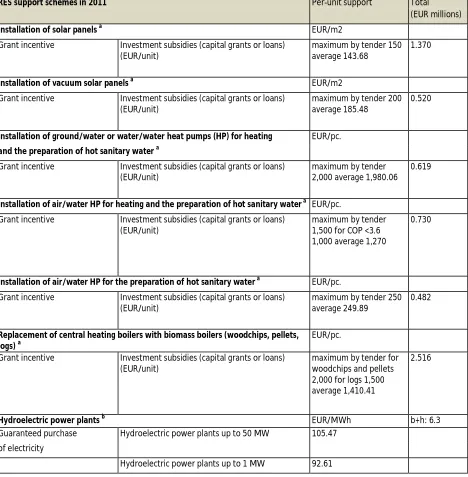
Table 3: Support schemes for renewable energy
RES support schemes in 2011 Per-unit support Total
(EUR millions)
Installation of solar panels a EUR/m2
Grant incentive Investment subsidies (capital grants or loans) (EUR/unit)
maximum by tender 150 average 143.68
1.370
Installation of vacuum solar panels a EUR/m2
Grant incentive Investment subsidies (capital grants or loans) (EUR/unit)
maximum by tender 200 average 185.48
0.520
Installation of ground/water or water/water heat pumps (HP) for heating EUR/pc. and the preparation of hot sanitary water a
Grant incentive Investment subsidies (capital grants or loans) (EUR/unit)
maximum by tender 2,000 average 1,980.06
0.619
Installation of air/water HP for heating and the preparation of hot sanitary water a EUR/pc. Grant incentive Investment subsidies (capital grants or loans)
(EUR/unit)
maximum by tender 1,500 for COP <3.6 1,000 average 1,270
0.730
Installation of air/water HP for the preparation of hot sanitary water a EUR/pc. Grant incentive Investment subsidies (capital grants or loans)
(EUR/unit)
maximum by tender 250 average 249.89
0.482
Replacement of central heating boilers with biomass boilers (woodchips, pellets, logs) a
EUR/pc. Grant incentive Investment subsidies (capital grants or loans)
(EUR/unit)
maximum by tender for woodchips and pellets 2,000 for logs 1,500 average 1,410.41
2.516
Hydroelectric power plants b EUR/MWh b+h: 6.3
Guaranteed purchase Hydroelectric power plants up to 50 MW 105.47 of electricity
Hydroelectric power plants over 1 kW 82.34
Wind generators c EUR/MWh c+i: >0
Wind generators 95.38
Guaranteed purchase of electricity
Solar power plants d EUR/MWh d+j: 14.2
Solar power plants on buildings up to 50 kW 332.37 Guaranteed purchase of
electricity
Solar power plants on buildings up to 1 MW 304.02 Solar power plants on buildings over 1 MW 252.29 Ground-level solar power plants up to 50 kW 312.34 Ground-level solar power plants up to 1 MW 287.77 Ground-level solar power plants over 1 MW 231.98
Geothermal power plants e EUR/MWh
Geothermal power plants 152.47
Guaranteed purchase of electricity
Wood biomass power plants f EUR/MWh f+l: 5.6
Wood biomass power plants up to 50 kW / Guaranteed purchase of
electricity
Wood biomass power plants up to 1 MW 233.79 Wood biomass power plants over 1 MW 175.30
Biogas power plants g EUR/MWh g+m: 13.1
160.56 Guaranteed purchase of
electricity
Biogas power plants using agricultural biomass up to 50 kW
156.31 Biogas power plants using agricultural biomass up
to 1 MW
141.42 Biogas power plants using agricultural biomass
over 1 MW
139.23 Biogas power plants using biomass from waste up
to 50 kW
139.23 Biogas power plants using biomass from waste up
to 1 MW
129.15 Biogas power plants using biomass from waste
over 1 MW
85.84 Biogas power plants using biomass from sewage
sludge up to 50 kW
74.42 Biogas power plants using biomass from sewage
sludge up to 1 MW
66.09 Biogas power plants using biomass from sewage
sludge over 1 MW
99.33 Biogas power plants using biomass from landfill
gas up to 50 kW
67.47 Biogas power plants using biomass from landfill
gas up to 1 MW
61.67 Biogas power plants using biomass from landfill
Hydroelectric power plants h EUR/MWh Hydroelectric power plants up to 50 MW 59.78 Feed-in premium
Hydroelectric power plants up to 1 MW 46.92 Hydroelectric power plants over 1 kW 34.52
Wind generators i EUR/MWh
Wind generators 52.88
Feed-in premium
Solar power plants j EUR/MWh
Solar power plants on buildings up to 50 kW 285.62 Feed-in premium
Solar power plants on buildings up to 1 MW 257.27 Solar power plants on buildings over 1 MW 302.94 Ground-level solar power plants up to 50 kW 265.59 Ground-level solar power plants up to 1 MW 241.02 Ground-level solar power plants over 1 MW 183.63
Geothermal power plants k EUR/MWh
Geothermal power plants 103.59
Feed-in premium
Wood biomass power plants l EUR/MWh
Wood biomass power plants up to 50 kW / Feed-in premium
Wood biomass power plants up to 1 MW 185.44 Wood biomass power plants over 1 MW 126.42
Biogas power plants m EUR/MWh
113.81 Feed-in premium Biogas power plants using agricultural biomass up
to 50 kW
107.96 Biogas power plants using agricultural biomass up
to 1 MW
92.54 Biogas power plants using agricultural biomass
over 1 MW
92.48 Biogas power plants using biomass from waste up to 50 kW
90.88 Biogas power plants using biomass from waste up to 1 MW
80.27 Biogas power plants using biomass from waste
over 1 MW
36.96 Biogas power plants using biomass from sewage
sludge up to 50 kW
25.54 Biogas power plants using biomass from sewage
sludge up to 1 MW
17.21 Biogas power plants using biomass from sewage
sludge over 1 MW
50.45 Biogas power plants using biomass from landfill
gas up to 50 kW
gas up to 1 MW
12.79 Biogas power plants using biomass from landfill
gas over 1 MW
Heating using wood biomass (boilers, micro district and district heating systems)
Production incentive tendering 30–50% of the
investment value
3.2 Total annual estimated support in the electricity sector EUR 143.73/MWh 42.4
Total annual estimated support in the heating sector 9.437
Total annual estimated support in the transport sector
a – The table includes the approved financial incentives for the programmes listed (decisions issued). The 2011 data covers the period from 1 January to 10 December.
b, c, d, e, f, g, h, i, j, k, l, m: realisation of support for 2011 from 1 January to 1 October 2011. In the first nine months of 2011, a little less than EUR 51.1 million was paid out in support under both schemes (guaranteed purchase of electricity and feed-in premium), which represents an increase of 52% on the same period in 2010, or 70% of the level planned for the whole of 2011. There was a marked increase in the share of solar power plants in the support schemes, although it must be noted that seasonal influences make a direct comparison with data for the calendar year impossible. In the last quarter, the share of solar power plants will fall slightly and the share of cogeneration (as a result of the heating season) and hydroelectric power plants (as a result of better hydrology in the autumn and winter months) will rise.
Demonstration and pilot projects, and energy consulting, information and training programmes
Demonstration and pilot projects are not implemented from Cohesion Fund resources. The old regulations on the minimum energy performance of buildings were in force when the Operational Programme for
Environmental and Transport Infrastructure Development was being drawn up. Demonstration projects were planned in order to show that buildings could be built with a greater level of energy-efficiency than was laid down in the minimum energy performance standards. The new Rules on the Efficient Use of Energy in Buildings (OGRS, Nos 93/08, 47/09, 52/10) began to be applied in 2010; these set substantially higher standards of energy efficiency for all new and renovated buildings. The Rules introduce stricter requirements for public buildings. The requirements are so strict that there is no longer any need for demonstration projects that would undertake to build to a superior energy-efficiency standard.
Rules on the Efficient Use of Energy in Buildings
The new Rules on the Efficient Use of Energy in Buildings (PURES, OGRS, No 52/10), which entered into force on 1 July 2010, will have a significant impact on buildings that will be renovated and constructed in the future, determining strict criteria for thermal insulation and the mandatory share of renewable energy sources in new buildings. The Rules were adopted on the basis of the requirements laid down by the European Directive on the energy performance of buildings, whose objective is to ensure reliability of energy supply and achievement of the aims of the Kyoto Protocol (8% reduction in emissions by 2012).
The more important requirements of PURES are as follows: - 25% of energy to be provided from renewable sources;
- more efficient thermal insulation in new buildings and buildings to be renovated (this must be U<0.28 W/m2K for residential buildings, which means 10 cm or more of insulation on modular brick); - a reduction in temperature in water heating systems from 70 or 90 to 55 degrees Celsius;
- a maximum permitted level of power for the cooling of a building which may not be exceeded; - restrictions in the average illumination of a building and in the use of lighting equipment.
Decree on Promotion of the Use of Biofuels and Other Renewable Fuels for the Propulsion of Motor Vehicles (OGRS, No 103/07)
The Decree on Promotion of the Use of Biofuels and Other Renewable Fuels for the Propulsion of Motor Vehicles (OGRS, Nos 103/07, 92/10, 74/11) is being implemented.
The Decree on Green Public Procurement (OGRS, No 102/11) has been adopted and will begin to be implemented from 13 March 2012. Among other things, the Decree will determine an obligatory share of electricity to be produced from renewable sources for all liable entities.
Obligatory shares of RES in district heating systems and 32. Promoting RES in local energy plans
The shares of heat produced from RES that must be attained by all district heating systems are laid down in the NREAP. The Rules Amending the Rules on the Methodology of the Obligatory Contents of Local Energy Plans (OGRS, No 3/11) lay down that energy activities ensuing from a plan must meet the targets set out in the NREAP.
Improving administrative procedures for installing facilities for decentralised electricity generation
The government has adopted the Decree Amending the Decree on Energy Infrastructure (OGRS, No 75/10).
System of energy management in the public sector
A fund for the management of state-owned property has been established but is not yet in operation.
Programme of information and awareness-raising about renewable energy sources
In 2010 and 2011 the Ministry of the Economy supported the implementation of the U•inkovito z energijo (‘Efficiently with Energy’) bulletin project, accessible to the general public via the ministry’s website http://www.mg.gov.si/si/zakonodaja_in_dokumenti/energetika/pomembni_dokumenti/bilten_ucink ovito_z_energijo/
The aim of the bulletin is to contribute to increasing efficient energy use and the production of renewable energy by raising awareness and providing information to larger energy users and other target groups. The bulletin was first published in 1996; since then it has become one of the key communications tools in the field of sustainable energy development.
It presents new developments in energy, environmental and other policy areas, regulations, standards, programmes, projects and tenders, along with other current issues relating to energy efficiency and renewable energy sources in Slovenia, Europe and around the globe. It also publishes information on development of the energy market, international and bilateral programmes and projects, energy-efficiency technologies, and the activities of energy-users, energy-supply companies, local communities, financial institutions and others.
The bulletin’s main target groups are: energy consumers in industry, the service and public sectors, and apartment buildings, local communities, energy-supply companies, consulting, planning and engineering organisations, suppliers of energy equipment and services, financial institutions, development, research and educational institutions, non-governmental organisations, state administration and others.
Two issues of the bulletin were published in 2010 and six issues in 2011. Each issue contains eight pages, giving a total of 64 pages.
Citizens’ Energy Advice (EnSVet)
These funding problems led to a fall in the number of pieces of advice provided by energy advisors through written reports – from 6,381 in 2010 to 5,449 in 2011. In recent years, efficient energy use has, on average, accounted for 55% of the advice given and renewable energy sources for 45% (10% wood biomass, 9% heat pumps, 13% solar energy systems, the remainder being accounted for by other RES topics, including photovoltaics). In two years, advisors have held over 27,000 short advisory sessions with citizens, provided 11,830 pieces of advice on specific topics, produced 400 expert articles, participated in more than 400 local radio and TV broadcasts, and completed more than 200 lectures, mentor hours, field visits and other agreed activities.
A total of EUR 1.198 million was spent on implementation of this instrument in 2010 and 2011, with EUR 320,000 of this coming from funds earmarked from the Eco Fund.
3.1. Please provide information on how supported electricity is allocated to final customers for the purposes of Article 3(6) of Directive 2003/54/EC (Article 22(1)(b) of Directive 2009/28/EC).
Beneficiaries of support were obliged to submit guarantees of origin to the support centre for electricity produced from renewable sources and supported by support funds paid by all final electricity customers. These guarantees are granted to all final electricity customers in Slovenia in proportion to the contribution they pay to the total support funds used. For electricity that is no longer eligible for support, suppliers may request guarantees of origin and take them into account when presenting to final customers, in their accounts and promotional material, the contribution made by renewable energy in the total amount of electricity supplied.
4. Please provide information on how, where applicable, the support schemes have been structured to take into account RES applications that give additional benefits, but may also have higher costs, including biofuels made from wastes, residues, non-food cellulosic material and ligno-cellulosic material) (Article 22(1)(c) of Directive 2009/28/EC).
The support scheme for electricity produced from renewable energy sources has been designed so that certain sustainability criteria must be taken into account if electricity is to be eligible for support. In certain cases, a more sustainable approach to the use of renewable sources means eligibility for additional bonuses:
- Generating plants that exploit the energy potential of watercourses may receive support only if they ensure the ecologically acceptable flow of the watercourse.
- Electricity produced from wood biomass must be produced alongside the simultaneous use of at least a part of the heat so that 60% total efficiency is achieved. If the wood biomass used has an FCS or PEFC certificate, the electricity produced is eligible to a 10% bonus.
- Biogas generating plants are not eligible for support if they use substrate that contains more than 40% by volume of the main field crops.
There were no producers of biofuels from waste, residues, food cellulosic material or ligno-cellulosic material in Slovenia in 2009 and 2010.
The new Energy Act will introduce a special fuel price supplement intended to cover the higher costs of producing biofuels than fossil fuels. The mechanism will be designed to promote biofuels from waste, residues and cellulosic material more strongly.
5. Please provide information on the functioning of the system of guarantees of origin for electricity and heating and cooling from RES, and the measures taken to ensure reliability and protection against fraud of the system (Article 22(1)d of Directive 2009/28/EC).
was generated in high-efficiency cogeneration or from renewable sources when obtaining operational support or for guaranteed purchases of electricity.
A producer may obtain a guarantee of origin for electricity generated in a plant for the production of energy from renewable sources which has a valid declaration that shows that in the period to which the guarantee relates, the generating plant operated in such a way as to meet the conditions and prescribed requirements.
Article 64g of the Energy Act stipulates that guarantees of origin are issued by the Energy Agency in an administrative procedure at the request of an electricity producer. If a producer receives support under the Energy Act for electricity from a generating plant, all guarantees of origin that the producer obtained for electricity from that plant while in receipt of support are transferred to the Support Centre. The Government has regulated in greater detail the method of issuing guarantees of origin in the Decree on the Issuing of Declarations for Production Plants and of Guarantees of Origin (OGRS, No 8/09 ).
A guarantee of origin issued by competent issuers in other European Union Member States in the manner and under the conditions set out in Directive 2004/8/EC have the same evidential power in the Republic of Slovenia as a guarantee of origin issued by the Energy Agency. Refusal to recognise a guarantee of origin as proof must be based on objective, transparent and non-discriminatory criteria. A person that refuses to recognise a guarantee of origin issued by a competent issuer in another European Union Member State is obliged to recognise the guarantee of origin at the request of the European Union.
Article 64i of the Energy Act stipulates that the Energy Agency shall maintain a register of guarantees of origin. The register must contain at least data on:
- electricity generated by individual electricity generating plants; - guarantees of origin held by an individual holder, including data on the country in which the individual guarantee was issued;
- all transfers of individual guarantees of origin;
- the use of guarantees of origin to demonstrate that a certain quantity of electricity was generated in high-efficiency cogeneration or from renewable sources (use of guarantees), with all data on the guarantee used and data on the owner of the guarantee used;
- a list of guarantees of origin that have been exported and imported.
Through the general Act on the Use of the Register of Guarantees of Origin of Electricity and the Method of Reporting Data on Electricity Generation (OGRS, No 33/09)), the Energy Agency has stipulated in detail the method and rules for maintaining the register of guarantees of origin, the conditions for opening an account with the register, the management and closure of accounts in the register, and the method of and form for reporting data on electricity generation.
6. Please describe the developments in the preceding two years in the availability and use of biomass resources for energy purposes (Article 22(1)(g) of Directive 2009/28/EC).
Table 4: Biomass supply for energy use
Amount of domestic raw material (*)
Amount of imported raw material from EU (*)
Amount of imported raw material from non-EU (*)
Primary energy in domestic raw material (ktoe)
Primary energy in amount of imported raw material from EU (ktoe)
Primary energy in amount of imported raw material from non-EU (ktoe)
Supply of biomass for heating and electricity:
982,600 1,104,046 4,712 4,175 93,159 109,172
m³a m³ a m³ m³ m³ b m³ b
Direct supply of wood biomass from forests and other wooded-land energy generation (fellings, etc.)**
Indirect supply of wood biomass (residues and co-products from wood industry, etc.)** c
Energy crops (grasses, etc.) and short-rotation trees (please specify)
Agricultural by-products/processed residues and fishery by-products **
234,354 237,250 tons tons Biomass from waste
(municipal, industrial, etc.) **
Others (please specify)
Biomass supply for transport:
Common arable crops for biofuels (please specify main types)
Energy crops (grasses, etc.) and short-rotation trees for biofuels (please specify main types)
Others (please specify)
* Amount of raw material, if possible, in m3 for biomass from forestry and in tonnes for biomass from agriculture and fishery, and biomass from waste
** The definition of this biomass category should be understood in line with Table 7 of Part 4.6.1 of Commission Decision C (2009) 5174 final establishing a template for National Renewable Energy Action Plans under Directive 2009/28/EC
a – Source of data: Joint Forest Sector Questionnaire (JFSQ) for 2010. The value includes the quantity of forest wood produced for heating.
b – Source of data: Joint Forest Sector Questionnaire (JFSQ) for 2010.
c – The quantities of wood WASTE from the wood industry are included under the category of biomass from waste (municipal, industrial, etc.) – we refer to waste and not to residues and by-products.
d – We have taken the biodegradable waste referred to in Annex 1 of the Decree on the Treatment of Biodegradable Waste (OGRS, No 62/2008) as waste from biomass. Directive 2009/28/EC lays down that biomass also includes biodegradable waste.
34/2008)). The values also include the quantities of waste imported (from EU and non-EU countries); however, the Statistical Office of the Republic of Slovenia does not handle precise data on the share of imported biomass in the share of waste processed using the R1 process.
Table 4a: Current domestic agricultural land use for production of crops dedicated to energy production (ha)
Land use Surface (ha)
2010 2009
1. Land used for common arable crops (wheat, sugar beet, etc.) and oilseeds (rapeseed, sunflower, etc.) (data for rapeseed)
6,464 4,424
2. Land used for short-rotation trees (willows, poplars) (test plantation of willow clones) 4 4
3. Land used for other energy crops such as grasses (reed canary grass, switch grass, Miscanthus), sorghum. (Please specify main types)
Slovenia’s most significant opportunities lie in producing biodiesel or pure vegetable oil. The basic raw material for the production of both these biofuels is oil obtained by pressing oilseed rape.
Only one registered producer produced biodiesel in Slovenia in 2010 (20,561 tons); oilseed rape from Slovenia and imported oilseed rape were used in the production of the biodiesel.
Trial production of biodiesel commenced at the end of 2009 in a new plant with an annual production capacity of 50,000 tons. This constitutes an incentive to produce plants in Slovenia which are suitable for the
production of biodiesel. Nevertheless, the need for raw materials will exceed production capacities in Slovenia; consequently, materials will also have to be imported from abroad. As its raw materials, the new plant will use imported oil, waste cooking oil and fats of animal origin, and to a lesser extent domestically produced seeds (mainly oilseed rape).
7. Please provide information on any changes in commodity prices and land use within your Member State in the preceding 2 years associated with increased use of biomass and other forms of energy from
renewable sources. Please provide, where available, references to relevant documentation on these impacts in your country. (Article 22(1) (h) of Directive 2009/28/EC)
We have no information on prices.
In 2008 and 2009, according to figures from the Statistical Office of the Republic of Slovenia, 4,442 and
4,424 ha of land respectively were sown with oilseed rape. In 2010 this figure was somewhat higher (6,464 ha), with the 15,518 tons thus produced being converted into just over 5,000 tons of biodiesel.
8. Please describe the development and share of biofuels made from wastes, residues, non-food cellulosic material and ligno-cellulosic material. (Article 22(1)(i) of Directive 2009/28/EC).
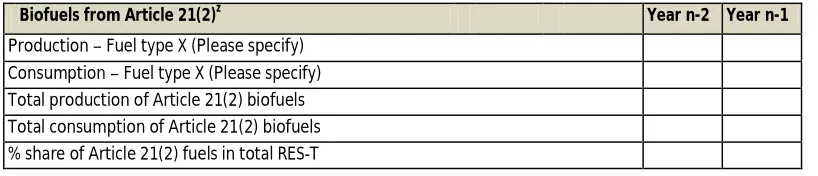
Table 5: Production and consumption of biofuels from Article 21(2) (Ktoe)
Biofuels from Article 21(2)z Year n-2 Year n-1
Production – Fuel type X (Please specify) Consumption – Fuel type X (Please specify) Total production of Article 21(2) biofuels Total consumption of Article 21(2) biofuels % share of Article 21(2) fuels in total RES-T
z [image:17.595.70.479.658.746.2]
There were no producers of biofuels from waste, residues, food cellulosic material or ligno-cellulosic material in Slovenia in 2009 and 2010.
The new Energy Act will introduce a special fuel price supplement intended to cover the higher costs of producing biofuels than fossil fuels. The mechanism will be designed to promote biofuels from waste, residues and cellulosic material more strongly.
9. Please provide information on the estimated impacts of the production of biofuels and bioliquids on biodiversity, water resources, water quality and soil quality within your country in the preceding 2 years. Please provide information on how these impacts were assessed, with references to relevant documentation on these impacts within your country. (Article 22(1)(j) of Directive 2009/28/EC)
We have no assessment of impacts.
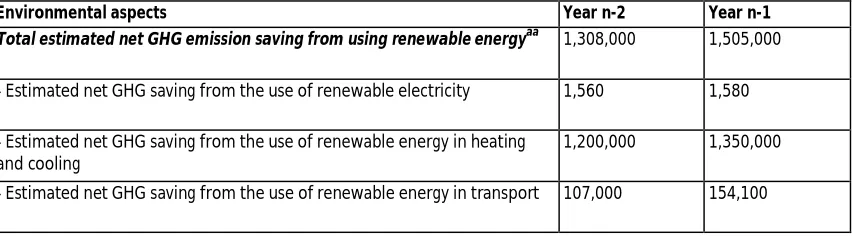
[image:18.595.76.504.340.458.2]10. Please estimate the net greenhouse gas emission savings due to the use of energy from renewable sources (Article 22 (1)(k) Directive 2009/28/EC).
Table 6: Estimated GHG emission savings from the use of renewable energy (t CO2eq)
Environmental aspects Year n-2 Year n-1
Total estimated net GHG emission saving from using renewable energyaa 1,308,000 1,505,000
- Estimated net GHG saving from the use of renewable electricity 1,560 1,580 - Estimated net GHG saving from the use of renewable energy in heating
and cooling
1,200,000 1,350,000
- Estimated net GHG saving from the use of renewable energy in transport 107,000 154,100
11. Please report on (for the preceding 2 years) and estimate (for the following years up to 2020) the excess/deficit production of energy from renewable sources compared to the indicative trajectory which could be transferred to/imported from other Member States and/or third countries, as well as estimated potential for joint projects until 2020. (Article 22(1)(l, m) of Directive 2009/28/EC)
Table 7: Actual and estimated excess and/or deficit (-) production of renewable energy compared to the
indicative trajectory which could be transferred to/from other Member States and/or third countries in [Member State] (ktoe)bb,cc
2011 2012 2013 2014 2015 2016 2017 2018 2019 2020 Year
(2009) Year (2010)
Actual/estimated excess or deficit production
0 149 0 0 0 0 0 0 0 0 0 0
11.1. Please provide details of statistical transfers, joint projects and joint support scheme decision rules.
aa The contribution of gas, electricity and hydrogen from renewable energy sources should be reported depending on the final use (electricity, heating and cooling or transport) and only be counted once towards the total estimated net GHG savings.
bb Please use actual figures to report on the excess production in the two years preceding submission of the report, and estimates for the following years up 2020. In each report, the Member State may correct the data of the previous reports.
cc
Statistical transfers were not performed.
12. Please provide information on how the share for biodegradable waste in waste used for producing energy has been estimated, and what steps have been taken to improve and verify such estimates.
(Article 22(1)(n) of Directive 2009/28/EC)
There were no producers of biofuels from waste, residues, food cellulosic material or ligno-cellulosic material in Slovenia in 2009 and 2010.
The new Energy Act will introduce a special fuel price supplement intended to cover the higher costs of producing biofuels than fossil fuels. The mechanism will be designed to promote biofuels from waste, residues and cellulosic material more strongly.
Please note that in the first progress report (2011 report), Member States are invited to outline their intentions with regard to the questions addressed in Article 22(3) (a)–(c). In addition, Member States are also welcome to provide any other information considered relevant to the specific situation of developing renewable energy of each Member State.
In connection with the questions addressed in Article 22(3) (a)–(c) in Slovenia:
(a) We currently do not intend to establish an administrative body responsible for processing authorisation, certification and licensing applications for renewable energy installations and for providing assistance to applicants. These tasks are divided between the Ministry of the Economy (www.mg.gov.si), the Ministry of the Environment and Spatial Planning (www.mop.gov.si), the Energy Agency of the Republic of Slovenia (www.agen-rs.si) and Borzen (www.borzen.si). Information is available from these institutions’ websites.
(b) Likewise, we currently have no intention of providing for automatic approval of planning and permit applications for renewable energy installations in the event that the body responsible for issuing permits fails to respond by the deadline set.