Nonlinear Output Feedback Control for Robust Stability
Chengkang Xie and Mark French
Abstract— In the presence of input and measurement distur-bances, an observer and a controller are designed to achieve robust stability for the nominal plant in normal form. By framework of nonlinear gap metric, a robust margin of plant perturbations is obtained, and the controller is shown to be robust to plant perturbations if the gap metric is less than the robust margin.
I. INTRODUCTION
In general, to control a physical plant, a mathematical model ( called the nominal plant ) for the plant is neces-sary. But, in practice, the nominal plant cannot completely describe the physical plant, there always exists a plant perturbation. In operation of control, sensors and actuators are setup to measure and input signals, and the sensors and actuators result in measurement errors and input errors, namely, measurement disturbances and input disturbances. A closed-loop could become unstable if a controller cannot tolerate these kinds of uncertainties. EI-Sakkary [1] gave an example that a small uncertainty changed the stability of the closed-loop. So, for control purposes, a basic requirement is that a controller designed for the nominal plant tolerates plant perturbations, measurement disturbances and input dis-turbances, that is the controller is robust to these kinds of uncertainties.
Although the study of robustness for control designs is as old as feedback control, even for linear systems effective systematic tools for robust control have only been devel-oped since 1980’s. An appropriate topological structure for studying the robustness of linear systems is the gap metric ( graph topology ) introduced by Zames and EI-Sakkary [8], [1]. In contrast, other frameworks for studying robustness have restrictions; e.g., the order of parametric uncertainty cannot be changed, a small time delay is not an allowable uncertainty, Un-modeled dynamics or plant perturbations are not allowed, etc.. For nonlinear control, it is difficult to cope with the complexity of nonlinear phenomena even in the absence of disturbances and other uncertainties, the robustness study of nonlinear systems is far less developed than for linear systems. In 1997, Georgiou and Smith [4] established a theory of gap metric for nonlinear case. It provides a powerful tool to study robustness of nonlinear
C. Xie is with Institute of Mathematics, Southwest University, Beibei, Chongqing, 400715, P.R. China;[email protected]. The author was supported by the Natural Science Foundation of Chongqing under Grants CSTC 2005EB2048.
M. French is with School of Electronics and Computer Sci-ence, University of Southampton, Southampton, SO17 1BJ, UK;
control. Via the framework of nonlinear gap metric, Xie and French [7] successfully designed a robust backstepping controller for state feedback in 2003. Any restrictions on disturbances and plant perturbations have been removed, and the disturbances and perturbations can be un-modeled dynamics. So, it presents that the framework of nonlinear gap metric is a appropriate topological structure for nonlinear feedback control.
In the past two decades, many of control techniques have been developed for nonlinear systems using feedback control. Most of the results, however, assume full state feedback. Efforts to extend some of these results to output feedback have naturally included the idea of designing an observer to estimate the state of a system from its output, see, e.g., [5], [2], [6], [3]. It is a meaningful work to utilize the framework of nonlinear gap metric for the study of output feedback control.
In this paper, we consider a nominal plant in normal form and design an observer and a controller to achieve robust stability of the closed-loop system in the presence of input and measurement disturbances. Then we utilize the results in [4] to obtain the robustness of the closed-loop to plant perturbations which are small in the sense of the gap metric. That is, we show that the controller stabilizes the closed-loop for any perturbed plant in the presence of input and measurement disturbances if the gap metric distance between the nominal and perturbed plant is less than a computable constant. Any restrictions on input and measurement disturbances, and plant perturbations have been removed, and the disturbances and perturbations can be un-modeled dynamics.
II. BACKGROUND ANDPROBLEMFORMULATION
In this section we first simply state the background for gap metric robustness. The material here comes from the fundamental paper [4].
A. Background for Gap Metric Robustness
Let U and Y be normed signal spaces, and consider a causal nominal plant
P : U → Y: u1→y1 and a causal controller
C: Y → U : y2→u2
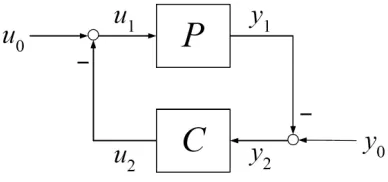
In a control system, there exist measurement disturbance y0∈ Y and input disturbance u0∈ U, which are uncertain-ties. The standard feedback configuration is shown in Fig. 1,
Proceedings of the
44th IEEE Conference on Decision and Control, and the European Control Conference 2005
Seville, Spain, December 12-15, 2005
Fig. 1. Standard Feedback Configuration
and the signals have relations:
y1=Pu1, u2=Cy2 y0=y1+y2, u0=u1+u2
LetW denoteU × Y, and write
w0=
u0 y0
, w1=
u1 y1
, w2=
u2 y2
Thus the closed-loop operator is defined by
HP,C : W → W × W: w0→(w1, w2)
The graph of the plantP is defined as
GP =
u
Pu
: u∈ U
⊂ W
and the graph of the control operatorC is defined as
GC=
Cy
y
: y∈ Y
⊂ W
For simplicity of notation, normally, we writeGP asM, and
GC asN respectively.
To define robust stability of the closed-loop to distur-bances, let Πi be the natural projection of W × W onto theith component ( i= 1,2 ), another tow operators
ΠM//N = Π1HP,C , ΠN//M= Π2HP,C
are introduced, that is
ΠM//N : W → W: w0→w1 ΠN//M: W → W: w0→w2
Definition 1: The closed-loop[P,C]is said to be stable if the operatorΠM//N has a finite induced norm, i.e.
ΠM//N= sup w0=0
ΠM//Nw0
w0 = supw0=0
w1
w0 <∞ The notion of stability for nonlinear control is a strong requirement. It can be relaxed to gain-function stability as follows.
Definition 2: The gain-function of the operatorΠM//N is defined as
g[ΠM//N](α) = sup
w0≤α
ΠM//Nw0, α≥0
The closed-loop [P,C] is said to be gain-function ( gf- ) stable ifg[ΠM//N](α)remains finite for allα≥0.
It can be seen that if there exists a positive constantΓsuch that
w1 ≤Γw0, w1, w0∈ W (1)
then[P,C]is stable; if there exists a continuous function γ(·)>0 such that
w1 ≤γ(w0), w1, w0∈ W (2)
then[P,C]is gf-stable.
Finally, we define the gap metric between the nominal plantP and any perturbed plantP1 as follows.
Definition 3: For plant P and plant P1, the directed gap metric between the two plants is defined as
δ(P,P1) =
infΦ∈O(Φ−I)|M, if O =∅
∞, if O=∅
and the gap metric is defined as
δ(P,P1) = max{δ(P,P1), δ(P1,P)}
where
O={Φ :M → M1|Φis causal, bijective andΦ(0) = 0}
andM1 is the graph of P1, namelyGP1.
The significance of the introduction of gap metric lies in the following theorem.
Theorem 1: For the feedback system in Fig. 1, let the closed-loop[P,C]be stable. If a plantP1 is such that
δ(P,P1)< 1
ΠM//N
then the closed-loop[P1,C]is also stable, and
ΠM1//N ≤ ΠM//N
1 +δ(P,P1) 1− ΠM//Nδ(P,P1)
The proof of this theorem can be found in paper [4]. Definition 1, 2, and Theorem 1 provide a complete frame-work to design a robust controller in the presence of input, measurement disturbances, and plant perturbations. First, for the nominal plant P design a controller C such that the closed-loop operator HP,C is stable, namely, the operator ΠM1//N has a finite induce norm, or the signals satisfy
(1). Second, by Theorem 1, we get a plant robust margin
ΠM1//N−1, the controllerCthus can stabilize any
B. Problem Formulation
Consider following nominal plant in normal form
P(x01) : ˙x11=x12 .. . ˙
x1(n−1)=x1n (3)
˙
x1n=ϕ(x11,· · ·, x1n) +u1 y1=x11
where
x01= (x011,· · ·, x01n)T
is the initial condition. Well-posedness of the differential equations grantees that of the feedback configuration, hence, for the well-posedness of the differential equations, we assume that ϕ(0) = 0, and ϕ is Lipschitz continuous, that is, there exist a constantLsuch that for anyω1, ω2∈Rn, it hold
|ϕ(ω1)−ϕ(ω2)| ≤Lω1−ω2
where we utilize · to denote the Euclid norm. We introduce following notations
x1=
⎛ ⎜ ⎜ ⎜ ⎝
x11 x12 .. . x1n
⎞ ⎟ ⎟ ⎟ ⎠, A=
⎛ ⎜ ⎜ ⎜ ⎜ ⎝
0 1 0 · · · 0 0 0 0 1 · · · 0 0 . . . . 0 0 0 · · · 0 1 0 0 0 · · · 0 0
⎞ ⎟ ⎟ ⎟ ⎟ ⎠, B=
⎛ ⎜ ⎜ ⎜ ⎝
0 .. . 0 1
⎞ ⎟ ⎟ ⎟ ⎠
C= (1,0,· · ·,0)
then the plant can be rewrite as
P(x0
1) : ˙x1=Ax1+B(ϕ(x1) +u1), x1(0) =x01 (4a)
y1=Cx1 (4b)
Take signal spaces
U =L∞(R), Y =L∞(R)
then
P(x0
1) : L∞(R)→L∞(R) : u1→y1
The norm for the spaceL∞(R)is defined as the normal norm
· ∞.
The problem is to design a controller such that the closed-loop system is stable or gf-stable. Alternatively, such that there exist a constantΓand a gain functionγ(·)which satisfy (1) and (2).
III. DESIGN OFCONTROLLER
Firstly, we chose a vector
K= (k1,· · ·, kn)
such that A0 = A+BK is Hurwitz. Secondly, we chose positive constantsαi, i= 1,· · ·, nsuch that the roots of the equation
sn+α1sn−1+· · ·+αn−1s+αn= 0
are in the left-half plane, and let
D= (α1, α2,· · ·, αn)T
Then we design an observer as ˙ˆ
x2=Aˆx2−D(y2−yˆ2) +BKxˆ2, xˆ2(0) = ˆx02 (5a) ˆ
y2=Cˆx2 (5b)
Lastly, we define a controller as
C(ˆx02) :
u2=ϕ(−y2) +Kxˆ2 (6a)
˙ˆ
x2=Aˆx2+D(y2−yˆ2) +BKxˆ2, xˆ2(0) = ˆx02 (6b) ˆ
y2=Cˆx2 (6c)
IV. ROBUSTNESSANALYSIS
First we prove a lemma about the estimate of the observer error.
Lemma 1: Letx1 be the state of the plant in (4), andxˆ2 be observer state in (5), and let
˜
x=x1+ ˆx2
be the perturbed observer error. Then there exist positive constantsb andβ such that
x˜∞≤bx˜0+β(u0, y0)T∞ (7) where
˜
x0=x01+ ˆx02
Proof: Note that
u1=u0−u2, y2=y0−y1
then the closed-loop[P(x01),C(ˆx02)]can be written as
˙
x1=Ax1+Bϕ(y1)−ϕ(−y2)−Kˆx2+u0, x1(0) =x01 ˙ˆ
x2=Aˆx2+Dy0−C(x1+ ˆx2)+BKxˆ2, xˆ2(0) = ˆx02
From above two equations, we obtain ˙˜
x=A1x˜+Dy0+B(ϕ(y1)−ϕ(−y2)+u0), x(0) = ˜˜ x0 (8)
where
A1=A−DC
Solving (8), we obtain
˜
x=eA1tx˜0+ t
0 e
A1(t−τ)×
Dy0(τ) +B
ϕy1(τ)−ϕ−y2(τ)+u0(τ)
dτ (9)
SinceA1 is Hurwitz, all the real parts of the eigenvalues of A1 are negative. We take a positive constantµ such that
−µis greater than all the real parts of the eigenvalues ofA1, then there exists a positive constantbsuch that
eA1t ≤be−µt
On the other hand, by Lipschitz condition, it holds that
|ϕ(y1)−ϕ(−y2)| ≤L|y1+y2|=L|y0|
Therefore, from (9), we obtain
x(t)˜
≤x˜0 · eA1t+ t
0 dτe
A1(t−τ)×
Dy0(τ)+ϕ(y1(τ))−ϕ(−y2(τ))+u0(τ)
≤x˜0be−µt
+
t
0 be
−µ(t−τ)(D+L)y
0∞+u0∞dτ
≤bx˜0+ b µ
(D+L)y0∞+u0∞
≤bx˜0+β(u0, y0)T∞
Write
β=b
√
2
µ max{D+L,1}
then we obtain (7), and complete the proof. Now we state and prove the main result.
Theorem 2: Let the plant P(x01) and controller C(ˆx02) be defined by (3) and (6). Then
1) There exists a continuous functionγ:R3+→[0,+∞) such that for all (u0, y0)T∈L∞(R+)×L∞(R+), it holds
(u1, y1)T
∞≤γ(u0, y0)T∞,x˜0,x01∞
(10) that is, the closed-loop[P(x01),C(ˆx02)]is gf-stable. 2) If x01 is zero, by setting xˆ02 to be zero, there
exists a positive constant Γ such that for all (u0, y0)T∈L∞(R+)×L∞(R+), it holds
(u1, y1)T
∞≤Γ(u0, y0)T∞ (11)
that is, the closed-loop[P(0),C(0)] is stable.
Proof: Let Qbe the solution of the equation
(A+BK)TQ+Q(A+BK) =−2I
and consider the Lyapunov function
V(t) =V(x1)(t) =xT1Qx1 (12)
then along the trajectories of the closed-loop, we have ˙
V = ˙xT1Qx1+xT1Qx˙1
=Ax1+B(ϕ(y1) +u1)TQx1 +xT1QAx1+B(ϕ(y1) +u1) =Ax1+Bϕ(y1) +u0−u2TQx1
+xT1Q
Ax1+Bϕ(y1) +u0−u2
=Ax1+Bϕ(y1) +u0−ϕ(−y2)−Kxˆ2TQx1
+xT1Q
Ax1+Bϕ(y1) +u0−ϕ(−y2)−Kxˆ2
=xT1(A+BK)TQ+Q(A+BK)x1 + 2BTQx1ϕ(y1)−ϕ(−y2)−Kx˜+u0
=−2xT1x1+ 2BTQx1ϕ(y1)−ϕ(−y2)−K˜x+u0 =−2x12+ 2BTQx1ϕ(y1)−ϕ(−y2)−Kx˜+u0
Let
Q={qij}n×n
and
q1= max 1≤j≤n{|q1j|}
then
BTQx1≤q1x1
On the other hand, from the Lipschitz condition and Lemma 1, we obtain
ϕ(y1)−ϕ(−y2)−Kx˜+u0
≤Ly0∞+Kx˜∞+u0∞
≤l√2(u0, y0)T∞+Kbx˜0+β(u0, y0)T∞
≤b∗x˜0+β∗(u0, y0)T∞
where
l= max{L,1}
b∗=Kb
β∗ =l√2 +Kβ
Hence
2BTQx1ϕ(y1)−ϕ(−y2)−Kx˜+u0
≤2q1b∗x˜0+β∗(u0, y0)T∞x1
Therefore ˙
V =−2x12+ 2BTQx1ϕ(y1)−ϕ(−y2)−kx˜+u0
≤ − x12− x12
By Young’s Inequality, we obtain that ˙
V ≤ −x12+q12b∗x˜0+β∗(u0, y0)T∞2
thenV decreases monotonically outside the compact set
R=x1∈Rn x1 ≤q1b∗x˜0+β∗(u0, y0)T∞
So, if
x01≤b∗x˜0+β∗(u0, y0)T∞
thenV(t)remains inR; if
x01> b∗x˜0+β∗(u0, y0)T∞
then V(t) monotonically decreases from t = 0 until x1 reachesR. Therefore
V(t)≤maxV(x01), V
where
V = sup
V(x1)x1 ≤q1b∗x˜0+β∗(u0, y0)T∞
Note that
λ(Q)x12≤V(x1)≤λ¯(Q)x12
whereλ(Q), λ(Q)¯ are the maximum and minim eigenvalues of matrixQrespectively, then
supV(x1)x1 ≤q1b∗x˜0+β∗(u0, y0)T∞ = sup ×
¯
λ(Q)x12x1 ≤q1b∗x˜0+β∗(u0, y0)T∞
=¯λ(Q)b∗x˜0+β∗(u0, y0)T∞2 therefore
x1 ≤
V
λ(Q) ≤max
⎧ ⎨ ⎩
¯ λ(Q)
λ(Q)x01, X
⎫ ⎬ ⎭
where
X=q1
¯
λ(Q)b∗x˜0+β∗(u0, y0)T∞
Write
g(p, q, r) = max
⎧ ⎨ ⎩
¯ λ(Q) λ(Q)r, q1
¯
λ(Q) (b∗q+β∗p)
⎫ ⎬ ⎭
then the above inequality can be rewritten as
x1 ≤g(u0, y0)T∞,˜x0,x01 So
x1∞≤g(u0, y0)T∞,x˜0,x01 since the left hand side of the inequality is a constant.
Therefore we obtain our estimate fory1∞ as follows.
y1∞=x11∞≤ x1∞
≤g(u0, y0)T∞,x˜0,x01
Next we estimateu1∞. First
u1=u0−u2
=u0−ϕ(−y2)−Kxˆ2
=u0+ϕ(y1)−ϕ(−y2)−K(x1+ ˆx2)−ϕ(y1) +Kx1 =u0+ϕ(y1)−ϕ(−y2)−Kx˜−ϕ(y1) +Kx1
Note thatϕis Lipschitz, andϕ(0)is zero, hence
u1∞≤u0∞+ϕ(y1)−ϕ(−y2)∞+Kx˜∞ +ϕ(y1)∞+Kx1∞
≤u0∞+Ly1+y2∞+Kx˜∞ +Ly1∞+Kx1∞
≤u0∞+Ly0∞
+Kbx˜0+β(u0, y0)T∞ +Lg(u0, y0)T∞,x˜0,x01 +Kg(u0, y0)T∞,x˜0,x01
≤l√2(u0, y0)T∞
+Kbx˜0+β(u0, y0)T∞
+ (L+K)g(u0, y0)T∞,x˜0,x01
Write
h(p, q, r) =l√2p+K(bq+βp) + (L+K)g(p, q, r)
then we obtain
u1∞≤h(u0, y0)T∞,x˜0,x01
Therefore, write
γ(p, q, r) =g(p, q, r)2+h(p, q, r)212
then we have built up the following inequality
(u1, y1)T∞=u12∞+u12∞12
≤g(u0, y0)T∞,x˜0,x012
+h(u0, y0)T∞,x˜0,x01
212
=γ(u0, y0)T∞,x˜0,x01
that is, the closed-loop is gf-stable.
Ifx01= 0andxˆ02= 0, thenx˜0= 0. From the definitions of functionsg andh
g(p,0,0) =q1β∗
¯ λ(Q)p
hence
h(p,0,0) = (l√2 +kβ)p+ (L+k)g(p,0,0) = (l√2 +kβ)p+ (L+k)q1β∗p
=
l√2 +kβ+ (L+k)q1β∗
¯ λ(Q)
and
γ(p,0,0)
=g(p,0,0)2+h(p,0,0)212
= q1β∗
¯ λ(Q)p
2
+
l√2 +kβ+ (L+k)q1β∗
¯ λ(Q)
p
2!1 2
=(q21(β∗)2¯λ(Q)
+
l√2 +kβ+ (L+k)q1β∗
¯ λ(Q)
21 2
p
Let
Γ =(q2
1(β∗)2λ(Q)¯
+
l√2 +kβ+ (L+k)q1β∗
¯ λ(Q)
21 2
then, it follows that (11) holds.
A robustness to plant perturbations can be given as follows.
Theorem 3: Let the plant P(x01) and controller C(ˆx02) be defined by (3) and (6). Then there existsΓ>0such that if a plantP1 satisfies
δ(P(0),P1)< Γ1 (13)
then the closed-loop[P1,C(0)]is also stable, and
ΠM1//N ≤Γ
1 +δ(P(0),P1) 1−Γδ(P(0),P1)
(14)
Proof: By Theorem 2, we have shown that there exists Γ>0 such that
ΠM//N ≤Γ
Then, if
δ(P,P1)< 1 Γ
it holds that
δ(P,P1)< 1
ΠM//N
Hence, by Theorem 1, the closed-loop [P1,C(0)] is stable, and (14) holds, and the proof is completed.
V. CONCLUSIONS ANDCOMMENTS
Within the framework of nonlinear gap metric, an output feedback control design procedure for robust stability has been established in the presence of input, measurement disturbances, and plant perturbations. Any restriction on input and measurement disturbances is not required. Un-modeled plant perturbations such as time delay are allowable uncertainties. So, the work in this paper shows that the frame-work of nonlinear gap metric is an appropriate topological structure for robust output feedback control designs. This paper therefore represents a start to apply the framework of nonlinear gap metric to output feedback control designs for robust stability.
A global Lipschitz condition is imposed on the nonlin-earity of the nominal plant, which is for a global result of input and measurement disturbances; a relaxation of the requirement to local Lipschitz condition leads a semi-global results.
VI. REFERENCES
[1] A. El-Sakkary,The gap metric: Robustness of stabiliza-tion of feedback systems, IEEE Transaction on Automatic Control30 (1985), no. 3, 240–247.
[2] J. Gauthier, H. Hamouri, and I. Kupka, Observer for nonlinear systems, Proceedings of the 30th IEEE Con-ference on Decision and Control (Brighton, England), IEEE, December 1991, pp. 1483–1489.
[3] J. Gauthier and I. Kupka, Observerty and observer for nonlinear systems, SIAM Journal on Control and Optimization 32(1994), no. 4, 975–994.
[4] T. Georgiou and M. Smith,Robustness analysis of non-linear feedback systems: An input-output approach, IEEE Transactions on Automatic Control 42 (1997), no. 9, 1200–1221.
[5] A. Krener and A. Isidori, Linearization by output and non-linear observers, Systems & Control Letters 3
(1983), no. 1, 47–52.
[6] R. Marino and P. Tomei, Global adaptive output-feedback control of nonlinear systems, part 1: Linear pa-rameterization, IEEE Transactions on Automatic Control
38 (1993), 17–32.
[7] C. Xie and M. French, Gap metric robustness of a backstepping control design, Proceedings of the 42nd IEEE Conference on Decision and Control (Hawaii, USA), vol. 5, December 2003, pp. 5180–5184.