Authors: Dr. Regina von Görtz and Karl Janssen
Showing what works: First insights from the scientific
research accompanying the project “Leave No Child
Behind! Municipalities in NRW take preventative
action providing equal opportunities for all children”.
In 2011, the State Government of North Rhine-Westphalia and the Bertelsmann Stiftung launched “Kein Kind zurücklassen! Kommunen in NRW beugen vor” (“Leave No Child Behind! Municipalities in NRW take preventative action providing equal opportunities for all children”). Together with eighteen municipalities taking part in this joint initiative, the partners aim to improve development prospects and provide equal opportunities for every child. The municipalities are creating local prevention chains, i.e. the systematic and ongoing collaboration between stakeholders in administration, agencies, associations and civil society. The intention is to improve the effectiveness and efficiency of local support and intervention practices.
The undertaking is being studied in a parallel research project led by the Bertelsmann Stiftung and selected partners from
academia.
Research element to
“Leave No Child Behind!”
Social aspects
Research element to “Leave No Child Behind!”
Defining the prevention chain
The “Leave no child behind!” project is centred on the idea of a “prevention chain”. The prevention chain is set out biographically along the life-line of a child (from birth to the transition to working life) and serves to adjust and coordinate the services and offers that, to date, have been separate from each other (Holz et al. 2011: 7). Municipalities offer a wide range of different proposals here. A functioning prevention chain, how-ever, must be understood and implemented as an inte-grated municipal strategy.
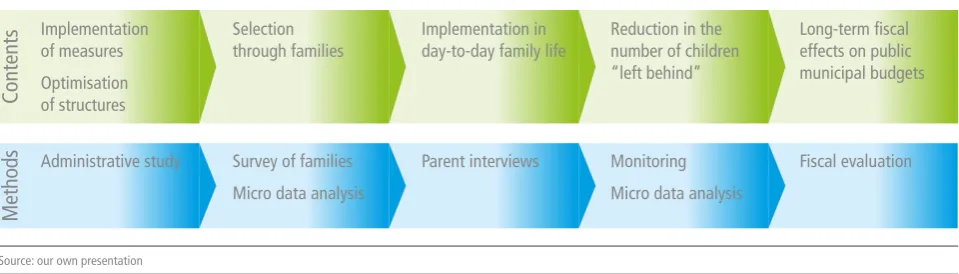
One objective of the accompanying scientific research is to investigate how municipal prevention chains work. Options for optimisation are identified and the amount that consequential social costs can be reduced through the development of prevention chains is then assessed. The accompanying research approaches the object of the investigation using a multi-level and multi-method design (Figure 1). An administrative study looks into which factors contribute positively to the development of prevention chains. The potential that preventative structures offer is investigated in families and children by means of a family survey. What approach best reaches the families, children and young people who have to date not taken advantage of any support is also to be researched. A monitoring process looks into who can benefit particularly from preventative services and develops indicators for observing the outcomes of preventative work. A micro data module is dedicated to systematically opening up and analysing data that is produced in the administration process and that the municipalities can use for self-evaluation. A fiscal accompanying research process concentrates on cost-benefit analyses at various different levels. Beyond that, any regulatory policy requirements are also investigated. In 2011 a report entitled “Social prevention –
quantify-ing the consequential social costs in North Rhine-West-phalia”, published in German by Prognos, was widely reported and discussed in the media. It calculated that the sum of 2.5 billion euros could be saved in the me-dium term through prevention in the area of child and youth welfare. The Bertelsmann Stiftung also reported on the results of consequential social costs, focusing on the education system (2012, Bertelsmann Stiftung). In-spired by the conviction that prevention is better than cure, the Bertelsmann Stiftung, together with the NRW state government, set out to both realise and quantify the potential of prevention. Together they started the model project “Leave No Child Behind! Municipalities in NRW take preventative action providing equal opportu-nities for all children”.
18 Model municipalities
Arnsberg Moers
Bielefeld Mönchengladbach Dormagen Münster
Dortmund Oberhausen Duisburg Witten Düsseldorf Wuppertal Gelsenkirchen Kreis Düren Gladbeck Kreis Unna Hamm Kreis Warendorf
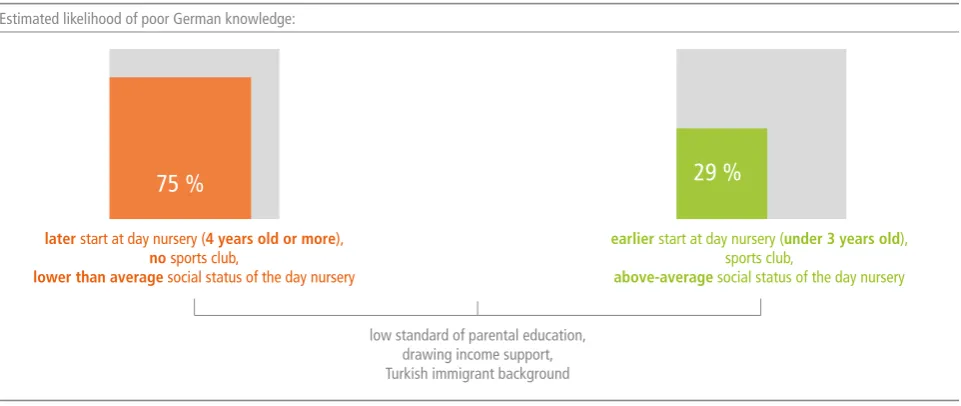
preventative measures. Our scientists were thus able to show that the likelihood of poor knowledge of German among children with a specific migration background whose parents have a low standard of school education and whose families receive income support can be reduced from 75 per cent to 29 per cent (!) by the time they start school. This applies if children 1.) join a day nursery before their third birthday, 2.) the day nursery they attend has an above-average social status and 3.) they are active in a sports club (Figure 3).
2. The utilisation of services by children and families is a central factor in the effectiveness of prevention
To realise the preventative effects of such measures and offers, they must be utilised by children and their families. Any means of encouragement, however well-intentioned, can only be effective if families also accept this support.
It is somewhat tragic that precisely those children who grow up in an especially disadvantaged environment, and consequently have special educational needs, start considerably later in a day nursery. This particularly concerns children of families on income support, children with a specific migration background and children of parents who are unemployed. Then there are children who grow up in economic poverty, who are less
What can we say after just over a year’s
research?
There are four key insights
1. Prevention is effective
The effects of prevention can only happen over the long term. The period of one year is really too short. How-ever, certain things have already been established; that prevention is effective – not always, not everywhere, but under certain conditions. Prevention takes place in the living environment of families and children, i. e. in edu-cational institutions such as day nurseries and schools, in open all-day schools (OGS), sports clubs and the homes where young people live.
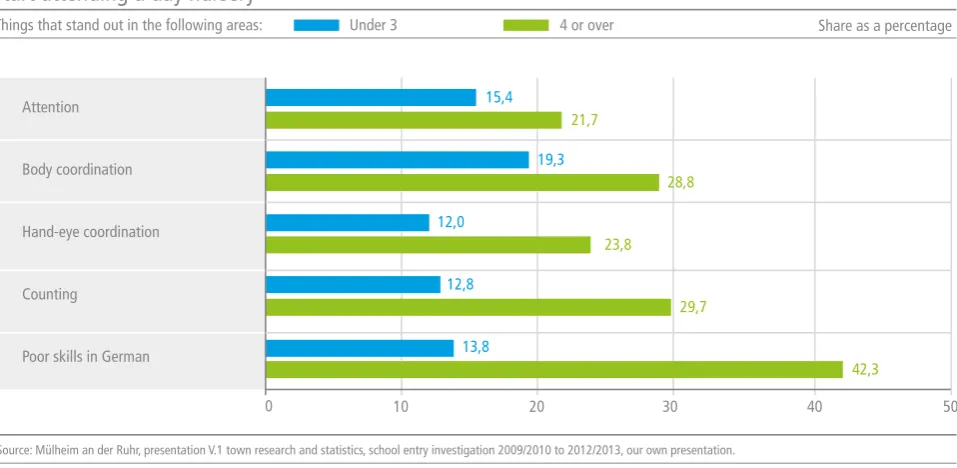
The fact that, especially with young children, a great deal can still be achieved through prevention has now become a consensus in the research. Our investigations also show that children who attend a day nursery from an early stage, for instance, benefit from this to a considerable degree. Figure 2 shows that children who start at a day nursery before the third year of their lives are further advanced in virtually all areas of development than children who start at a day nursery later (at the age of four or older).
Selection through families
[image:3.595.59.539.175.312.2]Implementation in day-to-day family life
Figure 1: Research contents and methods around here
Contents
Long-term fiscal
effects on public municipal budgets Implementation
of measures Optimisation of structures
Reduction in the number of children “left behind”
Survey of families Micro data analysis
Parent interviews
Methods
Fiscal evaluation Administrative study Monitoring
Micro data analysis
Source: our own presentation
in the prevention chain here are asked to make a self-evaluation. To assist this process, the Bertelsmann Stiftung offers a broad range of support:
• Within the micro data module of the accompanying research, the scientists develop methods and approaches to self-evaluation with accrued routine statistical data (e.g. through assessment of data from school entry investigations, day nursery screenings etc.). The methods, data sources and results are published and can be reproduced and adopted by other municipalities.
• The Bertelsmann Stiftung has already made tools such as KECK and KOMPIK available to enable municipalities to collect comparable data on children’s levels of development in the day nursery area and assess data on a social environment level.
• The evaluation of individual measures and offers can and must be carried out by the municipalities themselves. The Bertelsmann Stiftung and Phineo1
have developed handouts (Schmidt et al. 2012, Phineo 2013) about how this can be done 1 Phineo gAG is a spin-off from the Bertelsmann Stiftung that provides private donors and socially committed companies with guidance in their involvement in the charitable sector.
– especially for children growing up in poverty – as only then can preventative services be effective.
A great deal can be offered to achieve these goals. Important criteria include a low access threshold, offers made in the right social context and easily accessible information, including to parents with different languages of origin (for examples of good practice from the model municipalities, see MFKJKS 2013 and MFKJKS 2014). It is important to break down any social exclusion that is currently still being reinforced through institutional practices. In some districts that are directly adjacent to each other, for example, there are day nurseries with a higher than average or lower than average share of children with an immigrant background. Such segregation tendencies are not just the result of parental selection behaviour; they are also the selection behaviour of the day nursery provider. The quality of the measures on offer is critical to their success in the long term and for them to be able to develop a preventative effect. The municipalities and all the institutions that influence the child (day nurseries, schools, clubs, independent sponsors etc.)
[image:4.595.62.541.162.396.2]Source: Mülheim an der Ruhr, presentation V.1 town research and statistics, school entry investigation 2009/2010 to 2012/2013, our own presentation.
Figure 2: Characteristics of the development of children when they start school in terms of the time they
start attending a day nursery
Body coordination Attention
Hand-eye coordination
Counting
Poor skills in German
0 10 20 30 40 50
15,4
19,3
12,0
12,8
13,8
21,7
28,8
23,8
29,7
42,3
4 or over
Under 3 Share as a percentage
Things that stand out in the following areas:
shows that, to initiate dialogue among all responsible parties, this data is best made transparent and open to the public (Bertelsmann Stiftung and ZEFIR 2014). Developments can be assessed more comprehensively together and effective measures can be embraced. The objective is to generate evidence-based know-how to enable even more targeted and effective support of children and their families.
What is required is a discussion of the issues of management across and within municipalities. This is most likely to succeed by creating transparency and a subsequent joint discussion process on “How well are the children doing in our town, our district, and in our facility?”, “What can we do better and where?” The Canadian HELP (Human Early Learning Partnership) project shows how successful this can be. There are already positive examples of such an approach in Germany. As indicated above, the Bertelsmann Stiftung has already made the KECK and KOMPIK tools available for this (see Bertelsmann Stiftung and ZEFIR 2014). Currently, however, the municipalities are largely left successfully in an ongoing process with relatively
low use of resources. As part of this model project, all the coordinators were offered a training course by the Bertelsmann Stiftung about quality assurance on the basis of these handouts. This offer is open to all municipalities.
3. Prevention can and must be managed purposefully by the municipalities themselves.
The creation of equal opportunities is a task for society as a whole, and one where municipalities can make a considerable contribution. They are the places where children grow up and they consequently have an immediate influence on their environment and lifestyle. To be able to meet these responsibilities, municipalities need the determination and the ability to manage prevention. It is crucial here that the right support services reach the right children in a targeted way. This includes the requirement for evidence-based management by the responsible administrative bodies in the municipalities. This works by jointly raising, assessing and discussing data from the social
[image:5.595.59.540.165.368.2]Source: Mülheim an der Ruhr, presentation V.1 town research and statistics, school entry investigation 2009/2010 to 2012/2013, our own presentation.
Figure 3: Risks of poor knowledge of German among two high-risk groups who started day nursery at
different times, with and without sports in a club and in differently segregated day nurseries
later start at day nursery (4 years old or more),
no sports club,
lower than average social status of the day nursery
earlier start at day nursery (under 3 years old), sports club,
above-average social status of the day nursery
low standard of parental education, drawing income support, Turkish immigrant background
29 %
75 %
Bertelsmann Stiftung and ZEFIR 2014, with financial support from the state of North Rhine-Westphalia and the European Social Fund.
as a whole. On the level of individual municipalities in Germany, however, the impact of economic effects is only limited, partly due to the counter-effects of the municipal financial adjustment. Stabilisation of the social structure has an indirect positive effect on the respective municipalities. So ultimately the municipalities do not benefit primarily from successful investment in prevention, instead it is the other participants in the system (the federation, the states and the social insurance providers) who benefit above all. The need for the state to take a greater share of the municipal and social expenditure is consequently also corroborated in this respect.
Conclusion
On the whole it can be seen that municipal prevention consists of a chain of many different linked elements. As a result, we need good educational institutions and good additional, complementary preventative services across all stages in the lives of young people. These good services must be available, and be used, by young people and their families and the structure and quality of these services and facilities must be managed by the municipalities.
The tasks for social safety net systems are not reduced by prevention alone. All the research shows that the cause of the increasing costs of child and youth welfare is, above all, high (child) poverty. In the Ruhr region of Germany, more than every fourth child grows up under the poverty line – in spite of the positive developments in the labour market over the last few years (Baumann and Seils 2014: 15). Poverty constitutes a separate development risk for young people, the effects of which can be lessened, but not causally remedied, by prevention. Poverty can only be combated in society as a whole. Municipalities can make an important contribution to this with preventative measures and the knowledge would be easier if municipalities had more
scientific and political support. The raising, assessment and allocation of data could, for example, take place through a central, neutral location – similar to the Canadian approach – such as a central research institute with an isolated statistics unit. Compilation of appropriate packages of measures would then be carried out on site by the municipalities on the basis of their specific, local knowledge.
4. Financial relief through prevention does not only benefit the municipalities, above all it benefits other players in the system
Three questions to Prof. Dr. Klaus Peter Strohmeier, principal investigator of the accompanying research element to the model project at ZEFIR/Ruhr-University Bochum.
Officially, access to the preventative services is open to everyone. What barriers to access do you still envisage? Some barriers to access are of an objective kind. The facilities are not always located where the families who particularly need them live and where their children grow up. There are also subjective barriers, such as parents who do not know about the support services available for themselves and their children and who overestimate the cost of using them.
How can equal opportunity access succeed? What can municipalities do? As part of the “Leave no child behind!” project, we are developing formats for a small-scale integrated monitoring service that enables precise diagnoses and apposite decisions to be made about locations, in terms of access to family centres, hot spots for day nurseries, consulting services or the opening of schools in the districts. The municipalities need to get involved in this.
What should definitely be initiated in the model project? I hope that we succeed in integrating and combining the various support programmes locally within the municipalities involved the model project. These programmes need to be implemented in cooperative structures in a municipality, with a view to sustainable improvement in the conditions under which children grow up in the town. This implementation of the integrated approach should be scientifically guided so that all municipalities can benefit from the experience. For this, the municipalities do not just need good cooperation structures and development of local prevention chains, but they cannot
solve the problem alone. This requires a joint effort from the government, the state, the municipalities, the economy and civil society.
Literature
Baumann, Helge und Eric Seils (2014). Wie „relativ“ ist Kinderarmut? Armutsrisiko und Mangel im regionalen Vergleich. WSI Report 11. Düsseldorf. Bertelsmann Stiftung (2012). Warum Sparen in der
Bildung teuer ist. Folgekosten unzureichender Bildung für die Gesellschaft. Gütersloh.
Bertelsmann Stiftung und ZEFIR (Hrsg.) (2014). Kleinräumiges Monitoring für kommunale Prävention am Beispiel des kanadischen Projektes HELP (Human Early Learning Partnership). Dokumentation. Arbeitspapiere wissenschaftliche Begleitforschung „Kein Kind zurücklassen!“, Band 1. Gütersloh. Holz, Gerda, et al. (2011). Fachliche Maßstäbe zum Auf-
und Ausbau von Präventionsketten in Kommunen. In: inform 2/2011, S. 3 – 12
MFKJKS (2013). Fachbericht „Kein Kind zurücklassen! Kommunen in NRW beugen vor“. Düsseldorf. MFKJKS (2014). Fachmagazin „Kein Kind zurücklassen!
Kommunen in NRW beugen vor“. Düsseldorf. Phineo (Hrsg.) (2013). Kursbuch Wirkung. Berlin. Prognos (Hrsg.) (2011). Soziale Prävention. Bilanzierung
der sozialen Folgekosten in Nordrhein-Westfalen. Basel.
Schmidt, Stefan, et al. (2012). Regionale Bildungsland-schaften wirkungsorientiert gestalten. Gütersloh. Strohmeier, Klaus Peter, et al. (2014). Die fachliche
Mission
The “Analyses and Concepts” mission is a range of publications from the “Liveable Community” programme. The programme is devoted to the three large social challenges at the municipality level: demographic change and its manifestations and effects on all fields of politics, the increasing social division – particularly among children and young people – and the budget crisis that is deepening in this region and is hindering the actions of municipalities. “Analyses and Concepts” is intended to impart the results of the Bertelsmann Stiftung’s work on these topics in a manner that is conducive to practical applications, and to provide decision-makers with relevant information. Bertelsmann Stiftung dedicates itself to the common good in the tradition of its founder Reinhard Mohn. It considers itself to be a promoter of social change and supports the aim of a future-ready society. The Bertelsmann Stiftung advocates the strengthening of municipalities’ autonomy, because social challenges can be most effectively faced at the municipal level. The foundation is independent and not affiliated with any political party.
Outlook
Issue 2/2014 appears in November
The effects of IPSAS/EPSAS on German municipalities
As a result of the debt crisis in some EU member states, the European Commission has been considering for some time how public accounting data can be improved, transparency and comparability can be created and monitoring of deficit limits can be assured. One approach is the harmonisation of public accounting, based on the International Public Sector Accounting Standards (IPSAS), which are currently being discussed under the name EPSAS. For German municipalities, in particular, this would be a considerable burden, especially considering the fact that Doppik/NKF has not yet been completely implemented and that it is as yet not known whether the desired benefit will be achieved.
The next issue of “Analyses and Concepts” is dedicated to the effects of this planned reform on municipalities. The investigation shows the significant differences between IPSAS and current budget law and estimates the cost of switching and the control advantages it would offer.
Imprint
© 2014 Bertelsmann Stiftung
Bertelsmann Stiftung | Carl-Bertelsmann-Straße 256 33311 Gütersloh | www.bertelsmann-stiftung.de
ISSN 2199-7969
Authors Dr. Regina von Görtz, Project Manager, Bertelsmann Stiftung; Karl Janssen, Projektleiter „Kein Kind zurücklassen!“ | Responsible person
Dr. René Geißler | Copy-editing Rudolf Jan Gajdacz, München | Design Nicole Meyerholz, Bielefeld |
Picture credits © image100 Ltd. | ISSN 2199-7969 With financial support from the state of North