REDUCED COMPLEXITY SINGLE-CARRIER MAXIMUM-LIKELIHOOD DETECTION FOR DECISION
FEEDBACK ASSISTED SPACE-TIME EQUALIZATION
A. Wolfgang, J. Akhtman, S. Chen, L. Hanzo
School of ECS Univ. of Southampton, SO17 1BJ, UK.
Tel: +44-23-80-593 125, Fax: +44-23-80-594 508
{
aw03r,yja02r,sqc,lh
}
@ecs.soton.ac.uk
http://www-mobile.ecs.soton.ac.uk
ABSTRACT
A novel Decision-Feedback (DF) aided reduced complexity
Maximum Likelihood (ML) Space-Time Equalizer (STE)
de-signed for single-carrier multiple antenna assisted receivers
is introduced. The proposed receiver structure is based on a
recursive tree search, which is capable of achieving ML
per-formance at a moderate computational cost and substantially
outperforms the linear benchmarker based on the Minimum
Mean-Squared Error (MMSE) criterion. Additionally a further
complexity reduction scheme is proposed, which exploits the
specific characteristics of both the wide-band channel and the
proposed DF-STE.
I. INTRODUCTION
In [1] a novel tree search based reduced complexity Maximum
Likelihood (ML) detector designed for Orthogonal Frequency
Divi-sion Multiplexing (OFDM) [2] systems has been introduced, which
is referred to as the Optimized Hierarchical Recursive Search
Algorithm (OHRSA). The OHRSA constitutes an evolution of the
sphere decoder [3], which describes the system’s transfer function
using an upper triangular matrix and then detects the signal on a
dimension by dimension basis. In contrast to conventional sphere
decoding [3], the OHRSA retains its low complexity even in
heavily overloaded systems, where the number of supported users
is significantly higher than the number of receiver antennas. The
computational complexity of the algorithm is close to that of the
linear Minimum Mean Squared Error (MMSE) detector.
The first objective of this contribution is to employ the OHRSA
in single-carrier synchronous uplink MIMO systems operating in
a dispersive environment. Directly applying the OHRSA, which
was originally designed for non-dispersive OFDM sub-channels
in a wideband single-carrier system does have the potential of
realizing a reduced complexity ML detector. However, employing
the OHRSA in a wideband single-carrier environment involves
the detection of undesired symbols engendered by the dispersive
channel, which imposes an increased computational complexity.
Therefore a low-complexity technique will be introduced for
cir-cumventing this problem in the context of single-carrier wideband
systems.
The remainder of this paper is organized as follows. In Section II
the basic system model describing the DF aided STE is introduced.
The system model is used in Section III for introducing the
The financial support of the EU under the auspices of the Phoenix and Newcom projects and that of the EPSRC, UK is gratefully acknowledged. The authors are also grateful to their colleagues for the enlightenment gained within the Phoenix consortium.
basic concept of the OHRSA using a simple numerical example.
Simulation results are provided in Section III-A for highlighting
the potential performance improvements that may be achieved
and the associated complexity is also discussed. In Section IV a
modification of the standard OHRSA is proposed, which results
in a further complexity reduction at a negligible performance
degradation. Finally in Section V we offer our conclusions.
II. SYSTEM MODEL
The system considered supports
K
number of perfectly
syn-chronized Mobile Stations (MSs), each employing an
N
T x-element
transmit antenna array and a Base Station (BS) receiver, which has
N
Rxnumber of Antenna Elements (AEs). The MSs’ transmitters
channel encode the input bitstream, map the encoded bits to the
N
T xdifferent transmit antennas and modulate the signal. The
mapped symbols are transmitted to the BS over a frequency
selective fading channel having a symbol-spaced Channel Impulse
Response (CIR) characterized by the channel coefficients
h
(ı,lk).
The channel coefficient
h
(ı,lk)represents the complex-valued
channel gain of the
l
thmulti-path component of the channel
between the
k
thMS’s AE
ı
and the
thBS receiver AE. Given
the transmitted symbol
s
(ık)(
n
)
, which is associated with the
k
thMS’s transmit AE
ı, the output signal of the
thAE of the BS
receiver at time instant
n
can be written as
1x
(
n
) =
Kk=1
NT x
ı=1
L
l=1
h
(ı,lk)s
(ık)(
n
−
l
−
1) +
η
(
n
)
.
(1)
Furthermore,
L
is the number of symbol-spaced multi-path
com-ponents and
η
(
n
)
is the complex-valued Additive White Gaussian
Noise (AWGN) having a variance of
E
|η
(
n
)
|
2= 2
σ
2.
Assuming that a MS transmits at a power of
σ
2k
and a channel
code with rate
R
is used, the resultant
E
b/N
0is given as
E
bN
0=
σ
2k NRx =1 NT x ı=1 L l=1E
|h
(ı,lk)|
2R
log
2(
M
)
N
T xN
Rx2
σ
2,
(2)
where
M
is the number of modulation levels.
Under the assumption of perfectly synchronized transmitters the
relation between the signal transmitted by the MSs’ AEs and the
channel’s output for channel tap
l
is described by a
(
N
Rx×
KN
T x)
-dimensional matrix
H
l, where the
(
,
(
k
−
1)
N
T x+
ı
)
thelement of the matrix is given by
h
(ı,lk). For simplicity, let us denote
the total number of transmitters in the system as
Q
=
KN
T x, with
the associated transmitter index given by
q
= (
k
−
1)
N
T x+
ı.
1Note, that the indicesıandare associated with the transmit and receive AE respectively, whereas the indicesiandj are used as running indices defined in the context where they occur.
Considering a finite-length STE having a feed-forward order
of
M, the super-matrix
H
, which represents the total system is
obtained by concatenating the (N
Rx×
Q)-dimensional matrices
H
l, yielding:
H
=
H
1· · ·
H
L0
· · ·
0
0
H
1· · ·
H
L. .
.
..
.
..
.
. .
.
. .
.
. .
.
. .
.
0
0
· · ·
0
H
1· · ·
H
L
.
Let us denote the
N
Rx-element channel output vector as
x
(
n
)
.
Then the channel output super-vector
x
(
n
) = [
x
(
n
)
T. . .
x
(
n
−
M
+ 1)
T]
Tcan be expressed as
x
(
n
)
=
H
(
n
)
s
(
n
)
T, . . . ,
s
(
n
−
L
−
M
+ 2)
TT+
η
(
n
)
T, . . . ,
η
(
n
−
M
+ 1)
T T=
H
(
n
)
s
(
n
) +
η
(
n
)
=
x
ˇ
(
n
) +
η
(
n
)
,
(3)
where
s
(
n
) = [
s
1(
n
)
, . . . , s
Q(
n
)]
Tis a column vector containing
the symbols transmitted by the
Q
=
KN
T xAEs present in
the system and
η
(
n
) = [
η
1(
n
)
, . . . η
NRx(
n
)]
T
. For notational
simplicity the time-index
n
will be dropped, where this is possible
without ambiguity. If referring to a delayed vector such as for
example
s
(
n
−
∆)
, this is indicated by
s
∆+1, which suggests that
s
∆+1is the
(∆ + 1)
thsubvector of the super-vector
s
(
n
)
defined
in Equation (3).
The performance of both linear and non-linear equalizers can
be enhanced by incorporating a decision feedback structure [4]
in the receiver. In addition to the feed-forward order
M
and the
decision delay [4] parameter of the STE we introduce the decision
feedback order
N
. Note that the oldest symbol vector, which
still influences the detected symbol
ˆ
s
∆+1is
s
M+L. Furthermore,
the oldest feedback symbol vector is
s
∆+N+1. Without loss of
generality we therefore chose
N
=
M
+
L
−
1
−
∆
for the
characterization of the proposed Decision Feedback (DF) aided
STE. In order to describe the feedback structure, we first partition
the system matrix
H
into two sub-matrices [4] as follows:
H
= [
H
1H
2]
,
(4)
where
H
1hosts the first
Q
(∆+1)
number of columns of
H
, while
H
2represents the last
QN
columns in
H
. The array output can
then be written as
x
=
x
1+
x
2=
x
ˇ
1+ ˇ
x
2+
η
=
H
1s
1+
H
2s
2+
η,
(5)
where
s
1=
s
T1. . .
s
T∆+1Tindicates the symbols in the
feed-forward shift register and
s
2=
s
T∆+2. . .
s
T∆+N+1Tdenotes
the symbols in the feedback register. The attainable complexity
reduction and the achievable performance gain associated with
DF is due to the fact that the previously received symbols of
all transmitters have already been decided upon and hence their
ambiguity imposed on the phasor constellation at the output of the
dispersive channel may be eliminated.
Equation (5) may be interpreted as a space translation [5], where
a received signal vector
x
is translated into the new observation
space
r
by eliminating the phasor-points corresponding to the
product of the DF sequence
s
2and the channel matrix
H
2. The
related space translation is described by
r
=
x
−
H
2s
2.
(6)
The DF assisted receiver first translates the received signal vector
x
into the translated space
r
and the detector then operates on
the translated received signal vector
r
assuming that
H
1was the
observed channel matrix.
III. THE NEAR-ML DETECTOR
In this section the OHRSA approximate ML algorithm designed
for the detection of the transmitted signal is highlighted [1]. For the
sake of notational convenience we only consider a STE dispensing
with DF. Its extension to a DF aided scheme however is readily
achieved by replacing
H
by
H
1and
x
by
r
in the subsequent
equations.
The ML detection of the transmitted signal vector given in
Equation (3) can be formulated as
ˆ
s
= arg max
ˇ s∈SP
(ˇ
s
|
x
,
H
)
,
(7)
where
S
is the set of potentially transmitted symbol vectors
s
.
Note that in this formulation the super-vector
s
is detected, rather
than only the subvector
s
∆+1of interest. In the absence of any a
priori knowledge about the transmitted data, Equation (7) may be
re-written as
ˆ
s
= arg min
ˇs∈S{||
x
ˇ
−
H
ˇ
s
||
2}.
(8)
Let us assume for the derivation of the algorithm that the channel
matrix
H
is real-valued and that the transmitted signal is Binary
Phase Shift Keying (BPSK) modulated. It was shown in [1] that
the solution to the problem defined by Equation (8) is identical to
solving
ˆ
s
= arg min
ˇs∈S||
U
(ˇ
s
−
ˆ
s
M M SE)
||
2,
(9)
where the upper triangular matrix
U
is defined by
U
HU
=
H
HH
+
σ
2I
,
(10)
while
ˆ
s
M M SE= (
H
HH
+
σ
2I
)
−1H
Hx
.
(11)
Let us now first define
N
s=
Q
(
M
+
L
−
1)
which is number of
symbols in
s
considered by the OHRSA. Exploiting the fact that
the matrix
U
has an upper triangular structure, it can be shown
that the objective function used for the detection of the transmitted
symbol vector
ˇ
s
may be written as [1]
J
(ˇ
s
)
=
||
U
(ˇ
s
−
ˆ
s
M M SE)
||
2(12)
=
(ˇ
s
−
ˆ
s
M M SE)
HU
HU
(ˇ
s
−
ˆ
s
M M SE)
(13)
=
Nsi
|
Ns
j=i
u
ij(ˇ
s
j−
s
ˆ
j,M M SE)
|
2(14)
=
i
φ
i(ˇ
s
i)
,
(15)
where
φ
(ˇ
s
i)
may be expressed as [1]
φ
(ˇ
s
i)
=
|u
ii(ˇ
s
i−
ˆ
s
j,M M SE)
+
Nsj=i+1
u
ij(ˇ
s
i−
ˆ
s
j,M M SE)
|
2ai
and where the second term of Equation (16) is independent of
the specific symbol’s value of
s
ˇ
i. The cost function given in
Equation (15) may now be re-written in a recursive manner as
J
i(ˇ
s
i) =
J
i+1(
s
i+1) +
φ
(
s
i)
, i
=
N
s−
1
, . . .
1
,
(17)
where we have
J
(ˇ
s
Ns) =
|u
NsNs)(ˇsNs−sˆNs,MMSE)|
2
. The cost
function has the essential property that [1]
J
(
s
) =
J
1(
s
1)
> J
2(
s
2)
>
· · ·
> J
Ns
(
s
Ns)
>
0
.
(18)
Due to the fact that the cost function
J
i(ˇ
s
i)
only depends on
{
s
ˇ
i, . . . ,
s
ˇ
Ns}, we introduce the notation
J
i(ˇ
s
i) =
J
i([ˇ
s
i, . . . ,
s
ˇ
Ns]
T) =
J
i
([ˇ
s
iˇ
s
i+1]
T)
.
(19)
This property facilitates an effective low complexity search, which
is outlined in detail in [1]. To ensure that the algorithm operates
efficiently, it is advisable to reorder the channel matrix first in
increasing order according to the norm of the columns. This will
result in a ‘best-first‘ detection strategy, as outlined in [2].
Consider now a simple candidate system supporting
K
= 2
MSs, employing
N
T x= 1
AE each, a
L
= 2
-path channel and
a BS configuration given as
M
= 2
,
∆ = 1
and
N
Rx= 2
. This
system configuration results in a
(
N
RxM
×KN
T x(
M
+
L
−
1))
-dimensional channel matrix constructed according to Equation (3).
The
KN
T x(
M
+
L−
1)
-element signal vector contains
(
M
+
L−
1)
number of consecutively transmitted vectors
s
, each hosting
KN
T xnumber of elements. The
(
M N
Rx)
-element channel output
x
is
given as the product of the channel matrix
H
and the transmitted
symbol vector
s
plus the AWGN. The characteristic quantities of
such a system are given for example as
H
=
0.45 0.16 0.89 0.47 0 0
0.39 0.30 0.92 0.40 0 0
0 0 0.45 0.16 0.89 0.47
0 0 0.39 0.30 0.92 0.40
x
=
−1.37 −1.20
0.04
0.44
and
s
=
+1 −1 −1 +1 +1 −1
,
(20)
This corresponds to a scenario, where the first MS’s signal is
received at
6
dB higher power than the signal of the second MS.
As mentioned earlier, the convergence of the algorithm can be
improved by reordering the columns of the channel matrix
H
, so
that the columns of the reordered channel matrix have increasing
power [2] [1]. Commencing the algorithm now by reordering the
channel matrix of Equation (20) yields
H
(o), where the superscript
(o)stands for ordered.
H
(o)=
0.16 0.45 0 0.47 0 0.89
0.30 0.39 0 0.40 0 0.92
0 0 0.47 0.16 0.89 0.45
0 0 0.40 0.30 0.92 0.39
.
(21)
It may be readily shown that the corresponding upper triangular
decomposition of
H
into
U
(o)and the required MMSE solution
for the ordered system are given as
U
(o)=
0.42 0.44 0 0.46 0 0.99
0 0.47 0 0.35 0 0.69
0 0 0.67 0.29 1.19 0.55
0 0 0 0.38 0.19 0.33
0 0 0 0 0.52 0.06
0 0 0 0 0 0.45
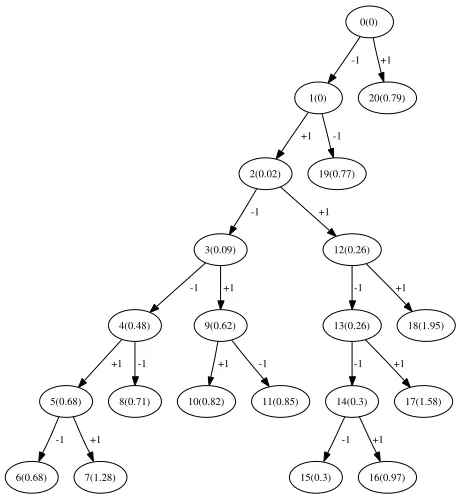
[image:3.595.308.536.56.303.2]
(22)
0(0) 1(0) -1 20(0.79) +1 2(0.02) +1 19(0.77) -1 3(0.09) -1 12(0.26) +1 4(0.48) -1 9(0.62) +1 5(0.68) +1 8(0.71) -1 6(0.68) -1 7(1.28) +1 10(0.82) +1 11(0.85) -1 13(0.26) -1 18(1.95) +1 14(0.3) -1 17(1.58) +1 15(0.3) -1 16(0.97) +1Fig. 1. Example of a search tree formed by the OHRSA based STE in a scenario employing BPSK modulation,NRx = 2, M = 2, ∆ = 1,
L= 2,K= 2andNT x = 1and encountering Eb/N0 = 12dB. The exact received signal vectorx, the channel matrixHand the transmitted sequencesare given in Equation (20). The labels indicate the search node index, while the value of the costfunction of Equation (17) is given in brackets.
and
ˆ
s
(o)M M SE
= [
−
0
.
11
−
0
.
61 0
.
10
−
0
.
12 0
.
69
−
1
.
01]
T.
(23)
Note that since both the system matrix and the transmitted signal
are real-valued, the imaginary part of the received sequence may be
omitted and the MMSE solution is also real-valued. The algorithm
commences at node 0 of Figure 1 by evaluating the cost function of
the hypothetical solutions
s
ˇ
(Nos)= ˇ
s
(6o)associated with the ordered
channel matrix of Equation (21), according to Equation (17), which
yields
J
6(ˇ
s
6)
(o)=
|u
(66o)(ˇ
s
(o) 6−
ˆ
s
(o) 6,M M SE
)
|
2J
6(ˇ
s
(6o)= +1) =
|.
45
·
(+1 + 1
.
01)
|
2= 0
.
79
J
6(ˇ
s
(6o)=
−
1) =
|.
45
·
(
−
1 + 1
.
01)
|
2= 0
.
00
.
The two values
J
6(ˇ
s
(6o))
can be seen at the second hierarchical
level of Figure 1 as nodes 1 and 20 together with the associated
hypothetical BPSK solutions indicated along the branches. Based
on the two cost function values seen within node 1 and 20 we
select node 1, since it has a value of
J
6(ˇ
s
(6o)=
−
1) = 0
.
0
, which
is the lower cost function value. The associated symbol value is
ˇ
s
(6o)=
−
1
. In the next step of the algorithm we proceed from node
1 of Figure 1 by calculating the cost function of Equation (17) for
the next two potential values of
ˇ
s
(5o)=
±
1
as follows:
a
5=
6j=6u
(5oj)·
(ˇ
s
(o)
j
−
s
ˆ
(o)
j,M M SE
)
=
0
.
06
·
(
−
1 + 1
.
01) = 0
.
00
J
5([ˇ
s
(5o)−
1]
T
)
=
|a
5
+
u
(55o)(ˇ
s
5−
s
ˆ
(5o,M M SE))
|
2
J
5([+1
−
1]
T)
=
|
0
.
00 +
.
52
·
(+1
−
.
68)
|
2= 0
.
02
J
5([
−
1
−
1]
T)
=
|
0
.
00 +
.
52
·
(
−
1
−
.
68)
|
2= 0
.
77
.
The resultant two values for
J
5(ˇ
s
(5o))
are associated with node 2
is node 2, where the associated symbol is
s
ˇ
(5o)= +1
, which has
a lower cost function value than node 19.
The value of
ˇ
s
(o)5
= [+1
−
1]
Tis now used for the calculation
of the cost function values of Equation (17) associated with
ˇ
s
(o) 4.
The cost function values
J
4(ˇ
s
(4o))
are illustrated at the fourth
hierarchical level of Figure 1 within node 3 and 12. Repeating this
procedure will result in the calculation of the cost function value
of
J
3(ˇ
s
(3o))
provided within node 4 and 9 at the fifth hierarchical
level of Figure 1, the calculation of
J
2(ˇ
s
(2o))
given in node 5 and
8 at the sixth hierarchical level of Figure 1 and finally
J
1(ˇ
s
(1o))
[image:4.595.318.527.55.294.2]given in node 6 and 7 at the seventh and last hierarchical level of
Figure 1.
Upon arriving at
J
1(ˇ
s
(1o))
at the bottom of the graph, we have
calculated the first potential solution of our optimization problem
described by Equation (7), which is constituted by the left-most
branch of the search tree illustrated in Figure 1. This potential
solution is given by
ˇ
s
(o)= [
−
1 + 1
−
1
−
1 + 1
−
1]
T.
The recursive optimization continues from the bottom (node 6)
to the top of the tree of Figure 1 with the objective of finding
the specific branch terminating at the bottom of the search tree
(hierarchical level 6) while having the minimum costfunction
value. The symbol vector
s
associated with this branch constitutes
the ML solution. Considering now the flipping of symbol
s
ˇ
(1o)or
ˇ
s
(2o)at hierarchical level 5 or 6 is not beneficial, since the cost
function associated with these changes would result in a higher
value, namely
1
.
28
and
0
.
71
, than the cost function of
0
.
68
at
node 6. Hence, if these tentative branches would be pursued to the
bottom of the tree, it would ultimately result in an increased cost
function value as a consequence of the ordering property outlined
in Equation (18).
When the recursive process initiated at node 6 arrives at node
3, however, it can be seen that changing the value of
s
ˇ
(4o)from
−
1
to
+1
results in a cost function value of 0.62 at node 3 which
is lower than the cost function value of 0.68 recorded at node 6.
Pursuing the path from node 9 further down the tree will however
again result in a cost function value that is higher than that of node
6. The corresponding branch is therefore not pursued further.
Returning to the most-left branch and changing the value of
ˇ
s
(4o)from
−
1
to
+1
, results in a cost function value of
0
.
26
,
which is lower than that of node 6 and the corresponding path is
therefore pursued further through nodes 13 and 14. Ultimately, this
results in two new branches through nodes 12 , 13, 14 and 15 as
well as 12, 13, 14 and 16 terminating at
ˇ
s
(o)1
, which constitute
additional potential solutions for
s
(o). Pursuing this path from
node 15 and 16 backwards, returning to the most-left branch and
moving recursively up to node 0 will result in no further branches
terminating at the bottom of the tree.
The desired solution is described by the specific branch
termi-nating at the bottom of the search tree and having the lowest cost
function value. Again, the associated symbol sequence is given by
ˇ
s
(o)= [
−
1
−
1
−
1 + 1 + 1
−
1]
T,
which can be obtained by tracing the branch back from node 15
to node 0. By contrast, the identically ordered MMSE solution is
given by
ˆ
s
(o)M M SE
= [
−
1
−
1 + 1
−
1 + 1
−
1]
T.
The corresponding solutions for reversed ordering are then given
10
-510
-410
-310
-210
-110
00
5
10
15
20
BER
E
b/N
0[dB]
MMSE
OHRSA
Bayesian
MAP
Fig. 2. BER versusEb/N0 for a scenario supporting K = 1 user employingNT x= 2transmit AEs, a two-path equal-power block-fading
channel, a BS equipped withNRx = 2,M = 2,∆ = 1 and perfect
channel knowledge. BPSK modulation was considered.
by
ˇ
s
=
[
−
1
−
1
−1 + 1
s∆+1
+1
−
1]
Tˆ
s
M M SE=
[
−
1
−
1
−1 −1
s∆+1
+1 + 1]
T,
which highlights the decision errors made by the MMSE detector.
The fact, that only a subset of the detector outputs is actually
of interest, namely the subvector
s
∆+1of
s
is a major
differ-ence between the OHRSA applied to the non-dispersive OFDM
subchannels in [1] and the wideband scenarios considered in this
treatise.
Following the procedure outlined in [1], the presented OHRSA
readily may be extended to account for complex-valued channel
matrices and higher order modulation schemes.
III-A. Results
In order to benchmark the proposed algorithm against
conven-tional DF-STEs proposed in the literature [6] a low-complexity
system consisting of
K
= 1
MS benefiting from
N
T x= 2
number
of transmit antennas and communicating over a channel modelled
by two equal-power independently faded path. The signal was
assumed to be BPSK modulated and the BS employed
N
Rx= 2
receive antennas as well as a DF aided STE in conjunction with
M
= 2
,
∆ = 1
and
N
= 1
. The fading envelope was assumed
to be constant during an entire transmission burst and no channel
coding was considered.
It can be seen from Figure 2 that the OHRSA indeed approaches
the performance bound constituted by the Bayesian DF-STE and
clearly outperforms the MMSE-based STE. The performance
dis-crepancy recorded in comparison to the Maximum A-Posteriori
(MAP) STE might be closed by considering a higher decision delay
in the STE.
[image:4.595.317.514.366.417.2]10
-510
-410
-310
-210
-110
00
5
10
15
20
BER
E
b/N
0[dB]
K=1
K=2
K=3
K=4
MMSE
OHRSA
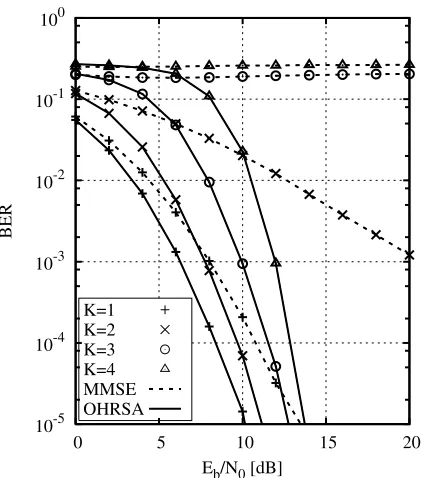
Fig. 3. BER versusEb/N0for a scenario supportingKnumber of users, each employingNT x = 2transmit AEs, a two-path equal-power
block-fading channel, a BS associated withNRx = 4,M = 2,∆ = 1and
perfect channel knowledge. 4QAM transmissions were considered.
10
110
210
310
410
510
610
710
810
910
101
2
3
4
No. Operations
No. MSs K
Search space
[image:5.595.66.278.55.294.2]E
b/N
0=0dB
E
b/N
0=10dB
Fig. 4. The number of combined addition and multiplication operations required for the detection of a single bit by the system used for generating Figure 3.
number of MSs
K, while keeping the other system parameters
as
M
= 2
,
∆ = 1
and
N
= 1
. For this system the classic
Bayesian and MAP STE benchmarker are excessively complex,
hence only the OHRSA and the MMSE DF-STE are considered. In
Figure 3, which shows the attainable average BER versus
E
b/N
0performance for different numbers of MSs it can be observed,
that the OHRSA is capable of detecting all MSs’ signals, even
in heavily overloaded systems, whereas the MMSE STE falters.
The complexity required for the detection of the signals associated
with Figure 3 is shown in Figure 4. The curve labeled as ’Search
Space’ indicates the number of possible transmitted bit sequences
in the search space, whereas the other curves show the number
of operations (multiplications plus additions) required for the
evaluation of the cost function given in Equation (15) for the
detection of a single bit. The graph clearly indicates that the
complexity of the OHRSA is several magnitudes lower than the
complexity associated with a full ML detector. It can also be seen
that for a higher SNR the number of operations imposed is lower
than that required as lower SNRs.
IV. TRUNCATED SEARCH
In contrast to the application of the OHRSA for the detection
of the narrowband OFDM subcarriers, the detection of all symbols
in
s
is not required in the context of wideband systems, since we
mentioned earlier that we are only interested in the detection of
the subvector
s
∆+1.
An attractive way of exploiting this phenomenon is to arrange
the columns of the channel matrix
H
not only according to the
squared norm of the columns as suggested in [1], but also ensuring
that the columns of specific interest appear at the end of the ordered
channel matrix
H
(o). In other words, we try to ensure that the
symbols associated with
s
∆+1appear at the top of the search tree
and are therefore detected first.
The corresponding reordering scheme can be divided into two
steps as follows:
1) Set the last
Q
number of columns of the channel matrix
given by
(
H
)
ii
∈
[∆
·
Q
+ 1
,
(∆ + 1)
·
Q
]
to the columns arranged according to their power. This
ensures that the symbols of interest are detected first
ac-cording to the squared norm of the associated columns. The
associated symbols appear in the top section of the search
tree.
2) Set the remaining columns of the channel matrix ordered
ac-cording to the squared norm of the columns to the remaining
columns of the channel matrix, again, arranged according to
their squared norm.
From a physical point of view the columns with very low
squared norm may contribute very little to the final cost function
value. This yields, that the search tree is subject to a very fine
branching at its bottom levels which has little influence on the final
cost function value and increases the complexity because each of
these branches has to be evaluated. Due to the fact, that the desired
symbols appear now in the top section of the search tree, a certain
number of levels at the bottom of the tree might be neglected in
order to avoid the evaluation of the cost function associated with
the fine branching.
The recursive cost function of Equation (17) can then be
rewritten as
J
i(ˇ
s
i) =
J
i+1(
s
i+1) +
φ
(
s
i)
, i
=
N
s−
1
, . . . , N
trunc+ 1
,
(24)
where
N
truncindicates the number of layers of the search tree
that have been discarded. Note however that truncation will always
result in performance degradation, because even though we are not
interested in the final decision concerning some of the symbols,
they still mildly influence the channel’s output vector
x
and the
cost function as it becomes explicit from Equation (9). Under
certain circumstances, however, when the power associated with
these symbols is very low (the associated column of the channel
matrix has a low squared norm), their influence becomes marginal
and might be neglected.
IV-A. Results
The effect of truncating the search tree has first been investigated
for the same system as the one studied in Figure 3. The number
of operations shown in Table I was recorded for
E
b/N
0=10 dB
[image:5.595.64.279.353.489.2]K= 1 K= 2 K= 3 Ntrunc= 2 Ntrunc= 4 Ntrunc= 4
Full 44 77 353
Trunc. 27 44 122
TABLE I
NUMBER OF OPERATIONS REQUIRED FOR THE DETECTION OF ONE BIT
ATEb/N0=10DBASSOCIATED WITH THE SYSTEM USED FOR GENERATINGFIGURE3IF TRUNCATION IS USED.
K= 1 K= 2 Ntrunc= 4 Ntrunc= 8
Full 254 7.1·104
Trunc. 60 193
TABLE II
NUMBER OF OPERATIONS REQUIRED FOR THE DETECTION OF ONE BIT
ATEb/N0=10DBASSOCIATED WITH THE SYSTEM USED FOR GENERATINGFIGURE5IF TRUNCATION IS USED.
Due to lack of space the corresponding BER curves are not
included. It is worth mentioning that the two-path equal-power
model channel may be considered to correspond to the
worst-case scenario, because the difference in squared norm between
the columns of the channel matrix associated with the desired and
the undesired symbols is not dramatic.
Let us therefore consider a more optimistic propagation scenario
having four equal-power paths and a DF-STE associated with
M
= 4
,
∆ = 3
,
N
= 3
and
N
Rx= 4
receive antennas. Each user
employed
N
T x= 2
transmit AEs and the channel code employed
was a half-rate punctured turbo-code [4] which was operating on
the hard-decision output of the DF-STE. In Table II the complexity
reduction achieved as a benefit of the above-mentioned truncation
procedure is summarized and the associated BER performance is
shown in Figure 5. It can be observed that the truncation technique
in this scenario provides a significant complexity reduction which
is of several orders of magnitudes attained at the cost of little
performance degradation. The associated high number of
opera-tions required for the conventional OHRSA assisted DF-STE is
due to the fact that the low power associated with some columns
of the channel matrix results in numerous extra branches at the
bottom of the search tree all of which have to be considered by
the algorithm. It is exactly this set of low-power branches, which
can be truncated without any significant loss of performance. The
higher difference in squared norm compared to the two-path system
is caused by the Toeplitz structure of the channel matrix
H
, which
is the characteristic of STEs.
V. CONCLUSION
A novel DF aided reduced complexity ML detector has been
proposed for employment in single-carrier wideband scenarios
. The detector was based on the recently contrived OHRSA
algorithm [1], which has been further developed for employment
in a single-carrier STE. It was shown that the proposed receiver
struture substantially outperforms the linear benchmarker based on
the MMSE criterion. Furthermore, a complexity reduction scheme
based on truncating the search tree has been proposed, which
accommodates the specific properties of the associated propagation
channel. The proposed modification of the OHRSA complements
10
-510
-410
-310
-210
-110
00
1
2
3
4
5
6
7
8
BER
[image:6.595.72.274.56.116.2]E
b/N
0[dB]
K=2, Trunc
K=2, Full
K=1, Trunc
K=1, Full
Fig. 5. BER versus Eb/N0 for a scenario supporting K number of users, each employingNT x = 2transmit AEs, a four-path equal-power
block-fading channel, a BS associated withNRx= 4,M = 4,∆ = 3
and perfect channel knowledge. 4QAM transmissions and a half-rate turbo code were considered.