!
!
!
Engineered Emulsions, Polymer
Structured Oils and Responsive
Polymer Nanoparticles
via
Polymer
Design and Emulsion Templating
!
By Robert Thomas Woodward
!
!
!
!
!
!
!
Thesis submitted in accordance with the requirements of the University of Liverpool
for the degree of Doctor in Philosophy by Robert Thomas Woodward
!
!
!
!
ACKNOWLEDGEMENTS
Firstly, I would like to express my gratitude to The University of Liverpool for all
of the opportunities offered to me over the last eight years.
I am forever grateful to my family for their continuous support, for never
questioning my educational decisions and most importantly, for shouldering the
burden of 8 years of chemistry. I am indebted to my wonderful girlfriend Emily,
who, by putting up with me, has put almost as much effort into this PhD as I have.
I would like to thank all of my friends in the department over these last
four years, in particular Jamie, Becca, Tamara, Mike, Rachel, Ben, Jaclyn, Fiona,
Paul, Ste, Tom and Marco for their regular lunch and tea breaks, providing some
stability and order to the working day.
I would like to thank Prof. Steve Rannard for offering me the opportunity
to complete my PhD four years ago, and both Steve and Dr. Dave Adams for the
continued support and guidance over the last four years, particularly in the
absence of my supervisor. I am also grateful to Dr. Lin Chen for her continuous
advice and also for the many, many discussions on just about anything, except
materials science.
I would like to thank Erol Hasan and Cristina Olariu at the University of
Liverpool for their contributions to Chapter 7 involving the synthesis and
characterisation of Fe3O4. I am grateful to Michael Barrow at the University of
Liverpool for mercury intrusion measurements included in Chapter 6 and also to
Prof. Andrew deMello at the Swiss Federal Institute of Technology for the
microfluidic analysis included in Chapter 4. I am grateful to Robert Bell at
Imperial College London, who ran the Karl Fischer titrations in Chapter 4 and
Nicolas Schaeffer, also as Imperial College London who ran the SEM images and
ICP measurements in Chapter 6.
ABSTRACT
!
The synthesis of branched copolymers with precise composition, specifically the
ratio of methacrylic acid (MAA) to ethylene glycol (EG) has been demonstrated.
These polymers were used to stabilise dodecane oil-in-water emulsion droplets. It
was demonstrated in the literature that branched copolymers containing a 1:1 ratio of
MAA:EG formed pH-responsive emulsions, capable of triggered inter-droplet
hydrogen bonding to form engineered emulsions (EE). The effect of varying this
ratio on the rate of engineered emulsion formation, and the resulting strength and
stiffness of the emulsion droplet aggregates was investigated. This control over
systems is exemplified by the demonstration of selective acid-triggered assembly of
binary mixtures of droplets stabilised by polymer containing only EG functionality
with droplets stabilised by polymers containing only MAA functionality.
EEs stabilised using a branched copolymer containing a 1:1 ratio of MAA:EG were
produced and allowed to dehydrate, leading to the removal of water from droplet
interstitial sites. The resulting single-phase materials are known as
polymer-structured oils (PSOs), held structurally by the inter-droplet polymer-polymer
interactions. These polymer boundaries provide enough of a barrier between droplets
to prevent coalescence upon the removal of water, allowing reversible hydration of
PSOs to reform EEs.
The production of large volume, well-defined EEs produced via the hydrolysis of
glucono-δ-lactone (GδL) to gluconic acid in an emulsion’s water phase was
investigated. This process provides a homogeneous pH trigger for the formation of
EEs, eliminating the slow diffusion of HCl. A homogeneous pH trigger also allows
the formation of EEs to be studied
in situ
using rheology. A comparison between
GδL and a conventional HCl trigger is presented.
Branched copolymer-stabilised ethyl acetate o/w emulsions were used as templates
in the production of both pH-responsive, surface-functionalised poly(methyl
methacrylate) (PMMA) colloidal nanoparticles and non-responsive PMMA particles
via an emulsion-solvent-evaporation technique. Lowering of the solution pH can
trigger the reversible aggregation of these highly dispersed pH-responsive colloids
into 3D structures with internal macroporosities dictated by the method of
dehydration employed. The colloids can also co-encapsulate various hydrophobic
molecules without any effect on particle stability and pH-responsiveness.
PRIMARY PUBLICATIONS ARISING FROM THIS THESIS
1.
“Controlling responsive emulsion properties via polymer design”, R. T.
Woodward, R. A. Slater, S. Higgins, S. P. Rannard, A. I. Cooper, B. J. L.
Royles, P. H. Findlay, J. V. M. Weaver,
Chemical Communications, 2009, 24,
3554-3556.
2.
“Fabrication of large volume, macroscopically defined and responsive
engineered emulsions using a homogeneous pH-trigger”, R. T. Woodward,
L. Chen, D. J. Adams, J. V. M. Weaver, Journal of Materials Chemistry, 2010,
25, 5228-5234.
3.
“The role of responsive branched copolymer composition in controlling
pH-triggered aggregation of “engineered” emulsion droplets: towards
selective droplet assembly”, R. T. Woodward, J. V. M. Weaver,
Polymer
Chemistry, 2011, 2, 403-410.
4.
“Multi-responsive polymer-stabilized magnetic engineered emulsions as
liquid-based switchable magneto-responsive actuators”, R. T. Woodward, C.
I. Olariu, E. A. Hasan, H. H. P. Yiu, M. J. Rosseinsky, J. V. M. Weaver,
Soft
Matter, 2011, 7, 4335-4340.
5.
“Reversible aggregation of responsive polymer-stabilized colloids and the
pH dependent formation of porous scaffolds”, R. T. Woodward, C. Hight, U.
Yildiz, N. Schaeffer, E. M. Valliant, J. R. Jones, M. M. Stevens, J. V. M.
Weaver, Soft Matter, 2011, 7, 7560-7566.
6.
“Microfluidic production of monodisperse functional o/w droplets and
study of their reversible pH-dependent aggregation behaviour”, W. A. C.
Bauer, J. Kotar, P. Cicuta, R. T. Woodward, J. V. M. Weaver, W. T. S. Huck,
Soft Matter, 2011, 7, 4214-4220.
CONTENTS
CHAPTER 1 - Introduction
!
List of Figures ... 2!
List of Schemes ... 3!
List of Tables ... 5!
1.1. Polymers ... 6!
1.2. Step-Growth Polymerisation ... 7!
1.3. Chain-Growth Polymerisation ... 8!
1.4. ‘Living’ Polymerisation ... 9!
1.5. Controlled Radical Polymerisation ... 10!
1.5.1. Atom Transfer Radical Polymerisation ... 11!
1.5.2. Reversible Addition-Fragmentation Chain Transfer Polymerisation ... 12!
1.6. Free Radical Polymerisation ... 13!
1.6.1. Decomposition and Initiation ... 13!
1.6.2. Kinetics of Decomposition and Initiation ... 15!
1.6.3. Propagation and Chain Transfer Reactions ... 16!
1.6.4. Kinetics of Propagation ... 17!
1.6.5. Termination ... 18!
1.6.6. Kinetics of Termination ... 18!
1.6.7. Average Kinetic Chain Length ... 19!
1.6.8. Kinetics of Chain Transfer Reactions ... 19!
1.7. Chain Transfer Agents ... 21!
1.8. Branched Polymers ... 22!
1.9. Copolymers ... 25!
1.10. Responsive Polymers ... 26!
1.11. Emulsions ... 27!
1.11.1. Small Molecule Surfactants ... 30!
1.11.2. Particulate Surfactants ... 31!
1.11.3. Polymeric Surfactants ... 32!
1.11.4. Responsive Surfactants ... 33!
1.12. Emulsions as Templates ... 40!
1.13. Present Study ... 41!
1.14. References ... 42!
CHAPTER 2 - Experimental
!
List of Figures ... 47!
2.1. Synthetic Processes Applicable to the Whole Thesis ... 47!
2.1.1. Preparation of PEGMAx/MAAy – EGDMA10 – DDT10 Branched
Copolymers ... 47!
2.1.2. Emulsion Preparation ... 48!
2.1.3. Emulsions with Guest Molecules Encapsulated ... 48!
2.1.4. Engineered Emulsion (EE) Formation ... 48!
2.2. Characterisation Techniques ... 48!
2.2.1. Light Scattering ... 48!
2.2.2. Gel Permeation Chromatography (GPC) ... 49!
2.2.3. Rheology ... 49!
2.2.4. Surface Tensiometry ... 49!
2.2.5. Optical Microscopy ... 50!
2.2.6. Confocal Microscopy ... 50!
2.2.7. Thermogravimetric Analysis (TGA) ... 50!
2.2.8. Nuclear Magnetic Resonance ... 50!
2.2.9. Ultraviolet-Visible Spectroscopy ... 50!
2.2.10. Karl Fischer Titration ... 50!
2.2.11. Scanning Electron Microscopy of Colloidal Aggregates ... 51!
2.2.12. Mercury Intrusion Porosimetry Measurements. ... 51!
2.2.13. Fourier Transform Infrared Spectroscopy ... 51!
2.2.14. Superconducting Quantum Interference Device (SQUID) ... 51!
2.2.15. Transmission Electron Microscopy ... 51!
2.3. Chapter 3 ... 52!
2.4. Chapter 4 ... 55!
2.5. Chapter 5 ... 57!
2.6. Chapter 6 ... 59!
2.8. References ... 64!
CHAPTER 3 – The Role of Branched Copolymer Composition in Controlling
pH Triggered Aggregation of Emulsion Droplets
!
List of Figures ... 66!
List of Tables ... 67!
3.1. Introduction ... 68!
3.2. Results and Discussion ... 69!
3.2.1. Synthesis of Branched Copolymer Surfactants ... 69!
3.2.2. Efficiency of Branched Copolymers as Emulsifiers ... 75!
3.2.3. Droplet Aggregation with Varying Polymer Composition ... 79!
3.2.4. Rheology of Engineered Emulsions ... 82!
3.2.5. Selective Droplet Aggregation ... 85!
3.3. Conclusions ... 90!
3.4. References ... 91!
CHAPTER 4 - Reversible Phase-Transitions in Responsive Polymer Stabilised
Emulsion Systems: Generation of Polymer Structured Oils
!
List of Figures ... 94!
List of Schemes ... 96!
List of Tables ... 96!
4.1. Introduction ... 98!
4.2. Results and Discussion ... 99!
4.2.1. Reversible Transitions in Polymer Stabilised Emulsions ... 99!
4.2.2. Imaging Emulsions Reversible Transitions ... 106!
4.2.3. Elasticity of Emulsions Between Switchable States ... 110!
4.2.4. Engineered Emulsions and Polymer Structured Oils Containing Guest
Molecules ... 114!
4.2.5. Triggerable Release from Polymer Structured Oils ... 115!
4.2.6. Uptake of Hydrophobic Dye by Polymer Structured Oils ... 120!
4.3. Conclusion ... 122!
CHAPTER 5 - Large Volume, Macroscopically Defined, Responsive Engineered
Emulsions Using a Homogeneous pH Trigger
List of Figures ... 126!
List of Schemes ... 127!
5.1. Introduction ... 128!
5.2. Results and Discussion ... 129!
5.2.1. Hydrolysis of glucono-δ-lactone ... 129!
5.2.2. Rheology of GδL systems ... 134!
5.2.3. Fabrication of large volume engineered emulsions ... 137!
5.3. Conclusion ... 141!
5.4. References ... 141!
CHAPTER 6 - Reversible Aggregation of Responsive Polymer-Stabilised
Colloids and the pH-Dependent Formation of Porous Scaffolds
!
List of Figures ... 144!
6.1. Introduction ... 147!
6.2. Results and Discussion ... 148!
6.2.1. pH Responsive Nanoparticles and Triggered Aggregation ... 148!
6.2.2. Measuring Free-Polymer in Solution and Its Effect On Aggregation .... 155!
6.2.3. Nanoparticle Aggregates ... 159!
6.2.4. Dehydration of Colloid Monolith for Formation of Porous Scaffolds ... 164!
6.3. Conclusions ... 168!
6.4. References ... 169!
CHAPTER 7 Multi-Responsive Polymer-Stabilised Magnetic Emulsions in the
Formation of Magnetic Engineered Emulsions
!
List of Figures ... 172!
7.1. Introduction ... 174!
7.2. Results and Discussion ... 175!
7.2.2. Comparison of Magnetic and Non-Magnetic, Free-Flowing Emulsions180!
7.2.3. Engineered Emulsions Containing PDMAEMA-mNPs ... 181!
7.2.4. Magnetic Engineered Emulsions in the Presence of a Magnetic Field .. 184!
7.3. Conclusion ... 189!
7.4. References ... 190!
CHAPTER 8 – Conclusions and Future Work
List of Tables ... 193!
8.1. Chapter 3 ... 193!
8.2. Chapter 4 ... 194!
8.3. Chapter 5 ... 195!
8.4. Chapter 6 ... 195!
GLOSSARY
ATRP
atom transfer radical polymerisation
CRP
controlled radical polymerisation
Ct
chain transfer constant
CTA
chain transfer agent
CTR
chain transfer reaction
Φoil
volume fraction of oil
D(4,3)
volume average diameter
DPn
number average degree of polymerisation
EE
engineered emulsion
ESE
emulsion-solvent-evaporation
FRP
free radical polymerisation
FTIR
fourier transform infrared spectroscopy
G'
storage modulus
G"
loss modulus
ICP
inductively coupled plasma mass spectrometry
LVE
linear viscoelastic
MFM
monofunctional monomer
Mn
number average molecular weight
MvH
magnetisation hysteresis measurement
Mw
weight-average molecular weight
o/w
oil-in-water emulsion
PDI
polydispersity index (Mw/Mn)
PRBN
pH-responsive branched polymer nanoparticles
RAFT
radical addition-fragmentation chain transfer polymerisation
rpm
revolutions per minute
SCL
shell cross-linked
SCVP
self-condensing vinyl polymerisation
SEM
scanning electron microscopy
SQUID
superconducting quantum interface device
t1/2
half life
TEM
transmission electron microscopy
TGA
thermogravimetric analysis
UV-Vis
ultraviolet-visible spectroscopy
CHEMICAL GLOSSARY
AIBN
azoisobutyronitrile
DDT
1-dodecanethiol
DEAEMA
(2-diethylamino)ethyl methacrylate
DNA
deoxyribonucleic acid
EG
ethylene glycol
EGDMA
ethylene glycol dimethacrylate
EtOAc
ethyl acetate
GδL
glucono-δ-lactone
MAA
methacrylic acid
MPA
mercaptopropionic acid
P4VP
poly(4-vinyl pyridine)
PDEAEMA
poly(2-diethylamino)ethyl methacrylate
PEG
poly(ethylene glycol)
PEGDMA
poly(ethylene glycol) dimethacrylate
PEGMA
poly(ethylene glycol) methacrylate
PHPMA
poly(2-hydroxypropyl methacrylate)
PMAA
poly(methacrylic acid)
PMMA
poly(methyl methacrylate)
PVC
poly(vinyl chloride)
SDS
sodium dodecyl sulfate
TG
1-thioglycerol
THF
tetrahydrofuran
CHAPTER 1
List of Figures
Figure 1.12. Schematic of (a) a triblock hydrophilic-hydrophobic-hydrophilic
copolymer and (b) how this polymer may stabilise an o/w emulsion. ... 33!
Figure 1.13. Schematic of pH triggered desorption of P4VP/SiO2 microgels, leading
to demulsification of an oil in water system. (Figure from ref. 92). ... 33!
Figure 1.14. PEG-grafted PMAA polymer at (a) basic pH, no hydrogen bonding
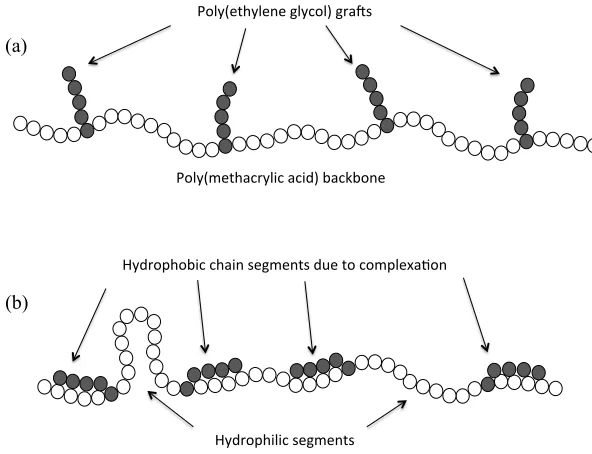
occurring so molecule remains completely hydrophilic and (b) acidic pH,
complexation occurs resulting in both hydrophobic and hydrophilic
segments. (Figure from ref. 90) ... 34!
Figure 1.15. Schematic comparing both linear and branched architectures,
demonstrating the multiple hydrophobic chain transfer molecules (black)
that are present in the branched structure containing monofunctional
monomer (white) and brancher (grey). ... 37!
Figure 1.16. Schematics of (a) polymer containing contra-functionality (red and blue)
with hydrophobic chain ends (black), (b) how (a) may interact with an oil
droplet at the o/w interface. ... 37!
Figure 1.17. Schematic showing the pH responsiveness of the MAA monomer and
how this results in electrostatically stabilised o/w droplets at high pH. ... 38!
Figure 1.18. Triggerable inter-droplet hydrogen-bonding gives rise to engineered
emulsions at low pH. ... 39!
Figure 1.19. Engineered emulsion (left) which can be redispersed on the addition of
base yielding discreet individual droplets (right). (Figure from ref. 102) ... 39!
Figure 1.20. A time series of optical micrographs showing the removal of toluene
and the subsequent packing of polystyrene microspheres to yield a cluster.
(Figure from ref. 69) ... 40!
List of Schemes
Scheme 1.15. Schematic showing pH responsiveness of PDEAEMA, switching from
hydrophilic at low pH to hydrophobic at high pH. ... 27!
List of Tables
1.1. Polymers
Since polymers were first produced, there have been many advances in this field of
synthetic chemistry, resulting in polymers playing a major role in modern day life.
The global demand for plastic materials had reached 245 million tonnes by 2009,
with this number only expected to increase.
1The idea of polymer chains was first
introduced by Staudinger in 1920,
2who later went on to win a Nobel prize in 1953
“for his discoveries in the field of macromolecular chemistry”. His work on high
molecular weight molecules, or macromolecules, paved the way for modern day
polymer chemistry. A polymer is a macromolecule consisting of repeating subunits
joined by covalent bonds. The name polymer is derived from the Greek words poly
and mer, meaning “many” and “part”, respectively. The ‘parts’ are monomers, which
are relatively simple organic molecules that react to form polymers
via
polymerisation.
Carothers was the first to distinguish between polymers by the mechanism in
which they were synthesised, i.e. by condensation or addition polymerisation.
3Carothers thought that condensation polymers were made up from multifunctional
monomers and proposed that small molecules are eliminated during polymerisation.
This differed from addition polymers, in which the polymer’s repeating unit has the
same structure as individual monomer molecules with no small molecule elimination
during polymerisation.
1.2. Step-Growth Polymerisation
Step-growth polymerisation occurs when two hypothetical functional groups, A and
B, can react together to form C.
4These two functional groups can exist in the same
molecule, for example when a hydroxycarboxylic acid forms a polyester (Scheme
1.1(a)), or they can exist on two difunctional monomers, such as the formation of
polyurethanes from diamine and bischloroformate (Scheme 1.1(b)).
Scheme 1.1. Step-growth polymerisation of (a) a hydroxycarboxylic acid, which has both A and
B functionality on one molecule and (b) a diamine and a bischloroformate, a system in which
one monomer has difunctionality A, the other difunctional with respect to B.
Polymerisation of monomers containing both A and B on one molecule (as in
Scheme 1.1(a)) results in polymer chains with active sites at both ends, with
functional group A at one end and B at the other. However, when A-A and B-B
monomers polymerise, either chain end may consist of A or B (Scheme 1.2).
Scheme 1.2. Resulting chain end functionalities in the step-growth polymerisation of (a) an A-B
monomer and (b) A-A and B-B monomers.
HO
R
O
OH
O
R
O
+
H2O
H2N
R
NH2
O
R'
O
Cl
Cl
O
O
+
N
H
R
N
H
O
R'
O
O
O
(a)
(b)
HClHO
R
O
OH
O
R
O
+
H
2O
H
2N
R
NH
2O
R'
O
Cl
Cl
O
O
+
N
H
R
N
H
O
R'
O
O
O
A"
B"
A"
(" )"
R"
B"
A"
A"
B"
B"
+"
A"
(" )"
R"
A"
A"
(" )"
R"
B"
B"
(" )"
R"
B"
(a)
Step-growth polymerisation results in the consumption of monomer without initial
large increases in molecular weight. Consider if all monomer had reacted to form
small polymers, or oligomers, the increase in molecular weight would be relatively
small. However, each polymer/oligomer formed still has two active sites, enabling
further polymerisation between these small molecules. Therefore reaction rate will
continue until the concentration of chain ends is sufficiently depleted. Step-growth
polymerisation is represented schematically in Figure 1.1.
Figure 1.1. Schematic representation of step-growth polymerisation of an A-B monomer system.
White dots represent monomer and black dots represent oligomer/polymer. (Figure from ref. 5).
1.3. Chain-Growth Polymerisation
Scheme 1.3. Schematic of (a) initiation in the polymerisation of methacrylic acid and (b) the
propagation process.
A representation of chain-growth polymerisation is shown in Figure 1.2. From this
we can see that, although high chain lengths can be reached fairly rapidly, a lot of
unreacted monomer is still present. However, in step-growth all monomer may be
consumed rapidly, but molecular weights increase slowly.
Figure 1.2. Schematic representation of chain-growth polymerisation. White dots represent
monomer and black dots represent oligomer/polymer. (Figure from ref. 5).
All of the work presented in this thesis utilises chain-growth polymerisation. Chain
growth allows chemists to design products, with the option to minimise termination
reactions via so-called ‘living’ polymerisation.
1.4. ‘Living’ Polymerisation
A ‘living’ polymerisation is one in which termination does not occur on the
timescale of polymerisation. Polymer chains propagate until all monomer present is
consumed; however, polymers are described as ‘living’ because even after monomer
I
C
HO
O
H
2C
C
HO
O
H
2C
I
I
H
2C
C
HO
O
H
2C
C
HO
O
I
H
2C
C
HO
O
H
2C
C
HO
O
(a)
consumption, the ends of the chains remain active. This allows further
polymerisation upon addition of more monomer. Although ‘living’ systems had been
observed previously,
6they were first defined as ‘living’ by Szwarc in 1956.
7Due to
the additional control ‘living’ polymerisation allows over the polymer composition, a
number of different architectures are possible, including block copolymers, branched
polymers (such as networks and ladders) and star polymers.
8This control comes from the ability to make polymer chains with
pre-determined molecular weights, as the number-average degree of polymerisation
(DPn) is dependent on the initial monomer/initiator ratio, shown in eq (1). [M]o and
[I]o represent the initial concentration of monomer and initiator respectively.
Number average degree of polymerisation (DPn) = [M]o / [I]o
(1)
Examples of ‘living’ polymerisation include both ‘living’ anionic and ‘living’
cationic polymerisation, ring opening metathesis polymerisation, and group transfer
polymerisation. Another polymerisation method used to synthesise polymers with
pre-determined DPn is controlled radical polymerisation. This is sometimes known as
‘living’ radical polymerisation due to the precise macromolecular synthesis that is
possible. However, as chain ends are in equilibrium between propagating radical
chains and dormant species, these are not strictly ‘living’ systems. Controlled radical
polymerisation (CRP) is discussed in more detail in section 1.5 below.
1.5. Controlled Radical Polymerisation
of polymerisations employ this technique, two of the more widely used processes are
known as atom transfer radical polymerisation (ATRP) and reversible
addition-fragmentation chain transfer polymerisation (RAFT).
1.5.1. Atom Transfer Radical Polymerisation
The Sawamoto group and Wang and Matyjaszewski published work on this
technique at a similar time, and both are now credited with its discovery.
11,12Sawamoto and co-workers reported a controlled free radical polymerisation of
methyl methacrylate catalysed by a ruthenium(II) complex, whereas Matyjaszewski
and co-workers polymerised styrene using a copper catalyst. Both methods slow the
rate of propagation, allowing individual polymer chains to grow at a similar rate,
resulting in polydispersity indices <1.2. However, Matyjaszewski’s method has
become the more popular of the two, as the copper catalyst is more cost-effective
than the ruthenium(II) catalyst used by the Sawamoto group. The mechanism of
ATRP reported by Wang and Matyjaszewski is shown in Scheme 1.4.
Scheme 1.4. Proposed mechanism of ATRP. The Cu catalyst removes the halogen (Cl) from the
initiator (R-Cl), enabling addition of monomer (M). However, the removal of the halogen is
reversible and addition of the Cl to the propagating chain (P) returns the polymer to its
dormant state. (Scheme from ref. 12)
The initiator (R-Cl) contains a removable halogen atom, which is extracted by the Cu
catalyst to form the oxidised species Cu
IILxCl, generating a free radical species (R
•
).
The free radical can then add to monomer (M) molecules initiating polymerisation.
Slow propagation then occurs in the presence of this equilibrium. The equilibrium
R Cl
+M
+ Cu
IL
x
[
R
!+
Cl
Cu
IIL
x]
+MR
Cl + Cu
IL
x
[
R
M
!+
Cl
Cu
IIL
x]
M
Initiation:
Propagation:
P
Cl + Cu
IL
12
must lie towards the formation of dormant chain ends in order to maintain a low
concentration of polymer radicals, minimising termination reactions. Rapid exchange
(activation and deactivation) enables controlled addition of monomer units, helping
the propagating chains to grow at the same rate.
1.5.2.
Reversible
Addition-Fragmentation
Chain
Transfer
Polymerisation
RAFT was first reported by Chiefari
et al. in 1998.
13RAFT is a radical
polymerisation in the presence of an appropriate dithioester molecule (Z-C(=S)-S-R),
which is known as a RAFT agent. The RAFT agent helps control polymerisation by
consumption of the propagating radicals, however fragmentation releases another
radical capable of reinitiating polymerisation. The resulting equilibrium between
dormant and active polymer chains allows uniform chain growth.
14The RAFT
mechanism is outlined in Scheme 1.5.
Scheme 1.5. Proposed mechanism of RAFT. Pn, Pm and Px are polymer chains, M represents
monomer and R is a radical capable of initiating polymerisation. (Scheme from ref. 14)
monium salt with benzyl bromide affords the desired
tetraarm RAFT agent
(2)
in good yield.
Mechanism of
RAFT
Polymerization.
Radical
polymerization with reversible addition-fragmentation
chain transfer
(RAFT)
is a living process reported
recently.
28-35
The mechanism by which the process
imparts living
character to
the polymerization is shown
in Scheme 3 and is
carried
out by simply introducing a
suitable thiocarbonylthio compound to
an
otherwise
conventional radical polymerization. During the
first
stages
of
the polymerization the RAFT agent
(ZCdSSR)
is
consumed by propagating radicals by an
addition-fragmentation mechanism. The
fragmented radical
(R
•
)
reinitiates polymerization, resulting in new propagating
radicals which then take part in the equilibrium
estab-lished between the dormant polymer and active
chains.
The equilibration process allows all
chains produced to
grow in a uniform manner, resulting in narrow
poly-dispersity polymers. The nature
of
the
Z
and R groups
is
crucial to
the success
of
the polymerization. The
results
of
an investigation
on their effects will be
published shortly.
36,37
Various types
of
effective RAFT agents have been
reported to
date. These include dithioesters,
dithiocar-28-35
acteristics as they
can accommodate either
one
or two
leaving groups attached to
the sulfur atoms
(Scheme
4). Depending
on the leaving ability
of
these groups,
polymers having a trithiocarbonate moiety incorporated
in the middle
of
the polymer
or at the terminus
can be
synthesized. The ability to
prepare
ABA
triblock
copoly-mers in two
steps
from those that have two
good leaving
groups is
one
of
the advantages
of
trithiocarbonates
reported recently.
35
When used in the preparation
of
star polymers, the ability to control the way in which
the RAFT agent
can
fragment
can be used to
advantage.
This allows the preparation
of
star polymers
of
con-trolled molecular weight and narrow polydispersity,
free
from star-star
coupled impurities.
Polymerizations.
As briefly described above
(see
Scheme 4),
control in the direction
of fragmentation
can
be used to
advantage in the syntheses
of
star polymers
with trithiocarbonates. Because each arm is tied at the
core
of
the molecule
(compounds
1
and
2), the way in
which
fragmentation
of
the intermediate radical
occurs
is important as
one would result in a propagating
radical attached and the
other detached
from the
core
of
the molecule. The direction
of fragmentation
of
the
intermediate
following radical attack at the thiocarbonyl
group is
controlled by the leaving ability
of
the groups
attached to
the two
sulfur atoms
of
the trithiocarbonate
moiety. The leaving ability
of
a group is dependent
on
the
combination
of
a number
of factors such as
thermo-dynamic (bond strength
of
the
forming and the breaking
bond), steric (presence
of
bulky substituents), electronic
effects
of
the substituents directly attached to
the
leaving
carbon
center
(electron withdrawing and
releas-ing abilities
of
groups), and the stability
of
the radical
formed. From experience
38,39
it is known that methyl
radicals, being primary, are poor leaving groups relative
to
secondary benzyl radicals. The latter radicals also
have the effect
of
being stabilized by the aromatic
ring
through electron delocalization;
however, they are
suf-ficiently reactive to
undergo
addition reactions which
makes them suitable as initiators in radical
polymeriza-tions. Having detailed the mixture
of complex
factors
that influence
fragmentation, in RAFT polymerization,
it is the relative stability/leaving ability
of
the adding
vs the
fragmenting
(leaving)
radicals that is
impor-tant.
32,36,37,40
As described earlier, rapid
consumption
of
the RAFT agent is
crucial to
the success
of
the reaction.
The
first type
of
the proposed RAFT agents, e.g.
1
where the leaving group
following
fragmentation is
bound to
the
central
core
of
the polymer, is shown in
Scheme
2
S
c
heme
3.
RAFT
Pro
c
ess
aa
M is m
o
n
o
mer
;
R is a radi
c
al that
c
an initiate p
o
lymeri
-zati
o
n
;
P
n, P
m, and P
xare p
o
lymer
c
hains.
S
c
heme
4
aa
M
A
and M
Bare di
ff
erent m
o
n
o
mers, and
An
and B
mare
their respe
c
tive p
o
lymers.
The nature of the Z and R groups is key to a successful polymerisation, the Z group
should activate the C=S bond for radical addition, while the R group should be a
stable leaving group that is also capable of re-initiating the polymerisation. Because
of these criteria, RAFT agents have to be optimised for each monomer, and although
RAFT can be used to polymerise a wide range of monomers,
14,15the synthesis of
copolymers can be difficult.
One method of polymerisation with less control is free radical polymerisation
(FRP). However, FRP is a much more versatile approach to polymerisation due to its
relatively non-specific nature. As free radical is the only form of polymerisation used
in this thesis, it shall make up the bulk of the polymer discussion of this introduction.
1.6. Free Radical Polymerisation
Free radical polymerisation is a chain-growth process, with the polymer being
formed via the successive addition of monomer building blocks to the growing chain
end. Vinyl polymers are the most commercially important polymers as they have a
vast number of commercial applications, including usage in packaging, insulation,
clothing, construction and cosmetics. Structures such as polystyrene, polyethylene,
poly(acrylic acid) and poly(vinyl chloride) (PVC) are just a few notable examples.
Unlike other methods of polymerisation, such as ionic, free radical polymerisation
can be applied to a wide range of monomers. The process is quite robust, showing
more tolerance to impurities and monomer functionality, as well as being relatively
cheap. For these reasons, vinyl polymers are predominantly produced commercially
using free radical processes.
As mentioned in 1.3, chain-growth polymerisation involves five main steps,
each of which is important to consider when designing a polymerisation.
1.6.1. Decomposition and Initiation
Scheme 1.6. Schematic of decomposition and initiation. I
•
is a radical capable of initiating
polymerisation of monomer CH
2=CHX.
Some monomers, notably styrene,
16often only require heating and do not need added
free radical initiators in order to undergo polymerisation. However, in the majority of
systems the addition of an initiator is required. Compounds providing the triggerable
production of radicals can be used as initiators. The majority of initiators can be
grouped into four categories. These are azo compounds,
17peroxides (ROOR) and
hydroperoxides (ROOH),
18redox initiators and photoinitiators. Ionising radiation,
for example α- and β-particles or γ- and x-rays, can also be used to generate radicals
by random destruction, although this is much less common and only used in special
cases.
19Thermal decomposition to form free radicals is the most common method of
initiation, with peroxides, hydroperoxides and azo compounds all falling under this
category. One of the most widely used peroxides is benzoyl peroxide, the
decomposition of which is shown in Scheme 1.7. Peroxides are the most widely used
initiators in industrial processes, as the large structural variation provides a wide
range of decomposition temperatures. The differences in decomposition rates of
initiators can be expressed in term of the initiator half-life (t1/2), which is the time it
takes for the concentration of the initiator to decrease to half of its original value.
Variation in t1/2 between initiators is due to differences in chemical structure, and the
stabilities of the radicals produced on decomposition.
20The more stable the initiator,
the higher the t1/2. Likewise, the more stable the resulting free radical, the lower the
t1/2. Initiators are commonly compared by quoting the temperature at which t1/2 = 10
hours or 1 hour.
Decomposition:
Initiator
I
!
Initiation:
I
!
+
CH
2
=CH
X
Scheme 1.7. Thermal homolysis of benzoyl peroxide to yield two benzoyloxy radicals.
Higher temperatures coupled with the release of N
2drive the decomposition of azo
compounds in radical formation. A common azo initiator, used throughout this piece
of work, is azobisisobutyronitrile (AIBN), shown in Scheme 1.8. AIBN is usually
decomposed at around 70
oC, where it has a half life of 4.8 hours.
20Scheme 1.8. Thermal decomposition of AIBN to give free radicals, driven by the formation of
N
2.
1.6.2. Kinetics of Decomposition and Initiation
As initiation occurs in two steps, two rate constants are needed, one representing
decomposition (2) and one for initial monomer addition (3).
Initiator
I•
(2)
I• + M
P
(3)
R
i= dt = 2 f
k
dec [I](4)
As (2) is a slow process in comparison to (3), this becomes the rate-determining step.
Therefore in the rate equation, (4),
R
i is the rate of initiation,I
• is the initiating
radical, and
f
is the initiator efficiency.
O
O
O
O
O
O
2
Δ
N
N
N
N
2
N
+
N
N
Δ
kdec
kadd
1.6.3. Propagation and Chain Transfer Reactions
Propagation occurs relatively quickly upon initiation, due to the inherent reactivity of
the radicals formed. Addition of a monomer radical to another monomer molecule is
the first step of propagation (Scheme 1.9(a)). Monomer molecules then continue to
add to the end of the chain (hence chain-growth) (Scheme 1.9(b)), until all monomer
is consumed or termination occurs.
Scheme 1.9. (a) First step of propagation of monomer CH
2=CHX after initiation by I, (b)
chain-growth of CH
2=CHX
Propagation usually results in head-to-tail addition (as in Scheme 1.9(a)) due to both
steric and electronic effects, although cases have been reported in which
head-to-head addition may occur to some extent.
21-23A number of reactions, known as chain
transfer reactions (CTR), can take place in this system when the propagating radical
does not show high regioselectivity towards the monomer vinyl bond. CTRs involve
radical transfer from the end of the growing polymer chain to another species. This
can lead to shorter chain lengths and polymers with branched architecture, resulting
in lower molecular weights and broader molecular weight distributions. For this
reason, CTRs can be purposefully utilised to regulate the mean chain length by the
addition of chain transfer agents (CTA), something discussed in greater detail in
section 1.7. A number of examples of CTRs are shown in Scheme 1.10 for
polyethylene. Both Scheme 1.10(b) and (c) lead to polymers with branched
architecture, while (a) leads to shorter chain lengths.
Propagation:
ICH
2CHCH
2CH
!ICH
2CH
!X
+ CH
2=CH
X
X
X
ICH
2CHCH
2CH
!X
X
+
nCH
2=CH
ICH
2CH(CH
2CH)
nCH
2CH
!X
X
X
(a)
(b)
Scheme 1.10. Schematic showing undesirable chain transfer reaction such as, (a) with initiator
molecules, (b) hydrogen abstraction from another polymer chain, and (c) backbiting, again
hydrogen abstraction but this time from the propagating chain itself.
1.6.4. Kinetics of Propagation
The propagation step can be defined kinetically as:
Pn• + M
Pn+1•
(5)
Rp = dt =
kp
[M] [P•]
(6)
So in the rate equation, (6),
Rp
is the rate of propagation,
M
is monomer, and
P
• is
the polymer radical. The rate of polymerisation is essentially dependent on the rate of
propagation.
kp
1.6.5. Termination
Termination is the cessation of propagation and occurs in all radical polymerisations.
There are two standard types of termination, known as combination and
disproportionation. Combination involves the coupling of two radicals to form a new
covalent bond. This can involve two propagating chains (Scheme 1.11(a)), or
combination of a propagating chain with an initiator fragment (Scheme 1.11(b)),
both of which result in the linear polymer having an initiator group at each end of the
chain.
Scheme 1.11. The combination of two radicals, or coupling, to form a new covalent bond (a) two
propagating chains and (b) a propagating chain with an initiator fragment.
Disproportionation involves the transfer of one atom from one polymer radical to
another, similar to hydrogen abstraction in CTR but without generation of another
free radical species (Scheme 1.12). Which termination mechanism prevails depends
on the monomer type and the reaction conditions,
24but it is usually assumed that
both processes are occurring.
4Disproportionation results in only one initiator group
per chain, but forms a vinyl group in one of the chains that can then polymerise.
Scheme 1.12. Disproportionation between two chains by hydrogen abstraction.
1.6.6. Kinetics of Termination
As there are two possible types of termination, see (7) & (8) overleaf, the kinetics
need to account for this.
I
CH
2CH
!+
!CHCH
2
I
I
I
X
X
I
CH
2CH
!+
X
I
I
I
(a)
(b)
I
CH
2CH
!+
X
!
CHCH
2I
X
I
CH=CH
X
+
CH
2CH
2I
Pn•
+ Pm•
Pn+m
(7)
Pn•
+ Pm•
Pn + Pm
(8)
Therefore termination can be defined as:
Rt = dt = 2 kt [P
•
]
2(9)
In (9)
R
t represents the rate of termination andkt
=
kta +
ktb,
the overall rate of
termination for both disproportionation and coupling.
1.6.7. Average Kinetic Chain Length
The average kinetic chain length,
ν, is defined as the average number of monomer
units polymerised per chain initiated, which is equal to the rate of polymerisation
(essentially the rate of propagation, Rp) divided by the rate of initiation, Ri.
4Kinetic
studies of free radical polymerisation tend to assume that the rate of initiation and
termination are identical shortly after the reaction has begun. This is known as the
‘steady-state’ assumption, which allows us to assume that the concentration of
polymer radicals, [Pn•], remains constant. From this it can be deduced:
ν = Rt
(10)Substituting Rp and Rt from equations (6) and (9) respectively:
ν = 2 kt [P
•
]
(11)
1.6.8. Kinetics of Chain Transfer Reactions
Deviations from predicted kinetic behaviour can arise from CTRs. As they play a key
role as CTAs in the polymer synthesis conducted in this thesis, it is necessary to
adjust the kinetic chain length, ν, to account for these changes. Therefore the kinetic
chain length,
νtr, shall be defined as the ratio of propagation rate to the combined
rates of termination and transfer, hence
k
tak
tb-d [P•]
Rp
ν
tr= R
t+ R
tr(12)
Where
Rtr
is the rate of transfer reactions. As transfer reactions are second order, if
T
is the transfer agent then R
trcan be expressed as:
R
tr= k
tr[P
•
] [T]
(13)
Therefore the expression for
ν
trtaking into account all possible transfer reactions is:
ν
tr= 2 k
t[P
•
]
2+ Σ k
tr[P
•
] [T] = 2 k
t[P
•
] + Σ k
tr[T]
(14)
Remembering equation (11), the reciprocal of (14) is:
ν
trν
k
p[M]
(15)
The ratio of the transfer rate constant to the rate constant for propagation is known as
the chain transfer constant, C
t:
C
t= k
p(16)
Substituting (16) into (15), we arrive at:
ν
trν
[M]
(17)
From (17) it can clearly be seen that, as the rate of transfer and the concentration of
the CTA are increased, the kinetic chain length becomes smaller, resulting in lower
molecular weight polymers. By using different CTAs, the chain transfer constant, C
t,
can be varied.
R
pk
p[M] [P
•
]
k
p[M]
1
Σ k
tr[T]
+
1
k
tr=
1
Σ C
t[T]
+
1
1.7. Chain Transfer Agents
Thiols, or mercaptans are probably the most common group of CTAs in radical
polymerisation.
25Thiols undergo reaction with radicals via the transfer of a hydrogen
atom, forming a saturated chain end and generating a thiyl radical (Scheme 1.13).
25A chain transfer agent is added to give controlled chain transfer reactions, which
allows some degree of manipulation over polymer end groups and molecular weight.
Scheme 1.13. A chain transfer process involving a thiol CTA, (a) abstraction of H and transfer
of radical onto S group, (b) CTA behaving as an initiator and ‘transferring’ the radical to start
a new polymer chain.
As mentioned in 1.6.8, the choice of CTA is important due to each species having a
unique chain transfer constant (C
t). The
C
tis essentially a measure of the reactivity
of a CTA and therefore an insight on its effect on reducing a polymer’s molecular
weight.
26It can be seen in equation (16) that C
t= k
tr/k
p. In a normal polymerisation,
the rate constant of propagation is much larger than the rate constant of transfer
(k
p>>k
tr), making
C
ta small number. However, this effect is not detrimental to
resulting chain lengths if the rate of reinitiation is rapid (case 1 in Table 1.1). C
tbecomes large if the rate of transfer is much greater than the rate of polymerisation
(k
tr>>k
p). If C
tbecomes too large, telomers (DPn ≈ 1 – 5) are formed (case 2 in Table
1.1). The rate of reinitiation, k
a, displayed by the CTA should be comparable to that
of the original propagating radical. If
k
p>k
a, retardation of the polymerisation will
occur as the CTA is a less efficient initiator (cases 3 and 4 in Table 1.1).
R
H
S
R'
S
R'
R
H
+
R'
S
H
2
C
CH
2R'
S
(a)
Table 1.1. Effect of chain transfer on R
pand DP
n. (Table from ref. 20)
As well as playing a crucial role in the synthesis of the polymer, chain transfer agents
can also be used to impart functionality to the polymer chain ends. Many examples
of this have been successful, including synthesis of epoxy-terminated polymers
27and
polymers capable of linking to biomolecules through their CTA.
28CTAs are also
used to increase hydrophilicity or hydrophobicity, sometimes contributing toward
amphiphilicity, in order to create surface active-polymers.
291.8. Branched Polymers
Polymers come in many different structural forms, both compositionally and
architecturally. It is possible to describe polymers as linear, branched or a network,
with a number of different structures already falling under the branched category.
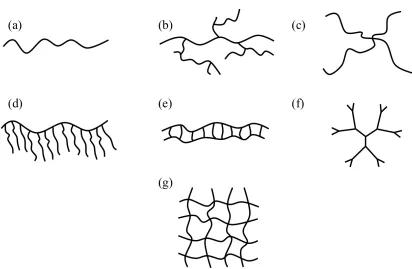
Some of the more common structures are shown in Figure 1.3.
Many forms of branched polymer have been reported in the literature,
including dendrimers,
30,31comb polymers,
32star polymers
33and hyperbranched
polymers.
34,35However, many of these materials are restricted to just a few structures
as they may require multiple steps and/or difficult synthesis. The first report of
hyperbranched polymers by the polycondensation of AB
2monomers was by Kim
and Webster in 1990.
36Their work was further simplified by Fréchet and co-workers,
who produced a more generic approach to hyperbranched polymers using
self-condensing vinyl polymerisation (SCVP). Fréchet’s method involved an AB
monomer which provided a branching point every time a new monomer was added
to the polymer chain. Fréchet and co-workers performed SCVP using many methods,
such as controlled radical polymerisation, ‘living’ cationic polymerisation and group
transfer.
37,38Although these methods provided a number of different routes to highly
Case
Relative Rates Constants
for Transfer, Propagation
and Reinitiation
Type of Effect
Effect on R
pEffect on DP
n1
k
p>>k
trk
p≈
k
aNormal chain transfer
None
Decrease
2
k
p<<k
trk
p≈
k
aTelomerisation
None
Large decrease
3
k
p>>k
trk
p>
k
aRetardation
Decrease
Decrease
branched materials, the vinyl monomers that formed these polymers had been
tailored to allow “self-condensation” (Scheme 1.14).
Scheme 1.14. (a) Basic concept of SCVP monomers with two active groups, (b) polymerisation is
initiated at B*, resulting in a new initiating centre, a propagating centre and a vinyl group,
which are all capable of polymerisation. (c) An example of an AB monomer used in SCVP, with
tin(IV) chloride as an activator. (Scheme from ref. 38)
This then hinders the addition of added functionality to the resulting polymer, as it
requires specific structural aspects in the monomer to allow branching. A number of
other routes to branching by SCVP have been successful, such as using ATRP,
39but
none of these systems provide a general method for the simple branching of vinyl
monomers, and generally require the use of specific, or specialised monomers.
H2C CH H2C CH
B
B *
H2C CH
B H2C CH
B *
*
H2C CH
B HC2 CH
B *
* External
activation
One vinyl group
One initiating center
One vinyl group
One initiating and one propagating center
Hyperbranched polymer with many reactive chain ends Self-condensation
Cl Cl
+ SnCl4
SnCl5
SnCl5
* SnCl4
Bu4NBr
(a)
(b)
[image:35.595.113.525.62.331.2]
(36)Figure 1.3. Representations of polymers with varied architecture. (a) Linear, (b) branched, (c)
star, (d) graft or comb, (e) ladder, (f) dendrimer and (g) a network.
Figure 1.4. Schematic represent free radical polymerisation with bifunctional monomer (top)
and the same system with an added chain transfer agent (bottom). CTA prevents gelation and
produces soluble branched polymers.
As this method of polymerisation is relatively uncontrolled and branching is
statistical, broad molecular weight distributions are achieved. However, Armes and
co-workers have published examples of this branched polymer synthesis using
controlled polymerisation techniques, allowing control over the primary chain
length.
42,43One particular report showed the synthesis of poly(2-hydroxypropyl
methacrylate) (PHPMA) with a disulphide- based dimethacrylate branching agent,
which could later be cleaved, resulting in polymers comparable to that of linear
PHPMA.
44This was a good demonstration of not only how successful branching was
in these systems, but also how well the polymer backbone chain length could still be
controlled using ATRP.
1.9. Copolymers
A copolymer is made up of two or more different monomeric units, whereas a
homopolymer is a polymer that consists of a single monomer repeating unit.
Copolymers can exist in a number of different architectures, including statistical
copolymers,
45alternating copolymers
46and block copolymers.
47A number of
examples are shown in Figure 1.5, with A and B representing two structurally
different monomers. Statistical copolymers are formed when the monomer units are
statistically distributed, whereas alternating copolymers consist of alternating
ini#ator(
Gel/
Network+
+
ini#ator(
chain(transfer(agent(
((((()(
Soluble+
branched+
monomers. Block copolymers are made up of ‘blocks’ of monomers and graft
polymers
48consist of one monomer branching from the backbone of another.
Figure 1.5. An array of copolymer compositions and architectures (with the exception of
homopolymer (a), shown for ease of comparison). (b) Statistical copolymer, (c) alternating
copolymer, (d) block copolymer and (e) graft copolymer.
Copolymerisation allows multi-functionality within one polymer molecule, which
has led to many interesting properties in the literature, including surface functionality
and micelle formation,
49-52self-assembly,
53,54encapsulation and drug delivery.
55,56Many of these polymers are amphiphilic, that is both hydrophilic and hydrophobic in
parts, which drives the self-assembly processes in aqueous solution involved in block
copolymer application.
1.10. Responsive Polymers
Polymers found in nature, for example proteins and deoxyribonucleic acid (DNA),
are capable of highly cooperative interactions, which are crucial in living organisms.
The field of responsive polymers in synthetic chemistry is huge, with many different
systems being designed to mimic only a fraction of biopolymers selectivity and
functionality. Synthetic polymers have been designed to respond to many external
stimuli, so-called ‘smart’ polymers.
57Some of these include responsiveness to
temperature,
58-61pH,
62-64glucose
65and antigens.
66Weaver et al. used the ‘Strathclyde approach’ to create ‘smart’ pH-responsive
branched polymer nanoparticles (PRBNs).
67These nanoparticles consisted of
poly(ethylene glycol) methacrylate (PEGMA) (Mn = 1,100 Da) and
(2-diethylamino)ethyl methacrylate (DEAEMA) in a 5:95 molar ratio, roughly 1:1 when
!A!A!A!A!A!A!A!A!A!A!#
!A!B!A!B!B!B!A!A!B!A!#
!A!B!A!B!A!B!A!B!A!B!#
!A!A!A!A!A!B!B!B!B!B!#
!A!A!A!A!A!A!A!A!A!A!#
B!B!B!B!B!#
(a)
(c)
(e)
(b)
considering the ratio of ethylene glycol (EG) repeat unit to DEAEMA comonomer.
The brancher (ethylene glycol dimethacrylate (EGDMA)) and CTAs
(1-dodecanethiol (DDT) and 1-thioglycerol (TG)) were varied throughout the series of
copolymers in order to examine how varying the copolymer architecture influences
the pH-responsiveness. In all cases, under acidic conditions, when the DEAEMA
units are protonated, the cationic copolymers readily dissolved in water. Upon
raising the pH, the PDEAEMA is deprotonated, (Scheme 1.15) and becomes
hydrophobic. Light scattering confirmed that upon this switch to basic conditions,
the hydrodynamic radius decreased significantly (from 45 nm to 25 nm) due to the
formation of DEAEMA-based hydrophobic cores. Variation of chain-end
hydrophobicity and degree of branching throughout these copolymers affected the
apparent p
K
a of the polymerised DEAEMA residues, providing the ability to tunepH-responsiveness of the nanoparticles.
Scheme 1.15. Schematic showing pH responsiveness of PDEAEMA, switching from hydrophilic
at low pH to hydrophobic at high pH.
1.11. Emulsions
Emulsions are metastable colloids consisting of two immiscible fluids, one being
dispersed throughout the other, usually in the form of spherical droplets.
68Emulsions
are important materials in the formation of many products and formulations, and can
be used as useful templates for the synthesis of complex materials.
69-74Some of these
examples involve the isolation of reaction solutions and the reproducible synthesis of
nanocrystals and colloidal particles, which will be discussed further in Chapter 6.
O
N O
H
O
N O