Control of Constrained Nonlinear Systems
Applications in Aerospace and Robotics
Khoi Ba Ngo
A thesis submitted for the degree of
Doctor of Philosophy
of
THE AUSTRALIAN NATIONAL UNIVERSITY
D e c la r a tio n
This thesis is an account of research undertaken at the Department of Engineering, Faculty of Engineering and Information Technology, Australian National University, Can berra, Australia, and is based upon work performed jointly with Dr. Robert Mahony and Prof. Zhong-Ping Jiang. The majority, approximately 85 percent, of the work is my own.
Except where acknowledged in the customary manner, the material presented in this thesis is, to the best of my knowledge, original and has not been published or submitted in whole or in part for a degree at any university or institute of higher learning.
Khoi Ba Ngo April, 2007
A b s tr a c t
Saturation nonlinearities are ubiquitous to all physical systems. The two most com mon forms of saturation nonlinearities encountered in control engineering are actuator saturations and state constraints. Whilst the problem of actuator saturations has been extensively studied, there has been much less effort expended to study the problem of state constraints, particularly within the framework of constructive nonlinear control. This is despite the fact that state constraints are a major concern in many practical engineering systems.
The principal objective of this thesis is to develop constructive nonlinear control design procedures to address the stabilisation problem for nonlinear systems subject to state constraints. The general approach adopted, and indeed the central theme of this thesis, is to directly incorporate the constraints into the control design process by modifying the energy function of the system to include barrier function characteristics at the constraint boundaries. The design tools employed are backstepping and passivity-based control.
The thesis comprises of two parts. In Part I, the stabilisation problem for certain classes of non-affine, nonlinear systems subject to state constraints is considered. Two modified backstepping approaches are developed, providing trade-offs between complexity and applicability. The new controller designs are validated via application to flight control. Simulations on a fully nonlinear, 6-degree-of-freedom dynamic model of an aerial robotic drone demonstrate that the proposed controller designs produce excellent closed-loop per formance, whilst strictly satisfying the imposed state constraints.
A c k n o w le d g m e n ts
First and foremost, I would like to express my gratitude to my supervisor, Dr. Robert Mahony. His unique perspective on control theory and rigorous mathematical approach have forever changed my perception of the fundamentals of control theory. I can never thank him enough for encouraging and allowing me great freedom in pursuing the research areas of my interest. Without his guidance, patience, and support, this thesis would not have come to fruition.
I would like to acknowledge the financial support from Aerosonde Pty Ltd. Special thanks to all the wonderful people at Aerosonde, particularly Gavin Brett, Andrew Glenk, Kate Wright, Brad Phillips, and Peter Kernebone, for making my visits to Aerosonde memorable experiences. I learned a great deal about UAVs and their operations there.
Many thanks go to Marius Niculescu for generously making his AeroSim blocket for Matlab/Simulink freely available for academic uses. His insider knowledge of the Aerosonde’s autopilots had also been a great help.
I am indebted to Prof. Zhong-Ping Jiang and Prof. Laurent Praly for their contri butions, direct and indirect, to this thesis. Moreover, their expert views, comments, and remarks on constructive nonlinear control theory have immensely enhanced my under standing of the subject.
I would like to thank Prof. John Baird, Prof. Matt James, and Andrew Glenk from Aerosonde for serving on my supervisory panel.
I consider myself to be tremendously fortunate to have met many wonderful friends during my years at the ANU, especially Dung, Van, Kien, Helmüt and Cynthia, Thao, Thanh, Nga, Thuy, Long, Hien, and Ha. Their friendships were the only few things that kept me “sane”.
Lastly, I am extremely grateful to my parents and everyone in the extended clan for doing everything they could to help me complete this thesis. Their encouragement and unwavering support had always been a source of inspiration and motivation for me during the most stressful of times.
List o f A b b reviation s
AGL cLf CPBC DGAS DOF ISS LQ MPC ODE PBC PD PLC RWP UAV
Above ground level control Lyapunov function
Constrained passivity-based control Domain globally asymptotically stable Degree of freedom
Input-to-state stability Linear Quadratic
Model predictive control Ordinary differential equation Passivity-based control Proportional-Derivative Piecewise-linear control Reaction Wheel Pendulum Uninhabited Aerial Vehicle
C o n te n ts
D eclaration iii
A cknow ledgm ents vii
List o f A bbreviations ix
1 Introduction 1
1.1 Constructive nonlinear control ... 1
1.2 Control of constrained s y s te m s ... 2
1.2.1 Input constraints... 3
1.2.2 State c o n strain ts... 5
1.3 Research directions... 6
1.4 Practical motivation: longitude control of Uninhabited Aerial Vehicles . . . 6
1.4.1 Traditional aircraft control design m e th o d s ... 8
1.4.2 Integrator backstepping... 8
1.5 Passivity-based control of Euler-Lagrange systems ... 10
1.6 Thesis contributions and outline ... 10
2 Prelim inaries 13 2.1 Notation and Terminology... 13
2.2 Barrier functions and re-centred barrier functions... 14
2.3 Relative d e g re e ... 14
2.4 S tab ility ... 15
2.5 Control Lyapunov functions... 17
2.6 Backstepping [74]... 18
I Integrator B ack step ping C ontrol o f C onstrained N on lin ear S ys te m s 21 3 Stabilisation o f nonlinear system s su bject to sta te constraints 23 3.1 The case of one constrained state: stabilisation with non-strict cLfs...26
3.1.1 Bounded state backstepping design... 27
3.1.2 Control t u n i n g ...31
3.1.3 Main r e s u l t ...32
3.2 The case of one constrained state: stabilisation with IS S -cL fs...35
3.2.1 Bounded state backstepping: an ISS red esig n ...35
xii Contents
3.3.1 Dynamical model and problem s ta te m e n t... 40
3.3.2 Controller d e sig n ...41
3.3.3 Simulation results ...46
3.4 The case of two state c o n stra in ts... 49
3.4.1 Problem statem e n t...49
3.4.2 Bounded states backstepping d e s ig n ... 50
3.4.3 Main r e s u l t ...53
3.5 Application: the Reaction Wheel P en d u lu m ... 57
3.5.1 Dynamical model and problem s ta te m e n t... 58
3.5.2 Controller d e sig n ...60
3.5.3 Simulation results ...63
3.6 Chapter summary ...64
4 Stabilisation of nonlinear system s su bject to m ultiple sta te constraints 67 4.1 Problem s ta te m e n t...68
4.2 Stabilisation with ISS-cLfs...69
4.3 Stabilisation with non-strict c L f s ... 73
4.3.1 Control design procedure ... 73
4.3.2 Main r e s u l t ...83
4.3.3 Tuning the control g a in s... 84
4.3.4 Finding feasible solutions for tuning the control gains ...86
4.3.5 Gain-scheduling...86
4.3.6 Manual tuning of control g a i n s ... 87
4.4 Simulation results ...88
4.5 Chapter summary ...89
5 C onstrained longitude control for th e A erosonde UAV 91 5.1 Introduction...92
5.2 System m o d e l ...94
5.3 Altitude controller: a backstepping d e s ig n ... 96
5.3.1 Simulation results ... 100
5.4 Constrained altitude controller: a backstepping re-design...103
5.4.1 Main r e s u l t ... 107
5.4.2 Control t u n i n g ... 108
5.4.3 Simulation results ... 109
5.5 Chapter summary ... I l l II P a s s iv ity -b a s e d C o n tr o l o f C o n str a in e d R o b o t M a n ip u la to r s 113 6 C onstrained stabilisation o f robot m anipulators 115 6.1 Robot dynamics ... 117
Contents xiii
6.3 Constrained P B C ... 119
6.3.1 Asymptotic s ta b ility ... 123
6.3.2 Joint velocity constraints expressed as kinetic energy b o u n d ...129
6.4 Simulation results ... 131
6.5 General Euler-Lagrange systems ... 135
6.6 Chapter summary ... 135
7 B o u n d e d torq u e co n tro l for ro b o t m a n ip u la to r s w ith jo in t v e lo c ity co n str a in ts 137 7.1 Robot dynamics and problem form ulation...138
7.1.1 Robot d y n a m ic s ... 138
7.1.2 Joint velocity constraints ...139
7.1.3 Problem statem e n t... 139
7.2 Bounded control design ... 140
7.3 Simulation results ... 147
7.4 General Euler-Lagrange systems ...149
7.5 Chapter summary ... 149
8 C on clu sio n s and fu tu re research 153 8.1 Future research ...155
A A p p e n d ix A 157 A.l Proof of Lemma 3.3, pg. 2 9 ... 157
A.2 Proof of Lemma 3.12, pg. 51 158
List o f Figures
1.1 The Aerosonde UAV (Digital image by Jon Becker, Aerosonde Pty Ltd) . . 7
1.2 Lower-triangular cascaded structure ... 9
1.3 Schematic representation of aircraft longitudinal dynam ics... 9
3.1 System subject to one constrained s t a t e ...25
3.2 System subject to two consecutive constrained s ta te s ...26
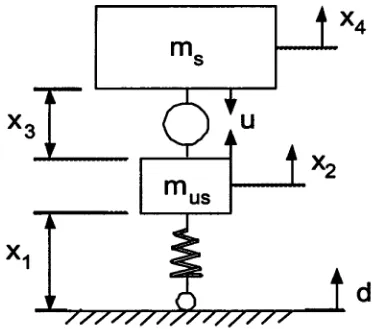
3.3 Quarter-car suspension m o d e l... 40
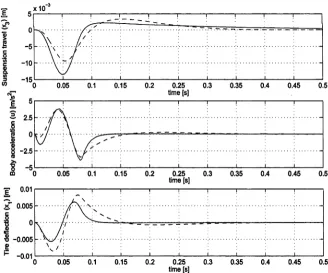
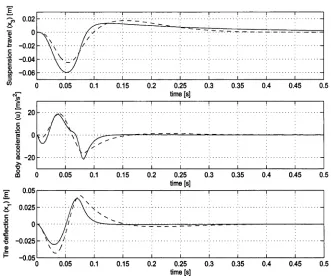
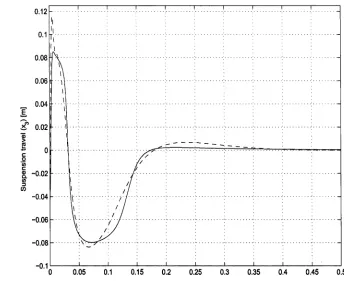
3.4 Closed-loop response to bump height A = 0.015m 47 3.5 Closed-loop response to bump height A = 0.075m 48 3.6 Closed-loop response to bump height A = 0 .1 1 m ... 48
3.7 Closed-loop response to bump height A = 0.1m - non-zero initial condition 49 3.8 The Reaction Wheel Pendulum sy stem ... 58
3.9 Closed-loop response to (91,91,92) = (tt/2, 0 , 0 ) ... 65
3.10 System trajectory in (91,91) plane with initial condition (91,91,92) = (tt/ 2 , 0 , 0 ) ... 65
3.11 Closed-loop response to (91,91,92) = (7r,0,0) ...66
3.12 System trajectory in (91,91) plane with initial condition (91,91,92) = (7r,0,0) 66 4.1 Closed-loop response with initial condition: £i(0) = —10, £2(0) = — 1.5,£3(0) = —0.05,£4(0) = —2 . 5 ... 90
4.2 Closed-loop response with initial condition: £i(0) = —100,£2(0) = L5,£3(0) = —4, £4(0) = —5 0 ... 90
5.1 Aircraft resp o n se... 101
5.2 Elevator d eflectio n ... 102
5.3 Aircraft response - stall case ...102
5.4 Elevator deflection - stall c a s e ... 103
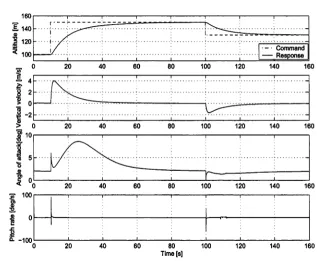
5.5 Constrained aircraft response to an altitude command of -f 100m at 10s . . 109
5.6 Elevator deflection for an altitude command of -1-100m at 1 0 s ... 110
5.7 Constrained aircraft response to an altitude command of +400m at 10s . . 110
5.8 Elevator deflection for an altitude command of +400m at 1 0 s ... I l l 6.1 Two-link revolute joint manipulator ...132
6.2 Joint positions ... 134
6.3 Joint ra te s ... 134
x v i L IST OF FIGURES
C h a p te r 1
In tr o d u c tio n
This introductory chapter aims to acquaint the readers with the background literature and the practical control problem that motivated our research. The chapter starts with a brief historical account of constructive nonlinear control and an overview of existing control design methods for constrained systems. This is followed by an outline of the research directions undertaken. A description of the flight control problem that provided the impetus behind our work along with a general review of traditional aircraft control design techniques are next presented. A brief literature review on passivity-based control of Euler-Lagrange systems is then given. The chapter ends with an outline of the thesis’s structure and main contributions to the body of knowledge.
1.1
C o n stru ctiv e nonlinear con trol
Although linear control theory has a long and rich history of successful industrial ap plications, it is deemed to be inadequate for many practical engineering systems. The rea sons are increasingly stringent performance requirements and vastly expanded operating envelopes, mainly due to safety considerations and technological advances. Inherent non linear phenomena such as finite escape time, multiple isolated equilibria, limit cycles, mul tiple modes of behaviour and other complex dynamic behaviours cannot be described nor predicted by linear models. In addition, many physical systems have hard-nonlinearities such as Coulomb friction, saturations, dead zones, backlash, and hysteresis [68]. These nonlinearities are non-smooth or discontinuous, thus precluding linear approximations. Furthermore, nonlinear systems do not follow the superposition principle, which states that the output response of a linear system to a combination of input signals is the sum of its responses to each individual input. The total effect of measurement noise, external disturbances, and reference inputs therefore cannot be simply determined by analysing the effect of each input signal separately. Other challenges include the facts that internal
and input-output stability are generally not equivalent, and the separation principle does not hold for nonlinear systems. All of the above factors have made nonlinear control a both theoretically and practically challenging topic. As a result, considerable research efforts have been expended on studying nonlinear systems and tremendous progress has been made over the past twenty five years.
In the early 1980s, Jurdjevic, Isidori, Krener, Sussmann and many other pioneers
2 Introduction
introduced differential geometric methods to express and extend notions from linear control theory such as controllability and observability. Differential geometric concepts, especially nonlinear relative degree and zero dynamics, have since become invaluable tools in the analysis of input-output structural properties of nonlinear systems. Following from the early seminal work is a number of nonlinear control design techniques generally grouped under the label of feedback linearization. (For a comprehensive treatment on the subject, see such texts as [52], [89], [106], and [127]). The central idea of these techniques is to algebraically transform nonlinear system dynamics into a fully, or partly, linear one. Linear theory is then applied to design the controller. The major drawback of feedback linearization methods is that useful nonlinearities, for example, inherently stabilising terms such as —x3, are canceled indiscriminately and replaced by their dangerously destabilising positive counterparts. Another weakness of feedback linearization is that in the presence of modeling errors, the concepts of relative degree and zero dynamics may be non-robust. Sastry et al. [120] showed that regular perturbations in a system may lead to singularly perturbed unstable zero dynamics.
It was in the 1990’s that nonlinear control theory really came of age with two excit ing breakthroughs. The emergence of new analysis tools such as input-to-state stability
(ISS), nonlinear small-gain theorems, and the idea of rendering a system passive by feed back have led to recursive design procedures, namely backstepping and forwarding. It is uncertain whether the idea of backstepping appeared in earlier literature but its use as a design tool was initiated in the early nineties [19,71,147,148]. However, the true potential of backstepping was only discovered when this approach was developed for non linear systems with structured uncertainty. With adaptive backstepping, Kanellakopoulos
et al. [59] achieved global stabilisation in the presence of unknown parameters, and with
robust backstepping, Freeman and Kokotovic in [36,37], and Marino and Tomei in [88], achieved global stabilisation in the presence of disturbances.
The ease with which backstepping incorporates uncertainties and unknown parameters contributed to its instant popularity and rapid acceptance. At the same time, its limi tation to a class of pure feedback (lower-triangular) systems stimulated the development of forwarding, which is applicable to feedforward systems, by Teel [142,143], Mäzene and Praly [93], and Jankovic, Sepulchre, and Kokotovic [53]. Interlacing the steps of these procedures further expanded the classes of systems these two recursive design techniques are applicable to [123].
1.2
C on trol o f co n stra in ed sy stem s
All physical systems are subject to constraints. In the mathematical model of a system, a constraint is expressed as a limit or bound on a system signal. Constraints can be soft or
1.2 Control of constrained systems 3
commonly encountered constraints, and stem from magnitude and slew rate limits of all actuators. State constraints arise from physical, performance, and/or safety constraints. For example, all aircraft have to fly below a certain angle of attack. Should they exceed this aerodynamic performance constraint, stall ensues with possibly disastrous consequences. In robotics, manipulator arms operating on factory floors may have constraints imposed on their movement due to spatial restrictions and/or performance limitations to prevent material wear and tear. Constraints on the output signals can be further classified into two distinct subclasses. The first subclass of output constraints consists of those which arise as a direct consequence of constraints on the system states. These constraints can be treated as nonlinear or linear combinations of the state constraints, depending on the mathematical output model of the system. The second subclass of output constraints arises from sensors’ measurement range saturations, and requires different analysis and control design strategies which are beyond the scope of this thesis and will not be considered herein.
1.2.1 In p u t constraints
The problem of actuator saturations has been extensively studied. There are many techniques available in the linear control literature for incorporating actuator saturations into the design process. The simplest but also most widely used in practice are anti-windup compensation schemes, see [3,42,60,72,115], and references therein. These approaches are however, ad hoc in nature which make their stability and robustness properties difficult to analyse. More sophisticated techniques include the use of l\ analysis and synthesis techniques, which allow specification of the maximum output response as a function of the maximum size of noise and disturbances [26], and the use of convex optimisation to design controllers with a variety of input and performance constraints [15,16]. A major limitation of using a linear approach is the requirement that the system operates in a linear regime. For any nonlinear system with non-trivial transient response, this assumption is immediately invalid.
Another limitation associated with linear control techniques is that in general, no linear systems, even simple integrator cascades, of order greater than two which are subject to input saturations can be globally asymptotically stabilised by linear feedback control laws [136]. This negative result led to a number of semi-global approaches, including the low-gain designs by Lin and Saberi [82,84] and Teel [139], which achieve semi-global stabilisation of null-controllable systems, that is, systems with non-positive eigenvalues. The main drawback of these designs is poor performance and disturbance attenuation due to the use of low gains to achieve large domains of attraction. In an effort to improve the performance and disturbance rejection properties of the closed-loop system, high-and-low gain designs were proposed by Saberi et al. [117] and Lin [83]. Although these approaches allow for more effective use of the allowable input gains, they do not, in general, provide any significant improvements over the low-gain designs [44].
4 Introduction
linear input constrained systems, Wredenhagen and Belanger [157] proposed a piecewise- linear control (PLC) design method, which is based on Linear Quadratic (LQ) theory. PLC employs a very simple fact, and that is as the system approaches the origin, the control gains may be increased without affecting the stability of the system. The method involves deriving a succession of positively invariant sets of diminishing size (nested ellipsoids) and assigning each with the corresponding highest LQ gain possible in the presence of the input constraints. As a system trajectory moves from an outer ellipsoid into an inner one, the controller switches to the corresponding feedback law. Since each ellipsoid is invariant under the corresponding feedback law, the switch is safe, that is, no chattering, and the existence and uniqueness of the solution to the closed-loop differential equation is guaranteed [50]. Consequently, the convergence performance of the closed-loop system is progressively enhanced as the system approaches the origin.
In optimal control theory, the bang-bang control methodology, which optimises a per formance index subject to control input constraint, has attracted numerous research ef forts [64,75,99,100,145,149,156]. In practice however, this control technique is rarely implemented. The major disadvantage of bang-bang control is that it is generally impos sible to characterise the switching surface. For discrete-time systems, online computation has been proposed in the literature, but the computational demand is substantial since dynamic programming has to be solved recursively with increasing time-horizon. This intensive online computation process increases the time delay and may lead to instability due to the accumulated error in the online evaluation of the control law, which is further exacerbated as the time-horizon is extended. In addition, the undesirable control chatter near the origin of state-space due to high frequency switching of the control signal often occurs which may lead to the excitation of undesirable high-frequency dynamics [49].
Several new nonlinear tools have been introduced in the last fifteen years for analysing and controlling linear and nonlinear systems with input saturations. One of the fundamen tal techniques is based on the thesis work of Teel [140,141], who showed how to stabilise a chain of integrators using nested saturation functions. This result is significant since it has been established that global asymptotic stabilisation of integrator chains of order greater than two cannot be achieved using bounded linear feedback laws. Thus, even simple lin ear systems with simple saturations can give rise to difficult nonlinear problems. Teel’s approach generates nonlinear controllers which are locally linear, but become nonlinear as the inputs grow toward the saturation limits. This result was later generalised to null- controllable systems by Sussman et al. [137]. Teel and Kapoor [144] then extended Teel’s earlier work by devising an algorithm to dynamically combine a local (performance) con troller and a global (stability) controller to achieve local performance and global stability for a class of fully-actuated Euler-Lagrange systems with input saturation.
feedfor-1.2 Control of constrained systems 5
ward systems subject to input constraints. Another design technique was introduced by Megretski [95], who used a gain-scheduling approach to generate nonlinear stabilisers for saturated linear systems. In addition to stability, Megretski showed that for stable plants, the map from plant disturbances to control inputs is L2 bounded. More recently, the con
trol input saturation problem was studied by Freeman and Praly in [35], and Mäzene and Iggidr [92] in the backstepping framework. They showed that global stabilisation of certain classes of systems subject to bounded control and control rates can be achieved by im posing bounds on the stabilising functions and propagating those boundedness properties through each step of the backstepping technique.
1.2.2 S ta te con straints
Although state constraints are a major concern in almost all practical control problems, they have not received as much attention as the problem of control input constraints. There have been efforts to solve state saturation control problems for linear systems using the concept of positive invariant sets, see [14,124] and references there within. These methods are based on the construction of a maximal controlled invariant set, that is, a subset of the state-space that will always contain the state under appropriate saturated state feedback. The available tools presented in this line of work, however, axe computationally very demanding and yield highly complex controllers. Model predictive control (MPC), a popular control design technique for industrial processes, has also been employed to deal with constrained linear systems [86,91] as well as nonlinear systems [1,2,33]. The general MPC algorithm functions as follows. At each sampling instant, MPC solves an open- loop trajectory optimisation problem to compute an optimal control sequence over a finite horizon, using the current state of the plant as the initial condition and the plant model to predict future plant outputs. The first control in the optimal control sequence is applied to the plant. At the next sampling instant, the optimisation problem is reformulated with the horizon shifted forward by one unit of time and the control input is computed using new measurements of the states as the initial condition, and so on. The popularity of the approach stems from its inherent ability to explicitly handle state and input constraints, and the resulting control action is stable, and optimal with respect to the specified cost function [91]. However, the demanded online computation, that is, the solving of an optimal control problem at each sampling instant, is intensive and therefore, not suitable for systems with fast dynamics.
In contrast to the aforementioned numerical methods, Saberi et al. [116] adopted a structural approach to the problem. They established necessary and sufficient structural conditions for the solvability of linear systems subject to magnitude and rate constraints on both the state and control signals. They then proposed nonlinear time-varying con trol laws for systems that satisfy the imposed structural conditions. Although different types of constraints are allowed, the solvability conditions are restrictive, thus limiting the applicability of the method.
prob-6 Introduction
lem of state constraints in the framework of constructive nonlinear control, Wolff and Buss [154,155] extended the concept of invariance control [87] to solve the problem of stabilisation for control affine nonlinear systems subject to state constraints. In their design, a nominal stabilising controller for the system, which does not take into account the constraints, is assumed to exist. Compliance with the constraints is enforced by con structing an invariance controller, through input-output linearization [121,127], to modify the nominal control signal such that a pointwise constraint admissible state space region becomes positively invariant. Switching from the nominal controller to the invariance con troller is done every time the trajectory of the constrained system reaches the boundary of the invariance region. The construction of the invariance controller, however, requires solving a set of polynomials, one for each constraint, where the order of each polynomial is the relative degree of the constrained state it corresponds to. The design therefore becomes analytically complex for state constraints with relative degree greater than two. For systems subject to state constraints with relative degree greater than four, closed-form solutions do not exist and numerical solutions must be sought.
1.3
R esearch d irectio n s
Although the problem of state constraints has been addressed in the literature, it has not received the same focus and energy as had the input constraint problem. Furthermore, there have been very few attempts made to study the state constraint problem within the context of constructive nonlinear control.
The purpose of this thesis is two fold. The first is to develop backstepping-based control design procedures to address the stabilisation problem for specific classes of non-affine, nonlinear systems subject to state constraints. The proposed control design procedures are then applied to provide solutions to practical engineering problems. The second objective is to address the set-point regulation problem for constrained Euler-Lagrange mechanical systems in the framework of passivity-based control.
1.4
P ra ctica l m otivation : lo n g itu d e con trol o f U n in h a b ited
A erial V eh icles
1.4 Practical motivation: longitude control of Uninhabited Aerial Vehicles 7
Figure 1.1: The Aerosonde UAV (Digital image by Jon Becker, Aerosonde Pty Ltd)
collection, which the aircraft was originally developed for, potential applications include coastal surveillance, landscape mapping, aerial photography, low-altitude mineral explo ration, just to name a few.
Commercial operations of miniaturized, low-cost UAVs pose different control problems to those of manned aircraft or military UAVs. Aircraft and load configurations are more likely to change quickly to capture market opportunities. Although performance criteria are less stringent, the desire for enhanced functionality demands that the aircraft operates over an expanded flight envelope characterised by potentially hostile and highly nonlinear variations in dynamic pressure and aerodynamic phenomena [20]. At the same time, limited resources, cost effectiveness considerations, and the fact that these aircraft are disposable, mandate the use of simplified and incomplete dynamic models and inexpensive hardware in the implementation of the control system.
In addition, as with any other practical systems, aircraft control warrants the consider ation of input and/or state constraints. Input constraints arise due to physical limitations on the range of operations of actuators. Aerodynamic phenomena such as stall and flutter impose magnitude constraints on the system states.
[image:20.539.16.525.20.636.2]8 Introduction
1.4.1 T raditional aircraft control d esign m eth o d s
Traditional approaches to automatic flight control design, though highly successful in manned aircraft and military UAVs, axe unsuitable as design tools for commercial UAVs. The popular, for its systematic divide-and-conquer framework, gain-scheduling methodology is tedious, relies heavily on the designer’s experience, demands system in formation to be known a 'priori, and requires extensive flight tests to verify the final control law [77,110]. Furthermore, small changes in aircraft dynamics require re-tuning of the controller since it does not intrinsically model nonlinear parameter variation in dy namic pressure [20]. Although automated gain-scheduling methods dramatically reduces the workload involved [98,108,111], automation does little to address the trial-and-error nature of the method and robustness issues. Moreover, there exists no simple or direct mechanism to incorporate actuator saturation and/or state constraints into the design pro cess. The use of nonlinear actuation systems can also significantly increase the complexity of the control design [20]. Similarly inapplicable are feedback linearization techniques because they involve the inversion of the nonlinear plant dynamics that depend crucially on the quality of the flight dynamic model. The so called self-learning approaches, in cluding fuzzy logic, neural network, and genetic algorithm, have significant problems. Although there have been various proposals which have produced encouraging simulation results [80,97,112,132], the major shortcoming of these methodologies as flight control design tools is the lack of the analytical and practical means to examine the stability, performance, and robustness of the resulting controller.
1.4.2 Integrator backstepp ing
Integrator backstepping is a nonlinear control design technique that employs Lyapunov synthesis to recursively determine controllers for systems satisfying the lower-triangular
cascaded structure, see Figure 1.2. The advantages of backstepping are numerous. In contrast to the feedback linearization technique which stipulates the cancellation of all nonlinearities including useful ones, backstepping affords the control engineer not only the choice of retaining all beneficial nonlinearities, but also great freedom in selecting the final control law [68]. Other strengths of backstepping include its ability to accommodate, by explicitly accounting for, large nonlinearities and uncertainties in the system’s model, ignored dynamics, input and measurement disturbances [74], [38], [56], [159], [6], [28]. All of these factors, coupled with its constructive nature, and the fact that the aircraft lon gitudinal dynamics can be transformed into the strict-feedback cascaded structure, make backstepping very attractive as a design tool to solve the Aerosonde’s control challenges described previously. However, direct application of traditional backstepping [74] tends to produce highly aggressive control laws. Such control laws are unsuitable for real sys tems due to actuator saturation and the possible presence of hard bounds on the physical system states.
1.4 Practical motivation: longitude control o f Uninhabited Aerial Vehicles 9
F ig u re 1.2: Lower-triangular cascaded structure
can be transformed into a 4</l-order system driven by the elevators, see Figure 1.3. The control margin provided by the elevators for a typical aircraft is more than adequate for all required manoeuvres. In fact, the control margin can be considered infinite w ith respect to the system in the sense that both the magnitude and the rate of the control inputs
are sufficient to cause catastrophic system failure should they be applied too aggressively. For example, if the aircraft attempts to gain altitude at too quickly a rate, the resultant large elevator deflections w ill cause the aircraft to stall. Hard bounds on the states due to performance/physical limitations such as that of the aircraft example are very common in
practice. To design a robust stabilising controller for such systems, it is more applicable to place hard bounds on the relevant state/s rather than the control inputs in the control design procedure.
elevator input pitch rate angle of attack climb rate altitude
6e q a vz h
F ig u re 1.3: Schematic representation of aircraft longitudinal dynamics
Motivated by this control problem, we dedicate the first part of this thesis to developing backstepping-based design procedures to asymptotically stabilise general classes of non-
affine, nonlinear systems subject to state constraints. The design procedures developed are then applied to design a longitudinal autopilot for the Aerosonde UAV which takes
10 Introduction
1.5
P a ssiv ity -b a sed con trol o f E uler-L agrange sy ste m s
Passivity-based control (PBC) is in essence a nonlinear, two-stage control design methodology whose objective is rendering the closed-loop system passive. The first stage, termed the energy shaping stage, involves the modification of the potential energy such that the modified potential energy function has a global and unique minimum in the de sired equilibrium. The second stage, or injection damping, entails the modification of the dissipation function to ensure asymptotic stability. First introduced in the seminal paper by Takegaki and Arimoto [138] to solve the set-point regulation of robot manip ulators, PBC has attracted enormous popularity because it generates computationally simple control laws that can accomplish complicated tasks with rigorously established stability, performance, and robustness properties. The final control laws are invariably Proportional-Derivative-like control laws, which are intuitively simple and can easily be implemented in practice. Numerous extensions of PBC have been made, most notably the research work described in [109] which is applicable to general Euler-Lagrange systems, that is, systems which admit an Euler-Lagrangian formulation. In [109], issues such as out put feedback, disturbance attenuation, under-actuation, and adaptivity were addressed. This work also provided the motivation that led to the thesis work of Akmeliawati [4] where the author applied the concept of PBC to design longitudinal autopilots for air craft. Akmeliawati’s approach however, does not account for state or input constraints. Although PBC has been employed to address the bounded input control problem for robot manipulators [65,66,119], the problem of state constraints has never been considered in the literature. Motivated by this, in the second part of this thesis, we extend the PBC methodology to solve the set-point regulation problem for constrained Euler-Lagrange systems. Although the results presented in this thesis are explicitly developed for robot manipulators, which are an important class of Euler-Lagrange systems due to their per vasive presence in modern manufacturing processes, the proposed controller designs are applicable to general Euler-Lagrange systems.
1.6
T h esis co n trib u tio n s and o u tlin e
This thesis consists of two parts, preceded by a chapter of preliminaries. In Part I, modified backstepping design procedures are developed to solve the problem of stabil isation for general classes of non-affine, nonlinear systems subject to state constraints. These theoretical developments are then applied to mechanical and aerospace systems to demonstrate their validity, practicality, and performance. Part II of the thesis is devoted to studying the set-point regulation problem for constrained robot manipulators in the framework of passivity-based control.
Part I
1.6 Thesis contributions and outline 11
• K. B. Ngo, R. Mahony, and Z.-P. Jiang, Integrator backstepping design for motion systems with velocity constraint, in Proceedings of the 5th Asian Control Conference 2004, pages 141-146, Melbourne, Australia, July 2004.
• K. B. Ngo, R. Mahony, and Z.-P. Jiang, Integrator backstepping using barrier func tions for systems with multiple state constraints, in Proceedings of the 4 4 th IEEE Conference on Decision and Control and European Control Conference 2005, Seville, Spain, December 2005.
In Chapter 3, two modified backstepping-based control designs are proposed to asymp totically stabilise a class of non-afhne, nonlinear systems subject to a single or two con secutively constrained states. The first design, or the “non-strict” approach, only requires the construction of non-strict control Lyapunov functions but yields long and algebraically complicated control laws. The second design, or the “ISS” approach, generates simpler control laws but at the cost of having to construct input-to-state control Lyapunov func tions, which are not always possible, and are generally much more difficult than the de termination of non-strict control Lyapunov functions. The validity and effectiveness of the proposed control designs are illustrated via closed-loop simulations of two mechani cal systems: the active car suspension system subject to suspension travel limits and the Reaction Wheel Pendulum system subject to torque and pendulum’s velocity constraints.
In Chapter 4, the results of Chapter 3 are extended to asymptotically stabilise a class of nonlinear systems subject to multiple state constraints. The adaptation of the “ISS” approach to accommodate multiple state constraints is straightforward, requiring only one additional assumption on the nonlinear terms in the system’s dynamic model. For the “non-strict” approach, the extension is more complicated. To achieve boundedness of the states, the cross-terms of the traditional backstepping method have to be dominated instead of being directly cancelled. The outcome of the proposed design procedure is a set of constraints on the controller parameters. From these constraints, nonlinear bounds for the stabilising functions and error variables, and ultimately, for the system states, in terms of the controller parameters can be computed. Together, the constraints on the controller parameters, the computed bounds on the system states, and the prescribed state bounds provide the ingredients for a multi-criteria constrained optimisation routine to tuning the controller parameters. The result is a set of controller parameters that guarantees that the closed-loop system is asymptotically stable, and yields the maximum possible constraint admissible region given the prescribed state bounds and the constraints imposed by the proposed design procedure.
12 Introduction
nonlinear, 6-degree-of-freedom dynamic model of the Aerosonde UAV are presented to demonstrate the validity and performance of the proposed controller design.
P a rt II
Part II of the thesis is devoted to studying robot manipulators subject to constraints in the framework of passivity-based control, and is a composition of the following two papers:
• K. B. Ngo and R. Mahony, Passivity-based control of robot manipulators subject to constraints, in Proceedings of the 2005 Australasian Conference on Robotics and Automation, Sydney, Australia, December 2005.
• K. B. Ngo and R. Mahony, Bounded torque control for robot manipulators subject to joint velocity constraints, in Proceedings of the 2006 IEEE International Conference
on Robotics and Automation, Florida, USA, May 2006.
In Chapter 6, a control design procedure is developed which utilizes ideas from passivity-based control and artificial potential field methods to address the general prob lem of autonomous obstacle avoidance for constrained robot manipulators subject to joint position and joint rate constraints. The control objectives are achieved by incorporating barrier-function characteristics into the control Lyapunov function. In common with the artificial potential field method, for arbitrary constraints, the asymptotic stability of the closed-loop system is not guaranteed due to the possible presence of local minima in the structure of the proposed control Lyapunov function. However, for systems with state con straints that possess certain convexity properties, asymptotic stability of the closed-loop system is assured.
In Chapter 7, the ideas of passivity-based control and artificial potential field methods are extended in a different direction to solve the stabilisation problem for robot manipu lators with torque limits and joint velocity constraints. The key advantage of the control design procedure derived in this chapter is that the resulting controllers axe invariably modified PD-controllers, which are structurally simple, robust, and immensely practical.
The attractiveness of the control design procedures developed in this part is that although the focus is principally on robot manipulator dynamics, the proposed design procedures are equally applicable to general Euler-Lagrange systems. Closed-loop simu lation results on a 2-link planar robot manipulator are provided to illustrate the validity and effectiveness of the proposed controller designs.
C hapter 2
P relim inaries
This chapter provides a brief review of the ideas and concepts used in this thesis. In Section 2.1, we lay the foundation for the thesis by defining the necessary notation and terminology. Section 2.2 contains the definitions of barrier functions and re-centred barrier functions. The concept of relative degree is outlined in Section 2.3. Notions of stability are given in Section 2.4. The definitions of control Lyapunov functions are presented next in Section 2.5. The chapter then ends with Section 2.6 where the integrator backstepping method is briefly recapitulated. Since the materials presented in Sections 2.4 and 2.6 are well-established, no proofs are offered. For more detailed treatments of those materials, the interested reader is referred to such excellent texts as [52,68,74,127].
2.1
N o ta tio n and T erm in ology
• A function / : IRn —* Rq is Ck if its partial derivatives exist and are continuous up to order k, 1 < k < oo. A C 0 function is continuous. A C°° function is smooth, that is, it has continuous partial derivatives of any order.
• Given a vector field / : Rn —► Rn and a differentiable scalar function A : Rn —► K,
LfX denotes the Lie derivative (directional derivative) of A along /
Lf \ { x) = ~ / ( ® ) Higher order Lie derivatives can be defined recursively as
L }\(x) = L)X(x) = L f V f 1 A(x)
for i = 1,2,... with L°^\(x) = A(x).
• A continuous function a : [0, a) —> [0, oo) is said to belong to class /C, that is, a e 1C,
if it is strictly increasing and c*(0) = 0. It is said to belong to class /C^ if a = oo and a(r) —> oo as r —> oo.
• A continuous function ß : [0, a) x [0, oo) —► [0, oo) is said to belong to class ICC if, for each fixed s, the mapping ß(r,s) belongs to class /C with respect to r and, for
14 Preliminaries
each fixed r, the mapping ß ( r ,s) is decreasing with respect to s and ß(r,s) —> 0 as s —* 00.
• The notations Amax{B } and Amin{B} denote the largest and smallest eigenvalues of matrix B, respectively. The norm of vector x is defined as ||x|| = V xT x, and that of matrix A is defined as ||A||2 = y/Xmax{A T A ) .
• Throughout this thesis, | . | denotes the Euclidean norm.
2.2
B arrier fu n ctio n s and re-cen tred barrier fu n ction s
D efinition 2.1 (Barrier function and re-centred barrier function [152], pg. 90). Let S be an open, non-empty, and convex subset o fW 1. A function f is called a barrier
function in S if it satisfies the following conditions.
• The function f : S —> R is continuously differentiable and strictly convex in S. • f ( xk) —> oo for every sequence {x^ 6 <S) approaching a boundary point of S. Given a point Xd € S , a barrier function f is called a re-centred barrier function about Xd if
• f { x d) = and f ( x ) > 0 f or all x G S with x j-
Xd-Lem m a 2.2 (R e-centred barrier function [152], pg. 94). Let S be an open, non empty convex subset o /R n, and f be a barrier function in S . Given a point Xd € S, and define function f Xd: S —> R a s
f xd(x ) = f ( x ) ~ f{xd) ~ V f i x d)T ix ~ x d)- (2.1) Then f Xd is a re-centred barrier function about Xd.
Proof. Since the function / is strictly convex and continuously differentiable in S , then
f i x ) > f i x d) + V f ( x d)T (x - x d), (2.2)
with equality only at x = Xd [152]. □
2.3
R ela tiv e d egree
D efinition 2.3 (R elative degree o f nonlinear system s [90]). The nonlinear Single-Input-Single-Output (SISO) system
x = f ( x ) + g(x)u
2.4 Stability 15
where f , g : V c R n —> R n, and h : V C W1 —» M, is said to have relative degree r,
1 < r < n, in a region Vo C V if
LgLlfh(x) = 0, z = l , . . . , r — 1,
LgLrjT1h(x) ± 0
for all x £ Vo.
2.4
S ta b ility
D efinition 2.4 (Lyapunov stab ility [74]). The origin of the system,
x = f ( x ), (2.4)
where x G Mn and f(x) is Lipschitz continuous, is said to be • Stable if, for each e > 0, there exists 6 > 0 such that
|x(0)| < S => |x(t)| < e,Vt > 0.
• Attractive if there exists 6 > 0 such that
|x(0)| < 6 => lim x(t) = 0.
t—►oo
• Asymptotically stable (AS) if it is stable and attractive. • Globally asymptotically stable (GAS) if it is stable and
Vx(0) G Rn, lim x(t) = 0.
x —>oo
• Locally exponentially stable (LES) if there exists 6, k, ß > 0 such that
\ x { 0 ) \ < S ^ \x ( t) \ < k \ x ( 0 ) \e - ßt.
A sufficient condition for stability at the origin of any system is established through Lyapunov’s direct method.
T heorem 2.5 (Global asym p totic stab ility [74]). Let x = 0 be an equilibrium of
system (2.f). If there exists a continuously differentiable positive definite and radially unbounded function V(x): IRn —> R+ such that
V(x) = ^ { x ) f { x ) < 0, Vx G Rn,
16 Preliminaries
then x — 0 is stable, and all solutions of (2-4) are bounded and converge to the set where x
= 0. I f V (x) is negative definite, the origin is globally asymptotically stable. The function
V(x) is called a Lyapunov function for system
(2-4)-T heorem 2.6 (L aSalle’s Invariance Principle [74]). Let LI be a positively invariant set of (2.4). Let V : LI —> R+ be a continuously differentiable function V ( x ) such that
V(x) < 0, Vx 6 Ll. Let E = {x £ Ll \ V(x) = 0}, and let M be the largest invariant set contained in E. Then, every bounded solution x(t) starting in Ll converges to M as
t —> 00.
Another stability concept used in this thesis is the input-to-state stability (ISS). First introduced by Sontag in [129], ISS is used to establish boundedness of system’s states with respect to bounded inputs.
D efinition 2.7 (ISS [68]). The time-invariant system
x = f ( x , d ) (2.5)
where x £ W 1 is the state, d £ W is the disturbance, and f : Rn x Rr is Lipschitz
continuous, is said to be input-to-state stable if there exist a class ICC function ß and a
class K, function 7such that for any initial state x q and for any bounded disturbance d(t),
the solution x(t) exists for all t > 0 and satisfies
|*(*)l < ß ( M , t ) + 7 ( sup |d(r)| J . (2.6)
Vo<T<t J
The following theorem establishes the connection between the existence of a Lyapunov-like function and ISS.
T heorem 2.8 (ISS Lyapunov function [74]). Suppose that for the system (2.5) there exists a continuously differentiable function V : Rn —> R+ such that for all x £ Mn and
d £ Mr,
7i(M ) < V’(ar) < 7 2(H ) (2.7)
and
1*1 > p(\dI) = > f ( x , d ) < -7 3 (|* |), (2.8)
where 71, 72, and p are class JC0Q functions and 73 is a class K. function. Then the system (2.5) is ISS with 7 = 7 f 1 072 °P- The function V is said to be an ISS-Lyapunov function.
2.5 Control Lyapunov functions 17
Corollary 2.9 (G A S o f ISS-interconnected cascades [68]). Given the cascade system
i i = f i ( x i , x
2
)
(
2.
9)
X2 = h ( X 2 ) , (2.10)
where f \ : Rni x Rn2 —>• Rn i, and f<i : Rn2 —► Rn2 are Lipschitz continuous. I f the system (2.9), with X2 as input, is input-to-state stable and the origin of (2.10) is globally
asymptotically stable, then the origin of the interconnected system with state x = [xi X2]T
is globally asymptotically stable.
D efinition 2.10 (D om ain global asym p totic stability [104]). A system
x = f ( x, t ) , f ( x 0,t) = 0, xo E Rn (2.11)
with equilibrium point xo is termed domain globally asymptotically stable (DGAS) to xo with domain U if
1. There exists a set U C R n that is forward invariant under the dynamics of (2.11) and xo € U.
2. The equilibrium point xo is Lyapunov stable under the dynamics of (2.11) restricted to U.
3. For any initial condition x(0) G U, then the solution x(t) of (2.11) satisfies
lim x(t) = 0.
t —* oo
2.5
C on trol L yapunov fu n ctio n s
In this section we present the definitions for control Lyapunov functions and ISS-control Lyapunov functions.
D efinition 2.11 (C ontrol Lyapunov functions [74]). Given the system
x = f ( x , u ) (2-12)
where x E Rn is the state vector, u € Rm is the control signal, and f : Rn x Rm —> Rn is Lipschitz continuous. A smooth positive definite and radially unbounded function V :
Rn —> R+ is called a control Lyapunov function (cLf) for (2.12) if
inf < ^ - ( x ) f ( x , u )
1
< 0, Vx G Rn.18 Preliminaries
I f in addition
u € K minf { T x (x ) f ( x >“) } < o, Vx ^ 0,
(2.14)
then it is called a strict elf.
D efinition 2.12 (ISS-control Lyapunov functions [68]). Consider the system
where x E Rn is the state, d G Rr is the disturbance, u E Rm is the control signal, and
/ : R" x f x Rm —» Rn is Lipschitz continuous. A smooth positive definite and radially unbounded function V : Rn —> R+ is called an ISS-control Lyapunov function (ISS-cLf) for (2.15) if there exists a class-K,^ function p such that
Backstepping is the main design tool in this thesis and in this section we give a brief description of the design procedure. Let us start with a simple nonlinear system cascaded by an integrator
where (a:,£) e Rn x R is the state vector, and m 6 R is the control. The functions /, g : Rn —► Rn are assumed to be smooth, and /(0 ) = 0. The objective is to find a state feedback control law such that the origin x = 0, £ = 0 is globally asymptotically stable. The design procedure proceeds as follows. Suppose the the ^-subsystem can be stabilised by a smooth state feedback virtual control, also stabilising function, £ = a(x), with a(0) = 0 such that the origin of
is globally asymptotically stable. Assume that there exist a positive definite and radially unbounded Lyapunov function V(x), and a positive definite function W( x) such that the following inequality is satisfied
x = f ( x , d , u ) (2.15)
2.6
B a ck step p in g [74]
x = /(:r) + g(x)Z
i
= u(2.17a) (2.17b)
x = f ( x ) + g(x)a(x)
2.6 Backstepping [74] 19
By adding and subtracting g(x)a(x) on the right hand side of (2.17a), we obtain the equivalent representation
x = |/(x ) + g(x)c*(x)] + g{x) [£ - a(x)]
i = u. (2.19)
Define the change of variables
z = £ - a(x),
which yields
i = u —da(x)
dt
Since /, g and a(x) are known, the derivative daj ^ can be computed analytically and is given by
da(x) dt
da( x)
dx [f(x) + g(x)£].
This change of variables can be viewed as “backstepping” the virtual control —a(x)
through the integrator, and results in the system
x = [f(x) + g{x)a(x)] + g(x)z (2.20a)
da(x)
z = u dt (2.20b)
which is exactly the same as the original system (2.17), except now the x-subsystem has a globally asymptotically stable origin when the input z is zero. This feature is now exploited in the design of a stabilising control law for the overall system (2.20). Consider the following positive definite and radially unbounded function as a candidate Lyapunov function
U(x,z) = V(x) + - z2. (2.21)
Differentiating U(x,z) with respect to time yields
• dV{x)
dx < — W{x) + z
[f{x) + g(x)a{x)] + 2 u ~ [/(*) + S(x)£] +
20 Preliminaries
To render Ü negative definite, the simplest choice is
u = -CZ + [f(x) + g{x)£,}
-where c > 0, which yields
(2.23)
Ü < — W( x) — cz2 (2.24)
and is negative definite since W( x) is positive definite. Since U is positive definite and radially unbounded, we can conclude that the origin x = 0, z = 0 is globally asymptotically stable. Since a(0) = 0, then the origin of the original system x — 0, C = 0 is also globally asymptotically stable, and the control law u in the original coordinates is given by
u = - c [ { - <*(*)] + [f(x) + g(x)£\ - g(x). (2.25)
It is clear that the above design procedure can be employed to globally asymptotically stabilize systems of the following form [74]
x = f ( x ) + g ( x ) £ i
6 = /i(z,Cl) + 0 i(z ,6 )6
C m - 1 — fm—2 ( ^ 5 Cl j•••> C m — 1) + <?m—2(x,Cl> . . . , C m —l ) C m
Cm = fm—1f a ) Cl j•••» C m ) T *?m—1( x , Cl j C m ) ^ (2.26)
Part I
In te g ra to r B a c k ste p p in g C o n tro l
o f C o n str a in e d N o n lin ea r S y s te m s
C h a p te r 3
S tab ilisation o f nonlinear sy stem s
su b ject to sta te con strain ts
The problem of saturation nonlinearities is by far the most common challenge faced by control engineers as all practical control problems are constrained in one way or an other [13,48]. There are two main types of saturation nonlinearities: actuator constraints and state constraints. Examples of constrained systems include mechanical systems with position and velocity limits, electrical systems with limited power supply to the actuators, chemical processes with magnitude restrictions on process variables due to safety issues etc. Control problems for constrained linear systems have been extensively studied in the literature due to the hitherto successful use of linear approximations to represent a restricted range of operating conditions of otherwise nonlinear processes. Key approaches include override control [43], set invariance and admissible set control [11,14], the refer ence governor approach [39], and Model Predictive Control (MPC) [10,21]. Many of the accepted linear techniques are numerical in nature, and rely heavily on computationally intensive algorithms to solve the control problems. It is only recently that insights into structural properties of stabilizable constrained linear systems, as well as control design methodologies for such systems, were provided in [116,118].
All real systems are, however, inherently nonlinear. In addition, factors such as higher product quality specifications, increasing productivity demands, tighter environmental regulations, and demanding economical considerations all require systems to operate over a wider range of operating conditions and often near the boundary of the admissible region. Under these conditions, linear models are no longer adequate to describe the system’s dynamics and nonlinear models should be considered. A number of linear techniques has been extended to address the stabilisation problem of constrained nonlinear systems, most notably the MPC approach (see [1,2,33] and references therein). MPC, however, requires the solution of an optimal control problem at each time step, rendering it unsuitable for systems with fast dynamics.
In the constructive nonlinear control literature, despite significant advances in the development of analysis and design methodologies, the general stabilisation problem of nonlinear systems subject to saturation nonlinearities remains an open area of research. Previous work in the literature has mainly focused on the problem of actuator
24 Stabilisation of nonlinear systems subject to state constraints
straints for feedforward systems. This has led to the modern techniques of small gain designs [45,55,57,141,143] and forwarding [93,123]. A criticism of small gain designs is that they generally have poor performance and are non-robust with respect to the presence of destabilising feedback terms [44]. Forwarding designs on the other hand, are mathe matically involved. The major burden of the forwarding design proposed by Jankovic et dl. [123] is the evaluation of the cross-terms which require the solving of partial differential equations, a difficult task in general. Similarly, the forwarding design devised by Mäzene and Praly [93] requires the determination of the coupling changes of coordinates which in many cases, lead to complicated calculations or cannot even be determined due to pa rameters inaccurately known or the presence of destabilising feedback terms. Motivated by the complexities associated with the forwarding control design methods, Freeman and Praly [35] showed that global stabilisation of the following class of control affine nonlinear systems
x = f (x) + g(x){
£ = u + /i(® ,0 , (3.1)
where (x, £) G (Rn xR) is the state vector, u € M is the control input, / (0) = 0, h(0,0) = 0, subject to bounded controls and control rates can be achieved by imposing bounds on the stabilising functions and their derivatives, and propagating those boundedness properties through each step of the backstepping technique. This result was later extended by Mäzene and Iggidr [92] to the more general class of systems
x = f { x , 0
i = u + / i ( z , 0 , (3-2)
where (x,£) G (Rn xR) is the state vector, u G R is the control input, /(0 ) = 0, h(0,0) = 0, which includes feedforward systems that are not stabilisable by the forwarding techniques. State constraints, which are a major concern in many practical control problems, have not received the same level of attention as the problem of actuator constraints has. Re cently, Wolff and Buss [154,155] employed the concept of invariance control [87] in con junction with feedback linearization to solve the stabilisation problem for control affine nonlinear systems
x = f ( x) + g(x)u,
where x G Rn is the state vector, u G K is the control input, and /, g : Rn —> Rn are smooth vector fields, subject to m G R+ hard state constraints as defined by
Vi = hi(x) < 0, 1 < i < m,