This is a repository copy of
Learning to drive in young adults with language impairment
.
White Rose Research Online URL for this paper:
http://eprints.whiterose.ac.uk/126313/
Version: Published Version
Article:
Durkin, Kevin, Toseeb, Umar orcid.org/0000-0002-7536-2722, Pickles, Andrew et al. (2
more authors) (2016) Learning to drive in young adults with language impairment.
Transportation research. Part F, Traffic psychology and behaviour. pp. 195-204. ISSN
1369-8478
https://doi.org/10.1016/j.trf.2016.07.015
[email protected]
https://eprints.whiterose.ac.uk/
Reuse
This article is distributed under the terms of the Creative Commons Attribution (CC BY) licence. This licence
allows you to distribute, remix, tweak, and build upon the work, even commercially, as long as you credit the
authors for the original work. More information and the full terms of the licence here:
https://creativecommons.org/licenses/
Takedown
If you consider content in White Rose Research Online to be in breach of UK law, please notify us by
Learning to drive in young adults with language impairment
Kevin Durkin
a, Umar Toseeb
b, Andrew Pickles
c, Nicola Botting
d, Gina Conti-Ramsden
b,⇑ aUniversity of Strathclyde, School of Psychological Sciences and Health, UKb
The University of Manchester, School of Psychological Sciences, UK
c
King’s College London, Institute of Psychiatry, Psychology and Neuroscience, UK
d
City University London, Language and Communication Science, UK
a r t i c l e
i n f o
Article history:
Received 30 July 2015
Received in revised form 16 June 2016 Accepted 23 July 2016
Available online 9 August 2016
Keywords:
Driving Young adults Language impairment
a b s t r a c t
Language impairment (LI) is a common developmental disorder which affects many aspects of young people’s functional skills and engagement with society. Little is known of early driving behaviour in those with this disability. This longitudinal study examines early driving experience in a sample of young adults with LI, compared with a sample of typically developing age-matched peers (AMPs). At age 24 years, significantly fewer partic-ipants with LI had acquired a driving licence. A crucial hurdle for those with LI appeared to be the Theory part of the (UK) test. Logistic regression analysis indicated that language ability and a measure of independence at age 17 contributed to the prediction of licence possession at age 24. There was no evidence of differences in traffic violations or accident rates between those with and without LI. There is little evidence that young people with LI are at greater risk on the roads than peers without LI, but some individuals with LI might benefit from support in the course of preparation for driving and in the driving test.
Ó2016 The Authors. Published by Elsevier Ltd. This is an open access article under the CC BY
license (http://creativecommons.org/licenses/by/4.0/).
1. Introduction
Learning to drive is an important dimension of achieving independence and self-sufficiency for many adolescents and young adults (Barkley & Cox, 2007). It affords or improves access to a larger geographical environment, it expands opportu-nities for employment and leisure, and it signals adult autonomy. It also places the young person at disproportionate risk of accidents: in most countries, young drivers are the highest risk group for road accidents and fatalities (World Health Organization, 2013). Hence, driving is at once a valuable skill, an indicator of social inclusion, and a source of major public health issues. For these reasons, there is considerable research and policy interest in the adequacy of preparation of young people for participation in road traffic, in the inclusion/exclusion of particular groups of potential transport users (Lamont, Kenyon, & Lyons, 2013), and in the factors that help to predict safe versus risky driver behaviour (Bina, Graziano, & Bonino, 2006; Durkin & Tolmie, 2010; Romer, Lee, McDonald, & Winston, 2014; Shope & Bingham, 2008).
One factor which might be anticipated to bear on young people’s driving-related choices and competence is whether or not they have developmental disabilities. For example, much of the literature on young drivers has focused on those with Attention Deficit Hyperactivity Disorder (ADHD). A large body of evidence indicates that individuals with this condition are at greater risk than non-affected peers of violating traffic safety regulations, receiving citations for driving offences, and having road accidents (Barkley & Cox, 2007; Barkley, Murphy, & Kwasnik, 1996; Chang, Lichtenstein, D’Onofrio,
http://dx.doi.org/10.1016/j.trf.2016.07.015
1369-8478/Ó2016 The Authors. Published by Elsevier Ltd.
This is an open access article under the CC BY license (http://creativecommons.org/licenses/by/4.0/).
⇑Corresponding author at: School of Psychological Sciences, The University of Manchester, Ellen Wilkinson Building, Oxford Road, Manchester M13 9PL, UK.
E-mail address:[email protected](G. Conti-Ramsden).
Transportation Research Part F 42 (2016) 195–204
Contents lists available atScienceDirect
Transportation Research Part F
Sjölander, & Larsson, 2014; Woodward, Fergusson, & Horwood, 2000). The symptoms characteristic of ADHD, including poor attention, impulsivity, hyperactivity and weak inhibitory control (Barkley, 1997) clearly present challenges to driver perfor-mance (although the extent of the risk is controversial, cf.Oliver, Han, Bos, & Backs, 2015; Vaa, 2014).
Researchers have also begun to address the difficulties of individuals with dyslexia, drawing attention to the fundamental but widely neglected observation that these ‘are transport users, too’ (Lamont, 2009). Lamont and colleagues’ in-depth qual-itative analysis demonstrates that the difficulties faced by people with dyslexia with spoken and written language impact on their uses of travel information, presenting obstacles to planning and executing journeys (Lamont et al., 2013).Brachacki, Nicolson, and Fawcett (1995)tested the abilities of adults with dyslexia to differentiate real and false traffic signs and found that the participants with dyslexia were less able to perform the task than were typical adults.
Less attention has been paid to the substantial proportion of young people who have language impairment (LI). These individuals are also transport users and, in many cases, will become drivers at some point. In this study, we present what we believe to be the first investigation of how young adults with LI progress towards becoming drivers.
1.1. Language impairment and driving
LI is a disability that is often unnoticed in everyday life yet can have pervasive consequences for the young person con-cerned. The major clinical symptoms of this disorder are deficits in the comprehension and/or production of language in the context of nonverbal intelligence within the normal range and the absence of any hearing impairment or frank neurological damage (Leonard, 2014). The condition is heterogeneous (different children have different combinations of characteristics) but many individuals with LI have receptive difficulties detecting subtle features of everyday talk, such as the small parts of speech (e.g., plural markers, inflections, past tense expressions) that contribute importantly to the exchange of meaning. Many have expressive difficulties in producing these details and appear stilted in speech. Many have both receptive and expressive difficulties. As a result, young people with LI find it difficult to keep up with conversations and to process com-plicated instructions. Approximately 7% of children have LI at the point of school entry (Tomblin et al., 1997) and, although it can resolve during the school years, for many LI continues into adolescence and adulthood (Conti-Ramsden, St Clair, Pickles, & Durkin, 2012; Nippold & Schwarz, 2002).
Why should LI be relevant to the tasks of the novice driver? LI can be expected to bear on transport use for reasons similar to those identified in young people with other, related, developmental disorders. Importantly, it is well-established that there are overlaps and comorbidities among ADHD, dyslexia and LI (Bishop & Snowling, 2004; Newbury et al., 2011; Redmond, 2016). For example, children with LI tend to manifest levels of hyperactivity and emotional difficulties that are significantly higher than those of typical comparison groups (Beitchman, Nair, Clegg, Ferguson, & Patel, 1986; Cardy, Tannock, Johnson, & Johnson, 2010; St Clair, Pickles, Durkin, & Conti-Ramsden, 2011). High proportions of children with LI have reading difficulties (Bishop & Snowling, 2004; Conti-Ramsden, Botting, Simkin, & Knox, 2001; St Clair, Durkin, Conti-Ramsden, & Pickles, 2010).
Young people with LI have also been found to lag behind peers with typical development in the achievement of indepen-dence in many aspects of daily life (Conti-Ramsden & Durkin, 2008). For example, Conti-Ramsden and Durkin found that vir-tually all (99%) of the parents of a control sample of typically developing 16-year-olds reported that their children were fully able to look after themselves in respect of everyday life tasks, that their children were able to travel independently (i.e., using public transport), and could organize their own going out; however, the corresponding parental endorsements for 16-year-olds with LI on the same three measures were 64%, 78%, and 62%, respectively. Although using a very different methodology and with a different sample, this dovetails with the findings ofLamont et al. (2013)concerning people with dyslexia who reported that they sometimes needed help executing their travel plans and sometimes, if help was not readily available, avoided or abandoned journeys. This suggests that, as a group, adolescents with LI achieve less familiarity with the daily tasks of transport use and are less equipped with the general level of personal independence that could form the backdrop to a desire to learn to drive.
In sum, the entry barriers to driving – such as learning how to drive, taking driving tests – normally involve listening to instructions, articulating plans, and reading texts and signs; all of these pose potential obstacles to those with language dif-ficulties. Learning to drive is an important developmental task for many young people, but those with LI tend to be delayed in addressing developmental tasks and in achieving autonomy. Taken together, these factors lead to the expectation that entry into driving will be later in young people with LI than in typically developing comparison peers.
1.2. The present study
young people was unwittingly excluded from road use because of language disability if, in fact, there was no relationship between the disorder and driving behaviour.
Safety indicators are of theoretical interest as measures of the real-world consequences of impairments. In respect of ado-lescents with ADHD,Barkley and Cox (2007)review evidence to suggest that people with this condition manifest impair-ments in operational driving skills (including reaction time, speed of cognitive processing, attention, concentration, visual scanning, visual-motor integration) and that these deficits contribute to poorer safe driving records and higher accident rates among those with ADHD. Deficits in similar cognitive-perceptual skills have also been identified in children and adolescents with LI (Bishop, 2002; Finneran, Francis, & Leonard, 2009; Hick, Botting, & Conti-Ramsden, 2005; Hill, 2001; Powell & Bishop, 1992). However, it is unknown whether there is an association between LI and driving safety problems. Again, the practical import of this question is that it speaks to community safety needs and to whether additional training and/or treatment would be advisable before allowing young people with LI to drive. One purpose of the present investigation was to provide the first body of relevant evidence.
We predicted that, compared to their typically developing peers, a smaller proportion of young people with LI would learn to drive and that, among those who did drive, confidence in driving would be lower than in their typically developing counterparts.
The basis for predictions concerning actual safety indicators is less straightforward. On the one hand, unlike adolescents with ADHD, there is no evidence to suggest that adolescents with LI are any more prone to risk-taking or antisocial behaviour than is normative among the typically developing population. On the other hand, as tasks such as reading signs and responding to instructions are potentially difficult for those with LI and, as there is evidence of cognitive-perceptual deficits associated with the disorder, it is possible that these characteristics could impact on decision making and errors in traffic; in turn, this could result in higher than normative accident rates. This is an open empirical question, and we aimed to provide preliminary evidence. We took note also thatLamont et al. (2013)reported that many adults with dyslexia found satellite navigation (sat nav) technology extremely beneficial. This is of interest to the present investigation because comprehension of real-time language is by definition difficult for many of those with LI. Using sat nav entails coordinating ‘live’ verbal instructions with on-screen maps and symbols and relating all of this information to the driver’s current location, goals and strategic plans. As well as their language difficulties and associated problems with online processing, adolescents with LI experience greater difficulties with using computer technologies and higher levels of computer anxiety than do adolescents without LI (Conti-Ramsden, Durkin, & Walker, 2010; Durkin, Conti-Ramsden, & Walker, 2010). Hence, on the one hand, those with a related disability (dyslexia) appear to fare well with this technology (or, at least, perceive it as very helpful) but, on the other hand, there are reasons to anticipate that it could be difficult and even threatening for those with LI. In relation to use of sat navs, we aimed to obtain self-report information which could guide future observational and experimental research.
2. Method
2.1. Ethics
The study reported here received ethical approval from The University of Manchester, UK. Participants and their parent/ legal guardian (for the parental questionnaires) provided written informed consent.
2.2. Participants
Participants were recruited as part of the Manchester Language Study, a large-scale longitudinal research programme that began when the children with LI were 7 years of age (Conti-Ramsden & Botting, 1999; Conti-Ramsden, Crutchley, & Botting, 1997). At 16/17 years of age a comparison group of young people (age-matched peers, AMPs) were also recruited. These par-ticipants had no history of special educational needs or speech and language therapy provision. For both groups of partici-pants, not all participants who took part at age 24 took part at age 16/17.
2.2.1. Young people with LI
The initial cohort of 242 children with LI originally consisted of 186 boys (77%) and 56 girls (23%), and was recruited from 118 language units across England. They represented a random sample of 50% of all 7-year olds attending language units. Language units are specialist resource classes for children who have been identified with primary language difficulties, which are attached to regular schools. Although attrition occurred, this was partly due to funding constraints at follow-up stages of the study. For this study, analysis was conducted on data collected at ages 16/17 (M 16.5, SD 0.4 years) and 24 years (M 24.4, SD 0.7 years). At age 16/17, there were 80 young people with LI (56 males and 24 females) and at age 24, there were 84 young people with LI (56 males and 28 females). From the 84 young people with LI at age 24, 57 provided data at both time points.
2.2.2. Comparison peers
The comparison group of peers was selected to be of similar age, similar geographical area, and similar socioeconomic background as the young people with LI. The comparison group was of a similar age to the sample with LI at each time point
(16/17: M 16.4, SD 0.4 years, 24: M 24.1, SD 0.9 years). At age 16/17, there were 85 participants in the AMP group (53 males and 32 females) and at age 24, there were 88 (49 males and 39 females). Participants at age 16/17 came from similar geo-graphical locations as the sample with LI. The comparison group came from the same schools as the participants with LI as well as additional targeted schools to ensure a similar urban versus rural geographical distribution in both groups. In addi-tion, participants in the comparison group were sampled from selected demographic areas in order to ensure comparison peers came from a broad range of socioeconomic backgrounds, similar to participants with a history of LI. The LI and the comparison groups did not differ on household income at age 16/17 years (
v
2(10,N= 145) = 9.32,p= .501) nor personal income at age 24 years (
v
2(5,N= 131) = 7.38,p= .194). For ease of reading, the comparison group is referred to asage-matched peers (AMP). From the 88 young people in the AMP group, 53 provided data at both time points. As expected, lan-guage, PIQ, and reading profiles were different for the groups at both time points (Table 1).
2.3. Materials
2.3.1. Language measures
The Clinical Evaluation of Language Fundamentals (CELF-IVuk,Semel, Wiig, & Secord, 2006) was used at both time points.
Neither group reached ceiling levels on this assessment which is normed up to age 21;11 years; therefore, the CELF-IV was deemed the best fit assessment for our cohort at 24 years of age. The Word Classes subscale for receptive language and Recalling Sentences subscale for expressive language were used at both time points. A core language score at age 16/17 was also derived using four subsets of the CELF-IV in accordance with the scoring manual: Recalling Sentences, Formulated Sentences, Word Classes 2, Word Definitions.
2.3.2. Non-verbal IQ
The Wechsler Abbreviated Scale of Intelligence (WASI,Wechsler, 1999) Performance subscale was used at both time points.
2.3.3. Reading measures at age 16/17
The Sight Word Efficiency Subscale of the Test of Word Reading Efficiency (TOWRE;Torgesen, Wagner, & Rashotte, 1999) was used. During this assessment, participants were required to identify the maximum number of words within set time duration.
2.3.4. Independence measure at age 16/17
The parent-report independence questionnaire (Conti-Ramsden & Durkin, 2008) was used. Questions covered self-help skills (e.g., looking after oneself), ability to carry out necessary tasks for every living (e.g., using the telephone), and the ability to carry out activities outside the home (e.g., travelling independently, going out on their own or with friends). Responses to the 11 questions were summed to create an overall score between 0 and 11. Higher scores indicated greater independence. The Cronbach’s
a
for this administration of the scale was .77.2.3.5. Driving related measures at age 24
A driving related behaviours questionnairecollected basic information about driving experience in four categories: general driving (5 items; e.g., ‘Can you drive a car?’), theory test (6 items; e.g., ‘Have you taken the Theory Test?’), practical test (6 items; e.g., ‘Did you find the Practical Test easy or hard?’), and use of satellite navigation system (3 items; e.g., ‘Do you use a sat nav?’).
A driving confidence scalewas adapted from previous measures of driving confidence (Baldock, Mathias, McLean, & Berndt, 2006; Parker, Macdonald, Sutcliffe, & Rabbitt, 2001). This assessed the individual’s confidence in a range of driving contexts. Example items include: ‘How confident are you in your ability to drive alone?’, ‘. . .drive on the motorway?’, ‘. . .drive at
night?’. Responses to each item were on a 5-point scale (1 ‘Not at all confident’, 5 ‘Very confident’). Scores ranged from 8 to 40; a higher score indicated higher confidence (Cronbach’s
a
= 0.8).Safety indicatorswere assessed using an adapted version of thedriving history interview(Barkley, Murphy, Dupaul, & Bush, 2002). This collects self-reports of violations of traffic rules and experience of accidents. Example items include: ‘How many times have you received a speeding ticket?’, ‘. . .driven without insurance’, ‘. . .been determined to be at fault in an accident?’
[image:5.544.41.508.627.684.2]Note that it is possible to give answers greater than 1 for any question (e.g., for the latter question, answers ranged from 0 to
Table 1
Mean (SD) language and performance IQ scores by group and age.
Aged 16/17 years Aged 24 years
LI AMP LI AMP
Receptive language 76.6 (18.0) 100.1 (11.8) 83.5 (18.6) 106.2 (8.9) Expressive language 67.3 (14.8) 96.3 (14.1) 70.6 (15.6) 99.5 (15.4)
6). Total scores from the 11 items were summed to create an overall safety indicators score. A higher score indicated more problematic driving behaviours.
2.4. Procedure
The participants were interviewed face-to-face on the measures described above as part of a wider battery. Interviews took place in a quiet room, wherever possible with only the participant and a trained researcher present. Standardized assessments of nonverbal and verbal skills were administered in the manner specified by the test manuals. During the inter-view, the items were read aloud to the participants. The items and response options were also presented visually to ensure comprehension.
2.5. Statistical analysis
All statistical analyses were conducted in Stata/SE 13.1 (StataCorp, 2013) and a two-tailed significance level ofp= .05.P
values are reported up to 3 decimal places and test statistics, means and standard deviations to 1 decimal place. Chi-squared tests were used to test for differences in binary responses and independent samplest-tests were used to test for differences in continuous responses. Using predictors measured at age 16/17 years, logistic regression analysis was conducted to calcu-late the likelihood of holding a full driver’s licence by age 24 years. In the cross-sectional analyses, data from all participants was used. For the longitudinal analysis, only participants who provided data at both time points were included.
3. Results
3.1. Engagement with driving
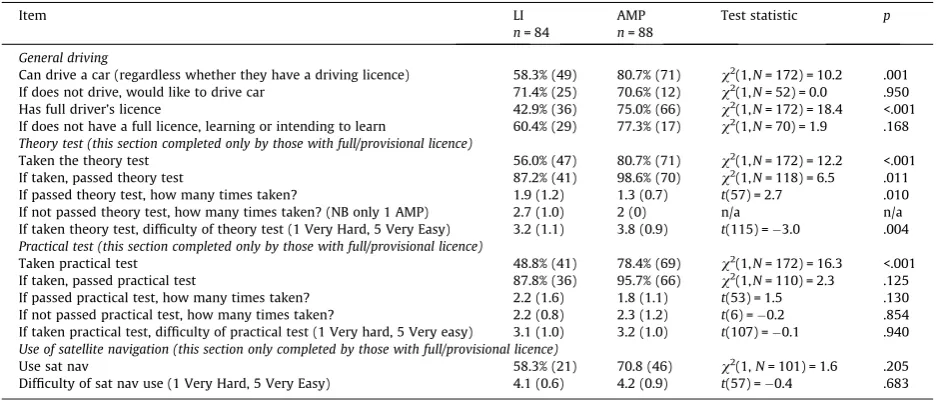
Comparisons between young people with LI and AMPs for questions relating to general driving, the theory test, and the practical test are shown inTable 2.
3.2. General driving
[image:6.544.36.505.471.671.2]In terms of general driving, fewer young people with LI stated that they could drive a car and fewer had a full driving licence compared to their AMPs. For those who could not drive, there were no differences between the young people with LI and their AMPs in their desire to drive a car or their intention to learn to drive. These comparisons are shown inTable 2. Of those who had learned to drive or were learning to drive, there was no difference between the groups in terms of the age at which they started to do so, which was 18.1 years (SD 1.8) in the LI group, and 18.1 years (SD 1.6) in the AMPs,t(115) = 0.1,p= .96.
Table 2
Driving related behaviours by group.
Item LI
n= 84
AMP
n= 88
Test statistic p
General driving
Can drive a car (regardless whether they have a driving licence) 58.3% (49) 80.7% (71) v2(1,N= 172) = 10.2 .001
If does not drive, would like to drive car 71.4% (25) 70.6% (12) v2(1,N= 52) = 0.0 .950
Has full driver’s licence 42.9% (36) 75.0% (66) v2(1,N= 172) = 18.4 <.001
If does not have a full licence, learning or intending to learn 60.4% (29) 77.3% (17) v2
(1,N= 70) = 1.9 .168
Theory test (this section completed only by those with full/provisional licence)
Taken the theory test 56.0% (47) 80.7% (71) v2
(1,N= 172) = 12.2 <.001 If taken, passed theory test 87.2% (41) 98.6% (70) v2
(1,N= 118) = 6.5 .011 If passed theory test, how many times taken? 1.9 (1.2) 1.3 (0.7) t(57) = 2.7 .010 If not passed theory test, how many times taken? (NB only 1 AMP) 2.7 (1.0) 2 (0) n/a n/a If taken theory test, difficulty of theory test (1 Very Hard, 5 Very Easy) 3.2 (1.1) 3.8 (0.9) t(115) = 3.0 .004
Practical test (this section completed only by those with full/provisional licence)
Taken practical test 48.8% (41) 78.4% (69) v2
(1,N= 172) = 16.3 <.001 If taken, passed practical test 87.8% (36) 95.7% (66) v2
(1,N= 110) = 2.3 .125 If passed practical test, how many times taken? 2.2 (1.6) 1.8 (1.1) t(53) = 1.5 .130 If not passed practical test, how many times taken? 2.2 (0.8) 2.3 (1.2) t(6) = 0.2 .854 If taken practical test, difficulty of practical test (1 Very hard, 5 Very easy) 3.1 (1.0) 3.2 (1.0) t(107) = 0.1 .940
Use of satellite navigation (this section only completed by those with full/provisional licence)
Use sat nav 58.3% (21) 70.8 (46) v2
(1,N= 101) = 1.6 .205 Difficulty of sat nav use (1 Very Hard, 5 Very Easy) 4.1 (0.6) 4.2 (0.9) t(57) = 0.4 .683 For binary items,v2
tests are reported and the figures shown are the% answered ‘yes’, with actual numbers in brackets. For continuous scales,t-tests are reported, figures shown are means (SDs).
3.3. Theory test
Fewer young people with LI had taken the theory test. Of those who had taken it, fewer young people with LI had passed it. More young people with LI took more than one attempt to pass their theory test, and more of the young people with LI rated the theory test as either hard or very hard. When participants were asked what they found difficult about the theory test, young people with LI selected reasons such as reading the instructions, reading the questions, the time limit, hazard perception, remembering the information, and understanding the questions. The AMPs did not select reading the instruc-tions, reading the quesinstruc-tions, and the time limit as reasons for their difficulty. Similarly to the young people with LI, however, some experienced difficulties with the hazard perception test, remembering the information, and understanding the questions.
3.4. Practical test
Fewer young people with LI had taken the practical test compared to their AMPs. However, of the young people with LI who had taken the practical test, the pass rate was not different to AMPs, and it did not take them more attempts than their AMPs. For those who failed, there was no difference between the young people with LI and AMPs in terms of how many times they had failed. For all participants (those who had passed or failed the practical driving test), there was no difference between young people with LI and their AMPs in their rating of the practical test as either hard or very hard. When partic-ipants were asked what they found difficult about the practical test, young people with LI selected difficulties such as under-standing directions/instructions from the examiner, technical questions, and nerves. The AMPs selected difficulties such as nerves and the pressure of the test.
3.5. Use of satellite navigation (sat nav)
There was no difference between young people with LI and their AMPs in the use of a sat nav whilst driving or their per-ceived difficulty when using the sat nav. None of the young people with LI reported difficulty using the sat nav and three of the AMPs reported difficulties: understanding the directions given was the main difficulty reported.
3.6. Driving confidence
There was no difference in self-reported driving confidence between the two groups. The driving confidence means were 33.8 (SD = 3.9) for LI and 34.2 (5.4) for AMPs,t(92) = .04p= .710.
3.7. Safety indicators
There were no differences in the safety indicators between the groups. The means and SDs were 4.1 (12.6) for LI and 4.0 (9.5) for AMPs,t(97) = .08p= .935.
3.8. Predicting possession of a full driving licence at age 24
Significantly fewer young people with LI had obtained a driving licence by age 24, compared to their AMPs (Table 2). To investigate the extent to which language, reading and independence influenced the likelihood of attaining a driving licence in young people with LI, a logistic regression was run in which the outcome variable was possession of a driving licence at age 24, and the predictors were language, reading, and independence, all measured at age 16/17. Thus, the analysis tests lon-gitudinally to what extent characteristics identifiable at around the age the young person becomes eligible to learn to drive help to predict the likelihood of gaining a licence within the next few years. The zero order correlations among the variables are presented inTable 3, and the results of the logistic regression are presented inTable 4.
[image:7.544.154.394.619.664.2]The analysis revealed a significant overall effect. Language and independence scores were identified as contributing sig-nificantly. This pattern of results was the same when controlling for PIQ and when controlling for gender. The same analysis was conducted for the group of AMPs but no significant effects were obtained.
Table 3
Correlation matrix for variables of interest at age 16/17 for young people with LI.
1 2 3
1. Language 1
2. Reading 0.6*** 1
3. Independence 0.1 0.1 1
4. Discussion
This is the first study of the early driving-related choices and experiences of young people who have grown up with lan-guage impairment. Because of previous evidence that a proportion of adolescents with LI are lacking in some of the indica-tors of personal independence and mobility, we expected that by early adulthood there would be lower levels of participation (obtaining a licence) in this group than in a group of age matched peers. This proved to be the case, with only 43% of our sample of young adults with LI having obtained a full driving licence, compared to 75% of those of the same age, geographical and socioeconomic backgrounds without LI. Fewer participants with LI had taken the theory component and, of those who had taken it, a smaller proportion had passed it. More participants with LI required more than one attempt to pass their theory test, and more participants with LI rated the theory test as either hard or very hard.
With respect to the second stage of the test, fewer participants with LI had taken the practical component, compared to AMPs. However, of the participants with LI who had taken the practical test, the pass rate was not different to that for the comparison group, and they did not require more attempts than the comparison group to pass it. For those who failed, there was no difference between the participants with LI and those without LI in terms of how many times they had failed. Among those who had attempted the practical driving test (whether they passed or failed), there was no difference between the LI group and the comparison group in their rating of this component as hard or very hard.
A diagrammatic summary of progress through the key stages of pursuit of a driving licence is presented inFig. 1. Some participants indicated no interest in learning to drive, so the diagram focuses on those whose aspirations to become a driver had already been realised, were in progress, or were expressed as a desire to be able to do so. Together, these are labelled as ‘Aspire to drive.’ Slightly more participants in the AMP group aspired to drive, but this was not a significant difference; the question of interest, then, is how the respective groups fared in the period under study.
These findings suggest that a crucial hurdle for young people with LI learning to drive in the UK is the theory test. A pro-portion of those with LI have not attempted this stage and, of those who have, high numbers (relative to those without LI) appear to have experienced difficulties. Because they are not eligible to proceed to the practical test until the theory test is passed, a smaller proportion of those with LI reach the practical stage - but, if they do reach it, they are no more likely to fail. The participants’ own indications of what they found difficult about the theory test were consistent with the interpreta-tion that the language and informainterpreta-tion processing features of the task were problematic for them. Participants with LI selected reasons such as reading the instructions, reading the questions, the time limit, hazard perception, remembering the information, and understanding the questions. The AMPs did not cite reading the instructions, reading the questions, and the time limit as reasons for their difficulty. However, similarly to the LI participants, some reported difficulties with hazard perception, remembering the information, and understanding the questions.
Difficulties indicated in relation to the practical test add to this picture. Participants with LI selected difficulties such as understanding directions/instructions from the examiner, technical questions, and nerves. The AMPs selected difficulties such as nerves and the pressure of the test.
[image:8.544.36.503.73.144.2]A strength of this study was that we had longitudinal data available, enabling us to test prospectively the relationship between ability measures collected at age 16/17 and driving outcomes reported by age 24. The results of the logistic regres-sion analyses provide further support for the inference that language-related difficulties bear on the early orientation towards driving in those with LI. Specifically, poorer language scores at age 17 and lower parent-rated independence scores at age 17 each contributed to the prediction of possession of a driving licence at age 24. This is consistent with a broad pattern of evidence that, throughout development, poorer language abilities are associated with a range of less favourable outcomes (Clegg, Hollis, Mawhood, & Rutter, 2005; Durkin & Conti-Ramsden, 2010; Johnson, Beitchman, & Brownlie, 2010; Mawhood, Howlin, & Rutter, 2000). Independence (as rated by parents) was the stronger predictor. Taken together,
Table 4
Binomial logistic regression model to predict driving licence possession for LI sample.
b SEb Wald’sv2
df p OR PseudoR2
Overall model 13.75 3 .003 .17
Predictor
Language .06 0.02 2.36 1 .018 1.05
Reading -.05 0.04 1.31 1 .191 .95
Independence .34 0.16 2.19 1 .029 1.41
Constant 2.73 2.53 1.08 1 .280 n/a
Aspire to Drive LI n = 74 AMP n = 85
Taken Theory LI n = 47 AMP n =71
Passed Theory LI n = 41 AMP n = 70
Passed Practical LI n = 36 AMP n = 66 Taken
Practical LI n = 41 AMP n = 69
LI 56% LI 49% LI 49% LI 43%
AMP 81% AMP 80% AMP 78% AMP 75%
Total Sample LI n = 84
AMP n = 88 AMP 97% LI 88%
Fig. 1. Progress through key stages of attaining a driving licence. Note: Figures above (LI) and below (AMP) arrows indicate the percentage of the total sample who had progressed from the stage on the left to the subsequent stage.
[image:8.544.47.493.628.667.2]these findings suggest that the impact of language impairment on learning to drive is part of a broader burden, such that those with LI find many life tasks more difficult than do their peers without LI.
We did not find evidence of an additional effect of literacy ability on driving preparation. Note that language ability and literacy are strongly associated (Table 3) and the latter does not add to the analysis once the former is taken into account. Although it appears plausible that individuals who struggle more with aspects of reading will be deterred from taking tests that entail a lot of written materials, it may be that the motivations to learn to drive are sufficient to overcome this potential barrier. Our study did not examine effects of reading ability in timed contexts – for example, during either component of the driving test or in actual or simulated road conditions. These remain issues for future research.
It is important to emphasize that we are presenting data here that relate to a particular stage of the participants’ lives: at the time when we solicited information on their driving qualifications and experiences, all were young adults, in their early 20s. It is perfectly possible that some of those who have not yet sought licences will do so in the future. Nevertheless, it is clear that members of this group (LI) are more likely to experience delay in learning to drive, relative to peers with typical development.
It is possible that later entry into the world of driving is adaptive for some individuals with LI. In their late teens/early 20s, they may not feel ready for learning to drive but the benefits of being able to do so may subsequently become more com-pelling and developmental changes in their desire for independence might in due course lead to changes in behaviour. The period taken into account in this study (17–24 years) is a time during which many young people undergo substantial changes in their attitudes towards driving and their involvement in risky road behaviours (Møller & Haustein, 2013); it could be argued (and accident rates and the pricing of insurance for young drivers underscore the point) that later entry is safer for most.
There was a slight, non-significant, tendency for those with LI to be less likely to use sat nav than were those without LI (58% vs. 71%, respectively). Among those who did use the technology, it was not perceived as an area of difficulty for either participants with LI or the AMPs. This is consistent with the self-reports of people with dyslexia that they often found sat nav beneficial (Lamont et al., 2013). It could be that there may be negative features of sat nav (e.g., distractions from the road, inefficient directions) that occur but are not fully recognised or acknowledged by drivers. Even so, there is no evidence from the present study that those with LI are more, or less, susceptible to any such consequence, and there was no indication that they were more vulnerable to misunderstandings or confusions about directions than were other drivers of their age.
One limitation of the present study is that it did not obtain discursive data. It would be advantageous in future work to adapt qualitative techniques, such as those ofLamont et al. (2013), to address participants’ own perceptions of what they find helpful or unhelpful. Such research could also examine more closely how people with LI use technologies in areas found to be difficult for those with dyslexia, such as journey planning and rehearsal (Lamont et al., 2013). The possibility emerges from the present findings that sat nav technology, generally designed to be user-friendly and facilitative, is indeed useful to those with LI, though more extensive research in road or simulated road conditions would be desirable.
In relation to policy, no evidence emerges here to suggest that young people with LI are a more problematic group of dri-vers than those without LI (i.e., there was no between-groups difference in safety indicators scores). A direct comparison with young drivers with other developmental disorders, such as ADHD and/or dyslexia, was beyond the scope of this study. We do know from other research that those with ADHD are at significantly greater risk of violations and accidents than peers without the condition (Barkley & Cox, 2007). In the case of individuals with ADHD, one possible intervention is to discourage early entry to driving. Overall, our findings indicate that the policy implications in respect of those with LI are not that the group or their families need to be counselled against learning to drive; instead, the salient issues for these young people relate to inclusiveness and support (which is similar to needs identified in transport users with dyslexia,Lamont et al., 2013). Some young people with LI are likely to lag their peers in terms of when, or if, they seek and obtain driving licences. This could reflect a sense of discomfort with language-related aspects of the training and test procedures and/or lack of readiness for independence. This presents issues for those who might influence the young person’s decision making in this area. For example, some may convey (unintentionally or overtly) guidance that learning to drive should be postponed. In some cases, it may indeed be appropriate to wait until the young person feels ready; in others, it may be that specific support with the language and reading requirements could help them to overcome the first stage of the formal test and they may then be on a par with other aspirant drivers. The UK test does aim to offer facilities to help individuals with disabilities and special needs (https://www.gov.uk/practical-driving-test-for-cars/special-needs). These include allowing extra time for persons with dyslexia or other reading difficulties. However, arrangements have to be requested and it is not known to what extent young people with LI make such requests; furthermore, given that this hidden disability is not widely known in the lay community, it is not clear that the basis for requests would be understood by all test officials.
4.1. Future research
warn-ings are partially obscured by ‘natural’ events such as adverse weather or presence of other vehicles, and conditions in which signs are passed at relatively high speed.
Of course, it is not possible to control for the order of administration of the two stages of the driving test (theory and prac-tical) in the real world, but this could be attempted in simulations. This would provide fuller evidence on whether the theory test is a key hurdle for many with LI and this in turn would guide the focus of intervention strategies and counselling.
Research is also needed to extend the present enquiry into other driving environments (i.e., different nations). While many young people do seek to learn to drive in the UK, the relative density of the population in this and other European countries, together with the availability of extensive public transport networks, make it less essential to drive than in many parts of North America, South America, Australia or New Zealand. It is also possible that there are urban versus rural differ-ences (some cities may provide good public transport, some country areas may have little). Thus, it is possible that in some locations there are strong practical reasons for young people to seek licences early; this may impose additional pressure on some young people with LI who may not yet have developmental readiness for this particular task.
Finally, international evidence over the last couple of decades points to substantial and ongoing reductions in the propor-tions of contemporary young people who are learning to drive, compared to earlier generapropor-tions (Delbosc & Currie, 2013; Noble, 2005; Sivak & Schoettle, 2016). The reasons for this are multifaceted, and include rising costs (of lessons, vehicles, fuel, insurance), changing social patterns (such as increased peer contact via social media), but one factor highlighted by
Noble (2005)was that the introduction of theory tests had led to approximately one year’s delay in the progress of young people in general towards obtaining licences. The present findings resonate with this point, suggesting that those with LI are particularly likely to be affected by this requirement. We are indebted to an anonymous reviewer for pointing out that it is also possible that the wider contextual dynamics may influence the behavioural decisions of those with LI (for example, by making it more acceptable in the peer community not to seek or have acquired a licence). Hence, it would be valuable in future large sample studies to take account of developmental disabilities such as LI (but also ADHD, dyslexia, and other con-ditions) to examine whether these young people contribute disproportionately to the numbers of the non-licensed or later-licensed. This is important not simply for comparison purposes but because length of driving experience is a predictor of driving skill (Mayhew, Simpson, & Pak, 2003; Wikman, Nieminen, & Summala, 1998). In sum, entry to driving is challenging for young people with LI and, as a group, they do not all proceed at the same rate as AMPs. This study indicates that, as antic-ipated, the difficulties of those with LI tend to arise in relation to the language/textual demands of learning and being tested. In the UK, the theoretical test appears to be the primary locus of difficulties. For those with LI who overcome this hurdle, there is no evidence here that they begin their driving careers as more risky or more rule violating than peers without LI; contrary to expectations, those who do learn to drive and possess licences are no less confident in driving. The main policy implication of these findings is that, to ensure that young people with LI experience the same opportunities as other young people to achieve autonomous road use, it would be desirable to inquire specifically about any language, reading or commu-nication needs young people may have. With such information the facilities to help individuals with disabilities and special needs can be extended to provide language support and to consider where testing procedures might be adapted to accom-modate language needs.
Acknowledgements
We acknowledge the Economic and Social Research Council (RES-062-23-2745p; ES/I00064X/1), the Nuffield Foundation (EDU-8366 and EDU-32083), the Wellcome Trust (060774) and for A. Pickles, the Medical Research Council (G0802307) and the National Institute for Health Research (NIHR) Biomedical Research Centre at South London and Maudsley NHS Founda-tion Trust and King’s College London. The views expressed are those of the author(s) and not necessarily those of the NHS, the NIHR or the Department of Health.
References
Baldock, M. R. J., Mathias, J. L., McLean, A. J., & Berndt, A. (2006). Self-regulation of driving and its relationship to driving ability among older adults.Accident Analysis and Prevention, 38, 1038–1045.
Barkley, R. A. (1997). Behavioral inhibition, sustained attention, and executive functions: Constructing a unifying theory of ADHD.Psychological Bulletin, 121 (1), 65.
Barkley, R. A., & Cox, D. (2007). A review of driving risks and impairments associated with attention-deficit/hyperactivity disorder and the effects of stimulant medication on driving performance.Journal of Safety Research, 38(1), 113–128.
Barkley, R. A., Murphy, K. R., Dupaul, G. J., & Bush, T. (2002). Driving in young adults with attention deficit hyperactivity disorder: Knowledge, performance, adverse outcomes, and the role of executive functioning.Journal of International Neuropsychological Society, 8, 655–672.
Barkley, R. A., Murphy, K. R., & Kwasnik, D. (1996). Motor vehicle driving competencies and risks in teens and young adults with attention deficit hyperactivity disorder.Pediatrics, 98(6), 1089–1095.
Beitchman, J. H., Nair, R., Clegg, M., Ferguson, B., & Patel, P. G. (1986). Prevalence of psychiatric disorders in children with speech and language disorders. Journal of the American Academy of Child Psychiatry, 25, 528–535.
Bina, M., Graziano, F., & Bonino, S. (2006). Risky driving and lifestyles in adolescence.Accident Analysis & Prevention, 38(3), 472–481.
Bishop, D. V. (2002). Motor immaturity and specific speech and language impairment: Evidence for a common genetic basis.American Journal of Medical Genetics, 114(1), 56–63.
Bishop, D. V., & Snowling, M. J. (2004). Developmental dyslexia and specific language impairment: Same or different?Psychological Bulletin, 130(6), 858–886.
Brachacki, G. W., Nicolson, R. I., & Fawcett, A. J. (1995). Impaired recognition of traffic signs in adults with dyslexia.Journal of Learning Disabilities, 28(5), 297–301.
Cardy, J. E. O., Tannock, R., Johnson, A. M., & Johnson, C. J. (2010). The contribution of processing impairments to SLI: Insights from attention-deficit/ hyperactivity disorder.Journal of Communication Disorders, 43(2), 77–91.
Chang, Z., Lichtenstein, P., D’Onofrio, B. M., Sjölander, A., & Larsson, H. (2014). Serious transport accidents in adults with attention-deficit/hyperactivity disorder and the effect of medication: A population-based study.JAMA Psychiatry, 71(3), 319–325.
Clegg, J., Hollis, C., Mawhood, L., & Rutter, M. (2005). Developmental language disorders–a follow-up in later adult life. Cognitive, language and psychosocial outcomes.Journal of Child Psychology and Psychiatry, 46(2), 128–149.
Conti-Ramsden, G., & Botting, N. (1999). Classification of children with Specific Language Impairment: Longitudinal considerations.Journal of Speech, Language, and Hearing Research, 42, 1195–1204.
Conti-Ramsden, G., Botting, N., Simkin, Z., & Knox, E. (2001). Follow-up of children attending infant language units: Outcomes at 11 years of age. International Journal of Language and Communication Disorders, 36, 207–219.
Conti-Ramsden, G., Crutchley, A., & Botting, N. (1997). The extent to which psychometric tests differentiate subgroups of children with SLI.Journal of Speech, Language, and Hearing Research, 40, 765–777.
Conti-Ramsden, G., & Durkin, K. (2008). Language and independence in adolescents with and without a history of specific language impairment (SLI).Journal of Speech, Language, and Hearing Research, 51(1), 70–83.
Conti-Ramsden, G., Durkin, K., & Walker, A. J. (2010). Computer anxiety: A comparison of adolescents with and without a history of specific language impairment (SLI).Computers & Education, 54(1), 136–145.
Conti-Ramsden, G., St Clair, M. C., Pickles, A., & Durkin, K. (2012). Developmental trajectories of verbal and nonverbal skills in individuals with a history of Specific Language Impairment: From childhood to adolescence.Journal of Speech Language and Hearing Research, 55(6), 1716–1735.
Delbosc, A., & Currie, G. (2013). Causes of youth licensing decline: A synthesis of evidence.Transport Reviews, 33(3), 271–290.
Durkin, K., & Conti-Ramsden, G. (2010). Young people with specific language impairment: A review of social and emotional functioning in adolescence.Child Language Teaching and Therapy, 26(2), 105–121.
Durkin, K., Conti-Ramsden, G., & Walker, A. J. (2010). Computer-mediated communication in adolescents with and without a history of specific language impairment (SLI).Computers in Human Behavior, 26(2), 176–185.
Durkin, K., & Tolmie, A. (2010).The development of children’s and young people’s attitudes to driving: A critical review of the literature (No. 18). London, UK: Department for Transport, HMSO.
Finneran, D. A., Francis, A. L., & Leonard, L. B. (2009). Sustained attention in children with specific language impairment (SLI).Journal of Speech, Language, and Hearing Research, 52(4), 915–929.
Hick, R., Botting, N., & Conti-Ramsden, G. (2005). Cognitive abilities in children with specific language impairment: Consideration of visuo-spatial skills. International Journal of Language & Communication Disorders, 40(2), 137–149.
Hill, E. L. (2001). Non-specific nature of specific language impairment: A review of the literature with regard to concomitant motor impairments. International Journal of Language & Communication Disorders, 36(2), 149–171.
Johnson, C. J., Beitchman, J. H., & Brownlie, E. B. (2010). Twenty-year follow-up of children with and without speech-language impairments: Family, educational, occupational, and quality of life outcomes.American Journal of Speech-Language Pathology, 19(1), 51–65.
Lamont, D. (2009). Dyslexic people are transport users too.Transport Times(67).
Lamont, D., Kenyon, S., & Lyons, G. (2013). Dyslexia and mobility-related social exclusion: The role of travel information provision.Journal of Transport Geography, 26, 147–157.
Leonard, L. (2014).Children with specific language impairment(2nd ed.). Cambridge, MA: MIT Press.
Mawhood, L., Howlin, P., & Rutter, M. (2000). Autism and developmental receptive language disorder—A comparative follow-up in early adult life. I: Cognitive and language outcomes.Journal of Child Psychology and Psychiatry, 41(5), 547–559.
Mayhew, D. R., Simpson, H. M., & Pak, A. (2003). Changes in collision rates among novice drivers during the first months of driving.Accident Analysis & Prevention, 35, 683–691.
Møller, M., & Haustein, S. (2013). Keep on cruising: Changes in lifestyle and driving style among male drivers between the age of 18 and 23.Transportation Research Part F: Traffic Psychology and Behaviour, 20, 59–69.
Newbury, D. F., Paracchini, S., Scerri, T. S., Winchester, L., Addis, L., Richardson, A. J., ... Monaco, A. P. (2011). Investigation of dyslexia and SLI risk variants in reading-and language-impaired subjects.Behavior Genetics, 41(1), 90–104.
Nippold, M. A., & Schwarz, I. E. (2002). Do children recover from specific language impairment?International Journal of Speech-Language Pathology, 4(1), 41–49.
Noble, B. (2005). Why are some young people choosing not to drive? Paper presented at the 33rd European Transport Conference. Strasbourg, France, September 2005. Available at<http://abstracts.aetransport.org/paper/index/id/2097/confid/11>.
Oliver, M. L., Han, K., Bos, A. J., & Backs, R. W. (2015). The relationship between ADHD symptoms and driving behavior in college students: The mediating effects of negative emotions and emotion control.Transportation Research Part F: Traffic Psychology and Behaviour, 30, 14–21.
Parker, D., Macdonald, L., Sutcliffe, P., & Rabbitt, P. (2001). Confidence and the older driver.Ageing and Society, 21(2), 169–182.
Powell, R. P., & Bishop, D. V. (1992). Clumsiness and perceptual problems in children with specific language impairment.Developmental Medicine & Child Neurology, 34(9), 755–765.
Redmond, S. M. (2016). Markers, models, and measurement error: Exploring the links between attention deficits and language impairments.Journal of Speech, Language, and Hearing Research, 59(1), 62–71.
Romer, D., Lee, Y. C., McDonald, C. C., & Winston, F. K. (2014). Adolescence, attention allocation, and driving safety.Journal of Adolescent Health, 54(5), S6–S15.
Semel, E., Wiig, E. H., & Secord, W. A. (2006).Clinical evaluation of language fundamentals UK standardisation(4th ed.). San Antonio, TX: The Psychological Corporation.
Shope, J. T., & Bingham, C. R. (2008). Teen driving: Motor-vehicle crashes and factors that contribute.American Journal of Preventive Medicine, 35(3), S261–S271.
Sivak, M., & Schoettle, B. (2016). Recent decreases in the proportion of persons with a driver’s license across all age groups. Report No. UMTRI-2016-4, January 2016.
St Clair, M. C., Durkin, K., Conti-Ramsden, G., & Pickles, A. (2010). Growth of reading skills in children with a history of specific language impairment: The role of autistic symptomatology and language-related abilities.British Journal of Developmental Psychology, 28, 109–131.
St Clair, M. C., Pickles, A., Durkin, K., & Conti-Ramsden, G. (2011). A longitudinal study of behavioral, emotional and social difficulties in individuals with a history of specific language impairment (SLI).Journal of Communication Disorders, 44(2), 186–199.
StataCorp (2013).Stata statistical software: Release 13.1 [Computer Software]. College Station, TX: Stata Corp LP.
Tomblin, J. B., Records, N. L., Buckwalter, P. R., Zhang, X., Smith, E., & O’Brien, M. (1997). Prevalence of specific language impairment in kindergarten children. Journal of Speech, Language and Hearing Research, 40, 1245–1260.
Torgesen, J. K., Wagner, R. K., & Rashotte, C. A. (1999).Test of word reading efficiency. Austin, TX: PRO-ED Publishing, Inc..
Vaa, T. (2014). ADHD and relative risk of accidents in road traffic: A meta-analysis.Accident Analysis & Prevention, 62, 415–425.
Wechsler, D. (1999).Wechsler abbreviated scale of intelligence. London, UK: The Psychological Corporation.
Wikman, A. S., Nieminen, T., & Summala, H. (1998). Driving experience and time-sharing during in-car tasks on roads of different width.Ergonomics, 41, 358–372.
Woodward, L. J., Fergusson, D. M., & Horwood, L. J. (2000). Driving outcomes of young people with attentional difficulties in adolescence.Journal of the American Academy of Child & Adolescent Psychiatry, 39(5), 627–634.