The Effect of Boundary Conditions on Resonant
Ultrasonic Spherical Chains
O. Akanji, Jia Yang, David Hutchins, Peter J. Thomas, Lee A. J. Davis, Sevan Harput, Member, IEEE,
Steven Freear, Senior Member, IEEE, Pierre N. Gélat, and Nader Saffari
Abstract— The response of a resonant chain of spheres to changes in holder material and precompression is studied at ultrasonic frequencies. The system is found to be very sensitive to these parameters, with the creation of impulsive waveforms from a narrow bandwidth input seen only for certain chain lengths and holder materials. In addition, careful experiments were performed using known amounts of precompression force, using a calibrated stylus arrangement. At negligible precompression levels, impulses were generated within the chain, which were then suppressed by increased precompression. This was accompanied by large changes in the propagation velocity as the system gradually changes from being strongly nonlinear to being more linear. Simulations using a discrete model for the motion of each sphere agree well with the experimental data.
Index Terms— Granular media, nonlinear, solitary waves, spherical chains.
I. INTRODUCTION
A
COUSTIC propagation along granular chains has been the subject of increased interest, because of their nonlin-ear acoustic properties caused by Hertzian contact between the spheres, and this allows such systems to support a range of properties, depending on the amount of nonlinearity present [1]–[6]. Such behavior has been observed in different types of materials that can be used in granular chains [7], [8]. One of the key parameters that affect the dynamics of the system is the magnitude of the applied static compression force F0 relative to the applied dynamic force Fm. Solitarywave propagation along an infinite chain of spheres has specific properties that can be predicted theoretically using a long-wave approximation, provided that there is negligible static precompression (Fm F0). Under these conditions,
propagation along the chain is in the form of a solitary wave with characteristics that depend upon the size and material of the spheres from which the chain is made. In fact, such solitary waves are predicted to have a constant wavelength, which is a certain number of particles long [2]. As the levels
Manuscript received April 21, 2016; accepted May 13, 2016. Date of publication June 7, 2016; date of current version November 1, 2016. This work was supported by the U.K. Engineering and Physical Sciences Research Council under Grant EP/K030159/1.
O. Akanji, J. Yang, D. Hutchins, P. J. Thomas, and L. A. J. Davis are with the School of Engineering, University of Warwick, Coventry CV4 7AL, U.K. (e-mail: [email protected]; [email protected]; d.a.hutchins.@
warwick.ac.uk; [email protected]; [email protected]).
S. Harput and S. Freear are with the School of Electronic and Electrical Engineering, University of Leeds, Leeds LS2 9JT, U.K. (e-mail: [email protected]; [email protected]).
P. N. Gelat and N. Saffari are with the Department of Mechanical Engineering, University College London, London WC1E 7JE, U.K. (e-mail: [email protected]; [email protected]).
Digital Object Identifier 10.1109/TUFFC.2016.2576563
of precompression increase, the nonlinearity reduces, and in the case of a strong static compression force (Fm F0),
the system becomes only weakly nonlinear. The Hertzian contact can then be simplified to a reduced linearized spring connection, and the passage of a harmonic wave through the chain can be investigated by a linear model in which the system behaves as a low-pass filter.
The observations made in the above paragraph apply to an infinite chain. The situation starts to become more complicated once the chain is of finite length. Now, reflection within the chain is possible, complicating the response. One way is to study the nonlinear normal modes (NNMs) of the sys-tem [9]–[12]. Under certain circumstances, separation between the spheres can occur, and the separation and collision of the spheres (in addition to their nonlinear Hertzian interaction) provide an added effect to the strong nonlinearity of the system. Although NNMs are usually defined as synchronous period particular solutions of the nonlinear equations of motion of dynamical systems, various authors [9]–[12] have identified a time-periodic oscillation where the bead oscillations possess identical frequencies but are not necessarily synchronous, leading to nonlinear and nonsmooth features (such as the separation of spheres). Under the correct conditions, an in-phase NNM results, which can be considered as a traveling wave propagating along the chain (as the spheres displace from their center positions in sequence). Sphere separation becomes less likely as precompression is applied, forcing the spheres closer together. Note that in all these theoreti-cal discussions, it is the motion of individual spheres rel-ative to each other that causes the effects. In practice, this means that the frequencies present have to remain below an upper cutoff frequency ( fc), which depends on the properties
(size, material, etc.) of the spheres used. The value of fc
can be approximately determined by a linearized discrete model.
Nonlinear systems have a distinct advantage of being able to transfer energy between frequencies, where subharmonic and superharmonic frequencies may appear via subharmonic and superharmonic bifurcations in energy transfer in the frequency domain, because of the presence of NNMs [11], [12]. Previous work in [13] and [14] has demonstrated that a train of impulses can be generated within chains of spheres at ultrasonic fre-quencies because of this effect, provided a negligible amount of precompression force F0 was applied. These studies used
high amplitude, narrow-bandwidth inputs at 73 kHz from an ultrasonic horn, with a chain containing small spheres (typically 1-mm diameter) of different types of materials held
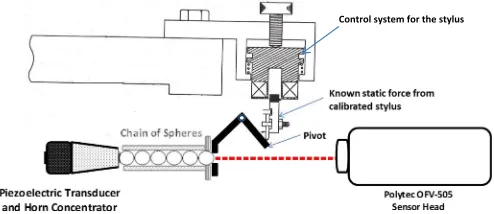
Fig. 1. Schematic of the apparatus.
within an acrylic holder. Once the correct conditions needed to set up an in-phase NNM were established, the time-domain response was in the form of a periodic set of impulses, accompanied by frequency spectra containing regularly spaced maxima that were separated in value as a whole fraction of the input frequency. The subharmonic and superharmonic bifur-cations in energy transfer in the frequency domain mentioned above were also exhibited in the experimental results. This response was able to be predicted by a theoretical model, the results from which were used to interpret the solitary wave propagation and the establishment of NNM behavior. This discrete model used a velocity-Verlet algorithm [15] to solve the relevant equations numerically. Note also that subharmonic frequencies were also observed in the work of Lydon et al. [16] in shorter chains at lower frequencies.
It is known from the previous work [17]–[19] that precom-pression can cause changes to the response of a granular chain. Our previous work verified that solitary wave impulses can be generated using harmonic excitation and a negligible amount of precompression force in a finite-length chain [13], [14]. In this paper, we will observe the effect of different holder materials and an increase in precompression on this response. It will be demonstrated that end-wall conditions are an impor-tant factor in dissipation and reflection at the boundaries, leading to changes in the characteristics of energy transfer to subharmonics and superharmonics. The effect of precompres-sion on the resultant waveform will also be investigated. It will be shown that an increase in precompression changes the wave regime from being strongly nonlinear to weakly nonlinear, accompanied by very sensitive changes in the propagation velocity.
II. APPARATUS ANDMETHODS
The apparatus used in the experiments is shown in Fig. 1. An exponential horn was used to provide high-amplitude input signals with a narrow bandwidth. The output displacement of the horn tip was approximately 1 μm at a center frequency of 73 kHz, when the horn/transducer assembly was driven with a tone-burst voltage signal. The frequency spectrum of the out-put had the expected main peak at 73 kHz, with only a small signal at the second harmonic at 146 kHz. The spheres were positioned within a cylindrical holder, and the output from the last sphere recorded using a Polytec OFV-505 vibrometer, whose output was a particle velocity waveform. The holders can be of different lengths to accommodate different chain lengths (from 3 to 10 mm) of 1-mm-diameter chrome steel
spheres. Three holder materials were investigated—an acrylic polymer [R11, as used in microstereolithography (MSL), a form of 3-D-printing], aluminum, and steel.
A force of known amplitude could be applied to the last sphere in the chain, using a calibrated 1.5-mm-diameter stylus acting upon a pivot. The stylus itself was part of a surface profiler instrument, modified to act as a mechanism of applying controlled precompression force. The control system for the stylus consisted of three main parts: an electromagnetic force actuator, a differential capacitive sensor, and a leaf spring suspension system. Further details of this design can be found in the paper by Chetwynd et al. [20]. To achieve the required function as a controlled mode of applying precompression, the current that passed through a coil/magnet assembly was varied, and careful design ensured that the force on the stylus along its axis was proportional to the current passing through the coil. Using a specially designed current drive, the force actuator was used to provide a calibrated static contact force at a neutral position. The stylus and the associated control system were mounted onto a Rank Taylor Hobson Talysurf 5 surface profiling instrument to ensure stability. Note that the force applied to the pivot was independent of small displacements, therefore, small vibrations within the system did not couple into the measurement loop. The Talysurf 5 instrument provided the means to carefully and accurately position the tip of the stylus onto a fulcrum or lever made of aluminum. The fulcrum was used to apply precompression directly on the chain of spheres as shown in Fig. 1, and was designed to be light and strong enough not to deform from the force exerted on it. The precompression system provided electrically selectable static force with a resolution of 1 mN. Note that in the absence of any applied precompression, a small force would still be exerted on the chain due to the need for the horn to touch the first sphere. This is discussed further below.
The work in this paper adds to our previous results [13], [14] by considering both the effect of chain length for a fixed input frequency and the use of different holder materials (and hence end-wall materials), and investigates in detail the effect of precompression on these resonant systems, where the response varies from being highly nonlinear in the case of negligible precompression (F0) to being almost linear at higher values
of F0.
III. THEORY
It is important for later discussions that the origin of the usual formula for the cutoff frequency for granular chains is given; in addition, it is shown why a more detailed analysis is required for finite chain lengths and varied precompres-sion forces. For a chain consisting of the identical spheres, the equation of motion of the nth sphere based on Hertzian contact has the general form [1]
mun¨ =A(δ0+un−1−un)3/2−A(δ0+un−un+1)3/2 (1)
where
A= E √
2R
and
m= 4
3πρR
3.
(3)
The spheres are assumed to be made of the same material with a radius R; mass m; densityρ; Young’s modulus E; and Poissons’s ratioν. This system is assumed to be in an equilib-rium state under a static compression force F0. At static
equi-librium, δ0 is the distance of approach of centers of spheres. unis the dynamic longitudinal displacement from the
equilib-rium position of the nth sphere. When |un−1−un|/δ0 1,
(1) can be changed into a lattice model with quadratic nonlin-earity, from which the nonlinear wave equation can be derived at the long wavelength limit. If the granular material is weakly compressed, so that |un−1−un|/δ0 1, the wave equation
for a Sonic vacuum in an infinite chain can be derived [2]. Strongly nonlinear solitary waves then appear in the analytical solution.
It will be shown in this paper that use of single frequency (harmonic) excitation and different levels of precompression can result in the presence of both subharmonics and superhar-monics, which are related to the driving frequency used. It is thus of interest to study the effect of a cutoff frequency on this process. Here, we first explore the dispersion relation in a sim-plified discrete linear model, which represents an infinite chain consisting of the identical spheres without dissipation. Under the limits |un−1−un| δ0 and (δ0+ |un−1−un|) < δmax,
the wave propagates in a continuum and smooth system (no separation between spheres occurs). It is assumed that the connections between the spheres are springs with an elastic coefficient μ, where δmax represents the corresponding value
of δ0 in the situation of the maximum elastic deformation.
Accordingly, the dynamic equation of the nth sphere of the chain is simplified as a linearized equation
mun¨ =μ(un−1−un)−μ(un−un+1)
=μ(un−1−2un+un+1). (4)
The chain then executes a motion of the form
un(t)=ei(kna−ωt). (5) This is a harmonic wave of frequencyω and wavenumber k, and a is the distance between the centers of neighboring spheres under static equilibrium, so that a = 2R − δ0.
The cutoff frequencyωc occurs when the wavelength (2π/k)
equals 2a. From (4) and (5), we obtain the dispersion relation
ω=ωcsin ka 2 =2 μ msin ka 2 (6)
whereμ can be determined by Hertzian law, that is
F0= √
2R E 3(1−ν2)δ
3/2 0 , μ=
∂F0
∂δ0 =
R
2
E
1−ν2δ 1/2 0 . (7)
The cutoff frequency fc is then given by
fc = ωc
2π = 3 4π3/2
F01/6
θ1/3R4/3ρ1/2 (8)
where θ = (3(1−ν2)/4E). This means that under strong precompression, the chain system operates as a low-pass filter
and waves of frequency f > fc are strongly attenuated. However, this analysis is based on the assumed linear model; in fact, superharmonic frequencies can appear in the discrete spherical chain due to the nonlinear Hertzian contact, which depends on the properties of the granular chain and the input conditions. Thus an accurate model to describe the experimental system is important, and the use of (8) to denote the expected upper frequency generated experimentally is not strictly correct.
In addition, in a finite length chain, reflection at the end-wall boundary and dissipation due to friction between the granular material and the holder materials are both essen-tial factors that influence wave transmission in the chain. Hutchins et al. [13], [14] presented dynamic equations of sphere motion that are described in (9a)–(9c), and investigated the characteristic of the solitary wave impulses using numer-ical calculations. These equations are still valid to model the motions of spheres based on the new experimental conditions in this paper. For the first sphere, positioned next to the horn, the equation is
md 2u1
dt2 =
2√R
3
×
2θl(δ0l+u0−u1)3/2− θ m √
2(δ0+u1−u2)
3/2 +λ du0 dt − du1 dt
H(δ0l+u0−u1)
−λ du1 dt − du2 dt
H(δ0+u1−u2) (9a)
where u0 is the displacement of the input signal andλis the
damping coefficient. For the second sphere to the penultimate one, the equivalent equation of motion is
md 2un
dt2 = √
2R 3 θm
× [(δ0+un−1−ui)3/2−(δ0+un−un+1)3/2] +λ
dun−1
dt − dun
dt
H(δ0+un−1−un)
−λ
dun
dt − dun+1
dt
H(δ0+un−un+1). (9b)
Finally, for the last (output) sphere, the relevant equation is
md 2u
n dt2 =
2√R
3
θm √
2(δ0+un−1−un)
3/2−
2θr(δ0r+un)3/2
+λ
dun−1
dt − dun
dt
H(δ0+un−1−un)
−λdun
dt H(δ0r+un). (9c)
Here
1 θl =
1−νl2
El +
1−νs2 Es
θm = Es
1−ν2 s
and 1 θr =
1−ν2 r Er +
1−ν2 s
Es . (10)
In (10), Elandνlare the Young’s modulus and Poisson ratio
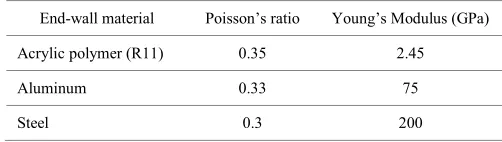
TABLE I
PROPERTIESUSED INCALCULATIONS FOR THEEFFECT OF THEEND-WALLMATERIAL
those of the spheres themselves. Here,δ0l,δ0, andδ0r denote
the mutual approach caused by the static force between the horn and the first sphere, between intermediate spheres, and between the last sphere and the end wall, respectively. Note that the equations relating to the first and last sphere of the chain assume that these are in contact with spheres of infinite radius, thus in effect modeling a wall.
Consider now the effect of damping. In (8), the dissipation term is described by the damping force and a Heaviside func-tion H is incorporated to judge if the spheres are in contact. λ is determined in our work from the experimental results of each chain structure. In addition, the initial positions of spheres are determined in turn for a particular precompression force, starting from the last sphere. Here, a boundary constraint is assumed in that the position of the contact point between the last sphere and the wall at the end of the chain is fixed. The properties of this end wall can be changed in the model via its effective Young’s modulusθr, which is associated with
contact interactions between the last sphere and the holder. The effects of dissipation for harmonic excitation of a statically compressed chain have also been investigated in [16], but in their dynamic model the boundary conditions were not explicitly stated for a finite length chain with different end-wall conditions. They used a spring with force F0 (the initial
compression force) to describe the experimental boundary condition. In our model, the (4√R/3)θr(δ0r+un)3/2 term
in (9c) allows the reflection process due to the different holder materials to be modified via the value of the effective Young’s modulus θr. Hence the two models differ in this respect.
Experimentally, the end-wall material has a big effect on the response, as will be shown later in this paper.
IV. RESULTS A. Effect of Changing the Holder Material
[image:4.612.47.298.98.169.2]It was found experimentally that the resonant chains were very sensitive to the physical conditions in which they were held. One other factor that had a measurable effect was the material from which the cylindrical holder of the spheres was made. The input sphere was touching the horn tip, whereas the output sphere protruded through the annular end of the holder. To investigate this, a chain of six chrome-steel spheres of 1-mm diameter were tested when contained within holders of three different materials: R11 photoreactive acrylic polymer (as used for additive manufacture via MSL), steel, and aluminum. Table I gives the relevant properties of these materials.
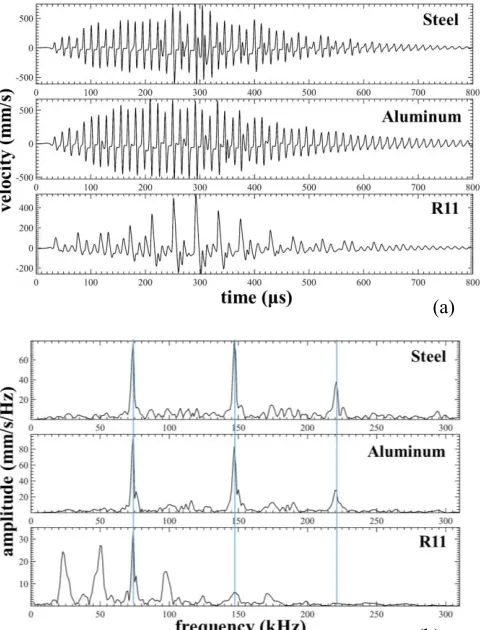
Fig. 2. (a) Experimental waveforms and (b) spectra obtained from a chain containing six chrome-steel spheres of 1-mm diameter, when enclosed within holders of various types of materials.
The results of these experiments are shown in Fig. 2. When the metallic steel and aluminum holders were used, the dominant feature was the creation of harmonics of the input frequency, a feature of nonlinear behavior; however, no subharmonics were present. It was only in the R11 acrylic material that the system truly exhibited strongly nonlinear behavior, with the creation of subharmonics and a series of superharmonics of the lowest subharmonic peak (and not just harmonics of the input frequency as in the case of steel and aluminum holders). Note that Lydon et al. [16] also observed the presence of frequencies that were subharmonics of the input frequency in their experiments; however, multiple harmonics of the lowest subharmonic peak were not present, as is the case here. It is this difference that is particularly striking in the present measurements, with strong solitary-wave generation as impulses in time. This is thought to be partly due to both the increased input energy levels that result from the use of an ultrasonic horn at the input stage, but also the fact that the final sphere interacted directly with the end wall, and not via a spring. The measurements demonstrate just how sensitive the system is to the end-wall material.
Fig. 3. (a) Predicted theoretical waveforms and (b) spectra for the same materials and excitation conditions as used in Fig. 2.
predicted to lead to a set of periodic impulses in the time domain, with a regular set of more closely spaced frequency peaks. It was found that the damping coefficient used in the theoretical model needed to be adjusted between each material for the end wall to get suitable correlation with the experimental results in each case. This is reasonable: each wall material will have its own damping properties, as well as its own elastic modulus. Both effects feed into the damping coefficient (λ) used theoretically for the best correlation between the theoretical prediction and experiment. The presence of subharmonics is predicted theoretically by our models, but only once the correct end-wall conditions have been met. The subharmonics are some of the allowed NNMs of a system, which is highly nonlinear. It is difficult to derive a definitive value forλbased on physical properties of the steel spheres and the holder material—in practice, we have had to adjust the value for λ to obtain the best fit of theory with experiment. Note that the main features (such as subharmonics and multiples thereof) exist for a range of values ofλfor each holder material—subharmonics are never predicted for steel and aluminum, no matter what value of λis chosen.
The results thus indicate that the material from which the end wall is made has a direct influence on the output from the spherical chain. This is likely to be due to the reflection properties of the end wall. In particular, this creates new frequency components as a result of bifurcations of energy in the frequency domain. For a holder material with a high elastic modulus, e.g., steel, the smaller damping coefficient
with a strong reflection from the boundary promotes the rapid propagation of the reflected signal returning to the source along the chain. This makes the period of the impulse close to the period of the input sinusoidal wave. Correspondingly, for the softer R11 acrylic material, the period of the impulses is three times that of the input sinusoidal wave, and the lowest peak in the spectrum is at one-third of the frequency of the input. This is because of the larger damping effect of the viscoelastic R11 acrylic material, and the fact that its lower elastic modulus delays the transmission of the reflection wave. Both the factors encourage the formation of a set of impulses, whose width in time effectively sets the envelope of the bandwidth in the frequency spectrum. The repetition rate of these impulses then fixes the frequency separation in the frequency domain.
As observed in a previous publication by Hutchins et al. [13], the length of the chain (as defined by the number of 1-mm-diameter spheres present) determines the number and spacing of both the impulses in time, and the frequency peaks in the corresponding spectrum. Longer chains produce a set of impulses that are farther apart in time, as might be expected. This is accompanied by a greater number of equally spaced frequency peaks, starting at a lower frequency (always a whole fraction of the input frequency of 73 kHz), and being closer together in frequency in longer chains. This is illustrated by the results obtained experimentally using the R11 acrylic holder, as presented in Fig. 4, which should be compared with those for the six-sphere chain (Fig. 2).
Consider now the cutoff frequency ( fc) expected for this
system as a function of precompression force (F0). The
predictions of (8) are shown in Fig. 5, where the input frequency of 73 kHz is also indicated. Assuming that the experiments are taking place at a value of F0≤0.1 mN [13],
all three end-wall materials give outputs that exceed the predicted value of fc from Fig. 5 of 180 kHz. This is quite
reasonable, because (8) was based on a linear assumption. In fact, the highest frequency generated by the system depends on the nonlinear Hertzian contact and any dissipation. The low-pass filter analysis provided by a linear discrete lattice model does not apply to the current spherical chain system of finite length.
Fig. 4. (a) Experimental waveforms and (b) spectra obtained for chains of three and ten chrome-steel spheres of 1-mm diameter, when enclosed within an R11 acrylic holder.
Fig. 5. Predictions of (7) for the expected cutoff frequency for solitary waves in chains of 1-mm-diameter chrome steel spheres.
some energy is lost to the holder material, which will affect the estimate of the damping coefficient. This will be different for each holder/end-wall material, as already discussed.
B. Effect of Precompression
Having characterized the response of the system without precompression, the stylus and fulcrum were now attached as shown in Fig. 1. The response of a chain of three chrome steel spheres of 1-mm diameter to increased levels of F0 is shown
Fig. 6. Measurement of the motion of the end wall of the R11 acrylic holder, using the vibrometer. (a) Time waveform. (b) Corresponding spectrum.
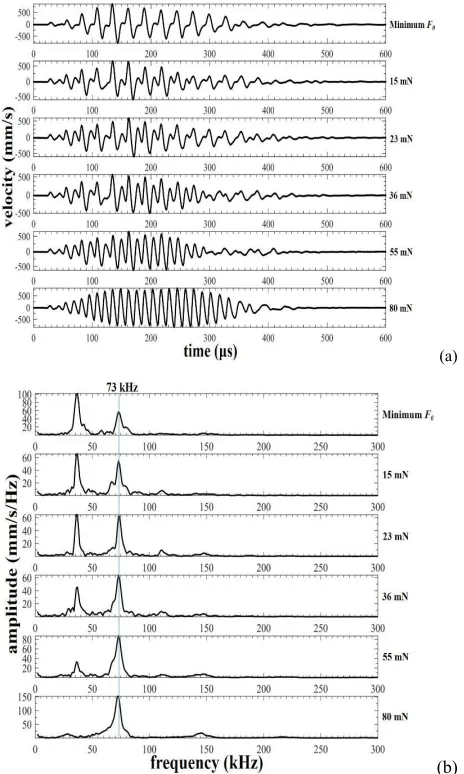
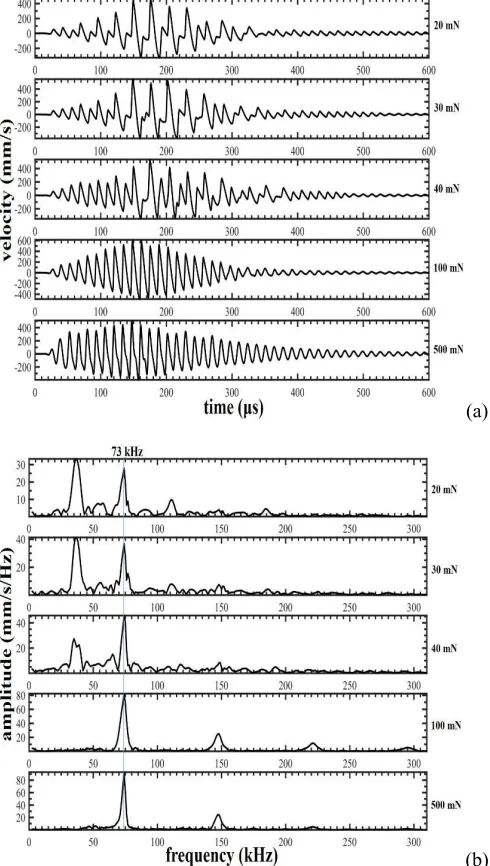
Fig. 7. Output waveforms for a chain of three spheres excited at 73 kHz and using the fulcrum to vary the precompression. (a) Time waveform. (b) Cor-responding frequency spectra obtained via a fast Fourier transform (FFT).
in Fig. 7(a) and (b) for waveforms and spectra, respectively. It will be seen from the time-domain data of Fig. 7(a) that the periodic impulses created using the minimum F0 (estimated
[image:6.612.319.557.58.198.2] [image:6.612.323.555.226.613.2] [image:6.612.70.280.419.607.2]Fig. 8. Theoretical predictions for a three-sphere chain using a tone-burst input of an ultrasonic horn at 73 kHz. Waveforms (left) and spectra (right) at various levels of precompression force F0, and assuming the maximum input amplitude from the ultrasonic horn [Fig. 1(c)]. Results are shown in terms of (a) time waveform and (b) corresponding frequency spectra obtained via an FFT.
of precompression, the impulses have been damped out by the increasing stiffness of the chain. The spectra of Fig. 7(b) reinforce this view–increased precompression is associated with a suppression of the subharmonics seen when a strong NNM is present, and a corresponding reduction in the presence of harmonics. The system has thus become weakly nonlinear, decreasing nonlinearity, and suppressing the presence of the solitary wave impulses.
The model described by (9) allows both the precompression force and the amount of viscous damping present, to be varied, and has been used to predict the expected outputs for the chain of three spheres. The results in Fig. 8 were obtained using a viscous damping coefficient of 0.23 Nsm−1for the theoretical model.
[image:7.612.325.545.62.236.2]Comparison of Figs. 7 and 8 indicates that the theoret-ical predictions have many features in common with the
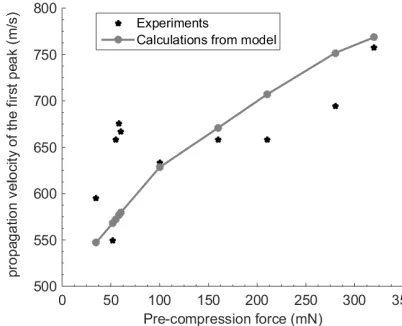
Fig. 9. Changes in propagation velocity for a three-sphere chain excited by a tone burst at 73 kHz at various levels of precompression force F0. Results are shown for the maximum input amplitude, with the time delay along the chain estimated using wavelet decomposition methods. Results are shown after processing waveforms from both experimental data and theoretical predictions for an R11 end wall of the holder.
experimental results. The waveforms obtained when the chain was subject to a precompression force from 20 to 40 mN contained increasing amounts of the input frequency. This was accompanied by a reduction in the relative amplitude of the subharmonic frequency peak at 37 kHz as the precompression was increased further. The theory also explores the response at relatively high precompression levels where, as expected, the response is dominated by the input frequency. There is also some first harmonic signal still present, due to the existence of the limited nonlinearity in the stiffened, weakly nonlinear chain.
Precompression is known to affect propagation delays along granular chains [17], [18]. It was thus also interesting to establish a method whereby the time of flight of the signals along the chain could be measured, and hence the velocity of the signal along the chain could be determined. Wavelet decomposition provided the ability to decompose a waveform into multiple levels with precise information in the time and frequency domains [21], and allowed the time delays along the chain to be determined. This could be carried out for both the experimental data and theoretical predictions. Consider then the propagation velocity of the solitary wave pulses along the three-sphere chain, excited by a tone-burst at 73 kHz at the maximum input amplitude available (a particle velocity amplitude of 600 mm/s in this case). The results are shown in Fig. 9. It is interesting to correlate Fig. 9 with the waveforms and spectra of Figs. 7 and 8. At levels of precompression below 50 mN, the spectra that resulted were characteristic of NNMs being present, with strong subharmonics (as in Figs. 7 and 8 at low precompression amplitudes). Thereafter, a transition occurred, and the subharmonics started to be supressed, with the input signal becoming more dominant, indicative of a weakly nonlinear behavior.
Fig. 10. As in Fig. 9, but for a ten-sphere chain.
and theoretical curves exhibit similar trends. In the strongly nonlinear regime, the velocity changes greatly with small changes in the precompression force. This is expected, in that the system will be very sensitive to the initial conditions. With increased precompression, the system changes to being weakly nonlinear, and the change in velocity will be less marked.
Similar trends were seen in different lengths of chains using the 1-mm-diameter steel ball bearings. This included the gradual suppression of the impulses seen at minimal precompression, and the increasing dominance of the input frequency of 73 kHz in the signal. Fig. 10 shows an example for a chain containing ten spheres. It can be seen that similar trends, namely that the velocity along the chain increased steadily with additional precompression. There was a period of instability in the experimental velocity values at low levels of
F0 in the experimental data, not replicated theoretically. The reasons for this are not clear. As for the case of the three-sphere chain, this region exhibited characteristics expected from the presence of NNMs, with strong subharmonics in the spectrum indicating a strongly nonlinear response. At pre-compression values above 100 mN, subharmonics were sup-pressed, with changing amounts of harmonics of the input frequency, indicative of a weakly nonlinear behavior.
V. DISCUSSION ANDCONCLUSION
The work described in this paper demonstrates that resonant granular chains can exhibit distinct properties. The chains themselves are able to generate an impulse train at high amplitude. This is achieved via the creation of a resonant chain of spheres, within which NNMs can exist at ultrasonic frequencies. However, this requires careful design. The spheres have to be small enough to exhibit individual motion relative to each other at the frequencies of interest, and this has to be below a certain cutoff frequency. If this condition holds, then relative motion between spheres leads to a strongly nonlinear interaction at the interface between them due to Hertzian mechanics. Provided the input signal (in terms of a force Fm) is much greater than any static force holding them
together (F0), the spheres can even lose contact, a feature of a
strong NNM. However, the precompression forces needed to achieve this are very small (10 mN in the present case). This requires care over the design of the experimental system.
A highly nonlinear system would be expected to be very sensitive to boundary conditions, and this is the case here. Thus, for example, changing the end-wall material in contact with the final sphere of the chain has a large effect on the response. In this paper, only an acrylic polymer led to the creation of the interesting impulse trains in the time domain. This indicates how sensitive such systems are to boundary conditions. The effect of precompression force was also stud-ied, and it was demonstrated that an additional 100 mN of precompression was enough to damp out the subharmonics in the frequency response of the chains. This was due to the characteristics of the system gradually changing from being highly nonlinear to being only weakly nonlinear. This was accompanied by a gradual increase in the propagation velocity along the chain. In addition to the above, the effect of the damping coefficient is of interest, and perhaps should be examined further. It has been known to be a sensitive parameter in theoretical modeling predictions, and it is likely that experimentally it is a factor in determining the nature of the response of the chain. This and other factors could perhaps be explored further, for example, by using finite element models of intergranular interactions and the effects of end-wall conditions [22].
REFERENCES
[1] V. F. Nesterenko, “Propagation of nonlinear compression pulses in granular media,” J. Appl. Mech. Tech. Phys., vol. 24, no. 5, pp. 733–743, 1983.
[2] V. Nesterenko, Dynamics of Heterogeneous Materials. New York, NY, USA: Springer-Verlag, 2001.
[3] C. Coste, E. Falcon, and S. Fauve, “Solitary waves in a chain of beads under Hertz contact,” Phys. Rev. E, vol. 56, pp. 6104–6117, Nov. 1997.
[4] S. Sen, J. Hong, J. Bang, E. Avalos, and R. Doney, “Solitary waves in the granular chain,” Phys. Rep., vol. 462, no. 2, pp. 21–66, 2008. [5] R. S. Mackay, “Solitary waves in a chain of beads under Hertz contact,”
Phys. Lett. A, vol. 251, no. 3, pp. 191–192, 1999.
[6] A. Spadoni and C. Daraio, “Generation and control of sound bullets with a nonlinear acoustic lens,” Proc. Nat. Acad. Sci. USA, vol. 107, no. 16, pp. 7230–7234, 2010.
[7] E. B. Herbold and V. F. Nesterenko, “Solitary and shock waves in discrete strongly nonlinear double power-law materials,” Appl. Phys. Lett., vol. 90, no. 26, p. 261902, 2007.
[8] C. Daraio, V. F. Nesterenko, E. B. Herbold, and S. Jin, “Strongly nonlinear waves in a chain of Teflon beads,” Phys. Rev. E., vol. 72, p. 016603, Jul. 2005.
[9] K. R. Jayaprakash, Y. Starosvetsky, and A. F. Vakakis, “New family of solitary waves in granular dimer chains with no precompression,” Phys. Rev. E, vol. 83, p. 036606, Mar. 2011.
[10] K. R. Jayaprakash, Y. Starosvetsky, A. F. Vakakis, M. Peeters, and G. Kerschen, “Nonlinear normal modes and band zones in granular chains with no pre-compression,” Nonlinear Dyn., vol. 63, no. 3, pp. 359–385, 2011.
[11] Y. Starosvetsky and A. F. Vakakis, “Traveling waves and localized modes in one-dimensional homogeneous granular chains with no precompres-sion,” Phys. Rev. E, vol. 82, p. 026603, Aug. 2010.
[12] J. Lydon, K. R. Jayaprakash, D. Ngo, Y. Starosvetsky, A. F. Vakakis, and C. Daraio, “Frequency bands of strongly nonlinear homogeneous granular systems,” Phys. Rev. E, vol. 88, p. 012206, Jul. 2013. [13] D. A. Hutchins et al., “Evolution of ultrasonic impulses in chains of
spheres using resonant excitation,” Eur. Phys. Lett., vol. 109, no. 5, p. 54002, 2015.
[14] D. A. Hutchins et al., “Ultrasonic propagation in finite-length granular chains,” Ultrasonics, vol. 69, pp. 215–223, Jul. 2016, doi: 10.1016/j.ultras.2015.10.018.
[16] J. Lydon, G. Theocharis, and C. Daraio, “Nonlinear resonances and energy transfer in finite granular chains,” Phys. Rev. E, vol. 91, no. 2, p. 023208, 2015.
[17] C. Daraio, V. F. Nesterenko, E. B. Herbold, and S. Jin, “Tunability of solitary wave properties in one-dimensional strongly nonlinear phononic crystals,” Phys. Rev. E, vol. 73, no. 2, p. 026610, 2006.
[18] C. M. Donahue, P. W. J. Anzel, L. Bonanomi, T. A. Keller, and C. Daraio, “Experimental realization of a nonlinear acoustic lens with a tunable focus,” Appl. Phys. Lett., vol. 104, no. 1, p. 014103, 2014. [19] V. J. Sánchez-Morcillo, I. Pérez-Arjona, V. Romero-García, V. Tournat,
and V. E. Gusev, “Second-harmonic generation for dispersive elastic waves in a discrete granular chain,” Phys. Rev. E, vol. 88, no. 4, p. 043203, 2013.
[20] D. G. Chetwynd, X. Liu, and S. T. Smith, “A controlled-force stylus displacement probe,” Precis. Eng., vol. 19, nos. 2–3, pp. 105–111, 1996. [21] S. Legendre, D. Massicotte, J. Goyette, and T. K. Bose, “Wavelet-transform-based method of analysis for Lamb-wave ultrasonic NDE signals,” IEEE Trans. Instrum. Meas., vol. 49, no. 3, pp. 524–530, Jun. 2000.
[22] P. Gélat et al., “The dynamic excitation of a granular chain for biomedical ultrasound applications: Contact mechanics finite element analysis and validation,” J. Phys., Conf. Ser., vol. 684, no. 1, p. 012005, 2016.
O. Akanji received the B.S. degree in electronics from the University of Durham, Durham, U.K., and the M.S. degree in biomedical engineering and the Ph.D. degree in electronics engineering from the University of Warwick, Coventry, U.K., in 2011 and 2015, respectively.
He is currently a Postdoctoral Research Fellow with the School of Engineering, University of War-wick. His current research interests include nonlinear solitary waves, high intensity focused ultrasound, and nondestructive testing using ultrasound.
Jia Yang received the B.S. degree in metallurgy material and engineering from the Wuhan Univer-sity of Technology, Wuhan, China, in 1989, and the M.S. and Ph.D. degrees in mechanical science and engineering from the Huazhong University of Science and Technology, Wuhan, China, in 1998 and 2003, respectively. She is currently pursuing the Ph.D. degree in sustainable energy engineering and design with the University of Warwick, Coventry, U.K.
She taught courses as a Teaching Assistant in mechanics and materials with Three Gorges University, Yichang, China, from 1989 to 1995. She was appointed as a Lecturer in 1995 and she continued to teach until 1996. She was with the Huazhong University of Science and Technology as a Postdoctoral Research Fellow until 2007. She was a Visiting Research Fellow in materials for high performance applications with the Interdisciplinary Research Centre, University of Birmingham, Birmingham, U.K., from 2005 to 2006. She is currently a Research Fellow with the School of Engineering, University of Warwick, Coventry, U.K. She has been a Research Fellow with the University of Warwick since 2013. Her current research interests include nonlinear dynamics and acoustics in granular media, ultrasonic engineering, and heat transfer in micro and nanoparticle-based systems.
David Hutchins received the B.Sc. and Ph.D. degrees from the University of Aston, Birmingham, U.K.
He held postdoctoral research positions in Den-mark, the U.K., and Canada. He was with Queen’s University, Kingston, ON, USA, as an Assis-tant/Associate Professor, for eight years, before moving to the University of Warwick, Coventry, U.K., where he has been a Professor since 1995. He has authored over 190 refereed journal papers in these and other areas. He received an IET Achieve-ment Medal in 2015. His current research interests include ultrasound and acoustics, including laser-generated ultrasound, air-coupled ultrasound, and nondestructive evaluation.
Dr. Hutchins acted as an Associate Editor of the IEEE TRANSACTIONS ON
ULTRASONICS, FERROELECTRICS,ANDFREQUENCYCONTROLfor many years.
Peter J. Thomas received the Dipl.-Phys. and Dr.rer.nat. degrees in physics from the Georg-August-Universität, Göttingen, Germany, in 1988 and 1991, respectively.
He was a Research Associate and then a Senior Research Associate with the Department of Applied Mathematics and Theoretical Physics, University of Cambridge, Cambridge, U.K., from 1992 to 1995. He joined the University of Warwick, Coventry, U.K., as a Warwick Research Fellow in 1995, where he was promoted to Reader in 2001 and to Professor in 2008. His current research interests include the experimental and theoretical investigations of problems in fluid dynamics and of nonlinear mechanical processes in general.
Dr. Thomas is a member of the European Mechanics Society. He received the International Union of Applied and Theoretical Mechanics Bureau Prize in 1996.
Lee A. J. Davis received the B.Sc. degree in physics and electronics engineering from Bangor University, Bangor, U.K., in 1989, the M.Sc. degree in indus-trial measurement systems from Brunel University, London, U.K., in 1992, and the Ph.D. degree in engi-neering from The University of Warwick, Coventry, U.K., in 2006.
He is currently a Research Fellow with the School of Engineering, University of Warwick. Previously, he has also worked in the area of fine surface metrology and precision mechanical structures. His current research interests include ultrasonic testing, near- and mid-infrared imaging and other related NDT technologies.
Sevan Harput (S’08–M’14) received the B.Sc. degree in microelectronics engineering and the M.Sc. degree in electronic engineering and computer sciences from Sabanci University, Istanbul, Turkey, in 2005 and 2007, respectively, and the Ph.D. degree from the University of Leeds, Leeds, U.K., in 2013.
He was a Teaching and Research Fellow with Sabanci University from 2007 to 2008. In 2009, he joined the Ultrasound Group, School of Electronic and Electrical Engineering, University of Leeds. He is currently a Research Fellow with the University of Leeds, where is involved in biomedical ultrasound systems and ultrasound imaging. His current research interests include high frame-rate ultrasound imaging, Doppler and flow imaging, elastography, coded excitation tech-niques, nonlinear acoustics, and ultrasound contrast agents.
Dr. Harput has been an Administrative Assistant of the IEEE TRANSAC
-TIONS ONULTRASONICS, FERROELECTRICS,ANDFREQUENCYCONTROL
since 2013. He received the University of Leeds Teaching and Research Award in 2014.
Steven Freear (S’95–M’97–SM’11) received the Ph.D. degree in 1997.
He was with the electronics industry for seven years as a medical ultrasonic system designer. He was appointed to Lecturer (Assistant Professor) and then to Senior Lecturer (Associate Professor) with the School of Electronic and Electrical Engineering, University of Leeds, Leeds, U.K., in 2006 and 2008, respectively. In 2006, he formed the Ultrasound Group, specializing in both industrial and biomedical research. In 2014, he was appointed as a Visiting Professor with the Georgia Institute of Technology, Atlanta, GA, USA. He is an External Examiner to master’s programs in electronic engineering with Queen’s University at Belfast, Belfast, U.K. He teaches digital signal process-ing, VLSI and embedded systems design, and hardware description languages at both undergraduate and postgraduate levels. His current research interests include advanced analog and digital signal processing and instrumentation for ultrasonic systems.
Dr. Freear has been Associate Editor of the IEEE TRANSACTIONS ON
Pierre N. Gélat was born in Paris, France, in 1972. He received the B.Eng. degree in elecroacoustics from the University of Salford, Salford, U.K., in 1994, the M.Sc. degree (Hons.) in sound and vibra-tion studies from the University of Southampton, Southampton, U.K., in 1996, and the Ph.D. degree from the Department of Mechanical Engineering, University College London (UCL), London, U.K., in 2013, investigating the optimization of high-intensity focused ultrasound (HIFU) fields for ablative thera-pies of tumors in the upper abdomen using boundary element methods.
He then completed a research assistantship in conjunction with Peugeot-Citroën, Paris, France, and the Institute of Sound and Vibration Research, University of Southampton, Southampton, U.K., where he was investigating vehicle engine vibration using statistical energy analysis methods and finite element modeling. In 1997, he joined the National Physical Laboratory, Teddington, U.K., where he was involved in the theoretical modeling of industrial and medical ultrasonic devices and characterization of resulting fields. In 2014, he joined the Department of Mechanical Engineering, UCL, where he is investigating the modeling of novel transducers for HIFU applications. He is currently a Chartered Engineer and Chair of the Physical Acoustics Group Committee of the Institute of Physics.
Dr. Gélat received the Bob Chivers Prize in 2011 from the Institute of Physics for best paper by a Ph.D. student in the field of physical acoustics.
Nader Saffari received the B.Sc. degree in electrical and electronic engineering from Leeds University, Leeds, U.K., in 1978, and the M.Sc. degree in microwaves and modern optics and the Ph.D. degree, both from University College London (UCL), Lon-don, U.K., in 1986.