Iowa State University Patents
Iowa State University Research Foundation, Inc.
7-2-1991
Method of raising meat producing animals to
increase lean tissue development
Steven L. Nissen
Iowa State University, [email protected]
Follow this and additional works at:
http://lib.dr.iastate.edu/patents
Part of the
Animal Sciences Commons
This Patent is brought to you for free and open access by the Iowa State University Research Foundation, Inc. at Iowa State University Digital Repository. It has been accepted for inclusion in Iowa State University Patents by an authorized administrator of Iowa State University Digital Repository. For more information, please [email protected].
Recommended Citation
Nissen, Steven L., "Method of raising meat producing animals to increase lean tissue development" (1991).Iowa State University Patents. 209.
Method of raising meat producing animals to increase lean tissue
development
Abstract
A method is provided for raising meat producing domestic animals to increase lean tissue development.
β-hydroxcy-β-methylbutyric acid or an edible salt thereof (HMB) is administered to the animals in an effective
amount for a sufficient length of time to obtain a substantial increase in lean tissue weight. Feed compositions
for use in practicing the method are also provided. The method and feed compositions are particularly
adapted for use with ruminants, including beef cattle and lambs, since HMB is not subject to appreciable
rumen destruction. The method can also be practiced with other domestic animals, including chickens, and
turkeys.
Keywords
Animal Science
Disciplines
Animal Sciences
United States Patent [19]
5,028,440
* Jul. 2, 1991
Patent Number:
Date of Patent:
[11]
[45]
Nissen
[54] METHOD OF RAISING MEAT PRODUCING
ANIMALS TO INCREASE LEAN TISSUE DEVELOPMENT
[75] Inventor: Steven L. Nissen, Ames, Iowa
[73] Assignee: Iowa State University Research.
Foundation, Inc., Ames, Iowa
[ ‘ ] Notice: The portion of the term of this patent subsequent to Feb. 12, 2008 has been disclaimed.
[21] Appl. No.2 472,090
[22] Filed:
Jan. 30, 1990
[51] Int. C1.5 ... .. A23K 1/00
[52] U.S. Cl. ... .. 426/002; 426/623;
426/630; 426/ 636; 426/ 807; 514/557
[58] Field of Search ... .. 426/2, 623, 630, 636,
426/807; 514/557
[56]
References Cited
U.S. PATENT DOCUMENTS
2,878,124 3/1957 Kruckenberg ... .. 514/557
4,073,960 2/1978 Scott et a1. . . . . . . .. 426/98
4,376,790 3/1983 Ames . . . . . . .. 426/2 4,388,327 6/1983 Cummins ... .. 426/2 4,673,576 6/1987 D‘Aiello . . . . . . .. 426/2
4,758,593 7/1988 Nissen 514/557
4,760,090 7/1988 Nissen ... .. 514/557 4,764,531 8/1988 Nissen ... .. 514/557 4,835,185 5/1989 Nissen ... .. 514/557 4,883,817 11/1989 Nissen ... .. 514/557
OTHER PUBLICATIONS Krebs et a1., Adv. Enz. Reg, 15:375-394 (1976).
Paxton et al., J. Biol. Chem, 257:14433-14439 (1982).
Landaas, Clinica Chimica Acta, 64:143-154 (1975).
Sabourin et a1., Fed. Proc., 38:283 Abs. 332 (1979). Sabourin et al., Arch. Biochem. Biophysics, 206:132-144
(1981).
Tanaka et a1., Proc. Natl. Acad. Sci, 56:236-242 (1966).
Tanaka et a1., Biochem. Biophys Acta, 152:638-641
(1968).
Chawla et al., J. Nutri, l05:798—803 (1975). Boebel et a1., J. Nutrzl, 112:1929-1939 (1982).
Chow et al., J. Nutr., 104:1208-1214 (1974).
Kuhlman et al., The FASEB Journal, vol. 3, No. 3, p.
267, Abs. 236 (dated Feb. 9, 1989; published Feb. 10,
1989).
Primary Examiner-R. B. Penland
Attorney, Agent, or Firm-Ti1ton, Fallon, Lungmus &
Chestnut
[57]
ABSTRACT
A method is provided for raising meat producing d0
mestic animals to increase lean tissue development.
B-hydroxcy-B-methylbutyric acid or an edible salt thereof (HMB)_is administered to the animals in an effective amount for a suf?cient length of time to obtain
a substantial increase in lean tissue weight. Feed compo
sitions for use in practicing the method are also pro
vided. The method and feed compositions are particu
larly adapted for use with ruminants, including beef
cattle and lambs, since HMB is not subject to apprecia
ble rumen destruction. The method can also be prac
ticed with other domestic animals, including chickens,
and turkeys. '
5,028,440
1
METHOD OF RAISING MEAT PRODUCING ANIMAIS TO INCREASE LEAN TISSUE
DEVELOPMENT
BACKGROUND OF INVENTION
The keto analog of L-leucine (a dietarily essential
amino acid) is a-keto-isocaproic acid, which is usually
referred to as ketoisocaproate (KIC), or sometimes also
as ketoleucine. In the accepted description of leucine metabolism, leucine is ?rst transaminated to its ketoa cid, o-ketoisocaproate (KIC). KIC then enters the mito chondria and is decarboxylated to isovalarylCoA by the branched chain ketoacid dehydrogenase. [See Krebs, et al., Adv. Enz. Reg. 15:375-394 (1976); and Paxton, et al., J. Biol. Chem. 257:14433-14439 (1982).] An alternate
minor pathway has been described in the rat and human liver [Sabourin, et al., Fed. Proc. 38:283 Abs. 312
(1979)]. This alternate oxidative pathway occurs in the cytosol and involves oxidation of KIC to B-hydroxy-B
methyl butyrate (HMB) by the enzyme KIC-oxygenase
[Sabourin, et al., Arch. Biochem. Biophys. 206:132—l44 (1981)]. According to Sabourin et al. (1981, p. 143): “The importance of this pathway is presently un
known”.
The administration of keto analogs of amino acids has
been proposed for treatment of certain disease condi
tions in humans, such as uremia. [See, for example, Walser, et al., J. Clin. Inv., 52:678-690 (1973).] For
nutritional purposes, it is known that KIC is an ineffi
cient substitute for leucine. Rat studies have shown that the feeding of KIC as a replacement for leucine requires
the feeding of from two to three times as much KIC as
the nutritionally required amount of leucine: Chawla, et al., J. Nutr., 105:798-803 (1975); and Boebel, et al., J. Nutr., 112: 1929-1939 (1982); and Chow, et al., J. Nutr.,
104: 1208-1214 (1974). I
It has been proposed to feed small amounts of KIC in
conjunction with animal diets containing sufficient leu cine for the purpose of improving the growth metabo lism of the animals. By using milligram amounts of KIC,
some increases in the rates of weight gain and/or feed
efficiencies have been obtained. [See, for example, U.S. Pat. Nos. 4,760,090 and 4,883,817.] With mature sheep
being fed for wool production, by feeding KIC the
amount'of wool produced may also be increased (U.S. Pat. No. 4,760,090). When lactating domestic animals,
such as dairy cattle, are fed small amounts of KIC, the
quantity of milk produced may be increased (U .5. Pat. No. 4,758,593). Egg production by laying chickens can also sometimes be increased (U.S. Pat. No. 4,760,531). Other effects of feeding KIC have been observed, in
cluding cholesterol reduction in meat, milk and eggs (U.S. Pat. Nos. 4,760,090 and 4,760,531), and some ap
parently bene?cial effects on the immune system (U.S. Pat. No. 4,835,185).
Why KIC addition to protein and leucine sufficient
animal diets can have different effects than the meta bolic conversion of leucine to KIC is not known. The
bene?cial effects of KIC on domestic animals are not
consistently obtainable. Variability of bene?ts have been particularly observed in the KIC feeding of rumi
nants. KIC supplementation has not become an estab
lished animal feeding practice for any purpose. With
reference to the use of KIC in feeds for cattle and sheep,
a major problem is that the KIC is subject to partial
rumen destruction, which is a variable factor. The use
of rumenprotective agents and procedures for KIC has
10 15 20 25 30 35 45 50 55 65
2
not been shown to be satisfactory for commercial pur
poses.
Nutritionally, as described above, leucine is con verted to KIC, which in the mitochondria is decarbox
ylated to isovalarylCoA. In certain disease conditions,
such as isovalaric acidemia, an alternate oxidative path way for KIC has been observed in the liver, which may
produce the substance B‘hydroxy-B-methylbutyrate
(HMB). To date, however, there is little or no evidence
that HMB is normally produced in the metabolism of
KIC. In some extreme cases, such as genetic absence of
the dehydrogenase enzyme, there is evidence HMB accumulates in the urine: Tanaka, et al., Proc. Natl.
Acad. Sci, 56:236-242 (1966); and Tanaka, et al., Biw
chim. Biophys Acta, 152:638-641 (1968). In acidosis
conditions HMB levels may be increased in urine: Land ass, Clin. Chim. Acta, 64:143-154 (1975).
Animals can be stimulated to grow in a general way
which increases all organs and tissues. In that case,
overall weight gain is usually increased, and feed ef?
ciency can also be increased, although usually not as
much as the rate of gain. Muscle or lean tissue can be stimulated to grow at the expense of fat or other organs.
In that case, weight gain rate may not change, but usu
ally feed efficiency is improved. Thus, growth of lean
tissue can be markedly stimulated without a major change in average daily gain, or other measure based on
body weight. The meat industry is now moving toward paying producers on the basis of lean tissue weight rather than on total animal weight. Thus, it is becoming
important to base performance on lean tissue gain and
lean tissue feed ef?ciency. However, previous research
with KIC had not shown that it speci?cally stimulates lean tissue gain (e.g., muscle growth). In some cases KIC has been shown to decrease fat deposition, such as in sheep, but KIC generally has not been found to stim
ulate muscle growth.
SUMMARY OF INVENTION
B-hydroxy-B-methyl butyrate (HMB) has been found
to be more effective for improving growth metabolism of domestic animals than 0 -ketoisocaproate (KIC). A major effect of HMB is to increase markedly the devel opment of lean tissue. This desirable effect is not obtain
able with KIC although there is a slight tending for KIC
to reduce the accumulation of body fat.
With reference to ruminants, HMB has the advantage of not being subject to appreciable rumen destruction. Consequently, HMB can be administered orally in de
?ned amounts to ruminants, such as an additive to feeds
for cattle or sheep, to obtain the growth metabolism effects and especially to increase the amount of lean
tissues produced.
Advantageous growth metabolic effects can also be
obtained by the feeding of HMB to non-ruminants,
including poultry being raised for meat production, and
chickens being fed for egg production. The use of HMB
to increase the amount of lean meat less fat meat is also
of importance with respect to pigs and chickens.
The desired growth effects described above can be
obtained by the oral administration of calcium-HMB
(Ca-HMB) or equivalent molar amount of other water
soluble non-toxic HMB salt. Amounts as low as 15 to 35
milligrams (mg) per kilogram (kg) of body weight per
5,028,440
3
DETAILED DESCRIPTION
The compound used for practicing the present inven
tion is B-hydroxy-B-methyl butyric acid or an edible
butyrate salt thereof. The free acid compound is also called B-hydroxy-isovalertic acid. It has the following
structure:
This compound in both free acid and salt form is
referred to herein generically as “HMB”. The acid form
is designated HMB acid, and the speci?c salt form, such
as the calcium or sodium salts, as Ca-HMB or Na-HMB.
HMB has no isomers and accordingly does not exist in L or D forms. For the purpose of the present invention, it is preferred to employ HMB in the form of an edible salt rather than as the free acid. Preferably the salt form
is water-soluble or becomes water-soluble in the stom
ach or intestines of the domestic animal. A preferred
salt is the calcium salt (Ca-HMB). Sodium (Na-HMB)
can also be used but Na-HMB is more hydroscopic than Ca-HMB. Other non-toxic salts can be used such as other alkali metal or alkaline earth metal salts. For mix
ing with feed ingredients, it is preferred that the salt
form be dry, non-sticky, and fmely-divided for blending
with the feed materials. Ca-HMB is particularly desir
able for these reasons.
HMB is not known to be commercially available.
However, procedures are known for synthesizing this
compound from commercially available starting materi
als. For example, HMB can be synthesized by oxidation
of diacetone alcohol (4-hydroxy-4-methyl-2-penta
none). One suitable procedure is described by Coffman,
et al., J. Am. Chem.Soc., 80:2882-2887, at 2885 (1958).
As there described, B-hydroxy-isovalaryic acid (HMB)
is synthesized by an alkaline sodium hypochlorite oxida
tion of diacetone alcohol. The product is recovered in
free acid form, which can be converted to the desired
salt. For example, HMB can be prepared as its calcium salt (Ca-HMB) by a similar procedure to that of Coff
man, et al. in which the HMB acid obtained is neutral
ized with calcium hydroxide, and recovered by crystal
lization from an aqueous ethanol solution. For example,
a 95% ethanol solution can be used with the Ca-HMB at about a 10% concentration. Such a procedure is illus
trated in more detail in the following examples.
To assure administration at a desired level, it is pre
ferred to mix the dry HMB salt with the dry feed ingre
dients to a predetermined concentration. The HMB salt
can be incorporated by dry blending using standard
mixing equipment. The HMB should be substantially
uniformly distributed throughout the feed. After mix ing, if desired, the feed material may be further pro
cessed, such as by conversion to pellets.
Most feed compositions for domestic animals, such as
for the raising of ruminants, swine, or poultry for meat production, are composed of mixtures of feed ingredi ents. These feed compositions contain protein-provid ing ingredients as principal components. These feed
ingredients usually provide at least 10% protein by
weight on a total dry matter basis, and may contain as
much as 24% or more by weight. Such mixed feed
15 20 25 30 35 45 50 55 60 65
4
compositions may comprise complete feeds or feed
concentrates. _
When HMB is combined with the feed material as a
uniform mixture, and the feed composition provides the
major food source for the diet, the amount of HMB may
be speci?ed in relation to the feed composition. For example, the admixed total ration feed compositions
may contain from 0.001 to 0.5 wt % HMB (Ca-HMB and dry feed basis). On the same basis, a presently pre ferred range is from about 0.01 to 0.1 wt. % HMB. Such
complete feed compositions will usually contain at least
10% protein and may contain up to 24% protein
(N ><6.25). For example, bene?cial growth effects such
as enhanced lean tissue development can be obtained in
preferred embodiments by incorporating from about
0.02 to 0.04 wt. % (dry basis) of Ca-HMB or molar equivalent amount of another edible non-toxic water soluble salt of HMB.
The foregoing feed composition levels of HMB relate
primarily to feeds which are formulated to comprise
substantially the total ration of the animal. Where feed
supplements or feed concentrates are employed as the
vehicle for administering the HMB, greater concentra
tions may be required. The concentrations can be simi larly related to either the total diet of the animal, or to
the body weight of the animals being fed.
It is believed that some bene?cial effects can be ob tained with as little as 0.05 to 0.2 milligrams (mg) of
HMB (Ca-HMB basis) per kilogram (kg) body weight
per 24 hours. It will usually be desirable, however, to administer at least 0.5 mg/kg body weight/24 hrs (Ca
I-IMB basis). It will not usually be necessary to adminis ter more than 100 mg HMB (Ca-HMB basis) per kilo
gram of body weight per 24 hours, but higher amounts can be given up optimum range for most domestic ani
mals is believed to be from about 15 to 35 mg/kg body
weight/24 hrs (Ca-HMB basis).
As previously indicated, it is preferred to combine
HMB with a complete feed ration, feed concentrate, or
other dry feed material being given to the cattle, sheep, swine, chickens, or turkeys. In certain cases, however, HMB could be administered by dissolving it in drinking
water for the animals. However, control of the amount
administered in water can be expected to be more diffi
cult. For more precise control, HMB could be orally
administered in the form of pellets. For example, such
pellets could be spread as a top dressing on the daily (24 hr) feed ration for each animal. Other methods of ad ministration could be used.
As far as is known, HMB is not subject to signi?cant rumen destruction. Following oral administration, the
HMB salt appears to pass intact through the rumen into
the intestines of the ruminant where it is absorbed. For the purpose of the present invention, it is believed that HMB should be absorbed into and distributed in the
circulatory system.
In improving growth metabolism of domestic ani
mals, several different effects can be selected as a pri
mary purpose of the HMB administration. For example,
with respect to animals being raised for meat produc
tion, including beef cattle, such as steers and heifers, as well as lambs, and chicks, a principal objective can be to increase the development of lean tissue while minimiz ing the accumulation of body fat. Also a valuable effect for meat producing animals is‘ to also improve feed
efficiency, thereby producing more pounds of meat per
5,028,440
5 .accordance with this invention can be used as a means
of increasing milk production, or the feed ef?ciency for
milk production. This can be evaluated in terms of the total amount of milk produced and/or the relation to
the amount of milk produced per pound of feed. With respect to mature animals, such as sheep being fed for wool production or laying chickens being fed for egg
production, an objective can be to increase the amounts
of wool or eggs produced. This can be evaluated in relation to the total amount of wool or eggs produced, or the amount of wool or eggs produced per pound of feed. With reference to all of the foregoing uses or
feeding objectives, it is believed that the HMB will also
have a bene?cial effect on the immune systems of the
animals. In particular, HMB will activate the blastogen esis function of the immune systems of the domestic
animals. This effect can be observed with respect to T
lymphocyte function. _
The method of this invention and the feed composi
tions for use therein can be further illustrated by the
following experimental examples.
EXAMPLE 1
Preparation of Ca-HMB
Reaction is contained in a 5000 ml round bottom ?ask
?tted with condenser. Constant mixing is achieved by a
magnetic stirrer.
Add in sequence:
1 gallon bleach (5.25% Sodium Hypochlorite)
45g NaOH powder
Mix well.
150 ml 1,4 Dioxane
93ml 4-Hydroxy-4-Methyl-2-Pentanone.
Re?ux for 40 minutes.
Transfer solution to washtub and cool for 30 minutes
under a hood.
Adjust pH to 5 using concentrated H2804. (HMB is
stabilized.)
Transfer solution to cooling pans under a vent hood, so that air is drawn in over the solution for faster
evaporation. Use the steam table if possible. Let solution evaporate overnight. Sodium sulfate
salts will precipitate out forming a slurry.
Transfer slurry to washtub, and adjust pH to 1 using concentrated H2804.
Salts and solution may be extracted separately de pending on the volume available after evaporation.
Transfer solution with/without salts to 10 liter bottle,
and wash 4X with approximately 2 liters of Ethyl
Acetate. (Acetate layer contains HMB.)
Save ethyl acetate layer. Discard ?nal acid layer. Roto Vap Acetate layer at 50° C.
Salts may precipitate out.
Solubilize in Ultra-pure H2O.
Add an equal volume of Ethyl Acetate and re
extract. Save ethyl acetate layer. Roto Vap Acetate layer at 50' C.
Increase Temperature to 70' C. and continue Roto
Vap. Remaining solution contains HMB and is
ready for crystallization.
The dried HMB acid is neutralized with calcium
hydroxide powder. The powder is added to the stirring
HMB acid until a basic pH is reached. The pH is as
sessed with pH paper. The HMB solidi?es at this point
and is subsequently dissolved in hot 95% ethanol at a
volume of ~10 times the original acid volume. Material
that does not dissolve is removed from the liquid by centrifugation or ?ltration. The ethanol-HMB solution
10 20 25 30 35 45 50 55 65
6
is then placed at —20%F until the mixture crystallizes.
Usually this takes overnight but can take 2-3 days. The HMB crystals are then ?ltered under vacuum through
paper towels and liquid squeezed out of the cake-like crystals. The HMB crystals are then redissolved in hot
ethanol and the process repeated. In most cases 3 re
crystallizations are suf?cient to fully remove any yel low color from the crystals. Further puri?cation can be
achieved by further crystallization. After the ?nal crys tallization the HMB is placed in a pan and freezedried
overnight to obtain an anhydrous calcium HMB pow der ready for feed additive use.
EXAMPLE 2
Stability of HMB in the Rumen
Rumen ?uid was collected from a ?stulated steer. After ?ltration and dilution (1:4) with an arti?cial sa
liva, 25ml of the solution was added to 50ml plastic
tubes. Each tube was ?tted with a one-way valve to
allow gases to escape while not allowing air into the tube. Each tube was then gassed with CO2 and incu
bated at 39° C. After 30 min a solution of KIC or HMB was added to the tube in concentrations to simulate what would be present in the rumen of an animal con suming 0.05% of the diet as KIC or HMB. It was esti mated that a 50 uM concentration would be attained in this case. At timed intervals 50 ul samples of this rumen
fluid were taken and analyzed for KIC and HMB. The
results are shown in Table A.
TABLE A
Time after
Addition (min) KIC HMB
0 30' 60
l5 15 76
30 4 81
60 2 71
240 2 74
1 480
‘Initial concentration of KIC could only be estimated. The initial concentrations should have been —50 uM but became of the rapid degradation of KIC in the rumen, KlC was alrndy being degraded before the 0 time collection could be cooled and processed.
The foregoing shows that KIC is rapidly destroyed
by the rumen bacteria while HMB is quite stable in a
rumen environment.
EXAMPLE 3
Feeding of HMB to Lambs-Trial 1 Materials and Methods
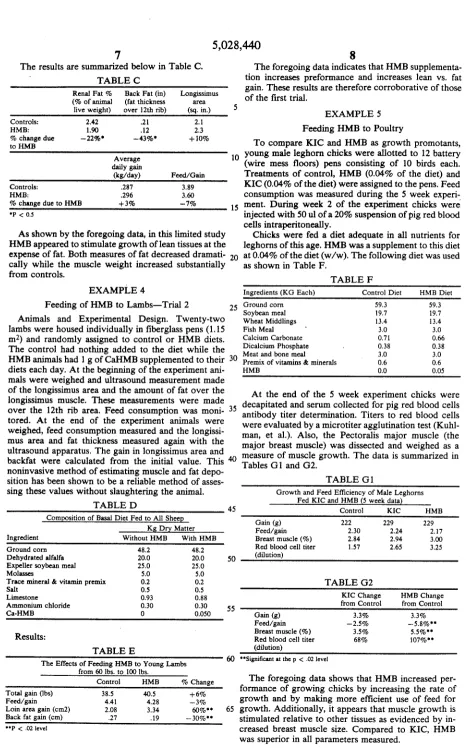
Animals and Experimental Design. Three sets of twin lambs were housed individually in ?berglass pens. Ani mals were randomly assigned to control or HMB diets, using Ca-HMB as the feed additive at a level of 0.5% of the basal diet.
TABLE B
Composition of Basal Diet Fed to All Sheep.
Kg Dry Matter
Ingredient Experiment 1
Ground com 84.4
Expeller soybean meal 5.]
Molasses 6.5
Trace mineral & vitamin premix 0.66
Salt 0.66
Limestone 2.1
5,028,440
7
8
The results are summarized below in Table C. - The fore oin data indicates that HMB n g g n supplementa - TABLE C tion increases preformance and increases lean vs. fat
R a! F t 7 B k F H, ) Lo _ _ gain. These results are therefore corroborative of those
en a 0 ac a in ngissimus -
(% ofanimal (fat thickness area of the ?rst “131'
live weight) over 12th rib) (sq. in.) 5 EXAMPLE 5
Co trols: 2.42 .21 2.l _
min. 1.90 .12 2.3 Fe?dmg HMB t0 Poultry
Z: we due 42%’ “43%, +10% To compare KIC and HMB as growth promotants,
young male leghorn chicks were allotted to 12 battery
Average 10 . - - .
daily gain (wire mess ?oors) pens consisting of 10 birds each.
(kg/day) Feed/Gain Treatments of control, HMB (0.04% of the diet) and
Controls: 18-, 189 KIC (0.04% of the diet) were assigned to the pens. Feed
HMB; .296 3,60 consumption was measured during the 5 week expeii-l
% chmse dueto HMB +3% —7% 15 merit. During week 2 of the experiment chicks were
‘P < 0.3 injected with 50 ul of a 20% suspension of pig red blood
cells intraperitoneally.
As shown by the foregoing data, in this limited study Chicks were fed a diet adequate in all nutrients for HMB appeared to stimulate growth of lean tissues at the leghorns of this age. HMB was a supplement to this diet expense of fat. Both measures of fat decreased dramati- 20 at 0.04% of the diet (w/w). The following diet was used cally while the muscle weight increased substantially as shown in Table F.
from controls. TABLE F
EXAMPLE 4 Ingredients (KG Each) Control Diet HMB Diet
Feeding of HMB to Lambs-Trial 2 25 Ground com 59.; 59.3
. _ _ Soybean meal 19. 19.7
Animals and Experimental Design. Twenty-two wheat Middlings 13,4 134 lambs were housed individually in ?berglass pens (1.15 Fish _Meal 3.0 3.0
m2) and randomly assigned to control or HMB diets.
8311211“?! cglll’mag
8g;
82‘;
The control had nothing added to the diet while the
Mlecatlug‘bongsgcaie
3:0
3:0
HMB animals had 1 g of Cal-1MB supplemented to their 30 premix of vitamins & minerals M 0,6
diets each day. At the beginning of the experiment ani- HMB 0.0 0.05 mals were weighed and ultrasound measurement made
10f thF iongmslmusl ar'flfhand the amount of fat Over the
At the end of the 5 week experiment chicks were
onglssrllmulsz
e‘
6;: measureme‘lts were mad? 35 decapitated and serum collected for pig red blood cells
oveiit Z L n dare?‘ heed con.sumptlon.wgls mom‘
antibody titer determination. Titers to red blood cells
‘or? fled tft 5 en 0
e expenmdent dumb“ I5 “fer?
were evaluated by a microtiter agglutination test (Kuhl
we‘g
’ eed ionsttxgligon measure dan
6 911615;"
man, et al.). Also, the Pectoralis major muscle (the
“ins areadan at t iirhess P1935111” ‘35am w“ t 3
major breast muscle) was dissected and weighed as a
u trasoun apparatus‘ c gam m oilglsfslmus area an. 40 measure of muscle growth. The data is summarized in
backfat were calculated from the initial value. This Tables G1 and G2_
noninvasive method of estimating muscle and fat depo
sition has been shown to be a reliable method of asses- TABLE G1
sing these values without slaughtering the animal. Growth and Feed Efficiency of Male Leghoms
Fed KIC and HMB (5 week data)
‘ I TABLE D 45 Control KIC HMB
Composition of Basal Diet Fed t?{Alll)SheI;pn Gain (g) 222 229 229
__._E.__r>'_____a er Feed/gain 2.30 2.24 2.17
Ingredient Without HMB With HMB Breast muscle (%) 2.84 2.94 3.00
Ground com 48.2 482 Reld blood cell titer 1.57 2.65 3.25 Dehydrated alfalfa 20.0 20.0 50 (d um“)
Expeller soybean meal 25.0 25.0
Molasses 5.0 5.0
Trace mineral & vitamin premix 0.2 0.2 TABLE G2
Salt 0.5 0.5
Limestone 0.93 0.88 KIC Chang‘ HMB change
Ammonium chloride 030 030 55 from Control from Control
ctr-HMB 0 0050 Gain (g) 3.3% 3.3%
Feed/gain -2.5% -5.B%"
Breast muscle (%) 3.5% 5.5%“
Results: Red blood cell titer 68% 107%"
dilution)
TABLE E <
The Effects of Feeding HMB to Young Lambs 60 sh} n m: p < '02 ‘eve!
from 60 lbs. to 100 lbs. _ _
comm} HMB % Change The foregoing data shows that HMB increased per
T m m (lbs) 38 5 405 67 formance of growing chicks by increasing the rate of
Fad/gain
4:41
4:28
:39;
growth and by making more efficient use of feed for
Loin area gain (cm2) 2.08 3.34 60%" 65 growth. Additionally, it appears that muscle growth is Back fat gain (cm) .27 .19 —30%" stimulated relative to other tissues as evidenced by in "P < .02 level creased breast muscle size. Compared to KIC, HMB
[image:7.557.44.510.0.749.2]5,028,440
9 .Feeding Periods
To obtain the advantages of the method and feed
compositions of this invention for selectively increasing
lean tissue formation while minimizing fat deposition in
the raising of meat producing animals, it will be pre
ferred to feed the animals the HMB on a daily basis while the animals are increasing in weight, and to con
tinue the feeding for at least 10 days and up to 180 days, depending on the animals being fed.
With beef cattle, for example, HMB
is preferably fed
for periods of at least 30 up to 180 days; with lambs, for
periods of at least 15 up to 100 days; for chickens, for periods of at least 10 up to 50 days, and for turkeys, for periods of at least 10 up to 100 days. The periods re
ferred to are when animals being raised are growing to
market weight sizes. The maximum advantage of HMB administration should be obtained when fat being de posited and time deposition have decreased, which usually occurs in the later portion of feeding before
marketing. Incorporation of HMB
in ?nishing rations is
therefore especially desirable.
I claim:
1. The method of raising meat producing domestic
animals to increase lean tissue development as shown by
muscle growth, said animals being selected from the
group consisting of beef cattle, lambs, and poultry,
comprising orally administering to said animals an ef
fective amount of B-hydroxy-B-methylbutyric acid or an edible salt thereof (HMB) to promote lean tissue
development as shown by muscle growth, said effective
amount being within the range from 0.05 to 500 milli
grams (mg) HMB
(Ca-HMB basis) per kilogram (kg) of
body weight per 24 hours, and said administration being
continued for a sufficient length of time to obtain a substantial increase in lean tissue.
2. The method of claim 1 in which the amount of said
HMB on the same basis is within the range from 0.5 to 100 mg.
3. The method of claim 1 or claim 2 in which said
HMB is administered by admixing with feed for said
animals, and the admixed feed is fed to the animals on a
regular repeated basis for an extended number of days
while the animals are increasing in weight.
4. The method of feeding beef cattle to increase lean tissue development as shown by muscle growth, com prising feeding to said beef cattle in admixture with a
10
20
25
30
35
45
55
65
10
protein-containing feed an effective amount of an edible
salt of B-hydroxy-B-methylbutyric acid (HMB) to pro
mote lean tissue development of said beef cattle as
shown by muscle growth, said effective amount being within the range from 0.05 to 500 milligrams (mg) HMB
(Ca-HMB basis) per kilogram (kg) of body weight per
24 hours, and said feeding being continued on a daily
basis for at least 30 days while said beef cattle are gain
ing weight. '
5. The method of claim 4 in which the amount of said HMB salt is Ca-HMB and on said basis is fed within the range from 0.5 to 100 mg.
6. The method of feeding lambs to increase lean tissue
development as evidenced by muscle growth, compris
ing feeding to said lambs in admixture with a protein
containing feed an effective amount of an edible salt of
B-hydroxy-B-methylbutyric acid (HMB) to promote
lean tissue development as shown by muscle growth,
said effective amount being within the range from 0.05
to 500 milligrams (mg) HMB (Ca-HMB basis) per kilo gram (kg) of body weight per 24 hours, and said feeding
being continued on a daily basis for at least 15 days
while said lambs are gaining weight.
7. The method of claim 6 in which said HMB is in the
form of its calcium salt (Ca-HMB) and said effective
amount of Ca-HMB is within the range from 0.5 to 100
mg.
8. The method of raising poultry for meat production
to increase the development of lean tissue as shown by
muscle growth, said poultry being selected from the
' group consisting of chickens and turkeys, comprising feeding said poultry an effective amount of an edible
salt of B-hydroxy-B-methylbutyric acid (HMB) to pro
mote lean tissue development as shown by muscle
growth, said effective amount being within the range from 0.05 to 500 milligrams (mg) HMB (Ca-HMB basis)
per kilogram (kg) of body weight per 24 hours, and said
feeding being continued on a daily basis for at least 10
days while said poultry are increasing in weight.
9. The method of claim 8 in which said HMB is in the form of its calcium salt (Ca-HMB) and said HMB is fed
in an amount from 0.5 to 100 mg on said basis. '
10. The method of claims 8 or 9 in which said poultry
are chickens.
11. The method of claims 8 or 9 in which said poultry
are turkeys.