Craig DeLancey
978-1-942341-43-7 print
This publication was made possible by a SUNY Innovative Instruction Technology Grant (IITG). IITG is a competitive grants program open to SUNY faculty and support staff across all disciplines. IITG encourages development of innovations that meet the Power of SUNY’s transformative vision.
Published by Open SUNY Textbooks
Milne Library
State University of New York at Geneseo Geneseo, NY 14454
This book was produced using Pressbooks.com, and PDF rendering was done by PrinceXML.
About the Textbook Reviewer's Notes
Adam Kovach
0. Introduction 1
Part I: Propositional Logic
1. Developing a Precise Language 7
2. “If…then….” and “It is not the case that….” 15
3. Good Arguments 29
4. Proofs 45
5. “And” 55
6. Conditional Derivations 69
7. “Or” 79
8. Reductio ad Absurdum 89
9. “… if and only if …”, Using Theorems 99
10. Summary of Propositional Logic 113
Part II: First Order Logic
11. Names and predicates 119
12. “All” and “some” 127
13. Reasoning with quantifiers 139
14. Universal derivation 147
15. Relations, functions, identity, and multiple quantifiers 159
16. Summary of first order logic 173
Part III: A Look Forward
17. Some advanced topics in logic 181
Bibliography 209
About the Author 210
True to its name,A Concise Introduction to Logic, by Craig DeLancey, surveys propositional logic and predicate logic and goes on to introduce selected advanced topics, in little over 200 pages. The book provides an integrated presentation of basic syntactic and semantic concepts and methods of logic. Part I starts with the concept of a formal language. The concept of valid inference, truth tables and proofs are introduced immediately after the first two propositional connectives. Connectives and inference rules are introduced in alternation, to develop a complete simple natural deduction system for propositional logic. Part II, adds the apparatus of quantification and proof rules for a complete predicate logic. The text covers the logic of relations, sentences with multiple quantifiers and Russell’s theory of definite descriptions. The presentation of concepts and principles is orderly, clear and thought provoking. Many topics are introduced with examples of philosophical arguments drawn from classic sources, adding depth of knowledge to an introductory course. The first two parts end with systematic overviews. The focus is on formal deductive logic throughout. Informal fallacies and traditional syllogistic logic are not covered. Advanced topics covered in the final part of the text include an axiomatic approach to logic, mathematical induction, a deduction theorem for propositional logic, and brief introductions to set theory, modal logic and number theory.
0.1 Why study logic?
Logic is one of the most important topics you will ever study.
“How could you say such a thing?” you might well protest. And yet, consider: logic teaches us many things, and one of these is how to recognize good and bad arguments.
Not just arguments about logic—anyargument.
Nearly every undertaking in life will ultimately require that you evaluate an argument, perhaps several. You are confronted with a question: Should I buy this car or that car? Should I go to this college or that college? Did that scientific experiment show what the scientist claims it did? Should I vote for the candidate who promises to lower taxes, or for the one who says she might raise them? And so on. Our lives are a long parade of choices. When we try to answer such questions, in order to make the best choices, we often have only one tool: an argument. We listen to the reasons for and against various options, and must choose between them. And so, the ability to evaluate arguments is an ability that is very useful in everything that you will do—in your work, your personal life, your deepest reflections.
If you are a student, note that nearly every discipline, be it a science, one of the humanities, or a study like business, relies upon arguments. Evaluating arguments is the most fundamental skill common to math, physics, psychology, literary studies, and any other intellectual endeavor. Logic alone tells you how to evaluate the arguments of any discipline.
The alternative to developing these logical skills is to be always at the mercy of bad reasoning and, as a result, you will make bad choices. Worse, you will always be manipulated by deceivers. Speaking in Canandaigua, New York, on August 3, 1857, the escaped slave and abolitionist leader Frederick Douglass observed that:
Power concedes nothing without a demand. It never did and it never will. Find out just what any people will quietly submit to and you have found out the exact measure of injustice and wrong which will be imposed upon them, and these will continue till they are resisted with either words or blows, or with both. The limits of tyrants are prescribed by the endurance of those whom they oppress.[1]
We can add to Frederick Douglass’s words that: find out just how much a person can be deceived, and that is just how far she will be deceived. The limits of tyrants are also prescribed by the reasoning abilities of those they aim to oppress. And what logic teaches you is how to demand and recognize good reasoning, and so how to avoid deceit. You are only as free as your powers of reasoning enable.
0.2 What is logic?
Some philosophers have argued that one cannot define “logic”. Instead, one can only show logic, by doing it and teaching others how to do it. I am inclined to agree. But it is easy to describe the benefits of logic. For example, in this book, you will learn how to:
• Evaluate reasons, and know when they should, and should not, be convincing;
• Describe things with a precision that avoids misunderstanding; • Get a sense of how one can construct the foundations of arithmetic; • Begin to describe the meaning of “possibility” and “necessity”.
That is by no means a complete list of the many useful things that logic can provide. Some of us believe that logic and mathematics are ultimately the same thing, two endeavors with the same underlying structure distinguished only by different starting assumptions. On such a view, we can also think of logic as the study of the ultimate foundations of mathematics. (This is a reasonable characterization of logic, but those afraid of mathematics need not fear: logic must become quite advanced before its relation to mathematics becomes evident.)
Ultimately, the only way to reveal the beauty and utility of logic is to get busy and do some logic. In this book, we will approach the study of logic by building several precise logical languages and seeing how we can best reason with these. The first of these languages is called “the propositional logic”.
0.3 A note to students
Logic is a skill. The only way to get good at understanding logic and at using logic is to practice. It is easy to watch someone explain a principle of logic, and easier yet to watch someone do a proof. But you must understand a principle well enough to be able to apply it to new cases, and you must be able to do new proofs on your own. Practice alone enables this.
The good news is that logic is easy. The very goal of logic is to take baby steps, small and simple and obvious, and after we do this for a long while we find ourselves in a surprising and unexpected new place. Each step on the way will be easy to take. Logic is a long distance walk, not a sprint. Study each small step we take, be sure you know how to apply the related skills, practice them, and then move on. Anyone who follows this advice can master logic.
0.4 A note to instructors
This book incorporates a number of features that come from many years of experience teaching both introductory and advanced logic.
First, the book moves directly to symbolic logic. I don’t believe that informal logic is worth the effort that it requires. Informal logic largely consists of memorization (memorizing seemingly disconnected rules, memorizing fallacies, and so on). Not only is this sure to be the kind of thing that students will promptly forget, but it completely obscures the simple beauty of why the various rules work, and why the fallacies are examples of bad reasoning. A student who learns symbolic logic, however, is learning a skill. Skills are retained longer; they encourage higher forms of reasoning; and they have far more power than a memorized
Second, this book focuses on some of the deeper features of logic, right at the beginning. The notions of semantics and syntax are introduced in the first chapter. Ideas liketheorem, and amodel, are discussed early on. My experience has shown that students can grasp these concepts, and they ultimately pay off well by greatly expanding their own understanding.
Third, this book uses examples, and constructs problems, from our intellectual history in order to illustrate key principles of logic. The author is a philosopher, and understands logic to be both the method of philosophy and also one of the four fundamental sub-disciplines of philosophy. But more importantly, these examples can do two things. They make it clear that arguments matter. Weighty concerns are discussed in these arguments, and whether we accept their conclusions will have significant effects on our society. Seeing this helps one to see the importance of logic. These examples can also make this book suitable for a logic course that aims to fulfill a requirement for an introduction to the history of thought, an overview of Western civilization, or the knowledge foundations of a related discipline.
Fourth, I follow a no-shortcuts principle. Most logic textbooks introduce a host of shortcuts. They drop outer parentheses, they teach methods for shrinking truth tables, and so on. These moves often confuse students, and for no good reason: they have no conceptual value. I suspect they only exist to spare the impatience of instructors, who would like to write expressions and truth tables more quickly. In this book, except in the last chapter that looks to advanced logic, we will not introduce exceptions to our syntax, nor will we spend time on abridged methods. The only exception is writing “TT” for trueand “FF” forfalsein truth tables.
Fifth, this book includes a final chapter introducing some advanced topics in logic. The purpose of this chapter is to provide students with some understanding of the exciting things that they can study if they continue with logic. In my experience, students imagine that advanced logic will be just more proofs in first order logic. Giving them a taste of what can come next is valuable. My hope is that this chapter will motivate students to want to study more logic, and also that it can serve as a bridge between their studies in basic logic and the study of advanced logic.
Finally, about typesetting: quotation is an important logical principle, and so I adopted the precise but comparatively rare practice of putting punctuation outside of quotes. This way, what appears in the quotations is alone what is being defined or otherwise mentioned. I use italics only to indicate the meaning of a concept, or to distinguish symbolic terms of the object language from functions of the object language. Bold is used to set aside elements of our metalanguage or object language.
0.5 Contact
The author would appreciate any comments, advice, or discoveries of errata. He can be contacted at: [email protected]
Dave Barker-Plummer, and Richard Zach.
Thanks to two reviewers for the Open SUNY Textbook program; and to Allison Brown and the other people who help make the Open SUNY Textbook program work; and to Carol Kunzer, Karen Gelles, and Carrie Fishner for copy editing the text. Thanks to Derek Bullard for catching some errata.
[1] From Blassingame (1985: 204), in a speech titled “The Significance of Emancipation in the West Indies.”
1.1 Starting with sentences
We begin the study of logic by building a precise logical language. This will allow us to do at least two things: first, to say some things more precisely than we otherwise would be able to do; second, to study reasoning. We will use a natural language—English—as our guide, but our logical language will be far simpler, far weaker, but more rigorous than English.
We must decide where to start. We could pick just about any part of English to try to emulate: names, adjectives, prepositions, general nouns, and so on. But it is traditional, and as we will see, quite handy, to begin with whole sentences. For this reason, the first language we will develop is called “the propositional logic”. It is also sometimes called “the sentential logic” or even “the sentential calculus”. These all mean the same thing: the logic of sentences. In this propositional logic, the smallest independent parts of the language are sentences (throughout this book, I will assume that sentences and propositions are the same thing in our logic, and I will use the terms “sentence” and “proposition” interchangeably).
There are of course many kinds of sentences. To take examples from our natural language, these include:
What time is it?
Open the window.
Damn you!
I promise to pay you back.
It rained in Central Park on June 26, 2015.
We could multiply such examples. Sentences in English can be used to ask questions, give commands, curse or insult, form contracts, and express emotions. But, the last example above is of special interest because it aims to describe the world. Such sentences, which are sometimes called “declarative sentences”, will be our model sentences for our logical language. We know a declarative sentence when we encounter it because it can be either true or false.
1.2 Precision in sentences
We want our logic of declarative sentences to be precise. But what does this mean? We can help clarify how we might pursue this by looking at sentences in a natural language that are perplexing, apparently because they are not precise. Here are three.
Tom is kind of tall.
When Karen had a baby, her mother gave her a pen.
This sentence is false.
We have already observed that an important feature of our declarative sentences is that they can be true or false. We call this the “truth value” of the sentence. These three sentences are perplexing because their truth values are unclear. The first sentence is vague, it is not clear under what conditions it would be true, and under what conditions it would be false. If Tom is six feet tall, is he kind of tall? There is no clear answer. The second sentence is ambiguous. If “pen” means writing implement, and Karen’s mother bought a playpen for the baby, then the sentence is false. But until we know what “pen” means in this sentence, we cannot tell if the sentence is true.
The third sentence is strange. Many logicians have spent many years studying this sentence, which is traditionally called “the Liar”. It is related to an old paradox about a Cretan who said, “All Cretans are liars”. The strange thing about the Liar is that its truth value seems to explode. If it is true, then it is false. If it is false, then it is true. Some philosophers think this sentence is, therefore, neither true nor false; some philosophers think it is both true and false. In either case, it is confusing. How could a sentence that looks like a declarative sentence have both or no truth value?
Since ancient times, philosophers have believed that we will deceive ourselves, and come to believe untruths, if we do not accept a principle sometimes called “bivalence”, or a related principle called “the principle of non-contradiction”. Bivalence is the view that there are only two truth values (true and false) and that they exclude each other. The principle of non-contradiction states that you have made a mistake if you both assert and deny a claim.
One or the other of these principles seems to be violated by the Liar.
We can take these observations for our guide: we want our language to have no vagueness and no ambiguity. In our propositional logic, this means we want it to be the case that each sentence is either true or false. It will not be kind of true, or partially true, or true from one perspective and not true from another. We also want to avoid things like the Liar. We do not need to agree on whether the Liar is both true and false, or neither true nor false. Either would be unfortunate. So, we will specify that our sentences have neither vice.
We can formulate our own revised version of the principle of bivalence, which states that:
Principle of Bivalence: Each sentence of our language must be either true or false, not both, not neither.
This requirement may sound trivial, but in fact it constrains what we do from now on in interesting and even surprising ways. Even as we build more complex logical languages later, this principle will be fundamental.
start somewhere, and the principle of bivalence is an intuitive way and—it would seem—the simplest way to start with respect to truth values. Learn basic logic first, and then you can explore these alternatives.
This points us to an important feature, and perhaps a mystery, of logic. In part, what a logical language shows us is the consequences of our assumptions. That might sound trivial, but, in fact, it is anything but. From very simple assumptions, we will discover new, and ultimately shocking, facts. So, if someone wants to study a logical language where we reject the principle of bivalence, they can do so. The difference between what they are doing, and what we will do in the following chapters, is that they will discover the consequences of rejecting the principle of bivalence, whereas we will discover the consequences of adhering to it. In either case, it would be wise to learn traditional logic first, before attempting to study or develop an alternative logic.
We should note at this point that we are not going to try to explain what “true” and “false” mean, other than saying that “false” means not true. When we add something to our language without explaining its meaning, we call it a “primitive”. Philosophers have done much to try to understand what truth is, but it remains quite difficult to define truth in any way that is not controversial. Fortunately, takingtrueas a primitive will not get us into trouble, and it appears unlikely to make logic mysterious. We all have some grasp of what “true” means, and this grasp will be sufficient for our development of the propositional logic.
1.3 Atomic sentences
Our language will be concerned with declarative sentences, sentences that are either true or false, never both, and never neither. Here are some example sentences.
2+2=4.
Malcolm Little is tall.
If Lincoln wins the election, then Lincoln will be President.
The Earth is not the center of the universe.
These are all declarative sentences. These all appear to satisfy our principle of bivalence. But they differ in important ways. The first two sentences do not have sentences as parts. For example, try to break up the first sentence. “2+2” is a function. “4” is a name. “=4” is a meaningless fragment, as is “2+”. Only the whole expression, “2+2=4”, is a sentence with a truth value. The second sentence is similar in this regard. “Malcolm Little” is a name. “is tall” is an adjective phrase (we will discover later that logicians call this a “predicate”). “Malcolm Little is” or “is tall” are fragments, they have no truth value.[2]Only “Malcolm Little is tall” is a complete sentence.
possible thing. (The fact that we now talk of having “split the atom” just goes to show that we changed the meaning of the word “atom”. We came to use it as a name for a particular kind of thing, which then turned out to have parts, such as electrons, protons, and neutrons.) In logic, the idea of an atomic sentence is of a sentence that can have no parts that are sentences.
In reasoning about these atomic sentences, we could continue to use English. But for reasons that become clear as we proceed, there are many advantages to coming up with our own way of writing our sentences. It is traditional in logic to use upper case letters from Pon (P,Q,R,S….) to stand for atomic sentences. Thus, instead of writing
Malcolm Little is tall.
We could write
P
If we want to know how to translate Pto English, we can provide a translation key. Similarly, instead of writing
Malcolm Little is a great orator.
We could write
Q
And so on. Of course, written in this way, all we can see about such a sentence is that it is a sentence, and that perhapsPandQare different sentences. But for now, these will be sufficient.
Note that not all sentences are atomic. The third sentence in our four examples above contains parts that are sentences. It contains the atomic sentence, “Lincoln wins the election” and also the atomic sentence, “Lincoln will be President”. We could represent this whole sentence with a single letter. That is, we could let
If Lincoln wins the election, Lincoln will be president.
be represented in our logical language by
S
However, this would have the disadvantage that it would hide some of the sentences that are inside this sentence, and also it would hide their relationship. Our language would tell us more if we could capture the relation between the parts of this sentence, instead of hiding them. We will do this in chapter 2.
1.4 Syntax and semantics
does not concern itself with what the elements of the language mean, but just specifies how they can be written out.
We can make a similar distinction (though not exactly the same) in a natural language. This expression in English has an uncertain meaning, but it has the right “shape” to be a sentence:
Colorless green ideas sleep furiously.
In other words, in English, this sentence is syntactically correct, although it may express some kind of meaning error.
An expression made with the parts of our language must have correct syntax in order for it to be a sentence. Sometimes, we also call an expression with the right syntactic form a “well-formed formula”.
We contrast syntax with semantics. “Semantics” refers to the meaning of an expression of our language. Semantics depends upon the relation of that element of the language to something else. For example, the truth value of the sentence, “The Earth has one moon” depends not upon the English language, but upon something exterior to the language. Since the self-standing elements of our propositional logic are sentences, and the most important property of these is their truth value, the only semantic feature of sentences that will concern us in our propositional logic is their truth value.
Whenever we introduce a new element into the propositional logic, we will specify its syntax and its semantics. In the propositional logic, the syntax is generally trivial, but the semantics is less so. We have so far introduced atomic sentences. The syntax for an atomic sentence is trivial. IfPis an atomic sentence, then it is syntactically correct to write down
P
By saying that this is syntactically correct, we are not saying thatPis true. Rather, we are saying thatPis a sentence.
If semantics in the propositional logic concerns only truth value, then we know that there are only two possible semantic values forP; it can be either true or false. We have a way of writing this that will later prove helpful. It is called a “truth table”. For an atomic sentence, the truth table is trivial, but when we look at other kinds of sentences their truth tables will be more complex.
The idea of a truth table is to describe the conditions in which a sentence is true or false. We do this by identifying all the atomic sentences that compose that sentence. Then, on the left side, we stipulate all the possible truth values of these atomic sentences and write these out. On the right side, we then identify under what conditions the sentence (that is composed of the other atomic sentences) is true or false.
Atomic sentence(s) that compose
the dependent sentence on the right Dependent sentence composed of the atomicsentences on the left All possible combinations of truth
values of the composing atomic sentences
Resulting truth values for each possible combination of truth values of the composing atomic sentences
We stipulate all the possible truth values on the bottom left because the propositional logic alone will not determine whether an atomic sentence is true or false; thus, we will simply have to consider both possibilities. Note that there are many ways that an atomic sentence can be true, and there are many ways that it can be false. For example, the sentence, “Tom is American” might be true if Tom was born in New York, in Texas, in Ohio, and so on. The sentence might be false because Tom was born to Italian parents in Italy, to French parents in France, and so on. So, we group all these cases together into two kinds of cases.
These are two rows of the truth table for an atomic sentence. Each row of the truth table represents a kind of way that the world could be. So here is the left side of a truth table with only a single atomic sentence,P. We will write “TT” fortrueand “FF” forfalse.
P
T T FF
There are only two relevant kinds of ways that the world can be, when we are considering the semantics of an atomic sentence. The world can be one of the many conditions such thatPis true, or it can be one of the many conditions such thatPis false.
To complete the truth table, we place the dependent sentence on the top right side, and describe its truth value in relation to the truth value of its parts. We want to identify the semantics ofP, which has only one part,P. The truth table thus has the final form:
P P
T T TT FF FF
This truth table tells us the meaning ofP, as far as our propositional logic can tell us about it. Thus, it gives us the complete semantics forP. (As we will see later, truth tables have three uses: to provide the semantics for a kind of sentence; to determine under what conditions a complex sentence is true or false; and to determine if an argument is good. Here we are describing only this first use.)
One last tool will be helpful to us. Strictly speaking, what we have done above is give the syntax and semantics for a particular atomic sentence, P. We need a way to make general claims about all the sentences of our language, and then give the syntax and semantics for any atomic sentences. We do this using variables, and here we will use Greek letters for those variables, such as Φand Ψ. Things said using these variables is called our “metalanguage”,which means literally the after language, but which we take to mean, our language about our language. The particular propositional logic that we create is called our “object language”. Pand Qare sentences of our object language. Φand Ψare elements of our metalanguage. To specify now the syntax of atomic sentences (that is, of all atomic sentences) we can say: IfΦis an atomic sentence, then
Φ
is a sentence. This tells us that simply writingΦdown (whatever atomic sentence it may be), as we have just done, is to write down something that is syntactically correct.
To specify now the semantics of atomic sentences (that is, of all atomic sentences) we can say: IfΦis an atomic sentence, then the semantics ofΦis given by
Φ Φ
T T TT FF FF
Note an important and subtle point. The atomic sentences of our propositional logic will be what we call “contingent” sentences. A contingent sentence can be either true or false. We will see later that some complex sentences of our propositional logic must be true, and some complex sentences of our propositional logic must be false. But for the propositional logic, every atomic sentence is (as far as we can tell using the propositional logic alone) contingent. This observation matters because it greatly helps to clarify where logic begins, and where the methods of another discipline ends. For example, suppose we have an atomic sentence like:
Force is equal to mass times acceleration.
Igneous rocks formed under pressure.
Germany inflated its currency in 1923 in order to reduce its reparations debt.
Logic cannot tell us whether these are true or false. We will turn to physicists, and use their methods, to evaluate the first claim. We will turn to geologists, and use their methods, to evaluate the second claim. We will turn to historians, and use their methods, to evaluate the third claim. But the logician can tell the physicist, geologist, and historian what follows from their claims.
1.5 Problems
1. Vagueness arises when the conditions under which a sentence might be true are
say, “Tom is tall”, this sentence is certainly true if Tom is the tallest person in the world, but it is not clear whether it is true if Tom is 185 centimeters tall. Identify or create five declarative sentences in English that are vague.
2. Ambiguity usually arises when a word or phrase has several distinct possible
interpretations. In our example above, the word “pen” could mean either a writing implement or a structure to hold a child. A sentence that includes “pen” could be ambiguous, in which case it might be true for one interpretation and false for another.
Identify or create five declarative sentences in English that are ambiguous. (This will probably require you to identify a homonym, a word that has more than one meaning but sounds or is written the same. If you are stumped, consider slang: many slang terms are ambiguous because they redefine existing words. For example, in the 1980s, in some communities and contexts, to say something was “bad” meant that it was good; this obviously can create ambiguous sentences.)
3. Often we can make a vague sentence precise by defining a specific interpretation of the meaning of an adjective, term, or other element of the language. For example, we could make the sentence “Tom is tall” precise by specifying one person referred to by “Tom”, and also by defining “…is tall” as true of anyone 180 centimeters tall or taller.
For each of the five vague sentences that you identified or created for problem 1, describe how the interpretation of certain elements of the sentence could make the sentence no longer vague.
4. Often we can make an ambiguous sentence precise by specifying which of the possible meanings we intend to use. We could make the sentence, “Tom is by the pen”
unambiguous by specifying which Tom we mean, and also defining “pen” to mean an infant play pen. For each of the five ambiguous sentences that you identified or created for problem 2, identify and describe how the interpretation of certain elements of the sentence could make the sentence no longer ambiguous.
5. Come up with five examples of your own of English sentences that are not declarative sentences. (Examples can include commands, exclamations, and promises.)
that….”
2.1 The Conditional
As we noted in chapter 1, there are sentences of a natural language, like English, that are not atomic sentences. Our examples included
If Lincoln wins the election, then Lincoln will be President.
The Earth is not the center of the universe.
We could treat these like atomic sentences, but then we would lose a great deal of important information. For example, the first sentence tells us something about the relationship between the atomic sentences “Lincoln wins the election” and “Lincoln will be President”. And the second sentence above will, one supposes, have an interesting relationship to the sentence, “The Earth is the center of the universe”. To make these relations explicit, we will have to understand what “if…then…” and “not” mean. Thus, it would be useful if our logical language was able to express these kinds of sentences in a way that made these elements explicit. Let us start with the first one.
The sentence, “If Lincoln wins the election, then Lincoln will be President” contains two atomic sentences, “Lincoln wins the election” and “Lincoln will be President”. We could thus represent this sentence by letting
Lincoln wins the election
be represented in our logical language by
P
And by letting
Lincoln will be president
be represented by
Q
Then, the whole expression could be represented by writing
IfPthenQ
It will be useful, however, to replace the English phrase “if…then…” by a single symbol in our language. The most commonly used such symbol is “→”. Thus, we would write
P→Q
One last thing needs to be observed, however. We might want to combine this complex sentence with other sentences. In that case, we need a way to identify that this is a single sentence when it is combined with other sentences. There are several ways to do this, but the most familiar (although not the most elegant) is to use parentheses. Thus, we will write our expression
(P→Q)
This kind of sentence is called a “conditional”. It is also sometimes called a “material conditional”. The first constituent sentence (the one before the arrow, which in this example is “P”) is called the “antecedent”. The second sentence (the one after the arrow, which in this example is “Q”) is called the “consequent”.
We know how to write the conditional, but what does it mean? As before, we will take the meaning to be given by the truth conditions—that is, a description of when the sentence is either true or false. We do this with a truth table. But now, our sentence has two parts that are atomic sentences,PandQ. Note that either atomic sentence could be true or false. That means, we have to consider four possible kinds of situations. We must consider when Pis true and when it is false, but then we need to consider those two kinds of situations twice: once for whenQis true and once for whenQis false. Thus, the left hand side of our truth table will look like this:
P Q
T T TT T T FF FF TT FF FF
There are four kinds of ways the world could be that we must consider.
Note that, since there are two possible truth values (true and false), whenever we consider another atomic sentence, there are twice as many ways the world could be that we should consider. Thus, for n atomic sentences, our truth table must have 2nrows. In the case of a conditional formed out of two atomic sentences, like our example of (P→Q), our truth table will have 22rows, which is 4 rows. We see this is the case above.
Now, we must decide upon what the conditional means. To some degree this is up to us. What matters is that once we define the semantics of the conditional, we stick to our definition. But we want to capture as much of the meaning of the English “if…then…” as we can, while remaining absolutely precise in our language.
Lincoln wins the election, then Lincoln will be President”? Most people agree that I would have. Similarly, suppose that Lincoln wins the election, but Lincoln will not be President. Would the sentence “If Lincoln wins the election, then Lincoln will be President” still be true? Most agree that it would be false now. So the first rows of our truth table are uncontroversial.
P Q (P→Q)
T
T TT TT T
T FF FF FF TT FF FF
Some students, however, find it hard to determine what truth values should go in the next two rows. Note now that our principle of bivalence requires us to fill in these rows. We cannot leave them blank. If we did, we would be saying that sometimes a conditional can have no truth value; that is, we would be saying that sometimes, some sentences have no truth value. But our principle of bivalence requires that—in all kinds of situations—every sentence is either true or false, never both, never neither. So, if we are going to respect the principle of bivalence, then we have to put eitherTTorFFin for each of the last two rows. It is helpful at this point to change our example. Let us consider two different examples to illustrate how best to fill out the remainder of the truth table for the conditional.
First, suppose I say the following to you: “If you give me $50, then I will buy you a ticket to the concert tonight.” Let
You give me $50
be represented in our logic by
R
and let
I will buy you a ticket to the concert tonight.
be represented by
S
Our sentence then is
(R→S)
R S (R→S)
T
T T TT T
T FF FF FF TT FF FF
That is, if you give me the money and I buy you the ticket, my claim that “If you give me $50, then I will buy you a ticket to the concert tonight” is true. And, if you give me the money and I don’t buy you the ticket, I lied, and my claim is false. But now, suppose you do not give me $50, but I buy you a ticket for the concert as a gift. Was my claim false? No. I simply bought you the ticket as a gift, but, presumably would have bought it if you gave me the money, also. Similarly, if you don’t give me money, and I do not buy you a ticket, that seems perfectly consistent with my claim.
So, the best way to fill out the truth table is as follows.
R S (R→S)
TT TT TT TT FF FF FF TT TT FF FF TT
Second, consider another sentence, which has the advantage that it is very clear with respect to these last two rows. Assume thataais a particular natural number, only you and I don’t know what number it is (the natural numbers are the whole positive numbers: 1, 2, 3, 4…).
Consider now the following sentence.
Ifaais evenly divisible by 4, thenaais evenly divisible by 2.
(By “evenly divisible,” I mean divisible without remainder.) The first thing to ask yourself is: is this sentence true? I hope we can all agree that it is—even though we do not know whataais. Let
aais evenly divisible by 4 be represented in our logic by
U
and let
V
Our sentence then is
(U→V)
And its truth table—as far as we understand right now—is:
U V (U→V)
T
T TT TT T
T FF FF FF TT FF FF
Now consider a case in whichaais 6. This is like the third row of the truth table. It is not the case that 6 is evenly divisible by 4, but it is the case that 6 is evenly divisible by 2. And consider the case in whichaais 7. This is like the fourth row of the truth table; 7 would be evenly divisible by neither 4 nor 2. But we agreed that the conditional is true—regardless of the value ofaa! So, the truth table must be:[3]
U V (U→V)
T
T TT TT T
T FF FF FF TT TT FF FF TT
Following this pattern, we should also fill out our table about the election with:
P Q (P→Q)
T
T TT TT T
T FF FF FF TT TT FF FF TT
If you are dissatisfied by this, it might be helpful to think of these last two rows as vacuous cases. A conditional tells us about what happens if the antecedent is true. But when the antecedent is false, we simply default to true.
We are now ready to offer, in a more formal way, the syntax and semantics for the conditional.
(Φ→Ψ)
is a sentence.
The semantics of the conditional are given by a truth table. For any sentencesΦandΨ:
Φ Ψ (Φ→Ψ)
T
T TT TT T
T FF FF FF TT TT FF FF TT
Remember that this truth table is now a definition. It defines the meaning of “→”. We are agreeing to use the symbol “→” to mean this from here on out.
The elements of the propositional logic, like “→”, that we add to our language in order to form more complex sentences, are called “truth functional connectives”. I hope it is clear why: the meaning of this symbol is given in a truth function. (If you are unfamiliar or uncertain about the idea of a function, think of a function as like a machine that takes in one or more inputs, and always then gives exactly one output. For the conditional, the inputs are two truth values; and the output is one truth value. For example, putTT FFinto the truth function called “→”, and you get outFF.)
2.2 Alternative phrasings in English for the conditional. Only if.
English includes many alternative phrasings that appear to be equivalent to the conditional. Furthermore, in English and other natural languages, the order of the conditional will sometimes be reversed. We can capture the general sense of these cases by recognizing that each of the following phrasings would be translated as(P→Q). (In these examples, we mix English and our propositional logic, in order to illustrate the variations succinctly.)
IfP, thenQ.
Q, ifP.
On the condition thatP,Q.
Q, on the condition thatP.
Given thatP,Q.
Q, given thatP.
Provided thatP,Q.
WhenP, thenQ.
Q, whenP.
PimpliesQ.
Qis implied byP.
Pis sufficient forQ.
Qis necessary forP.
An oddity of English is that the word “only” changes the meaning of “if”. You can see this if you consider the following two sentences.
Fifi is a cat, if Fifi is a mammal.
Fifi is a cat only if Fifi is a mammal.
Suppose we know Fifi is an organism, but, we don’t know what kind of organism Fifi is. Fifi could be a dog, a cat, a gray whale, a ladybug, a sponge. It seems clear that the first sentence is not necessarily true. If Fifi is a gray whale, for example, then it is true that Fifi is a mammal, but false that Fifi is a cat; and so, the first sentence would be false. But the second sentence looks like it must be true (given what you and I know about cats and mammals).
We should thus be careful to recognize that “only if” does not mean the same thing as “if”. (If it did, these two sentences would have the same truth value in all situations.) In fact, it seems that “only if” can best be expressed by a conditional where the “only if” appears before the consequent (remember, the consequent is the second part of the conditional—the part that the arrows points at). Thus, sentences of this form:
Ponly ifQ.
Only ifQ,P.
are best expressed by the formula
(P→Q)
2.3 Test your understanding of the conditional
People sometimes find conditionals confusing. In part, this seems to be because some people confuse them with another kind of truth-functional connective, which we will learn about later, called the “biconditional”. Also, sometimes “if…then…” is used in English in a different way (see section 17.7 if you are curious about alternative possible meanings). But from now on, we will understand the conditional as described above. To test whether you have properly grasped the conditional, consider the following puzzle.[4]
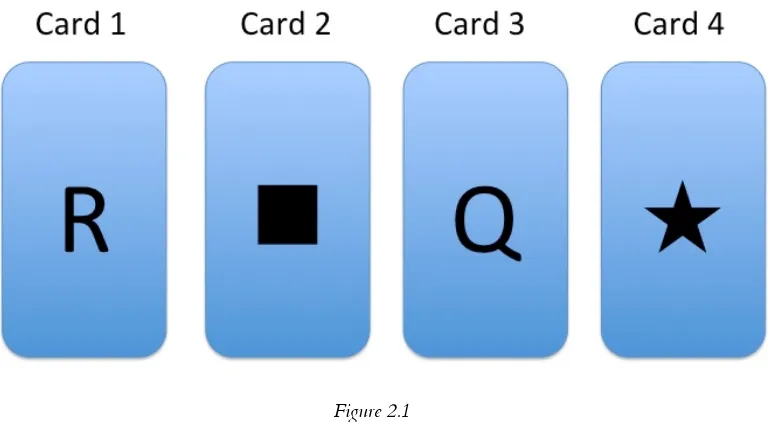
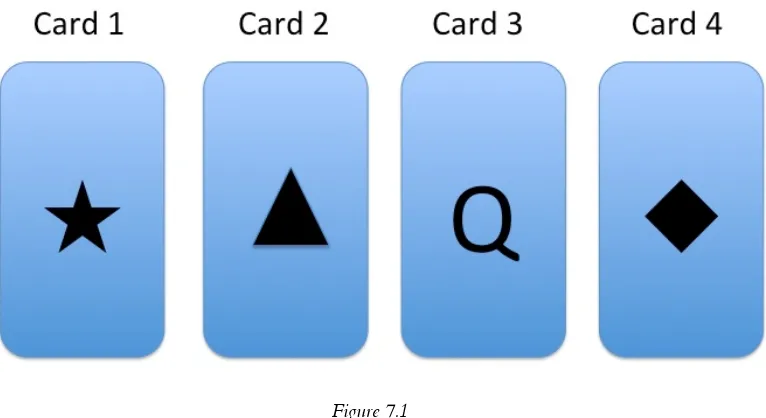
shape on one side, and a letter on the other side. We shuffle and mix the cards, flipping some over while we shuffle. Then, we lay out the four cards:
Figure 2.1
Given our constraint that each card has a letter on one side and a shape on the other, we know that card 1 has a shape on the unseen side; card 2 has a letter on the unseen side; and so on.
Consider now the following claim:
For each of these four cards, if the card has a Q on the letter side of the card, then it has a square on the shape side of the card.
Here is our puzzle: what is the minimum number of cards that we must turn over to test whether this claim is true of all four cards; and which cards are they that we must turn over? Of course we could turn them all over, but the puzzle asks you to identify all and only the cards that will test the claim.
Stop reading now, and see if you can decide on the answer. Be warned, people generally perform poorly on this puzzle. Think about it for a while. The answer is given below in problem 1.
2.4 Alternative symbolizations for the conditional
Some logic books, and some logicians, use alternative symbolizations for the various truth-functional connectives. The meanings (that is, the truth tables) are always the same, but the symbol used may be different. For this reason, we will take the time in this text to briefly recognize alternative symbolizations.
The conditional is sometimes represented with the following symbol: “⊃”. Thus, in such a case,(P→Q)would be written
2.5 Negation
In chapter 1, we considered as an example the sentence,
The Earth is not the center of the universe.
At first glance, such a sentence might appear to be fundamentally unlike a conditional. It does not contain two sentences, but only one. There is a “not” in the sentence, but it is not connecting two sentences. However, we can still think of this sentence as being constructed with a truth functional connective, if we are willing to accept that this sentence is equivalent to the following sentence.
It is not the case that the Earth is the center of the universe.
If this sentence is equivalent to the one above, then we can treat “It is not the case” as a truth functional connective. It is traditional to replace this cumbersome English phrase with a single symbol, “¬”. Then, mixing our propositional logic with English, we would have
¬The Earth is the center of the universe.
And if we letWbe a sentence in our language that has the meaningThe Earth is the center of the universe, we would write
¬W
This connective is called “negation”. Its syntax is: if Φ is a sentence, then
¬Φ
is a sentence. We call such a sentence a “negation sentence”.
The semantics of a negation sentence is also obvious, and is given by the following truth table.
Φ ¬Φ
T T FF FF TT
To deny a true sentence is to speak a falsehood. To deny a false sentence is to say something true.
2.6 Alternative symbolizations for negation
Some texts may use “~” for negation. Thus,¬Pwould be expressed with
~P
2.7 Problems
1. The answer to our card game was: you need only turn over cards 3 and 4. This might seem confusing to many people at first. But remember the meaning of the conditional:
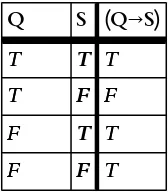
it can only be false if the first part is true and the second part is false. The sentence we want to test is “For each of these four cards, if the card has a Q on the letter side of the card, then it has a square on the shape side of the card”. LetQstand for “the card has a Q on the letter side of the card.” LetSstand for “the card has a square on the shape side of the card.” Then we could make a truth table to express the meaning of the claim being tested:
Q S (Q→S)
TT TT TT TT FF FF FF TT TT FF FF TT
[image:36.612.264.348.269.367.2]Look back at the cards. The first card has an R on the letter side. So, sentence Qis false. But then we are in a situation like the last two rows of the truth table, and the conditional cannot be false. We do not need to check that card. The second card has a square on it. That meansSis true for that card. But then we are in a situation represented by either the first or third row of the truth table. Again, the claim that(Q→S)cannot be false in either case with respect to that card, so there is no point in checking that card. The third card shows a Q. It corresponds to a situation that is like either the first or second row of the truth table. We cannot tell then whether(Q→S)is true or false of that card, without turning the card over. Similarly, the last card shows a situation where Sis false, so we are in a kind of situation represented by either the second or last row of the truth table. We must turn the card over to determine if(Q→S)is true or false of that card.
Try this puzzle again. Consider the following claim about those same four cards: If there is a star on the shape side of the card, then there is an R on the letter side of the card. What is the minimum number of cards that you must turn over to check this claim? What cards are they?
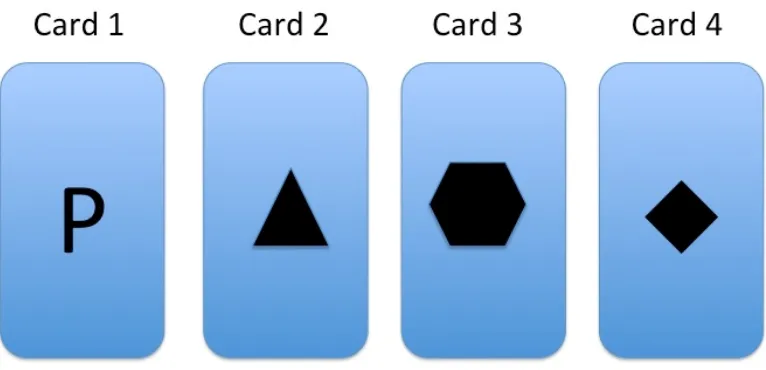
2. Consider the following four cards in figure 2.2. Each card has a letter on one side, and a shape on the other side.
For each of the following claims, in order to determine if the claim is true of all four cards, describe (1) The minimum number of cards you must turn over to check the claim, and (2) what those cards are.
Figure 2.2
b. There is not an octagon on the shape side of the card.
c. If there is a triangle on the shape side of the card, then there is a P on the letter side of the card.
d. There is an R on the letter side of the card only if there is a diamond on the shape side of the card.
e. There is a hexagon on the shape side of the card, on the condition that there is a P on the letter side of the card.
f. There is a diamond on the shape side of the card only if there is a P on the letter side of the card.
3. Which of the following have correct syntax? Which have incorrect syntax?
a. P→Q b. ¬(P→Q) c. (¬P→Q) d. (P¬→Q) e. (P→¬Q)
4. Use the following translation key to translate the following sentences into a propositional logic.
Translation Key
Logic English
P Abe is able.
Q Abe is honest.
b. Abe is not able.
c. Abe is not able only if Abe is not honest. d. Abe is able, provided that Abe is not honest. e. If Abe is not able then Abe is not honest.
5. Make up your own translation key to translate the following sentences into a propositional logic. Then, use your key to translate the sentences into the propositional logic. Your translation key should contain only atomic sentences. These should be all and only the atomic sentences needed to translate the following sentences of English. Don’t let it bother you that some of the sentences must be false.
a. Josie is a cat. b. Josie is a mammal. c. Josie is not a mammal.
d. If Josie is not a cat, then Josie is not a mammal. e. Josie is a fish.
f. Provided that Josie is a mammal, Josie is not a fish. g. Josie is a cat only if Josie is a mammal.
h. Josie is a fish only if Josie is not a mammal. i. It’s not the case that Josie is not a mammal. j. Josie is not a cat, if Josie is a fish.
6. This problem will make use of the principle that our syntax is recursive. Translating these sentences is more challenging. Make up your own translation key to translate the following sentences into a propositional logic. Your translation key should contain only atomic sentences; these should be all and only the atomic sentences needed to translate the following sentences of English.
a. It is not the case that Tom won’t pass the exam. b. If Tom studies, Tom will pass the exam.
c. It is not the case that if Tom studies, then Tom will pass the exam. d. If Tom does not study, then Tom will not pass the exam.
e. If Tom studies, Tom will pass the exam—provided that he wakes in time. f. If Tom passes the exam, then if Steve studies, Steve will pass the exam.
g. It is not the case that if Tom passes the exam, then if Steve studies, Steve will pass the exam.
h. If Tom does not pass the exam, then if Steve studies, Steve will pass the exam. i. If Tom does not pass the exam, then it is not the case that if Steve studies, Steve will
pass the exam.
j. If Tom does not pass the exam, then if Steve does not study, Steve won’t pass the exam.
a. (R→S) b. ¬¬R c. (S→R) d. (¬S→¬R) e. ¬(R→S)
3.1 A historical example
An important example of excellent reasoning can be found in the case of the medical advances of the Nineteenth Century physician, Ignaz Semmelweis. Semmelweis was an obstetrician at the Vienna General Hospital. Built on the foundation of a poor house, and opened in 1784, the General Hospital is still operating today. Semmelweis, during his tenure as assistant to the head of one of two maternity clinics, noticed something very disturbing. The hospital had two clinics, separated only by a shared anteroom, known as the First and the Second Clinics. The mortality rate for mothers delivering babies in the First Clinic, however, was nearly three times as bad as the mortality for mothers in the Second Clinic (9.9 % average versus 3.4% average). The same was true for the babies born in the clinics: the mortality rate in the First Clinic was 6.1% versus 2.1% at the Second Clinic.[5] In nearly all these cases, the deaths were caused by what appeared to be the same illness, commonly called “childbed fever”. Worse, these numbers actually understated the mortality rate of the First Clinic, because sometimes very ill patients were transferred to the general treatment portion of the hospital, and when they died, their death was counted as part of the mortality rate of the general hospital, not of the First Clinic.
Semmelweis set about trying to determine why the First Clinic had the higher mortality rate. He considered a number of hypotheses, many of which were suggested by or believed by other doctors.
One hypothesis was that cosmic-atmospheric-terrestrial influences caused childbed fever. The idea here was that some kind of feature of the atmosphere would cause the disease. But, Semmelweis observed, the First and Second Clinics were very close to each other, had similar ventilation, and shared a common anteroom. So, they had similar atmospheric conditions. He reasoned: If childbed fever is caused by cosmic-atmospheric-terrestrial influences, then the mortality rate would be similar in the First and Second Clinics. But the mortality rate was not similar in the First and Second Clinics. So, the childbed fever was not caused by cosmic-atmospheric-terrestrial influences.
Another hypothesis was that overcrowding caused the childbed fever. But, if overcrowding caused the childbed fever, then the more crowded of the two clinics should have the higher mortality rate. But, the Second Clinic was more crowded (in part because, aware of its lower mortality rate, mothers fought desperately to be put there instead of in the First Clinic). It did not have a higher mortality rate. So, the childbed fever was not caused by overcrowding.
Another hypothesis was that fear caused the childbed fever. In the Second Clinic, the priest delivering last rites could walk directly to a dying patient’s room. For reasons of the layout of the rooms, the priest delivering last rites in the First Clinic walked by all the rooms, ringing a bell announcing his approach. This frightened patients; they could not tell if the priest was coming for them. Semmelweis arranged a different route for the priest and asked him to silence his bell. He reasoned: if the higher rate of childbed fever was caused by fear of death resulting from the priest’s approach, then the rate of childbed fever should decline
if people could not tell when the priest was coming to the Clinic. But it was not the case that the rate of childbed fever declined when people could not tell if the priest was coming to the First Clinic. So, the higher rate of childbed fever in the First Clinic was not caused by fear of death resulting from the priest’s approach.
In the First Clinic, male doctors were trained; this was not true in the Second Clinic. These male doctors performed autopsies across the hall from the clinic, before delivering babies. Semmelweis knew of a doctor who cut himself while performing an autopsy, and who then died a terrible death not unlike that of the mothers who died of childbed fever. Semmelweis formed a hypothesis. The childbed fever was caused by something on the hands of the doctors, something that they picked up from corpses during autopsies, but that infected the women and infants. He reasoned that: if the fever was caused by cadaveric matter on the hands of the doctors, then the mortality rate would drop when doctors washed their hands with chlorinated water before delivering babies. He forced the doctors to do this. The result was that the mortality rate dropped to a rate below that even of the Second Clinic.
Semmelweis concluded that the best explanation of the higher mortality rate was this “cadaveric matter” on the hands of doctors. He was the first person to see that washing of hands with sterilizing cleaners would save thousands of lives. It is hard to overstate how important this contribution is to human well being. Semmelweis’s fine reasoning deserves our endless respect and gratitude.
But how can we be sure his reasoning was good? Semmelweis was essentially considering a series of arguments. Let us turn to the question: how shall we evaluate arguments?
3.2 Arguments
Our logical language now allows us to say conditional and negation statements. That may not seem like much, but our language is now complex enough for us to develop the idea of using our logic not just to describe things, but also to reason about those things.
We will think of reasoning as providing an argument. Here, we use the word “argument” not in the sense of two or more people criticizing each other, but rather in the sense we mean when we say, “Pythagoras’s argument”. In such a case, someone is using language to try to convince us that something is true. Our goal is to make this notion very precise, and then identify what makes an argument good.
We need to begin by making the notion of an argument precise. Our logical language so far contains only sentences. An argument will, therefore, consist of sentences. In a natural language, we use the term “argument” in a strong way, which includes the suggestion that the argument should be good. However, we want to separate the notion of a good argument from the notion of an argument, so we can identify what makes an argument good, and what makes an argument bad. To do this, we will start with a minimal notion of what an argument is. Here is the simplest, most minimal notion:
Argument: an ordered list of sentences; we call one of these sentences the “conclusion”, and we call the other sentences “premises”.
comedians ridicules the very idea that such a thing could be called an argument.) But for our purposes, this is a useful notion because it is very clearly defined, and we can now ask, what makes an argument good?
The everyday notion of an argument is that it is used to convince us to believe something. The thing that we are being encouraged to believe is the conclusion. Following our definition of “argument”, the reasons that the person gives will be what we are calling “premises”. But beliefis a psychological notion. We instead are interested only in truth. So, we can reformulate this intuitive notion of what an argument should do, and think of an argument as being used to show that something is true. The premises of the argument are meant to show us that the conclusion is true.
What then should be this relation between the premises and the conclusion? Intuitive notions include that the premises should support the conclusion, or corroborate the conclusion, or make the conclusion true. But “support” and “corroborate” sound rather weak, and “make” is not very clear. What we can use in their place is a stronger standard: let us say as a first approximation that if the premises are true, the conclusion is true.
But even this seems weak, on reflection. For, the conclusion could be true by accident, for reasons unrelated to our premises. Remember that we define the conditional as true if the antecedent and consequent are true. But this could happen by accident. For example, suppose I say, “If Tom wears blue then he will get an A on the exam”. Suppose also that Tom both wears blue and Tom gets an A on the exam. This makes the conditional true, but (we hope) the color of his clothes really had nothing to do with his performance on the exam. Just so, we want our definition of “good argument” to be such that it cannot be an accident that the premises and conclusion are both true.
A better and stronger standard would be that, necessarily, given true premises, the conclusion is true.
This points us to our definition of a good argument. It is traditional to call a good argument “valid.”
Valid argument: an argument for which, necessarily, if the premises are true, then the conclusion is true.
This is the single most important principle in this book. Memorize it.
A bad argument is an argument that is not valid. Our name for this will be an “invalid argument”.
Sometimes, a dictionary or other book will define or describe a “valid argument” as an argument that follows the rules of logic. This is a hopeless way to define “valid”, because it is circular in a pernicious way: we are going to create the rules of our logic in order to ensure that they construct valid arguments. We cannot make rules of logical reasoning until we know what we want those rules to do, and what we want them to do is to create valid arguments. So “valid” must be defined before we can make our reasoning system.
argument”, he or she will typically make the error of assuming that a valid argument has all true premises. This is not required. There are valid arguments with false premises and a false conclusion. Here’s one:
If Miami is the capital of Kansas, then Miami is in Canada. Miami is the capital of Kansas. Therefore, Miami is in Canada.
This argument has at least one false premise: Miami is not the capital of Kansas. And the conclusion is false: Miami is not in Canada. But the argument is valid: if the premises were both true, the conclusion would have to be true. (If that bothers you, hold on a while and we will convince you that this argument is valid because of its form alone. Also, keep in mind always that “if…then…” is interpreted as meaning the conditional.)
Similarly, there are invalid arguments with true premises, and with a true conclusion. Here’s one:
If Miami is the capital of Ontario, then Miami is in Canada. Miami is not the capital of Ontario. Therefore, Miami is not in Canada.
(If you find it confusing that this argument is invalid, look at it again after you finish reading this chapter.)
Validity is about the relationship between the sentences in the argument. It is not a claim that those sentences are true.
Another variation of this confusion seems to arise when we forgot to think carefully about the conditional. The definition of valid is not “All the premises are true, so the conclusion is true.” If you don’t see the difference, consider the following two sentences. “If your house is on fire, then you should call the fire department.” In this sentence, there is no claim that your house is on fire. It is rather advice about what you should do if your house is on fire. In the same way, the definition of valid argument does not tell you that the premises are true. It tells you what follows if they are true. Contrast now, “Your house is on fire, so you should call the fire department”. This sentence delivers very bad news. It is not a conditional at all. What it really means is, “Your house is on fire and you should call the fire department”. Our definition of valid is not, “All the premises are true and the conclusion is true”.
Finally, another common mistake is to confusetrueandvalid. In the sense that we are using these terms in this book, only sentences can be true or false, and only arguments can be valid and invalid. When discussing and using our logical language, it is nonsense to say, “a true argument”, and it is nonsense to say, “a valid sentence”.
that have the same form as the invalid argument given above. Logic lets us embrace all the former arguments at once, and reject all those bad ones at once.
Furthermore, our propositional logic will not be able to tell us whether an atomic sentence is true. If our argument is about rocks, we must ask the geologist if the premises are true. If our argument is about history, we must ask the historian if the premises are true. If our argument is about music, we must ask the music theorist if the premises are true. But the logician can tell the geologist, the historian, and the musicologist whether her arguments are good or bad, independent of the particular premises.
We do have a common term for a good argument that has true premises. This is called “sound”. It is a useful notion when we are applying our logic. Here is our definition:
Sound argument: a valid argument with true premises.
A sound argument must have a true conclusion, given the definition of “valid”.
3.3 Checking arguments semantically
Every element of our definition of “valid” is clear except for one. We know what “if…then…” means. We defined the semantics of the conditional in chapter 2. We have defined “argument”, “premise”, and “conclusion”. We taketrueandfalseas primitives. But what does “necessarily” mean?
We define a valid argument as one where, necessarily, if the premises are true, then the conclusion is true. It would seem the best way to understand this is to say, there is no situation in which the premises are true but the conclusion is false. But then, what are these “situations”? Fortunately, we already have a tool that looks like it could help us: the truth table.
Remember that in the truth table, we put on the bottom left side all the possible combinations of truth values of some set of atomic sentences. Each row of the table then represents a kind of way the world could be. Using this as a way to understand “necessarily”, we could rephrase our definition of valid to something like this, “In any kind of situation in which all the premises are true, the conclusion is true.”
Let’s try it out. We will need to use truth tables in a new way: to check an argument. That will require having not just one sentence, but several on the truth table. Consider an argument that looks like it should be valid.
If Jupiter is more massive than Earth, then Jupiter has a stronger gravitational field than Earth. Jupiter is more massive than Earth. In conclusion, Jupiter has a stronger gravitational field than Earth.
P: Jupiter is more massive than Earth
Q: Jupiter has a stronger gravitational field than Earth.
This way of writing out sentences of logic and sentences of English we can call a “translation key”. We can use this format whenever we want to explain what our sentences mean in English.
Using this key, our argument would be formulated
(P→Q)
P
______
Q
That short line is not part of our language, but rather is a handy tradition. When quickly writing down arguments, we write the premises, and then write the conclusion last, and draw a short line above the conclusion.
This is an argument: it is an ordered list of sentences, the first two of which are premises and the last of which is the conclusion.
To make a truth table, we identify all the atomic sentences that constitute these sentences. These are PandQ. There are four possible kinds of ways the world could be that matter to us then:
P Q
T
T TT T
T FF FF TT FF FF
We’ll write out the sentences, in the order of premises and then conclusion.
premise premise conclusion P Q (P→Q) P Q
Now we can fill in the columns for each sentence, identifying the truth value of the sentence for that kind of situation.
premise premise conclusion P Q (P→Q) P Q
TT TT TT TT TT TT FF FF TT FF FF TT TT FF TT FF FF TT FF FF
We know how to fill in the column for the conditional because we can refer back to the truth table used to define the conditional, to determine what its truth value is when the first part and second part are true; and so on. Pis true in those kinds of situations where Pis true, andPis false in those kinds of situations wherePis false. And the same is so forQ.
Now, consider all those kinds of ways the world could be such that all the premises are true. Only the first row of the truth table is one where all the premises are true. Note that the conclusion is true in that row. That means, in any kind of situation in which all the premises are true, the conclusion will be true. Or, equivalently: necessarily, if all the premises are true, then the conclusion is true.
premise premise conclusion P Q (P→Q) P Q
TT TT TT TT TT TT FF FF TT FF FF TT TT FF TT FF FF TT FF FF
Consider in contrast the second argument above, the invalid argument with all true premises and a true conclusion. We’ll use the following translation key.
R: Miami is the capital of Ontario
S: Miami is in Canada
And our argument is thus
(R→S)
¬R
_____