Rochester Institute of Technology
RIT Scholar Works
Theses
Thesis/Dissertation Collections
2010
Efficient object tracking in WAAS data streams
Trevor Clarke
Follow this and additional works at:
http://scholarworks.rit.edu/theses
This Thesis is brought to you for free and open access by the Thesis/Dissertation Collections at RIT Scholar Works. It has been accepted for inclusion in Theses by an authorized administrator of RIT Scholar Works. For more information, please [email protected].
Recommended Citation
Efficient Object Tracking in WAAS Data Streams
by
Trevor R.H. Clarke
Thesis
Presented to the Faculty of the Graduate School of
Rochester Institute of Technology
in Partial Fulfillment
of the Requirements
for the Degree of
Master of Science
Committee:
Dr. Roxanne Canosa
Dr. Roger Gaborski
Reynold Bailey
Rochester Institute of Technology
Department of Computer Science
B. Thomas Golisano College of Computing and Information Science
Dedicated to Robert Clarke
for his never ending support
Acknowledgements
I would like to thank Dr. Roxanne Canosa for her excellent supervision and assistance. She
successfully steered me through the many obstacles and setbacks that come with pursuit of an
advanced degree.
I would also like the thank Dr. Bischof and the entire CS department support team. No research
endeavor can possibly succeed without a top notch group of support professionals.
This thesis would not be possible without high quality data. The Air Force Research Labs,
Persis-tent Surveillance Systems, the RIT College of Imaging Science, and Ball Aerospace and
Tech-nologies Corporation all provided data for use in this research.
Last but not least, thanks to my family and friends for motivating me to complete my work. I never
would have made it without the support of Jennifer, Bob, Susan, Raymond, and many more.
Abstract
Wide area airborne surveillance (WAAS) systems are a new class of remote sensing imagers
which have many military and civilian applications. These systems are characterized by long
loi-ter times (extended imaging time over fixed target areas) and large footprint target areas. These
characteristics complicate moving object detection and tracking due to the large image size and
high number of moving objects. This thesis evaluates existing object detection and tracking
al-gorithms with WAAS data and provides enhancements to the processing chain which decrease
processing time and increase tracking accuracy. Decreases in processing time are needed to
perform real-time or near real-time tracking either on the WAAS sensor platform or in ground
station processing centers. Increased tracking accuracy benefits real-time users and forensic
(off-line) users. The original contribution of this thesis increases tracking efficiency and
accu-racy by breaking a WAAS scene into hierarchical areas of interest (AOIs) and through the use of
Contents
Contents i
List of Figures ii
List of Tables iii
1 Overview 1
2 Thesis Objective 1
3 Background 2
3.1
RX Filter
. . . .
4
3.2
Nested Spatial Window Target Detector (NSWTD)
. . . .
4
3.3
Spectral Angle Mapper (SAM)
. . . .
5
3.4
Optical Flow Estimation
. . . .
5
3.5
RANSAC
. . . .
7
3.6
Hyperspectral Cueing
. . . .
7
3.7
Wang Tracking Algorithm
. . . .
7
3.8
Cohen Tracking Algorithm
. . . .
9
3.9
Camera motion compensation
. . . 11
4 Approach 11
4.1
WAAS Data Characteristics
. . . 11
4.2
Frame Segmentation
. . . 13
4.3
Motion Compensation
. . . 13
4.4
Object Detection
. . . 15
4.5
Object Tracking
. . . 15
4.6
Testing and Verification
. . . 16
4.7
Hyperspectral Cueing
. . . 17
5 Results and Discussion 18
5.1
Hyperspectral Anomaly Detection
. . . 18
5.2
Motion Compensation
. . . 19
5.3
Object Detection
. . . 20
5.4
Object Tracking
. . . 21
6 Conclusions 24
References 25
List of Figures
1
Tracking pipeline
. . . .
3
2
Sample frame from the CLIF dataset
. . . 12
3
An unbalanced quadtree decomposition has a higher depth in areas of
high object density.
. . . 14
4
Apparent motion due to parallax in frames 1 and 10 of CLIF-II dataset.
The motion is particularly noticeable with the building in the bottom
center of the images.
. . . 15
5
MISI K-RXD Results (in yellow)
. . . 18
6
CLIF-II Motion Correction
. . . 20
7
CLIF-II Object Detection
. . . 21
8
Tracks found in raw data (blue) and in data with camera motion removed
(orange)
. . . 22
9
Tracks found in data with camera motion removed (orange lines) and
ob-jects found using the automated method. The two colored blobs indicate
object locations in different frames.
. . . 23
10
Intersection detail with analyst tracks and automated object detection.
. 23
11
Spectral comparison of two car paint colors.
. . . 24
List of Tables
1
Properties of hyperspectral test data
. . . 17
2
Properties of datasets used for K-RXD timing
. . . 19
3
Execution times and throughput for K-RXD
. . . 19
4
Execution time and throughput for motion compensation
. . . 20
1 Overview
Wide area airborne surveillance (WAAS) systems are a new class of remote sensing imagers
which have many military and civilian applications. These systems are characterized by long
loi-ter times (extended imaging time over fixed target areas) and large footprint target areas. These
systems may be airborne or orbital and may contain sensors from any imaging modality
(syn-thetic aperture radar (SAR), hyperspectral (HSI), thermal (TIR), and electro-optical (EO) systems
have all been developed). The data streams generally have high spatial resolution and low
tem-poral resolution. A system from Persistent Surveillance Systems, for example, generates 96
megapixel EO frames at about 1 frame per second. There are two major difficulties created by
WAAS systems: a non-stationary camera makes tracking of moving objects difficult and tracking
the many objects in a scene is computationally expensive. The main contribution of this thesis
will be to adapt existing tracking algorithms to WAAS data streams. This is augmented by a target
nomination algorithm used to reduce the size of the tracking space.
WAAS systems often circle a fixed target area in order to increase loiter time. This generates
additional image motion which complicates object tracking. Existing tracking algorithms are
de-signed for use in fixed camera situations or traditional unmanned aerial vehicle (UAV) full motion
video (FMV). Much work has been done developing and adapting tracking algorithms for use
with standard UAV video. Wenshuai Yu[1] has developed a framework for moving target detec-tion and tracking for use with near real-time UAV video. Jiangjian Xiao[2] has shown two methods for tracking vehicles and people in UAV video. Isaac Cohen[3] has developed an algorithm which uses a directed acyclic graph of detected objects to register video and track objects even when
the object tracks are partially obscured.
These systems fail to address the second major difficulty with WAAS streams. Large target
foot-prints expose many targets (hundreds or more), many of which are partially obscured for portions
of the video sequence. Identifying and accurately tracking this many objects is a computationally
expensive operation. Human operators rarely need to track all of these objects simultaneously
and concentrate on an area of interest for near real-time exploitation. Target nomination using
supplemental HSI or other data will be explored as a way to shrink the tracking space. These
techniques will be demonstrated on data from the Air Force Research Labs Angel Fire project,
as well as data from aircraft mounted HSI sensors. The original contribution of this thesis is an
increase in tracking efficiency and accuracy by breaking a WAAS scene into hierarchical areas
of interest (AOIs) and through the use of hyperspectral cueing.
2 Thesis Objective
The objectives of this thesis are to determine the effectiveness of existing tracking algorithms
on WAAS data, increase the efficiency of existing algorithms on WAAS data, and increase the
There is a large body of prior research dealing with object tracking in airborne video data. Most
of this research deals with low spatial resolution, full frame rate EO video. A goal of this thesis
is to gauge the applicability of these techniques to WAAS data, which has high spatial resolution
and low frame rate. Existing algorithms will be modified to work on the lower frame rate WAAS
data and their effectiveness judged against human derived object tracks.
The lower spatial resolution video data typically used for object tracking constrains the number
of objects available for tracking. The high spatial resolution of WAAS data coupled with common
uses of this data, such as large event security monitoring, lead to a large number of objects which
need to be tracked. This can complicate tracking as there is a greater number of similar objects
following similar tracks. Determining which object belongs to which track and maintaining the
proper track can be difficult. This problem is also addressed by this thesis.
3 Background
Object detection and tracking are difficult with WAAS data. Large spatial resolution increases
the number of objects which need to be tracked and increases the computational requirements
needed for detection and tracking. The low frame rate also complicates tracking as object motion
predictions have greater variability from frame to frame.
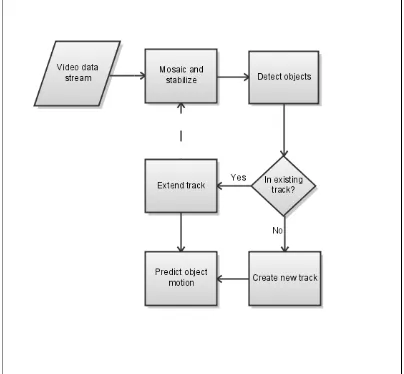
Most object detection and tracking systems can be structured in a processing pipeline with a
number of common steps. Not all steps are present in all systems but this pipeline provides a
useful abstraction for comparison and evaluation of different techniques. The pipeline in Figure1
will be used for discussion.
Many WAAS systems use multiple cameras to capture the image data. These images need to
be mosaiced into a single frame. This is typically performed by the sensor’s internal processing
pipeline using a camera model specific to that particular imaging system. Generic mosaicing
algorithms exist but this thesis will assume that the sensor specific mosaicing algorithms are
sufficient and will concentrate on other portions of the tracking pipeline.
WAAS platforms are in motion relative to the ground so the apparent motion of objects in a video
sequence consists of the actual object’s motion combined with the motion of the WAAS platform.
Some algorithms require the platform to be stable so algorithms are needed to stabilize a video
stream relative to the ground. This stabilization may be accomplished by the platform’s mosaicing
algorithm but this stabilization is often coarse and may need refinement.
Object detection is a key step in the tracking pipeline. Detection algorithms may require multiple
video frames or a single frame for detection. There may be different methods of detection for
objects which are part of an existing track. A number of detection algorithms will be discussed in
Figure 1: Tracking pipeline
The primary decision point in the tracking pipeline determines if a detected object is in an
ex-isting object track or if it represents a new object. This decision may be implicit in the object
detection step if a separate algorithm is used to detect existing objects. Alternately, it may be an
explicit step in the pipeline. There are a couple of classes of tracking algorithms in general use.
Predictive tracking algorithms use existing information about a track and an object to estimate
where that object will reside in the next frame. This prediction is used to search for objects within
a threshold of the predicted location. The other class is matching algorithms. These algorithms
attempt to associate newly detected objects with existing tracks using a variety of metrics. If a
match is found, the track is extended; otherwise the object is considered new. Some algorithms
may implement a hybrid approach using data from both methods.
The object prediction step is used in predictive tracking algorithms to predict the next probable
location for an object. Matching algorithms use this stage to generate model parameters which
A number of algorithms will be presented and discussed below. Basic information on the
algo-rithm will be presented along with information on how the algoalgo-rithm has been used in existing
tracking applications. Some algorithms may encompass multiple stages in the tracking pipeline
or just a single stage.
3.1 RX Filter
A common anomaly detection algorithm, often used as a baseline anomaly detector for
com-parison with other algorithms, was developed by Reed and Yu [4]. This algorithm is commonly called the RX detector (RXD), RX filter, or simply RX. The classic expression of RXD is shown in
Equation1and is referred to as
K
−
RX D
.δ
K−RX D(
r
) = (
r
−
µ
)
TK
−1L×L
(
r
−
µ
)
(1)
The
K
refers to the sample covariance matrix,r
is theL
length vector of spectral intensities ata particular spatial location and
µ
is the sample mean. A modification shown in Equation2uses the sample correlation matrix (R) and is sometimes used in optimized implementation since the sample mean is not needed. It is referred to asR
−
RX D
to distinguish it from the covarianceversion, K-RXD.
δ
R−RX D(
r
) =
r
TR
−1L×L
r
(2)
Both forms of RXD are related to the Mahalanobis distance which measures the similarity
be-tween an unknown sample set and a known one. Further explanation of the properties and
application of RXD can be found in [5] and a number of other introductory texts on hyperspectral data exploitation.
3.2 Nested Spatial Window Target Detector (NSWTD)
NSWTD is an anomaly detection algorithm for hyperspectral data discussed in [6]. It can be used for object detection in a tracking pipeline. A group of three concentric spatial windows is used to
detect objects which are statistically distinct from their background. A spatially large window
con-tains a medium sized window and a small window. The two smaller windows represent potential
target sizes and the large window will be used to calculate the background statistics. NSWTD
uses a metric known as orthogonal projection divergence (OPD) shown in Equation3.
OP D
(
s
i,
s
j) =
Ç
s
iTP
s j⊥s
iT+
s
TjP
s i⊥s
Tj)
P
s j⊥=
I
L×L−
s
k(
s
kTs
k)
−1s
kT∀
k
=
i
,
j
(3)
Where
I
is an identity matrix,s
T is the signal to noise ratio maximization operator fromThe OPD equation must be calculated twice, once between the inner and middle windows as in
Equation4and once between the middle and outer windows as in Equation5.
δ
2W−N SW1
(
r
) =
OP D
(
m
i n(
r
)
,
m
d,1(
r
))
(4)
δ
2W−N SW2
(
r
) =
OP D
(
m
mi d(
r
)
,
m
d,2(
r
))
(5)
Where
m
d,1 is the mean of the outer window minus the inner window andm
d,2is the mean of the outer window minus the middle window. Finally, the three window NSW is calculated byEquation6.
δ
3W−N SW(
r
) =
max
i=1,2
(
δ
i2W−N SW(
r
))
(6)
This gives a metric for each pixel which can be thresholded to determine if the pixel is
anoma-lous. According to [8], the NSWTD algorithm is faster than other, common anomaly detection algorithms such as RX while providing good detection results for targets of varying sizes.
3.3 Spectral Angle Mapper (SAM)
SAM is a common hyperspectral classification algorithm[9]. It can be used for object detection in a tracking pipeline or it may be used as an input to a matching-based object tracking algorithm.
Spectra are compared pair-wise by treating the spectral vectors as points in n-dimensional space,
normalizing to unit vectors, and calculating an angle between the two vectors. Since the vectors
are normalized, this method is invariant to illumination level. SAM is a way to quickly determine
similarity between two spectra and is a useful filter when the spectral angles are thresholded
against a fairly high target angle. Other spectral comparison algorithms provide more accurate
similarity results but SAM is extremely fast and is a good first cut for similarity filtering of pixels.
3.4 Optical Flow Estimation
Optical flow is the apparent motion of objects, surfaces, and edges between frames. This motion
is typically caused by motion of the camera and motion of individual objects in the scene. A
num-ber of methods are available for estimating optical flow but they generally fall into two categories.
Dense estimation techniques map all pixels in the first frame to corresponding pixels in the
sec-ond frame. Dense techniques are quite accurate and provide motion vectors for all the data in a
frame but are generally very computationally expensive. They are typically used on very small
scenes or subsets.
Sparse estimation techniques map a subset of pixels from one frame to another. This subset
may be an actual subset of pixels chosen by some external criteria or it may amalgamate pixels
into blocks and calculate the motion of the blocks. While less accurate, sparse techniques are
generally effective for calculating camera motion since a majority or pixels will have the same
The Lucas-Kanade (LK) [10] method was originally proposed as a dense estimation method but has since been adapted to become a sparse estimation method. LK can be used as a sparse
estimator since it only relies on spatially local information when estimating a pixel’s motion. The
motion of a subset of pixels can be calculated and these can be used as an estimate for the
motions of the other pixels.
The local information is derived from a small window around the pixel in question. This has a
serious drawback in that large motions which fall outside of this window can not be calculated. A
pyramidal version of LK can be used to overcome this deficiency. LK is first run on a low detail
version of the image, in essence a series of image blocks. This accounts for larger motions since
a window of a fixed size encompasses a larger percentage of the frame at a lower detail level.
This is repeated on one or more additional detail levels until the full detail frame is used.
LK make a few assumptions about the frames.
1. Brightness consistency - A pixel or object from one frame to another has fairly consistent
brightness levels.
2. Temporal persistence - A pixel or object makes only small movements. Small is not an
exact qualifier and relates to the overall size of the frame.
3. Spatial coherence - Neighboring pixels belong to the same surface, project to nearby
points on the image plane, and have similar motion.
These assumptions can be represented by equations7where
I
is the intensity of pixelx
(
t
)
at framet
.f
(
x,
t
)
≡
I
(
x
(
t
)
,
t
) =
I
(
x
(
t
+
d t
)
,
t
+
d t
)
∂
f
(
x
)
∂
t
=
0
∂
I
∂
x
|
t(
∂
x
∂
t
)+
∂
I
∂
t
|
x(t)=
0
v
=
−
I
tI
x(7)
Starting with the brightness invariance and temporal persistence and applying the chain rule for
partial differentiation we end up with the second to last equation. We substitute
I
x,v
, andI
t foreach term to indicate the spatial brightness derivative, the velocity, and the temporal brightness
derivative. This yields the final form which is the basis for LK. The form indicated is the one
dimensional case but can be easily extended to two dimensions.
The change in space for a given time period is measured by finding strong corners in the edge
image of each frame. We search for corresponding corners in a local window and calculate an
so we use Newton’s method to refine the estimate using edge information in the spatial window.
A more in depth derivation of LK is available in [11] including a discussion of the strengths and weaknesses of the technique.
3.5 RANSAC
Random sample consensus (RANSAC) [12] is a method used to fit a model to observed data. RANSAC is an iterative method which is robust against outliers.
The algorithm works by randomly selecting a number of points from the observed data and fitting
a model to those points. Each point in the data which is not in this set is tested against the model
estimate. If the calculated error is less than a threshold it is added to a set of consensus points.
The algorithm is halted when the size of this consensus set exceeds a threshold or a maximum
number of iterations has occurred. The model with the largest consensus set is selected.
While robust, RANSAC has no upper bound on execution time. The maximum iteration count is
used to force an upper bound but exiting the algorithm this way results in a sub-optimal model. It
is possible to calculate the probability that RANSAC will generate a model with a maximum error
value and a maximum number of iterations. This information can be used to adjust these two
parameters in order to control the execution time or the margin of error.
3.6 Hyperspectral Cueing
Cueing as it relates to video tracking uses the video data or other, external data to mark candidate
objects or areas of interest. The supplemental data reduces the search space for the primary
tracking algorithm or supplements the primary tracking algorithm to increase the object detection
accuracy. Hyperspectral cueing uses external hyperspectral imagery to locate areas of interest
and to increase tracking accuracy. Anomaly detectors such as K-RXD locate areas of interest
based on spectral disimilarity. This areas of interest are intersected with the pixels flagged during
motion estimation. The other use of hyperspectral imagery is to supplement tracking of identified
objects. Objects in two frames of data are compared using a signature comparison algorithm
such as SAM. Comparing the spectral signatures of two objects provides additional information
when determining if these are the same object and thus constitute part of an object track.
3.7 Wang Tracking Algorithm
The tracking algorithm used by Wang, et al. [13] is a hybrid object tracking algorithm which uses matching-based and prediction-based techniques. Four values are examined to decide if an
object is a candidate for addition to a track: object trajectory, object size, grayscale distribution,
and object texture. Wang’s tracking algorithm requires a stabilized video stream. Stabilization is
estimate the bilinear projective model for the camera motion. [14][15] Object detection in Wang’s method utilizes a wavelet transform and the bilinear predictive camera model to remove camera
motion. The resultant differences between various levels of the wavelet pyramid identify objects.
Wang’s end goal is a motion prediction system which is used to compress video streams. Other
portions of the compression utilize the wavelet transform, so this is a process with zero additional
cost. The wavelet transform can be computationally expensive and will not be discussed in
further detail. It was used by Wang since the wavelet transformed needed to be calculated for
a non-tracking algorithm thus the data was already available for used for object detection. The
object tracking portion of Wang’s pipeline is of primary interest for this thesis.
Object position is defined in Equation8as the centroid of a detected object.
c
x= (
X
(i,j)∈Op
i,j·
i
)
/
(
X
(i,j)∈Op
i,j)
c
y= (
X
(i,j)∈Op
i,j·
j
)
/
(
X
(i,j)∈Op
i,j)
(8)
Where
O
is the set of coordinates of an object area andp
i,j is the value of the edge image at position(
i
,
j
)
. Object motion over a few frames is assumed to be a straight line with constantacceleration. Three frames are used to calculate speed
v
and accelerationa
in Equation 9. These values predict a location for the current frame which is compared to the candidate object.S
=
v t
+
1
2
at
2
(9)
With an adequate framerate, object size does not change significantly from frame to frame. A
dispersion value as calculated by Equation10is a metric for measuring object size. This equa-tion determines how far from the object centroid a nearly uniform gray level extends.
(
c
x,
c
y)
represents to object centroid from Equation8.
d i s p
= (
X
(i,j)∈Oq
(
i
−
c
x)
2+(
j
−
c
y)
2·
p
i,j)
/
(
X
(i,j)∈Op
i,j)
(10)
Grayscale distribution (the width of the grayscale histogram) of an object is fairly constant for
objects of interest assuming the lighting conditions are constant from frame to frame. Grayscale
distribution is calculated as
(
g r
m,
g r
h,
g r
l)
the mean of groups of pixels in the entire range,upper 10% of the range, and lower 10% of the range respectively.
The object texture measures grayscale variation across an object. Wang estimates texture by
of calculating the edge image is not discussed, but a reasonable assumption is that a common
edge detection method such as the Laplacian method or Sobel method can be used.
The four metrics discussed above are calculated for candidate objects and existing tracks (as
the object in the track for the previous frame). The difference between these sets of values is
thresholded and metrics outside the threshold are ignored. At least three of the four metrics
must be within the threshold for consideration. If no objects fit this criteria for a certain track, it
is terminated. If there is an unambiguous correspondence between a single object and a single
track, the track is extended. If multiple objects are candidates for a track, or multiple tracks
are candidates for an object, a weighted cost is calculated for each potential object and track
pairing using Equation11. The
w
variables represent the weights and thef
andt
superscripted variables represent the metrics for the current frame and the track. Wang was not clear how theweights were determined, but it is implied that values were chosen which performed well with a
set of sample data.
d i f
=
w
t r(
|
c
xf−
c
xt|
+
|
c
yf−
c
yt|
)
+
w
d i s p(
|
d i s p
f−
d i s p
t|
)
+
w
g r(
|
g r
f l−
g r
t l
|
+
|
g r
f m
−
g r
t
m
|
+
|
g r
f h−
g r
t h
|
)
+
w
t x(
t x
f−
t x
t)
(11)
Wang’s algorithm is not expected to work well with WAAS data as stated due to the assumption
of a reasonably high frame rate in multiple steps in the algorithm.
3.8 Cohen Tracking Algorithm
Cohen and Medioni [3] present an alternate method for object detection and tracking as well as elimination of camera movement using optical flow. This system performs object detection and
matching-based object tracking.
Instead of directly modeling the 3D parameters of the camera motion, Cohen estimates the
in-duced optical flow of coincident frames. A small set of feature points
(
x
i,y
i)
in the image aretracked from a reference image
I
0 to a target imageI
1. These two images are registered by computing the transformationT
I1I0 which warps
I
0 toI
1. The parameters are estimated usingan iterative minimization of the least square criterion as in Equation12.
E
=
X
i(
I
0(
x
i,
y
i)
−
I
1(
T
(
x
i,
y
i)))
2(12)
levels in an image pyramid. This transformation is incorporated into the optical flow calculation
according to Equation13.
∇
I
i∇
TI
iw
=
−∇
I
id I
id t
(13)
Where
w
= (
u
,v
)
T is the optical flow. This equation can be used to extrapolate the normal tothe optical flow in Equation14.
w
⊥=
−
(
I
i+1(
T
i+1,j)
−
I
i(
T
i,j))
||∇
T
i,j∇
I
i(
T
i j)
||
·
∇
T
i j∇
I
i(
T
i j)
||∇
T
i j∇
I
i(
T
i j)
||
(14)
w
⊥ can be used to detect residual motion after compensation for optical flow. Large values ofw
⊥ occur near regions of motion.w
⊥ is thresholded and a 4-connectivity scheme is used to aggregate points into regions of residual motion.Cohen represents potential tracks using a graph. Nodes in the graph represent blobs detected
using the normal to the optical flow. Edges in the graph represent relationships between blobs
in coincident frames. Edges are created by measuring grayscale similarity between blobs in a
neighborhood. The size of the neighborhood is calculated based on the amplitude of the blob’s
motion. The eigenvalue of the potential transformation from a blob in
I
0 to a blob inI
1 are attached to the associated edge. A set of attributes are also associated with each node. Cohenassociates the following attributes: frame number, centroid, principal directions, mean, variance,
velocity, parent ID and similarity, children IDs and similarities, and length.
Single objects may be detected as multiple blobs when using the optical flow normal. This
situa-tion can be detected in the graph when multiple blobs which are spatially close and have nearly
the same direction and velocity. When this occurs, the nodes on the graph are merged to a single
node and the edges updated accordingly. Detection accuracy of broken objects is increased by
maintaining a dynamic template for each object and matching it to potential broken objects. The
blob centroids and orientations are aligned over the last five detected frames and a median filter
is applied. Cohen calls this process amedian shape template. This filter can also detect objects
which stop and then resume motion. Each blob which has no connected components in
subse-quent frames will be propagated some number of frames into the future. The template for this
node is matched against nodes in these future frames and a positive match indicates an object
which has resumed motion.
Object trajectories can be extracted from the graph by finding an optimum path through the
c
i j=
C
i j1
+
d
i j2(15)
An optimal graph path is then calculated from a node with no successors to a node with no parent
to determine an object trajectory.
Cohen’s algorithm is not expected to work well with WAAS data as stated. The need to build
a sizeable graph using many frames before tracks can be extrapolated lends itself to offline
data processing. Using low frame rate WAAS data may create a significant delay between data
collection and track determination, independent of processing resource requirements.
3.9 Camera motion compensation
The Columbus Large Image Format (CLIF) and CLIF-II data are used as a basis for motion
compensation and tracking. Data from a single camera in the six camera system is used. Since
a hierarchical subdivision of the image is used to target specific areas of the image to maximize
the throughput, using a spatial subset is equivalent to using the entire data set and setting focus
to the spatial subset. Scaling up processing to multiple machines would allow simultaneous
processing of these additional areas.
4 Approach
This thesis meets the objectives of increasing tracking efficiency and accuracy by breaking a
WAAS scene into hierarchical areas of interest (AOIs) and through the use of hyperspectral
cueing. The size of these AOIs and the number of AOIs which are actively processed will provide
a measure of control over the accuracy/efficiency ratio.
4.1 WAAS Data Characteristics
The primary datasets from the Air Force Research Labs are the Columbus Large Image Format
(CLIF[16] and CLIF-II[17]) datasets. Each are approximately 12000x5000 pixels spatially and were collected with a matrix of commercial digital cameras. The panchromatic frames are 8-bit
uncompressed. One dataset contains 50 frames and the other contains 56 frames. The data
were collected at approximately 2 fps.
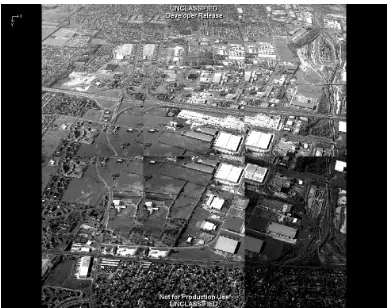
The CLIF dataset has a number of camera registration issues resulting in overlapping areas
within the image. The data was acquired with a high off NADIR angle (side looking collection) and
contains light industrial and farmland areas. The registration makes accurate tracking difficult as
the unique location, the other data used is primarily urban, so this dataset is used for comparison
of execution speed but not for accuracy of object and track detection. A sample frame is show in
Figure2.
Figure 2: Sample frame from the CLIF dataset
Within the CLIF-II dataset, the areas captured by cameras 0 and 1 are used. A single camera is a
convenient region to use as it represents a reasonably sized subset of the data for the workstation
used for analysis, approximately 4000x2600 pixels.
The camera 0 area is a residential neighborhood with two multi-lane roads meeting at an
inter-section. A number of vehicles are in motion and there are a small number of pedestrians in
motion. Lighting is fairly constant and there are no large buildings showing significant parallax.
The camera 1 area contains the Ohio State University football stadium and the surrounding area.
A couple of tall buildings show parallax effects and there are some noticeable reflection, sun glint,
and shadow effects in and around the stadium. These effects add noise to the image which may
be mistaken for moving objects. A small number of vehicles are in motion but this portion of the
scene is mostly static.
Hyperspectral data from a number of sensors including NASA’s AVIRIS, RIT’s MISI, the US
[image:20.612.101.491.129.437.2]scenes are shown in Table2.
No current collection system provides synchronized WAAS video and hyperspectral data required
for integrated performance analysis of the complete cueing system. Processing throughputs of
the individual compone
4.2 Frame Segmentation
An integral part of the optimizations of the various component algorithms is a hierarchical, spatial
breakdown of the WAAS data. A WAAS frame was segmented into smaller sub-images arranged
in a quadtree. The extent of the segmentation will vary based on the step in the tracking pipeline.
Breaking an image into smaller areas allows selective processing of a subset of the areas based
on expected processing requirements. When the average processing requirements of an AOI
exceed a threshold, the AOI can be further divided into four smaller AOIs and processing can be
limited to one or more of these.
This independent processing of a subset of the image allows for easy exploitation of parallel
com-puting capabilities. A number of AOIs can be processed independently on multiple computation
units. Processing of a greater number of concurrent AOIs could be accomplished by increasing
the number of available processing units. This aspect will not be fully explored by this thesis.
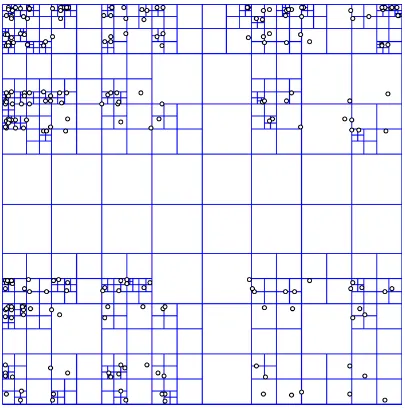
The frame segmentation is accomplished using a balanced quadtree whose leaf nodes contain
sub-frames of a reasonable (user defined) spatial dimension. When objects are being actively
tracked, further decomposition in areas of high object density can reduce processing load. Figure
3shows a sample quadtree decomposition of a scene.
4.3 Motion Compensation
Motion compensation of a sub-frame is accomplished by calculating the optical flow vectors
be-tween points in neighboring frames. A pyramidal implementation of the Lucas-Kanade (LK)
op-tical flow calculation method [10] is employed. The LK method is applied to various levels in an image detail pyramid of each sub-frame. This captures large motions using the LK method which
employs a small change detection window.
Sparse tracking is used to speed up calculations. Strong corners are located in an edge image
and these points are tracked between sub-frames. Once the optical flow vectors between these
points are calculated, RANSAC is used to approximate the motion of the sub-frame while ignoring
errors in the optical flow calculations.
The 3-D motion of the aircraft mapped to the 2-D image plane requires a perspective transform
Figure 3: An unbalanced quadtree decomposition has a higher depth in areas of high
object density.
An assumption is made that the altitude of the aircraft does not change significantly between
neighboring frames which allows a for a fairly accurate estimation of the sub-frame motion using
an affine transform. This assumption does not always hold particularly in urban environments
with many tall buildings. This fails to compensate for some of the parallax effect seen when
looking at these buildings. Parallax is the apparent motion of an object (usually rotation about
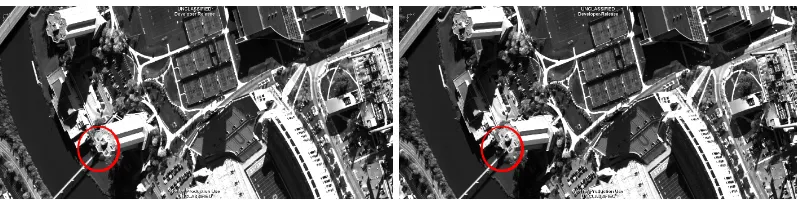
a point) due to differences in observation location. The CLIF-II dataset provides an example of
this as seen in Figure 4. The apparent motion of buildings may register as object tracks but these false positives are obvious to an analyst interpreting the data. Tracking extra objects may
slow down execution of the algorithm due to the additional data processing. Compensation for
parallax may be addressed in future work. Once the affine transform has been estimated, one of
Figure 4: Apparent motion due to parallax in frames 1 and 10 of CLIF-II dataset.
The motion is particularly noticeable with the building in the bottom center of the
images.
4.4 Object Detection
Two object detection methods are available depending on availability of hyperspectral data. When
hyperspectral data is available for a sub-frame, K-RXD is used to detect anomalous pixels in the
sub-frame. K-RXD was chosen instead of NSWTD as it is less sensitive to noise than NSWTD.
[18] provides a study of the accuracy and performance characteristics of a number of hyperspec-tral anomaly detection algorithms including RXD and NSWTD. NSWTD is potentially faster to
execute and has a higher correct detection rate for high signal to noise data and is worth further
exploration for future work.
When hyperspectral data is not available, frame differencing is used to remove the background.
The two sub-frames are thresholded to minimize brightness differences between the two frames.
Additional noise is removed by eroding the resulting threshold images. This removes single pixel
noise often called salt and pepper noise or speckle. The frames are subtracted from each other
to remove the background.
In either case, the resulting foreground or anomaly images are run through a morphological
opening to fill in small gaps internal to the object blobs. These blobs are labeled using connected
component labeling and each is treated as an object candidate.
4.5 Object Tracking
Object tracking was accomplished using a variation of Wang’s tracking algorithm.
Each object is added to a directed graph as a vertex. Objects from the base frame are connected
to the objects in the current frame and a number of properties are calculated on the vertices and
edges.
The vertices contain a dispersion value, an object blob centroid, and a hyperspectral spectra.
The edges contain the absolute difference of the dispersion values of the vertices and a velocity
track edge to the current edge. Both the absolute velocity magnitude difference is calculated and
the velocity vector angular difference. Finally, the spectral angle between the two objects is
calculated for each edge.
Edges with a velocity magnitude exceeding a threshold are removed. This is based on the
assumption that objects being tracked (usually vehicles and people) have an upper limit on their
speed. A cost is calculated on the remaining edges as a weighted sum of the edge properties. F
Tracking is performed within a quadtree AOI. As a track approaches the edge of an AOI, the
tracking algorithm is applied to the parent AOI in the quadtree. This larger area processing is
performed for a small number of frames until the location of the object in an AOI lower in the tree
can be determined. The object track information is passed to the new AOI for processing.
4.6 Testing and Verification
The following tests indicates the level of success for the thesis.
1. The efficiency of the hierarchical partitioning and hyperspectral cueing.
2. The accuracy of the tracking algorithm without hyperspectral object detection.
3. The accuracy of the hyperspectral object detection and track property.
Performance of the partitioning is determined by executing the tracking algorithm without any
par-titioning and comparing this to execution of the algorithm with various quadtree partition depths.
Throughput in terms of megapixels per second processed is the primary metric.
Comparison of the hyperspectral cueing performance is measured is megapixels per second
pro-cessed. This is compared to the collection rate of the hyperspectral sensor and to the processing
throughput of the optical flow differencing method.
Accuracy of the tracking algorithm is compared to human derived truth data. Two WAAS analysts
manually locate and mark objects and tracks in available data sets using techniques employed
by US Air Force intelligence services. These sets of truth data are compared and outliers
dis-carded. This technique may under-represent the number of objects and tracks in a data set but
should minimize the number of false positives. The accuracy in terms of number of correctly
iden-tified tracks, false positives, false negatives, and incomplete or interrupted tracks are the primary
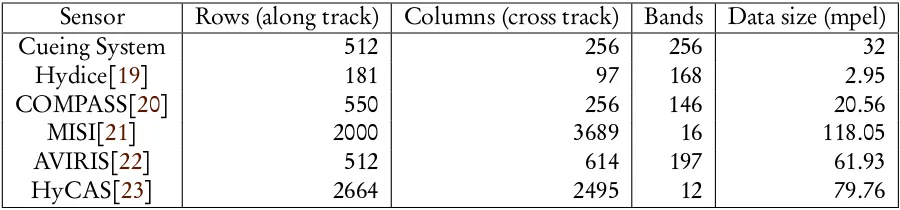
Table 1: Properties of hyperspectral test data
Sensor
Rows (along track)
Columns (cross track)
Bands
Data size (mpel)
Cueing System
512
256
256
32
Hydice
[
19
]
181
97
168
2.95
COMPASS
[
20
]
550
256
146
20.56
MISI
[
21
]
2000
3689
16
118.05
AVIRIS
[
22
]
512
614
197
61.93
HyCAS
[
23
]
2664
2495
12
79.76
4.7 Hyperspectral Cueing
No current collection system provides synchronized WAAS video and hyperspectral data required
for a complete hyperspectral cueing system as described in the background section. A
hypotheti-cal HSI collection system is used as the basis for hyperspectral cueing in the tracking system. The
properties of this system are consistent with current HSI imaging system technologies.
Perfor-mance of the system is characterized and conclusions are drawn about the utility of the system.
Future work may analyze integrated WAAS and hyperspectral data collections.
The system is a whiskbroom collector which contains a 256x256 pixel CMOS imaging array which
collects spectral information along one axis and spatial information along the other. Light enters
the system and is reflected off a rotating mirror, passes through a prism and is directed to the
detector array. The mirror slowly rotates which collects data across the second spatial dimension.
The speed of the mirror and extent of the rotation for which data is captured define the collection
rate and width of the collected swath. The size of the imaging array defines the height and each
swath and the number of spectral bands collected, 256 for each. Bands are in the visible and
near-IR spectral region; 400nm to 1000nm. A swath with a width of 512 pixels can be collected
in approximately 10 seconds including time to reset the mirror to the start position. The collection
platform can be moved such that a swath can be collected anywhere in the ground area covered
by the panchromatic WAAS imager. The maximum time to move the imager across the entire
WAAS field of view is less than or equal to 10 seconds. This means that the worst case collection
rate including repositioning of the imager is 20 seconds per swath. This yields a collection rate in
megapixels between 1.6
m pe l
/s
and 3.3m pe l
/s
.A number of existing hyperspectral sensor images have been used for experimental testing.
These sensors share some properties with the hypothetical system so they can be used to
ex-trapolate performance characteristics of the hypothetical system. All datasets contain data in
the visible and near-IR spectral regions providing complete or nearly complete overlap with the
5 Results and Discussion
5.1 Hyperspectral Anomaly Detection
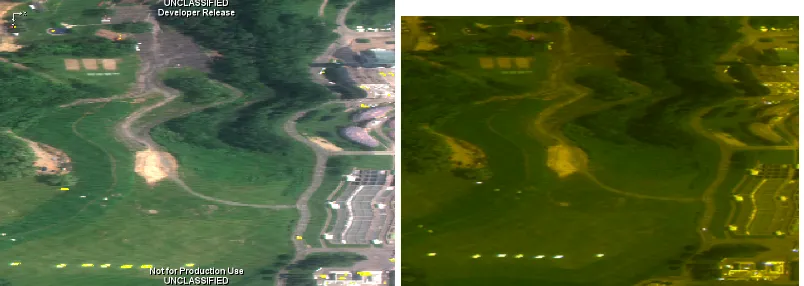
The K-RXD implementation was tested on 5 hyperspectral data cubes and information on
per-formance was calculated. The resulting anomalous regions were reviews by 2 hyperspectral
data analysts to ensure the results are reasonable and correct. Validation is purely subjective
and the experience of the analysts is used to lend credibility to the opinions. The analysts
visu-ally inspected the spectra of a sample of flagged pixels to surrounding pixels. Inspection took
approximately 10 minutes per data set per analyst. In all cases, the analysts felt the indicated
anomalous regions are reasonable and correct. A visual comparison of the results with results
from a similar anomaly detection algorithm in the ENVI tool indicates nearly identical anomalous
pixels. The exact details of the ENVI detector are not known as that information is not made
avail-able in the documentation for the tool. ENVI is a frequently used tool for hyperspectral analysis
[image:26.612.106.508.319.462.2]so it is reasonable to assume that it generates valid results.
Figure 5: MISI K-RXD Results (in yellow)
The five data sets used have the following properties. Band counts do not include "bad bands"
which contain invalid data. This invalid data is usually due to atmospheric absorption spectral
regions which yield very low signal to noise values. In most cases data does not represent a
single swath either because the sensor is not a whiskbroom sensor or multiple whisks had already
been combined into a single image. All tests were run on a Windows XP 64-bit workstation with
4GB of RAM and an Intel Core2 E8500 dual-core CPU running at 3.17GHz.
Table3shows timing information for the K-RXD implementation. The values indicate the average of five executions of the algorithm for each data set. Absolute times are shown for the entire
algorithm execution minus the overhead introduced by unrelated processes such as graphical
display of the results and for the execution of the covariance matrix calculations. The data is also
presented as a throughput in terms of megapixels per second. The covariance matrix calculations
are performed by a separate plug-in which prevented certain optimizations such as calculation
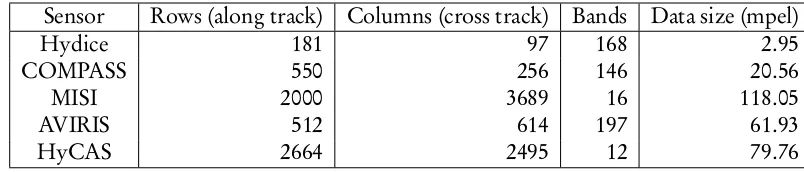
Table 2: Properties of datasets used for K-RXD timing
Sensor
Rows (along track)
Columns (cross track)
Bands
Data size (mpel)
Hydice
181
97
168
2.95
COMPASS
550
256
146
20.56
MISI
2000
3689
16
118.05
AVIRIS
512
614
197
61.93
[image:27.612.102.508.220.294.2]HyCAS
2664
2495
12
79.76
Table 3: Execution times and throughput for K-RXD
Sensor Execution Time (ms) Throughput (m pe l/s) Optimized Throughput (m pe l/s)
Hydice 3132 0.9417 1.310
COMPASS 20402 1.008 1.441
MISI 77315 1.527 2.737
AVIRIS 66685 0.9287 1.261
HyCAS 52016 1.533 2.762
the loop which calculate the sample mean has been removed and the throughput recalculated to
estimate the throughput of an implementation with this optimization.
This yields an average throughput across all the data set of 1.188
m pe l
/
s
and a standarddevi-ation of 0.3140. Applying the stated optimizdevi-ation, the average throughput is 1.902
m pe l
/s
anda standard deviation of 0.7763. This is between 57% and 75% of the estimated collection rate of
the hypothetical hyperspectral sensor. It is clear that further optimization would be necessary to
maintain the hardware collection throughput. A faster processor or more highly optimized
imple-mentation seems within reach especially if the anomaly detection is performed on the collection
hardware using a highly optimized DSP implementation. The correlation matrix variant R-RXD
may also provide a more efficient implementation. Finally, the number of spectral bands in the
data strongly effects the calculation throughput. The number of bands increases the size of the
matrices and vectors in the RXD calculations which the spatial resolution effects the number of
times the RXD calculations are made. The higher order complexity of the RXD calculation (due
to three matrix multiplications) accounts for this effect. Minimizing the number of spectral bands
needed for adequate anomaly detection can also increase the throughput of the algorithm.
5.2 Motion Compensation
Table4shows timing information for the optical flow motion compensation implementation. The values indicate the average of five executions of the algorithm for each data set. Absolute times
are shown for the entire algorithm execution for a single frame. Times include overhead
intro-duced by informational display processes. The data is also presented as a throughput in terms
of megapixels per second.
Table 4: Execution time and throughput for motion compensation
Sensor Size (mpel) Execution Time (ms) Throughput (m pe l/s)
CLIF 61.28 6690.00 9.1645
CLIF-II camera 0 (vehicle traffic) 10.23 1769.64 5.8119
CLIF-II camera 1 (noise from sun glint) 10.23 2045.13 5.0079
deviation of 2.2047. These values suggest that processing has a noticeable per frame constant
overhead. Much of this can likely be attributed to informational data visualization which would
not be needed in a production implementation. Even though the current implementation does
not meet the expected 1fps data rate of the sensor, it is reasonable to a assume additional
optimizations and a faster CPU can achieve the desired processing rate at the single camera
[image:28.612.104.507.264.564.2]resolution. This sensor has six cameras which can be processed on multiple compute cores.
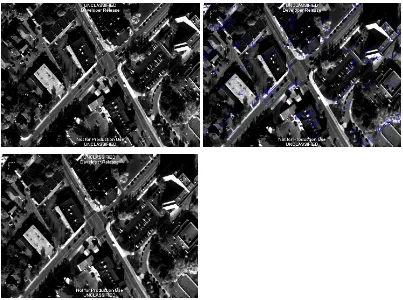
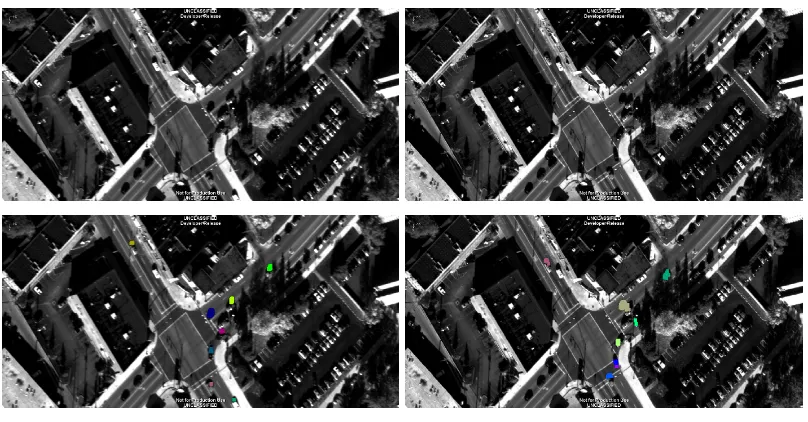
Figure 6: CLIF-II Motion Correction
from top left CLIF-II frame 0, frame 1 with optical flow vectors, frame 0 corrected
for sensor motion
5.3 Object Detection
Figure7shows two frames from the CLIF-II dataset. Optical flow camera motion correction has been applied to the frames. Objects detected from residual motion are shown and color coded
Table 5: Execution time and throughput for residual motion object detection
Sensor
Size (mpel)
Execution Time (ms)
Throughput (m pe l
/
s
)
CLIF-II full scene
61.40
3285.6
19.187
CLIF-II camera 0
10.23
476.68
21.476
CLIF-II camera 1
10.23
483.28
21.228
some cases only part of the object have been flagged. In another case, two cars passing each
other are flagged as the same object in frame 1.
Timing information for object detection for two sub-sets of the CLIF-II dataset are shown below.
Camera 0 contains an intersection with a number of moving vehicles. Camera 1 has fewer
moving vehicles and a significant amount of noise due to shadows and sun glint. The results are
averaged over 5 frame transitions. The standard deviation for the camera 0 data is 0.6146 and
for camera 1 is 0.4872. Full scene data is also included so that some information on scaling can
be inferred. The standard deviation for the full scene data is 1.629.
Figure 7: CLIF-II Object Detection
left to right from top CLIF-II frame 0, frame 1, frame 0 with detected object, frame
1 with detected objects
5.4 Object Tracking
A WAAS analyst was asked to locate moving objects and assign tracks over 5 frames of data. A
mission objective is always provided when WAAS analysis is performed. This allows the analyst
to limit evaluation to relevant data. The situation presented was a need to divert a VIP motorcade
through a residential neighborhood. The analyst was asked to provide a situational awareness
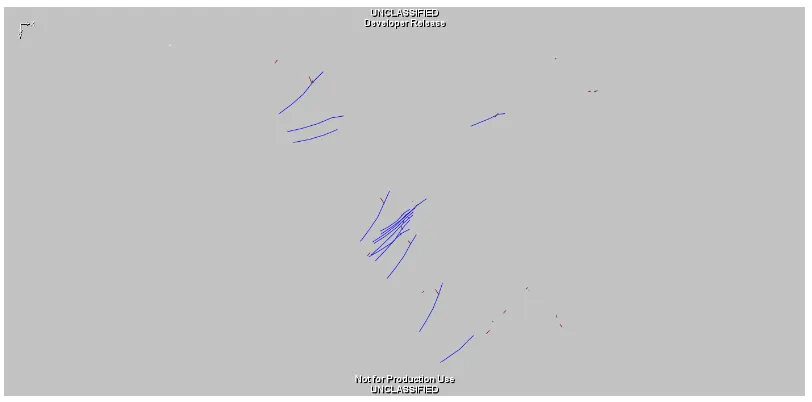
[image:29.612.104.508.319.530.2]camera 0 scene. The blue tracks represent objects located in the raw data stream and the
green tracks represents objects located after camera motion was removed. The importance of
camera motion compensation can be seen by the number of additional tracks found after motion
compensation. Figure9shows a similar image comparing the analyst tracks to objects located using the automated method. Detail of the intersection is show in Figure10as this area of the data has a significant amount of activity. These images show that the analyst was able to locate
7 additional tracks, some of them indicating very little motion. These slower objects are people
which the algorithm has difficulty detecting. This is likely due to the various blurring operations
and morphological erosions which remove small detected object candidates. There are also a
number of tracks which the algorithm located but it required an additional frame of data. Looking
more closely at these locations indicates that the objects are obscured by shadows in all cases.
This results in dark areas a low signal to noise ratio which are likely removed during the threshold
[image:30.612.103.509.291.492.2]portion of the object detection algorithm.
Figure 8: Tracks found in raw data (blue) and in data with camera motion removed
(orange)
Another problem can be seen in Figure10near the center of the image on the upper right road. Two cars are passing each other but the algorithm detects a single, multi-lobed object instead of
two distinct objects. Hyperspectral data for this scene is not available but if it were, the different
spectra of the two vehicles, due to different paint colors, would be used to distinguish the two
vehicles. Figure11compares the spectra of two vehicles with different paint colors.
Tracking objects which leave a sub-frame can be non-optimal in some circumstances as shown
in Figure12. An object moving outside of a sub-frame, represented by locations 1, 2, and 3, will reach the edge of sub-frame A at location 2. Tracking this object to location 3 requires processing
of a larger sub-frame. The next larger sub-frame is B but the edge of A is also the edge of B.
Figure 9: Tracks found in data with camera motion removed (orange lines) and
objects found using the automated method. The two colored blobs indicate object
locations in different frames.
Figure 10: Intersection detail with analyst tracks and automated object detection.
could be resolved by allowing arbitrary frames but this increases the number of possible
sub-frames. Another way to address this problem is to locate the adjacent sub-frame instead of using
[image:31.612.104.508.380.579.2]Figure 11: Spectral comparison of two car paint colors.
6 Conclusions
The algorithms presented in this thesis are effective at compensating for camera motion in WAAS
data, locating objects of interest in hyperspectral and panchromatic WAAS data, and identifying
tracks between interconnected objects. The execution speed and throughput for these algorithms
is not sufficient to match the framerate of the WAAS data at full spatial resolution. Processing a
portion of the image using a quadtree decomposition on the frames maintains the framerate of
the data. The size of the processing area can be adjusted to match the processing capability of
the workstation.
The K-RXD hyperspectral anomaly detection algorithm is effective at locating spectrally distinct
areas in images with varying signal to noise. However, other anomaly detection algorithms may
be more efficient in terms of processing requirements. Further exploration of other anomaly
detection algorithms, especially NSWTD may decrease the processing requirements for
hyper-spectral cueing without serious effect on the quality of the results.
The lack of availability of coordinated hyperspectral and WAAS data collections prevents an
in-tegrated test of the proposed tracking system. While this thesis provides arguments that the
integrated system will prove efficient and effective in production situations, coordinated data
col-lections of both types of imagery are required to continue research on this topic. The increased
Figure 12: An object at locations 1, 2, and 3 in subsequent frames requires processing
of the entire image.
occur in the coming years. Testing the integrated system on operational data is of prime interest
for future research.
References
[1] Wenshuai Yu, Xuchu Yu, Penqiang Zhang, and Jun Zhou. A New Framework of Moving Target
Detection and Tracking for UAV Video Application.The International Archives of the Photogrammetry, Remote Sensing, and Spatial Information Sciences, 37:609–613, 2008.[cited at p. 1]
[3] I. Cohen and G. Medioni. Detecting and tracking moving objects for video surveillance. In Pro-ceedings of the IEEE Computer Society Conference on Computer Vision and Pattern Recognition, volume 2, pages 319–325. Citeseer, 1999.[cited at p. 1, 9]
[4] IS Reed and X. Yu. Adaptive multiple-band CFAR detection of an optical pattern withunknown
spec-tral distribution.IEEE Transactions on Acoustics, Speech and Signal Processing, 38(10):1760–1770, 1990.[cited at p. 4]
[5] C.I. Chang. Hyperspectral data exploitation: theory and applications. Wiley-Blackwell, 2007.
[cited at p. 4]
[6] W. Liu and C.I. Chang. A nested spatial window-based approach to target detection for
hyper-spectral imagery. In2004 IEEE International Geoscience and Remote Sensing Symposium, 2004. IGARSS’04. Proceedings, volume 1, 2004. [cited at p. 4]
[7] Joseph C. Harsanyi, Chein i Chang, and Senior Member. Hyperspectral image classification and
dimensionality reduction: an orthogonal subspace projection approach. IEEE Transactions on Geo-science and Remote Sensing, 32:779–785, 1994.[cited at p. 4]
[8] SR Soofbaf, H. Fahimnejad, M.J.V. Zoej, and B. Mojaradi. ANOMALY DETECTION ALGORITHMS
FOR HYPERSPECTRAL IMAGERY.[cited at p. 5]
[9] R.H. Yuhas, A.F.H. Goetz, and J.W. Boardman. Discrimination among semi-arid landscape
end-members using the spectral angle mapper (SAM) algorithm. InSummaries of the Third annual JPL airborne geoscience workshop, volume 1, pages 92–14. Pasadena, CA: JPL Publication, 1992.
[cited at p. 5]
[10] Bruce D. Lucas and Takeo Kanade. An iterative image registration technique with an application to
stereo vision. pages 674–679, 1981.[cited at p. 6, 13]
[11] Dr. Gary Rost Bradski and Adrian Kaehler.Learning opencv, 1st edition. O’Reilly Media, Inc., 2008.
[cited at p. 7]
[12] Martin A. Fischler and Robert C. Bolles. Random sample consensus: a paradigm for model fitting
with applications to image analysis and automated cartography. Commun. ACM, 24(6):381–395, 1981.[cited at p. 7]
[13] Y. Wang, J.F. Doherty, and R.E. Van Dyck. Moving object tracking in video. InProceedings of the 29th Applied Imagery Pattern Recognition Workshop, page 95. IEEE Computer Society, 2000.[cited at p. 7]
[14] S. Mann and R.W. Picard. Video orbits of the projective group: A simple approach to featureless
es-timation of parameters.IEEE Transactions on Image Processing, 6(9):1281–1295, 1997.[cited at p. 8]
[15] S. Lertrattanapanich and NK Bose. Latest results on high-resolution reconstruction from video
se-quences.IEIC Technical Report (Institute of Electronics, Information and Communication Engineers), 99(505):59–65, 1999.[cited at p. 8]
[16] Columbus large image format (clif) 2006 dataset. Website.
[17] Columbus large image format (clif) 2007 dataset. Website.
https://www.sdms.afrl.af.mil/datasets/clif2007.[cited at p. 11]
[18] Soofbaf, S.R., ValadanZoej, M.J, and Ashoori, H. Efficient Detection of Anomalies in Hyperspectral
Images.The International Archives of the Photogrammetry, Remote Sensing, and Spatial Information Sciences, 37:303–308, 2008.[cited at p. 15]
[19] R. Basedow, P. Silverglate, W. Rappoport, R. Rockwell, D. Rosenberg, K. Shu, R. Whittlesey, and
E. Zalewski. The HYDICE instrument design and its application to planetary instruments. In J. F.
Ap-pleby, editor,Advanced Technologies for Planetary Instruments, pages 1–+, 1993.[cited at p. 17]
[20] J. Zadnik, D. Guerin, R. Moss, A. Orbeta, R. Dixon, C. G. Simi, S. Dunbar, and A. Hill. Calibration
procedures and measurements for the COMPASS hyperspectral imager. In S. S. Shen & P. E. Lewis,
editor,Society of Photo-Optical Instrumentation Engineers (SPIE) Conference Series, volume 5425 ofSociety of Photo-Optical Instrumentation Engineers (SPIE) Conference Series, pages 182–188, August 2004.[cited at p. 17]
[21] J.R. Schott. Modular imaging spectrometer instrument (misi). InACSM/ASPRS Annual Convention and Exposition, February 1993.[cited at p. 17]
[22] G. Vane, R.O. Green, T.G. Chrien, H.T. Enmark, E.G. Hansen, and W.M. Porter. The airborne
visible/infrared imaging spectrometer (AVIRIS). Remote Sensing of Environment, 44(2-3):127–143, 1993.[cited at p. 17]
[23] NASIC. Hyperspectral collection and analysis system (hycas). Technical report, National Air
A Source Code Listing
The following pages contain source code listings for the test application. This source code builds
1 c:\Opticks\COAN\Tracking\Code\Tracking\Rx.cpp
1 /*
2 * The information in this file is
3 * Copyright(c) 2010 Ball Aerospace & Technologies Corporation
4 * and is subject to the terms and conditions of the
5 * GNU Lesser General Public License Version 2.1
6 * The license text is available from
7 * http://www.gnu.org/licenses/lgpl.html
8 */ 9
10 #include "AoiElement.h" 11 #include "AppVerify.h"
12 #include "BitMaskIterator.h"
13 #include "DataAccessorImpl.h"
14 #include "DataRequest.h"
15 #include "DesktopServices.h"
16 #include "ObjectResource.h" 17 #include "PlugInArgList.h"
18 #include "PlugInManagerServices.h" 19 #include "PlugInRegistration.h"
20 #include "PlugInResource.h"
21 #include "ProgressTracker.h"
22 #include "RasterDataDescriptor.h"
23 #include "RasterElement.h"
24 #include "RasterUtilities.h" 25 #include "SpatialDataView.h" 26 #include "Rx.h"
27 #include "ThresholdLayer.h"
28 #include <gsl/gsl_blas.h>
29 #include <gsl/gsl_matrix.h>
30
31 REGISTER_PLUGIN_BASIC(Tracking, Rx);
32
33 Rx::Rx() 34 {
35 setName("Rx");
36 setDescriptorId("{55f85fb3-1a65-4686-9fdf-2c759383fbcb}");
37 setSubtype("Anomaly Detection");
38 setMenuLocation("[Tracking]/RX");
39 } 40 41 Rx::~Rx() 42 { 43 } 44
45 bool Rx::getInputSpecification(PlugInArgList*& pArgList)
46 {
47 VERIFY(pArgList = Service<PlugInManagerServices>()->getPlugInArgList());
48 VERIFY(pArgList->addArg<Progress>(ProgressArg(), NULL));
49 VERIFY(pArgList->addArg<RasterElement>(DataElementArg())); 50 VERIFY(pArgList->addArg<SpatialDataView>(ViewArg())); 51 VERIFY(pArgList->addArg<AoiElement>("AOI", NULL)); 52 return true;
53 }
54
55 bool Rx::getOutputSpecification(PlugInArgList*& pArgList)
56 {
57 VERIFY(pArgList = Service<PlugInManagerServices>()->getPlugInArgList());
58 VERIFY(pArgList->addArg<RasterElement>("Results")); 59 return true;
60 } 61
62 bool Rx::execute(PlugInArgList *pInArgList, PlugInArgList *pOutArgList)
63 {
64 VERIFY(pInArgList);
2 c:\Opticks\COAN\Tracking\Code\Tracking\Rx.cpp
66
67 RasterElement* pElement = pInArgList->getPlugInArgValue<RasterElement> (DataElementArg());
68 SpatialDataView* pView = pInArgList->getPlugInArgValue<SpatialDataView>(ViewArg());
69 AoiElement* pAoi = pInArgList->getPlugInArgValue<AoiElement>("AOI");
70
71 if (pElement == NULL)
72 {
73 progress.report("No element specified.", 0, ERRORS, true); 74 return false;
75 }
76 RasterElement* pCov = NULL;
77 { // scope
78 bool success = true;
79 ExecutableResource covar("Covariance", std::string(), progress.getCurrentProgress (), isBatch());
80 success &= covar->getInArgList().setPlugInArgValue(DataElementArg(), pElement); 81 if (isBatch())
82 {
83 success &= covar->getInArgList().setPlugInArgValue("AOI", pAoi);
84 }
85 success &= covar->execute();
86 pCov = static_cast<RasterElement*>(
87 Service<ModelServices>()->getElement("Inverse Covariance Matrix",
TypeConverter::toString<RasterElement>(), pElement));
88 success &= pCov != NULL; 89 if (!success)
90 {
91 progress.report("Unable to calculate covariance.", 0, ERRORS, true);
92 return false;
93 }
94 }
95 const RasterDataDescriptor* pDesc = static_cast<const RasterDataDescriptor*>
(pElement->getDataDescriptor());
96 const BitMask* pBitmask = (pAoi == NULL) ? NULL : pAoi->getSelectedPoints(); 97 BitMaskIterator iter(pBitmask, pElement);
98 FactoryResource<DataRequest> pReq;
99 pReq->setInterleaveFormat(BIP);
100 pReq->setRows(pDesc->getActiveRow(iter.getBoundingBoxStartRow()), pDesc-> getActiveRow(iter.getBoundingBoxEndRow()));
101 pReq->setColumns(pDesc->getActiveC