OPTIMAL ALLOCATION OF TRADABLE EMISSION
PERMITS UNDER UPSTREAM-DOWNSTREAM
STRATEGIC INTERACTION
GIUSEPPE DE FEO1; JOANA RESENDE2; MARIA-EUGENIA SANIN3
Version:
In this paper we analyze environmental regulation based on tradable emission permits in the presence of strategic interaction in an output market with di¤erentiated products. We characterize …rms’equilibrium behavior in the permits and in the output market and we show that both …rms adopt "rival’s cost-rising strategies". Then, we study the problem of the regulator that aims to maximize social welfare, proposing an e¢ cient criterion to allocate permits between …rms. We …nd that the optimal allocation criterion requires a perfect balance between the di¤erence on …rms’ price-cost margins in the permits and the di¤erence on …rms’ mark ups in the output market. In light of the previous result, we use a simulation to obtain the optimal allocation of permits between …rms as a function of output market characteristics, in particular as a function of goods substitutability.
1. INTRODUCTION
The interplay between some of the tradable emission permits (TEP) markets implemented so far and the corresponding output market has raised some concern regarding non-competitive emission trading (see Montero, 2009 for a survey on the existing literature on this point). For example, according to Kolstad and Wolak (2008), the oligopolistic …rms participating in the Californian electricity market (CAISO) behaved strategically in the Los Angeles market for NOx emissions called RECLAIM (Regional Clean Air Incentives Market). Such …rms, shown to exert unilateral market power in the CAISO by Wolak (2003), were allocated 56% of total initial stock of permits. In the same line, Chen et al. (2006) compute equilibrium behavior considering the interaction between the NOx budget program and the Pennsylvania-New Jersey-Maryland (PJM) electricity market. Due to the high concentration of the PJM market, six large electricity generators alone account for 90% of emissions in the referred permits market. In this context, Chen et al. (2006)
1University of Strathclyde and Università degli Studi di Pavia. E-mail: [email protected]. The authors thank Rabah Amir, Paul Belle‡amme, Thierry Brechet, So…a Castro, Jean Gabszewicz, the Editors Ariel Dinar and Fioravante Patrone, and two anonymous referee report for their helpful comments. The usual disclaimer applies.
2University of Porto and Cef.up. E-mail: [email protected]. Financial support from FCT is deeply acknowledged (Research grant PTDC/EGE-ECO/115625/2009).
…nd that a Stackelberg leader with a long position in the permits market could gain substantial pro…ts by withholding permits and driving up permits costs for rival producers. More recently, Tanaka and Chen (2012) analyze the in‡uence of permits allocation on strategic …rms in a forward electricity market that could produce shifts in the spot electricity market. In particular they …nd that the more allowances are allocated to the less polluting …rm, the more this …rm will contract in the forward market leading to a decline in spot electricity prices.
Supporters of environmental regulation based on TEP markets argue that the creation of such market makes it possible to reach the pollution reduction target (re‡ected in "the cap") in a cost-e¤ective manner (Montgomery, 1972) and with a minimum information cost for the regulator, in particular concerning the pollution abatement technology available. This argument has been challenged, …rst, by Hahn’s (1984) dominant-fringe model which argues that the existence of market power reduces the cost-e¤ectiveness of TEP markets because a dominant …rm manipulates the price of permits to reduce its own emission abatement costs.
Misiolek and Elder (1989), inspired in Salop and Sche¤man (1987), and Eshel (2005), also relying on a dominant-fringe setting, show that technological linkages between permits and output markets would give raise to "rival’s cost-rising strategies" by the dominant …rm, which would introduce an additional type of market distortion. Fehr (1993) and Sartzetakis (1997) have also challenged the e¤ectiveness of environmental regulation based on TEP markets, showing that, in a context of strategic permits trading, TEP markets could lead to monopolization or excessive entry barriers. Although the last two papers have considered strategic interaction in the output market, their objective is to focus on the monopolization or no-entry corner solutions instead of assessing the e¤ects of strategic interaction on optimal permits allocation. In fact, Fehr (1993) assumes that downstream …rms buy permits for a given supply, whereas Sartzetakis (1997) assumes a competitive permits market. To our knowledge only Tanaka and Chen (2012) and De Feo et al. (2012) consider a model of strategic interaction both in the permits and in an output market. The former is mostly interested on the way electricity prices are a¤ected by the linkages between a forward electricity market and the permits and spot electricity markets, while the latter is only interested on the way interaction on the permits market impacts the …nal price in a homogeneous good market.
degree of output di¤erentiation. In this context the price-making …rm in the permits market may mark permits up or down. Di¤erently from De Feo et al. (2012) we …nd a price-making …rm in the permits market may set a discount on the permits price if he is a net buyer. This occurs when the degree of di¤erentiation in the output market is enough high. Moreover, even when he is a net seller, the strength of his cost-rising strategies depends on his relative e¢ ciency as compared to his rival.
In light of these results, we show how the net impact of the simultaneous adoption of rival’s cost-rising strategies on cost-e¤ectiveness of environmental regulation depends on …rms’position in the permits market (buyer or seller), on the interplay of …rms’ cost structures and on the degree of substitutability between goods. Altogether, these factors determine the way TEP should be allocated to promote e¢ ciency.
In this line, we propose an optimal criterion to allocate permits between …rms, when the regulator aims to maximize total welfare. We …nd that the optimal allocation criterion is the one guaranteeing that the di¤erence on each …rm´s price-cost margins in the permits and in the output market are equalized for the last permit distributed. Accordingly, the optimal criterion we derive (accounting for strategic interaction in the output market) departs from the so-called equimarginal principle that has been generally adopted by the environmental literature (see for example Requate, 2005). The equimarginal abatement costs criterion assumes perfect competition in the market that is subject to the environmental regulation. While, under perfect competition in the output market equimarginality ensures the minimization of total abatement costs and, consequently, maximization of total welfare, that is not the case in our set-up.
2. MODELLING FRAMEWORK
We model …rms interaction in the permits market and sequentiality of decisions as in De Feoet al. (2012) but accounting for general demand and abatement functions as well as a di¤erentiated output market. We consider two …rms that meet both in the permits and in the output market. In the permits market, one of the …rms (say …rm j) is assumed to move …rst, setting the price of permits and clearing the permits market. In the output market the two …rms (…rmi and …rmj) compete in quantities producing imperfect substitute goods. Quantityyk represents the production
of goodk=i; jandpk represents its price. The inverse demand function for each available variant
kof the good is given bypk(yk; y k), wherey k represents the output production of …rmk0srival.
Firms may have asymmetric production technologies. The production cost function of …rmkis given byck[yk], withc0k[yk]>0 andc00k[yk] 0:4
The production of goodsiandj generates polluting emissions as a by-product. The parameter
>0represents output polluting intensity. We consider that …rms must comply with environmental
regulation based on a cap and trade system: (i)permits are freely distributed up to the capSand; (ii) each …rm k needs to hold an amount of permits equal to the non-abated polluting emissions generated by the production of yk. A percentage of total permits is received by …rm i and a
percentage1 by …rm j. The parameter 2[0;1]and the cap S are an exogenous choice of the regulator. In this paper we restrict our attention to the allocation decision (as pointed out by Eshel (2005) the regulator’s choices concerning permits allocation and the cap on total permits can be studied separately).5
When …rms initial permits holdings, S and (1 )S; respectively, do not coincide with the polluting emissions caused by the production of the optimal quantity of output yk, …rms may either abate some of the extra polluting emissions or engage in permits trading. Then, the environmental regulation implies the following restriction:
yk=Ek+ak; k=i; j;
whereEk 0denotes the amount of TEP that …rmkmust hold to comply with the environmental
rule and ak 0 stands for the level of emissions abated. The abatement of polluting emissions is
costly. Firms may have asymmetric abatement technologies. More precisely, to abateak polluting
emissions, …rmkincurs a cost of hk(ak);6 withh0k(ak)>0 andh00k(ak)>0:7
Under the previous assumptions, …rms’pro…ts write as follows:
i(yi; yj; Ei; q) =pi(yi; yj)yi ci(yi) +q( S Ei) h( yi Ei) ;
j(yi; yj; Ei; q) =pj(yi; yj)yj cj(yj) q( S Ei) h( yj+S Ei):
where (i) S Ei=xi= xjcorresponds to the amount of permits sold (or bought, whenxi<0)
by …rmi;(ii) yi Ei=ai corresponds to the amount of polluting emissions abated by …rmiand
(iii) yj S+Ei=aj corresponds to the amount of polluting emissions abated8 by …rm j:
Assumption: Throughout the paper we assume that: (A1) The demand functions are linear with @pk(yk;y k)
@yk <0. (A2) The goods are imperfect substitutes with @pk(yk;y k)
@y k <0.
5The cap on pollution is generally …xed by the regulatory authority with the help of experts in the light of the pollution control target (e.g. the IPCC 1990 Scienti…c Assessment in the case of the Kyoto protocol and its European side agreement for the creation of the EU-ETS).
6Similarly to Eshel (2005) and De Feo et al. (2012), this paper assumes total cost independence between production and abatement. Since we are interested in analyzing the demand-side mechanisms leading to rival’s rising cost strategies, the study of cost dependence between output production and abatement is beyond the scope of this paper.
7The assumption of strictly increasing marginal abatement costs is in line with other papers studying TEP markets, such as Montero (2009) and Liski and Montero (2011).
8From the market clearing condition,x
i = xj: Sincexi= S Ei andxj = (1 )S Ej;we obtain that
(A3) @2 k
@yk@y k >
@2 k
@y2
k ;or:
@pk(yk;y k)
@y k >2
@pk(yk;y k)
@yk c
00
k(yk)
2
h00k( yk Ek):
Note that Assumption (A2) implies @2 k
@yk@y k =
@pk(yk;y k)
@y k , which ensures strategic substitutability, i.e. downward sloping reaction functions in the output market. Additionally, (A3) ensures that the equilibrium in the output market is unique.9 A su¢ cient condition when production and abatement
costs are convex is that @pk(yk;y k)
@yk <
@pk(yk;y k)
@y k :
Under the previous assumptions, we model interaction in the output (downstream) and the permits (upstream) market using a three stages sequential game. The players are the two …rms and the timing of the game is the following: in the …rst stage, …rmjsets the price of permits (q2R+); in the second stage, …rm i observes the price q and it chooses the amount of permits to use for production (Ei 2 R+); which determines the amount of permits to buy or sell (xi 2R). Firm j
clears the permits market. Finally, in the third stage, given …rms’ permits holdings after trading
(Ei2R+), …rms simultaneously interact in the output market, strategically competing on quantities
(yi2R+ andyj2R+) and abating the extra polluting emissions (ak 2R+;withak = yk Ek).
The payo¤s of the game are the sum of …rms’ pro…ts in the permits market and in the output market. We rely on the notion of subgame perfect Nash equilibrium (SPNE) to investigate …rms’ optimal behavior in the context of our sequential game. In the following subsection, we look for the SPNE, using backward induction techniques.
2.1. Subgame Perfect Nash Equilibrium
We sequentially solve the three-stages game previously described, starting from the last stage of interaction. In the last stage, both …rms simultaneously choose the output levels that solve the following pro…t maximization problem:
max
yk 0
k(yk; y k; Ei; q);
where each …rm takes as given the output level of the rival …rm (in the spirit of Cournot competition) as well as the outcomes in the permits market (to be determined in the …rst two stages of the game). The solution10 to the previous problem de…nes …rm k’s best response function in the output 9More precisely it ensures that the downward sloping reaction functions are contractions;i.e., their slope is always smaller than 1 in absolute value.
market,k=i; jand is directly obtained from the …rst order condition (FOC):
pk(yk; y k) +@pk(@yyk;yk k)yk=c0k(yk) + h0k(ak): (1)
The equilibrium output levels in the third stage are the quantities for which both …rms are giving their best response to the rival’s output choice. In other words, the equilibrium vector
yi (Ei; q); yj(Ei; q) corresponds to the solution of the two-equations system that is obtained
when we setk=iandk=j in condition (1).
Condition (1) shows that, in equilibrium each …rm chooses the output levelyk(Ei; q)for which
there is a perfect balance between the marginal revenue and the marginal cost (including abate-ment marginal costs). It also illustrates …rms’ability to exploit the upstream-downstream strategic linkages topass-through to consumers (at least part of) the additional cost of environmental regu-lation.11
In the following Lemma, we summarize how the outcomes in the permits market a¤ect output decisions via marginal abatement costs:
Lemma 1. The larger the amount of permits used for production by …rm k; the larger its equi-librium output level and the lower the equiequi-librium output level for its rival k. It follows:
@yk(Ek)
@Ek >0;
@y k(Ek)
@Ek <0: (2)
Proof. The proof relies on the study of the cross-partial derivatives @2 k
@yk@Ek and
@2 k
@y k@Ek (su-permodularity and complementarity, see Amir, 2005). Without loss of generality, supposek =i. Since
@2 i
@yi@Ei= h
00
i( yi Ei)>0
and
@2 j
@yj@Ei= h
00
j( yj S+Ei)<0
the largerEi, the largeryi(Ei)and the smaller yj(Ei).
Lemma 1 shows that …rms’equilibrium output production increases with their level of permits holdings after trading (decreasing with the rival’s level). Everything else the same, the larger the amount of permits hold by …rmk after trading, the lower its abatement needs. As a result, …rm
k0s marginal abatement cost is lower and …rm k is able to increase its output production. This
direct e¤ect is reinforced by the strategic substitutability of …rms’ output decisions. Accordingly, the result in (2) is independent of which of the two rival …rms is the most e¢ cient in terms of
abatement.
In the second stage, …rm i chooses the amount of permits to use in production (Ei) after
observing the price of permits(q). When decidingEi; …rm ianticipates the strategic interaction
that will take place in the output market. Formally, …rmisolves the following optimization problem:
max
Ei 0
i(yi; yj; Ei; q)
s.t. yi=yi(Ei)andyj=yj(Ei)
The restrictions follows from …rmi0s ability to anticipate how its decisions in the permits market a¤ect output competition in the third stage.
The solution to the previous problem de…nes …rm i0s equilibrium permits endowments after trading conditional on the price of permits,Ei(q): In the interior equilibrium, Ei(q) is obtained from the FOC of the previous problem, that after rearranging12 becomes
q h0
i(yi(Ei)) =
@pi(yi;yj)
@yj yi
@yj(Ei)
@Ei (3)
In equilibrium,Ei(q)is such that …rmidoes not have any opportunity to increase its total pro…ts by trading-o¤ output pro…ts by pro…ts due to permits’transactions.13 The equilibrium condition
(3) shows that, when deciding Ei, …rm i takes into account the marginal pro…tability of permits
transactions (q h0
i(:)) as well as the impact of Ei in the pro…ts in the output market (which
is given by the LHS of (3)). This behavior leads …rm i to adopt a “rival’s cost-rising strategy". Despite being a follower in the permits market, …rm i does not behave as a typical price-taker. Di¤erently from the dominant-fringe setting (e.g. Eshel 2005), in the context of our model, …rmi
has incentives to over-use emission permits to decrease its abatement needs (while increasing the rival’s abatement needs) and become more competitive in the output market.
The following Lemma demonstrates that …rm i’s behavior in the permits market is indeed consistent with a rival’s cost-rising strategy.14
Lemma 2. For a given price of permits q, …rm i abates less than e¢ ciently. The di¤ erence
1 2The FOC is
d i
dEi =
@ i
@Ei+
@ i
@yi(Ei)
@yi(Ei)
@Ei +
@ i
@yj(Ei)
@yj(Ei)
@Ei = 0
Since@ i=@yi(Ei) = 0because …rmioptimally chooses its quantity in the third stage, the FOC reduces to @ i
@Ei+
@ i
@yj(Ei)
@yj(Ei)
@Ei = 0;
where @ i
@Ei = q+h
0
i(yi(Ei))and @y@ i
j(Ei) =
@pi yi;yj
@yj yi:
1 3Our analysis is valid when the second order condition d2 i[Ei;q]
dE2 i
< 0 holds. See Appendix for its explicit computation.
between permits price and …rmi’s marginal abatement costs is given by:
q h0
i(yi(Ei)) =
@pi(yi;yj)
@yj yi @yj(Ei)
@Ei >0 (4)
Proof. The proof is straightforward since @pi(yi;yj)
@yj <0 and @yj(Ei)
@Ei <0, as shown in Lemma 1.
Due to strategic interaction in the output market, the price-taking …rm in the permits market ends up behaving strategically: …rmistrategically chooses to forego pro…ts from permits transac-tions to bene…t from a better position in relation to its rival in the output market. Di¤erently from a typical price-taker, …rm i uses its decisions concerning Ei to reduce its overall marginal costs,
while increasing its rival marginal costs (recall that the rival is responsible for clearing the permits market). This strategy allows …rmi to increase its market share in the output market, obtaining higher output pro…ts than the pro…t level corresponding to the choice ofEi that leads toq=h0i.
Finally, in the …rst stage, …rm j quotes the price q that solves the following optimization problem:
max
q 0 j(yi; yj; Ei; q)
s.t. Ei=Ei(q); yi=yi(Ei(q))andyj =yj(Ei(q)):
Since …rmj anticipates interactions in the subsequent stages of the game, we need to account for the previous restrictions that state that …rmjis able to anticipate both(i)…rmi0s permits holdings
after trading in the second stage,i.e. Ei =Ei(q); and(ii) how the decisions in the permits market
a¤ect output competition in the third stage,i.e. yk =yk(Ei(q)); k=i; j:
Concentrating exclusively on the case of interior solutions, the equilibrium price of permits is obtained from the …rst order condition to the previous problem d j
dq = 0, yielding:
@ j
@q + @ j
@Ei @Ei
@q = @ j
@yj @yj
@Ei @Ei
@q @ j
@yi @yi
@Ei @Ei
@q (5)
The equilibrium price of permitsq that satis…es the previous guarantees that …rm j is exploiting all existing pro…t opportunities (considering the permits market as well as the output market). In equilibrium, variations in output pro…ts induced by marginal variations inq (given by the RHS in condition (5)) are exactly compensated by variations in the pro…ts associated with permits’trans-actions (given by the LHS in condition (5)). The optimality condition shows that the equilibrium price of permits q depends on …rm j0s market power in the permits market but also on …rms’
equilibrium price of permits will, in general, di¤er from …rmj0s marginal abatement cost.15 The
following Lemma identi…es the mechanisms driving …rmj away from marginal cost pricing in the permits market.
Lemma 3. Everything else the same, the equilibrium price of permits (q )may be either higher or lower than the e¢ cient one,bq=h0j, with:
q h0
j=
@pj(yi;yj)
@yi
@yi
@Eiyj +
xi
@Ei=@q: (6)
Proof. Equation 6 is obtained by substituting the single elements in (5) and rearranging.
The …rst determinant of the di¤erence between the equilibrium price of permitsq and the mar-ginal abatement costh0j corresponds to the positive term @pj(yi;yj)
@yi
@yi
@Eiyj(Ei(q))>0in condition (6). This term is associated with …rm j’s reaction to …rm i0s cost-rising strategy in the second
stage: In stage 2, …rmi wishes to purchase more/ sell less permits than a competitive …rm would do. This shifts upwards …rm i’s demand/ supply of permits. Anticipating such behavior, in the …rst stage, …rmj tries to make …rmi0s rising-cost strategy less e¤ective by charging an additional
mark-up equal to @pj(yi;yj)
@yi
@yi
@Eiyj(Ei(q))>0. The second determinant of the gapq h0
j is associated with the market power of …rmjin the
permits market. This determinant corresponds to xi(q)
@Ei(q)=@q in condition (6). Focusing exclusively on this e¤ect, condition (6) implies that, everything else the same, when …rm j is a net-seller of permits(xi <0), it is willing to quote an additional mark-up16 over h0
j. In contrast, when …rmj
is a net-buyer of permits(xi >0);there is a price discount equal to xi(q)
@Ei(q)=@q.
In light of (6), the gapq h0
j may be positive or negative. When …rmj is a seller of permits
it will certainly be positive. In contrast, when …rmjis a buyer of permits, if the e¤ect xi(q)
@Ei(q)=@q is very strong, …rmj might be interested in marking down the price of permits in order to increase its pro…ts from permits trading. This possibility is ruled out in De Feoet al. (2012). Due to perfect substitutability, in their paper it is always pro…table to mark up the price of permits in an interior solution to become more competitive in the output market. Herein, instead, we see how the degree of output competition (which is related to the degree of product di¤erentiation17) and abatement
1 5The single elements of equation (5) are the following. On the LHS: @ j
@q =Ei S= xi(q) @ j
@Ei =q h0j( yj S+Ei)
and @Ei
@q <0because @2 i
@Ei@q= 1<0:
On the RHS, we have that @ j
@yj @yj @Ei
@Ei
@q = 0;by the FOC of …rm j in the third stage:In addition, @ j
@yi = @pj(yi;yj)
@yi yj <0;and
@yi
@Ei <0 as shown in Lemma 1. 1 6Recall that @Ei(q)
@q <0:
cost asymmetries interact to determine which strategy is more pro…table for the …rm.
Subtracting (6) from (4) we can compute the equilibrium value of the gap between …rms’mar-ginal abatement costs:
h0
i(ai) h0j(aj) = xi(q)
@Ei(q)=@q
@pj
@yi
@yi
@Eiyj
@pi
@yj
@yj
@Eiyi: (7)
The previous equality shows that the equilibrium di¤erential between …rms’ abatement costs can be decomposed in three e¤ects. The …rst e¤ect is given by xi(q)
@Ei(q)=@q and it stems from …rm
j0s market power in the permits market (Hahn, 1985). This e¤ect may be positive or negative
(depending on whether …rmi is a buyer or a seller of permits, respectively). The second e¤ect is given by @pj
@yi
@yi
@Eiyj >0 and it stems from …rm j
0s ability to adopt a rising rival’s cost strategy.
This e¤ect is equivalent to the output market e¤ect emphasized in the dominant-fringe literature (see,e.g. Eshel, 2005). Finally, the third e¤ect is given by @pi
@yj
@yj
@Eiyi <0and it is associated with …rmi’s ability to adopt rising rival’s cost strategies as well.
Whether this third e¤ect increases or decreases the gap between marginal abatement costs depends on …rms’position in the permits market, as well as on the interplay of …rms in the permits market and in the output market18.
In the context of our general framework, …rms’behavior is in‡uenced by several determinants (demand con…guration, production costs, abatement technologies, pollution intensities and regula-tory decisions) that a¤ect equilibrium outcomes in potentially di¤erent directions. In Appendix B we consider speci…c functional forms to illustrate the strategic interactions previously discussed. In the remainder of this section, we highlight how the key parameters of our model (namely, pollution intensity, degree of substitutability in the output market, and …rms’abatement technologies) a¤ect equilibrium outcomes. We leave the analysis of welfare and regulatory implications for next section. First, it is worth noting that in this paper we have assumed that the two …rms have the same pollution intensity , somehow19 implying the use of the same production technology by the two
…rms. Assuming di¤erent pollution intensities would be di¤erent from assuming di¤erences in
1 8When …rmjis a net buyer of permits and the …rst term in the RHS of (6) is higher in absolute value than the second term, permits prices are under-priced, leading toh0
i(ai)< h0j(aj):The fact that permits are under-priced generate a downward move along …rmi’s supply of permits. This is further aggravated by the upward shift in the supply of permits that is associated with …rmi0s rising rival’s cost strategies. When …rmjis a net-seller of permits, they are always over-priced (q > h0
j aj ). The higher price of permits induces a reduction in the quantity of permits demanded by …rm i due to a move along …rm i0s demand curve for permits. However, as described in Lemma 2, …rmi0s strategic behavior alsoshiftspermits’demand curve upwards. As the two e¤ects move in opposite directions, it is not possible to saya priori,which …rm has the lowest marginal abatement cost. When @pi
@yj
@yj @Eiyi
is small enough, we have thath0i(ai)> h0j(aj):In contrast, when the adoption of rising rival’s cost strategy by …rm
imore than compensates …rmj0s over-pricing strategy in the permits market
,
we have that …rmiis the one with the lowest marginal abatement cost (withh0i(ai)< h0j(aj)).abatement technologies and cannot be fully captured by using simple scale factors in the abatement function. It is therefore worth discussing what would be the e¤ect of having a …rm using a less polluting production process. Everything else the same, a lower would shift outwards the reaction function in the output market of the less polluting …rm (and make it ‡atter). The result would be that the less polluting …rm would produce more in equilibrium, for any given amount of permits held, and the most polluting …rm would produce less.
As for the permits market, we …rst explore the case in which …rmihas a lower pollution intensity than …rmj. Looking at equation (4), when comparing the results with …rmihaving a lower we can identify a direct e¤ect, for which …rmiis willing to accept a lower price for the supply of any amount of permits (and is therefore willing to sell more permits for any given priceq): h0idecreases with a lower pollution intensity. However there is also a strategic e¤ect which goes in the opposite direction.20 In equation (4) the term on the RHS increases with a lower sinceyi is larger for any given Ei. This term shows that the less polluting …rm is willing to withhold permits in order to
gain a strategic advantage in the output market.
The same reasoning can be done in the case in which …rmjhas a pollution intensity that is lower than …rmi. Looking at (6) we see that there is a direct e¤ect of a lower on the demand of permits by …rmj that would choose a lowerq (and therefore a lowerEj) on the supply schedule of …rmi
because of its lower marginal abatement costh0
j. As in the case of …rmi there is also a strategic
e¤ect related to the rising-rival-cost strategy of …rm j. The …rm with lower has an incentive to withhold pollution permits in order to gain an advantage on the output market. Everything else the same, the term on the RHS of (6) increases with a lower sinceyj is larger for any givenEi.
Regarding the degree of product di¤erentiation in the output market, it a¤ects …rms’ optimal decisions not only in the output market but also in the permits market. As shown in (4), the degree of substitutability between good i and j determines the magnitude of q-h0i for …rm i. Similarly, the degree of substitutability between good j and i determines the magnitude of the …rst term in (6). When products are very di¤erentiated, a reduction in …rms’marginal abatement cost has a lower impact on …rms’relative competitiveness in the output market than in the case of close substitutes. Accordingly, when products are signi…cantly di¤erentiated, the rival’s cost-rising strategies tend to become less e¤ective and the equilibrium price of permits is mostly in‡uenced by …rmj0s position in the permits market. Instead, when products are close substitutes21, …rms’relative competitiveness
in the output market depends more signi…cantly on their marginal abatement cost and therefore …rmj tends to mark up the price of permits to decrease its abatement needs (while increasing the rival’s abatement needs) and become more competitive in the output market.
The asymmetry between marginal abatement cost functions also a¤ect the relative magnitude of the two e¤ects in (6) and, as we will see in the following section, the optimal allocation of
2 0We thank an anonimous referee for pointing out this e¤ect.
permits between …rms. As the relative size of the permits market increases in relation to the output market, if …rmjis a net buyer of permits, it tends to be more interested in marking-down the price of permits than in increasing its rival’s cost in the output market.
3. REGULATION AND POLICY IMPLICATIONS
From Lemma 2, we conclude that strategic interaction in the output market results in an upward shift of …rmi0s demand curve (or supply curve) of permits, which leads …rmi to under-invest in
pollution abatement, for any given price of permits. Depending on the interplay between the market power in the permits market and the incentive to adopt a rival’s cost-rising strategy, …rmj might be interested in abating more or less than e¢ ciently.
Environmental literature usually presents the maximization of social welfare as the main ob-jective of the environmental regulator. With this purpose the regulator maximizes welfare that depends positively on consumer’s surplus (CS) and pro…ts ( i+ j) and negatively on a damage
function that depends on total emissions, and that herein we assume linear. Since total emissions in a cap-and-trade system are …xed equal toS our linear damage functionaS does not depend on the permits allocation rule . Then, the regulator maximizes
W =CS+ i+ j aS
with respect to anticipating subsequent equilibrium outcomes,q ( ); Ei (q ( ))andyk(Ei (q ( ))):
Accordingly, we consider that the regulator is able to anticipate the impacts of not only in the permits market but also on the output market. In particular, the regulator is able to anticipate that along the equilibrium path, the output level of the …rm receiving more permits increases while the output of the …rm receiving less permits decreases (see the Appendix for more detail on this):
@yi
@ >0and @yj
@ <0 (8)
The mechanism behind this result is the following: …rst, an increases of leads to a decrease in the permits’ price. This reduction of the price of permits entails a downward move along …rm
i0s demand curve for permits (or supply of permits, if …rmi is a net-seller), which, in turn, leads
to an increase in the use of permits for production by …rmi: As a consequence, …rmi0s marginal
abatement costs are lower than before, yielding an increase in …rm i0s output production. The opposite occurs to …rm j; that looses market share after an increase of . The impact on total output and consumers’welfare depends on whether the increase ofyk more than compensates the
Give the regulator’s maximization problem, the following FOC is valid for interior solutions22:
@CS
@ +
@ i
@ +
@ j
@ = 0
In Appendix C we show how the previous FOC results in the following optimal permits allocation rule in the case of symmetric demands in the output market:
dEi
d h
0
i h0j =
dEi d
@yi @Ei
yi @pi @yi
+@yj @Ei
yj@pj @yj
: (9)
Basically such allocation rule ensures that any asymmetry on …rms’equilibrium marginal abate-ment costs is compensated by an equal asymmetry in the strategic e¤ect on the output market in equilibrium.
The result in (9) violates the so-called equimarginal principle that has been generally adopted by the environmental literature (see for example Requate, 2005) that assumes perfect competition in the market that is subject to the environmental regulation (see for example Montgomery, 1972). Under perfect competition in the output market equimarginality ensures the minimization of total abatement costs and, consequently, maximization of total welfare. Due to the strategic interaction in the output market our result di¤ers from the equimarginal principle. In fact (9) can be reformulated as we do in the following proposition.
Proposition 1. The optimal allocation of permits is the one that ensures that the di¤ erence on each …rm’s price-cost margins in the permits and in the output market are equalized for the last permit distributed:
q h0
j
@yj @Ej j
dEi
d = (q h
0
i)
@yi @Ei i
dEi
d (10)
where we note markups as j = pj c0
j h0j and i = (pi c0i h0i)respectively.
Proof. See Appendix C.
From Proposition 1 it follows that the optimal allocation of permits is the one guaranteeing that, for the last permit distributed, the di¤erence on each …rm´s price-cost margin in the permits market is balanced with the di¤erence on each …rm’s mark-up in the output market, where the latter is weighted by @yk
@Ek which measures the e¤ect of the allocation on …rm’s output production. From (10) we get
h0i h0j= @yj @Ej j
@yi @Ei i
: (11)
The gap in marginal abatement costs must compensate for the relative strength of …rms’strategic e¤ects in the output market. For each …rm k; the strategic e¤ect is captured by @yk
@Ek k, which measures the marginal pro…tability obtained by …rm k in the output market when it uses an additional permit in production. When …rmj0s strategic e¤ect @yj
@Ej j >0 is higher than the one of …rmi;given by @yi
@Ei i >0;the regulator should allocate permits so that h
0
i > h0j:The opposite
occurs when …rmi0s strategic e¤ect is stronger than the one of …rmj:
Note that, for …rm k; the marginal pro…tability of receiving an additional permit to use in production is given by the savings in the marginal abatement costh0kplus the marginal pro…tability of the output increase that such permit will generate, that is entailed by strategic interaction and it is given by @yk
@Ek k in our set-up. Accordingly, an alternative approach to interpret the condition (11) is to state that the welfare maximizing permits’allocation must equalize …rms’total marginal pro…tability of receiving an additional permit, as can be seen from restating (11) as
h0i+ @yi @Ei i
=h0j+ @yj @Ej j
:
A regulator that considers strategic interaction in the output market is neglected would allocate permits so as to ensure equimarginality of abatement costs. For the sake of comparison let us note the equimarginal allocation rule as EM, which solves:23
@pj
@yi
@yi @Ei
yj+ @pi @yj
@yj @Ei
yi =S
EM E i(q)
@Ei(q)=@q : (12)
Recall that the sign of the LHS of (12) is a priori undetermined. The term associated with …rm
j0s rising cost-e¤ect, @pj
@yi
@yi
@Eiyj; is negative, whereas the term associated with …rm i’s rising-cost e¤ect, @pi
@yj
@yj
@Eiyi; is positive. When the …rst term is dominant, so that
@pi
@yj
@yj
@Eiyi <
@pj
@yi
@yi
@Eiyj;
the LHS of (12) is negative. This takes place, when one or more of the following occurs: @pi
@yj
is su¢ ciently smaller than @pj
@yi ; the equilibrium output of …rm i is lower than the equilibrium output of …rmj, and/ or …rmi0sabatement technology is signi…cantly less e¢ cient than the one of …rmj: In this case, the equimarginal allocation rule distributes more permits to …rmi(recall that
@Ei(q)=@qis negative). By making …rmia net-seller of permits, the regulator is inducing …rmjto buy permits in the market and therefore, …rm j will have additional incentives to mark-down the price of permits (this corresponds to the e¤ect xi
@Ei=@q, in equation (6)). This partially o¤sets the strength of …rmj’s rival’s cost rising e¤ect, restoring equimarginality of abatement. The opposite situation takes place when the strength of the rising rival’s cost e¤ect is higher for …rm i than for …rm j (which occurs, for example, when …rm i is endowed with a more e¢ cient abatement
2 3To obtain condition (12), let us consider the results in the …rst and second stage of the game and substract equations such thath0
technology). In that case the LHS of (12) is positive and equimarginality requires …rmj to be a net-seller of permits. By doing this, the regulator ensures that …rm j will set a positive mark-up on the price of permits, which countervails the strength of …rmi0s rival’s rising cost e¤ect.
In addition, our model also predicts that, everything else the same, the fraction of permits allocated to …rmito ensure equimarginality tends to increase if this …rm becomes more ine¢ cient in relation to …rmj:24
Finally, it is worth noting that the allocation schemes W E2[0;1]as well as EM 2[0;1]may
not always exist in our set-up. In particular, the conditions for the existence of an interior solution to the regulator’s problem may be violated when the degree of asymmetry between …rms is very high in terms of abatement. Same thing with the equimarginal allocation: when the impossibility to restore equimarginality in abatement is caused by the asymmetry in abatement technologies, the regulator should allocate all the available emission permits to the …rm with the highest marginal abatement cost25.
Optimal allocation rules may change considerably depending on the regulator’s objective. Some examples of possible objectives to be pursued by the regulator are: equalization of abatement costs, maximization of joint pro…ts, maximization of consumers’surplus (even with some preference over some category of consumers), maximization of total welfare, or other. Depending on the scope of the regulator’s activity and the speci…c objective pursued by the regulator, there may be contradictory recommendations regarding the optimal allocation rule :In the following subsection, we rely on an example to study this point.
3.1. The importance of output demand characteristics
In this subsection we rely on a simulation26 to illustrate the policy implications of our model.
In particular, we stress the importance of output demand characteristics in the de…nition of the optimal allocation rules by the environmental regulator. In line with the example presented in Appendix B, we consider an industry in which: (i) the inverse demand for good k is given by
pk(yk; y k) = 25 +"j 2yk y k; with 0 < < 2 and "j = 0:1 if k = j; (ii) ck[yk] =
(yk)2
4 ; (iii) = 0:8; (iv) S = 3; and, (v) …rms’ abatement technologies are given by hi(ai) = 1:1(ai)2
2 andhj(aj) = (aj)2
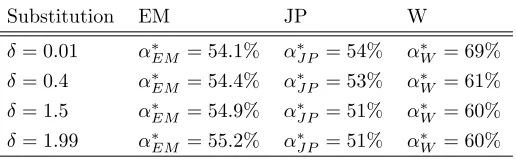
2 :We compute optimal allocation rules for progressively higher degrees of substitutability between goods, comparing outcomes for = 0:01; = 0:4; = 1:5;and = 1:99. Concerning the impact of the objective pursued by the regulator, we compare optimal allocation
2 4For instance, in the context of the example presented in Appendix B, we would obtain that EM increases from
50%to54:9%when increases from = 1to = 1:1.
2 5For instance, in the context of the example presented in Appendix B, we obtain the following corner solutions: (i) EM= 1when …rmiis endowed with the least e¢ cient abatement technology( = 4) ;and (ii) EM= 0when …rmiis endowed with the most e¢ cient technology( = 0:4):
rules under four di¤erent regulatory objectives: (i)equimarginality of abatement e¤ort(EM);(ii) maximization of …rms’ joint pro…ts (J P); and, …nally, (iii) maximization of total social welfare
(W). To compute consumer’s surplus, we use the partial equilibrium analysis from Belle‡amme and Peitz (2010). Table 3 summarizes our results:
Substitution EM JP W
= 0:01 EM = 54:1% J P = 54% W = 69%
= 0:4 EM = 54:4% J P = 53% W = 61%
= 1:5 EM = 54:9% J P = 51% W = 60%
[image:16.612.189.447.165.247.2]= 1:99 EM = 55:2% J P = 51% W = 60%
Table 3: Optimal permits allocations
Reading each line separately, we conclude that the optimal allocation of permits varies according to the regulator’s objective. When the regulator wants to promote equimarginality of pollution abatement (EM), he voluntarily chooses to ignore the impact of permits decisions on the output market. Table 3 shows that, under a equimarginality allocation rule, the regulator must allocate more permits to the …rm that owns the less e¢ cient abatement technology (as described in the previous section). In relation to the way output market characteristics in‡uence the equimarginality allocation rule, table 3 shows that as substitutability decreases, rising-rival’s cost strategies are weaker (due to less competition) and therefore the lower needs to be the compensation27 to the least e¢ cient …rm. It is worth noting that the equimarginality allocation rule is not very sensitive to changes in the degree of output substitutability. In fact output demands remain perfectly symmetric, with @pi
@yj =
@pj
@yi and therefore, the degree of product substitutability only a¤ects the strength of rival’s cost-rising e¤ects indirectly, through its e¤ect on output production (and therefore in …rms’abatement needs).
Turning now to the maximization of joint pro…ts (JP), the optimal allocation of permits once more favours the least e¢ cient …rmi: This is the case because, when giving more permits to the least e¢ cient …rm, the increase in its output production (and its pro…ts) more than compensates the decrease in its rival’s production (and pro…ts). The changes in the pro…t-maximizing allocation as substitutability changes are stronger than in the cost-e¤ective allocation.
Finally, the welfare maximizing (W) allocation rule gives even more permits to the least e¢ cient …rm than the pro…t maximizing allocation rule. This is the case because the latter only accounts for the fact that the increase in the least e¢ cient …rm’s output production after an increase in more than compensates the decrease in the most e¢ cient …rm’s output production. Instead, the welfare maximizing allocation rule also accounts for the fact that the mentioned changes in quantities a¤ect prices and consequently consumer’s surplus. In particular, for the values of the parameters that we
considered, we observe that the reduction in the pricepi more than compensates the increase in
pj:This leads to permits allocation rules more biased towards …rmi(around 60%)
Concerning the impact of output substitutability on the welfare-maximizing allocation rule, we …nd that as goods become less substitutable, …rm i must receive a higher fraction of permits to compensate the fact thatpi is higher thanpj (due to the higher marginal abatement costs of …rm
i).
It is worth noting that the amount of permits allocated to the least e¢ cient …rm increases as we move rightwise in Table 3. This is because, when giving more permits to the least e¢ cient …rm, the cost-e¤ective allocation rule takes into account the bene…t in terms of cost minimization while the pro…t-maximizing allocation takes into account, additionally, the positive e¤ect on overall output quantity and, …nally, the welfare-maximizing allocation considers the bene…ts for consumers in terms of prices (although one group of consumers is favoured in detriment of the other).28
4. CONCLUDING REMARKS
We have shown how the possibility of the simultaneous adoption of rival’s cost-rising strategies in an oligopolistic market may either aggravate of ameliorate the cost-e¤ectiveness of environmental regulation based on TEP markets. In particular, we found that it depends on each …rms’position as buyer or seller of permits as well as on the interplay of abatement and production cost struc-tures (and its impact in the output market with di¤erentiated products). In light of the previous results, we have investigated optimal criteria to allocate permits between …rms as a function of the regulator’s objective, addressing in more detail the characterization of permits allocation that lead to cost-e¤ectiveness of pollution abatement. We …nd that the optimal allocation of permits is the one that ensures that the di¤erence on each …rm´s price-cost margins in the permits and in the output market are equalized for the last permit distributed. Our analysis also reveals that optimal allocation rules may be extremely sensitive to the speci…c characteristics of the output market. Then, in line with Sartzetakis (1997), this paper emphasizes that the regulator is often faced with extremely demanding information needs.
REFERENCES
[1] Belle‡amme, P and Peitz, M. [2010] Industrial Organization Markets and Strategies, Cam-bridge University Press.
[2] Amir, R. [2005]. Supermodularity and Complementarity in Economics: An Elementary Survey, Southern Economic Journal,71(3), 636-660.
[3] Chen, Y., Hobbs, B.F., Ley¤er, S. and Munson T.S., [2006], Leader-follower equilibria for electric power and NOx allowances markets,Computational Managment Science,3, 307–330.
[4] G. de Feo, J. Resende, M-E Sanin, [2012], Emission permits trading and downstream strategic interaction, forthcomingThe Manchester School.
[5] D. M. D. Eshel, [2005], Optimal allocation of tradable pollution rights and market structures, Journal of Regulatory Economics,28:2, 205-223.
[6] Fehr, N.-H. M. v. d. [1993], Tradable Emission Rights and Strategic Interaction,Environmental and Resource Economics, 3, 129-151.
[7] Hahn, R. [1985], Market power and transferable property rights. Quarterly Journal of Eco-nomics,99, 753–765.
[8] IPCC [1990], Climate change: The IPCC Scienti…c Assessment.
[9] Kolstad, J. and F. Wolak, [2008], Using emission permits prices to rise electricity prices: Evi-dence from the California electricity market, Harvard University,mimeo.
[10] Liski, M and Juan-Pablo Montero, [2011], Market Power in an Exhaustible Resource Market: The Case of Storable Pollution Permits,Economic Journal,121(551), 116-144.
[11] Misiolek, W. S. and H. W. Elder [1989], Exclusionary manipulation of markets of pollution rights. Journal of Environmental Economics and Management,16, 156-166.
[12] Montero, J.P. [2009], Market Power in Pollution Permit Markets. The Energy Journal, 30 (Special I), 115-142.
[13] Montgomery, D. W. [1972], Market in Licenses and E¢ cient Pollution Control Programs, Journal of Economic Theory, 395-418.
[15] Salop, S.C. and D.T. Sche¤man [1983], Raising rivals’costs,American Economic Review Papers and Proceedings,73, 267-271.
[16] Sartzetakis E.S. [1997], Tradable Emission Permits Regulations in the Presence of Imperfectly Competitive Product Markets: Welfare Implications,Environmental and Resource Economics, 9, 65-81.
[17] Tanaka, M. and Y. Chen [2012], Emissions Trading in Forward and Spot Markets of Electricity, The Energy Journal, 33(2)
Appendix A
Proof of Lemma 1
By applying the theory of supermodular games, the sign of the e¤ect ofEkonykandy kdepends
on the sign of the cross-partial derivatives @2 k
@yk@Ek and
@2 k
@y k@Ek.
29 Without loss of generality,
supposek=i. Since
@2 i
@yi@Ei= h
00
i( yi Ei)>0
and
@2 j
@yj@Ei= h
00
j( yj S+Ei)<0
the largerEi, the largeryi(Ei)and the smaller yj(Ei).
SOC of the second-stage optimization problem The second order condition of the problem can be written as
d2
i
dE2
i
= @(d i=dEi) @Ei
+@(d i=dEi) @y?
i
@y? i
@Ei
+@(d i=dEi) @y?
j
@y? j
@Ei
where the …rst term is:
@(d i=dEi)
@Ei
= @y
? i
@Ei
1 h00i ( y?i Ei) +
@Pi yi?; y?j
@y? j @y? j @Ei ;
the second term is:
@(d i=dEi)
@y? i @y? i @Ei = "
h00i ( yi? Ei) + 2
@pi yi?; y?j
@y? i
c00i (y?i) 2h00i ( yi? Ei) #
@y? i
@Ei
;
and …nally the third term is:
@(d i=dEi)
@y? j
@yj? @Ei
= @pi y
? i; yj?
@y? i @y? i @Ei @y? i @Ei :
Therefore the SOC can be written as follows:
1 2+ @y
? i
@Ei
1 h00i ( y?i Ei)+
@pi yi?; y?j
@y? i
@yi? @Ei
1 + @y
? i
@Ei
+
"
2@pi y
? i; y?j
@y? i
c00i (y?i)
#
@y?i @Ei
<0
Proof of (8)
Applying the chain rule, the derivatives @yk
@ can be decomposed as follows:
@yk
@ =
@yk(q; Ei)
@Ei
@Ei(q) @q
@q
@ ;
where the derivatives @yk(q;Ei)
@Ei have already been obtained in Lemma , with
@yk(Ek)
@Ek > 0;and
@y k(Ek)
@Ek < 0: We have also seen that
@Ei
@q < 0 because @2
i
@Ei@q < 0: Similarly,
@q
@ < 0 because @2
j
@q@ <0(complementarity and supermodularity, see Amir, 2005).
Accordingly, along the equilibrium path
@yi @ =
@yi(q;Ei)
@Ei
@Ei(q)
@q @q
@ >0;
and
@yj
@ =
@yi(q;Ei)
@Ei
@Ei(q)
@q @q
@ <0:
As stated in (8) after a marginal variation of ; the equilibrium output of …rm i changes in the same direction, while the equilibrium output of …rmj changes in the opposite direction.
Appendix B: an example
Herein we rely on an example to illustrate how relevant parameters, such as …rms’ relative e¢ ciency in terms of abatement, may a¤ect equilibrium market outcomes.30 We consider that(i)
the inverse demand for goodk is given by pk(yk; y k) = 25 2yk 1:5y k; (ii) …rms’production
technology is similar, withck[yk] = (yk)
2
4 ;(iii)the intensity of pollution is equal to = 0:8;(iv)the total stock of emission permits is exogenously …xed by the regulator to meet the pollution control target and we consider it to beS = 3;which constrains …rms’production plans. Finally,(v) …rms’ abatement technologies are given byhi(ai) = (ai)
2
2 andhj(aj) = (aj)
2
2 :
In what follows, we compute the equilibrium outcomes as in Section 2.1 considering the speci…c functions detailed in points(i)to (v). Regarding …rmi0s abatement technology, we consider three
possible scenarios: …rm i is more e¢ cient in terms of abatement ( = 0:4); …rms have symmetric abatement technologies ( = 1); and …rmj is more e¢ cient in terms of abatement ( = 4): In the following table we reproduce the predictions of our model regarding equilibrium prices (both for
permits and output) and equilibrium trading levels for di¤erent values of :
pi pj q xi
[image:22.612.159.454.121.184.2]= 0:4 10:9 + 0:02 10:9 + 0:13 2:1 0:21 2:3 0:9 = 1 11:2 0:11 11:2 0:11 3:3 0:75 2:0 1:0 = 4 12:4 0:78 11:8 0:22 7:1 2:81 1:7 1:1
Table B: Equilibrium outcomes = 0:4; = 1; = 4
Table B shows that equilibrium output prices depend on …rms’abatement technologies. As we would expect, since …rms are symmetric with respect to everything else except abatement e¢ ciency, the …rm with the most e¢ cient abatement technology has a competitive advantage in the output market o¤ering its product as a lower price. Furthermore, Table B shows that an increase in leads to an increase in the output price of both goods. The regulator can partially o¤set this increase by allocating more permits to …rmiwhen this …rm becomes progressively more ine¢ cient. In a quite di¤erent context Tanaka and Chen (2012) …nd a contrasting result, which underlines the importance of taking into account the market structure as a key variable to choose optimal permits allocation. Regarding permits’trading, Table B shows that …rmimight be a net buyer or seller, depending on the value of : For example, if <0:39; …rmi is always a net buyer of permits, for the three technological speci…cations. In contrast, if > 0:65; …rmi is always a net seller of permits, for the three technological speci…cations. For intermediate values of ; …rmi is a net seller only for some speci…cations of the abatement cost function. As expected, when …rmibecomes relatively less e¢ cient than …rmj;it sells less (or buys more) permits to compensate its lower abatement e¢ ciency and become more competitive in the output market (in other words, …rm i is adopting a rival’s rising-cost strategy). In what concerns the price of permits, when …rmi becomes relatively less e¢ cient than …rmj; Table B shows an increase in the price of permits. As we move from = 0:4
to = 4; and …rm i becomes more ine¢ cient, …rm j increases the price of permits to withhold permit emissions and avoid the e¤ects of …rmi0s rival’s rising-cost strategies in the second stage. It
is worth noting that herein we just consider technological speci…cations for whichq h0j >0;
meaning that even when …rm j is a net buyer of permits, the rival’s rising cost e¤ect is always dominant.
Appendix C: Social Optimum
The regulator’s problem is to maximize (assuming a linear damage function aS) W = CS+
i+ j aS with respect to :Whenever interiority conditions are met, the FOC to the previous
problem is given by @CS@ +@ i
@ + @ j
@ = 0:Let us now compute each of the derivatives herein.
Let us call direct and indirect e¤ects as @pi
@yi =
@pj
@yj = and
@pi
@yj =
@pj
@yi = :The consumer surplus for symmetric linear demands and di¤erentiated products is given by (see Belle‡amme and Peitz, 2010 for details):
CS= 1
2 y
2
i + 2 yiyj+ y2j :
Deriving w.r.t. and equalizing to zero we get, after rearraning,
@Ei @q @q @ @yi @Ei
yi +
@yj @Ei
yj +
@yi @Ei
yj+
@yj @Ei
yi = 0
Pro…ts
We maximize pro…ts w.r.t. and we get:
@ i
@ =
dyi
d ( yi+pi c
0(y
i) h0i)
dyj d yi+
dq
d ( S Ei)
+q S dEi
d h
0
i
dEi d
By the FOC of the third stage, we have( yi+pi c0(yi) h0i) = 0.
Thus, by analogy, we should obtain that
@ j
@ =
dyi d yj
dq
d ( S Ei) q S+ q h
0
j
dEi d
Adding up so that we have the e¤ect of on total pro…ts, we obtain:
@ i
@ +
@ j
@ =
dyj
d yi+
dyi
d yj + h
0
i h0j
dEi d
E¤ect of on total welfare
Then, adding up previous derivations we …nd that @CS@ +@ i
@ + @ j
@ = 0 if and only if
dyi
d yi +
dyj
d yj + h
0
i h0j
dEi
d = 0
that after developing becomes
dEi d
@yi @Ei
yi +@yj @Ei
Considering that @pi
@yi =
@pj
@yj = we get equation (9):
dEi
d h
0
i h0j =
dEi d
@yi @Ei
yi @pi @yi
+@yj @Ei
yj@pj @yj
:
The previous can be rearranged considering the following equalities taken from the third stage equilibrium:
yi@pi @yi
= (pi c0i h0i)
yj@pi @yi
= pj c0j h0j
to get
dEi
d h
0
i h0j =
dEi d
@yj @Ei
pj c0j h0j @yi @Ei
(pi c0i h0i)
Adding and subtractingqdEi
d on the LHS and rearranging, we get
q h0j @yj
@Ej j
dEi
d = (q h
0
i)
@yi @Ei i
dEi d