City, University of London Institutional Repository
Citation
:
Wood, S. & de Menezes, L. M. (2011). High Involvement Management, High Performance Work Systems and Well-being. International Journal of Human Resource Management, 22(7), pp. 1586-1610. doi: 10.1080/09585192.2011.561967This is the accepted version of the paper.
This version of the publication may differ from the final published
version.
Permanent repository link:
http://openaccess.city.ac.uk/14079/Link to published version
:
http://dx.doi.org/10.1080/09585192.2011.561967Copyright and reuse:
City Research Online aims to make research
outputs of City, University of London available to a wider audience.
Copyright and Moral Rights remain with the author(s) and/or copyright
holders. URLs from City Research Online may be freely distributed and
linked to.
City Research Online: http://openaccess.city.ac.uk/ [email protected]
HIGH INVOLVEMENT MANAGEMENT, HIGH PERFORMANCE WORK
SYSTEMS AND WELL-BEING
Stephen Wood*
School of Management, University of Leicester, Leicester.
Lilian M. de Menezes
Cass Business School, City University London
*Corresponding author School of Management, Ken Edwards Building, University of
Council (Grant number 000-23-1482). The empirical research uses data from the Workplace
Employment Relations Survey of 2004 (WERS2004). This survey is jointly sponsored by the
UK’s Department of Trade and Industry, the Advisory, Conciliation and Arbitration Service,
the Economic and Social Research Council, and the Policy Studies Institute. The National
Centre for Social Research was commissioned to conduct the survey fieldwork on behalf of
the sponsors. WERS2004 is deposited and available from the Data Archive at the University
of Essex, UK. Neither the sponsors nor the Data Archive have any responsibility for the
analysis or interpretation of the material contained in this paper. We thank Ellen Farleigh and
Melina Dritsaki for preparing some of the data for the analysis, Garry Gelade for conducting
part of the analysis, and Alison Geldart for her editorial assistance.
ABSTRACT
Studies on the impact of high performance work systems on employees’ well-being are
emerging but the underlying theory remains weak. This paper attempts to develop theory of
the effects on well-being of four dimensions of high performance work systems: enriched
jobs, high involvement management, employee voice, and motivational supports.
Hypothesized associations are tested using multilevel models and data from Britain’s
Workplace Employment Relations Survey of 2004 (WERS2004). Results show that enriched
jobs are positively associated with both measures of well-being: job satisfaction and anxiety–
contentment. Voice is positively associated with job satisfaction, and motivational supports
with neither measure. The results for high involvement management are not as predicted,
since it increases anxiety and is independent of job satisfaction.
Keywords: high performance work systems; high involvement management; enriched jobs;
employee voice; trade unions; performance-related pay; job security; well-being; job
HIGH INVOLVEMENT MANAGEMENT, HIGH PERFORMANCE WORK
SYSTEMS AND WELL-BEING
High performance work systems are a key invention of modern management, and are claimed
to have strong beneficial effects on individual and organizational performance. This
expectation has spawned a significant research stream aimed at testing for performance gains.
By comparison, research on the potential effects on employee well-being have been rare until
recently (Appelbaum, Bailey, Berg and Kalleberg, 2000; Barling, Kelloway and Iverson,
2003; Harley, Allen and Sargent, 2007; Macky and Boxall, 2007, 2008; Mohr and Zoghi,
2008; Takeuchi, Chen and Lepak, 2009). Such studies are important in their own right, as
policies that can increase worker well-being are essential to the industrial landscape, not least
because there is strong evidence that stress at work extends to general health (e.g. Danna and
Griffin, 1999; DeLongis, Folkman and Lazarus, 1988; Ganster and Schaubroeck, 1991;
Macik-Frey, Quick and Nelson, 2007; Wilkins and Beaudet, 1998), and increases work–
family conflict (e.g. Frone, Russell and Cooper, 1992; Geurts, Kompoier, Roxburgh and
Houtman, 2003; Williams and Alliger, 1994). Furthermore, research can also help explain
why the high performance work system may affect organizational performance as job
satisfaction, contentment and enthusiasm are commonly seen as mechanisms or employee
outcomes that explain some of the association between the system and organizational
performance (Becker and Huselid, 1998; Boxall and Purcell, 2003; Pfeffer, 1994; Wright and
Gardner, 2003).
The studies thus far offer some support for a positive link between high performance
work systems and job satisfaction, but the results are mixed. Moreover, their theoretical
underpinning remains underdeveloped. Consequently, in this paper we extend our theoretical
well-being. In particular, we apply Warr’s (1990, 2007) concepts for explaining variations in
job-related well-being (see, for example, Feldman Barrett and Russell, 1999; Remington,
Fabrigar andVisser, 2000).
We then empirically investigate the high performance work systems–well-being link
using data from a large representative sample of British workplaces and their employees, the
2004 Workplace Employment Relations Survey (WERS2004).
Part One: High Performance Work Systems and Well-Being
High Performance Work Systems
High performance work systems are generally associated with employers providing a)
opportunities for worker involvement and participation, b) intensive training and
development and, c) incentives (Appelbaum et al., 2000; Bailey, 1993; Gerhart, 2007;
Kalleberg, Marsden, Reynolds and Knoke, 2006). Human resource specialists often advocate
an integrated approach, in which the triad of high involvement, skill development and
incentives are used in concert. Consequently, in most studies that test for performance effects
of high performance work systems, practices associated with each element of this triad are
treated collectively as if they formed a unity, typically with little investigation of whether or
not they co-exist. It is, however, by no means clear that these three elements will be adopted
together on a widespread scale.
Moreover, in practice, strategies that place emphasis on specific elements may vary.
A human capital approach, for example, may emphasize recruitment of talent at the expense
of widespread involvement, while approaches centered on extrinsic motivation or more
specifically performance-related pay have been presented as antithetical to high involvement
management (Beer, Spector, Lawrence, Mills and Walton, 1984; Wood, 1996a). In fact,
resource management–performance literature in favour of an emphasis on human capital (i.e.
the skills and knowledge element), reflecting the significance of the resource-based view of
the firm among human resource management specialists (Barling et al., 2003; Wood and
Wall, 2007). This emphasis contrasts with the industrial relations tradition, in which
involvement is viewed as the core of high performance management (Boxall and Macky,
2009; Cappelli and Neumark, 2001; Godard, 2004:351). In this context, the motivational
element has often been treated as a support for involvement.
In this study we focus on two elements: involvement and incentives, which are
generally seen as forms of financial or economic involvement, such as performance-related
pay or stock options. We differentiate four types of involvement: role involvement, high
involvement management, voice, and economic involvement.
First, role involvement concerns individuals’ level of responsibility to execute and
manage their own primary task. Extending beyond the conscious job redesign associated with
job enrichment, the role involvement (Wall, Wood and Leach, 2004) associated with the high
performance work system includes all cases where jobs are structured with some level of
non-routine tasks and job discretion. Accordingly, we use the term “enriched jobs” if
employees have a degree of variety and autonomy over their role.
Second, high involvement management is the type of direct organizational
involvement, as popularized by Lawler (1986, 1991), that centers on teamwork, quality
circles and other idea-capturing schemes. More specifically, high involvement management is
a managerial orientation that encourages greater flexibility, proactivity and collaboration. It is
reflected in management practices that offer opportunities for organizational involvement,
either directly (through teamwork, flexible job descriptions and idea-capturing schemes) or
indirectly through information dissemination or training specifically to aid involvement
development of broader horizons among all workers so that they can think of better ways of
doing their jobs, connect what they do with what others do, and react effectively to novel
problems. It aims to induce more than proficient performance – the adaptation and proactivity
that characterize the modern work requirements associated with a continuous improvement
culture (Griffin, Neal and Parker, 2007).
Employee voice, the third element, covers the indirect mechanisms for participation
associated with formal employee relations mechanisms, such as trade unions or consultative
committees. These mechanisms allow employees or their representatives to express their
grievances, dissatisfactions, demands for changes, and reactions to management’s plans or
initiatives. Such expressions are distinguishable from other reactions to dissatisfactions:
quitting, remaining loyal to the organization, or simply neglecting the sources of
dissatisfaction (Farrell, 1983; Hirschman, 1971). When Freeman and Medoff (1984) first
applied Hirschman’s concept of voice to work organizations, they concentrated on trade
unions, but other methods exist, so we take voice to encompass union-based collective
bargaining, works councils, non-union representative systems, and grievance procedures
(Kaufman and Taras, 2000). Within managerial circles the relationship between voice
mechanisms and performance is often assumed to be negative, yet following Freeman and
Medoff’s association of them with potential positive effects, such mechanisms have often
been included within measures of high performance work systems (Arthur, 1994; Datta,
Guthrie and Wright, 2005; Fey, Björkman and Pavlovskaya, 2000; Huselid, 1995;
Ichniowski, Shaw and Prennushi, 1997; Wright, Gardner and Moynihan, 2003).
Finally, economic involvement involves methods of payment, promotion and
financial benefits, i.e. practices that are typically associated with the motivational element of
“use their … creativity, enthusiasm, and intimate knowledge of their particular job for the
benefit of the organization” (Appelbaum et al., 2000:42).
There is no strong evidence to suggest that these four forms of involvement are
actually used together. If anything, the evidence is that they are not. First, case studies
suggest that high involvement management practices have been introduced into work systems
unaccompanied by job enrichment (Wickens, 1988; Wood, 1986), and the broader survey
evidence (limited to Britain) supports the contention that high involvement management and
job enrichment are separate and largely independent (de Menezes and Wood, 2006). Indeed,
the hallmark of the Toyota production system is the introduction of high involvement
management practices into systems that remain Taylorist in key aspects, as workers may lack
job autonomy or task variety (Cappelli and Neumark, 2001: 751–752; Wood, 1993). Second,
high involvement management or enriched jobs may be independent of employee voice, or at
least with trade union voice (Machin and Wood, 2005; Osterman, 1994; Wood, 1996b; Wood
and Bryson, 2009). Third, as the recent controversy about bonus systems suggests,
motivational practices like performance-related pay can be used outside of a high
involvement regime. Indeed, it is argued that individual performance-related pay is
antithetical to involvement (e.g. Beer et al., 1984), though advocates of high performance
work systems claim that collective forms of performance pay systems are more relevant for
involvement (Lawler, 1991; Walton, 1985). Variable pay was only weakly correlated with
high involvement management in de Menezes and Wood’s study (2006) and unrelated to
enriched jobs. Moreover, de Menezes and Wood found no association between job security
guarantees or internal recruitment and either enriched jobs or high involvement management
in British workplaces, which is consistent with the findings of Barnard and Rodgers’ (2000)
study in Singapore. Theoretically, motivational systems can align an individual’s motivations
organization, and thus we expect no single form of reward system to be uniquely associated
with high involvement management.
The Link between Elements of the High Performance Work System and Well-Being
Recent studies of high performance work systems and well-being have used a global measure
that encompassed several elements, except for Mohr and Zoghi’s (2008), which focused
explicitly on high involvement management. The emphasis has been on how high
performance work systems increase job satisfaction by improving aspects traditionally
associated with enriched jobs, such as autonomy, skill utilization, and development. For
example, Macky and Boxall (2008:41) suggest that the key mechanism in a high performance
work system explaining a performance effect of employee involvement is its elicitation of
“greater discretionary effort from employees”.
Attempts at more in-depth theorization have applied the demand–control theory of
stress associated with Karasek (1979, 1989), which hypothesizes that increased control or
discretion for workers reduces psychological strain and enables them to cope better with
higher demands. Macky and Boxall (2008) and Appelbaum et al. (2000:196) argue that high
performance work systems may reduce stress, but may “place greater demands on employees
by encouraging them to put forth discretionary effort to help their team and organization
succeed” and thus may also increase stress. Essentially, the link between high performance
work systems and stress could go either way: the negative effects of increased demands may
outweigh the positive effects of increased control, or vice versa.
Empirical work has thus been motivated by the quest to ascertain the nature of the
balance by testing the direction of the association between high performance work systems
and well-being. While the measures of high performance work systems vary between studies,
they all focus on discretion as the main mechanism linking them to positive well-being.
measure what they call “opportunity to participate” that combines job autonomy with key
high involvement mechanisms such as self-directed teams and quality circles; while Barling
et al.’s (2003) measure includes job autonomy and training measures. By contrast, Takeuchi
et al. (2009) associate high performance work systems not with the demand or control
elements of Karasek’s model, but with its additional support dimension. They see high
performance work systems increasing job satisfaction through an organizational climate that
reflects a concern for employees, and concentrate on motivational or skill acquisition
practices, which are assumed to provide a sense that the organization is “caring about its
employees’ success and well-being” (op cit: 7). The evidence of these studies is promising as
they suggest that the balance of the effects of high performance work systems, however
measured or conceived, on job satisfaction are positive.
In our terms, the various dimensions of involvement may be related to well-being
differently and even the impact of enriched jobs may not be confined to increasing autonomy
or demands. We therefore aim to move away from an extension of the demand–control
job-level model and concentrate on other mechanisms that may link organizational involvement
to well-being. We use Warr’s (2007: 81–140) model of 12 environmental factors that may
affect well-being to outline ways in which the types of involvement can relate to well-being.
In our view, the most important of these factors are: opportunity for personal control (as in
the Karasek model), opportunity for skill use and acquisition, externally generated goals such
as job demands, variety in job content, role clarity and task feedback, contact with others,
valued social position, job security, and opportunity for advancement. Warr implies that his
factors can predict various dimensions of well-being, e.g. anxiety–contentment or
depression–enthusiasm, while acknowledging that some may be “more predictive of one
form … than of others” (Warr, 2007:23). For example, a lack of personal control is likely to
Enriched jobs and well-being. First, we expect that enriched jobs will have positive
effects on well-being as they increase personal autonomy; equally, a lack of discretion and
limited variety will have negative effects (Fried and Ferris, 1987; Humphrey, Nahrgang and
Morgeson, 2007; Judge, Thorsen, Bono and Patton, 2001; Sparks, Faragher and Cooper,
2001). But an enriched job may also increase opportunities for skill use and development, job
variety, and the sense of being valued or playing a significant role in the organization or
society, thus adding to the potential impact on well-being.
High involvement management and well-being. First, high involvement
management through enhancing role breadth and opportunities for idea generation and
suggestion making may increase perceived personal control and variety of work, even if there
is no concomitant increase in job discretion. Second, teamwork, and perhaps functional
flexibility and group forms of idea capturing, increase social contact, a vital cause of
satisfaction (Warr, 2007: 86–87) which helps to reduce anxieties. Third, information sharing
and workers’ greater understanding of the organization’s objectives and their role in the
achievement of these may make their environment less uncertain. Fourth, in so far as high
involvement management creates successful results or the perceptions of a successful
adaptive organization, workers may perceive their jobs to be more secure or their career
prospects to be good. Fifth, the acquisition of the skills and information that high
involvement management entails may increase satisfaction and contentment through its
impact on the individual’s job variety, self-esteem and the ability to learn and be proactive.
Sixth, the invitation to be more involved in the organization implicit in high involvement
management may signal to the employee that they are respected and that their contribution is
valued. Moreover, being directly involved in and informed of the organization’s objectives
and its progress towards them may also increase the meaningfulness of both work and
individuals are then less likely to see their work as a mere job and more as a career, and there
is evidence that people for whom work is a career or calling are more satisfied (Warr,
2007:125).
Overall, such effects may increase workers’ pride in their work and contribution to the
success of their organization, reinforcing feelings of contentment and enthusiasm. Individuals
may also use their discretion and the opportunities for creativity to reduce irritants, problems
or hindrance stressors (Cavanaugh, Boswell, Roehling and Boudreau, 2000) that make their
job more difficult to perform. Finally, Mackie, Holahan and Gottlieb (2001: 1070–1071)
argue that the increased meaningfulness, manageability and comprehensibility of work and
organizational life associated with high involvement management enhances the individual’s
sense of coherency, which in turn improves their coping mechanisms, enabling them to better
withstand any stressors.
Employee voice and well-being. We expect workers whose managers are receptive
to workers’ voice, regardless of whether it is direct, or via union or non-union
representatives, to have greater levels of employee being. Voice firstly affects
well-being through its provision of higher wages, better job design, and the amelioration of
unsatisfactory conditions. If such items are included in the analysis, employee voice may not
have a strong independent impact on well-being. But voice may secondly enhance procedural
justice, and employees’ sense that their grievances will be heard (Alexander and Ruderman,
1987; Leventhal, 1980; Thibaut and Walker, 1978), and that they and their views are valued
(Lind and Tyler, 1988). It may thus have an effect over and above its substantive
achievements.
In so far as recognized trade unions provide a distinctive, independent voice for
workers, we might expect their existence to have an independent effect on well-being.
union’s achievements may also increase perceived equity in the treatment of employees, and
reinforce feelings of being valued. Indeed, Karasek and Theorell (1990:70) cast trade unions
in this light (as providers of social support), adding to employees’ sense of identity, based on
“the socially confirmed value of individuals’ contribution to … collective goals”.
Empirical work has concentrated on trade union membership or representation and its
link with job satisfaction. Consequently, the links with other dimensions of well-being, the
impact on well-being of consultation, and non-union mechanisms have been neglected. The
results of the union–satisfaction studies are, however, inconclusive: several found no
relationship (Borjas, 1979; Bryson, Cappellari and Lucifora, 2004; Freeman, 1978; Miller,
1990), whilst others found a negative relationship (Gazioglu and Tansel, 2006:1163; Meng,
1990).
Allied to employee voice, a management that is perceived to be informative,
particularly about change (secrecy being an oft-quoted characteristic of low involvement
management), may contribute to job satisfaction and well-being by enhancing the
individuals’ sense of value, worth, and security, as well as procedural or substantive justice
(Folger and Cropanzano, 1998: 39–40). We therefore hypothesize that informative
management is positively associated with job satisfaction and contentment.
Economic involvement and incentives. We consider team- or organization-based
incentive schemes, profit sharing, and employee stock ownership, job security guarantees,
and internal promotion. Baron and Kreps (1999:264) highlight the symbolic rather than
material significance of such methods, since they contribute to transforming a market
relationship between the organization and its employees to “a team member relationship in
which the employee shares in the successes (…[and] failures) of the
team/firm[/organization]”. If such economic involvement complements high involvement
and their internalization of organizational values (Baron and Kreps, 1999:195), then we
would expect that its effects on well-being (or performance) are largely interactional with
high involvement management.
We would argue, however, that motivational supports may also have independent
effects, especially when incentives are organization-wide, since they can enhance people’s
sense of being valued, secure and supported. Moreover, if motivational supports are applied
consistently, they may add to a perception of equality, thus potentially increasing social
cohesion and distributive and procedural justice.
In addition, the incentive elements of collective payment systems may be perceived as
contributing to a higher level of pay than there would be otherwise and thus may enhance pay
satisfaction and reduce anxieties that result from economic insecurity. Yet the main effect
may be to enhance the sense of being part of a valuable collective and cooperative enterprise
(Helliwell, 2006; Layard, 2006). Job security guarantees are likely to have a positive impact
on well-being because personal security is valued by most people (Hellgren and Sverke,
2003; Sverke, Hellgren and Näswall, 2002; Warr, 2007: 133–135). Finally, internal
recruitment implies the existence of a career ladder, which may provide employees with what
Warr (2007: 133–135) calls a good career outlook, with equal effect on job satisfaction and
contentment. However, Appelbaum et al. (2000) found no relationship between promotion
opportunities and stress, measured on a single item self-rated scale.
Interactions between the Types of Involvement
A great emphasis has been placed in the literature on the potential synergies between the
different elements of the high performance work system. This concept implies that there will
be stronger interaction effects on performance between elements (or even between
sub-elements within the sub-elements) and this argument has been extended to well-being (e.g. by
performance are replicated in the case of well-being, but nonetheless there are theoretical
reasons for expecting some interaction effects.1
First, we might expect an interaction between high involvement management and
enriched jobs on the grounds that both enhance the impact of each other. On the one hand,
under a high involvement management regime through being more involved in idea
capturing, teamwork, information sharing, and training, workers may feel more confident and
able to take advantage of available opportunities to make decisions outside of their usual
remit or reduce any constraints that would inhibit their ability to make routine decisions. The
feeling of being more valued when high involvement management is practiced may also
amplify any similar feelings generated by enriched jobs. On the other hand, when individuals
in highly constrained jobs are encouraged to be more involved in organizational decisions,
they may react cynically; since management allows little discretion in their core jobs, workers
may reason that suggestions will not be taken seriously or engagement fairly rewarded.
Second, following Kochan and Osterman’s (1994) mutual gains perspective on
worker participation, we hypothesize that consultative and informative management enhances
any effect of high involvement management, be this on performance or well-being: without
the sharing of information, management will be mistrusted and high involvement
management will lack credibility and not have a sustained impact. In addition, Kochan and
Osterman (1994: 105–107) see trade union voice as adding to the organization-wide sense of
commitment to a sustainable participation. Consequently, we might expect an interaction
between trade union representation and consultative methods.
Third, in so far as motivational practices act as supports for high involvement
management, we would expect they impact on well-being also through intensifying high
involvement management’s effect. Such practices complement high involvement
reinforcing the employee’s attachment to the organization and their work team. Job security
guarantees help to assure employees that any suggestions to improve productivity will not be
used in ways that harm their long term prospects or lead to job losses (Kochan and Osterman,
1994: 14). Collective performance-related pay systems signal that the organization aims to
divide any gains from high involvement management with employees. Indeed, Kruse,
Freeman and Blasi (2008) tested for an interaction effect involving motivational supports and
high involvement management, and found that group- or organization-level payment systems
had a positive effect on job satisfaction when used in conjunction with high involvement
management. Conversely, they found that such pay systems had a negative impact on job
satisfaction where there is no high involvement and close supervision. The implication is that
without high involvement management such pay systems become the fulcrum of the human
resource system and elevate performance management to a prime role in the organization’s
human resource management approach – akin to Taylor’s (1972: 34) notion of management
through the pay system – in a way that is threatening and undermines feelings of having
personal control or being valued.
Part Two: The Empirical Study
Warr (1990, 2007) conceptualizes job-related well-being in terms of three dimensions:
dissatisfaction to satisfaction, anxiety to contentment (or comfort), and depression to
enthusiasm, which are differentiated on the basis of degrees of pleasure and arousal. The
positive ends of anxiety–contentment and depression–enthusiasm are characterized by a state
of high pleasure or positive affect, but their negative ends differ in relation to arousal.
Anxiety involves low levels of pleasure and high arousal, contentment high pleasure and low
arousal. Depression is characterized by low pleasure and arousal, enthusiasm by high
dimension – the extent of pleasure one gains from one’s job. In our data, we have measures
of job satisfaction and anxiety–contentment, but not depression–enthusiasm.
At this stage, we have no strong reason for expecting large differences among the
relationships between our involvement types across well-being outcomes. Thus, we test for
the following predictors of well-being: (a) enriched jobs, (b) high involvement management,
(c) consultative management, (d) trade union representation, (e) informative management, (f)
job security guarantees, (g) internal labour markets, (h) group- or organization-level payment
systems. We also test for interactions across the types of involvement (e.g. between high
involvement management and enriched jobs).
The Data
Our study uses workplace and employee data from WERS2004. Since employees are nested
within workplaces, observations at the employee level are not independent and we have a
two-level nested structure. Workplace-level data were collected by an interview with a single
manager in the workplace – known as the management survey – and employee data by a
survey of employees in workplaces that had been included in the management survey.
For the management survey, the interview was face-to-face with the senior person at
the workplace with day-to-day responsibility for industrial relations, employee relations, or
personnel matters. In some cases this was a personnel specialist. In others, it was a general
manager or a person with a different functional specialty, such as finance. Interviews were
conducted with managers in a total of 2,295 workplaces from an in-scope sample of 3,587
addresses, representing a response rate of 64%. The sample covers the private and public
sector and all industries, with the exception of establishments engaged in primary industries
and private households with domestic staff (7% of all workplaces) or with fewer than five
employees (60% of all workplaces). It was taken from the Inter-Departmental Business
The employee survey within WERS2004 produced a sample of 22,451 employees,
which represented a response rate of 61%. Data were collected via an eight page,
self-completion questionnaire distributed within 86% of workplaces where WERS surveyors had
conducted the management interview. The aim was to get up to 25 employees in each
workplace, selected on a random basis, to complete the questionnaire. A further 12% of
workplaces did not return any questionnaires, and in those with 10 or more employees these
were treated, for the purposes of calculating the 61% response rate, as the same as those who
had initially declined to distribute questionnaires. The median number of employees per
workplace completing the questionnaire was 13, with the most frequent (in 100 workplaces)
being 16 employees. The number of employees in no cases exceeded the 25 employees
requested by the surveyors.
The Measures
Dependent variables: well-being measures. Job satisfaction: The measure of job
satisfaction is based on an eight-item measure concerned with how satisfied individuals are
with: the amount of influence the person has over their job, the amount of pay they receive,
the sense of achievement they get from their work, the scope for using initiative, the training
the person receives, their job security, involvement in decision making, and the work itself.
Principal component analysis of the items indicated that they form a single dimension, with
the model explaining 50% of the variance. We measure job satisfaction by the mean scores
on all eight items. The scale reliability is 0.85, as measured by Cronbach’s alpha.
Contentment scale is Warr’s (1990) measure, based on respondents being asked,
“thinking of the past few weeks, how much of the time has your job made you feel” each of
six emotional states. Three positive states – calm, contented, relaxed – and three negative
ones – tense, uneasy, worried – are used to measure the contentment dimension. A five point
principal component analysis, where the positive items were recoded so that the scale ranges
from a negative state to a positive state, anxiety to contentment, revealed two discrete
components, as the negative items load on one factor and the positive items on the other.
However, following Segura and González-Romá (2003), we tested to see if this two factor
model reflects the fact that the relationships between positive and negative items are
nonlinear by applying the Mokken model (using STATA9). This is a nonlinear scaling
method similar to Guttman’s, in which scalability is evaluated by the Loevinger H coefficient
(Loevinger, 1948). The overall coefficient is 0.55, which means that the items are scalable on
an underlying (bipolar) dimension and the scale is deemed strong, since the Loevinger H
coefficient for each item is over 0.5 (González-Romá, Schaufeliu, Bakker and Lloret, 2006:
170). We thus measured contentment by the mean scores on the six items. The contentment
scale has Cronbach’s alpha of 0.85. The correlation between contentment and job satisfaction
in the WERS2004 sample is the moderate 0.47.
Independent variables. Enriched jobs is measured at the employee level by a
five-item scale (Cronbach’s α = 0.81) based on workers’ ratings of their jobs on a four point scale – a lot, some, a little, none – of how much influence they have over five areas of work: “the
tasks you do in your job”, “the pace at which you work”, “how you do your work”, “the order
in which you carry out your tasks”, and “the time you start or finish your work”.
High involvement management is measured at the workplace level by a score based on
a one factor latent trait model with the following high involvement practices, as used in
Wood and de Menezes’ (2008: 663–664) analysis of the WERS98 data: functional flexibility,
quality circles, suggestion schemes, teamwork, induction, interpersonal skills training, team
briefing, information disclosure, and appraisal. The percentage of the log-likelihood ratio
calculated as proposed by Bartholomew and Knott (1999: 93, equation 4.36), is equal to
0.68.2
Consultative management is the extent to which managers at the workplace consult
employees or their representatives, and is a three-item scale (Cronbach’s α = 0.93) based on a question in the employee survey asking about employees’ perceptions of how good managers
were at the following three processes: “seeking the views of employees or employee
representatives”, “responding to suggestions from employees or employee representatives”,
and “allowing employees or employee representatives to influence final decisions”.
Informative management measures the extent to which management disseminates and
shares information with its employees. It is a three-item scale (Cronbach’s α = 0.91) based on an employee survey question asking how good employees felt managers were at keeping
them informed of: “changes to the way the organization is run”, “changes in staffing”,
“changes in the way you do your job”, and “financial matters, including budgets or profits”.
Trade union recognition measures whether one or more trade union is recognized for
negotiating pay and conditions for any section of the workforce.
Job security guarantees are measured at the workplace level by a binary indicator
that guaranteed job security or noncompulsory redundancies are available for any
occupational group other than management.
Internal recruitment is a binary measure that was constructed from a management
survey question asking about the approach to filling vacancies in the workplace, equal to 1
where internal applicants are the only source of recruitment or are given preference over
external applicants, other things being equal, or 0 where internal and external applicants are
Group- or organization-level performance-related pay is a binary indicator based on
data from the management survey that at least 80% of non-managerial employees are paid by
results based on group or team performance.
Profit sharing is a binary variable based on data from the management survey that
measures whether at least 80% of non-managerial employees in the workplace are
participating in the profit-related pay scheme.
Employee share ownership is a binary variable, which indicates that at least 80% of
non-managerial employees in the workplace are eligible for a share ownership scheme.
Individual-level controls. Contractual status: two binary variables are indicative of
temporary or fixed-term contracts (the reference category is permanent).
Manager: a binary variable is coded 1 if the employee is a manager and 0 otherwise.
University educated: a binary variable is coded 1 if the individual is educated to degree level
and 0 otherwise.
Gender: a binary variable is coded 1 if the individual is male and 0 if female.
Age group: eight binary variables that indicate the following age groups: 18–19 years,
20–21, 22–29, 30–39, 40–49, 50–59, 60–64, and 65+ (the reference category is 16–17 years).
Tenure in the workplace: four binary variables indicate the length of tenure: 1–<2
years, 2–<5, 5–<10, and 10+ (the reference category is less than one year).
Low wage: a binary variable that is equal to 1 if the individual earns up to £220 per
week (£4.50 per hour was the national minimum wage when the data were collected).
Job demands or workload is measured in two ways: (a) the amount of hours per week,
including overtime or extra hours, that the respondent usually works, and (b) a scale based on
respondents’ level of agreement (a five point scale from strongly agree to strongly disagree)
with the statements: “my job requires that I work very hard”, and “I never seem to have
Trade union membership is measured by data from the employee survey as a binary
variable that is equal to 1 if the individual is currently a member of a trade union or staff
association.
Perceived supportive management: a six-item scale (Cronbach’s α = 0.93) based on a
question that asked about the extent to which the managers at the workplaces had the
following characteristics: “can be relied upon to keep to their promises”, “are sincere in
attempting to understand employees’ views”, “deal with employees honestly”, “understand
about employees having to meet responsibilities outside work”, “encourage people to develop
their skills”, and “treat employees fairly”. It is aimed at measuring management’s behavioral
integrity, consistency or demonstration of concern for employee needs, built around some of
the measures of Whitener, Brodt, Korsgaard and Werner’s (1998) trustworthy behaviors
(Guest, Brown, Peccei and Huxley, 2007).
Workplace-level controls. Employment level: a continuous variable that is equal to
the logarithm of the total number of full- and part-time employees in the workplace.
Size of the total organization of which the workplace is a part: four binary variables
indicate the total number of employees in the larger company to which the establishment
belongs. (In the case of the single-site workplace, this will be the same figure as that for the
workplace employment level.) The reference category is less than 100 employees and the
other categories are: 100 to 1,000, 1,001 to 5,000, 5,001 to 50,000, and greater than 50,000.
Non-private workplace: a binary indicator of whether the workplace belongs to the
public or voluntary sector, regardless of its industrial group.
Industry: eleven dummy variables indicate the industry groups, each with workplaces
in the private and public sector (reference category: wholesale and retail).
Since we are combining workplace- and individual-level variables and the data constitute a
two-level nested structure, we use weighted hierarchical multilevel regression models to test
whether our hypothesized predictors of well-being and job satisfaction are significant. These
were calculated using MLWin, which estimates linear models of the following form:
[ ]
[ ]
~ (0, ) ) , 0 ( ~ being -Well ) , ( ~ being -Well 2 0 2 0 0 0 0 0 0 e ij u j ij j ij lj l l kij k k ij ij ij N e N u e u X X XB N σ σ β β β β β + + = + + = Ω∑
∑
These are known as random effects models; more specifically, these are random intercept
models, for the intercepts can vary between workplaces since they are the sum of a fixed
effect (β0) and a random workplace error term that is normally distributed with zero mean
and constant variance ( 2 u
σ ). Accordingly, j corresponds to a workplace and i to an employee
and e0ij is the error term, which is also assumed to be normally distributed with zero mean
and constant variance. We consider the two-level structure, employees (level 1) being nested
within workplaces (level 2). This approach allows direct assessment of the relative
importance of employee and workplace characteristics.
A model of the above form assumes that the well-being scales measured at the
individual (employee) level are normally distributed with a mean that is a linear combination
of the explanatory variables (Xs) and variance that, in our models, is constant. The equation,
which describes the well-being of each individual employee, can be rewritten by substituting
the intercept for its value:
ij j lj l l kij k k
ij 0 X X u0 e0
being
In doing so, we can clearly see the fixed part of the model that is followed by its random
component and we assume that the individual error terms are independent of the workplace
error terms.
For each well-being scale, we start with a null model that estimates its mean and the
residual variances. This model is sometimes called a variance components model because the
residual variance is partitioned into components corresponding to each level in the model.
The similarity between employees in the same workplace can be measured by the intra-class
correlation, namely: 2 2
2
e u
u σ σ
σ
+ , which measures the extent to which the well-being of
individuals in the same workplace is similar in comparison to those of individuals in different
workplaces. It can also be interpreted as the proportion of the total residual variance that is
due to differences between workplaces, known as variance partition coefficient or VPC
(Goldstein, 2003: 16–17).
Subsequently, for each well-being scale, we estimate a model that includes controls
and predictors of both levels which tests our hypothesized main predictors. Following this
model, we add the interactions between the types of involvement. Using the weights that are
provided in WERS2004 and are standardized in the regression estimation procedure, our
population parameters are computed based on the sample. By doing so, we can infer the
association between each independent and dependent variable within workplaces in the UK.
MLWin provides estimates of the coefficients and their standard errors as well as a
log-likelihood statistic (IGLS Deviation) that can be used to compute the log-log-likelihood ratio test
statistic to test if additional coefficients in a hierarchical analysis are significant. The residual
variances and respective standard errors are also estimated so that improvements in the
We conducted two analyses. The first model covers the whole sample and the second
just the private sector sample, since profit sharing and employee share ownership schemes are
unavailable in either the public or voluntary sectors.
Results
According to the null models, the average level of anxiety–contentment is equal to 3.21 (s.e.
0.01) and of job satisfaction 3.6 (s.e. 0.20), thus suggesting that the average employee is
content and satisfied with their job. The variance partition coefficients show that 14.67% and
18.55% of the total variation for anxiety–contentment and job satisfaction are attributable to
between-workplace differences. If we consider the private sector separately, these values are
respectively 15.42% and 18.65%. The variance partitions in both the whole sample and the
private sector are therefore significant, and thus two-level models are important in
understanding the associations in the data.
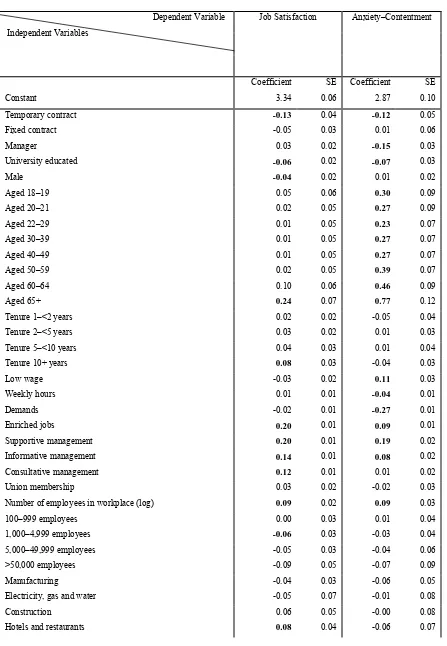
Main results for the whole sample. Job satisfaction: Table 1 (column 2) shows the
estimated coefficients and respective standard errors for the potential predictors from the
model of job satisfaction required to test our potential main effects. Of the individual-level
predictors, those that are positively associated with job satisfaction are: enriched jobs,
consultative management, and informative management. In contrast, none of the
workplace-level predictors are positively related to job satisfaction.
– Insert Table 1 –
Individual-level controls that are associated with increases in job satisfaction are:
supportive management, being 60 or older, and long tenure (over 10 years). Variables that are
negatively associated with job satisfaction are: job demands, not having a permanent contract
(temporary or fixed-term contracts), being educated, and being male. The amount of hours
Workplace-level control variables that are positively related to job satisfaction are: the
size of the workplace and the workplace being in health, education, or other community
services. Job satisfaction is less in financial services workplaces, when compared to
wholesale and retail, and when the total organization of which the workplace is a part has
over 5,000 employees.
These results demonstrate that some, but not all, of our hypothesized predictors of
well-being are related to job satisfaction: enriched jobs, consultative management, and
informative management. Nonetheless, high involvement management, trade union
representation, and motivational supports do not predict job satisfaction.
After adding the hypothesized interactions to the model, we found no strong
interaction effects. Hence, there is no support for synergies between the four types of
involvement on job satisfaction.
Anxiety–contentment: Table 1 (column 3) summarizes the results of the two-level
model, whose dependent variable is the anxiety–contentment scale. There is a positive
association with the following individual-level predictors: enriched jobs and informative
management. Of the workplace-level predictors, only high involvement management is
associated with anxiety–contentment, but contrary to our expectations, the relationship is
negative.
Of the individual-level controls, anxiety–contentment is positively associated with:
supportive management, age, low earnings, and the size of the workplace. It is related
negatively to the following: the two measures of demands or workload (job demands and
hours worked), having a temporary contract, being a manager, being educated to degree level,
and being a union member. Among the workplace-level controls, the size of the workplace is
positively associated with anxiety–contentment, while working in either the financial or other
Key results for anxiety–contentment tally with our findings with respect to job
satisfaction: enriched jobs and informative management are positively associated with
anxiety–contentment, whilst trade union variables and motivational supports are not.
However, consultative management is not related to anxiety–contentment, but it is related to
job satisfaction. High involvement management is negatively associated with anxiety–
contentment, and hence the association is in the opposite direction to that hypothesized.
When we consider the potential interactions, the only significant relationship is that
between high involvement management and internal recruitment, which is positively related
to anxiety–contentment (coefficient equal to 0.02 with standard error 0.01); the negative
impact of high involvement management is thus attenuated by internal recruitment.
Given that even though managers are employees they are more the instigators or
bearers, rather than recipients, of practices such as high involvement management and we
have found that being a manager was negatively associated with anxiety–contentment, we
tested to see if the observed associations were moderated by being a manager; for example,
whether managers working under a high involvement regime were less content or that having
an enriched job had more effect on their well-being than it did for non-managers. The
interactions, however, were not significant. In short, managers appear to be less content than
non-managers and this association is not moderated by any type of involvement.
Table 2 summarizes our results for the private sector. The two distinctively private
sector motivational supports – profit sharing (0.05<P-value<0.01) and employee share
ownership schemes – are not associated with either measure of well-being.
– Insert Table 2 –
For the private sector, the main effects are broadly consistent with those for the whole
sample. The only difference in the job satisfaction models (comparing the second columns of
satisfaction as they are in the whole sample. In the case of anxiety–contentment, the only
differences in relation to the whole sample are that in the private sector there is no negative
association between union membership and anxiety–contentment and those working in
transport and communication are less contented than those in wholesale and retail.
In general the results for the public sector are consistent with the whole sample, but
again the relationship between the interaction of high involvement management and internal
recruitment and anxiety–contentment is insignificant, thus suggesting that this result has to be
treated with caution.
Discussion
Our UK-based study has shown, in line with our theory, that enriched jobs and informative
management are positively associated with both measures of well-being. High involvement
management is, however, negatively associated with contentment, the opposite of that
hypothesized, and is independent of job satisfaction. Consultative management is related to
job satisfaction but not anxiety–contentment.
There is some indication that enriched jobs may have more impact on job satisfaction
than on anxiety. When we divide the estimated coefficients by their standard errors in the
tables, we observe that in the whole data and in the private sector subsample, the coefficient
for enriched jobs in the anxiety–contentment models has significantly lower t-values than that
in the job satisfaction model.
There is no evidence that economic involvement or motivational supports practices
are related to well-being, or that they strengthen the relationships between other types of
involvement and well-being. Nor is trade unionism seemingly significant as a moderator.
That a consultative approach is more significant for job satisfaction than a trade union
presence suggests that having a voice, albeit not necessarily one with bargaining rights, is
management are both sources of satisfaction, the lack of a positive association between any
voice measure and anxiety–contentment suggests that sharing information may be sufficient
to reduce employee anxiety. There is, though, evidence that lack of contentment, not
satisfaction, is associated with union membership.
The lack of an association between unionism and well-being does not necessarily
mean that trade unions have no effect on the valued outcomes that we have controlled for,
such as wages. But it would appear that any effects on workers’ perceptions of fairness,
equality and identities may be subsumed under a general consultative approach.
Overall, there is no support for the idea that all the involvement elements of the high
performance work system have positive effects on the well-being of employees, either
independently or jointly. Enriched jobs appear to be key to well-being, consistent with the
longstanding job design tradition and the importance that autonomy is given in Warr’s and
others’ theories of happiness.
The negative relationship between high involvement management and contentment,
though not as strong as the positive associations involving enriched jobs, is nonetheless
significant. It is not consistent with the typical concept of the happy worker that has underlain
the high performance work systems vogue or more generally organizational behavior (Wright
and Staw, 1999). In contrast, it may be consistent with what we is often called the labour
process or critical management tradition, according to which high involvement management
is associated with intensification of work, which in turn results in higher levels of demands
and stress being placed on workers (e.g. Babson, 1995; Delbridge, Turnbull and Wilkinson,
1992; Harley, 1999; Ramsey, Scholarios and Harley, 2000: 504–505; Thompson and Harley,
2007). In some critical accounts of high performance work systems, it is unclear whether it is
accepted that the practices actually entail increased involvement. In which case, the argument
conditions for more involvement (though not all workers will perceive it as a means of
involvement, or participate). However, writers such as Ramsey et al. (2000: 505) accept that
the high performance work system approach entails some autonomy and involvement, but
assume that the benefits of any increase in these will be outweighed by work intensification,
insecurity and stress. In this context, we found a relatively weak correlation between job
demands and high involvement management (weighted correlation equals 0.22). If high
involvement management simply intensified the demands on workers, it would also be
negatively related to job satisfaction, which it is not. We also tested whether job demands
mediates the negative impact of high involvement on contentment and found it does not.
We have measured high involvement management as an orientation towards
encouraging employees to be proactive and flexible; in theory at least, it is more about
engaging employees to work better, not necessarily harder. So we can speculate that the link
between high involvement management and anxiety can be explained by greater pressures on
employees to improve their performance, raising concerns about their own competencies.
Such questioning may reduce employees’ self-efficacy and psychological and economic
security, as they perceive that jobs are threatened if performance does not improve. High
involvement management may also reduce role clarity or increase role ambiguity. There
could be uncertainty surrounding what greater proactivity requires. Adding proactive and
adaptive elements could also lead to confusion over the amount of time that should be
allocated to these relative to core (proficient) elements and how this should be decided.
The emphasis of the happy-productive worker thesis (Wright, and Staw, 1999) is on
the pleasure or affective dimension of emotions. Our results suggest that more emphasis
should be placed on the arousal dimension, especially when considering high involvement
management. It may be that high involvement management is positively related to
creating the aroused worker is especially consistent with the argument that it is associated
with lean production (Womack, Jones and Roos, 1990). Indeed, analysis of the predictors of
high involvement management using WERS2004 data shows that a measure of lean
production (dominated by total quality items) was by far the most significant predictor of its
use (Wood and Bryson, 2009).
Differences in our findings between enriched jobs, high involvement management,
employee voice, and economic involvement reinforce the need to treat them as distinct
elements of employee management. In the case of economic involvement or incentives, it is
the refutation of the hypotheses involving them means that there is no evidence for theories
involving payment systems or share ownership (e.g. shared capitalism theory as in Kruse et
al., 2009). The lack of moderation effects between collective forms of payment and high
involvement management does not suggest that these are uniquely appropriate for high
involvement management, though research on performance may yet offer some support for
this.
Given that high involvement management and enriched jobs are discrete, the principle
of aligning payment systems to both the requirements of the task and the wider human
resource approach creates a problem for managements that follow high involvement
management and design enriched jobs. To which should they align their payment system, or
should they have complex combinations of systems? It may be that some followers of high
involvement management align their payment system to the type of jobs. Whilst from a high
involvement management perspective, individual-level payment systems may not be
supportive of high involvement management, they may play a role if jobs have high levels of
discretion. In addition, following expectancy theory, we might expect the converse to be the
case: a lack of autonomy will accentuate the negative impact of individual-level payment
performance that is linked to pay. We tested whether individual-level payment systems3 are
negatively associated with job satisfaction and anxiety–contentment and they are not.
However, the interaction of individual-level payment systems and enriched jobs is
significantly positively associated with job satisfaction (coefficient = 0.03, standard error =
0.01), but not anxiety–contentment. This suggests that individual performance-related pay
strengthens the effect of enriched jobs on job satisfaction.
Often studies of job satisfaction, particularly from economists or industrial relations
specialists, have not included many job- or organization-level factors, and have concentrated
on demographic differences such as age and gender. Our study shows that even when
controlling for a range of job and organizational factors, certain demographic factors remain
significant predictors of job satisfaction, though the results may be different for anxiety–
contentment. Our results confirm Gazioglu and Tansel’s (2006) analysis of WERS98, which
found that men are less satisfied with their jobs than women, and better educated workers are
less satisfied; but the relationship between job satisfaction and age is J-shaped rather than
U-shaped in WERS2004, and higher income is not related to greater satisfaction. Age is in fact
not particularly significantly related to job satisfaction, except that employed workers over 65
have a significantly higher level of it. This result is also the same for contentment. Whilst,
men are no more or less content than women, but more highly educated workers are less
content and . workers on low wages are, in fact, more content than those on higher wages.
Our finding that supportive management is significant for well-being echoes the
human relations emphasis on the value of management support, at both local and top levels. It
is consistent with the prediction and results of Rafferty and Griffin’s (2006) theory that
supportive supervision will be related to job satisfaction, making it an alternative or addition
to the emphasis on employee involvement that characterizes high involvement management
with employee voice. Assessment of the moderating effects of supportive management
revealed that it did not reinforce the positive effects of enriched jobs on well-being, or
attenuate the negative effect of high involvement management on anxiety–contentment.
This study’s strength is that it is based on a large representative sample of workplaces
and combines workplace- and individual-level data. The variation in job satisfaction and
anxiety–contentment is explained by factors at both levels. As we rely on responses from
both a manager and employees within the workplace, there is less likelihood of common
method variation; the differences between the results for high involvement management and
consultative management across the two measures of well-being imply that common method
variance was not a significant problem. Because the measure of high involvement
management is statistically based and involved an examination of the correlations between
practices prior to an assessment of whether a common factor explained them, it is unlike
existing measures that are commonly based on aggregating practice use or cluster analysis (cf
de Menezes and Wood, 2006).
The weaknesses of the study are that it is cross-sectional and the data used in the high
involvement management and economic involvement measures are based on the report of one
management respondent. Data on the participation of workers in high involvement activities
such as quality circles would have also added to the study’s value. It may be that participation
in these activities moderates the impact of high involvement management on anxiety–
contentment, so that those who have been more involved in them are less likely to feel
anxious. It may even be that those less involved may question management’s motives more
or feel themselves to be discriminated against if high involvement management entails
different practices for different groups of workers. Wood (1986: 426) revealed how, when
in the 1980s, the opportunities for participation varied between men and women and between
the skilled and semi-skilled males.
Nonetheless, this study is the first of its kind that has sought to test a range of
hypotheses involving employee involvement and well-being using an economy-wide
representative sample of workplaces. Further work might include a measure of Warr’s third
dimension of well-being, depression–enthusiasm. An assessment of the impact of high
involvement management, job enrichment, and employee voice over time could be interesting
in order to see whether the effects wane or are disproportionately associated with changes in
practice use. Our emphasis has been on the effects of involvement on environmental factors
that may affect workers’ well-being, so extending the work to include more on individual
differences and the judgment processes that individuals use (Warr, 2006) would be an
important next stage.
Conclusions
In this paper we have outlined how the four dimensions of high performance work systems –
enriched jobs, high involvement management, employee voice, and economic involvement –
may have positive effects on well-being. We tested the associations between these
dimensions and two of Warr’s three dimensions of job-related well-being – job satisfaction
and anxiety–contentment – using an economy-wide dataset of British workplaces.
Enriched jobs are shown to be positively associated with the study’s two measures of
well-being, as is informative management. However, voice is associated only with job
satisfaction, and motivational supports with neither measure. High involvement
management’s results are not as expected, as it is negatively associated with anxiety–
contentment and is unrelated to job satisfaction. Further theoretical and empirical work is
required, both to assess our speculation that high involvement management may be linked to
well-being, or assessing causal or reciprocal relationships. A greater consideration of contextual
factors that may influence the association between high involvement management and
anxiety–contentment is welcome. It may be that while this relationship is not affected by the
degree of supportive leadership, other dimensions such as development leadership are
important.
For policy, our study implies that priority should be given to initiatives that enrich
jobs, enhance consultation and improve information sharing and consultation. The precise
form of motivational supports may not be significant for well-being, although individual
performance-related pay may support enriched jobs. Formal job guarantees were shown not
to be sufficient to make a happy workforce. While further analysis suggests that high
involvement management may have some positive effect on performance, our results imply
that it may also, at least in today’s Britain, have the downside of increasing anxiety. The
challenge, then, in the absence of research that throws light on the circumstances in which
this will not occur, is to minimize these effects, perhaps via training that increases
employees’ self-efficacy, clearer definitions of how proactive behavior is incorporated into
References
Alexander, S., and Ruderman, M. (1987). The role of procedural and distributive justice in
organizational behavior. Social Justice Research, 1: 177–198.
Appelbaum, E., Bailey, T., Berg, P., and Kalleberg, A. L. (2000). Manufacturing advantage:
Why high performance work systems pay off. Ithaca, NY: Cornell University Press.
Arthur, J. B. (1994). Effects of human resource systems on manufacturing performance and
turnover. Academy of Management Journal, 7: 670–687.
Babson, S. (Ed.) (1995). Lean work. Detroit: Wayne State University Press.
Bailey, T. (1993). Discretionary effort and the organization of work: Employee participation
and work reform since Hawthorne. Teachers College, Columbia University, mimeo.
Barling, J., Kelloway, E. K., and Iverson, R. D. (2003). High-quality work, job satisfaction
and occupational injuries. Journal of Applied Psychology, 88: 276–283.
Barnard, M., and Rodgers, R. A. (2000). How are internally oriented HRM policies related to
high-performance practices? Evidence from Singapore. International Journal of Human
Resource Management, 11: 1017–1046.
Baron, J. N., and Kreps, D. M. (1999). Strategic human resources. New York: Wiley.
Bartholomew, D. J., and Knott, M. (1999). Latent variable models and factor analysis (2nd
ed.). London: Arnold.
Becker, B. E., and Huselid, M. A. (1998). High performance work systems and firm
performance: A synthesis of research and managerial implications. In G. R. Ferris (Ed.),
Research in personnel and human resources (volume 16). Stamford, CT: JAI Press, pp.
53–101
Beer, M., Spector, B., Lawrence, P. R., Mills, D. Q., and Walton, R. E. (1984). Managing