City, University of London Institutional Repository
Citation
:
Wilson, S., Galliers, J. R. and Fone, J. (2006). Not all sharing is equal: The
impact of a large display on small group collaborative work. Paper presented at the
Conference on Computer Supported Cooperative Work (CSCW 2006) 20th Anniversary,
04-11-2006 - 08-04-11-2006, Banff, Alberta, Canada.
This is the unspecified version of the paper.
This version of the publication may differ from the final published
version.
Permanent repository link:
http://openaccess.city.ac.uk/1054/
Link to published version
:
Copyright and reuse:
City Research Online aims to make research
outputs of City, University of London available to a wider audience.
Copyright and Moral Rights remain with the author(s) and/or copyright
holders. URLs from City Research Online may be freely distributed and
linked to.
City Research Online:
http://openaccess.city.ac.uk/
[email protected]
Not All Sharing Is Equal: The Impact of a Large Display
on Small Group Collaborative Work
Stephanie Wilson and Julia Galliers
Centre for HCI Design
City University
Northampton Square
London EC1V 0HB, UK
{steph, jrg}@soi.city.ac.uk
James Fone
Framfab UK Ltd
1 Naoroji Street
London WC1X 0JD
[email protected]
ABSTRACT
Large, shared displays are used in support of many forms of collaborative work and are generally assumed to benefit the work. We investigate this in a qualitative study of an interven-tion to introduce such a display to support the work of shift handover in a medical setting. Results suggest that the conse-quences of introducing a shared display can be more subtle than expected. In particular, we highlight the fact that the common distinction between private and public information i s too coarse-grained and discuss the importance of considering how access to public information is initiated. We briefly touch upon implications for interaction design.
Categories and Subject Descriptors
K.4.3 [Computers and Society]: Organizational Issues – Computer-Supported Collaborative Work.
General Terms
: Design, Human FactorsKeywords
Large shared display, shift handover, public versus private work.
1.
INTRODUCTION
Large, shared displays are ubiquitous in work and social places and the use of such display surfaces to support collabo-rative work has been a major theme of research and practice i n the CSCW and HCI communities. Studies of non-digital, shared displays have often focused on how the display facili-tates the accomplishment of the work. For example, in the medical domain [10] reports a study of a shared whiteboard used for operating room scheduling tasks, while [2] describes bed management. These studies highlight how features of the displays, such as the flexibility in the information they pre-sent and the interactions they afford, are invaluable for the work practice.Sophisticated digital displays have also been developed, some of which are concerned with technological innovation while others attend more carefully to the intrica-cies of the work that the display will support. We note that while collaborative work takes many forms and occurs in wide-ranging settings, many of these technological developments are concerned with very specific forms of collaboration such as
supporting awareness, remote collaboration, design and scheduling tasks and knowledge work.
A key question for us is what happens when a technology such as a large, shared display is introduced into a collaborative work context? We find little data on how collaborative work i s changed in this situation, but there is often an assumption that the large interactional space afforded by such a display brings only benefits for collaborative work. In this paper, we report a study investigating the impact of introducing a large (non-digital) display on one particular form of collaborative work: handover (sometimes called handoff or signoff). Handover i s the transfer of responsibility and accountability for a system from one individual or team to another. The handovers that we investigated took place in a medical context: they were han-dovers between different shifts of medical staff on a paediatric unit. We introduce the collaborative work of shift handover, describe the study we conducted and discuss one of the main findings which highlights the need to think carefully about the consequences of introducing new technology.
2.
SHIFT HANDOVER
Handovers occur in a multitude of work and other settings o n an everyday basis but are often not recognized as such. For example, a handover occurs as one helpdesk operative passes on information about outstanding problems requiring resolu-tion to a colleague starting his or her shift. The ‘work’ of han-dover is the essence of collaborative work: it is fundamentally about communication of information and coordination of work activities. In the particular case of shift change, the goal of handover according to Lardner [4] is “the accurate, reliable communication of task-relevant information across shift changes, thereby ensuring continuity of safe and effective working.”. Where medical staff work in shifts, as is often the case today, handovers should take place at each shift change and effective handovers make a crucial contribution to the continuity and safety of patient care [8]. In essence, incoming staff need to construct a mental model of the state of the sys-tem that allows them to assume effective responsibility for it. Handover and the various strategies employed in handover facilitate the construction of this model. In a medical setting, this is achieved through the communication of information such as the current status and treatment of patients, tasks that need to be done, cases that require urgent review and events that are likely to occur during the forthcoming shift.
We investigated medical shift handover on the paediatric ward of a medium-sized general hospital in the UK as part of a broader investigation into adverse events in medical settings and how sensitively designed interactive technologies may help mitigate against such events. (Ethics committee approval Permission to make digital or hard copies of all or part of this work for
personal or classroom use is granted without fee provided that copies are not made or distributed for profit or commercial advantage and that copies bear this notice and the full citation on the first page. To copy otherwise, or republish, to post on servers or to redistribute to lists, re-quires prior specific permission and/or a fee.
CSCW'06, November 4–8, 2006, Banff, Alberta, Canada. Copyright 2006 ACM 1-59593-249-6/06/0011...$5.00.
was obtained for the studies.) We identified problems with information resources and flows in handover and opportuni-ties for improving its efficacy. Exploring these opportuniopportuni-ties provided the motivation for the study reported here: we wanted to investigate the impact of introducing a large, shared display to shift handover as a contribution to future design work on collaboration technologies for this setting.
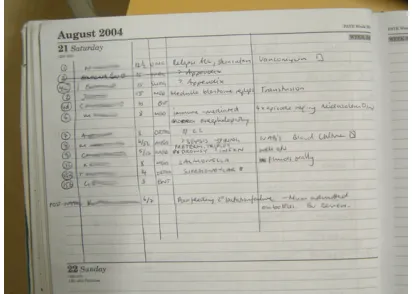
Medical shift handovers on the paediatric ward were team-based: at shift change, all doctors on the outgoing and incom-ing shifts attended a handover meetincom-ing held in a small seminar room adjoining the ward. A junior member of the outgoing team would ‘present’ the handover. This verbal presentation was supported by a written summary of the information to be handed over, which he or she had prepared in the period imme-diately prior to handover. The summary took the form of ei-ther a print-out of a word processed document or a handwritten summary in a page-a-day diary. It listed all the patients on the ward, their ages, consultants1, diagnoses, treatments and any
tasks that needed to be done (e.g. blood tests, x-rays, dis-charges), as well as more general ward information. It was a subset of all the available information about the patients and ward. The presenting doctor usually retained the summary during the handover meeting and might annotate it with cor-rections or information about decisions made at the meeting. At the end of the meeting, the summary would be passed to the incoming team for use during their shift. Outside of handover, the summary was kept at the nursing station on the ward where any of the medical staff could refer to and update it. With its brief summaries of diagnoses, treatments and tasks to be done, this artifact was an important information resource throughout the shift and was central in the co-ordination of clinical care. For the most part, the incoming team did not have access to the written summary during the handover meeting. Without such an external representation, they were obliged either to try t o remember the information or to wait until after the meeting when they would be able to access the written summary. Tak-ing personal notes durTak-ing handover, a practice commonly re-ported to occur elsewhere, was prohibited due to doctors hav-ing left notes containhav-ing sensitive information lyhav-ing around. Work by Patterson et al [7] and others has suggested that one strategy to improve the effectiveness of handover is to provide incoming staff with a visual overview of the current state of the system before and/or during the update. Intuitively, we would expect this to reduce cognitive load, with a consequent improvement in the quality of the handovers and a positive impact on patient safety. This motivated the study reported here.
3.
INTRODUCING A SHARED DISPLAY
We conducted a study to investigate the consequences of in-troducing a large, shared display to support medical shift han-dover. We sought to investigate the impact of the intervention on the real work of shift handover as it occurred in everyday practice. For this reason, and in contrast to lab-based studies of shared displays, we adopted a field-study based approach. We first studied the shift handovers as they normally occurred, with the handover summary handwritten in a diary. We then studied a second set of handovers to which we had introduced a large, shared display. The large display was achieved by the
1 “Consultant” refers to a medical doctor. This senior position
in the UK is equivalent to “Attending Physician” in the US.
[image:3.612.335.541.177.324.2]simple means of taking a high-resolution digital photograph of the handwritten summary immediately prior to the meeting and projecting it on the white wall of the handover room. This meant that the only difference was in the way that the informa-tion was presented to participants. Other than this, we at-tempted to change the environment as little as possible, though some rearrangement of the furniture was necessary. The study took place over a two week period and included twenty-seven handovers. Figure 1 gives an example of the handover summary on a day when the large display was used.
Figure 1: An example of the handover summary in the diary (anonymised) from a day when the large display was used
While there were certain issues in which we were particularly interested e.g. the impact of the display on the accuracy of the information represented in the handover summary, the ease with which incoming staff were able to establish an effective and accurate mental model of the state of the ward, and the detection and correction of errors in the handover information, we sought to be open to any changes that might arise as a re-sult of our intervention. For this reason, and the fact that this was real work, subject to all the vagaries of an open, dynamic, resource-pressured environment, with many uncontrollable variables (e.g. who was present, the nature and number of pa-tients to be handed over), we looked to cognitive ethnography [1] as an approach appropriate to our purpose. Several com-plementary forms of data were collected:
• Detailed observations were conducted in both study condi-tions. During the handover meetings we observed: interac-tion with the written summary, interacinterac-tion with and com-ments on the large display, staff present, position and activ-ity of those present, information presented about and dis-cussions on each patient, disdis-cussions before and after han-dover, duration of the handover. During the shifts we ob-served: staff activity before and after handover including any preparation for handover and interaction between in-coming and outgoing teams outside of the handover room, activity involving the written summary (who used it, where it was used, what it was used for), general activity involving the patients, comments related to the handover. Audio re-cording was used where consent from patients’ guardians had been obtained; otherwise we relied on detailed notes. • We took digital photos of the handwritten summary in the
• After doctors had been in a handover with the large display for the last time, we asked them to fill out a brief question-naire and held an unstructured interview with them about their experience of handovers with and without the display. • After each handover, the consultant on duty was interviewed
and asked, as an expert, to rate the quality of the handover and to express their views on its effectiveness. This was an attempt to get some measure, albeit subjective, of the quality of the handovers. (A more objective measure might look at the number of adverse events where handover is a contribu-tory factor, but this could only be achieved in a long-term study and even then with some difficulty.)
4.
RESULTS
The study revealed that the introduction of the shared display had an impact on several different aspects of the work. We give a brief overview before concentrating on the specific is-sue of the public nature of the displayed information.
Many of the medical staff in our study expressed the view that it was difficult for the incoming team to remember the informa-tion presented at handover if it was only communicated t o them verbally. This problem was exacerbated if it was a long time since they had last worked a shift on the ward or there had been a lot of new admissions or the cases were complicated. Positive comments on the impact of the display in this regard included one consultant describing it as a “helping tool” and staff on the incoming shift commenting “things register bet-ter”, “[it] helps to visualize patients”, “I feel in control now”. Another doctor made an analogy with a shopping list and how with a visual list you were much less likely to forget some-thing than with just a mental list, suggesting that the display can reduce the cognitive load for the incoming team. As well as feeling more ‘in control‘ of the information, some people felt that the visual display helped them to concentrate more o n handover and to re-focus their attention if their mind had wan-dered. Comments were also made on the value of display as an overview representation (“have the whole picture from the beginning”), reinforcing Patterson et al’s [7] strategy.
Clarification questions (e.g. checking a patient’s name or age) and error detection (e.g. wrong consultant, wrong medication in the summary) occur frequently in handover and are some of the ways in which handover provides an opportunity for the system to recover from potential failures [9]. Although the nature of our data meant that it was difficult to obtain accurate quantitative measures, it did appear that, contrary to our ex-pectations, the number of clarification questions actually in-creased with the introduction of the large display. People would ask about things that they could see written in the summary but which had not been mentioned in the verbal presentation (so the display acted as a trigger) and would also ask about information that appeared to be missing from the summary (e.g. “Is X still on IV fluids?”, “Have you had U&Es done?”). This change might appear to be a positive one but i s related to other, less expected findings concerning the nature of private versus public work. The remainder of this paper focuses on this topic.
The junior medical staff (who both prepared the summary and conducted most of the day-to-day work that it described) felt that the shared display exposed their work to public scrutiny in a way that did not occur with the written summary alone. One doctor expressed this as “Everyone can see it!”. Both their preparation for handover (including how neatly they wrote-up
the handover information) and the work that had and had not been accomplished during the shift were now on display for all to see during the meeting. As an immediate consequence, there was evidence (photographs, our observations and staff reports) that after a doctor had first experienced the large display, they would make an effort to write the summary more neatly next time. This in itself was not a bad thing. Indeed, the senior staff saw this consequence of the display as a positive out-come, with comments such as “I really like this” and “Spend-ing an extra 5 minutes [creat“Spend-ing the summary] is worth it”. A greater concern was that the shared display was fundamentally changing how junior doctors used the handover summary and the information recorded in it. It was already apparent that some people were reluctant to mention (in the verbal hando-ver) tasks they had not completed because they did not want this information to be brought to the attention of senior staff, in spite of the fact that this is crucial information to hand over. This concern now extended to the written summary. This was reinforced by one consultant stating that the display allowed her to spot things that the junior doctors had omitted to men-tion because they didn’t want her to find out about them. Similarly, another consultant said that the display allowed him to check that all the information in the written summary had been handed over, implying that people might deliber-ately not mention things.
5.
PUBLIC VERSUS PRIVATE WORK
The reaction of the junior doctors, which many people will not find surprising, cannot be explained in terms of a simplistic distinction between private and public information. The exist-ing paper-based summary was already a public artifact. This was demonstrated in several ways. Although created primarily by the doctor who would be presenting the handover, this was often achieved in collaboration with other staff. Further, as staff convened for the handover, we frequently observed small groups referring to the summary and senior staff sometimes checked its accuracy. It was created to support the verbal pres-entation at the handover meeting and to be handed over (liter-ally) to the incoming team immediately afterwards. It was available at all times throughout the shift for any member of medical staff to read and/or modify but, in general, only junior staff did so and then it was done either individually or i n small groups of two or three people. The collaboration was largely asynchronous.
In terms of consequences for the work, it seemed that with its increased ‘publicness’ the summary was no longer just a tool supporting the work of handover and the ongoing work of the shift but was now a mechanism for submitting the work of the shift to the scrutiny of senior staff. While the existing paper-based summary had evolved in use to become a central re-source in communication and co-ordination activities, dis-playing the information gave the document a role and a for-mality within the work system that the paper document did not have. It now served the new purposes of reporting work t o senior staff and of prompting the senior staff to enquire about issues. Our observations revealed that this led to increased emphasis on creating the summary in an appropriate form for these purposes with the consequent danger that in the longer term it might become an idealized record of the work rather than the useful, but less formal, artifact to support the work that it currently is. Clearly, studying the work over a longer time frame than we were able to do would yield further insight into impact of the shared display in this regard.
The shared display provided a different (synchronrous and more public) presentation of the handover summary but the issues of private versus public work arising here are not spe-cific to this technology. For example, Luff and Heath [5] i n studying how paper-based medical records support collabora-tion between doctors talk of the need to allow objects to be moved from private to public. Greenberg et al [3] describe the SharedNotes system which supports a distinction between private and public items and where, once a private item is made public, its originator no longer has any special claim over it. The authors discuss how this rigid distinction is overly sim-plistic and how, in real life, people fluidly move artifacts from the personal to the public and the many stages inbetween. They recommend investigating a system “that will let people fluidly shift their artifacts from personal to public and the many gradations between in subtle and lightweight ways”. Similarly, a simplistic approach to implementing personal and public documents in a handover application would not ad-dress the issue identified here. A naïve interpretation would be to say the summary was a private item from the time it was created until it was “published” by the doctor bringing it t o the public forum of the meeting. However, as already dis-cussed, the handover summary is never truly a private docu-ment. We suggest that taking account of how people gain ac-cess to public information (push versus pull), as well as the different groups of people who have access, helps articulate the gradations between “less public” and “more public” items in systems to support collaborative work such as shared dis-plays. In turn, understanding these gradations provides a ba-sis for understanding the consequences of introducing a tech-nology that will change the extent to which an item is public.
6.
SUMMARY
The work of shift handover investigated in this study falls into the category described by Mynatt et al [6] as small group, collaborative work supported by semi-public displays. It is a form of collaborative work that has not as yet been subject t o as much scrutiny as some other kinds of collaborative work. In the particular case of medical shift handover, it is serious, potentially life-critical work and we need to have confidence that any technological ‘advances’ will enhance rather than
compromise the effectiveness of current work practice. Our projected display was never intended as a technological solu-tion to handover; it was an investigative intervensolu-tion prior t o the design of new technology. However, this study points t o the fact that the consequences of even simple interventions can be subtle and complex. While there were clearly benefits t o introducing a large shared display, there were also negative consequences. We suggest that CSCW systems introduced t o support small group collaborative work should look beyond a coarse-grained distinction between public and private work t o look at (a) changes in how access to public information will be initiated, (b) changes in who will access the information, how often how often they will do so and in what social context, and (c) the impact on both the artifact and the work it represents.
7.
ACKNOWLEDGMENTS
This work was funded in part by the ESRC/DTI/EPSRC PACCIT Research Programme (RES-328-25-0002). We are grateful t o the Bromley Hospitals NHS Trust for their collaboration and t o the anonymous reviewers for their thoughtful comments.
8.
REFERENCES
[1] Ball, L.J. and Ormerod, T.C. Putting Ethnography to Work: The Case for a Cognitive Ethnography of Design. Int. J. of Human-Computer Studies, 53, 1, 2000, 147-168.
[2] Clarke, K., Hughes, J., Rouncefield, M. and Hemmings, T. When a bed is not a bed: the situated display of knowl-edge on a hospital ward. In O'Hara, K. et al (Eds) Public and Situated Displays. Social and Interactional Aspects of Shared Display Technologies. Kluwer Academic Pub-lishers, 2003.
[3] Greenberg, S., Boyle, M. and Laberge, J. PDAs and Shared Public Displays: Making Personal Information Public, and Public Information Personal. Personal Technologies, 3, 1, 1999.
[4] Lardner, R. Effective Shift Handover – A Literature Re-view. Offshore Technology Report. HSE 96 003, 1996. [5] Luff, P. and Heath, C. Mobility in Collaboration. In Proc.
CSCW’98, ACM Press, 1998, 305-314.
[6] Mynatt, E.D., Huang, E.M., Voida, S., and MacIntyre, B. Large displays for knowledge work. In O'Hara, K. et al (Eds.) Public and Situated Displays. Social and Interac-tional Aspects of Shared Display Technologies. Kluwer Academic Publishers, 2003.
[7] Patterson, E., Roth, E., Woods, D., Chow R. and Orlando J. Handoff strategies in settings with high consequences for failure: lessons for health care operations. Int. J.. Quality in Health Care. 16, 2, 2004, 1-8.
[8] Wears, R.L., Perry, S.J., Shapiro, M., Beach, C. Croskerry, P. and Behara, R., Shift Changes Among Emergency Physi-cians: Best of Times, Worst of Times. In Proc. HFES 47th Annual Meeting, 2003, 1420-1423.
[9] Wilson, S., Galliers, J. and Fone, J. Medical Handover: A Study and Implications for Information Technology. In
Proc. Healthcare Systems, Ergonomics and Patient Safety (HEPS), 2005.