City, University of London Institutional Repository
Citation
:
Spanos, P. D., Giaralis, A. and Politis, N. P. (2007). Time-frequencyrepresentation of earthquake accelerograms and inelastic structural response records using the adaptive chirplet decomposition and empirical mode decomposition. Soil Dynamics and Earthquake Engineering, 27(7), pp. 675-689. doi: 10.1016/j.soildyn.2006.11.007
This is the unspecified version of the paper.
This version of the publication may differ from the final published
version.
Permanent repository link:
http://openaccess.city.ac.uk/923/Link to published version
:
http://dx.doi.org/10.1016/j.soildyn.2006.11.007Copyright and reuse:
City Research Online aims to make research
outputs of City, University of London available to a wider audience.
Copyright and Moral Rights remain with the author(s) and/or copyright
holders. URLs from City Research Online may be freely distributed and
linked to.
City Research Online: http://openaccess.city.ac.uk/ [email protected]
Time- frequency representation of earthquake accelerograms and
inelastic structural response records using the adaptive chirplet
decomposition and empirical mode decomposition
Authors
P.D. Spanos1,* A. Giaralis2, N.P. Politis3
Affiliations
1L. B. Ryon Chair in Engineering, Rice University, Houston, Texas
2Ph.D. Candidate, Department of Civil Engineering, Rice University, Houston, Texas
3Floating Systems Engineer, BP America Inc.
Abstract
In this paper the adaptive chirplet decomposition combined with the Wigner-Ville
transform and the empirical mode decomposition combined with the Hilbert transform
are employed to process various nonstationary signals (strong ground motions and
structural responses). The efficacy of these two adaptive techniques for capturing the
temporal evolution of the frequency content of specific seismic signals is assessed. In this
respect, two near- field and two far- field seismic accelerograms are analyzed. Further, a
similar analysis is performed for records pertaining to the response of a 20-story steel
frame benchmark building excited by one of the four accelerograms scaled by appropriate
factors to simulate undamaged and severely damaged conditions for the structure. It is
shown that the derived joint time- frequency representations of the response time
* Pol D. Spanos, George R. Brown School of Engineering, L. B. Ryon Chair in
Engineering, Rice University, MS 321, P.O. Box 1892, Houston, TX 77251, U.S.A.
histories capture quite effectively the influence of nonlinearity on the variation of the
effective natural frequencies of a structural system during the evolution of a seismic
event; in this context, tracing the mean instantaneous frequency of records of critical
structural responses is adopted.
The study suggests, overall, that the aforementioned techniques are quite viable
tools for detecting and monitoring damage to constructed facilities exposed to seismic
excitations.
Keywords: time-frequency representation; chirplets; empirical mode decomposition;
intrinsic modes; accelerograms; nonlinear structural response; damage detection
1. Introduction
Transient signals encountered in earthquake engineering and structural dynamics
are inherently nonstationary in the sense that both their frequency content and amplitude
vary with time. Typical earthquake accelerograms exhibit a time-evolving frequency
composition due to the dispersion of the propagating seismic waves, and a time-decaying
intensity after a short initial period of development. Structural systems are characterized
by their natural frequencies and modes of vibration, rendering their response to strong
ground motions a relative resonance phenomenon. Thus, capturing the time-varying
dominant frequencies present in a seismic accelerogram facilitates the assessment of its
structural damage potential. Furthermore, the time histories tracing certain structural
response quantities, such as floor displacements and inter-story drifts of a building under
evolving frequency content provides valuable information about the possible level of
global structural damage caused by the ground motion. Signals of this kind require a joint
time- frequency analysis.
Ordinary Fourier analysis has been used for several decades in earthquake
engineering for representing the frequency content of seismic events. In this regard there
are obvious limitations, since the Fourier transform can only provide an “average”
spectral decomposition of a signal. The availability of more powerful computers,
advances in applied mathematics [1-8], and the development of fast algorithms [7-12]
have facilitated the application of time-frequency analysis techniques in various
engineering fields over the past years. These techniques can be loosely divided into
adaptive and non-adaptive. It is the intention of this paper to exploit certain adaptive
methods for capturing the temporal variation of the frequency content of earthquake
accelerograms and of seismic structural response signals. However, it is emphasized that
techniques belonging to both the above categories constitute viable tools for the purpose.
To ensure completeness and to enhance the readability of the manuscript a
conspectus of the commonly used non-adaptive methods is first provided before focusing
on the adaptive methods that the present study considers.
Introduced by Gabor [13], the first and most widely used method for joint
time-frequency representation of non-stationary signals utilizes the so-called short-time
Fourier transform (STFT) to project a signal onto a family of appropriately shifted
(translated in time domain), and modulated (translated in frequency domain), copies of a
constant width window function. Then the spectrogram defined by the modulus of the
time-frequency plane. This gives rise to a non- adaptive analysis procedure with significant
time- frequency resolution limitations; once the window function is chosen, the frequency
and time resolutions are fixed for all frequency bands and all times [1,7].
A more flexible representation of a signal with non-constant windowing can be
achieved by the wavelet transform (WT) [2,3], which incorporates a family of oscillatory
functions generated by appropriately shifting and scaling a single “mother wavelet”
function of certain frequency content and of localized energy in time. The flexibility of
the WT stems from the scaling operation and the wave-like form of the mother wavelet:
dilating and contracting the support of a wavelet (scaling) allows the adjustment of its
time duration, while narrows and expands the bandwidth, respectively. The scalogram
defined in a similar way from the WT as the spectrogram from STFT yields enhanced
time resolution representations for short-lived high-frequency phenomena, and frequency
resolution for long-lasting low-frequency phenomena.
Obviously, the WT is a potent tool for analyzing and representing nonstationary
signals in the time-frequency domain. In a recent review article by Spanos and Failla [14]
an extensive reference list is provided citing numerous publications incorporating the
wavelet analysis for various structural engineering and vibration applications.
Alternatively, adaptive signal processing techniques can be adopted for
effectively capturing local variations of a much wider variety of signals and for the
efficient representation of signals by much fewer terms than the classic non-adaptive
methods. In this context, the matching pursuit (MP) algorithm [9-11] for the
decomposition of the signal on a Gaussian chirplet set of functions (Gaussian chirplet
case-specific data-driven decomposition of a signal into non predefined functions [6] are
exclusively used in the present work.
Chirplets can be construed as generalized wavelets, containing more “degrees of
freedom” than a wavelet since a chirplet waveform can be induced to “shear” and
“rotation” in the time-frequency plane, apart from translation and scaling [4,5]. In this
case, the adaptive character of the method stems from the fact that a Gaussian chirplet set
of functions is redundant (over-determined); not all functions of the set are necessary for
the representation of a particular signal and thus different subsets of chirplets is chosen
for the representation of different signals. The MP algorithm seeks the optimal unfolding
of any signal in the time-frequency plane. More importantly, the Wigner-Ville
distribution (WVD) of a signal decomposed by Gaussian chirplet functions [5] posses all
the attractive mathematical properties of the WVD [1] and yields a non-negative and
cross-term free bilinear distribution on the time-frequency plane of exceptional resolution
[7]. Further, the WVD lends itself to mathematical manipulations that lead to important
concepts like the mean instantaneous frequency (MIF) [7,14].
As far as the EMD is concerned, it decomposes any signal into several
monocomponent signals [1] extracted from the initial signal itself in the form of intrinsic
mode functions (IMFs) [5], for which the instantaneous frequency (IF) [1,15] has
physical meaning. Then, the MIF and the Hilbert spectrum of all IMFs can be computed
to reach an alternative time-frequency representation of the initial multicomponent signal.
The algorithm for the EMD is simple, iterative, and computationally demanding in the
case of long duration signals. Flandrin et al. [16] have used EMD in stochastic analysis to
self-similarity, quasi-decorrelation, and variance progression. However, there is no theoretical
definition of the decomposition in terms of analytic expressions for the IMFs which
depend on the settings of the EMD algorithm.
Wang et al. [17] considered the analysis of recorded earthquake accelerograms
via the adaptive chirplet decomposition to define a physically meaningful time and
frequency dependent envelop function in the context of defining appropriately an
evolutionary power spectrum. Hilbert spectra representations using IMFs have been used
to capture the spectral characteristics of earthquake accelerograms [18-21], in structural
damage detection [22-24], and in soil dynamics problems [25]. Many researchers have
compared the results of the EMD versus the traditional Fourier analysis and/or
non-adaptive methods for time-frequency representation such as the WT in the light of the
aforementioned and other applications in engineering [18,22,23,25-27].
Since the EMD is a purely numerical semi-empirical method it seems more
appropriate to evaluate its effectiveness for joint time-frequency representation of signals
by comparison with numerical results obtained from other adaptive methods, like the
adaptive chirplet decomposition. Herein, a detailed study of strong ground motions is
conducted by means of the adaptive chirplet decomposition and the EMD, to explore
their time-frequency representation capabilities, investigate their needed level of
sophistication, assess their comparative efficiency and extract information related to the
MIF as computed by both techniques. In this regard, joint time- frequency representations
are provided in the form of the WVD and Hilbert spectra respectively for two near- field,
and two far- field recorded seismic data [28,29], together with time-histories of the MIF.
Roesset [30], to capture the influence of nonlinearity on the variation of the effective
natural frequencies of a structural system during the evolution of a seismic event. For this
purpose nonlinear, step-by-step in time, analysis is performed for a benchmark 20- story
steel frame [28,29], excited by one of the above mentioned strong ground motions scaled
by various factors. Appropriate numerical results for certain structural response time
histories processed by the previously mentioned adaptive methods are given for
undamaged and severely damaged conditions, showing that the MIF can be considered as
a promising global structural damage detection tool.
2. Mean instantaneous frequency via the adaptive chirplet decomposition
In this section, closed formulas for the mean instantaneous frequency (MIF) and
for the adaptive periodogram (AP) are derived by application of the Wigner- Ville
distribution (WVD) on the decomposed signal. For the signal decomposition, Gaussian
chirplets and the Matching Pursue (MP) algorithm are utilized.
2.1 Signal decomposition: The Matching Pursue algorithm
Consider the Gaussian function
( )
4 1 12t2g t e
π
⎧− ⎫
⎨ ⎬
⎩ ⎭
= (1)
The Gaussian chirplet h tk
( )
is a four- parametered function described by the equation( )
4 2( )2 2( )2 { ( )}k k
k k
k k
a
t t i t t
i t t k
k
a
h t e e e
β ω π ⎧− − ⎫ ⎧ − ⎫ ⎨ ⎬ ⎨ ⎬ − ⎩ ⎭ ⎩ ⎭ = (2)
This function involves scaling by the parameter αk, shifting in time and in frequency by tk
and ωk, respectively, and linear frequency modulation by chirprate βk [4]. Note that Eq.
successive transformations imposed on the Gaussian function. If there is no frequency
modulation, that is βk= 0, the Gaussian chirplet becomes a Gabor atom.
Consider a signal x t
( )
of finite energy in the time domain x t( )
2 satisfying thecondition
( )
2E x t dt
∞
−∞
=
∫
< ∞, (3)where E is the total energy of the signal.
Traditional Fourier analysis utilizes the Fourier Transform (FT), defined by
( )
( )
i tX ω x t e ωdt
∞
−
−∞
=
∫
, (4)to project the signal x t
( )
onto the basis of the trigonometric (sinusoid) functions{ }
i t Reω ω∈ . By Parseval’s theorem, the FT preserves the signal energy, and thus the
modulus of the FT squared X
( )
ω 2, commonly called as the energy density spectrum,can be viewed as a distribution of the energy of x t
( )
in the frequency domain [1].Sinusoids correspond to delta functions in the frequency domain, yielding the best
possible spectral resolution. However, they possess no localization capabilities in the
time domain, being functions of infinite support. Thus, the energy density spectrum
depicts the overall frequency content of a signal with the highest possible resolution, but
provides no information about the time that each frequency component was present in the
signal.
Developed independently by Mallat and Zhang [9], and Qian and Chen [10], the
(3)into a linear combination of any set of analyzing functions (dictionary) [8]. Note that
Gaussian chirplets attain finite effective support both in the time and in frequency
domain. They are capable of capturing the local characteristics of a signal in both
domains and, thus, are suited for the decomposition of highly nonstationary signals.
Employing a set (dictionary) comprising Gaussian chirplets, the MP yields the
following decomposition of the signal x t
( )
:( )
k k( )
k
x t =
∑
A h t (5)The expansion coefficients Ak are determined sequentially via successive approximations
of the signal by orthogonal projections (inner products), on the elements of the
dictionary. This is equivalent to the solution of the optimization problem
( ) ( )
( ) ( )
2 2
2
max , max
k k
k k k k k
h h
A x t h t x t h t dt
∞
−∞
= =
∫
(6)First, the original signal x t
( )
=x tk( )
for k = 0 is projected on all the functions of thedictionary and the coefficient A0 is determined from Eq. (6). Then, the residual xk+1
( )
t isdetermined
( )
( )
( )
1
k k k k
x+ t =x t −A h t (7)
This procedure, described above for the original signal, is repeated for the residual
iteratively, and the algorithm terminates when the energy of the residual reaches a desired
predefined level that obviously characterizes the quality of the approximation.
Note that the MP algorithm imposes no restrictions on the analyzing functions.
( )
2( )
21
k k
h t h t dt
∞
−∞
=
∫
= (8)Then it can be readily proved that the energy of the signal can be expressed as [14]
( )
2 2 0k k
x t A
∞
=
=
∑
(9)showing that the previously described decomposition preserves the signal energy.
The algorithm that was outlined by Eqs. (5)-(7) is based on a predetermined
dictionary, whose size influences the accuracy of the signal representation. More accurate
representations require larger dictionaries, and thus excessive computations. The efficient
and accurate numerical implementation of the MP algorithm is an open research area. In
the present study a refinement scheme introduced by Yin et al. [11], is adopted, which
allows the use of a coarse chirplet dictionary for a first estimate, and then refinement of
the analysis by a curve fitting process.
2.2 Wigner-Ville distribution of the decomposed signal
Upon expressing the signal x t
( )
as a weighted sum of chirplet functions, asuitable representation on the time-frequency plane must be established. In the present
work the bilinear Wigner-Ville distribution (WVD), is chosen. The WVD of a signal
( )
x t is defined by the equation [1]
( )
, 1 1 * 12 2 2
i x
WVD t ω x t τ x t τ e ωτdτ
π ∞ − −∞ ⎛ ⎞ ⎛ ⎞ = ⎜ + ⎟ ⎜ − ⎟ ⎝ ⎠ ⎝ ⎠
∫
, (10)and has finite support both in the time and frequency domains. In terms of the STFT, the
signal is analyzed in this case by using a modulated and appropriately shifted window
which coincides with the signal itself after being time-reversed at each time instant t.
inventors of the WVD, it does provide an intuitive perspective on the formulation of the
distribution, and reveals its self-adaptive character.
For any finite energy signalx t
( )
the WVD satisfies always the so-called marginaldistributions of the signal [1]. That is,
( )
( )
2( )
( )
21
, ,
2π WVD tx ω ωd x t and WVD tx ω dt X ω
∞ ∞
−∞ −∞
= =
∫
∫
. (11)From Eq. (11) it is deduced that the WVD preserves the energy of the signal.
Further, x t
( )
can be expressed in the polar form( )
Re( )
i ( )tx t = ⎡⎣C t eϕ ⎤⎦, (12)
where C t
( )
and ϕ( )
t are the magnitude and phase, respectively. Then the first orderconditional moment of time is expressed by the equation
( )
( )
( )
2( )
( )
1 , 2 1 , 1 2 , 2 x x t x
WVD t d
WVD t d t x t
WVD t d
ω ω ω
π
ω ω ω ω ϕ
π ω ω π ∞ ∞ −∞ ∞ −∞ −∞ =
∫
=∫
=∫
, (13)and defines the mean instantaneous frequency (MIF) of x t
( )
, if x t( )
is amulticomponent signal; and the instantaneous frequency (IF) of x t
( )
, if x t( )
is amonocomponent signal [1,7,15]. In Eq. (13) and hereafter the dot over a symbol denotes
differentiation with respect to time.
The concept of the IF is interwoven with the study of non-stationary signals; it
serves as a tool to quantify the frequencies present in a signal at each time instant t. The
definition of the optimal mathematical measure of the temporal change of the frequency
though it is an intuitive concept. However, in the case of monocomponent signals, the IF
as defined in Eq. (13) is considered quite appropriate.
Besides the aforementioned attractive mathematical properties, the WVD exhibits
two general drawbacks.
The first drawback is that it often attains negative values in certain regions of the
time-frequency plane [1] rendering the physical interpretation problematic. This feature is
inherent in every bilinear distribution satisfying the marginal distributions, as expressed
by Eq. (11). Note however, that the Gaussian chirplet defined by Eq. (2) has the WVD
( )
, 2{
k( k)2}
1k ( k) k( k)2 ki t t
a t t a
h
WVD t e e
ω ω β
ω
⎧ ⎫
⎪− ⎡ − − − ⎤ ⎪
⎨ ⎣ ⎦ ⎬
− − ⎪⎩ ⎪⎭
= , (14)
which is non-negative everywhere; in this case the WVD leads to a valid time-frequency
density function of the signal.
The second main drawback of the WVD that in general limits its use in favor of
the spectrogram, is the so-called cross-term interference [1,7]. It is caused by the fact that
the WVD is non-additive. Indeed, application of the WVD in both sides of Eq. (5) yields
( )
2( )
( )
, , ,
k k q
x k h k q h h
k k q
WVD t ω A WVD t ω A A WVD t ω
≠
=
∑
+∑
, (15)where the first summation corresponds to the auto-WVD terms of the analyzing chirplet
functions, and the second summation corresponds to their cross-WVD terms. In many
practical cases, the latter terms, inherent in all multicomponent signals, corrupt the
time-frequency representation severely and induce poor resolution in the WVD. It is clear that
the extent of the cross-term interference depend on the decomposition of the signal. It can
be readily shown using the energy preservation properties of the MP and of the WVD
( )
, 0k q
k q h h
k q
A A WVD t ω
≠
=
∑
. (16)Thus, the cross-term free adaptive spectrogram (AS) of the decomposed signal
( )
x t using the MP is defined as [10]
( )
2( )
2{
( )2}
1 ( ) ( )2, , 2 k k k k k k
k
t t
a t t a
x k h k
k k
AS t A WVD t A e e
ω ω β
ω ω
⎧ ⎫
⎪− ⎡ − − − ⎤ ⎪
⎨ ⎣ ⎦ ⎬
− − ⎪⎩ ⎪⎭
=
∑
=∑
(17)Obviously, AS is always positive and preserves the energy of the original signal. Clearly,
it serves as a quite effective tool of representing any signal in the joint time-frequency
domain incorporating all the advantages of the WVD and none of its drawbacks.
2.3 Mean instantaneous frequency and adaptive periodogram
The adaptive periodogram (AP) of the analyzed signal x t
( )
can be obtained in aclosed form using Eqs. (11) and (17). That is,
( )
( )
( )2
2 2 2
, 2 ;
k
k k k
x x k k
k k k
a
AP AS t dt A e
a
ω ω
γ β
π
ω ω γ
γ ⎧ − ⎫ ⎪ ⎪ ∞ ⎨− ⎬ ⎪ ⎪ ⎩ ⎭ −∞ +
=
∫
=∑
= . (18)The MIF can be obtained as the conditional average of the WVD for a particular time t by
combining Eqs. (11), (13) and (15). Specifically, after some algebraic manipulation one
finds that
( )
( )
(
)
(
)
{
( )}
( ){
}
2 2 2 2 1 , 2 2 1 , 2 k k k ka t t
x k k k k k
k
t a t t
k k
x
k
WVD t d A a t t e
MIF A a e
WVD t d
ω ω ω π ω β
π ω π ω ω π ∞ − − −∞ ∞ − − −∞ + − =
∫
=∑
=∑
∫
.(19)The analytical expressions derived herein for the AP (Eq. (18)), and the MIF (Eq. (19))
indeed the only quantities of interest, the computationally-demanding determination of
the AS can be circumvented.
3. Hilbert spectrum and mean instantaneous frequency via the Empirical Mode
Decomposition
The Empirical Mode Decomposition (EMD) is a numerical data-driven
algorithmic procedure for the decomposition of nonstationary signals into a finite number
of non predefined case-specific functions, the Intrinsic Mode functions (IMFs) [6]. An
IMF is defined in Huang et al [6] as a function which satisfies the following two
conditions: (a) the number of the zero crossings and the number of extrema must be
either equal or differ by one and (b) the mean value of the local minima envelope and the
local maxima envelopes of the function must be zero. Let a signal be heuristically
construed as a superposition of “fast” oscillations on top of “slower” oscillations. Then,
the EMD identifies locally the fastest oscillating IMF by an iterative “sifting” procedure,
subtracts it from the signal, and iterates on the residual [6,12,16]. Assuming that the
energy of the final residue is negligible, the EMD yields the following decomposition of
a finite energy signalx t
( )
:( )
( )
1
N j j
x t b t
=
=
∑
, (20)where bj(t) is the jth IMF. Associated with each IMF is the analytic signal written in
polar form as
( )
( )
i j( )tj j
where
( )
2( )
2( )
j j j
a t = b t +b t is the magnitude,
( )
( )
( )
arctan j j j b t t b tϕ = is the phase, and
( )
j
b t denotes the Hilbert transform of the jth IMF [1], given by the equation
( )
1 j( )
jb s
b t ds
t s
π
=
−
∫
. (22)
The salient property of the IMFs is that they are monocomponent signals and
therefore, the IF of the jth IMF at time
t is appropriately defined as the derivative of the
phase of its analytic signal [15]
( )
( )
( ) ( )
2( )
2( ) ( )
( )
j j j j
j j
j j
b t b t b t b t
t t
b t b t
ω =ϕ = −
+
. (23)
By making use of Eqs. (20) and (21) the analytic signal x tˆ
( )
of the original signal( )
x t equals the sum of the analytic signals z tj
( )
of the IMF components b tj( )
. That is( )
( )
( )
( )1 1
ˆ j
N N
i t dt
j j
j j
x t z t a t e ω
= =
∫
=
∑
=∑
. (24)Then the Hilbert spectrum of x tˆ
( )
defined as( )
(
)
( )
(
( )
)
1 1
( , ) N , N
x j j j j
j j
H t ω a t ω t a t δ ω ω t
= =
=
∑
=∑
− , (25)constitutes a time-frequency representation of the signal x t
( )
and is an amalgamation ofthe individual Hilbert spectra of each of the analytic IMFs.
In this case, it is natural to define the MIF as the weighted average of the IFs
( )
j i t
( ) ( )
( )
2 1 2 1 N j j j N t j ja t t
MIF a t ω ω = = =
∑
=∑
(26)For discrete signals, a straightforward computation of the IF using Eq. (23) is
numerically sensitive since it requires the calculation of two additional derivatives.
Moreover, for noisy signals this approach yields IF of high variance which are not readily
amenable to physical interpretation. Better results can be obtained by using a numerical
differentiation method directly on the phase as given by Eq. (21), after applying a
low-pass filter to the analytic signal [31]. In this context, a fourth- order estimation
[ ]
[ ]
1(
[
2]
8[
1 8]
[
1]
[
2]
)
12
j n j n j n j n j n j n
ω =ϕ = ϕ − − ϕ − + ϕ + −ϕ + (26)
of the IF is adopted in the present study, and at the end-points the five- point formula
[ ]
[ ]
1(
25[ ]
48[
1 36]
[
2 16]
[
3]
3[
4]
)
12
j n j n j n j n j n j n j n
ω =ϕ = ± − ϕ + ϕ ± − ϕ ± + ϕ ± − ϕ ± (27)
is used, following Olhede and Walden [32].
It is emphasized that the IMFs are obtained by the application of an empirical algorithmic
procedure and, thus, cannot be analytically expressed. Their form depends primarily on
the settings and assumptions adopted, that is, intermittency frequency, interpolation
method, and stopping criteria, during the sifting operations that the EMD incorporates for
the extraction of the IMFs from the signal [26]. Besides the original algorithm introduced
by Huang et al. [6], there exist several other approaches in the literature regarding the
interpolation procedure and the stopping criteria [12,16,26]. In practice, a trial and error
procedure for the fine- tuning of these settings may not be feasible since the EMD is quite
Recently, Yan and Miyamoto [23] incorporated entropy concepts to obtain rational case-
specific values for the stopping criteria and various thresholds featured in the EMD
algorithm, instead of using the default values proposed by Rilling et al [12]. This
approach increases further the computational time by an amount that in many cases is
disproportional to the additional improvement achieved.
The EMD algorithm and the default stopping criteria proposed in [12], were
adopted for all the ensuing numerical analyses. Further numerical experimentation on the
EMD would considerably increase the requisite computations to the extent of rendering
the two methods incomparable.
4. Historic accelerograms and the benchmark structural system description
Four historic earthquake records are studied to assess the appropriateness of the
adaptive chirplet decomposition and the EMD to provide information about the
time-frequency characteristics of ground acceleration records pertaining to major earthquake
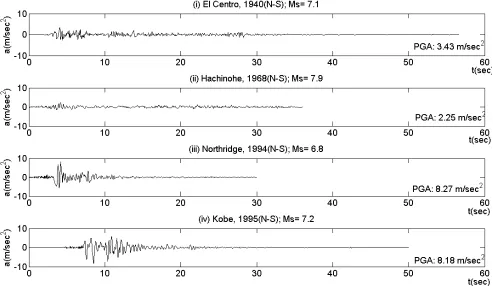
events. The El Centro (N-S component recorded at the Imperial Valley Irrigation District
substation in El Centro, California, during the Imperial Valley, California earthquake of
May 18, 1940), and the Hachinohe (N-S component recorded at Hachinohe City during
the Takochi-oki earthquake of May 16, 1968), earthquakes have been selected as far-field
examples. The Northridge (N-S component recorded at Sylmar County Hospital parking
lot in Sylmar, California, during the Northridge, California earthquake of January 17,
1994), and the Kobe (N-S component recorded at the Kobe Japanese Meteorological
earthquakes have been chosen as near-field examples [28,29]. Fig. (1) shows the
accelerograms of these strong ground motions.
The potential of the adaptive chirplet decomposition and the HHT for capturing
localized frequency content of nonlinear structural seismic responses is also examined.
To this end, the nonlinear dynamic response of a benchmark 20-story steel frame [28,29]
to the above accelerograms is considered. It was designed by Brandow & Johnston
Associates for the SAC Phase II Steel Project and is part of a typical mid- to high-rise
building which meets the seismic code for the Los Angeles, California region.
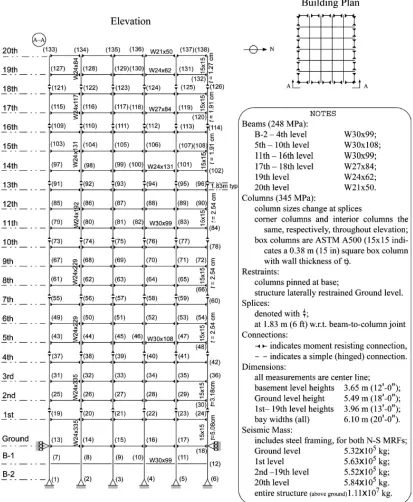
The structural system consists of moment- resisting frames (MRFs), at the
perimeter to engage lateral loads, and simple framing in the interior. The columns are 345
MPa steel and the floors are composite with 248 MPa steel beams and concrete. The
model of the building along with information regarding various structural parameters is
shown in Fig. (2). The floors are assumed to be rigid in the horizontal plane and thus
diaphragmatic action holds. The inertia forces are assumed to be evenly distributed on the
two moment resistant frames. Symmetry allows an in-plane 2-D analysis of half of the
entire building and thus only one MRF along the weak N-S direction is considered. The
mathematic model described in Ohtori et al [28] is followed for the boundary conditions
and the discretization of the elastic and inertia properties of the frame. The first five
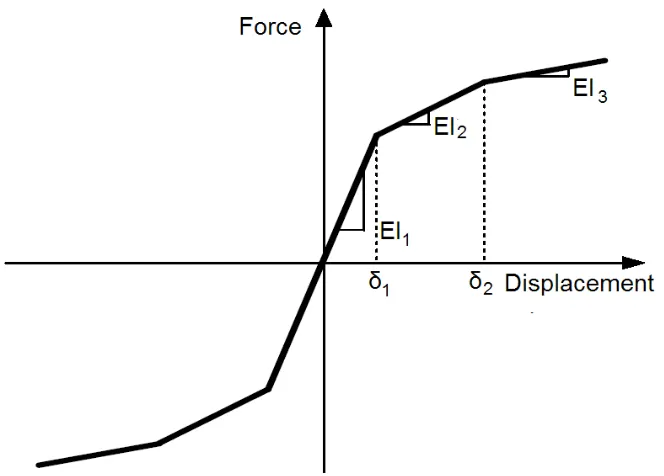
natural frequencies of the frame are 0.261, 0.753, 1.30, 1.83 and 2.40 Hz. A trilinear
hysteresis model for structural member bending, as the one shown in Fig. (3), is adopted.
More details on the trilinear model values considered for each member can be found in
5. Numerical results: Adaptive Chirplet Spectrograms and Hilbert Spectra
5.1 Seismic Accelerograms
Both the MP algorithm utilizing a Gaussian chirplet dictionary, and the EMD
algorithm have been employed to analyze the four accelerograms presented in Fig. (1).
Adequate representations of the earthquake signals were made possible by relatively
small numbers of terms: of order of fifty chirplet functions, and of less than ten intrinsic
modes, in all of the cases. Further, due to the adaptive nature of the decomposition
algorithms, the significant time-frequency characteristics of the earthquake signals were
captured by the very first few terms. Regarding the level of sophistication of the adaptive
chirplet decomposition, it is worth noting that the frequency modulation rate βk of the
chirplets hk was found to be negligible, as it has been reported before [23]. Thus, a
simpler dictionary of the three parametered Gabor atoms, instead of the four parametered
Gaussian chirplets, can be used yielding practically the same signal expansion. This
observation also suggests that the generation mechanisms of seismic events, the
propagation of seismic waves through the geological formations and the potential
influences of the surface soil layers do not produce signals whose complexity would
justify the use of Gaussian chirplets as analyzing functions.
Upon expanding the accelerograms into a series of chirplet functions, the WVD is
applied to yield the desired representation of these signals on the time-frequency plane.
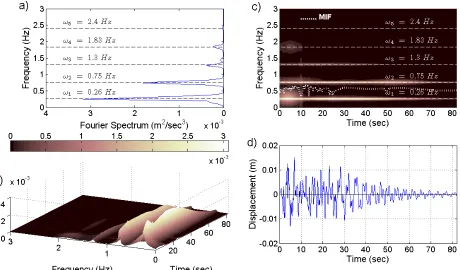
Certain plots summarizing appropriate numerical results are provided in Figs. (4), (6), (8)
and (10), corresponding to the El Centro, Hachinohe, Northridge and Kobe earthquake
records, respectively. In the (a) plot of each figure the standard Fourier amplitude
chirplet spectrograms as computed by Eq. (17). In the (c) part of the aforementioned
figures contour plots of the adaptive spectrograms are presented to provide a more
efficient and practically useful joint time- frequency signal representation. The mean
instantaneous frequency (MIF) is superimposed, as obtained by the newly derived Eq.
(19), and the time histories of the accelerograms (d) are included, as well, to facilitate the
physical interpretation.
All surfaces shown in the (b) plots are exceptionally smooth throughout the
time-frequency plane and manifest the capacity of the Gaussian chirplets to represent the
signals considered with adequate resolution at all frequency bands of interest. By
comparing the corresponding (a) and (c) plots, it is obvious that the overall frequency
content provided by the Fourier amplitude spectra can equivalently be deduced by the
adaptive spectrograms. However, the latter capture, additionally, the evolution of the
frequencies present at every time instant of the records which illustrates the superiority of
a joint time-frequency analysis over the traditional Fourier analysis for earthquake
accelerograms. As expected, the higher frequencies prevail during the “growth phase” of
the accelerograms and then decay following a rate that is influenced by many parameters
whose consideration is beyond the scope of the present study.
In implementing the EMD, the basic algorithm and assumptions proposed by
Rilling et al [12], were adopted to balance precision versus computational cost, as it has
already been mentioned. The IMFs thus obtained yielded quite oscillating Hilbert spectra.
Low-pass filtering of the unwrapped phase of the IMFs and their associated amplitudes
by means of spline fitting was proved to be a necessity to achieve smoother results
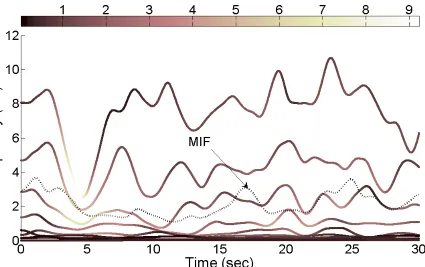
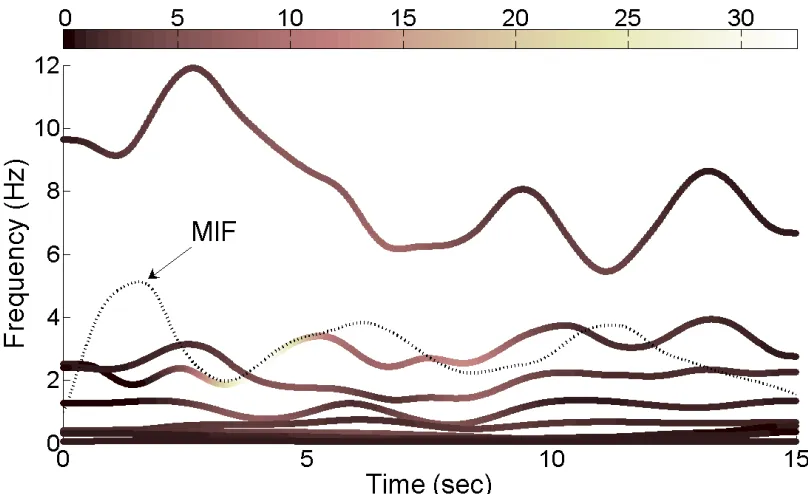
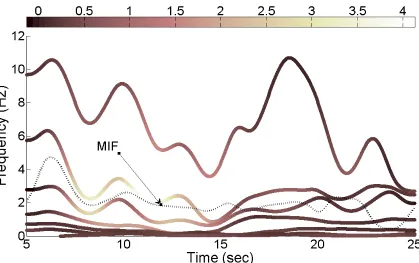
spectra (Eq. (24)) and estimates of the MIF (Eq. (25)) based on the intrinsic mode
expansion are provided for the El Centro, Hachinohe, Northridge and Kobe earthquake
records, respectively.
As discussed earlier, the adaptive chirplet spectrogram enjoys a solid
mathematical background, which is not the case for the Hilbert spectrum based on the
IMFs. Evaluation of the performance of the EMD algorithm and of the smoothing
procedure of the IMFs is attempted by a qualitative comparison of the Hilbert spectra and
the MIF obtained by the IMFs with the corresponding adaptive spectrograms and the MIF
obtained by the Gaussian chirplets, for the four accelerograms considered. Specifically, it
can be seen from the figures provided, the two different types of time-frequency spectra
are consistent in the sense that the highest spectral values are attained at almost the same
time intervals and frequency levels. Furthermore, the trends of the temporal change of the
MIF exhibit a close similarity, even though the IMFs yield more oscillatory MIF
time-histories.
5.2 Structural response
Inelastic time-history dynamic analysis was performed for the 20- story steel
frame of Fig. (2) using as input the El Centro ground acceleration of Fig. (1) multiplied
by various factors. The standard β-Newmark algorithm with the assumption of constant
acceleration at each time step (values β=1/4, γ=1/2), was employed for the numerical
integration in time. In this manner, the non linear behavior of the frame stemming from
the adopted trilinear hysteresis model is properly taken into account, as described
The same decomposition algorithms used to analyze the seismic accelerograms
were next applied to the lateral displacement response signals of the first floor of the
frame under consideration as obtained by the above dynamic analysis. Herein, the
objective was to assess the potential of both methods for providing valid joint
time-frequency representations of non linear structural responses, for capturing the influence
of nonlinearity on the evolution of the effective natural frequencies of yielding structural
systems during a strong ground motion, and for demonstrating the effectiveness of the
MIF for global damage detection.
In the case of the adaptive chirplet expansion it has been observed that a
significantly smaller number of chirplets is required to fully describe the response signals
than in the case of the seismic accelerograms. This is due to the fact that structural
systems exhibit highly “resonant” transfer functions which filter the relatively broadband
earthquake signal inputs yielding response signals characterized by the structural natural
frequencies. Consequently, the MP algorithm readily locates the narrowband dominant
components present in the structural response signals by assigning appropriate weights to
the most similar analyzing functions to match efficiently these components. A Gabor
atoms dictionary yields practically the same decomposition of the structural response
signals as the one obtained by using Gaussian chirplets in the same way as it was noted in
the case of the analysis of the earthquake records.
To demonstrate the potential of the MIF as analytical damage detection tool two
extreme cases are shown in Figs. (12) and (13) where the plots included are of the same
kind and order as in Fig. (10). In Fig. (12) the imposed excitation is the El Centro
Fig. (13) the El Centro accelerogram scaled by 2.50 is used as input and the frame suffers
structural damage witnessed by permanent deformation and a large offset component in
the Fourier spectrum. For reference purposes the first five natural frequencies of the
elastic frame are shown on the plots.
It is well known that structural systems forced to exhibit inelastic behavior are
characterized by gradually reduced effective natural frequencies, due to stiffness
degradation. Obviously, the variation in the “effective” natural frequencies of non linear
systems is reflected on the time-dependent transfer functions they attain and thus on the
output-response signals. In this context, the concentration of the energy of the response
signal about the natural frequencies of the frame which decrease when the frame
undergoes inelastic deformations can be readily seen in Figs. (12) and (13) in the
traditional Fourier spectrum plots (a), and in the adaptive spectrograms (b), (c).
Apparently, the joint time- frequency representation gives additional time localization
information about the effective frequencies of the response signals and adequately
captures their evolution in time.
More importantly, in this case the MIF can be interpreted as a global structural
damage indicator. The fundamental theorem of linear systems states that the spectrum of
the output signal is equal to the product of the Fourier transform of the input signal times
the transfer function of the system. Intuitively, for any particular effective temporal
segment defined such that the transfer function of the structure is assumed constant, the
MIF of the response averages this product over the frequency domain. Note that during
the first 25 seconds of both of the response signals examined in Figures (12c) and (13c)
MIF averages the product of the effective transfer function of the structure with the
spectrum of the excitation. Subsequently, the 30th second approximately marks the
effective duration of this particular input; practically the rest of the output signals
correspond to free vibration responses. As expected, after this time instant, the MIF
significantly decreases and remains in much lower levels for the scaled by 2.50 El Centro
input where the frame undergoes plastic deformations. However, in the elastic case, it
converges to a value similar to that attained at the beginning of the seismic event, since
the dynamic characteristics of the structure remain the same.
Prior to the application of the EMD, the response signals considered in this
analysis were limited to a bandwidth of approximately 0-5 Hz. The same algorithm was
applied as before and yielded again eight to ten IMFs for signal durations of 60 sec
sampled at the Nyquist frequency. Apparently, the number of the IMFs and the
computational cost of the EMD algorithm depend primarily on the length of the data and
not on the frequency content of the data which was the case for the MP algorithm and
adaptive chirplet decomposition, as was reported above.
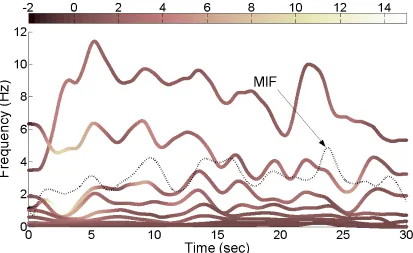
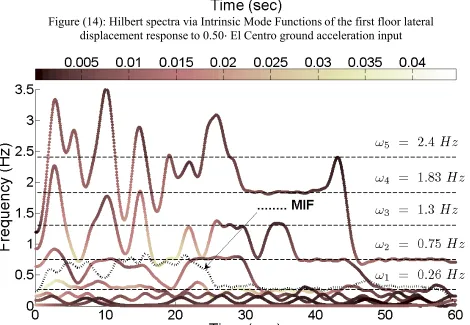
In Figs. (14) and (15), the Hilbert spectra of the decomposed lateral displacement
response of the first floor for the El Centro accelerogram input scaled by 0.50 and 2.50
are shown, respectively. The natural frequencies of the linear elastic system and the MIF
are also superimposed. The results show that the obtained IMFs are capable of capturing
the evolution of the natural frequencies of the structural system under consideration.
Nevertheless, the Hilbert spectra and the temporal variation of the MIF are not as smooth,
and amenable to physical interpretation compared to the corresponding adaptive
some IMFs are “attracted” by different natural frequencies during various time intervals.
This phenomenon can be reduced by introducing restrictions on the time interval between
successive extreme points attained by the IMFs based on the natural frequencies of the
analyzed system. Furthermore, additional low-pass filtering of the unwrapped phase and
amplitude of the IMFs can be used to yield less oscillating Hilbert spectra, at the expense
of poorer resolution. However, the later improvements require increased user/analyst
interaction in the form of parameter adjustments, rendering often the method less
appealing for practical purposes [27].
6. Concluding remarks
The present article has focused on the appropriateness, level of sophistication, and
comparative efficiency of certain adaptive signal analysis techniques for time-frequency
representation of non-stationary signals encountered in earthquake engineering problems.
In this regard, the adaptive chirplet transform (incorporating the MP algorithm), and the
EMD have been employed to analyze historic earthquake accelerograms and inelastic
structural response time histories to seismic signal inputs. Signals of this nature are
inherently non stationary as their intensity and frequency content varies with time and
thus require a joint time- frequency representation.
In this context, four ground acceleration records pertaining to two near-field and
two far- field major earthquake events have been decomposed into chirplet functions and
IMFs, and the WVD and Hilbert spectra of the decomposed signals have been obtained
respectively. A relatively small number of analyzing functions has been found to be
sufficient for the adequate approximation of the signals, while their main patterns and
found that a much simpler dictionary comprising Gabor atoms instead of Gaussian
chirplets yields an almost identical unfolding of the seismic signals in the time-frequency
domain and thus can be adopted to reduce the computational cost. The appropriateness of
the time-frequency representation to capture the evolving frequency content in time,
unlike the traditional Fourier amplitude spectrum, has been pointed out. Indeed, both
representations can be used as stand-alone time-frequency analysis tools. Note however
that despite the qualitative similarity of the two mathematically different representations,
the WVD is smoother and lends itself to easier physical interpretation compared to the
Hilbert spectrum.
Furthermore, both adaptive methods have been applied to the lateral displacement
response of the first floor of a 20-story steel frame exposed to one of the four
accelerograms scaled by appropriate factors to simulate undamaged and severely
damaged conditions for the structure. It has been found that significantly less chirplet
functions were sufficient to fully describe the response signals, than in the case of the
strong ground motion accelerograms, while the number of the required IMFs remained
practically the same, suggesting that the adaptive chirplet transform is much more
economical in terms of computational time. This observation can be attributed to the
highly resonant filtering effect of structural systems to broadband strong ground
excitations which facilitates the approximation of the response via chirp- type functions.
Furthermore, this concentration of the frequency content of the response signals about the
natural frequencies of the structure caused a characteristic mode-mixing in the IMFs
which obscures the physical interpretation of the Hilbert spectrum. This difficulty can be
during the EMD of the signal and by further smoothing the unwrapped phase and
amplitude of the resulting IMFs. Clearly, these measures require increased user/analyst
interaction in the form of parameter adjustments, and may render the adaptive chirplet
decomposition more attractive in practice vis-à-vis the EMD.
The potential of time-frequency representations of structural response signals as a
detection tool for global structural damage has been also pointed out. Specifically,
attention has been focused on the temporal evolution of the mean instantaneous
frequency. Indeed, if the structure is forced to exhibit inelastic behavior, the mean
instantaneous frequency reduces significantly reflecting the overall decrease of the
effective frequencies which is due to the structural stiffness degradation.
In conclusion, the findings of the present study show that both the adaptive
chirplet decomposition and the intrinsic modes decomposition are viable options for joint
time-frequency analyses of seismic signals. Furthermore, considering collectively these
two decompositions and the competing wavelet based decomposition, it is perhaps
premature to dispute any of the three as clearly the most advantageous for earthquake
engineering applications.
7. Acknowledgements
References
1. Cohen L. Time- Frequency Analysis. Upper Saddle River, NJ: Prentice-hall; 1995.
2. Burrus CS, Gopinath RA, Guo H. Introduction to wavelets and wavelet transforms- A
primer. Upper Saddle River, NJ: Prentice-hall; 1997.
3. Mallat S. A wavelet tour of signal processing. London: Academic Press; 1998.
4. Mann S, Haykin S. The chirplet transform: Physical considerations. IEEE Trans Signal
Process 1995;43(11):2745-2761.
5. Baraniuk RG, Jones DL. Wigner- based formulation of the chirplet transform. IEEE
Trans Signal Process 1996;44(12):3129-3135.
6. Huang NE, Shen Z, Long SR, Wu MC, Shih HH, Zheng Q, Yen NC, Tung CC, Liu
HH. The empirical mode decomposition and the Hilbert spectrum for nonlinear and
non-stationary time series analysis. Proc R Soc Lond A 1998;454:903-995.
7. Qian S. Introduction to time-frequency and wavelet transforms. Upper Saddle River,
NJ: Prentice-hall; 2001.
8. Chen SS, Donoho DL, Saunders MA. Atomic decomposition by basis pursuit. SIAM J.
Sci Comput 1998;20(1):33-61.
9. Mallat S, Zhang Z. Matching pursuits with time-frequency dictionaries. IEEE Trans
Signal Process 1993;41(12):3397-3415.
10. Qian S, Chen D. Signal representation via adaptive normalized Gaussian functions.
Signal Process 1994;36(1):1-11.
11. Yin Q, Qian S, Feng A. A fast refinement for adaptive gaussian chirplet
12. Rilling G, Flandrin P, Goncalves P. On empirical mode decomposition and its
algorithms. In: IEEE-EURASIP Workshop on nonlinear signal and image processing.
NSIP-03, GRADO(I); 2003.
13. Gabor D. Theory of communication. J. IEEE 1946;93(3):429-457.
14. Spanos PD, Failla G. Wavelets: Theoretical concepts and vibrations related
applications. Shock Vib Digest 2005;37(5):359-375.
15. Boashash B. Estimating and interpreting the instantaneous frequency of a signal. I.
Fundamentals. Proc IEEE 1992;80(4):520-538.
16. Flandrin P, Goncalves P. Empirical mode decompositions as data-driven wavelet-like
expansions. International Journal of Wavelets, Multiresolution & Information Processing,
2004;2(4):477-496.
17. Wang J, Fan L, Qian S, Zhou J. Simulations of non-stationary frequency content and
its importance to seismic assessment of structures. Earthquake Eng Struct Dyn
2002;31:993-1005.
18. Huang NE, Chern CC, Huang K, Salvino LW, Long SR, Fan KL. A new spectral
representation of earthquake data: Hilbert spectral analysis of station TCU129, Chi-Chi,
Taiwan, 21 September 1999. Bull Seism Soc Amer 2001;91(5):1310-1338.
19. Loh CH, Wu TC, Huang NE. Application of the empirical mode
decomposition-Hilbert spectrum method to identify near-fault ground-motion characteristics and
structural responses. Bull Seism Soc Amer 2001;91(5):1339-1357.
20. Zhang RR, Ma S, Hartzell S. Signatures of the seismic source in EMD-based
characterization of the 1994 Northridge, California, earthquake recordings. Bull Seism
21. Zhang RR, Ma S, Safak E, Hartzell S. Hilbert-Huang transform analysis of dynamic
and earthquake motion recordings. J. Eng Mech ASCE 2003;129(8):861-875.
22. Yang JN, Lei Y, Lin S, Huang N. Hilbert-Huang based approach for structural
damage detection. J. Eng Mech ASCE 2004;130(1):85-95.
23. Yan B, Miyamoto A. A comparative study of modal Parameter identification based
on wavelet and Hilbert-Huang transforms. Computer- aided civil and infrastructure
engineering. 2006;21(1):9-23.
24. Xu YL, Chen J. Structural damage detection using empirical mode decomposition:
Experimental investigation. J. Eng Mech ASCE 2004;130(11):1279-1288.
25. Zhang RR, Denmark LV, Liang J, Hu Y. On estimating site damping with soil
non-linearity from earthquake records. Int. J. Non-linear Mech. 2004;39:1501-1517.
26. Huang NE, Attoh-Okine NO, editors. The Hilbert-Huang transform in engineering.
Boca Raton, FL: CRC Press; 2005.
27. Kijewski-Correa T, Kareem A. Efficacy of Hilbert and wavelet transforms for
time-frequency analysis. J. Eng Mech ASCE 2006;132(10):1037-1049.
28. Ohtori Y, Christenson RE, Spencer BFJ, Dyke SJ. Benchmark structural control
problems for seismically excited nonlinear buildings. J. Eng Mech ASCE
2004;130(4):366-385.
29. Spencer BFJ, Christenson RE, Dyke SJ. Next generation benchmark control problems
for seismically excited buildings. In: Proceedings of the 2nd World Conference on
Structural Control. Kobori T et al. editors. Vol.2:1135–1360. Wiley, New York, 1999.
30. Roesset JM. Nonlinear dynamic response of frames. In: 8th Symposium on
31. Boashash B. Estimating and interpreting the instantaneous frequency of a signal. II.
Algorithms and applications. Proc IEEE 1992;80(4):540-568.
32. Olhede S, Walden AT. The Hilbert spectrum via wavelet projections. Proc R Soc
Figure (4): Joint time-frequency analysis of the El Centro accelerogram record via adaptive Gaussian chirplet expansion in conjunction with the Wigner-Ville distribution
[image:36.612.70.545.75.350.2] [image:36.612.99.512.408.661.2]Figure (6): Joint time-frequency analysis of the Hachinohe accelerogram record via adaptive Gaussian chirplet expansion in conjunction with the Wigner-Ville distribution
[image:37.612.59.555.73.358.2] [image:37.612.104.529.410.677.2]Figure (8): Joint time-frequency analysis of the Northridge accelerogram record via adaptive Gaussian chirplet expansion in conjunction with the Wigner-Ville distribution
[image:38.612.69.547.91.366.2] [image:38.612.94.498.420.667.2]Figure (10): Joint time-frequency analysis of the Kobe N-S accelerogram record via adaptive Gaussian chirplet expansion in conjunction with the Wigner-Ville distribution
[image:39.612.65.540.83.355.2] [image:39.612.101.520.407.670.2]Figure (12): Adaptive chirplet spectrogram of the first floor lateral displacement response to 0.50· El Centro ground acceleration input
[image:40.612.69.529.74.344.2] [image:40.612.67.565.387.680.2]Figure (14): Hilbert spectra via Intrinsic Mode Functionsof the first floor lateral displacement responseto 0.50· El Centro ground acceleration input
[image:41.612.69.527.69.352.2] [image:41.612.65.535.338.663.2]