Effect of Variations in Environmental
Temperature on 2D-WH/TS OCDMA Code
Performance
Tolulope B. Osadola, Siti K. Idris, Ivan Glesk, and Wing C. Kwong
Abstract—Extensive research has been carried out on the performance investigation of two-dimensional wavelength hopping/time spreading optical code division multiple access (OCDMA) codes, which are based on picosecond multiwave-length pulses under the influence of temperature variations resulting from changing environmental conditions. Equations have been derived to theoretically evaluate the extent to which such temperature changes will degrade the overall OCDMA system performance. To mitigate these negative effects on the OCDMA system, several steps have been introduced to improve the code robustness. System design improvements have then been investigated. We also found they would help to improve the spectral efficiency.
Index Terms—Bit error rate; Optical code division multiple access; 2D-WH/TS codes.
I. INTRODUCTION
T
here are several impairments that have been identified as a cause of signal deterioration in optical fiber commu-nication systems; these include chromatic dispersion, timing jitter and fiber loss, just to name a few. All these effects have been extensively studied for various optical systems including wavelength division multiplexing (WDM), optical time division multiple access (OTDMA) and optical code division multiple access (OCDMA), and various mitigation techniques have been proposed. Most fiber optic cable installations are buried at a depth of about 2–4 feet below the ground. At these depths, it has been shown that they could be exposed to temperature variations up to about 20 ◦C [1]. The fiber temperature variation can cause the transmitted signal to degrade in its quality under certain circumstances. Because of the dynamic nature of these temperature variations, tunable compen-sation schemes that will track and compensate for these unpredictable changes are always preferable. The effect of the impairments caused by the temperature changes was investigated for WDM system transmissions with data rates up to 40 Gb/s by [2–4]. It was established that these impairmentsManuscript received August 16, 2012; revised October 31, 2012; accepted November 6, 2012; published December 17, 2012 (Doc. ID 174492).
Tolulope B. Osadola (e-mail: [email protected]), Siti K. Idris, and Ivan Glesk are with The Center for Intelligent and Dynamic Communications, Electronic and Electrical Engineering Department, University of Strathclyde, Glasgow, G1 1XW, UK.
Wing C. Kwong is with Hofstra University, Hempstead, New York 11550-1030, USA.
Digital Object Identifier 10.1364/JOCN.5.000068
can increase the error probability of an optical transmission system, but the effect is not severe until after transmitting over considerably long distances. This is because the bit width (for example, 25 ps for 40 Gb/s systems) is very large when compared to its relative change resulting from its distortion via the fiber thermal coefficient. However, this may not always be true. For example, if an OCDMA system utilized two-dimensional wavelength hopping/time spreading (2D-WH/TS) codes comprising multiwavelength pulses [5–9] with the pulse width smaller than 5 ps, the effect of temperature fluctuations would be of the order of the pulse width [10] and therefore cannot be neglected anymore even when the transmission link is fully compensated for chromatic dispersion.
To the best of our knowledge, there has not been a report of any study to quantify the extent to which environmental tem-perature variations influence the performance of 2D-WH/TS codes used in OCDMA systems if multiwavelength picosecond pulses are utilized. In this paper, we report for the first time a theoretical analysis and a field based performance evaluation of incoherent 2D-WH/TS OCDMA (iOCDMA), which uses codes based on multiwavelength picosecond pulses under the influ-ence of environmental temperature variations. We propose and verify recommendations for 2D-WH/TS code design that will improve the robustness of these codes, help better maintain the system performance and at the same time improve spectral efficiency without the need for additional hardware.
II. IMPACT OFTEMPERATUREFLUCTUATIONS ON
AUTOCORRELATION OFINCOHERENT2D-WH/TS
OCDMA CODES
2D-WH/TS codes consist of a wavelength–time matrix representing a logical 1 in a bit sequence. The number of rows is determined by the number of available wavelengths (and is called the code weight (w)) and the number of columns of the matrix is the code length. For a bit periodtb, the chip width tc is usually equal to the duration of the wavelength pulse, resulting in tc=tb/Nc, where Nc represents the number of columns (chips) in the code matrix.
There is rich literature on the design of 2D-WH/TS codes with various code properties, such as cardinality and correlation values [10–12]. Our study in this paper can apply to any 2D-WH/TS code without restrictions.
It is well known that an increase in the number of chips results in an improvement in the number of simultaneous
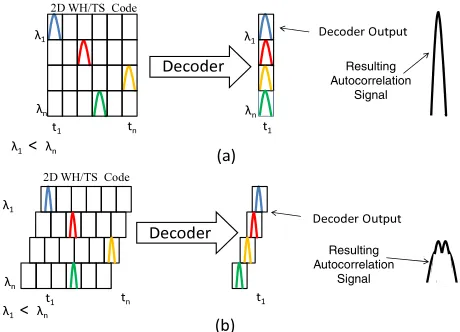
Fig. 1. (Color online) (a) Decoding of the 2D-WH/TS OCDMA code after its propagation in a fully dispersion compensated fiber link under ideal conditions; (b) code matrix distortion after code propagation when the fiber temperature has changed. The resulting autocorrelation signal is distorted due to a temperature induced temporal skewing effect.
users and thereby improved scalability [10]. In order to increase the number of chips within a 2D-WH/TS iOCDMA code if the data rate is fixed, the chip widthtcmust be reduced. In practical terms, this requires reducing the duration of each wavelength pulse width.
Theoretically, it is possible to obtain large code sets for the iOCDMA systems provided that short pulses are used to form the 2D-WH/TS codes. As we shall show, in the implementation of such 2D-WH/TS code based incoherent OCDMA systems the environmental factors must be considered to ensure an effective and robust data transmission. We will also show that variations in the fiber temperature will severely impact these systems despite the fact that the thermal coefficient of the opti-cal fiber has only a small value (typiopti-cally−0.0025 ps/nm·km/◦C for a nonzero dispersion shifted fiber (NZ-DSF)) [13].
Figure1(a)illustrates the decoding of the 2D-WH/TS code under ideal conditions. By ideal conditions, we mean that the codes have been transmitted over a fully dispersion compensated link and also losses due to fiber attenuation have been compensated. Figure 1(b) illustrates the effect of fiber temperature fluctuations on this type of the code and the resulting autocorrelation signal. If wavelength pulses within the code remain in their time chips spaced as originally designed even after propagating in a fully dispersion compensated fiber link, the decoder output will be an autocorrelation signal with its height equal to the code weight (w) (see Fig.1(a)) and an unaffected width.
If, however, the fiber temperature has changed, thanks to the character of the fiber thermal coefficient, the OCDMA code will be temporally skewed and the decoder will output a distorted autocorrelation (see Fig.1(b)for an illustration). The severity of this effect is a function of the temperature change magnitude (∆T) and the propagation distance (L).
The degree to which temperature induced skewing affects the code and the decoded autocorrelation signal (its height, shape, width) influences the outcome of the thresholding
process by the receiver threshold detector. Improper thresh-olding of the distorted autocorrelation signal will result in an increased bit error rate [14]. This effect can be mitigated via a delay line matched with the skewed-chip duration after certain distances, but this will add to the complexity of the system bearing in mind the dynamic nature of the temperature fluctuation. Also, more complexity arises when the OCDMA signal is encoded/decoded using integrated fiber Bragg gratings where there is no direct access to the individual wavelengths. It is important to note that temperature variation will affect both synchronous and asynchronous OCDMA schemes. This is because the skewing occurs within the codes of individual users, thus causing a misalignment of the pulses at the time of decoding. Hence it is imperative to quantify the effect of the fiber temperature fluctuations on the autocorrelation signal.
Therefore, we shall now analyze the effect of the varying temperature on the autocorrelation signal resulting from the decoding of an incoherent 2D-WH/TS OCDMA code that consists ofwwavelength pulses of pulse widthτequal to chip width tc. Let us denote the temperature variation induced temporal skew as∆tand the amount of pulse width shrinking for each wavelength pulse as∆τ; then from [9] we can express ∆tas
∆t=Dtemp×∆T×∆Λ×L (1)
and∆τas
∆τ=Dtemp×∆T×∆λ×L, (2)
where Dtemp (ps/nm·km/◦C) is the thermal coefficient of the fiber, ∆T (◦C) is the average change in temperature experienced by the buried transmission fiber of lengthL(km), ∆Λ(nm) is the spectral spacing between 2D-WH/TS OCDMA code wavelength pulses and∆λ(nm) is the pulse spectral line width of each wavelength pulse within the code. In our calcula-tions,∆Λis assumed to be a constant for all wavelength pairs.
Next, let us derive the expression for the envelope of the resulting autocorrelation signalSt. Stis the incoherent sum ofwwavelength pulses present within the code at a decoder output after the code has been propagated in the optical fiber of length L (km), which has been fully compensated for chromatic dispersion over the wavelength slope. Assuming each wavelength pulse has a Gaussian shape with a constant peak power Pp, then the incoherent sum of w wavelength pulses spaced by (t−k∆t) whose width has been reduced from the initial pulse width valueτtoτ−∆τ(ps) can be expressed as
St(L)= w−1
X
k=0 Ppexp
( −2.77
· t−k∆t
τ−∆τ ¸2)
. (3)
0 2 4 6 8
Autocorrelation (a.u.)
0 2 4 6 8
Autocorrelation (a.u.)
0 2 4 6 8
Autocorrelation (a.u.)
0 2 4 6 8
Autocorrelation (a.u.)
(a) (b)
[image:3.576.303.531.57.186.2](c) (d)
Fig. 2. Plot of autocorrelation signal formed by decoding OCDMA transmission based on 2D-WH/TS OCDMA codes with 2 ps eight wavelength pulses after experiencing 20◦C temperature variation over a distance of (a) 0 km (back to back), (b) 10 km, (c) 20 km and (d) 40 km. The fiber temperature coefficient used for calculationDtemp=0.0025 ps/nm·km/◦C [13].
temperature variation, then the autocorrelation signal height would drop to below 8 (see Fig.2(b)). After 20 km it can be observed that the peak of the autocorrelation signal becomes flattened (see Fig.2(c)), and at 40 km peaks of the individual wavelength pulses can be clearly observed (see Fig.2(d)): this is a result of the discussed time skewing.
Figure3is the plot based on Eq. (3). Figure3(a)illustrates the maximum obtainable autocorrelation height St as the temperature variation (∆T) increases for 10 km and 20 km propagation, respectively. It can be observed that, as the ∆T increases for a particular distance, the height of the autocorrelation drops more rapidly. This will lead to a situation as shown in Fig.3(b), which illustrates the maximum obtainable autocorrelation height for an (8200) 2D-WH/TS OCDMA code for the different propagation distances up to 10 km for a case of Dtemp = 0.0025 ps/nm·km/◦C and ∆T=20 ◦C. It can be seen that the maximum achievable autocorrelation height drops from the theoretical value of 8 (expected under the ideal conditions) to a new lower value of 7 in less than 8 km. This implies that the OCDMA receiver designed with a threshold valuethset to the code weight of 8 will function incorrectly.
Its performance can be evaluated by calculating the relationship between the probability of errorPeand number of simultaneous users (K) for an OCDMA system using 2D-WH/TS codes [10].
Pe=1 2
th X
j=0 (−1)j
à w j
! µ
1− jq1,1 w
¶K−1
, (4)
whereq1,1is the hit probability and is given as
q1,1= w 2.Nc
. (5)
3 4 5 6 7 8
Autocorrelation height (a.u.) Autocorrelation height (a.u.) 10 km
20 km
0 5 10 15 20
Temperature fluctuation ΔT (°C)
0 2 4 6 8 10
Distance (km) 5
5.5 6 6.5 7 7.5 8
(a) (b)
Fig. 3. (Color online) (a) Maximum obtainable autocorrelation height for an (8200) 2D-WH/TS code as temperature increases over a 10 km and 20 km link. (b) Maximum obtainable autocorrelation height after an (8200) 2D-WH/TS code propagates in a fiber under the influence of environmental temperature swing.
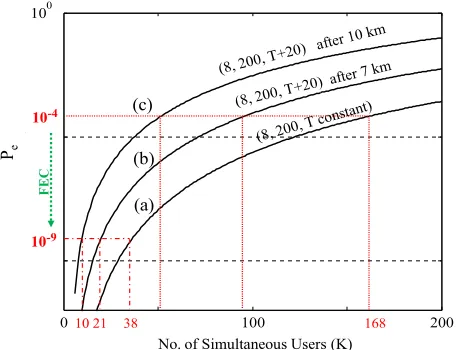
For an optimum performance,this usually set to be equal to w[10]. To obtainPe, we used the OCDMA system with (8200) 2D-WH/TS codes initially operating at the “designed” tempera-tureTand then with the temperature changed to the valueT+ 20◦C (resulting from an environmental temperature swing).
Obtained results are shown in Fig.4. It should be noted that the results are based on the assumptions that the fiber link has been fully compensated for dispersion and also signal power is assumed to be below levels that can trigger nonlinear effects These assumptions are used in order to isolate the performance loss due to temperature variations from other losses due to transmissions through the optical fiber.
The effect of physical layer noise, which includes beat noise, has been studied in depth for WH/TS code based OCDMA systems [15,16]. It was found that the amount of beat noise directly depends on the coherent length of the incoherent laser sources used in the systems. Since this paper focuses on investigating the true performance of the 2D-WH/TS codes under the influence of temperature fluctuations, we do not include beat noise or other physical noise in the analysis.
We assume the use of laser sources with very short coherent length in order to isolate the code performance from the beat-noise effects. Our study thus assumes the MAI-limited scenario with infinite signal-to-noise ratio. If one is interested in the effect of beat noise on OCDMA systems, the analyses in [15,16] can be combined with our analysis.
[image:3.576.48.278.58.262.2]Fig. 4. (Color online) Performance curves for an (8200) 2D-WH/TS OCDMA system illustrating (a) the case whereTis constant, (b) the case whereT changes by 20◦C and the code propagation distance is 7 km and (c) the case whereT changes by 20◦C and the code propagation distance is 10 km. FEC—forward error correction. FEC can be used to improve the number of simultaneous users.
III. IMPROVINGSYSTEMDESIGN FORBETTER PERFORMANCE
In view of these significant degradations experienced by the 2D-WH/TS code deploying picosecond multiwavelength pulses under the influence of temperature changes, we shall now analyze if also wavelength channel spacing within the code has any effect on the overall OCDMA system performance. As we have shown, the major contributor to the degradation experienced by the codes employing picosecond pulses is the temporal skew, but the amount of temporal skewing is dependent on the code spectral allocation and the spectral spacing between the individual wavelengths used in the code formation. Let us now define∆ttot as the total temperature variation induced temporal skew, then from Eq. (3) we can express ∆ttot, which is the sum of individual temperature induced temporal skews experienced by the w wavelength pulses that form the decoded autocorrelation signal as∆ttot= w×∆t. After substituting for∆T=20 ◦C and ∆Λ=0.8 nm in Eq. (1), we found that the maximum transmission distance at which the total temporal skew∆ttot equals one chip width tcfor the (8200) 2D-WH/TS code used by the OCDMA system running at OC-48 would be less than 7 km. This would also mean that the height of the autocorrelation signal for the decoded (8200) system would have dropped from 8 to 7 after propagating in less than 7 km of the temperature affected fiber.
Figure5 shows the data we obtained when we performed similar calculations for ∆T = 10 ◦C (black), 15 ◦C (light gray) and 20 ◦C (brown) change, for 2D-WH/TS code using (w,∆Λ) values of (8, 0.8 nm), (8, 0.4 nm), (4, 0.8 nm) and (4, 0.4 nm). From Fig. 5, it can be observed that, for any given transmission performance (say system BER=10−9), an OCDMA system using 2D-WH/TS OCDMA codes would be able to transmit over twice the distance at a temperature increase of T+10 ◦C (black), compared with temperature increases by+20 ◦C (dark gray). Figures5(b) and 5(c)give the same
0 10 20 30 40 50 60
Fig. 5. (Color online) Transmission distance against code spectral allocation for a 200 chip OCDMA system using 2D-WH/TS OCDMA codes when the total temperature induced skew is below 1 chip duration.∆Λis the wavelength spacing. Code spectral allocation is directly related to the code weight.
results for different code weights. This is expected because the wavelength spectrum occupied by these code sets is the same and therefore the autocorrelation signal will experience the same distortion due to the time skewing.
Our calculations also show, as can be seen by comparing Fig. 5(a) with Fig. 5(b) [w=8] and Fig. 5(c) with Fig. 5(d) [w = 4], that the system transmission distance can be significantly improved when the channel spacing between multiwavelength picosecond pulses within the 2D-WH/TS code is reduced: in this given example from 0.8 nm (100 GHz) to 0.4 nm (50 GHz). This is valid for all incoherent WH/TS OCDMA codes.
This reduction in channel spacing will also enhance the spectral efficiency of the system because the used code will occupy less spectral bandwidth. By calculating the spectral efficiency (ε) of the w=8 wavelength system in Fig.5using ε=K/(tb×w×∆Λ) [17], we found that a 50% reduction in the wavelength channel spacing (∆Λ) will double the spectral efficiency for a K =38 user iOCDMA system at 10−9 BER running at the OC-48 data rate. It is worthy of note that the OCDMA system parameters related to the code weightwwill not be affected by this channel spacing reduction. This means that the cardinality and the number of simultaneous users will remain the same.
IV. CONCLUSION
[image:4.576.305.528.60.242.2]temperature changes on the decoded autocorrelation signal from such 2D-WH/TS codes after propagating in a fully dispersion compensated fiber link.
It has been shown that temperature changes would adversely affect these codes by causing a reduction in the ex-pected height of the autocorrelation peak, thereby resulting in significant performance deterioration of the iOCDMA system. This will also limit the reach of these systems. We also showed that an implementation of FEC will help to significantly increase the number of simultaneous users even under the influence of temperature variation. Because of the dynamic nature of these temperature changes, tunable compensation schemes are preferable but their implementation may involve additional cost and complexity.
To partially mitigate such hardware needs, following certain code design rules was shown to help in minimizing the effect of fiber temperature changes on the iOCDMA system. Therefore, the effect of different values of channel spacing occupied by individual wavelength pulses within 2D-WH/TS codes under the influence of the environmental temperature changes on the system performance was investigated. It was found that the codes perform better under the influence of environmental temperature fluctuations if the channel spacing can be reduced. The proposed channel spacing reduction is valid for all incoherent WH/TS OCDMA codes.
This finding is very important because it also amounts to an improvement in spectral efficiency. For instance, the performance of a 2D-WH/TS code with a 0.4 nm channel spacing will be more robust under a 20◦C temperature change compared with the code designed with a 0.8 nm channel spacing. It should be noted that the costs of 0.4 nm and 0.8 nm based encoders/decoders are approximately the same; hence no additional cost is incurred. Finally, the reduction in channel spacing will allow delivery of the same system performance when the transmission distance is doubled.
ACKNOWLEDGMENT
This work was supported in part by a GRPe grant and a University of Strathclyde Postgraduate Research Studentship.
REFERENCES
[1] G. Ghosh, M. Endo, and T. Iwasaki, “Temperature-dependent Sellmeier coefficients and chromatic dispersions for some op-tical fiber glasses,” J. Lightwave Technol., vol. 12, no. 8, pp. 1338–1342, Aug. 1994.
[2] T. Kato, Y. Koyano, and M. Nishimura, “Temperature dependence of chromatic dispersion in various types of optical fiber,”Opt. Lett., vol. 25, pp. 1156–1158, 2000.
[3] E. K. H. Ng, G. E. Weichenberg, and E. H. Sargent, “Dispersion in multi-wavelength optical code division multiple access systems: Impact and remedies,”IEEE Trans. Commun., vol. 50, no. 11, pp. 1811–1816, Nov. 2002.
[4] H. C. Ji, J. H. Lee, and Y. C. Chung, “System outage probability due to dispersion variation caused by seasonal and regional temperature variations,” inOptical Fiber Communication Conf. and the Nat. Fiber Optic Engineers Conf. (OFC/NFOEC), 2005, OME79.
[5] C.-S. Brès, I. Glesk, and P. R. Prucnal, “Demonstration of a transparent router for wavelength-hopping time-spreading opti-cal CDMA,”Opt. Commun., vol. 254, pp. 58–66, 2005.
[6] C.-S. Brès, Y.-K. Huang, I. Glesk, and P. R. Prucnal, “Scalable asynchronous incoherent optical CDMA,”J. Opt. Netw., vol. 6, no. 6, pp. 599–615, June 2007.
[7] V. Baby, C.-S. Brès, L. Xu, I. Glesk, and P. R. Prucnal, “Demon-stration of differentiated service provisioning with 4-node 253 Gchip/s fast frequency hopping time spreading OCDMA,” Electron. Lett., vol. 40, no. 12, pp. 755–756, 2006.
[8] N. Minato, H. Tami, H. Iwamura, S. Kutsuzawa, S. Kobayashi, K. Sasaki, and A. Nishiki, “Demonstration of 10 Gbit/s-based time-spreading and wavelength-hopping optical-code-division-multiplexing using fiber-Bragg-grating en/decoder,” IEICE Trans. Commun., vol. E88-B, no. 10, pp. 3848–3854, Oct. 2005. [9] V. Jyoti and R. S. Kaler, “Design and implementation of
2-dimensional wavelength/time codes for OCDMA,”Optik: Int. J. Light Electron. Opt., vol. 122, no. 10, pp. 851–857, 2010. [10] G.-C. Yang and W. C. Kwong,Prime Codes With Applications to
CDMA Optical and Wireless Networks. Artech House, Norwood, MA, 2002.
[11] P. R. Prucnal,Optical CDMA: Fundamentals and Applications. Taylor & Francis Books, New York, 2006.
[12] C.-H. Hsieh, G.-C. Yang, C.-Y. Chang, and W. C. Kwong, “Multi-level prime codes for optical CDMA systems,”J. Opt. Commun. Netw., vol. 1, no. 7, pp. 600–607, Dec. 2009.
[13] A. Walter and G. S. Schaefer, “Chromatic dispersion variations in ultra-long-haul transmission systems arising from seasonal soil temperature variations,” inOptical Fiber Communication Conf. and Exhibit (OFC 2002), 2002, pp. 332–333.
[14] V. Baby, C.-S. Bres, I. Glesk, L. Xu, and P. R. Prucnal, “Wave-length aware receiver for enhanced 2D OCDMA system perfor-mance,”Electron. Lett., vol. 40, no. 6, pp. 385–387, Mar. 2004. [15] C.-S. Bres, Y.-K. Huang, D. Rand, I. Glesk, P. R. Prucnal,
T. M. Bazan, C. Michie, D. Harle, and I. Andonovic, “On the ex-perimental characterization of beat noise in 2-D time-spreading wavelength-hopping OCDMA systems,”IEEE Photon. Technol. Lett., vol. 18, no. 21, pp. 2314–2316, Nov. 2006.
[16] X. Wang and K. Kitayama, “Analysis of beat noise in coherent and incoherent time-spreading OCDMA,”J. Lightwave Technol., vol. 22, no. 10, pp. 2226–2235, Oct. 2004.
[17] M. Rochette and L. A. Rusch, “Spectral efficiency of OCDMA systems with coherent pulsed sources,”J. Lightwave Technol., vol. 23, no. 3, pp. 1033–1038, Mar. 2005.
Tolulope Osadola (S’09) received the M.Sc. degree in
Communi-cations Control and Digital Signal Processing (with distinction) in 2009 from the University of Strathclyde in Glasgow. In 2010 he joined the Department of Electronic and Electrical Engineering, Ekiti State University, Ado-Ekiti, Nigeria, as a lecturer. He is currently studying for his Ph.D. degree in Electronic and Electrical Engineering at the Center for Intelligent and Dynamic Communication (CIDCOM), University of Strathclyde in Glasgow. His area of current research interests includes ultra-short pulsed lasers, ultrafast all-optical data processing, and optical network security.
Tolulope Osadola is a recipient of the Scottish overseas research students’ award and the University of Strathclyde postgraduate research studentship.
Siti Idrisreceived her M.Sc. in Microelectronics from the Universiti
Ivan Glesk (M’01–SM’01) received the Ph.D. degree in quantum electronics and optics from Comenius University, Bratislava, Slovak Republic, in 1989, and the D.Sc. degree from the Slovak Academy of Sciences, Bratislava. In 1986, he joined the Department of Experimental Physics, Comenius University, where he later became a professor of physics, and was engaged in research in the areas of nonlinear optics, laser physics, and light detection and ranging (LIDAR) methods of remotely sensing the atmosphere. In 1991, he joined Princeton University, USA, where he was Manager of the Lightwave Communication Research Laboratory and Senior Research Scholar in the Department of Electrical Engineering. In 2007, he joined University of Strathclyde, Glasgow, UK, as Professor of Broadband Communication Systems in the Department of Electronic and Electrical Engineering. His current research interests include applications of ultra-short pulsed laser systems for optical networks, ultrafast all-optical signal processing, and optical interconnects. He is author or coauthor of more than 280 publications and 16 book chapters and holds five patents. He is on the editorial board of theInternational Journal of Optics and Optica Applicata and is a recipient of the International Research and Exchanges Board (IREX) Fellowship.
Wing C. Kwongreceived the Ph.D. degree in electrical engineering