Equilibrium Refinement through Negotiation in Binary Voting
∗Umberto Grandi
University of Toulouse
France
[email protected]
Davide Grossi
University of Liverpool
United Kingdom
[email protected]
Paolo Turrini
Imperial College London
United Kingdom
[email protected]
Abstract
We study voting games on binary is-sues, where voters might hold an objec-tive over some issues at stake, while will-ing to strike deals on the remainwill-ing ones, and can influence one another’s voting decision before the vote takes place. We analyse voters’ rational behaviour in the resulting two-phase game, showing un-der what conditions undesirable equilib-ria can be removed as an effect of the pre-vote phase.
1
Introduction
Social choice theory, and voting theory in particular, have been gaining increased attention in the multiagent systems (MAS) literature in the last decade, and voting is considered a fundamental tool for the study of MAS [Brandtet al., 2014]. In the face of the extreme popularity of the voting paradigm, the MAS literature studying voting as a fully-fledged form of strategic interaction, i.e., as a non-cooperative game, is very small (although growing, e.g., [Desmedt and Elkind, 2010; Xia and Conitzer, 2010; Obraztsova et al., 2013]). In particular, no work with the notable exception of the literature on iterative voting [Meiret al., 2010; Lev and Rosenschein, 2012; Brˆanzei et al., 2013] has studied how voting behavior in rational agents is influenced by strategic forms of interaction that precede the voting stage. Litera-ture in social choice has recognised that interaction preced-ing votpreced-ing can be an effective tool to induce opinion change and achieve compromise solutions [Dryzek and List, 2003; List, 2011] while in game theory pre-play negotiations are known to be effective in overcoming inefficient allocations caused by players’ individual rationality [Jackson and Wilkie, 2005]. When players are allowed to offer a part of their gains at certain outcomes to influence the decisions of the other agents, they are able to overcome highly inefficient scenarios, such as the Prisoners’ Dilemma [Jackson and Wilkie, 2005].
∗
The original version of this paper published in the proceedings ofIJCAI-2015contained a number of mistakes. The current paper is an amended version of the original publication, and can be cited as U. Grandi, D. Grossi and P. Turrini. Equilibrium Refinement through Negotiation in Binary Voting. ArXiv:1404.5433, 2015
In this paper we study pre-vote negotiations in voting games over binary (yes/no) issues, where voters hold a spe-cial type of lexicographic preferences over the set of issues at stake, i.e., hold an objective about a subset of them while they are willing to negotiate on the remaining ones, and can influ-ence one another before casting their ballots by transferring utility in order to obtain a more favourable outcome. We show that this type of pre-vote interaction has beneficial effects on voting games by refining their set of equilibria.
Related work Our approach relates directly to several on-going lines of research in social choice, game theory and their applications to MAS.
Binary Aggregation and Voting Games.We study societies of voters that express a yes/no opinion on issues at stake. The setting is also known as voting in multiple referenda and closely related to the growing literature on voting games. Classical references include the work of Dhillon and Lock-wood [2004] and Messner and Polborn [2007], and more re-cently lead to computational studies of best-response dynam-ics in voting games [Meir et al., 2010; Xia and Conitzer, 2010; Lev and Rosenschein, 2012]. In binary voting, aside from the (non-)manipulability of voting rules (see, for in-stance, [Dietrich and List, 2007b]), non-cooperative game-theoretic aspects are underexplored and are our focus here. Binary voting can be further enriched by imposing that in-dividual opinions also need to satisfy a set of integrity con-straints, like in binary voting with constraints [Grandi and Endriss, 2013] and judgment aggregation [Dietrich and List, 2007a; Grossi and Pigozzi, 2014]. Standard preference aggre-gation, which is the classical framework for voting theory, is a special case of binary voting with constraints [Dietrich and List, 2007a]. Voting with constraints will be touched upon to-wards the end of the paper.
is shared among the voters and its final truth value is deter-mined by a voting rule.
Election control.The field of computational social choice has extensively studied lobbying [Christian et al., 2007; Brederecket al., 2014] and bribery [Baumeisteret al., 2013; Hazonet al., 2013], modelled from the single agent perspec-tive of a lobbyist or briber who tries to influence voters’ deci-sions through monetary incentives, or from the perspective of a coalition of colluders [Bachrachet al., 2011]. Here we study forms of control from a non-cooperative game-theoretic per-spective where any voter can influence any other voter.
Equilibrium refinement.Non-cooperative models of voting are known to suffer from a multiplicity of equilibria, many of which appear counterintuitive. Equilibrium selection or refinement is a vast and long-standing research program in game theory [Meyerson, 1978]. Models of equilibrium refine-ment have been applied to voting games in the literature on economics [Gueth and Selten, 1991; Kim, 1996] and within MAS [Desmedt and Elkind, 2010; Obraztsovaet al., 2013], as well as the above mentioned iterative voting model, which offers a natural strategy for selecting equilibria through best response dynamics from the profile of truthful votes. In this paper we study a two-phase model for equilibrium refinement in a voting game where equilibria are selected by means of an initial pre-vote negotiation phase.
Pre-play negotiations.We model negotiations as a pre-play interaction phase, in the spirit of Jackson and Wilkie [2005]. During this phase, which precedes the play of a normal form game, players are entitled to sacrifice a part of their final utility in order to convince their opponents to play certain strategies, which in our case consist of voting ballots. In do-ing so we build upon and simplify the framework of endoge-nous boolean games [Turrini, 2013], which enriches boolean games with a pre-play phase.
Paper contribution and outline We describe a model of equilibrium refinement for voting games which: (i) is applica-ble to one-shot voting in the general context of binary aggre-gation; (ii) does not rely on limit behavior in repeated interac-tions; and (iii) can capture the compromise-seeking phase that typically precedes decision-making by voting. More specifi-cally we address the effect of pre-play negotiations on the outcomes of voting games on binary (yes-no) issues. We iso-late precise conditions under which bad equilibria – e.g., in-efficient ones – can be overcome, and good ones sustained.
The paper is organised as follows. First, in Section 2 we present the setting of binary aggregation, defining the (issue-wise) majority rule and a more general class of aggregation procedures, which constitute the rules of choice for the cur-rent paper. Second, we define voting games for binary aggre-gation, specifying individual preferences by means of both a goal and a utility function, and we show how undesirable equilibria can be removed by appropriate modifications of the game matrix (Section 3). Third, we present a full-blown model of collective decisions as a two-phase game, with a negotiation phase preceding the vote. We show how the set of equilibria can be refined by means of rational negotiations removing undesirable equilibria and, dually, maintaining de-sirable ones (Section 4). Section 5 concludes.
2
Preliminaries
We model situations of collective decision-making in the framework of binary aggregation. In this setting a finite set of agents express yes/no opinions on a finite set of binary is-sues, and these opinions are then aggregated into a collective decision over each issue.
Definition 1(BAstructure). A binary aggregation structure (BA structure) is a tupleS=hN,Iiwhere:
• N ={1, . . . , n}is a finite set individuals s.t.|N |is odd1 and≥3;
• I ={1, . . . , m}is a finite set of issues.
We denoteD={B |B :I → {0,1}}the set of all possible binary opinions over the set of issuesI and call an element
B ∈ D aballot. Thus,B(j) = 0(respectively, B(j) = 1) indicates that the agent who submits ballotBrejects (respec-tively, accepts) the issuej.
AprofileB = (B1, . . . , Bn)is the choice of a ballot for every individual inN. We writeBi to denote the ballot of individuali within a profileB. Thus,Bi(j) = 1 indicates that individualiaccepts issuejin profileB. Furthermore we denote byNB
j ={i∈ N |Bi(j) = 1}the set of individuals accepting issuejin profileB.
Definition 2 (Aggregation rule). Given a BA structure S, an aggregation rule (or aggregator) for S is a function
F:DN → D, mapping every profile to a binary ballot inD.
F(B)(j)denotes the outcome of the aggregation on issuej.
Possibly the best-known aggregation rule is issue-by-issue strict majority rule(maj), which accepts an issue if and only if the majority of voters accept it, formallymaj(B)(j) = 1 if and only if|NB
j | ≥ |N |+1
2 . Other notable examples of
ag-gregation rules includequota rules, which accept an issue if the number of voters accepting it exceeds a possibly different quota for each issue, anddistance-based rules, which output the ballot that minimises the overall distance to the profile for a suitable notion of distance.
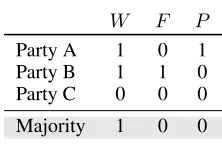
Example 1. A parliament composed by equally representa-tive partiesA, B, C is to decide whether to develop atomic weapons (W), importing nuclear technology from the foreign market (F), and build in-house nuclear plants (P). The profile in Table 1 is an instance of binary aggregation with the ma-jority rule, in which each individual submits a binary opinion over each of the three issues at stake.
W F P
Party A 1 0 1 Party B 1 1 0 Party C 0 0 0
[image:2.612.380.491.568.640.2]Majority 1 0 0
Table 1: An instance of binary aggregation
1
Given an aggregation ruleF, we call a set of votersC⊆ N awinning coalitionif for every profileB, issuesj ∈ I and
x∈ {0,1}, ifC={i∈ N |Bi(j) =x}thenF(B)(j) =x. We call C a resilient winning coalition if C is a winning coalition and C\ {i} is also a winning coalition for every
i ∈ C.2 Given an aggregator F, we denote with WF the set of winning coalitions forF, and with W+
F the set of re-silient winning coalitions. In the case of the majority rule we
haveWmaj+ = nC⊆ N | |C| ≥ |N |2+1+ 1o, i.e., all coali-tions exceeding the majority threshold of at least one element are resilient.
Aggregation rules are classified by means of axioms that bind the properties of the outcome at certain profiles. We re-fer the reader to the relevant literature for a formal treatment of axiomatic properties. Here we provide just the following definitions in terms of winning coalitions:
Definition 3(Systematicity). An aggregatorFis called sys-tematicif it can be characterised through winning coalitions, i.e., if there exists a setWF ⊆2N such that for all profilesB and issuesj∈ I, we have thatF(B)(j) = 1iffNB
j ∈ WF.
Definition 4(Monotonicity). A systematic ruleF is called monotonicif its set of winning coalitions is closed under su-persets, i.e., for allC∈ WF, ifC⊆C0thenC0∈ WF.
The majority rule and all quota rules satisfy these axioms, but systematicity, for instance, is violated by most distance-based rules. In this paper we focus on systematic and mono-tonic rules, as a strict generalisation of the majority rule.
3
Aggregation Games
In this section we present the model of a strategic game played by voters involved in a collective decision-making problem on binary issues. The players’ strategies consist of all binary ballots and players’ preferences are expressed in the form of a goal that is interpreted on the outcomes of the aggregation (i.e., the collective decision), and by an explicit payoff function for each playeri, yielding toia real number at each profile and encoding, intuitively, the material value he would receive, should that profile of votes occur. Given a set of issuesI, letPS={p1, . . . , pm}contain one
proposi-tional atom for each issue inI andLPSbe the propositional
language constructed by closingPSunder a functionally com-plete set of Boolean connectives (e.g.,{¬,∧}).
Definition 5(Aggregation games). An aggregation game is a tupleA=
N,I, F,{γi}i∈N,{πi}i∈N where:
• hN,Iiis a binary aggregation structure; • Fis an aggregation rule forhN,Ii;
• eachγiis a cube, i.e. a conjunction of literals fromLPS;3
• πi : DN → R is a payoff function assigning to each
profile a real number denoting the utility of playeri.
A strategy profile in an aggregation game is a profile of bi-nary ballots, and will be denoted withB. Intuitively, goals
2
Cf. the notion ofk-resiliency in [Halpern, 2011].
3Formally, eachγ
iis equivalent toVj∈K`jwhereK⊆ Iand
`j=pjor`j=¬pjfor allj∈K.
represent positions that players are not willing to sacrifice. By making the assumptions that goals are cubes we assume that each voter has a simple incentive structure, and can identify a certain set of atoms that she would like to be positive, an-other set of atoms that she would like to be negative, and that she is indifferent to all others. When comparing two states, one of which satisfying his goal and one of which not satis-fying it, a player will choose the state satissatis-fying his goal. In case of indifference with respect to goals, players will look at the value yielded by the payoff function. This is technically called aquasi-dichotomouspreference relation [Wooldridge et al., 2013]. Henceforth we employ the satisfaction relation |=(respectively, its negation6|=) to express that a ballot satis-fies (respectively, does not satisfy) a goal.
Definition 6. LetA=
N,I, F,{γi}i∈N,{πi}i∈N
be an aggregation game,B,B0 be two ballot profiles andi ∈ N a player. The preference relationπ
i for eachi∈ N is such thatBπ
i B 0
iff:
• [F(B0)6|=γiandF(B)|=γi]or
• [F(B0)|=γi⇔F(B)|=γi]andπi(B)≥π0i(B). In other words, a profileBis preferred by playeritoB0 if eitherF(B)satisfiesi’s goal andF(B0)does not or, if both satisfyi’s goal or neither do,Byields toia better payoff than B0. Individual preferences over strategy profiles are therefore induced by their goals, by their payoff functions, and by the aggregation procedure used.
A natural class of aggregation games is that of games where the individual utility only depends on the outcome of the collective decision:
Definition 7. An aggregation gameAis calleduniformif for alli∈ N and profilesBit is the case thatπi(B) =πi(B0) wheneverF(B) =F(B0). It is calledconstant, if allπi are constant functions, i.e., for alli ∈ N and all profilesBwe have thatπi(B) =πi(B0).
Clearly, all constant aggregation games are uniform. Games with uniform payoff are arguably the most natural examples of aggregation games. The payoff each player receives is only dependent on the outcome of the vote, and not on the ballot profile that determines it. For convenience, we assume that in uniform games the payoff function is defined directly on outcomes, i.e.,πi:D →R.
Adapting a standard definition from the literature, we call a strategyB i-truthfulif it satisfiesγi. In caseγiis a complete cube that specifies fully a single binary ballot, i.e., the agent has one precise objective over all issues at stake, we fall into the classic setting of having a unique truthful strategy and all other ballots available for strategic voting.
Definition 8. LetC ⊆ N. We call a strategy profile B = (B1, . . . , Bn):
(i) C-truthful if allBiwithi∈Carei-truthful, i.e.,Bi |=
γi, for alli∈C;
(ii) C-goal-efficient (C-efficient) ifF(B)|=V i∈Cγi; (iii) totally C-goal-inefficient (totally C-inefficient) if
F(B)|=V
i∈C¬γi.
One last piece of notation: let us call a gameC-consistent, for
C⊆ N, if the conjunction of the goals of agents in coalition
Cis consistent, i.e., ifV
Equilibria in Uniform Aggregation Games
In this section we explore the existence of Nash equilibria (NE) in aggregation games and their properties, paying spe-cial attention to NE that are truthful and efficient. We omit the easier proofs in the interest of space.
We start with the following result. Recall that a strategyBi isweakly dominantfor agentiif for all profilesB we have that(B−i, Bi)πi B.
Proposition 1. IfAis a constant aggregation game for the majority rule, then for everyi ∈ N everyi-truthful strategy is weakly dominant.
Proof. LetB∗i be i-truthful and letB0i be any non-truthful strategy fori. We show that for each profileB−iwe have that (B−i, Bi∗)iπ (B−i, B0i). Since payoffs are constant by as-sumption, we can reason by case distinction as follows. There are four cases. Bothmaj(B−i, B∗i)andmaj(B−i, Bi0) sat-isfy γi (1) or do not satisfy it (2). In both these cases
Bi∗ weakly dominates Bi0. If (3) maj(B−i, Bi∗) satisfies
γi and maj(B−i, Bi0) does not, then Bi∗ strictly domi-natesBi0. Finally, (4)maj(B−i, B∗i)does not satisfyγi but
maj(B−i, Bi0)does. Sinceγi =Vj∈X`j, then there exists a
k∈X such thatmaj(B−i, Bi∗)6|=`k butmaj(B−i, Bi0)|=
`k. Assume wlog that`kis positive, i.e.,`k =pk. SinceBi∗ is assumed to be truthful, we know that B∗i |= `k which in turns implies that Bi∗(k) = 1. By the systematicity of the majority rule we know that the acceptance of issuekin profileB depends solely on the acceptance of issuekbyi. Combining our assumption thatmaj(B−i, Bi0)(k) = 1with the monotonicity of the majority rule, we can infer that also
maj(B−i, Bi∗)(k) = 1, against our assumption that this last profile does not satisfy`k.
It follows that every constant aggregation game has a NE.
Remark 2 (Generalisation). Proposition 1 can be gen-eralised to all aggregation rules that are systematic and monotonic, and therefore non-manipulable in social-choice-theoretic sense [Dietrich and List, 2007b].
The following example shows that Proposition 1 ceases to hold if we allow the goals of the voters to be propositional formulas more complex than a cube:
Example 2. Let there be three voters, and let agent 1’s goal be that of having an odd number of accepted issues, while agents 2 and 3 have no specific goals. LetB2= (1,0,0)and
B3 = (0,1,0). The 1-truthful ballotB1 = (0,0,1)results
under the majority rule in(0,0,0), and is hence dominated by ballot(1,0,1)which is non-truthful but results in(1,0,0). This last outcome has has an odd number of accepted issues and hence satisfies1’s goal.
We now observe that Proposition 1 does not generalise to uniform aggregation games, i.e., games where the utility of players depends solely on the outcome of the aggregation:
Proposition 3. There exist uniform aggregation games for
maj in which truthful strategies are not dominant.
Proof. Consider the set of issues {p, q, t} and a set N = {1,2,3}. Letγ1 = ¬p∧q∧ ¬t,γ2 = ¬p∧ ¬q∧ ¬t, and
γ3=¬p∧ ¬q∧t. Define the payoff function as follows, let
πi(B) = 1fori= 3andB= (0,1,0), and 0 otherwise. Take the following profiles: B1 = ((0,1,0),(0,0,0),(0,0,1))
andB2 = ((0,1,0),(0,0,0),(0,1,0)). Since maj(B1) =
(0,0,0)andmaj(B2) = (0,1,0), we haveB2 π3 B1and
B1, unlikeB2, comprises a truthful strategy by3.
The fact that truthful voting is not always a dominant strat-egy for aggregation games with sigle-model goals might seem counterintuitive, especially when the payoff is required to be uniform across profiles leading to the same outcome. It is however sufficient to recall that when a player is in the po-sition of changing the outcome of the decision in a certain profile this does not necessarily mean he has the power to satisfy his goal, but he might simply choose the outcome he prefers because of the payoff.
Despite the negative result in Proposition 3, we can still prove the existence of truthful and efficient equilibria in a uni-form aggregation game if we assume the mutual consistency of the individual goals of a resilient winning coalition.
Proposition 4. LetF be a systematic and monotonic aggre-gator, and letC∈ W+
F. EveryC-consistent uniform aggrega-tion game forFhas a NE that isC-truthful andC-efficient.
Proof. Take aC-consistent game. Then there exists a ballot
B∗ such thatB∗ |= V
i∈Cγi. Take now any ballot profile B∗such thatB∗is the ballot of all and only the voters inC
while all agents inN \Cvote the inverse ballotB∗ (that is, for any issuej,B∗(j) = 1iffB∗(j) = 0). SinceC ∈ WF (by the assumption thatC ∈ WF+) we have thatF(B∗) = B∗. ClearlyF(B∗)satisfiesV
iγi, and each individual inC votes truthfully. We show thatB∗is a Nash equilibrium, by showing that (a) no agent inN \Chas a profitable deviation, and (b) no agent inC has a profitable deviation. As to (a), sinceFis monotonic, any change in the ballotB∗(j)by some voter inN \Cdoes not change the outcomeF(B∗) =B∗. As to (b), any change in the ballotB∗by some voter inC does not change the outcome becauseC ∈ W+
F. This completes the proof.
On the other hand, undesirable equilibria may occur even whenallagents have compatible goals.
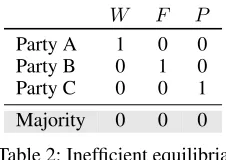
Proposition 5. There existN-consistent aggregation games formajwith NE that areN-truthful and totallyN-inefficient. Proof. LetAbe an aggregation game formaj such thatγi=
pi, and let B∗ be the profile illustrated in Table 2. Let all payoff functionsπibe constant. We can observe thatB∗is a truthful profile, and therefore it is a NE by Proposition 1 and by the fact that the game is constant. However, the outcome of the majority rule inB∗is totally inefficient, since none of the individual goals are satisfied.
W F P
Party A 1 0 0 Party B 0 1 0 Party C 0 0 1
[image:5.612.119.232.51.131.2]Majority 0 0 0
Table 2: Inefficient equilibria
Goal-inefficiency and payoff transformations
We show that goal-inefficiency at equilibrium in uniform ag-gregation games can be ruled out by means of a redistribution of payoff among the members of a winning coalition. This result is the stepping stone for the framework of Section 4.
Proposition 6. Let A =
N,I, F,{γi}i∈N,{πi}i∈N be a C-consistent uniform aggregation game for a sys-tematic and monotonic procedure F, where C is a winning coalition for F. Then, there exist payoff func-tions {πi0}i∈C such that P
i∈Cπi0(B) = P
i∈Cπi(B) for every profile B, and such that the game A = DN,I, F,{γi}i∈N,{π0i}i∈C∪ {πi}i6∈CE has no
C-inefficient NE.
Proof. Let B∗ be a ballot such that B∗ |= V
i∈Cγi. We now construct a redistribution of payoffs in which player 1 ∈ C gives all other players in C an incentive to play
B∗, turning it into a weakly dominant strategy. LetM −1 be the maximal payoff difference that some player can ob-tain between two outcomes in the gamehA,{πi}i∈Ni. The desired payoff functions are constructed as follows. For all
j 6= 1 such that j ∈ C defineπj0(B) = πj(B) +M for all profiles B with Bj = B∗, and π0j(B) = πj(B) oth-erwise. Let finallyπ0
1(B) = π1(B)−(P16=k∈Cπ0k(B)− P
16=k∈Cπk(B)). Observe that the construction of π0 en-sures thatP
i∈Cπ0i(B) = P
i∈Cπi(B), for every profileB. Now letBbe aC-inefficient profile of the new game and as-sume towards a contradiction that it is a NE. Take an arbitrary playerj ∈Csuch thatBj 6=B∗. Such a player exists since, by monotonicity ofF, ifBi =B∗for alli ∈Cthen profile Bis notC-inefficient. By construction ofπ0jand the fact that
C is a winning coalition, playerj ∈ C has an incentive to deviate toB∗, henceBis not a NE. Contradiction.
In other words, given a uniform game, payoff functions al-ways exist that can eliminate any NE which is goal-inefficient for a winning coalition, while keeping the sum of players’ payoffs constant in the coalition. The new payoff function – which, note, is not necessarily uniform any more – can be thought of asa binding offer of payoffthat a player makes to the others, incentivising them to deviate to an outcome which is goal-efficient for the coalition.
4
Endogenous Aggregation Games
The games we are going to study have two phases:• A pre-vote phase, where, starting from a uniform ag-gregation game, players make simultaneous transfers of payoff to their fellow players;
• Avote phase, where players play the original aggrega-tion game, but where payoffs are updated according to the transfers occurred in the pre-vote phase.
We call these games endogenous aggregation games. The key concept to define them is the one of transfer function
τi :DN × N →R+(withi∈ N). These functions encode
the amount of payoff that a playerigives to playerjshould a certain profile of votesBbe played, in symbols,τi(B, j). We callτ ∈Q
iTiatransfer profile, denoting byτ0thevoid transfer where at every profile every player gives 0 to the oth-ers. So byτ(A) =
N,I, F,{γi}i∈N,{π0i}i∈N
we denote the aggregation game with payoff obtained fromAwhereπi0
is updated according to the transfer profileτas follows:
π0i(B) =πi(B) + X
j∈N
τj(B, i)− X
j∈N
τi(B, j) (1)
It is important to notice that transfers do not preserve the uni-formity of payoffs. We define now endogenous aggregation games formally as follows:
Definition 9. An endogenous aggregation game is a tuple AT =hA,{Ti}i∈NiwhereAis a uniform aggregation game, and eachTiis the set of all functionsτi:DN × N →R+.
Endogenous aggregation games will be analysed as exten-sive form games with perfect information and simultaneous choices. There are two phases in the overall game and there-fore two choice points: in the first one a transfer profile is de-termined; in the second one a ballot profile is determined. So strategies of playericonsist of sequential choices of a transfer
τiand a ballotBi. Preference relations are naturally defined between tuples of the form(τ,B): for two profiles of ballots B,B0, the expression(τ,B)i(τ0,B0)denotes that player
iprefers B after τ has been played in the pre-vote phase, toB0afterτ0has been played in the pre-vote phase. Equilib-rium analysis will be carried out using the solution concept of reference for extensive games: subgame perfect Nash equilib-rium (SPE). To avoid complicating the framework with the introduction of mixed strategies over lexicographic prefer-ences – which bears notorious difficulties in terms of game-theoretic analysis [Rubinstein, 2012] – and to keep the focus on pure strategy equilibria, we make the following assump-tion: (♠) for any gameτ(A)with some pure strategy NE and any playeri ∈ N,a deviation byito a game(τ0
i, τ−i)(A0) with no pure strategy NE is never profitable fori.
Definition 10. Given an endogenous aggregation game hA,{Ti}i∈Ni, we call a NEB of the aggregation gameA asurviving Nash equilibrium (SNE) if there exists a trans-fer profileτand a SPE ofAT where(τ,B)is played on the equilibrium path.
what follows we show that surviving equilibria display desir-able properties, and pre-play negotiations can effectively act as equilibrium refinement tools for aggregation games.
Equilibria in Endogenous Aggregation Games
Pre-vote negotiations can be shown to yield desirable effects in terms of goal-efficiency, as shown in the following:
Theorem 7. LetAT =hA,{Ti}i∈Nibe aN-consistent en-dogenous aggregation game for a systematic and monotonic aggregatorF. Then, everyN-efficient NE ofhA,{πi}i∈Niis a surviving NE.
Proof. LetB be aN-efficient NE ofA. We want to find a transfer functionτ∗ such that(τ∗,B)is a SPE ofAT. Let
M −1be the maximal payoff difference between outcomes as defined in the proof of Proposition 6. For all i, j ∈ N, letτi∗(B0, j) = 2M ifBi0 6= Bi, andτi∗(B0, j) = 0 other-wise. In words, each playeriis committing to play the bal-lotBi by offering the others2M in case of deviation. Now we show that(τ∗,B)is a SPE.4 First, notice that, since the game isN-consistent and the goals are cubes (Definition 5), by Proposition 1 (which applies because the assumptions of monotonicity and systematicity forF) and the construction ofτ,Bis a unique dominant strategy equilibrium. Now con-sider the strategy profile(τ∗,B)ofAT. We now show that a deviation to someτi00∗by a playeri∗ is not profitable fori∗. Observe that such a deviation can only be improving fori∗if it also leads some other playerjto play something other than
Bj. If onlyi∗deviates, theni∗cannot do better given thatB is a NE by assumption andτj∗(B0, i∗) = 0whenBj0 =Bj. So suppose a NE B00 is played in the second stage where
Bj00 6=Bjfor somej 6=i∗. If no Nash equilibria exist in the second stage, then by assumption (♠) a deviation fromτ∗ is not profitable. Let there bek ≥ 1playersj 6=i∗ for which
Bj00 6=Bj and consider some suchj. By playingBj00player
j’s payoff is:
πj(B00)−(|N | −1)2M+ 2M(k+ 1) +τi00∗(B00, j). IfjplaysBjinstead, thenj’s payoff is:
πj(Bj,B00−j) + 2M(k+ 1) +τi00∗(Bj,B00−j, j).
AsB00is a NE, it follows that:
τi00∗(B00, j)−τi00∗(Bj,B00−j, j)≥πj(Bj,B00−j)
−πj(B00) + (|N | −1)2M. Given the definition ofMand given the fact that|N | −1≥2 it follows thatτ00
i∗(B00, j)−τi00∗(Bj,B00−j, j) > 3M, which implies thatτi00∗(B00, j) > 3M. Thereforei∗’s utility in the new equilibrium is at mostπi∗(B00)−k3M+k2M. The fact thatk≥1implies thatπi∗(B00)−k3M +k2M ≤πi∗(B). SinceBisN-efficient, then the constructed deviationτ00 can-not be profitable.
4
Our argument generalises the argument for pre-play negotia-tions with more than two players given in the proof of Jackson and Wilkie’s [2005, Theorem 4].
The converse of Theorem 7 holds true, and it generalises to winning coalitions with internally consistent goals:
Theorem 8. LetAT =hA,{Ti}i∈Nibe an endogenous ag-gregation game for a systematic and monotonic aggregator
Fsuch thatAisC-consistent forC∈ WF. Then, every sur-viving NE ofAT isC-efficient.
Proof. We proceed by contraposition. LetB∗ be a NE that is notC-efficient, i.e., such thatF(B∗) 6|= γi for some in-dividual i ∈ C, and assume towards a contradiction that B∗ is a SNE. Therefore there exists a transfer functionτ∗
and a SPE ofAT such that(τ∗,B∗
)is played on the equi-librium path. We now construct a profitable deviation from
τ∗, leading to contradiction. By C-consistency of A there exists a ballotB0 such that B0 |= V
j∈Cγj, hence in par-ticular B0 |= γi. Let now i deviate to any transfer profile
τ0 = (τi0, τ−i∗ )such that she offers more than the payoff dif-ference to all other players if they vote for ballot B0, i.e.,
τi0(Bj0,B00−j, j)−τi∗(B00, j)> πj(B00)−πj(B0j,B 00 −j), for eachj∈N, and eachB00−j. By the fact thatB0isC-efficient,
F systematic and monotonic, andC is a winning coalition, this transfer makes eachB0j, withj ∈ N \ {i}, (uniquely) survive iterated elimination of strictly dominated strategies. All NE after playingτ0will now satisfyγi, makingτ0a prof-itable deviation.
Observe that Theorem 8 implies the existence of endoge-nous aggregation games where no equilibria is surviving. This is the case when distinct but overlapping coalitions have in-compatible goals, as the following example shows:
Example 3. Let there be five players in N, and let F be the majority rule. Let γ1 = p∧ ¬r,γ2 = γ3 = γ4 = >
and letγ5 = r∧ ¬p. Both coalitionsC1 ={1,2,3,4} and
C2 = {2,3,4,5} are resilient winning coalitions, and the
game is bothC1consistent andC2consistent. Hence, by
The-orem 8 any surviving equilibria must be bothC1-efficient and
C2 efficient, which is impossible given that the goals of the
two coalitions are mutually incompatible.
What happens in situations similar to the one presented in Example 3 is that both player 1 and player 5 will offer ever increasing amount of utility to the remaining three players, in order to attain their goals. A deeper analysis of the coali-tional structure induced by the goals, as well as a generalisa-tion of the setting to budgeted goals may suggest solugeneralisa-tions to the problems highlighted in the previous example.
Remark 9(Algorithms). An algorithm to compute a pre-vote negotiation strategy that leads to a sustainable NE is pro-vided in the proof of Theorems 7. The assumption of perfect information is crucial here, and can be considered as an ap-proximation of a real-world situation in which the goals and payoffs of the agents can be assessed by means, e.g., of a poll.
Pre-vote negotiations and voting paradoxes
We show an application of endogenous aggregation games to binary aggregation with constraints, or judgment aggregation [Grandi and Endriss, 2013; Grossi and Pigozzi, 2014], where individual ballots need to satisfy a logical formula, the in-tegrity constraint, to be consideredadmissible. In case each individual provides an admissible ballot, the obvious ques-tion is whether the outcome of a given aggregaques-tion rule will be admissible, as well. Here is an instance of this problem.
Example 4. Consider the scenario in Table 1. In line with the intuitions behind the example, we stipulate that accepting
W while at the same time rejecting bothF andP is not an admissible opinion: if one wants to develop atomic weapons one should either import nuclear technology or develop it do-mestically. We can formulate this requirement in a proposi-tional language asW → (F ∨P), making ballot(1,0,0) inadmissible. All submitted ballots in the example satisfy this requirement but the majority ballot does not (Table 1).
Paradoxical situations as those in Example 4 can be viewed as undesirable outcomes of aggregation games. Assume to this purpose each party to have the following goals: γ0A = W, γB0 =F, γC0 =¬P. LetπA=πB =πCbe constant pay-off functions. Observe that parties’ goals are all consistent with the integrity constraintW →(F∨P), and that admissi-ble ballot (1,1,0) satisfies each of them. The profile in Taadmissi-ble 1 shows a truthful NE that however does not satisfy neither the goal of partyBnor the integrity constraintW → (F∨P). However, this equilibrium isnotsurviving because partyB
could transfer enough utility to partyCfor it to vote forF. In consistent aggregation games equilibria that give rise to a voting paradox may not survive, whereas equilibria avoid-ing such paradoxes arealwayssustained by a pre-vote nego-tiation phase. But the key question is whether we can guaran-tee that inadmissible equilibria do not survive.The following proposition shows a simple sufficient condition. Let the in-tegrity constraint be a formula IC, and call an individuali
responsibleifγi |= IC, i.e., ifi’s goal logically implies the constraint. The following holds:
Proposition 10. IfA=hA,{Ti}i∈Niis anN-consistent en-dogenous aggregation game such that there exists a responsi-ble player, then every surviving equilibrium isIC-consistent.
In particular, if all individual goals imply the integrity con-straint, i.e., the goal of each party includes an admissible decision, pre-vote negotiation will rule out all inadmissible equilibria and some admissible outcome is bound to survive.
5
Conclusions
In this paper we studied the effect of a pre-vote phase be-fore an aggregation game for binary voting, where voters might hold an objective about a subset of the issues at stake
while willing to strike deals on the remaining ones. A num-ber of papers in the literature on voting games have fo-cused on the problem of avoiding undesirable equilibria (e.g., [Desmedt and Elkind, 2010] and [Obraztsovaet al., 2013]). Our proposal has been to study an explicit pre-vote negoti-ation phase, during which agents can influence one another before casting their ballots in order to obtain an individu-ally more favourable electoral outcome. By doing so, we have shown how undesirable equilibria can be eliminated (dually, desirable ones sustained) as an effect of a rational distributed negotiation phase, for a set of aggregators defined axiomati-cally. We have also seen how these results have potential con-sequences in avoiding paradoxical situations of aggregation procedures, a core research problem in judgment aggregation [Grossi and Pigozzi, 2014].
Future work include the study of aggregation games for different voting procedures, e.g., distance-based ones, that do not satisfy the axiom of systematicity. A second important line of work is the study of budgeted transfer functions, in which agents are endowed with limited resources to be used in the negotiation phase. Finally, as observed in Remark 9, a treatment of imperfect information is naturally called for.
Acknowledgments
Paolo Turrini acknowledges support from the Marie Curie fel-lowship “NINA” (FP7- PEOPLE-2012-IEF, 327424). The au-thors are greatly indebted to Edith Elkind for her feedback on an earlier version of the paper.
References
[Bachrachet al., 2011] Y. Bachrach, E. Elkind, and P. Fal-iszewski. Coalitional voting manipulation. InProc. of the 22nd International Joint Conference on Artificial Intelli-gence (IJCAI-2011), 2011.
[Baumeisteret al., 2013] D. Baumeister, G. Erd´elyi, O. Jo-hanna Erd´elyi, and J. Rothe. Computational aspects of ma-nipulation and control in judgment aggregation. InProc. of the Third International Conference on Algorithmic De-cision Theory (ADT-2013), 2013.
[Brandtet al., 2014] F. Brandt, V. Conitzer, and U. Endriss. Computational social choice. In G. Weiss, editor, Multia-gent Systems, pages 213–283. MIT Press, 2014.
[Brˆanzeiet al., 2013] S. Brˆanzei, I. Caragiannis, J. Morgen-stern, and A. Procaccia. How bad is selfish voting? In Proc. of the 27th Conference on Artificial Intelligence (AAAI-13), 2013.
[Brederecket al., 2014] R. Bredereck, J. Chen, S. Hartung, S. Kratsch, R. Niedermeier, O. Such´y, and G. J. Woeg-inger. A multivariate complexity analysis of lobbying in multiple referenda. Journal of Artificial Intelligence Re-search, 50:409–446, 2014.
[Desmedt and Elkind, 2010] Y. Desmedt and E. Elkind. Equilibria of plurality voting with abstentions. In Proc. of EC-2010, 2010.
[Dhillon and Lockwood, 2004] Amrita Dhillon and Ben Lockwood. When are plurality rule voting games dominance-solvable? Games and Economic Behavior, 46(1):55 – 75, 2004.
[Dietrich and List, 2007a] F. Dietrich and C. List. Arrow’s theorem in judgment aggregation. Social Choice and Wel-fare, 29(19–33), 2007.
[Dietrich and List, 2007b] F. Dietrich and C. List. Strategy-proof judgment aggregation. Economics and Philosophy, 23(3):269–300, 2007.
[Dryzek and List, 2003] J. Dryzek and C. List. Social choice theory and deliberative democracy: A reconcilia-tion. British Journal of Political Science, 33:1–28, 2003. [Grandi and Endriss, 2013] Umberto Grandi and Ulle
En-driss. Lifting integrity constraints in binary aggregation. Artificial Intelligence, 199-200:45–66, 2013.
[Grossi and Pigozzi, 2014] Davide Grossi and Gabriella Pigozzi. Judgment Aggregation: A Primer. Synthesis Lectures on Artificial Intelligence and Machine Learning. Morgan & Claypool Publishers, 2014.
[Gueth and Selten, 1991] W. Gueth and R. Selten. Majority voting in the condorcet paradox as a problem of equilib-rium selection. InGame Equilibrium Models IV. 1991. [Halpern, 2011] J. Halpern. Beyond nash-equilibrium:
Solu-tion concepts for the 21st century. In K. Apt and E. Gr¨adel, editors,Lectures in Game Theory for Computer Scientists, pages 264–289. Cambridge University Press, 2011. [Harrensteinet al., 2001] Paul Harrenstein, Wiebe van der
Hoek, John-Jules Ch. Meyer, and Cees Witteveen. Boolean games. In Proceeding TARK VIII, pages 287– 298, 2001.
[Hazonet al., 2013] Noam Hazon, Raz Lin, and Sarit Kraus. How to change a group’s collective decision? InProc. of the 23rd International Joint Conference on Artificial Intel-ligence (IJCAI-2013), 2013.
[Jackson and Wilkie, 2005] Matthew O. Jackson and Simon Wilkie. Endogenous games and mechanisms: Side
pay-ments among players. Review of Economic Studies, 72(2):543–566, 2005.
[Kim, 1996] Y. Kim. Equilibrium selection in n-person coor-dination games.Games and Economic Behavior, 15:203– 227, 1996.
[Lev and Rosenschein, 2012] Omer Lev and Jeffrey S. Rosenschein. Convergence of iterative voting. InProc. of the 11th International Conference on Autonomous Agents and Multiagent Systems (AAMAS-2012), 2012.
[List, 2011] C. List. Group communication and the transfor-mation of judgments: An impossibility result.The Journal of Political Philosophy, 19(1):1–27, 2011.
[Meiret al., 2010] Reshef Meir, Maria Polukarov, Jeffrey S. Rosenschein, and Nicholas R. Jennings. Convergence to equilibria in plurality voting. InProc. of the 24th confer-ence on Artificial Intelligconfer-ence (AAAI-2010), 2010.
[Messner and Polborn, 2007] Matthias Messner and Mattias Polborn. Strong and coalition-proof political equilibria under plurality and runoff rule. International Journal of Game Theory, 35(2):287–314, 2007.
[Meyerson, 1978] R. B. Meyerson. Refinements of the nash equilibrium concept. International Journal of Game The-ory, 7(2):73–80, 1978.
[Obraztsovaet al., 2013] Svetlana Obraztsova, Evangelos Markakis, and David R. M. Thompson. Plurality voting with truth-biased agents. InProc. of SAGT-2013, 2013.
[Rubinstein, 2012] Ariel Rubinstein. Lecture Notes in Mi-croeconomic Theory: The Economic Agent. Princeton Uni-versity Press, 2012.
[Turrini, 2013] P. Turrini. Endogenous boolean games. In Proc. of IJCAI-2013, 2013.
[Wooldridgeet al., 2013] M. Wooldridge, U. Endriss, S. Kraus, and J. Lang. Incentive engineering in boolean games.Artificial Intelligence, 195:418–439, 2013.