DRAFT
December 2003
Please refer to final book chapter when citing this work
Needing a New Program:
Why is Union Membership so Low among Software Workers?
Jeff Hyman, University of Aberdeen ([email protected])
Cliff Lockyer, University of Strathclyde ([email protected])
Abigail Marks, Heriot-Watt University ([email protected])
Dora Scholarios, University of Strathclyde ([email protected])
Chapter prepared for Brown, W., Healy, G., Heery, E. and Taylor, P. (eds) The Future of Worker Representation
Correspondence: Professor Jeff Hyman
Department of Management Studies University of Aberdeen Business School Edward Wright Building
Dunbar Street
Aberdeen AB24 3QY Tel: +44 (0)1224 272712 Fax: +44 (0)1224 273843 e-mail [email protected]
Acknowledgement:
Needing a New Program:
Why is Union Membership so Low among Software Workers?
Introduction
In the near 600 pages of Castells’ seminal The Rise of the Network Society, two meagre paragraphs are devoted to trade unions. In the first, they are dismissed as being too institutionally enfeebled in their representational and organising capacities to respond
effectively to organisational restructuring strategies and in the second, as victims to the ability of information technologies to “assemble and disperse labor on specific projects and tasks anywhere, anytime...” (2000:301-2; see also Dawson 2003: 143-5). Software workers could help develop and apply the information technologies to support organisational plans for workforce dispersal and fragmentation which in turn may influence prospects for employee collectivisation. Nevertheless, we know very little about the identification of this rapidly expanding and highly strategic section of the work-force towards management or their orientations and behaviour towards trade unions and unionisation. We do know though that union membership among software workers is low and declining. This chapter draws upon data collected from five software companies located in the central belt of Scotland in order to examine the orientations and experiences of software workers toward trade unions. For, whether union members or not, we know very little about the overall predispositions of these workers to trade unions and as a growing occupation, located firmly in the “knowledge economy”, these may be able to provide valuable indications for future union vitality.
We can identify two main inter-locking organisational dimensions with regard to union behaviour. The first of these is the character of the employees themselves and their orientations, attitudes and propensities towards unionisation and relationships with
management. In this chapter we explore these attributes and also enquire whether there may be alternative foci to trade unions for software workers in terms of their work identification and cohesiveness as an occupational grouping. The second dimension covered in this chapter concerns employers and the extent to which they can influence the behaviour of software employees.
In terms of employee characteristics, software workers represent a particularly fascinating and important group of workers to explore in terms of their behaviour towards unions. They represent an expanding cohort of so-called knowledge workers in the UK and other countries, many possessing considerable latent power through their proximity to and involvement with electronic means of production and accumulation. An early study of technical workers’ unionism by Smith (1987) provides evidence that computer personnel possess at least some of Batstone et al’s (1978) four potential sources of industrial power, namely: skill scarcity, strategic position, immediate impact on production, and potential to create uncertainty (Smith 1987: 104). Other writers, however, have hinted that software workers are no less immune to management pressures to routinise and Taylorise their work than are any other group of skilled workers (Kraft and Dubnoff 1986; Beirne et al 1998). Software workers also enjoy familiarity with information technology, an increasingly effective tool in organising union membership both in the USA (Fiorito et al 2002) and the UK (Diamond and Freeman 2002).
which employee orientations and propensities are nurtured is also highly relevant. Historically, levels of union recognition and membership in an organisation have been directly associated with employer strategies and policies (Bain 1970).
This chapter therefore raises a number of research issues regarding software workers and their attitudes toward unions which we intend to explore through five case study
companies. This approach allows us to examine perspectives of both employees and employers and especially to note factors which encourage or inhibit expressions of collectivism among software workers. Following a brief review of employment and union membership trends in the sector, the literature pertaining to each of these factors will be outlined, following which the chapter will present an analysis of software workers derived from the case studies.
Growth of Software Work – Falls in Union Density
Software has been the largest global knowledge-based industry, with the European software market, at least until 2001, growing at about ten per cent annually (Ramsay, 1999). In the UK, according to the LFS, between 1996 and 2000 the numbers of economically active core software occupations (including computer systems managers, software engineers and computer programmers/analysts) rose by 39 per cent to 726,200. The rapid growth between 1996 and 2000, compared to an increase of two per cent in the economically active
population, prompted major Government polices to alleviate skill shortages and a number of measures, including simplifying the allocation of work permits to non-EU software workers, were introduced. Disaggregating these figures, during the same period, the numbers of software engineers in the UK virtually doubled to just under 200,000. Numbers of computer systems managers and computer analysts also grew, though not quite so spectacularly. The largest growth was found in the general ‘business services’ sector, which employed over two-thirds of software engineers by the year 2000.
In Scotland, where the present study was conducted, the rate of growth was even higher at 15 per cent annually during the late 1990s. The sector employs around 25,000 and contributes £1.4 billion to the Scottish economy (Scottish Enterprise, 2001). Although Scotland has a growing software industry, there are few large indigenous firms.
Approximately 38 per cent of all software employees in Scotland are employed in indigenous software firms (the largest of which employ about 200 people). The remaining workers are employed within autonomous software divisions of large organisations (45per cent), are sole traders (two per cent), and individual contractors (15 per cent). It is predicted that by 2005 there will be 50,000 software professionals in total employed within Scotland.
Notwithstanding current fluctuations, software is clearly a long term growth industry.
Whilst software employment has increased over the past five years, and in some cases substantially, union membership growth has been virtually static and as a proportion of the employed software workforce, has actually declined. Between 1996 and 2000, whilst LFS data indicates an overall increase, there was an overall increase of 14,000 in union
membership amongst software workers the percentage of those organised fell from 16 per cent to 12 per cent, with the proportions organised ranging from five per cent of software engineers to 15 per cent for computer analysts. However, of the 14,000 additional union members almost 11,000 were in the public sector.
software engineers fell from 44 per cent to 31 per cent (all figures from LFS Autumn, 1996; 2000).
Again disaggregating, LFS data indicate that for the UK in 1996, slightly fewer than 10,000 software engineers were union members, representing approximately ten percent of the employed software labour force. By 2000, absolute numbers of union members declined very slightly, but during this time, the overall numbers of engineers doubled, thereby reducing union density to a mere five per cent. Either software engineers were not joining unions or alternatively there has been rapid membership turnover during this period
Software jobs and alternatives to collectivisation
Whilst we know that union membership among software workers is low, there is considerably less agreement about possible reasons. In general terms, professionally related occupations have been problematic groups for explanations of white collar union trends since the 1960s (Bain 1970; Bain et al 1973). These explanations of white collar and professional trade union membership have traditionally combined mainly structural and attitudinal factors. Trade union legislation together with government economic and employment policies are identified as the defining factors in the increasing union membership trends in the 1970s and, together with sectoral restructuring, the sustained decline in membership in the 1990s. Following from the political policies of the 1980s, attention has been directed, particularly within the labour process debate (Kelly 1998:20), towards the policies of employers as a second structural influence (see Kelly 1998:43). These include reduced or restricted patterns of union
recognition, growth of small green-field sites where union presence is unwelcome (and from the union perspective, difficult to organise), preference for alternative representative
arrangements, such as staff associations as in some parts of the financial services sector, and in establishing and consolidating unitarist techniques such as employee share schemes and performance related pay. A further set of structural factors has focused on the characteristics of the sector and workforce, with higher levels of union membership associated with large establishments, public sector employment, long established sectors and workplaces in which other groups of employees are organised, and with older rather than younger employees.
The influence of attitudinal factors towards trade union membership has proved more difficult to categorise. The dominant and mainly institutional approach has been to link social status, images of society and the orientations of employees themselves to collective institutions and behaviour. Writing in the 1960s Goldthorpe, Lockwood and their colleagues noted the non-unionised images of non manual workers (Goldthorpe et al, 1963:146). Kochan’s (1980) behavioural model attempted to link employees’ satisfaction with pay, working conditions, the utility of non-union voice mechanisms and attitudes to the union’s ability to affect pay and conditions with employees’ perceptions of the ‘utility’ of union membership versus individual action. Though this model may be accused of oversimplifying both motivational and identity issues it does offer scope to identify the principal influences on patterns of union membership. In the 1990s Kelly’s ambitious model drew on Tilly’s (1978) mobilisation theory to integrate employee interests, organization, mobilisation, opportunity and different forms of action (Kelly 1998:25).
route for employees to pursue specific sectional interests. Following this tradition, Purcell (1987) sees collectivism as one end of a continuum of management style which at one pole embraces union representation and at the other, are adopted highly individualised policies in which collective representation plays no part (Deery and Walsh 1999). Nevertheless, commentators have adopted different positions within this broad configuration. Thus Storey and Bacon (1993) equate collectivism with unionism and individualism with non-unionism, but classify practices such as team-working and what Deery and Walsh (1999:248) term “participative group methods of work” as representative of a “new collectivism” (1993:8). Other commentators suggest that by incorporating management inspired techniques within a collectivist framework, distinctions between the domains inevitably break down and that it is definitionally and analytically preferable to reserve collectivism as the preserve of
independent groups of employees seeking to protect their interests (Kessler and Purcell 1995). This distinction is important, for membership of a work team or professional identification may have implications for union orientation or membership but nevertheless may still be compatible with latent adversarial feelings toward management.
Deery and Walsh further point out that in this debate the perspective of the employee has been rather overlooked, though it is vitally important to question the orientations of employees toward union membership and their attitudes toward unions if we are to gain more critical understanding of these institutions and their future relevance (1999:246). This
understanding is especially pertinent when the occupations are becoming prominent features of the economic and labour market landscape, as is undoubtedly the case with software workers. Nevertheless, as we indicate below, the scope for expressions of collectivism (however defined) lies not just within the realm of employees themselves: the attitudes and behaviour of employers may also determine the extent to which employees’ orientations may find expression.
In the remainder of the chapter, we first introduce the research context and empirical study which forms the basis of our exploration of worker orientations towards unions. The findings of the study then form the focus of analysis which attempts to explain the relative absence of union awareness or orientation amongst software workers, and for the majority of our case study and other software organisations, the complete absence of union organisation. We draw on both attitudinal explanations for the absence of collectivist orientations as well as structural explanations based on organisational and employment context.
Research Context
Large-scale surveys such as LFS are able to provide useful indications of union membership trends but are not designed to explore the orientations, attitudes and behaviours which contribute to these trends. The present study offers in-depth case studies and survey data of software employers and workers selected to be representative of the Scottish software sector. Drawn from a larger project examining meanings of work for people employed in two high growth sectors in Scotland, namely, call centres as well as software development, five
software houses were selected as representative of the profile of the sector in Scotland, taking into account location, size, and product or service. These comprised a unit of a substantial telecommunications concern (Beta), two medium sized independents (Omega and Gamma), and two smaller independent firms (Pi and Lamda).
received a questionnaire. A total of 541 surveys were distributed directly to all technical employees by a team of researchers over a four-week period. 328 completed surveys were returned, representing an average response rate of 69 per cent, although where direct contact between employees and the research team was not possible, as in the case of Gamma where most developers worked off-site, the response rate was much lower at 25 per cent. From the surveys returned, 288 were used in the present analysis. These responses represented employees who replied that they regularly used skills or knowledge related to a technical role (i.e., included programming, testing, systems analysis, business analysis, software design or user/application support) and excluded employees subcontracted from Indian companies.
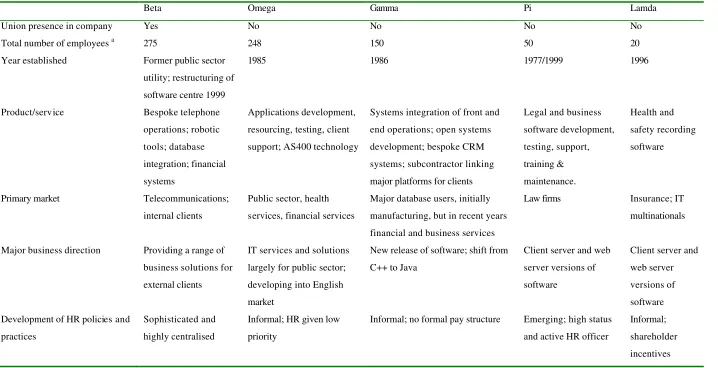
The key characteristics of the case study organisations are presented in Table 2.1. In terms of union organization, the case studies represent at least three contrasting contexts. Beta, which is a software engineering division within a former public utility
telecommunications company, was the only one of our case studies which recognized unions and had significant levels of union membership amongst its software employees. Both the CWU (acting for 64,000 Beta employees worldwide) and Connect (acting for 16,000 employees) were represented in the software division, although Connect was the specialist union for managerial and professional grades – the majority of our software workers – for whom Connect had negotiated a collective bargaining agreement. Connect represents about forty to fifty percent of Beta employees within the UK, and recently has attempted to widen its membership to large blue chip companies including Fujitsu, T Mobile and Vodaphone. In our Beta sample, 57 per cent reported being members of the union. These numbers are relatively low given that the union maintained a high level of visibility within the workplace, and that consultation principles were publicised on the employee intranet, along with full information on a range of industrial relations issues.
None of the other four case study organizations recognized Connect or any other union. The medium-sized owner-managed companies (Omega and Gamma) were either negative or indifferent towards the suggestion of a union representing software workers. Omega, which was founded by two women who had previously worked for another female -oriented organisation, explicitly promoted the recruitment of females and use of previous employment networks. Several employees also were related to the owners. As such, the owner and some managers perceived little need for a union believing trust within the organisation to be high. Other employees appeared divided on this issue. One of the managers was
pessimistic about his future with the company citing an ‘autocratic regime at the top’ and the company’s failed attempts to ‘shake off the small company culture’ (Omega, Manager, exploratory interview). Another employee raised the culture of openness in the company as some compensation for the lack of a union. “I wouldn’t say there is no demand for it but it has just never cropped up… There is an element of consultation but not a lot”. (Omega, HR officer, semi-structured workplace interview). It should be noted that Omega was the only case study organisation that refused to allow us to ask questions about union membership in our questionnaire.
Gamma, like Omega, provided a range of services to varied clients and was one of Scotland’s largest and most successful independent owner-managed software firms. It also had informal, haphazard and rudimentary HR policies and procedures. There was no formal pay structure although they were in the process of implementing a “reward and remuneration package” at the time of the research. The organisational structure was flat, with few
specialisms, and largely project-driven around product releases with some gaps between development and deployment. Employees were generally deployed in clients’ offices and seldom in the company’s head offices.
management structures – Lamda’s MD described a 'relaxed atmosphere' and Pi’s CEO a ‘peer to peer oriented culture’ with the ‘values of camaraderie and close relationships’. There were no formal written policies and practices, although, as the companies began to grow, some attempts in the direction of formal procedures were evident. Pi represented the most visibly emerging HR strategy with a recently appointed and active HR officer who attended senior management meetings. She had implemented several new initiatives centred around
formalising policies and practices, and described the organization as extremely supportive of employees, to the degree that the company would back them over clients. Many of Lambda’s employees had some association with trade unions as the company had been formed
following a management buyout in 1996 of the IT support and project management division of a former heavy engineering company with a history of union membership. Those unions (AMICUS and the AEEU) were of little relevance to the software workers and managers of the new company, however.
INSERT TABLE 2.1
Software Employees Views on Work, Unions and Employers
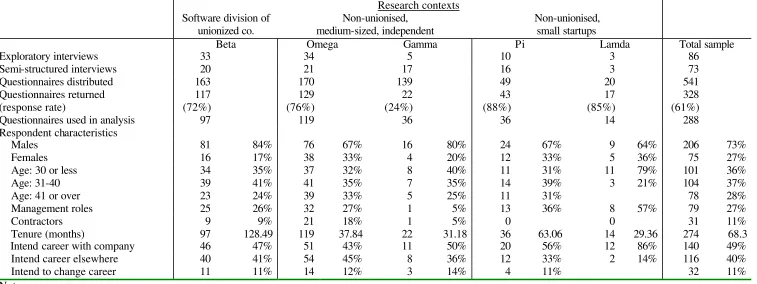
Views of employees regarding unions and collectivist orientations were obtained from two principal sources, the employee survey and from interviews. Survey responses provide data on general attitudes whilst case study interviews illustrate those factors which sustain employee and employer orientations towards individualism or collectivism. These in turn help to explain the low profiles of union membership and activity in all the companies, and in the case of the four smaller companies, the absence of a union at all. Five key dimensions can be identified: first, individualism as a behavioural trait; second, levels of satisfaction with work; third, levels of satisfaction with pay and grievances associated with pay; fourth, awareness of unions and attraction to their activities; and finally, the significance of employment context. In each case, the findings of the questionnaire study (see Table 2.2 for a description of the respondent sample) are used first to examine the extent to which these themes explain software workers’ attitudes to collectivisation.
Individualism
Our examination of attitudes to collective representation through the questionnaire study confirm adherence to individualist values. Although the responses indicate that there is still a general acceptance of a role for collective representation and action, the majority of software workers perceive this to be an unimportant aspect of their own jobs. Table 2.3 summarises the responses to three questions we selected to reflect attitudes to potential union
organization. Approximately half the total sample strongly disagreed or disagreed with the statement ‘Management should have the right to manage their organisation without interference’ with the other half of the sample split between a neutral position and the more extreme position of agreement with this statement. Only in Gamma where the response rate to the questionnaire had been low were attitudes more favourable to management. Over half the sample, again with the exception of Gamma, strongly agreed or agreed that ‘People have the right to take industrial action in order to get a fair deal’.
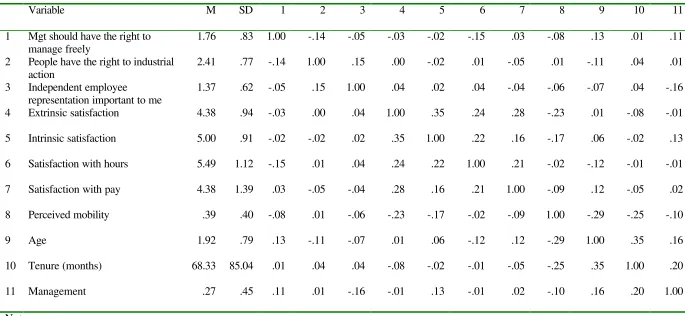
members in our sample did not feel independent employee representation to be important. The effects of age, tenure, job status and perceived mobility on these attitudes is suggested in the correlation coefficients presented in Table 2.4. Supportiveness for the rights of management to manage uncontested increased with age (r=.13, p<.016). Not surprisingly, independent employee representation was less important for those with people or project management responsibility (r=-.16, p<.008).
INSERT TABLE 2.2
INSERT TABLE 2.3
Our qualitative data supports the findings of much earlier studies which found that strong individualised instrumental orientations to work among white-collar and technical workers were associated with both loose organisational bureaucracy (which in particular typified our four non-union companies) and with strong market conditions for employees (which were evident in all five companies). Hence, the absence of bureaucracy offered Kuhn’s American engineers in 1963 with “ample opportunity for individual bargaining” and in consequence little attraction to a union whilst a third of the unorganised engineers and scientists in Riegel’s 1959 study also took the instrumental view that a union was unnecessary owing to their individual market strength (both reported in Bain et al 1973:135). Very similar individually materialistic and instrumentalised views were evident among our contemporary sample of software workers. Thus a typical comment when asked about the lack of interest in the union at Beta was:
‘I guess people feel more independent ...there’s a perception to look after themselves in the large part, and I guess the labour market being as it is in this sector, with lots of opportunities, is the major part’ (Beta, software engineers and Personal Development Manager, semi-structured workplace interview).
This individual bargaining strength is further illustrated in the following observations from software workers in the same (unionised) company:
‘I wouldn’t trust a union to represent my views to Beta. I’d rather represent my views myself... If I went in tomorrow and said JP Morgan have offered me another £5000, if you give me another £2000 though, I’ll stay...’(Beta, software engineer,
semi-structured home interview).
and:
‘I think there is the attitude within the software industry that if you don’t like the conditions you’ve got, go somewhere else where the conditions are better ...I know that if I walked out the door today I could be in another job by the end of next week’ (Beta, applications support analyst, semi-structured workplace interview)
At non-union Gamma, the response was similar:
‘...as an employee you have a lot more leverage, a lot more bargaining power, just as an individual, you can go in and say well, if you don’t give me another £5000 I’m going to go...’(Gamma, software engineer, semi-structured home interview).
Lamda: ‘I would speak to my boss about it’ (software engineer, semi-structured workplace interview).
INSERT TABLE 2.4
Satisfaction with work
Notwithstanding the apparent willingness of software employees to act on their own behalf, at the time of the study, there appeared to be few intractable problems for the employees to resolve either individually or collectively. There is evidence that satisfied employees are less likely to join a union than satisfied workers (Charlwood 2002; Premack and Hunter 1988) and previous studies indicate that IT workers are generally satisfied with their working lives (May et al 2002). In short, we may expect software workers’ attitudes to collectivisation to be related to their job satisfaction given the employment conditions which they have come to expect. In return for long working hours when required (Perlow 1998), software workers tend to expect a high degree of autonomy and generous rewards whether financially or in terms of skill acquisition and career progression (Barrett 2001).
The results of the questionnaire do reveal relatively high levels of satisfaction with different aspects of the job across the sample. In particular, using 18 items from the short form of the Minnesota Satisfaction Questionnaire (Weiss et al 1967), we created variables measuring four different dimensions of job satisfaction: extrinsic satisfaction (work
conditions, supervision, management relations and effectiveness, career prospects, and policy towards performance assessment) (Cronbach alpha reliability of scale α=.86); intrinsic
satisfaction (job variety, influence, sense of achievement) (Cronbach alpha reliability of scale
α=.78); satisfaction with pay (single item); and satisfaction with working hours and shifts
(single item).
Table 2.5, which summarises the levels of satisfaction and dissatisfaction overall, for each company, and for union members/non-members in Beta, shows approximately 80 per cent moderately to extremely satisfied with intrinsic aspects of the job and hours of work and shifts. This varied little across the companies, as one would expect – autonomy, variety and sense of achievement are an integral part of the profession which software developers would expect in any company. Satisfaction with extrinsic aspects of the job (e.g., management relations, supervision, policies) and pay was lower, although 70 per cent and 64 per cent respectively still responded that they were satisfied with each of these. Extrinsic satisfaction was higher in the smaller companies (Pi and Lamda) and the company with the low response rate (Gamma). The differences in satisfaction levels between union members and non-members in Beta were marginal and not statistically significant.
In terms of how satisfaction affected attitudes to collective action, only dissatisfaction with hours and shifts seemed to matter enough to shift opinion about management’s right to manage without interference. Table 5 shows that satisfaction with hours was significantly inversely related to support of management across the whole sample (r=-.15, p<.009). Rather, dissatisfaction with either extrinsic or intrinsic factors were both significantly related to intention to pursue their career elsewhere (r=-.23 and r=-.17 respectively). As interview quotes readily confirm job mobility is clearly a preferred and perhaps more effective solution to dissatisfaction with working conditions than reliance on a union.
low levels of extrinsic satisfaction and the even larger proportion in Beta, Pi and Lamda dissatisfied with pay. Further analysis presented below examines the potential consequences of this dissatisfaction for stimulating interest in collective action.
A previous study based on the same group of software workers reported their experience of long and unpredicatable hours, intensity of work and potential intrusion of work into their domestic lives (Hyman et al 2003). Despite this, many respondents explained that the considerable satisfaction which they derive from their work stems from the autonomy and freedom offered to them. At Beta an engineer explained that:
‘ I would say what’s particularly important is the working environment and we are allowed to get on with our job without any real interference. We are allowed to take decisions’ (Beta, applications support analyst, semi-structured workplace interview)
A Lamda software worker explained that:
‘I am happy where I am and I’m quite glad with the free rein that we’ve got as well which I don’t think would be there in a lot of other companies or large companies’ (Lamda, UK business development manager, semi-structured workplace interview)
The importance attached by managers and employees to individual skill development was evident. Thus at Beta, a management development specialist explained that:
‘the emphasis in skills development lies very much with the individuals ... what we do is to make sure we give them as much support we can ... We’ll support it by turning it round in terms of authorisation and budget provision as quickly as possible’
INSERT TABLE 2.5
Satisfaction with Pay
As already noted, at least 60 per cent of the questionnaire respondent sample overall and in each company reported being moderately to extremely satisfied with pay, but approximately a third reported being dissatisfied. The correlations in Table 5 indicate a positive relationship between satisfaction with pay and age (r=.12, p<.029) suggesting greater dissatisfaction amongst younger employees. This group was also more mobile; that is, more likely to pursue their career in other companies (r=-.29, p<.001) – specifically, 56 per cent of those under 30, compared to 41 per cent of 31-40s and 17 per cent of over 40s saw their current jobs as part of a career that would take them elsewhere. Thus, although pay dissatisfaction was not itself related to greater perceived mobility, there is a suggestion of alternatives to union action offered by labour market power for those who experience dissatisfaction with pay.
you’ve got, go somewhere else where the conditions are better’ (Beta, software engineer, semi-structured home interview).
Rather than try and negotiate higher pay with an existing employer, to which loyalty in any case is tenuous:
‘It’s become very clear to me as long as ten years ago that the way to make salary increases is to move job. You do not make salary increases by staying in a job’ (Beta, technical architect, semi-structured workplace interview)
Awareness of Union
Bain et al (1973) pointed out that one obstacle for unions wanting to attract non-manual employees is lack of awareness of their existence. In our case studies we found that awareness of unions was generally low and where there was awareness, union membership held few attractions. Moreover, the ‘services’ offered by unions held little attraction or relevance for staff.
Unions were recognised only in Beta, which provided an opportunity to use the questionnaire responses from Beta employees to examine attitudes towards the existing union in that company more closely. On a positive note, union awareness in Beta was high with only 16 out of the 97 respondents (16 per cent) unaware of the union’s presence. The 54 per cent of our sample who were members of the union also expressed slightly more positive attitudes about the union’s general effectiveness, as might be expected; however, this was not unanimous. Only 45 per cent of union members rated the union as generally effective, with the majority either unsure or more negative with regard to its overall performance. All of the 43 non-members in Beta were either unsure or more negative about its effectiveness.
When asked about the union’s effectiveness in dealing with specific issues, union members were positive about its record on health and safety matters (64 per cent rating it as effective), and individual member grievances (57 per cent rating it as effective). Half of the members, however, rated the union as ineffective in pay negotiations, while 34 per cent responded that it was ineffective in recruiting new members. Although on most issues, non-union members responded that they were unsure about the non-union’s effectiveness, on pay negotiations and recruitment of new members there was striking agreement with the attitudes of union members: 57 per cent of non-members rated the union as ineffective in pay
negotiations and 38 per cent as ineffective in recruitment.
Interviews at Beta demonstrate its perceived impotence among staff. The inability of the union to gain concessions from employers in the contemporary workplace was a
commonly expressed frustration:
‘There is a union but neither Brian or I are in it. Well, I’m not in it because I think they are completely ineffectual, I don’t see anything. The union fees are actually quite high and I don’t see what they are doing for this vast amount of money they take in. They appear to have minimal influence over Beta management. I really don’t think they are really very good’ (Beta, software engineer, semi-structured home interview).
And the alternative approach of offering discounted commercial services treated with disdain by the same person:
In terms of awareness at the non-union sites, one Gamma employee expressed his ignorance of unions in the following explicit terms:
‘They sound so old fashioned and ancient that I don’t really know of anything to do with them apart from sort of the miners; that was the last I heard about them’ (Gamma, software engineer, semi-structured home interview).
At Omega, another non-unionised workplace, previous negative experie nce of a union deterred any further interest for one software worker:
‘Well, I was in the union at the bank, but it did nine-tenths of nothing when I was made redundant. So I’ve never thought it worth pursuing since then. In theory they were there to protect you but they didn’t do anything. It’s never been an issue here. I wouldn’t say there is no demand for it but it has just never cropped up’ (Omega, HR manager, semi-structured home interview).
Colleagues at the same company and at the unionized Beta pointed to the positive physical and cultural contexts in their companies as key deterrents to unions:
‘ ...I don’t really reckon they are as important in an organisation like Omega, where you have predominantly professional people working in good, clean working
conditions. So there is less for unions to actually campaign for and do anything about and individuals have the right to appeal against things that happen to them in the workplace...So I guess it works for us. I don’t think there are many grievances from people that would indicate that something like a trade union or staff association would actually help’ (Omega, manager, semi-structured home interview).
‘There is a fair amount of stuff goes around to do with the union but they don’t seem too active in our area. I think because we are in the sort of job that gets reasonably treated anyway...’ (Beta, software engineer, semi-structured workplace interview).
In response to falling membership some unions have adapted the instrumental attractions of a union to advocate a servicing role for their members as opposed to the more collectively orientated approach where union membership is viewed as a committed expression of collective interests in “which members actively particpate and ‘become’ the union through their collective organisation and activity” (Heery et al 2001). Surprisingly perhaps, the more instrumental service role for unions held little attraction for many of our respondents and in consequence suggests that this may not be a fertile route for union revitalisation. Thus in Beta one union member complained that:
‘Our union seems to just spend most of their time trying to sell me insurance rather than talking to members, they are turning into financial advisers and that’s basically another string to their bow to try and make some money, and that’s basically all that we seem to get...so that’s where I see them going’ (Beta, software engineer, semi-structured home interview).
The Organisational Culture and Context
There has been a considerable literature which links attempts to link ideological, structural and behavioural factors among employers to patterns of union recognition. Ideology has been noted as a factor, especially when linked to holding families or dynasties whose ideological positions have inclined toward unitarism or paternalism (Purcell and Sisson 1983; Cully et al 1999:257). Unitarist values have also been associated with North American transplants operating in the UK (McLoughlin and Gourlay 1994). Structural influences include size, with SMEs especially prone to non- or anti- unionism (Rainnie 1989). The 1998 WERS survey indicated that union recognition among small enterprises was low, especially where working owners were present at the workplace (Millward et al 2000). In these circumstances, only one in a hundred owner managers were in favour of union membership (Cully et al 1999:265). In each of the four SMEs covered in the present study, working owners were present and took active executive roles at their workplaces. Low union membership has also been noted in private sector services (Cully et al 1999:92).
With four of our companies sharing common characteristics of small to medium size, private services sector and active owner participation, it is perhaps not surprising that unions were not recognised. Bearing in mind the vital role of the active executive owner, a further component needs also to be considered in the context of union endorsement, namely owner views on enterprise, management and work relations. With the four private sector companies, a unitarist orientation is clearly evident. This approach is apparent in individualistic
approaches to pay, communication from the top downwards and as we show below, a strong company ethos based on informality but underwritten by charismatic personalities and unwritten codes of conduct typified each of the SME case studies. In common with the non-union companies studied by McLoughlin and Gourlay (1994), there was little sign of
sophisticated systems of HRM, with few written policies and little evident sign of attempts to link business strategy with employment strategy. Interviews with senior management at Beta, however, indicated a different and more structured style of management, one largely derived from its origins as large public sector corporation.
At Lamda, where recruitment was mainly for graduates, a sense of mission and of enterprise was readily evident. The owner insisted that he wanted to recruit people ‘who want to join the club, not with a 9-5 mentality’. He was concerned that too many graduates ‘want everything on their plate’and turn out to be ‘not that motivated to go places’. After five years with the company, employees become shareholders and the club-like emphasis was reinforced by days out for all staff, barbecues and raft races.
At Omega, interviews with the chief executive quickly established that unions would not be welcome, notwithstanding the relative size and continuing expansion of the company. No union questions were permitted on the employee questionnaire and an element of autocratism was apparent through interviews with both senior and junior staff. As with Pi below, there was a strong emphasis on recruiting former colleagues and close acquaintances to the company. A senior manager pointed out that the culture is entrepreneurial, with a flat structure but ‘the managerial style is control’ and in the words of another: ‘the owners have had a problem letting go ... we pay lip service to giving over authority and responsibility, but...’. Communication was tightly controlled from the top and consisted mainly of twice-yearly formal evening meetings addressed by the Chief Executive and in which little audience participation occurs, echoing Bacon and Storey’s (1996: 43) point that: ‘direct communication by a company or an organisation with its workforce implies individualism’.
Recruitment was originally among former business colleagues: ‘I knew them personally. I knew their families. I knew what they are capable of and I brought them into the business’.
He insisted that to maintain a ‘family’ culture ‘we’ve created mechanisms for that ... we’ve created traditions’ such as ‘a boy’s golf outing ... we’ve gone to the same place every year and very few people from outside the company are invited’.
At Beta, union membership was estimated at about 40 per cent by the Connect branch official. Amongst our questionnaire sample, the figure was slightly higher at 54 per cent. The Software Centre manager at Beta indicated that notwithstanding a move towards informality, Beta’s identity as a company is rooted in its traditions: ‘When I joined it I was amazed. I walked in and everybody was wearing a shirt and tie. Where I worked before the software guys ... came in sandals, kaftans and all that kind of stuff, pony tails. Then coming in here and having a dress code seemed to be absurd’. The company has more of a structure and operates more by formal written codes than the smaller independent software firms. There are formal appraisal systems based on ‘competencies’: ‘... a set of behaviours the business has decided that our people must exhibit. And that’s what we use to measure performance. There are paragraphs to tell you how people should behave and get certain marks’.
In summary, with the exception of Beta, where a union is recognised, there appears to be little encouragement from owner-managers for employees to join unions and coded
messages from them of organisational cultures incompatible with union organisation or activity.
Discussion: Potential for Union Intervention
Recent editions of the European Journal of Industrial Relations (March 3003) and British Journal of Industrial Relations (September 2002) were dedicated to union revitalisation problems, potential and prospects in different European countries. In one paper, Heery and his colleagues offered a summary of union attempts in the UK to gain members and achieve employer recognition. These initiatives include: efforts to recruit and retain workers in workplaces irrespective of union recognition by the employer; to gain recognition from employers through direct approaches to them; to merge with other unions; to establish coalitions with other interest and campaigning groups; through political pressure; and through social partnership arrangements with employers (Heery et al 2003). In his summary of European trends, Visser (2002) concludes with the pessimistic message that continued decline across Europe can be expected unless unions can reach ‘new workers’ and workplaces and offer sufficient incentives for employees to join and remain with the union through the diverse employment trajectories which typify new work in the contemporary economy (2002:425). In software, an archetypal “new” industry and in which union density continues to decline, there was little evidence in our study of concerted union efforts to adopt systematically any of the above approaches. Nor was there any clear indication of areas of potential growth or influence available to unions.
Moreover, if we consider the main explanations for propensity to join unions offered by Kochan (1980), the prognosis for unions in the software sector is not promising.
McLoughlin and Gourlay developed Kochan’s ‘critical determinants’ for a propensity to unionise to include job satisfaction, participative utility and perceived ability of union to secure additional benefits (1994:94). In other words, if employees are satisfied, happy with existing communication channels and have little expectation that a union can secure additional benefits, then propensity to unionise will be low. In addition, there appears to be little evidence in our study for the so-called ‘representation gap’ identified by Towers (1997), which purports to offer unions with opportunities to expand their membership following the recent years of decline and subsequent ‘frustrated demand for union membership among non-union members’ (Charlwood 2002: 463).
Indeed, the sense which emerges from employee interviews and questionnaire study is that employees are generally satisfied with their work, and that individual autonomy is especially valued. Any shortcomings in the job would be treated through individual
intervention with the ultimate sanction of exiting if job and salary expectations are not met by the company. Unions appear to have little substantive role in meeting these expectations, with the common view being that they lack sufficient authority to intercede on behalf of the software workers. In Beta, the one company which recognised a union and where the union was actively involved in pay negotiations, even union members were despondent over its effectiveness in this respect.Most of the software workers in our study appear to lack commitment to collective action and at the same time consider that unions offer little
instrumental capability to satisfy their labour market requirements. In consequence interest in unions and their activities is low. Kochan’s broad critical determinants are clearly not met in these circumstances. Even if union interest were higher, employees would face substantial barriers in persuading owner-managers to recognise unions in their enterprises, whilst in Beta, where unions are recognised, activity seems to be maintained at a subdued, and essentially individualist level. It appears that union vitality is sustained by both structural and attitudinal factors and when the trajectories of both coincide, as has been the case with software workers, opportunities for union organisation become heavily circumscribed.
Thus, from this study it appears that opportunities for unions to expand membership in software are limited. Current union organising initiatives in the sector appear to very low profile and inconsequential. These pessimistic conclusions may perhaps be mitigated by two emergent factors, though the first of these offers scant comfort to software workers in that their labour market has loosened significantly in the past couple of years. Promoted
established posts are now scarcer and software workers wishing to enhance their salaries and conditions may not be able to manipulate their individual mobility with the same freedom as was available during the period when the research was undertaken. Internal advancement (or consolidation) and security may become preferable or more feasible objectives. Any
ambitions toward union presence may be helped by the statutory recognition procedures offered by the Employment Relations Act 1999, though our early study showed few if any signs of increased activity among software workers during the three years following the Act (see also Charlwood 2002: 488). It appears, though, that even under these changing
conditions, there is no evidence as yet that software employees are turning to their sector unions to defend or advance their interests. Nor is there much likelihood that employers, now operating within a more favourable (to them) labour market, will be more welcoming to union representation.
Nevertheless, a second possible opportunity derives from this labour market volatility and resides with the unions themselves. It is clear both from available union statistics and from the findings of this study that few unions with interests in the sector are making headway in terms of recruitment and recognition. Arguably unions may need to examine alternative approaches to securing membership, especially if direct recognition from
strategies. According to Benner these initiatives: ‘are helping members build success careers. By strengthening networks among people in similar occupational communities, they are helping to mitigate the risk of the high turnover and volatility inherent in information technology industries. In the process, rather than building careers based in a single firm, members are building careers through their occupationally based community networks’ (2002:175-6).
Similar approaches can be seen in the early initiatives being developed by Connect, the ‘union for professionals in communications’. Recognising the volatility of employment and continuous change inherent in the communications industry, the union offers an employment exchange service, career counselling, advice over employment contracts and advice on employment matters as well as provision of other services. Where ‘Connect works in partnership with your employer’ the union even offers ‘to negotiate on your behalf’
(Connect advertising leaflet 2002). Whether this shift to a professionalised service model will be effective in gaining recruits is perhaps too early to say, though signs given by employees and employers in the reported study are not promising.
References
Bacon N. and Storey J. (1996), ‘Individualism and Collectivism and the Changing Role of Trade Unions’, in P. Ackers, C. Smith, P. Smith (eds) The New Workplace and Trade Unionism, London, Routledge
Bain G. S. (1970), The Growth of White Collar Unionism, Oxford, Clarendon
Bain G., Coates D. and Ellis V. (1973), Social Stratification and Trade Unionism, London, Heinemann
Barrett, R. (2001), Symbolic Analysts or Cyberserfs? Software Development Work and Workers, Working Paper, Monash University.
Batstone E., Boraston I. and Frenkel S. (1978), The Social Organisation of Strikes, Oxford, Blackwell
Beirne M., Ramsay H. and Panteli A. (1998), ‘Developments in computing work: control and contradiction in the software labour process’, in P. Thompson and C. Warhurst (eds)
Workplaces of the Future, Macmillan Business, Hampshire, pp. 142-162
Benner C. (2002), Work in the New Economy: Flexible Labor Markets in Silicon Valley, Oxford, Blackwell
Blackburn R. (1967), Union Character and Social Class, London, Batsford
Bradley H., Erickson M., Stephenson C. and Williams S. (2000), Myths at Work, Bristol, Polity Press
Castells M. (2000), The Rise of the Network Society, Vol 1, 2nd edn, Oxford, Blackwell
Charlwood A. (2002), ‘Why do non-union employees want to unionize?’, British Journal of Industrial Relations, Vol 40 No 3, pp 463-491
Cully M., Woodland S., O’Reilly A. and Dix G. (1999), Britain at Work, London, Routledge
Deery S. and Walsh J. (1999), ‘The decline of collectivism? A comparative study of white-collar employees in Britain and Australia’, British Journal of Industrial Relations, Vol 37 No 2, pp. 245-269
Diamond W. J. and Freeman R. B. (2002), ‘Will unionism prosper in cyberspace? The promise of the internet for employee organization’, British Journal of Industrial Relations, Vol 40 No 3, pp.569-596
Fiorito J., Jarley P. and Delaney J. T. (2002), ‘Information technology, union organizing and union effectiveness’, British Journal of Industrial Relations, Vol 40 No 4, pp. 627-658
Goldthorpe J., Lockwood D., Bechhofer F. and Platt J. (1968), ‘The Affluent Worker: Industrial Attitudes and Behaviour’, Cambridge, Cambridge University Press.
Heery E., Kelly J. and Waddington J. (2003), ‘Union revitalization in Britain’, European Journal of Industrial Relations, Vol 9, No 1, pp. 79-97
Hyman J., Baldry C., Scholarios D., and Bunzel D. (2003), ‘Work-life imbalance in call
centres and software development’, British Journal of Industrial Relations, Vol 41 No 2, pp. 215-239.
Hyman R. (1991), ‘European unions: towards 2000’, Work, Employment & Society, Vol 5 No 4, pp. 621-639
Kelly J. (1998), Rethinking Industrial Relations: Mobilisation, Collectivism and Long Waves, London, Routledge
Kessler I. and Purcell J. (1995), ‘Individualism and collectivism in theory and practice: managment style and the design of pay systems’, in P Edwards (ed), Industrial Relations: Theory and Practice in Britain, Oxford, Blackwell
Kochan T. (1980), Collective Bargaining and Industrial Relations, Homeword, Illinois, Richard D Irwin
Kraft P. and Dubnoff S. (1979), ‘Job content, fragmentation and control in computer software work’. Industrial Relations Vol 25 No 2, pp. 184 -196
Lupton T. (1963), On the Shop Floor, Oxford, Pergamon
May T. Y., Korczynski M. and Frenkel, F. (2002). Organizational and Occupational
Commitment: Knowledge Workers in Large Corporations. Journal of Management Studies, 39,6, 775-801.
McLoughlin I. and Gourlay S. (1994), Enterprise without Unions, Buckingham, Open University Press
Middlehurst R. and Kennie T. (1997), ‘Leading professionals: Towards new concepts of professionalism' in J Broadbent (ed), The End of the Professions? The Restructuring of Professional Work, London, Routledge
Millward N., Bryson A. and Forth J. (2000), All Change at Work?, London, Routledge
Perlow, L.A. (1998) ‘Boundary control: the social ordering of work and family time in high-tech corporations’, Administrative Science Quarterly, Vol 43, pp. 328-357.
Premack S. L. and Hunter J. E. (1988), ‘Individual unionization decisions’, Psychological Bulletin, Vol 103, pp. 223-234
Purcell J. (1987), ‘Mapping management styles in employee relations’, Journal of Management Studies, Vol 23 pp 205-223
Purcell J. and Sisson K. (1983), ‘Strategies and practice in the management of industrial relations’, in G S Bain (ed), Industrial Relations in Britain, Oxford, Blackwell
Rainnie A. (1989), Industrial Relations in Small Firms, London, Routledge
Ramsay, H. (1999). Close encounters of the nerd kind. Paper presented to the Worklife 2000 Programme. Sweden.
Reed C. S., Young W.R., and McHugh, P. (1994). A Comparative Look at Dual Commitment: An international study. Human Relations, 47(10), 1269-1291
Smith C. (1987), Technical Workers: Class, Labour and Trade Unionism, Basingstoke Macmillan
Storey J. and Bacon N. (1993), ‘Individualism and collectivism into the 1990s’ International Journal of Human Resource Management, Vol 4, pp. 665-684
Tilly C. (1978). From Mobilization to Revolution, New York McGraw-Hill
Towers B. (1997), The Representation Gap: Change and Reform in the British and American Workplace, Oxford, Oxford University Press
Visser J. (2002), ‘Why fewer workers join unions in Europe: A social custom explanation of membership trends’, British Journal of Industrial Relations, Vol 40 No 3, pp. 403-430
Table 2.1. Description of case studies
Beta Omega Gamma Pi Lamda
Union presence in company Yes No No No No
Total number of employees a 275 248 150 50 20
Year established Former public sector utility; restructuring of software centre 1999
1985 1986 1977/1999 1996
Product/serv ice Bespoke telephone operations; robotic tools; database integration; financial systems
Applications development, resourcing, testing, client support; AS400 technology
Systems integration of front and end operations; open systems development; bespoke CRM systems; subcontractor linking major platforms for clients
Legal and business software development, testing, support, training & maintenance. Health and safety recording software
Primary market Telecommunications; internal clients
Public sector, health services, financial services
Major database users, initially manufacturing, but in recent years financial and business services
Law firms Insurance; IT multinationals
Major business direction Providing a range of business solutions for external clients
IT services and solutions largely for public sector; developing into English market
New release of software; shift from C++ to Java
Client server and web server versions of software
Client server and web server versions of software Development of HR policies and
practices
Sophisticated and highly centralised
Informal; HR given low priority
Informal; no formal pay structure Emerging; high status and active HR officer
Table 2.2 Research design and survey respondent characteristics
Research contexts Software division of
unionized co.
Non-unionised, medium-sized, independent
Non-unionised, small startups
Beta Omega Gamma Pi Lamda Total sample
Exploratory interviews 33 34 5 10 3 86
Semi-structured interviews 20 21 17 16 3 73
Questionnaires distributed 163 170 139 49 20 541
Questionnaires returned (response rate)
117 (72%)
129 (76%)
22 (24%)
43 (88%)
17 (85%)
328 (61%)
Questionnaires used in analysis 97 119 36 36 14 288
Respondent characteristics
Males 81 84% 76 67% 16 80% 24 67% 9 64% 206 73%
Females 16 17% 38 33% 4 20% 12 33% 5 36% 75 27%
Age: 30 or less 34 35% 37 32% 8 40% 11 31% 11 79% 101 36%
Age: 31-40 39 41% 41 35% 7 35% 14 39% 3 21% 104 37%
Age: 41 or over 23 24% 39 33% 5 25% 11 31% 78 28%
Management roles 25 26% 32 27% 1 5% 13 36% 8 57% 79 27%
Contractors 9 9% 21 18% 1 5% 0 0 31 11%
Tenure (months) 97 128.49 119 37.84 22 31.18 36 63.06 14 29.36 274 68.3
Intend career with company 46 47% 51 43% 11 50% 20 56% 12 86% 140 49%
Intend career elsewhere 40 41% 54 45% 8 36% 12 33% 2 14% 116 40%
Intend to change career 11 11% 14 12% 3 14% 4 11% 32 11%
Notes.
a
Table 2.3: Attitudes to collective representation (percentages)
Variables Overall
N=281
Beta N=96
Omega N=115
Gamma N=21
Pi N=35
Lamda N=14
Beta union members N=54
Beta non-union members N=43
D A D A D A D A D A D A D A D A
Management should have the right to manage their organisation without interference
49 25 52 22 46 24 38 33 54 29 50 29 52 24 52 19
People have the right to take industrial action in order to get a fair deal
17 58 14 69 19 51 24 43 23 60 7 57 7 80 21 55
Independent employee
representation is a very important part of any job for me
71 8 58 14 82 4 65 5 76 64 14 40 22 79 5
Notes.
Table 2.4: Job satisfaction (percentages)
Variables Overall
N=281
Beta N=96
Omega N=115
Gamma N=21
Pi N=35
Lamda N=14
Beta union members N=54
Beta non-union members N=43 Sat Dis Sat Dis Sat Dis Sat Dis Sat Dis Sat Dis Sat Dis Sat Dis Extrinsic satisfaction 70 27 64 33 68 29 86 14 71 26 100 63 35 65 30
Intrinsic satisfaction 84 11 82 13 80 11 81 14 97 3 100 85 11 79 16
Satisfaction with hours/shifts 88 6 93 4 89 4 76 14 79 9 86 7 93 2 93 7 Satisfaction with pay 64 31 58 38 69 25 71 14 59 41 64 36 61 36 53 42
Notes.
Table 2.5: Means, standard deviations and correlations between main study variables
Variable M SD 1 2 3 4 5 6 7 8 9 10 11
1 Mgt should have the right to manage freely
1.76 .83 1.00 -.14 -.05 -.03 -.02 -.15 .03 -.08 .13 .01 .11
2 People have the right to industrial action
2.41 .77 -.14 1.00 .15 .00 -.02 .01 -.05 .01 -.11 .04 .01
3 Independent employee
representation important to me
1.37 .62 -.05 .15 1.00 .04 .02 .04 -.04 -.06 -.07 .04 -.16
4 Extrinsic satisfaction 4.38 .94 -.03 .00 .04 1.00 .35 .24 .28 -.23 .01 -.08 -.01
5 Intrinsic satisfaction 5.00 .91 -.02 -.02 .02 .35 1.00 .22 .16 -.17 .06 -.02 .13
6 Satisfaction with hours 5.49 1.12 -.15 .01 .04 .24 .22 1.00 .21 -.02 -.12 -.01 -.01
7 Satisfaction with pay 4.38 1.39 .03 -.05 -.04 .28 .16 .21 1.00 -.09 .12 -.05 .02
8 Perceived mobility .39 .40 -.08 .01 -.06 -.23 -.17 -.02 -.09 1.00 -.29 -.25 -.10
9 Age 1.92 .79 .13 -.11 -.07 .01 .06 -.12 .12 -.29 1.00 .35 .16
10 Tenure (months) 68.33 85.04 .01 .04 .04 -.08 -.02 -.01 -.05 -.25 .35 1.00 .20
11 Management .27 .45 .11 .01 -.16 -.01 .13 -.01 .02 -.10 .16 .20 1.00
Notes:
N=252; correlation coefficients are Kendall tau values; values above .12 are statistically significant at p<.05