Oi, D K L and Schirmer, S G and Greentree, A D and Stace, T M (2005)
Robust charge-based qubit encoding. Physical Review B, 72 (7). -. ISSN
1098-0121 , http://dx.doi.org/10.1103/PhysRevB.72.075348
This version is available at
https://strathprints.strath.ac.uk/35332/
Strathprints is designed to allow users to access the research output of the University of Strathclyde. Unless otherwise explicitly stated on the manuscript, Copyright © and Moral Rights for the papers on this site are retained by the individual authors and/or other copyright owners. Please check the manuscript for details of any other licences that may have been applied. You may not engage in further distribution of the material for any profitmaking activities or any commercial gain. You may freely distribute both the url (https://strathprints.strath.ac.uk/) and the content of this paper for research or private study, educational, or not-for-profit purposes without prior permission or charge.
Any correspondence concerning this service should be sent to the Strathprints administrator: [email protected]
The Strathprints institutional repository (https://strathprints.strath.ac.uk) is a digital archive of University of Strathclyde research outputs. It has been developed to disseminate open access research outputs, expose data about those outputs, and enable the
arXiv:quant-ph/0412122v3 13 Sep 2005
Daniel K. L. Oi,1,∗ Sonia G. Schirmer,1 Andrew D. Greentree,2 and Tom M. Stace1 1
Department of Applied Mathematics and Theoretical Physics, University of Cambridge, Wilberforce Road, Cambridge CB3 0WA, UK 2
Centre for Quantum Computer Technology, University of Melbourne, Victoria, Australia (Dated: February 1, 2008)
We propose a simple encoding of charge-based quantum dot qubits which protects against fluctu-ating electric fields by charge symmetry of the logical states. We analyze the reduction of coupling to noise due to nearby charge traps and present single qubit gates. The relative advantage of the encoding increases with lower charge trap density.
PACS numbers: 03.67.Lx,03.65.Yz
I. INTRODUCTION
Quantum computation faces considerable hurdles, one of the most serious being engineering physical systems performing coherent operations without the deleterious effects of decoherence1, particularly in the solid state. However by isolation and manipulation of states of quan-tum dot (QD) structures2, it may be possible to per-form many unitary operations within the dephasing time, a pre-requisite for quantum error correction (QEC) by means of Calderbank-Shor-Steane codes3.
Underlying logical QEC, a complementary strategy is to use Hilbert subspaces which couple least to noise pro-cesses, decoherence free subspaces (DFS)4,5,6,7. Practi-cal quantum computing will undoubtedly use elements of both. Charge-based QD quantum computing8,9,10,11,12,13 is a prime candidate for DFS encoding as electric field coupling is a major source of decoherence14,15. Here, we present an architecture incorporating charge symmetry of the logical states to protect against electromagnetic fluc-tuations, analyze its resistance to charge trap noise and present single-qubit gates. Coupling to charge trap noise and decoherence is suppressed by several orders of mag-nitude compared to a conventional charge qubit, depend-ing on charge trap density. Alternatives to the passive control implied by DFS encoding include active control sequences, such as Bang-Bang control16,17.
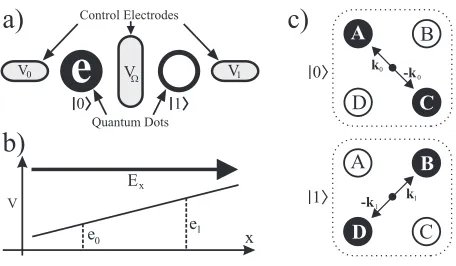
In a typical charge-based QD qubit (Fig. 1a) the posi-tion of an excess electron defines the logical states. Ide-ally, the logical states of the system should be eigenstates of the system Hamiltonian when the system is idle, i.e. tunnelling should be suppressed on practical time-scales byVΩ. Furthermore, we assume that the system can be tuned, via V0,1, such that the logical states are degen-erate, hence (known) relative dynamical phases can be neglected.
II. CLASSICAL NOISE
Fluctuations of the electromagnetic environment su-perimpose inhomogeneities on the potential seen by the charge states. An electric field component along the axis
0 1
V0 VW V1
Quantum Dots Control Electrodes
x V
E
e0
e1 x
a)
b)
0
1 k0
k1 -k0
-k1
c)
A
C B
D
e
A
C
B
[image:2.612.326.554.217.350.2]D
FIG. 1: a) 2QD Dipole Charge Qubit. Logical states,
{|0i,|1i}, are defined by an excess electron on the left or right dot respectively. Symmetry electrodes (V0,1) control σz ro-tations, and a barrier electrode (VΩ) controls σx. An SET (omitted) measures in the logical basis. b) Temporally and spatially varying potential due to external field. c) 2-Electron 4QD Quadrupole Qubit with|0i=a†c†
|vaci, |1i=b†d†
|vaci.
of the qubit will cause a sloping potential (Fig. 1b), in-ducing for each state a different dynamic phase,
|j(t)i=e−iq~
Rt
0ǫj(t
′)dt′
|j(0)i, j= 0,1 (1)
whereǫj is the on-site energy fluctuation andqthe elec-tron charge. Fluctuations drive superpositions |ψi =
α|0i + β|1i to mixed states, |ψihψ| 7→ |α|2|0ih0| +
|β|2|1ih1|. Furthermore, electrodes operating on nearby qubits will look like noise, i.e. it may only be practical to actively compensate for operations on nearest neigh-bors, but not those further away which may also cause unwanted perturbations.
cor-2
related mode24. Qutrits or higher dimensional systems may also be considered, e.g. a qutrit encoded as two elec-trons in a three dimensional 6QD octohedral structure.
An external electric field induces phase shifts, as in Eq. (1), where the energies to first order are
ǫ0(t) = ǫA+ǫC= 2 ¯V +k0·E+ (−k0)·E= 2 ¯V
ǫ1(t) = ǫB+ǫD= 2 ¯V +k1·E+ (−k1)·E= 2 ¯V ,
where ¯V is the potential at the common centroid and
ǫA,B,C,D are the on-site energy fluctuations of the re-spective QDs. The symmetrical distributions of charge ensure that each logical state acquires the same dynamic phase due to the external potential gradient. Thus, an initial superposition acquires an overall dynamic phase which is unobservable.
III. CHARGE TRAP NOISE
Though linear spatially varying potentials have no de-phasing effect on the 4QD qubit, charge trap fluctu-ators24 may pose a problem25,26,27,28,29. An occupied charge trap has a ∼ 1/r potential, which perturbs the degeneracy of the DFS states. In principle the charge trap density can be made arbitrarily low but a few charge traps may be unavoidable in practice39, and charge trap noise may be a significant source of decoherence.
To understand the effect of charge trap noise, consider a single charge trap coupled to the qubit via the Hamil-tonianH =kξ(t)σz/2, whereξ=±1 is a Poisson process of rateλ, andkis the coupling30,31. Averaging over noise processes leads to a decay of the coherence of the qubit density operator,
hρ01(t)iξ = ρ01(0) D
e−ikR0tξ(t
′)dt′E
ξ
= ρ01(0)e−tλ
cosωt+λ
ωsinωt
whereω=√k2−λ2. For many independent fluctuators with different rates λj and couplings kj, the coherence decays in a non-Markovian manner (Fig. 2),
hρ01(t)iξ =ρ01(0)e−t
P
jλjY
j
cosωjt+ λj
ωjsinωjt
.
(2) A Taylor expansion of the solution (2) aboutt= 0 shows that the initial decay is parabolic
hρ01iξ/ρ01(0)≈1−t2/2 X
j
kj2+O(t3), t≪1, (3)
independent of λj, and depends only on the effective coupling of the encoded qubits to the charge traps,
k2
eff=
P
jkj2(Fig. 3a). Therefore, the short-term
behav-ior will be dominated by the fluctuator that couples most strongly to the qubit, while the others mainly dampen
Blochvectorlength,2QD
Blochvectorlength,4QD t (ns)
0 1 2 3 4 5 6 7 8 9 10
0 0.1 0.2 0.3 0.4 0.5 0.6 0.7 0.8 0.9 1
1
0.8
0.6
0.4
0.2
0
1
0.8
0.6
0.4
0.2
[image:3.612.322.555.49.216.2]0
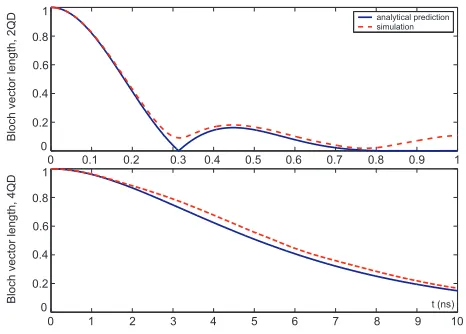
FIG. 2: Qubit Coherence Decay. Initial state (|0i+|1i)/√2 coupled to 100 charge traps. keff(2) = 12.46×10⁹~/s and
k(4)eff = 0.60×10⁹~/s. A total of 200 quantum trajectories
were simulated and averaged. For all simulations, the 2QD qubit was 20nm long and the 4QD qubit was a 20nm square (e.g. P donors in Si, see Ref. 14). Both were located 20nm be-low the layer in which the charge traps were located. Charge trap transition rate was 2×10⁸Hz.
further oscillations of the coherence vector (Fig. 2). Fur-thermore, the time it takes for the coherence to decay from 1 (maximal coherence) topfor pclose to 1, which is of crucial importantance in quantum information pro-cessing, is inversely proportional to the effective coupling strengthkeff, τp=
p
2(1−p)keff−1, and we have
τp(4) τp(2)
= k (2) eff
k(4)eff , (4)
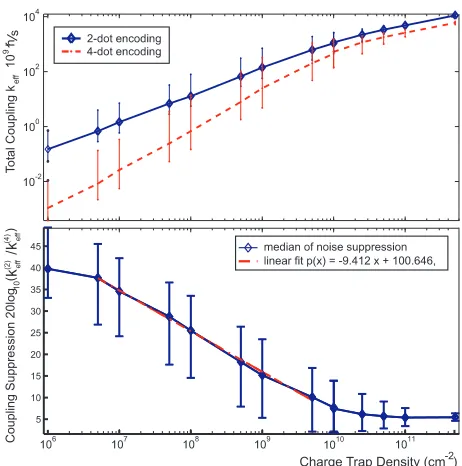
wherek(2)eff and keff(4) is the effective coupling strength for the two-dot and four-dot encoding respectively (Fig. 3 b). Thus, the ratio of the effective coupling strengths is a good measure for the superiority of the 4QD encod-ing versus the 2QD encodencod-ing—the former will be better provided thatkeff(2)/keff(4)>1, and the larger the ratio the greater the improvement.
The 2QD and 4QD qubits couple differently to charge traps, k(2)j ∝ rj−2, and k(4)j ∝ r−3j respectively, where
t
t
t
t
t
t
t
t
t
t
a)
b)
eff (4) (2)
[image:4.612.324.555.48.281.2]eff
FIG. 3: Decoherence of 2QD and 4QD qubits. (a) The de-coherence decay times are inversely related to the effective coupling to fluctuators and show the same dependence for the 2QD and 4QD qubits. (b) The ratio of the short-term co-herence times for the 2QD and 4QD encodings are inversely proportional to the ratio of the effective coupling constants. Each point represents the average of 200 quantum trajectories of a qubit coupled to 100 randomly distributed fluctuators.
IV. ROBUSTNESS OF ENCODING
The results in the previous section show that the 4QD encoding can substantially increase short-term coherence times for an ideal geometry. However, any physical im-plementation is likely to deviate from the perfect sym-metry of the ideal quantum dot structure. The scheme’s sensitivity to such deviations is thus an important prac-tical consideration.
Non-ideal geometry, e.g. due to imperfect QD place-ment, will introduce a dipole moplace-ment, spoiling decou-pling from external fields and reducing robustness to charge trap noise. However, as the magnitude of this
Charge Trap Density (cm )
CouplingSuppression20log()
10
T
ot
alCouplingk10
ef
f
9h
s
-2
ef
f
(4)
(2)
ef
f
FIG. 4: Coupling and Noise vs Charge Trap Density. Noise suppression of the 4QD vs 2QD qubits was calculated for 100 random charge trap distributions per density, which was then averaged. Coupling strength is in units of 109~/s, bars
indicate the 10%−90% ranges. At high densities, the mean charge trap spacing is comparable to the size of the qubit, leading to saturation effects.
dipole is comparable to, and linear in the displacement, and given that fabricational precision should be at least a fraction of QD spacing for QIP purposes40, the extra dipole for the 4QD qubit should be much smaller than for a 2QD qubit, hence the encoding should still offer a noticeable advantage.
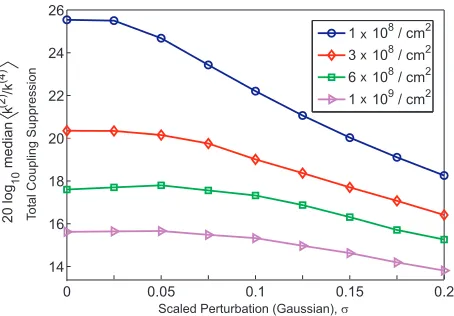
To quantify the effect of asymmetry due to placement errors in the quantum dots, we performed extensive sim-ulations computing the effective couplings for various randomly perturbed 2QD and 4QD architectures for dif-ferent charge trap densities and a wide range of charge distributions. The simulations show that for reasonable errors (∼ 10% placement error), the efficiency of the scheme is only modestly affected over a wide range of fluctuator densities (Fig. 5).
V. QUANTUM GATES
We now consider implementing a universal set of quan-tum gates, {σφ
z, σ π/2
x , c−σzπ}. Ideally, we would like
[image:4.612.61.290.49.446.2]4
0 0.05 0.1 0.15 0.2
14 16 18 20 22 24 26
1 108/ cm2 3 108/ cm2
6 108/ cm2 1 109/ cm2
20log
10
mediank
(2)
/k
(4)
x
x
x
x
Scaled Perturbation (Gaussian),s
T
ot
[image:5.612.64.291.50.208.2]alCouplingSuppression
FIG. 5: Decoupling vs Placement Error. We simultaneously and independently purturbed the positions of all quantum dots by a Gaussian displacement with standard deviationσ
(expressed as a fraction of the array side-length). This was repeated 1000 times for each of 500 fluctuator distributions. We plot of median w.r.t fluctuator distributions of the mean over the perturbations of the decoupling ratios as a function of error magnitude for different effective fluctuator densities. Even with a 10% displacement error (i.e. σ= 0.1), the 4QD qubit is still effective.
tunneling between dots can implement the required log-ical gates quickly. If the gate time is short enough, tran-sient population in non-DFS states, should have minimal coupling to electric field fluctuations. Intra-dot charging should effectively suppress double occupation, which can be further enhanced by ensuring all spins are parallel so that each orbital cannot have more than one electron.
We describe the four dot system as a two-electron, four-site Hubbard model. The electronic creation oper-ators are defineda†, b†, c†, d† for dotsA, B, C, D respec-tively, labelled in clockwise fashion (Fig. 1c). Firstly, the phase gate (a rotation of the Bloch sphere by angle φ
around the z-axis)σφ
z = diag(1, eiφ) is achieved by
bias-ing one pair of diagonally opposite quantum dots with respect to the other,
φ=2e
~
Z t
0
[V0(t′)−V1(t′)]dt′,
where V0, V1 are the on-site potentials of the quantum dots defining the |0i ≡ a†c†|vaci and |1i ≡ b†d†|vaci states respectively.
Next, theσπ/x 2 gate requires inter-dot tunnelling. We
allow tunnelling between dots A↔D and B ↔C. Al-lowing A ↔ B and C ↔ D tunneling as well leads to similar dynamics but at the expense of extra control elec-trodes and more non-DFS states involved. With vertical tunneling only, the available state space is spanned by four states, {|0i,|1i,|ε0i = a†b†|vaci,|ε1i = c†d†|vaci}. Hence the Hamiltonian with no tunneling is, H0V = diag(0,0, δ, δ) in the above basis, and where we have taken the (degenerate) ground state energy to be 0 andδ
is the energy of the non-diagonal states{|ε0i,|ε1i}due to
Coulomb repulsion of the two electrons. We now switch on equal tunneling with rate Ω in the vertical direction,
HtunnelV =
0 0 Ω Ω 0 0 Ω Ω Ω Ω 0 0 Ω Ω 0 0
.
For convenience, we normalizeδ= 1, and scale Ω relative to this. The eigenstates ofHtot=H0+Htunnel are
|ψ1i = |0i − |1i,
|ψ2i = |ε0i − |ε1i,
|ψ3i =
4Ω(|0i+|1i)
√
1 + 16Ω2+ 1+|ε0i+|ε1i,
|ψ4i =
4Ω(|0i+|1i)
√
1 + 16Ω2−1− |ε0i − |ε1i,
where the eigen-energies are E1 = 0, E2 = 1, E3 = (1 +√1 + 16Ω2)/2, E
4= (1−
√
1 + 16Ω2)/2. Tunnelling between dots mixes the states so that {|0i,|1i} are no longer eigenstates ofHtot. Transitions between |0i and
|1icannot occur directly but only via transient occupa-tion of the non-DFS states.
In order to achieve a π/2 rotation around an axis (cosγ,sinγ,0) lying on the equator of the Bloch sphere (which is equiavalent to aσπ/x 2 gate up toσγz rotations) |0i 7→ |0i+eiγ|1i, |1i 7→ |0i −eiγ|1i, we require E
3 and E4 to be rational. This leads to the conditions,
4Ω =p
(n/m)2−1 where {n/2, m} ⊂ Z+, n > m and gcd(n, m) = 1. These requirements derive from the fact that the amplitudes of the|0iand|1ishould be equal in magnitude when the amplitudes of the non-DFS states are zero, leading to jm/n = 1/2 +k,{j, k} ⊂ Z+, and
the gate timetf = 2jmπ/n. Whentf =πm, we achieve the operation with γ = π(n−m)/2. If tf = 2πm, we perform a logical NOT (|0i ↔ |1i).
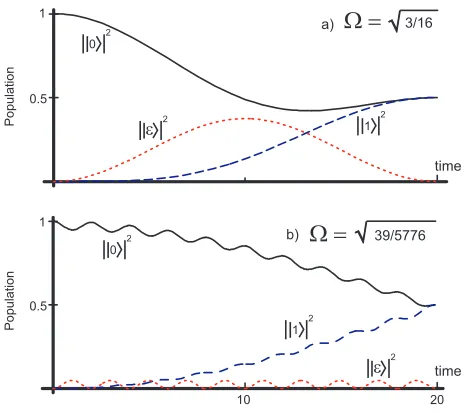
The minimum gate time for aπ/2-gate istf =πwhen 2≤n even andm = 1 (Fig. 6). If m >1, the time re-quired to implement the gate increases. Coulomb repul-sion favors the diagonal charge configurations but tran-sient population in the other states will still occur. For
n/m→1, the gate time is on the order of πm but the maximum transient population scales as (n2−m2)/n2. The integrated population in the non-DFS states during the total gate time is proportional tom(n2−m2)/n2and thus using smaller tunneling rates does not improve the overall transient occupation of non-DFS states.
The average gate error, E = 1− F where F is the average fidelity36,37, for different charge trap couplings (densities) was simulated for 4QD and 2QD qubits. The ratio of the errors, presented in Fig. 7, show that despite transient population in non-DFS states during the oper-ation of theσπ/x 2-gate, the 4QD configuration still shows
a significant advantage over the 2QD qubit.
1 0
e
2 2
2
0 2
1 2
e 2
1
0.5
1
0.5
20p time 3/16
39/5776
W =
W =
Population
a)
b)
Population
p
p/2
10p
time
FIG. 6: Populations During σπ/x 2-Gate vertical tunneling. An initial state |0i is transformed into (|0i+i|1i)/√2 with transient population in non-DFS subspace |εi. a) Ω large:
n= 2, m= 1, b) Ω small: n= 20, m= 19.
2
4
RatioofGateError
eff (4) (2)
eff
Ratio of Effective Coupling
[image:6.612.60.295.48.255.2]80 70 60 50 40 30 20 10 0 5 10 15 20 25 30 35 40 45
FIG. 7: σπ/x 2-Gate Error vs Noise Coupling. Gate parame-ters: tf ≈ 50ps, Ω2 =π/(4tf), δ = 3.84×10¹²~/s, 4Ω4 =
δcp(62/61)2−1. Fidelity was calculated from 50 trajectories per initial state{| ±xi,| ±yi,| ±zi}.
qubits by the use of auxiliary quantum dots would allow modulation of an effective σz ⊗σz interaction. Charge symmetry could still be maintained during the gate by use of auxiliary dots.
VI. CONCLUSION
We have analyzed the noise suppression of a 2-electron 4QD qubit encoding, which decouples from linearly vary-ing fields. For nearby charge fluctuators, the decouplvary-ing depends upon the exact distribution, but analytic and numerical results show considerable enhancement of noise resistance and coherence times, increasing at low charge trap densities. This advantage persists in the presence dot placement errors. We show how to construct sin-gle qubit rotations, and two-qubit gates may be pos-sible via previously proposed schemes for conventional charge qubits. Characterization and tuning of the 4QD qubit should be be similar to that for a conventional 2QD qubit. The architecture requires only a modest increase in complexity and may also be applied to systems such as super-conducting charge qubits.
Acknowledgments
SGS, DKLO and TMS acknowledge Fujitsu,
Cambridge-MIT Institute, EPSRC (UK), and EU
grants RESQ 2001-37559) and TOPQIP (IST-2001-39215). DKLO is supported by Sidney Sussex College Cambridge. ADG is supported by the Australian Research Council, the Australian government, and NSA,
ARDA and ARO under DAAD19-01-1-0653. ADG
acknowledges the generosity of Fujitsu whilst visiting Cambridge. We are grateful to Christina Goldschmidt for useful discussions.
∗ Electronic address: [email protected]
1 W. H. Zurek, Physics Today44, 36 (1991).
2 D. P. DiVincenzo, D. Bacon, J. Kempe, G. Burkard and
K. B. Whaley, Nature408, 339 (2000).
3 A. M. Steane, Phys. Rev. Lett.77, 793 (1996).
4 P. Zanardi and M. Rasetti, Phys. Rev. Lett 79, 3306
(1997).
5 D. A. Lidar, I. L. Chuang and K. B. Whaley, Phys. Rev.
Lett.81, 2594 (1998).
6 P. Zanardi and F.Rossi, Phys. Rev. Lett.
81, 4752 (1998).
7 M.V.Feigel’man, L.B. Ioffe, V.B. Geshkenbein, P.Dayal
and G. Blatter, Phys. Rev. B70, 224524 (2004).
8 A. Ekert and R. Jozsa, Rev. Mod. Phys.68, 733 (1996). 9 T. Hayashi, T. Fujisawa, H. D. Cheong, Y. H. Jeong and
Y. Hirayama, Phys. Rev. Lett.91, 226804 (2003).
10 S. G. Schirmer, A. D. Greentree and D. K. L. Oi,
arXiv:quant-ph/0305052 (2003).
11 J. R. Petta, A. C. Johnson, C. M. Marcus, M. P. Hanson,
and A. C. Gossard, Phys. Rev. Lett.93, 186802 (2004).
12 J. Gorman, D. G. Hasko, and D. A. Williams,
arXiv:cond-mat/0504451 (2005).
13 T. M. Buehler, V. Chan, A. J. Ferguson, A. S. Dzurak, F.
E. Hudson, D. J. Reilly, A. R. Hamilton, R. G. Clark, D. N. Jamieson, C. Yang, C. I. Pakes and S. Prawer, arXiv:cond-mat/0506594 (2005).
14 L. C. L. Hollenberg, A. S. Dzurak, C. Wellard, A. R.
Hamil-ton, D. J. Reilly, G. J. Milburn and R. G. Clark, Phys. Rev. B69, 113301 (2004).
15 S. D. Barrett and G. J. Milburn, Phys. Rev. B68, 155307
(2003).
16 L. Viola and S. Lloyd, Phys. Rev. A58, 2733 (1998).
[image:6.612.61.291.321.447.2]6
arXiv:quant-ph/0412061 (2004).
18 G. T´oth, A. O. Orlov, I. Amlani, C. S. Lent, G. H.
Bern-stein and G. L. Snider, Phys. Rev. B60, 16906 (1999).
19 G. T´oth and C. S. Lent, Phys. Rev. A63, 052315 (2001). 20 C. E. Creffield and G. Platero, Phys. Rev. B 66, 235303
(2002).
21 J. H. Jefferson, M. Fearn, D. L. J. Tipton and T. P. Spiller,
Phys. Rev. A66, 042328 (2002).
22 J. H. Cole, A. D. Greentree, C. J. Wellard, L. C. L.
Hol-lenberg and S. Prawer, Phys. Rev. B71, 115302 (2005).
23 S. Gardelis, C. G. Smith, J. Cooper, D. A. Ritchie, E. H.
Linfield and Y. Jin, Phys. Rev. B67, 033302 (2003).
24 T. M. Buehler, D. J. Reilly, R. Brenner, A. R. Hamilton,
A. S. Dzurak and R. G. Clark, Appl. Phys. Lett.82, 577 (2003).
25 T. Itakura and Y. Tokura, Phys. Rev. B67, 195320 (2003). 26 M. Schultz, Surf. Sci.132422 (1983).
27 H. H. Mueller and M. Schultz, J. Appl. Phys. 83, 1734
(1998).
28 D. R. McCamey, M. Francis, J. C. McCallum, A. R.
Hamil-ton, A. D. Greentree and R. G. Clark, Semicond. Sci. Tech.
20, 363 (2005).
29 J. C. Ang, C. J. Wellard, L. C. L. Hollenberg, Proc. of
SPIE5650, 527 (2005).
30 Y. M. Galperin, B. L. Altshuler and D. V. Shantsev, Proc.
Conf. Fund. Prob. of Mesoscopic Phys: Interactions & De-coherence, Spain (2003) arXiv:cont-mat/0312490 (2003).
31 F. Meier and D. Loss, Phys. Rev. B71, 094519 (2005). 32 S. R. Schofield, N. J. Curson, M. Y. Simmons, F. J. Rueß,
T. Hallam, L. Oberbeck and R.G. Clark, Phys. Rev. Lett.
91, 136104 (2003)
33 P. Zanardi and M. Rasetti, Phys. Lett. A264, 94 (1999). 34 R. G. Unanyan, B. W. Shore and K. Bergmann, Phys. Rev.
A59, 2910 (1999).
35 L.-M. Duan, J. I. Cirac and P. Zoller, Science 292, 1695
(2001).
36 J. F. Poyatos, J. I. Cirac and P. Zoller, Phys. Rev. Lett. 78, 390 (1997).
37 M. D. Bowdrey, D. K. L. Oi, A. J. Short, K. Banaszek and
J. A. Jones, Phys. Lett. A294, 258 (2002).
38 S. G. Schirmer, D. K. L. Oi and A. D. Greentree, Phys.
Rev. A71, 012325 (2005)
39 For thick SiO
2 layers on Si, defect densities of∼108cm−2
have been achieved26. Trap densities for thin oxide layers
of order∼1011cm−2 have been reported in Refs. 27,28 40 Atomic-scale placement (